Archive for February, 2012

Lamont Peterson, Amir Khan Set Fight

By Dan Rafael for Espn
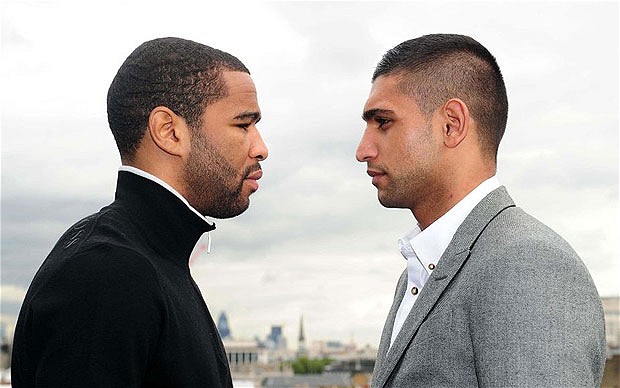
Unified junior welterweight titlist Lamont Peterson and former titleholder Amir Khan will meet in a rematch at Mandalay Bay in Las Vegas on May 19, a little more than five months to the day after their all-action first fight went down as one of the most controversial bouts of 2011.

“Everyone is very pleased that this is Lamont’s next fight,” attorney Jeff Fried, who represents Peterson and Barry Hunter, Peterson’s trainer/manager and father figure, told ESPN.com on Thursday after the deal had been signed. “It was challenging for a variety of reasons, including some of the post-fight antics undertaken by Khan. But at the end of the day, Lamont and Barry had a singular focus on what is in the best interest in Lamont Peterson and his family, and that is what drove this deal getting done.”

England’s Khan (26-2, 18 KOs) came to Peterson’s native Washington, D.C., to defend his belts Dec. 10 and lost a split decision in a fight filled with great action but marred by questionable officiating, issues over the scorecards and an unauthorized figure at ringside.

“Both sides are signed, but this has been one of the most difficult negotiations I have had for any fight I have ever been involved with,” said Golden Boy promoter Richard Schaefer, who has negotiated dozens of major fights. “There was a lot of back and forth, but it all ended good in getting this fight done. I think it’s one of the most anticipated rematches. It’s the right fight for Lamont and the right fight for Amir, and I’m really excited both parties agreed to do this fight.”

Peterson accepted the deal from Golden Boy, which handles Khan, for the rematch even though Top Rank’s Bob Arum had been wooing Peterson, a promotional free agent, for a fight with Juan Manuel Marquez, which he hoped to put on at Cowboys Stadium in Arlington, Texas.

Peterson, who earned $650,000 for the first fight and rejected a $1 million offer for the rematch shortly after the first fight, will make “substantially more than $1 million,” Fried said, although he did not divulge the terms.

Khan, who has a contract with HBO in the United States and Sky in England, brings substantial money to the fight but wanted the rematch so badly that he gave 50 percent of the worldwide revenue that the fight will generate to Peterson.

“We offered 50-50 because that was how much Amir wanted this fight,” Schaefer said. “There were times where it looked like we were close to getting it done, but it was a drawn out process. But in the end it was not a sanctioning organization, a TV network, the media or fans who made this rematch. It’s the fighters who wanted to get the fight done. It was Lamont Peterson saying he didn’t want to fight anybody else except Amir Khan and it was Amir Khan saying he wanted to fight only Lamont Peterson. That is what makes fights.

“The truth is both fighters had other options. But it really came down to what they wanted most. For both guys, other options might have been more lucrative, but it was not really only about the money. They realized the right thing to do was to fight each other again.”

The refereeing was the most controversial aspect of the December fight. Khan had two points deducted for pushing — an almost unheard of foul call — in the seventh and 12th rounds by Washington-area referee Joe Cooper. Without the deductions, Khan would have retained the belts via unanimous decision.

Khan complained that while he was docked points for pushing, Peterson (30-1-1, 15 KOs) was never warned for leading with his head. Golden Boy also raised questions about judge George Hill’s scoring of the seventh round, which appeared to read 10-10 but was crossed out to read 10-8 in Peterson’s favor.

Then there was the much-publicized issue of the so-called ringside “mystery man,” who turned out to be Mustafa Ameen, who is affiliated with the IBF and had a credential arranged as a courtesy from the organization, but was not at the fight in an official capacity. However, he was seen on video at ringside apparently touching the scoring slips, which is against the rules, and distracting a judge. He was later seen in the ring apparently celebrating with the Peterson team after the fight.

It all led to Khan protesting the decision to the sanctioning bodies and harsh words were exchanged between the camps. But now all of that should only add to the interest surrounding the rematch, which will headline HBO’s “World Championship Boxing.”

“May the better man win,” Schaefer said. “It will be one of the most talked-about fights of the year. This is one of those fights people wanted to see and I am happy we can deliver it to the fight fans. I will say this, Jeff Fried deserves a lot of credit for helping us get this done.”

Schaefer said he is close to finalizing the co-featured bout for the card, which would also take place in the 140-pound division: Lucas Matthysse (29-2, 27 KOs), the hard punching contender from Argentina, against former lightweight titleholder Humberto Soto (57-7-2, 34 KOs) of Mexico, who is now fighting as a junior welterweight.

“I am almost done with that fight and HBO is licking their chops on this fight,” Schaefer said. “Those two fights as a doubleheader is probably the best 1-2 punch HBO boxing has delivered in a long time.”
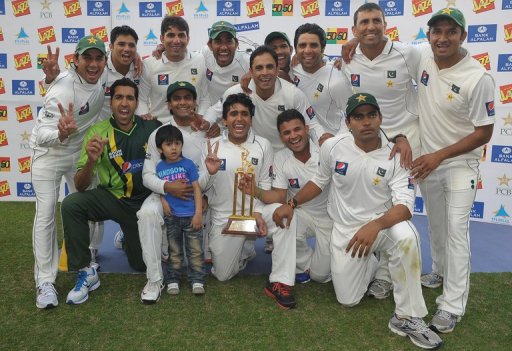

The Stars of Pakistan’s Resurgence

By Jamie Alter for Cricket Next

Pakistan’s 3-0 sweep of England, the No. 1 Test team, in the UAE was the most glittering result for a team that has managed to hold its own on the field despite facing a mountain of problems off it. Here’s a look at the key players in Pakistan’s resurgence as a Test team.

Misbah-ul-Haq

Ten months ago, Misbah-ul-Haq was a condemned man whose time as an international cricketer seemed over after he was made the scapegoat for Pakistan’s defeat to India in the World Cup semi-final in Mohali. Today, he is being heralded as an astute leader of a team bristling with pride and rightful claims to being a top-level Test side. Handed the captaincy ahead of Pakistan’s series against South Africa in the UAE in 2010, the soft-spoken, almost laidback Misbah has been hugely influential in steering Pakistan from a host of troubles and to series wins over New Zealand, Zimbabwe, Sri Lanka, Bangladesh and England – not to forget a draw with South Africa – and just the anomaly of a 1-1 scoreline against West Indies.

He hasn’t always been a proactive captain – his reluctance to push for a win against Sri Lanka in Sharjah last November attracted criticism – but his numbers as leader have been highly impressive: 15 matches, 1165 runs, average 64.72, with one century and 12 fifties. That one century – an unbeaten 102 in the second innings at Basseterre – played a big role in Pakistan leveling the two-Test series in the West Indies in May 2011. Innings of 99 and 70 not out earned him the Man-of-the-Match award in Wellington in January 2011, and those were clutch innings in a draw that gave Pakistan their first series victory outside the subcontinent since a triumph in New Zealand in 2003-04, and their first anywhere since 2006-07. In the first innings of the second Test against England in Abu Dhabi, Misbah top-scored with 84 on day in which the opposition dominated, and what a key innings it proved.

Saeed Ajmal

If there is one player who personifies Pakistan’s new-found aggression and fluency, it is the leader of their immensely proficient spin attack. Ajmal, 34, has been a constant threat to opposing teams with his accurate, nagging and attacking offspin, with his doosra causing batsmen much strife. His role as a strike bowler – he has bowled 696 overs in those 12 Tests, the most for any Pakistan bowler – has taken pressure off Umar Gul and meant he has been relied on to consistently take wickets. His success is staggering.

In 12 Tests under Misbah, Ajmal has reaped 77 wickets an average of 22.63 and strike-rate of 54.20 – significantly lower than career figures of 26.70 and 61.20. Along the way he picked up Man-of-the-Match awards for eight wickets in a nine-wicket win over Sri Lanka and in Dubai and 10 – including a career-best 7 for 55 – in a 10-wicket win over England at the same venue. He was the leading Test wicket-taker in 2011, and so far this year he has grabbed 24 wickets in three Tests against England.

In this recent series, the England batsmen were largely baffled by Ajmal’s variety. In the second Test, he became the fastest Pakistan bowler to 100 Tests, and to make his achievement more remarkable, he has not played a single of his 20 Tests at home.

Abdur Rehman

If Ajmal has been an expected success during Pakistan’s run under Misbah, then the 31-year-old Abdur Rehman has been a surprise package. In 13 Tests, this canny left-arm spinner – enjoying unexpected success in his late-blooming career – has been a constant threat with 64 wickets at an average of 26.57. With an almost immaculate line and length he has attained turn and dip while convincing batsmen to play back when they should have been forward. Nothing summed this up better than the series against England, when he made several reputed batsmen appear hapless against spin, none more so than Eoin Morgan.

However, it was Rehman’s Man-of-the-Match performance against New Zealand at Hamilton in January 2011 that really made him a certainty in the playing XI. His three wickets in each innings and a crucial innings of 28 helped propel Pakistan to victory in the first Test. This year, a career-best 6 for 25 routed England for 72 as Pakistan grabbed the series in Abu Dhabi, and in the final Test his 5 for 40 was decisive in Pakistan reducing England’s lead to 42. His 19 wickets in the series played a huge role in a 3-0 scoreline, and highlighted what a key ingredient Rehman has been for Pakistan.

Like Ajmal, he has bowled a lot of overs – 683.4 – while rarely allowing the batsmen to dominate. Rehman’s batting has been handy too, with an average of 13.s8 and a half-century offering some stability to the lower order.

Umar Gul

The only fast bowler to play consistently under Misbah, Umar Gul has carried himself with discipline all throughout. Ajmal and Rehman have hogged the wickets, but Gul’s 49 victims at 29.79 have been every bit as crucial in the team’s success.
The reliance on spin has eased Gul’s workload – he has bowled 452.5 overs in 13 matches – and this has undoubtedly led to the tall fast bowler not breaking down from injury, as he was prone to do so earlier in his career. His eight-wicket haul at Wellington was a stand-out effort in overseas conditions, and even on tracks in the UAE he has plugged away relentlessly, as 29 wickets from eight matches show.

In the first Test in Abu Dhabi, Gul responded to a flat surface with a hostile spell on the third day – during which he surpassed 150 Test wickets – as his new-ball incursions bagged him four wickets before Ajmal and Rehman wrapped up the rest. In the third Test in Abu Dhabi, Gul’s four wickets on the final day set the course of the match categorically towards Pakistan. The spinners have been the talking point of Pakistan’s success, but Gul’s role cannot he underestimated.

Mohammad Hafeez

At last looking like he belongs at Test-match level, Mohammad Hafeez has flourished in his latest avatar as opener and key ingredient in Pakistan’s spin-heavy bowling attack.

With the bat, he has offered solidity to a top order that has for too long been shaky, scoring 967 runs in 15 Tests at an average of 38.68, including two centuries and four fifties. With Taufeeq Umar – another cricketer enjoying a new lease on his international career – Hafeez has stitched together three century stands and four of 50 or more. For a side that used to regularly chop and change openers during the last decade, Hafeez’s pairing with Taufeeq over 15 Tests has been nothing short of solid.

Relied on heavily with the ball – he has bowled 250 overs – Hafeez has repaid the faith with 51 wickets at 26.36. His brisk offspin has helped Ajmal and Rehman take much-needed breaks in the field, and when tossed the new ball in Guyana he responded with wickets. The highlight of Hafeez’s run over these 15 Tests was a fine all-round performance against Zimbabwe in Bulawayo, where Hafeez followed a quick-fire 119 with four wickets and a brisk 38 in a successful chase.

Taufeeq Umar

Given an extended run as opener after a four-year hiatus, the 30-year-old Taufeeq has scored 1055 runs in 15 Tests under Misbah while averaging 39.07. His batting hasn’t always been attractive, as a strike-rate of 43.18 indicates, but the fact that he has been able to deliver platforms has been immense. Two fifties in New Zealand helped blunt the threat of the home team’s pace bowlers in seam-friendly conditions, and his 135 in the second innings against West Indies at Basseterre helped Pakistan level the series.

A career-best 236 followed against Sri Lanka in Abu Dhabi, as Pakistan drew the first Test. It was a marathon effort that helped grind Sri Lanka patiently through the second day, and Taufeeq was just pipped by Kumar Sangakkara for the Man-of-the-Match award. A seventh Test hundred would come against Bangladesh soon after.

Taufeeq’s form trailed off after a fifty in the first innings of the series against England, but his success in Pakistan’s resurgence merits further persistence.

Younis Khan

The former Pakistan captain has come back excellently from a ban imposed by the PCB after allegations that he had been partially responsible for infighting within the team. His 1138 runs at 66.94, including four centuries and four fifties, have been invaluable to Pakistan.
His presence in the middle order has steadied the team numerous times, not least when he scored centuries against South Africa and Sri Lanka to go with twin fifties against New Zealand at Wellington. But his most responsible innings came in the second innings of the third Test against England, as an out of form Younis took the game away from the opposition with a superbly crafted century. Yet again, he had summoned the resolve to produce a century when his detractors were gunning for him.

Azhar Ali

Of the younger players that have flourished under Misbah, 26-year-old Azhar Ali has been the most successful. His 1220 runs from 15 matches at 50.83 include two centuries and 11 fifties, and he has been a consistent performer at No. 3. Three consecutive half-centuries against South Africa got him going after an indifferent start to his career, and from there he ploughed on with fifties against each of the teams he played. His two centuries – 100 against Sri Lanka and 157 against England – were proof that Azhar has a long career ahead of him.

Study: US Muslims Don’t Want Shariah, Either

By Omar Sacirbey for The Houston Chronicle

North American Muslims are more than satisfied with the secular legal system and do not want a set of parallel courts for Islamic law, according to a new study of U.S. and Canadian Muslims by a Washington-based think tank.

The study, by University of Windsor law professor Judy Macfarlane for the Institute for Social Policy and Understanding, refutes critics’ claims that American Muslims want to impose Shariah, or Islamic law.

In fact, the study indicates that Muslims are just as unwilling to accept Islamic law as non-Muslims.

Macfarlane interviewed 212 Muslim Americans, including 41 imams and 70 community leaders who used aspects of Shariah in their daily lives. The other 101 interviewees were divorced Muslim men and women. About a quarter of the interviewees were from Canada, and the rest from the United States.

“Aside from formal religious observance, American Muslims relate to their Shariah responsibilities primarily through rituals of marriage and divorce,” Macfarlane wrote.

“They see these as compatible with the civil law – almost all the respondents in this study married and divorced twice, once in Islam and once in law – and will use the courts where they cannot agree outcomes, just like any other couple.”

When asked whether they thought American courts should apply Shariah to non-Muslims in the legal system, all of the respondents answered no. Just three of the 41 imams said they wanted parallel Shariah tribunals where Muslims could handle civil issues like marriage, divorce, and inheritance.

Macfarlane began her research after a Muslim group in Ontario petitioned the provincial government in 2003 to establish a separate Islamic family tribunal where Muslims could get binding legal decisions on family law issues. The Ontario government denied the request, and later that year abolished similar tribunals for Catholic and Jewish citizens that had been allowed in 1991.ˇ

The study follows a Jan. 10 decision by a federal appeals court that upheld a lower court’s ruling to overturn a 2010 Oklahoma constitutional amendment to prohibit judges from using Shariah in their deliberations.

Tennessee and Louisiana have passed similar laws, while 20 other states are considering such legislation.

Jews Honour Muslim Rescuers

By Mario Toneguzzi for The Calgary Herald

Calgary’s Jewish community is honouring Muslims who rescued Jews during the Holocaust.

In commemoration of International Holocaust Remembrance Day, the Calgary Jewish Federation, in association with the Canadian Society for Yad Vashem, is presenting the Yad Vashem exhibition Besa: A Code of Honor — Muslim Albanians who Rescued Jews During the Holocaust.

The photographic exhibition opened Friday and will remain open through Feb. 11 at the Calgary Jewish Community Centre, 1607 90th Ave. S.W.

“We are very pleased to be sharing this inspiring and visually stunning exhibit with the Calgary community at large,” said Adam Singer, president of the Calgary Jewish Federation.

“Historically, there have been many examples of Jews and Muslims living side by side as neighbours and friends. The 17 Albanian Muslims featured in the exhibit are among 63 who have been recognized by the state of Israel as Righteous Among the Nations. The courageous acts of all rescuers, carried out under perilous circumstances, set a moving example. We want to get the message out that every one of us has the potential to emulate the humanity and bravery celebrated by renowned photographer Norman Gershman in the Besa exhibit.”

The Calgary showing of Besa was made possible through grants from the Calgary Foundation and Citizenship and Immigration Canada.

Singer said Besa means “to keep the promise” by taking responsibility for others, especially in peril.

Close to 24,000 individuals from around the world have been named Righteous Among the Nations by Yad Vashem, Israel’s world centre for Holocaust research, documentation, education and commemoration.

Admission is free to the exhibit and everyone is welcome.

“One message, obviously, is that the Holocaust happened and it’s been recognized by the United Nations,” Singer said. “It’s important to bear in mind that as years pass and the Second World War becomes more distant in time from the present, we lose, of course, first-hand accounts. The survivors are dying off and at some point will no longer be with us. And there’s a tendency to not want to remember things like the Holocaust. That’s a natural and even normal human desire not to think about bad things that happened in the past.

“So it’s critical that we take active steps to ensure that there is collective recollection of what happened. And collective recollection not only of the terrible things that were done, but also the great things.

“The other thing is that there seems to be a narrative these days that Jews and Muslims are enemies and this exhibit helps remind us that that’s only a small part of a centuries-old narrative in which Jews and Muslims are not enemies, but in fact are neighbours and friends and people who help each other.”

Punishing Pakistan Is Not The Way To Go

By Nancy Birdall for Foreign Policy

In the January/February 2012 issue of Foreign Affairs, Stanford political scientist Stephen Krasner claims that “current U.S. policy toward Pakistan has failed” and recommends that the United States take a radically different approach: credibly threaten to sever all forms of cooperation, including all U.S. aid – military and civilian – to force Pakistan into cooperating with the United States on security matters. Center for Global Development President Nancy Birdsall responds.

Stephen Krasner (“Talk Tough to Pakistan: How to End Islamabad’s Defiance,” Jan/Feb 2012) wants to change the Pakistani government’s behavior. He argues that its failure to cooperate with the United States on Afghanistan and on terrorism is not due to its weakness as a state. Instead, it is a rational response of Pakistan’s military leadership, whose priority is to defend itself against India – with a nuclear deterrent and support for terrorists and the Afghan Taliban. Therefore, the only way the United States can win cooperation from Pakistan is to threaten “malign neglect”- cut off military and civilian assistance, sever intelligence cooperation, maintain and possibly escalate drone strikes and initiate unilateral cross-border raids. If that isn’t enough, then the U.S. could move on to “active isolation” — declare Pakistan a state sponsor of terrorism, making it a pariah, and impose sanctions.

If only it were this easy. Krasner fails to mention that the U.S. has tried this approach before. In the 1990s it cut off military and civilian assistance to Pakistan and imposed sanctions in an effort to dissuade Pakistan from developing a nuclear capability. We all know how that story ended. But let’s suppose this time the threats or the follow-through worked and brought the military and intelligence establishment to heel in Pakistan. Let’s suppose the United States got what it wanted on the security front – helping assure a timely U.S and NATO withdrawal from Afghanistan. Would that solve the problem Pakistan poses for America’s security in the long run? No.

What Krasner doesn’t say is that the U.S. wants something more than compliance from Pakistan’s military and intelligence communities with its immediate security needs. The U.S. wants a capable and stable civilian government that plays by the rules of the international community. It wants a democratic state that would not abuse and misuse its nuclear capability and that would find its way to peaceful relations with India.

In other words the U.S. has a long-run vision for Pakistan, very much in its own interests, as well as a set of short-term demands. In the 2009 Enhanced Partnership with Pakistan Act (known as Kerry-Lugar Berman, or KLB) Congress recognized the resulting need for a two-track approach. That legislation made U.S. security assistance (not actually authorized in the legislation) conditional on Pakistani cooperation on security matters. But its fundamental purpose, and the money it authorized for civilian aid, was the rebuilding of a serious partnership with the civilian government and the people of Pakistan. With KLB as the framework, since 2009 the Obama Administration has engaged fully with the civilian government and with civil society and private sector leaders in Pakistan on a range of issues — energy, water, agriculture, macroeconomic issues, private investment and trade.

In short, the purpose of U.S. civilian aid to Pakistan is to help build a better state. It is not to bribe or reward the “government” (neither the military nor the civilian leadership). Withholding military aid would likely not punish the military anyway. It would, however, reduce the resources available to the civilian government, since the evidence is that the military can get what it wants from the government’s overall available resources. And withholding civilian aid obviously would not punish the military. It would, however, take away a modest tool of America – investing to educate kids, create jobs, and strengthen civil society and representative institutions and thus give Pakistan a better shot at becoming a stable, prosperous and democratic country in the long term.

There are of course real questions about the effectiveness of U.S engagement with the civilian government – with aid and dialogue – given the prevailing suspicion there of U.S. motives, the inherent difficulties of operating in a complex and insecure environment, and the bureaucratic shortcomings of the U.S. aid system itself. But then those are reasons to put relatively more emphasis on other forms of engagement: trade, investment, and encouraging the normalization of relations with India. They do not warrant bullying the weak civilian government that the U.S. wants to strengthen.

Krasner begins and ends his article by invoking the testimony of former chairman of the Joint Chiefs of Staff Admiral Mike Mullen during his last appearance before the Senate Armed Services Committee. Krasner is right in pointing out that Mullen was critical of Pakistan’s role in supporting extremist organizations and the need to get tough with Pakistan. Yet, Krasner fails to mention the conclusion Mullen reached in his statement. Mullen recognized that the U.S. has a variety of objectives in Pakistan and the region, and that by focusing too intensely on short term interests, the U.S. will end up short-changing itself over the long haul: “We must also move beyond counter-terrorism to address long-term foundations of Pakistan’s success – to help the Pakistanis find realistic and productive ways to achieve their aspirations of prosperity and security.” Mullen concludes, “Isolating the people of Pakistan from the world right now would be counter-productive.”

Nancy Birdsall is the founding president of the Center for Global Development, a Washington, DC based think tank.

Pakistani Surgeon Lands in Guinness Book

By Majid Mirza for The Good News

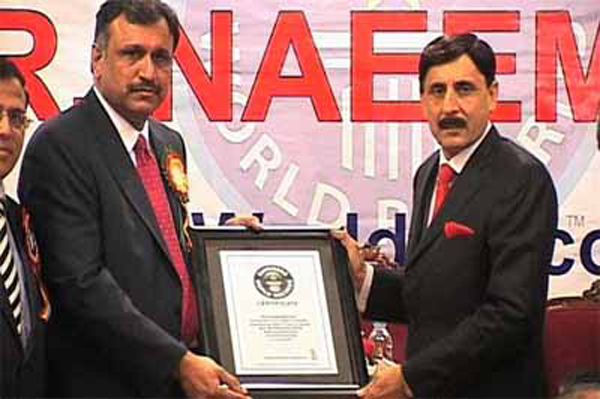
Dr Naeem Taj, a surgeon of the Capital Hospital CDA, has earned fame and prestige for the nation by gaining entry into the Guinness Book of World Record by removing 25.5 cm long gallbladder through 1 cm incision.

Dr Naeem after operating 70-year-old patient Rasheeda Bibi at CDA hospital removed 25.5cm long gallbladder from her body. This is the longest ever gallbladder removed laparoscopically in medical history. Guinness Book of World record has awarded Dr Naeem Taj of CDA with the certificate of “world’s longest gallbladder removed through laparoscopy”.

Executive Director Capital Hospital, Dr Saddique Akbar Satti on the occasion said that he was proud of his surgeon Dr Naeem Taj and expected much more on his credit due to his sheer talent.

Pakistan is Helping Afghan Taliban, Says Nato Report

As Reported by The BBC

The Taliban in Afghanistan are being directly assisted by Pakistani security services, according to a secret Nato report seen by the BBC.
The leaked report, derived from thousands of interrogations, claims the Taliban remain defiant and have wide support among the Afghan people. It alleges that Pakistan knows the locations of senior Taliban leaders.

A BBC correspondent says the report is painful reading for international forces and the Afghan government. Pakistan has strenuously denied any links with the Taliban on previous occasions.

“We have long been concerned about ties between elements of the ISI and some extremist networks,” said US Pentagon spokesman Captain John Kirby, adding that the US Defence Department had not seen the report.

The BBC’s Quentin Sommerville in Kabul says the report – on the state of the Taliban – fully exposes for the first time the relationship between the Pakistani intelligence service (ISI) and the Taliban.

The report is based on material from 27,000 interrogations with more than 4,000 captured Taliban, al-Qaeda and other foreign fighters and civilians.
It notes: “Pakistan’s manipulation of the Taliban senior leadership continues unabatedly”. It says that Pakistan is aware of the locations of senior Taliban leaders.

The report states: “As this document is derived directly from insurgents it should be considered informational and not necessarily analytical.”
Despite Nato’s strategy to secure the country with Afghan forces, the secret document details widespread collaboration between the insurgents and Afghan police and military.

Lt Col Jimmie Cummings, a spokesman for Nato’s International Security Assistance Force (Isaf) in Afghanistan, said the document was “a classified internal document that is not meant to be released to the public”.

“It is a matter of policy that documents that are classified are not discussed under any circumstances,” he said.
The report also depicts the depth of continuing support among the Afghan population for the Taliban, our correspondent says.
It paints a picture of al-Qaeda’s influence diminishing but the Taliban’s influence increasing, he adds.

In a damning conclusion, the document says that in the last year there has been unprecedented interest, even from members of the Afghan government, in joining the Taliban cause. It adds: “Afghan civilians frequently prefer Taliban governance over the Afghan government, usually as a result of government corruption.”

The report has evidence that the Taliban are purposely hastening Nato’s withdrawal by deliberately reducing their attacks in some areas and then initiating a comprehensive hearts-and-minds campaign.

It says that in areas where Isaf has withdrawn, Taliban influence has increased, often with little or no resistance from government security forces. And in many cases, with the active help of the Afghan police and army.

When foreign soldiers leave, Afghan security forces are expected to take control. However according to the report, rifles, pistols and heavy weapons have been sold by Afghan security forces in bazaars in Pakistan.