Archive for the ‘ India ’ Category

Pakistan and its Image Problem

By Eric Schmidt for Google

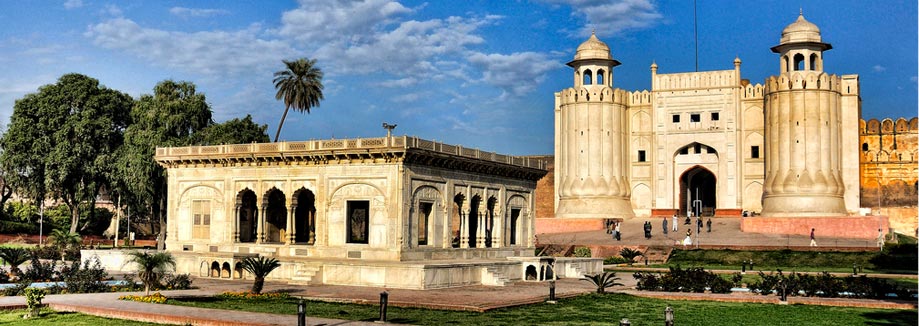
Pakistan, a Muslim country, has spent about half of its independent life under military governments. Today, Pakistani leadership celebrates the ruling coalitions success in almost finishing the first five year term in history (previous leaders indicted by the courts, assassinated by extremists or brushed aside by the generals.) In meetings last week with the senior General, Prime Minister and the Foreign Minister, they made the case for a new and updated image of Pakistan: one of the largest democracies in the world, with a vibrant and open press, an upcoming demographic dividend of hardworking young people, and a highly educated elite leadership of the country. Islamabad and Lahore, where we visited, were relatively safe and certainly safer than Afghanistan. It was clear to us that Pakistan has an image problem.

Pakistan also has a power problem, as in electric power. Power is now off two hours out of three all day and all night. Estimates are that the country has enough generation capacity (hydro and oil based) to handle all the load, but corruption, power stealing, poor payment rates and the classic mistake of underpricing power compared to its real generation cost means that industrial production is threatened. Everyone of means has a UPS, and the air-conditioning seldom works on a 45 Celcius day. Our meetings often were literally in the dark, a common enough occurrence that people did not even remark about it.

Pakistanis are on their way to full mobile penetration with more than 110 million users, and all effective political communication programs now rely on SMS. 3G licenses are underway and the start of a real software industry can be seen.

Against this backdrop, another side of Pakistan emerges. The consensus is that the military drives the foreign policy of the country with unforeseen consequences. Alleged use of extremist groups to fight in Kashmir enables a criminal element to flourish, and the hosting of the Taliban in the autonomous regions (called FATA) to the north and west in the mountains turned an ungoverned area into a very dangerous area. The Army Generals explained the difference between fundamentalism (which they support) and extremism (which they fight), and the political leadership explained that the extremism now comes from “seminaries” where youth are indoctrinated, housed and fed in the rural areas where there are no opportunities at all.

Until recently a strong US ally, Pakistan is now on very good terms with China, and has improving relations with India (with whom they have had three wars.) The development of a nuclear stalemate between India and Pakistan seems to have forced them to pursue accommodation and trade is now increasing rapidly. The press are generally hyper-critical of the United States policies in the region and take the view that the India-US relationship is driving much of our countries behavior. The drone strikes are universally condemned as a violation of sovereignty and their constitution and are subject to much negotiation between the two countries. The bin Laden raid is viewed with strikingly different perspectives in the two countries.

The son of the chief of the Supreme Court is under investigation for corruption, and the media in turmoil after the appearance of staged interviews. In return, the Supreme Court has ruled that the Prime Minister is unable to govern after he was sentenced to a 30 second (yes, that’s right) detention for failing to investigate a corruption case against the President. The Prime Minister, so proud of the stability of the political system in his comments a week ago, is now the former-Prime Minister. The lack of trust within the society weakens both the real and perceived effectiveness of the government on security, corruption and good government matters.

We met a number of impressive Pakistanis, none more so than Masarrat Misbah of Smile Again. Every year, hundreds of young rural women have acid thrown on their faces by men as punishment for some dishonor, including being raped by the men who pour acid on her. This horrific crime, which often leads to death or blindness, requires painful rehabilitation and rebuilding of the woman’s life. Masarrat Misbah’s home in Lahore provides a temporary safe house. The perpetrators, most often direct family members, are seldom prosecuted and almost never convicted of anything. I will never forget the faces of these shy, young women so grievously injured in such an evil way.

Much of what people say and think about Pakistan is absolutely true for most of the FATA provinces (autonomous areas) and for Baluchistan. Pakistan’s image problem results from the fact that people outside the country believe the realities of North and South Waziristan and Quetta are reflective of what the larger country looks like. Islamabad and Lahore are certainly safer than people realize, unless you are a politician (many prominent politicians still suffer assassination attempts and threats inside these cities).

Pakistan’s major security challenge comes from having two many fronts. FATA represents a Haqqani network and Taliban problem, threatening the establishment in Islamabad. Baluchistan is a persistent separatist movement. Afghanistan is a threat because Pashtuns are allowed to go back and forth undocumented. All of this, including India, is simply too much for a government like Pakistan to take on right now.

We ultimately see three Pakistans: 1) The places where the security issues are true (FATA, Baluchistan, parts of SWAT Valley, and Kashmir); 2) the rest of Pakistan for the average citizen, much larger than the first and which is reasonably misunderstood and relatively safe; 3) The politician’s and military’s Pakistan, which whether in FATA or Islamabad, is turbulent, unsafe, and complex.

There is a good case for optimism about Pakistan, simply because of the large emergent middle class (#2). The country, vast, tribal and complicated, can follow the more successful model of India. Connectivity changes the rural experience completely.. illiteracy at 43% can be overcome relatively quickly, and providing information alternatives can dissuade young males from a life of terrorism. The well educated elite can decide to further reform the countries institutions to increase confidence in the government. The war in Afghanistan, destabilizing to Pakistan in many ways, winds down after 2014 and buys time for Pakistan to address its real and continuing internal terrorism threat (more than 30,000 civilian terror deaths in the decade.)

Technology can help in other ways as well. The power problem is mostly a tracking problem (tracing corruption and mis-distribution). The problem of extreme crimes (like acid, or stoning) in poorly policed regions can be mitigated with videos and exposes that shame authorities into prosecution. The corruption problem can be tracked and traced using mobile money and transparent government finances. We met with clever Pakistani entrepreneurs who will build large, new businesses in Pakistan in the next few years and global multinational will locate sales and eventually manufacturing in the country.

The emergent middle class of Pakistan won’t settle for a corrupt system with constant terrorism and will push for reforms in a burgeoning democracy. Here’s to the new civil society of Pakistan, who will use connectivity, information and the Internet, to drive a peaceful revolution that brings Pakistan up to its true potential.
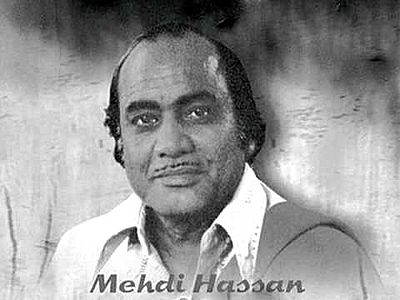
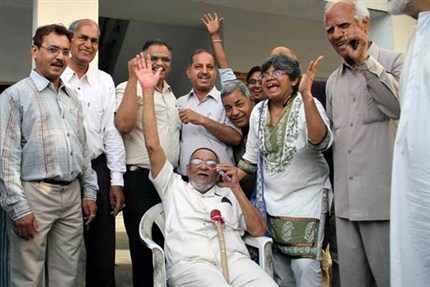
Legendary Ghazal Singing Legend Mehdi Hassan Dies

As Reported by Maimoona Shoaib and Mohammad Ashraf for The Gulf News

He worked in a bicycle shop. He repaired cars. And when he would sing a ghazal, he would mesmerise a continent.

Pakistani ghazal legend Mehdi Hassan, who suffered from lung, chest and urinary tract ailments for ten years, died of breathing complications at a Karachi hospital on Wednesday at the age of 84.

His famous ghazals (ballads) include “Patta patta boota boota,” “Abke bicchde khwaabon mein mile”, “Zindagi mein sabhi pyar kiya kartein hain,” “Dekh tu dil ki jaan se uthta hai,” and “Ranjish hi Sahi”.

“My father’s funeral will take place Friday in Karachi,” son Arif Mehdi said, adding that the family was yet to finalise the burial location. “We have asked for the permission from the government to bury him at Quaid-e-Azam mazar [near the mausoleum of Mohammad Ali Jinnah, the founding father of Pakistan] in Karachi, but we are waiting for approval,” he said.

Born into a family of musicians in Loona village in undivided India (now in the Indian state of Rajasthan) in July 1927, Hassan had a modest beginning, mirroring the situation of the new country he migrated to at age 20 after the partition of India in 1947.

The family sank into penury after moving to Pakistan, and eking out a living was difficult. Young Hassan worked in a bicycle shop and later became a car mechanic, even as he was initiated into music by father Ustad Azeem Khan and uncle Ustad Esmail Khan, who were dhrupad (Indian classical) musicians.

In his book “Mehdi Hasan: The Man & his Music”, Pakistani author Asif Noorani writes that his humility during this phase stood tall against the fame and greatness he had achieved later.

“He had earned his living by repairing automobiles during his younger days. During his years of stardom, his harmonium broke and he started repairing it himself, wittingly replying to the people surrounding him that this was a piece of cake compared to the number of engines that he had repaired in the past,” Noorani writes.

Eventually, Hassan found his real vocation in the ghazal.

Mehdi is said to have given his first performance when he was eight, in sync with tradition where musicians started early and were paced through various levels of public performance before they graduated as accomplished vocalists.

The hardships of life notwithstanding, Hassan stuck to his music and continued with his rigorous practice, relying on the extreme discipline he lent to his style of constricted-throat singing as opposed to the full-throated version.

He was well into his twenties when he was first noticed as a singer of some merit. The break came when he was invited to sing for Radio Pakistan in Karachi in 1957 — first as a thumri singer and then as a ghazal exponent.

Hassan had to work harder than many of his younger colleagues but his innovative approach earned him fame.

Traditionally, ghazals were sung in a thumri-like manner. They were set to Indian classical ragas such as Khamaj, Piloo and Desh. The classical format stymied the scope of the compositions — preventing it from innovating. However, Hassan pioneered a ghazal “gayaki” (manner of singing) that played upon the mood of the music rather than on the classical nuances. A composer of rare brilliance, his style combined classical and Rajasthani folk music to create a new realm of ghazals whose magic spread beyond Pakistan to India and the rest of the world.

He was one of the first Pakistani ghazal singers who charmed Indian audiences and won impressive fan followings — former Indian prime minister Atal Bihari Vajpayee invited him for a private performance at his residence.

But many more years were to pass after 1957 for Hassan to get his opportunity to sing for films.

As Hassan arrived, the ghazal stage was dominated by greats as Khan Sahib Barkat Ali Khan, Mukhtar Begum and Begum Akhtar. Among Hassan’s contemporaries were Farida Khanum, Iqbal Bano and Ustad Amanat Ali Khan, with Gulam Ali and Jagjit Singh followed not too far behind.

According to an estimate by Arif, Hassan sang more than 20,000 songs and apart from Urdu, also sang in Bengali, Punjabi and Pashto.

It’s not uncommon for a singer whose career spanned over 50 years to churn up 20,000 songs. But given the quality and the unfailing discipline which were the hallmarks of Hassan’s songs, it will go down in the history of music as a gigantic superhuman effort. And the way Hassan sustained himself until health issues made it impossible for him to carry on, is a remarkable story that parallels the struggles of his homeland.

After shining on the musical firmament from the 1960s to 1980s, Hassan’s career started fading as frequent illnesses took their toll. The death of his first wife in 1998 followed by an attack of paralysis restricted Hassan to bed and he lost the power of speech. His health deteriorated further over the past 12 years.

His home country honoured Hassan with several awards and honours — from Tamgha-e-Imtiaz to Pride of Performance and Hilal-e-Imtiaz — while India honoured him with the Sehgal Award in 1979. The Nepal government too honoured him with the Gorkha Dakshina Bahu.

Hassan, who married twice, is survived by 14 children — nine sons and five daughters. His second wife also died before him.

His death brings the curtains down on a journey in music that lasted more than 50 years and crafted a new era of lyricism, melody and poetry in ghazals.

Pakistanis for Peace Editor’s Note– Pakistan has had a few stars that transform their industry across all borders. One of them was surely Mehdi Hassan, a supernova so bright that he was considered living legend for the last several decades. His passing has dimmed the night sky over Pakistan and indeed over the entire Indian subcontinent as many in the neighboring country are mourning his loss as of one of their own. RIP Hassan sahib, thank you for all your songs and ghazals, through which you will live on forver.

India, Pakistan Ties Hinge on Hope

By Mir Ayoob Ali Khan for The Times of India

When hope is lost, everything seems to be lost. But when we hear the adage, Ummid pe dunya khayam hai (the world stands on hope), we visualize a ray of light at the end of a tunnel.

The rollercoaster ties between India and Pakistan are an unending reading in despair. It is hope that makes people believe that one day, some day, we will live like good neighbours. That someday becomes believably close when we hear that Indian and Pakistani politicians, officials and members of the civil society are ‘seriously’ talking about the benefits of developing stronger economic and commercial links between the two nations. Or, when the Supreme Court of India allows aging Pakistani virologist Mohammed Khalil Chishti, a murder convict, to visit his hometown Karachi.

It is an unprecedented move by the Supreme Court which took a humane approach in a murder case. The apex court spoke of Chishti’s age (82), his global reputation as an accomplished microbiologist and his previous clean record to say that he is free to go to his country but on certain conditions. He should be back in India in November to face trial in court. Though the Supreme Court’s order is solely based on the prudence of the judges, there is hope that Islamabad would show some reciprocation with regard to Indians stranded in Pakistan prisons. For instance, many are waiting to see if they would free Sarabjit Singh, an Indian convicted of life imprisonment in a case of mistaken identity.

Chishti and Singh have been in the public eye owing to the extensive coverage of their plight in the media. However, there are numerous Indians languishing in Pakistani prisons and vice versa who have hardly been covered by any media agency or their cases taken up by any human rights organization seriously. They too deserve attention as their loved ones are waiting to see them. In the meantime, the air over India and Pakistan is thick with hope that the two countries are about to enter into a new era of trade and commercial cooperation. Activity in this direction gained momentum ever since Pakistan decided to give the MFN-the Most Favoured Nation-status to India last year.

The two sides have realised that the trade volume was a paltry $2.6 billion in the year ending 2011. Officials and members of the trading community believe that this could be taken to $10 billion to $12 billion in the next three to five years. In the forefront of trade with Pakistan which is expected to grow in the coming weeks, not years, are tomatoes from Maharashtra. About 4,000 trucks carrying tomatoes have crossed over to Pakistan in the past three months. Lorries containing soya beans followed. Not to lag behind, Pakistan has started exporting cement and other construction material to India. Talks are on to allow 8,000 items from Pakistan to enter India in the next couple of years.

Hope is now fuelled by the foundation laying of an oil refinery in Bathinda, a town in Punjab which is160 km from Lahore, by billionaire Lakshmi Mittal and Indian Oil Company Ltd costing $4 billion. Pakistan that is already importing kerosene and diesel from India is hungry for petroleum products. The refinery in Punjab and another one owned by the Reliance Group in Gujarat which is close to Karachi could meet the fuel needs of Pakistan, at least to some extent. There are also talks to dismantle hurdles in matters pertaining to education and IT sectors, visa regimes, especially for the business community and tourists, opening of more land and air trade routes.

In India-Pakistan relations, hope is the key word. Let’s hope that it becomes a reality extending benefits to the people of the two neighbouring nations.

India, Pakistan Try ‘Trade Diplomacy’

As Reported by AFP

India and Pakistan, still at loggerheads on Kashmir and no closer to a full peace deal, are channeling their efforts into increasing trade in the hope that business can bring them together.

31-year-old Karachi food trader Kashif Gul Memom is among those eager to seize the opportunities offered by easier links between the estranged neighbours, which have fought three wars since independence in 1947.

“This is a change for the good. It’s an exciting time,” said Memom, one of the generation born after the painful partition of the subcontinent that gave birth to India and the Islamic republic of Pakistan.

“My generation of business people is putting the past behind us. We’re looking to the future, India is such a huge market for us,” Memom told AFP while at the largest ever Pakistani trade fair held in India.

The improved relations between the nuclear-armed rivals stem from Pakistan’s decision to grant India “Most Favoured Nation (MFN)” status by year end, meaning Indian exports will be treated the same as those from other nations.

In further progress, the neighbours opened a second trading gate in April along their heavily militarised border, boosting the number of trucks able to cross daily to 600 from 150.

India now also says it is ready to end a ban on investment from Pakistan and the countries are planning to allow multiple-entry business visas to spur exchanges — a key demand by company executives.

The warming commercial ties underline the new relevance of the private sector in the peace process, with prospects still low for any swift settlement of the “core issue” of the nations’ competing claims to Kashmir. The divided Himalayan territory has been the trigger of two of their three wars since independence.

Indian and Pakistani officials have been looking at the so-called “China option” as a model, with deepening economic engagement seen by experts as crucial to establishing lasting peace in the troubled region.

Beijing and New Delhi have been pursuing stronger economic ties while resolving outstanding political issues, such as a festering border dispute that erupted into a brief, bloody war in the 1960s.

“There is no other option but economic partnership between India and Pakistan — this leads on to other partnerships,” Indian Commerce Minister Anand Sharma said at the April trade fair in Delhi, a follow-on to a similar venture in Lahore earlier in the year.

“We have to recognise our true trade potential and leave our children with a legacy that ensures prosperity, harmony and peace.”
Some Pakistani businesses have protested against the trade opening, fearing they may be swamped by cheaper Indian goods, especially in drugs, auto parts and consumer goods. But others eye the possibilities India’s market offers.

“India with 1.2 billion people gives us great potential,” Mian Ahad, one of Pakistan’s leading furniture designers, told AFP.
Indian businessmen are equally enthusiastic, saying there is an opportunity for trade in areas from agriculture, information technology, pharmaceuticals, and engineering to chemicals.

Official bilateral trade between India and Pakistan is just $2.7 billion and heavily tilted in New Delhi’s favour.
But Indian business chamber Assocham estimates up to $10 billion worth of goods are routed illicitly — carried by donkeys through Afghanistan or shipped by container from Singapore and the Gulf.

Indian commerce secretary Rahul Khullar told AFP that Pakistan’s decision to grant India MFN status by the end of the year was “the game-changer.”
MFN status will mean India can export 6,800 items to Pakistan, up from around 2,000 at present, and the countries aim to boost bilateral trade to $6 billion within three years.

“I’m cautiously optimistic. Commerce is an excellent way to bring countries together,” Indian strategic analyst Uday Bhaskar told AFP.
“Once you institutionalise trade, it becomes hard to slow the momentum for cross-border exchanges. People say if there are onions or cement or sugar available next door, why can’t I have them? And why can’t I travel there too?”

India and Pakistan: The Truth of the One Nation Theory

By Aakar Patel for FirstPost

The first time I came to Pakistan, I was taken aback at how good some of the infrastructure was. The airports at Karachi and Lahore were small, but they were efficient and well designed. I think my host told me the Japanese had built one or both of them, and those airports were a very different thing from the ones I had just taken off from in India.

This was when the government made the airports and as with all things the Indian government takes up, our airports were clumsy and barely functional. But a few years later this changed. Today the airports at Mumbai, Delhi and Bangalore are pretty good. They’re not world class (nothing in India can ever be), but they are not embarrassing as the earlier ones were.

The differences that I had thought were significant turned out not to be so.

This led me to think of how similar we were as nations. Not in the sense that Mohd Ali Jinnah meant. I think it is fairly obvious that the character of India and of Pakistan is different when we observe their constitutions. India’s secularism is fundamentally Hindu in its nature. Pakistans constitution is Islamic by design and in appearance.

Though this is an important aspect of nationhood, however, it is only one aspect.

What I mean is how we are one nation in all the negative aspects. Our neighbourhoods and streets are among the most shameful in the world, because we are selfish and blind to the concern of others. Delhi’s drivers are as terrible as those in Lahore (and the women of Delhi and Lahore would concur on the behaviour of the loutish men of those cities). Half of us are illiterate and the half who are literate don’t really read much. The comments sections of Indian and Pakistani websites are the most dreadful in the world, without qualification. Hateful and pedantic, the product of minds who are only functionally literate. We think time will bring some big change in our society but it isn’t easy to see where this change is going to come from.

I know of few other nations where people would not be embarrassed at the thought of keeping servants. Few cultures would be so unaffected, so uncaring of privacy to not mind the constant presence of the servant in the house. I am not even talking about the bestial manner in which we treat them, because every reader of this piece, whether Indian or Pakistani already knows what I mean.

We divide ourselves into nations based on things like which animal the other eats or does not eat. The outsider probably sees no difference between us, and rightly.

We produce very little of meaning to the outside world, and it is tough to think of what our contribution is to the nations from whom we take so much. In science and technology we have nothing to offer the West, despite the boasts of Indians that we gave the world Arabic numerals and zero (I agree with that; we have given the world zero).

Pakistanis stake claim to Islams golden age. Daily Jang columnist Hassan Nisar often takes up this point. He says that the Arabs laugh when Pakistanis owns Islams achievements. What aspect of the conquest of Spain or the scientific revolution in Baghdad did Punjabis and Sindhis participate in?
To the world we are one people in that sense.

My friend Col Iftikhar, from Musharrafs batch in the Pakistan Military Academy, said he discovered this horrifying fact when he went to Mecca a few decades ago for Haj. He met some Saudis, one of whom asked him where he was from. Lahore, said Ifti. Where’s that, the Saudi asked (this was in the 70s). Pakistan, said Ifti proudly. Where’s that, the puzzled Saudi asked. Ifti took out a map and pointed. Ah, said the Saudi to his friends, he’s Hindi.

Our problems are so primitive that they should make us stop and repair ourselves immediately. But they don’t seem to affect us at all. Our media carry on like we are normal people. Reading the militant bombast of the strategic affairs experts in the newspapers of these two nations, the outsider would never suspect that these were two nations unable to even keep their public toilets clean.

India Tests Nuclear Missile That Can Hit Beijing

As Reported By The Associated Press

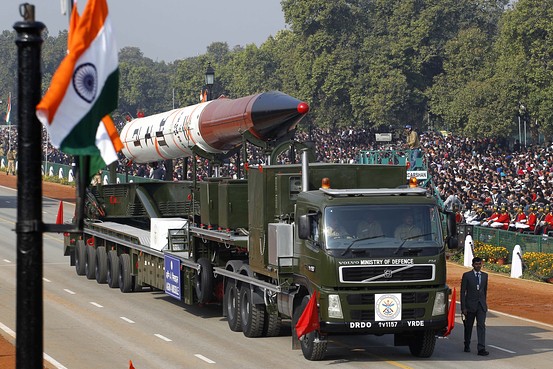
India announced Thursday that it had successfully test launched a new nuclear-capable missile that would give it, for the first time, the capability of striking the major Chinese cities of Beijing and Shanghai.

The government has hailed the Agni-V missile, with a range of 5,000 kilometers (3,100 miles), as a major boost to its efforts to counter China’s regional dominance and become an Asian power in its own right.

The head of India’s Defense Research and Development Organization, Vijay Saraswat, said the missile was launched at 8:07 a.m. from Wheeler Island off India’s east coast.

It rose to an altitude of more than 600 kilometers (370 miles), its three stages worked properly and its payload was deployed as planned, he told Times Now news channel.

“India has emerged from this launch as a major missile power,” he said.

The window for the launch opened Wednesday night, but the test had to be postponed because of weather conditions.

Avinash Chandra, mission director for the test, said that when the launch took place Thursday morning the missile performed as planned.

“We have achieved exactly what we wanted to achieve in this mission,” he told Times Now.

The Agni-V is a solid-fuel, three-stage missile designed to carry a 1.5-ton nuclear warhead. It stands 17.5 meters (57 feet) tall, has a launch weight of 50 tons and was built at a reported cost of 25 billion rupees ($486 million). It can be moved across the country by road or rail and can be used to carry multiple warheads or to launch satellites into orbit.

The missile will need four or five more trials before it can be inducted into India’s arsenal at some point in 2014 or 2015, Indian officials said.

China is far ahead of India in the missile race, with intercontinental ballistic missiles capable of reaching anywhere in India. Currently, the longest-range Indian missile, the Agni-III, has a range of only 3,500 kilometers (2,100 miles) and falls short of many major Chinese cities.

India hailed Thursday’s test as a major step in its fight to be seen as a world power.

“India has today become a nation with the capability to develop, produce, build long-range ballistic missiles and today we are among the six countries who have this capability,” Saraswat said.

India and China fought a war in 1962 and continue to nurse a border dispute. India has also been suspicious of Beijing’s efforts to increase its influence in the Indian Ocean in recent years.

“While China doesn’t really consider India any kind of a threat or any kind of a rival, India definitely doesn’t think in the same way,” said Rahul Bedi, a defense analyst in New Delhi.

India already has the capability of hitting anywhere inside archrival Pakistan, but has engaged in a splurge of defense spending in recent years to counter the perceived Chinese threat.

The Indian navy took command of a Russian nuclear submarine earlier this year, and India is expected to take delivery of a retrofitted Soviet-built aircraft carrier soon.

The new Agni, named for the Hindi word for fire, is part of this military buildup and was designed to hit deep inside China, Bedi said.

Government officials said the missile should not be seen as a threat.

“We have a declared no-first-use policy, and all our missile systems, they are not country specific. There is no threat to anybody,” said Ravi Gupta, spokesman for the Defense Research and Development Organization, which built the missile. “Our missile systems are purely for deterrence and to meet our security needs.”

The test came days after North Korea‘s failed long-range rocket launch. North Korea said the rocket was launched to put a satellite into space, but the U.S. and other countries said it was a cover for testing long-range missile technology.

One Delhi-based Western diplomat dismissed comparisons with the international condemnation of North Korea’s launch, saying that Pyongyang was violating U.N. Security Council resolutions requiring it to suspend its missile program, while India is not considered a global threat. The diplomat spoke on condition of anonymity because he was not authorized to comment on India’s security affairs.

In Washington, State Department spokesman Mark Toner said the United States urges all nuclear-capable states to exercise restraint regarding nuclear capabilities.

“That said, India has a solid non-proliferation record,” he told a news briefing. “They’re engaged with the international community on non-proliferation issues.”

Some reports characterized the Agni-V as an intercontinental ballistic missile — which would make India one of the few countries to have that capability — but Gupta and analysts said its range fell short of that category.

India has no need for such sophisticated weapons, said Rajaram Nagappa, a missile expert and the head of the International Strategic and Security Studies Program at the National Institute of Advanced Studies in Bangalore.

“I don’t think our threat perceptions are anything beyond this region,” he said.

iPakistan- Rebranding Pakistan

About

iPakistan is simply an intitative to bring Pakistan to the world and the world to Pakistan.

WHO ARE THEY?

iPakistan ia a group of university students and young professionals who are done whining about Pakistan’s image and want to do something about it. Most of them are studying in foreign universities and so have first hand experience of various kinds of stereotypes that Pakistanis overseas face as well as the tarnished image of the nation is portrayed in other countries.

Sadly, terrorism has become synonymous with Pakistan. There was this one time when a team member of this group was asked as a serious question by a Chinese students : “Does your family have any Taliban?” IMAGINE!

So iPakistan and iLahore are collaborative efforts about changing this wrongly propagated image, and even if we the group members are only able to neutralize one person’s opinion, they will feel happy that they made a small difference.

THE TEAM

Founder – Rehman Ilyas

He is the guy most pissed about Pakistan’s image and hence the one who came up with iPakistan and iLahore. He studies Economics and Finance at the University of Hong Kong and is particularly interested in Development Economics. Reads up on Chinese economy a lot and plans to heavily promote Chinese recipe of economics success, and apply it to Pakistan with a few unique ingredients of his own, through the Business section of ilahore.

Mentor – Khalid Malik

Mr. Khalid Malik is a famous Business Studies A-Levels teacher in Lahore. He is a visiting lecturer at various top schools including LGS Defence, LGS Paragon, SICAS etc. Recently he has been gaining further acclaim for his efforts to get the beloved festival of Basant, back to the people of Lahore.

Mentor – Ali Murtaza

Mr. Murtaza is a visiting professor at Beacon House National University (BNU) where he teaches design and illustration. In addition he works for a social marketing company and does commercial web site designing. His awesome illustrations, animations & creations have earned him the prestigious

Fulbright scholarship recently.

Editor Health – Burhan Ahmad
MBBS
Founder & CEO Medicalopedia, LLC

Editor Tourism – Muhammad Zargam Arshad

“BBA Accounting and Finance student at University of Hong Kong. Zargam is fondly known as “Ziggy”. He has extensive travel experience: Saudi Arabia, Hong Kong, Austria, England and of course Pakistan! Fond of reading two diverse types of poetry: Modernist and Sufi poetry. Currently working with
“YES Network” on breaking down discrimination barriers in Hong Kong society. “

Editor Fashion – Khizra Wynne

Although i have crippled my four senses while Majoring in Economics and Finance but, the sense of sight still stands to fight because it’s all about living to look ravishing.

Editor Wisdom – Hassan Riaz

Hassan is an engineering student at the University of Hong Kong and claims to be very ‘Wisdomistic’.

Editor Religion – Syed Abrar Ahamd

Abar is an active member of the Muslim Scoiety at the University of Hong Kong and wants to share his passion for Islam and peace through ‘religion’ ilahore.

Editor HumourAli – Mohiudin Ahmad

There is no single description which fits Ali, and you will get to more about him andh is personality based on his upcoming awesome humour at iPakitsan.

Editor ‘Read’ – Hinna Malik

Hinna did her Masters in Mass Communication from the University of Surrey and has worked in RBS for several years.

Editor Music – Muhammad Hamza Bukhari

Hamza is a Biotechnology major in the University of Hong Kong and claims that there isn’t a single article/ blog on metal music that hasn’t passed through his eyes.

Editor Food – Mahnum and Mahnoor

The awesome duo loves dining out and usually are present at every restaurant opening.

Editors, Romancing the Border – Pulkit Saneja, Shirin Soni, Sonica Dunichand, Rehman Ilyas

Sonica and Rehman are from Pakistan, Shirin and pulpit from India and they are typicals, fighting and arguing over Kashmir, Sania Mirza and other crucial issues on a day to day basis.

Editor The world and Us – Mark Gray

“Mark is interested in issues of law and international relations. An American and a graduate from Princeton, he is currently living in Asia doing legal research, and plans to go to law school. He enjoys travel, photography, and music.”

Editor Business – Minahil Haroon

Completing her BBA in Wealth management at the University of Hong Kong. Loves Pakistan and is hoping to represent the real Pakistan through iLahore.
But they are different too, in the sense that they love each other and want to extend their love to the entire region!

Ambassadors

UK ambassador: Bilal Mustafa(Kings College)
India Ambassador: Shirin Soni ( HKU)
Karachi Ambassador: Minahil Haroon (HKU)
Multan Ambassador : Iqra Amjad (Punjab College)
Lahore School of Economics Ambassador: Mehreen Saba
LGS (JT) Ambassador: Ahmed Awais
Salamat School group Ambassador : Rahema Hassan
And counting…

Pakistanis for Peace Editor’s Note–  Groups like iPakistan and Friends Across LOC are attempting to do the same things that we here at Pakistanis for Peace are doing as well and that is to bring the people of India and Pakistan closer together. We feel that the only solution to Pakistan and India’s problems and indeed over a billion people of the sub-continent is through a dialogue and peace. The neighborhood can not suffer another war between the two, which surely would be nuclear. Let’s hope that the our vision of peace between India and Pakistan succeeds and Pakistan is able to rid itself of a terrible image globally that its wonderful people do not deserve.

Baisakhi Festival: Sikhs Pray For World Peace, Porous Borders

By Maha Mussadaq for The Express Tribune

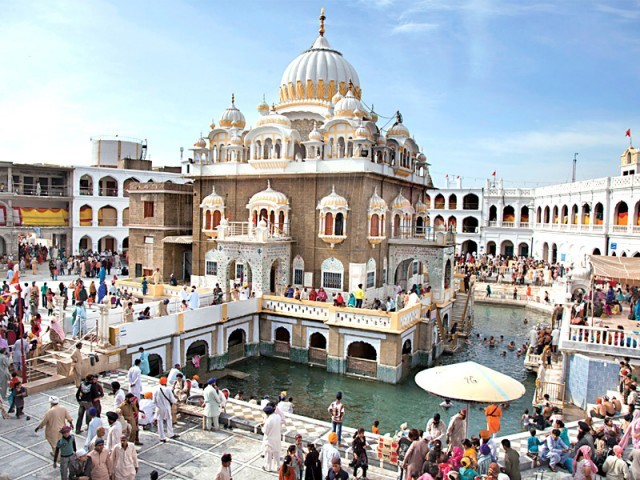
Tears gushed down Supreet Kaur’s face as she stared at the shrine of Punja Sahib and prayed for less stringent border controls so she can visit Hassan Abdal every year for Baisakhi. The three-day festival ended on Friday.

Wiping her tears with her veil Kaur said that her ‘mannat’ — a prayer that she hopes will be answered by visiting the shrine this year — is that people around the world live as one and all borders become porous. “I want the world to live in harmony and peace. So far all my prayers have come true and I am sure this one will as well”

Supreet was not the only one to wish for easier access to the shrine. Thousands of pilgrims who came for Baisakhi prayed for a change in visa policy for Sikhs so that they are able to visit the shrine any time of the year. Some pilgrims complained about acquiring a letter of invitation from either family or friends in Pakistan for their visa.

Rajpal Singh said that it was unfortunate that many Sikhs could not visit Pakistan because of the restrictions. “Both governments should devise a verification system so that Sikhs can cross the border for religious rituals. Even a permit would be fine,” Rajpal added. “I want these restrictions to come to an end so we can visit other shrines in Pakistan, such as Baba Buleh Shah’s,” Supreet said.

Baisakhi is an annual event which holds a very special place in the lives of Sikhs. The day marks the beginning of the new solar year. It also marks the formation of Khalsa (the pure one). Sikhs believe that it was on this day in 1699 when the tenth Sikh Guru, Gobind Singh declared all human beings as equal.

On Baisakhi, traditions of Gurus were compiled by Sikhs. Guru Granth Sahib was established as their eternal guide and the holy book. Punja Sahib is one of the three holiest shrines for Sikhs because of a large rock bearing an imprint of Guru Nanak’s hand or punja, founder of the Sikh religion. Sikhs swim across the stream, making a wish as they touch the imprint.

Security

Due to security fears, Sikhs could not leave Punja Sahib without permission. Some 3,000 Rangers had been deployed by the Punjab government in and around the premises.

Arrangements

Approximately 8,000 Sikhs came to Punja Sahib this year for the annual Baisakhi festival. Singh said that he was extremely satisfied with the arrangements and was happy to see the hospitality of the Pakistani government. However, Major Singh, 67, said both governments should improve facilities offered to pilgrims, including operational bathrooms and lights in trains.

Thousands of pilgrims were accommodated inside the gurdawara like every year. A huge portion of Punja Sahib is still under construction but most pilgrims were satisfied with the rooms provided.

Approximately, 2,300 Sikhs travelling from India have been accommodated in more than 400 rooms in Punja Sahib. Paramjeet Singh laughingly said just sleeping under a shade at Punja Sahib is more relaxing than any other place in the world. “It’s not about my physical needs; I am spiritually satisfied.”

Business opportunities
A large number of men and women had set up their stalls at the back of the gurdwara. Hindu vendor, Inder Kaur had come from Sindh to sell jewellery made in Mumbai. He said merchants make approximately Rs25,000 in three days. “I love shopping here because they sell items such as clothes or even bindia that we do not get in Pakistan,” said Kalvinder Kaur, who was buying bangles from Inder.

More than 120 Pakistani Soldiers Lie Dead in the Snow for Nothing

By Mohammed Hanif for The Guardian

Two months before President Asif Zardari’s unexpected visit to India, a newly formed political alliance, the Council to Defend Pakistan, unveiled its slogan. “What is our relationship with India?” it asked. And then in a rickety Urdu rhyme it answered: of hatred, of revenge.

The council is an alliance between recovering jihadists, some one-person political parties and the kind of sectarian organisations whose declared aim is that Pakistan cannot fulfil its destiny until every single Shia has been killed or expelled from the country.

The council is not likely to have much impact on Pakistan’s electoral politics, but it is a clear reminder that there are strong forces within the country, which want a return to the days when India was Pakistan’s enemy No 1. Back then all you had to do to malign a Pakistani politician was to somehow prove that they were soft on India. Things have changed. When President Zardari went to India, his bitter political enemy and the opposition leader Nawaz Sharif welcomed the visit.

President Zardari’s visit on the one hand was a reminder that India is right next door. If you plan carefully, you can do a day trip, have lunch, visit a shrine and make the correct, polite noises that visitors make about their future intentions.

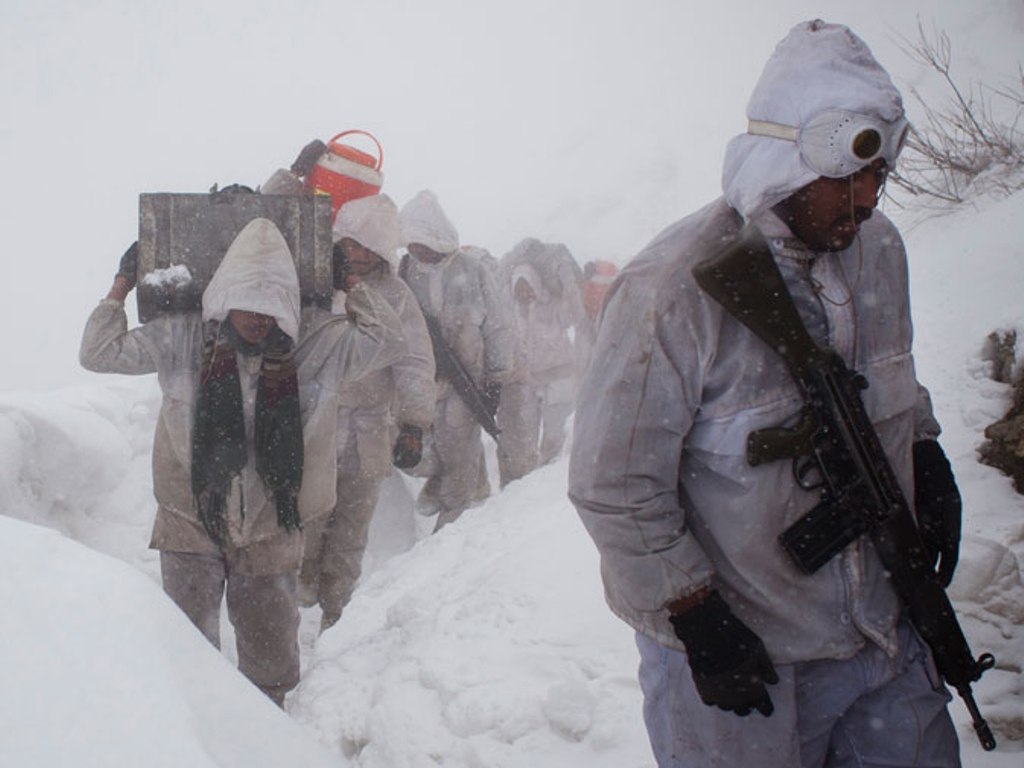
But the president’s visit was also set against a reminder that India and Pakistan have raised their animosity to a brutal art form. As the president’s plane landed in Delhi, rescue workers were trying to reach the Siachen glacier, where more than 120 Pakistani soldiers had been buried after an avalanche obliterated their military post. Siachen is often proclaimed the world’s highest battlefront – as if it’s a Guinness world record and not a monument to our mutual stupidity. As I write this, not a single survivor or body has been found. India offered help in rescue efforts. Pakistan politely declined, because that would compromise its military posts.

President Zardari’s visit was billed as a private one, but the pageantry surrounding it was state-visit like, complete with dozens of cameras broadcasting empty skies where the presidential plane was about to appear. And, of course, the media had scooped the menu for the state lunch a day in advance.

Did the visit achieve anything? An 80-year-old Pakistani prisoner in an Indian jail was released on bail. The leaders’ sons and probable heirs – Bilawal Bhutto Zardari and Rahul Gandhi – got to hang out.

There are peaceniks on both sides who have held endless candlelit vigils on the borders. They would like the borders to melt away, for all of us to come together in a giant hug and live happily ever after just like we did in a mythical past when we were all either little Gandhis or sufis and got along fine. There is another minority on both sides that would like us to live permanently in the nightmare that was partition. There are Pakistani groups who want to raise the green flag over the Red Fort in Delhi, and there are Indian hawks who go to sleep thinking of new ways to teach this pesky little country a lesson. But the vast majority – and given the size of population and ethnic diversity, that majority is really vast – would just be happy with cheaper onions from across the border.

There is another kind of coming together: Pakistani writers and artists can attend both Indian and Pakistani literary festivals and art expos, and although it’s great that they can peddle their wares to a curious audience, the rest of the population are denied that privilege. A Punjabi farmer, for example, can’t sell his often perishable produce in India, a couple of hours away, but is forced to transport it a thousand miles to southern Pakistan. If India and Pakistan could take tiny steps which weren’t just meant for the rulers and cultural tourists, it might make some difference. For instance, if there were only a couple of thousand Pakistani and Indian students studying in each others’ countries, the appetite for a war rhetoric might wane. At the moment it can’t happen because the security establishment fear infiltration. The same establishment forget that infiltrators usually don’t apply for a visa, and no suspects so far have been to an IT school in Bangalore or an arts college in Lahore.

I mention education because one in 10 children who doesn’t go to school lives in Pakistan. One in three children in the world who is malnourished lives in India. And these countries insist on sending young men to a frontline where there is no war, where there is nothing to fight over, and where 4,000 soldiers have died, mostly because it’s just too cold. Tens of thousands return with serious mental ailments because it’s so lonely and depressing. Twenty three years ago a withdrawal agreement had been agreed upon, but according to Indian defence analyst Srikant Rao, the then Indian prime minister Rajiv Gandhi backed out because withdrawing troops wouldn’t look very good in pictures. Well, troops buried under miles of snow don’t look very good either.

If India and Pakistan can’t leave each other alone, they should at least leave those mountains alone.

Pakistan Leader’s India Visit Hailed For Its Symbolism

By Mark Magnier for The Los Angeles Times

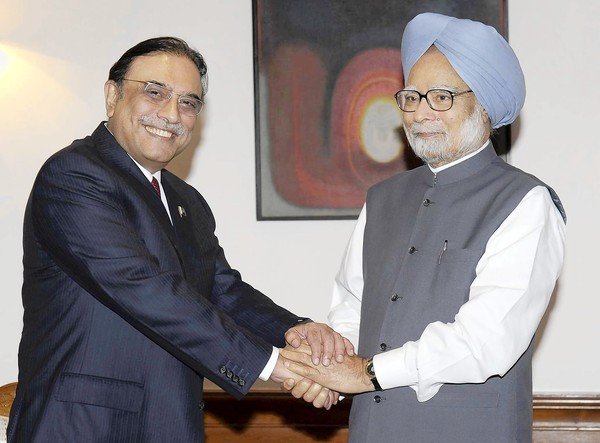
Pakistan’s president arrived in India on Sunday, the first official visit one leader of the wary neighbors has paid to the other nation in seven years. No breakthroughs were announced, but both sides hailed the meeting as a sign of easing tensions along one of the world’s most dangerous borders.

Spinmeisters on both sides worked overtime to lower public expectations of the “private” trip that saw Pakistani President Asif Ali Zardari and Indian Prime Minister Manmohan Singh discuss the 2008 terrorist attack on the Indian city of Mumbai, modest if expanding trade links, the disputed territory of Kashmir and efforts to bring various militants to justice.

The Pakistani president then visited a famous Muslim shrine for Sufi saint Moinuddin Chishti, offering a $1-million contribution.

“I am very satisfied with the outcome of this visit,” Singh said. “The relations between India and Pakistan should become normal — that is our common desire.”

The rapid-fire luncheon and shrine visit weren’t enough to overturn long-standing distrust between the nuclear neighbors, however, as summed up in a headline in India’s Mail Today tabloid newspaper: “Eat, Pray, No Love.”

The meeting is part of an apparent effort to follow the diplomatic model in place between India and China, which fought a war in 1962 over their disputed border: Put aside the most nettlesome issues for the time being and focus on building investment and trade links that benefit both sides.

This year, India and Pakistan approved a most-favored-nation agreement, lowering taxes that impede trade. Although India had offered this benefit to Pakistan in 1996, it wasn’t reciprocated until recently. Official two-way trade of about $2.6 billion is heavily weighted in India’s favor.

Sunday’s one-day visit was heavy on symbolism if not on substance. Zardari invited Singh for a reciprocal visit to Pakistan, which the Indian leader accepted, although no date was set. Zardari’s 23-year-old son, Bilawal, invited ruling Congress Party General Secretary Rahul Gandhi to Pakistan, which was also accepted, again with no date set.

On other fronts, both sides agreed in principle to ease visa restrictions. India offered its assistance in the wake of this weekend’s massive avalanche in the Siachen Glacier area, which buried about 130 people on the Pakistani-controlled side of the border in disputed Kashmir. And both sides did lots of glad-handing for the cameras.

“We had fruitful bilateral talks,” Zardari said. We “hope to meet on Pakistani soil very soon.”

But any bid to bring to justice those who planned the 2008 Mumbai attack that killed at least 166 people was sidestepped. India has long blamed Pakistani-based groups for plotting the attack.

Last week, Washington offered a $10-million reward for information leading to the capture of one Pakistani militant leader, Hafiz Muhammad Saeed, who enjoys widespread support in Pakistan.

Analysts on both sides of the divide welcomed the gradual thaw even as they acknowledged its slow pace. That no date was set for a return visit, and that Congress Party head Sonia Gandhi — characterized by some as India’s real leader behind the scenes — didn’t meet Zardari or attend the lunch, suggests the Indian government is wary of getting too far ahead of public opinion, some observers said.

“There have been some useful steps forward,” said B. Raman, director of Chennai’s Institute for Topical Studies and a former Indian intelligence officer on the Pakistan desk. “But the government has taken a cautious line.”

The fact that Zardari, 56, made the trip at all suggests that Pakistan’s military realizes improved relations are in its interest, added Talat Masood, an analyst and retired Pakistani general.

“They’re overstretched, realize the economy’s in a shambles and that you can’t have a genuine defense without a good economy,” Masood said. “It’s very sad in a way, that the process has been held hostage to jihadi groups and hard-rightists on both sides.”

Singh, 79, heading a weak government beset by corruption scandals, has pushed for improved ties with Pakistan in a bid to secure a legacy, analysts on both sides said. “Prime Minister Singh realizes he’s only going to be there a few more months,” said Masood. “He wants to do something positive so he’s remembered.”

Pakistani Troops Dig for 135 Missing in Avalanche

By Chris Brummitt for The Associated Press

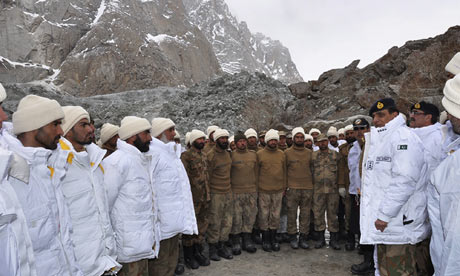
Pakistani soldiers dug into a massive avalanche in a mountain battleground close to the Indian border on Saturday, searching for at least 135 people buried when the wall of snow engulfed a military complex.

More than 12 hours after the disaster at the entrance to the Siachen Glacier, no survivors had been found.

“We are waiting for news and keeping our fingers crossed,” said army spokesman Maj. Gen. Athar Abbas.

Hundreds of troops, sniffer dogs and mechanical equipment were at the scene, but were struggling to make much headway into the avalanche, which crashed down onto the rear headquarters building in the Gayari sector early in the morning, burying it under some 21 meters (70 feet) of snow, Abbas said.

“It’s on a massive scale,” he added. “Everything is completely covered.”

The military said in a statement that at least 124 soldiers and 11 civilian contractors were missing.

Siachen is on the northern tip of the divided Kashmir region claimed by both India and Pakistan.

The accident highlighted the risks of deploying troops to one of the most inhospitable places on earth.

The thousands of troops from both nations stationed there brave viciously cold temperatures, altitude sickness, high winds and isolation for months at a time. Troops have been deployed at elevations of up to 6,700 meters (22,000 feet) and have skirmished intermittently since 1984, though the area has been quiet since a cease-fire in 2003. The glacier is known as the world’s highest battlefield.

Prime Minister Yousuf Raza Gilani expressed his shock at the incident, which he said “would in no way would undermine the high morale of soldiers and officers.”

The headquarters in Gayari, situated at around 4,572 meters (15,000 feet) is the main gateway through which troops and supplies pass on their to other more remote outposts in the sector. It is situated in a valley between two high mountains, close to a military hospital, according to an officer who was stationed there in 2003.

“I can’t comprehend how an avalanche can reach that place,” said the officer, who didn’t give his name because he is not authorized to speak to the media. “It was supposed to be safe.”

More soldiers have died from the weather than combat on the glacier, which was uninhabited before troops moved there.

Conflict there began in 1984 when India occupied the heights of the 78-kilometer (49-mile)-long glacier, fearing Pakistan wanted to claim the territory. Pakistan also deployed its troops. Both armies remain entrenched despite the cease-fire, costing the poverty-stricken countries many millions of dollars each year.

Pakistan and India have fought three wars since the partition of the subcontinent on independence from Britain in 1947. Two of the wars have been over Kashmir, which both claim in its entirety.

Pakistanis for Peace Editor’s Note– The death of these 135 and allegedly more soldiers should prove to be a defining moment for Pakistan in regards to the urgency of peace with India just as the death of the 24 killed by “friendly” NATO attack that killed so many near the Afghanistan border last November.  It is high time India and Pakistan find a way to make peace and end this 60+ year battle and hatred with ourselves as we are one people.  This may not completely apply for India, but the ONLY way to fix EVERYTHING that ails Pakistan is a peace treaty with India~ RIP to the patriots of my sacred land~ MM

Haley’s Comment

As Reported By Robert Walker for The Huffington Post

Like a comet streaking across the heavens, Governor Nikki Haley’s comment on The View about women not caring about contraception is drawing a lot of attention. And rightly so.

Poll after poll suggests that women do care about contraception. Case in point: Mitt Romney’s plan to shut down the family planning clinics run by Planned Parenthood has cost him dearly. His support among women has dropped precipitously in the past few months as voters learn more about his views on family planning.

When Haley and other Republican leaders opine about the lack of voter interest in contraception, it’s more wishful thinking than political insight. They recognize that the positions taken by the GOP presidential aspirants on family planning may help them in the primaries, but it will undoubtedly hurt them in the general election. As a result, they want to change the subject in the worst way.

Unfortunately for them, comments like those made by Governor Haley do nothing to shift voter attention to the issues they want to talk about, like deficits and the economy. To the contrary, they reinforce the idea that Republicans are tone-deaf on women’s issues.

Haley’s comment, in particular, appears to suggest that Republican leaders, even women like her, don’t care about a women’s access to contraception. Before making her claim, maybe she should have checked in with another Republican leader, Senator Olympia Snowe, who earlier this week said that the political attacks on contraception were “retro.”

What’s even more “retro,” however, is the unspoken half of Haley’s comment. By suggesting that women don’t really care about contraception, she’s suggesting that men could care even less. So much less that it’s not even worth discussing.

Polls, of course, suggest to the contrary. While men may feel less strongly than women do, they also care about contraception. Most men recognize that they also benefit when women are able to determine the number and timing of their pregnancies. Some men may want to keep women “barefoot and pregnant,” but it’s a pretty small minority. This is, after all, the 21st century.

As governor of South Carolina, Nikki Haley ought to appreciate the critical need for family planning services. Nearly half of all pregnancies in the United States are unintended. According to the Guttmacher Institute, South Carolina’s rate of unintended pregnancy is significantly higher than the national average. In 2006, 52,000 South Carolina residents had an unintended pregnancy, a rate of 58 per 1,000 women aged 15 to 44. Guttmacher report that births resulting from these unintended pregnancies cost the state and federal governments $254 million in 2006.

And South Carolina’s teenage pregnancy rate, while it’s been declining in recent years, is still about 25 percent higher than the national average according to the Centers for Disease Control.

A poll released earlier this year indicated that 95 percent of South Carolinians believe that teenage pregnancy is an important issue, with 85 percent supporting school-based sexuality education. Maybe, Governor Haley should go on a listening tour in South Carolina before declaring that women don’t care about contraception.

Many regard Governor Haley as a rising political star in the political firmament. She’s frequently mentioned as a possible vice presidential selection. Given Romney’s “gender gap,” adding a woman to the ticket might be a smart move, but, maybe he should find a woman who understands how women — and men — genuinely feel about contraception.

Governor Haley’s comment, like the famed Halley’s comet, will soon fade from public view, but the issue of contraception will not fade anytime soon. The war on contraception is real. State cutbacks, like those in Texas, are forcing family-planning clinics to close their doors, and if GOP leaders succeed in their efforts to eliminate Title X, the federal program that provides low-income women with improved access to family planning, more shutdowns will inevitably occur.

That’s why it’s so critically important that women — and men — pledge to speak out in support of reproductive health and rights. Don’t let the Governor Haleys of the world speak for you.

Pakistanis for Peace Editor’s Note– We profiled Governor Nikki Haley a few days before she was elected as the first Indian born female governor as well as minority woman governor of a US state and wished her well here. However, her party and ideals diametrically are opposed to ours as Democratic voters in the US elections as many Pakistani Americans now are. Thus, some of her ideas and beliefs are not necessarily our own, but we still wish her well as she is a fellow Desi~

Why President Zardari’s Visit Is A Small Bonus

By Soutik Biswas for The BBC

Hope is not a policy, but neither is despair, as South Asia expert Stephen Cohen says in a recent essay on Pakistan.

So it is with relations between India and Pakistan.

The past few days have shown how fragile the relationship can be – even as India welcomed President Asif Ali Zardari’s private trip to India on Sunday – the first by a Pakistani head of state for seven years – and PM Manmohan Singh invited him for lunch, the $10m US bounty for Hafiz Saeed, the founder of Pakistan-based militant group Lashkar-e-Taiba, provoked the cleric to openly launch a fresh attack against India (and the US).

But people live in hope, so Indian media is gung-ho about Mr Zardari’s visit.

They say the Pakistani president must be applauded for trying to end trade discrimination against India, easing petroleum imports from across the border, and moving towards a liberal visa deal.

“Under Mr Zardari’s watch, India and Pakistan are considering a sweeping agenda for economic co-operation for the first time in decades. The prime minister has every reason to welcome Mr Zardari warmly and consider the next steps in consolidating the unexpected movement in bilateral relations,” the Indian Express wrote.

Analyst C Raja Mohan believes Mr Singh must make an official trip to Pakistan after his meeting with Mr Zardari. “For his part,” he wrote, “Mr Singh should convey to Mr Zardari his readiness to move as fast and as far as the Pakistan president is willing to go.” Others like Jyoti Malhotra actually find Mr Zardari’s visit to the shrine of a famous Sufi Muslim saint in Rajasthan loaded with symbolism in these troubled times. “Clearly, Mr Zardari has stolen an imaginative moment from the bitter-sullen history of India-Pakistan, by asking to come to pay his respects to a cherished and much-beloved saint across the Indian subcontinent,” she wrote.

The relations between two neighbours remain complex. A 2010 Pew survey found 53% of the respondents in Pakistan chose India as the greater threat to their country, and only 26% chose the Taliban and al-Qaeda. At the same time 72% said it was important to improve relations with India, and about 75% wanted more trade relations and talks with India.

Pundits like Mr Cohen believe that it will “take the [Pakistan] army’s compliance, strong political leadership, and resolutely independent-minded foreign ministers to secure any significant shift of approach towards India”.

None of this appears to be in much evidence at the moment.

Both countries have seriously weakened governments that makes them unable to move towards any radical confidence building measures. In the current circumstances, President Zardari’s visit can only be a small bonus. And as scholars like Kanti Bajpai suggest, India must remain patient (even if faced with another Mumbai-style attack), continue to engage with Islamabad, help the civilian government in Pakistan politically, try to resolve a few outstanding disputes like Siachen and Sir Creek, build a relationship with the army and explore the possibility of cooperating with Islamabad on the future of Afghanistan. Despair does not help mend a stormy relationship.

Pakistani militant taunts US: ‘I will be in Lahore tomorrow’

By Sebastian Abbot for The Associated Press

One of Pakistan’s most notorious extremists mocked the United States during a defiant media conference close to the country’s military headquarters Wednesday, a day after the US slapped a $10 million bounty on him.

“I am here, I am visible. America should give that reward money to me,” said Hafiz Mohammad Saeed, referring to the fact that the bounty was given to a man whose whereabouts are not a mystery. “I will be in Lahore tomorrow. America can contact me whenever it wants to.”

Analysts have said Pakistan is unlikely to arrest Saeed, founder of the militant group Lashkar-e-Taiba, because of his alleged links with the country’s intelligence agency and the political danger of doing Washington’s bidding in a country where anti-American sentiment is rampant.

Saeed, 61, has been accused of orchestrating the 2008 attacks in the Indian city of Mumbai that killed 166 people, including six American citizens. But he operates openly in Pakistan, giving public speeches and appearing on TV talk shows.

He has used his high-profile status in recent months to lead a protest movement against US drone strikes and the resumption of NATO supplies for troops in Afghanistan sent through Pakistan. The supplies were suspended in November in retaliation for American airstrikes that accidentally killed 24 Pakistani soldiers.

Hours before Saeed spoke, US Deputy Secretary of State Thomas Nides met Pakistani Foreign Minister Hina Rabbani Khar in the nearby capital, Islamabad, for talks about rebuilding the two nation’s relationship. In a brief statement, Nides did not mention the bounty offer but reaffirmed America’s commitment to “work through” the challenges bedeviling ties.

Increasingly ‘brazen’ appearances
The US said Tuesday it issued the bounty for information leading to Saeed’s arrest and conviction in response to his increasingly “brazen” appearances. It also offered up to $2 million for Lashkar-e-Taiba’s deputy leader, Hafiz Abdul Rahman Makki, who is Saeed’s brother-in-law.

The rewards marked a shift in the long-standing US calculation that going after the leadership of an organization used as a proxy by the Pakistani military against archenemy India would cause too much friction with the Pakistani government.

This shift has occurred as the US-Pakistani relationship steadily deteriorated over the last year, and as the perception of Lashkar-e-Taiba’s potential threat to the West increased.

Bounty backfire?
The US may be hoping the bounty will force Pakistan to curb Saeed’s activities, even if it isn’t willing to arrest him. But the press conference he called at a hotel in the garrison city of Rawalpindi on Wednesday was an indication that is unlikely, and the bounty may even help him by boosting his visibility.

At the hotel, located near the Pakistani army’s main base and only a half hour drive from the US Embassy in Islamabad, Saeed was flanked by more than a dozen right-wing politicians and hardline Islamists who make up the leadership of the Difa-e-Pakistan, or Defense of Pakistan, Council. The group has held a series of large demonstrations against the US and India in recent months.

Some in the media have speculated the movement has the tacit support of the Pakistani military, possibly to put pressure on Washington.

“I want to tell America we will continue our peaceful struggle,” said Saeed. “Life and death is in the hands of God, not in the hands of America.”

Denies involvement in Mumbai massacre
He denied involvement in the Mumbai attacks and said he had been exonerated by Pakistani courts.

Pakistan kept Saeed under house arrest for several months after the attacks but released him after he challenged his detention in court. It has also resisted Indian demands to do more, saying there isn’t sufficient evidence.

The bounty offers could complicate US efforts to get the NATO supply line reopened. Pakistan’s parliament is currently debating a revised framework for ties with the US that Washington hopes will get supplies moving again. But the bounties could be seen by lawmakers and the country’s powerful army as a provocation and an attempt to gain favor with India.

Origins in the Kashmir dispute
Saeed founded Lashkar-e-Taiba in the 1980s allegedly with ISI support to pressure India over the disputed territory of Kashmir. The two countries have fought three major wars since they were carved out of the British empire in 1947, two of them over Kashmir.

Pakistan banned the group in 2002 under US pressure, but it operates with relative freedom under the name of its social welfare wing Jamaat-ud-Dawwa — even doing charity work using government money.

The US has designated both groups foreign terrorist organizations. Intelligence officials and terrorism experts say Lashkar-e-Taiba has expanded its focus beyond India in recent years and has plotted attacks in Europe and Australia. Some have called it “the next Al Qaeda” and fear it could set its sights on the US

* Associated Press writer Asif Shahzad contributed to this report from Islamabad.

Pakistan Salute Record-Setting Tendulkar’s Achievement

As Reported by The AFP

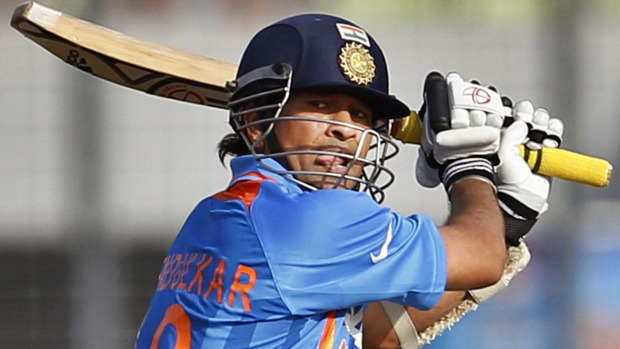
Former cricketing greats and fans in Pakistan paid tribute to Indian batting superstar Sachin Tendulkar after he became the first player ever to score 100 international centuries.

“It is a great achievement which other players of his era and those who come after him will not even think of achieving,” said former Pakistan captain Javed Miandad.

“When he played against us in 1989 he showed glimpses of what was in store for world cricket and the kind of sincerity he has shown with the game has only made him immortal and prolonged his career to 23 years and he can still go on.”

Miandad hailed the father of two, known variously as the “Little Master” or “Bombay Blaster“, as a role model for the cricketing world.

Another former Pakistan captain Moin Khan, who played against Tendulkar from 1992-2004, also joined the chorus of praise.

“He has achieved something which will be tough to match. He has been a trend–setter and if players emulate him we will get more great players.

“Tendulkar’s speciality is that he is very professional, loves the game and lusts for runs. With no controversy in his career he has been a role model for future cricketers,” said Moin.

“Great players are not those who do great achievements but those who, with their great character on and off the field, become role models.”

Fans in the street also acknowledged Tendulkar’s feat.

“Tendulkar is adored in Pakistan and we are happy at his achievement. We are happy that he has not hit his 100th hundred against Pakistan,” said Babar Khan, a local resident