Archive for the ‘ Pakistani Taliban ’ Category

Why My Father Hated India

By Aatish Taseer for The Wall Street Journal

Ten days before he was assassinated in January, my father, Salman Taseer, sent out a tweet about an Indian rocket that had come down over the Bay of Bengal: “Why does India make fools of themselves messing in space technology? Stick 2 bollywood my advice.”

My father was the governor of Punjab, Pakistan’s largest province, and his tweet, with its taunt at India’s misfortune, would have delighted his many thousands of followers. It fed straight into Pakistan’s unhealthy obsession with India, the country from which it was carved in 1947.

Though my father’s attitude went down well in Pakistan, it had caused considerable tension between us. I am half-Indian, raised in Delhi by my Indian mother: India is a country that I consider my own. When my father was killed by one of his own bodyguards for defending a Christian woman accused of blasphemy, we had not spoken for three years.

To understand the Pakistani obsession with India, to get a sense of its special edge—its hysteria—it is necessary to understand the rejection of India, its culture and past, that lies at the heart of the idea of Pakistan. This is not merely an academic question. Pakistan’s animus toward India is the cause of both its unwillingness to fight Islamic extremism and its active complicity in undermining the aims of its ostensible ally, the United States.

The idea of Pakistan was first seriously formulated by neither a cleric nor a politician but by a poet. In 1930, Muhammad Iqbal, addressing the All-India Muslim league, made the case for a state in which India’s Muslims would realize their “political and ethical essence.” Though he was always vague about what the new state would be, he was quite clear about what it would not be: the old pluralistic society of India, with its composite culture.

Iqbal’s vision took concrete shape in August 1947. Despite the partition of British India, it had seemed at first that there would be no transfer of populations. But violence erupted, and it quickly became clear that in the new homeland for India’s Muslims, there would be no place for its non-Muslim communities. Pakistan and India came into being at the cost of a million lives and the largest migration in history.

This shared experience of carnage and loss is the foundation of the modern relationship between the two countries. In human terms, it meant that each of my parents, my father in Pakistan and my mother in India, grew up around symmetrically violent stories of uprooting and homelessness.

But in Pakistan, the partition had another, deeper meaning. It raised big questions, in cultural and civilizational terms, about what its separation from India would mean.

In the absence of a true national identity, Pakistan defined itself by its opposition to India. It turned its back on all that had been common between Muslims and non-Muslims in the era before partition. Everything came under suspicion, from dress to customs to festivals, marriage rituals and literature. The new country set itself the task of erasing its association with the subcontinent, an association that many came to view as a contamination.

Had this assertion of national identity meant the casting out of something alien or foreign in favor of an organic or homegrown identity, it might have had an empowering effect. What made it self-wounding, even nihilistic, was that Pakistan, by asserting a new Arabized Islamic identity, rejected its own local and regional culture. In trying to turn its back on its shared past with India, Pakistan turned its back on itself.

But there was one problem: India was just across the border, and it was still its composite, pluralistic self, a place where nearly as many Muslims lived as in Pakistan. It was a daily reminder of the past that Pakistan had tried to erase.

Pakistan’s existential confusion made itself apparent in the political turmoil of the decades after partition. The state failed to perform a single legal transfer of power; coups were commonplace. And yet, in 1980, my father would still have felt that the partition had not been a mistake, for one critical reason: India, for all its democracy and pluralism, was an economic disaster.

Pakistan had better roads, better cars; Pakistani businesses were thriving; its citizens could take foreign currency abroad. Compared with starving, socialist India, they were on much surer ground. So what if India had democracy? It had brought nothing but drought and famine.

But in the early 1990s, a reversal began to occur in the fortunes of the two countries. The advantage that Pakistan had seemed to enjoy in the years after independence evaporated, as it became clear that the quest to rid itself of its Indian identity had come at a price: the emergence of a new and dangerous brand of Islam.

As India rose, thanks to economic liberalization, Pakistan withered. The country that had begun as a poet’s utopia was reduced to ruin and insolvency.

The primary agent of this decline has been the Pakistani army. The beneficiary of vast amounts of American assistance and money—$11 billion since 9/11—the military has diverted a significant amount of these resources to arming itself against India. In Afghanistan, it has sought neither security nor stability but rather a backyard, which—once the Americans leave—might provide Pakistan with “strategic depth” against India.

In order to realize these objectives, the Pakistani army has led the U.S. in a dance, in which it had to be seen to be fighting the war on terror, but never so much as to actually win it, for its extension meant the continuing flow of American money. All this time the army kept alive a double game, in which some terror was fought and some—such as Laskhar-e-Tayyba’s 2008 attack on Mumbai—actively supported.

The army’s duplicity was exposed decisively this May, with the killing of Osama bin Laden in the garrison town of Abbottabad. It was only the last and most incriminating charge against an institution whose activities over the years have included the creation of the Taliban, the financing of international terrorism and the running of a lucrative trade in nuclear secrets.

This army, whose might has always been justified by the imaginary threat from India, has been more harmful to Pakistan than to anybody else. It has consumed annually a quarter of the country’s wealth, undermined one civilian government after another and enriched itself through a range of economic interests, from bakeries and shopping malls to huge property holdings.

The reversal in the fortunes of the two countries—India’s sudden prosperity and cultural power, seen next to the calamity of Muhammad Iqbal’s unrealized utopia—is what explains the bitterness of my father’s tweet just days before he died. It captures the rage of being forced to reject a culture of which you feel effortlessly a part—a culture that Pakistanis, via Bollywood, experience daily in their homes.

This rage is what makes it impossible to reduce Pakistan’s obsession with India to matters of security or a land dispute in Kashmir. It can heal only when the wounds of 1947 are healed. And it should provoke no triumphalism in India, for behind the bluster and the bravado, there is arid pain and sadness.

—Mr. Taseer is the author of “Stranger to History: A Son’s Journey Through Islamic Lands.” His second novel, “Noon,” will be published in the U.S. in September

-Pakistanis for Peace Editor’s Note– Aatish Taseer’s brutally honest and forthright column is one of the best articles I have read in a long time.  As a Pakistani American, I find a lot of truth in what he is saying, no matter how ill received it may be back in Pakistan, I feel that Aatish does make some good points and it was well worth sharing with you readers.

Musharraf Moves to Mend US-Pakistan Relations

By Lydia Mulvany for The Mimami Hearld

Former Pakistani President Pervez Musharraf said Thursday that his country wasn’t complicit in hiding Osama bin Laden but was “extremely negligent” for not knowing that the al-Qaida leader was living a 75-mile drive from the Pakistani capital.

Speaking in Washington, the former military dictator sought to heal a U.S.-Pakistani relationship that’s become badly strained since the American raid May 2 that killed bin Laden, saying mutual interests in the global war on terrorism bound the countries and that blaming each other was counterproductive.

“The United States and Pakistan must restore trust,” Musharraf told an audience at the Woodrow Wilson International Center for Scholars. “Confrontation would be most unwise.”

The bin Laden incident pushed U.S.-Pakistani relations to their lowest point in years. American officials weren’t happy when, after a decade-long hunt, they found al-Qaida’s leader living in a garrison town so close to Islamabad. Pakistani officials were outraged that they weren’t told about the unilateral raid beforehand.

Since the raid, Pakistan has restricted visas for American officials and expelled military trainers. The U.S. has cut off $800 million, about one-third of its aid to Pakistan’s military. The U.S. has long complained of ties between Pakistan’s military and insurgent groups that have attacked American-led forces in neighboring Afghanistan.

But Musharraf said that if Pakistani intelligence had colluded with bin Laden, it also would have known that the CIA was operating a safe house nearby and whisked the al-Qaida leader away. He described bin Laden’s high-walled compound in the town of Abbottabad as a normal dwelling that wouldn’t have raised suspicion.

He also claimed that Abbottabad – which is home to a major military college that’s been described as Pakistan’s West Point, as well as other military installations – wasn’t a garrison town but a touristy resort area with many colleges.

The recent raid was a “violation of sovereignty,” Musharraf said, echoing a widespread Pakistani complaint. He added that Pakistani antipathy toward the U.S. also stems from the American campaign of drone strikes on militant targets, which reportedly have caused civilian casualties, as well as lingering bitterness over U.S. sanctions for developing nuclear weapons in the 1990s.

The way forward for Pakistan, Musharraf said, is to show that it isn’t complicit with terrorists and to deal with domestic extremism. It also needs to establish an honest, stable government in the 2013 elections, said the former leader, who’s expected to mount a run for president.

Musharraf, who seized power in a military coup in 1999 and resigned in 2008, embodied the frustration and contradictions of American policy toward Pakistan.

Mark Quarterman, a senior adviser at the Center for Strategic and International Studies, a nonpartisan Washington research center, said that many wanted to see Musharraf as a modern, progressive leader: He wasn’t an extremist, his wife and daughter didn’t wear veils and the family even had a dog, an animal many Muslims view as impure. Ultimately, however, Musharraf’s rule was a military dictatorship and, according to many experts, he didn’t do enough to rein in Taliban militants who were operating in remote corners of Pakistan.

Mumbai Counts Its Losses

As Reported by The Hindustan Times

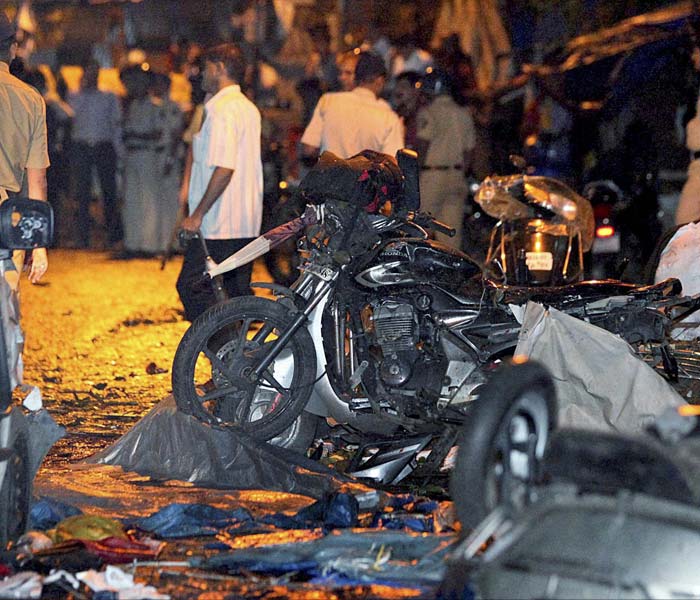
The improvised explosive devices (IEDs) used in the triple bombings were not crude but prepared with “some level of sophistication”, the government said as investigators scrambled for clues on a rain-soaked Thursday and a weary Mumbai picked up the pieces after yet another terror strike.

A day after 17 people were killed and 131 injured when synchronised blasts rocked India’s financial capital, striking the congested areas of Dadar, Zaveri Bazaar and Opera House within minutes of each other, there was no breakthrough on who was behind it.

“We will ensure no matter wherever the accused are, we will identify them and bring them to book,” Maharashtra Anti-Terrorism Squad (ATS) chief Rakesh Maria vowed, appealing for faith and trust.

In a flurry of activity, Prime Minister Manmohan Singh and Congress chief Sonia Gandhi headed for Mumbai. Home minister P. Chidambaram reached on Wednesday night and opposition leader LK Advani on Thursday morning.

Resigned, outraged or simply stoic, Mumbaikars rallied around to battle the crisis, 31 months after the Nov 26-28, 2008 terror assault, India’s worst. They waited outside morgues to claim the bodies of their kin, lined up at hospitals or packed into trains and buses to go about their daily work.

“I am a Mumbaikar and we shall not be scared by these terror attacks. Like me, lakhs of co-commuters are in the trains, buses and roads. It actually helps gives strength to each other,” Archana Shukla said as she went to work.

In Zaveri Bazaar, Mumbai’s most popular address for jewellery that on Wednesday saw its third terror strike, merchants were shocked. But said firmly they were staying put.

“What is the point in shifting base? Are other business locations safer?” asked Raju Solanki, a gold jeweller.

That was a question even experts were loathe to answer as investigators began unravelling the conspiracy behind this latest assault by yet unknown terrorists.

Various agencies, including the National Security Guard (NSG), the Central Forensic Science Laboratory (CFSL) and the National Investigation Agency (NIA) and Mumbai Police, were involved in the probe.

According to union home secretary RK Singh, the ammonium nitrate-based IEDs were “not crude” but indicated “some level of sophistication”.

A top doctor at one of the hospitals where the bodies of the dead were taken for a post mortem said an electric circuit, that may have triggered the blast, was found on one of them, leading to speculation that it may have been a suicide bomber at work.

Sources said traces of ammonium nitrate, also confirmed by Chidambaram, and fuel had been found in the explosives.

“Ammonium nitrate was used with a timer. The fact that they all took place within minutes of each other — eight-to-10 minutes — shows that it was a coordinated terror attack,” Chidambaram said.

The CCTV footage holds the key. Sources told IANS that some of the footage was marred by the rain and bad light Wednesday evening.

Hours after visiting the terror sites, Chidambaram said 131 people had been taken to 13 hospitals with injuries. He said one severed head was also found at the site that could take the death toll to 18.

Addressing a press conference in Mumbai, he admitted there was no prior intelligence input.

Quick to seize the initiative, BJP leader Advani pointed the needle of suspicion towards Pakistan.

“It is a policy failure not intelligence failure. There have been repeated attacks on Mumbai, this is a failure of policy,” Advani told reporters.

Advani quoted reports of a probable link between the blast and the Indian Mujahideen (IM) and said even if it were behind the attack it was being sustained by Pakistan.

“The last attack on our land is proved to have been engineered by the ISI (Inter-Services Intelligence),” Advani said.

“So far as India is concerned, the government of India should shed its ambivalence to terrorism,” Advani said.

Pakistan’s foreign minister comes to New Delhi for talks July 26-27 and external affairs minister SM Krishna said the terror strikes would not impact the strategic dialogue.

The timing of the attack has raised suspicions in informed strategic circles over whether the serial blasts were engineered by those who wanted to derail the peace process in the subcontinent.

Pakistanis for Peace Editor’s Note– We at Pakistanis for Peace are saddened by this loss of life and would like to let our Indian friends know that we as Pakistanis for Peace stand in solidarity with India against acts of terror.

Pakistan threatens to withdraw troops from Afghan border over US aid reduction

By Rob Crilly for The Telegraph

Pakistan has warned it will withdraw troops from the Afghan border where they are fighting Taliban and al-Qaeda-linked insurgents if the US does not reinstate $800m in military assistance which has been suspended amid a worsening diplomatic row.

The cash includes $300m to reimburse the Pakistan military for deploying troops in the mountainous tribal areas close to Afghanistan.

Chaudhry Ahmad Mukhtar, the country’s defence minister, said without it Pakistan could not afford to keep troops at 1,100 checkpoints near the mountainous border.

“The next step would be that the government or the armed forces will pull back the forces from the border areas,” he told the Express 24/7 news channel. “We cannot afford to keep military out in the mountains for such a long period.”

Officials say 147,000 troops are deployed in the tribal areas, where they are engaged in operations against Taliban and al-Qaeda cells.

Relations between the two countries have been fraught ever since they were forced into an awkward alliance in the aftermath of 9/11. This year they have plunged to new depths.

You might like:Prince Harry’s new girlfriend is his cousin (eight times removed)29 Jun 2011(Telegraph News)
News of the World final crossword has a message for ‘ catastrophe’ Rebekah Brooks10 Jul 2011(Telegraph News)
As Gordon and Sarah Brown learnt of son’s illness, The Sun editor Rebekah Brooks called to say she knew11 Jul 2011(Telegraph News)

Pakistan’s military officers are furious that the Pentagon did not inform them of a covert raid to kill or capture Osama bin Laden in May in the town of Abbottabad, only 30 miles from the capital Islamabad.

Since then they have stepped up condemnation of CIA drone strikes against terror suspects and expelled American military trainers, as they try noisily to distract domestic attention from their own failure to find bin Laden or spot the American helicopters as they flew through Pakistani air space.

In return, US officials have questioned Pakistan’s commitment to tackling militants and accused the government of assassinating a troublesome journalist.

At the weekend it emerged that the Pentagon was to end a third of its annual $2.7bn assistance to the Pakistan military.

In Washington, Colonel David Lapan, Pentagon spokesman, said the military aid could be resumed if Pakistan increased the number of visas for US personnel and reinstated the training missions.

However, analysts in Islamabad said such threats would be counterproductive and warned of an anti-American backlash.

“The US needs to treat Pakistan as a country it’s not trying to bully into submission,” said Cyril Almeida, a columnist with Dawn newspaper.

In the meantime, the US has begun using land routes through Central Asia to resupply troops in Afghanistan in case Pakistan shuts the Khyber Pass to convoys carrying food and fuel.

A fresh wave of drone attacks may also exacerbate tension. At least 45 suspected militants were killed by missiles in Pakistan’s northwest, according to local intelligence officials on Tuesday, one of the largest death tolls to date in the controversial air bombing campaign.

US Suspends Pakistan Military Aid as Diplomatic Relations Worsen

By Saeed Shah for The Guardian

The Pakistan military declared it did not need US military aid as the White House confirmed that it would withhold some $800m (£498m) in assistance to the country’s armed forces.

The row will worsen the already poisonous relationship between the two “allies”, which since the unilateral US raid to kill Osama bin Laden in May has lurched towards breakdown.

Pakistan recently expelled US military trainers from the country, limited the ability of US diplomats and other officials to get visas, and restricted CIA operations on its territory. “The Pakistani relationship is difficult but it must be made to work over time. But until we get through these difficulties we will hold back some of the money that the American taxpayers have committed to give them,” William Daley, the White House chief-of-staff, told ABC News on Sunday.

At stake is Pakistani co-operation against al-Qaida, the Taliban and other extremist groups, which the increasingly bitter relationship is putting at risk. Much of al-Qaida’s remaining leadership is believed to be hiding in Pakistan, while Pakistani territory is used as a safe haven by Afghan Taliban and the allied Haqqani network, fighting across the border in Afghanistan.

The new US defence secretary, Leon Panetta, said over the weekend that he believed Bin Laden’s successor, Ayman al-Zawahiri, was in Pakistan’s tribal area and “he’s one of those we would like to see the Pakistanis target”. Pakistan responded by asking for the US to share the intelligence on Zawahiri’s whereabouts.

Nuclear-armed Pakistan is meanwhile fighting its home-grown extremists in the tribal area on the border with Afghanistan, where a new offensive was launched earlier this month. Major General Athar Abbas, the chief spokesman for the Pakistan military, said that the military had received no formal notification of any aid being cut. He also pointed out that the army chief, General Ashfaq Kayani, had already declared that cash reimbursements to the military, known as coalition support funds, should go instead to the civilian government, where there was more need.

“We have conducted our [anti-extremist] military operations without external support or assistance,” said Abbas. “Reports coming out of the US are aimed at undermining the authority of our military organisations.”

Critical stories about Pakistan are leaked on an almost daily basis to the American press, riling Pakistani public and official opinion against Washington. Many in Pakistan believe there is a concerted American effort to weaken Pakistan and its armed forces, which are some of the largest in the world.

For Washington, Pakistan’s refusal to launch an offensive against the Haqqani network and suspicions that Bin Laden benefited from some kind of official support to live in Pakistan has corroded ties.

There are also questions hanging over future civilian aid, which is meant to provide $1.5bn a year in economic help.

Cyril Almeida, a columnist with Pakistan’s Dawn newspaper, said the country was in danger of becoming internationally isolated, while US policy towards Pakistan was muddled.

“The US can’t decide they if they want to stay in this relationship or cut Pakistan off,” he said. “These leaks and pressure tactics just confirm to the army generals the view that America is no friend of Pakistan and it wishes Pakistan harm.”

Since 2001, the US has provided $21bn in civilian and military assistance, including $4.5bn in the 2010-2011 financial year, as aid was increased under the Obama administration. Two proposed bills in Congress over the last week, which were voted down, would have cut off aid to Pakistan altogether.

Pakistan’s economy is spiralling downwards, with electricity shortages shutting down industry, and rising food and fuel prices causing protests on the streets. Karachi, the country’s economic powerhouse, is often shut down by ethnic gang violence, which has claimed more than 100 lives in the current spate of bloodshed.

Nominee Questions Pakistan’s Battle Plan

By Julian E Barnes for The Wall Street Journal

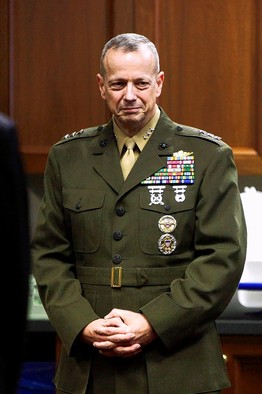
WASHINGTON—The Marine general chosen by President Barack Obama to lead the Afghanistan war raised doubts about Pakistan’s willingness to go after militants who cross the Afghan border to attack U.S. and allied troops.

In a confirmation hearing before the Senate Armed Services Committee, Lt. Gen. John Allen also said he believed that the Afghan insurgency’s momentum has been halted and even reversed in key parts of the country, and backed Mr. Obama’s troop drawdown plans.

But Pakistan, as a haven for militants, looms large over the war in Afghanistan. Gen. Allen said Pakistan continues to “hedge” against a precipitous U.S. withdrawal from Afghanistan by supporting anti-American militant groups, including the Haqqani network.

The statements were a rare public show of military skepticism about Pakistan’s intentions, reflecting the military’s increasing view that relations with Pakistan are deteriorating.

Gen. Allen, deputy commander of the U.S. Central Command, argued that it would be ultimately in Islamabad’s interest to expel militant groups from their sanctuaries in Pakistan.

“We will encourage and will continue to encourage our Pakistani friends to bring pressure to bear upon those safe havens,” he said. “It’s not just good for the outcome of our strategy and for the president’s vision on the outcome in Afghanistan; it’s good for Pakistan as well.”

Appearing alongside Gen. Allen, Adm. William McRaven, nominated to lead Special Operations Command, also said Pakistan is unlikely to move against the frontier militant havens anytime soon.

The admiral oversaw the Navy SEAL team that last month killed Osama bin Laden at his hideout in a Pakistani garrison town.

The officers’ testimony shined a light on the fragile state of U.S.-Pakistan relations, which have grown combative in the wake of the bin Laden raid.

Military leaders have made plain they are displeased with the declining cooperation by Pakistan, but insist the U.S. can’t walk away from the relationship.

“We’re giving them $4 billion,” said Sen. Scott Brown (R., Mass.). “And yet sometimes we don’t know if they’re in or they’re out, are they with us or [are] they not?”

After Adm. McRaven said Taliban leader Mullah Mohammad Omar is likely hiding in Pakistan, Sen. Lindsey Graham (R., S.C.) demanded Pakistan hand him over.

Pakistani officials have said limited military capacity—not lack of will—is inhibiting their operations against militant groups.

Gen. Allen said he backs President Obama’s decision to pull 10,000 troops out of Afghanistan this year, and the remaining 23,000 surge troops by the end of next summer. After the drawdown, the U.S. would still have 68,000 troops in the country, he said.

But he acknowledged that the military didn’t recommend a drawdown schedule as aggressive as the one Mr. Obama chose.

Under questioning from Sen. Joe Lieberman (I., Conn.), a critic of the Obama administration’s drawdown plan, Gen. Allen suggested that if conditions deteriorate he would advise Mr. Obama to alter the plan.

“It is my responsibility to the chain of command and to our commander-in-chief to ensure—should I be concerned about the progress or the execution of the campaign—that I so advise the chain of command,” he said.

Neither the Afghan Taliban nor the Haqqani network has directly targeted the Pakistani government. And Islamabad remains wary of a hasty U.S. withdrawal and sees the militant networks as potential future allies in Afghanistan.

Gen. Allen said even as troops leave Afghanistan, the military would continue to implement its current counterinsurgency strategy, which is aimed at protecting civilians from the insurgents while helping the government extend its reach and legitimacy.

Sen. Graham asked if Gen. Allen would have enough forces to continue that strategy, which requires large numbers of troops to secure population centers.

“How can we maintain counterinsurgency if all the surge forces have gone?” Sen. Graham asked.

The End of AfPak

By Scott Malcomson for The New York Times

Remember how after 9/11, Osama bin Laden’s attacks on us could be linked to almost anything, from shopping habits to the rediscovery of Western values to carbon-pricing schemes? Something similar appears to be happening with Bin Laden’s death. Jihadism sure isn’t what it used to be. After 10 years, it seems, the time has come to go home. Troops are and will be coming back to the United States from Iraq and Afghanistan. The military budget will be cut. The outgoing secretary of defense feels able to openly mock NATO because, presumably, he thinks he can afford to — because it doesn’t matter all that much. The global war on terror is being downgraded from Armageddon to something more out of Leviticus: a tricked-out police action, just as John Kerry, in this magazine, always said it should be. On Sunday, Helene Cooper and Mark Landler reported that “American success in the counterterrorism campaign would seem to bolster arguments for a swift withdrawal from Afghanistan.” By Tuesday morning, they were reporting that President Obama would announce his withdrawal plans on Wednesday. Meanwhile, a Harris poll revealed that 51 percent of Americans and 54 percent of Britons believed “the death of Bin Laden meant it was time to bring troops from their countries home.”

That isn’t quite how it looked when I was in Washington a few weeks ago and spoke with about a dozen current and former American officials and with Pakistanis. The impression they each gave was that American withdrawal would be speeded not because of Bin Laden’s death but because of Pakistan’s reaction to it. After the initial shock, Pakistan’s (government-influenced) press latched onto a narrative of “national humiliation” as a result of the American raid, rather than, say, one of jubilation at the demise of a killer whose fantasies have brought Pakistan nothing but misery. A younger generation of military officers — Pakistan is dominated by its military — seemed at times about to revolt in reaction to the insult to Pakistan’s sovereignty. And the Inter Services Intelligence (I.S.I.), Pakistan’s ubiquitous military intelligence outfit, reacted, as was subsequently reported, by scouring the neighborhood around Bin Laden’s house for … evidence of how the C.I.A. found out he was there, and to determine who had been helping the Americans.

Finally, the Pakistan government did not respond to the Bin Laden raid by pressing its new advantage and rolling up terrorist networks across the land. No, it did not do that at all. So Secretary of State Hillary Rodham Clinton and Admiral Mike Mullen, chairman of the joint chiefs of staff, went to Islamabad and on May 27 presented a list of demands. These included the arrest or elimination of Ayman al-Zawahiri (of Al Qaeda), Ilyas Kashmiri (a long-sought semi-free-agent and former Pakistani military man), Sirajuddin Haqqani (of the AfPak-border based Haqqani network) and Atiya Abdur Rahman (Al Qaeda), and the shutting down of bomb factories in Pakistan.

By June 3, Kashmiri was dead. But this promising start now seems isolated. The other wanted men are still at large. The bomb-makers might well be getting tipped off. The revolt by younger Pakistani officers seemed only to get worse.

In short, the U.S. and Pakistan are really not getting along. Among members of Congress, beating up Pakistan has become ritualized; Senators McCain and Rogers were doing it again on the Sunday programs. I wondered: How many times can Pakistan be abandoned? As Bruce Riedel, a former C.I.A. officer and the head of President Obama’s first major AfPak review, shows in his excellent new book, “Deadly Embrace: Pakistan, America and the Future of Islamist Jihad,” embrace and abandonment have formed the pattern of American-Pakistani relations since the majority-Muslim nation was formed out of the breakup of British India in 1947. Harry Truman’s lack of interest yielded to Dwight Eisenhower’s enthusiasm for Pakistan as an anti-Communist bulwark and a base for spying on the Soviets. The relationship was and remained built around security and intelligence. Lyndon Johnson reversed course when India and Pakistan went to war in 1965; he cut off both, but Pakistan had, unlike India, been a strong ally, and it felt betrayed. This set the pattern: ultimately, Pakistan was tactical and India was strategic.

Now, after almost 10 years of intense engagement, Pakistan and the U.S. appear set for another split; at least that was the consensus among the officials I spoke with. There was a pervasive sadness in these conversations. It was due in part to the sheer human effort that has gone into the U.S.-Pakistan relationship. A lot of spies and soldiers and diplomats and politicians have put years of their lives into making “AfPak” work, which requires making Pak work. A lot (not all) of that effort seems to be going down the drain, along with much of the billions of taxpayer dollars that financed it.

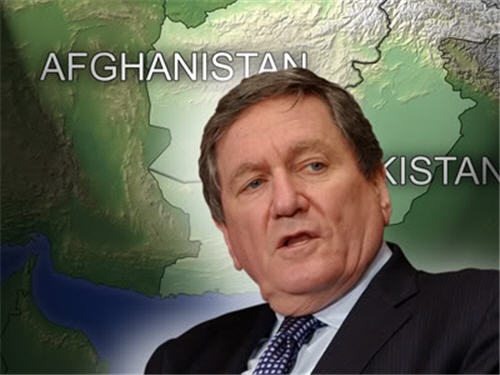
There is also personal sadness in that the AfPak effort was associated toward the end with Richard Holbrooke, whose death late last year brought the foreign-policy world up short. Holbrooke did not take great care of himself, so objectively his death could not be entirely a surprise, and among people over 70 the reactions I heard were more of the well-what-did-you-expect variety. But in the 35-to-65 range it was different. Holbrooke represented, very attractively, the assertion of youth and hope against experience. Even at 69 he had a distinct eagerness, even boyishness, alongside the baritone gravitas. He attracted bright young people. He could be young and old at the same time. Once he was gone, that sort of generational bridging disappeared. (Older figures are few in this administration.) The sense of continuity (as well as of optimism) is weakening. There’s something missing now.

There was also a sense of ideological loss of direction. For all their differences, Bill Clinton and George W. Bush shared a tangible optimism about American governmental involvement abroad. President Obama is different, and even if he weren’t the national mood is. The people’s representatives in Congress are vying to bring troops home faster, and if there is an internationalist remaining in the House he or she is keeping quiet. The Republican candidates for president seem to have settled on anti-war isolationism as a winning position. Obama’s great strength in foreign policy — his ability to repackage, and optimize, American power in a multipolar world — is the strategy that dare not speak its name, or it will bring accusations of “declinism.”

Finally, there is the tremendous sadness of Pakistan itself. The country doesn’t have enough water. It lacks the electricity to develop its industries. Literacy, by some reckonings, is actually declining. Democracy has been restored but the government is hardly stable. The one truly semi-stable institution, the military, is struggling against itself, just as Pakistanis are dividing, and attacking each other on an increasing scale (which is saying something).

But, in a way, the saddest thing of all, from a foreign-policy point of view — Pakistani or American — is that the one great card Pakistan has to play is to make itself a problem. Pakistan formed itself into a regional player through building its army, running terrorist proxies in Kashmir and Afghanistan, indulging in enough Islamist millenarianism to make itself frightening, and developing nuclear weapons. None of these strategies have a good future. But in the absence of a long-term committed relationship — what Holbrooke promoted as a “strategic partnership” — with the United States or, perhaps, with China, Pakistan is left with fear as its most successful export.

There was some discussion in Washington as to whether Mullah Omar’s name was on that list that Clinton and Mullen presented in Islamabad. It almost doesn’t matter. The doubt itself is the message: Pakistan stays valuable because it has terrorist “ties” or “links” or “proxies” or whatever. As national existential dilemmas go, Pakistan’s is particularly nightmarish. The U.S. will leave them to it — abandonment again — and choose the happier relationship with India. Secretary Clinton will be at the regional forum of the Association of Southeast Asian Nations in late July, helping to take her longtime initiative of eastward Indian engagement, and the integration of the United States into East Asian political structures, to a new level. This is part of a long-term strategy of accommodating the rise of China and of India.

And Pakistan, after 10 years, will be left behind; as the line in Washington goes, “There is no good solution.”

Suspicions Rise as Pakistan Bomb Labs Empty Before Raids

By Thom Shanker for The New York Times

For the second time this month, bomb-making factories in Pakistan were evacuated shortly after American intelligence officials notified Pakistani security forces of their existence, fueling suspicions that such intelligence is being shared with insurgents.

It remains unclear whether the evacuations — four of them in the past month alone — were the result of deliberate or inadvertent leaks or were planned in advance of the intelligence sharing as part of a mobile production operation.

But the disclosure, which appeared in an article by The Associated Press over the weekend, prompted senior members of Congress on Sunday to accuse Pakistan of playing a double game by aiding the United States on some counterterrorism operations while also maintaining ties to violent, extremist organizations operating from its territory.

The comments, by legislators who specialize in intelligence matters and military affairs, were just the latest expression of distrust between Washington and Islamabad after a series of bruising episodes, notably the secret American raid that killed Osama bin Laden.

However — as with everything having to do with Pakistan, terrorism and espionage — it remained unclear how or whether the militants learned of the American intelligence, which came with a request from Washington for local security forces to raid the explosives laboratories. Pakistani security forces routinely inform tribal elders before raids, in order to keep the peace with them, and it is possible that these village leaders in turn tipped off fellow Pashtuns among the insurgents.

Representative Mike Rogers, a Republican of Michigan and the chairman of the House Intelligence Committee, having returned from meetings in Pakistan last week, said Sunday on the CBS program “Face the Nation” that “I am more pessimistic coming out of this trip than I have been in the past.”

He expressed deep skepticism that the Pakistani military and the nation’s spy agency, the Inter-Services Intelligence, or ISI, were fully partners with the United States in battling terrorists and insurgents on their side of the border with Afghanistan.

“Pakistan needs to understand that there is no such thing as a good terrorist,” Mr. Rogers said. “They’re playing this very dangerous game of destabilization by having elements of the ISI and the army sympathetic to the Taliban and Al Qaeda elements.”

He was joined by Senator John McCain of Arizona, the ranking Republican on the Senate Armed Services Committee, in calling for a reassessment of American financial assistance to Pakistan.

“After all, the United States is investing billions and billions of dollars in Pakistan,” Mr. McCain said on the ABC program “This Week.” “And taxpayers have a right to have a return on that.”

He said “the most frustrating aspect of this whole issue” was ISI’s continuing relations with two insurgent organizations, the Taliban and the Haqqani network, a Taliban ally based in the Pakistan tribal area of North Waziristan. “So it seems to me that to restore our confidence in our relationship with Pakistan, they have to make certain steps,” Mr. McCain said. “And we have to sort of set up some benchmarks as to what we expect.”

All four of the bomb factories — which made improvised explosive devices, or I.E.D.’s, the largest killer of American troops in Afghanistan — were evacuated before Pakistani security forces could take action against them. Information on two of the locations, in Pakistan’s tribal areas, was shared only in the past week, and insurgents packed up and left both sites within days.

A range of senior American intelligence officials, diplomats and military officers have visited Pakistan since the May 2 raid that killed Bin Laden; the mission outraged Pakistan’s government and citizens because it was carried out without first informing the government in Islamabad.

The goal of these high-level visits has been to halt the erosion of the relationship and to offer new opportunities for cooperation. Some have described those offers as tests of Pakistan’s will to be a full partner and act on shared information to pursue terrorists and insurgents.

The Pakistan military spy agency has arrested more than 30 people who fed information about the Bin Laden compound to the Central Intelligence Agency in the months leading up to the raid, fueling further distrust between the two nations.

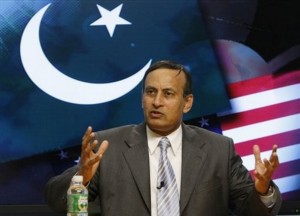
On “This Week” on Sunday, Pakistan’s ambassador to the United States, Husain Haqqani, defended the arrests. “No one is being punished,” he said, adding: “When something like this happens, you want to know what happened and how, and who was involved.”

Pakistan Aid Depends on Security Cooperation, Panetta Says

By Roxana Tiron for Bloomberg News

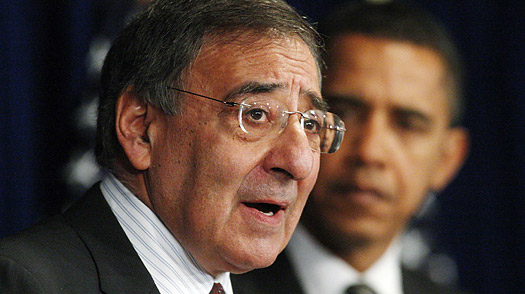
An accelerated counterterrorism campaign in the border region between Afghanistan and Pakistan is “vital” for the U.S. to defeat al-Qaeda there and prevent its return, according to CIA Director Leon Panetta, who is nominated to succeed Defense Secretary Robert Gates.

Any decisions on future U.S. security assistance “will be informed” by Pakistan’s response to the “concrete steps” the U.S. has set for counterterrorism cooperation, Panetta said in a 79-page set of answers to questions from the Senate Armed Services Committee in advance of his confirmation hearing scheduled for June 9.

Last month, the U.S. found and killed al-Qaeda leader Osama bin Laden who was hiding in a compound in the city of Abbottabad, 30 miles (50 kilometers) north of the capital, Islamabad.

The U.S. “train-advise-equip” programs with Pakistani military and paramilitary forces have been important in eliminating terrorist sanctuaries and disrupting the al-Qaeda network, Panetta said.

“It is vital, however, that Pakistan live up to its end of the bargain, cooperating more fully in counterterrorism matters and ceasing to provide sanctuary to Afghan Taliban and other insurgent groups,” he said.

Pakistan continues to lack the necessary military and civilian capacities to “hold” and “build” in areas along the border region that have been cleared of al-Qaeda forces, Panetta said.

Seeking Results

“If confirmed, I will work the Congress to ensure that the support we provide is yielding the results we seek,” he said.
Since 2009, Pakistan has undertaken counterinsurgency operations against extremist organizations in the northwest, including in Swat, South Waziristan, Mohmand and Bajaur “with varying levels of success,” said Panetta.

“Pakistan’s level of commitment is reflected in the enormous casualties it has suffered as a result of terrorism in the last few years, including more than 11,000 military personnel killed or wounded in action and more than 30,000 civilian causalities in recent years,” he said.
Panetta said that while, bin Laden’s death is a “significant blow” to al-Qaeda, the core group and its offshoots “remain a vary dangerous threat” in the region and to the U.S. homeland.

“There is a risk that decentralized affiliates may pose an increased threat to the United States,” he said
Panetta said that President Barack Obama’s Afghanistan strategy is “sound” and the U.S. has made “the progress necessary to give the President meaningful options for his decision,” on how many U.S. forces to withdraw beginning in July.
The military gains in Afghanistan are “helping to create the conditions for reconciliation,” between Afghanistan’s government and the Taliban insurgents.

Pakistan Leaders Must Make Choice After Clinton’s Warning

By The Bloomberg News Editorial Board

When U.S. Secretary of State Hillary Clinton visited Pakistan last week, she noted that U.S.- Pakistani relations were at a turning point after the killing of Osama bin Laden. It was up to the Pakistanis, she said, to decide “what kind of country they wish to live in.”

The brutalized body of investigative journalist Syed Saleem Shahzad, which turned up outside of Islamabad on May 31, may provide a clue to the answer.
Shahzad disappeared after publishing the first of two promised articles linking elements of the Pakistan navy to al- Qaeda following a deadly May 22 attack on a Karachi naval station. Last fall, after being questioned about a different story by Pakistan’s Directorate for Inter-Services Intelligence (ISI), Shahzad wrote that he was threatened by the spy agency.

Alternatively, it could be that foul play like Shahzad’s murder will become a thing of the past in Pakistan. While in Islamabad May 27, Clinton and Chairman of the Joint Chiefs of Staff Admiral Mike Mullen demanded authorities take “decisive steps” to crush the violent extremists the government has long supported, which would end the need to intimidate journalists who expose that support. Whichever way the Pakistan government goes, the May warnings by the U.S. ought to be the last.

The U.S. administration has continued to insist, as President Barack Obama did in a May 22 interview with the BBC, that the Pakistanis have “generally been significant and serious partners against the terrorist threat to the West.” This simply isn’t the case.

Victim, Sponsor

For much of the past decade, Pakistan has been both a victim and a sponsor of Islamic militants. Its soldiers are fighting bravely against homegrown terrorists seeking to install an Islamic government. In 20 attacks in May, these radicals killed some 150 people.

At the same time, the Pakistani army, led by General Ashfaq Parvez Kayani, is a longstanding patron of violent groups targeting Afghanistan and India.
Guided by excessive fear bordering on paranoia about India, Pakistan’s military and intelligence services believe that nurturing those extremists is an effective way to frustrate India’s regional ambitions. The ISI largely created and continues to support the Taliban and the Haqqani Network, the principal groups battling U.S. forces in Afghanistan and the fledgling government in Kabul. It also backs Lashkar-e-Taiba, the group responsible for the 2008 attacks in Mumbai that killed more than 160 people.

Double-Dealing

President George W. Bush’s administration tried to end this double-dealing by giving Pakistan billions in economic and military assistance. Yet Bush didn’t make the aid contingent on a crackdown on extremists. The Pakistanis cooperated somewhat with U.S. efforts to dismantle al-Qaeda but refused to act against other groups, including the Afghan Taliban, which was given refuge inside Pakistan’s borders.

The Obama administration accelerated the failed Bush policy, substantially increasing military and economic assistance, again without imposing rigorous conditions. And Pakistan continued to ignore administration warnings about continued support for extremists.
In one incident reported by the Washington Post, Obama’s first national security adviser, James Jones, warned officials in Islamabad that there would be “consequences” if a terrorist attack directed at the U.S. was traced to Pakistan. Yet when a man who had trained at a terrorist camp in that country attempted to detonate a car bomb in Times Square in May 2010, the U.S. administration did nothing. Shortly thereafter, Obama watered down Jones’s words, telling Kayani that a “successful” attack would have consequences.

Meaning Business

So when U.S. authorities learned that Osama bin Laden might be housed in a villa in a Pakistani garrison town, they dispatched Navy Seals to capture or kill him without so much as notifying the Pakistanis in advance. The raid provoked great outrage from officials in Pakistan. Since then, emotions have cooled. Clinton and Mullen have delivered their warnings, public and private. And this time, the Americans may mean business.

Will the Pakistanis respond?

Shahzad’s murder is a bad sign. On the other hand, reports from Pakistani tribal leaders suggest that the Pakistani army may be preparing a serious campaign in North Waziristan, where the leaders of the Haqqani Network and other extremist groups live.
It will soon be clear whether Clinton’s latest message got through. If not, the administration must consider new ways to persuade Pakistan to change course, recognizing that the country is behaving more like an adversary than a partner.

Al Qaeda’s Latest Loss

By Bruce Riedel for The Daily Beast

The reported death of Muhammad Ilyas Kashmiri deals a huge hit to the terror cell, still reeling from bin Laden’s killing. Ex-CIA analyst Bruce Riedel on the impact on U.S.-Pakistan relations.

Pakistani sources are reporting the death in a drone strike this weekend of Muhammad Ilyas Kashmiri. If true, it is a big setback for al Qaeda and could help ease tensions between Pakistan and the U.S. a bit.

Kashmiri is al Qaeda’s top Pakistani operative. He was born in Pakistani-controlled Kashmir on February 10, 1964. Trained in the camps of the Pakistani Inter Services Intelligence directorate (ISI) and then the elite Pakistani commando group, the Special Services Group (SSG), he was the darling of the Pakistani army for years. He fought in the war against the Soviets in Afghanistan where he lost an eye and a finger. Then he took the war to India both in Kashmir and in New Delhi itself.

He formed his own militant group called the 313 Brigade, after the 313 fighters who joined the prophet Muhammad in an early Islamic victory. His exploits in India were legendary. He was personally decorated and thanked by the then head of Inter-services Intelligence (ISI), Mahmud Ahmad and Pakistani’s dictator, Pervez Musharraf, in 2000. But Kashmiri broke with his ISI and army friends in 2002 when Musharraf decided to give the Americans at least some help against al Qaeda.

Kashmiri took his 313 Brigade into al Qaeda’s camp and assisted in training Taliban fighters in Afghanistan and began targeting his former friends in the ISI. His teams killed at least one senior ISI officer. He was involved in an attempt to assassinate Musharraf in 2004. The United Nations credits him as a key player in the plot to murder former Prime Minister Benazir Bhutto in December 2007.

The Pakistani American David Headley, who has confessed to plotting the Mumbai terror attack in November 2008, says Kashmiri was his key contact in al Qaeda. The two worked on a plot to attack a Danish newspaper office in Copenhagen in 2009. That was foiled when the FBI arrested Headley, but Kashmiri continued planning to carry out Mumbai-style attacks in Europe. Another was foiled in Denmark at the end of 2010. Kashmiri would have played an important role in helping al Qaeda recover from bin Laden’s demise. He had key connections inside the Pakistani syndicate of terror groups.

Just last week one of Pakistan’s best investigative reporters Syed Salam Shahzad was murdered after finishing a new book on al Qaeda in Pakistan. According to excerpts published in India and Pakistan, Shahzad had evidence Kashmiri may have been the real brains behind the Mumbai plot and hoped it would precipitate an Indo-Pakistani war that al Qaeda could exploit.

This is not the first time Kashmiri has been reported killed by a drone attack; he has reappeared after claims of his demise. But if this time he is dead, it is a significant setback for al Qaeda just a month after American commandos killed Osama bin Laden. Kashmiri would have played an important role in helping al Qaeda recover from bin Laden’s demise. He had key connections inside the Pakistani syndicate of terror groups with both the Afghan and Pakistani Taliban and Lashkar-e-Taiba, and with al Qaeda operatives in Europe and fund raisers in the Persian Gulf. And he had penetrations deep inside the Pakistani army and ISI.

So both Washington and Islamabad will be glad to see him gone. Kashmiri’s demise won’t solve all the problems in the tortured American relationship with Pakistan by any means but it will help.

Of course, if Kashmiri is not dead and reappears yet again unscathed, it will only add to his credentials. Bin Laden benefited enormously from surviving the cruise missile attack that targeted him in 1998. Recriminations could damage the Pakistani-American relationship further. Nonetheless those are risks worth taking. In either case we will know soon. Al Qaeda is quick to eulogize its martyrs. If Kashmiri’s dead, they will say so.

-Pakistanis for Peace Editor’s Note– Good Riddance!!!

Pakistani Journalists Defiant at Reporter’s Burial

As Reported by The Associated Press

A Pakistani reporter who investigated terrorism and was found slain after telling a rights activist he’d been threatened by intelligence agents was buried Wednesday. Fellow journalists vowed his killing would not silence them.

Syed Saleem Shahzad wrote for the Asia Times Online and other publications. He delved into topics that were often sensitive in Pakistan, where journalists face threats from insurgents as well as a security establishment that operates largely outside the law.

“We will not shut our voices down,” said Azhar Abbas, a prominent Pakistani journalist. “The journalist community is united on this. We will not stop ”

Pakistan was the deadliest country for journalists in 2010, with at least eight killed in the line of duty, according to the New York-based Committee to Protect Journalists. Six died in suicide attacks, the group said in a report late last year.

Despite the dangers, the media establishment in Pakistan has expanded rapidly over the past decade, and reporters here operate with tremendous freedom compared with many other developing countries.

In recent weeks, the media have carried unusually scathing coverage about the security establishment after it was caught unawares by the May 2 U.S. raid that killed al-Qaida chief Osama bin Laden in a garrison city in Pakistan’s northwest.

Shahzad’s death could heighten the criticism, though commentators are being careful about how they discuss the alleged link to spy agencies.

After disappearing Sunday from Islamabad, Shahzad’s body was found dozens of miles outside the capital on Tuesday, bearing signs of torture, police said. His death drew numerous condemnations, including from U.S. Secretary of State Hillary Rodham Clinton.

The 40-year-old was buried in his hometown, Karachi, as hundreds of friends, relatives, political figures and fellow journalists mourned.

Sindh province Information Minister Sharjeel Memon called the killing a “cowardly act” and promised that those responsible would be brought to justice. But it’s unclear how much the weak civilian government can do if, as some suspect, Pakistani security agencies played a role.

A spokesman for Pakistan’s premier spy agency, Inter-Services Intelligence, called the allegations “absurd.” He spoke on condition of anonymity because he was not authorized to speak to media on the record.

However, Ali Dayan Hasan, a researcher with Human Rights Watch, said Shahzad had told him that he feared Pakistani intelligence agents were after him.

The agencies pressured him to reveal his sources in October after he wrote a story about Pakistan allegedly freeing a detained Afghan Taliban commander, according to an email Shahzad sent Hasan. Hasan said Shahzad was still worried in recent weeks, but kept up his reporting.

Just last week, Shahzad wrote a story about alleged al-Qaida infiltration of the navy. The report came after a 17-hour insurgent siege of a naval base in Pakistan’s south added to the recent humiliations suffered by security agencies.

Within days, Shahzad vanished, and his wife contacted Hasan as her husband had instructed in case he disappeared.

In a statement, Clinton said Shahzad’s reporting “brought to light the troubles extremism poses to Pakistan’s stability,” and said the U.S. supports the “Pakistani government’s investigation into the circumstances surrounding his death.”

U.S., Pakistan, Through Thick and Thin

By Gerald F Seib for The Wall Street Journal

One diplomat long involved in the tempestuous U.S.-Pakistan relationship likens it to a Catholic marriage: There may be problems, but divorce isn’t an option.

And so it is that, almost a month after U.S. Navy SEALs entered Pakistan to kill Osama bin Laden, the two troubled partners find themselves not in divorce court but in an awkward but unmistakable process of reconciliation.

Signs of healing are popping up. Despite its anger and embarrassment at being left in the dark about the bin Laden raid, Pakistan’s intelligence service has begun cooperating again on a series of sensitive matters. Meanwhile, Secretary of State Hillary Clinton and Joint Chiefs of Staff Chairman Mike Mullen have just held the obligatory kiss-and-make-up talks in Pakistan, which U.S. officials describe as blunt but useful in moving forward.

And despite widespread anger in Congress over Pakistan’s harboring, either willfully or unknowingly, the world’s leading terrorist, Obama administration officials seem to be squelching the desire to extract revenge by cutting Pakistan’s aid.

There remains the danger of a rupture, and there still could be long-term damage. Street-level anger on both sides means the relationship can’t stand too many more shocks just now.

In particular, it seems likely that one result of the trauma will be a scaling back of the drone wars—America’s use of armed drones to launch strikes inside Pakistan to attack operatives of the Taliban movement fighting U.S. forces next door in Afghanistan.

The drones likely will continue to be used against top Taliban leaders when found, but less often against lower-priority targets, and probably under new and clearer rules of cooperation with the Pakistanis, say those familiar with the effort.

Still, the reality is that the two countries don’t have much choice but to move on. Regardless of how much love is flowing at any moment, they simply need each other.

The American war against al Qaeda globally and against Taliban insurgents in Afghanistan simply can’t be won without the cooperation of Pakistan. Much as Americans are infuriated by the way elements of Pakistan’s government and intelligence service hedge their bets by playing both sides in the struggle against extremism, there’s no doubt that Pakistani intelligence has been crucial in the fight.

For its part, Pakistan has, in its fit of pique over the bin Laden raid, made its best show of playing the China card to demonstrate to the U.S. that Pakistanis can find good, powerful friends in Beijing if Americans don’t treat them better. By coincidence, this has been proclaimed, officially by the two countries, the year of China-Pakistan friendship, which is a useful card for Pakistan to play right now.

But Pakistan’s post-raid overture showed the limits of the China option as much as anything else. Pakistani Prime Minister Yousuf Raza Gilani made a four-day trip to China soon after the bin Laden operation, and came away with a Chinese pledge to speed up delivery of some previously promised fighter jets.

Mr. Gilani’s other takeaway from his visit promptly proved dubious. His defense minister announced that Pakistan had invited China to take over management of a big Pakistani port at Gwadar, and to build a new naval base there. In response, the Chinese said, essentially, “We have no idea what you’re talking about.” Whatever was discussed, it appears to be less than originally advertised.

Pakistanis as well as Americans know China has its limits as an alternative big-power friend for Islamabad. American aid can’t easily be replaced, and China doesn’t tend to dole out assistance easily. Meanwhile, the U.S. is the top market for Pakistani exports, while China ranks fifth. China’s big textile industry actually is a key international competitor to Pakistan’s own textile sector.

Ultimately, the Chinese are less likely to be helpful to Pakistan in the war against extremism than will the U.S. China tends to use partnerships abroad to solve its problems, not to help friends solve theirs.

In the meantime, real and meaningful steps have resumed in the U.S.-Pakistani intelligence relationship. Pakistan has allowed American officials to speak with the bin Laden wives found in his compound. It has returned the tail section of a U.S. helicopter lost in the raid; there was stealth technology embedded in it—technology the U.S. feared an angry Pakistan might instead share with China.

And Pakistan has agreed to allow American officials into the bin Laden compound to search for more intelligence on al Qaeda operations run from there.

The U.S. now seeks more help in fighting the Taliban inside Pakistan, and there will be a three-way American-Afghan-Pakistani meeting to discuss Afghanistan next month.

All isn’t bliss between Washington and Islamabad—not by a long shot—but those aren’t the actions of partners headed their separate ways.

U.S.-Pakistan Ties And The Curse of Secrecy

By Myra MacDonald for Reuters

When President Barack Obama telephoned Pakistan’s president to say U.S. forces had found and killed bin Laden, he offered him a choice. He could say Pakistan helped find bin Laden, or that it knew nothing, according to a senior western official. Pakistan initially chose to stress the former – that it had helped – but later shifted to condemning what it called the U.S. violation of its sovereignty.

The story illustrates the complicity between the United States and Pakistan in their deliberately ambiguous relationship. This ambiguity has its uses. It allows Washington to keep working with Pakistan in the face of angry questions at home about why Osama bin Laden was living there. And it lets Pakistan cooperate with the United States, for example on drone attacks, while trying — not particularly successfully — to minimize the domestic backlash.

But the result of that ambiguity has been a disconnect between the leadership of both the United States and Pakistan and their own people, who have little knowledge of the understandings being reached in the many high-level meetings between the two countries (and which will continue despite the deep distrust on both sides.)

As Christine Fair says in her interview with NBR, ”the Obama administration has had no illusions about Pakistan.” When it took office, it had full knowledge of Pakistan’s reluctance to eradicate militant groups, and indeed of the rapid expansion of its nuclear programme. But she added, “the Obama administration, like past administrations, has been willing to look the other way when it deems necessary.”

And for all the furious debate in both countries about the state of U.S.-Pakistan relations, “the leaderships of both countries know that they need each other in ways that are both humiliating and difficult to explain to publics that are ever more outraged and appalled by the perfidy of the other.”

The problem with this pattern of public fury and private reconciliation is that it leaves very little room to build trust between the two countries and almost no scope for properly informed public debate. Some secrecy is of course needed in war and diplomacy. But with the United States and Pakistan, it has become the automatic default position.

This secrecy and complicity did not just start with bin Laden and drone strikes. It goes way back to U-2 spy planes flying over the Soviet Union – Gary Powers, shot down in Russia in 1960, took off from Peshawar. It goes back to the jihad against the Soviet occupation of Afghanistan from 1979-1989, when Washington knew Pakistan would be forced to lie to the Soviet Union about its involvement for fear of inviting Russian retaliation on its own soil. It goes back to the United States turning a blind eye to Pakistan’s expanding nuclear weapons programme in the 1980s.

The United States is now talking about establishing new ground rules for the U.S.-Pakistan relationship. So how about introducing some openness into those new ground rules?

Consider one example where transparency just might be less damaging than secrecy.

The United States, which has begun tentative direct talks with representatives of the Taliban, wants Pakistan to facilitate the process of reconciliation. So does Pakistan (though they may not see eye-to-eye on how it should work.) As far as I understand from conversations with officials from various countries, including from Pakistan, these talks are not about reaching a straight-forward power-sharing agreement with the Taliban that would allow U.S. troops to leave Afghanistan. Rather they are one part of a wider and complex process meant eventually to bring all Afghan parties into a broad political settlement.

Yet such is the secrecy around the talks that there is a serious risk that if enough people believe the Taliban are about to return to power, their opponents will prepare for civil war, building up arms and funding in a way that makes this a self-fulfilling prophecy.

As Ronald Neumann, a former U.S. ambassador to Afghanistan, writes here about his visit to the country in March, “there is a desperate need to clarify U.S. intentions. From President Hamid Karzai to his opponents to non-political Afghans, I found everyone asking what our long-term goals are. Afghanistan is a traumatized nation after 30 years of conflict. Doubts about American intentions lead to conspiracy theories, hedging strategies and even talk of civil war if too much haste to reach a political settlement means the Taliban could be returned to power — something that many Afghans who suffered under the Taliban’s savage rule are determined to resist at all costs. ”

I have written before that there is rather greater strategic convergence between the United States and Pakistan than appears on the surface. Both want stability in Afghanistan. Pakistan – rather than wanting to reinstall a Taliban government in Kabul – has been insisting for a while it wants a stable and neutral Afghanistan. Both the United States and Pakistan want stability in Pakistan- such a statement of the obvious that it is often overlooked.

Meanwhile, India – always the elephant in the room in discussions about Pakistan – has begun a slow but steady attempt at peace-making – its focus nowadays being very much on doing what it takes to build its economy. Pakistan desperately needs to salvage its own economy – a view, analysts say, also promoted by army chief General Ashfaq Pervez Kayani, who sees the country’s security as coming from its economic strength. If a political settlement in Afghanistan and an India-Pakistan thaw were to open up trade across the region, all three countries would benefit and the gain of one would not necessarily be at the expense of the other (this idea at the moment is largely aspirational – but the fact that it is on the table at all shows how much times have changed.)

So arguably, both the United States and Pakistan are roughly on the same page on what needs to happen. Yet their relations are a tactical and emotional disaster. Those long decades of secrecy have not helped. As Najam Sethi wrote in his column, the “carefully contrived and mutually agreed ambiguity has now run aground.”

If something needs to change in the U.S.-Pakistan relationship, there is one approach that has not been tried yet. Try breaking that habit of confining neary everything to secret understandings between military and political leaderships, and instead trusting the people of the countries affected — and that includes Afghanistan — to have a properly informed debate about what is the best way to bring stability to the region.

Pakistan Shuts Down U.S. ‘Intelligence Fusion’ Cells

By David S Cloud for The Los Angeles Times

In a clear sign of Pakistan’s deepening mistrust of the United States, Islamabad has told the Obama administration to reduce the number of U.S. troops in the country and has moved to close three military intelligence liaison centers, setting back American efforts to eliminate insurgent sanctuaries in largely lawless areas bordering Afghanistan, U.S. officials said.

The liaison centers, also known as intelligence fusion cells, in Quetta and Peshawar are the main conduits for the United States to share satellite imagery, target data and other intelligence with Pakistani ground forces conducting operations against militants, including Taliban fighters who slip into Afghanistan to attack U.S. and allied forces.

U.S. special operations units have relied on the three facilities, two in Peshawar and one in Quetta, to help coordinate operations on both sides of the border, senior U.S. officials said. The U.S. units are now being withdrawn from all three sites, the officials said, and the centers are being shut down.

It wasn’t immediately clear whether the steps are permanent. Adm. Mike Mullen, chairman of the Joint Chiefs of Staff, flew Thursday to Pakistan for a hastily arranged meeting with Gen. Ashfaq Kayani, the head of the Pakistani army. A Pentagon official said the two will probably discuss Pakistan’s demands for a smaller U.S. military presence.

The closures, which have not been publicly announced, remove U.S. advisors from the front lines of the war against militant groups in Pakistan. U.S. Army Gen. David Petraeus spearheaded the effort to increase the U.S. presence in the border areas two years ago out of frustration with Pakistan’s failure to control the militants.

The collapse of the effort will probably hinder the Obama administration’s efforts to gradually push Pakistan toward conducting ground operations against insurgent strongholds in North Waziristan and elsewhere, U.S. officials said.

The Pakistani decision has not affected the CIA’s ability to launch missiles from drone aircraft in northwest Pakistan. Those flights, which the CIA has never publicly acknowledged, receive assistance from Pakistan through intelligence channels separate from the fusion centers, current and former officials said.

The move to close the three facilities, plus a recent written demand by Pakistan to reduce the number of U.S. military personnel in the country from approximately 200, signals mounting anger in Pakistan over a series of incidents.

In January, Raymond Davis, a CIA contractor, shot dead two men in Lahore who he said were attempting to rob him. He was arrested on charges of murder but was released and left the country in mid-March, prompting violent protests in several cities.

Soon after, Pakistan ordered several dozen U.S. special operations trainers to leave the country in what U.S. officials believe was retaliation for the Davis case, according to a senior U.S. military officer.

Then, on May 2, five U.S. helicopters secretly entered Pakistani airspace and a team of U.S. Navy SEALs killed Osama bin Laden and four others at a compound in Abbottabad, a military garrison city near the capital, Islamabad. The raid deeply embarrassed Pakistan’s military and inflamed anti-U.S. sentiment across the country.

Javed Hussain, a retired Pakistani brigadier, blamed the decision to close the three intelligence centers on the mistrust that has plagued U.S.-Pakistani relations in recent months. Washington’s decision to carry out the raid against Bin Laden without informing Pakistan’s security establishment brought that mistrust to a new low, he said.

“There is lot of discontent within Pakistan’s armed forces with regard to the fact they’ve done so much in the war on terror, and yet they are not trusted,” Hussain said. “Particularly after the Abbottabad raid … the image of the armed forces in the eyes of the people has gone down. And they hold the U.S. responsible.”

The two intelligence centers in Peshawar were set up in 2009, one with the Pakistani army’s 11th Corps and the other with the paramilitary Frontier Corps, which are both headquartered in the city, capital of the troubled Khyber-Pakhtunkhwa province.

The third fusion cell was opened last year at the Pakistani army’s 12th Corps headquarters in Quetta, a city long used by Taliban fighters to mount attacks in Afghanistan’s southern provinces. U.S. troops have staffed the Quetta facility only intermittently, U.S. officials said.

The closures have effectively stopped the U.S. training of the Frontier Corps, a force that American officials had hoped could help halt infiltration of Taliban and other militants into Afghanistan, a senior U.S. military officer said.

The Frontier Corps’ facility in Peshawar, staffed by a handful of U.S. special operations personnel, was located at Bala Hissar, an old fort, according to a classified U.S. Embassy cable from 2009 that was recently made public by WikiLeaks.

The cable, which was first disclosed by Pakistan’s Dawn newspaper, hinted at U.S. hopes that special operations teams would be allowed to join the paramilitary units and the Special Services Group, a Pakistani army commando unit, in operations against militants.

“We have created Intelligence Fusion cells with embedded U.S. Special Forces with both the SSG and Frontier Corps” at Bala Hissar, Peshawar, the 2009 cable says. “But we have not been given Pakistani military permission to accompany the Pakistani forces on deployments as yet. Through these embeds, we are assisting the Pakistanis [to] collect and coordinate existing intelligence assets.”

Another U.S. Embassy cable said that a “U.S. Special Operations Command Force” was providing the Frontier Corps with “imagery, target packages and operational planning” in a campaign against Taliban insurgents in Lower Dir, an area of northwest Pakistan considered an insurgent stronghold.

In September 2009, then U.S. ambassador, Anne W. Patterson, wrote in another classified message that the fusion cells provided “enhanced capacity to share real-time intelligence with units engaged in counter-insurgency operations” and were “a significant step forward for the Pakistan military.”

The intelligence fusion cell in Quetta was not nearly as active as the facilities in Peshawar, current and former U.S. officials said. Pakistan has long resisted pressure to intensify operations against Taliban militants in Quetta. The city, capital of Baluchistan, is outside the tribal area, which explains Pakistan’s reluctance to permit a permanent U.S. military presence, a U.S. official said.

Despite the ongoing tensions, Pakistani authorities have agreed to allow a CIA team to inspect the compound where Bin Laden was killed, according to a U.S. official. The Pakistanis have signaled they will allow U.S. intelligence analysts to examine documents and other material that Pakistani authorities found at the site.

A U.S. official briefed on intelligence matters said the reams of documents and electronic data that the SEALs seized at the compound have sparked “dozens” of intelligence investigations and have produced new insights into schisms among Al Qaeda leaders.