Posts Tagged ‘ Hamid Karzai ’

Obama, Karzai Strive To Project Unity, Deny Serious Differences

By Jonathan Landay for The Kansas City Star
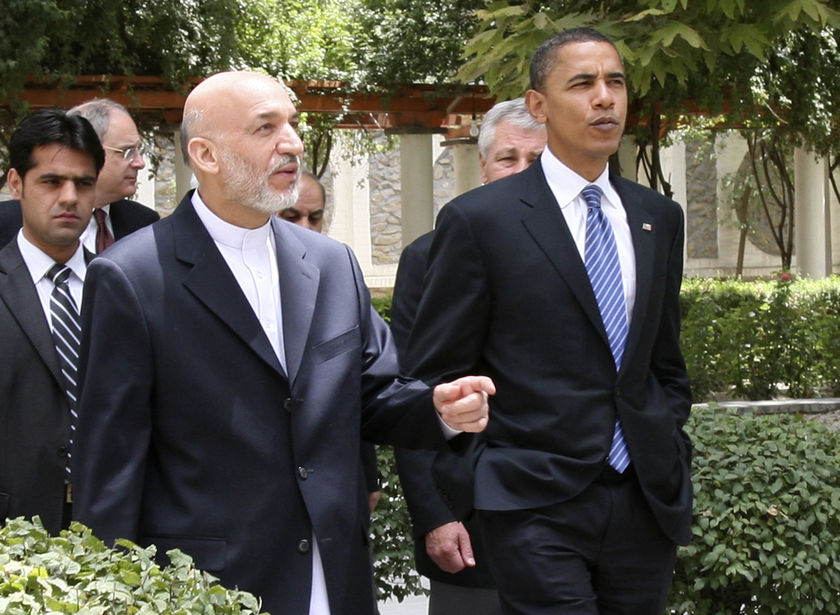
President Barack Obama and Afghan President Hamid Karzai asserted Wednesday that progress is being made toward crushing the Taliban-led insurgency, but new studies on the Afghan army and police raise serious doubts about whether the strategy can succeed before a U.S. troop drawdown begins in July 2011.

Flanked by Karzai at a White House news conference, Obama urged Americans to have patience with the “joint strategy” that he unveiled in December to stabilize Afghanistan, defeat the insurgency and prevent the country’s reversion to a Qaida sanctuary. He warned, however, that “there is going to be some hard fighting over the next couple of months.”

He apparently was referring to the summer “fighting season” that’s traditionally racked Afghanistan and that this year will see a drive to clear the Taliban from the southern city of Kandahar that’s being supplemented by an additional 30,000 U.S. troops.

The joint news conference was the public high point of a tightly scripted four-day visit in which Karzai was feted, praised and lavished with the full red-carpet treatment by the U.S. administration, which is determined to reset a relationship scarred by feuding and anti-American tirades by the Afghan leader amid record bloodshed.

The administration concluded that the tensions were an obstacle to Afghan cooperation on a number of fronts central to Obama’s strategy, especially the operations to drive the Taliban from their strongholds in the southern provinces of Helmand and Kandahar, turn them over to government control and jump-start economic development.

Moreover, U.S. officials want to reassure Karzai and ordinary Afghans – as well as regional powers that already are jockeying for influence – that the U.S. troop drawdown doesn’t mean that the United States will abandon Afghanistan as it did after the 1979-89 Soviet occupation, which was followed by a vicious 12-year civil war.

“We are not suddenly as of July 2011 finished with Afghanistan,” Obama said. “This is a long-term partnership that is not simply defined by our military presence.”

Obama and Karzai sought to present a portrait of unity, saying that progress is being made by the U.S.-led counterinsurgency campaign, by an American effort to avert civilian casualties and by Karzai on his vows to clean up narcotics-fueled corruption and boost public services, the rule of law and good governance.

“Our solidarity today sends an unmistakable message to those who would stand in the way of Afghanistan’s progress,” Obama said. “They will try to drive us apart, but we will partner with the Afghan people for the long term, toward a future of greater security, prosperity, justice and progress. And I am absolutely convinced we will succeed.”

Obama conceded that “there are going to be tensions in such a complicated and difficult environment and in a situation in which, on the ground, both Afghans and Americans are making enormous sacrifices.”

However, he said, a lot of “perceived tensions” between the sides “were simply overstated.”

“It’s a real relationship,” Karzai agreed. “It’s based on some very hard realities. We are in a campaign against terrorism together. There are days that we are happy. There are days that we are not happy.

“The bottom line is that we are much more strongly related to each other than we ever were before. That is a good message that I will take back to the Afghan people.”

U.S.-led international efforts have made considerable progress in helping to bring stability, education, health care and development to many parts of the country of 32 million people since the 2001 invasion drove the Taliban and al-Qaida leadership into neighboring Pakistan.

However, the Taliban and allied groups – aided by al-Qaida and the former Bush administration’s diversion of U.S. forces, time and money to Iraq – staged a major comeback that’s surged as U.S. commanders struggle to implement Obama’s strategy.

New reports on the Afghan army and police – each a crucial element of Obama’s plan to transfer responsibility for districts cleared of insurgents to Afghan government control as the U.S. troop drawdown begins – underscore the enormous hurdles that persist.

A report released Wednesday by the International Crisis Group, a respected conflict-prevention organization, says that the Afghan army is suffused with corruption, desertions, ethnic tensions and disputes between its highest leaders.

The report warns that Obama’s plan to expand the Afghan National Army to 240,000 troops from 90,000 by 2013 could worsen those problems and “risk the army’s disintegration after the withdrawal of international forces.”

A report by the Rand Corp. research center on the Afghan Civil Order Police, an elite unit that’s playing a key role in Helmand and Kandahar, found that the contingent is infected with the same problems of corruption and ineptitude that plague other police forces.

ANCOP members have set up checkpoints to shake down residents, been kicked out of the unit for drug use and been shunned in some areas as outsiders, according to U.S. officials briefed on the Rand Corp. analysis, who spoke to McClatchy only on the condition of anonymity because of the sensitivity of the issue.

Relations between Kabul and Washington have been brittle since Obama took office last year, shaken by U.S. criticism of Karzai’s failure to crack down on official corruption, his dubious dependability, his reliance on a patronage network of warlords and family members, and the massive fraud that marred his re-election to another term last August.

For his part, Karzai has complained about civilian casualties caused by U.S. military operations and launched tirades against the United States and his other international backers, reflecting his unpopularity among ordinary Afghans, who are angry that the war is still raging nearly nine years after the U.S.-led invasion.

“We have an interest in reducing civilian casualties not because it’s a problem for President Karzai. We have an interest in reducing civilian casualties because I don’t want civilians killed,” said Obama, who noted that the Taliban have killed more civilians.

A Pentagon report last month said the overall level of violence in Afghanistan rose 87 percent from February 2009 to March 2010. More than 1,760 international troops – including 1,068 Americans – have been killed, according to iCasualties.org, a website that tracks casualties in Iraq and Afghanistan.

Tens of thousands of Afghan security forces, officials and civilians have been killed and wounded. There are currently 102,000 troops from 46 nations, including the United States, in Afghanistan. There will be 98,000 U.S. troops there when the surge is completed later this summer.
Hamid Karzai Is Losing All His Marbles and His Credibility

By Manzer Munir for Pakistanis for Peace

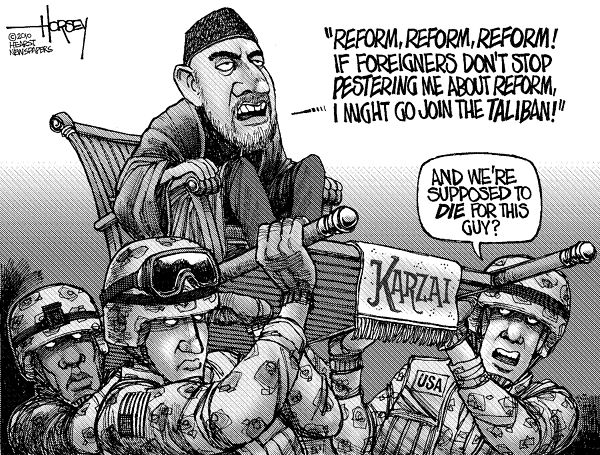
Kabul, Afghanistan- President Hamid Karzai’s troubling remarks this past Saturday that he would join the Taliban if he continues to come under pressure to reform by the United States and other ā€œoutsidersā€ has caused a stir in Washington DC. Ā Karzai’s comments came a week after President Obama’s surprise visit to Afghanistan at the end of March to pressure Karzai’s government to reform the political system, end corruption, and do a better job of fighting the Taliban.

Instead, what Karza delivered was a threat of the worse kind and quite possibly the most offensive and troubling thing one can say to a country that is risking countless soldiers lives daily to secure the country from the Taliban and other militant warlords in Afghanistan. In 8 short years, Hamid Karzai has gone from being the special guest of honor at George Bush’s State of the Union address to a leader who threatened to join our worst enemy. All because he feels that the US needs to stop badgering him to be a more responsible, fair, and an equitable leader as well as an effective partner in fighting the Taliban.

Karzai apparently made these unusual comments at a closed door meeting of lawmakers on Saturday, just days after accusing ā€œforeignersā€ presumably the Unites States of being behind the fraud of the disputed elections of 2009. ā€œHe said that if I come under foreign pressure, I might join the Talibanā€, said Farooq Marenai, a lawmaker from the eastern province of Nangarhar. Ā Mareni also stated that Karzai appeared nervous and demanded to know why parliament last week rejected legal reforms that would have strengthened Karzai’s authority over the country’s electoral institutions. Several other lawmakers confirmed that Karzai twice threatened to join the insurgency and the Taliban.

Karzai’s comments are troubling on many levels. First and foremost, he gives legitimacy and strength to the Taliban as his comments present the Taliban as an alternative option to American support or view on the situation. Karzai’s statement will no doubt have traveled the length and breadth of Afghanistan as word will spread that there is a weakness in the American-Afghan coalition that has been fighting and hunting the Taliban since October of 2001, post 9-11. The remarks by Karzai also puts every American, NATO, and Pakistani soldier at risk as instead of liberators, the foreign armies would be thought of as invaders, literally overnight. Lastly, Karzai’s remarks prove to the fact that Karzai is no longer an ally nor a credible partner for the US , NATO, and Pakistani army that have been fighting the Taliban with all their might.

There are reports of widespread nepotism, corruption, fraud, looting of the treasuries, and even drug trafficking, as Karzai’s brother,Ā Ahmed Wali Karzai, has been alleged to be a prominent figure in Afghanistan’s world leading illegal heroin production, cultivation and its global distribution. These facts along with his inability to rule effectively and assist the United States in its exit strategy out of Afghanistan by end of 2011 has made the Obama administration weary of dealing with Karzai. Also his typically slow response in instituting political and social freedoms along with a renewed focus in fighting the Taliban, has also been a factor in displeasure from Washington.

The Obama administration has refocused on the Afghan war with 30,000 additional troops to help with the war effort and that initial surge has helped the commanders on the ground in running the Taliban out of certain areas. There have also been great recent victories by the Pakistani army to go after the Taliban militants on its side of the border and in helping cut down the bases of support for the Afghan Taliban from the Pakistani tribal areas sympathetic to their cause. So these comments come at the worst possible time when the Taliban are on the run both in Afghanistan and Pakistan and a strong coalition of US-Afghan-Pakistan resistance against them could help eliminate or destroy the militants for good. But instead,Ā the US and its allies are left wondering what to do with Karzai and how much he could be trusted in this tenuous partnership against the Taliban.

Seasoned Diplomat Appointed Special Envoy to Afghanistan and Pakistan

richard-holbrooke

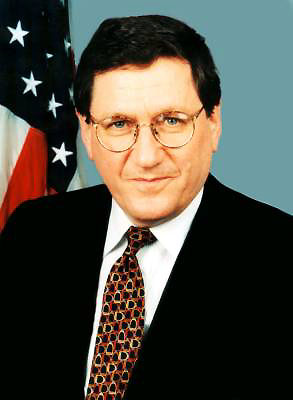
On her very first day as the new Secretary of State, Hillary Clinton called on the Prime Minister of Pakistan Asif Ali Zardari to advise him and the Pakistani government that the Obama administration has designated former US ambassador to the UN, Richard Holbrooke as a special envoy for Afghanistan and Pakistan.

A senior diplomat at the State department stated that it was a touch-base meeting between Clinton and Zardari but she also wanted to advise him that Pakistan would continue to be a crucial ally to the US and also a partner in fighting extremists in the region. It is noted that back in the 80’s the United States had appointed a similar envoy during the Afghan-Russian war and the individual had been instrumental in helping the Afghan resistance groups comprised of the mujhaideens fighters successful in repelling the Soviets with US and Pakistani backed assistance.

The US government terminated the special envoy position after the end of the war and the pullout of the Soviets but the incoming Obama administration is keen on reestablishing the important position.

Richard Holbrooke is seen as a very capable career diplomat very familiar with the two countries from his time as the American ambassador for the UN. He was also nominated 7 times for the Nobel Peace prize and is also the only person to have held the assistant secretary of state for two different regions of the world. He also was instrumental in brokering the peace agreement among the Bosnian warring factions that led to the Dayton Peace Accord in 1995. During Bill Clinton he was considered heavily for the Secretary of State position before eventually losing out to Madeline Albright as the head person in charge at the State department.

More recently he also served as a senior advisor for Hillary Clinton’s campaign for President and is seen as a close confidant of the former first lady.Ā  President Obama and Secretary Clinton have stated that the Afghanistan and Pakistan border and the situation in the two couuntries will be one of their top foreign policy concerns. The appointment of such an experience and powerful diplomat underscores this commitment by the new administration.

Pakistanis for Peace believes that the appointment of Richard Holbrooke as the special envoy to the region is a welcome sign to a region that will be a critial focus for the US and for this new president. An accomplished and well experienced diplomat such as Mr. Holbrooke will ensure that when he talks, Kabul and Islamabad are awareĀ that itĀ isĀ essentially Secretary Clinton or President Obama himself that they are conversing with and this direct link back to Washington will enable the two countries to fight the militants better. There is not just change afoot in Washington DC, the appointment of Richard Holbrook signals the arrival of a more robust and engaging US policy towards Afghanistan and Pakistan.

-ReportingĀ by Manzer Munir for Ā www.pakistanisforpeace.com .