Posts Tagged ‘ Muslim Americans ’

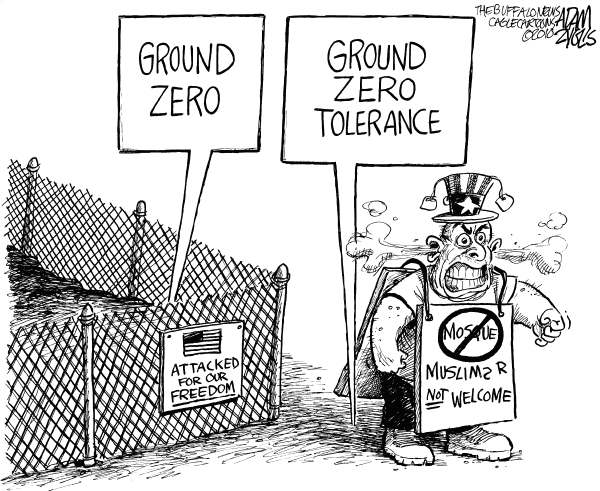
Mosque Near Ground Zero Divides Sept. 11 Relatives

By Samantha Gross for The Associated Press
Talat Hamdani traveled to Mecca to pray that her missing son, an EMT, was safe in the days after 9/11. She held out hope that his Muslim background had led to his detention as a suspect, considering it better than the alternative.

When part of his body was returned to her โ€” his lower half shattered into 34 pieces โ€” it was final proof he had indeed been killed when Islamic extremists brought down the World Trade Center. As Americans take sides over plans to build an Islamic cultural center and mosque blocks away, Hamdani says it feels personal.

“Why are we paying the price? Why are we being ostracized? Our loved ones died,” she said at her Lake Grove, N.Y., home. “America was founded on the grounds of religious freedom,” and opposition to the cultural center “is un-American. It’s unethical. And it is wrong.”

The thousands of relatives of the 2,976 victims have no single representative and no unified voice, even as another 9/11 anniversary approaches. The conflict is dividing a group that in many ways has never been united, with some saying the cultural center would reopen old wounds too close to hallowed ground and others saying that opposing it is tantamount to bigotry.
And some, like Vandna Jain, walk a middle ground.

“It is unfair to persecute the group, however, in turn, there should be some respect for the feelings of the people that are forever attached to this site due to their losses,” the New City, N.Y., resident, whose father, Yudh, died in the north tower, wrote in an e-mail. “I think people have a right to be upset about it, just as much as people have a right to build a mosque.” Jim Riches, a former New York Fire Department deputy chief whose son, Jimmy, was killed at the trade center, believes the dispute has nothing to do with religious freedom.

“We’re not telling them not to practice their religion. … It’s about location, location, location,” he said, asking why the mosque couldn’t be built farther away from the land that he still considers a cemetery. “It’s disrespectful. You wouldn’t put a Japanese cultural center at Pearl Harbor.”

Liza Murphy feels differently. Her brother, Charlie, died at ground zero, but she says she doesn’t lay claim to the sprawling, 16-acre site. “It’s a place where a terrible tragedy took place, but I don’t see what makes it sacred,” said the Brooklyn resident. “Nine years later, that now belongs to the public. And my brother and his death are private and belong to me.” Murphy says she has no objection to the planned mosque and wouldn’t want to judge one group of Muslims based on the actions of another.

But Peter Gadiel says he owes no apologies for singling one group out. Since his son, James, was killed at the trade center, Gadiel has argued publicly that all Muslims should share some collective guilt for what happened on 9/11.

“The fact is that Islam does not coexist well with other religions, and you can’t separate that from Islam,” the Kent, Conn., resident said, explaining his stand against the mosque. “If that sounds intolerant on my part, that’s too bad.” The families’ impassioned responses to the prospect of the mosque have influenced the public debate.

Gov. David Paterson has suggested moving the project further away from the trade center site out of respect for opponents’ feelings, while Mayor Michael Bloomberg came out in support of the mosque, calling it a test of the separation of church and state.
President Barack Obama has said he believes Muslims have the right to build the Islamic center as a matter of religious freedom, though he’s also said he won’t take a position on whether they should actually build it.

The imam leading plans for the center on Friday called extremism a security threat in both the West and the Muslim world. Feisal Abdul Rauf made his comments to Associated Press Television News in Bahrain during a Mideast tour funded by the U.S. State Department, but he wouldn’t discuss the uproar over the Islamic center.

Relatives of those slain on Sept. 11 have made their diverging voices heard on a number of issues over the years โ€” from whether to try the suspects in a civilian court to the location of a proposed freedom museum at ground zero that is no longer planned for the site.

Charles Wolf, who lost his wife, Katherine, at the trade center, says emotions among family members are especially raw right now.
“This is anniversary season. It’s really, really hard,” the Manhattanite said. “Passions are up and this is bringing up a lot of hurt in people.”

He says he worries that any decision to respond to public pressure and move the mosque would be used by extremists to paint Americans as intolerant.

“The powers of evil were piloting those airplanes,” he said of the Sept. 11 attackers. Now, with the mosque dispute, “here is where we’re falling into the terrorists’ trap … trying to tear each other apart. Good people fighting other good people โ€” does that sound like evil at work?”

Keith Olbermann โ€“ Special Comment, Muslim Community Center

“THEY CAME FIRST for the Communists,
and I didn’t speak up because I wasn’t a Communist.

THEN THEY CAME for the trade unionists,
and I didn’t speak up because I wasn’t a trade unionist.

THEN THEY CAME for the Jews,
and I didn’t speak up because I wasn’t a Jew.

THEN THEY CAME for me
and by that time no one was left to speak up.”
-Martin Niemรถller

“This is America damn it! And in America when somebody comes for your neighbor, or his Bible, or his Torah, or his Athiest Manifesto, or his Koran, you and I do what our fathers did and our grandmothers did, and our founders did, you and I SPEAK UP!”
– Keith Olbermann

A Pakistani American Celebrates July 4

By Manzer Munir for Pakistanis for Peace

Thousands of Pakistani Americans celebrate the July 4 Independence Day holiday with their friends and families across the United States today. As different as Pakistan and the United States may be as countries and societies, one thing they both have in common is that both countries were founded on religious reasons. Unfortunately, that is where their similiarites end as the religious freedom experienceย in these present day countriesย varies greatly.

The earliest settlers of these United States were in fact Europeans who felt persecuted in the old countries of Europe for their religious beliefs. Many of these Puritans came to America in search of religious freedom.ย  Their hope was to escape the religious persecution they were facing in their countries and so the United States was founded on religious grounds.

Pakistan too is a country that sees the basis of its founding for a religious purpose. The nationalist movement for an independent India from British rule also caused communal conflicts between the Hindus and Muslims as there were calls by many Muslim leaders for a separate country for the Muslims of India since many felt being a minority in a Hindu dominated country would come at the expense of their rights. So a separate country for the Muslims of India and for their right to practice their religion gained momentum and indeed on August 14, 1947, the Islamic Republic of Pakistan became independent, a country founded on religious freedom for the Muslims of India.

This is not to deny the fact that Muslims still exist in India and are free to practice their religion under a Hindu dominated country. In fact, there are more Muslims in India than there are in present day Pakistan. However, many Muslims at the time of partition felt that they would be freer to practice Islam in a Muslim country rather than a Hindu one. It is an open debate whether people in Pakistan today have more freedom to practice their religion. If you are a member of either a minority Muslim group as Shiite or if you happen to be a Christian, Hindu, Sikh or Jew In Pakistan today, you have far less freedom of religion than a comparable religious group in present day India. There is absolutely a very low level of tolerance in Pakistan today for other religions or ways of life different than the majority group.

The promise of religious freedom that saw the founding of both Pakistan and the United States has seen the two countries go separate ways in realizing the dream of each countries forefathers. While the American Founding Fathers dream of a nation that respects freedom of religion and honors a separation between church and state held true, Pakistan unfortunately ย has become a country thatย has becomeย intolerant of other religions. Many religious minorities such as Christians, Hindus, and even Muslim Ahmadis are routinely persecuted or attacked by Muslims who see these groups as infidels and heathens and not merely as human beings with different religious beliefs. The influx of Taliban and religious extremists inside Pakistan has further made life difficult for anyone who is not a devout Sunni Muslim. On many occasions, the police does not investigate or prosecute attacks on religious minorities by various extremist groups leading to a constant fear of their lives and properties.

As Pakistani as well as Muslim Americans across the United States today celebrate the the July 4 holiday, they are keenly awareย  that their brethren back in their original countries are not as free to practice their religion, speak their minds, and or protest peacefully as they are able to do in the United States. For this nation indeed guarantees freedom and liberty for all and not just a certain religious or ethnic group.

That is why Pakistani Americans such as myself and Muslim Americans across the US are appreciative of the fact that in this, our adopted country, our religious and civic freedoms are safe guarded in that greatest of living documents, the US Constitution. I have long felt that after the three great religious books of the Torah, the Bible, and the Koran, the US Constitution is the next best thing that man ever wrote down on paper. The Founding Fathers of America were indeed some of the greatest minds in history for crafting a document that continues to make the United States the freest country in the world and one that stayed true to its founding of liberty and freedom for all. Happy Birthday America, May you have many more!

–Manzer Munir, a proud Pakistani American plans to celebrate the July 4 Independence Day with family and friendsย at a picnic with fireworks and by watching a parade.

Muslim-Americans: Bracing For A Backlash

By Christopher Alessi for The Huffington Post

Adil Najam, a Pakistani-American professor at Boston University, took his 12-year-old son aside before sending him off to school last Wednesday. He told him to hold his head high, even if the other kids make fun of him and call him a terrorist.

In the days following this month’s attempted car bombing in Times Square by Pakistani-American Faisal Shahzad, Pakistanis and other Muslim groups in the U.S. have been taking precautions to prevent a public backlash similar to the one Muslim-Americans faced following 9/11–but they are still preparing for the worst.

“We are so grateful, thank God, that the bomb did not blow up, but the real damage here is to the Pakistani community,” Najam said. “Everyone [Pakistani-Americans] now gets ready for the office – or school – knowing he will be looked at differently.”

As a result, community leaders, such as Dr. Saud Anwar, the director of Connecticut’s branch of the Pakistani-American Public Affairs Committee, are counseling fellow Pakistanis to jump on the offensive. “We’re hoping we’re not going to be marginalized and we’re trying not to be scared, so we’re mobilizing the community to condemn the incident,” he said.

After 9/11, Anwar made a choice to be more “politically active and to build bridges with the law enforcement community.” He now works closely with the FBI and the Department of Homeland Security to help identify suspected terrorists. He has also encouraged his fellow Pakistanis in Connecticut to become more engaged with the police, in part to counter the stereotype that all Muslims are terrorist-sympathizers.

If Muslim-Americans don’t take an active approach, Anwar believes, they will only be further marginalized, which in turn will lead to increased “identity crises” and subsequent radicalization in the greater Muslim community–an arguably vicious and deadly cycle.

Najam also contends that Muslims are being “more vigilant against crackpots within their own communities,” by reporting them to the authorities. “We are trying to deal with incidents involving black sheep much better,” he said, referring to fellow Muslims that are suspected of harboring radical and violent agendas.

Both Najam and Anwar are trying to preemptively thwart the onslaught they say their communities faced after 9/11. Back then, both men argue, many Muslim-Americans felt they were put under a microscope by the mainstream American media and society at large. “There was a very high level of apprehension immediately after 9/11,” Najam said. “‘American-Americans’ – whatever that is – were apprehensive about Muslims, and we were internally apprehensive about how we were being viewed.”

Prof. Sinan Antoon of New York University believes that U.S. government policy and rhetoric following 9/11 only compounded the situation for Muslims. “The war on terror discourse and the manichaean view of a world populated by those who are with us and those others who are against us spelled danger and disaster for Arab and Muslim citizens or immigrants,” Antoon said. “After 9/11,” he added, “Arab-Americans and Muslim-Americans were all guilty by association.”

Indeed, for many ‘ordinary’ Americans – non-Muslims, or “American-Americans,” as Najam put it – ‘Muslim’ became the codeword for ‘terrorist.’ As a result, many Muslims felt forced to take responsibility for the acts of religious (and political) fanatics who happened to share the same faith.

Antoon further argues that Muslims were easily linked with terrorists after 9/11 because “terrorism was explained in cultural and civilizational terms, not in material history and politics.” “The result,” he explained, “was for the U.S. government to absolve itself of its own responsibility in supporting foreign jihadists in the 1980s…and skirt the blame to the cultural sphere and simplify phenomena and events as simply a class of cultures.”

But Najam is optimistic that things could be different this time. He believes that mainstream American society has evolved since the time period following 9/11. “Society is more adept at handling these [terrorism incidents] as acts of criminality,” he said. Most Americans, Najam argues, no longer see the actions of individuals such as Shahzad as representative of an entire cultural or religious group.

Anwar, too, is trying to remain positive. “There are over 1 million people of Pakistani heritage in the U.S., and there was one idiot that couldn’t think straight,” he said.

“I think America is better than that–blaming the whole community.”

Media Ignore The Fact That Man Who Alerted Police To Failed Times Square Bombing Is A Muslim Immigrant

By Zaid Jilani for ThinkProgress.org

The chief suspect in the case of the failed Times Square car bombing is Pakistani-American Faisal Shahzad, who has confessed to the plot. Much of the media has latched onto Shahzadโ€™s Muslim faith and his Pakistani identity, making inflammatory remarks and suggestions about Muslims and Pakistanis:

โ€“ CNN contributor and Redstate.com blogger Erick Erickson complained that the words โ€œmuslimโ€ and โ€œIslamโ€ are โ€œnot mentionedโ€ enough in stories about Shahzad. He wrote, โ€œIt really is pathetic that youโ€™re more likely to see the words โ€œracistโ€ and โ€œRepublicanโ€ together in the newspaper these days than โ€œterrorismโ€ and โ€œIslam.โ€ [5/4/2010]

โ€“ Hate radio host Neal Boortz tweeted, โ€œOMG! The Times Square Bomber is a Muslim! Shocker! Who would have believed it?โ€ [5/4/2010]

โ€“ The cover of todayโ€™s Washington Post-published Express features a black-and-white photo of Shahzad with the sensationalist headline โ€œMADE IN PAKISTANโ€ [5/5/2010]

Yet one fact being ignored in the American mediaโ€™s sensationalist narrative about the failed bombing is that the man who was responsible for police finding the bomb was Muslim. The UKโ€™s Times Online reports that Aliou Niasse, a Senagalese Muslim immigrant who works as a photograph vendor on Times Square, was the first to bring the smoking car to the policeโ€™s attention:

Aliou Niasse, a street vendor selling framed photographs of New York, said that he was the first to spot the car containing the bomb, which pulled up right in front of his cart on the corner of 45th street and Broadway next to the Marriott hotel.

โ€œI didnโ€™t see the car pull up or notice the driver because I was busy with customers. But when I looked up I saw that smoke appeared to be coming from the car. This would have been around 6.30pm.โ€

โ€œI thought I should call 911, but my English is not very good and I had no credit left on my phone, so I walked over to Lance, who has the T-shirt stall next to mine, and told him. He said we shouldnโ€™t call 911. Immediately he alerted a police officer near by,โ€ said Mr Niasse, who is originally from Senegal and who has been a vendor in Times Square for about eight years.

As the Leadership Conference on Civil Rights notes, โ€œSouth Asian, and Muslim communities may yield useful information to those fighting terrorism. Arabs and Arab Americans also offer the government an important source of Arabic speakers and translators. The singling out of Arabs, South Asians, Muslims, and Sikhs for investigation regardless of whether any credible evidence links them to terrorism will simply alienate these individuals and compromise the anti-terrorism effort.โ€

Reflecting on Niasseโ€™s good samaritanism Muslim-American author Sumbul Ali-Karamali writes, โ€œItโ€™s somewhat consoling to know that the man who first noticed the smoking Nissan Pathfinder and sought help is also Muslim, a Senegalese immigrant. โ€ฆ I grew up Muslim in this country, with Muslim friends and non-Muslim friends, and there was very little difference between the two groups. We were all American.โ€