Posts Tagged ‘ Nawaz Sharif ’

Pakistan’s Musharraf is Launching a Long-Shot, Long-Distance Bid to be President Again

By Zain Shauk for The Houston Chronicle
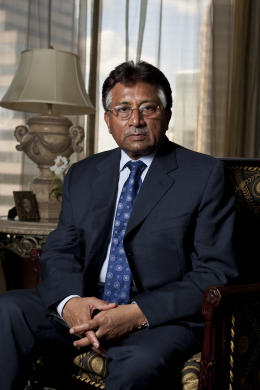
Former Pakistani President Pervez Musharraf hopes to retake the leadership of his country, and he is actively campaigning — in Texas.

Musharraf, who relinquished his presidency in 2008, has a set of Houston meetings planned this week with wealthy Pakistani-Americans and corporate leaders.

He is scheduled to meet today with former President George H.W. Bush and Joanne King Herring, a longtime advocate for development in Afghanistan and Pakistan who was played by actress Julia Roberts in the film Charlie Wilson’s War.

Musharraf, a London resident, announced this month the creation of a new political party and a plan to run in Pakistan’s 2013 parliamentary elections.

But he has kicked off his campaign in the U.S., a decision that could say more about the perceived influence of the Pakistani-American community in cities such as Houston than Musharraf’s chances for success, experts say.

Musharraf said he believes connecting with Pakistanis in America will give him enough backing — financially and politically — to carry him to victory in Pakistan.

“I do need financial support, and I would ask the American Pakistani diaspora to support me … because I see darkness in Pakistan,” Musharraf said. “Because I don’t see a political party or a leader in Pakistan to be able to tackle the problems that Pakistan is facing.”

While Musharraf enjoys backing from the Pakistani-American elite, experts say he will be hard-pressed to develop a political base within his country and likely does not stand a chance against more established parties.

He is also in no position to campaign within Pakistan. Safety is a concern after multiple assassination attempts during his presidency, and he would likely face prosecution in connection with several criminal cases currently pending in Pakistani courts, experts said.

Still, Musharraf’s interest in wooing deep-pocketed Pakistani-Americans is revealing, said Walter Andersen, associate director of the South Asia program at Johns Hopkins University.

Not only do Pakistani-Americans play a role in financially supporting candidates, but their meetings in America are covered by Pakistani news media and seem to give politicians the idea that they are gaining traction, Andersen said.

Former Prime Ministers Benazir Bhutto and Nawaz Sharif also visited U.S. communities while campaigning, he said.

“Whether it works is not important,” Andersen said. “The perception among them (politicians) is that it works.”

Wide-ranging itinerary
U.S. communities don’t play a visible role in Pakistani elections, but Musharraf could stand to gain from his current North America tour, said Jamal Elias, an expert on contemporary Pakistan and chairman of the religious studies department at the University of Pennsylvania.

Musharraf’s itinerary will include stops in Chicago, New York, San Francisco and Toronto. He visited Dallas last week.

“Appearing statesman-like is going to help him in Pakistan,” Elias said. “It’s not going to build a constituency, but it may help him.”

There are more than 75,000 people of Pakistani origin in the Houston area, which includes more than 800 doctors, executives in the energy and information technology industries and scores of business owners, according to the Consulate of Pakistan in Houston.

Many of them have in the past contributed financially to political parties in Pakistan and will likely do so again, said M.J. Khan, a former Houston city councilman and member of the Pakistani community.

Khan said he does not send money to Pakistani political candidates, but knows U.S. residents in Houston and elsewhere who do. “They’re an educated community, and they send a lot of resources to Pakistan,” Khan said. “So I think every politician in Pakistan feels the Pakistani-American community is an important group to reach out to.”

Tactics questioned
Some community members – including Sajjad Burki, president of a Houston chapter for a political party headed by Pakistani cricket star Imran Khan – were not sure of the former president’s legitimacy as a candidate. Burki questioned Musharraf’s campaign tactics and priorities.

“It doesn’t make sense for him to be creating a political party and campaigning abroad rather than campaigning in Pakistan,” he said.

Herring, who is hoping to build support for Musharraf’s candidacy, said she planned to back him because of his support for her development efforts in Afghanistan.

“I think that Musharraf is interested in my plan,” Herring said. “I know he is. He supports it.”

Seeks ‘legitimacy’
Musharraf, a retired general, said he hopes a possible election to office will give him “the legitimacy that maybe I didn’t have in the past” as someone who had seized control of the government in a 1999 military coup.

He spent much of a luncheon Tuesday discussing the threats to Pakistan created by instability and lack of development in Afghanistan. Asked how he would solve that and a host of other challenges, Musharraf paused and smiled at his audience.

“First of all, get me elected,” he said.
Clinton, With Initiatives in Hand, Arrives in Pakistan

By Mark Landler for The New York Times

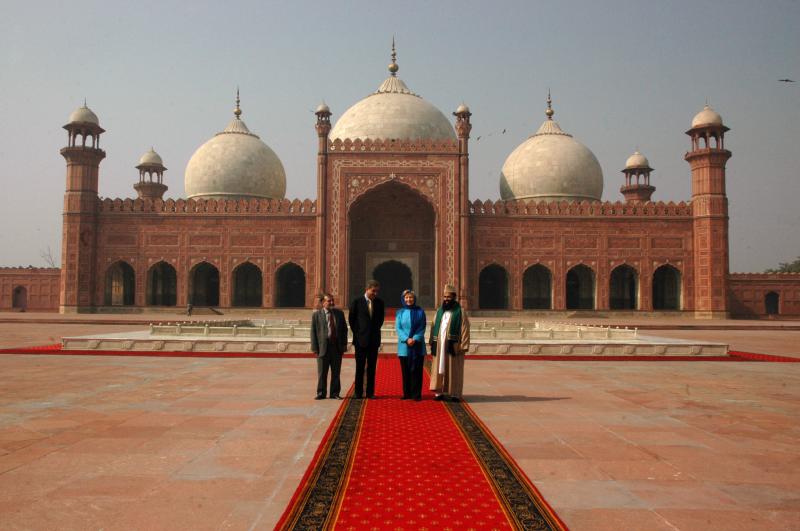
Secretary of State Hillary Rodham Clinton arrived here Sunday for high-level deliberations with Pakistani leaders, the latest in a series of encounters that the Obama administration hopes will chip away at decades of suspicion between Pakistan and the United States.

Hillary Rodham ClintonMrs. Clinton will announce a raft of initiatives to help Pakistan in public health, water distribution and agriculture, to be funded by $500 million in American economic aid. Among other things, the United States will build a 60-bed hospital in Karachi and help farmers export their mangoes.

Yet these projects, however beneficial to this economically fragile country, do not disguise several nagging sources of friction between the two sides. American officials still question Pakistan’s commitment to root out Taliban insurgents in its frontier areas, its motives in reaching out to war-torn Afghanistan and its determination to expand its own nuclear program.

Pakistan plans to buy two nuclear reactors from China — a deal that alarms the United States because it is cloaked in secrecy and is being conducted outside the global nonproliferation regime. Administration officials said they did not know if Mrs. Clinton planned to raise the purchase.

Relations could be further tested if the Obama administration decides to place a major Pakistani insurgent group, the Haqqani network, on the State Department’s list of terrorist organizations. Islamabad maintains ties to the group through its intelligence service, and it is seeking to exploit those connections as a way to extend its influence over Afghanistan.

For all that, tensions between the two sides have ebbed since Mrs. Clinton’s last visit here in October, when she was peppered with hostile questions in public meetings and bluntly suggested that people in the Pakistani government know the whereabouts of Osama bin Laden and Mullah Omar.

“We needed to change the core of the relationship with Pakistan,” said Richard C. Holbrooke, the special representative to Afghanistan and Pakistan. “The evolution of the strategic dialogue, and the fact that we are delivering, is producing a change in Pakistani attitudes.”

Mr. Holbrooke noted a U-turn in Pakistan’s policy on issuing visas to American diplomats. For months, Pakistani officials had held up those applications, creating a huge backlog and frustrating the United States. But Pakistan issued 450 visas in the last five days, he said.

Mr. Holbrooke conceded that public-opinion polls toward the United States had yet to show much of a change. Mrs. Clinton may receive more criticism on Monday at a town-hall meeting in Islamabad. Her visit, which was not announced due to security concerns, is being conducted under tight security.

Vali Nasr, a senior advisor to Mr. Holbrooke, said it was unrealistic to expect “to change 30 years of foreign policy of Pakistan on a dime.” But he said, “On foreign policy issues, we’re seeing a lot more convergence.”

The United States is encouraged by the burgeoning dialogue between President Hamid Karzai of Afghanistan and Pakistani leaders, including the chief of the staff of the army, Gen. Ashfaq Parvez Kayani. Any resolution of the war, Mr. Holbrooke said, must involve Pakistan.

While American officials would like to see a more aggressive Pakistani military push in North Waziristan, the stronghold of the Haqqani network, they praise the military’s campaigns in South Waziristan and the Swat Valley, where Taliban insurgents had also made gains.

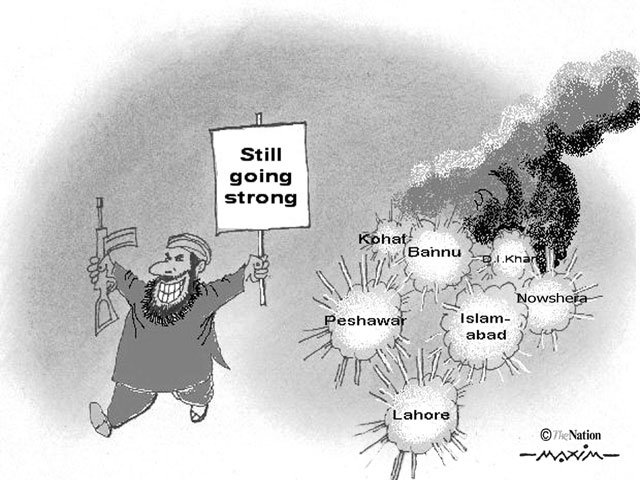
Pakistan’s battle against insurgents has exacted a fearful civilian toll. Last week, a suicide bomber killed 45 people, and injured 175, in an attack on a 1,000-year-old Sufi shrine in Lahore. Many Pakistanis blame the American-led war in Afghanistan for fomenting anti-Pakistan terrorism.

A coalition of protest groups issued a statement Sunday, timed to Mrs. Clinton’s arrival, which calls for an end to the war in Afghanistan and for Americans and Pakistanis who are involved in clandestine air strikes on Pakistani targets to be tried for war crimes.

Mrs. Clinton is to meet General Kayani on Monday, after meetings on Sunday with President Asif Ali Zardari and Prime Minister Yousaf Raza Gillani. She was also scheduled to meet Pakistani business leaders and the head of the Pakistani opposition, Nawaz Sharif.

Mrs. Clinton has brought a shopping-bag full of commitments for Pakistan, drawn from the $7.5 billion in non-military aid, over five years, pledged by Congress last year. The emphasis is on basic services like electricity and water, politically-charged issues in this country, particularly during the hot summer.

“Our commitment is broad and deep,” said Rajiv Shah, the administrator of the United States Agency for International Development, who is with Mrs. Clinton. “We will not do what we’ve done in the past.”

Administration officials said the project to upgrade Pakistan’s creaky power grid, which involves building hydroelectric dams and rehabilitating power plants, had helped reduce chronic power outages. But on the day Mrs. Clinton landed, television reports here warned of further outages.

Government in Pakistan Calls Meeting on Terrorism

By Jane Perlez for The New York Times

In an unusual sign of accord between the two major political parties, Prime Minister Yousaf Raza Gilani announced over the weekend that the government and the opposition would hold a national conference on ways to combat terrorism.

The announcement came days after 42 people were killed and hundreds were wounded when two suicide bombers struck the famed Sufi shrine Data Darbar on Thursday night in Lahore, the capital of Punjab Province.

The attack incited street protests in Lahore on Saturday, and it provoked complaints that law enforcement was not doing enough to protect holy sites from sectarian militant groups.

Nawaz Sharif, the leader of the main opposition party, Pakistan Muslim League-N,  deplored the attack at a news conference on Saturday. It is time, he said, for the government to hold a national conference on terrorism and open talks with the Pakistani Taliban, “who are ready to talk and ready to listen.”

Mr. Sharif, whose brother Shahbaz Sharif  is the chief minister of Punjab, did not specify which Taliban figures such talks should include.

Prime Minister Gilani agreed late Saturday to the proposal for a national conference, though it appeared unlikely that it would involve representatives of any militant groups. The conference will discuss how to better fight back against the militants, and show concern for the problem, politicians said.

The creation of such a conference was interpreted as an encouraging step by politicians who have called for greater leadership by the civilian government against terrorism. Until now the army has mostly led the effort against the Pakistani Taliban, fighting the militants in the tribal areas adjacent to Afghanistan.

The Pakistani Taliban denied responsibility for the Data Darbar attack. The shrine, one of the most popular in Lahore, is considered un-Islamic by followers of the Wahhabi and Salafi schools of Islamic thought that Taliban fighters generally adhere to.

Some religious scholars were so outraged by the attack on the shrine that they called for the resignations of Chief Minister Sharif and the Punjab law minister, Rana Sanaullah.

Earlier this year, Chief Minister Sharif was criticized by the national government, led by the more secular Pakistan Peoples Party, when he appealed to the Taliban to stop attacking Punjab on the grounds that the Muslim League and the Taliban had a common enemy in the United States. Since then, he has been accused of not doing enough to crack down on militant groups that have coalesced under the umbrella of the Punjabi Taliban.

The federal Interior Ministry said after the assault on the shrine that it had warned Punjab authorities of a possible terrorist attack in Lahore last week.

A rare joint statement by the prime minister and Nawaz Sharif on Sunday said now was “not the time for blame games.”

A similar conference on terrorism by the two main political parties was held in Islamabad two years ago, but those talks petered out and responsibility for tackling terrorism was handed to the army.

An effective national strategy by the civilian government would need stronger and more cohesive leadership and more money for the poorly financed police forces in the major cities, according to law enforcement officials.

Why Pakistan’s Ahmadi Community is Officially Detested

By Mohammed Hanif  for BBC

By Mohammed Hanif for BBC

When a Pakistani Muslim applies for a passport or national ID card, they are asked to sign an oath that no Muslim anywhere in the world is asked to sign. The oath goes like this: “I consider Mirza Ghulam Ahmad an impostor prophet. And also consider his followers, whether belonging to the Lahori or Qadiani group, to be non-Muslims.”

Like millions of other Pakistanis, I have signed this oath several times without giving much thought to exactly what Mr Ahmad stands for, or what the technical difference between Lahoris or Qadianis is. I want my passport, and if I have to sign up to a fatwa to get it, so be it.

But like millions of people from my generation I also remember that when I was growing up, the minority Ahmadi sect were considered just another Muslim sect.

When a Pakistani Muslim applies for a passport or national ID card, they are asked to sign an oath that no Muslim anywhere in the world is asked to sign. The oath goes like this: “I consider Mirza Ghulam Ahmad an impostor prophet. And also consider his followers, whether belonging to the Lahori or Qadiani group, to be non-Muslims.

Like millions of other Pakistanis, I have signed this oath several times without giving much thought to exactly what Mr Ahmad stands for, or what the technical difference between Lahoris or Qadianis is. I want my passport, and if I have to sign up to a fatwa to get it, so be it.  But like millions of people from my generation I also remember that when I was growing up, the minority Ahmadi sect were considered just another Muslim sect.

Like scores of others I had friends who were Ahmadis. We played cricket together, and sometimes, when our parents ordered us off to the mosque, we even prayed side by side.

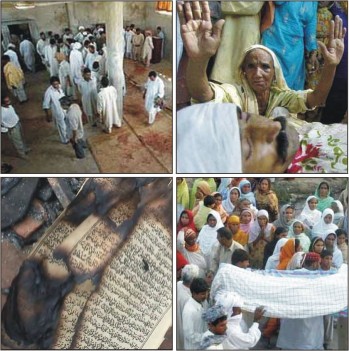
Last month, when more than 90 Ahmadis were massacred in two mosques in Lahore, I remembered the precise moment in 1974 when it all began to change.  There were street protests by religious parties against Ahmadis demanding that they should be declared non-Muslims.

One day I saw some bearded activists standing outside a clothes merchant’s shop in our town, chanting anti-Ahmadi slogans and turning customers away, telling them that buying clothes from Ahmadis was haram – forbidden. At the time I was learning to memorise the Koran from a very kind, mild-mannered teacher. I asked him what exactly was wrong with the Ahmadis.  He explained to me that they didn’t believe that the Prophet Muhammad was the last and the final messenger.

I said OK, maybe that makes them kafirs, infidels, but who says that kafirs can’t sell cloth?  My teacher’s response was a full-handed slap, so sudden, so unexpected that it rang in my ears for days to come. That same year Pakistan’s first elected parliament declared Ahmadis non-Muslims.  Then in 1984 Pakistan’s military dictator and self-appointed guardian of the faith General Zia-ul-Haq inserted that oath in the constitution that we are all required to sign.  Because of the new laws, Ahmadis have been sent to prison simply for using the Muslim greeting Assalamu alaikum, or putting a Koranic verse in a greeting card.

Over the last three decades the hatred against Ahmadis has become so widespread that Pakistan is now embarrassed by the only Nobel laureate it has ever produced.

Dr Abdus Salam Khan won the Nobel Prize for physics and, as a proud Pakistani, accepted his award in national dress.  But he was an Ahmadi so there is no monument to celebrate him, no universities named after him.

The word “Muslim” on his gravestone has been erased. Even the town he is buried in has been renamed in an attempt to erase our collective memory. This hatred was evident in the reactions to the massacre. TV channels were more obsessed with making sure that in their broadcasts Ahmadi mosques were called “places of worship”.

When you refuse to call a place of worship by its proper name, you are implying that it’s not a mosque, it’s not a church, it’s not a synagogue, it’s a place where godless people do godless things. And all the various Islamic political parties, whose leaders often refuse to pray together, are united on this.

When Pakistan’s main opposition leader Nawaz Sharif used the phrase “our brothers” for the murdered Ahmadis, leaders from 11 political parties came together to condemn him and threatened to issue a fatwa declaring him a heretic.  Over the last three decades the siege has been so palpable that those Ahmadis who couldn’t afford to emigrate have taken to hiding their identity.

If you want to destroy someone in public life it’s enough to drop a hint that they are Ahmadi. In the 1980s, the former chief minister of Punjab and current federal minister didn’t attend his own mother’s funeral because there were rumors that she was an Ahmadi.  When the funerals of the massacred Ahmadis took place there were no officials, no politicians present 

Pakistan’s liberal bloggers and some English-language columnists did write along the lines that Ahmadi blood is on our hands.  Others were adamant that it was yet another Friday, yet another massacre by the Pakistani Taliban, and we should just fight this sort of terrorism and leave the sectarian debates alone.

Two incidents in the past week made me realize how pathological our response was. At a vigil to mark the massacre, where a handful of people had turned up, a passer-by asked me “Are you an Ahmadi?” My own loud and aggressive denial surprised me.

Then an Ahmadi friend whose father survived the Lahore massacre wrote to me saying: “You know we have been living like this for decades. Did something like this have to happen for you to speak up?”

–Editor’s Note- It is high time that this law be repealed and the Ahmadi community of Pakistan be given all the basic human rights and privileges enjoyed by all Pakistanis.