Posts Tagged ‘ USA ’

Progress, For a Price, in Pakistan

By Doyle McManus for The Los Angeles Times
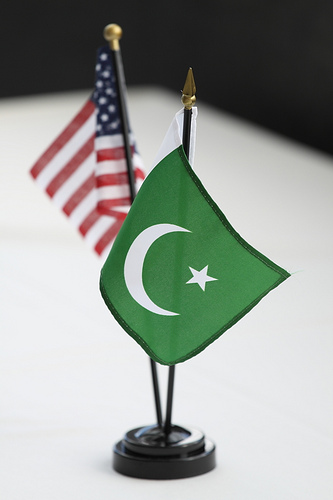
In 2001, on the eve of the U.S. invasion of Afghanistan, President George W. Bush gave Pakistan’s then-leader, Gen. Pervez Musharraf, a choice: He was either with us or against us. Musharraf chose to become an ally, but the question ever since has been whether that shotgun marriage can mature into a healthy adult relationship. At times, the prospect has seemed far from reach.

The world’s second-most-populous Muslim country is caught in a brutal internal struggle between extremism and moderation. Most of its people tell pollsters they don’t like the United States and wish we’d go away. The tribesmen of its western frontier shelter Osama bin Laden and the leaders of Afghanistan’s Taliban. And the United States can’t forget how, in the 1980s, Pakistan built nuclear weapons — and then later exported nuclear technology to North Korea and Iran.

But in recent months, there has been progress in the relationship. Military and intelligence cooperation between the United States and Pakistan has increased significantly. Pakistan has allowed the CIA to increase its missile strikes against Al Qaeda and Taliban targets in Pakistani territory. Pakistani authorities have arrested several Taliban leaders and allowed U.S. intelligence officers to question them. And now Pakistan is offering to increase its own military operations in North Waziristan, the presumed lair of Bin Laden. All that cooperation came at a price, of course: a flood of U.S. military and economic aid.

And last week, the Pakistanis came to Washington to press for more. The academic criticism of the U.S.-Pakistani relationship is that it is “transactional” — nothing more than a series of bargains between buyers and sellers who don’t trust each other much. That’s still mostly true. Pakistan’s delegation arrived with a 56-page shopping list covering everything from military equipment to education and cultural exchanges. And one Pakistani official, asked during the visit whether his government was truly willing to act against the havens that allow the Taliban to maintain bases in Pakistan, replied frankly: “Yes — but at a price.”

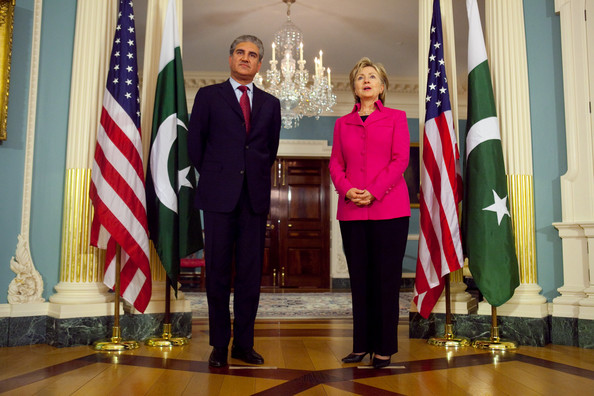
After a series of meetings with Secretary of State Hillary Rodham Clinton, Pakistan’s ebullient foreign minister, Shah Mehmood Qureshi, declared: “I think we are going to move from a relationship to a partnership.” But he used the future tense. In the meantime, there are things to work out. Pakistan is clearly worried about what happens when the United States begins pulling troops out of Afghanistan in 2011.

Although Obama administration officials have tried to reassure Pakistan that Washington’s commitment to the region is for the long haul, uncertainty remains. “Our fear is . . . that we get into a fight with these guys [the Taliban], and you walk away, and we’re still there,” a Pakistani official said. Pakistan’s powerful army chief of staff, Gen. Ashfaq Kayani, spent part of his time in Washington visiting Congress with PowerPoint slides to show that Pakistan has committed more troops to its fight against insurgents than the United States has on the ground in Afghanistan, and that it has suffered almost 30,000 killed and wounded in the process.

According to U.S. officials, Kayani made a strong case that Pakistan can do more if it gets more modern military equipment from the United States, especially helicopters to ferry troops into the rugged badlands where Al Qaeda and the Taliban hide. The United States has helped Pakistan acquire some helicopters, but not as many and not as quickly as the Pakistanis would like. U.S. officials said they would try to speed the delivery of more. In the past, U.S. officials complained that Pakistan used much of its U.S. military aid to bolster its eastern front with India instead of its fight with internal insurgents; but since Pakistan’s 2009 offensive in the Swat Valley, that criticism has been stilled.

The delegation also added a new item to Islamabad’s wish list: a nuclear agreement under which the United States would help Pakistan develop its civilian nuclear energy industry — to mirror a similar U.S. agreement with India, Pakistan’s longtime enemy. The United States told the Pakistanis that would have to wait. The memory of having to clamp sanctions on Pakistan for its nuclear weapons program is still too fresh. But it was a sign of improving relations that the idea wasn’t rejected completely.

 In 2001, the United States sought a new relationship with Pakistan mostly because it was next to Afghanistan — and thus a country we would need for moving military supplies and basing drones. But that thinking has slowly evolved. In the long run, with its population of 170 million people — not to mention its cache of nuclear weapons — Pakistan is more important than Afghanistan.

“We’re engaging with Pakistan because we’re afraid of it,” says Christine Fair, a Pakistan expert at Georgetown University. “It’s the scariest country in the region. Because of Afghanistan, it’s been treated as if it were a subsidiary issue. But Pakistan should be the primary issue.” The Americans are working hard to convince the Pakistanis that they are interested in Pakistan’s stability for its own sake, not just because it’s next door to Afghanistan. The Pakistanis are working hard to convince the Americans that they are committed to defeating the extremists in their midst. It’s not a strategic relationship yet. If it’s a partnership, it’s still a wary one. But that’s progress.
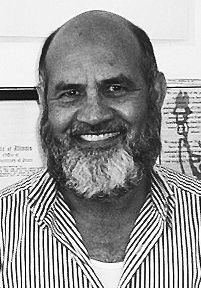
Pakistan-Born Cabdriver In Chicago Accused of Helping Al-Qaeda

By Carrie Johnson for The Washington Post

A Chicago taxi driver born in Pakistan was arrested Friday on two charges of providing material support to terrorists — allegedly attempting to funnel money to al-Qaeda and discussing an attack on a U.S. stadium.

Raja Lahrasib Khan, a naturalized U.S. citizen, does not pose an imminent danger to Americans, prosecutors said. But they said Khan, 56, had claimed he knew Ilyas Kashmiri, a Pakistan-based extremist leader with close ties to al-Qaeda.

Kashmiri faces criminal charges in the United States for allegedly conspiring with another Chicagoan, David C. Headley, to kill employees of a Danish newspaper that published derogatory cartoons of the prophet Muhammad.

The court papers in Khan’s case describe a March 11 phone call in which he appeared to discuss attacking an unnamed U.S. stadium in August with bombs that go “boom, boom, boom, boom.”

Authorities sent an undercover agent to meet with Khan and give him $1,000 to send to Kashmiri, the court papers said. Khan, 56, of the North Side, was then charged with two counts of providing material support to terrorism in a criminal complaint filed Thursday in U.S. District Court in Chicago and unsealed Friday following his arrest, the release said. The investigation is continuing.

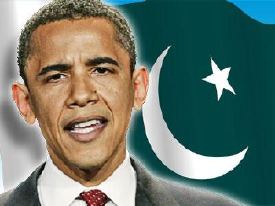
Obama Pledges To Work With ‘Peace-Loving’ Pakistanis On Occasion of 70th Pakistan Day 3/23

By Lalit K Jha for The Press Trust of India  

Greeting people of Pakistan on the occasion of its National Day, US President Barack Obama today pledged to remain a partner of all Pakistanis who “seek to build a future of peace and prosperity”.

Sending his best wishes to the people of Pakistan and all those of Pakistani descent in America and around the world observing Pakistan National Day, Obama said: “Seventy years ago, Muhammad Ali Jinnah and those of the independence generation declared their dreams of self-determination and democracy.

“Today, the people of Pakistan are carrying on the great work of Quaid-e Azam,” Obama said in his message issued on the occasion of Pakistan National Day, being marked on March 23.

“Here in the United States, our country is enriched by the many Pakistani Americans who excel as doctors, small business owners, students, members of our armed forces and in many other fields. On this National Day, we give thanks for the contributions of these fellow Americans, and the United States pledges to remain a partner of all Pakistanis who seek to build a future of peace and prosperity.”

“In these efforts, the American people are proud to join in the education, health and economic partnerships that can improve the daily lives of Pakistanis and their families,” he said.

A Recap of The Whole Health Care Reform Legislation Process

By Anonymous at Digg.com

Democrats: “We need health care reform”
Republicans: “Liberal fascists! Give us a majority and we’ll do it better”
Democrats: “Done, you have majority of both houses”

12 years later, health care is irrefutably worse in every respect for every single person in the United States

Democrats: “We need health care reform”
Republicans: “Liberal fascists! Americans are tired of partisan politics!”
Democrats: “OK, let’s compromise”
Republicans: “OK, get rid of half your ideas”
Democrats: “Done”
Republicans: “Too liberal, get rid of half your ideas”
Democrats: “Done”
Republicans: “Too liberal, get rid of half your ideas”
Democrats: “Done”
Republicans: “Too liberal, get rid of half your ideas”
Democrats: “Done”
Republicans: “Too liberal, get rid of half your ideas”
Democrats: “Done. Time to end debate”
Republicans: “Too liberal, we need more debate, we will filibuster to prevent you from voting”
Democrats: “OK, we’ll vote–sorry guys, debate is ended. It’s time to vote on the bill”
Republicans: “Too liberal, we vote no”
Democrats: “OK, it passed anyway–sorry guys.”

One month later

Republicans: “Wait–wait, OK, we have less of a minority now so we can filibuster forever.”
Democrats: “Sorry, the bill already passed, we need it to pass the House now”
Republicans: “But we have enough to filibuster”
Democrats: “Sorry, the bill already passed, we need it to pass the House now”
Republicans: “Liberal fascists! You haven’t listened to our ideas! You’ve shut us out of this whole process!”
Democrats: “Sorry, show us your proposal”
Republicans: “Smaller government”
Democrats: “That’s not very specific”
Republicans: “OK, here’s our detailed proposal–It’s our common-sense ideas we spent 12 years not enacting”
Democrats: “OK, we’ll add a bunch more of your ideas”
Republicans: “Liberal fascists! You included all these back-room deals”
Democrats: “OK, we’ll get rid of the back-room deals”
Republicans: “Liberal fascists! You’re using obscure procedural tricks to eliminate the back-room deals!”
Democrats: “No, we’re using reconciliation, which both parties have used dozens of times for much larger bills”
Republicans: “Liberal fascists! You’re pressuring Congressmen to vote for your bill! Scandal!”
Democrats: “It’s called ‘whipping’, it’s been done since 1789”
Republicans: “Liberal fascists! Can’t you see the American people don’t want this?”
Democrats: “This bill is mildly unpopular, doing nothing (your proposal) is extraordinarily unpopular”
Republicans: “We need to start over! We need to start over!”
Democrats: “We should really consider voting–”
Republicans: “Liberal fascists! Start over! Clean slate! Common-sense! America!”

US-Pakistan Talks Mark ‘Intensification’ of Partnership

By Suzanne Presto for Voice of America News

The United States and Pakistan will hold their first strategic dialogue at the ministerial level in Washington next Wednesday (March 24). U.S. Special Representative for Afghanistan and Pakistan Richard Holbrooke told reporters at the State Department Friday that these talks mark a “major intensification” of the U.S.-Pakistan partnership. Wednesday’s talks will be co-chaired by Secretary of State Hillary Clinton and Pakistani Foreign Minister Shah Mehmood Qureshi.

Holbrooke says delegations from both sides will include senior officials of their nation’s defense, diplomacy, finance and agriculture departments. The U.S. delegation will also include aid and trade officials, and Pakistan’s will include officials who handle water, power and social issues.
“This is a partnership that goes far beyond security, but security is an important part of it,” he said. Holbrooke told reporters Friday that U.S. officials want to see aid money for Pakistan distributed more quickly.

“We are doing more. We will announce more. We want to do as much as the Congress will support,” Holbrooke said. The Obama administration has made improving and broadening relations with Pakistan a top priority, but U.S. policies and drone strikes targeting militants in the region remain unpopular. Holbrooke said the U.S. supports Pakistan as it seeks to strengthen democratic institutions and economic development, handle energy and water problems, as well as defeat extremists. “Everyone is aware of the popular public-opinion polls, and we think that our support for Pakistan deserves more recognition among the people,” he added.

Speaking to reporters in Islamabad Thursday, Foreign Minister Qureshi said Pakistani and U.S. officials have been talking a lot, and in his words, “the time has come to walk the talk.” Holbrooke responded to Qureshi’s statement that next week’s talks would be a good opportunity to rebuild confidence and trust on both sides. “The first time I went to Pakistan, Foreign Minister Qureshi introduced me to the phrase “trust deficit,” and so I have heard it many times,” he said. “The last time I was there, we both said in a press conference that we thought we had made huge advances in that,” Holbrooke added. Secretary of State Clinton last visited Pakistan in October, where she spoke with officials and students alike.

Holbrooke said there are plans to hold the next set of strategic talks in Pakistan, likely within the next six months. He underscored that these bilateral talks do not replace the trilateral talks among the U.S., Pakistan and Afghanistan which he said are expected to resume later this year.

A Victory For Obama, From An Unlikely Quarter-Pakistan

By Fareed Zakaria for Newsweek

President Obama gets much credit for changing America’s image in the world—he was probably awarded the Nobel Prize for doing so. But if you asked even devoted fans to cite a specific foreign-policy achievement, they would probably hesitate. “It’s too soon for that,” they would say. But in fact, there is a place where Barack Obama’s foreign policy is working, and one that is crucial to U.S. national security—Pakistan.

There has been a spate of good news coming out of that complicated country, which has long promised to take action against Islamic militants but rarely done so. (The reason: Pakistan has used many of these same militants to destabilize its traditional foe, India, and to gain influence in Afghanistan.) Over the past few months, the Pakistani military has engaged in serious and successful operations in the militant havens of Swat, Malakand, South Waziristan, and Bajaur. Some of these areas are badlands where no Pakistani government has been able to establish its writ, so the achievement is all the more important. The Pakistanis have also ramped up their intelligence sharing with the U.S. This latter process led to the arrest a month ago of Mullah Abdul Ghani Baradar, the deputy leader of the Afghan Taliban, among other Taliban figures.

Some caveats: most of the Taliban who have been captured are small fish, and the Pakistani military has a history of “catching and releasing” terrorists so that they can impress Americans but still maintain their ties with the militants. But there does seem to be a shift in Pakistani behavior. Why it’s taken place and how it might continue is a case study in the nature and limits of foreign-policy successes.

First, the Obama administration de-fined the problem correctly. Senior ad-ministration officials stopped referring to America’s efforts in Afghanistan and instead spoke constantly of “AfPak,” to emphasize the notion that success in Afghanistan depended on actions taken in Pakistan. This dismayed the Pakistanis but they got the message. They were on notice to show they were part of the solution, not the problem.

Second, the administration used both sticks and carrots. For his first state dinner, Obama pointedly invited Indian Prime Minister Manmohan Singh—clearly not Pakistan’s first choice. Obama made clear that America would continue to pursue the special relationship forged with India under the Bush administration, including a far-reaching deal on nuclear cooperation. But at the same time, the White House insisted it wanted a deep, long-term, and positive relationship with Pakistan. Sens. John Kerry and Dick Lugar put together the largest nonmilitary package of U.S. assistance for the country ever. Aid to the Pakistani military is also growing rapidly.

Third, it put in time and effort. The administration has adopted what Central Command’s Gen. David Petraeus calls a “whole of government” approach to Pakistan. All elements of U.S. power and diplomacy have been deployed. Pakistan has received more than 25 visits by senior administration officials in the past year, all pushing the Pakistani military to deliver on commitments to fight the militants.

Finally, as always, luck and timing have played a key role. The militants in Pakistan, like those associated with Al Qaeda almost everywhere, went too far, brutally killing civilians, shutting down girls’ schools, and creating an atmosphere of medievalism. Pakistan’s public, which had tended to downplay the problem of terrorism, now saw it as “Pakistan’s war.” The Army, reading the street, felt it had to show results.

These results are still tentative. Pakistan’s military retains its obsession with India—how else to justify a vast budget in a small, poor nation? It has still not acted seriously against any of the major militant groups active against Afghanistan, India, or the United States. The Afghan Taliban, the Haqqani group, Gulbuddin Hekmatyar, Lashkar-e-Taiba, and many smaller groups all operate with impunity within Pakistan. But the Pakistani military is doing more than it has before, and that counts as success in the world of foreign policy.

Such success will endure only if the Obama administration keeps at it. There are some who believe that Pakistan has changed its basic strategy and now understands that it should cut its ties to these groups altogether. Strangely this naive view is held by the U.S. military, whose top brass have spent so many hours with their counterparts in Islamabad that they’ve gone native. It’s up to Obama and his team to remind the generals that pressing Pakistan is a lot like running on a treadmill. If you stop, you move backward, and, most likely, you fall down.

Pakistan and India Are Back At the Peace Table

By Manzer Munir

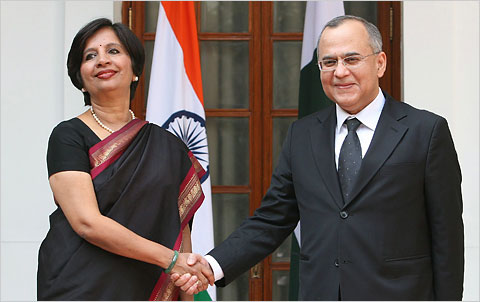
Islamabad, Pakistan- India’s Foreign Secretary Nirupama Rao is scheduled to visit Islamabad later this month as both India and Pakistan are back on track to resume their high level diplomatic talks. The discussions between the two so far are considered “preliminary” and are a “first step” in the words of Secretary Rao. She had earlier restated India’s concerns about terrorist groups operating in Pakistan and provided additional information related to the Mumbai attacks. Her counterpart in Pakistan, Foreign Secretary Salman Bashir, stated that “Pakistan is doing all that it can to fight terrorism”. Expressing his sympathy with the victims of the Mumbai attacks, he focused on Pakistan’s core concern that “terrorism should be looked at more broadly”. He believes that the two countries should address the root causes of the terror campaign and, from that perspective; Kashmir is the “core issue.” Pakistani officials believe that if India was a bit more flexible on Kashmir, then all the outstanding issues between the two countries can be resolved.

India’s Prime Minister Manmohan Singh is believed to sincerely desire to make a “breakthrough” in relations with Pakistan and has been vocal about it too in recent interviews. During the elections last year, he had highlighted his efforts to promote back-channel diplomacy for conflict resolution during the rule of former Pakistani President Pervez Musharraf. He also met last year with the current Pakistani Prime Minister to pledge to resume peace talks.

In Pakistan there also appears to be a significant shift in foreign policy. The American and Pakistani militaries and intelligence agencies are working closely and have had some recent successes together to stop the al Qaeda-sponsored terrorism in Pakistan and Afghanistan. The US commanders have been full of praise of the Pakistan army and its recent offensives against the Taliban. The Pakistani army has disrupted the al Qaeda and Taliban network over most of the Federally Administered Tribal Areas. This has come at a steep price as more than 2,500 soldiers have been killed.

This sacrifice by the Pakistan army has not gone unnoticed as the United States has increased both military and economic aid to Pakistan. The US is nudging both India and Pakistan to the peace table since a peaceful border with India will allow Pakistan to focus entirely on its western border at the Taliban and Al-Qaeda in Afghanistan. This will facilitate the Obama administration’s ability to eradicate the Taliban and Al-Qaeda once and for all from the region with Pakistan army’s help.

For far too long since Pakistan’s independence, the army has always felt India to be the biggest threat to the nation’s sovereignty and freedom. But for the first time in its history, an enemy has surfaced and proven to be much more detrimental to Pakistan’s survival as a nation and security for its citizens. And that enemy and threat is the radicalized groups such as the Taliban both from Afghanistan and inside Pakistan as well as the largely Arab Al-Qaeda network that operates in the area. Also militant groups like Lashkar-e-Taiba, Jaish-e-Mohammed and others also pose the biggest threat to the nuclear armed nation. The danger from the extremists has allowed elements inside Pakistan’s army leadership to reconsider the threats to Pakistan.

The dialogue between India and Pakistan has been off again and on again for over 63 years. But in the current climate of mistrust and hatred coupled with tensions still simmering from the Mumbai attacks, there is little room for error on both sides. It is hoped that the upcoming talks prove to be a step in the right direction of normalizing relations between these two nuclear armed neighbors who share almost an 1800 mile long border known in this part of the world as the Berlin Wall of Asia.

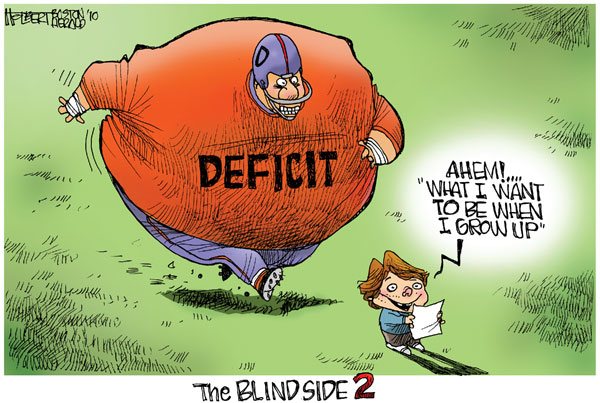
Prosperity of Future US Generations in Harm’s Way From Current Deficit Spending

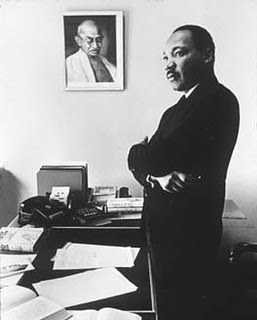
Gandhi and King- Two Martyrs Who Will Never Die

By Manzer Munir

Martin Luther King Jr, who would have been 81 years old January 15, was a great believer of Mohandas K Gandhi, the leader of India’s independence movement from Brittan. King saw that Gandhi’s peaceful civil disobedience and non-violent methods of protest were very effective in bringing down the British Empire in India and as a result Pakistan after some 300 years of direct and indirect rule. Gandhi had believed that people could resist immoral government action by simply refusing to cooperate. Gandhi adopted many peaceful resistance techniques in developing his concept of Satyagraha, which was a philosophy and practice of passive nonviolent resistance.

Gandhi had earlier used this resistance technique in his struggles for freedom and equality for blacks and Indians in South Africa where both minorities were subjected to second and third class citizenry. His methods and refusal to bow down to the injustices that Indians faced in colonial South Africa inspired Nelson Mandela several years later to start his own peaceful struggle that eventually led to the end of Apartheid in South Africa in 1990.

While at Morehouse College, King learned about Gandhi and became very excited about his ideas. He wanted to further educate himself and read many books on Gandhi and his life and beliefs. In his book, Stride Toward Freedom, King states that “Gandhi was probably the first person in history to lift the love ethic of Jesus above mere interaction between individuals to a powerful and effective social force on a large scale. He further writes in his book that “It was in this Gandhian emphasis on love and nonviolence that I discovered the method for social reform that I had been seeking. I came to feel that this was the only morally and practically sound method open to oppressed people in their struggle for freedom.”

King felt that he had finally found a way to where oppressed people could successfully unlock social protest through Jesus’ teachings of love. In fact Gandhi himself had said “What does Jesus mean to me? To me, he was one of the greatest teachers humanity has ever had.” He also once mentioned Jesus as the “most active resister known perhaps to history. His was non-violence par excellence” Therefore to the Christian minister living in the pre-civil rights era in the South in America, Gandhi appeared to King as a follower of Christ, someone who preached peace and love even at the expense of suffering. Martin Luther King once said of Gandhi “It is ironic yet inescapably true that the greatest Christian of the modern world was a man who never embraced Christianity.”

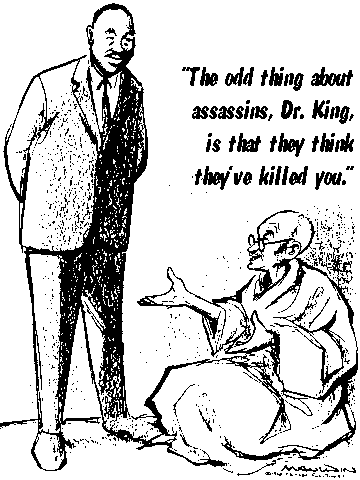
In 1959, King visited India and became fully convinced that Satyagraha could be effectively applied to the struggle by blacks in the United States for racial integration. He came back to the United States where he continued the struggle for freedom and equality for all Americans. Like Gandhi, King also talked about suffering as a path to self purification and spiritual growth. He not only experienced this suffering by being jailed, beaten and harassed by the authorities of the day, but he eventually ended up paying for this cause for freedom for all with his life.

 Mohandas K Gandhi and Martin Luther King Jr arguably were two of the greatest men of the last century.  Both men believed that “injustice anywhere was a threat to justice everywhere.” They both led their people and millions of others out of slavery and servitude against seemingly insurmountable odds to freedom and salvation. On what would have been his 81st birthday, let us recognize that despite an assassin’s bullet and in the greatest democracy in the history of the world, the spirit and dream of a King still live on.