Archive for January, 2011

China Ramps Up Pressure Over Kashmir

By Sudha Ramachandran The Asia Times
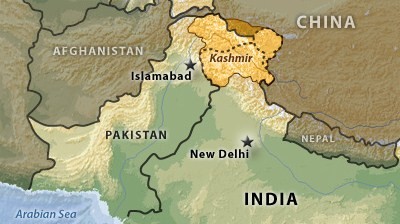
BANGALORE – A recent report in the Chinese media describing the Sino-Indian border as being 2,000 kilometers long, roughly 1,500 km shorter than that defined by India, has evoked an alarmed response among sections of the Indian strategic community.

The “missing 1,500 km” from the definition of the Sino-Indian border is seen to be a clear pointer to Beijing’s hardening position, not only on its long-standing boundary dispute with India but also on Jammu and Kashmir (J&K). While India holds about 45% of J&K territory and Pakistan controls 35%, China occupies about 20% (including Aksai Chin and the Shaksgam Valley, ceded by Pakistan to China in 1963).

A Beijing-datelined Xinhua news agency report of an official briefing by China’s Assistant Foreign Minister Hu Zhengyue on the eve of Prime Minister Wen Jiabao’s recent visit to India triggered the flap. “China and India share a 2,000-km-long border that has never been formally demarcated,” the report said. India describes the border as being 3,488 km.

The different positions were made even more explicit by the Global Times, an English-language newspaper published by the People’s Daily, the official mouthpiece of the ruling Chinese Communist Party. In an interview with Global Times, India’s ambassador to China, Subrahmanyam Jaishankar, spoke of the “long common border of 3,488 kilometers” between the two countries. But a comment by the editors of Global Times in parentheses said: “There is no settled length of the common border. The Chinese government often refers to the border length as being ‘about 2,000 kilometers’.”

Reports in state-owned media have been describing the border as being 2,000 km for at least a year now.

The roughly 1,500 km-long shortfall in the Chinese perception is believed to refer to the Sino-Indian boundary in J&K. “China apparently no longer treats the line of nearly 1,600 km separating Jammu and Kashmir on the one hand and Xinjiang and Tibet on the other as a border with India,” strategic affairs expert C Raja Mohan wrote in the Indian Express. That is, it does not recognize Kashmir to be part of India.

Beijing is questioning India’s locus standi to discuss J&K’s border with China, observes B Raman, a retired director in India’s external intelligence agency, the Research and Analysis Wing (RAW). In essence, it is seeking to exclude discussion of the western sector of the disputed Sino-Indian boundary with India. The western sector includes the large chunk of Indian territory, Aksai Chin, in the Ladakh region of Jammu and Kashmir that China occupied in 1962.

Besides, China “wants to change the format of the border talks in order to keep it confined bilaterally to the eastern and middle sectors and expand it to a trilateral issue involving India, China and Pakistan in the western sector,” Raman wrote recently.

China has become increasingly assertive in its questioning of India’s sovereignty over J&K. Since 2008, it has been issuing visas on a separate sheet of paper to residents of Jammu and Kashmir rather than stamping the visa in their passports, as is the norm with other Indian citizens. In August last year, China also denied a visa to Lieutenant General B S Jaswal – commander of the Indian army’s Northern Command, which includes Kashmir – for an official visit to China, on the grounds that he “controlled” a “disputed area”.

Besides, over the past year, Beijing has been reaching out to the Hurriyat Conference, an umbrella organization of Kashmiri separatist outfits. In March 2010, for instance, Chinese Foreign Affairs director Ying Gang met with Hurriyat leader Mirwaiz Umar Farooq in Geneva on the sidelines of the 13th session of the UN Human Rights Council. Besides questioning India’s sovereignty over Kashmir, China has been endorsing Islamabad’s control over the part of Kashmir it has administered since 1947.

It was with India that the Maharajah of Jammu and Kashmir, Hari Singh, signed an Instrument of Accession in October 1947. However, only 45% of the territory of the former princely state is in India’s hands today, roughly 35% remaining under Pakistani administration and another 20% under Chinese control. The territory under Chinese occupation includes Aksai Chin and the Shaksgam Valley that Pakistan gifted to China in 1963.

In the Northern Areas of Pakistan-administered Kashmir, China is involved in the construction of several infrastructure projects, including roads, hydroelectric power projects, dams, expressways, bridges and telecommunication facilities. During Wen’s recent visit to Pakistan, the two countries signed a US$275 million agreement for repair and expansion of the Karakoram Highway. Earlier in September, Beijing underlined its support to Islamabad’s territorial claims over parts of Pakistan-administered Kashmir when it described the Northern Areas as “a northern part of Pakistan”.

The India-Pakistan dispute over Kashmir predates the People’s Republic of China (PRC). India and Pakistan had already fought their first war over Kashmir when the PRC came into being. Initially, China took its cues from the Soviet Union on the issue. It described the conflict as a Western creation and maintained that the US and Britain were hoping to make Kashmir a Western base.
China took a “neutral position” in the 1950s. It opposed foreign arbitration on the Kashmir issue, which pleased India. At the same time, it did not endorse Delhi’s claims over Kashmir. Fraying Sino-Soviet relations and Moscow’s overt support to Jammu and Kashmir as “an inalienable part of the Republic of India”, as well as concerns that its backing of India would push Pakistan into a closer embrace of the US, seem to have prompted it to adopt a more “neutral position” between India and Pakistan on Kashmir.

With Sino-Indian relations deteriorating from 1959 onwards, China began tilting towards Pakistan. It signed a border agreement with Pakistan. Since this dealt with areas that constituted Pakistan-administered Kashmir, the agreement amounted to a de facto Chinese recognition of Pakistan’s control over this area. Although it subsequently denied such recognition, describing this as “provisional” and “pending settlement of the Kashmir dispute”, a joint communique issued at the end of prime minister Zhou Enlai’s visit to Pakistan in February 1964 was a strong endorsement of the Pakistani position. It urged a solution of the dispute “in accordance with the wishes of the people of Kashmir”. India is opposed to a plebiscite in Kashmir.

By the mid/late 1970s, China began advocating a status quo on Kashmir. Support for the Kashmiris’ right to self-determination was toned down. In 1976, in his speech before the UN General Assembly, Chinese foreign minister Chia Kuan-Hua omitted naming Kashmir in a list of territories where the right to self-determination had not been exercised. It is believed that China’s own troubles with separatism and improving ties with India prompted its shrinking support on self-determination.

With Sino-Indian rapprochement gathering momentum in the 1990s, China began describing Kashmir as a bilateral matter to be resolved by India and Pakistan through peaceful means. On his visit to India in 1996, president Ziang Zemin called on India and Pakistan to set aside contentious issues and build a cooperative relationship. During the brief Kargil conflict in 1999, China called on India and Pakistan to respect the Line of Control that separates Pakistani- and Indian-administered Kashmir. These were seen as signs of Beijing taking a neutral position on Kashmir again.

China has never accepted India’s sovereignty over Jammu and Kashmir, even over the part that is under its control. After all, if it did it would mean giving up the roughly 43,180 square kilometers of territory that is currently under its control. However, it had avoided provoking India on the matter publicly. This has changed in recent years, with Beijing being “deliberately provocative” on Kashmir.

India is not letting the repeated provocations go unchallenged. After all, the territorial integrity of the country is a core concern of the Indian state. A couple of months ago, in his talks with Chinese Foreign Minister Yang Jiechi, India’s External Affairs Minister S M Krishna did some tough talking. According to officials quoted by the Hindu, for the first time India drew a parallel between “the territorial red lines” of the two countries.

Krishna reportedly told Yang that just as India had been sensitive to its concerns over Tibet and Taiwan, Beijing too should be mindful of Indian sensitivities on Jammu and Kashmir. The message that India is sending is that if China questions India’s sovereignty over Kashmir, India will question Beijing’s sovereignty over Tibet and Taiwan.

Delhi has indicated that Krishna’s warning was to be taken seriously. The joint communique issued at the end of Wen’s visit to India made no reference to India’s commitment to a “one china policy”. This is the first time since 1988 that a summit-level joint communique has made no mention of the policy. Instead, both sides agreed to show “mutual respect and sensitivity for each other’s concerns and aspirations”.

-Sudha Ramachandran is an independent journalist/researcher based in Bangalore.
Pakistan’s Political Crisis

Reported by Farhana Bokhari for CBS News

Pakistan’s pro-U.S. ruling coalition on Sunday night battled to restore calm across the country’s political landscape after a regional political party allied to president Asif Ali Zardari’s Pakistan People’s Party (PPP) quit at short notice, leaving the PPP in minority in the lower house of parliament, the national assembly.

The Muhajir Qaumi Movement (MQM), a political party mainly representing Pakistanis who migrated from India to Pakistan when the country was created in 1947, withdrew its support to the PPP, reacting to the government’s decision on Saturday to raise gasoline prices.

The move marked the first major upheaval over gasoline prices since they were raised, mainly to be kept in line with global trends. Western diplomats based in Islamabad, reacting to the latest political developments, warned it was still early to tell if Zardari or his handpicked prime minister, Yusuf Raza Gilani, were in danger of being forced out.

There were warnings that the split with the MQM may in the short term completely paralyze the government. Long term consequences are harder to predict. Pakistan has been ruled by its army for more than half the of country’s 63-year existence. Some previous periods of heightened uncertainty have been followed by the military stepping in to fill the void.

General Ashfaq Pervez Kayani, Pakistan’s present military chief, is widely known to be an apolitical figure. A western ambassador based in Islamabad, speaking to CBS News on condition of anonymity, said, “While there are no signs of the military stepping in, you have to remember that previous [military] takeovers have been preceded by fast growing turmoil. Much depends on the way things happen in future.”

For the U.S., mounting political uncertainty in Pakistan is potentially worrying. This has to do with the support that Washington receives from Pakistan in its campaign to defeat Al-Qaeda and the Taliban in the Afghanistan-Pakistan region, as well as periodic worries in the western world over Islamic hardliners making inroads into Pakistan’s politics.

A minister from the PPP who spoke on condition of anonymity to CBS News Sunday said after the split with the MQM was announced, “If a government is weak and struggling for its own survival, how will it be able to pursue interests of other countries, including the U.S.?” The minister added, “Unpopular steps like petroleum prices are forced upon governments through circumstances which are beyond their control.”

A second western diplomat in Islamabad who spoke to CBS News on condition of anonymity said while Islamic politicians have only pockets of support across Pakistan, “You can never rule out the dangerous possibility of a ground swell in their favor, especially if governments from the political mainstream become weak and unpopular.”

A Prayer for Peace

Reported by Ghazi Salahuddin for The News International

We, in Pakistan, have rang out 2010 with a general strike and noisy rallies by religious elements in defence of the blasphemy law. We also rang out the year with a massive increase in petroleum products. And these spiritually and economically debilitating influences were certainly a distraction in our celebration of the biggest night of the year.

Today, on Sunday, the New Year is more than a day old. After spending the last few days of the departed year in taking stock of 2010, we are more inclined to look ahead and wonder what the coming year is going to be like. The general mood, certainly, is depressing. The past year was the year of floods, and Wikileaks, and drone attacks and social as well as political disarray. At the same time, it was also a year of hope – of Aman ki Asha – and of some intimations of how we, as a nation, still possess a conspicuous potential for survival.

In a sense, the attempt that so many ordinary citizens desperately made to celebrate the New Year in a communal spirit of joy was a genuine reflection of the life-force of a society that yearns for peace and happiness. In Karachi, the authorities made a concerted effort to subvert the inherent desire of the people to have a good time, as they always do. Roads leading to the Sea View promenade were blocked and eating places in the area were not allowed to do business.

It is besides the point that the young were still able to put up their show and the New Year was greeted with song and dance. Yes, the more privileged were able to celebrate the occasion in their private premises. But the point here is that public expression of any social or cultural vitality is increasingly being suppressed at the same time that the obscurantist elements are openly able to project their narrow outlook. What makes this dereliction more ominous is the government’s policy of appeasement and, even, surrender when it comes to dealing with the rise of intolerance and prejudice in our society.

It would be instructive to compare the rallies that were taken out in the late afternoon on Friday and the celebrations that were held a few hours later. I had an occasion to see the main procession that was taken out in Karachi and let me confess that it left me in a depressed state of mind. I simply could not identify with that crowd and the slogans it was raising. When I returned home at six, Sydney was greeting the New Year with its spectacular fireworks.

So, where do we, as a nation, belong in this world that is forever changing and embracing new technologies and new ideas? And it is in this context that I would like to return to the inspiration that we may draw from Aman ki Asha, the campaign launched by The Times of India Group and the Jang Group one year ago to promote peace between India and Pakistan.

Since yesterday was the first anniversary of this remarkable initiative, this newspaper has already underlined its main features and the success that it has achieved in the face of the raw winds of suspicion and animosity that have for long been blowing across this region. There was an editorial on this subject and a special edition. It was very encouraging to see the piece especially written for Aman ki Asha by Karen Armstrong, the celebrated religious historian.

Hence, I would not want to replicate the points that have been made. Still, I think that the public opinion poll conducted on the first anniversary of the project deserves to be carefully analysed. Here is a message that should not be overlooked when we interpret the social and political character of our society. It is true that the results of the survey are not at all surprising for those of us who have always believed in the overwhelming imperative of peace in not just our relations with India but also in a domestic context.

Now, the survey that was independently conducted by credible professionals, has certified that 70 per cent of Pakistanis and 74 per cent of Indians want peaceful relations between the two countries. What is crucial and meaningful here is that there has been a marked increase in the popular support for peace during the year that the largest media groups in India and Pakistan had conducted their varied and well-designed programmes under the umbrella of Aman ki Asha.

At a time when there is so much confusion about the role and the impact of the media, particularly the broadcast media, here is evidence that it can make a positive difference in shaping popular opinion when its message is in harmony with the natural aspirations of the people. This should make us realise that the media also has the power to sabotage the interests of the people when it is allowed to be manipulated by vested interests and when its expression is suppressed through intolerance and mindless chauvinism.

In many ways, the rise of extremism and militancy can be attributed to conflicts that are allowed to fester, distracting the attention and the resources of the nation from attending to the economic, social, and cultural needs of the people. Nothing undermines our national security more than rampant poverty and injustice and other deprivations of our people.

Indeed, the logic for normalisation of relations between India and Pakistan is rooted in the immortal desire of the people of both countries for social justice and for progress. In fact, Aman ki Asha should be seen in a larger context. Our need for peace transcends the otherwise fundamental issue of how our national security policies have remained India-centric.

Take, for instance, the official response to the rise of religious extremism in the country. Even when there is growing awareness that the threats we confront internally are very severe and could even jeopardise the very survival of the nation, the rulers do not seem to have the time or the intellectual ability to rethink and revise their national security formulations.

Meanwhile, of course, the people are ready and eager for what may be described as a paradigm shift. Initiatives like Aman ki Asha are necessary to set the stage for change and promote an environment in which an honorable and durable peace is possible.

When Aman ki Asha was launched one year ago, it affirmed that “peace between Pakistan and India is an idea whose time has come”. It also said that “it is daybreak for the people of the two countries who have languished in the twilight of mutual animosity and distrust for over six decades”. How long would it take for the rulers in the two countries to accept this self-evident truth?

The writer is a staff member. Email: ghazi_salahuddin@hotmail .com

Pakistan, India Swap Nuclear Sites Lists

By Zhang Xiang for Xinhua News

Pakistan and India exchanged lists of nuclear installations and facilities on Saturday in spite of a tension over the 2008 Mumbai attacks that has disrupted the dialogue process between the two countries, the Foreign Ministry said.

The two countries exchange the lists of nuclear sites on the first day of the new year under an agreement signed in 1988 and came into force in January 1991.

“The government of Pakistan and India today exchanged lists of their respective nuclear installations and facilities in accordance with Article-II of the Agreement on Prohibition of Attacks against Nuclear Installations and Facilities between Pakistan and India of Dec. 31, 1988,” a Foreign Ministry statement said.

The statement said the Ministry of Foreign Affairs handed over the list of Pakistan’s nuclear installations and facilities to an officer of the Indian High Commission in Islamabad at the Foreign Office on Saturday morning.

The Indian side also handed over their list to an officer of the Pakistan High Commission at the Ministry of External Affairs in New Delhi, it said.

After the agreement was signed the first exchange took place Jan. 1, 1992.

Sources said it is the 20th consecutive list exchange between the two countries.

Pakistan and India conducted tit-for-tat nuclear tests in 1998. India conducted its first nuclear test in 1974, followed by five more in 1998. Pakistan conducted its six nuclear tests in 1998. Neither India nor Pakistan is a signatory to the Nuclear Non- Proliferation Treaty (NPT).

India considers the NPT discriminatory, while Pakistan has indicated that it won’t join the international agreement till its neighbor does so.

Neither of the two rival neighbors have signed the Comprehensive Test Ban Treaty.

In 2004 they launched a peace process, but that is now on hold following the Mumbai attacks, with New Delhi pressuring Islamabad to do more to punish those responsible for the carnage and to crack down on anti-India groups.

Meanwhile, both countries also exchanged Lists of Prisoners in the two countries, the Foreign Ministry said.

According to the Agreement on Consular Access signed between Pakistan and India on May 21, 2008, both countries are required to exchange lists of prisoners in each other’s custody on Jan. 1 and July 1 every year, the statement said.

“Consistent with the provisions of this Agreement, the Ministry of Foreign Affairs handed over the list of Indian prisoners in Pakistan to the Indian High Commission in Islamabad today,” it said.