By Sudha Ramachandran The Asia Times

BANGALORE – A recent report in the Chinese media describing the Sino-Indian border as being 2,000 kilometers long, roughly 1,500 km shorter than that defined by India, has evoked an alarmed response among sections of the Indian strategic community.
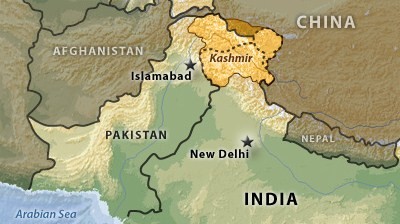
The “missing 1,500 km” from the definition of the Sino-Indian border is seen to be a clear pointer to Beijing’s hardening position, not only on its long-standing boundary dispute with India but also on Jammu and Kashmir (J&K). While India holds about 45% of J&K territory and Pakistan controls 35%, China occupies about 20% (including Aksai Chin and the Shaksgam Valley, ceded by Pakistan to China in 1963).
A Beijing-datelined Xinhua news agency report of an official briefing by China’s Assistant Foreign Minister Hu Zhengyue on the eve of Prime Minister Wen Jiabao’s recent visit to India triggered the flap. “China and India share a 2,000-km-long border that has never been formally demarcated,” the report said. India describes the border as being 3,488 km.
The different positions were made even more explicit by the Global Times, an English-language newspaper published by the People’s Daily, the official mouthpiece of the ruling Chinese Communist Party. In an interview with Global Times, India’s ambassador to China, Subrahmanyam Jaishankar, spoke of the “long common border of 3,488 kilometers” between the two countries. But a comment by the editors of Global Times in parentheses said: “There is no settled length of the common border. The Chinese government often refers to the border length as being ‘about 2,000 kilometers’.”
Reports in state-owned media have been describing the border as being 2,000 km for at least a year now.
The roughly 1,500 km-long shortfall in the Chinese perception is believed to refer to the Sino-Indian boundary in J&K. “China apparently no longer treats the line of nearly 1,600 km separating Jammu and Kashmir on the one hand and Xinjiang and Tibet on the other as a border with India,” strategic affairs expert C Raja Mohan wrote in the Indian Express. That is, it does not recognize Kashmir to be part of India.
Beijing is questioning India’s locus standi to discuss J&K’s border with China, observes B Raman, a retired director in India’s external intelligence agency, the Research and Analysis Wing (RAW). In essence, it is seeking to exclude discussion of the western sector of the disputed Sino-Indian boundary with India. The western sector includes the large chunk of Indian territory, Aksai Chin, in the Ladakh region of Jammu and Kashmir that China occupied in 1962.
Besides, China “wants to change the format of the border talks in order to keep it confined bilaterally to the eastern and middle sectors and expand it to a trilateral issue involving India, China and Pakistan in the western sector,” Raman wrote recently.
China has become increasingly assertive in its questioning of India’s sovereignty over J&K. Since 2008, it has been issuing visas on a separate sheet of paper to residents of Jammu and Kashmir rather than stamping the visa in their passports, as is the norm with other Indian citizens. In August last year, China also denied a visa to Lieutenant General B S Jaswal – commander of the Indian army’s Northern Command, which includes Kashmir – for an official visit to China, on the grounds that he “controlled” a “disputed area”.
Besides, over the past year, Beijing has been reaching out to the Hurriyat Conference, an umbrella organization of Kashmiri separatist outfits. In March 2010, for instance, Chinese Foreign Affairs director Ying Gang met with Hurriyat leader Mirwaiz Umar Farooq in Geneva on the sidelines of the 13th session of the UN Human Rights Council. Besides questioning India’s sovereignty over Kashmir, China has been endorsing Islamabad’s control over the part of Kashmir it has administered since 1947.
It was with India that the Maharajah of Jammu and Kashmir, Hari Singh, signed an Instrument of Accession in October 1947. However, only 45% of the territory of the former princely state is in India’s hands today, roughly 35% remaining under Pakistani administration and another 20% under Chinese control. The territory under Chinese occupation includes Aksai Chin and the Shaksgam Valley that Pakistan gifted to China in 1963.
In the Northern Areas of Pakistan-administered Kashmir, China is involved in the construction of several infrastructure projects, including roads, hydroelectric power projects, dams, expressways, bridges and telecommunication facilities. During Wen’s recent visit to Pakistan, the two countries signed a US$275 million agreement for repair and expansion of the Karakoram Highway. Earlier in September, Beijing underlined its support to Islamabad’s territorial claims over parts of Pakistan-administered Kashmir when it described the Northern Areas as “a northern part of Pakistan”.
The India-Pakistan dispute over Kashmir predates the People’s Republic of China (PRC). India and Pakistan had already fought their first war over Kashmir when the PRC came into being. Initially, China took its cues from the Soviet Union on the issue. It described the conflict as a Western creation and maintained that the US and Britain were hoping to make Kashmir a Western base.
China took a “neutral position” in the 1950s. It opposed foreign arbitration on the Kashmir issue, which pleased India. At the same time, it did not endorse Delhi’s claims over Kashmir. Fraying Sino-Soviet relations and Moscow’s overt support to Jammu and Kashmir as “an inalienable part of the Republic of India”, as well as concerns that its backing of India would push Pakistan into a closer embrace of the US, seem to have prompted it to adopt a more “neutral position” between India and Pakistan on Kashmir.
With Sino-Indian relations deteriorating from 1959 onwards, China began tilting towards Pakistan. It signed a border agreement with Pakistan. Since this dealt with areas that constituted Pakistan-administered Kashmir, the agreement amounted to a de facto Chinese recognition of Pakistan’s control over this area. Although it subsequently denied such recognition, describing this as “provisional” and “pending settlement of the Kashmir dispute”, a joint communique issued at the end of prime minister Zhou Enlai’s visit to Pakistan in February 1964 was a strong endorsement of the Pakistani position. It urged a solution of the dispute “in accordance with the wishes of the people of Kashmir”. India is opposed to a plebiscite in Kashmir.
By the mid/late 1970s, China began advocating a status quo on Kashmir. Support for the Kashmiris’ right to self-determination was toned down. In 1976, in his speech before the UN General Assembly, Chinese foreign minister Chia Kuan-Hua omitted naming Kashmir in a list of territories where the right to self-determination had not been exercised. It is believed that China’s own troubles with separatism and improving ties with India prompted its shrinking support on self-determination.
With Sino-Indian rapprochement gathering momentum in the 1990s, China began describing Kashmir as a bilateral matter to be resolved by India and Pakistan through peaceful means. On his visit to India in 1996, president Ziang Zemin called on India and Pakistan to set aside contentious issues and build a cooperative relationship. During the brief Kargil conflict in 1999, China called on India and Pakistan to respect the Line of Control that separates Pakistani- and Indian-administered Kashmir. These were seen as signs of Beijing taking a neutral position on Kashmir again.
China has never accepted India’s sovereignty over Jammu and Kashmir, even over the part that is under its control. After all, if it did it would mean giving up the roughly 43,180 square kilometers of territory that is currently under its control. However, it had avoided provoking India on the matter publicly. This has changed in recent years, with Beijing being “deliberately provocative” on Kashmir.
India is not letting the repeated provocations go unchallenged. After all, the territorial integrity of the country is a core concern of the Indian state. A couple of months ago, in his talks with Chinese Foreign Minister Yang Jiechi, India’s External Affairs Minister S M Krishna did some tough talking. According to officials quoted by the Hindu, for the first time India drew a parallel between “the territorial red lines” of the two countries.
Krishna reportedly told Yang that just as India had been sensitive to its concerns over Tibet and Taiwan, Beijing too should be mindful of Indian sensitivities on Jammu and Kashmir. The message that India is sending is that if China questions India’s sovereignty over Kashmir, India will question Beijing’s sovereignty over Tibet and Taiwan.
Delhi has indicated that Krishna’s warning was to be taken seriously. The joint communique issued at the end of Wen’s visit to India made no reference to India’s commitment to a “one china policy”. This is the first time since 1988 that a summit-level joint communique has made no mention of the policy. Instead, both sides agreed to show “mutual respect and sensitivity for each other’s concerns and aspirations”.
-Sudha Ramachandran is an independent journalist/researcher based in Bangalore.




You must be logged in to post a comment.