Archive for April, 2012

Why President Zardari’s Visit Is A Small Bonus

By Soutik Biswas for The BBC
Hope is not a policy, but neither is despair, as South Asia expert Stephen Cohen says in a recent essay on Pakistan.

So it is with relations between India and Pakistan.

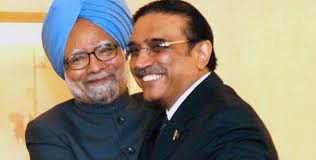
The past few days have shown how fragile the relationship can be – even as India welcomed President Asif Ali Zardari’s private trip to India on Sunday – the first by a Pakistani head of state for seven years – and PM Manmohan Singh invited him for lunch, the $10m US bounty for Hafiz Saeed, the founder of Pakistan-based militant group Lashkar-e-Taiba, provoked the cleric to openly launch a fresh attack against India (and the US).

But people live in hope, so Indian media is gung-ho about Mr Zardari’s visit.

They say the Pakistani president must be applauded for trying to end trade discrimination against India, easing petroleum imports from across the border, and moving towards a liberal visa deal.

“Under Mr Zardari’s watch, India and Pakistan are considering a sweeping agenda for economic co-operation for the first time in decades. The prime minister has every reason to welcome Mr Zardari warmly and consider the next steps in consolidating the unexpected movement in bilateral relations,” the Indian Express wrote.

Analyst C Raja Mohan believes Mr Singh must make an official trip to Pakistan after his meeting with Mr Zardari. “For his part,” he wrote, “Mr Singh should convey to Mr Zardari his readiness to move as fast and as far as the Pakistan president is willing to go.” Others like Jyoti Malhotra actually find Mr Zardari’s visit to the shrine of a famous Sufi Muslim saint in Rajasthan loaded with symbolism in these troubled times. “Clearly, Mr Zardari has stolen an imaginative moment from the bitter-sullen history of India-Pakistan, by asking to come to pay his respects to a cherished and much-beloved saint across the Indian subcontinent,” she wrote.

The relations between two neighbours remain complex. A 2010 Pew survey found 53% of the respondents in Pakistan chose India as the greater threat to their country, and only 26% chose the Taliban and al-Qaeda. At the same time 72% said it was important to improve relations with India, and about 75% wanted more trade relations and talks with India.

Pundits like Mr Cohen believe that it will “take the [Pakistan] army’s compliance, strong political leadership, and resolutely independent-minded foreign ministers to secure any significant shift of approach towards India”.

None of this appears to be in much evidence at the moment.

Both countries have seriously weakened governments that makes them unable to move towards any radical confidence building measures. In the current circumstances, President Zardari’s visit can only be a small bonus. And as scholars like Kanti Bajpai suggest, India must remain patient (even if faced with another Mumbai-style attack), continue to engage with Islamabad, help the civilian government in Pakistan politically, try to resolve a few outstanding disputes like Siachen and Sir Creek, build a relationship with the army and explore the possibility of cooperating with Islamabad on the future of Afghanistan. Despair does not help mend a stormy relationship.

Pakistani militant taunts US: ‘I will be in Lahore tomorrow’

By Sebastian Abbot for The Associated Press

One of Pakistan’s most notorious extremists mocked the United States during a defiant media conference close to the country’s military headquarters Wednesday, a day after the US slapped a $10 million bounty on him.

“I am here, I am visible. America should give that reward money to me,” said Hafiz Mohammad Saeed, referring to the fact that the bounty was given to a man whose whereabouts are not a mystery. “I will be in Lahore tomorrow. America can contact me whenever it wants to.”

Analysts have said Pakistan is unlikely to arrest Saeed, founder of the militant group Lashkar-e-Taiba, because of his alleged links with the country’s intelligence agency and the political danger of doing Washington’s bidding in a country where anti-American sentiment is rampant.

Saeed, 61, has been accused of orchestrating the 2008 attacks in the Indian city of Mumbai that killed 166 people, including six American citizens. But he operates openly in Pakistan, giving public speeches and appearing on TV talk shows.

He has used his high-profile status in recent months to lead a protest movement against US drone strikes and the resumption of NATO supplies for troops in Afghanistan sent through Pakistan. The supplies were suspended in November in retaliation for American airstrikes that accidentally killed 24 Pakistani soldiers.

Hours before Saeed spoke, US Deputy Secretary of State Thomas Nides met Pakistani Foreign Minister Hina Rabbani Khar in the nearby capital, Islamabad, for talks about rebuilding the two nation’s relationship. In a brief statement, Nides did not mention the bounty offer but reaffirmed America’s commitment to “work through” the challenges bedeviling ties.

Increasingly ‘brazen’ appearances
The US said Tuesday it issued the bounty for information leading to Saeed’s arrest and conviction in response to his increasingly “brazen” appearances. It also offered up to $2 million for Lashkar-e-Taiba’s deputy leader, Hafiz Abdul Rahman Makki, who is Saeed’s brother-in-law.

The rewards marked a shift in the long-standing US calculation that going after the leadership of an organization used as a proxy by the Pakistani military against archenemy India would cause too much friction with the Pakistani government.

This shift has occurred as the US-Pakistani relationship steadily deteriorated over the last year, and as the perception of Lashkar-e-Taiba’s potential threat to the West increased.

Bounty backfire?
The US may be hoping the bounty will force Pakistan to curb Saeed’s activities, even if it isn’t willing to arrest him. But the press conference he called at a hotel in the garrison city of Rawalpindi on Wednesday was an indication that is unlikely, and the bounty may even help him by boosting his visibility.

At the hotel, located near the Pakistani army’s main base and only a half hour drive from the US Embassy in Islamabad, Saeed was flanked by more than a dozen right-wing politicians and hardline Islamists who make up the leadership of the Difa-e-Pakistan, or Defense of Pakistan, Council. The group has held a series of large demonstrations against the US and India in recent months.

Some in the media have speculated the movement has the tacit support of the Pakistani military, possibly to put pressure on Washington.

“I want to tell America we will continue our peaceful struggle,” said Saeed. “Life and death is in the hands of God, not in the hands of America.”

Denies involvement in Mumbai massacre
He denied involvement in the Mumbai attacks and said he had been exonerated by Pakistani courts.

Pakistan kept Saeed under house arrest for several months after the attacks but released him after he challenged his detention in court. It has also resisted Indian demands to do more, saying there isn’t sufficient evidence.

The bounty offers could complicate US efforts to get the NATO supply line reopened. Pakistan’s parliament is currently debating a revised framework for ties with the US that Washington hopes will get supplies moving again. But the bounties could be seen by lawmakers and the country’s powerful army as a provocation and an attempt to gain favor with India.

Origins in the Kashmir dispute
Saeed founded Lashkar-e-Taiba in the 1980s allegedly with ISI support to pressure India over the disputed territory of Kashmir. The two countries have fought three major wars since they were carved out of the British empire in 1947, two of them over Kashmir.

Pakistan banned the group in 2002 under US pressure, but it operates with relative freedom under the name of its social welfare wing Jamaat-ud-Dawwa — even doing charity work using government money.

The US has designated both groups foreign terrorist organizations. Intelligence officials and terrorism experts say Lashkar-e-Taiba has expanded its focus beyond India in recent years and has plotted attacks in Europe and Australia. Some have called it “the next Al Qaeda” and fear it could set its sights on the US

* Associated Press writer Asif Shahzad contributed to this report from Islamabad.

Ornate, but not lavish: Another bin Laden home located in Pakistan

By Kathy Gannon for The Associated Press

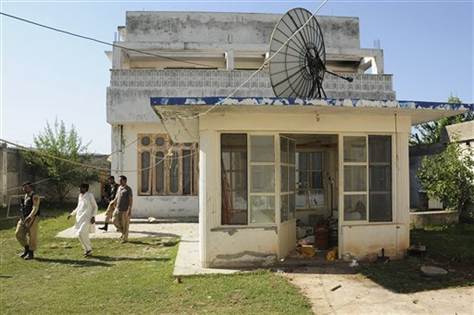
It’s an ornate but not lavish two-story house tucked away at the end of a mud clogged street. This is where Pakistan’s intelligence agency believes Osama bin Laden lived for nearly a year until he moved into the villa in which he was eventually killed.

The residence in the frontier town of Haripur was one of five safe houses used by the slain Al Qaeda leader while on the run in Pakistan according to information revealed by his youngest wife, who has been detained.

Retired Pakistani Brig. Shaukat Qadir, who has spent the last eight months tracking bin Laden’s movements, told The Associated Press that he was taken to the Haripur house last November by intelligence agents who located it from a description they got from Amal Ahmed Abdel-Fatah al-Sada.

Al-Sada, a 30-year-old Yemeni, has been in Pakistani custody since May 2 when US Navy SEALs overran the Abbottabad compound, killing bin Laden and four other people inside. Since then, Pakistan’s intelligence agency, known as the ISI, has been trying to uncover the trail that brought him to Abbottabad villa in the summer of 2005.

The best information appears to have come from al-Sada, who was believed to be his favorite and who traveled with bin Laden since his escape from Afghanistan’s eastern Tora Bora mountain range in 2001.

Qadir, a 35-year army veteran who is now a security consultant, was given rare access to transcripts of Pakistani intelligence’s interrogation of al-Sada and access to other documents on bin-Laden’s movements. He provided the AP with details in a recent interview.

The details of bin Laden’s life as a fugitive — which were first published by the Pakistani newspaper Dawn — raise fresh questions over how bin Laden was able to remain undetected for so long in Pakistan after the Sept. 11, 2001 attacks, despite being the subject of a massive international manhunt.

Yet a senior US official, who is familiar with the contents recovered in bin Laden’s Abbottabad house, said there was no evidence that Pakistani officials were aware of bin Laden’s presence. “There was no smoking gun. We didn’t find anything,” he said on condition of anonymity because he was not authorized to speak about the contents of the Abbottabad house

According to the interrogation report, bin Laden lived in five safe houses and fathered four children — the two youngest born in a public hospital in Abbotabad. But investigators have only located the houses in Abbottabad and Haripur.

Al-Sada’s descriptions of the homes have been vague and the Haripur house was found only after a series of hits and misses.

She knew only that it was located on the edge of Haripur, it was two stories and it had a basement. It apparently was used by bin Laden while he waited for construction crews to finish his new home Abbottabad, a garrison town just 20 miles away.

Investigators scoured the area looking for properties until they found the Haripur house in Naseem Town, a chaotic suburb where relatively affluent houses bump up against sun-baked mud huts that belong to nomadic Afghans.

Like the CIA, the Pakistani agency also tracked the movements of bin Laden’s Pakistani courier who used the pseudonym Abu Ahmed al-Kuwaiti and his brother. The two were ethnic Pashtuns from Pakistan’s Khyber Pukhtunkhwa province on the border with Afghanistan. They were bin Laden’s front men.

The ISI discovered that the Haripur house, like the land on which bin Laden’s Abbottabad villa was built, was rented by two Pashtun brothers claiming to be from Charsadda, a Pashtun dominated town about 80 miles away.

The AP located the Haripur house that Qadir said ISI agents had taken him to last November and found the real estate broker, Pir Mohammed, who rented the four-bedroom house to the two brothers, Salim and Javed Khan from Charsadda, for $150 a month.

At the time Pir Mohammed ran a small real estate firm called Mashallah. He said his meeting with the brothers was random.

“They must have seen my sign and come in,” Mohammed said, adding that he had met the brothers only three times — when they signed the contract, when they moved into the house, and when they moved out 11 months later.

Two months ago several ISI agents took all the records of the house and its tenants since its construction in 2000, said Qasi Anis Rahman, the brother of the widow who owns the house.

“All they said was that it was for ‘security purposes,'” said Rahman.

Al-Sada is currently in Pakistani custody, along with bin Laden’s two other wives and several children. They were arrested after the raid. The US Navy SEALs shot al-Sada in the leg during the operation.

Mohammed Amir Khalil, a lawyer for the three widows, said the women would be formally charged for illegally staying in Pakistan on April 2. That charge carries a maximum five-year prison sentence.