Archive for July, 2012

Michele Bachmann and Muslim Witch Hunts

By Haris Tarin for The CNN

It is difficult being an American Muslim engaged in civic activities, let alone working in government or politics. We Muslims must always second-guess what we say, guard against people questioning our loyalty and make sure that nobody thinks we are trying to infiltrate the government to sabotage it from within and hand it over to the Muslim Brotherhood.

Most Americans would dismiss these accusations, especially the last one, as outrageous conspiracy theories written by loonies on their blogs. Yet American Muslim public servants are facing these charges from sitting members of Congress. The sad reality is that it has been happening for a decade, and has been met with complete indifference from the media and the public.

Recently, Rep. Michele Bachmann, briefly the front-runner for GOP presidential candidate, sent letters to the State Department, Department of Justice and the Department of Homeland Security asking them to investigate American Muslim organizations, individuals and government employees to determine if they are infiltrating the government and sabotaging it from within. This week, Newt Gringrich wrote an op-ed defending Bachmann’s request.

Bachmann and her friends — Republican representatives Trent Franks of Arizona, Louie Gohmert of Texas, Tom Rooney of Florida and Lynn Westmoreland of Georgia — pulled out all the stops. They not only hurled these outrageous claims at our organization, the Muslim Public Affairs Council, and others like ours, but also accuse Secretary of State Hillary Clinton’s deputy chief-of-staff of being part of the conspiracy.

Huma Abedin, married to former New York Rep. Anthony Weiner, has served Clinton since she was the first lady. The slurs against her are beyond malicious. They accuse Abedin’s late father and her family of being a part of an international conspiracy seeking to sabotage the United States.
This latest witch hunt comes as no surprise to those of us in public life. This is a natural next step for hate mongers. First, people who do not have mainstream political backing start the rumors. Next, if we take a page from Sen. Joseph McCarthy’s 1950s playbook, the rumors become accusations leveled by the most politically privileged. It’s simple — the more accusations thrown at American Muslims trying to serve their country, the harder it is for them to be hired and the more politicians shy away from engaging them.

For years, we have watched presidential candidates talking about their discomfort with appointing Muslims to senior positions in government. We have seen them sparring over our ethics and principles. Legislation against Sharia law has been introduced in 20 states, frightening residents into thinking Sharia is an imminent threat. President Obama still faces vicious and pointed accusations of being a Muslim, as though it were a slur.
These attacks are real and hurt people’s lives. Public servants have been forced out of jobs, with suspicion shadowing them. Very few public officials have had the courage to publicly condemn the escalating witch hunt. Will this latest absurdity finally force our politicians and policy-makers to not only defend someone like Huma Abedin, whose public service needs no defense, but also all American Muslims who serve this country every day?

A few Republicans have rallied to Abedin’s side. This week, Ed Rollins, Bachmann’s former campaign chief, denounced her in an op-ed on Fox News. Speaker of the House John Boehner defended Abedin’s character.

Arizona Republican Sen. John McCain felt compelled to stand on the floor of the Senate and denounce the accusations. “Ultimately, what is at stake in this matter is larger even than the reputation of one person. This is about who we are as a nation, and who we aspire to be,” he said.
The question is whether this incident will serve as a tipping point. Will our political and religious leaders and the media push back against Islamophobes whose clear agenda is to marginalize American Muslims? Will this wave of McCarthyism be exposed, condemned and made politically unacceptable? Will American Muslim public servants be able to serve their country without suspicion?
Every year, my organization brings 25 young American Muslim leaders to Washington to help them better understand policy making. The majority are inspired to develop careers in government and public service.

Yet every year I ask myself: Are these individuals better off in banking, medicine and less high-profile careers? Am I exposing them to a career that will be tarnished by the likes of Michele Bachmann? In the end, I still believe that the sacrifice to serve this nation and make America a better place is worth the headache, and heartache, of dealing with bigots — including those in Congress.

Haris Tarin is the director of the Washington office of the Muslim Public Affairs Council.

Pakistan Should Open Itself Up to India

By Aakar Patel for Firstpost

India and Pakistan have a reciprocal relationship. If one does something to the other, send back a spying diplomat for instance, the other imitates this and also sends one back. One country’s visa regime mirrors the other’s. We would rather harm ourselves by an act that is imitative than let the other side get away.

The world sees this behaviour as childish, perhaps rightly.

India acted maturely in opening up trade unilaterally a few years ago. This is why the shelves of Thom’s Cafe and Bakery, where I shop for groceries in Bangalore, are filled with Shan Masala boxes.

Now an opportunity exists for Pakistan to take the lead.

Islamabad should open up its borders and give Indian tourists visas on arrival. The same conditions under which Indians are allowed into Sri Lanka and Nepal and Bhutan. A quick stamp on the passport and that’s it.

Vast crowds of Indians will come to Pakistan.

Sikhs on pilgrimage to Nankana Sahib and to see Ranjit Singh’s masoleum (totally empty when I went there 10 years ago) next to Lahore fort.

Hindus who want to see the Indus, after which their country is named, and their faith. Muslims and Hindus who want to visit Pak Pattan, Data Saheb, and the shrines of Rukn-e-Alam and Bahauddin Zakariya.

Pakistanis will be amazed by how many Hindus worship at Muslim shrines. Punjabis will come and see the cities of Lahore and Pindi, of which they have only heard about from their grandparents. India’s wealthy Sindhi community will come to Sukkur, Hyderabad and Karachi.

Three Muslim communities – Memons, Bohras and Khojas – have their headquarters in India. They have family ties to Karachi and also business interests that will benefit from regular visits.

Deoband and Nadwa scholars can exchange views with Pakistan’s ulema.

The package tour business, which is big in India, will bring in large numbers who might see a Pakistan different from the one in their imagination. College and school excursions, which are also big in India, will find new venues to take their students to.

Bollywood will be interested in new settings to shoot, and access to the cities will open up plot-lines.

As an intelligent piece in The Friday Times a few years ago noted, Indian tourists will blend in, dress modestly, not expect too much, be at home with the food and do shopping on a healthy scale.

The exchange rate of the Pakistani Rupee, whose value is a little over half that of the Indian Rupee, will give them a bigger budget than they have at home.

The Hindu middle class, especially Bengali and Gujarati, are adventurous travellers and will not be easily put off by a couple of bomb blasts as westerners will. Because Indian women are not secluded, whole families will come, especially if non-airplane routes such as road and rail are opened. Pakistanis will not be threatened by middle aged Indian men and women with squealing kids about them.

It will not be possible, given the mischief in Mumbai and in Parliament, for India to freely let Pakistanis enter. So reciprocality must not be expected immediately. But that shouldn’t be seen as a problem.

Pakistan has already accepted a break in the tit-for-tat relationship. Pakistan’s cricket team is likely to play in India while there’s no chance that India’s players will come to Pakistan. No other cricketing nation is willing either and so it’s not about Indian obstinacy in this case. Just the circumstances, which can be altered by a little wisdom.

It’s a profitable opportunity for Pakistan to benefit economically, improve its image as a safe place and normalise relations with India. Three things gained while nothing is lost.

Pakistan should open itself up to Indians without waiting for reciprocity. And it should do this in self interest.

Pakistan and India to Resume Cricket Matches

By Michele Langevine Leiby for The Washington Post

Whatever their differences, Pakistanis and Indians love their cricket. Their armies might fight wars and their governments may deeply mistrust each other, but sports fans and politicians in both countries see a diplomatic bright spot: a series of matches this year between the historical rivals.

The Board of Control for Cricket in India announced last week that the country would resume matches with Pakistan for the first time in five years. They will be the first bilateral games between the countries since the 2008 Mumbai attacks, which India says were launched by Pakistani terrorists who have been protected from prosecution by Pakistan’s government.

Although dates and the venue are still being worked out, the prospect of a renewed sporting rivalry has stirred optimism for rapprochement in both capitals.

“I think this will be further cementing the bilateral relationship, which is improving by the day,” Indian Foreign Minister S.M. Krishna said. Krishna is planning a visit to Islamabad in September.

Pakistan’s president, Asif Ali Zardari, wrote a letter to Indian Prime Minister Manmohan Singh expressing hope that reviving cricket matches would improve trust between the two nations, the newspaper Dawn reported.

Pakistani cricket-star-turned-politician Imran Khan also weighed in. “Anything which can bring both the countries to negotiations and normalcy is very good, and we must appreciate that,” he said.

Khan, who is running for prime minister, captained the Pakistan cricket team to its 1992 World Cup championship.

Young Pakistanis and Indians — aided by social media and unhampered by the long and contentious history — have found other ways to interact. Facebook pages such as “Romancing the Border” offer a forum for college students from both sides to learn about each other.

But online messaging and cricket diplomacy may not have much impact on a fundamentally hostile relationship; India and Pakistan fought three wars and remain locked in conflict over control of Kashmir. Their militaries are faced off on the disputed Siachen Glacier, described as the world’s highest battleground, where more men are lost due to the brutal conditions than to actual combat. In April, an avalanche at the entry to the glacier buried dozens of Pakistanis, most of them soldiers.

Religion Journal: For Ramadan, India Goes it Alone

By Joanna Sugden for The Wall Street Journal

Muslims start the month-long daytime fast of Ramadan Friday. But not in India.

While most of the world’s Muslims look to Saudi Arabia or follow astronomical calculations to determine when the new moon of the ninth lunar month has arrived – marking the start of Ramadan – India follows the declaration of its own Central Moon Sighting Committee.

“Geographical differences mean we are a day behind Saudi Arabia in terms of lunar months, so we are expecting to start on Saturday,” says Syed Tariq Bukhari, a member of the committee and general secretary of the advisory council at Old Delhi’s Jama Masjid, one of the country’s most important mosques.

At sunset Friday, the 29th day of the eighth lunar month, 21 senior leaders from Delhi’s mosques will meet to decide whether the new moon has been sighted. In the Muslim calendar, months are either 29 or 30 days long.

“It is very difficult to spot a new moon, particularly on the 29th day of the month because it appears for a very short time and is a very thin sliver,” Mr. Bukhari said, adding that the best time to spot a new moon is half an hour before sunset.

“If naturally we are not able to see it because it’s cloudy then we coordinate with the other committees of other cities who have similar geographic circumstances,” Mr. Bukhari said.

The committee then waits for a Shahadah or Islamic witness who has seen the new moon. “The appearance of the witness should be according to Sharia law, which means having a beard and his neighbors should know him as a dependable person as far as being a witness is concerned,” Mr. Bukhari added.

If no credible Islamic witness comes forward, the committee waits until between 80 and 90 other witness statements on sightings are collected by moon sighting committees across the country. Then it declares the start of Ramadan.

If the moon isn’t sighted at all in the last days of the lunar month, the committee waits until the first day of the ninth lunar month – which this year is on Sunday – to declare that Ramadan has begun. It announces the start of the fast via the media, to the government and over loud speakers from mosques.

Zasarul Islam Khan, president of the All India Muslim Majlis-e-Mushawarat, an umbrella body for Muslim organizations, says the timing of Ramadan should always be based on local sightings of the moon.

“Outside the Subcontinent they are following Saudi Arabia, which is technically wrong. The scholars say that you should wait to see the new moon physically before starting Ramadan,” he told India Real Time.

Mosques in the southern Indian state of Kerala go by Saudi Arabian timings because they have close links with the Middle East, according to Mr. Bukhari. Those in the northern state of Jammu and Kashmir go by Pakistan’s declaration as they are more geographically in line with the country, he adds.

The Fiqh Council of North America, which rules on matters of Islamic jurisprudence, says Muslims should follow precise astrological calculations to decide the start of the fast.

In sunlight hours during Ramadan, Muslims refrain from food, water, sex, smoking and oral medicine in order to bring desire under self-control and to focus on prayer and Allah.

This year, the fast coincides with the London Olympics, so Muslim athletes will have to decide whether to observe it and risk a dent in their performance or exempt themselves and carry out the fast once they finish the competition.

Maher Abu Rmeileh, a Palestinian Judo champion who is competing at the Games, told the BBC that he would not be observing Ramadan this year. “Scholars recommended me not to fast and said that I represented my nation not just myself, so once I return from the games I will have to make up for it,” he said.

Such a clash only happens once every 44 years and the International Olympic Committee has said it will look into the possibility of avoiding such a conflict in future, once London 2012 is over.

People exempt from fasting include pregnant women, children who haven’t reached puberty, menstruating women, breast-feeding women, the elderly, travelers and the chronically ill.

Mr. Khan said those who are sick or elderly are allowed to give to charity instead of fasting. If they are determined to observe Ramadan, they should consult their doctor, he added.

Joanna Sugden is freelance journalist living in Delhi. Before coming to India in 2011 she spent four-and-a-half years as a reporter at The Times of London, covering religion and education. You can follow her on Twitter @jhsugden.

Amir Khan at Crossroads After Fourth-Round Loss to Danny Garcia

Kevin Mitchell for The Guardian

Amir Khan does not lack for friends. They gathered around him in impressive numbers in the small hours of Sunday morning after the second shocking stoppage loss of his career – this time at the hands of the strong young Philadelphian Danny Garcia in four rounds at the Mandalay Bay on Saturday night – and it seems not only will he fight on but he will be encouraged to do so by those who write the cheques as well as the condolence cards.

How wise this sympathy is might become clearer when they have time to reflect on the consequences of their loyalty. Khan will have to start again.

If he has the stomach for it, fine. If he finds some discipline to go with his courage and talent, fine. If he could buy a new chin, even better still.

But boxing rarely allows fighters to write all their own story. It seems unlikely that Khan will get a rematch with the unbeaten Garcia, a fine champion but the son of an intransigent father, Angel, who wants to move on, declaring Khan “an old pair of shoes”. It was a remark as cutting as were his pre-fight barbs, which had strong racial undertones and which got to Khan, according to his trainer, Freddie Roach.

This WBA/WBC light-welterweight unification bout defeat was a bad loss. It was bad for quite a few reasons. Not only did Khan, reinstalled as the WBA champion at 10st, lay down a beautiful gameplan in the first two rounds then rip it up, but the chin that Breidis Prescott famously exposed inside a minute in Manchester four years ago again looks a liability.

Khan did not lose just because he was angry. He lost because Garcia survived a ferocious battering for two rounds then got him with a peach of a counter that unravelled his senses. He lost because he boxed poorly – and he knows it.

The punches that felled him were heavy and arrived unseen – a left hook behind the ear in the third round, a glancing right that relieved his unsteady legs of their power at the start of the fourth then another arcing hook from the left that thumped the top of his head to finish it 32sec from the end of a fierce, thrilling stanza.

He was not counted out; indeed he would have fought on until dawn. But he would have been badly beaten up had Kenny Bayless, a sound referee, let it continue.

Khan went out swinging, but he should have gone out boxing – and winning. Too often, as Roach, the boxer’s father Shah, and his American promotional partner Richard Schaefer, agreed afterwards, he is unable to resist a war.

He is some entertainer. But he entertains disaster – especially when he lets the fire in his belly burn through his arms without constraint.

As Roach said while Khan was undergoing routine checks in hospital: “The plan was to counterpunch, use the jab, but Mr Garcia got under his skin, and his heart got in the way. Amir says he will be back. Hopefully Garcia will come to England and we will fight him over there.”

From what Angel Garcia said afterwards, there is no hope of that. “Why should we?” he screamed. “He is like an old pair of shoes that you throw out. Who needs him now?”

Cruel? Well, Mr Garcia is a pretty uncompromising character – and a roadblock to a rematch.

Schaefer, the CEO of Golden Boy Promotions, was still supportive, though. “I agree with Freddie. Amir will be back. He’s an exciting fighter, one of the best pound for pound. He likes to entertain and the public like to see fights like that. We will let him rest and see what opportunities are out there for him at 140lb. Sometimes his balls are too big for his own good, but that’s what makes him the fighter he is. It doesn’t mean we have to write off Amir Khan. Who wouldn’t want to see him again?”

Shah Khan added: “He’s got a big heart and wanted to get engaged. All he had to do was stay one step away, but that’s the way he is. He’s OK, no worries, just getting a check-up in hospital. The Americans love him, Mandalay Bay love him, HBO love him. He’s not one of those guys who hides away.”

Yet, for all the kind words and promises of rehabilitation, Khan is a beaten champion for the third time in his career. That’s a worrying cycle of events. And for the second time, he has been physically taken apart.

The doubly disappointing aspect to the evening for Khan was that he had it pretty much all his own way for two-and-a-half rounds. He carved bleeding bruises in Garcia’s right eyelid, cheek and nose. Victory seemed assured.

Then he was felled by a left hook behind the ear – and we were in Prescott territory again. Garcia found the sweet spot twice more, and it was done. “I’m a killer,” Garcia said later.

Before he went to hospital, Khan took a quick look at the replay. He did not like what he saw. “I was coming in with my hands down and Danny took advantage,” he said. “I respect Danny. He was countering very well against me, I got a little complacent and he caught me. I was a little surprised when the referee stopped it. My mind was clear and my legs were OK. I respect the commission and the officials. Who knows? Maybe they made the right call.”

They did. Without question.

The other loss on his record – a controversial decision to Lamont Peterson in Washington last December – was seemingly forgiven by Golden Boy Promotions, HBO and the public – especially when Peterson failed a drug test.

Khan had tremendous backing on Saturday night. But talk of a super-fight with Floyd Mayweather Jr in London next May is no longer relevant.

Whatever Schaefer says, Khan will have to reconstruct his career from the bottom up. There will be no immediate world title fight. It will be against a lesser foe, someone he might struggle to feel motivated against – and that is another danger for him. He lives on the adrenaline of the big occasion – and, on Saturday night, it flooded his brain with foolishness.

Pakistan Wedding Rush to Beat New UK Visa Laws

By Bob Crilly for The Telegraph

In the first week of July, wedding halls, English classes and immigration consultants said they had all seen a surge in people preparing for new lives in the UK.

They were trying to beat rules which came into force on July 9 setting a minimum income of £18,600 a year for anyone hoping to bring a foreign spouse into the country from outside Europe – an increase of about £5000 for most applicants.
The spike in applications has seen visa processing times double in some cases – from 12 to 24 weeks – as the UK Border Agency struggles to cope with the numbers, according to its website.
Nowhere has seen more intense activity than Mirpur, a Kashmiri town which supplied hundreds of thousands of migrants to work in the UK during the 1960s.

Zahra, who asked that her name be changed for fear it might prejudice her visa application, said her family had no choice but to bring wedding plans forward from the autumn.

“My parents wanted me to marry a good man in Manchester with a good job but even he doesn’t earn enough,” she said.
“We knew these rules were coming so we had to get organised. It meant getting married in the heat of summer but it will be worth it if it means I can move to England.”

Arshad Hussein Shah said his eight wedding halls had seen a 75 per cent increase in activity in the month leading up to July 9.
“These were mostly couples who said they wanted to get married in time to be able to go to UK,” he told The Daily Telegraph.
The Office of National Statistics says net migration to the UK is at a record high of 250,000 people each year, a figure ministers have promised to cut to below 100,00 by the next election.

From October next year, applicants from outside the European Economic Area will also have to pass a “life in the UK” test and present an English language qualification.

Prominent British Pakistanis have spoken out about the new rules, complaining they will disrupt life for families split between the two countries.
More than a million people of Pakistani origin already live in the UK.

Sohail Sajid, a lawyer and immigration consultant in Islamabad, said many Britons with roots in Pakistan were finding their intended husbands and wives would struggle with the new language and salary requirements.

“They felt it has become next to impossible,” he said. “People are very concerned about this.”
The squeeze will be felt in many towns in the region and in Kashmir, where entire generations upped and left for a better life in the UK. Many family homes in towns such as Mirpur are built with wage packets sent from the UK and shops even display prices in Sterling.
Ali Raza, managing director of the UK College of English Language, said 35 students had enrolled for courses in June – 50 per cent more than usual.
“Everybody wanted to complete a quick English course and obtain certificates to file immigration papers,” he said.

The Unsolicited Symbolism of Amir Khan

By Shahan Mufti for Grantland
British, Pakistani, Muslim — how fans from Islamabad to London to New York process the champion boxer.

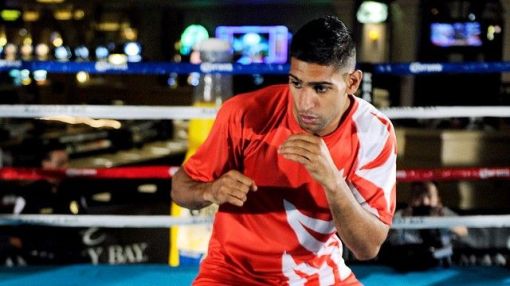
Since the very beginning of his career, Amir Khan has been more than just a boxer. He has been a symbol — well, more like symbols. One fighter, whose ethnic background, birthplace, and blinding hand speed mean very different things to different groups of fans. Khan himself has little control over how the people watching him choose to interpret his success.

It started early, when Khan was 17 years old and won a silver medal in the 2004 Athens Olympics. He became not only the “pride of Bolton,” his hometown, but also “the great young hope of British Boxing.” Khan decided to turn professional soon after, but days before his debut, the mood around Khan’s celebrity changed. The coordinated bombings on London’s transport system in July 2005 were the largest terrorist attack in British history. Three of the four bombers were, like Khan, of Pakistani origin, and all of them hailed from within a hundred miles of Khan’s home in Northern England. Khan, whose Olympic run established him as the country’s most prominent homegrown Muslim athlete, had no choice but to speak up. “I hope, by stepping into a ring, I can show all young kids in Britain, whether they are white, Muslims, or whatever, that there are better things to do than sitting around on street corners getting into trouble and mixing with bad people.” Ten days after the attacks, Khan proudly held the Union Flag when he walked to the ring. It was embroidered with the word “London” in black ribbons to mourn the victims. Moments after Khan wrapped up a first-round TKO victory, the police issued a red alert for a bomb scare and evacuated the arena.

At the ripe age of 18, Khan was not only a professional fighter, but also an unofficial spokesperson for Muslims and Asians in the U.K. Like it or not, he was a role model for underprivileged children caught at the crossroads of drugs, poverty, and now international terrorism. He also became “the best thing to happen for race relations in Britain.” All this translated into tremendous box office appeal. Before his London debut, for example, Khan visited Brick Lane, a large South Asian neighborhood on London’s East End, to promote the fight. “We brought him to the heart of the Asian community and we hope they will turn out and support him,” promoter Frank Warren said. They did. His next fight, against Belarussian Vitali Martynov, sold 10,000 tickets. It was Khan’s fifth professional fight.

Seven years later, it’s more of the same. Wherever Khan goes, he seems to carry the aspirations and insecurities of fans from all over the world. At the time of his last fight, on December 10, 2011, I was in Pakistan, a few miles away from Khan’s ancestral home, near Rawalpindi. Pakistanis aren’t die-hard boxing fans, but the sport isn’t completely unknown on the national scene. Of the two Olympic medals Pakistan has won in individual events, one is in boxing. Before every Khan fight, highlights from his previous bouts and flashy promos amped with heavy metal soundtracks start running on a loop on Pakistani television. Local governments set up big screens in public markets, and dense crowds arrive to cheer for Khan. Everything from his ring entrance to his punches to his post-match interviews are parsed and analyzed for how they reflect on Pakistan and its people.

In Pakistan, the buildup to Khan’s December bout with Lamont Peterson was feverish even by the local media’s distorted standards. Exactly two Saturdays before the fight, a swarm of American jet fighters and attack helicopters swooped into Pakistani territory from bases in neighboring Afghanistan and let loose a barrage of missiles targeting two Pakistani military posts. When the smoke cleared, 24 Pakistani soldiers were dead. The reaction was something like what it might have been if a Pakistani helicopter had flown into American territory and killed two dozen American soldiers: People cried bloody murder. America refused to apologize for the attack and instead blamed Pakistan for provoking it. In response, Pakistan cut off the American military supply routes that run through its territory to deprive U.S. forces in Afghanistan of equipment and food. The resulting standoff was the closest the two countries had come to all-out war after a decade of complex military rivalry.

While the world watched the diplomatic stare-down between two nuclear states, Pakistanis looked to Khan’s fight for a taste of vengeance. Khan’s opponent wasn’t just a real-life American — he was a real-life American from Washington, D.C. And in Pakistan, Washington is not just the name of another American city (never mind that the Washington from which Peterson hails bears little resemblance to the government monoliths that most Pakistanis associate with the city). Vashing-tone is the dark lair from which Obama orders the drone strikes that hit Pakistani villages every week. Vashing-tone is the Pentagon that drops American Special Forces into Pakistan in the dark of night to take out Osama. It’s akin to what the Kremlin meant to Americans during the Cold War. Actually, it’s not unlike what the word “PACK-istan” conjures up in many Americans’ minds today.

The Peterson fight would be Khan’s fourth in the United States, and this time he would enter the ring accompanied not only by the Union Jack, but also by the green flag of Pakistan with its white crescent. Unlike the battlefield, the American was the underdog in this fight, which ended up being one of 2011’s best. At the end, two questionable point deductions by the referee cost Khan the bout, and he lost on the scorecards. Khan let the alarm bells ring before he’d even left the ring. “It was like I was against two people in there, Lamont and the ref himself,” he said. Golden Boy Promotions appealed the decision a week later and the IBF began an investigation into the scoring of the fight.

Two weeks later, Khan flew to Pakistan. He travels there every so often to visit his parents’ homeland, but this time he visited to lend some star power to a Pakistani boxing tournament. When Khan arrived in the country, this is what you might have found while flipping through the dozen-odd local news channels: a steaming-mad middle-aged man calling for war against America; a montage from the Khan-Peterson fight showing Khan’s best combinations and Peterson hitting the mat again and again and again; an elaborate computer-generated graphic re-creating the American attack on the border posts; a field of caskets draped in Pakistani flags; Khan at a press conference calling the judges’ decision “disgusting” or saying something like “let’s take the fight somewhere neutral and I’ll see if he’s the same man.” The TV channels almost didn’t need different talking heads to discuss the two conflicts. The narrative was essentially the same: Americans play dirty, and when they feel like they’re losing, they cheat.

It was in the middle of such channel flipping that I found Amir Khan on my screen, being interviewed on Khyber News, a regional outfit that telecasts in the Pashto language to the Pashtuns, most of whom live along Pakistan’s western border with Afghanistan, including in the troubled tribal areas. Khan was seated on a plush, bright orange-and-yellow sofa, watching the tournament at ringside. The interviewer threw questions at him in Urdu and Khan answered in English, but that was no problem — Khan demonstrated a solid understanding of the questions in Urdu. It was the substance of the questions, which were less interested in Khan’s boxing career than in exploring the prospects of an interviewer, a TV channel, an ethnic group, and a nation’s hopes for itself on the global stage. Here are excerpts:

[“Khyber” is what Pakistanis call the northwest Afghan border regions. Inshallah means, “If Allah wills it.”]

INTERVIEWER: Does Amir Khan like the international popularity more or the love he gets from Pakistanis?
KHAN: Ummmm … it’s the same, you know. It’s the same in England. And in Pakistan, very same. You know? I’d say it’s the same everywhere we go. The two places where we get a lot of love is in England and also in Pakistan …

INTERVIEWER: Khyber News wants to show your fights live. I just talked to your father about this as well, but in the future do you think you will have a relationship with Khyber News?
KHAN: Yeah, definitely, I think it’s a good idea. We’re happy to work with anybody. To work with Khyber News will be, maybe good, you know. Let me speak to my team and inshallah the next fight for me will be in April or May against Lamont Peterson — I want a rematch — so maybe it can be on Khyber News. Let’s see what happens. I will try and speak to my team also …
INTERVIEWER: Wouldn’t it be nice if there were a ‘Khyber’ logo next to the ‘Khan’?
KHAN: Khyber Khan? Yeah, you know, maybe … [Laughs uncomfortably.]

INTERVIEWER: One more question, we’ve heard you have found your life partner and she lives in USA, I think. Is she Pakistani or is she from there?
KHAN: No, no. She’s Pakistani.
INTERVIEWER: Where from in Pakistan?
KHAN: Her father’s from Multan and her mother’s from Lahore.
INTERVIEWER: So she’s Punjabi?
KHAN: Yeah, I think so.
INTERVIEWER: When are you going to get married?
KHAN: Oh, not for a long time. I’m getting engaged next month so inshallah I’ll let the engagement happen first. Step at a time, brother.
INTERVIEWER: Will you keep fighting after the marriage?
KHAN: Yeah, yeah, it’s my job. It’s my job. I love boxing.
Any final thoughts? “To everybody in Pakistan, I want to say I hope they watch my next fight. Inshallah I’ll win for them. I’ll do it for my people in Pakistan.”

Khan seems to have understood what’s expected of him.

Where is Amir Khan from? The question follows Khan wherever he goes. Without a doubt that same question was asked when he arrived in New York to defend his WBA light welterweight title against Paulie Malignaggi in 2010. At the weigh-in, a group of 40 or so Pakistani-British fans who call themselves “Khan’s Army” caused pandemonium. Their fervent support for Khan was reminiscent of British football supporters, but with a Muslim twist. “If anyone can, Khan can,” they bellowed. “Amir, Amir, Amir.” This was punctuated several times with the loudest call of all: “Allah-o-Akbar.” While Khan and Malignaggi engaged in a stare-down for the flashing cameras, their supporters were in the throes of a full-fledged brawl.

Khan’s Army is no jihadi outfit. This is just how they show love for their fighter. But America was understandably tone-deaf to Khan’s Army when the latter first arrived in the country. How many times in the previous decade had a large group of brown men chanted “Allah-o-Akbar” with such confrontational zeal in New York City? You could probably ask any Pakistani immigrant — a taxi driver in New York or a heart surgeon in Chicago — or even a Pakistani in Pakistan and they would all tell you with equal certainty: It is not a good idea to gather in large groups with other men who look like you and scream “Allah-o-Akbar” for any reason whatsoever, especially in New York. But then, Khan’s Army is not Pakistani; nor is it Pakistani American. They are British Pakistanis and they are part of a different culture, one in which “Allah-o-Akbar” often has more to do with ethnic pride than with Allah.

Khan was born in a town called Bolton, on the outskirts of Manchester in northern England, a fact he demonstrates by failing to pronounce the letter t when it comes in the middle of a word. Long before Manchester became famous for its football clubs, the city was an engine of the industrial revolution. The region’s textile mills attracted thousands of immigrants from the former British colonies in South Asia. Khan’s family arrived in the 1970s from the northern Punjab region of Pakistan.

Today, “Asians” — that’s what the British call South Asian immigrants from Pakistan, India, and Bangladesh — make up about 5 percent of the population of England, and together they are the country’s largest minority group. A large majority of British Asians are Muslim, and a vast majority of Muslims are Pakistani immigrants. Khan’s father did well as a scrap metal merchant, and although Khan grew up in a comfortable home, his family still lived in a depressed part of Bolton. In general, Pakistani immigrants are some of the poorest people in Britain, living in some of the more violent and drug-ridden neighborhoods in London and the big cities of the North.

Amir “King” Khan was arguably the best thing that ever happened to this community. So when Khan left his English promoter to join Oscar de la Hoya’s Golden Boy Promotions in 2010, some in Britain saw the move as more than just a desire for big money. Maybe Amir was trying to get away, to base his career in a country where every business decision he makes and every punch he throws is not fraught with ethnic, religious, and class symbolism. And how did that reflect on Britain itself? Kevin Mitchell, the Guardian’s boxing correspondent, blamed “the small crew of British bigots who have taken against Khan” and driven him out of the country. “Over there, living quietly and comfortably in the Californian sunshine,” Mitchell lamented, “he is accepted without question by the fans — black and white Americans, Filipinos, Mexicans, all of them.”

Khan’s other British fans didn’t seem to mind the move as much. They just started traveling en masse to the United States for his fights. Khan’s Army remains as die-hard as ever, but it seems that they’ve toned down the “Allah-o-Akbar” — at least in America.

Amir Khan will step into the ring Saturday night with undefeated light welterweight champion Danny Garcia. The bout has been a long time coming for Khan — the seven-month layoff since his December loss to Peterson is as long an inactive period as he has had in his career. He was scheduled to fight Peterson in a May rematch that was canceled after Peterson tested positive for performance-enhancing drugs. Peterson also admitted to having the banned substance in his system before the first Khan fight, and that led the WBA to reinstate Khan as its 140-pound champion earlier this week. The Pakistani press had a ball with the news about Peterson’s failed drug test, but it sent Khan scrambling to find a new opponent. The Islamic holy month of Ramadan was coming up in mid-July, and Khan, as always, planned to fast. After that, he probably wouldn’t be in fighting shape until winter. Khan has already fought almost every credible opponent in the 140-pound weight class and so Garcia, the current WBC champion, seemed like the best option, even if Khan would be a heavy favorite in the fight.

Ever since the match was set up, Angel Garcia, Danny’s father and trainer, has been calling Khan an “overrated” fighter. But that’s not all he’s saying. He proclaimed that he has “never, ever, ever in my lifetime, that I’ve been living 49 years, I ain’t never met a Pakistani that could fight.” Then, somewhat nonsensically, he dismissed Khan as a “European fighter from Europe.” Finally, for good measure, he went after Khan’s religion: “I know Khan’s god already. His god is a punishing god. And my god is a loving god.” At the press conference in Los Angeles to announce the fight, Garcia senior cut off everyone from team Khan and began ranting about “magic carpets” and a “genie.” Boxers and their camps always play up their mutual dislike to promote fights, but Angel Garcia seems genuinely perturbed by Khan. It was at the end of the presser, when Angel was practically spitting with rage, that the elder Garcia yelled what he was really getting at this whole time: “Where you from, man? Europe? America? Where you from?”

California has been good to Khan. Since relocating to Los Angeles to train at Freddie Roach’s Wild Card gym, he’s been spotted sitting courtside at Laker games, he’s been featured in a GQ fashion spread, and he’s been photographed on the red carpet for the L.A. Spider-Man premiere. He even got to throw the first pitch at a Dodgers game this month, and it reportedly zipped right over home plate. With the exception of Angel Garcia, America and Amir Khan seem to be getting along just fine.

Islam, Pakistani, Muslim, European — none of those are necessarily flattering descriptions in America these days, but Khan continues to hold together the various strands of his identity and carry the dreams of people halfway across the world, and perhaps that’s what’s most appealing about him. Which flag is he going to carry into the ring this weekend? Will he someday add the Stars and Stripes to his collection? At the end of the day it doesn’t really matter. What matters is that there will be people spread across a dozen time zones, all of whom will root for Khan, all for their very own personal and selfish reasons. And as long as he keeps delivering, Khan’s Army will be there, too, in ever-growing numbers. Khan said once about his fans that “they might not be boxing fans, but they might be Amir Khan fans, y’ge’ me?” It’s a figure like this who can transcend boxing’s current status as a niche sport and grow from a prizefighter to a global sports figure.

Shahan Mufti is a freelance journalist whose work has been published in Harper’s Magazine, Wired, The New York Times Magazine, Bloomberg Businessweek, and The Atlantic, among other places. He is at work on a book about Muslim identity in Pakistan that comes out next year. This is his first piece in Grantland.

Pakistan Shuns Physicist Linked to ‘God Particle’

By Sebastian Abbot for Bloomberg Businessweek News

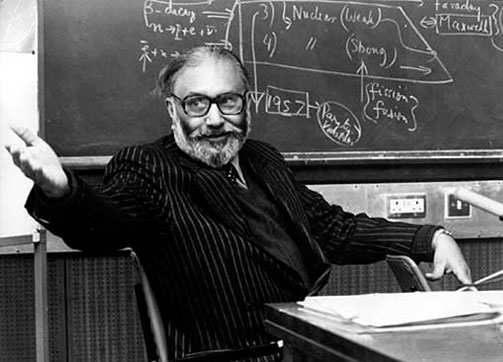
The pioneering work of Abdus Salam, Pakistan’s only Nobel laureate, helped lead to the apparent discovery of the subatomic “God particle” last week. But the late physicist is no hero at home, where his name has been stricken from school textbooks.

Praise within Pakistan for Salam, who also guided the early stages of the country’s nuclear program, faded decades ago as Muslim fundamentalists gained power. He belonged to the Ahmadi sect, which has been persecuted by the government and targeted by Taliban militants who view its members as heretics.

Their plight — along with that of Pakistan’s other religious minorities, such as Shiite Muslims, Christians and Hindus — has deepened in recent years as hardline interpretations of Islam have gained ground and militants have stepped up attacks against groups they oppose. Most Pakistanis are Sunni Muslims.

Salam, a child prodigy born in 1926 in what was to become Pakistan after the partition of British-controlled India, won more than a dozen international prizes and honors. In 1979, he was co-winner of the Nobel Prize for his work on the so-called Standard Model of particle physics, which theorizes how fundamental forces govern the overall dynamics of the universe. He died in 1996.

Salam and Steven Weinberg, with whom he shared the Nobel Prize, independently predicted the existence of a subatomic particle now called the Higgs boson, named after a British physicist who theorized that it endowed other particles with mass, said Pervez Hoodbhoy, a Pakistani physicist who once worked with Salam. It is also known as the “God particle” because its existence is vitally important toward understanding the early evolution of the universe.

Physicists in Switzerland stoked worldwide excitement Wednesday when they announced they have all but proven the particle’s existence. This was done using the world’s largest atom smasher at the European Organization for Nuclear Research, or CERN, near Geneva.

“This would be a great vindication of Salam’s work and the Standard Model as a whole,” said Khurshid Hasanain, chairman of the physics department at Quaid-i-Azam University in Islamabad.

In the 1960s and early 1970s, Salam wielded significant influence in Pakistan as the chief scientific adviser to the president, helping to set up the country’s space agency and institute for nuclear science and technology. Salam also assisted in the early stages of Pakistan’s effort to build a nuclear bomb, which it eventually tested in 1998.

Salam’s life, along with the fate of the 3 million other Ahmadis in Pakistan, drastically changed in 1974 when parliament amended the constitution to declare that members of the sect were not considered Muslims under Pakistani law.

Ahmadis believe their spiritual leader, Hadrat Mirza Ghulam Ahmad, who died in 1908, was a prophet of God — a position rejected by the government in response to a mass movement led by Pakistan’s major Islamic parties. Islam considers Muhammad the last prophet and those who subsequently declared themselves prophets as heretics.

All Pakistani passport applicants must sign a section saying the Ahmadi faith’s founder was an “impostor” and his followers are “non-Muslims.” Ahmadis are prevented by law in Pakistan to “pose” as Muslims, declare their faith publicly, call their places of worship mosques or perform the Muslim call to prayer. They can be punished with prison and even death.

Salam resigned from his government post in protest following the 1974 constitutional amendment and eventually moved to Europe to pursue his work. In Italy, he created a center for theoretical physics to help physicists from the developing world.

Although Pakistan’s then-president, Gen. Zia ul-Haq, presented Salam with Pakistan’s highest civilian honor after he won the Nobel Prize, the general response in the country was muted. The physicist was celebrated more enthusiastically by other nations, including Pakistan’s archenemy, India.

Despite his achievements, Salam’s name appears in few textbooks and is rarely mentioned by Pakistani leaders or the media. By contrast, fellow Pakistani physicist A.Q. Khan, who played a key role in developing the country’s nuclear bomb and later confessed to spreading nuclear technology to Iran, North Korea and Libya, is considered a national hero. Khan is a Muslim.

Officials at Quaid-i-Azam University had to cancel plans for Salam to lecture about his Nobel-winning theory when Islamist student activists threatened to break the physicist’s legs, said his colleague Hoodbhoy.

“The way he has been treated is such a tragedy,” said Hoodbhoy. “He went from someone who was revered in Pakistan, a national celebrity, to someone who could not set foot in Pakistan. If he came, he would be insulted and could be hurt or even killed.”

The president who honored Salam would later go on to intensify persecution of Ahmadis, for whom life in Pakistan has grown even more precarious. Taliban militants attacked two mosques packed with Ahmadis in Lahore in 2010, killing at least 80 people.

“Many Ahmadis have received letters from fundamentalists since the 2010 attacks threatening to target them again, and the government isn’t doing anything,” said Qamar Suleiman, a spokesman for the Ahmadi community.

For Salam, not even death saved him from being targeted.

Hoodbhoy said his body was returned to Pakistan in 1996 after he died in Oxford, England, and was buried under a gravestone that read “First Muslim Nobel Laureate.” A local magistrate ordered that the word “Muslim” be erased.

For Surjeet Singh, Life Unfolds a Guessing Game

As Reported by The Hindustan Times

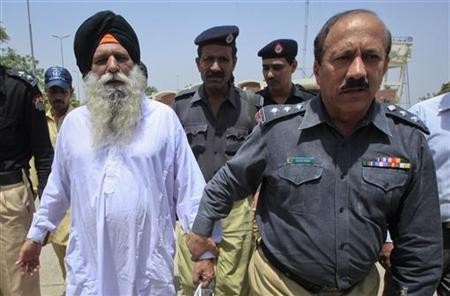
“Pehchanon ji ye kaun hai” (guess who this is), is what Surjeet Singh often hears, as he relaxes on a cot in the sweltering summer heat on a farm in this Punjab village. Surjeet, 69, now plays this ‘guessing game’ several times a day, ever since he arrived in his native village last week, after more than 30 years of incarceration in Pakistan.
“There are several people from villages and other places coming to meet me despite the heat. Sometimes, my family members ask me to guess who a particular person is. Most of them look so different and older, just like me. It is hard to guess every time and then I try to identify them by their names. I can re-collect some names though,” Surjeet Singh told IANS with several people sitting around him.

“Ye budhi kaun hai (who is this old woman)?” was a question Surjeet popped in Punjabi to his relatives as an elderly woman came to meet him. He was told that she was a relative and he gave her a warm hug.

Surjeet wears a pair of white kurta-payjama and slippers as he wanders through his daily life and receives scores of visitors or meets them around his village. He returned home Thursday to a tumultuous and teary welcome from family and friends.

Among the visitors Saturday was Gurbaksh Ram, a fellow prisoner in Pakistan who returned to India in June 2006.

“I was with Bapuji in the Lahore jail for several years. I was released in June 2006 after, spending over 20 years in Pakistani jails. When I read about his return, I wanted to meet him,” Gurbaksh told IANS.

Among the visitors were two Sikh gentlemen who asked if he could recognise them.

“I am Bhai Singh and he is Vikar Singh,” one of them said. Surjeet had a hearty laugh as he hugged the taller Vikar Singh and remarked: “Ehh taan baba baneya phirda hai (he has become an old man).”

Besides the people who knew him from over three decades back, there are others who come to him with hope to hear about their own missing ones.

“Some people get their files and photographs of missing family members who are believed to be in Pakistani jails. They show him (Surjeet) the photos to know if he has met that person in Lahore jail,” one of his relatives said.

“He is very happy to be back in his country and among his family members and friends. Even though we were forced to sell our old house (where Surjeet lived) and land, this new house is lucky for us as it has brought him back,” Surjeet’s wife Harbans Kaur said.

“In the (Pakistani) jail, he had some facilities like regular power supply which is not available here. He is back now and my tension is over. I will put the entire responsibility on him. He will take charge of things,” Harbans Kaur, who supported her children in adversity after Surjeet went missing in 1982, said with a smile.

Surjeet languished in Pakistani jails for over 30 years after being arrested on charges of spying there. He was sentenced to death but the sentence was later commuted to life imprisonment.

Surjeet was released from Lahore’s Kot Lakhpat jail early Thursday and made the road journey in a prison van to Wagah, on the Pakistan side of the border, before walking into India at the famous checkpost.