Archive for the ‘ Hate Crime ’ Category

Deadly blasts hit Sufi shrine in Lahore

By Syed Shoaib Hasan for The BBC
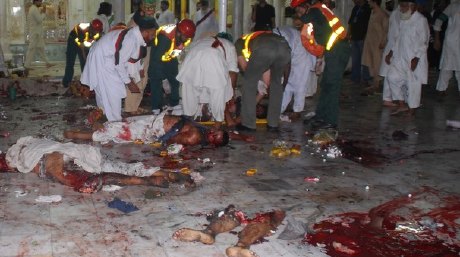
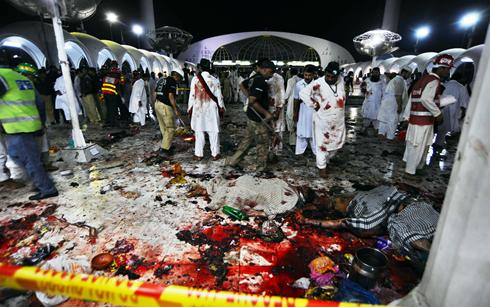
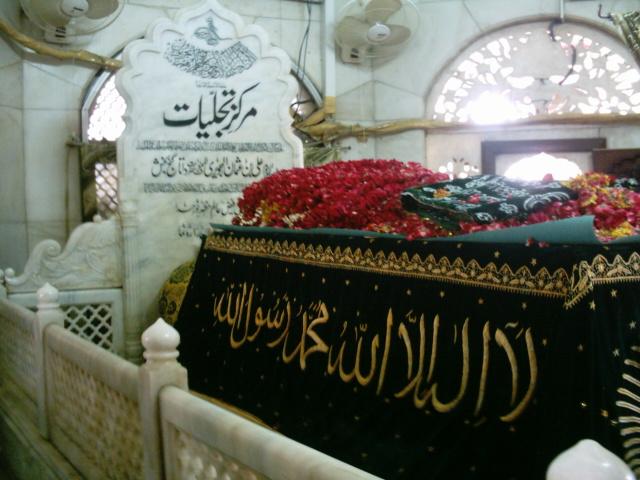
Suicide bombers have launched a deadly attack on a Sufi shrine in the eastern Pakistani city of Lahore. At least 35 people died in the blasts at the popular Data Darbar shrine late on Thursday evening, officials say. At least 175 other people were hurt in the blasts, believed to be the first targeting a shrine in Lahore. Thousands of people were visiting the shrine at the time, officials say. It holds the remains of a Persian Sufi saint, Abul Hassan Ali Hajvery.

Although no-one has yet said they carried out the attack, Taliban militants and their Punjabi jihadi allies have been involved in several such bombings in the northern Khyber Pakhtoonkhwa province. The shrine is largely frequented by members of the majority Barelvi sect, who are seen as heretics by the Taliban. Most of the Taliban belong to the rival Deoband Sunni sect, which strongly disapproves of worship at shrines. Many are also allied to the Sipah-e-Sahaba, and its armed splinter group, Lashkar-e-Jhangvi, which seeks to turn Pakistan into a Deoband Sunni state.

The shrine is visited by hundreds of thousands of people each year from both Sunni and Shia traditions of Islam. At least two attackers were involved, although police initially said three explosions had been heard.  The impact of the blasts ripped open the courtyard of the shrine. Rescue workers could be seen clambering over the rubble as they carried out the victims. Khusro Pervez, commissioner of Lahore, said two of the attacks took place in the main courtyard and one in the lower level of the shrine.

The first attacker struck in the underground area where visitors sleep and prepare themselves for prayer, he said. As people fled, a second bomber detonated his explosives in the upstairs area. Officials say they believe the bombers used devices packed with ball-bearings to maximise the impact of their attack.  A volunteer security guard at the shrine described scenes of devastation.

“It was a horrible scene,” said Mohammed Nasir. “There were dead bodies all around with blood and people were crying.” The attack is the biggest on a Sufi shrine in Pakistan since militant attacks began in 2001.  No group has said it carried out the attack, but correspondents say the attacks continue a growing trend among militants to target members of other sects as well as minorities.

Lahore has been hit by a series of bomb attacks, including a suicide blast at anti-terrorist offices in March, when at least 13 people died. In May, more than 90 people were killed in a double attack on the minority Ahmadi sect in the city.

Earlier, security chiefs had been congratulating themselves after what was the first month in two years in which there had been no suicide bombings in Pakistan, the BBC’s Aleem Maqbool reports from Islamabad.

They said it was proof the militant networks had been disrupted. Most Pakistanis knew the battle against militancy in this country was far from over, he adds. Last year Pakistan launched a major military offensive against militant strongholds in South Waziristan.  In December the military said they had achieved victory, but subsequent reports have suggested the militants remain active in the region.
Why Pakistan’s Ahmadi Community is Officially Detested

By Mohammed Hanif  for BBC

By Mohammed Hanif for BBC

When a Pakistani Muslim applies for a passport or national ID card, they are asked to sign an oath that no Muslim anywhere in the world is asked to sign. The oath goes like this: “I consider Mirza Ghulam Ahmad an impostor prophet. And also consider his followers, whether belonging to the Lahori or Qadiani group, to be non-Muslims.”

Like millions of other Pakistanis, I have signed this oath several times without giving much thought to exactly what Mr Ahmad stands for, or what the technical difference between Lahoris or Qadianis is. I want my passport, and if I have to sign up to a fatwa to get it, so be it.

But like millions of people from my generation I also remember that when I was growing up, the minority Ahmadi sect were considered just another Muslim sect.

When a Pakistani Muslim applies for a passport or national ID card, they are asked to sign an oath that no Muslim anywhere in the world is asked to sign. The oath goes like this: “I consider Mirza Ghulam Ahmad an impostor prophet. And also consider his followers, whether belonging to the Lahori or Qadiani group, to be non-Muslims.

Like millions of other Pakistanis, I have signed this oath several times without giving much thought to exactly what Mr Ahmad stands for, or what the technical difference between Lahoris or Qadianis is. I want my passport, and if I have to sign up to a fatwa to get it, so be it.  But like millions of people from my generation I also remember that when I was growing up, the minority Ahmadi sect were considered just another Muslim sect.

Like scores of others I had friends who were Ahmadis. We played cricket together, and sometimes, when our parents ordered us off to the mosque, we even prayed side by side.

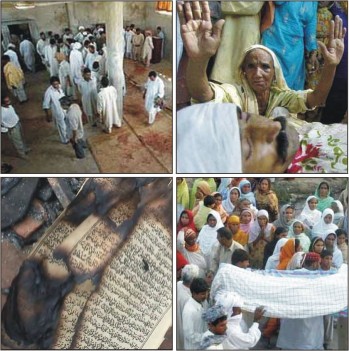
Last month, when more than 90 Ahmadis were massacred in two mosques in Lahore, I remembered the precise moment in 1974 when it all began to change.  There were street protests by religious parties against Ahmadis demanding that they should be declared non-Muslims.

One day I saw some bearded activists standing outside a clothes merchant’s shop in our town, chanting anti-Ahmadi slogans and turning customers away, telling them that buying clothes from Ahmadis was haram – forbidden. At the time I was learning to memorise the Koran from a very kind, mild-mannered teacher. I asked him what exactly was wrong with the Ahmadis.  He explained to me that they didn’t believe that the Prophet Muhammad was the last and the final messenger.

I said OK, maybe that makes them kafirs, infidels, but who says that kafirs can’t sell cloth?  My teacher’s response was a full-handed slap, so sudden, so unexpected that it rang in my ears for days to come. That same year Pakistan’s first elected parliament declared Ahmadis non-Muslims.  Then in 1984 Pakistan’s military dictator and self-appointed guardian of the faith General Zia-ul-Haq inserted that oath in the constitution that we are all required to sign.  Because of the new laws, Ahmadis have been sent to prison simply for using the Muslim greeting Assalamu alaikum, or putting a Koranic verse in a greeting card.

Over the last three decades the hatred against Ahmadis has become so widespread that Pakistan is now embarrassed by the only Nobel laureate it has ever produced.

Dr Abdus Salam Khan won the Nobel Prize for physics and, as a proud Pakistani, accepted his award in national dress.  But he was an Ahmadi so there is no monument to celebrate him, no universities named after him.

The word “Muslim” on his gravestone has been erased. Even the town he is buried in has been renamed in an attempt to erase our collective memory. This hatred was evident in the reactions to the massacre. TV channels were more obsessed with making sure that in their broadcasts Ahmadi mosques were called “places of worship”.

When you refuse to call a place of worship by its proper name, you are implying that it’s not a mosque, it’s not a church, it’s not a synagogue, it’s a place where godless people do godless things. And all the various Islamic political parties, whose leaders often refuse to pray together, are united on this.

When Pakistan’s main opposition leader Nawaz Sharif used the phrase “our brothers” for the murdered Ahmadis, leaders from 11 political parties came together to condemn him and threatened to issue a fatwa declaring him a heretic.  Over the last three decades the siege has been so palpable that those Ahmadis who couldn’t afford to emigrate have taken to hiding their identity.

If you want to destroy someone in public life it’s enough to drop a hint that they are Ahmadi. In the 1980s, the former chief minister of Punjab and current federal minister didn’t attend his own mother’s funeral because there were rumors that she was an Ahmadi.  When the funerals of the massacred Ahmadis took place there were no officials, no politicians present 

Pakistan’s liberal bloggers and some English-language columnists did write along the lines that Ahmadi blood is on our hands.  Others were adamant that it was yet another Friday, yet another massacre by the Pakistani Taliban, and we should just fight this sort of terrorism and leave the sectarian debates alone.

Two incidents in the past week made me realize how pathological our response was. At a vigil to mark the massacre, where a handful of people had turned up, a passer-by asked me “Are you an Ahmadi?” My own loud and aggressive denial surprised me.

Then an Ahmadi friend whose father survived the Lahore massacre wrote to me saying: “You know we have been living like this for decades. Did something like this have to happen for you to speak up?”

–Editor’s Note- It is high time that this law be repealed and the Ahmadi community of Pakistan be given all the basic human rights and privileges enjoyed by all Pakistanis.

A Journey into America, Past and Present

By Akbar Ahmed for The Guardian

Muslims are for Americans what the Russians were for Churchill: “A riddle, wrapped in a mystery, inside an enigma.” While the post-9/11 period brought an interest in the Qur’an and its language, the gap between Islam and mainstream America has steadily widened. It remains more urgent than ever for the US to comprehend Islam, a religion practised by one out four people in the world, not only for the sake of its ideals (which include religious tolerance) but also for its geopolitical needs and strategy as America remains militarily involved in Afghanistan, Iraq, Pakistan, and Somalia.

The reality is that Islam remains unknown to most Americans, who, on top of all the other insecurities and fears about the religion, have recently added another: the “homegrown terrorist”, which President Obama has named as one of his administration’s top national security priorities.

I have been in a unique position to observe America’s attitudes towards Islam, travelling with a team of young Americans for over a year throughout the length and breadth of the United States to over 75 cities, visiting more than 100 mosques and talking to thousands of Muslims and non-Muslims.

I realised that it was impossible to study Islam in America without studying America itself and its identity, which I determined goes back to the first Mayflower settlers. In short, there are three basic identities that define American society: primordial, pluralist, and predator. Primordial identity is rooted in the seminal landing at Plymouth and provides the foundation of the two other identities. The aim of the early settlers was to survive and create a Christian society under the rule of law. The majority of the Founding Fathers in the next century would subscribe to what I call pluralist identity – believing in civil rights and liberties, religious freedom and tolerance.

America has a strong foundation in which to solve the challenge of the Muslim community if Americans look to their past and revive the spirit of some of their truly great leaders. Roger Williams, in the 17th century laid the groundwork for separation of church and state and welcomed people of other faiths. The state, said Williams, should allow all religions, including the “Turkish” (Islamic).

Thomas Jefferson owned a Qur’an and we found a statue of Jefferson at the University of Virginia advocating “Religious Freedom, 1786” with the words God, Jehovah, Brahma and Allah carved on the tablet he embraces.

A treaty, which was sponsored by George Washington and signed by John Adams in 1797, pertained to Tripoli and assured that the United States “has in itself no character of enmity against the laws, religion or tranquility of Musselmen.” Even the Prophet Muhammad was praised by the Founding Fathers; Adams called him one of the world’s “sober inquirers after truth” alongside such figures as Confucius and Socrates, and Benjamin Franklin cited the prophet as a model of compassion.

As primordial identity was taking shape at Plymouth, however, and new trends were already emerging. The more zealous of the settlers argued that the land was given to them by God, and they were to occupy it regardless of who was living there. As their confidence grew, they began to prey on the weaker natives, justifying their force in the name of protecting the community, generating an arrogance that did not encourage self-reflection and making it easy to demonise and destroy the enemy. This marked the birth of a predator identity.

It is this understanding of American society which allows us to put the Muslim community in America into context. Our findings from the field bring both bad news and good news. The bad news is that every one of the major American Muslim categories – African Americans, immigrants, and converts – has been involved in recent violence-related cases in the United States. In view of the bankruptcy of Muslim leadership and American failure to truly understand the Muslim community, it is not difficult to predict that violence will increase in both frequency and intensity. I am sorry to say that the government and its various agencies still do not have an adequate policy towards the country’s Muslim population. Some Muslims are affected by US actions taken in response to 9/11, which included the arrests and deportation of thousands, prompting many others to flee the country. These realities have reinforced the sense of being a mistrusted community. Others resent the Islamophobia they see in the media.

The good news is that American and Muslim leaders alike are now conscious of the problem of terrorism and its scale and are actively discussing the position of Muslims in America. Some of our findings challenge the received wisdom telling us that most Americans are hostile to Muslims. Of those questioned for our study, 95% said that they would vote for a Muslim for public office, for example, and an equally high number of respondents had no problem with Muslims being “American”, although some inserted “if” clauses. We found a patriotic and vibrant Muslim community committed to contributing to the country. Dialogue and understanding are urgently recommended.

America stands at a crossroads. It will have to choose either to embrace the Founding Fathers’ pluralist vision or the America that compromises the Constitution and the values of the Founding Fathers. Primordial and predator identity remain alive and well in today’s United States. In one way or another, people everywhere have a stake in America resolving its identity because America’s unique, universal vision of society formulated by its Founding Fathers attracts the world. A new chapter in the history of the United States has opened after 9/11 and America’s future will be decided on how it resolves its ongoing engagement and entanglement with Islam.

Muslim-Americans: Bracing For A Backlash

By Christopher Alessi for The Huffington Post

Adil Najam, a Pakistani-American professor at Boston University, took his 12-year-old son aside before sending him off to school last Wednesday. He told him to hold his head high, even if the other kids make fun of him and call him a terrorist.

In the days following this month’s attempted car bombing in Times Square by Pakistani-American Faisal Shahzad, Pakistanis and other Muslim groups in the U.S. have been taking precautions to prevent a public backlash similar to the one Muslim-Americans faced following 9/11–but they are still preparing for the worst.

“We are so grateful, thank God, that the bomb did not blow up, but the real damage here is to the Pakistani community,” Najam said. “Everyone [Pakistani-Americans] now gets ready for the office – or school – knowing he will be looked at differently.”

As a result, community leaders, such as Dr. Saud Anwar, the director of Connecticut’s branch of the Pakistani-American Public Affairs Committee, are counseling fellow Pakistanis to jump on the offensive. “We’re hoping we’re not going to be marginalized and we’re trying not to be scared, so we’re mobilizing the community to condemn the incident,” he said.

After 9/11, Anwar made a choice to be more “politically active and to build bridges with the law enforcement community.” He now works closely with the FBI and the Department of Homeland Security to help identify suspected terrorists. He has also encouraged his fellow Pakistanis in Connecticut to become more engaged with the police, in part to counter the stereotype that all Muslims are terrorist-sympathizers.

If Muslim-Americans don’t take an active approach, Anwar believes, they will only be further marginalized, which in turn will lead to increased “identity crises” and subsequent radicalization in the greater Muslim community–an arguably vicious and deadly cycle.

Najam also contends that Muslims are being “more vigilant against crackpots within their own communities,” by reporting them to the authorities. “We are trying to deal with incidents involving black sheep much better,” he said, referring to fellow Muslims that are suspected of harboring radical and violent agendas.

Both Najam and Anwar are trying to preemptively thwart the onslaught they say their communities faced after 9/11. Back then, both men argue, many Muslim-Americans felt they were put under a microscope by the mainstream American media and society at large. “There was a very high level of apprehension immediately after 9/11,” Najam said. “‘American-Americans’ – whatever that is – were apprehensive about Muslims, and we were internally apprehensive about how we were being viewed.”

Prof. Sinan Antoon of New York University believes that U.S. government policy and rhetoric following 9/11 only compounded the situation for Muslims. “The war on terror discourse and the manichaean view of a world populated by those who are with us and those others who are against us spelled danger and disaster for Arab and Muslim citizens or immigrants,” Antoon said. “After 9/11,” he added, “Arab-Americans and Muslim-Americans were all guilty by association.”

Indeed, for many ‘ordinary’ Americans – non-Muslims, or “American-Americans,” as Najam put it – ‘Muslim’ became the codeword for ‘terrorist.’ As a result, many Muslims felt forced to take responsibility for the acts of religious (and political) fanatics who happened to share the same faith.

Antoon further argues that Muslims were easily linked with terrorists after 9/11 because “terrorism was explained in cultural and civilizational terms, not in material history and politics.” “The result,” he explained, “was for the U.S. government to absolve itself of its own responsibility in supporting foreign jihadists in the 1980s…and skirt the blame to the cultural sphere and simplify phenomena and events as simply a class of cultures.”

But Najam is optimistic that things could be different this time. He believes that mainstream American society has evolved since the time period following 9/11. “Society is more adept at handling these [terrorism incidents] as acts of criminality,” he said. Most Americans, Najam argues, no longer see the actions of individuals such as Shahzad as representative of an entire cultural or religious group.

Anwar, too, is trying to remain positive. “There are over 1 million people of Pakistani heritage in the U.S., and there was one idiot that couldn’t think straight,” he said.

“I think America is better than that–blaming the whole community.”

Fear and Mistrust of Muslims and Islam is Widespread

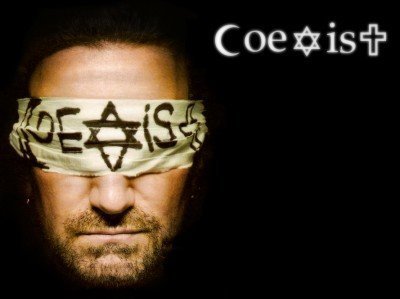
(Yes, this is Singer Bono from U2 in case you were wondering)

Dear Group,

Below is a response that I wrote after receiving a message from a Christian minister I thought I knew after sending  him an email to join Pakistanis for Peace on Facebook.  I don’t have his original message but he stated that Muslims are instructed by the Quran to “kill the infidels”, called Mohammad (pbuh) a “blood warrior”, said the Islam was a violent religion and Jesus is the one true Lord.

It was nice to see an email from you but I have to admit I was a little disappointed in the message.  This group is not a “Muslim” group.  Yes it is for Pakistan and yes the majority of Pakistanis are Muslim, however, the focus of this group is to promote peace in a region of the world where there is little.  These people simply want their home to be peaceful so they can send their children to school or go to the market without being blown to pieces!!  I would support a group that was promoting this in any region of the world regardless of the religion of its people or the politics of their government.  I would join Japanese for Peace, Finns for Peace, Mexicans for Peace, etc.  When the message is for peace, why would anyone NOT support the cause?

I too have read parts of the Quran along with commentary regarding it.  I own more than one copy in order to get more than one perspective.  I’ve also read material on the Sunna and the Hadiths (most people outside of Islam don’t even know what those are).  I’ve been to more than one mosque in the Orlando area and have been to countless lectures regarding Islam and the Middle East.  (I graduated with minors in Religion AND the Middle Eastern studies.)  The reason I selected those topics was because I want to educate myself in order to educate others about the misconceptions of the Middle East and of the Muslims worldwide.  You are not the first person to say these things and I’m sure you will not be the last. 

Yes there are things in the Quran that are violent but there are peaceful things as well.  The Muslim mission is not to kill all of the infidels.  All of the suicide bombers we hear about are all going to hell according to the laws of their own religion!!  Suicide in Islam is haram, or sinful.  The acts of these extremists are killing innocent people AND other Muslims so they will punished on the Day of Judgment (yes Islam has this too).  Also, Muslims are required to respect Jews and Christians because they are people of the book.  Did you know that Jesus is mentioned in the Quran more than their own prophet Mohammed (peace be upon him)?  Most people don’t know that that.  Most people don’t even know that Jesus is part of Islam. 

As far as Mohammed (pbuh) is concerned, yes he fought but he did for his religion….wouldn’t you?  Would you not kill or be killed for your lord and your God?  Yes there are extremists within Islam but you can find extremist in EVERY religion….even in Christianity.  The Crusades were for the sake of God.  Convert or be killed and many were killed.  Many people don’t know that in the Ottoman Empire, which was Islamic, some leaders were not concerned with people converting to Islam.  Why?  If the people were not Muslim, they would pay a higher tax.  The Empire receives more money and the citizen worship however the please.  Does that not seem like a much more reasonable solution rather then murdering those who don’t worship as you do?  Let’s not forget, Hitler was a Christian.  Some KKK groups are Christians too and if you’re a Jew, black, Latino, Arab, gay, etc, they want you dead.  That’s not very Christian like but I would never condemn all Christians based on the behavior of a few extremists. 

The issue these days a simple lack of knowledge.  We listen to what we hear on the News and take it as gospel.  This is very dangerous.  Watch this video and you’ll understand were I’m coming from.

This should have NEVER happened! I have no underlining motive here do to the fact I do not practice Christianity OR Islam.  I just have a message of peace.  I encourage you to take another look at the religion with more of an open mind.  If you would like, I can give you the name and number of an Imam in the area that can answer questions for you and give you an endless amount of material and resources to investigate on your own.   Also, seeing that you are a religious leader within your own community, I ask that you support and promote peace as much as possible.  Peace should not be a luxury, enjoyed by only a few.  Everyone has the right to live peaceful regardless of where they live, what they look like, what language they speak or who (or what) they worship. 

Written by Pakistanis for Peace Facebook group member Alicia for www.PakistanisforPeace.com

Alicia Koutsoulieris

President of Amnesty International at the University of Central Florida

Akoutsoulieris@aol.com

Attacks on Sri Lankan Cricket Team in Pakistan a New Low on War on Terror


Lahore, Pakistan- The already bad security situation in Pakistan got worse Tuesday when about 12 to 15 gunmen attacked the bus carrying Sri Lanka’s cricket team for a match against the Pakistani national team in Lahore Pakistan. At least 5 Pakistani policemen and a driver were killed in the attack and up to eight visiting Sri Lankan cricketers were injured.


The masked men opened fire on the Sri Lankan bus as it approached the cricket stadium for its match against Pakistan. Grenades, rocket launchers, weapons and backpacks with dry food and water were left behind by the attackers who all successfully fled the scene after the carnage.


Pakistani officials stated that the incident had similarities to the attacks in Mumbai in November of last year by the organization, weapons and the brazenness of the attacks. New Zealand immediately canceled its planned tour of Pakistan scheduled for later this year.  Australia also had previously canceled matches in Pakistan last year due to safety concerns. The attacks have also put great doubt on Pakistan’s ability to host some of the matches for the cricket World Cup scheduled for 2011 to be hosted by India, Pakistan and Sri Lanka. In fact, all international sporting events to be held in Pakistan are now in jeopardy as visiting foreign sportsmen will fear for their safety and are obvious targets by the crazed militants in Pakistan.


Pakistan has long been feared to be a country on the verge of becoming a failed state. However various events in the last 18 months have shown how true this unfortunate statement has come to reality. All the attacks that have happened in Pakistan from the Marriott bombing in Islamabad, to the murder of Benazir Bhutto, to the involvement in the Mumbai attacks in India, to the Taliban attacks in Swat valley and their win against the government in gaining Sharia Law, the continued kidnapping and beheading of foreigners and now the brazen attacks on a foreign sporting team just go to show how close to a failed state Pakistan has become.


Pakistan has for a long time been the most dangerous country in the world for its citizens with rampant crime, lawlessness, mixture of ethnic groups fighting amongst themselves, armed militants and Islamic extremists fighting in Afghanistan and India, and nuclear weapons in a country with a very weak government and constant political upheaval. The attacks on the Sri Lankan team now show the world and especially to the cricket loving Pakistanis that the enemies of the country will stop at nothing to destroy everything that is cherished in their country for their own misguided goals. No patriotic citizen of Pakistan should after these attacks have any doubt as to the immediate need to eradicate these terrorist groups from within Pakistan as they not only represent a clear and present danger to all friends and visitors to Pakistan but to the nation of Pakistan and its sovereignty. These terrorists aim to destroy Pakistan from within and hope to incite a civil war much like the one in Afghanistan with chaos and destruction through their continued attacks and then hope to put in power Islamic extremists like the Taliban who will proclaim to bring order to the country by instituting Sharia Law throughout the country.


We at Pakistanis for Peace and the majority of the good citizenry of Pakistan can not let this happen as the dissolution of the state of Pakistan into anarchy like the one in most parts of Afghanistan and Somalia will lead to a point of no return. As a nation of 170 million people, Pakistan’s population is five to six times the size of Iraq and Afghanistan. It has more ethnic groups and divisions than the two countries combined. And most importantly, it possesses a nuclear arsenal believed to be between 80 to 120 warheads. In a country with many armed militant groups that are operating in various parts of the nation and where the security and law and order situation is perhaps the worst in the world, there needs to be greater attention placed by the international community and the United States in eradicating the militant threat and in securing the weapons. Our condolences go out to the family of the dead policemen and to the injured Sri Lankan team and hope that this horrible attack helps the Pakistani people realize and understand that the true enemy of Islam and Pakistan are these extremists who are determined to destroy their nation.

 Reported by Manzer Munir for http://www.PakistanisforPeace.com