Archive for the ‘ homegrown terror ’ Category

Government in Pakistan Calls Meeting on Terrorism

By Jane Perlez for The New York Times

In an unusual sign of accord between the two major political parties, Prime Minister Yousaf Raza Gilani announced over the weekend that the government and the opposition would hold a national conference on ways to combat terrorism.

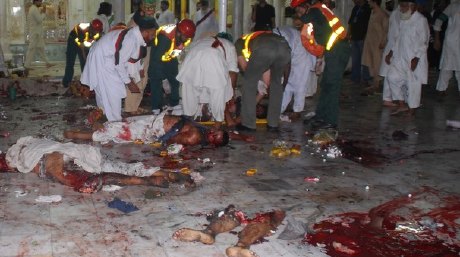
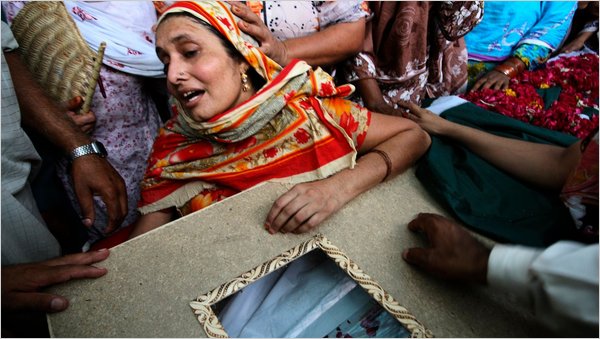
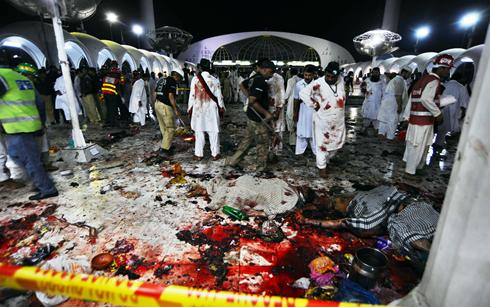
The announcement came days after 42 people were killed and hundreds were wounded when two suicide bombers struck the famed Sufi shrine Data Darbar on Thursday night in Lahore, the capital of Punjab Province.

The attack incited street protests in Lahore on Saturday, and it provoked complaints that law enforcement was not doing enough to protect holy sites from sectarian militant groups.

Nawaz Sharif, the leader of the main opposition party, Pakistan Muslim League-N,  deplored the attack at a news conference on Saturday. It is time, he said, for the government to hold a national conference on terrorism and open talks with the Pakistani Taliban, “who are ready to talk and ready to listen.”

Mr. Sharif, whose brother Shahbaz Sharif  is the chief minister of Punjab, did not specify which Taliban figures such talks should include.

Prime Minister Gilani agreed late Saturday to the proposal for a national conference, though it appeared unlikely that it would involve representatives of any militant groups. The conference will discuss how to better fight back against the militants, and show concern for the problem, politicians said.

The creation of such a conference was interpreted as an encouraging step by politicians who have called for greater leadership by the civilian government against terrorism. Until now the army has mostly led the effort against the Pakistani Taliban, fighting the militants in the tribal areas adjacent to Afghanistan.

The Pakistani Taliban denied responsibility for the Data Darbar attack. The shrine, one of the most popular in Lahore, is considered un-Islamic by followers of the Wahhabi and Salafi schools of Islamic thought that Taliban fighters generally adhere to.

Some religious scholars were so outraged by the attack on the shrine that they called for the resignations of Chief Minister Sharif and the Punjab law minister, Rana Sanaullah.

Earlier this year, Chief Minister Sharif was criticized by the national government, led by the more secular Pakistan Peoples Party, when he appealed to the Taliban to stop attacking Punjab on the grounds that the Muslim League and the Taliban had a common enemy in the United States. Since then, he has been accused of not doing enough to crack down on militant groups that have coalesced under the umbrella of the Punjabi Taliban.

The federal Interior Ministry said after the assault on the shrine that it had warned Punjab authorities of a possible terrorist attack in Lahore last week.

A rare joint statement by the prime minister and Nawaz Sharif on Sunday said now was “not the time for blame games.”

A similar conference on terrorism by the two main political parties was held in Islamabad two years ago, but those talks petered out and responsibility for tackling terrorism was handed to the army.

An effective national strategy by the civilian government would need stronger and more cohesive leadership and more money for the poorly financed police forces in the major cities, according to law enforcement officials.

Sectarianism Has Poisoned Pakistan

By Basim Usmani for The Guardian

The recent attacks on a prominent shrine in Lahore demonstrate how the unrest in Pakistan is caused by a minority of few who cannot tolerate the plurality of beliefs in Pakistan. The Tehrik-e-Taliban are lying through their teeth when they claim that they do not attack public places. It’s becoming more and more apparent that these militants aren’t resisting American hegemony; this a war to determine Pakistan’s future and, by proxy, the future of Islam.

Whether the Tehrik-e-Taliban actually arranged the bombers’ suicide belts is irrelevant; they have created a domino effect that’s likely to spread from commercial capitals such as Lahore to cities with historic shrines and Pakistani historical sites, such as Multan, or Taxila.

Unlike Baghdad, where violence between Islamic sects is a product of the war America is waging, the onus of last Thursday’s blasts falls squarely on us, the citizens of Pakistan. We have been complacent about sectarianism for too long.

A good friend who works for a transportation company told me in 2007 that in villages along the highways to Waziristan where the Taliban had seized control were the bodies of butchered Shia Muslims. That year, Lahore’s public was too busy mobilising about the judiciary and President Musharraf to pay the violence any mind.

Sectarianism has a brutal history in Pakistan that existed long before militants in Afghanistan began calling themselves the Taliban. I remember as a child in Lahore the broadcasts of gun violence outside Shia houses of worship during the early 1990s.

Many Pakistanis feel that the attacks on two Ahmadiyya mosques last May, where gunmen unloaded bullets and grenades on Friday prayer-goers, were unprecedented. Certainly the Ahmadiyya community doesn’t think they are.

To have a Pakistani passport requires citizens to assert that they are not part of the Ahmadiyya community. In a sense, holding that passport also makes you complicit in the blasts that killed dozens in Lahore’s most famous Sufi shrine last week. Our inability to understand that this war is about national identity is rooted in the same complacency.

We are OK with the state deciding for us who is or isn’t Muslim. In this regard, the Pakistani government has the weakest moral fibre in taking on this growing strand of extremism. It is hypocritical to fight the Taliban in Waziristan if we are okay about denying citizenship to millions of Muslims born in Pakistan.

It may sound extreme of me, but we should be jailing clerics in Pakistan that give edicts declaring believers to be non-Muslim or anti-Pakistani. It may seem extreme to an American that writers who deny the Holocaust are imprisoned in Europe, but extreme contexts call for extreme measures.

Pakistanis must stress how being born or raised in their country is enough to be Pakistani; laws preventing Ahmadis from referring to themselves as Muslims were amended to the constitution by Zulfikar Ali Bhutto in the 1970s.

I remember being uneasy at my desk in middle school when I was studying at Aitchison College in Lahore, and some of my classmates were getting bullied for having marks on them after returning from Shia processions during Muharram. Pakistanis themselves are the only ones capable of stamping out this discriminatory culture.

Some proactiveness is necessary on our part to make it clear that mystics, Shias, Ahmadis and Christians are all fellow Pakistanis. When you are pulled over by street police in any major Pakistani city, the first bit of information the police ask for is your family name. From one name your caste, religious beliefs and affluence is determined.

This came as a shock to all of my family who have emigrated away: that collectively our stock in our own nationhood has plummeted so. In a sense, these problems are all accrued debt we’ve accumulated for being so complacent. In the light of our bigoted constitution and deterministic culture we have to – for ourselves – decide that being Pakistani is enough to make us all countrymen. Otherwise, we might as well just refer to ourselves as Taliban, Muslim extremists, Islamic militants, and so forth.

Deadly blasts hit Sufi shrine in Lahore

By Syed Shoaib Hasan for The BBC

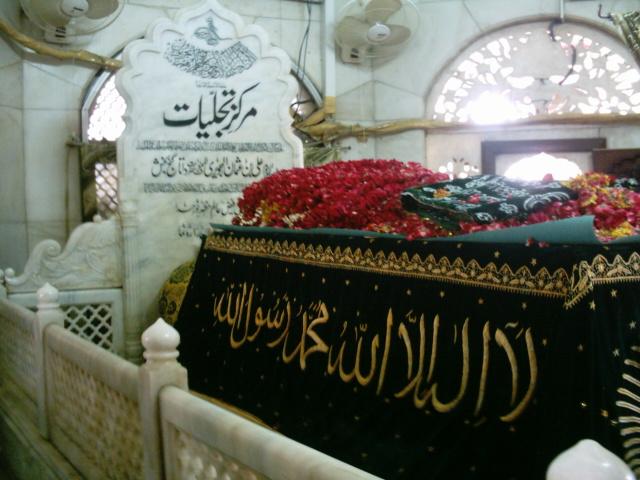
Suicide bombers have launched a deadly attack on a Sufi shrine in the eastern Pakistani city of Lahore. At least 35 people died in the blasts at the popular Data Darbar shrine late on Thursday evening, officials say. At least 175 other people were hurt in the blasts, believed to be the first targeting a shrine in Lahore. Thousands of people were visiting the shrine at the time, officials say. It holds the remains of a Persian Sufi saint, Abul Hassan Ali Hajvery.

Although no-one has yet said they carried out the attack, Taliban militants and their Punjabi jihadi allies have been involved in several such bombings in the northern Khyber Pakhtoonkhwa province. The shrine is largely frequented by members of the majority Barelvi sect, who are seen as heretics by the Taliban. Most of the Taliban belong to the rival Deoband Sunni sect, which strongly disapproves of worship at shrines. Many are also allied to the Sipah-e-Sahaba, and its armed splinter group, Lashkar-e-Jhangvi, which seeks to turn Pakistan into a Deoband Sunni state.

The shrine is visited by hundreds of thousands of people each year from both Sunni and Shia traditions of Islam. At least two attackers were involved, although police initially said three explosions had been heard.  The impact of the blasts ripped open the courtyard of the shrine. Rescue workers could be seen clambering over the rubble as they carried out the victims. Khusro Pervez, commissioner of Lahore, said two of the attacks took place in the main courtyard and one in the lower level of the shrine.

The first attacker struck in the underground area where visitors sleep and prepare themselves for prayer, he said. As people fled, a second bomber detonated his explosives in the upstairs area. Officials say they believe the bombers used devices packed with ball-bearings to maximise the impact of their attack.  A volunteer security guard at the shrine described scenes of devastation.

“It was a horrible scene,” said Mohammed Nasir. “There were dead bodies all around with blood and people were crying.” The attack is the biggest on a Sufi shrine in Pakistan since militant attacks began in 2001.  No group has said it carried out the attack, but correspondents say the attacks continue a growing trend among militants to target members of other sects as well as minorities.

Lahore has been hit by a series of bomb attacks, including a suicide blast at anti-terrorist offices in March, when at least 13 people died. In May, more than 90 people were killed in a double attack on the minority Ahmadi sect in the city.

Earlier, security chiefs had been congratulating themselves after what was the first month in two years in which there had been no suicide bombings in Pakistan, the BBC’s Aleem Maqbool reports from Islamabad.

They said it was proof the militant networks had been disrupted. Most Pakistanis knew the battle against militancy in this country was far from over, he adds. Last year Pakistan launched a major military offensive against militant strongholds in South Waziristan.  In December the military said they had achieved victory, but subsequent reports have suggested the militants remain active in the region.

Vengeful New Militant Group Emerges in Pakistan

By Kathy Gannon for The Associated Press
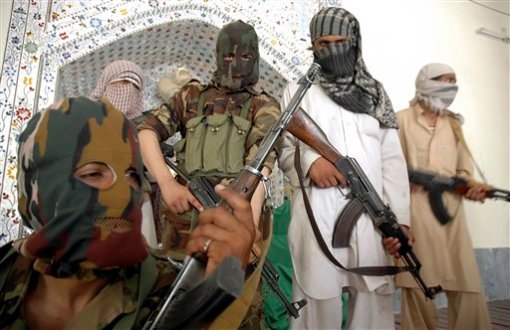
Pakistani authorities now believe a dangerous new militant group, out to avenge a deadly army assault on a mosque in Islamabad three years ago, has carried out several major bombings in the capital previously blamed on the Taliban.

The emergence of the Ghazi Force was part of the outrage among many deeply religious Pakistani Muslims over the July 2007 attack by security forces against the Lal Masjid, or Red Mosque, a stronghold of Islamic militants.

The fierce attack, in which scores of young, heavily armed religious students died, inspired a new generation of militants. These Pakistanis have turned against a government they felt has betrayed them and, to their dismay, backed the U.S. role in neighboring Afghanistan.

The brief but bloody history of the Ghazi Force illustrates the unintended results of Pakistan’s policy of promoting Islamic extremists to fight India in the disputed area of Kashmir. That policy — which Pakistan denies it pursues — now threatens regional stability as the U.S. and Pakistan’s other Western partners pour billions of dollars into the country to stop the rise of Islamic militancy.

The new group is made up of relatives of students who died in the Red Mosque assault. It is named after the students’ leader, Maulana Abdul Rashid Ghazi, who was also killed. The mosque’s religious school, or madrassa, had been a sanctuary for militants opposed to Pakistan’s support of the U.S.-run war in Afghanistan.

Private television stations broadcast vivid scenes of the assault — commandos in black fatigues rapelling down ropes, the crackle of gunfire, bodies of black-shrouded girls carried out through the smoldering gates. Those images stunned the nation, especially families of the students and Pakistanis with deep religious feelings.

“Before the Lal Masjid, militants hadn’t yet declared war on the state of Pakistan. That changed with Lal Masjid,” said Zahid Hussain, author and terrorism expert who has written extensively about Pakistan.

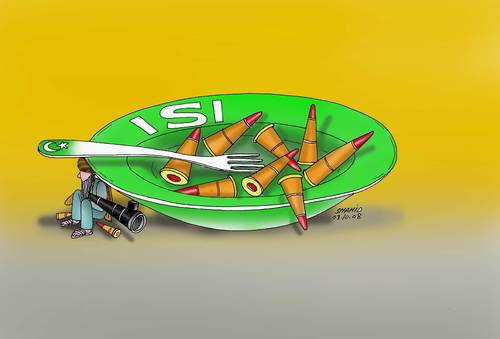
Islamabad’s inspector general of police, Kalim Imam, told The Associated Press that the Ghazi Force was behind most of the deadliest attacks in the capital during the last three years. The attacks targeted the military, the Inter-Services Intelligence agency or ISI — which had ties to a number of militants — and a five-star hotel frequented by foreigners and the Pakistani elite.

The Ghazi Force helped recruit a security official who blew himself up inside the office of the World Food Program last October, killing five people, according to Imam. The force also sent a suicide bomber in September 2007 into the mess hall of the commando unit that attacked the Red Mosque, killing 22 people, he said.

Ghazi Force members may also have been involved in the audacious June 9 attack north of the capital that killed seven people and destroyed 60 vehicles ferrying supplies to NATO and U.S. soldiers next door in Afghanistan, Imam said.

Many of those attacks had been attributed to the Pakistani Taliban, which operates in the remote tribal areas of the northwest along the border with Afghanistan. There is evidence of close ties between the Ghazi Force and the Pakistani Taliban, which the government has vowed to crush.

The Ghazi Force is believed to be headquartered in the Orakzai region of the border area, where the leader of the Pakistan Taliban, Hakimullah Mehsud, held sway for years. The leader of the Ghazi Force is believed to be Maulana Niaz Raheem, a former student at the Red Mosque.

Anger over the bloodshed at the mosque was all the greater because many of the militants and their supporters felt betrayed by a government that had once supported them. Both Ghazi and his brother Maulana Abdul Aziz Ghazi, who was freed on bail this year after two years in jail, were widely believed to have been on the payrolls of both the government and the ISI intelligence service.

Their father, Maulana Mohammed Abdullah, enjoyed a close relationship with the late President Mohammad Zia ul-Haq, and the mosque was a center for recruiting volunteers to fight against the Soviets in Afghanistan in the 1980s.

As opposition grew to Pakistan’s support of the U.S. role in Afghanistan, the mosque became a center of religious agitation against the government, with armed students taking over the complex and police laying siege.

A former senior official in the Interior Ministry told The Associated Press that the police wanted to storm the mosque and end the siege at its outset, send the students home and shut down the religious school and a neighboring library until tempers cooled.

President Gen. Pervez Musharraf refused, the official said, even though police knew that members of al-Qaida’s affiliate organization Jaish-e-Mohammed, which is banned in Pakistan, were bringing in weapons for the students.

Musharraf relented and ordered the assault after militants kidnapped several Chinese nationals running a massage parlor in Islamabad, accusing them of prostitution. The death toll remains in dispute. Red Mosque officials say hundreds died. The government says fewer than 100 were killed.

In a rare interview, Abdul Aziz Ghazi told AP he warned the government that an assault on the mosque would unleash forces that no one could control.

“I have been in jail. I did not form this force and I don’t condone the violence but they are angry at the injustices done,” he said this week.

Although the assault turned many Islamic hard-liners against the government, Pakistan remains unwilling to break all ties to the militants, instead following a high-risk strategy of coddling “good militants” while fighting those deemed “bad militants,” analysts say.

“The military and the ISI have given importance to these militants as assets. But those who have openly declared war, and there is no chance of them returning back to the state, the army is going after them,” said Manzar Jameel, a terrorism expert and researcher on the growth of extremism in Pakistan. “Yet they still believe that some are still assets and that they can keep control of the assets. It’s a failure of strategy.”

Army spokesman Maj. Gen. Athar Abbas denies any assistance to militant groups, saying past ties have long since been severed. He says the Ghazi Force is among the groups the 120,000 Pakistani soldiers waging war in the tribal regions are fighting.

Yet Anatol Lieven, a terrorism expert with the Department of War Studies at London’s King College, said it’s clear that the ISI continues to protect some militant groups, even if it has broken with others.

In a June report, the Rand Corporation think tank also alleged that Pakistan’s military and intelligence still support some militant groups “as a tool of its foreign and domestic policy.”

“A key objective of U.S. policy must be to alter Pakistan’s strategic calculus and end its support to militant groups,” the report said.

Christine Fair, a co-author of that report and an assistant professor at Georgetown University’s Center for Peace and Security Studies, said the battle against extremists in Pakistan is mired in layers of subterfuge by Pakistani intelligence and a “mystifying” acceptance by the CIA of Pakistan’s “good-militant, bad-militant” policy.

She said U.S. intelligence knows Pakistan protects one group — Lashkar-e-Taiba, which India blames for the 2008 Mumbai assault and Afghanistan accuses of masterminding deadly attacks against the Indian Embassy in Kabul.

“Lashkar-e-Taiba remains intact. I have had conversations with … officials in Washington. It is not their priority. Lashkar-e-Taiba is not an issue,” she said in an interview. “Yet Lashkar-e-Taiba has been attacking us in Afghanistan since 2004.”
Pakistan Rejects Allegations of Taliban Ties

As reported by CNN

Pakistani officials Sunday rejected allegations that their country’s powerful intelligence agency still supports the Taliban and other Afghan insurgents after a paper from a Harvard academic accused the agency of continued links to the rebels.

The powerful Inter-Services Intelligence agency does not “actually control the Afghan insurgency” and does not have “the ability to bring it to an end,” Matt Waldman argues in a paper for the London School of Economics. But the ISI provides “sanctuary, and very substantial financial, military and logistical support to the insurgency,” giving it “strong strategic and operational influence — reinforced by coercion,” according to his report, which cites Taliban commanders among its sources.

The ISI is widely thought to have played a key role in creating the Afghan Taliban during the 1990s, but Pakistan officially denies supporting them now. Maj. Gen. Athar Abbas, spokesman for the Pakistani military, called the claim “rubbish” on Sunday and said Waldman’s report “does not have a credible source or authenticity.”

“At best, it is speculative and only gives open sources without naming [them],” Abbas told CNN. “So, therefore, this kind of report requires a treatment which it really deserves. We are not going to formally respond to this, but we reject these allegations and accusation. If there are hard evidence, we would like for them to be brought out and we would be able to respond accurately.”

And Farahnaz Ispahani, a spokeswoman for President Asif Ali Zardari, called Waldman’s report “one-sided” and dismissed what she called its “wild accusations.”

“If Mr. Waldman had been a seasoned academic, he would have conducted interviews in Pakistan itself to balance his so-called research report,” Ispahani said. “The Pakistani government and its military have been performing an outstanding service to the world community as well as the region in its fight against militancy and extremism, and we can count the dead we have sacrificed in the thousands.”

Waldman’s report is titled, “The Sun in the Sky: The relationship between Pakistan’s ISI and Afghan insurgents.” He based his conclusions on interviews with nine insurgent field commanders in three regions of Afghanistan, plus former Taliban officials, tribal leaders, politicians, experts and diplomats. The title comes from Taliban commanders’ claims that their relationship with Pakistani intelligence is “as clear as the sun in the sky.”

Waldman concluded that that Pakistan “continues to give extensive support to the insurgency in terms of funding, munitions and supplies.” But Abbas dismissed the unnamed sources, calling the report “rubbish.”

“Has he named any Taliban commanders in this, has he named any officials?” Abbas said. “So, therefore, if it doesn’t have any specific source, which is not willing to disclose a name, it just becomes one of those reports that keep appearing. It is a serious allegation, but unless it has a credible evidence to support it or substantiate the report, only then it warrants a serious consideration for response.”

The ISI works not only with the Taliban, but also with the armed Haqqani network, led by Jalaluddin Haqqani and his son Sirajuddin, Waldman wrote. The Haqqani network sometimes cooperates with the Taliban and sometimes fights it.

The Taliban members interviewed believe that the ISI has a heavy influence on their leadership, which some of them said amounts to control, according to the report.

One of the southern commanders claimed: “If anyone rejects that the ISI backs or controls the Taliban, he has a mental problem … all our plans and strategy are made in Pakistan and step by step it is brought to us, for military operations or other activities,” the report says.

And southern Taliban commanders all complained of heavy ISI involvement, which they blamed for some attacks on civilians.

“One southern commander described their predicament as follows: ‘Another group of Taliban is directly supported by the ISI. They will never stop fighting in the country; they want to destroy the government and bring chaos. Behind all the attacks on … NGOs, schools, teachers, doctors, this is Pakistan. We cannot deny that it is Taliban; but there are Pakistan controlled groups among us. They want destabilisation …,’ ” the report says.

Waldman’s report comes two months after a U.N. report on the assassination of former Prime Minister Benazir Bhutto in 2007 — an attack blamed on Pakistani Taliban leaders — found that intelligence agencies hindered the subsequent investigation. The report concluded that the “pervasive reach” of Pakistan’s intelligence agencies left police “unsure of how vigorously they ought to pursue actions, which they knew, as professionals, they should have taken,” the report states.

A Journey into America, Past and Present

By Akbar Ahmed for The Guardian

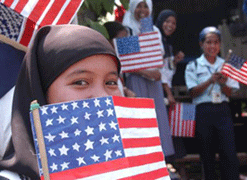
Muslims are for Americans what the Russians were for Churchill: “A riddle, wrapped in a mystery, inside an enigma.” While the post-9/11 period brought an interest in the Qur’an and its language, the gap between Islam and mainstream America has steadily widened. It remains more urgent than ever for the US to comprehend Islam, a religion practised by one out four people in the world, not only for the sake of its ideals (which include religious tolerance) but also for its geopolitical needs and strategy as America remains militarily involved in Afghanistan, Iraq, Pakistan, and Somalia.

The reality is that Islam remains unknown to most Americans, who, on top of all the other insecurities and fears about the religion, have recently added another: the “homegrown terrorist”, which President Obama has named as one of his administration’s top national security priorities.

I have been in a unique position to observe America’s attitudes towards Islam, travelling with a team of young Americans for over a year throughout the length and breadth of the United States to over 75 cities, visiting more than 100 mosques and talking to thousands of Muslims and non-Muslims.

I realised that it was impossible to study Islam in America without studying America itself and its identity, which I determined goes back to the first Mayflower settlers. In short, there are three basic identities that define American society: primordial, pluralist, and predator. Primordial identity is rooted in the seminal landing at Plymouth and provides the foundation of the two other identities. The aim of the early settlers was to survive and create a Christian society under the rule of law. The majority of the Founding Fathers in the next century would subscribe to what I call pluralist identity – believing in civil rights and liberties, religious freedom and tolerance.

America has a strong foundation in which to solve the challenge of the Muslim community if Americans look to their past and revive the spirit of some of their truly great leaders. Roger Williams, in the 17th century laid the groundwork for separation of church and state and welcomed people of other faiths. The state, said Williams, should allow all religions, including the “Turkish” (Islamic).

Thomas Jefferson owned a Qur’an and we found a statue of Jefferson at the University of Virginia advocating “Religious Freedom, 1786” with the words God, Jehovah, Brahma and Allah carved on the tablet he embraces.

A treaty, which was sponsored by George Washington and signed by John Adams in 1797, pertained to Tripoli and assured that the United States “has in itself no character of enmity against the laws, religion or tranquility of Musselmen.” Even the Prophet Muhammad was praised by the Founding Fathers; Adams called him one of the world’s “sober inquirers after truth” alongside such figures as Confucius and Socrates, and Benjamin Franklin cited the prophet as a model of compassion.

As primordial identity was taking shape at Plymouth, however, and new trends were already emerging. The more zealous of the settlers argued that the land was given to them by God, and they were to occupy it regardless of who was living there. As their confidence grew, they began to prey on the weaker natives, justifying their force in the name of protecting the community, generating an arrogance that did not encourage self-reflection and making it easy to demonise and destroy the enemy. This marked the birth of a predator identity.

It is this understanding of American society which allows us to put the Muslim community in America into context. Our findings from the field bring both bad news and good news. The bad news is that every one of the major American Muslim categories – African Americans, immigrants, and converts – has been involved in recent violence-related cases in the United States. In view of the bankruptcy of Muslim leadership and American failure to truly understand the Muslim community, it is not difficult to predict that violence will increase in both frequency and intensity. I am sorry to say that the government and its various agencies still do not have an adequate policy towards the country’s Muslim population. Some Muslims are affected by US actions taken in response to 9/11, which included the arrests and deportation of thousands, prompting many others to flee the country. These realities have reinforced the sense of being a mistrusted community. Others resent the Islamophobia they see in the media.

The good news is that American and Muslim leaders alike are now conscious of the problem of terrorism and its scale and are actively discussing the position of Muslims in America. Some of our findings challenge the received wisdom telling us that most Americans are hostile to Muslims. Of those questioned for our study, 95% said that they would vote for a Muslim for public office, for example, and an equally high number of respondents had no problem with Muslims being “American”, although some inserted “if” clauses. We found a patriotic and vibrant Muslim community committed to contributing to the country. Dialogue and understanding are urgently recommended.

America stands at a crossroads. It will have to choose either to embrace the Founding Fathers’ pluralist vision or the America that compromises the Constitution and the values of the Founding Fathers. Primordial and predator identity remain alive and well in today’s United States. In one way or another, people everywhere have a stake in America resolving its identity because America’s unique, universal vision of society formulated by its Founding Fathers attracts the world. A new chapter in the history of the United States has opened after 9/11 and America’s future will be decided on how it resolves its ongoing engagement and entanglement with Islam.

Official Admits Militancy’s Deep Roots in Pakistan

By Jane Perlez and Waqar Gillani for The New York Times

LAHORE, Pakistan — Days after one of the worst terrorist attacks in Pakistan, a senior Pakistani official declared in a surprising public admission that extremist groups were entrenched in the southern portion of the nation’s most populous province, underscoring the growing threats to the state.

 The statements by the interior minister, Rehman Malik, after the killing of more than 80 people at two mosques last week here in Lahore, were exceptional because few Pakistani politicians have acknowledged so explicitly the deep roots of militancy in Pakistan. They also highlighted the seeming impotence of the civilian government to root out the militant groups, even in Punjab Province, providing a troubling recognition that decades of state policy to nurture extremism had come home to roost in the very heart of the country.

 The extent of the problem has become an increasing concern for the United States, which has pressed the government to deal with the issue with renewed urgency since the failed attempt by a Pakistani-American to explode a car bomb in Times Square.

 “We’re dealing with a problem that is so deeply burrowed into the bosom of the society,” said a senior Western official about the difficulty of loosening the grip of the militant groups. “And we’re dealing with a government that is unhappy within itself.”

The problem for Pakistan, Western officials and some Pakistani politicians said, is not only the specific acts of terrorism by these groups, but the far more pervasive jihadi mentality that has been nurtured in the society by an extensive network of extremist madrasas and mosques.

Mr. Malik’s remarks — in which he rattled off a host of extremist groups once supported by the state — were a nod to these larger problems. In contrast to the tribal areas at the nation’s periphery, where the military is battling the Pakistani Taliban on several fronts, militants were “now active” in the southern part of Punjab and were trying to “destabilize the country,” he said.

Though Mr. Malik seemed to hint at possible military action in Punjab, the civilian government, led by the Pakistan Peoples Party, the more secular of the political parties in Pakistan, has little leverage to make it happen.

The Pakistani military, which still holds most power, has shown little interest in taking on extremist groups in Punjab. The province is a major recruiting area for the army, and many of the militant groups there were created by the state decades ago and have been fostered since as arms of Pakistan’s enduring anti-India strategy.

To a large degree, they have slipped from the control of their handlers in the military and intelligence services, according to Western diplomats and Pakistani security experts, and have linked up with Taliban fighters and other militant groups that are now striking deeper into Pakistan in an effort to overthrow the state.

Today these militants move back and forth easily between the tribal areas for training and Punjab, where they carry out a rising number of spectacular attacks.

“They — Lashkar-e-Janghvi, the Sipah-e-Sohaba Pakistan and Jaish-e-Mohammad — are allies of the Taliban and Al Qaeda,” Mr. Malik told reporters in Lahore after the mosque attacks. 

The loose conglomerate of militants that Mr. Malik listed is now being grouped by officials and others under the name of the Punjabi Taliban, a designation that itself highlights the expanding nature of the threat in Pakistan’s most important province and the militants’ shifting ambitions. Under that rubric also falls Lashkar-e-Taiba, an anti-India militant group. Like the others listed by Mr. Malik, Lashkar-e-Taiba has been banned by the state, but continues to operate under a different name and apparently with the blessing of the military.

The Punjabi Taliban took credit for the assaults on the two Ahmadi mosques last Friday. At least one of the men arrested by the Pakistani authorities in connection with the Times Square bombing case is connected to Jaish-e-Mohammed, according to law enforcement officials in Karachi.  Adding to the difficulty of clamping down on the groups, the Punjabi government, led by Shahbaz Sharif, a leader of the more conservative Pakistan Muslim League-N and a chief political rival of President Asif Ali Zardari, has stopped short of condemning the militants. In some respects, he has treated them as allies.

Two months ago, Mr. Sharif asked the Taliban to stay away from Punjab, arguing that his party and the Taliban had a common enemy in the United States. The Punjab government is “in a state of denial,” said Arif Nizami, a columnist with the newspaper The News. Mr. Sharif played down the attack on the two mosques in Lahore, Punjab’s capital. Instead, he visited the wounded survivors in a hospital quietly at night without the usual television coverage.

The groups hold such sway that Pakistani politicians frequently pander to some, like the pro-Taliban Sipah-e-Sohaba Pakistan, during elections.  In a bold illustration of the power of one of the militant groups in southern Punjab, the provincial law minister, Rana Sanaullah, campaigned alongside the leader of Sipah-e-Sohaba, Maulana Muhammad Ahmed Ludhianvi, during a March by-election for the provincial assembly in the city of Jhang.

In an interview, Mr. Sanaullah, said he saw nothing wrong with campaigning with Mr. Ludhianvi. It was a good thing, he said, because it helped bring groups that he described as no longer militant into the democratic mainstream. “If they want to be law-abiding citizens, we should allow them to be,” Mr. Sanaullah said.  Mr. Sanaullah was not alone in seeking votes from Sipah-e-Sohaba. A candidate for the National Assembly running for the Pakistan Peoples Party also won with its support earlier this year. Though security is a paramount concern, government officials and others acknowledge that the problem of militancy will not be solved by military force alone. Having been nurtured through generations, it will also not be undone quickly.

A program announced by Mr. Zardari two years ago to rein in the madrasas has yet to get off the ground, blocked by bureaucratic inertia and fears of a backlash from powerful conservative religious groups, Pakistani officials say. As state-sponsored education becomes too expensive for poor parents, the number of madrasas has actually increased in the past three years, to more than 17,000 in 2010 from 13,000 in 2007. At least several thousand of the madrasas churn out militant students, experts say.

Pakistani-Americans and Police Sharing, and Trying to Spread, Trust

By Anne Barnhard for The New York Times

STRATFORD, Conn. — Last month, a resident of Avon, Conn., received a threatening letter full of religious references. The police chief there, Mark Rinaldo, wondered whether the letter implied a broader threat from a Muslim militant.

He called Dr. Atique A. Mirza, a Pakistani-born Muslim cardiologist, who studied the letter for cultural, religious and political clues. They concluded that the threat probably involved a narrow dispute between neighbors.

Now that a Pakistani-American man from Connecticut, Faisal Shahzad, stands accused of trying to detonate a car bomb in Times Square, setting off soul-searching and unease among the state’s thousands of residents of Pakistani descent, Mr. Rinaldo and Dr. Mirza are holding up their relationship — built over three years of meetings and cooperation between Pakistani-Americans and law enforcement — as a model for communities across the state and the nation.

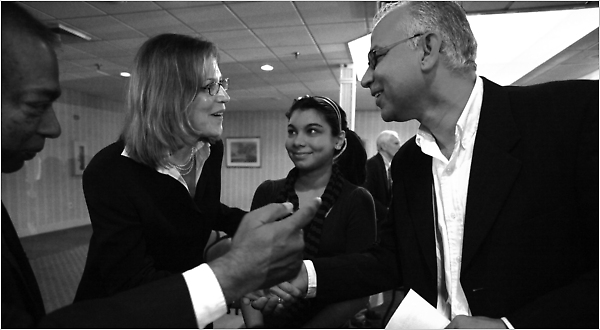
The comfort level is such, said Mr. Rinaldo, that Dr. Mirza “wouldn’t be insulted and say, ‘Why are you calling me,’ “ nor would the chief doubt Dr. Mirza’s analysis. “That’s the trusting relationship we are looking for,” said Dr. Mirza, who has formally assumed the role of Avon’s police-community liaison for the Pakistani American Association of Connecticut (Paact), which has similar representatives in 13 towns and hopes to increase the number to 70.

Paact’s work makes Mr. Shahzad’s case all the more upsetting to Dr. M. Saud Anwar, a pulmonologist who founded the group. He has played a role in the investigation, acting as liaison between the authorities and a Pakistani friend of Mr. Shahzad’s who feared talking to them. The friend provided e-mail messages that may shed light on Mr. Shahzad’s views on violence.

But Dr. Anwar wishes the attempt could have been stopped before it began, something he calls possible in future cases if cooperation between his community and the authorities increases by another “order of magnitude.”

“This is not, God forbid, to spy on people, but just to live your life the way it is and if you notice something that concerns you, speak up,” he said, speaking to about 100 Connecticut residents of Pakistani descent and representatives of the F.B.I., the State Police and a dozen police departments who gathered Saturday at the Ramada Inn in Stratford. “This is someone who lived among us and under the radar without anybody in the community knowing he was radicalized.”

Paact moves beyond reminding law enforcement not to unfairly paint all Muslims as terrorists — though it still strongly takes that position. It also calls on Pakistani-Americans to acknowledge that people of Pakistani descent have been implicated in high-profile terrorist attacks, to probe the causes and in the process to remind the public that they want security as much as other Americans do.

Dr. Mirza’s wife, Faryal, an endocrinologist, took a similar approach when her son was called “terrorist” in school several years ago. She began giving annual diversity classes, in which she offered Pakistani food and talked about her culture and religion. She also goes out of her way to let patients know she is Pakistani, so they associate the country with something other than terrorism.

Although she could have argued that the burden of explaining culture should not fall on her, she said, “We have to be proactive.”

Now Paact hopes to franchise its approach to other states. On June 19, the group is holding a national conference in Hartford on radicalization and prevention, featuring the Pakistani ambassador, representatives of the National Counterterrorism Center, theologians and others.

Saturday’s meeting focused on the narrower question of how it could have been that people did not seem to remember Mr. Shahzad from a mosque or a dinner party, let alone alert the authorities about him.

Dr. Mirza said it pointed to a need to rethink the atomization of suburban culture: “Know your neighbors; say hi; help them when they need you; be attentive.”

Mr. Shahzad may have isolated himself from mosques and Pakistani organizations, but he must have had some connections; he was married to a Pakistani-American and lived in Bridgeport, where there is a relatively large Pakistani-American population, said Jaleel Rahman, a retired real estate agent.

“We have to be more vigilant,” Mr. Rahman said.

Zaheer Sharaf, Paact’s president, said that many Pakistanis were afraid of the police, because they believe that police officers in their original country are corrupt.

Add to that the post-9/11 fear that reporting a suspicion about a Muslim might lead to an overreaction by the authorities, and it made for a wide gulf between Pakistani-Americans and the police forces that Mr. Rinaldo, the police chief of Avon, said he was unaware of until he began meeting with Dr. Mirza and others.

His reaction: “Wait a minute. We’re the good guys. We have to open up to this community.”

This month, he said, he was upset to see negative reactions to Pakistani-Americans after Mr. Shahzad’s arrest.

“It seems to be one individual, yet a whole community is suffering for the crime,” Mr. Rinaldo said. “It’s not fair.”

Mateen Haider, 56, an engineer from South Windsor, said that Pakistanis, like all immigrants, simply want to fit in, so they are loath to do anything that could draw attention, including call the police.

“That is no longer enough,” he said, telling the meeting: “Today is a great day. We have spoken out. We are all united together as citizens, and we will fight this to the end.”

Militant Factions With Global Aims Are Spreading Roots Throughout Pakistan

By Karin Brulliard and Pamela Constable for The Washington Post

KARACHI, PAKISTAN- Terrorism suspect Faisal Shahzad’s alleged path to Times Square reflects what experts say is a militant support network that spans Pakistan and is eager to shepherd aspiring terrorists from around the globe. In this teeming southern metropolis, authorities are focusing on a domestic militant outfit that might have escorted Shahzad to distant northern peaks where U.S. investigators allege he received training with the al-Qaeda-affiliated Pakistani Taliban. In Pakistan’s heartland, extremist organizations freely build compounds and campaign with politicians, while their foot soldiers fight alongside the Taliban in the borderlands, intelligence officials say.

The overall picture is one of a jumbled scaffolding of militancy that supports al-Qaeda and the Taliban with money and safe houses, and can provide entrance tickets to mountain training camps for aspiring terrorists, one U.S. counterterrorism official said. Although the planners of most serious terror plots against the West in recent years have received direction or training from groups in the Afghanistan Pakistan border region, the reach of extremist organizations across Pakistan underscores the limits of Pakistani military offensives and of U.S. airstrikes that target the Taliban and al-Qaeda only along the frontier.

“Our cells are working everywhere,” one Pakistani Taliban fighter said in a telephone interview. New foreign recruits, among them Europeans and Americans, undergo days of isolation and “complete observation” by militants outside the tribal areas before gaining access to camps, he said.
Many such aspirants do not make it, the Taliban fighter said, because they are deemed to be spies. That happened to five Northern Virginia men, who were rebuffed by Jaish-e-Mohammed and Lashkar-i-Taiba last year despite the reference of an online recruiter, according to Pakistani authorities. However, those aspirants deemed sincere represent a “one in a million” opportunity for militants to strike in the West, said Masood Sharif Khattak, a former Pakistani Intelligence Bureau chief. Their first stop is typically not the mountains of Waziristan, where Shahzad told U.S. investigators he had trained, but 1,000 miles south in Karachi, the Taliban fighter said.

An Arabian Sea gateway of 18 million people, the city is awash in weapons and dotted with mosques where, police say, jihadist literature is freely distributed and clerics deliver vitriolic anti-American sermons. Among them is the Bath’ha mosque and seminary, an unassuming building known locally as a bastion for Jaish-e-Mohammed, a banned Kashmir-focused group. Authorities said they have arrested a man at the mosque who escorted Shahzad to the northwestern city of Peshawar.

Operatives from Pakistan’s array of jihadist groups find haven in Karachi’s multiethnic sprawl; Afghan Taliban deputy leader Mullah Abdul Ghani Baradar was arrested in the city earlier this year.

The groups form a nexus, according to recent local intelligence reports. One report, obtained by The Washington Post, warns of coordinated plans by the Pakistani Taliban — a group based in the tribal areas that has focused its attacks inside Pakistan — and the traditionally anti-India militant groups of Punjab province. The target: NATO supply convoys in Karachi.

Farther north in the expanse of Punjab, experts say the major anti-India militant groups and other radical Sunni organizations need little cover: They are tolerated and even supported by the state. Banned groups such as Lashkar-i-Taiba and Jaish-e-Mohammed have formed organizations with new names that operate freely. Some of their leaders have been arrested for alleged links to terrorist attacks, then released by the courts.
The groups have in recent years increasingly focused attacks within Punjab as provincial officials have tried to placate them, both to capitalize on their popularity and in hopes of moderating their views.

The chief provincial minister, Shahbaz Sharif, was widely criticized in March for calling on the Pakistani Taliban to “spare Punjab,” which he suggested had common cause with the militants by rejecting Western dictates. Another provincial minister visited the seminary of a banned group and campaigned for office with the leader of another. Jaish-e-Mohammed recently built a large walled compound in the southern Punjabi city of Bahawalpur.

“These groups have not been touched,” said Ahmed Rashid, a leading Pakistani expert on the Taliban and Islamist extremism. “They have been through a metamorphosis and turned their guns inward and linked up with other groups in the northwest, but no one is acknowledging it. The word is out that if you hang with them, you’re safe.”

The counterinsurgency tactics used in the tribal areas — missiles and military operations — are widely thought to be unfeasible in Pakistan’s populous mainland. But critics say Pakistani police, security agencies and officials could at least start to clamp down on extremist organizations by vocally condemning them, monitoring mosques and madrassas and denying public space and private property to militant-linked groups.

Pakistan says it is still investigating the extent of Shahzad’s militant links; some security officials have said that he definitely had ties to Jaish-e-Mohammed. Terrorism analyst Muhammad Amir Rana said that what appears to be a lack of political will to tackle militant organizations in Pakistan’s heartland is actually rooted in a problem with far greater implications for the global battle against terror: The groups’ reach and presence in cities has made them a beast that cannot easily be dismantled. “It’s very complex,” Rana said. “They have infrastructure in all different areas.”

Media Ignore The Fact That Man Who Alerted Police To Failed Times Square Bombing Is A Muslim Immigrant

By Zaid Jilani for ThinkProgress.org

The chief suspect in the case of the failed Times Square car bombing is Pakistani-American Faisal Shahzad, who has confessed to the plot. Much of the media has latched onto Shahzad’s Muslim faith and his Pakistani identity, making inflammatory remarks and suggestions about Muslims and Pakistanis:

– CNN contributor and Redstate.com blogger Erick Erickson complained that the words “muslim” and “Islam” are “not mentioned” enough in stories about Shahzad. He wrote, “It really is pathetic that you’re more likely to see the words “racist” and “Republican” together in the newspaper these days than “terrorism” and “Islam.” [5/4/2010]

– Hate radio host Neal Boortz tweeted, “OMG! The Times Square Bomber is a Muslim! Shocker! Who would have believed it?” [5/4/2010]

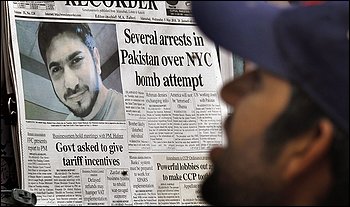
– The cover of today’s Washington Post-published Express features a black-and-white photo of Shahzad with the sensationalist headline “MADE IN PAKISTAN” [5/5/2010]

Yet one fact being ignored in the American media’s sensationalist narrative about the failed bombing is that the man who was responsible for police finding the bomb was Muslim. The UK’s Times Online reports that Aliou Niasse, a Senagalese Muslim immigrant who works as a photograph vendor on Times Square, was the first to bring the smoking car to the police’s attention:

Aliou Niasse, a street vendor selling framed photographs of New York, said that he was the first to spot the car containing the bomb, which pulled up right in front of his cart on the corner of 45th street and Broadway next to the Marriott hotel.

“I didn’t see the car pull up or notice the driver because I was busy with customers. But when I looked up I saw that smoke appeared to be coming from the car. This would have been around 6.30pm.”

“I thought I should call 911, but my English is not very good and I had no credit left on my phone, so I walked over to Lance, who has the T-shirt stall next to mine, and told him. He said we shouldn’t call 911. Immediately he alerted a police officer near by,” said Mr Niasse, who is originally from Senegal and who has been a vendor in Times Square for about eight years.

As the Leadership Conference on Civil Rights notes, “South Asian, and Muslim communities may yield useful information to those fighting terrorism. Arabs and Arab Americans also offer the government an important source of Arabic speakers and translators. The singling out of Arabs, South Asians, Muslims, and Sikhs for investigation regardless of whether any credible evidence links them to terrorism will simply alienate these individuals and compromise the anti-terrorism effort.”

Reflecting on Niasse’s good samaritanism Muslim-American author Sumbul Ali-Karamali writes, “It’s somewhat consoling to know that the man who first noticed the smoking Nissan Pathfinder and sought help is also Muslim, a Senegalese immigrant. … I grew up Muslim in this country, with Muslim friends and non-Muslim friends, and there was very little difference between the two groups. We were all American.”

Pakistan and India- The Love-Hate Relationship of Two Brothers

By Manzer Munir for Pakistanis for Peace

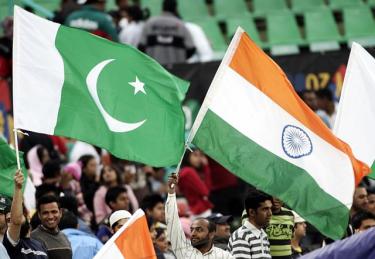
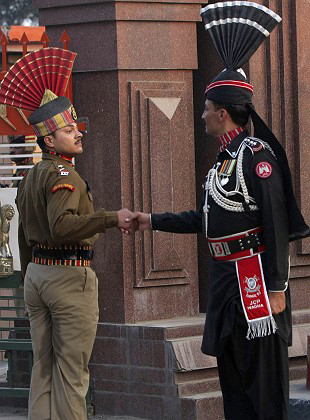
Since the bitter partition that resulted in the creation of Pakistan and India in 1947, and three subsequent wars with each other, not to mention countless near incidents, the two neighbors have not had an easy relationship, to say the least.

However, mixed in with fear and hatred towards each other is a fascination and affinity to the arch rival on the other side of the Line of Control. In fact, one could say that the two have a love-hate relationship with each other. The recent wedding of Pakistani cricketer Shoaib Malik to Indian tennis sensation Sania Mirza is an indication to the amount of interest and hype given to the couple in media from both sides of the border, making them instantly one of the hottest and most talked about young couples in this Bollywood and glamour obsessed culture.

In Pakistani schools, children are taught very little if anything at all about Pakistan’s pre-Islamic history. Instead the children are told of the glories of the Muslim Caliphate from the time of the prophet Mohammed and then the grand rule of the Moguls of India with the construction of immortal buildings like the Taj Mahal in Agra, or the Badshahi Masjid and the Shalimar Gardens in Lahore, all three built on the Islamic style of architecture. Not very much emphasis is given to the great contributions that the people of present day Pakistan made as Hindus for centuries prior to the arrival of Islam in the subcontinent.

Criticisms abound by Muslims that in India, Muslim contributions to modern India are down played or not explored in the manner they are deserved. However, In Pakistan it is well documented those Pakistani textbooks not only do not teach about Hindu history and achievements, they actually teach hatred against India and Hindus. There is an underlying culture of hate and inequality based on religious grounds that permeates in the society despite Islam teaching respect for all religions and faiths. It’s as if thinking of someone as a polytheist makes them less equal as a human.

The mindset becomes that these non believers are infidels and this somehow makes it easy to dehumanize them or in some way think them to be inferior to you as a human being. Even the current terrorism situation in Pakistan has its roots in this culture of hate and to some level a dehumanization of people of other faiths, especially non-Abrahamic like Hinduism or Buddhism. To not recognize that ancient Indian/Hindu history is also the history of Pakistan does a great injustice to the shared history of one of the most ancient of cultures.

The natural history of this region shows that the origins of the Indian/Pakistani civilization go back to the end of the last Ice Age, more than 10,000 years ago, making this one of the oldest civilizations of the ancient world. This area of the world is a place which gave the world not only Hinduism, but also Buddhism, Sikhism, Jainism, and other religions and has been a source of spiritual inspiration since the earliest of times. But maybe even more important than the contributions in the field of religion are the ancient civilization’s gifts to science and medicine.

Albert Einstein once said “We owe a lot to the Indians, who taught us how to count, without which no worthwhile scientific discovery could have been made.” Indeed, Indian civilization is credited with the creation of the decimal number system, the binary numbering system, negative number, the origins of algebra, and even the all important concept mathematically of zero came from ancient Indian mathematicians.

Archaeologically, India has the most extensive and continuous record of all ancient civilizations, much more than Egypt, Sumeria or Mesopotamia of the same time periods. The ruins in Mohenjo-Daro and Taxila in modern day Pakistan point to the fact that there was a very advanced civilization present here and even the beginnings of one of the early urban settlements of the ancient world as they were remarkably constructed, considering its antiquity. Taxila is also the site of what is believed to be the first university or school of higher learning in the ancient world.

Also the ancient Vedic literature is the largest in the ancient world and contains thousands upon thousands of pages dwarfing what little has been successfully preserved by the rest of the world. This literature contains profound spiritual concepts, skills in mathematics, astronomy and medicine. Sanskrit is the mother of all European languages and Ayurveda is the earliest school of medicine known to man.

Indian culture not only gave the world the game of chess, but was also was a place where some of the earliest innovations in the fields of surgery and advanced dentistry were developed as there is evidence of complex dental procedures being performed in the Indus valley some 8,000 years ago!

The celebrated American author Mark Twain once famously said of India that “India is the cradle of the human race, the birthplace of human speech, the mother of history, the grandmother of legend, and the great grandmother of tradition. Our most valuable and most constructive materials in the history of man are treasured up in India only.” And not so long ago, in a statement made by China’s former ambassador to the US, Hu Shih stated that “India conquered and dominated China culturally for 20 centuries without ever having to send a single soldier across her border.” This is further validated by the fact that the Indian civilization is considered unique in that it never invaded any country in the last 10,000 years of its history!

By denying its centuries old Hindu/Indian ancestry and history, modern day Pakistan is willfully abandoning its participation and hand in some of the greatest contributions made by one civilization to mankind. Not teaching children the importance of the pre-Islamic history and beginnings of what is now Pakistan is actually a disservice to its people. Also, since the ancestors of all Pakistanis were at some point or another Indian Hindus, disrespecting Hinduism and pre-Islamic Indian culture in essence disrespects one’s own ancestors!

Pakistan can learn a great deal from its ancient brother in the fields of democracy, constitutional freedoms, economic empowerment and technological advancements. A culture of hate has only bred more hate that has now begun to consume internally a nation that has for too long wearily looked outside to its larger neighbor as its chief enemy, instead of as a brother.

Pakistani court suspends deportation as another case of homegrown terror troubles US authorities

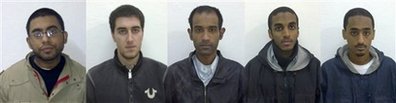
Karachi, Pakistan- Pakistani police on Monday seized a luggage and a cell phone from a hotel where three of the five Americans who were arrested on suspicion of terrorism planning and militant links stayed. A court has ruled that the men cannot be deported to the United States until the judges review their case.  Pakistani police has alleged that the five young Americans intended to join militant and extremist groups in the northwest tribal areas of Pakistan and Afghanistan. This case is troubling as it would appear that Americans and Western raised men are traveling to Pakistan to link up with Al-Qaeda and other militant groups like the Taliban.

Pakistani police had searched their hotel, aptly named Saddam Hotel in the southern city of Karachi.  The detainees have been accused of using the internet and such sites as Facebook and Youtube to reach out and connect to extremist groups and have been said to have been in contacts with a Taliban recruiter also.  The Pakistani court actions are intended to prevent the deportation of the accused to the United States until the courts in Pakistan can ascertain the facts and review the case.

The men, who are from the Washington DC area were picked up last week by Pakistani authorities after their worried families in the US contacted the FBI about their missing sons and enlisted their help in tracking the men down. The authorities were given a farewell video found by one of the family members that showed scenes of war and called for Muslims to be defended. FBI agents, who have had some access to the men, are trying to see if there is enough evidence to charge the men with conspiracy to provide material support to a terrorist group.

A US government official was satisfied with the Pakistani government’s assistance stating that “We’ve had excellent cooperation with the Pakistani authorities, both on the diplomatic side and on the law enforcement side,” said State Department spokesman Ian Kelly, “And the Pakistani authorities granted us access to the individuals within 24 hours of our request, which is a very speedy response.”

The threat posed by homegrown terrorists in the United States and in European countries is a growing concern for the FBI and US agencies. The incidents such as the Fort Hood shooting where Major Nidal Hasan allegedly shot and killed 13 fellow soldiers at the Texas base last month do nothing but further raise those concerns. Then there’s David Headley, an American born Muslim to mixed ancestry who is indicted in the Mumbai blasts of November 2008. And now comes the story of the five Muslim American men arrested in Pakistan who were interested in waging  jihad against the US.

It is too early to call it a growing trend, but the incidents and their frequency does suggest that there is certainly a minority segment of very young Muslim males who somehow are being radicalized not in strict Afghanistan or Pakistan or somewhere in Iran. Rather, in the streets of Virginia, New York, Chicago and other cities, certain young Muslim males are becoming radicalized and becoming extremists. This phenomenon can be best described as a catch 22. You see, these radicalized and misguided men feel that because the United States is waging wars in Muslin countries such as Iraq and Afghanistan, it is being an oppressor. To these men, defending Muslim lands from an outsider and an oppressor is an obligation and a duty and is a call for every Muslim. On the other side, there is the American policy of engagement of the enemy on its turf, as is seen in the Bush doctrine. “Take the war to the terrorists” as President Bush so famously put it in 2001.  These wars that were initiated to be pre-emptive in the case of Iraq and retribution in the case of Afghanistan, have inadvertently become the cause célèbre of these jihadists and young extremists.

In essence, there is a vicious cycle of violence at work here. We have American troops in Afghanistan who are there to defeat the Taliban and Al-Qaeda in Afghanistan so that the US is safe from a terrorist attack hatched overseas. Yet, the next threat may actually be coming from an American born Muslim who is being alienated and radicalized due to the “unjust” war against his “brothers” constant 24 hour cable news coverage, satellite TV and foreign news channels, the internet websites and other sources.

As instances of homegrown Muslim radicalization grow or come into the limelight, it is imperative that the vast majority of peaceful, law abiding and patriotic American Muslims keep vigilant and mindful of the few in their midst who may be becoming radicalized in front of their eyes. It is vital that the Muslim community speak up as the parents of these young men did and alerted the authorities when they became concerned that they may have some sinister designs after discovering their farewell video. It is together with our cooperation with the authorities that we can sniff out these lost individuals before they do any harm to anyone or to an entire religion. The mosques and Islamic centers must do more to ensure that there is no radicalization or fiery sermons. There needs to be a conscientious effort on the part of the American Muslim community of progressives and moderates to speak up and chastise those that are becoming extremists within their midst in order to prevent the next Fort Hood massacare or the next Mumbai.

 Reported by Manzer Munir for www.PakistanisforPeace.com