Archive for the ‘ India ’ Category

Poor Clerk First to Win Million on India Game Show

By Nirmala George for The Associated Press

A poor government clerk from a desolate region of eastern India has become the first person ever to win $1 million on an Indian game show.

Sushil Kumar’s staggering win on the popular Indian version of “Who Wants to Be a Millionaire” has transformed him into a role model for millions of aspiring youth yearning to escape from lives of poverty and find a role in India’s burgeoning economy.

Kumar’s win echoes the plot of the 2008 Oscar-winning film “Slumdog Millionaire,” whose impoverished protagonist won the grand prize on the show.

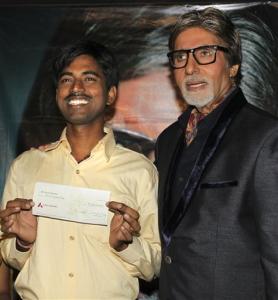
Kumar and his wife of five months wept when Indian movie legend Amitabh Bachchan, the show’s host, handed them a check for 50 million rupees (just over $1 million) after the contestant gave all the right answers on the show. “You have created history. Your grit and determination has made you come so far in this show,” Bachchan said.

Before Kumar went on the program, which was taped Tuesday and will air next week, he earned $120 a month as a government office worker and supplemented his income by working as a private tutor in the small town of Motihari in the eastern state of Bihar.

Kumar, 26, told viewers his family was so poor they couldn’t afford a television set, forcing him to go to a neighbor’s home to watch the quiz show. Watching him tick off correct answer after correct answer, his neighbors persuaded him to try out for the show, he said.

The trip to the Mumbai studio where the show is taped was his first ride in a plane and his first visit to a big city, he said. Kumar had clear, if modest, plans for the money.

He said he will use some to pay for a preparatory course so he can take India’s tough civil service exam, which could lead to a secure and prestigious lifetime job.

He said he will also buy a new home for his wife, pay off his parents’ debts and give his brothers startup cash so they can set up small businesses.

And he plans to build a library in Motihari so the children of his village will have access to the books and knowledge he so desperately craved, he said.

China Seeks Military Bases in Pakistan

By Amir Mir for Asia Times
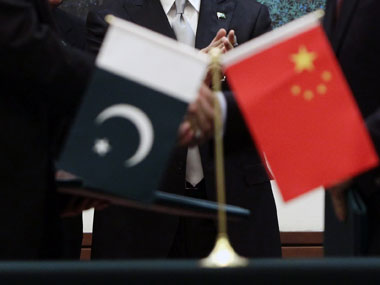
While Pakistan wants China to build a naval base at its southwestern seaport of Gwadar in Balochistan province, Beijing is more interested in setting up military bases either in the Federally Administered Tribal Areas (FATA) of Pakistan or in the Federally Administered Northern Areas (FANA) that border Xinjiang province.

The Chinese desire is meant to contain growing terrorist activities of Chinese rebels belonging to the al-Qaeda-linked East Turkestan Islamic Movement (ETIM) that is also described as the Turkistani Islamic Party (TIP).

The Chinese Muslim rebels want the creation of an independent Islamic state and are allegedly being trained in the tribal areas of Pakistan. According to well-placed diplomatic circles in Islamabad, Beijing’s wish for a military presence in Pakistan was discussed at length by the political and military leadership of both countries in recent months as China (which views the Uyghur separatist sentiment as a dire threat) has become ever-more concerned about Pakistan’s tribal areas as a haven for radicals.

Beijing believes that similar to the United States military presence in Pakistan, a Chinese attendance would enable its military to effectively counter the Muslim separatists who have been operating from the tribal areas of Pakistan for almost a decade, carrying out cross-border terrorist activities in trouble-stricken Xinjiang province.

There have been three high-profile visits from Pakistan to China in recent months; the first by Foreign Minister Hina Rabbani Khar; the second by President Asif Ali Zardari and the third by the director general of the Inter-Services Intelligence, Lieutenant General Ahmed Shuja Pasha.

The Pakistani visits were reciprocated by the September 28 visits to Islamabad by Chinese Vice Premier Meng Jianzhu and Public Security Minister Meng Jianzhu. This was prompted by two bomb blasts in Kashgar city of Xinjiang province on July 30 and 31 in which 18 people were killed.

The explosions provoked senior government officials in Xinjiang to publicly claim for the first time in recent years that the attackers had been trained in explosives in ETIM/TIP camps run by Chinese separatists in the Waziristan tribal regions of Pakistan.

The Chinese allegation was described by many in the diplomatic circles of Islamabad as a clear sign of the growing impatience of Beijing with Islamabad’s failure to control radical groups operating within its borders.

The Chinese charge was made on the basis of a confession by a Uyghur militant arrested by the Chinese authorities. Pakistan swiftly extended all possible cooperation to Beijing against the ETIM/TIP network. “Terrorists, extremists and separatists in Xinjiang province constitute an evil force,” said an August 1 statement issued by the Pakistani Foreign Ministry after Chinese President Hu Jintao rang Zardari to express his grave concern over the growing activities of “terrorists” belonging to the Pakistan-based ETIM/TIP network.

In a subsequent video released on September 7, ETIM/TIP corroborated earlier Chinese claims that it was involved in attacks in Xinjiang in July.

The ETIM/TIP, run by natives of Xinjiang province, a Muslim-dominated region three times the size of France, is fighting against the settlement of China’s majority Han ethnic group in the western province, describing its struggle as a freedom movement.

The ETIM/TIP maintains that the Chinese are a colonial force in Xinjiang province – which it refers to as Turkistan – and emphasizes Islam over ethnicity. Though the ETIM/TIP network on the Pakistan-Afghanistan border has been much weakened in recent years in the wake of the killing of many of its top leaders in US drone attacks, hardcore Uyghur militants are still shuttling between China and Pakistan, mainly because Xinjiang province shares a border with Pakistan.

The ETIM/TIP presence in Pakistan was first confirmed when one of its founding leaders, Hasan Mahsum alias Abu Muhammad al-Turkistan, was killed by Pakistani security forces in South Waziristan in October 2003.

The next one to be killed by the Americans in a drone attack was Memetiming Memeti alias Abdul Haq al-Turkistani, the ETIM/TIP chief, who was targeted in North Waziristan on February 15, 2010. Abdul Haq was succeeded by Abdul Shakoor Turkistani, a Chinese Uyghur, who is well known for his friendly terms with major Taliban groups in Waziristan.

He has taken control of overall command of Chinese and Uzbek militants in North Waziristan, due to his past association with the late Abdul Haq and late Tahir Yuldashev of the Islamic Movement of Uzbekistan.

Beijing believes that the Chinese rebels operating from the Pakistani tribal areas are well-connected to al-Qaeda, which not only trains them but also provides funding.

Thus, Pakistan and China, which have cooperated for a long time in the field of counter-terrorism, have intensified their efforts to nip the terrorism in the bud, especially after the Kashgar blasts.

In fact, it was in the aftermath of the May 2 US raid which killed al-Qaeda chief Osama bin Laden in his Abbottabad hideout that Islamabad started playing its China card aggressively, perhaps to caution Washington against pushing it too hard. Shortly after the Abbottabad raid, Pakistani Prime Minister Yousaf Raza Gillani traveled to Beijing.

Accompanying Defense Minister Ahmed Mukhtar had stated on May 21 that whatever requests for assistance the Pakistani side made, the Chinese government was more than happy to oblige, including agreeing to take over operations of the strategically positioned but underused port of Gwadar on the Arabian Sea on expiry of a contract with a Singaporean government company.

He disclosed that Pakistan had asked China to begin building a naval base at Gwadar, where Beijing funded and built the port. “We would be grateful to the Chinese government if a naval base is constructed at the site of Gwadar for Pakistan,” he said in a statement. Mukhtar later told a British newspaper in an interview: “We have asked our Chinese brothers to please build a naval base at Gwadar port.”

Knowledgeable Defense Ministry sources in Islamabad say that by having a Chinese naval base in the Gwadar area, Pakistan intends to counter-balance Indian naval forces.

However, diplomatic circles in Islamabad say Beijing, which has no military bases outside its territory and has often been vocal in criticizing American moves for operating such bases, first wants to establish military bases in Pakistan, which could be followed by the setting up of the naval base.

Therefore, Chinese Defense Minister Liang Guanglie promptly dismissed (on June 6) suggestions that Beijing was carving out a permanent naval presence in India’s neighborhood.

Answering questions at the 10th Asia Security Summit, organized by the London-based International Institute for Strategic Studies, Liang disclaimed moves to build naval bases at Gwadar and at a Sri Lankan port. Emphasizing his credentials as a member of the Chinese State Council and Central Military Commission, he said:
We will have a very serious and careful study of an issue of such importance to the government and the military like the reported move for establishing naval bases in Pakistan and Sri Lanka. Indeed, we will have exact plans and set up a panel to discuss it if the move were for real. However, I haven’t heard of it.

Asked by Manish Tewari, the Indian Congress party’s spokesman, to spell out China’s core interests in South Asia and the Indian Ocean area, Liang said:
The core interests include anything related to sovereignty, stability and form of government. China is now pursuing socialism. If there is any attempt to reject this path, it will touch upon China’s core interests. Or, if there is any attempt to encourage any part of China to secede, that also touches upon China’s core interests related to our land, sea or air. Then, anything that is related to China’s national economic and social development also touches upon China’s core interests.
The Chinese desire to have military bases in Pakistan is not a new one and has been discussed in the past.

An article published on the official website of the Chinese central government (www.gov.cn) on January 28, 2010, signaled that Beijing wanted to go the US way and set up military bases in overseas locations that would possibly include Pakistan. The obvious purpose would be to exert pressure on India as well as counter American influence in Pakistan and Afghanistan. The article stated:
Setting up overseas military bases is not an idea we have to shun; on the contrary, it is our right. It is baseless to say that we will not set up any military bases in future because we have never sent troops abroad. As for the military aspect, we should be able to conduct a retaliatory attack within the country or at the neighboring area of our potential enemies. We should also be able to put pressure on the overseas interests of potential enemies. With further development, China will be in great demand of military protection.
Analysts say although it might not be politically feasible for the Pakistani government to openly allow China to set up military bases on its soil, Islamabad might allow Beijing the use of its military facilities without any public announcement as a first step.

The Chinese demand to set up military bases in Pakistan has gained momentum at a time when the Indian military leadership is already raising a hue and cry over the alleged presence of People’s Liberation Army (PLA) troops in the Pakistan-administered part of Kashmir as well as in the FANA, which was earlier called Gilgit and Baltistan.

In August 2009, the Pakistan government passed the Gilgit-Baltistan Empowerment and Self-Governance Order to grant self-rule to the people of the area and create an elected legislative assembly. Gilgit-Baltistan thus gained de facto province-like status without doing so constitutionally.

Gilgit Baltistan province borders Pakistan’s Khyber Pukhtunkhwa province to the west, Afghanistan’s Wakhan Corridor to the north, China to the east and northeast, Pakistan-administered Kashmir to the southwest, and Jammu Kashmir to the southeast.

Although the supposed Chinese military presence in Pakistan’s northern areas of Gilgit Baltistan has been a matter of intense speculation in India, it was on October 5 that Indian army chief General V K Singh went public for the first time with the Indian establishment’s assessment of the kind of Chinese presence in the northern areas of Pakistan. “Around 4,000 Chinese including troops of the People’s Liberation Army are present in Pakistan-occupied Kashmir,” Singh told journalists in New Delhi.

However, senior Foreign Office officials of Xinjiang told this writer during a briefing in Urumqi, the capital of the province, that the Indian army chief’s claim was fallacious and must be based on some misunderstanding.

Despite the fact that diplomatic ties between China and India have improved in recent years, they are still at odds over territorial claims from both countries dating back to the India-China border war in 1962.

While India and Pakistan control Pakistan-administered Kashmir (Azad) and Jammu Kashmir states respectively, China claims part of northeastern Kashmir that it says is a part of Tibet. Therefore, Beijing is highly critical of India’s support for the Tibetan spiritual leader, the Dalai Lama, who fled Tibet in 1959 and set up a government in exile in the northern Indian hill town of Dharmsala.

The Indian army chief was not the first senior military official to have talked about the alleged Chinese presence in the northern areas of Pakistan.

In April this year, Northern Army Commander Lieutenant General K T Parnaik, while addressing a seminar in Jammu and Kashmir, said that the Chinese footprint in Pakistan-administered Kashmir was increasing steadily and its troops were actually present along the line of control (LoC) that divides the disputed Kashmir area.

“The Chinese presence in Gilgit-Baltistan and the northern areas of Pakistan is increasing steadily. There are many who are concerned about the fact that if there was to be hostility between India and Pakistan, what would be the complicity of the Chinese. Not only are they in the neighborhood, but the fact is that they are actually present and stationed along the LoC,” Parnaik said.

Zhang Xiaodi, the director general of the foreign affairs office in Urumqi, told this writer in a meeting on October 10 that there is no truth in the allegations leveled by Indian military officials. “There are only Chinese construction teams working in the northern areas of Pakistan on certain development projects being carried out by Pakistan and China jointly. The presence of People’s Liberation Army troops there is out of question.”

At the same time, there are those in the Pakistani Embassy in Beijing who view the Indian army chief’s allegation against the backdrop of the Pakistan army’s recent decision to include for the first time Chinese troops in military exercises along the border with the Indian states of Punjab and Rajasthan; the 101 Engineering Regiment of the PLA took part in exercises with their Pakistani counterparts in August this year.

Analysts say China’s deepening strategic penetration of Pakistan and the joint plans to set up not only new oil pipelines and railroads but also naval and military bases, are enough to set alarm bells ringing in New Delhi and Washington. The repercussions are particularly stark for India because both Beijing and Islamabad refuse to accept the territorial status quo and lay claim to large tracts of Indian land that could come under Chinese sway once Beijing is allowed to establish military bases in Pakistan.

The fact that Gilgit and Baltistan is located in the Pakistani-administered part of Kashmir presents India with a two-front theater in the event of a war with either country. By deploying troops near the LoC and playing the Kashmir card against New Delhi, Beijing is clearly signaling that Kashmir is where the Sino-Pakistan nexus can squeeze India.

Amir Mir is a senior Pakistani journalist and the author of several books on the subject of militant Islam and terrorism, the latest being The Bhutto murder trail: From Waziristan to GHQ.
Karzai’s Pakistan Comment Jolts West

By Dion Nissenbaum for The Wall Street Journal

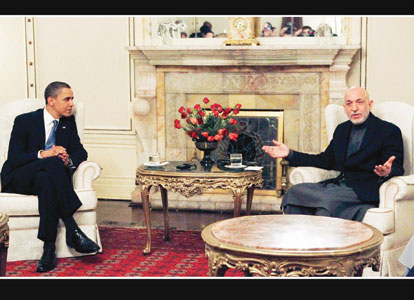
America’s latest attempts to strengthen its relationship with Afghan President Hamid Karzai received an unexpected jolt over the weekend, as the Afghan leader said he would back Pakistan if it went to war with the U.S.

“God forbid, if any war took place between Pakistan and the United States, we will stand by Pakistan,” Mr. Karzai said an interview broadcast Saturday on Pakistan’s Geo television network. “If Pakistan is attacked and if the people of Pakistan needed Afghanistan’s help, Afghanistan will be there with you.”

The prospects for a U.S. war with Pakistan are remote, and Mr. Karzai’s comments were viewed by some Afghan and Western officials in Kabul as a poorly executed effort to blunt his recent angry comments about Pakistan’s support for Afghan insurgent groups. “This is not about war with each other,” said Gavin Sundwall, spokesman for the U.S. Embassy in Kabul. “This is about a joint approach to a threat to all three of our countries.”

Mr. Karzai’s comments came as a surprise to some Western officials in Kabul, who were heartened by the success of last week’s visit by U.S. Secretary of State Hillary Clinton.

In the past, Mr. Karzai has alienated his Western allies with comments suggesting that he might side with the Taliban, or that America could come to be seen as an occupier if its forces didn’t stop killing Afghan civilians.

Mr. Karzai’s latest remarks struck a nerve with some Afghan and Western officials in Kabul who were reminded of the president’s penchant for criticizing the U.S.-led coalition that supports and funds his government. “It was totally careless, unnecessary and, yes, irresponsible,” said one Afghan official. “He hasn’t pleased anyone except, maybe, a few Pakistani generals.”

American officials said, however, that Mr. Karzai’s remarks wouldn’t overshadow Mrs. Clinton’s visit. Mr. Karzai and Mrs. Clinton were united during her trip in demanding that Pakistan stop supporting the Taliban and other Afghan insurgent groups.

Relations between Afghanistan and Pakistan have vacillated over the past year between spells of political chill and attempts at a rapprochement.
Mr. Karzai and the U.S. have sought to pressure Pakistan in recent weeks to clamp down on the Haqqani insurgent network suspected of staging a series of deadly attacks on American and Afghan targets.

Afghan officials also accused Pakistan’s spy agency of involvement in last month’s assassination of Burhanuddin Rabbani, the former Afghan president who had been leading the country’s peace entreaties to the Taliban. Pakistan denied these accusations. Earlier this month, Mr. Karzai unexpectedly flew to New Delhi to sign a strategic agreement with Pakistan’s archenemy India. The move angered Pakistani officials, who viewed it as political provocation.

In the Saturday TV interview, Mr. Karzai repeated his characterization of Pakistan as a “brother” and said Afghanistan wouldn’t let the U.S. or any other country dictate its foreign policy. “Afghanistan is a brother,” he said “But, please brother, stop using all methods that hurt us and are now hurting you. Let us engage from a different platform.” Separately, Afghanistan’s interior minister Sunday evaded an apparent assassination attempt near Kabul.

Officials said a suicide bomber targeted a convoy thought to be carrying Interior Minister Bismullah Khan Mohammadi. But the attacker was shot dead before he could do any harm, and the interior minister wasn’t in the convoy, the Interior Ministry said.
–Ziaulhaq Sultani contributed to this article.

Pakistan Takes Giant Step With Trade Move

By James Lamont for The Financial Times

The move to grant Most Favoured Nation status to India by Pakistan marks a small step for the world trading system. But it is a giant step for Pakistan.

For decades, these two nuclear-armed rivals have strangled trade along what in centuries past was a commercial highway between the subcontinent and central Asia. Today bilateral trade totals a paltry $2.7bn – a fraction of its potential.

The obstacle is ideology. Pakistan’s leadership insisted that trade ties were conditional on progress in resolving a bitter dispute over the territory of Kashmir, a Muslim majority region claimed by both countries after the end of British rule in 1947.

India’s leadership was obligingly intransigent.

The “in principle” granting of MFN and easing of business visas, responding to Indian signals of goodwill, are courageous moves by Pakistan’s civilian and military leaders.

They have immediately attracted criticism from domestic industrial sectors which fear greater competition. Executives in Pakistan’s pharmaceuticals industry were quick to warn that their companies would be hurt by market access for India’s generic drugs companies.

Other sceptics hold up the example of India’s Bollywood film industry, already swamping the Pakistani entertainment market, as a sign of worse to come.

More menacingly, Kashmiri groups have condemned the decision as a betrayal. The United Jihad Council called trade liberalisation a “direct contravention” of Islamabad’s fight for Kashmir. It threatened “grave consequences” of going soft on Hindu-majority India.

Many fear that militant attacks on India will ensue in a bid to sap Delhi’s confidence in peace with Pakistan, and derail negotiations. Such attacks already rain down almost daily across Pakistan.

Most of all, the move reflects a mighty shift in opinion in Rawalpindi, the headquarters of the powerful Pakistani army, at a time when the local economy is weakening.

A section of the army’s leadership is deeply worried about a mismanaged economy and anxious to put Pakistan, growing at 3 per cent, on a higher trajectory similar to the economies of India and China. With good reason. Railway workers go unpaid, industrialists are starved of power for their factories, and foreign investors, alongside Pakistani talent, are being frightened away by security risks.

More long term, some generals view the hostile position against India as unsustainable, and see incentives to normalise ties. They also say that Pakistan’s long-term military expenditure, supported by assistance from the US, cannot be borne by a broken economy.

Many of Pakistan’s most powerful industrialists are encouraging this change of heart. They see opportunity for cement, agriculture, banking and engineering in more access to the Indian market. More broadly, they say that the benefits of opening up more to China will only bear fruit when India too can compete in the local market.

From their offices in Karachi and Lahore, they dream of Pakistan forming a regional trade grouping with fast-growing China and India akin to that formed between Canada, Mexico and the US by the North American Free Trade Agreement.

That is of course a long way off thanks to one of the most intractable of world conflicts.

Some diplomats in Islamabad are highly sceptical of regional integration so long as the disputes fester over Kashmir and a security menace pours out of the border regions with Afghanistan.

They say that security still dominates the strategic debate in Pakistan. Any bilateral relationship is hamstrung by failure to find agreement on Kashmir.

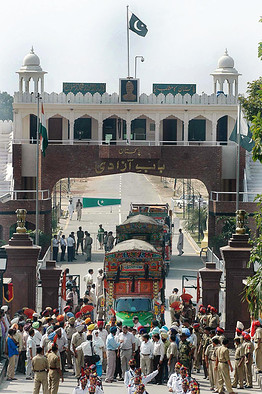
Earthmovers are already busy at the Wagha border, the principal land crossing between the two countries, preparing a new freight handling facility for rising commerce.

The current limitations are plain to see. A delegation of Pakistani traders crossed the post on Tuesday on their way to a fair in Chandigarh, the capital of India’s Punjab state. The existing facilities, usually catering to about 20 foot passengers a day, were entirely overwhelmed.

Both sides need to capitalise on what are baby steps towards more open markets. The first thing they can do is improve the infrastructure linking the two countries. The second is to ease other obstacles like quantitative restrictions, customs procedures and formidable non-tariff barriers.

The far bigger task is to resist efforts to blow up reconciliation through commercial ties, and to proceed equally purposefully on some of the thornier issues that make the region one of the world’s most dangerous.

Have We Hit Rock Bottom Yet?

By Shahzad Chaudhry for The Express Tribune

Attending conferences and travelling to them are the two most testing tasks these days for most Pakistanis. The airports tend to give you a full low-down as soon as the ‘green’ passport is presented: I am told by authentic sources that in as friendly country as China it takes twice the time to clear immigration for a Pakistani traveller than for someone with any other passport.

Just so that we may place our ‘higher than the Himalayas’ relationship in perspective, I was also informed that there was a daily flight between Delhi and Beijing compared to only two a week between Islamabad and Beijing. The disparity in trade figures between Beijing and Delhi, and Beijing and Islamabad, respectively, are already well-known. Call it anything, size of the economies or economic pragmatism, or whatever, the fact is China and India are unlikely to go to war with a $100 billion stake, keeping the two tied in an interdependent embrace; wish what you may, Pakistan, bosom love ain’t coming to the rescue. That is the new world ‘geconomics’.

One thing that always strengthened my hand as an ambassador for Pakistan during the Shaukat Aziz years was the perpetual good news that came out on the economic front from Pakistan. Now there may be more than one opinion about Musharrafian economy, but I have always held, and with some conviction I might add, that economies work on few sound fundamentals and a lot of good sentiment. This last word is key. So if the services sector — telecom, construction, finance — all seemed to be galloping under Shaukat Aziz’s mantra of economic progress, he perhaps understood well the significance of looking dapper and sounding happy. He held the dollar pegged and the stock market boomed: the first was clever policy, the latter sentiment. After all what is in the story of an ‘Incredible’ India — the incredibility indeed of a well-manufactured fable and from there on the critical mass of success takes on.

It was famously reported that a particular British chancellor of the Exchequer was singing in the bathroom: the veil of pessimism lifted and the economic sentiment began its own hum. But when you sit on a dredged economy and scooped-out resources there is little that you can offer to the world as hope. Words remain just that, words. Give Hafeez Shaikh something to hum about, and he will hum. The difficulty is he himself remains incapable of carving one.

I haven’t heard a sicker pronouncement of Pakistan’s economic predicament than someone quoting to me the likely $12-16 billion flowing in remittances, as the ultimate trigger for turning around our fortunes. There cannot be a darker indictment of our lows. Incapable of generating revenues inside, we hope like hell for the world and the people to resuscitate us from the outside. Even in that, though, madness must have a method. Investments, portfolio or otherwise, flow into congenial environs; some, Hafeez Shaikh will have to conjure, some we, as partners in crime, will have to relent and enable.

I am not an economist, and certainly never pretended to be one, but I have been subjected enough to the pains of a few that even I could venture to suggest a course to the hapless finance minister. For instance, capital flight is a growing reality and industry needs an injection of support and sustenance under a dwindling availability of energy. The approaching winter months may just provide some respite from domestic energy consumption, enabling diversion to the industry sector. Where possible, policy measures can enable relief and sectoral benefits to industries that wish to work through the difficult times. That might just sustain the benefits emerging from an export boost last year.

Many have tended to qualify the boost in different ways and perhaps each has a point but then how long can you keep a merchant down; there is something called “recess fatigue”, and he must break from it to keep the wheels going. One hopes that a finance minister may recognise such trends and then have the wits to turn them into triggers of rebound. If not, paralysis may just be a more enveloping reality in Islamabad.

Agriculture is half policy, half divine. The policy side has seen some attention while divinity is mostly earned. Our erstwhile brothers in East Punjab seem to have hit a good combination and are worth a reflection. So if there is a formula for our finance gurus to follow in the short-term, it must reside around energy, industry and agriculture. Once out of the hole, we can then begin to embellish our societal existence.

What will bring back a smile on the finance minister’s face? An enabling environment? A country in war, and a 10-year-old war at that, cannot be given to economic congeniality. We need to wean this country away from war. Seriously taken, the All Parties Conference urgings to ‘give peace a chance’ is a worthy, if catchy slogan, and must find the necessary politico-military resolve. The difficulty in our prevailing discourse is that few are willing to find solace in a political effort alone. As the refrain is that military runs the policy, perhaps that is where one may head. So then, over to General Kayani.

With two years to go in his tenure, here are a few things that General Kayani must do: get us out of this war — the lesser the pain the better; shun militancy in all its manifestations — and here the word manifestation to my mind carries all its consequences; and cleanse the military system of this ill-advised and ill-conceived baggage of the yore. We need not depend on the augmenting effect of an irregular effort in enhancing our national agenda. For some time let us simply look inside and avoid external diversions. With General Kayani convinced of such disposition, no arm whatever can practice any part of our rather sad legacy in regional ambitions.

I do not know who killed Rabbani and why; I also don’t know if the Pakistani military alone supports the Haqqani network and to what extent, but I do know that defending accusations of Pakistani culpability is becoming a harder task. The time when any such insinuation will stick is when we will have hit rock bottom.

I wish we were out of this predicament. I wish to see my country relevant and respected; and, I wish to see a smile on a humming Hafeez Shaikh.

Wake up Pakistan

By Najam Sethi for The Friday Times

US- PAK relations have broken down. The United States has “ suspended” military aid and all but closed the Kerry- Lugar- Berman tap of funds for the civilians. Proud Pakistanis have puffed up their chests and vowed to eat grass, if necessary, in order to defend their country’s “sovereignty”. What’s the big deal, they aver, US aid was peanuts anyway, and our traditional friends like China and Saudi Arabia can bail us out of our problems.

To be sure, our relationship with the US has been no small disaster.

In the 1950s, we begged the US to befriend us instead of India, cheerily going along with the US into the Cold War against the USSR when it wasn’t our war at all. In consequence, the military became the dominant theme of our life and wrecked the budding impulse of democracy. Once again, in the 1980s and 2000s, we tripped over ourselves to rent out our services to the US in Afghanistan.

Today we are reaping the terrorist whirlwind of our greed and opportunism.

But a little introspection is in order to prove that we don’t need the US as an enemy because we are our own worst enemies.

More Pakistanis are eating “ grass” now than ever before. The number of Pakistanis below the poverty line has increased from 27 per cent five years ago to 33 per cent in 2011. And this has nothing to do with the US. The growth rate of the economy has fallen from 6.5 per cent five years ago to 3 per cent now. The fiscal deficit is yawning at 7.5 per cent of the GDP today compared to 4.5 per cent five years ago. And this has nothing to do with the US. The Rupee has fallen from 77 to the dollar five years ago to 90 today. General inflation is running at 15% and food inflation at 25%. And this has nothing to do with the US. The tax to GDP ratio is down to 8.7% in 2011 from 11.5% five years ago. And this has nothing to do with the US. Floods continue to devastate the lives and produce of millions of poor people across the country.

And this has nothing to do with the US. Sunni extremists are rampaging, killing Shias. Ethnic parties continue to mow down people in Karachi. And this has nothing to do with the US. Power breakdowns have made the lives of tens of millions wretched and miserable while rendering millions of others jobless.

And this has nothing to do with the US. Instead of rooting for Pakistani nationalism, we are proud to undermine it as Muslims first, or Sindhis, Muhajirs, Baloch, Pakhtun, Punjabi, Seraiki, Hazarajat, Kashmiri, Sunni, Shia, Deobandi, Barelvi. And this has nothing to do with the US. We are counted amongst the most corrupt countries of the world. We have waged four wars with India and lost each of them, in the bargain losing half of Pakistan.

And this has nothing to do with the US. As if this litany of self- induced failures isn’t enough, there is the hypocrisy of double standards to contend with too. Of course, the US has violated our sovereignty by raining drones on FATA. But so have the Afghan Taliban and Al- Qaeda who have established safe havens there too. But we are quick to blast the US and quicker still to pretend that Al- Qaeda doesn’t exist and the Taliban are innocent refugees for whom our traditional hospitality is on offer.

The story doesn’t end here.

The IMF is not welcome. How dare it demand that we tax the rich, plug the bleeding in public sector corporations, stop the theft of power, and spend according to our means. US aid is dispensable.

We don’t need to build dams and reservoirs for managing our natural resources, we don’t need schools and teachers for our children and hospitals for the poor.

Our all- weather friends are China and Saudi Arabia. Never mind that China doesn’t help us much when we are ravaged by earthquakes and floods or when we are short of cash to pay our foreign bills.

NEVER MIND that Saudi Arabia treats our migrant workers like slaves, rents our military to crack down on Shia majorities in Bahrain and exports extremist “ Islam” to our lands.

At the end of the day, who eats grass when we rise to defend our sovereignty? Not our pot- bellied traders and businessmen. Not our golf- playing generals. Not our Defence Housing Society residents.

Not our foreign- asset holding politicians whose kids go to English- medium private schools at home and abroad. Not our self righteous media Mughals who berate our slavish black- skins and white masks. Not our corrupt judges and civil servants. It’s the wretched of the earth, the poorest of the poor, who eat grass.

For too long we have made foreign scapegoats for our own failures and corruptions. It is time to wake up and set our house in order without begging or berating the US.

Growing Hope for Trade Ties Between India and Pakistan

By Shahzeb Jillani

Business leaders from India and Pakistan say there’s new optimism about the efforts their governments are making to improve trade ties. But critics warn that overcoming decades of mistrust may not be that easy.

For the first time in 35 years, a Pakistani commerce minister led a business delegation to India last week. The entourage included nearly 80 leading industrialists, traders and high-ranking officials.

Peace talks between the two nuclear-armed neighbours broke down in 2008 after the attacks in the Indian city of Mumbai, which India blamed on Pakistan-based militants.

Nearly three years on, as if to emphasise a sense of normalcy, the Pakistani Commerce Minister, Makhdoom Amin Fahim, stayed at the city’s Taj Mahal Hotel – which was one of the main targets of the 2008 attacks.

There, leading Pakistani traders got a chance to mingle with their equally eager-for-business Indian counterparts.

Between them, they spoke not just of the profits their individual businesses could make if their governments removed the long standing hurdles in their way. But also of how much the people of their two countries, and indeed the wider region, stand to benefit from freer movement of goods, money and commodities.

The only way I see realisation of trade potential between our two countries is for India to remove its non-tariff trade barriers and for Pakistan to reciprocate by granting the MFN status to India”

Vijay Kalantri, president of All India Association of Industries, said traders on both sides feel business between India and Pakistan is a win-win situation for everyone.

“Why are Indians and Pakistanis forced to trade unofficially via third countries like Dubai or Sri Lanka?” he tells the BBC from Mumbai.

“All we are asking is, let there be direct business-to-business contact between us.”

After the talks in Delhi, ministers from the two sides announced their agreement to boost their annual bilateral trade from current $2.7bn (£1.7bn) to $6bn by 2015.

They also pledged to ease business travel and promote bilateral trade through the land route.

For Pakistan, a significant announcement was a pledge by India to drop its opposition to the European Union’s plan to grant Pakistan tariff waiver on select commodities to help it recover from the devastation of 2010 floods.

There was hope that Pakistan might reciprocate and grant India the Most Favoured Nation status (India granted Pakistan MFN status way back in the 1990s).

Even though no such announcement came, Pakistan committed itself to a road map to implement preferential trade ties with India, as prescribed under the South Asia Free Trade Agreement (Safta).

Trade barriers
There are a number of explanations why Pakistan has so far withheld the MFN status from India.

At present there are a number of barriers to prevent trade between Indian and Pakistan
First is political. Pakistani leaders have often linked it to the resolution of the core issue of Kashmir.

It’s a stance which has long been propagated for mainly domestic consumption.

But there is a sense in Pakistan that while the country should continue to push for a negotiated settlement of the Kashmir issue, trade and commerce should not be held hostage to resolution of political disputes.

The second is protectionism. For years, domestic industry in Pakistan has feared it would be swamped by imports from India. But even there, the mood appears to have shifted.

Senator Haji Ghulam Ali, president of Federation of Pakistan Chambers of Commerce and Industry, says there’s a consensus that Pakistan should open up to Indian business.

“Everyone now recognises it will be beneficial for both sides. It’s just a matter of time before it’s done,” he tells the BBC from Delhi.

Business leaders say that less trade barriers would benefit firms in both countries, However, the last, and more plausible, obstacle is the issue of non-tariff barriers.

“In my experience, India has one of the most restrictive trade regimes in the region,” asserts Dr Ashfaq Hasan Khan, a former advisor to Pakistan’s Ministry of Finance. His view matters, given has decades of dealings with South Asian governments on trade liberalization.

He explains that despite granting Pakistan the MFN status, India has a variety of non-tariff barriers in place – such as, stringent certification codes, customs rules, security clearances and movement restrictions – which make it virtually impossible for Pakistani traders to do business in India.

“The only way I see realisation of trade potential between our two countries is for India to remove its non-tariff trade barriers and for Pakistan to reciprocate by granting the MFN status to India,” says Mr Khan.

He adds: “Unless there’s political will to do that, everything else is just talk and photo op.”

Analysis: Pakistan’s Double-Game: Treachery or Strategy?

By John Chalmers for Reuters

Washington has just about had it withPakistan.

“Turns out they are disloyal, deceptive and a danger to the United States,” fumed Republican Representative Ted Poe last week. “We pay them to hate us. Now we pay them to bomb us. Let’s not pay them at all.”

For many in America, Islamabad has been nothing short of perfidious since joining a strategic alliance with Washington 10 years ago: selectively cooperating in the war on extremist violence and taking billions of dollars in aid to do the job, while all the time sheltering and supporting Islamist militant groups that fight NATO troops in Afghanistan.

Pakistan has angrily denied the charges, but if its critics are right, what could the explanation be for such duplicity? What strategic agendas might be hidden behind this puzzling statecraft?

The answer is that Pakistan wants to guarantee for itself a stake in Afghanistan’s political future.

It knows that, as U.S. forces gradually withdraw from Afghanistan, ethnic groups will be competing for ascendancy there and other regional powers – from India to China and Iran – will be jostling for a foot in the door.

Islamabad’s support for the Taliban movement in the 1990s gives it an outsized influence among Afghanistan’s Pashtuns, who make up about 42 percent of the total population and who maintain close ties with their Pakistani fellow tribesmen.

In particular, Pakistan’s powerful military is determined there should be no vacuum in Afghanistan that could be filled by its arch-foe, India.

INDIA FOCUS

Pakistan has fought three wars with its neighbor since the bloody partition of the subcontinent that led to the creation of the country in 1947, and mutual suspicion still hobbles relations between the two nuclear-armed powers today.

“They still think India is their primary policy,” said Talat Masood, a retired Pakistani general and prominent political analyst. “India is always in the back of their minds.”

In an interview with Reuters on Tuesday, Pakistani Prime Minister Yusuf Raza Gilani – unprompted – complained that Washington’s failure to deal even-handedly with New Delhi and Islamabad was a source of regional instability.

Aqil Shah, a South Asia security expert at the Harvard Society of Fellows, said Islamabad’s worst-case scenario would be an Afghanistan controlled or dominated by groups with ties to India, such as the Tajik-dominated Northern Alliance, which it fears would pursue activities hostile to Pakistan.

“Ideally, the military would like Afghanistan to become a relatively stable satellite dominated by Islamist Pashtuns,” Shah wrote in a Foreign Affairs article this week.

Although Pakistan, an Islamic state, officially abandoned support for the predominantly Pashtun Taliban after the 9/11 attacks on the United States in 2001, elements of the military never made the doctrinal shift.

Few doubt that the shadowy intelligence directorate, the Inter-Services Intelligence (ISI), has maintained links to the Taliban that emerged from its support for the Afghan mujahideen during the 1979-1989 Soviet occupation of Afghanistan.

Until recently, there appeared to be a grudging acceptance from Washington that this was the inevitable status quo.

That was until it emerged in May that al Qaeda leader Osama bin Laden – who was killed in a U.S. Navy SEALs raid – had been hiding out in a Pakistani garrison town just two hours up the road from Islamabad, by some accounts for up to five years.

Relations between Pakistan and the United States have been stormy ever since, culminating in a tirade by the outgoing U.S. joint chiefs of staff, Mike Mullen, last week.

Mullen described the Haqqani network, the most feared faction among Taliban militants in Afghanistan, as a “veritable arm” of the ISI and accused Islamabad of providing support for the group’s September 13 attack on the U.S. embassy in Kabul.

The reaction in Islamabad has been one of stunned outrage.

Washington has not gone public with evidence to back its accusation, and Pakistani officials say that contacts with the Haqqani group do not amount to actual support.

However, Imran Khan, a Pakistani cricketer-turned-populist-politician, said this week that it was too much to expect that old friends could have become enemies overnight.

He told Reuters that, instead of demanding that Pakistan attack the Haqqanis in the mountainous border region of North Waziristan, the United States should use Islamabad’s leverage with the group to bring the Afghan Taliban into negotiations.

“Haqqani could be your ticket to getting them on the negotiating table, which at the moment they are refusing,” Khan said. “So I think that is a much saner policy than to ask Pakistan to try to take them on.”

REGIONAL GAME

The big risk for the United States in berating Islamabad is that it will exacerbate anti-American sentiment, which already runs deep in Pakistan, and perhaps embolden it further.

C. Raja Mohan, senior fellow at New Delhi’s Center for Policy Research, said Pakistan was probably gambling that the United States’ economic crisis and upcoming presidential elections would distract Washington.

“The real game is unfolding on the ground with the Americans. The Pakistan army is betting that the United States does not have too many choices and more broadly that the U.S. is on the decline, he said.

It is also becoming clear that as Pakistan’s relations with Washington deteriorate, it can fall back into the arms of its “all-weather friend,” China, the energy-hungry giant that is the biggest investor in Afghanistan’s nascent resources sector.

Pakistani officials heaped praise on Beijing this week as a Chinese minister visited Islamabad. Among them was army chief General Ashfaq Kayani, arguably the country’s most powerful man, who spoke of China’s “unwavering support.”

In addition, Pakistan has extended a cordial hand to Iran, which also shares a border with Afghanistan.

Teheran has been mostly opposed to the Taliban, which is dominated by Sunni Muslims while Iran is predominantly Shi’ite. But Iran’s anti-Americanism is more deep-seated.

“My reading is the Iranians want to see the Americans go,” said Raja Mohan, the Indian analyst. “They have a problem with the Taliban, but any American retreat will suit them. Iran in the short term is looking at the Americans being humiliated.”

ARMY CALLS THE SHOTS

The supremacy of the military in Pakistan means that Washington has little to gain little from wagging its finger about ties with the Taliban at the civilian government, which is regularly lashed for its incompetence and corruption.

“The state has become so soft and powerless it can’t make any difference,” said Masood, the Pakistani retired general. “Any change will have to come from the military.”

Daniel Markey, a senior fellow for South Asia at the U.S. Council on Foreign Relations, said the problem lies with a security establishment that continues to believe that arming and working – actively and passively – with militant groups serves its purposes.

“Until … soul-searching takes place within the Pakistani military and the ISI, you’re not likely to see an end to these U.S. demands, and a real shift in terms of the relationship,” Markey said in an online discussion this week. “This is the most significant shift that has to take place.”

Bacha Khan, Anti-Partition Hero Who Can Help Pakistan Today

By Mauro Vaiani for Pakistanis for Peace

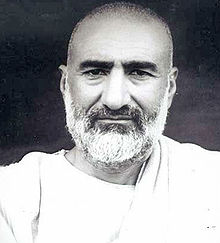
A person once stigmatized as an enemy of Pakistan, has something important to say in the contemporary public discourse in the second Islamic country in the world. His name is Abdul Ghaffar Khan (in the picture), a Pakhtun patriot, social reformer, charismatic leader. He was a lifelong activist in favour of his fellows Pathans living North and South the frontier Durand Line. He became a very close friend of the Mahatma and he himself was called the “Frontier Gandhi”.

Anti-Partition apostle of nonviolence
He was born on 1890 in Utmanzai, a town in Charsadda District, in the North-West Frontier Province, today Khyber Pakhtunkhwa Province in Pakistan. He was an apostle of nonviolence, that he considered a form of spiritual jihad for his time and for the future of his people. He founded a nonviolent movement which arrived to count 100,000 members. As he wrote in his 1969 autobiography, “My life and struggle”, “in 1929 we were able to found the kind of organisation we wanted. We decided to call it the Khudai Khidmatgar movement (Servants of God movement). Our motive for choosing that name was that we wanted to awaken in the Pathans the idea of service and the desire to serve their country and their people in the name of God, an idea and a desire which was sadly lacking among them”. The Khudai Khidmatgars were also known, for the color of their uniforms, “Red Shirts”. The founder was called by his followers, as a mark of esteem, Badshah Khan, also spelled Baacha Khan, or more commonly Bacha Khan, that means “king of our nobles”.

Baacha Khan fostered free education for all, women rights, religious freedom, judicial reform. He also was a pioneer of ecology and sustainable development. He believed in self-government for both the settled and the tribal Pakhtuns. He strongly opposed the Partition of India, proposing autonomous provinces in a unified Indian federal framework. When the Partition became inevitable, he renounce to oppose it with riots or violence. He and his Khidmatgars accepted, reluctantly, Pakistan as their new country and decided to be loyal. They hoped the new regime would have given the Pakhtuns a chance to live united in their territory, free to self-govern their own province. The autonomy of the federal units in Pakistan was instead nipped in the bud and their movement was declared illegal.
For the freedom fighter, a new cycle of imprisonment started. Baacha Khan spent one-third of his life in prison, but, more precisely, he spent more time, about 15 years, in Pakistani prisons than he had spent in the prisons of the British Raj, “only” 12.

He also went in exile in Afghanistan, where he supported local Pashtun cultural, social and economical development, fighting backwardness, clanism, family feuds. He gave in Afghanistan many speeches in favor of “Pakhtunistan”, which were free of every kind of chauvinism, fostering freedom and self-government of his people, within the Pakistani federation, firmly anchored to a commitment for peace in all South Asia, all over the world.
“I am looking forward to the time when free, general elections will be possible again in Pakistan. – he wrote in his 1969’s autobiography – For only then will the world know which way my people are going and whom do they follow. This is the main conflict between me and the rulers of Pakistan.”. This champion of Pakhtun patriotism remained unheeded. He won’t see general and local fair election either under the dictatorship of Ayub Khan, nor under Yahya Khan, nor under the civil but still authoritarian rule of Zulfiqar Ali Bhutto, nor under Zia Ul-Haq.
He couldn’t see the general elections of December 1988, when Benazir Bhutto, daughter of Zulfiqar Ali, became Prime Minister, for he died in Peshawar on January 20.

He had requested to be buried in Jalalabad, Afghanistan. He hoped this way to witness the need of friendship, and mutual understanding, among all Pakhtuns, between Afghanistan and Pakistan. His last wish succeeded in leaving a footprint in the heart of many throughout South Asia. As one can read in Rajmohan Gandhi’s biography of Bacha Khan (New Delhi, 2004) his funeral resulted a mammoth rally: “Though the Afghan struggle was not yet over, the Kabul government and the mujahedin both announced a ceasefire for the event. Tens of thousands of the Frontier’s mourning Pakhtuns accompanied the coffin and crossed the Durand Line. Pakistan’s military ruler, Zia-ul Haq (who would be killed in a plane crash later in the year), and India’s Prime Minister, Rajiv Gandhi (also destined for a violent death), were present for the last rites.” (see Gandhi R., Ghaffar Khan, 2004, p. 263).

Political heritage

After decades of oblivion, his political heritage are now again gaining momentum among Pakhtuns. An important political player in the re-established Pakistani democracy, the Awami National Party (ANP), wrote in its manifesto that it “draws its inspiration from the example and teachings of Khan Abdul Ghaffar Khan, affectionately known to his people as Baacha Khan. He spent his entire life in the struggle for freedom and justice. He and his Khudai Khidmatgars offered great sacrifices in the fight against colonialism, imperialism and all other forms of oppression. In a broader sense, Baacha Khan saw politics as the highest form of public service and often described himself as only a social worker. His objective was to liberate the masses of South Asia and, particularly, his own people, the Pakhtuns, from the shackles of ignorance and poverty, so that they could rise to their full potential.” (cf http://awaminationalparty.org/).
The ANP was led in the past by Bacha Khan’s son, Abdul Wali Khan, and today the most prominent figure is his grandson, Asfandyar Wali Khan. In the 2008 elections, the Awami National Party won the majority in Khyber Pakhtunkhwa and elected its first Chief Minister since the independence, in coalition with the Pakistan People’s Party. ANP is allied with PPP also in other provinces and at the federal level.
The parable of the Taliban regime and the political violence that still sets fire through the area, has been a terrifying experience for everybody but especially for Pakhtuns. Baacha Khan is being rediscovered, as a source of inspiration for a better future. He was a devout Muslim believer, but he refused terror and was also alien from any bigotry. His political action was centered on peace and social reformation. He sacrificed as a satyagrahi in nonviolent campaign of civil disobedience, firstly against the British Raj, but later also against Pakistan authoritarianism and military rule.
His spiritual heritage helped ANP to defeat the Muttahida Majlis-e-Amal, the Islamist coalition, which was in power in Pakhtunkhwa before 2008. It was a highly symbolic victory. In the name of Baacha Khan, the modern ANP defeated the Islamists, as well as the ancient Khudai Khidmatgars had always defeated the Muslim League in both the elections hold in the province, under the British rule, on 1936 and 1946. Many hope that this political change could represent the end of a cycle, dominated by a tangle of Islamist and nationalist ideologies, which have painfully marked the history of the Frontier, of all Pakistan, Afghanistan.

Several notable cultural foundations and charities are working in South Asia to promote peace and human rights through the rediscover of Badshah Khan’s life, thought and action. We must nominate the Baacha Khan Trust (see http://www.baachakhantrust.org/), whose chief aim is propagation of Ghaffar Khan’s philosophy, his vision of renaissance for the oppressed and marginalized Pakhtuns communities, and for peace in Pakistan, Afghanistan, the whole South Asia.
Nowadays efforts to make the public opinion and new generations aware of the figure and the teachings of Baacha Khan would certainly help the stabilization of the so called Afpak area. After 60 years of political authoritarianism and violence in Pakistan and 40 years of civil war in Afghanistan, it’s probably time to know something more about Bacha Khan.

Self-government

His Red Shirts were able to provide “local leadership for education and development, and stood up for the dignity and rights of their community. They balanced affirmations of the rights and dignity of all people with teachings about responsibility and sacrifices needed to serve those same communities.” – Ali Gohar, founder and guide at the Just Peace International center, in Peshawar, recently wrote, adding that the beauty of this kind of nonviolent struggle is again alive in 2011 Arab Spring heroes cf http://www.khyberwatch.com/index.php?mod=article&cat=MediaWatch&article=391).

“You all know that I believe in the principles of non•violence. – he said on August 31, 1966, talking in Afghanistan on the Pakhtunistan Day, as reported in his 1969’s autobiography – I am convinced that there will be no peace in the world till the problem of the Pakhtuns has been solved. I am telling both the Russians and the Americans the same thing: if they really want peace, they should solve the problem of the Pakhtuns. What do we want? We keep on telling Pakistan to consider us their brothers and not to make us their slaves. We were never the slaves of the British and you should not expect us to be your slaves.”. Heared today, these words are somehow prophetic and should encourage a serious reflection.

The Pathans, both in Afghanistan and in Pakistan, still need an accountable local self-government, in order to take on full responsibility of their own territories. They can hardly be governed from Kabul, or from Islamabad. May be they can resolve their own way their problems, included terror-related and security’s ones.

The recent Pakistani devolution can be seen as a historical accomplishment on the way indicated by Baacha Khan. This is what many political leaders, not only ANP’s ones, strongly believe. Federalism was part of the independence struggle and the only way to make the idea of Pakistan into a lasting reality.

Unfortunately, the centralized, bigoted and corrupt, republic chosen by Afghani Pashtun leadership, after the fall of the Taliban regime, is much farer from Baacha Khan’s ideal of decentralized responsible and accountable self-government. The present solution resembles too much like the 1973 republic. It may be not reveal the right solution for the future of such a vast, diverse, and bitterly divided, country.

Don’t let anybody deceive you in the name of Islam

Abdul Ghaffar Khan, along all his existence, advocated for reforms, social justice, change through education, and, last but not least, peaceful coexistence of all communities, without any kind of ethnic, religious, caste, clan, social discrimination.
He strongly demanded his fellow Pakhtuns, to strive against ignorance, bigotry, prejudices, family feud and political violence. His message, which follows the furrow of modern nonviolent revolutions, which have already brought down more than an empire, can drive the Islamist factions and wider Muslim public opinion to a radical rethinking.

His teaching was prescient and it is today more relevant than ever: “And you, misguided Pathans, you do not even stop to think whether this is Islam or not, you just swallow anything you are told… I want you to promise me that you will never let anybody deceive you in the name of Islam.” (from Baacha Khan’s speech in Afghanistan, on Pakhtunistan Day, 31 August 1967, as reported in Baacha Khan’s autobiography, 1969).

-Mauro Vaiani is a Geopolitics PhD Candidate at the University of Pisa in Italy and is a Facebook group member and contributor of Pakistanis for Peace. His page at the university is at http://www.sp.unipi.it/hp/vaiani and he can be reached via email at mauro.vaiani@sp.unipi.it

Anna’s Trip to Pakistan: Should He Or Shouldn’t He

By Akshaya Mishra for Firstpost

Should he or shouldn’t he?

The supporters of Anna Hazare are in a bind. Two days after the Gandhian accepted the invitation of a human rights delegation from Pakistan to visit that country, the public opinion in India stands divided.

The Shiv Sena was first off the block opposing Anna’s move. Its argument follows the usual political theme. Islamabad must stop sponsoring terrorist activities in India first. The anti-corruption crusader should have taken cognisance of the sentiments of people before even considering such an invitation, it said.

Others are likely follow the Sena’s line soon. The hard line Hindutva followers, who have been silent so far, may erupt in anger, putting a communal spin to the visit.

Anna might just have put his feet in uncharted territory, and a minefield of potential controversies. Pakistan is not an easy proposition even for seasoned politicians to handle. He could be risking his reputation.

So, should he or should not he? There are no easy answers.

Anna is not just an individual, he is a phenomenon. He is an idea that easily transcends boundaries. The massive support to his anti-corruption movement across the social spectrum was a pointer to the fact.

“I will go to Pakistan. In fact, I will go anywhere for the sake of peace and poor people,” he said while meeting the Pakistani delegation, which included former judge of Supreme Court of Pakistan Nasir Aslam Zahid and founder of Pakistan India Forum for Peace and Democracy Karamat Ali.

Anna might just have put his feet in uncharted territory, and a minefield of potential controversies. PTI
“I believe in the religion of humanity, and humanity should begin with your neighbour. Like Indians, Pakistanis too are suffering due to widespread corruption in their country,” he added.

The statements reflect the man as he is — simple, honest and innocent of concerns that bother others so much. It’s possible he would not have given a serious thought to the troubled India-Pakistan equations. It is possible he would be worried about people and their happiness only, not issues or borders.

Isn’t corruption a big issue in Pakistan too? Don’t people suffer because of that? That would be his line of thinking. He would be oblivious to the fact that any movement there guided by him would amount to challenging the rulers in Islamabad and that any intention to help the country would inflame passions in India.

Sena chief Bal Thackeray has sounded the warning note. “Be it Anna or anyone else, they should first speak to kin of those killed in the Mumbai and Delhi blasts, before anointing themselves Nishan-e-Pakistan (Pakistan’s highest civilian award),” he wrote in the party mouthpiece Saamna today.

“Whether Anna goes to Pakistan or not is another matter, but it would have been better had he given a thought to the country’s sentiments on the issue,” he added.

Earlier, the party’s spokesperson Sanjay Raut had made his disapproval clear. “Anna should have told the visiting delegation to go back to Pakistan and create awareness among the people about the Pak-sponsored terrorism in India. The entire world may have praised the anti-corruption movement in India, but Anna cannot ignore sentiments of the people in his own country vis-a vis Pakistan,” he had said.

Anna is likely to lose most of his following in India if he goes ahead with his Pakistan trip, which for all practical purposes would be a symbolic one. Worse, notwithstanding the nature of his visit he would turn a political entity, without intending to be so.

His biggest achievement so far has been that he has managed to stay apolitical despite the desperate efforts from parties to align with him. He represents the common Indian and the other India, which stays out of the power circle that rules the country.

But the other India hates Pakistan too. This is where Anna is likely to run into a problem. Questions could be raised about his intention — the ordinary follower is not expected to understand and appreciate the nuances of his high thinking. The adulation for him is likely to shrink.

Anna should not let that happen. Pakistan can wait.

India, Pakistan To Open New Trade Check-Post

By Tom Wright for The Wall Street Journal

While India and Pakistan trade barbs over terrorism, the country’s trade officials are making small but notable steps toward opening up their economies to one another.

In October, authorities plan to open a second trade check-post at the Wagah border in Punjab state, the only land-crossing between the two hostile neighbors, in an attempt to boost trade volumes. The commerce ministers of both countries are expected to formally announce the new check-post at a meeting in New Delhi later this month.

It might look like a baby step in normalizing frozen trade relations. But with so much else going wrong in India-Pakistan ties, it’s a welcome bit of positive news and one that is energizing Indian businessmen who work close to the border.

Currently, trucks that carry the meager flow of trade between India and Pakistan have to stop unloading at 3 p.m. because that’s when tourists from both sides start arriving at the Wagah border for the evening “Beating Retreat” ceremony – a display of nationalistic bravado that precedes the formal closing of the gates between the countries each evening.

The new terminal will allow trade to continue until 7 p.m. and hopefully increase volumes passing through the check-post.

Some business groups in Amritsar, a city near the Indian side of the border,  are betting on an expansion of trade. Suneet Kochhar, director of a paper company based in Amritsar, is involved with a group of investors who have accumulated land to develop a freight terminal near the second trade check-post.

“Once it’s operational, things will change,” Mr. Kocchar says. Land near the border has doubled in value in the past two years, he adds.

To be sure, Pakistan and India have looked like moving ahead on trade in the past but things have gotten nowhere. Another attack like the one carried out by Pakistani militants on Mumbai in 2008, killing over 160 people, could easily nip the current optimism in the bud.

Two-way India-Pakistan trade was a paltry $1.8 billion in the year ended March 31, 2010, basically unchanged over the past five years, while India’s trade with China has skyrocketed to $60 billion.

Indian Prime Minister Manmohan Singh has said that India won’t be able to fulfill its economic potential unless it normalizes relations with Pakistan, which is a gateway to the Central Asian republics and beyond. For Pakistan, India is a huge potential market of 1.2 billion people. For now, businesses that want to get around restrictions have to ship goods at extra cost via ports like  Dubai.

The new check-post is a good start. Indian officials estimate two-way trade could easily jump to $2.7 billion in the short term. But there won’t be a seismic shift in trade volumes until both countries make serious efforts to expand the list of products that they can trade with one another. The current list encompasses just over 1,000 items.

That has frustrated some business people. Sunil Behal, director at Poplon Chemie, an Amritsar-based company that makes chemicals to treat leather, says some of its key products are not on the list. The company currently exports only $7,000 worth of products to Pakistan each month out of its total global exports of over $180,000 in the same period, he says.

But like many businesspeople in the area, he’s hopeful that politicians really mean to make progress this time. The check-post, he say, “will definitely boost business.”

There are tentative signs of seriousness. Ahead of the commerce ministers’ meeting later this month, officials from both sides met in New Delhi and thrashed out their differences. The minutes of the meeting  are here.

The officials were candid about the challenges. The new check-post, they agreed, will only be effective if both sides take other measures like simplifying customs procedures.

Pakistan officials complained they were not even aware of the customs rules followed by India, and faced a number of non-tariff barriers to trade such as cumbersome testing of products by Indian authorities that can take weeks, according to the minutes.

India lamented that Pakistan continues to put blocks in the way of trade, including proscribing a number of goods that aren’t allowed to enter Pakistan by road but instead have to come by rail. Mr. Kochhar, the paper company director, says he would export newsprint to Pakistan, but it’s uneconomical at the moment to ship via rail.

Both sides complain about the difficulty of getting business visas and have promised to remove bureaucratic obstacles.

The key, though, might be plans that India and Pakistan have to allow trade in most products, only protecting weak and strategic industries. The two countries are currently drawing up a list of these industries – known as a negative list – to submit to the other side.

Don’t expect these issues to be ironed out overnight. Still, there’s movement which both nations are trying to build on.

Pakistan’s Floods: Deja Vu, All Over Again

By Ishaan Tharoor for Time

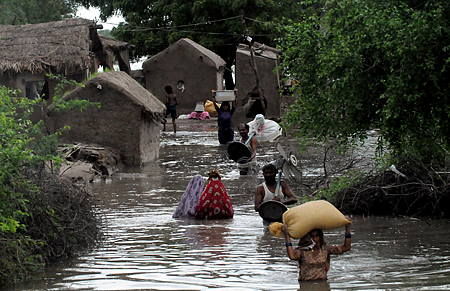
These days when it rains in South Asia, it doesn’t just pour — it floods. A month of monsoon squalls has deluged hundreds of towns and villages in northwest India and Pakistan. The latter has seen the most acute flooding, and, on all evidence, has been the least prepared for it. At least 233 people have already died and 300,000 are now stranded or in makeshift camps — a figure that will surely grow. Officials in Pakistan claim some 5.5 million people so far have been affected by rising waters. That’s still only a fraction of the 20 million hit by last year’s catastrophic rains, but the forecast looks ominous.

Neva Khan, Oxfam’s Pakistan country director, spelled out the dimensions of the crisis on the relief agency’s website:
There is an urgent need to provide immediate and life saving relief to the millions affected. It hasn’t stopped raining in Sindh for the last 10 days. Large swathes of land are underwater and people are desperately awaiting relief. They have lost their crops, homes and livestock for the second time – and been pushed from last year’s disaster to this one.

Sindh, the vast, fertile province abutting the Arabian Sea, appears the worst affected. Across Pakistan, some 900 villages have been wholly submerged and millions of hectares of arable land — some still irrevocably damaged by last year’s floods — are under water.
What’s most depressing about the situation now is how keenly it echoes the 2010 calamity. Omar Waraich, TIME’s Islamabad correspondent, wrote this excellent piece a year ago for the magazine’s international editions. As the waters rise, Pakistan faces a familiar cocktail of maladies from last summer.

Then, the civilian government headed by the unpopular President Asif Zardari was hampered by political infighting and its fundamental subservience to the real power of Pakistan’s influential military. Now, not much has changed (though Zardari is still in his position, a surprise to some). Then, militants and terrorists were exposing the fragility of the Pakistani state with cold-blooded strikes on some of country’s major cities. Now, after a rancorous summer of barb-flinging with the U.S., not much has changed either — not least when suspected al-Qaeda allied militants raided a prominent naval base in Karachi earlier this year. Then, the cash-strapped government pleaded for foreign assistance. Now similar calls are being issued, with similar notes of desperation.

In the weeks to come, inquests will be made into whether enough had been done to shore up riverbanks, provide shelter and food for the hundreds of thousands left destitute for over a year, and prepare for the next season’s rains. Already, there are reports of angry civilians blockading roads — like last year — demanding outside intervention and aid. Cities like Karachi, which this summer has seen a spasm of internecine blood-letting, will be further strained by refugees fleeing the countryside.

On many levels, though, the disaster is not man-made. The floodplain of the great Indus river, home to over 100 million people, birthed one of the world’s first ancient civilizations. But the river likely also swallowed it up. Because of its own particular ecology, the Indus can’t be controlled by similar mechanisms of levees prevalent in the West. And climate change has made weather patterns more unpredictable and volatile. This BBC story from a year ago cites the research of an Indian scientist: Professor Rajiv Sinha, from the Indian Institute of Technology in Kanpur, who has had first hand experience of Asian river floods, takes a more strident position.

“What all the climate models predict is that the distribution of monsoon rains will become more uneven in the future,” he told BBC News.
“Total rainfall stays the same, but it comes in shorter more intense bursts.”

In August 2010, more than half of the normal monsoon rain fell in only one week. Typically it is spread over three months.
Professor Sinha remarked: “Rivers just can’t cope with all that water in such a short time. It was five times, maybe 10 times, more than normal.”
So, if the unusually intense 2010 monsoon is the shape of things to come – and that is uncertain – the future may hold more flood misery for the people of Pakistan.

It’s a closing sentence that has proven sadly prophetic.

Jinnah’s Pakistan

By Ziyad Faisal for The Friday Times

When a suicide-bomber targets a market-place, a rabid Islamist kills a figure who is not pious enough or Independence Day comes, we are reminded of the psychosis of the Pakistani state. We are reminded that in addition to shaky material foundations, the Pakistani state rests upon highly flimsy and contested ideological grounds. At such times, there is almost always a chorus from the literate urban middle-classes of the country: they want “Jinnah’s Pakistan”. For the more conservative sections of our urban middle-class, the Pakistan they long for is the “laboratory” which Jinnah claimed he sought, to implement Islamic values. For the more liberal sections of the urban middle-class, the Pakistan they want was described by a secular Jinnah in his speech on August 11, 1947. The more perceptive reader will already realize that while every historical figure can be interpreted in a wide variety of ways, if a single leader can be held up by secularists, conservatives, nationalists and Islamists alike, perhaps the leader himself was not so sure about certain things.

But what exactly was Mr Jinnah’s own vision for Pakistan, and how did it interact with the nature of the Pakistan Movement and the realities of post-1947 Pakistan? To understand the yearning for “Quaid-e-Azam ka Pakistan”, one must look at the founding myths of Pakistan and Jinnah’s place therein.

Almost any child who goes to school in Pakistan learns a certain story. The story involves a young man, burning the proverbial midnight oil as he studied at night, trying to shield the light he was using with cardboard sheets, so as not to disturb his siblings. When asked by his sister as to why he would not simply go to bed, he said something along the lines of how important this hard work was, for him to become a great man. The Pakistani reader will recognize immediately the young man we are talking about: the Quaid-e-Azam, Muhammad Ali Jinnah.

Most modern nation-states actively propagate their foundational myths: based on a kernel of truth but embellished greatly with fantasy, exaggeration and historical omissions. It is only natural that such myths centre around the integrity, heroism or ambition of one or more “founding fathers” who were instrumental in creating the state it in its modern, institutional form. So, for instance, Israel has its Bar Kochba and its Ben Gurion. Turkey has its Attaturk leading the fight for independence from barren Anatolia. The United States has its George Washington, who supposedly would not lie to his father about cutting a cherry tree, even as a boy. Latin American countries have their Simon Bolivar, Italy has its Garibaldi, Ireland has its Michael Collins. The Indian state has its own pantheon of founding fathers, from Asoka to the Rani of Jhansi, all the way down to Gandhi and Subhas Chandra Bose. Even Saudi Arabia has its epic tale of Bedouin raiders from the sand-dunes of Najd turning into majestic kings and defenders of the Holy Kaabah.

As for the foundational myths of Pakistan, let us bear in mind the following: every modern nation-state is ultimately a very artificial social construct, and the more artificial a state, the more artificial its founding myths.

And what is the Pakistani child taught about the founding fathers of the country? Well, if we put aside the valuable nation-building efforts of Muhammad bin Qasim and Mahmud of Ghazni, what we are left with is essentially Allama Muhammad Iqbal and, of course, the Quaid-e-Azam. Iqbal, as a brilliant poet and an aspiring philosopher, who dreamt of Pakistan. Mr Jinnah, the great political leader who brought this vision to fruition. Such is the clichéd narrative we are given.

In that famous story about the hard-working youthful Jinnah, the Pakistani student is being taught that a boy in his mid-to-late teens had already within him a young Quaid-e-Azam: the Great Leader. He would go on to study the legal system of the British colonialists, gain the respect of the British and the adulation of the Muslim masses of South Asia and eventually this epic tale culminates in the heroic Muslim League’s achievements of Partition and its accompanying bloodbath.

The historical record suggests that the budding Leader was not exactly convinced about the need for communal Muslim politics until at least the early 1920s. He was, after all, the chief architect of the Lucknow Pact of 1916: the “ambassador of Hindu-Muslim unity” as Sarojni Naidu famously described him. Even as late as 1946, Jinnah as a practical politician could entertain the possibility of some sort of compromise with the Congress leadership and the British. The Muslim League leadership would have been satisfied with adequate guarantees of limited autonomy for Muslim-majority regions of Punjab, Sindh and Bengal. The Pashtun leaders of the north-western Frontier, of course, were not to be taken on board, because their loyalty to the Congress amounted to some sort of treachery. As for the Baloch, one imagines, it was assumed that they need not be considered in any calculations: they would somehow automatically be convinced to join the new nation-state and forget centuries of distinct history.

The Muslim League itself, founded in 1905-06 by disinherited and disgruntled members of the former Muslim elite of South Asia, was not committed to mass politics or independence from British rule – and certainly not an independent Pakistan. Unlike the populist appeals of Congress leaders like Gandhi, Nehru and others, the Muslim League’s political programme was for a long time directed towards the Aligarh-educated ex-nobility among Muslims. In the 1940s, were it not for a last-minute alliance with Muslim feudal lords in Punjab and some urban elements from Sindh, the Muslim League could never have mustered the political resources to make their demand for an independent Pakistan into a reality.

Conservative nationalists and Islamists in Pakistan are likely to be disappointed by the real Mr Jinnah. He was an intelligent, British-educated barrister, and had little time for the discourse of village mullahs. Steeped in the traditions of British liberalism, Jinnah could bring only a tiny minority of the Muslim clergy to his side even in the 1940s. It is obvious that he was looking for some form of constitutional liberal democracy, no matter how inspiring the pan-Islamic yearnings of Allama Iqbal might have been.

But perhaps our secular liberals are even more likely to be disappointed, notwithstanding the fact that Mr Jinnah laid out a set of principles for a secular Pakistani state in his speech to our first Constituent Assembly, on the 11th of August, 1947. To quote his memorable words on that occasion:

“You are free; you are free to go to your temples, you are free to go to your mosques or to any other place or worship in this State of Pakistan. You may belong to any religion or caste or creed that has nothing to do with the business of the State. ”

While these are admirable sentiments, perhaps we can be forgiven for pointing out the glaring contradiction here. If a citizen’s religion is not the business of the state, how does one explain the creation of Pakistan as a separate state? If it were not differences in religion with the Hindus and other religious communities of India, what else was it that motivated the Muslim League to demand Pakistan?

Allow me go one step further and remind the reader of the many occasions on which Mr Jinnah invoked Islamic rhetoric in his various speeches to justify the idea of Pakistan. With apologies beforehand, allow me to recall that it was the same Mr Jinnah who would not accept his daughter marrying a non-Muslim man, even though he himself had married a non-Muslim woman. One is reminded of the typical mindset of the contemporary Pakistani Muslim father or brother.

For years, Mr Jinnah brilliantly argued for federal autonomy in Muslim-majority provinces…until Partition happened and the Pashtuns, Bengalis, Baloch and other nationalities within Pakistan demanded the same autonomy. For years, Mr Jinnah pointed out the distinct cultural identity of South Asian Muslims…until Partition happened and Bengalis asked for their language to be given the status of a national language. Urdu and Urdu alone, Mr Jinnah firmly reminded them.

I understand that quite a few readers ought to be exasperated by now. What am I trying to say? What exactly was Muhammad Ali Jinnah? Was he socially liberal or conservative? Was he secular or not? What future did he envision for Pakistan?

The historical record shows that Mr Jinnah was himself has given us adequate arguments for just about any side we choose. Despite the personal integrity, intelligence and political skill of Mr Jinnah, it has to be recognized that the Muslim League was not exactly what it claimed to be. It was supposed to speak for the Muslims of South Asia, but its actual representative credentials were not very credible, even in the “moth-eaten and truncated” (to quote Mr Jinnah) Pakistan of 1947.

To limit ourselves to an imagined version of what Mr Jinnah wanted would mean limiting our political vision and perhaps the very frontiers of our political morality.

What sort of Pakistan does the hari from Sindh want? What sort of Pakistan does the silenced rape victim want? What sort of Pakistan does the tortured body of the young Baloch student want? What sort of Pakistan does the textile worker from Faisalabad want, considering he is paid some 6000 rupees a month? What sort of Pakistan does the terrified Ahmadi want? What sort of Pakistan do you want? What sort of Pakistan do I want?

You see, perhaps the real question is not what our founding father(s) wanted, but what today’s unfortunate Pakistanis want.

Perhaps it is time to consider a possibility: that the laboratory for implementing Islamic teachings was created, and the experiment went horribly wrong. And perhaps it is time to consider another possibility: given the many different interpretations which Mr Jinnah left himself open to, might we be forgiven for concluding that this is it? That this, where we live today, is Jinnah’s Pakistan in all its glory?

Eid ul-Fitr 2011

China launches communications satellite for Pakistan

As Reported by The South Asian News Agency

The year 2011 marks 60 years of diplomatic relationship between China and Pakistan. This all-weather relationship has largely withstood ‘the test of time’.

Both states recognize the relevance of their cooperation in areas like security, trade and culture. All these years China has mostly followed the ‘friend of Pakistan policy’. From the Indian perspective the focus of their cooperation, which has mostly revolved around security issues, has been a source of anxiety. Apart from the question of direct military aid, India must also take note of China’s assistance to Pakistan in the field of science and technology as well since it has long-term strategic implications. China launched Pakistan’s first communications satellite (PAKSAT-1R) on August 12, 2011 on a Long March-3B carrier rocket. This event demonstrates the deepening in technological cooperation between these two states. For China this was also an event to display the capabilities of its rapidly growing commercial satellite industry.

Over the years Pakistan has largely demonstrated a copycat syndrome (with reference to India) as far as programmes of strategic importance are concerned. Pakistan’s technological and industrial base is not well-established in comparison with India. Therefore, to match India, Pakistan has relied on foreign (overt or covert) help. In certain cases Pakistan also developed underground networks to ‘manage’ hardware/technology. However, Pakistan’s investments in space technologies have been minimal. This is somewhat surprising particularly, because it has a reasonably well-developed missile programme which, in fact, could have helped at least partially to build up an indigenous space programme.

Pakistan’s lack of interest in space technology could be due to three reasons. Firstly, the Pakistani focus on long-term investments in technology has predominantly been military specific over the years. The use of technology for social, educational and scientific needs was not the prime focus. Secondly, Pakistan appears to have failed to anticipate the long-term strategic importance of space technologies. What is more surprising is the failure to understand the importance of space technologies particularly, in the background of the country’s nuclear ambitions. Thirdly, because of superfluous investments in military hardware, Pakistan was unable to make investments in space technology. Also, the state appears to have failed to realise the future commercial relevance of a space programme.

Against this backdrop the launch of the made in China PAKSAT-1R with 30 transponders for the purposes of communications services marks a new beginning. This satellite would take care of broadband Internet, telecom and broadcasting services. It is expected to cover South Asia, Europe, West Asia and eastern Africa and is also likely to help in weather monitoring. Being a communication satellite its dual-use nature could offer strategic defence applications as well. Pakistan has been collaborating with China in the space arena since the 1990s. Its first satellite Badr-1 was launched by China on July 16, 1990 (on a Long March 2E rocket). However, during the span of the last two decades, Pakistan’s space programme has not made any significant progress baring two more satellite launches with outside help. Pakistan’s space agency called Space and Upper Atmosphere Research Commission (SUPARCO) was established in 1961 as a committee. It was upgraded into a Commission in 1981. But it has failed to make any significant progress.

The August 2011 launch of a communication satellite opens a new chapter in Pakistan’s space history. Today, Pakistan has no launch vehicle of its own to launch satellites of any type. It has a long way to go in developing expertise in this arena as well as in satellite manufacture though the very first satellite was developed indigenously. Pakistan also needs to invest in the development of Spaceport and ground stations. All this will take time and its dependence on China is expected to increase in coming years.

Since their border settlement pact of March 3, 1963 the relationship between these two neighbours of India has been steadily growing. In the field of space there was a pause for almost two decades particularly, in the high-end projects like satellite launches. However, during these years a certain degree of collaboration was underway for personnel training and infrastructure development. Pakistan’s inadequacy in the space field offers China an opportunity to take their strategic partnership to a higher plane and also simultaneously maintain its own commercial interests.

For the last couple of years China has been using space technology to further its geopolitical as well as commercial interests. Now, Pakistan offers it an opportunity to use space engagement for strategic purposes as well. China has begun to help states like Nigeria and Venezuela with their satellite programmes. Also, recently China signed a deal with Bolivia for building and launching a satellite. In comparison with the western space agencies, China offers better commercial deals. Also, China has earned a prestige for its space programme with various successful space launches. Naturally, various developing states in the world are looking towards China.

China’s space programme is surging ahead at a much faster rate than India’s. Pakistan’s space programme is likely to remain in infancy for some more time to come. However, nuclear Pakistan is likely to pursue its space agenda (with China’s help) with more vigour in the future. On the military front, it is bound to benefit from various Chinese programmes like the navigational programme (COMPASS constellation). India needs to look at these developments seriously. Till date Pakistan’s space capabilities were probably not factored into India’s strategic planning, but that must change