Archive for the ‘ Islam ’ Category

Aqsa Parvez: A Canadian Tragedy Lost in ‘Culture Talk’

By Uzma Shakir for Rabble Blogs
Aqsa Parvez is a “Canadian” tragedy — not an immigrant tragedy, or a Pakistani tragedy, or indeed a Muslim tragedy. In her formative years, Aqsa was raised in Canada; oppressed by her pathologically patriarchal father in Canada; failed by the family, the friends of the family, the education system, the student counseling services, the social service sector — in Canada. To make her tragedy a case of “these immigrant types with their medieval cultures” is to insult her memory and even worse learn nothing from it so that we can prevent it from happening again in the future — in Canada.

Like Aqsa and her father I was born and raised in Pakistan. Like Aqsa I grew up in a devout Muslim household. Unlike Aqsa’s father I came here as an immigrant while he came as a refugee. Like Aqsa and her father I was also raised with the notion of “honour.” In my upbringing there was honour in respecting your elders, there was honour in treating the women in the family with respect, there was honour in making sure that every child in the family had good education, there was honour in allowing your children (men or women) to make choices with regards to where they wanted to go for education or who they wanted to marry. My father and mother made decisions in the family by mutual dialogue and consent. As the only female child in the family and the youngest, my parents spent more money on my education than that of my brothers. And yes I had an arranged marriage — I arranged it myself, thank you. In fact, what was considered dishonourable in my family was to use physical force against women and children (my father used to say to my brothers “never raise your hand”), for adults to lie or cheat, to hurt someone and than justify it, and a particularly heinous act was to take a life — since, according to my dad, only God had that power. In fact, everyone I know in Pakistan or in Canada who is of Pakistani origin have similar values and family trajectories. Of course, my reality is very much conditioned by my family class background, my urban location, my family’s personal history, my parents’ education levels, and the socio-political context in which we grew up. So the question arises: who is the norm here and who is the exception? Who gets to define “the” Pakistani culture?

Neither Aqsa’s father nor I represent “the” Pakistani culture. We both experience it differently given our different locations of class, place, gender, education, family history etc. Mohammad Parvez may have suffered the same so-called culture shock in Lahore or Karachi as he is supposed to do in Toronto and Canada. Both Aqsa’s father and I immigrated to Canada but even our personal histories here are almost polar opposites — just like they were in Pakistan. Once again this is conditioned by our class, place, education, gender but this time it is further compounded by level of accessibility to the mainstream society in terms of language, economic opportunity, social inclusion and ultimately level of perceived cultural threat.

While I am lauded and praised by the mainstream society in Canada because I am “familiar” (probably the inevitable intimacy of bourgeois affinity), Mohammed Parvez was left in his own alienated world as the undesirable “other” facing what must have appeared to him to be a hostile world. Often enough Canadian experience is not just one of sampling diversity of cultural values but rather of hostile mainstream values actively undermining your perceived values as a cultural inferior. In my case, I can deal with this cultural assault because I have a voice in the public sphere and also I feel in control of my life because I have access to adequate financial, social, political and familial capital, while his control only went so far as his immediate family — and he exercised it to its grave end. However, to consider him to be more “cultural” than me, simply because he seems to exemplify what appears to be a “gaping divide” between the so-called traditional values and Western values, is patently absurd. We were divided about our notions of culture long before we came here because there is no neat little box that contains Pakistani monolithic cultural values that either of us can claim to be “authentic.”

Had we met in Pakistan he would have found me too urban and not Pakistani enough and I would have written him off as a fossil of entrenched feudalism and not Pakistani enough. However, if we meet here, he will find me to be Canadian and himself to be a Pakistani — a distinction encouraged by the mainstream notions of “our” and “their” values. But actually we are both the same — Canadian and Pakistani at the same time. This process of ‘othering’, denial and identity distinctions have more to do with Canada and immigrant experience here than with what might be or not be Pakistani culture. Over the years our experience of culture has changed, as has the Canadian society. So to turn this into either a case of “in our culture girls must obey their fathers” as an assertion of a simplistic fact by the Pakistani Canadian community or “he can’t handle our freedoms” as portrayed by the mainstream media is the worst form of myopia and chauvinism.

 These factors are critically important to understand because neither Aqsa’s father nor I represent either Pakistani or indeed immigrant “culture” but rather are a reflection of how our individual histories and personal interactions with the Canadian society shape our actions and responses — including our understanding of “culture.” However, ultimately Aqsa’s tragedy is about her father as an individual with his own pathological and uncontrolled desire for power and his own twisted notions of justifying his pathology through trumped up notions of “honour” and “shame.” To my mind the real dishonour and shame is to treat women and children as your personal property and not as equal members of society. The real dishonour and shame is to live in patriarchal societies where men exercise disproportionate power over women both personally and structurally — be it Pakistan or Canada. The real dishonour and shame is to brush off our collective responsibility and our institutional failures and treat a Canadian child’s tragedy as “their” problem or even worse our problem for allowing them to come here in the first place.

— Uzma Shakir is a community-based researcher, advocate, activist. She is the past Executive Director of Council of Agencies Serving South Asians (CASSA) and the South Asian Legal Clinic of Ontario (SALCO). She has worked as a teacher, journalist and researcher. She blogs at www.rabble.ca
Why Pakistan’s Ahmadi Community is Officially Detested

By Mohammed Hanif  for BBC

By Mohammed Hanif for BBC

When a Pakistani Muslim applies for a passport or national ID card, they are asked to sign an oath that no Muslim anywhere in the world is asked to sign. The oath goes like this: “I consider Mirza Ghulam Ahmad an impostor prophet. And also consider his followers, whether belonging to the Lahori or Qadiani group, to be non-Muslims.”

Like millions of other Pakistanis, I have signed this oath several times without giving much thought to exactly what Mr Ahmad stands for, or what the technical difference between Lahoris or Qadianis is. I want my passport, and if I have to sign up to a fatwa to get it, so be it.

But like millions of people from my generation I also remember that when I was growing up, the minority Ahmadi sect were considered just another Muslim sect.

When a Pakistani Muslim applies for a passport or national ID card, they are asked to sign an oath that no Muslim anywhere in the world is asked to sign. The oath goes like this: “I consider Mirza Ghulam Ahmad an impostor prophet. And also consider his followers, whether belonging to the Lahori or Qadiani group, to be non-Muslims.

Like millions of other Pakistanis, I have signed this oath several times without giving much thought to exactly what Mr Ahmad stands for, or what the technical difference between Lahoris or Qadianis is. I want my passport, and if I have to sign up to a fatwa to get it, so be it.  But like millions of people from my generation I also remember that when I was growing up, the minority Ahmadi sect were considered just another Muslim sect.

Like scores of others I had friends who were Ahmadis. We played cricket together, and sometimes, when our parents ordered us off to the mosque, we even prayed side by side.

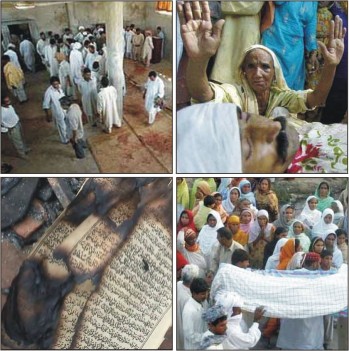
Last month, when more than 90 Ahmadis were massacred in two mosques in Lahore, I remembered the precise moment in 1974 when it all began to change.  There were street protests by religious parties against Ahmadis demanding that they should be declared non-Muslims.

One day I saw some bearded activists standing outside a clothes merchant’s shop in our town, chanting anti-Ahmadi slogans and turning customers away, telling them that buying clothes from Ahmadis was haram – forbidden. At the time I was learning to memorise the Koran from a very kind, mild-mannered teacher. I asked him what exactly was wrong with the Ahmadis.  He explained to me that they didn’t believe that the Prophet Muhammad was the last and the final messenger.

I said OK, maybe that makes them kafirs, infidels, but who says that kafirs can’t sell cloth?  My teacher’s response was a full-handed slap, so sudden, so unexpected that it rang in my ears for days to come. That same year Pakistan’s first elected parliament declared Ahmadis non-Muslims.  Then in 1984 Pakistan’s military dictator and self-appointed guardian of the faith General Zia-ul-Haq inserted that oath in the constitution that we are all required to sign.  Because of the new laws, Ahmadis have been sent to prison simply for using the Muslim greeting Assalamu alaikum, or putting a Koranic verse in a greeting card.

Over the last three decades the hatred against Ahmadis has become so widespread that Pakistan is now embarrassed by the only Nobel laureate it has ever produced.

Dr Abdus Salam Khan won the Nobel Prize for physics and, as a proud Pakistani, accepted his award in national dress.  But he was an Ahmadi so there is no monument to celebrate him, no universities named after him.

The word “Muslim” on his gravestone has been erased. Even the town he is buried in has been renamed in an attempt to erase our collective memory. This hatred was evident in the reactions to the massacre. TV channels were more obsessed with making sure that in their broadcasts Ahmadi mosques were called “places of worship”.

When you refuse to call a place of worship by its proper name, you are implying that it’s not a mosque, it’s not a church, it’s not a synagogue, it’s a place where godless people do godless things. And all the various Islamic political parties, whose leaders often refuse to pray together, are united on this.

When Pakistan’s main opposition leader Nawaz Sharif used the phrase “our brothers” for the murdered Ahmadis, leaders from 11 political parties came together to condemn him and threatened to issue a fatwa declaring him a heretic.  Over the last three decades the siege has been so palpable that those Ahmadis who couldn’t afford to emigrate have taken to hiding their identity.

If you want to destroy someone in public life it’s enough to drop a hint that they are Ahmadi. In the 1980s, the former chief minister of Punjab and current federal minister didn’t attend his own mother’s funeral because there were rumors that she was an Ahmadi.  When the funerals of the massacred Ahmadis took place there were no officials, no politicians present 

Pakistan’s liberal bloggers and some English-language columnists did write along the lines that Ahmadi blood is on our hands.  Others were adamant that it was yet another Friday, yet another massacre by the Pakistani Taliban, and we should just fight this sort of terrorism and leave the sectarian debates alone.

Two incidents in the past week made me realize how pathological our response was. At a vigil to mark the massacre, where a handful of people had turned up, a passer-by asked me “Are you an Ahmadi?” My own loud and aggressive denial surprised me.

Then an Ahmadi friend whose father survived the Lahore massacre wrote to me saying: “You know we have been living like this for decades. Did something like this have to happen for you to speak up?”

–Editor’s Note- It is high time that this law be repealed and the Ahmadi community of Pakistan be given all the basic human rights and privileges enjoyed by all Pakistanis.

India, Pakistan and the Musical Gurus of Peace

By Varun Soni for The Huffington Post

In July, India and Pakistan will begin a new round of talks in hopes of reviving their diplomatic efforts and renewing their peace process. While there are many pressing political issues to discuss, these talks could also be a remarkable opportunity for an innovative public diplomacy initiative between the nuclear neighbors. Although public diplomacy is often thought of as a form of state-to-state engagement, it also has the power to engage populations on a person-to-person level as well, especially in the age of social media and networking. Given the fact that many Indians and Pakistanis sing the same songs and listen to the same music, there is a unique opportunity now to promote popular music as a form of public diplomacy.

Although India and Pakistan are politically divided, their cultural roots still bind them together. Nowhere is this more apparent than Punjab — a region that was partitioned to create the modern nation-states of India and Pakistan in 1947, and further divided into the Indian states of Haryana and Himachal Pradesh in the 1960s. Despite these geopolitical divisions, Punjabis in both India and Pakistan remain united by “Punjabiyat,” a shared cultural heritage that has developed over millennia.

The historical Punjab is the only region in South Asia where Hindus, Muslims, and Sikhs are all represented in large numbers. Even as Punjab’s history is one of conflict and communalism, it is also one of overlapping musical and religious traditions. For example, the Guru Granth Sahib, the Sikh canonical text, contains within it not only the devotional compositions of Guru Nanak and his Sikh successors, but also verses from poets now considered Hindu and Muslim, such as Namdev and Baba Farid. Likewise, the Sikh devotional music of kirtan draws from similar lyrical sources and employs a similar instrumentation as Hindu bhajan music and Sufi qawwali music. For contemporary musicians, the devotional syncretism of Punjab remains a powerful model for how music can provide an encompassing framework for both unity and diversity.

Earlier this year, I interviewed the Sufi rock star Salman Ahmad as part of a USC book launch series focused on religion, popular culture, and diplomacy. As the founder of Junoon, Pakistan’s most popular rock band, Ahmad discussed his experiences performing in both India and Pakistan and explained how rock and roll empowers and connects the youth in both countries. In the name of rock-and-roll diplomacy, Ahmad organized last year’s Concert for Pakistan at the UN General Assembly Hall as a way of raising money and awareness for the three million internally displaced people of the Swat Valley in Pakistan. Inspired by George Harrison and Ravi Shankar’s famous Concert for Bangladesh, the Concert for Pakistan brought together prominent Indian and Pakistani musicians, diplomats, and entrepreneurs in solidarity and support for Swat.

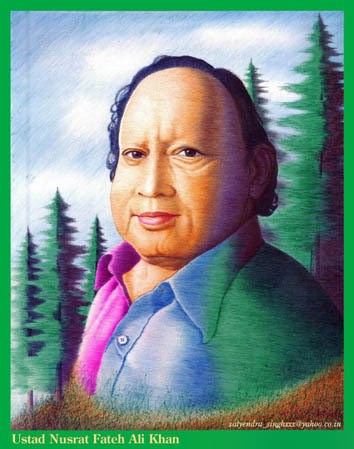
Another powerful moment in India-Pakistan musical diplomacy occurred in August of 1997, when India and Pakistan celebrated their fiftieth anniversaries of independence as nation-states. In order to commemorate this occasion, the virtuoso Indian music composer A.R. Rahman recorded with the late great Pakistani qawwali singer Nusrat Fateh Ali Khan. Together, the most famous musician from India and the most famous musician from Pakistan composed “Gurus of Peace,” an impassioned plea for peace between India and Pakistan. “Gurus of Peace” proved prescient, as the following year both India and Pakistan tested nuclear weapons, prompting President Clinton to call the India-Pakistan border the world’s most dangerous region. But A.R. Rahman and Nusrat Fateh Ali Khan had reminded the region the year earlier that India and Pakistan could unite through musical fusion instead of divide over nuclear fusion.

In the 1950s, the US State Department began sponsoring jazz luminaries, such as Duke Ellington and Dizzy Gillespie, to perform concerts overseas and serve as American cultural ambassadors. This public diplomacy initiative was aimed at winning the hearts and minds of potential allies in the Cold War, but the concerts also connected communities and ideas at a person-to-person level, and inspired artistic movements throughout the world. Likewise, India and Pakistan should sponsor and promote a series of musical concerts, workshops, and exchanges as a way of creating connections and engaging communities on a non-state level. Musical diplomacy certainly has its limits and should only be one part of a broader public diplomacy strategy, but after more than 60 years of missed public diplomacy opportunities, it’s time for India and Pakistan to follow the lead of A.R. Rahman and Nusrat Fateh Ali Khan and give music a chance.

Analysis: Turkey Looks East, Snarling Key US Goals

By Steven R Hurst for The Associated Press                                                                                                                                                                                                                                                    President Barack Obama scored two key foreign policy victories this week _ a new round of U.N. sanctions on Iran even as he kept Israeli-Palestinian talks on life support after the Israeli attack on Turkish ship carrying aid to Gaza.  The unintended costs may be heavy.

Both issues threaten key alliances with Muslim Turkey. And both test the ability of the U.S. and Israeli to cope with Ankara’s move out of the Western and NATO orbit toward largely Islamic regions of the Middle East and Central Asia. That matters because the United States is losing sway with its longtime NATO anchor, a democracy that bridges Europe to Asia and the Middle East.

Israel too is struggling to avoid Turkey’s threatened estrangement _ a break that would cost the Jewish state its only Muslim military ally. Turkey was one of the first countries to recognize Israel after its establishment more than six decades ago. The widening fissures in both alliances likely carry heavier psychological than strategic implications for the time being, particularly for Israel.

Here’s why. Turkish Prime Minister Recep Tayyip Erdogan “suddenly is the most popular politician in the Arab world and he doesn’t speak a word of Arabic,” asserts Henri Barkey of the Carnegie Endowment for International Peace.

Erdogan’s popularity grew exponentially after the Israeli commando raid on a Turkish-sanction flotilla of aid ships bound for Gaza. Muslims across the Middle East are holding him up as a hero for his tough talk against the Jewish state in their midst. That’s a stunning reversal. Turks, who migrated into modern day Turkey from Central Asia centuries ago, had always been seen in the Arab world as heirs to the Ottoman empire that had oppressed Arabs for 400 years.

Erdogan received a thunderous reception from fellow Muslim leaders Thursday at the Turkish-Arab Economic Forum that opened with calls for an international investigation of the May 31 Israeli raid that killed eight Turkish activists and a Turkish-American teenager. Erdogan’s Islamic-rooted Justice and Development Party came to power in 2002 in a landslide victory, a clear shift away from Turkey’s secular traditions that were established in the modern state, the post World War I and shrunken remnant of the Ottoman Empire.

The political shift was a clear precursor of Turkey’s move toward a more comfortable and powerful place in the Muslim world, despite continued efforts for membership in the European Union. Erdogan has since taken to championing the Palestinians’ cause, often more loudly than their fellow Arabs. That had badly strained Israeli-Turkish relations even before the crisis that blew up around the Gaza aid flotilla.

Then there was Turkey’s insertion of itself into the effort to move Iran away from uranium enrichment and its alleged program to build a nuclear weapon. After Iran rejected a deal to swap nuclear fuel last fall, the United States was determined to impose a fourth round of U.N. sanctions on Tehran. Washington had the backing of fellow U.N. Security Council members France and Britain all along and was on the verge of announcing that Russia and China also were on board.

Turkey, with help from Brazil, suddenly announced that it had revived the swap deal and that Iran had agreed. That agreement, more than a half year after initially rejected by Iran, was deeply flawed.

And the next day the United States said a new sanctions package had unanimous support from all five permanent Security Council members. It thanked Turkey for its efforts but said the train had already left the station. When the council voted earlier this week, only Turkey and Brazil cast no votes. Those did little but register protest since neither country holds a veto.

In spite of its rhetoric and obstructionism, Turkey does not appear ready any time soon the break fully from the West. It has vast interests intricately woven into NATO and the European Union. Turkey has a customs union agreement with its top trading partner, Europe, and wants to become part of the EU. But there is no doubt that the tone in Turkey’s foreign policy is changing.

Although the United States has been its chief ally since the Cold War, Turkey opposed the U.S. invasion of Iraq through Turkish soil, triggering tensions with Washington. Until the late 1990s, Turkish relations with Iran were tense, with its secular, westernized government accusing Tehran of trying to export its radical Islamic regime to this predominantly Muslim but secular country. Today, Turkey wants to build deeper trade ties with Iran.

Erdogan also is building support for next year’s election by playing the Islam card _ one that appeals heavily to traditionalist, rural and Muslim voters who make up the vast majority of the electorate. “This is not being driven by foreign affairs,” said Jonathan Adelman, professor at the University of Denver. “Erdogan is winning points at home _ going back to the country’s Muslim roots.”

Islam in the Indian Subcontinent and the Rise of Sects

By Nagwa Malik 

Islam, a religion described by many as a religion of peace, and by many again a religion of terrorism. Why this huge controversy? Simple. Islam is a religion of peace and fortunately or unfortunately it goes past creed, race, cast, color or country, through all the continents and like the Chinese whisper, the meaning gets scrambled along the way.

But if we examine Islam in the Indian subcontinent alone we find various colors within this one religion. In fact I am amazed to see that the amount of misinformation, lack of information and incomplete knowledge is so high in this area of the world that most of the sects are generated from within this boundary alone. Islam is one, it is a sign of unity, so the thought of any sect violates the essence of the religion. The Quran itself states that creating sects in Islam is Haram (forbidden).

This is one fact that we  as Muslims do not seem to realize. Why are these sects formed and continue to grow? Because every individual interprets the traditions of the Prophet (pbuh) and even the Quran in a different light and in doing so everyone seems to think they have hit upon something new and that something new has to be the real truth. They go around preaching in their excitement of having learnt what they think is unknown to anyone else, and thus a sect is formed. Did you know that there are more sects within the Islamic religion in this part of the world than the rest of the world put together?

I am very sad to point out that where every scholar from every part of the world will agree upon certain basics of Islam, these very basics will be found challenged and put through controversy by only writers of the subcontinent.  Similarly this question about challenging hadith or the concept of it has been only and only from this part of the world in the same way does the production of hadiths that do not exist in the first place at all. These two extremes are born from within our very country, and nowhere else in the world.

People realise their lack of knowledge at a rather later stage in life usually 40 above and decide to conduct a research. This usually comes out rather worse for the rest of the human race, for they do not do a complete research, but pick on that one single idea that has clicked and instead of trying to find out the truth, only start justifying their idea as the truth. This leads to rather disastrous results which is why Islam practised in the subcontinent is not the fundamental basics of Islam. You know the saying: a half truth is worse than a lie. A very small example of this is the recent wave of ideology that whatever is in the Quran is Islam, and there is no other source. That the Quran is complete and nothing is left unexplained. The idea continues with the denouncement of Hadith or the Prophet’s tradition. How bizarre can one get in trying to understand religion, only to denounce that very fundament of religion? It is true that Quran touches on every subject and completely defines the Muslim code of life, but not everything is put to print. Some things have been left to the Prophet (pbuh) to practise and to explain.

There are four basics of Islam which are not to be tampered with when conducting any research, and these four are undisputed by every scholar in the world except again the few in the subcontinent who think they have hit the jack pot…rather the opposite if you ask me; these four are Quran, Hadith, Ijma and Qiyas. These basics form the Shariah. The present legal system followed by the west and rather poorly by the subcontinent is actually based on this very foundation of Islam and Islamic legal system. The tradition of cross referencing a case, reading from the statute, citing previous cases all stem from the four basic references of Islam. To denounce anyone is to denounce the religion itself. So one has to be very careful before one forms rather ingenious theories about understanding Islam.

A tip for all new researchers: try to avoid reading books written by local writers first, or try to avoid reading them at all, for they base their books on controversies. Instead pick up authentic writers accepted all over the world for their deep and accurate research work. Try reading old writers who have been authenticated by the Islamic panel internationally. It should be noticed that people in Pakistan and India are less informed about their religion than other Muslim countries, and those who have had a basic education of Islam abroad hold a more solid and clear view of Islam whereas unfortunately in the subcontinent this is not so. Abroad there is only one book, one rule, one religion, whereas in the subcontinent there are many books, many rules and many sects. We need to eradicate this flaw within our system.  When we go for the pilgrimage we find that the pilgrims from around the world are mostly young but only pilgrims from the subcontinent are old. That explains a lot doesn’t it? For a country called the Islamic Republic of Pakistan we are curiously very unfamiliar with Islam and its basic teachings.

Before we go about getting excited over our incomplete research works and start preaching them, please do understand a rule of Islam which says misinformation is a sin.  It is suggested, then, that once it is sure that a thorough research is conducted in the right way, and the three stages of basic research have been passed through, then and only then should one allow oneself to preach. Also, one must try practising it first. Too often people who claim to be righteous Muslims  are ones who inevitably do not fully practice what they preach. We must remember the saying: neem hakeem khatara-e-jaan, neem mullah khatara-e-imaan. (A half baked physician is a danger to your life and a half baked mullah is a danger to your faith).

Pakistan’s Mosques, Media and Intolerance

By Zeeshan Haider for Reuters

Pakistan has been fighting Islamist militants for years, but tough measures are needed to overturn a system breeding religious intolerance after the long failure of authorities to confront mullahs and hardline groups.

Analysts say the notion of religious mistrust is deeply entrenched in the predominatly Muslim country — even in the school system — and it is now up to leaders to mobilise public.

Last week’s massacre in the city of Lahore of more than 80 Ahmadis – a minority religious sect deemed non-Muslim and heretical by the constitution – has generated a heated debate in Pakistan, a U.S. ally, on how to tackle the issue.

In a sign of how hatred is propagated, The News newspaper said one of the two surviving gunmen caught by security forces said he had been persuaded that Ahmadis were “blaspheming” Islam.

Identified as Abdullah, he told investigators that his mentors had him believe that Ahmadis were drawing caricatures of Prophet Mohammad during a recent online contest and “so their bloodshed was a great service to Islam”, the newspaper said. That raised alarm bells in a country combatting militancy.

“The nagging feeling that the government has already lost the battle against extremism has now acquired the force of conviction,” Zafar Hilaly, a former ambassador, wrote in The News last week.

After joining the U.S.-led war on terrorism after the September 11, 2001 attacks on the United States, Pakistan mounted a crackdown on militancy, outlawing several groups, arresting hundreds of suspects and warning hardline mullahs against delivering hate speeches and distributing hate literature.

The government also vowed to reform tens of thousands of Islamic seminaries, known as madrassas, many of which are considered as breeding grounds for militancy. Almost none of these measures, however, has been implemented.

Most outlawed groups have re-emerged under new names. Radical clerics still deliver fiery speeches against sects. The U.S. Embassy acknowledged the difficulties, given the importance placed on Pakistan helping Washington battle al Qaeda and its extremist allies.

“We recognise this is a problem,” an embassy official said, adding that the embassy encouraged Pakistanis to take part in exchange programmes to see a multi-faith United States.

Analysts say Pakistani leaders dating back to the 1970s, however popular, took no action to counter radicals. Hasan Askari Rizvi, a Lahore-based political and security analyst said governments have lacked the stomach to implement reforms, particularly in school curricula.

“In textbooks used in government schools, Pakistan is equated with Muslims…They teach Pakistan is a country only for Muslims. They don’t teach that non-Muslims also live here,” he said.

Journalist and analyst Ahmed Rashid described school programmes as “the most sensitive issue. But it is an issue in which any attempt to change the curriculum would have a whole host of fundamentalist groups oppose you.”

In 1974, Pakistan’s first popularly elected Prime Minister, Zulfikar Ali Bhutto, bowed to Islamic groups and won approval of a constitutional amendment declaring Ahmadis as non-Muslims. He also switched the weekly day off from Sunday to Friday.

But much of the upsurge in militancy occurred in the late 1970s and 1980s during the “Islamisation drive” by late military leader General Mohammad Zia-ul-Haq and Pakistan’s support for the U.S.-baked Afghan jihad or holy war against the Soviet invasion which saw a rapid growth of radical groups and madrasas.

Haq introduced several laws, such as the notorious blasphemy law, which are deemed discriminatory against non-Muslim minorities and fuelled tensions between different Muslim sects. Subsequent governments did nothing to reverse the laws.

Military dictators, who ruled Pakistan for more than half of its existence, have also used militant groups to further policy objectives in Afghanistan and India and marginalise liberals.

“In earlier years, in order to pursue its foreign policy using the instrument of jihad, the state actively sought to create a religiously charged citizenry,” said Pervez Hoodbhoy, a physicist and analyst. “But, now that the Pakistani military and political establishments have become a victim of extremism, they are foundering in confusion.”

Former President Pervez Musharraf, a military ruler, though he espoused a modern and liberal version of Islam, repeatedly failed to get the laws reviewed while in office from 1999-2008.

Former Prime Minister Benazir Bhutto, a pro-West politician and a vocal opponent of the militants, was killed in December 2007 in a suicide attack blamed on militants linked to al Qaeda. Civilian leaders are made even more cautious now in tackling radical groups by the tremendous fear of militants who have unleashed bomb and suicide attacks across the country.

“Religious intolerance is getting worse in Pakistan because the political leadership lacks the will to fight this,” said analyst Rizvi. “They don’t want to face the wrath of mullahs.”

A Journey into America, Past and Present

By Akbar Ahmed for The Guardian

Muslims are for Americans what the Russians were for Churchill: “A riddle, wrapped in a mystery, inside an enigma.” While the post-9/11 period brought an interest in the Qur’an and its language, the gap between Islam and mainstream America has steadily widened. It remains more urgent than ever for the US to comprehend Islam, a religion practised by one out four people in the world, not only for the sake of its ideals (which include religious tolerance) but also for its geopolitical needs and strategy as America remains militarily involved in Afghanistan, Iraq, Pakistan, and Somalia.

The reality is that Islam remains unknown to most Americans, who, on top of all the other insecurities and fears about the religion, have recently added another: the “homegrown terrorist”, which President Obama has named as one of his administration’s top national security priorities.

I have been in a unique position to observe America’s attitudes towards Islam, travelling with a team of young Americans for over a year throughout the length and breadth of the United States to over 75 cities, visiting more than 100 mosques and talking to thousands of Muslims and non-Muslims.

I realised that it was impossible to study Islam in America without studying America itself and its identity, which I determined goes back to the first Mayflower settlers. In short, there are three basic identities that define American society: primordial, pluralist, and predator. Primordial identity is rooted in the seminal landing at Plymouth and provides the foundation of the two other identities. The aim of the early settlers was to survive and create a Christian society under the rule of law. The majority of the Founding Fathers in the next century would subscribe to what I call pluralist identity – believing in civil rights and liberties, religious freedom and tolerance.

America has a strong foundation in which to solve the challenge of the Muslim community if Americans look to their past and revive the spirit of some of their truly great leaders. Roger Williams, in the 17th century laid the groundwork for separation of church and state and welcomed people of other faiths. The state, said Williams, should allow all religions, including the “Turkish” (Islamic).

Thomas Jefferson owned a Qur’an and we found a statue of Jefferson at the University of Virginia advocating “Religious Freedom, 1786” with the words God, Jehovah, Brahma and Allah carved on the tablet he embraces.

A treaty, which was sponsored by George Washington and signed by John Adams in 1797, pertained to Tripoli and assured that the United States “has in itself no character of enmity against the laws, religion or tranquility of Musselmen.” Even the Prophet Muhammad was praised by the Founding Fathers; Adams called him one of the world’s “sober inquirers after truth” alongside such figures as Confucius and Socrates, and Benjamin Franklin cited the prophet as a model of compassion.

As primordial identity was taking shape at Plymouth, however, and new trends were already emerging. The more zealous of the settlers argued that the land was given to them by God, and they were to occupy it regardless of who was living there. As their confidence grew, they began to prey on the weaker natives, justifying their force in the name of protecting the community, generating an arrogance that did not encourage self-reflection and making it easy to demonise and destroy the enemy. This marked the birth of a predator identity.

It is this understanding of American society which allows us to put the Muslim community in America into context. Our findings from the field bring both bad news and good news. The bad news is that every one of the major American Muslim categories – African Americans, immigrants, and converts – has been involved in recent violence-related cases in the United States. In view of the bankruptcy of Muslim leadership and American failure to truly understand the Muslim community, it is not difficult to predict that violence will increase in both frequency and intensity. I am sorry to say that the government and its various agencies still do not have an adequate policy towards the country’s Muslim population. Some Muslims are affected by US actions taken in response to 9/11, which included the arrests and deportation of thousands, prompting many others to flee the country. These realities have reinforced the sense of being a mistrusted community. Others resent the Islamophobia they see in the media.

The good news is that American and Muslim leaders alike are now conscious of the problem of terrorism and its scale and are actively discussing the position of Muslims in America. Some of our findings challenge the received wisdom telling us that most Americans are hostile to Muslims. Of those questioned for our study, 95% said that they would vote for a Muslim for public office, for example, and an equally high number of respondents had no problem with Muslims being “American”, although some inserted “if” clauses. We found a patriotic and vibrant Muslim community committed to contributing to the country. Dialogue and understanding are urgently recommended.

America stands at a crossroads. It will have to choose either to embrace the Founding Fathers’ pluralist vision or the America that compromises the Constitution and the values of the Founding Fathers. Primordial and predator identity remain alive and well in today’s United States. In one way or another, people everywhere have a stake in America resolving its identity because America’s unique, universal vision of society formulated by its Founding Fathers attracts the world. A new chapter in the history of the United States has opened after 9/11 and America’s future will be decided on how it resolves its ongoing engagement and entanglement with Islam.

Facebook in Pakistan: Islamists vs. Liberals

By Adam B Ellick and Ahmad Ziadi for The New York Times

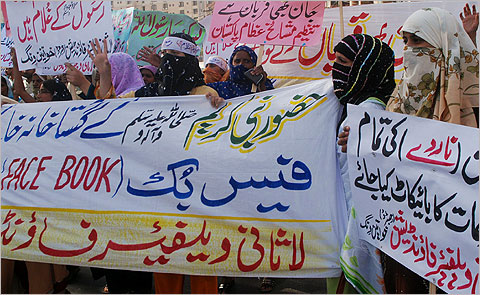
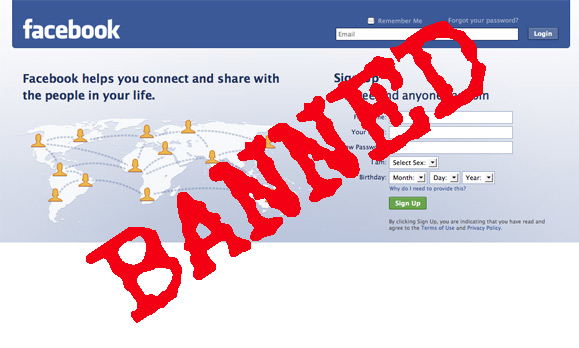
When Facebook was recently banned in Pakistan for hosting a “Draw Muhammad Day” fan page, one thing became very clear: Islamists here operate with organized precision, able to mobilize the masses in an instant, while the liberal voice remains paralyzed by fear and passivity.

Some media experts predicted that the ban – which a Pakistani court has now ordered the government to lift – might motivate the nation’s deeply disconnected liberal elite to take on the Islamists. After all, while members of the urban elite have been largely immune to the recent rise of violent militant attacks, the Facebook ban presented them with a personal vendetta.

In a nation without bars, and where entertainment options such as music concerts are rare, Facebook serves as a precious tool for the elite to organize discreet private events with music, drugs and alcohol. It has also helped mobilize social movements, including the lawyers’ march in 2009.

But the fervor that has followed the Facebook ban has been entirely one-sided in favor of the Islamists.

As the rest of Muslim world remains largely indifferent, tens of thousands of anti-Facebook Pakistanis protested in urban centers by burning American flags. A poll conducted by an IT portal called ProPakistani showed 73 percent out of about 8,000 voters favor a permanent ban on Facebook.

How did it get to this? There has been a widespread SMS campaign perpetuating a false narrative that Pakistan’s ban has brought a behemoth anti-Muslim company to its knees. One SMS attributes the recent fall in the Euro to the ban. Here’s another SMS I received:

THE BOYCOTT MADE BY MUSLIMS AGAINST FACEBOOK SINCE LAST 2 DAYS

CHARGE DEM A LOSS OF 2 BILLION EUROS..AND IF ITS CONTINUED AFTER 7 DAYS IT WOULD

REACH AROUND 40 BILLION EURO…. PLZ SPREAD AS MUCH AS U CAN.

Facts suggest otherwise. Facebook is not a publicly traded company, therefore, its earnings are not published. Still, some venture capitalists have valued Facebook at about $8 billion. Its annual revenue is estimated between $500 to $800 million.

In addition to the SMS campaign, this week, two new Muslim-friendly alternatives to Facebook have been launched. One of them, www.millatfacebook.com, was inaugurated by the bar association of the same Lahore court that banned Facebook. Millat means “Nation” in Urdu.

The site wooed more than 20,000 users with its slogan: “A site for Muslims by Muslims where sweet people of other religions are also welcome!!” Members are asked to specify if they drink alcohol. The founders are enraged at Facebook for curtailing Nazi-related hate speech while refusing to curb the Muhammad cartoons.

Their website says “Let’s prove to the world that if we can generate revenue for Facebook.com then we can also run our own website. Prove to the world that we are independent Muslims…” The other alternative site, www.Buddyflick.com , aims to “create/build/run our own network.” But where are Pakistan’s liberal and moderate voices?

Speaking out against the ban can be as hazardous as the forbidden cartoons. When those against the ban held a small news conference, the press mostly ignored it. After the press conference, several anti-ban activists were aggressively confronted by a large crowd of opposing activists as they left the venue. As tensions escalated, the anti-ban activists retreated into the building and waited for the crowd to dissipate.

One friend who is especially furious about the ban wouldn’t dare to speak out. “Nobody has the guts to go out and do something about it. The issue of Muhammad is so sensitive that you just never know.”

Instead, liberals are hashing out their frustrations in the low-traffic comment sections of liberal blogs and leftist newspapers, and, ironically enough, on their actual Facebook pages. Some have hacked into the banned site from the confines of their gated homes. Among the comment section in one newspaper is the latest joke: What’s the difference between Facebook and Lashkar  e Taiba? Answer: Facebook is banned!

The Facebook Creed? Racism’s Bad, Bashing Religion Is Good

By Tommy De Seno for FoxNews.com

Recently, in a column for the Fox Forum called “Muhammad Cartoons vs. Piss Christ” I compared the insult Muslims feel when they see a drawing of Muhammad to the hurt Christians felt when an artist photographed a crucifix in a jar of urine, called it “Piss Christ” and received a tax-funded monetary award from the National Endowment of the Arts.

The point I tried to make is that just because the First Amendment allows you to say something doesn’t mean you should say it. Freedom comes with responsibility, which includes tactfulness when discussing the revered symbols of another’s religion.

Sure you are free to hurl insults – but remember the purpose of criticism is persuasion, and no one has ever been persuaded by first being insulted. Criticism can be made of Islam and Christianity without denigrating either’s most sacred symbols.

As Americans we should fight like hell for the right to draw a picture of Muhammad, but then choose not to.

This issue is hot today because some folks short on good criticism and long on juvenile insult declared May 20 “Everybody Draw Muhammad Day.” I wonder why they didn’t include “Everyone Piss On a Crucifix Day,” too? That they didn’t do just that, suggests that this is not a pro-First Amendment movement, but a purely an anti-Muslim movement.

So here’s my question: Why does Facebook allow a page whose purpose is to spread hate for a religion? After all, Facebook used to ban activity for no other reason than the author was home-schooled (and that’s some weird priorities right there).

A Facebook spokesperson defended the company’s decision to not ban the “Draw Muhammad” page to FoxNews.com earlier this week:

“Groups that express an opinion on a state, institution, or set of beliefs — even if that opinion is outrageous or offensive to some — do not by themselves violate our policies.”  

But compare that to this quote from an interview with a Facebook spokesman last year with Britain’s Daily Mail newspaper. Things were different when the topic was not anti-religion pages, but about pages that include racism:

“However, there is no place for content that is threatening, abusive, hateful, or racially or ethnically objectionable on the site and Facebook will remove any such content that violates our Terms of Use when it is reported… We have already removed a number of groups that violated these terms and we are continuing to be vigilant, immediately removing further postings when we become aware of them.”  

I see the Facebook matrix: “Racism is bad, but bashing religion is good.”

Facebook also said this to FoxNews.com about the “Draw Muhammad” page:

“When a group created to express an opinion devolves into threats or hate speech, we will remove the threatening or hateful comments and may even remove the group itself.” 

Hey Facebook – have you seen the two pages today? They are both a cesspool of hateful anti-religious commentary, devoid of useful criticism and swimming with the worst of distance-induced Internet hatred and nastiness.

If these pages don’t violate Facebook’s rules against hate speech, you can’t violate them.

Both pages have been taken over by anti-religious zealots whose purpose is to stir up anger for the sake of eliciting an even angrier response – all heat and no light. The folks posting the hate have the advantage of hiding whatever it is they hold sacred, so that no one can employ their own tactics against them. Cowards.

Both pages are filled with drawings, manipulated photos and commentary showing all religious leaders in acts of bestiality, pedophilia and outrages claims to calamities in history that religion couldn’t possibly be held accountable for.

Even if you’ve read hateful speech, you’ve still probably never read such blind, ignorant rage as is existent on these pages. Both pages should be taken down immediately, but they won’t be.

Facebook has obliterated civilized discourse.

Pakistani Muslim Rocks Against Extremism

By Richard Allen Greene for CNN

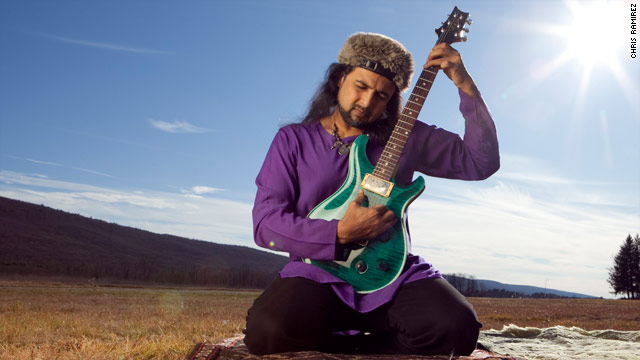
Salman Ahmad is a devout Pakistani Muslim on jihad — but his holy war is a rock ‘n’ roll battle against intolerance, he says. He’s the frontman of the band Junoon. He’s sold 30 million albums. And he says music is a powerful weapon against extremism. “My own personal narrative tells me that arts and culture is mightier than the sword,” he told CNN during a tour of the United Kingdom Thursday.

Ahmad, who was born in Pakistan and grew up in New York, has set himself an ambitious goal — not only fighting Muslims’ own misconceptions about their religion, but reclaiming the very word “jihad” from extremists.

It’s come to mean violent holy war of the kind waged by al Qaeda and the Taliban. But Ahmad says that’s not its true meaning”There has been a sinister case of identity theft where the extremists have hijacked not only language but culture,” he said. “Jihad means to strive, to overcome your ego, to work for social justice and peace.” That may be why his new book and album are called “Rock & Roll Jihad.”

He insists his long-haired, guitar-driven rock music is entirely compatible with Islam.

“Anybody who says that music is un-Islamic is a poser,” he said. “Muslims have expressed their faith, their lives, their hopes, through music, through poetry, for 1,400 years.”

His own music is a fusion of the wildly disparate influences he grew up with, he said. “I was a 13-year-old from Pakistan (when I) arrived in a suburban cocoon like New York,” he recalled. “My exposure to rock-and-roll was watching Led Zeppelin in Madison Square Garden.” Frontman Jimmy Page “had a two-headed guitar and dragons painted on his pants, and I said: ‘That’s what I want to do with the rest of my life.'”

“My music takes equal inspiration from classic rock like Led Zeppelin and the Beatles and also Sufi poetry,” he said, citing a mystical Muslim tradition. “We are in the same tradition of musicians who are sending out a message of love, a message of joy. “And while he may seem like a trailblazer — and be one — he said he is not alone. South Indian Muslim composer A.R. Rahman won an Academy Award for best song for “Slumdog Millionaire’s” anthemic “Jai Ho,” Ahmad observed. And Ahmad’s mentor, Nusrat Fateh Ali Khan, performed with Peter Gabriel and Pearl Jam’s Eddie Vedder. “He said to me, “The Quran promotes cultural diversity, so why not play with rockers?'”

Ahmad’s done some high-profile collaborations of his own, including recording a song with American rocker Melissa Etheridge. “I saw him perform at the concert and was amazed by his vocal and guitar abilities. Here was this traditional Eastern sound that was rocking hard at the same time,” Etheridge writes in the introduction to Ahmad’s new book. They traded ideas, resulting in the song “Ring The Bells.”

She remembers listening to some tunes he recorded to kick off their collaboration: “I found in one track a haunting guitar part that I kept playing over and over until finally the words started to come. ‘Whose God is God? Whose light is light? Whose law is wrong? Whose might is right?'” The message is resonating, Ahmad said.

He has played rock concerts in the disputed territory of Kashmir, with “thousands of kids braving death threats going to hear concerts,” he said.

“It’s a way for people to vent their emotions. Junoon’s sold over 30 million albums,” he said. “That music wasn’t bought by a fringe. That’s a mainstream majority.”

Lebanese Immigrant Becomes First Muslim Woman to be Crowned Miss U.S.A.

By Derrick Henry for The New York Times


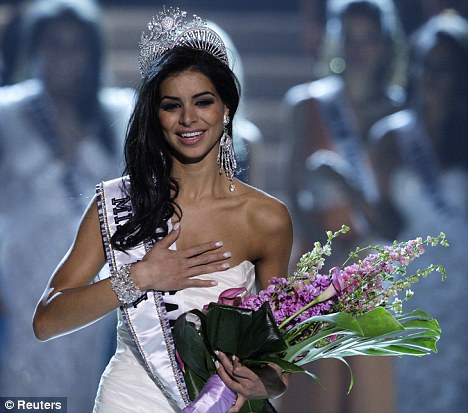
Pageant organizers on Sunday night crowned a 24-year-old Lebanese immigrant from Michigan as Miss USA 2010.

Rima Fakih was born in Lebanon, moved to the United States as a baby and was raised in New York City, where she attended a Catholic school. She told pageant organizers her family celebrates both Muslim and Christian faiths. Her family moved to Michigan in 2003, where she later became Miss Michigan USA.

Pageant officials told The Associated Press that pageant records were not detailed enough to show whether Ms. Fakih was the first Arab-American, Muslim or immigrant to win the Miss USA title. The pageant started in 1952 as a local swimsuit competition in Long Beach, Calif.

Ms. Fakih is from Dearborn and is a graduate of the University of Michigan, where she earned her bachelors degree in economics with a minor in business administration, the pageant said in a release. She said she planned to attend law school after completing her term as Miss USA.

Fans in her state celebrated after learning that she had been crowned at the event held in Las Vegas.

“This is unbelievable,” Rami Haddad, 26, of Livonia told The Detroit Free Press on Sunday night. Mr. Haddad said he was one of Ms. Fakih’s biggest supporters. “It’s a dream come true. I can’t express my feelings.”

During the pageant, Ms. Fakih nearly fell in her evening gown because of the length of its train, but she recovered. During the interview portion she was asked whether she thought birth control should be paid for by health insurance. She said she believed it should because it is expensive.

“I believe that birth control is just like every other medication even though it’s a controlled substance,” Ms. Fakih said.

Miss Oklahoma USA, Morgan Elizabeth Woolard, was first runner-up. She was asked about Arizona’s new immigration law, and said she supported the law, which would make the failure to carry immigration documents a crime and give the police broad power to detain anyone suspected of being in the country illegally. She also said she was against illegal immigration but against racial profiling.

Donald Trump owns the pageant with NBC, which aired the event live

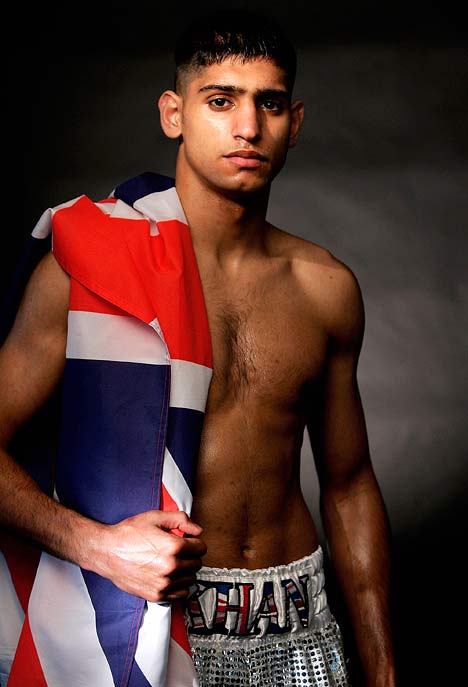
Amir Khan the Ambassador

By Lem Satterfield for Boxing Fanhouse

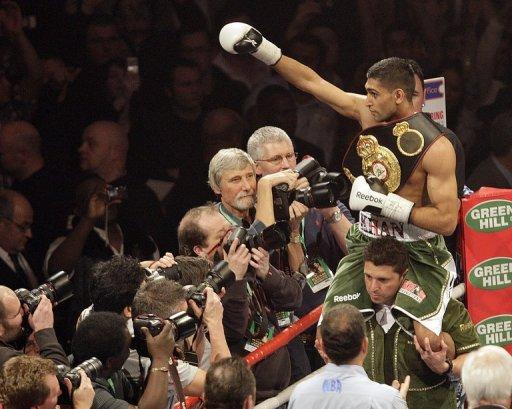
NEW YORK — WBA junior welterweight (140 pounds) champion Amir Khan had just scored Saturday night’s 11th-round knockout over Brooklyn’s Paulie Malignaggi in the biggest victory of his career.

In doing so, the 23-year-old, 2004 Olympic silver medalist not only out-boxed a pure boxer, but he mixed in an assortment of power shots — namely crisp, counter and over hand rights behind double- and triple-jabs — with a compliment of damaging left hooks and uppercuts.

When the fight was over, the English-born titlist had won the approval of the roaring crowd of more than 4,412 that filled Madison Square Garden’s 5,000 capacity WaMu Theater, and left the trash-talking Malignaggi beaten, battered and bloodied in his own hometown.

Khan had Malignaggi pinned on the ropes and was nailing him with several unanswered blows when referee Steve Smoger came to the rescue, calling a halt to the bout at 1:25 of the round.

“I was nervous, this being my first time in America. And I was walking into the theater, I could hear a lot of boos. But at the end of the fight, they started cheering for Amir Khan because I won them over with my style. I want to make all of my fights like this one,” said Khan, who rose to 23-1, with his 17th knockout and his fourth, consecutive victory.

“It’s my style. I’m explosive. I’m entertaining to watch. I’ve got speed, and I think I made a statement. I think that now there are a lot of American people who are interested in Amir Khan,” said Khan, who was coming off of a December’s first-round knockout of another Brooklyn resident, Dmitry Salita (30-1-1, 16 KOs).

“I’d love to fight some more over here. I want to save some big fights for the United Kingdom,” said Khan. “But I’ve had my American debut, and it’s the best feeling fighting in America. It’s a dream come true. I’d love to go to Las Vegas and have a big fight over there too.”

But as admirable as Khan’s in-the-ring efforts had been against Malignaggi, it is the maturity, poise and grace with which he handled the out-of-the ring distractions that may yet make Khan even more of a cross-cultural, crossover icon.

There was an irony surrounding Khan’s visa issues, which overlapped with the recent actions of alleged Times Square bombing attempt suspect Faisal Shahzad. Together, the two situations caused concern heading into Khan-Malignaggi.

Khan is a practicing Muslim who was born in England, but who is of Pakistani descent, while Shahzad is a native of Pakistan who became a U.S. citizen a year ago.

In early March, long before Shahzad’s actions on May 1, which resulted in a failed attack after he left an SUV rigged with a homemade bombing device in Times Square, Khan and his promoter, Golden Boy Promotions, became aware of the fighter’s issues concerning the obtaining of a work visa.

David Itskowitch, chief operating officer of Golden Boy Promotions, said that Khan entered America under the country’s visa waivers program “which, for all intents and purposes,” allows its holder, “a tourist visa, which is good for ‘X’-amount of days.”

“Khan’s status while he was here training was one of a tourist while not earning money,” said Itskowitch. “In order to change your status to someone who is working, you have to leave the country, get a visa, and, then, come back.”

Khan had been holding workouts at Wild Card Boxing Club, in Hollywood, Calif., owned by his trainer, Freddie Roach, a three-time Trainer Of The Year.

But Khan was forced to leave the United States, and has been preparing for his American debut against Malignaggi (27-4, five KOs), while training under Roach in Vancouver, Canada.

“I was in training camp. Then I had to go to Vancouver to get my visa. And my visa took a long time. We had to move the whole training camp there. My head was all over the place, so I had to stay mentally strong,” said Khan, who was not granted the work visa until nine days prior to the fight.

“When I finally got my visa, I had to go back to Los Angeles again, and the, fly to New York. So I was flying a lot. I was traveling all over country, and I got a visa for 23 days that it took me three weeks to get. That could have gotten to me, but I had to work very hard not to let it bother me,” said Khan.

“I have to thank Freddie for flying all over with me,” said Khan. “One thing about Freddie, he looks at his fighters like they’re his kids. He was standing beside me all of the way through, so I have to thank him for that.”

Although Khan laments the notion that suspicion may have been heightened due to the comparisons between himself and Shahzad, he also embraces the opportunity to perhaps be an ambassador.

Khan wants to use his boxing skills to influence American opinion.

“What I want to do in this game is that, you know, I know that a lot of the Pakistani people and the Muslims are getting a bad name in the United States with the bombings and the terrorism and stuff, but not all of us are like that. Look at Amir Khan. I’m an English boxer. I’m one of the faces of boxing,” said Khan.

“And I want to do the same thing that I’ve done in the United Kingdom. I want to put a new face into boxing. I want to bring the Muslim community into boxing. Whenever you’re at an Amir Khan fight, if you come to the United Kingdom and watch me fight, you look into the crowd, and you see all different colors,” said Khan.

“You see the Asian, Chinese, Pakistanis, Muslims — you see everyone. I want to do the same in the United States,” said Khan. “As more people get to know Amir Khan, you’ll see more of that. Hopefully the Americans will love my style and I can do the same here. I want to fill out the stadiums and the arenas like I do in the United Kingdom.”

Muslim-Americans: Bracing For A Backlash

By Christopher Alessi for The Huffington Post

Adil Najam, a Pakistani-American professor at Boston University, took his 12-year-old son aside before sending him off to school last Wednesday. He told him to hold his head high, even if the other kids make fun of him and call him a terrorist.

In the days following this month’s attempted car bombing in Times Square by Pakistani-American Faisal Shahzad, Pakistanis and other Muslim groups in the U.S. have been taking precautions to prevent a public backlash similar to the one Muslim-Americans faced following 9/11–but they are still preparing for the worst.

“We are so grateful, thank God, that the bomb did not blow up, but the real damage here is to the Pakistani community,” Najam said. “Everyone [Pakistani-Americans] now gets ready for the office – or school – knowing he will be looked at differently.”

As a result, community leaders, such as Dr. Saud Anwar, the director of Connecticut’s branch of the Pakistani-American Public Affairs Committee, are counseling fellow Pakistanis to jump on the offensive. “We’re hoping we’re not going to be marginalized and we’re trying not to be scared, so we’re mobilizing the community to condemn the incident,” he said.

After 9/11, Anwar made a choice to be more “politically active and to build bridges with the law enforcement community.” He now works closely with the FBI and the Department of Homeland Security to help identify suspected terrorists. He has also encouraged his fellow Pakistanis in Connecticut to become more engaged with the police, in part to counter the stereotype that all Muslims are terrorist-sympathizers.

If Muslim-Americans don’t take an active approach, Anwar believes, they will only be further marginalized, which in turn will lead to increased “identity crises” and subsequent radicalization in the greater Muslim community–an arguably vicious and deadly cycle.

Najam also contends that Muslims are being “more vigilant against crackpots within their own communities,” by reporting them to the authorities. “We are trying to deal with incidents involving black sheep much better,” he said, referring to fellow Muslims that are suspected of harboring radical and violent agendas.

Both Najam and Anwar are trying to preemptively thwart the onslaught they say their communities faced after 9/11. Back then, both men argue, many Muslim-Americans felt they were put under a microscope by the mainstream American media and society at large. “There was a very high level of apprehension immediately after 9/11,” Najam said. “‘American-Americans’ – whatever that is – were apprehensive about Muslims, and we were internally apprehensive about how we were being viewed.”

Prof. Sinan Antoon of New York University believes that U.S. government policy and rhetoric following 9/11 only compounded the situation for Muslims. “The war on terror discourse and the manichaean view of a world populated by those who are with us and those others who are against us spelled danger and disaster for Arab and Muslim citizens or immigrants,” Antoon said. “After 9/11,” he added, “Arab-Americans and Muslim-Americans were all guilty by association.”

Indeed, for many ‘ordinary’ Americans – non-Muslims, or “American-Americans,” as Najam put it – ‘Muslim’ became the codeword for ‘terrorist.’ As a result, many Muslims felt forced to take responsibility for the acts of religious (and political) fanatics who happened to share the same faith.

Antoon further argues that Muslims were easily linked with terrorists after 9/11 because “terrorism was explained in cultural and civilizational terms, not in material history and politics.” “The result,” he explained, “was for the U.S. government to absolve itself of its own responsibility in supporting foreign jihadists in the 1980s…and skirt the blame to the cultural sphere and simplify phenomena and events as simply a class of cultures.”

But Najam is optimistic that things could be different this time. He believes that mainstream American society has evolved since the time period following 9/11. “Society is more adept at handling these [terrorism incidents] as acts of criminality,” he said. Most Americans, Najam argues, no longer see the actions of individuals such as Shahzad as representative of an entire cultural or religious group.

Anwar, too, is trying to remain positive. “There are over 1 million people of Pakistani heritage in the U.S., and there was one idiot that couldn’t think straight,” he said.

“I think America is better than that–blaming the whole community.”

Media Ignore The Fact That Man Who Alerted Police To Failed Times Square Bombing Is A Muslim Immigrant

By Zaid Jilani for ThinkProgress.org

The chief suspect in the case of the failed Times Square car bombing is Pakistani-American Faisal Shahzad, who has confessed to the plot. Much of the media has latched onto Shahzad’s Muslim faith and his Pakistani identity, making inflammatory remarks and suggestions about Muslims and Pakistanis:

– CNN contributor and Redstate.com blogger Erick Erickson complained that the words “muslim” and “Islam” are “not mentioned” enough in stories about Shahzad. He wrote, “It really is pathetic that you’re more likely to see the words “racist” and “Republican” together in the newspaper these days than “terrorism” and “Islam.” [5/4/2010]

– Hate radio host Neal Boortz tweeted, “OMG! The Times Square Bomber is a Muslim! Shocker! Who would have believed it?” [5/4/2010]

– The cover of today’s Washington Post-published Express features a black-and-white photo of Shahzad with the sensationalist headline “MADE IN PAKISTAN” [5/5/2010]

Yet one fact being ignored in the American media’s sensationalist narrative about the failed bombing is that the man who was responsible for police finding the bomb was Muslim. The UK’s Times Online reports that Aliou Niasse, a Senagalese Muslim immigrant who works as a photograph vendor on Times Square, was the first to bring the smoking car to the police’s attention:

Aliou Niasse, a street vendor selling framed photographs of New York, said that he was the first to spot the car containing the bomb, which pulled up right in front of his cart on the corner of 45th street and Broadway next to the Marriott hotel.

“I didn’t see the car pull up or notice the driver because I was busy with customers. But when I looked up I saw that smoke appeared to be coming from the car. This would have been around 6.30pm.”

“I thought I should call 911, but my English is not very good and I had no credit left on my phone, so I walked over to Lance, who has the T-shirt stall next to mine, and told him. He said we shouldn’t call 911. Immediately he alerted a police officer near by,” said Mr Niasse, who is originally from Senegal and who has been a vendor in Times Square for about eight years.

As the Leadership Conference on Civil Rights notes, “South Asian, and Muslim communities may yield useful information to those fighting terrorism. Arabs and Arab Americans also offer the government an important source of Arabic speakers and translators. The singling out of Arabs, South Asians, Muslims, and Sikhs for investigation regardless of whether any credible evidence links them to terrorism will simply alienate these individuals and compromise the anti-terrorism effort.”

Reflecting on Niasse’s good samaritanism Muslim-American author Sumbul Ali-Karamali writes, “It’s somewhat consoling to know that the man who first noticed the smoking Nissan Pathfinder and sought help is also Muslim, a Senegalese immigrant. … I grew up Muslim in this country, with Muslim friends and non-Muslim friends, and there was very little difference between the two groups. We were all American.”

Pakistan and India- The Love-Hate Relationship of Two Brothers

By Manzer Munir for Pakistanis for Peace

Since the bitter partition that resulted in the creation of Pakistan and India in 1947, and three subsequent wars with each other, not to mention countless near incidents, the two neighbors have not had an easy relationship, to say the least.

However, mixed in with fear and hatred towards each other is a fascination and affinity to the arch rival on the other side of the Line of Control. In fact, one could say that the two have a love-hate relationship with each other. The recent wedding of Pakistani cricketer Shoaib Malik to Indian tennis sensation Sania Mirza is an indication to the amount of interest and hype given to the couple in media from both sides of the border, making them instantly one of the hottest and most talked about young couples in this Bollywood and glamour obsessed culture.

In Pakistani schools, children are taught very little if anything at all about Pakistan’s pre-Islamic history. Instead the children are told of the glories of the Muslim Caliphate from the time of the prophet Mohammed and then the grand rule of the Moguls of India with the construction of immortal buildings like the Taj Mahal in Agra, or the Badshahi Masjid and the Shalimar Gardens in Lahore, all three built on the Islamic style of architecture. Not very much emphasis is given to the great contributions that the people of present day Pakistan made as Hindus for centuries prior to the arrival of Islam in the subcontinent.

Criticisms abound by Muslims that in India, Muslim contributions to modern India are down played or not explored in the manner they are deserved. However, In Pakistan it is well documented those Pakistani textbooks not only do not teach about Hindu history and achievements, they actually teach hatred against India and Hindus. There is an underlying culture of hate and inequality based on religious grounds that permeates in the society despite Islam teaching respect for all religions and faiths. It’s as if thinking of someone as a polytheist makes them less equal as a human.

The mindset becomes that these non believers are infidels and this somehow makes it easy to dehumanize them or in some way think them to be inferior to you as a human being. Even the current terrorism situation in Pakistan has its roots in this culture of hate and to some level a dehumanization of people of other faiths, especially non-Abrahamic like Hinduism or Buddhism. To not recognize that ancient Indian/Hindu history is also the history of Pakistan does a great injustice to the shared history of one of the most ancient of cultures.

The natural history of this region shows that the origins of the Indian/Pakistani civilization go back to the end of the last Ice Age, more than 10,000 years ago, making this one of the oldest civilizations of the ancient world. This area of the world is a place which gave the world not only Hinduism, but also Buddhism, Sikhism, Jainism, and other religions and has been a source of spiritual inspiration since the earliest of times. But maybe even more important than the contributions in the field of religion are the ancient civilization’s gifts to science and medicine.

Albert Einstein once said “We owe a lot to the Indians, who taught us how to count, without which no worthwhile scientific discovery could have been made.” Indeed, Indian civilization is credited with the creation of the decimal number system, the binary numbering system, negative number, the origins of algebra, and even the all important concept mathematically of zero came from ancient Indian mathematicians.

Archaeologically, India has the most extensive and continuous record of all ancient civilizations, much more than Egypt, Sumeria or Mesopotamia of the same time periods. The ruins in Mohenjo-Daro and Taxila in modern day Pakistan point to the fact that there was a very advanced civilization present here and even the beginnings of one of the early urban settlements of the ancient world as they were remarkably constructed, considering its antiquity. Taxila is also the site of what is believed to be the first university or school of higher learning in the ancient world.

Also the ancient Vedic literature is the largest in the ancient world and contains thousands upon thousands of pages dwarfing what little has been successfully preserved by the rest of the world. This literature contains profound spiritual concepts, skills in mathematics, astronomy and medicine. Sanskrit is the mother of all European languages and Ayurveda is the earliest school of medicine known to man.

Indian culture not only gave the world the game of chess, but was also was a place where some of the earliest innovations in the fields of surgery and advanced dentistry were developed as there is evidence of complex dental procedures being performed in the Indus valley some 8,000 years ago!

The celebrated American author Mark Twain once famously said of India that “India is the cradle of the human race, the birthplace of human speech, the mother of history, the grandmother of legend, and the great grandmother of tradition. Our most valuable and most constructive materials in the history of man are treasured up in India only.” And not so long ago, in a statement made by China’s former ambassador to the US, Hu Shih stated that “India conquered and dominated China culturally for 20 centuries without ever having to send a single soldier across her border.” This is further validated by the fact that the Indian civilization is considered unique in that it never invaded any country in the last 10,000 years of its history!

By denying its centuries old Hindu/Indian ancestry and history, modern day Pakistan is willfully abandoning its participation and hand in some of the greatest contributions made by one civilization to mankind. Not teaching children the importance of the pre-Islamic history and beginnings of what is now Pakistan is actually a disservice to its people. Also, since the ancestors of all Pakistanis were at some point or another Indian Hindus, disrespecting Hinduism and pre-Islamic Indian culture in essence disrespects one’s own ancestors!

Pakistan can learn a great deal from its ancient brother in the fields of democracy, constitutional freedoms, economic empowerment and technological advancements. A culture of hate has only bred more hate that has now begun to consume internally a nation that has for too long wearily looked outside to its larger neighbor as its chief enemy, instead of as a brother.