Archive for the ‘ Pakistani Britons ’ Category

World Cup 2010: Football’s India vs Pakistan

By Paul Beckett for The Wall Street Journal

It is standard for newspapers, including ours, to include the following sentence in almost any story about India and Pakistan: The two countries have fought three wars since Independence in 1947. You do not read the same about England and Germany: The two countries have fought two World Wars since 1914. Except at times like this.

For a series of reasons, part historical part psychological, there may be no match up in soccer that is quite equivalent to England versus Germany. Not for the quality of the football although Germany last night ran over England at the FIFA World Cup 2010 with some of the best football of the tournament so far, winning 4-1. Germany now advances to the quarter finals.

Nor does the significance of the game come from the fervor of football in each country. Yes, both are football crazy but there are plenty of countries that take football as seriously, if not more so, as these two do.

But there may be no bigger game when it comes to two nations who view each other as former enemies, now allies and rivals. Indeed, it is hard to imagine any other sporting event where two major nations weave so much national drama into men running around on grass, with the possible exception of when India and Pakistan play at cricket.

Why is this so?

India and Pakistan may have been separated at birth, but England and Germany have their own shared attributes (which certainly don’t get any attention at times like this): They are both northern, beer-drinking, sausage-eating nations; Britain’s current monarchy, the House of Windsor, has German origins; they may be more alike as nations than England is when compared with any nation outside the British Isles (just don;t tell the English.)

Of course, the situations have as many similarities as they do differences. England and Germany are friendly nations (despite what you read in the British press at times like this) bound together by the European Union and NATO. “It is high time to forget (World War II),” said Germany coach Joachim Loew, according to the Associated Press. “This is year 2010, we are all in the EU and it’s highly inappropriate to raise this subject.”

India and Pakistan, meanwhile, are caught in a diplomatic netherworld between war and peace that only now is showing signs of some thaw.

England and Germany, overall, have prospered in the past few decades, even if Germany’s industrial might means its economy has eclipsed that of the U.K.; India has prospered while Pakistan has struggled as the two nations took dramatically different courses, politically and economically, post Independence.

Yet there are times when sport comes to represent something that defines relations, seizes national imaginations and confirms dearly-held stereotypes, and that is the case with England versus Germany at football and India versus Pakistan at cricket.

It is not that the fans of either team hate the fans of the other (despite what you read in the British press at times like this.) It is a strange mix of respect, rivalry, historic ties, insecurities, bluster, hope, fear and a desire to read deeper meaning in a game of football that makes these games so compelling.

It is a time when entire nations stop to watch. When everything else is eclipsed in favor of one game and people want to think they are watching something that will go down in the history books, a marker of where they were when.

“It’s insane, the roads are completely empty here right now,” an Indian friend said in a text from London before yesterday’s kick-off. When Miroslav Klose in the 20th minute pierced a sloppy England defense to score, he followed with: “And the pub goes quiet.”

England also got the required controversial referee’s decision that will let it, as a nation, worry over its beads for years: a shot by Frank Lampard that clearly bounced over the line but which was not allowed as a goal.

That would have equalized the game at 2-2 and who knows what would have happened next, mate, it would have done the England team no end of good mate, you hear what I’m saying, it’s all about the psychology and that was devastating for the lads, just devastating wasn’t it and I’m not saying that Germany didn’t outplay them, mate, but you’re never gonna win when the ref’s an #%^& and mine’s a pint of lager.

“Fabio’s flops are battered in Bloemfontein,” said The Sun, a reference to English manager Fabio Capello. The headline ran on top of a picture of Frank Lampard realizing he hadn’t scored. “Three Lions Muller-ed by Germans…and the Ref,” said The Mirror, a reference to Thomas Muller, who scored goals three and four for Germany and the referee. Imagine an umpiring decision that incorrectly dismisssed Sachin Tendulkar from the crease against Pakistan.

This was a matchup that probably carried greater weight for England than for Germany, even before the opening whistle. Germany has had the better of England in big tournaments in the last several years. Germany also took a famously young side to these World Cup finals; many of them will return four years from now.

Not so England. Only are handful – and not including Steven Gerrard, John Terry, or Mr. Lampard – are likely to have a shot at Brazil 2014.

And now England can sink into its other national sport: getting depressed over the underperformance of its football team. As my friend in London texted: “All you hear is the german girl laughing. Totally quiet otherwise. This is amazing.” Not long after, he added: “This really tortured drunk guy screamed at Rooney at that last corner. And then put his head in his hands. Awesome.”
Pakistan Set to Ban More Web Blasphemy and Monitor Yahoo!, Google, Amazon, Bing…

By Rik Myslewski for The Register

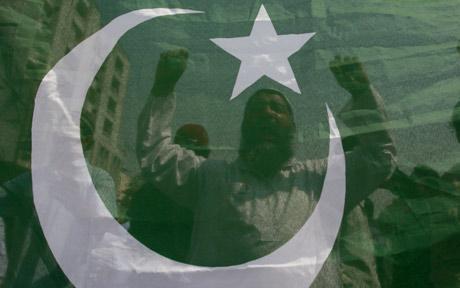
Pakistan announced Friday that it will monitor Yahoo, Google, MSN, Hotmail, YouTube, Amazon, and Bing, and will block links and content that it deems anti-Islamic.

“If any particular link with offensive content appears on these websites, the [link] shall be blocked immediately without disturbing the main website,” Pakistan Telecommunication Authority spokesman Khurram Mehran told the Associated Press.

In addition to the link-blockage of the seven named high-traffic sites, Pakistan web-watchers have also completely blocked 17 lesser sites, including, for example, Islam Exposed, which includes links to blaspheming articles such as “Muhammad, A Symbol Of Terrorism” along with over-the-top posts such as “Joe Lieberman Spews Excrement!”.

The monitoring and blockage comes in response to a court order, as did Pakistan’s recent ban on Facebook due to its hosting of an “Everybody Draw Mohammed Day” page — a page that was subsequently taken down, although Facebook officials claimed to have had no part in its removal.

The complete banning of Facebook was lifted after censorship official Najibullah Malik was satisfied that the site had lifted all all “sacrilegious material”.

In addition to the Facebook ban, Pakistan last month blocked, then unblocked YouTube for depictions of the prophet Muhammad, a practice that many Muslims find blasphemous.

“We decided that this kind of information was going to hurt people’s feelings. We have directed the [Pakistan Telecommunications Authority] to block all and any sites that display those caricatures,” Malik told The Guardian at the time of the YouTube ban.

The Guardian, reporting on internal controversy surrounding the YouTube ban, quoted one Pakistani tweeter as tweeting: “Way to go assholes. Why don’t you just cut us off from the internet and get it over and done with.”

Despite lifting the Facebook and YouTube bans, Pakistan hasn’t given up its censorship efforts. “At least 800 individual web pages and URLs have been blocked since the government’s orders to shut Facebook and YouTube,” Wahaj us Siraj, a spokesman for the Internet Service Providers Association of Pakistan (ISPAK), told AFP.

In perhaps the most bizarre development in the country’s campaign to remove blasphemy from its interwebs, Pakistan’s Deputy Attorney General recently launched a criminal investigation against Facebook founder and CEO Mark Zuckerberg for his role in the “Everybody Draw Mohammed Day” dust-up.

Although no charges have been filed in the case, the Pakistani newspaper The News International reports that the law that prompted the Zuckerberg investigation, Section 295-C of the penal code, carries with it penalties of “death, or imprisonment for life”.

Not all Pakistanis, of course, are in support of their government’s draconian crackdown on what Section 295-C refers to as “Use of derogatory remark etc, in respect of the Holy Prophet … either spoken or written, or by visible representation, or by any imputation, innuendo, or insinuation, directly or indirectly.”

“It’s absurd,” journalist and filmmaker Hasan Zaidi told The Guardian. “They haven’t thought this through. The logical conclusion is that we should shut our eyes, stick our fingers in our ears and ban the entire internet, even email.”

Nadeem Paracha of Pakistan’s Dawn news service wrote in his “Smokers’ Corner” column: “By continuing to tolerate a psychotic faith-based fringe for so long, we have actually helped it metamorphose into an unrestrained monster that has zero tolerance for what we think or do.” The problem, Paracha told The Guardian, is that “Anything to do with Allah, or the prophet, and everyone keeps quiet.”

And it must also be noted that the more extreme members of the Muslim world aren’t alone in taking angry offense at what they perceive as “blasphemy”. Remember, for example, the hue-and-cry that resulted from artist Chris Ofili’s elephant dung–encrusted The Holy Virgin Mary, or the attacks on the US National Endowment for the Arts over works such as Andres Serrano’s photograph, Piss Christ. But, to be fair, we must also note that neither Ofili nor Serrano were subject to a possible government-sanctioned death sentence.

–Editor’s note for Pakistanis for Peace- A true  democracy should  protect freedom of speech, no matter how hateful and unpleasant. Banning and censoring content on the interent is the action of communist states, dictatorships, monarchies or theocratic nations like Iran, not a democracy that Pakistan aims to be. There are certainly bigger problems in Pakistan than people visiting websites that are disparaging to Islam.  This is a clear indication of the power in the society still held by the mullahs~

At Talks, Pakistan, India Close the Gap

By Anita Joshua for The Hindu

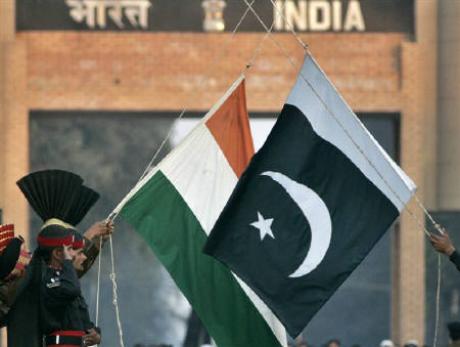
Conscious of the historical baggage, but unwilling to be burdened by it, India and Pakistan on Thursday inched closer to each other during the Foreign Secretary-level talks here and both sides held out the possibility of some tangible outcome after the July 15 ministerial engagement.

However, both Foreign Secretaries refused to be drawn into chalking out a road map or identifying goal posts. “There is a constituency for peace in both countries, and we should avoid stock phrases like road map,” Foreign Secretary Nirupama Rao said at a “joint press stakeout” here, shortly after spending a greater part of the morning with her Pakistan counterpart Salman Bashir.

The talks, according to Mr. Bashir, began as an exploratory venture, but “after this round, we are much more optimistic of good prospects at the Foreign Ministers meeting.” He summed up the talks as a “good essay in mutual comprehension,” a phrase he admitted to have borrowed from Ms. Rao.

Optimism apart, both conceded that this would be a protracted process that may not yield quick results, but decided to work on the doables in the interim. As to how they proposed to insulate the process from another freeze in relations in the eventuality of a flashpoint, Ms. Rao said this would also be a subject of discussion.

The first indication of some forward movement came with the announcement of the “joint press stakeout” soon after the talks had wound up, and the Foreign Secretaries were breaking bread in the Foreign Office.

In his opening remarks, Mr. Bashir said the two sides decided to work towards restoring confidence and building trust to make it possible for a comprehensive, sustained and substantial dialogue.

Speaking in a similar vein, Ms. Rao described the talks as forward-looking with both sides trying to understand each other’s position. “We reflected on the modalities for restoring trust and confidence to pave the way for a comprehensive, sustained and meaningful dialogue in all areas. We have agreed that dialogue is the best way forward.”

Asked whether terrorism was discussed, she said both sides agreed that terrorists must be denied the opportunity to derail the process of dialogue while pointing out that Pakistan Prime Minister Yusuf Raza Gilani had made an important commitment when he told his counterpart that efforts would be made to ensure that the Pakistani soil was not used for attacks on India.

Unlike in the past, when the two countries appeared to be speaking at cross purposes, this time the Foreign Secretaries seemed to complement each other.

If Ms. Rao deftly side-stepped a leading question on India’s reluctance to continue with composite dialogue by saying there was no issue over nomenclature, Mr. Bashir returned the favour by echoing this remark and refusing to be drawn into commenting on why Pakistan was not raising the issue of Indian-sponsored terrorism in Balochistan.

Instead, he broad-brushed the issue, stating that terrorism impacted Pakistan and was a concern to the region and the world. “Essentially, we have agreed to move from the rhetoric to the ways and means of addressing these concerns,” he said.

Aqsa Parvez: A Canadian Tragedy Lost in ‘Culture Talk’

By Uzma Shakir for Rabble Blogs

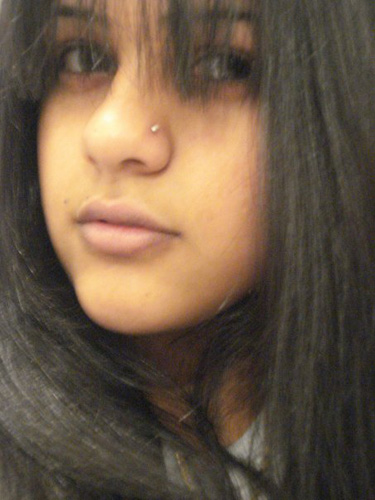
Aqsa Parvez is a “Canadian” tragedy — not an immigrant tragedy, or a Pakistani tragedy, or indeed a Muslim tragedy. In her formative years, Aqsa was raised in Canada; oppressed by her pathologically patriarchal father in Canada; failed by the family, the friends of the family, the education system, the student counseling services, the social service sector — in Canada. To make her tragedy a case of “these immigrant types with their medieval cultures” is to insult her memory and even worse learn nothing from it so that we can prevent it from happening again in the future — in Canada.

Like Aqsa and her father I was born and raised in Pakistan. Like Aqsa I grew up in a devout Muslim household. Unlike Aqsa’s father I came here as an immigrant while he came as a refugee. Like Aqsa and her father I was also raised with the notion of “honour.” In my upbringing there was honour in respecting your elders, there was honour in treating the women in the family with respect, there was honour in making sure that every child in the family had good education, there was honour in allowing your children (men or women) to make choices with regards to where they wanted to go for education or who they wanted to marry. My father and mother made decisions in the family by mutual dialogue and consent. As the only female child in the family and the youngest, my parents spent more money on my education than that of my brothers. And yes I had an arranged marriage — I arranged it myself, thank you. In fact, what was considered dishonourable in my family was to use physical force against women and children (my father used to say to my brothers “never raise your hand”), for adults to lie or cheat, to hurt someone and than justify it, and a particularly heinous act was to take a life — since, according to my dad, only God had that power. In fact, everyone I know in Pakistan or in Canada who is of Pakistani origin have similar values and family trajectories. Of course, my reality is very much conditioned by my family class background, my urban location, my family’s personal history, my parents’ education levels, and the socio-political context in which we grew up. So the question arises: who is the norm here and who is the exception? Who gets to define “the” Pakistani culture?

Neither Aqsa’s father nor I represent “the” Pakistani culture. We both experience it differently given our different locations of class, place, gender, education, family history etc. Mohammad Parvez may have suffered the same so-called culture shock in Lahore or Karachi as he is supposed to do in Toronto and Canada. Both Aqsa’s father and I immigrated to Canada but even our personal histories here are almost polar opposites — just like they were in Pakistan. Once again this is conditioned by our class, place, education, gender but this time it is further compounded by level of accessibility to the mainstream society in terms of language, economic opportunity, social inclusion and ultimately level of perceived cultural threat.

While I am lauded and praised by the mainstream society in Canada because I am “familiar” (probably the inevitable intimacy of bourgeois affinity), Mohammed Parvez was left in his own alienated world as the undesirable “other” facing what must have appeared to him to be a hostile world. Often enough Canadian experience is not just one of sampling diversity of cultural values but rather of hostile mainstream values actively undermining your perceived values as a cultural inferior. In my case, I can deal with this cultural assault because I have a voice in the public sphere and also I feel in control of my life because I have access to adequate financial, social, political and familial capital, while his control only went so far as his immediate family — and he exercised it to its grave end. However, to consider him to be more “cultural” than me, simply because he seems to exemplify what appears to be a “gaping divide” between the so-called traditional values and Western values, is patently absurd. We were divided about our notions of culture long before we came here because there is no neat little box that contains Pakistani monolithic cultural values that either of us can claim to be “authentic.”

Had we met in Pakistan he would have found me too urban and not Pakistani enough and I would have written him off as a fossil of entrenched feudalism and not Pakistani enough. However, if we meet here, he will find me to be Canadian and himself to be a Pakistani — a distinction encouraged by the mainstream notions of “our” and “their” values. But actually we are both the same — Canadian and Pakistani at the same time. This process of ‘othering’, denial and identity distinctions have more to do with Canada and immigrant experience here than with what might be or not be Pakistani culture. Over the years our experience of culture has changed, as has the Canadian society. So to turn this into either a case of “in our culture girls must obey their fathers” as an assertion of a simplistic fact by the Pakistani Canadian community or “he can’t handle our freedoms” as portrayed by the mainstream media is the worst form of myopia and chauvinism.

 These factors are critically important to understand because neither Aqsa’s father nor I represent either Pakistani or indeed immigrant “culture” but rather are a reflection of how our individual histories and personal interactions with the Canadian society shape our actions and responses — including our understanding of “culture.” However, ultimately Aqsa’s tragedy is about her father as an individual with his own pathological and uncontrolled desire for power and his own twisted notions of justifying his pathology through trumped up notions of “honour” and “shame.” To my mind the real dishonour and shame is to treat women and children as your personal property and not as equal members of society. The real dishonour and shame is to live in patriarchal societies where men exercise disproportionate power over women both personally and structurally — be it Pakistan or Canada. The real dishonour and shame is to brush off our collective responsibility and our institutional failures and treat a Canadian child’s tragedy as “their” problem or even worse our problem for allowing them to come here in the first place.

— Uzma Shakir is a community-based researcher, advocate, activist. She is the past Executive Director of Council of Agencies Serving South Asians (CASSA) and the South Asian Legal Clinic of Ontario (SALCO). She has worked as a teacher, journalist and researcher. She blogs at www.rabble.ca

Why Pakistan’s Ahmadi Community is Officially Detested

By Mohammed Hanif  for BBC

By Mohammed Hanif for BBC

When a Pakistani Muslim applies for a passport or national ID card, they are asked to sign an oath that no Muslim anywhere in the world is asked to sign. The oath goes like this: “I consider Mirza Ghulam Ahmad an impostor prophet. And also consider his followers, whether belonging to the Lahori or Qadiani group, to be non-Muslims.”

Like millions of other Pakistanis, I have signed this oath several times without giving much thought to exactly what Mr Ahmad stands for, or what the technical difference between Lahoris or Qadianis is. I want my passport, and if I have to sign up to a fatwa to get it, so be it.

But like millions of people from my generation I also remember that when I was growing up, the minority Ahmadi sect were considered just another Muslim sect.

When a Pakistani Muslim applies for a passport or national ID card, they are asked to sign an oath that no Muslim anywhere in the world is asked to sign. The oath goes like this: “I consider Mirza Ghulam Ahmad an impostor prophet. And also consider his followers, whether belonging to the Lahori or Qadiani group, to be non-Muslims.

Like millions of other Pakistanis, I have signed this oath several times without giving much thought to exactly what Mr Ahmad stands for, or what the technical difference between Lahoris or Qadianis is. I want my passport, and if I have to sign up to a fatwa to get it, so be it.  But like millions of people from my generation I also remember that when I was growing up, the minority Ahmadi sect were considered just another Muslim sect.

Like scores of others I had friends who were Ahmadis. We played cricket together, and sometimes, when our parents ordered us off to the mosque, we even prayed side by side.

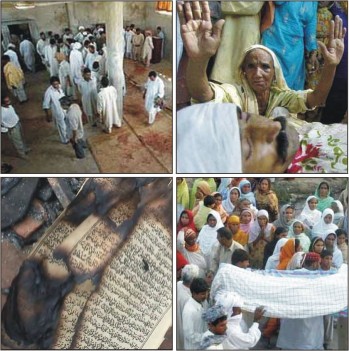
Last month, when more than 90 Ahmadis were massacred in two mosques in Lahore, I remembered the precise moment in 1974 when it all began to change.  There were street protests by religious parties against Ahmadis demanding that they should be declared non-Muslims.

One day I saw some bearded activists standing outside a clothes merchant’s shop in our town, chanting anti-Ahmadi slogans and turning customers away, telling them that buying clothes from Ahmadis was haram – forbidden. At the time I was learning to memorise the Koran from a very kind, mild-mannered teacher. I asked him what exactly was wrong with the Ahmadis.  He explained to me that they didn’t believe that the Prophet Muhammad was the last and the final messenger.

I said OK, maybe that makes them kafirs, infidels, but who says that kafirs can’t sell cloth?  My teacher’s response was a full-handed slap, so sudden, so unexpected that it rang in my ears for days to come. That same year Pakistan’s first elected parliament declared Ahmadis non-Muslims.  Then in 1984 Pakistan’s military dictator and self-appointed guardian of the faith General Zia-ul-Haq inserted that oath in the constitution that we are all required to sign.  Because of the new laws, Ahmadis have been sent to prison simply for using the Muslim greeting Assalamu alaikum, or putting a Koranic verse in a greeting card.

Over the last three decades the hatred against Ahmadis has become so widespread that Pakistan is now embarrassed by the only Nobel laureate it has ever produced.

Dr Abdus Salam Khan won the Nobel Prize for physics and, as a proud Pakistani, accepted his award in national dress.  But he was an Ahmadi so there is no monument to celebrate him, no universities named after him.

The word “Muslim” on his gravestone has been erased. Even the town he is buried in has been renamed in an attempt to erase our collective memory. This hatred was evident in the reactions to the massacre. TV channels were more obsessed with making sure that in their broadcasts Ahmadi mosques were called “places of worship”.

When you refuse to call a place of worship by its proper name, you are implying that it’s not a mosque, it’s not a church, it’s not a synagogue, it’s a place where godless people do godless things. And all the various Islamic political parties, whose leaders often refuse to pray together, are united on this.

When Pakistan’s main opposition leader Nawaz Sharif used the phrase “our brothers” for the murdered Ahmadis, leaders from 11 political parties came together to condemn him and threatened to issue a fatwa declaring him a heretic.  Over the last three decades the siege has been so palpable that those Ahmadis who couldn’t afford to emigrate have taken to hiding their identity.

If you want to destroy someone in public life it’s enough to drop a hint that they are Ahmadi. In the 1980s, the former chief minister of Punjab and current federal minister didn’t attend his own mother’s funeral because there were rumors that she was an Ahmadi.  When the funerals of the massacred Ahmadis took place there were no officials, no politicians present 

Pakistan’s liberal bloggers and some English-language columnists did write along the lines that Ahmadi blood is on our hands.  Others were adamant that it was yet another Friday, yet another massacre by the Pakistani Taliban, and we should just fight this sort of terrorism and leave the sectarian debates alone.

Two incidents in the past week made me realize how pathological our response was. At a vigil to mark the massacre, where a handful of people had turned up, a passer-by asked me “Are you an Ahmadi?” My own loud and aggressive denial surprised me.

Then an Ahmadi friend whose father survived the Lahore massacre wrote to me saying: “You know we have been living like this for decades. Did something like this have to happen for you to speak up?”

–Editor’s Note- It is high time that this law be repealed and the Ahmadi community of Pakistan be given all the basic human rights and privileges enjoyed by all Pakistanis.

Facebook in Pakistan: Islamists vs. Liberals

By Adam B Ellick and Ahmad Ziadi for The New York Times

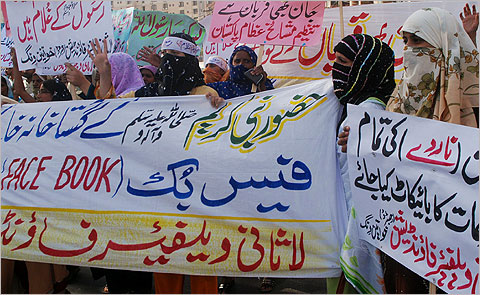
When Facebook was recently banned in Pakistan for hosting a “Draw Muhammad Day” fan page, one thing became very clear: Islamists here operate with organized precision, able to mobilize the masses in an instant, while the liberal voice remains paralyzed by fear and passivity.

Some media experts predicted that the ban – which a Pakistani court has now ordered the government to lift – might motivate the nation’s deeply disconnected liberal elite to take on the Islamists. After all, while members of the urban elite have been largely immune to the recent rise of violent militant attacks, the Facebook ban presented them with a personal vendetta.

In a nation without bars, and where entertainment options such as music concerts are rare, Facebook serves as a precious tool for the elite to organize discreet private events with music, drugs and alcohol. It has also helped mobilize social movements, including the lawyers’ march in 2009.

But the fervor that has followed the Facebook ban has been entirely one-sided in favor of the Islamists.

As the rest of Muslim world remains largely indifferent, tens of thousands of anti-Facebook Pakistanis protested in urban centers by burning American flags. A poll conducted by an IT portal called ProPakistani showed 73 percent out of about 8,000 voters favor a permanent ban on Facebook.

How did it get to this? There has been a widespread SMS campaign perpetuating a false narrative that Pakistan’s ban has brought a behemoth anti-Muslim company to its knees. One SMS attributes the recent fall in the Euro to the ban. Here’s another SMS I received:

THE BOYCOTT MADE BY MUSLIMS AGAINST FACEBOOK SINCE LAST 2 DAYS

CHARGE DEM A LOSS OF 2 BILLION EUROS..AND IF ITS CONTINUED AFTER 7 DAYS IT WOULD

REACH AROUND 40 BILLION EURO…. PLZ SPREAD AS MUCH AS U CAN.

Facts suggest otherwise. Facebook is not a publicly traded company, therefore, its earnings are not published. Still, some venture capitalists have valued Facebook at about $8 billion. Its annual revenue is estimated between $500 to $800 million.

In addition to the SMS campaign, this week, two new Muslim-friendly alternatives to Facebook have been launched. One of them, www.millatfacebook.com, was inaugurated by the bar association of the same Lahore court that banned Facebook. Millat means “Nation” in Urdu.

The site wooed more than 20,000 users with its slogan: “A site for Muslims by Muslims where sweet people of other religions are also welcome!!” Members are asked to specify if they drink alcohol. The founders are enraged at Facebook for curtailing Nazi-related hate speech while refusing to curb the Muhammad cartoons.

Their website says “Let’s prove to the world that if we can generate revenue for Facebook.com then we can also run our own website. Prove to the world that we are independent Muslims…” The other alternative site, www.Buddyflick.com , aims to “create/build/run our own network.” But where are Pakistan’s liberal and moderate voices?

Speaking out against the ban can be as hazardous as the forbidden cartoons. When those against the ban held a small news conference, the press mostly ignored it. After the press conference, several anti-ban activists were aggressively confronted by a large crowd of opposing activists as they left the venue. As tensions escalated, the anti-ban activists retreated into the building and waited for the crowd to dissipate.

One friend who is especially furious about the ban wouldn’t dare to speak out. “Nobody has the guts to go out and do something about it. The issue of Muhammad is so sensitive that you just never know.”

Instead, liberals are hashing out their frustrations in the low-traffic comment sections of liberal blogs and leftist newspapers, and, ironically enough, on their actual Facebook pages. Some have hacked into the banned site from the confines of their gated homes. Among the comment section in one newspaper is the latest joke: What’s the difference between Facebook and Lashkar  e Taiba? Answer: Facebook is banned!

Amir Khan the Ambassador

By Lem Satterfield for Boxing Fanhouse

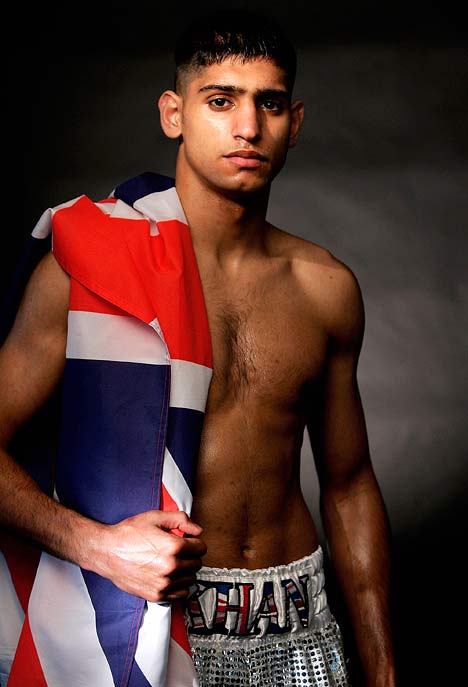
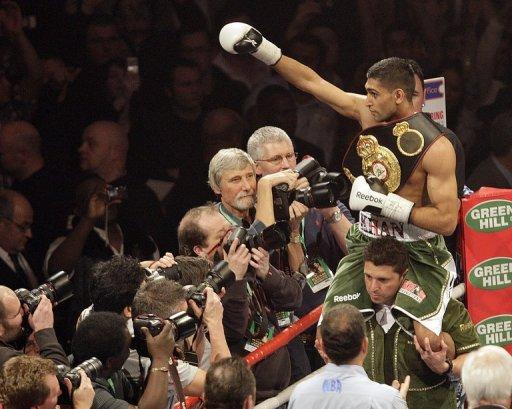
NEW YORK — WBA junior welterweight (140 pounds) champion Amir Khan had just scored Saturday night’s 11th-round knockout over Brooklyn’s Paulie Malignaggi in the biggest victory of his career.

In doing so, the 23-year-old, 2004 Olympic silver medalist not only out-boxed a pure boxer, but he mixed in an assortment of power shots — namely crisp, counter and over hand rights behind double- and triple-jabs — with a compliment of damaging left hooks and uppercuts.

When the fight was over, the English-born titlist had won the approval of the roaring crowd of more than 4,412 that filled Madison Square Garden’s 5,000 capacity WaMu Theater, and left the trash-talking Malignaggi beaten, battered and bloodied in his own hometown.

Khan had Malignaggi pinned on the ropes and was nailing him with several unanswered blows when referee Steve Smoger came to the rescue, calling a halt to the bout at 1:25 of the round.

“I was nervous, this being my first time in America. And I was walking into the theater, I could hear a lot of boos. But at the end of the fight, they started cheering for Amir Khan because I won them over with my style. I want to make all of my fights like this one,” said Khan, who rose to 23-1, with his 17th knockout and his fourth, consecutive victory.

“It’s my style. I’m explosive. I’m entertaining to watch. I’ve got speed, and I think I made a statement. I think that now there are a lot of American people who are interested in Amir Khan,” said Khan, who was coming off of a December’s first-round knockout of another Brooklyn resident, Dmitry Salita (30-1-1, 16 KOs).

“I’d love to fight some more over here. I want to save some big fights for the United Kingdom,” said Khan. “But I’ve had my American debut, and it’s the best feeling fighting in America. It’s a dream come true. I’d love to go to Las Vegas and have a big fight over there too.”

But as admirable as Khan’s in-the-ring efforts had been against Malignaggi, it is the maturity, poise and grace with which he handled the out-of-the ring distractions that may yet make Khan even more of a cross-cultural, crossover icon.

There was an irony surrounding Khan’s visa issues, which overlapped with the recent actions of alleged Times Square bombing attempt suspect Faisal Shahzad. Together, the two situations caused concern heading into Khan-Malignaggi.

Khan is a practicing Muslim who was born in England, but who is of Pakistani descent, while Shahzad is a native of Pakistan who became a U.S. citizen a year ago.

In early March, long before Shahzad’s actions on May 1, which resulted in a failed attack after he left an SUV rigged with a homemade bombing device in Times Square, Khan and his promoter, Golden Boy Promotions, became aware of the fighter’s issues concerning the obtaining of a work visa.

David Itskowitch, chief operating officer of Golden Boy Promotions, said that Khan entered America under the country’s visa waivers program “which, for all intents and purposes,” allows its holder, “a tourist visa, which is good for ‘X’-amount of days.”

“Khan’s status while he was here training was one of a tourist while not earning money,” said Itskowitch. “In order to change your status to someone who is working, you have to leave the country, get a visa, and, then, come back.”

Khan had been holding workouts at Wild Card Boxing Club, in Hollywood, Calif., owned by his trainer, Freddie Roach, a three-time Trainer Of The Year.

But Khan was forced to leave the United States, and has been preparing for his American debut against Malignaggi (27-4, five KOs), while training under Roach in Vancouver, Canada.

“I was in training camp. Then I had to go to Vancouver to get my visa. And my visa took a long time. We had to move the whole training camp there. My head was all over the place, so I had to stay mentally strong,” said Khan, who was not granted the work visa until nine days prior to the fight.

“When I finally got my visa, I had to go back to Los Angeles again, and the, fly to New York. So I was flying a lot. I was traveling all over country, and I got a visa for 23 days that it took me three weeks to get. That could have gotten to me, but I had to work very hard not to let it bother me,” said Khan.

“I have to thank Freddie for flying all over with me,” said Khan. “One thing about Freddie, he looks at his fighters like they’re his kids. He was standing beside me all of the way through, so I have to thank him for that.”

Although Khan laments the notion that suspicion may have been heightened due to the comparisons between himself and Shahzad, he also embraces the opportunity to perhaps be an ambassador.

Khan wants to use his boxing skills to influence American opinion.

“What I want to do in this game is that, you know, I know that a lot of the Pakistani people and the Muslims are getting a bad name in the United States with the bombings and the terrorism and stuff, but not all of us are like that. Look at Amir Khan. I’m an English boxer. I’m one of the faces of boxing,” said Khan.

“And I want to do the same thing that I’ve done in the United Kingdom. I want to put a new face into boxing. I want to bring the Muslim community into boxing. Whenever you’re at an Amir Khan fight, if you come to the United Kingdom and watch me fight, you look into the crowd, and you see all different colors,” said Khan.

“You see the Asian, Chinese, Pakistanis, Muslims — you see everyone. I want to do the same in the United States,” said Khan. “As more people get to know Amir Khan, you’ll see more of that. Hopefully the Americans will love my style and I can do the same here. I want to fill out the stadiums and the arenas like I do in the United Kingdom.”

Pakistani Makes History as Nation’s First Winter Olympian

By Manzer Munir

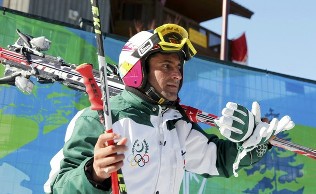
Vancouver, Canada- On Tuesday February 23, 2010, Pakistan will field its very first entry into its very first Winter Olympics. While the nation has won three gold, three silver and four bronze medals in its history at the Olympics since becoming a nation in 1947, this is the first time Pakistan will field an athlete for the Vancouver Olympics in Canada. The sole member of Pakistan’s Winter Olympics team is a 24 year old Pakistani skier by the name of Mohammad Abbas. He was the first Pakistani to qualify for a Winter Olympic event and will participate in the Alpine Skiing in the Giant Slalom category.

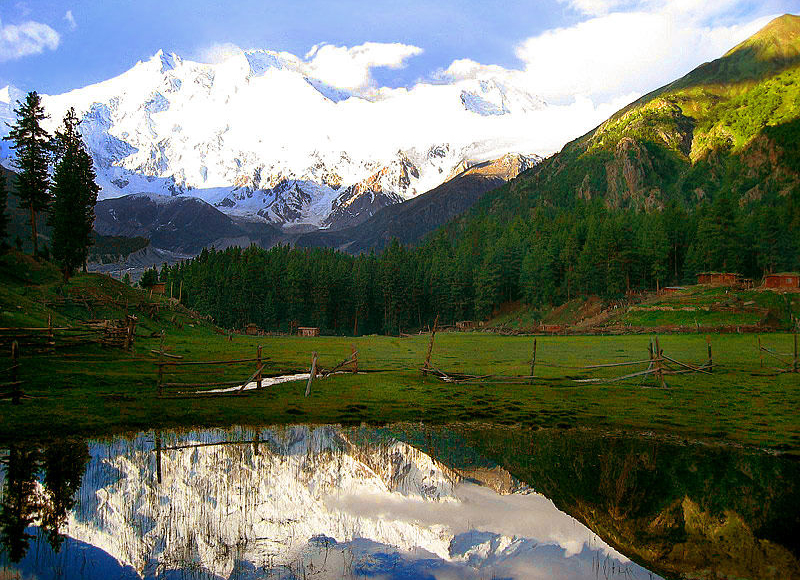
Mohammad Abbas hails from Pakistan’s northern Nalthar valley near Gilgit, Balistan and the now troubled beautiful Swat valley of Pakistan. For years very popular with the British and since with affluent Pakistanis, this picturesque and scenic area of Pakistan is nestled at the foothills of the Himalayas and receives a good amount of snow fall in the winter months. There are not many ski hills in hot weather Pakistan, but there is one in the Nalthar valley where Abbas grew up as one of the local boys. He grew up in a small village near the ski slopes.

When the idea of creating a ski team first developed, all the candidates were local children. Unfortunately out of the original 9 hopefuls, only Abbas qualified for the Vancouver games. “I started skating in 1995 using homemade wooden skates, which is how all the children in our village used to learn. We didn’t have ski boots so we tied our feet to the skis with traditional woolen foot bindings. It was pretty precarious so we had to get our balance right,” he said.

For Abbas, it has been a long and at times arduous 15 year journey since 1995 when he first took interest in skiing at the age of 9 in his village near the ski slopes of Pakistan’s Nalthar valley watching Pakistani and foreign tourists skiing spurned young Abbas and many of his cousins to take up the sport. In a cricket mad country, not very many people pick up skiing. Very few people in Pakistan can afford ski equipment and also only a very small portion of the country gets snow, so it is a surprise that the nation is even fielding an athlete at the Winter Olympics.

Sitting in the Olympics athletes village in Vancouver, Abbas admits that he does not have the camaraderie or the support of Olympic teammates that most other nations participants share, and he was concerned that he may feel a bit lonely representing his country by himself at such a big stage. But the boy from Nalthar valley was greeted with great enthusiasm and support by the rather large Pakistani Canadian community of British Columbia. “The support from my fellow countrymen has really helped me deal with the lack of teammates,” said Abbas.

Abbas said that he “achieved his ambition through hard work” and hopes he has inspired other Pakistani athletes to take up the challenge and aim for future Winter Olympic games. He also realized that his chances of bringing home Pakistan’s first Winter Olympic gold are very small but he said he wants to finish the race in an “honorable manner and make his country proud.”

Although not expected to medal, he is considered the fastest of the first time entrants to compete in the Giant Slalom that is scheduled to take place at Tuesday. It is perhaps an accomplishment to have finally fielded a Winter Olympics team, but for Pakistan it is also a moral victory to have a young man represent the country from the same troubled yet beautiful valley that has been now for months fighting for its life from Taliban insurgents. He represents not just Pakistan’s Olympic hopes, but the spirit of the people of the area to make the best of their situation and rise above the adversity of their daily struggles in a very beautiful part of the world that has also long been known as the “Switzerland of Pakistan.”

Gandhi and King- Two Martyrs Who Will Never Die

By Manzer Munir

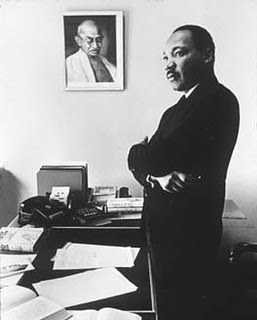
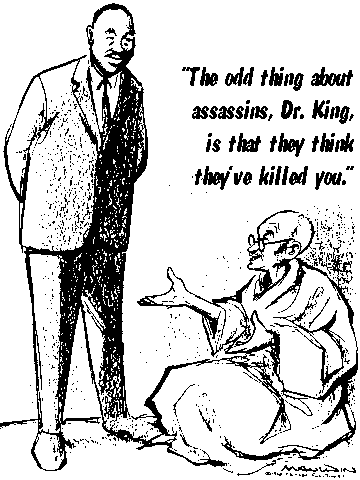
Martin Luther King Jr, who would have been 81 years old January 15, was a great believer of Mohandas K Gandhi, the leader of India’s independence movement from Brittan. King saw that Gandhi’s peaceful civil disobedience and non-violent methods of protest were very effective in bringing down the British Empire in India and as a result Pakistan after some 300 years of direct and indirect rule. Gandhi had believed that people could resist immoral government action by simply refusing to cooperate. Gandhi adopted many peaceful resistance techniques in developing his concept of Satyagraha, which was a philosophy and practice of passive nonviolent resistance.

Gandhi had earlier used this resistance technique in his struggles for freedom and equality for blacks and Indians in South Africa where both minorities were subjected to second and third class citizenry. His methods and refusal to bow down to the injustices that Indians faced in colonial South Africa inspired Nelson Mandela several years later to start his own peaceful struggle that eventually led to the end of Apartheid in South Africa in 1990.

While at Morehouse College, King learned about Gandhi and became very excited about his ideas. He wanted to further educate himself and read many books on Gandhi and his life and beliefs. In his book, Stride Toward Freedom, King states that “Gandhi was probably the first person in history to lift the love ethic of Jesus above mere interaction between individuals to a powerful and effective social force on a large scale. He further writes in his book that “It was in this Gandhian emphasis on love and nonviolence that I discovered the method for social reform that I had been seeking. I came to feel that this was the only morally and practically sound method open to oppressed people in their struggle for freedom.”

King felt that he had finally found a way to where oppressed people could successfully unlock social protest through Jesus’ teachings of love. In fact Gandhi himself had said “What does Jesus mean to me? To me, he was one of the greatest teachers humanity has ever had.” He also once mentioned Jesus as the “most active resister known perhaps to history. His was non-violence par excellence” Therefore to the Christian minister living in the pre-civil rights era in the South in America, Gandhi appeared to King as a follower of Christ, someone who preached peace and love even at the expense of suffering. Martin Luther King once said of Gandhi “It is ironic yet inescapably true that the greatest Christian of the modern world was a man who never embraced Christianity.”

In 1959, King visited India and became fully convinced that Satyagraha could be effectively applied to the struggle by blacks in the United States for racial integration. He came back to the United States where he continued the struggle for freedom and equality for all Americans. Like Gandhi, King also talked about suffering as a path to self purification and spiritual growth. He not only experienced this suffering by being jailed, beaten and harassed by the authorities of the day, but he eventually ended up paying for this cause for freedom for all with his life.

 Mohandas K Gandhi and Martin Luther King Jr arguably were two of the greatest men of the last century.  Both men believed that “injustice anywhere was a threat to justice everywhere.” They both led their people and millions of others out of slavery and servitude against seemingly insurmountable odds to freedom and salvation. On what would have been his 81st birthday, let us recognize that despite an assassin’s bullet and in the greatest democracy in the history of the world, the spirit and dream of a King still live on.