Archive for the ‘ Taliban ’ Category

Republicans Sharply Criticize Pakistan in Debate

By Arshad Mohammed for Reuters

Pakistan took a lot of criticism in Saturday’s Republican presidential debate, with a leading candidate saying it was nearly a failed state and another suggesting the United States cut its foreign aid to zero.

But it is unclear whether any of their ideas is likely to be imposed on a country that has nuclear weapons and whose cooperation is seen as vital to stabilizing Afghanistan as the United States prepares to pull out from there by the end of 2014.

Former Massachusetts Governor Mitt Romney said Pakistan has multiple centers of power including the relatively weak civilian leadership, the military and the powerful intelligence agency know as the Inter-Services Intelligence Directorate.

“The right way to deal with Pakistan is to recognize that Pakistan is not a country, like other countries, with a strong political center that you can go to and say, ‘Gee, can we come here, will you take care of this problem?'” Romney said.

“This is instead a nation which is close to being a failed state. I hope it doesn’t reach that point, but it’s really a fragile nation,” he said.

Polls point to Romney as the Republican who would be the most likely among the party’s crop of candidates to defeat President Barack Obama, a Democrat, in the November 2012 U.S. presidential election. The Republicans begin choosing their nominee in state contests beginning in January.

Texas Governor Rick Perry suggested that every country, including Pakistan, should see its U.S. aid eliminated each year and then should convince the United States why it deserves any money at all.

“Then we’ll have a conversation in this country about whether or not a penny of our taxpayer dollars needs to go into those countries,” Perry said in response to a question about whether Islamabad was playing a double game with Washington.

“Pakistan is clearly sending us messages … that they don’t deserve our foreign aid … because they’re not being honest with us,” he added.

“American soldiers’ lives are being put at jeopardy because of that country … and it’s time for us as a country to say no to foreign aid to countries that don’t support the United States of America,” he said.

‘FRIEND OR FOE’

Businessman Herman Cain had difficulty offering a direct response when asked whether Pakistan was ultimately an ally or adversary. “There isn’t a clear answer as to whether or not Pakistan is a friend or foe,” Cain said.”

U.S. officials have long argued that the Taliban and other militants enjoy safe havens in Pakistan from which they attack U.S. soldiers in neighboring Afghanistan.

They privately argue Pakistan plays a double game, taking billions of dollars in U.S. aid while elements of its government tolerate militant groups such as the Haqqani network blamed for a September attack on the U.S. embassy in Kabul.

Pakistan says it has made more sacrifices than any other country in the war against militancy, losing about 10,000 members of its military and security forces.

There have been growing questions in Washington about whether U.S. troops should to go after Taliban safe havens in Pakistan, an idea sure to be deeply unpopular in a population already embittered by U.S. drone strikes.

Some Republican candidates argued that the United States has little choice but to nurture relations with Pakistan, citing the fact that it has nuclear arms and that it has to be part of the solution in Afghanistan.

“Pakistan must be a friend of the United States for the reason that Michele (Bachmann) outlined. Pakistan is a nuclear power,” said former Pennsylvania Senator Rick Santorum, referring to fellow Republican candidate Bachmann.

“It’s important for us, with a nuclear power with a very vast number of people in Pakistan who are radicalizing, that we keep a solid and stable relationship and work through our difficulties,” he added.

Satirical Song, a YouTube Hit, Challenges Extremism in Pakistan

By Salman Masood for The New York Times


A satirical song that takes a tongue-in-cheek swipe at religious extremism, militancy and contradictions in Pakistani society has become an instant hit here, drawing widespread attention as a rare voice of the country’s embattled liberals.

The song, “Aalu Anday,” which means “Potatoes and Eggs,” comes from a group of three young men who call themselves Beygairat Brigade, or A Brigade Without Honor, openly mocking the military, religious conservatives, nationalist politicians and conspiracy theorists.

Their YouTube video has been viewed more than 350,000 times since it was uploaded in mid-October. The song is getting glowing reviews in the news media here and is widely talked about — and shared — on social networking sites like Twitter and Facebook.

The name of the band is itself a satire of Pakistan’s nationalists and conservatives, who are often described in the local news media as the Ghairat Brigade, or Honor Brigade.

Local musicians have produced work in the past vilifying the West, especially the United States, but rarely do they ridicule the military or religious extremists, and none have had Beygairat Brigade’s kind of success.

Sung in Punjabi, the language of the most populous and prosperous province, the song delivers biting commentary on the current socio-political milieu of the country, in which religious radicalism and militancy have steadily risen over the years and tolerance for religious minorities is waning.

Just this year, a governor who opposed Pakistan’s contentious blasphemy law was killed by one of his guards. The assassin was then celebrated by many in the country, including lawyers who greeted him with rose petals and garlands.

The song rues the fact that killers and religious extremists are hailed as heroes in Pakistan, while someone like Abdus Salam, the nation’s only Nobel Prize-winning scientist, is often ignored because he belonged to the minority Ahmadi sect.

“Qadri is treated like a royal,” wonders the goofy-looking lead vocalist in the song, referring to Malik Mumtaz Qadri, the elite police guard who killed the governor of Punjab, Salman Taseer, in January after he challenged the blasphemy law.

Another line in the song, “where Ajmal Kasab is a hero,” makes a reference to the only surviving Pakistani gunman involved in the 2008 terrorist attacks in Mumbai, India. Still another line, “cleric tried to escape in a veil,” alludes to the head cleric of Islamabad’s Red Mosque — which was the target of a siege in 2007 by the Pakistani government against Islamic militants — who tried unsuccessfully to break the security cordon by wearing a veil.

The song even makes fun of the powerful army chief, Gen. Ashfaq Parvez Kayani, for extending his role for another three years.

Potatoes and eggs “never tasted so good,” wrote Fahd Husain in a commentary on Tuesday in The Daily Times, a newspaper based in Lahore. “They will always be credited for being politically incorrect when most needed, and giving voice to all those Pakistanis who live in fear.”

The popularity of the song on the Internet has made it a sensation across the border in India as well, surprising the band members, who have been incessantly asked whether they feel they have put their lives in danger by ridiculing the mighty.

There are certainly enough provocations to rile nationalists and conservatives. At one point in the music video, the lead singer holds a placard that reads, in English: “This video is sponsored by Zionists.”

The band members chose to upload the song on YouTube instead of handing it to television networks because they said the work was too offbeat and might be censored. Not surprisingly, some have criticized the song and its taunts as pedestrian and in bad taste.

“We were not expecting such a huge response,” said Ali Aftab Saeed, 27, the lead vocalist, who lives in Lahore, a city that is often considered the country’s cultural capital.

He said the assassination of Mr. Taseer was the inspiration for the song and its lyrics.

Resistance poetry and literature are not new to Pakistan, and they raised spirits during the somber years of military dictatorships.

During the protest rallies of the seminal lawyers movement in 2007, when they led the campaign to oust the president, Pervez Musharraf, the lawyers would sing and dance to a poem written by Faiz Ahmad Faiz, considered a giant of Urdu literature. Habib Jalib, another famous Pakistani poet, wrote several poems against Gen. Mohammad Zia ul-Haq, the military dictator in the 1980s.

But “Jalib is irrelevant to the generation of urban, young, middle-class kids that Beygairat Brigade is addressing,” said Nadeem Farooq Paracha, a culture critic based in Karachi.

“This band is offering an alternative narrative to the one this generation has grown up on, and provides a counternarrative to establishmentarian and conservative notions of politics, history and society advocated by televangelists, conspiracy theorists and, of course, the right-wing electronic media,” Mr. Paracha added. “And what better and more effective way to do this than by using satire and pop music.”

The band members, on the other hand, have no pretensions of being revolutionaries, activists or intellectuals, though they do feel that the song represents those who do not believe in extremism and want to live peacefully.

“At the end of the day,” said Mr. Saeed, the lead vocalist, “we are just musicians who raised some questions.”

Pakistan, India take Another Cautious Step Forward

By Alex Rodriguez and Mark Magnier for The Los Angeles Times


In cautious increments, nuclear archrivals Pakistan and Indiahave been easing the pall of tension that has overshadowed the two nations in recent years, as Islamabad increasingly worries about another neighbor: volatile Afghanistan.

The latest move toward rapprochement came last week, when the Pakistani Cabinet announced it would normalize trade relations with India by granting its longtime foe “most favored nation” status.

The designation has practical ramifications, including the elimination of discriminatory pricing and mutual imposition of lower tariffs and high import quotas. More important, however, it marks the latest in a series of decisions and events that signals a warming in relations between two countries that have fought three wars since their independence after the 1947 partition of British India.

Driving the move toward improved relations with India is Pakistan’s belief that strained ties with traditional allies such as the U.S. and Afghanistan are leaving it increasingly isolated, analysts say. India and Afghanistan signed a strategic partnership pact last month that included the training of Afghan troops by Indian forces — a move that rankled Islamabad.

The steps between the two South Asian neighbors have been small yet striking.

After an Indian military helicopter flying in bad weather strayed into Pakistani-controlled territory Oct. 23, Pakistani troops promptly released the aircraft and its crew and returned them to India, averting a crisis. Earlier this year, the two countries also resumed peace talks scuttled by the 2008 attacks in Mumbai that killed 166 people. Pakistani militants carried out the attacks, and India has accused Pakistan’s ISI spy agency of involvement in the assault.

Both countries are also discussing a deal that would allow Pakistan to import electricity from India to relieve massive power shortages crippling the Muslim nation’s economy. In addition, India didn’t oppose Pakistan’s nonpermanent seat on the United Nations Security Council last month, which passed by a single vote. And, earlier this year, New Delhi didn’t fight a European Union bid to allow duty-free imports of Pakistani textiles, even though it would cost competing Indian textile makers an estimated $1 billion a year in lost sales.

Experts warn that major roadblocks still loom. At the top of that list is the divided Himalayan region of Kashmir, claimed by both countries and the cause of two wars since 1947. A dispute over water rights remains unresolved, and New Delhi continues to accuse the ISI of backing militant groups that target India.

Still, bolstering trade relations between the two countries, said Zafar Hilaly, a former Pakistani ambassador to the U.S., “is a good first step. It shows a genuine feeling within Pakistan that the relationship should be normalized.”

Particularly significant is the Pakistani military’s decision to endorse granting MFN status to India. Foreign policy remains the purview of Pakistan’s security establishment, especially when it comes to the country historically regarded by the military as its chief enemy.

“All the stakeholders, including the military … are on board,” Pakistani Information Minister Firdous Ashiq Awan said in announcing the decision. “Such a big step could not be taken alone.”

The military’s backing of MFN status for India, Hilaly said, likely represents a realization that an easing of tensions with New Delhi may now be in Pakistan’s best interests, particularly at a time when relations with Washington and Kabul have soured. Both the U.S. and Afghanistan assert that their efforts to battle Afghan Taliban insurgents have been hampered by Pakistan’s backing of the insurgency there, a charge that Islamabad denies.

“What has happened is that, with respect to issues that the military faces, the priorities have changed,” Hilaly said. “India is still the main culprit as far as security is concerned, but the eastern front is much less active than the one developing in Afghanistan.”

Officials in Washington have been encouraged by the movement toward trade normalization between Islamabad and New Delhi, especially because economic interdependence is seen as an ideal path toward stability in South Asia. Testifying before the House Foreign Affairs Committee last month, Secretary of State Hillary Rodham Clinton called the Pakistan-India relationship “the real game-changer in the region.”

“We have in Pakistan today a leadership, both civilian and military, that wants to see progress with India, and we have the same on the Indian side,” Clinton told lawmakers. “I firmly believe greater regional economic integration would revolutionize the economy in Pakistan.”

Though India extended MFN status to Pakistan in 1996, Pakistan had not reciprocated until now. Observers in India wondered why it took Islamabad so long to see the value in the move. “Not allowing MFN status hurt Pakistan more than India and was shortsighted,” said Satish Chandra, an analyst and former Indian ambassador to Pakistan. “It was an exercise in cutting your nose to spite your face.”

With trade normalization, experts estimate two-way trade could triple to $8 billion within five years. Official trade flows currently run nearly 7 to 1 in New Delhi’s favor, with Indian exports to Pakistan totaling about $2.33 billion versus $332 million in the other direction.

“When trade picks up, there’s more and more confidence to ease political and other differences,” said Shaqeel Qalander, a furniture maker and former president of a business group on the Indian-held portion of Kashmir. “It’s a very good decision.”

Our Man in Pakistan?

By Ed Husain for The Council on Foreign Relations

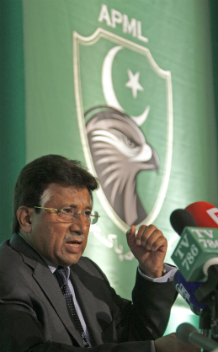
His close proximity to former U.S. president George W. Bush earned him the popular moniker, “Busharraf.” So it was with some intrigue that I went to hear Pakistan’s former president, Pervez Musharraf, address a prestigious and influential U.S. audience at a packed meeting at the Council on Foreign Relations’ headquarters in New York this week.

I was struck by what was, essentially, his appeal for U.S. political sponsorship of his bid to contest elections in Pakistan next year. He spoke eloquently about the poor state of U.S.-Pakistan relations, the need for a peace settlement with elements of the Taliban, and his country’s—and his own—unhelpful Machiavellian attitude toward India and Afghanistan. Nevertheless, the following facts left me worried:
First, for a man who prosecuted the war on terror with such vigor, it was unforgivable for him to say to an Indian journalist who asked about Pakistan’s export of terrorism, ‘Sir, your terrorist is someone else’s freedom fighter.” This moral equivocation is the same justification used by terrorists to inflict harm on innocent lives around the world. Musharraf should know better.

Second, a major cause for widespread, ongoing anti-American radicalization in Pakistan is the CIA-led drone attacks in the country’s tribal regions. Musharraf did not make any references to the drones, their many innocent victims, and the perceived violation of Pakistani sovereignty. It would have been wiser to reassure the audience that a Pakistan under his control would be a nation in which the United States would not need to use drones because terrorists would be brought to justice. Ignoring the issue of drones is self-defeating all around.

Third, his confidence that Pakistan’s nuclear weapons arsenal is safe is questionable. The premise of his assurance was that extremists seeking access to these weapons would need to fight elite battalions of the Pakistani armed forces. The assumption there, of course, is that the Pakistani army is immune from extremism. Sadly, that thinking is flawed. Since General Zia’s time, and increasingly so in recent years, Islamist radicalization within Pakistan’s armed forces has been a cause for concern.

It wasn’t all bad. Fortunately, he spoke somewhat candidly about the economic and energy generation challenges faced by Pakistan. My colleague Isobel Coleman, who was also in attendance, has analyzed his remarks on her thoughtful blog, “Democracy in Development.”
With Imran Khan and Pervez Musharraf both gearing up for elections in Pakistan in 2013, the next two years will be eventful and heated in Pakistan’s fractious political landscape.

Pakistan: More To Offer Than Bombs And Beards

By Asim Haneef for Al Jazeera

If you did not know anything about Pakistan and happened to pick up a newspaper or turn on the evening news, you might be forgiven for assuming that it is possibly the most broken, troubled and violent country on the face of the earth – a basket case just moments from imploding.

In the all-important arena of international public perception, Pakistan has taken an unprecedented battering in recent years, accumulating more bad headlines than nearly any other country and making places like Afghanistan and Iraq look relatively stable by comparison.

The list of challenges it faces is seemingly unending: terrorism, corruption, drone attacks, natural disasters, poverty, a deficit in leadership, discrimination against minorities, mistreatment of women, attacks on freedom of speech, mass tax evasion, match fixing, the murder of judges, politicians, union organisers and journalists – and that is just the tip of the iceberg.

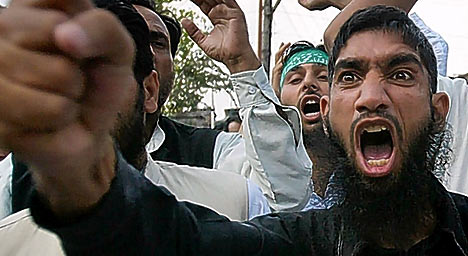
So pervasive are the headlines pointing to a crisis in Pakistan that after a while they seem to blur into one another. Whether it is “hostages held in Karachi”, “al-Qaeda hideout discovered in Swat”, “floods bring pain to millions”, “suicide bomber explodes in market square”, “senior judge in blasphemy case shot dead” or “Pakistan’s ISI actively supporting Taliban in Afghan war” the message is uniformly bad news. The result is that for many the image of Pakistan is one of bombers, beards, shaking fists, distressed women and utter hopelessness. It makes for a pretty depressing picture.

I guess that is why the work of Syed Ali Abbas and his Pakistan Youth Alliance (PYA) featured in this week’s Activate, Pakistan: The New Radicals, is so refreshing. A courageous young social activist, Ali founded the PYA together with Maryam Kanwer when he was just 21 years old. It was born in the midst of severe political turmoil, as then-President Pervez Musharraf imposed emergency rule and fired the chief justice on national television, while the security forces brutally cracked down on dissenting lawyers.

Fed up with watching their country’s problems on the television, the PYA initially organised protests and rallies but quickly became more active. Its core premise and mission statement is to take a stand, to get as practically involved on the ground as possible and to exemplify the change they seek through their actions rather than merely proposing it on paper.

Their main goal is to create political and social awareness among the youth of Pakistan and to unite them irrespective of their religion, ethnicity, caste, race or language on an unbiased platform through which they can engage with one another and contribute practically to building a more progressive society in Pakistan – whether through protest, social and relief work or the arts.

Earlier this year, Ali was among a small group instrumental in organising counter protests to the hate filled ones celebrating and glorifying Mumtaz Qadri, the killer of Salman Taseer, the governor of Punjab who was murdered in January over his stance on Pakistan’s blasphemy laws and his ardent defence of religious minorities like Christians and Ahmadis. Ali says he did this because: “This is not what the founder of Pakistan and ‘Father of the Nation’ Quaid-i-Azam Muhammad Ali Jinnah would have wanted for this country today, especially as he repeatedly stressed the importance of inter-faith unity and religious harmony.”

Stories like these and others bring about something much needed in international news these days – a positive, hopeful narrative against the odds, showcasing some of the good news stories coming out of places like Pakistan, which often go unreported and deserve a spotlight too. So although we appear to have an extraordinary capacity to become fixated on negative headlines, there are also good things happening too and though progress and development is not as ‘sexy’ as a suicide bomber or a train-wreck, perhaps a little balance is in order, so that we do not become as, Ali says at the close of the film, “filled with dread, being hopeless about the future”.

So do good stories actually emanate from Pakistan? And, if so, where are they? Well an initiative by brothers and social entrepreneurs Majid and Mahmood Mirza aims to answer this. They set up a website simply titled Good News (www.goodnews.pk) , which focuses solely on positive developments coming out of the country. They describe the idea behind the website via Skype as being “to highlight amazing, awesome and inspirational news stories coming from Pakistan, as opposed to the usual negativities that steal the headlines”.

And they have plenty of examples ready. For instance, did you know that Pakistan has become only the sixth country in the world to map the human genome, joining the ranks of the US, the UK, China, Japan and India, which have all successfully sequenced it. Or, how about the fact that Pakistan has the largest volunteer ambulance organisation in the world started by “living saint” Abdul Sattar Edhi in 1948. Today, the radio-linked network includes 600 ambulances that work in every corner of the country. Or how about the recent news that Dr Umar Saif, an associate professor at the School of Science and Engineering in Lahore, has been recognised by MIT Technology Review as one of the top 35 innovators in the world – joining an elite group of researchers and entrepreneurs selected over the last decade, which includes Larry Page and Sergey Brin, the co-founders of Google, Mark Zuckerberg, the founder of Facebook, and Jonathan Ive, the chief designer at Apple. Now who has heard of those stories?

Then there are serial entrepreneurs like Monis Rahman, who just four years ago set-up Rozee.pk, which is now Pakistan’s largest jobs website, with 500,000 unique visitors a month; or Karachi-born freelance designer Vakas Siddiqui laying to rest the myth that Pakistani students are limited to excellence in science and the humanities by being selected as one of the top 28 designers in the world; or filmmaker Sharmeen Obaid Chinoy who has just been shortlisted for an Oscar in the ‘best documentary short’ category for her film Saving Face. Whether it be in music, fashion, academia, activism, technology, sports or science these are stories that people do not usually associate with Pakistan and which might just show that there is more to the country than just bombs and beards.

Some of these unreported positive stories, along with the courage and creativity shown by people like Syed Ali Abbas and the Pakistan Youth Alliance in challenging these problems, reflect a surprising shift in the country’s growing and increasingly switched-on, globally-minded youth. They are using outlets like social media platforms and blogs to become more aware, educated and informed about their rights and more savvy to the different methods they must perfect in order to stop their country peddling even further backwards than it already has and to lead it to a brighter day, free from the same old headlines we’re all universally tired of reading and hearing about.

Asim Haneef worked extensively on Activate, a new eight part series featuring grass-roots activists from across the globe who are challenging the status quo and bringing about a change in their society. You can follow him on Twitter @asimhaneef

Imran Khan Laps Up Acclaim in Pakistan

Declan Walsh for The Guardian

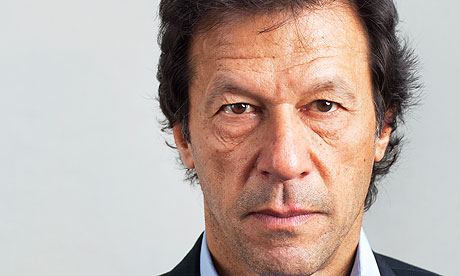
For a decade Imran Khan has occupied the hinterland, if not quite the wilderness, of Pakistani politics. The cricket legend has won just one seat in parliament – his own – and been scorned by critics as a celebrity windbag at best and a Taliban sympathiser at worst.

But this weekend Khan dramatically transformed his standing at a stroke, bursting onto the national stage with an impressive show of street power that jolted Pakistan’s largest parties and turned received wisdom on its head.

At least 100,000 people gathered to hear Khan issue a rousing call to political “revolution” spiced with strident denunciations of government corruption.

“Declare your assets or face the wrath of the people,” he shouted, drawing roars of approval, in the largest rally for decades in Lahore, Pakistan’s political heartland.

The crowd reflected the vein that Khan has tapped – young, urban and mostly educated Pakistanis who have grown disillusioned by the chaotic politicking and inept governance of the traditional political elite. “It’s an activation of the upper middle class – people who, over the years, haven’t had a voice in Pakistani politics,” said political analyst Mosharraf Zaidi.

In contrast Khan enjoys a reputation for being incorruptible and straight-talking, polished by a glint of fame. Also in Lahore was his ex-wife Jemima, who remains a supporter, and Jennifer Robinson, a London media lawyer whose clients include WikiLeaks founder Julian Assange. “Yes we Khan,” she tweeted afterwards.

The rally set the political scene abuzz with speculation; “Imran’s Lahore rally stuns opponents” read the headline in Dawn. But large questions loom about whether he can transform his acclaim into power.

Despite his claims of a “revolution” against President Asif Ali Zardari, Khan is more likely to hurt Nawaz Sharif, the opposition leader who considers Lahore his political base. Sunday’s rally crowned a wave of smaller yet well-attended rallies across the surrounding Punjab province over the past three months.

“It’s been slowly taking root. People are getting disillusioned, they saw Imran as more dynamic and focused,” said Najam Sethi, a veteran journalist and analyst.

National elections are not scheduled until 2013, although a midterm Senate election next March – which is likely to see the Pakistan People’s party led by Zardari seize control of the upper house of parliament – has caused the political temperature to soar.

Electoral success for Khan would likely fracture politics further – a prospect that would please Pakistan’s spymasters and generals, who have traditionally liked their civilian leaders both shaken and stirred. Khan has faced accusations that his new-found popularity is being quietly boosted by the military, and his Lahore speech was notable for his lack of criticism of the army. Khan denies any link. “I think Imran and the army will get along very well – if he ever comes to power,” said Sethi. He entered politics in 1996 as one of the most loved public figures in a cricket-crazy nation, and the founder of a cancer hospital that remains one of Pakistan’s most respected charities.

But his politics have been more controversial. He supported Pervez Musharraf’s coup in 1999, sided with Islamist mullahs and, in 2009, opposed an army operation against the Taliban in the Swat valley, arguing it was better to talk than fight. He boycotted the 2008 election, a move that relegated him to the chat show fringe of politics.

But in recent years he has steadily built his popularity among young Pakistanis, capitalising on disillusionment with political corruption and anger at US drone strikes in the tribal belt.

His Lahore rally echoed many of those themes. Pakistan wanted “independence, not slavery” in its relations with the US, he said, before announcing that he would be leaving for China hours later. “I am leaving at the invitation of the Chinese government. Friendship with them will be pursued to the fullest,” he said.

But critics said that while his speech was high on inflammatory rhetoric – including gratuitous attacks at some rivals and one diplomat – it was lacking in concrete prescriptions. “His next challenge is to show that he understands Pakistan’s problems – and can formulate policy to deal with them” said Zaidi.

Pakistan, Islam & Radicalism

By Syed Ali Abbas Zaidi for The Huffington Post

I was in Kasur, a small town near Lahore, Pakistan, where the celebrated mystic poet Bulleh Shah is buried. Thousands gathered for the 254th anniversary of his death. Slogans chanted on that occasion would be branded ‘blasphemous’ by extremist organisations in Pakistan.

Neither Hindu nor Muslim,
Sacrificing pride, let us sit together.
Neither Sunni nor Shia,
Let us walk the road of peace.

Bulleh Shah penned these verses challenging religious extremism and orthodoxy that plagued Muslim society hundreds of years ago. He was exiled from his home town and, history has it, he was denied a burial in Muslim cemetery. His advice has clearly gone unheeded as my country is still yet to find peace. Not even the founder of Pakistan, Muhammad Ali Jinnah has been spared being labelled ‘the great infidel’.

Incidentally, the same ilk of religio-political parties who now manipulate public discourse were at the forefront of using religious narrative for political point scoring before Pakistan came into being.

4 January 2011 is a day I cannot forget. Salmaan Taseer, the Governor of Pakistan’s biggest province Punjab, was gunned down by his bodyguard. He was killed for supporting a Christian woman accused of insulting the Prophet Muhammad. He was shot twenty six times.

For the entire week after the killing, I was scared. I don’t remember being in that state of mind since Benazir Bhutto was assassinated. It’s not a very heartening sight to see fellow ‘educated’ countrymen glorifying a murderer and justifying his actions based on ignorant rhetoric. Scores of fan pages popped up on Facebook, many of my friends changed their profile pictures to one of the killer, Mumtaz Qadri, exalting a murderer as hero.

Very few turned out to pay homage to the slain governor in days to come, as ‘liberals’ arranged vigils in his remembrance. Yet thousands poured on to the streets to defend Mumtaz Qadri, his assassin. The media, which has been a primary tool in fanning conspiracy theories in public, had again played a pivotal role in enticing ‘religious’ emotions on this issue.

The killer of Salman Taseer had confessed proudly. The brave judge who sentenced him to death has gone into hiding and will not be re-appearing anytime soon.

7 March 2011. The start of another week of gloom and, if I’m honest, I was ashamed to be a Pakistani. We had arranged a protest to condemn the killing of Shahbaz Bhatti, the Federal Minister for Minorities who was brutally assassinated on 2 March. He was an outspoken critic of Pakistan’s blasphemy laws and the only Christian in the cabinet. Only a few youngsters turned up.

When it comes to numbers, we can gather thousands but the ’cause’ has to be against India, Israel or America. Not many will show up if the demonstration is against radical organisations, or asking for introspection within.

Many who rallied for Gaza in early 2009 were not seen in protests condemning Taliban atrocities in Swat at the same time. Many who burnt down shops in anger at the Danish cartoons of the Prophet Muhammad never stood up for Parachinar, a small town near the border of Afghanistan where thousands have been killed in sectarian violence between Sunni’s and Shia’s.

9 October 2011. I was stuck on the Islamabad Highway, the main road that connects Islamabad with Rawalpindi as it was blocked by flash mobs protesting for the release of Mumtaz Qadri.

Two decades and 40,000 deaths later which includes top politicians, generals and clerics – not many things have changed when it comes to checking radicalism within Islam.

Many attacks on places of worship of minority sects within Islam, recurring violent brawls between followers of different schools of thought, reaction to the murder of Salman Taseer and Shahbaz Bhatti, recent acts of violence in Baluchistan and the tale of Parachinar are chapters in recent history which expose the extent of radicalisation in Pakistani society.

Soon, we as citizens of a country founded because a minority felt discriminated against and followers of the great religion of Islam, need to face up to the challenge of the radical minded and their extremist ideology.

This is a war of ideologies and is inevitably a war that must be fought with opinions and ideas; it must encourage discourse and exchange of reason. It is a war that must form the basic pillar of a new and improved national paradigm for Pakistan

We as a society cannot ignore an emerging threat from radicalism within our ranks, because if it gets too late, there might be no ‘music’ left to face.

Beyond Gaddafi, America Turns its Attention to Pakistan

By Peter Hoskin for The Spectator

It’s hard to recall a more grisly complement of newspaper covers than those this morning. Only the FT refrains from showing either Gaddafi’s stumbling last moments or his corpse, whereas the Sun runs with the headline, big and plain: “That’s for Lockerbie”.

The insides of the papers are more uncertain. There are doubts about the details, such as what has happened to Gaddafi’s infamous son Saif. And there are doubts about the general tide of events too. Several commentators, includingPeter Oborne, make the point that the passing of Gaddafi is only the first phase in Libya’s struggle towards democracy — and it is a struggle that might easily be forced off course by various factions, splinter groups and madmen. As the New York Times puts it, “The conflicting accounts about how [Gaddafi] was killed seemed to reflect an instability that could trouble Libya long after the euphoria fades…”

As significant as all this is, however, we should also alight on the news from another area of instability: Afghanistan and Pakistan. Hillary Clinton visited Kabul yesterday, where she not only heard about the Gaddafi’s death in photo montage-friendly fashion, but took some very clear swipes at Pakistan for being the Taliban’s favourite holiday destination. Here are some extracts from the full transcript of her speech and Q&A here:

“We will be looking to the Pakistanis to take the lead, because the terrorists operating outside of Pakistan pose a threat to Pakistanis, as well as to Afghans and others. And we will have ideas to share with the Pakistanis. We will certainly listen carefully to the ideas that they have. But our message is very clear: We’re going to be fighting, we’re going to talking, and we’re going to be building. And they can either be helping or hindering, but we are not going to stop our efforts……So my message will be as it just was to you: We have to deal with the safe havens on both sides of the border. It is not enough to point fingers across the border; we must work together to end the safe havens. We must send a clear, unequivocal message to the government and the people of Pakistan that they must be part of the solution, and that means ridding their own country of terrorists who kill their own people and who cross the border to kill in Afghanistan.I think that how we increase that pressure, how we make that commitment, is the subject of the conversations that President Karzai and I have had, and that I will have in Pakistan. But we’re looking to the Pakistanis to lead on this, because there’s no place to go any longer. The terrorists are on both sides. They are killing both people. No one should be in any way mistaken about allowing this to continue without paying a very big price. So I will deliver the message on behalf of the mothers of Afghanistan andon behalf of my own country.”

Just words, perhaps. But these words are some of the firmest that Obama’s adminstration has directed towards Islamabad since the death of Osama Bin Laden. In a news interview last night (do watch it if you’ve got two minutes), Clinton suggested that “something has changed” in the relationship between the two countries, and that Pakistan needs to “make some some serious choices”. That change could well define much of what lies ahead for Afghanistan and the wider region.

Wake up Pakistan

By Najam Sethi for The Friday Times

US- PAK relations have broken down. The United States has “ suspended” military aid and all but closed the Kerry- Lugar- Berman tap of funds for the civilians. Proud Pakistanis have puffed up their chests and vowed to eat grass, if necessary, in order to defend their country’s “sovereignty”. What’s the big deal, they aver, US aid was peanuts anyway, and our traditional friends like China and Saudi Arabia can bail us out of our problems.

To be sure, our relationship with the US has been no small disaster.

In the 1950s, we begged the US to befriend us instead of India, cheerily going along with the US into the Cold War against the USSR when it wasn’t our war at all. In consequence, the military became the dominant theme of our life and wrecked the budding impulse of democracy. Once again, in the 1980s and 2000s, we tripped over ourselves to rent out our services to the US in Afghanistan.

Today we are reaping the terrorist whirlwind of our greed and opportunism.

But a little introspection is in order to prove that we don’t need the US as an enemy because we are our own worst enemies.

More Pakistanis are eating “ grass” now than ever before. The number of Pakistanis below the poverty line has increased from 27 per cent five years ago to 33 per cent in 2011. And this has nothing to do with the US. The growth rate of the economy has fallen from 6.5 per cent five years ago to 3 per cent now. The fiscal deficit is yawning at 7.5 per cent of the GDP today compared to 4.5 per cent five years ago. And this has nothing to do with the US. The Rupee has fallen from 77 to the dollar five years ago to 90 today. General inflation is running at 15% and food inflation at 25%. And this has nothing to do with the US. The tax to GDP ratio is down to 8.7% in 2011 from 11.5% five years ago. And this has nothing to do with the US. Floods continue to devastate the lives and produce of millions of poor people across the country.

And this has nothing to do with the US. Sunni extremists are rampaging, killing Shias. Ethnic parties continue to mow down people in Karachi. And this has nothing to do with the US. Power breakdowns have made the lives of tens of millions wretched and miserable while rendering millions of others jobless.

And this has nothing to do with the US. Instead of rooting for Pakistani nationalism, we are proud to undermine it as Muslims first, or Sindhis, Muhajirs, Baloch, Pakhtun, Punjabi, Seraiki, Hazarajat, Kashmiri, Sunni, Shia, Deobandi, Barelvi. And this has nothing to do with the US. We are counted amongst the most corrupt countries of the world. We have waged four wars with India and lost each of them, in the bargain losing half of Pakistan.

And this has nothing to do with the US. As if this litany of self- induced failures isn’t enough, there is the hypocrisy of double standards to contend with too. Of course, the US has violated our sovereignty by raining drones on FATA. But so have the Afghan Taliban and Al- Qaeda who have established safe havens there too. But we are quick to blast the US and quicker still to pretend that Al- Qaeda doesn’t exist and the Taliban are innocent refugees for whom our traditional hospitality is on offer.

The story doesn’t end here.

The IMF is not welcome. How dare it demand that we tax the rich, plug the bleeding in public sector corporations, stop the theft of power, and spend according to our means. US aid is dispensable.

We don’t need to build dams and reservoirs for managing our natural resources, we don’t need schools and teachers for our children and hospitals for the poor.

Our all- weather friends are China and Saudi Arabia. Never mind that China doesn’t help us much when we are ravaged by earthquakes and floods or when we are short of cash to pay our foreign bills.

NEVER MIND that Saudi Arabia treats our migrant workers like slaves, rents our military to crack down on Shia majorities in Bahrain and exports extremist “ Islam” to our lands.

At the end of the day, who eats grass when we rise to defend our sovereignty? Not our pot- bellied traders and businessmen. Not our golf- playing generals. Not our Defence Housing Society residents.

Not our foreign- asset holding politicians whose kids go to English- medium private schools at home and abroad. Not our self righteous media Mughals who berate our slavish black- skins and white masks. Not our corrupt judges and civil servants. It’s the wretched of the earth, the poorest of the poor, who eat grass.

For too long we have made foreign scapegoats for our own failures and corruptions. It is time to wake up and set our house in order without begging or berating the US.

Gunmen Attack Shiite Muslims in Pakistan, 12 Dead

As Reported By USA Today

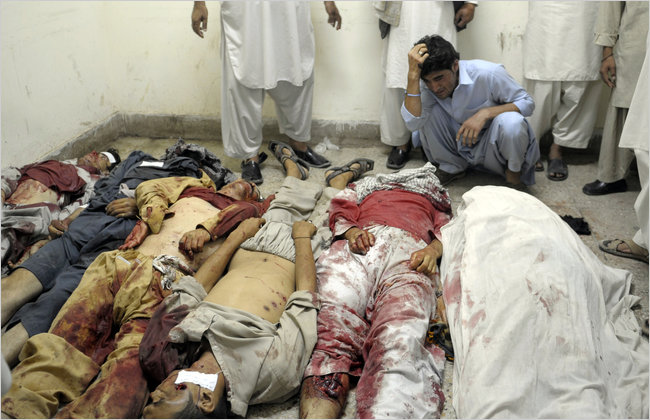
Suspected Sunni extremists opened fire on Shiite Muslims traveling through southwestern Pakistan on Tuesday, killing 12 people and wounding six others in the latest apparent sectarian attack to plague the country, police said.

Sunni militants with ideological and operational links to al-Qaida and the Taliban have carried out scores of bombings and shootings against minority Shiites in recent years, but the past couple weeks have been particularly bloody.

The gunmen who attacked Tuesday were riding on motorbikes and stopped a bus carrying mostly Shiite Muslims who were headed to work at a vegetable market on the outskirts of Quetta, the capital of Baluchistan province, said police official Hamid Shakeel.

The attackers forced the people off the bus, made them stand in a line and then opened fire, said Shakeel. The dead included 11 Shiites and one Sunni, he said. The wounded included four Shiites and two Sunnis.

Sunni extremists carried out a similar attack on Shiite pilgrims traveling through Baluchistan about two weeks ago, killing 26 people. Pakistan is a majority Sunni Muslim state, with around 15 percent Shiite.

Most Sunnis and Shiites live together peacefully in Pakistan, though tensions have existed for decades. In the 1980s and 1990s, Pakistan became the scene of a proxy war between mostly Shiite Iran and Sunni Saudi Arabia, with both sides funneling money to sectarian groups that regularly targeted each other.

The level of sectarian violence has declined somewhat since then, but attacks continue. In recent years, Sunni attacks on Shiites have been far more common.

The groups have been energized by al-Qaida and the Taliban, which are also Sunni and share the belief that Shiites are infidels and it is permissible to kill them. The Sunni-Shiite schism over the true heir to Islam’s Prophet Muhammad dates back to the seventh century.

Lashkar-e-Jhangvi, one of the country’s most ruthless Sunni militant groups, claimed responsibility for the attack in Baluchistan two weeks ago. One of its alleged leaders, Malik Ishaq, was released from prison on bail in July after being held for 14 years on charges, never proven, of killing Shiites.

Ishaq was re-arrested about a week ago after making inflammatory speeches against Shiites in the country. He was not charged but detained under a public order act, which means he can be held for three months.

It’s not clear if Ishaq’s speeches have been connected to the recent wave of sectarian attacks.

Analysis: Pakistan’s Double-Game: Treachery or Strategy?

By John Chalmers for Reuters

Washington has just about had it withPakistan.

“Turns out they are disloyal, deceptive and a danger to the United States,” fumed Republican Representative Ted Poe last week. “We pay them to hate us. Now we pay them to bomb us. Let’s not pay them at all.”

For many in America, Islamabad has been nothing short of perfidious since joining a strategic alliance with Washington 10 years ago: selectively cooperating in the war on extremist violence and taking billions of dollars in aid to do the job, while all the time sheltering and supporting Islamist militant groups that fight NATO troops in Afghanistan.

Pakistan has angrily denied the charges, but if its critics are right, what could the explanation be for such duplicity? What strategic agendas might be hidden behind this puzzling statecraft?

The answer is that Pakistan wants to guarantee for itself a stake in Afghanistan’s political future.

It knows that, as U.S. forces gradually withdraw from Afghanistan, ethnic groups will be competing for ascendancy there and other regional powers – from India to China and Iran – will be jostling for a foot in the door.

Islamabad’s support for the Taliban movement in the 1990s gives it an outsized influence among Afghanistan’s Pashtuns, who make up about 42 percent of the total population and who maintain close ties with their Pakistani fellow tribesmen.

In particular, Pakistan’s powerful military is determined there should be no vacuum in Afghanistan that could be filled by its arch-foe, India.

INDIA FOCUS

Pakistan has fought three wars with its neighbor since the bloody partition of the subcontinent that led to the creation of the country in 1947, and mutual suspicion still hobbles relations between the two nuclear-armed powers today.

“They still think India is their primary policy,” said Talat Masood, a retired Pakistani general and prominent political analyst. “India is always in the back of their minds.”

In an interview with Reuters on Tuesday, Pakistani Prime Minister Yusuf Raza Gilani – unprompted – complained that Washington’s failure to deal even-handedly with New Delhi and Islamabad was a source of regional instability.

Aqil Shah, a South Asia security expert at the Harvard Society of Fellows, said Islamabad’s worst-case scenario would be an Afghanistan controlled or dominated by groups with ties to India, such as the Tajik-dominated Northern Alliance, which it fears would pursue activities hostile to Pakistan.

“Ideally, the military would like Afghanistan to become a relatively stable satellite dominated by Islamist Pashtuns,” Shah wrote in a Foreign Affairs article this week.

Although Pakistan, an Islamic state, officially abandoned support for the predominantly Pashtun Taliban after the 9/11 attacks on the United States in 2001, elements of the military never made the doctrinal shift.

Few doubt that the shadowy intelligence directorate, the Inter-Services Intelligence (ISI), has maintained links to the Taliban that emerged from its support for the Afghan mujahideen during the 1979-1989 Soviet occupation of Afghanistan.

Until recently, there appeared to be a grudging acceptance from Washington that this was the inevitable status quo.

That was until it emerged in May that al Qaeda leader Osama bin Laden – who was killed in a U.S. Navy SEALs raid – had been hiding out in a Pakistani garrison town just two hours up the road from Islamabad, by some accounts for up to five years.

Relations between Pakistan and the United States have been stormy ever since, culminating in a tirade by the outgoing U.S. joint chiefs of staff, Mike Mullen, last week.

Mullen described the Haqqani network, the most feared faction among Taliban militants in Afghanistan, as a “veritable arm” of the ISI and accused Islamabad of providing support for the group’s September 13 attack on the U.S. embassy in Kabul.

The reaction in Islamabad has been one of stunned outrage.

Washington has not gone public with evidence to back its accusation, and Pakistani officials say that contacts with the Haqqani group do not amount to actual support.

However, Imran Khan, a Pakistani cricketer-turned-populist-politician, said this week that it was too much to expect that old friends could have become enemies overnight.

He told Reuters that, instead of demanding that Pakistan attack the Haqqanis in the mountainous border region of North Waziristan, the United States should use Islamabad’s leverage with the group to bring the Afghan Taliban into negotiations.

“Haqqani could be your ticket to getting them on the negotiating table, which at the moment they are refusing,” Khan said. “So I think that is a much saner policy than to ask Pakistan to try to take them on.”

REGIONAL GAME

The big risk for the United States in berating Islamabad is that it will exacerbate anti-American sentiment, which already runs deep in Pakistan, and perhaps embolden it further.

C. Raja Mohan, senior fellow at New Delhi’s Center for Policy Research, said Pakistan was probably gambling that the United States’ economic crisis and upcoming presidential elections would distract Washington.

“The real game is unfolding on the ground with the Americans. The Pakistan army is betting that the United States does not have too many choices and more broadly that the U.S. is on the decline, he said.

It is also becoming clear that as Pakistan’s relations with Washington deteriorate, it can fall back into the arms of its “all-weather friend,” China, the energy-hungry giant that is the biggest investor in Afghanistan’s nascent resources sector.

Pakistani officials heaped praise on Beijing this week as a Chinese minister visited Islamabad. Among them was army chief General Ashfaq Kayani, arguably the country’s most powerful man, who spoke of China’s “unwavering support.”

In addition, Pakistan has extended a cordial hand to Iran, which also shares a border with Afghanistan.

Teheran has been mostly opposed to the Taliban, which is dominated by Sunni Muslims while Iran is predominantly Shi’ite. But Iran’s anti-Americanism is more deep-seated.

“My reading is the Iranians want to see the Americans go,” said Raja Mohan, the Indian analyst. “They have a problem with the Taliban, but any American retreat will suit them. Iran in the short term is looking at the Americans being humiliated.”

ARMY CALLS THE SHOTS

The supremacy of the military in Pakistan means that Washington has little to gain little from wagging its finger about ties with the Taliban at the civilian government, which is regularly lashed for its incompetence and corruption.

“The state has become so soft and powerless it can’t make any difference,” said Masood, the Pakistani retired general. “Any change will have to come from the military.”

Daniel Markey, a senior fellow for South Asia at the U.S. Council on Foreign Relations, said the problem lies with a security establishment that continues to believe that arming and working – actively and passively – with militant groups serves its purposes.

“Until … soul-searching takes place within the Pakistani military and the ISI, you’re not likely to see an end to these U.S. demands, and a real shift in terms of the relationship,” Markey said in an online discussion this week. “This is the most significant shift that has to take place.”

Bacha Khan, Anti-Partition Hero Who Can Help Pakistan Today

By Mauro Vaiani for Pakistanis for Peace
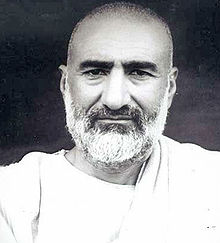
A person once stigmatized as an enemy of Pakistan, has something important to say in the contemporary public discourse in the second Islamic country in the world. His name is Abdul Ghaffar Khan (in the picture), a Pakhtun patriot, social reformer, charismatic leader. He was a lifelong activist in favour of his fellows Pathans living North and South the frontier Durand Line. He became a very close friend of the Mahatma and he himself was called the “Frontier Gandhi”.

Anti-Partition apostle of nonviolence
He was born on 1890 in Utmanzai, a town in Charsadda District, in the North-West Frontier Province, today Khyber Pakhtunkhwa Province in Pakistan. He was an apostle of nonviolence, that he considered a form of spiritual jihad for his time and for the future of his people. He founded a nonviolent movement which arrived to count 100,000 members. As he wrote in his 1969 autobiography, “My life and struggle”, “in 1929 we were able to found the kind of organisation we wanted. We decided to call it the Khudai Khidmatgar movement (Servants of God movement). Our motive for choosing that name was that we wanted to awaken in the Pathans the idea of service and the desire to serve their country and their people in the name of God, an idea and a desire which was sadly lacking among them”. The Khudai Khidmatgars were also known, for the color of their uniforms, “Red Shirts”. The founder was called by his followers, as a mark of esteem, Badshah Khan, also spelled Baacha Khan, or more commonly Bacha Khan, that means “king of our nobles”.

Baacha Khan fostered free education for all, women rights, religious freedom, judicial reform. He also was a pioneer of ecology and sustainable development. He believed in self-government for both the settled and the tribal Pakhtuns. He strongly opposed the Partition of India, proposing autonomous provinces in a unified Indian federal framework. When the Partition became inevitable, he renounce to oppose it with riots or violence. He and his Khidmatgars accepted, reluctantly, Pakistan as their new country and decided to be loyal. They hoped the new regime would have given the Pakhtuns a chance to live united in their territory, free to self-govern their own province. The autonomy of the federal units in Pakistan was instead nipped in the bud and their movement was declared illegal.
For the freedom fighter, a new cycle of imprisonment started. Baacha Khan spent one-third of his life in prison, but, more precisely, he spent more time, about 15 years, in Pakistani prisons than he had spent in the prisons of the British Raj, “only” 12.

He also went in exile in Afghanistan, where he supported local Pashtun cultural, social and economical development, fighting backwardness, clanism, family feuds. He gave in Afghanistan many speeches in favor of “Pakhtunistan”, which were free of every kind of chauvinism, fostering freedom and self-government of his people, within the Pakistani federation, firmly anchored to a commitment for peace in all South Asia, all over the world.
“I am looking forward to the time when free, general elections will be possible again in Pakistan. – he wrote in his 1969’s autobiography – For only then will the world know which way my people are going and whom do they follow. This is the main conflict between me and the rulers of Pakistan.”. This champion of Pakhtun patriotism remained unheeded. He won’t see general and local fair election either under the dictatorship of Ayub Khan, nor under Yahya Khan, nor under the civil but still authoritarian rule of Zulfiqar Ali Bhutto, nor under Zia Ul-Haq.
He couldn’t see the general elections of December 1988, when Benazir Bhutto, daughter of Zulfiqar Ali, became Prime Minister, for he died in Peshawar on January 20.

He had requested to be buried in Jalalabad, Afghanistan. He hoped this way to witness the need of friendship, and mutual understanding, among all Pakhtuns, between Afghanistan and Pakistan. His last wish succeeded in leaving a footprint in the heart of many throughout South Asia. As one can read in Rajmohan Gandhi’s biography of Bacha Khan (New Delhi, 2004) his funeral resulted a mammoth rally: “Though the Afghan struggle was not yet over, the Kabul government and the mujahedin both announced a ceasefire for the event. Tens of thousands of the Frontier’s mourning Pakhtuns accompanied the coffin and crossed the Durand Line. Pakistan’s military ruler, Zia-ul Haq (who would be killed in a plane crash later in the year), and India’s Prime Minister, Rajiv Gandhi (also destined for a violent death), were present for the last rites.” (see Gandhi R., Ghaffar Khan, 2004, p. 263).

Political heritage

After decades of oblivion, his political heritage are now again gaining momentum among Pakhtuns. An important political player in the re-established Pakistani democracy, the Awami National Party (ANP), wrote in its manifesto that it “draws its inspiration from the example and teachings of Khan Abdul Ghaffar Khan, affectionately known to his people as Baacha Khan. He spent his entire life in the struggle for freedom and justice. He and his Khudai Khidmatgars offered great sacrifices in the fight against colonialism, imperialism and all other forms of oppression. In a broader sense, Baacha Khan saw politics as the highest form of public service and often described himself as only a social worker. His objective was to liberate the masses of South Asia and, particularly, his own people, the Pakhtuns, from the shackles of ignorance and poverty, so that they could rise to their full potential.” (cf http://awaminationalparty.org/).
The ANP was led in the past by Bacha Khan’s son, Abdul Wali Khan, and today the most prominent figure is his grandson, Asfandyar Wali Khan. In the 2008 elections, the Awami National Party won the majority in Khyber Pakhtunkhwa and elected its first Chief Minister since the independence, in coalition with the Pakistan People’s Party. ANP is allied with PPP also in other provinces and at the federal level.
The parable of the Taliban regime and the political violence that still sets fire through the area, has been a terrifying experience for everybody but especially for Pakhtuns. Baacha Khan is being rediscovered, as a source of inspiration for a better future. He was a devout Muslim believer, but he refused terror and was also alien from any bigotry. His political action was centered on peace and social reformation. He sacrificed as a satyagrahi in nonviolent campaign of civil disobedience, firstly against the British Raj, but later also against Pakistan authoritarianism and military rule.
His spiritual heritage helped ANP to defeat the Muttahida Majlis-e-Amal, the Islamist coalition, which was in power in Pakhtunkhwa before 2008. It was a highly symbolic victory. In the name of Baacha Khan, the modern ANP defeated the Islamists, as well as the ancient Khudai Khidmatgars had always defeated the Muslim League in both the elections hold in the province, under the British rule, on 1936 and 1946. Many hope that this political change could represent the end of a cycle, dominated by a tangle of Islamist and nationalist ideologies, which have painfully marked the history of the Frontier, of all Pakistan, Afghanistan.

Several notable cultural foundations and charities are working in South Asia to promote peace and human rights through the rediscover of Badshah Khan’s life, thought and action. We must nominate the Baacha Khan Trust (see http://www.baachakhantrust.org/), whose chief aim is propagation of Ghaffar Khan’s philosophy, his vision of renaissance for the oppressed and marginalized Pakhtuns communities, and for peace in Pakistan, Afghanistan, the whole South Asia.
Nowadays efforts to make the public opinion and new generations aware of the figure and the teachings of Baacha Khan would certainly help the stabilization of the so called Afpak area. After 60 years of political authoritarianism and violence in Pakistan and 40 years of civil war in Afghanistan, it’s probably time to know something more about Bacha Khan.

Self-government

His Red Shirts were able to provide “local leadership for education and development, and stood up for the dignity and rights of their community. They balanced affirmations of the rights and dignity of all people with teachings about responsibility and sacrifices needed to serve those same communities.” – Ali Gohar, founder and guide at the Just Peace International center, in Peshawar, recently wrote, adding that the beauty of this kind of nonviolent struggle is again alive in 2011 Arab Spring heroes cf http://www.khyberwatch.com/index.php?mod=article&cat=MediaWatch&article=391).

“You all know that I believe in the principles of non•violence. – he said on August 31, 1966, talking in Afghanistan on the Pakhtunistan Day, as reported in his 1969’s autobiography – I am convinced that there will be no peace in the world till the problem of the Pakhtuns has been solved. I am telling both the Russians and the Americans the same thing: if they really want peace, they should solve the problem of the Pakhtuns. What do we want? We keep on telling Pakistan to consider us their brothers and not to make us their slaves. We were never the slaves of the British and you should not expect us to be your slaves.”. Heared today, these words are somehow prophetic and should encourage a serious reflection.

The Pathans, both in Afghanistan and in Pakistan, still need an accountable local self-government, in order to take on full responsibility of their own territories. They can hardly be governed from Kabul, or from Islamabad. May be they can resolve their own way their problems, included terror-related and security’s ones.

The recent Pakistani devolution can be seen as a historical accomplishment on the way indicated by Baacha Khan. This is what many political leaders, not only ANP’s ones, strongly believe. Federalism was part of the independence struggle and the only way to make the idea of Pakistan into a lasting reality.

Unfortunately, the centralized, bigoted and corrupt, republic chosen by Afghani Pashtun leadership, after the fall of the Taliban regime, is much farer from Baacha Khan’s ideal of decentralized responsible and accountable self-government. The present solution resembles too much like the 1973 republic. It may be not reveal the right solution for the future of such a vast, diverse, and bitterly divided, country.

Don’t let anybody deceive you in the name of Islam

Abdul Ghaffar Khan, along all his existence, advocated for reforms, social justice, change through education, and, last but not least, peaceful coexistence of all communities, without any kind of ethnic, religious, caste, clan, social discrimination.
He strongly demanded his fellow Pakhtuns, to strive against ignorance, bigotry, prejudices, family feud and political violence. His message, which follows the furrow of modern nonviolent revolutions, which have already brought down more than an empire, can drive the Islamist factions and wider Muslim public opinion to a radical rethinking.

His teaching was prescient and it is today more relevant than ever: “And you, misguided Pathans, you do not even stop to think whether this is Islam or not, you just swallow anything you are told… I want you to promise me that you will never let anybody deceive you in the name of Islam.” (from Baacha Khan’s speech in Afghanistan, on Pakhtunistan Day, 31 August 1967, as reported in Baacha Khan’s autobiography, 1969).

-Mauro Vaiani is a Geopolitics PhD Candidate at the University of Pisa in Italy and is a Facebook group member and contributor of Pakistanis for Peace. His page at the university is at http://www.sp.unipi.it/hp/vaiani and he can be reached via email at mauro.vaiani@sp.unipi.it
U.S. Refrains From Declaring Haqqani Terrorist Group on Pakistan Concerns

By John Walcott and Viola Gienger for Bloomberg News

The Obama administration isn’t ready to declare the Haqqani group in Pakistan a “foreign terrorist organization” even after Admiral Mike Mullen, chairman of the Joint Chiefs of Staff, said the group attacked the U.S. embassy and American troops in Afghanistan.

“We are continuing to review whether to designate” the Haqqani organization, State Department spokeswoman Victoria Nuland said yesterday.
Mullen’s declaration in Senate testimony last week that Haqqani operatives acted as a “proxy” for Pakistan’s intelligence service may have further complicated the question.

Taking the first step — adding the Haqqani group to the list of terrorist organizations — would lead to demands that Pakistan be declared a state sponsor of terrorism. That would put at risk Pakistan’s cooperation as the U.S. tries to snuff out al-Qaeda’s core and other militants in the country’s tribal areas.

For now, the U.S. has designated the Haqqani network’s founder and other leaders. It has made clear to Pakistan that clamping down on the group “is job one, that we want to do it together, and that’s the conversation that we’re having now,” Nuland said.
Designating Pakistan a state sponsor of terrorism would put it in the company of only four other countries — Cuba, Iran, Sudan and Syria — and might trigger a nationalist backlash in Pakistan. It would require halting U.S. aid to Pakistan, force the U.S. to oppose World Bank loans to Pakistan, and end cooperation between the two countries in fighting terrorism and trying to stabilize Afghanistan.

Pariah State

Naming Pakistan a sponsor of terrorism “would turn it into a pariah state,” Robert Lamb, a senior fellow at the Center for Strategic and International Studies in Washington, said in a telephone interview. “That would complicate a lot of aspects of the relationship, which is complicated enough already. It’s ugly, but it’s not unsalvageable.”

The administration is under new pressure to designate the Haqqanis a terrorist organization alongside 49 others, including al-Qaeda, Lebanon’s Hezbollah, and Hamas, the Palestinian Islamist group that controls the Gaza Strip.

After Mullen testified to the Senate Armed Services Committee, Senator Dianne Feinstein, a California Democrat and chairman of the Senate Intelligence Committee, wrote Secretary of State Hillary Clinton that the Haqqani group “meets the standards for designation” as a terrorist organization. So far, said congressional officials, Clinton hasn’t responded.

Congressional Pressure

“I think there’s going to be increasing congressional pressure on them to list the Haqqani network as a foreign terrorist organization,” said Lisa Curtis, a former CIA analyst and now a senior research fellow at the Heritage Foundation policy group in Washington.
“If we know that the Haqqani network is behind these major attacks on U.S. interests and we fail to confront them, that is a signal of weakness and it simply invites more attacks,” she said.

Nuland and other administration and military officials signaled a reluctance to sanction Pakistan.
Pentagon Press Secretary George Little said yesterday that the U.S. wants to “maintain a relationship with Pakistan that’s grounded in common interests, to include going after terrorists that threaten both countries.”
“There are differences from time to time,” Little told reporters at the Pentagon. “Those differences have been made public, and we continue to discuss those differences in private. We look forward to working with the Pakistanis to try to resolve them.”

Stretched Thin

Pakistani military officials told reporters in Islamabad on Sept. 25 that they had decided not to take action against the Haqqani group because their forces are stretched too thin.

If tensions escalated, Pakistan might again, as it did in a previous diplomatic confrontation, cut supply lines to U.S., NATO and Afghan forces in Afghanistan from its port city of Karachi. Alternative land or air routes are more costly and difficult.
The Pakistanis, said two U.S. intelligence officials, also might abandon secret agreements that permit unmanned U.S. drones to collect intelligence and attack targets in designated areas of Pakistan.

The U.S. already is restricted from operating over the Haqqanis’ suspected base in North Waziristan or the border city of Quetta, home to the main Afghan Taliban group. They also might expel some or all of the classified number of U.S. intelligence officers and special operations forces who are training Pakistani troops and helping target drone attacks, the officials said.

ISI Role

Designating the Haqqani network a terrorist organization would do little to stop the group, said Curtis of the Heritage Foundation. The Haqqanis, she said, probably still would be able to garner financial support from their allies in the Persian Gulf region and backing from the Pakistan spy agency, the Directorate of Inter-Services Intelligence, known as ISI.
A U.S. designation of the Haqqanis isn’t likely to change Pakistani policy either, said Christine Fair, a Pakistan expert at Georgetown University in Washington.

The ISI and the Pakistani military regard the Haqqani network and other militants as allies in their campaign to maintain Pakistani influence in Afghanistan and prevent arch- rival India from getting a toehold on Pakistan’s western border, said Fair and other specialists.
“They believe that the Haqqanis would protect Pakistan’s interest in any future setup in Afghanistan,” Curtis said.
Rejecting the charges that his government uses the Haqqanis as a proxy, Pakistani Prime Minister Yousuf Raza Gilani said in a Sept. 25 statement that U.S. policy on Afghanistan shows “confusion and policy disarray.”

“We may just let this ride,” said Marvin Weinbaum, a former Afghanistan and Pakistan intelligence analyst at the State Department and director of the Center for Pakistan Studies at the Middle East Institute in Washington. “We know what direction the U.S.-Pakistan relationship is going, and now we have no idea what the bottom looks like.”

US Links Militant Group to Pakistan Government

As Reported by ABC News

The United States says there is evidence linking the Pakistani government to the militant group that carried out last week’s attack on the US embassy in Kabul.

The US ambassador to Pakistan, Cameron Munter, claims there are links between the Pakistani government and high-profile terrorist group the Haqqani network.

In blunt comments broadcast by state-run Radio Pakistan, Mr Munter said: “Let me tell you that the attack that took place in Kabul a few days ago that was the work of the Haqqani network,” he said, referring to a deadly miltant attack in on Tuesday.

“There is evidence linking the Haqqani network to the Pakistan government. This is something that must stop.

“We have to make sure that we work together to fight terrorism.”

Asked to provide evidence of the link with the Pakistani government, Mr Munter said only “we believe that to be the case”.

The Haqqani network, which is closely allied to the Taliban, has been blamed for several high-profile attacks against Western, Indian and government targets in Afghanistan.

The group is believed to be based in Pakistan but Islamabad has consistently denied links with militant groups.

The US has long urged Pakistan to take action against the Haqqani network and suspected the group had support within the Islamabad administration.

Strained ties
Acknowledging that the past year had been tough, Mr Munter urged joint action against terrorism and said that the United States and Pakistan were “fundamentally on the same side”.

But the public comments are a mark of strained ties between the fragile anti-terrorism allies, with relations fractious since the US raid on Pakistani soil that killed Al Qaeda leader Osama bin Laden in May.

The Haqqani network is thought to have been behind a number of attacks in Afghanistan, where NATO plans a gradual withdrawal of troops after a gruelling 10-year war.

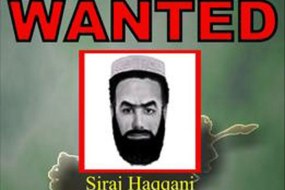
Jalaluddin Haqqani, founder of the network, and his son Sirajuddin, who now runs the group, have both been designated “global terrorists” by Washington.

Mr Munter’s remarks follow a warning by US defence secretary Leon Panetta, who said after the Kabul attack that the US would retaliate against Pakistan-based insurgents.

“Time and again we’ve urged the Pakistanis to exercise their influence over these kinds of attacks from the Haqqanis and we’ve made very little progress in that area,” Mr Panetta said Wednesday, a day after the Kabul siege.

“I’m not going to talk about how we’re going to respond. I’ll just let you know that we’re not going to allow these kinds of attacks to go on,” he said.

Pakistan’s foreign ministry condemned those remarks as “out of line”, saying that “terrorism and militancy is a complex issue”.

Pakistan WSJ Ad Unlikely to Change Narrative

By Tom Wright for The Wall Street Journal

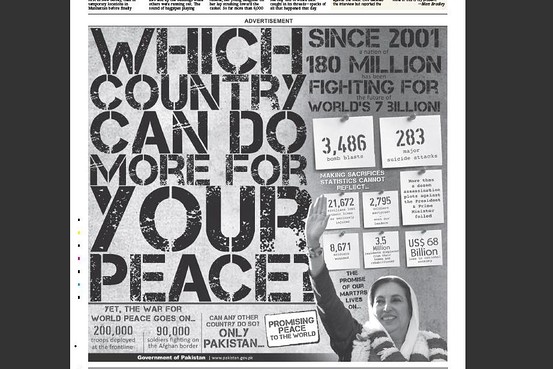
Pakistan has taken out a half-page advertisement in The Wall Street Journal to coincide with the 10th anniversary of the Sept. 11 attacks in an attempt to shift what Islamabad feels is an anti-Pakistan narrative in the American media.

“Which country can do more for your peace?” the ad asks, sitting below a story on page A10 of the U.S. Journal’s Saturday/Sunday edition titled “When the Towers Came Down.”

“Since 2001 a nation of 180 million has been fighting for the future of world’s 7 billion!” it continues.”Can any other country do so? Only Pakistan…Promising peace to the world.”

Pakistani army and civilian officials complain that in the U.S. their country is often portrayed in the media and by members of Congress as a double-dealing ally that takes billions of dollars in U.S. aid but secretly helps the Taliban kill U.S. soldiers.

Pakistan’s leaders have been publicly trying to promote a competing narrative, but with almost no success.

In their telling, Pakistan did foster Islamist militant groups, first to fight Soviet troops in Afghanistan and then Indian soldiers in Kashmir. Pakistan military and civilian officials point out the U.S. was all for the Mujahideen war against Moscow in the 1980s. But in the past decade, Pakistan’s army has severed its links with militants, who have unleashed a bloody war against Pakistan’s army and government, according to Islamabad’s narrative.

Pakistani officials regularly tell this version of events in public speechs and to visiting U.S. officials and journalists. The military has even made a local TV drama featuring real soldiers to publicize its sacrifices in the war against militants.

The advert in the Journal seeks to give the message to a wider audience.

To underline its point, the ad carries a picture of Benazir Bhutto, Pakistan’s former prime minister who was assassinated by Islamist militants in 2007, next to the slogan, “The promise of our martyrs lives on…”

The ad cites a series of statistics. Almost 22,000 Pakistani civilians have died or been seriously injured in the fight against terrorism, the ad said. The army has lost almost 3,000 soldiers. More than 3.5 million people have been displaced by the fighting and the damage to the economy over the past decade is estimated at $68 billion, it added.

People will quibble with these statistics from a country where reporters often find it difficult to get basic data.

It was not clear whether the ad was carried in other U.S. publications. Pakistan’s government also tried to place it in the New York Times. The Times asked for “more clarity in the ad about who was placing it,” according to a spokeswoman for the newspaper. The Times did not hear back from the government and so has not yet run the ad, she said.

The ad as printed in the Journal carries a line at the bottom in small font saying “Government of Pakistan” next to a web address for the government. A spokeswoman for the Journal declined to comment.

Will the advertisement be effective in shifting the narrative? It’s unlikely.

The points raised are all fair enough. Pakistan has been hammered by suicide bombings by Islamist militants against civilian and army targets. It’s perhaps fair to say that many in the U.S. have failed to recognize the changes in Pakistan, especially in the past few years, that have led to its domestic war against militancy.

Still, many in the U.S. and elsewhere are likely to shrug their shoulders. In the U.S. and India, where Pakistani-based militants are viewed as a daily threat to security, many politicians, analysts and ordinary citizens blame Pakistan for failing to stop the export of terrorism and being selective in which Islamist militant groups they go after.

Pakistan has waged a war against homegrown Pakistan Taliban militants for the past three years, suffering large casualties. But U.S. defense officials say publicly they are concerned that the country continues to protect Afghan Taliban fighters that don’t attack inside Pakistan. It’s these fighters who use Pakistan soil as a base from which to launch attacks on U.S. forces in Afghanistan, they say.

Some U.S. officials say they believe Pakistan’s argument that it’s too stretched fighting the Pakistan Taliban to open new fronts in its war against militants. But many members of Congress and U.S. defense officials say Islamabad wants to keep ties strong with the Afghan Taliban so it can influence politics over the border once the U.S. pulls out its troops by 2014.

India blames Pakistan for failing to crack down on Lashkar-e-Taiba, the militant group which carried out the attacks on Mumbai in 2008, killing over 160 people, and has hit Indian targets in Afghanistan. LET has not carried out any attacks against the Pakistan state.