Archive for the ‘ Tehrik-i-Taliban ’ Category

Pakistan WSJ Ad Unlikely to Change Narrative

By Tom Wright for The Wall Street Journal

Pakistan has taken out a half-page advertisement in The Wall Street Journal to coincide with the 10th anniversary of the Sept. 11 attacks in an attempt to shift what Islamabad feels is an anti-Pakistan narrative in the American media.

“Which country can do more for your peace?” the ad asks, sitting below a story on page A10 of the U.S. Journal’s Saturday/Sunday edition titled “When the Towers Came Down.”

“Since 2001 a nation of 180 million has been fighting for the future of world’s 7 billion!” it continues.”Can any other country do so? Only Pakistan…Promising peace to the world.”

Pakistani army and civilian officials complain that in the U.S. their country is often portrayed in the media and by members of Congress as a double-dealing ally that takes billions of dollars in U.S. aid but secretly helps the Taliban kill U.S. soldiers.

Pakistan’s leaders have been publicly trying to promote a competing narrative, but with almost no success.

In their telling, Pakistan did foster Islamist militant groups, first to fight Soviet troops in Afghanistan and then Indian soldiers in Kashmir. Pakistan military and civilian officials point out the U.S. was all for the Mujahideen war against Moscow in the 1980s. But in the past decade, Pakistan’s army has severed its links with militants, who have unleashed a bloody war against Pakistan’s army and government, according to Islamabad’s narrative.

Pakistani officials regularly tell this version of events in public speechs and to visiting U.S. officials and journalists. The military has even made a local TV drama featuring real soldiers to publicize its sacrifices in the war against militants.

The advert in the Journal seeks to give the message to a wider audience.

To underline its point, the ad carries a picture of Benazir Bhutto, Pakistan’s former prime minister who was assassinated by Islamist militants in 2007, next to the slogan, “The promise of our martyrs lives on…”

The ad cites a series of statistics. Almost 22,000 Pakistani civilians have died or been seriously injured in the fight against terrorism, the ad said. The army has lost almost 3,000 soldiers. More than 3.5 million people have been displaced by the fighting and the damage to the economy over the past decade is estimated at $68 billion, it added.

People will quibble with these statistics from a country where reporters often find it difficult to get basic data.

It was not clear whether the ad was carried in other U.S. publications. Pakistan’s government also tried to place it in the New York Times. The Times asked for “more clarity in the ad about who was placing it,” according to a spokeswoman for the newspaper. The Times did not hear back from the government and so has not yet run the ad, she said.

The ad as printed in the Journal carries a line at the bottom in small font saying “Government of Pakistan” next to a web address for the government. A spokeswoman for the Journal declined to comment.

Will the advertisement be effective in shifting the narrative? It’s unlikely.

The points raised are all fair enough. Pakistan has been hammered by suicide bombings by Islamist militants against civilian and army targets. It’s perhaps fair to say that many in the U.S. have failed to recognize the changes in Pakistan, especially in the past few years, that have led to its domestic war against militancy.

Still, many in the U.S. and elsewhere are likely to shrug their shoulders. In the U.S. and India, where Pakistani-based militants are viewed as a daily threat to security, many politicians, analysts and ordinary citizens blame Pakistan for failing to stop the export of terrorism and being selective in which Islamist militant groups they go after.

Pakistan has waged a war against homegrown Pakistan Taliban militants for the past three years, suffering large casualties. But U.S. defense officials say publicly they are concerned that the country continues to protect Afghan Taliban fighters that don’t attack inside Pakistan. It’s these fighters who use Pakistan soil as a base from which to launch attacks on U.S. forces in Afghanistan, they say.

Some U.S. officials say they believe Pakistan’s argument that it’s too stretched fighting the Pakistan Taliban to open new fronts in its war against militants. But many members of Congress and U.S. defense officials say Islamabad wants to keep ties strong with the Afghan Taliban so it can influence politics over the border once the U.S. pulls out its troops by 2014.

India blames Pakistan for failing to crack down on Lashkar-e-Taiba, the militant group which carried out the attacks on Mumbai in 2008, killing over 160 people, and has hit Indian targets in Afghanistan. LET has not carried out any attacks against the Pakistan state.

Al Qaeda’s Roots Grow Deeper in Pakistan’

As Reported in Zee News

Ten years after the 9/11 terrorist attacks and the subsequent “war on terror” launched by United Stated-led forces against al Qaeda, the terrorist outfit “continues to pose a serious threat to the world as it keeps surviving and thriving mainly on the Pakistan-Afghanistan tribal belt”, a senior Pakistani journalist and author has said.

“In these rugged areas, it [al Qaeda] has established an effective jihadi network that increasingly exploits its Pakistani affiliates to carry on the global jihadi agenda of Osama bin Laden, despite his May 02 killing in a United States military raid in Abbottabad in Pakistan,” Amir Mir wrote in a piece for Asia Times Online.

Until recently, analysts have been mostly focusing on the dangers posed by the growing Talibanisation of Pakistan, he noted.

“Yet, it has now become abundantly clear that the time has come to pay more attention to the bigger dangers posed by the Pakistanisation of al Qaeda,” he added.

Mir, who has written several books on the subject of militant Islam and terrorism, the latest being ‘The Bhutto murder trail: From Waziristan to GHQ’, said that the al Qaeda leadership’s choice of using the FATA region, especially the North and South Waziristan tribal agencies as their hideout, has enabled the terror outfit to build a new power base, separate from Afghanistan.

“As a result, despite Pakistan’s extensive contribution to the “war on terror”, many questions persist about the extent to which al Qaeda and its allied groups are operating within Pakistan,” he observed.

He said that al Qaeda’s success in forging close ties to Pakistani jihadi groups has given it an increasingly secure haven in Pakistan’s mountainous tribal areas, which have “replaced Afghanistan as the key training and indoctrination grounds for al Qaeda recruits to be used in operations abroad and for training those indoctrinated and radicalised elsewhere.”

The journalist also said it appears that al Qaeda not only remains in business in its traditional stronghold in the Waziristan tribal region, it has “also clearly advanced to the urban areas in all four provinces of Pakistan”.

“This is confirmed by the growing belief of the Barack Obama administration that if there is one country that matters most to the future of al Qaeda, it is Pakistan,” he added.

A Monster Roaming The World

By Paul Mcgeough for The City Weekly
Search for a firm footing in Pakistan and there is none – all is quicksand … strategically, politically, morally.

Here in south Asia, strategically sandwiched between failing Afghanistan and the China and India powerhouses, is a country in which journalists are abducted in the night by agents of the state and murdered; in which the only advance after a decade in which Washington has tried to buy friendship with cheques for more than $20 billion, is the expansion of Pakistan’s nuclear arsenal – which is on the verge of surpassing Britain’s as the fifth biggest in the world.

In Pakistan, a 50-year-old woman is sentenced to death on a dubious blasphemy charge – and politicians who dare to speak in her defence are gunned down; and a woman is gang-raped and paraded naked through her village on the orders of a local council, over bogus claims that her 12-year-old brother has offended a 20-year-old woman from the clan of the men who defiled her.

But that’s village life. In the leafy garrison town of Abbottabad, an hour’s drive north of Islamabad, Osama bin Laden, mastermind of the attacks of September 11, 2001, was able to hide in plain sight for years. The location of his fortified bunker, a stone’s throw from a prestigious military academy, made it harder to give any credence to the generals’ repeated denials that significant elements of Pakistan’s extensive security apparatus sheltered the al-Qaeda chief and continue to give succour to the Taliban and other insurgency and terrorist movements.

In the south-west, in the wilds of provincial Baluchistan, there have been 150 ”kill and dump” operations this year. Most of the victims are Baluch nationalist rebels. Their killers are the Inter-Services Intelligence agency (ISI) and other elements of Pakistan’s national security forces – driven to brutality by a belief, which could be correct, that Pakistan’s arch foe, India, stirs the local nationalist pot. In turn, the Baluch nationalists are accused of running their own death squads – their victims are Punjabi ”settlers”, government workers brought in from other parts of the country.

Baluchistan is half Pashtun, which also makes it a sanctuary for the Taliban from adjoining Afghanistan, where Washington and the world still struggle, with little success, to impose a semblance of democracy on the bones of a fracturing, failing state. Here then is another of the ironies that puts a serious question mark over the bona fides of the Pakistani security forces: the leadership of the Afghanistan Taliban sequesters in Quetta, the provincial capital of Baluchistan, but the various Pakistani security services are so busy putting the Baluch nationalists through the mincer they don’t have time to take down the Taliban command-and-control centre. Instead, they reportedly socialise with the Taliban and sit in on their strategy meetings.

West from Baluchistan is the sprawling port city of Karachi, where the spiralling death toll in renewed ethnic turf-wars gives raw meaning to what local novelist Kamila Shamsie broaches obliquely, recounting how the city ”winks” at her. “Yes, the city said, I am a breeding ground for monsters, ” she writes, “but don’t think that is the full measure of what I am.”

This drab, chaotic home to 18 million people who account for 65 per cent of Pakistan’s economy is being carved up by bullets that this year have accounted for as many as 1000 ”wrong place, wrong time” deaths as gunmen randomly select their targets – sending messages to whole communities, not the individuals with whose blood they paint the rough pavements. As the suburbs seethe, police do little, because they are cowed by the systematic elimination of those in their ranks who intervened in the last iteration of these ethnic wars. Provincial and federal governments and the security forces only wring their hands.

In Karachi everyone lies. No one denies turf wars are being waged. They simply blame everyone else – all the political parties deny any links to the militias that prosecute their bloody agendas and to the crime, drug and land-development mafias that prosper in their wake. And the city’s once-dominant Urdu-speaking Mohajirs fight to maintain their control of corrupted city politics, amid an influx of Pashtuns fleeing upheavals along the Afghan border.

“Tension rises, we see killings and then scores must be settled,” an adviser to the provincial governor says. “We are at war – the political parties say they are not involved, but the mafias take shelter from the parties as they exploit the situation.”

In Islamabad, enter any of the city’s newsrooms, and see fear in the eyes of journalists who risk death and torture for going about assignments. Consider the words of their Karachi colleague Madiha Sattar – “a growth of intolerance has forged an extreme, murderous antipathy to freedom of expression.”

Most shocking in this campaign of fear and intimidation against one of the pillars of democracy was the disappearance in late May of Syed Saleem Shahzad, an investigative reporter for the respected, Hong Kong-based Asia Times Online. Two days after his abduction, Shahzad’s battered body was found at Mandi Bahauddin, 130 kilometres south-east of the capital. The reporter left detailed accounts of the threats he had received from the ISI; in Washington, senior officials unflinchingly confirming that Shahzad’s death had been ”sanctioned” by the Pakistani government.

Umar Cheema might just as easily have been their victim. Behind a door marked ”Investigation Cell” off a basement corridor in the Islamabad offices of The News, the 34-year-old father of two explains that the shock in his colleague Saleem Shahzad’s murder was a realisation it might just as easily have been him.

As Cheema drove home from a party in the early hours during Ramadan last year, 12 men who identified themselves as police commandos abducted him, he says. Informing him first that he was a suspect in a killing, they pulled a bag over his head and hauled him away.

“They took me to a building where the leader stripped off my clothes. Then I was ordered to lie on the floor and they beat me on the back and shoulders for 20 or 25 minutes with leather straps and wooden canes.

“I was writing about corruption in the government and the lack of accountability in the military and intelligence agencies – they said they were beating me because of my reporting. Then they shaved my head and eyebrows – that’s what is done to thieves in rural areas to humiliate them.

“Shahzad’s death left me speechless,” he says. “I was the second last victim before they took him. So I felt very much that this was a message for me – it was very, very personal.”

In Islamabad, the government of Prime Minister Yousaf Gillani is as overwhelmed as it is complicit in the nation’s failings. The economy is in crisis and the government has ceded control of more than half the country to the military or to extremist militias. “None of the cogs of state mesh to make it do what must be done,” Human Rights Commission of Pakistan’s Kamran Arif said.

Just south of Islamabad is Rawalpindi, a more typical Asian city than the sanitised and empty boulevards of Islamabad. As home and headquarters to the men and institutions that comprise Pakistan’s military and intelligence establishment, this is the centre of absolute power in Pakistan. And it is here that a deep-fried sense of humiliation over the American raid to kill Osama bin Laden, in May this year, is felt most acutely.

“After the bin Laden raid, it’s a question of the survival of the state,” the defence analyst and director of the South Asian Strategic Stability Institute, Maria Sultan, says. “The problem now is that by this very public humiliation, the US has lost its biggest supporter – it’s not the capability of the Pakistani military that is affected, it’s its credibility.”

A close reading of ”Getting Bin Laden”, The New Yorker’s inside account of the May 2 raid, reveals the mission was not just a single US incursion that managed to evade Pakistan’s air defences. On the night, there were effectively three separate American missions, none of which was detected by a military-security complex that demands indulgence by the people of Pakistan on the grounds that it is their only protection from the Indian hordes.

Pakistan’s generals faced a grim choice – they had to admit to deceiving the world in harbouring bin Laden, or to incompetence by not knowing he was lounging in their backyard. So supine were they in opting to plead incompetence there were fears of a mutiny in the middle ranks of the security services.

The US signal to the world of just how much it could not trust its south Asian ally came hard on the heels of serial embarrassments at the hands of the Taliban and other militant groups in Pakistan.

There have been a series of militant attacks on the most secure and sensitive defence establishments. The latest, which some observers concluded could not have been undertaken without inside help, saw a 10-man assault team storm the Mehran naval aviation base in Karachi. It took hundreds of Pakistani navy commandos, marines and paramilitaries to retake the base, but not before two aircraft were destroyed, hostages taken and the base had been occupied for the best part of a day.

But it takes a discerning Pakistani general to differentiate between militants – some are ”strategic assets” of the security apparatus and the generals refuse to go after them.

Dr Ayesha Agha, whose military and political commentaries appear in Pakistan’s Dawn newspaper, explains: “The military depends on these ‘assets’ – they are a cost-effective means to fighting wars that the Pakistani military wants to fight in India and Afghanistan.” Extrajudicial killings by the military now are counted in the hundreds.

When men in uniform were filmed recently murdering a detainee, the reckoning in human rights circles was that far from being a lapse of judgment, the recording had been allowed in the knowledge that its distribution on the internet would serve as a useful warning to the wider community.

A Karachi taxi driver becomes excited as he ferries us from the airport to a downtown hotel – “Pakistan lovely country,” he bellows. “Terrorism? No, no, no.”

But a single graphic in a 200-page study of Pakistan, published in May by the Washington-based Centre for Strategic and International Studies, reveals an impossible security challenge. Last year alone, 2113 terrorist attacks, 369 clashes between the security services and militants, 260 operational attacks by the security forces, 135 US drone attacks, 69 border clashes, 233 bouts of ethno-political violence and 214 inter-tribal clashes resulted in more than 10,000 dead and as many injured.

The death of bin Laden and the reported death of al-Qaeda’s new No. 2 figure, Atiyah Abd al-Rahman, in an American drone attack last week, are still being factored into a running debate among intelligence specialists on the extent to which al-Qaeda offshoots elsewhere in the world, especially the Yemen-based al-Qaeda in the Arabian Peninsula [AQAP], have taken the baton from the Pakistani organisation.

But a July study by the New America Foundation of 32 ”serious” jihadist terror plots against the West from 2004 to 2011, finds 53 per cent had operational or training links to jihadist groups in Pakistan – compared to just 6 per cent being linked to Yemen. And the rising tempo of the drone attacks has failed to dent the rising frequency of Pakistan-linked plots against the West, the study finds.

Implicit or explicit in any discussion on Pakistan’s volatile mix of militant violence and governmental chaos, is the level of anxiety around the world about the security of its nuclear arsenal. Confronted with claims such as that by bin Laden that acquiring a nuclear weapon was a ”religious duty” and the hope expressed by one of his lieutenants that such a weapon one day might be seized in Pakistan, officials in Islamabad invariably boast that all is tightly locked down.

But when we ask a Pakistani diplomat how secure were the weapons in the aftermath of the US mission to kill Osama bin Laden, he replies: “Less so, now that the Americans have revealed to the world that it is possible to sneak into Pakistan undetected, to take something that you really want.”

President Obama’s public appeal that Pakistan not become the world’s first ”nuclear-armed militant state” gives context to disclosures by The New Yorker’s Seymour Hersh of the existence of a US Special Operations rapid-response team which would be parachuted into Pakistan in the event of a nuclear crisis.

Rolf Mowatt-Larssen, a former director of intelligence and counter intelligence at the US Department of Energy, is boldest in setting out the fears of Washington, London and other capitals – some of which were disclosed without diplomatic varnish by Wikileaks last year.

Writing in Arms Control Today, Mowatt-Larssen, who served 20 years at the CIA, bills Pakistan as the most likely setting for terrorists bent on acquiring a nuclear device to co-opt a nuclear insider – of whom there are estimated to be as many as 70,000 in Pakistan.

“There is a lethal proximity between terrorists, extremists, and nuclear weapons insiders,” he writes. “Insiders have facilitated terrorist attacks. Suicide bombings have occurred at air force bases that reportedly serve as nuclear weapons storage sites. It is difficult to ignore such trends.

”Purely in actuarial terms, there is a strong possibility that bad apples in the nuclear establishment are willing to co-operate with outsiders for personal gain or out of sympathy for their cause.”

“Not possible,” says Maria Sultan. “About eight to 10,000 personnel working at the strategic level on security,” she says, ticking off seven or eight interlocking layers of complex security, the first of which she says would trip most intruders before they came within 80 kilometres of a nuclear facility. “The idea that a terrorist can walk in and get hold of a device is just not possible.”

Such is the bind in which Pakistanis find themselves. But if it is true feeble and corrupt civilian administrations make circumstances ripe for a military takeover, it is hardly surprising the generals have no respect for democratic fundamentals.

As revealed in one of the Wikileaks cables, Army chief General Ashfaq Parvez Kayani was ready to force President Asif Ali Zardari from office – save for the fact the general thought even less of Zardari’s likely civilian replacement. And historically, Washington has opted to connect with Pakistan through the military power of the generals, rather than the people power of the civilian leadership.

Bruce Riedel, a veteran CIA analyst, sets out the connections in Deadly Embrace: Pakistan, America and the Future of the Global Jihad. “…Richard Nixon turned a blind eye to the murder of hundreds of thousands of Bangladeshis to keep his friends in Pakistan’s army in power, a strategy that ultimately failed,” Riedel writes. “Ronald Reagan entertained Zia-ul-Haq even as Zia was giving succour to the Arab jihadists who would become al-Qaeda. George W. Bush allowed Pervez Musharraf to give the Afghan Taliban a sanctuary from which to kill American and NATO soldiers in Afghanistan.”

And in the judgment of Bushra Gohar, an elected MP from Pakistan’s troubled Swat Valley, Washington still prefers to deal with the military rather than the country’s civilian leadership. “That’s not a role that the military has under the constitution,” she says during a break in the business of the National Assembly in Islamabad. “There has been a democratic transition in this country and we expect the international community to support it.”

Power vacuums become ripe for exploitation, as was revealed with frightening clarity earlier this year when two of three elected figures who had dared to speak out against Pakistan’s draconian blasphemy laws were assassinated. In January, Punjab provincial governor Salman Taseer was gunned down by one of his state-provided security men; in March, the Minorities Minister and the only Christian in Gillani’s cabinet, Shahbaz Bhatti, died in a hail of gunfire as his car left his mother’s home in Islamabad.

Taseer’s killer confessed and became a national hero. His home is a shrine, he is garlanded with rose petals and, in the oddest twist of all, the young lawyers’ movement that effectively bundled Pervez Musharraf, the last dictator, from power in 2008, has taken the side of this cold-blooded murderer – not the principle for which his victim died.

A visitor leaves Pakistan wondering if anyone here speaks the truth. The dictators habitually resort to amping up religious parties – either to drown out secular ones that might be interested in the ideals of selfless democracy, or to further marginalise the country’s Shiia Muslim minority.

“And people like Musharraf have two faces,” Kamran Arif of the Human Rights Commission of Pakistan said. “He would say all the right things for the West and do just what he wanted to do at home.”

Some foreign analysts fall back on the seeming failure of Pakistan’s religious parties at the ballot box as a hopeful sign. But a sense of rising radicalisation, particularly in the military and the middle classes, suggests an asymmetric contest for control of a highly unstable society – the non-religious parties fight in the parliament, but the religious parties are street brawlers.

Sherry Rehman, the only elected figure in the country to defend the convicted blasphemer Aasia Bibi, makes the same point in explaining how that debate was lost. “The discourse shifted from the parliament to the street,” she says.

“We have to keep the agenda in the parliament, and not with the gun-toting thugs who make inflammatory speeches outside.”

Like the financial institutions in the 2008 global financial crisis, Pakistan is deemed by Washington to be ”too big to fail”. Between them, however, Washington and Islamabad have been unable in the past decade to make this relationship work – credibly or creditably.

Predictions of imminent collapse in Islamabad are exaggerated, but perhaps not overly so. “The government does not have the capacity to tackle any of the issues,” says the Human Rights Commission of Pakistan’s Arif. “Things will just keep getting bad … and I don’t discount the fact that we can fall into chaos.”

Like many other analysts, Bruce Riedel laboriously sets out the policy options by which Washington and Islamabad might work together to defeat the global jihadist movement – before he concludes that none is easy or guaranteed.

An adviser to several US administrations and now with the Brookings Institution, Riedel sees Pakistan under siege from a syndicate of radical terrorist groups unified by the notion that nuclear-armed Pakistan could be the extremist jihadist state they have never had.

“They want to hijack Pakistan and its weapons,” he says. Alluding to Islamabad’s role in creating a monster, as often as not with Washington’s sponsorship, he writes: “An extremely powerful jihadist Frankenstein is now roaming the world, with equally powerful protectors in Pakistani society, right up to the very top.

“Who cannot fear that the ‘long beards’ will prevail?”

Pakistan’s 10 Years of Chaos

As Reported by Jennie Matthew for AFP

The 9/11 attacks that thrust Pakistan into the war on terror have brought the nuclear-armed state to its knees, fighting Islamist radicals at home and risking pariah status abroad.

It was already evening in Pakistan when television channels, recently deregulated by then president General Pervez Musharraf, began broadcasting the terrifying scenes from the twin towers in New York.

Few slept that night, realising immediately that the world had changed forever and that Pakistan was in the eye of the storm after spending years fostering extremist movements for its own ends.

“My immediate thought was ‘oh my God, more trouble coming onto Pakistan’,” said author Imtiaz Gul, who has written extensively about the subsequent war and its fallout at home.

“My fears have been borne out… The 9/11 events shocked Pakistan into an unprecedented crisis of insecurity,” he said.
It didn’t take long for Musharraf to weigh up conditions imposed by Washington and announce on September 19 that Pakistan would offer its airspace, territory and capabilities to help the United States defeat terrorism.

But as America put the finishing touches to its war plans, Pakistan desperately tried to persuade its Taliban allies in Afghanistan to give up Osama bin Laden and avert catastrophic military action, to no avail.

Within weeks, bin Laden, his future successor Ayman al-Zawahiri and Taliban leaders had fled the American invasion into Pakistan.

And there in the northwestern tribal belt, which no government has been able to subjugate, they found refuge among an extremist support network dating back to the 1990s jihad against the Soviets in Afghanistan.

They regrouped, forming bases used by the Taliban to direct the insurgency in Afghanistan and training camps for Al-Qaeda to brainwash young extremists from all over the world into carrying out terror attacks.

As a result, the last decade has made the only Muslim nuclear power more unstable than ever before in its bloody and chaotic 64-year existence.

The watershed came in July 2007 when government troops cleared out extremists preaching hate from the Red mosque in the heart of the capital Islamabad.

The militants declared war and in the past four years, around 500 bomb attacks have killed 4,600 people, according to an AFP tally.
Just when it appeared things couldn’t get worse, this year the US discovered bin Laden living close to Pakistan’s equivalent of West Point, sending in Navy SEALs to kill him and sinking already fractured US-Pakistani relations.

“No doubt that this is absolutely the worst time for the country,” said Pakistani journalist Ahmed Rashid, whose book “Taliban” became an international bestseller after 9/11.

Rashid describes Pakistan as “completely isolated” by a war that “brought terrorism, sectarianism, a weakening of the state (and) much greater ethnic insurgencies” within the country.

But the blame — he says — is Pakistan’s for frittering away American aid money and refusing to realign its national security priorities.
“Politically, the most far-reaching mistake was the hosting and relaunching of the Afghan Taliban by the military and the intelligence agencies. That was enormously detrimental and led to the growth of the Pakistani Taliban.” Pakistan routinely proclaims to have sacrificed the most of any country fighting terror.

The government claims that 35,000 people have been killed. The army confirms the deaths of 3,019 soldiers since 2001 — more than the 2,684 Western soldiers to have died in Afghanistan.

More than three million people have been displaced by violence and counter-terrorism activities in Pakistan since 9/11, according to International Crisis Group figures released in 2010.

The army says 147,000 troops are deployed in the northwest compared to 35,000 in October 2001, a drastic reversal from the previous concentration along the Indian border in the east.

Yet extremism has increased. An average of one US drone strike every four days against militants in the tribal belt is raising fears that the campaign is recruiting a new generation of insurgents and suicide bombers.

Jihadist groups — fostered by Pakistan’s security establishment to fight India in Kashmir and maintain Afghanistan as a strategic asset — have splintered, and increasingly turned the guns on their old allies in the state.

“Pakistan is a lot less secure country now than 10 years ago, because it has become a battleground, an extension of the Afghan war. Pakistan is now facing a serious threat for its stability,” said journalist Zahid Hussain.

Yet the public discourse concentrates less on how to defeat militancy than debating the merits of the hugely unpopular US alliance.
Trust between Islamabad and Washington is at an all-time low. Cooperation between the CIA and Pakistan’s ISI spy agency is poor. Blame games on both sides are played out in the media.

Compounding the sense of crisis is the country’s economic meltdown. Pakistan says losses related to the war are $68 billion. Critics say the country has squandered up to $20 billion in aid given by the United States. “The biggest mistake was the failure to really address strategic issues in the economy. Pakistan could have changed its very weak economic structure at that point in time,” said Rashid.

Instead crippling inflation, rampant unemployment and an energy crisis with power cuts of up to 16 hours a day have left millions wondering how to fill the void.

Panetta: ‘No Choice’ in US Relations with Pakistan

By David Gollust for Voice of America

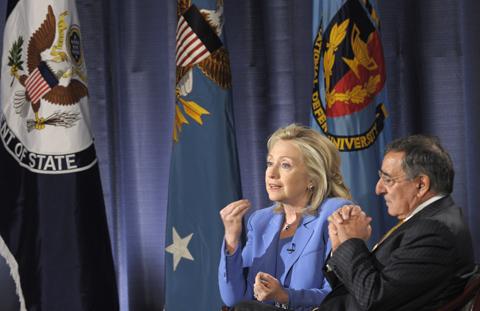
Defense Secretary Leon Panetta said Tuesday that the United States has no choice but to maintain close relations with Pakistan, despite government links with Islamic militants including the Haqqani network. The State Department, meanwhile, put sanctions on another Haqqani network commander.

Panetta, who took over as defense secretary in June after two years of heading the CIA, declined comment on news reports that Pakistan allowed China to inspect the wreckage of an advanced U.S. helicopter lost in the raid that killed Osama bin Laden.

But at a public forum with Secretary of State Hillary Clinton at Washington’s National Defense University, the defense chief was unusually candid about U.S. problem issues with Pakistan.

Panetta said Pakistan has “relationships” with the Haqqani network – militants based in western Pakistan who conduct cross-border attacks on U.S. forces in Afghanistan, and with Lashkar-e-Taiba militants who have attacked India.

Both groups are listed by the United States as terrorist organizations. Despite complaints that Pakistan has withheld visas for U.S. citizens being posted there, Panetta said the relationship remains essential.

“There is no choice but to maintain a relationship with Pakistan,” said Panetta. “Why? Because we are fighting a war there. We are fighting al-Qaida there. And they do give us some cooperation in that effort. Because they do represent an important force in that region. Because they do happen to be a nuclear power that has nuclear weapons, and we have to be concerned about what happens with those nuclear weapons. So for all of those reasons, we’ve got to maintain a relationship with Pakistan.”

Secretary of State Clinton said the Obama administration considers relations with Pakistan to be of “paramount importance.”

She said there have been “challenges” in bilateral ties for decades with valid complaints on both sides, and that she credits the Islamabad government with lately recognizing its shared interest with Washington in confronting terrorism.

“I was very pleased when the Pakistanis moved into [the] Swat [Valley] and cleaned out a lot of what had become a kind of Pakistani Taliban stronghold,” said Clinton. “And then they began to take some troops off their border with India, to put more resources into the fight against the Pakistani Taliban. Now, as Leon [Panetta] says, we have some other targets that we discuss with them – the Haqqanis, for example. And yet it’s been a relatively short period of time, two-and-a-half years, when they have begun to reorient themselves militarily against what is, in our view, an internal threat to them.”

The State Department on Tuesday designated a key Haqqani network commander – Mullah Sangeen Zadran – a terrorist under a 2001 White House executive order, freezing any U.S. assets he has and barring Americans from business dealings with him.

At the same time, Sangeen was designated a terrorist by the U.N. sanctions committee, which will subject him to a global travel ban, an asset freeze and an arms embargo.

A State Department statement said Sangeen, is a “shadow governor” of Afghanistan’s southeast Paktika province and a senior lieutenant of network leader Sirajuddin Haqqani. It said Sangeen has coordinated the movement of hundreds of foreign fighters into that country and that he is linked to numerous bomb attacks and kidnappings.

Al Qaeda’s Latest Loss

By Bruce Riedel for The Daily Beast

The reported death of Muhammad Ilyas Kashmiri deals a huge hit to the terror cell, still reeling from bin Laden’s killing. Ex-CIA analyst Bruce Riedel on the impact on U.S.-Pakistan relations.

Pakistani sources are reporting the death in a drone strike this weekend of Muhammad Ilyas Kashmiri. If true, it is a big setback for al Qaeda and could help ease tensions between Pakistan and the U.S. a bit.

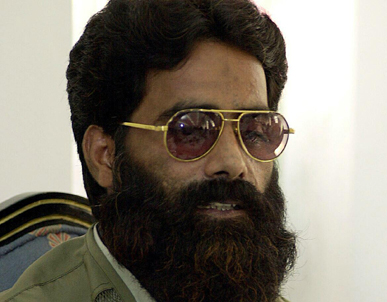
Kashmiri is al Qaeda’s top Pakistani operative. He was born in Pakistani-controlled Kashmir on February 10, 1964. Trained in the camps of the Pakistani Inter Services Intelligence directorate (ISI) and then the elite Pakistani commando group, the Special Services Group (SSG), he was the darling of the Pakistani army for years. He fought in the war against the Soviets in Afghanistan where he lost an eye and a finger. Then he took the war to India both in Kashmir and in New Delhi itself.

He formed his own militant group called the 313 Brigade, after the 313 fighters who joined the prophet Muhammad in an early Islamic victory. His exploits in India were legendary. He was personally decorated and thanked by the then head of Inter-services Intelligence (ISI), Mahmud Ahmad and Pakistani’s dictator, Pervez Musharraf, in 2000. But Kashmiri broke with his ISI and army friends in 2002 when Musharraf decided to give the Americans at least some help against al Qaeda.

Kashmiri took his 313 Brigade into al Qaeda’s camp and assisted in training Taliban fighters in Afghanistan and began targeting his former friends in the ISI. His teams killed at least one senior ISI officer. He was involved in an attempt to assassinate Musharraf in 2004. The United Nations credits him as a key player in the plot to murder former Prime Minister Benazir Bhutto in December 2007.

The Pakistani American David Headley, who has confessed to plotting the Mumbai terror attack in November 2008, says Kashmiri was his key contact in al Qaeda. The two worked on a plot to attack a Danish newspaper office in Copenhagen in 2009. That was foiled when the FBI arrested Headley, but Kashmiri continued planning to carry out Mumbai-style attacks in Europe. Another was foiled in Denmark at the end of 2010. Kashmiri would have played an important role in helping al Qaeda recover from bin Laden’s demise. He had key connections inside the Pakistani syndicate of terror groups.

Just last week one of Pakistan’s best investigative reporters Syed Salam Shahzad was murdered after finishing a new book on al Qaeda in Pakistan. According to excerpts published in India and Pakistan, Shahzad had evidence Kashmiri may have been the real brains behind the Mumbai plot and hoped it would precipitate an Indo-Pakistani war that al Qaeda could exploit.

This is not the first time Kashmiri has been reported killed by a drone attack; he has reappeared after claims of his demise. But if this time he is dead, it is a significant setback for al Qaeda just a month after American commandos killed Osama bin Laden. Kashmiri would have played an important role in helping al Qaeda recover from bin Laden’s demise. He had key connections inside the Pakistani syndicate of terror groups with both the Afghan and Pakistani Taliban and Lashkar-e-Taiba, and with al Qaeda operatives in Europe and fund raisers in the Persian Gulf. And he had penetrations deep inside the Pakistani army and ISI.

So both Washington and Islamabad will be glad to see him gone. Kashmiri’s demise won’t solve all the problems in the tortured American relationship with Pakistan by any means but it will help.

Of course, if Kashmiri is not dead and reappears yet again unscathed, it will only add to his credentials. Bin Laden benefited enormously from surviving the cruise missile attack that targeted him in 1998. Recriminations could damage the Pakistani-American relationship further. Nonetheless those are risks worth taking. In either case we will know soon. Al Qaeda is quick to eulogize its martyrs. If Kashmiri’s dead, they will say so.

-Pakistanis for Peace Editor’s Note– Good Riddance!!!

Pakistani Journalists Defiant at Reporter’s Burial

As Reported by The Associated Press

A Pakistani reporter who investigated terrorism and was found slain after telling a rights activist he’d been threatened by intelligence agents was buried Wednesday. Fellow journalists vowed his killing would not silence them.

Syed Saleem Shahzad wrote for the Asia Times Online and other publications. He delved into topics that were often sensitive in Pakistan, where journalists face threats from insurgents as well as a security establishment that operates largely outside the law.

“We will not shut our voices down,” said Azhar Abbas, a prominent Pakistani journalist. “The journalist community is united on this. We will not stop ”

Pakistan was the deadliest country for journalists in 2010, with at least eight killed in the line of duty, according to the New York-based Committee to Protect Journalists. Six died in suicide attacks, the group said in a report late last year.

Despite the dangers, the media establishment in Pakistan has expanded rapidly over the past decade, and reporters here operate with tremendous freedom compared with many other developing countries.

In recent weeks, the media have carried unusually scathing coverage about the security establishment after it was caught unawares by the May 2 U.S. raid that killed al-Qaida chief Osama bin Laden in a garrison city in Pakistan’s northwest.

Shahzad’s death could heighten the criticism, though commentators are being careful about how they discuss the alleged link to spy agencies.

After disappearing Sunday from Islamabad, Shahzad’s body was found dozens of miles outside the capital on Tuesday, bearing signs of torture, police said. His death drew numerous condemnations, including from U.S. Secretary of State Hillary Rodham Clinton.

The 40-year-old was buried in his hometown, Karachi, as hundreds of friends, relatives, political figures and fellow journalists mourned.

Sindh province Information Minister Sharjeel Memon called the killing a “cowardly act” and promised that those responsible would be brought to justice. But it’s unclear how much the weak civilian government can do if, as some suspect, Pakistani security agencies played a role.

A spokesman for Pakistan’s premier spy agency, Inter-Services Intelligence, called the allegations “absurd.” He spoke on condition of anonymity because he was not authorized to speak to media on the record.

However, Ali Dayan Hasan, a researcher with Human Rights Watch, said Shahzad had told him that he feared Pakistani intelligence agents were after him.

The agencies pressured him to reveal his sources in October after he wrote a story about Pakistan allegedly freeing a detained Afghan Taliban commander, according to an email Shahzad sent Hasan. Hasan said Shahzad was still worried in recent weeks, but kept up his reporting.

Just last week, Shahzad wrote a story about alleged al-Qaida infiltration of the navy. The report came after a 17-hour insurgent siege of a naval base in Pakistan’s south added to the recent humiliations suffered by security agencies.

Within days, Shahzad vanished, and his wife contacted Hasan as her husband had instructed in case he disappeared.

In a statement, Clinton said Shahzad’s reporting “brought to light the troubles extremism poses to Pakistan’s stability,” and said the U.S. supports the “Pakistani government’s investigation into the circumstances surrounding his death.”

Pakistan Shuts Down U.S. ‘Intelligence Fusion’ Cells

By David S Cloud for The Los Angeles Times

In a clear sign of Pakistan’s deepening mistrust of the United States, Islamabad has told the Obama administration to reduce the number of U.S. troops in the country and has moved to close three military intelligence liaison centers, setting back American efforts to eliminate insurgent sanctuaries in largely lawless areas bordering Afghanistan, U.S. officials said.

The liaison centers, also known as intelligence fusion cells, in Quetta and Peshawar are the main conduits for the United States to share satellite imagery, target data and other intelligence with Pakistani ground forces conducting operations against militants, including Taliban fighters who slip into Afghanistan to attack U.S. and allied forces.

U.S. special operations units have relied on the three facilities, two in Peshawar and one in Quetta, to help coordinate operations on both sides of the border, senior U.S. officials said. The U.S. units are now being withdrawn from all three sites, the officials said, and the centers are being shut down.

It wasn’t immediately clear whether the steps are permanent. Adm. Mike Mullen, chairman of the Joint Chiefs of Staff, flew Thursday to Pakistan for a hastily arranged meeting with Gen. Ashfaq Kayani, the head of the Pakistani army. A Pentagon official said the two will probably discuss Pakistan’s demands for a smaller U.S. military presence.

The closures, which have not been publicly announced, remove U.S. advisors from the front lines of the war against militant groups in Pakistan. U.S. Army Gen. David Petraeus spearheaded the effort to increase the U.S. presence in the border areas two years ago out of frustration with Pakistan’s failure to control the militants.

The collapse of the effort will probably hinder the Obama administration’s efforts to gradually push Pakistan toward conducting ground operations against insurgent strongholds in North Waziristan and elsewhere, U.S. officials said.

The Pakistani decision has not affected the CIA’s ability to launch missiles from drone aircraft in northwest Pakistan. Those flights, which the CIA has never publicly acknowledged, receive assistance from Pakistan through intelligence channels separate from the fusion centers, current and former officials said.

The move to close the three facilities, plus a recent written demand by Pakistan to reduce the number of U.S. military personnel in the country from approximately 200, signals mounting anger in Pakistan over a series of incidents.

In January, Raymond Davis, a CIA contractor, shot dead two men in Lahore who he said were attempting to rob him. He was arrested on charges of murder but was released and left the country in mid-March, prompting violent protests in several cities.

Soon after, Pakistan ordered several dozen U.S. special operations trainers to leave the country in what U.S. officials believe was retaliation for the Davis case, according to a senior U.S. military officer.

Then, on May 2, five U.S. helicopters secretly entered Pakistani airspace and a team of U.S. Navy SEALs killed Osama bin Laden and four others at a compound in Abbottabad, a military garrison city near the capital, Islamabad. The raid deeply embarrassed Pakistan’s military and inflamed anti-U.S. sentiment across the country.

Javed Hussain, a retired Pakistani brigadier, blamed the decision to close the three intelligence centers on the mistrust that has plagued U.S.-Pakistani relations in recent months. Washington’s decision to carry out the raid against Bin Laden without informing Pakistan’s security establishment brought that mistrust to a new low, he said.

“There is lot of discontent within Pakistan’s armed forces with regard to the fact they’ve done so much in the war on terror, and yet they are not trusted,” Hussain said. “Particularly after the Abbottabad raid … the image of the armed forces in the eyes of the people has gone down. And they hold the U.S. responsible.”

The two intelligence centers in Peshawar were set up in 2009, one with the Pakistani army’s 11th Corps and the other with the paramilitary Frontier Corps, which are both headquartered in the city, capital of the troubled Khyber-Pakhtunkhwa province.

The third fusion cell was opened last year at the Pakistani army’s 12th Corps headquarters in Quetta, a city long used by Taliban fighters to mount attacks in Afghanistan’s southern provinces. U.S. troops have staffed the Quetta facility only intermittently, U.S. officials said.

The closures have effectively stopped the U.S. training of the Frontier Corps, a force that American officials had hoped could help halt infiltration of Taliban and other militants into Afghanistan, a senior U.S. military officer said.

The Frontier Corps’ facility in Peshawar, staffed by a handful of U.S. special operations personnel, was located at Bala Hissar, an old fort, according to a classified U.S. Embassy cable from 2009 that was recently made public by WikiLeaks.

The cable, which was first disclosed by Pakistan’s Dawn newspaper, hinted at U.S. hopes that special operations teams would be allowed to join the paramilitary units and the Special Services Group, a Pakistani army commando unit, in operations against militants.

“We have created Intelligence Fusion cells with embedded U.S. Special Forces with both the SSG and Frontier Corps” at Bala Hissar, Peshawar, the 2009 cable says. “But we have not been given Pakistani military permission to accompany the Pakistani forces on deployments as yet. Through these embeds, we are assisting the Pakistanis [to] collect and coordinate existing intelligence assets.”

Another U.S. Embassy cable said that a “U.S. Special Operations Command Force” was providing the Frontier Corps with “imagery, target packages and operational planning” in a campaign against Taliban insurgents in Lower Dir, an area of northwest Pakistan considered an insurgent stronghold.

In September 2009, then U.S. ambassador, Anne W. Patterson, wrote in another classified message that the fusion cells provided “enhanced capacity to share real-time intelligence with units engaged in counter-insurgency operations” and were “a significant step forward for the Pakistan military.”

The intelligence fusion cell in Quetta was not nearly as active as the facilities in Peshawar, current and former U.S. officials said. Pakistan has long resisted pressure to intensify operations against Taliban militants in Quetta. The city, capital of Baluchistan, is outside the tribal area, which explains Pakistan’s reluctance to permit a permanent U.S. military presence, a U.S. official said.

Despite the ongoing tensions, Pakistani authorities have agreed to allow a CIA team to inspect the compound where Bin Laden was killed, according to a U.S. official. The Pakistanis have signaled they will allow U.S. intelligence analysts to examine documents and other material that Pakistani authorities found at the site.

A U.S. official briefed on intelligence matters said the reams of documents and electronic data that the SEALs seized at the compound have sparked “dozens” of intelligence investigations and have produced new insights into schisms among Al Qaeda leaders.

Pakistan’s Nuclear Surge

By Andrew Bast for Newsweek

Even in the best of times, Pakistan’s nuclear-weapons program warrants alarm. But these are perilous days. At a moment of unprecedented misgiving between Washington and Islamabad, new evidence suggests that Pakistan’s nuclear program is barreling ahead at a furious clip.

According to new commercial-satellite imagery obtained exclusively by NEWSWEEK, Pakistan is aggressively accelerating construction at the Khushab nuclear site, about 140 miles south of Islamabad. The images, analysts say, prove Pakistan will soon have a fourth operational reactor, greatly expanding plutonium production for its nuclear-weapons program.

“The buildup is remarkable,” says Paul Brannan of the Institute for Science and International Security. “And that nobody in the U.S. or in the Pakistani government says anything about this—especially in this day and age—is perplexing.”

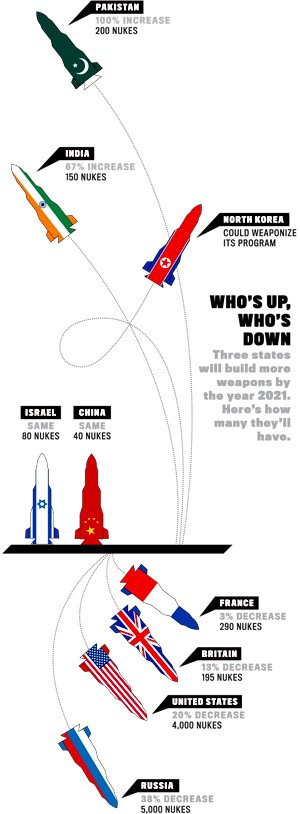
Unlike Iran, which has yet to produce highly enriched uranium, or North Korea, which has produced plutonium but still lacks any real weapons capability, Pakistan is significantly ramping up its nuclear-weapons program. Eric Edelman, undersecretary of defense in the George W. Bush administration, puts it bluntly: “You’re talking about Pakistan even potentially passing France at some point. That’s extraordinary.”

Pakistani officials say the buildup is a response to the threat from India, which is spending $50 billion over the next five years on its military. “But to say it’s just an issue between just India and Pakistan is divorced from reality,” says former senator Sam Nunn, who co-chairs the Nuclear Threat Initiative. “The U.S. and Soviet Union went through 40 years of the Cold War and came out every time from dangerous situations with lessons learned. Pakistan and India have gone through some dangerous times, and they have learned some lessons. But not all of them. Today, deterrence has fundamentally changed. The whole globe has a stake in this. It’s extremely dangerous.”

It’s dangerous because Pakistan is also stockpiling fissile material, or bomb fuel. Since Islamabad can mine uranium on its own territory and has decades of enrichment know-how—beginning with the work of nuclear scientist A. Q. Khan—the potential for production is significant.
Although the White House declined to comment, a senior U.S. congressional official who works on nuclear issues told NEWSWEEK that intelligence estimates suggest Pakistan has already developed enough fissile material to produce more than 100 warheads and manufacture between eight and 20 weapons a year. “There’s no question,” the official says, “it’s the fastest-growing program in the world.”

What has leaders around the world especially worried is what’s popularly known as “loose nukes”—nuclear weapons or fissile material falling into the wrong hands. “There’s no transparency in how the fissile material is handled or transported,” says Mansoor Ijaz, who has played an active role in back-channel diplomacy between Islamabad and New Delhi. “And the amount—they have significant quantities—is what’s so alarming.”

That Osama bin Laden was found in a Pakistani military community, and that the country is home to such jihadi groups as Lashkar-e-Taiba, only heightens concerns. “We’ve looked the other way from Pakistan’s growing program for 30 years,” says Sharon Squassoni, a director at the Center for Strategic and International Studies. What we’re facing, she says, is “a disaster waiting to happen.”

A Defense Department official told NEWSWEEK that the U.S. government is “confident that Pakistan has taken appropriate steps toward securing its nuclear arsenal.” But beyond palliatives, few in Washington want to openly discuss the nightmare scenario of terrorists getting hold of nuclear material or weapons. “The less that is said publicly, the better,” says Stephen Hadley, national-security adviser to President George W. Bush. “But don’t confuse the lack of public discussion for a lack of concern.”

The bomb lends the Pakistanis a certain diplomatic insouciance. Nukes, after all, are a valuable political tool, ensuring continued economic aid from the United States and Europe. “Pakistan knows it can outstare” the West, says Pakistani nuclear physicist Pervez Hoodbhoy. “It’s confident the West knows that Pakistan’s collapse is too big a price to pay, so the bailout is there in perpetuity. It’s the one thing we’ve been successful at.”

Pakistani leaders defend their weapons program as a strategic necessity: since they can’t match India’s military spending, they have to bridge the gap with nukes. “Regretfully, there are several destabilizing developments that have taken place in recent years,” Khalid Banuri of Pakistan’s Strategic Plans Division, the nuclear arsenal’s guardian, wrote in response to NEWSWEEK questions. Among his country’s concerns, Banuri pointed to India’s military buildup and the U.S.’s -civilian nuclear deal with India.

“Most Pakistanis believe the jihadist scenario is something that the West has created as a bogey,” says Hoodbhoy, “an excuse, so they can screw us, defang, and denuclearize us.”

“Our program is an issue of extreme sensitivity for every man, woman, and child in Pakistan,” says former Pakistani president Pervez Musharraf, adding that the nukes are “well dispersed and protected in secure locations.” When asked whether the U.S. has a role to play in securing the arsenal, Musharraf said: “A U.S. role to play? A U.S. role in helping? Zero role. No, sir. It is our own production?.?.?.?We have not and cannot now have any intrusion by any element in the U.S.” To guard its “strategic assets,” Pakistan employs two Army divisions—about 18,000 troops—and, as Musharraf drily puts it, “If you want to get into a firefight with the forces guarding our strategic assets, it will be a very sad day.”

For now, the White House appears to have made a tacit tradeoff with Islamabad: for your cooperation in Afghanistan, we’ll leave you to your own nuclear devices. “People bristle at the suggestion, but it follows, doesn’t it?” says Rolf Mowatt-Larssen, formerly the CIA’s chief officer handling terrorism and weapons of mass destruction. “The irony is that the U.S. presence in Afghanistan and Pakistan, and the money we’re giving them to fight terrorism, could inadvertently aggravate the very problem we’re trying to stop. After all, terrorism and nukes is the worst-case scenario.”

With this fourth nuclear facility at Khushab coming online as early as 2013, and the prospect of an accelerated nuclear-weapons program, the U.S. is facing a diplomatic dilemma. “The Pakistanis have gone through a humiliation with the killing of Osama bin Laden,” says Nunn. “That’s never a time to corner somebody. But with both recent and preexisting problems, we are in a race between cooperation and catastrophe. Both sides need to take a deep breath, count to 10, and find a way to cooperate.”

Florida Men Accused of Aiding Pakistani Taliban

By Gardiner Harris for The New York Times

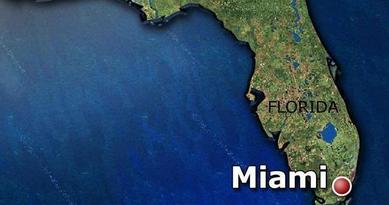
The F.B.I. on Saturday arrested three Pakistani-Americans, including father and son imams from South Florida mosques, charging them with providing financing and other material support to the Pakistani Taliban.
Related

Three people living in Pakistan were also charged in the indictment, which was made public by Wilfredo A. Ferrer, the United States attorney for the Southern District of Florida. The F.B.I. said that the indictment grew out of a review of suspicious financial transactions and other evidence and not from an undercover sting operation. The arrests seem to be unrelated to the raid that killed Osama bin Laden a week ago.

The four-count indictment charges that the six sought to aid the Pakistani Taliban’s fight against the Pakistani government and its allies, including the United States, by supporting acts of murder, kidnapping and maiming in Pakistan and elsewhere in order to displace the government and establish strict Islamic law known as Shariah.

“Today, terrorists have lost another funding source to use against innocent people and U.S. interests,” said John V. Gillies, the special agent in charge of the F.B.I.’s Miami office.

Five of the six people charged are related. Arrested in the United States were Hafiz Muhammed Sher Ali Khan, 76, of Miami; and two of his sons, Izhar Khan, 24, of Miami; and Irfan Khan, 37, of North Lauderdale.

Hafiz Khan is the imam at the Miami Mosque, also known as the Flagler Mosque. Izhar Khan is an imam at the Jamaat Al-Mu’mineen Mosque in Margate, Fla. Hafiz and Izhar Khan were arrested Saturday in South Florida, while Irfan Khan was arrested in Los Angeles. All three are originally from Pakistan.

The three people residing in Pakistan who were charged were Amina Khan, Hafiz Khan’s daughter, and Alam Zeb, her son, as well as Ali Rehman, also known as Faisal Ali Rehman. A statement from prosecutors said that the defendants were assisted “by others in the United States and Pakistan.”

The indictment said that the six transferred money to the Pakistani Taliban that was intended to buy guns and sustain militants and their families. Hafiz Khan is also accused of supporting the Pakistani Taliban through a madrasa, or Islamic school, that he founded and controlled in the Swat Valley region of Pakistan. He was charged with using the madrasa to provide shelter and other support for the Pakistani Taliban and sending children from his madrasa to learn to kill Americans in Afghanistan.

The indictment does not charge the mosques with any wrongdoing. The Muslim Communities Association of South Florida announced that that Hafiz Khan had been suspended indefinitely from his mosque.

“Our organizations, together through the Coalition of South Florida Muslim Organizations, has been working with the U.S. Attorney’s Office and the Miami F.B.I. office,” the association said in a statement released Saturday afternoon, “and appreciate the efforts of law enforcement to root out potential sources and supporters of terrorism.”

“We stand together with the U.S. attorney, Wilfredo Ferrer, and the men and women of the F.B.I., and have been and will be cooperating with law enforcement to our fullest ability,” it added.

The F.B.I. news release took pains to describe the charges as reflecting only the actions of the defendants, not of their mosques or Islam. “Let me be clear that this is not an indictment against a particular community or religion,” Mr. Ferrer said. “Instead, today’s indictment charges six individuals for promoting terror and violence through their financial and other support of the Pakistani Taliban. Radical extremists know no boundaries; they come in all shapes and sizes and are not limited by religion, age or geography.”

“The indictment does not charge the mosques themselves with any wrongdoing,” it continued, “and the individual defendants are charged based on their provision of material support to terrorism, not on their religious beliefs or teachings.”

The inclusion of those statements were “well appreciated” by the Muslim community in South Florida, said Asad Ba-Yunus, who is a legal adviser to the Muslim Communities Association of South Florida.

“We have been working with the U.S. attorney’s office over last few months” to improve relations, Mr. Ba-Yunus said, adding that he had spoken with the office Saturday morning before the indictment was announced.

The charges against the Florida men accusing them of supporting the Pakistani Taliban but not actually carrying out operations themselves are the most common types of terrorism prosecutions that United States authorities have pursued since the attacks of Sept. 11, 2001. Of the 50 leading terrorism cases since those attacks, about 70 percent have involved financing or other support to terrorist groups, according to the Center on Law and Security at the New York University School of Law.

The Pakistani Taliban were officially designated as a terrorist organization by the State Department on Aug. 12, 2010.

The Pakistani Taliban are closely allied with Al Qaeda, and is responsible for a series of attacks against Pakistani police and military targets in recent years. Pakistani authorities believe a splinter group of the Pakistani Taliban was responsible for the suicide attack in northwestern Pakistan on Friday that killed more than 80 cadets from a government paramilitary force. According to American officials, the Pakistani Taliban have been involved in or claimed responsibility for attacks on United States interests, including an attack on a military base in Khost, Afghanistan, along the border with Pakistan, and a suicide bombing against the consulate in Peshawar, Pakistan.

American officials say the failed attempt to detonate a car bomb in Times Square last May was developed and financed by the Pakistani Taliban. The convicted bomb plotter, Faisal Shahzad, contacted the Pakistani Taliban via computer to confer with handlers over what he had done, the government wrote in court papers in September.

Pakistanis for Peace Editor’s Note– As peace loving Americans of Pakistani descent, we are upset to hear that some members of the US Muslim community would want to do the great nation of the Unites States harm. If found guilty, we hope that they are severly punished and a message is sent to anyone else intending to do us harm. We commend the FBI and the Department of Justice in these arrests and in keeping the American homeland safe.

After Bin Laden Raid, Might US-Pakistan Cooperation Get Better?

By Howard LaFranchi for The Christian Science Monitor

The United States launched a drone strike targeting militants in the North Waziristan region of Pakistan Friday, raising tantalizing questions in the aftermath of Osama bin Laden’s death.

And does the drone strike suggest, despite official Pakistani protests to the contrary, that cooperation between the two countries not only continues but may in fact end up enhanced by Sunday’s operation, which was an embarrassment for Pakistan?

It was impossible to know if the strike, which reportedly killed at least eight suspected militants gathered in a house in North Waziristan, resulted from any information seized Sunday, since word of the strike came from Pakistani military officials.

But the drone attack appeared to bolster the argument, voiced by a wide range of regional and intelligence experts, that the US would be able to use Sunday’s raid to pressure Pakistani officials to side more unequivocally with the US in battling Islamist extremists.

Also on Friday, Yemeni officials reported that a drone strike there killed two Al Qaeda operatives.

Drone strikes have been a contentious issue in US-Pakistan relations. But it is also true that a considerable increase over the past year in US strikes inside Pakistan by the unmanned aircraft has not led to a breach in the bilateral relationship.

“It was proper for Obama not to publicly rub Pakistan’s nose in” the embarrassment of having bin Laden discovered in the country, says Paul Pillar, who now directs security studies at Georgetown University in Washington after a long career in US intelligence. “But in private, they owe us something…. We do expect more cooperation.”

That perspective is riding high in Washington – especially among those security analysts and former officials who consider the relationship with Pakistan, difficult as it is, too vital for the US to simply throw up its hands and leave.

If anything, the bin Laden operation should pave the way for the US to develop closer intelligence and military ties to Pakistan, says Pete Hoekstra, a former Republican congressman from Michigan and former chairman of the House Permanent Select Committee on Intelligence.

An advantage for the US coming out of the successful raid, he says, is that America looks competent and like it may be a good friend to have in the battle with extremism.

“For the people sitting on the fence, it’s like, ‘They [the US] may be really getting good at this, and maybe now is the time to make a decision to get closer,’” said Mr. Hoekstra, speaking Thursday at a discussion on Pakistan at the American Enterprise Institute in Washington.

Dov Zakheim, a former deputy Defense secretary under President George W. Bush, agrees that the enhanced US stature after the raid should be leveraged to win stronger cooperation from countries like Pakistan that have hedged their bets about America’s staying power.

The successful operation against bin Laden “tells the world we’re not a spent power, we’re not a declining power,” said Mr. Zakheim, speaking Tuesday at a Center for the National Interest forum in Washington. “There’s a message there about US military power that is terribly important.”

Few experts in the bilateral relationship believe that Pakistan knew absolutely nothing about bin Laden’s whereabouts. But Mr. Pillar of Georgetown guesses that in the end, it may be learned that Pakistani officials simply didn’t want to know about something that existed right under their noses.

“My guess is … there was no effort to try to find things out,” said Pillar, speaking at the National Interest forum. “My guess would be, it’s not a matter of [Pakistani Army Chief] Gen. [Ashfaq Parvez] Kayani or the head of the ISI [Pakistani intelligence agency] knowing who was in that compound – but more the inquiries to find out just never having taken place.”

Kayani this week warned the US that Pakistan would not tolerate another raid like Sunday’s. But similar categorical statements have been made before about US drone attacks, some officials and experts have noted – and the attacks continue, if Friday’s strike is any indication.

Despite the bluster at both ends about the US-Pakistan relationship, a difficult but essential partnership will continue because, with Al Qaeda still in Pakistan and the US still next door in Afghanistan, there is no alternative, some say.

“What’s the alternative strategy in regards to Pakistan? We can’t overreact; we can’t back off the relationship if you don’t have a new strategy,” says Hoekstra, addressing in particular members of Congress who are calling for reduced foreign aid and cooperation. “We’ve got enough relations in the world to worry about right now, rather than adding to the list.”

With Friends Like Pakistan…

By Manzer Munir for Pakistanis for Peace

Many people in Pakistan these days are wondering why their nation often finds itself on the wrong side of recent history. First, there is the continued and unjust imprisonment of a Christian Pakistani woman named Asia Bibi who has been languishing in jail for nearly two years. She has been given a death sentence for allegedly making derogatory remarks about the prophet Muhammad.

Then there was the killing of Salman Taseer, who was the then sitting governor of Punjab, Pakistan’s most populous province, by one of his own bodyguards for his outspoken support for Asia’s rights and her freedom. Instead of swift punishment and public outcry at his actions, the killer, Malik Mumtaz Hussain Qadri, was showered with rose petals by some cheering members of the bar association of Lahore when he came to the courthouse for formal charges of murder. Yes, members of the judiciary were cheering his unilateral action of murdering another human being simply for his support towards a condemned non Muslim woman’s rights.

You can only imagine the warped sense of logic and justice in a country where lawyers cheer the cold blooded murder of an innocent man whose only crime was to come at the aid of a condemned Christian mother of two children.

Fast forward to a few months later, the extremists managed to assassinate the only Christian member of President Asif Ali Zardari’s government when the Minister for Minority Affairs, Shahbaz Bhatti, was killed in a hail of bullets by unknown gunmen who then managed to escape on their motorcycle. Bhatti being a Christian as well as a minister in the government, had campaigned for the release of Asia as well as for the repeal of the blasphemy laws in Pakistan that at help promote a culture of state sanctioned hatred against religious minorities in Pakistan.

The culture of fear and hatred as well as violence against the religious minorities has progressively gotten worse along with the security situation inside the country in the last ten years. If there is anything that has been proven by some of these recent events in Pakistan, it is only that the country has become the undisputed global hotbed of extremism, fanaticism, and Islamic militancy in the Muslim world. It has now morphed into a country where the Wahhabi and Salafi fanatics have successfully used fear and hate to silence the majority moderate Barelvi and Sufi Muslims of Pakistan.

When powerful moderate voices like those of Bhatti and Taseer are silenced despite having heavy protection, how safe can the common man feel about his life if he chooses to speak up against the radicals within Islam? To kill someone is against Islamic belief at its core, unless it is done in self defense but you would be hard pressed to hear that view from the religious fanatics in Pakistan. They have justified killing others over many insane reasons such as making derogatory remarks about Islam or the prophet Muhammad. They also rationalize the killing of someone over a family’s honor, thus honor killings where often young women are killed if they are deemed to have brought dishonor to their family. These radical Islamists will even want someone dead for simply uttering disparaging remarks against Islam or its prophet. It is both ironic and hypocritical to see that the same derogatory remarks towards other figures such as Jesus, Moses, Abraham or other prophets of the Quran do not meet the same outcry nor receive the same impassioned response from the masses as when Islam or its prophet Muhammad are criticized.

The seeds of this current fanaticism fanning the flames of hatred were planted during an earlier conflict, this one involving the Soviets against an under matched adversary in Afghanistan. It was during this time in the ‘80’s when the Pakistani dictator, General Zia ul Haq, was in power and he accepted American aid from the Reagan administration in thwarting the threat from the 1979 Soviet invasion of neighboring Afghanistan. At the time, Pakistan’s ISI worked very closely with these “freedom fighters” waging what many thought was a just jihad against a communist foe who disallowed all religious worship. In fact, a good movie to rent right now to put some of these current events in perspective would be Charlie Wilson’s War starring Tom Hanks which details this era of Pakistan-US relations and cooperation against a common enemy in the Soviets.

The trouble now however is that in this current uneasy alliance between Pakistan and the US, there is not a common enemy, at least not as how it is viewed by many in Pakistan, which recently was polled to be the most anti-American nation in the world. Even though radical Islam and fanaticism is as much a threat to Pakistan’s sovereignty and prosperity as it is to the United States, India has always been seen as the big threat by its army and rulers. Pakistan has long seen Afghanistan as a country offering it strategic depth in any future wars with India. Thus, its interests in Afghanistan do not coincide with those of the United States.

The Pakistani media also constantly feeds a steady news diet of bombings by the Taliban/Haqqani network as well as any one of the other fill-in-the-blank militants groups seemingly operating freely from within its borders. There is also the regular news reports of US drone attacks and NATO actions in the AfPak region, as well as the all ubiquitous and constant threat faced from India, who is still seething from the Mumbai bombings in 2008, which were blamed on Pakistani trained terrorists. To further add insult to their injury, not a single leader of the Lashkar E Taiba has been convicted in Pakistan for the attacks in Mumbai that claimed 174 deaths and seriously injured several hundred others.

To the Indians, the perpetrator of their version of 9/11 is not an Arab from Yemen named Osama, but rather a whole nation state with whom it has fought three wars in 60 years and who is a long time sworn enemy with which it shares a long border. Too often it is rightly assumed by many that Pakistan will not act against Lashkar E Taiba and other openly anti-Indian militant groups because these groups are seen as a strategic asset for use against India. Only the fear of an all out nuclear war between the two nations by a trigger happy Pakistan placated India enough so that New Delhi did not immediately take military action against Pakistan after the Mumbai attacks.

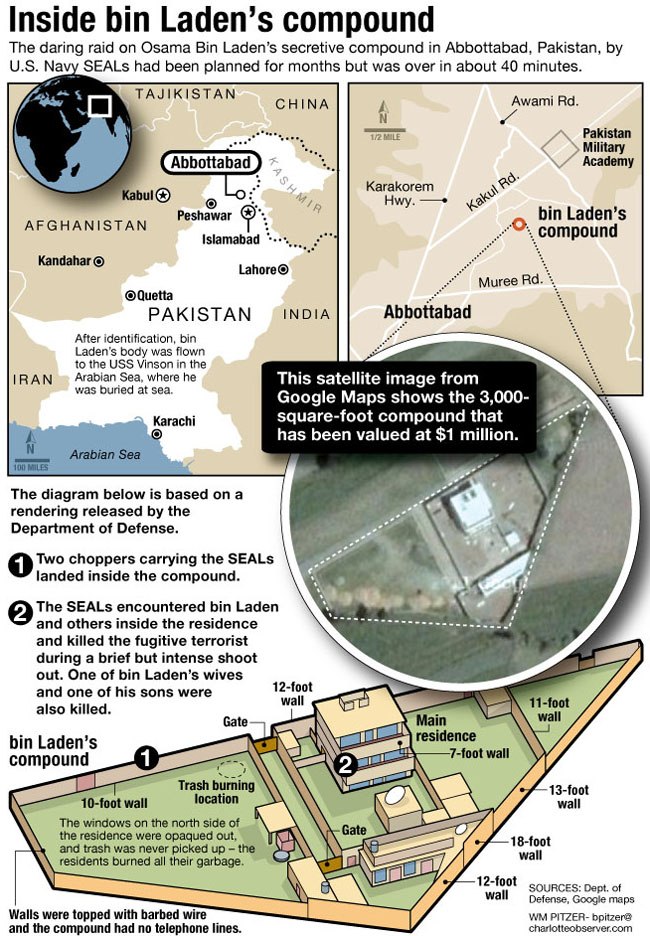
So this culture of fear from all enemies both foreign and domestic to Pakistan’s sovereignty is now at an all time high within the nation. With a several decade long war on its western border in Afghanistan as well as the constant threat from its arch enemy to the east in India, Pakistan has never felt more threatened or squeezed. This pressure is now only going to get ratcheted higher since last week’s killing of Osama Bin Laden at a compound in a suburb of Islamabad, Pakistan. Living for five years undetected in the compound, Bin Laden was less than a mile away from the Kakul Military Academy in Abbottabad, Pakistan’s version of the famed American military college of West Point, when he was killed by a US Navy Seal team.

For the world’s most wanted terrorist to hide in plain sight in such a manner and for so many years, rightly points a lot of suspicion on Pakistan. Long suspected by many intelligence analysts, elements within Pakistan’s spy agency, the ISI, naturally now attracts a lot of suspicion in their possible involvement in the whole affair. There are strong voices and calls within the US Congress to halt all aid to Pakistan in light of Bin Laden’s death. We certainly can assume that any other country in the world found to be harboring terrorists would already have been labeled a state sponsor of terrorism and would be facing immediate sanctions from the international community. “You are either with us or against us” were the words so famously uttered by then President Bush to Pakistan specifically after 9/11. But due to Pakistan’s importance for a successful pullout from Afghanistan of US troops, as well as its strategic position within the Islamic world, neither side can afford to cut off relations with each other.

Although the Obama administration stopped short of claiming that the corrupt civilian government of Zardari was directly involved in protecting and sheltering Bin Laden, all signs point to complicity to some extent by some segments within Pakistan’s hierarchy. There is near unanimous agreement among many in Washington, and this is true on both sides of the aisle, that there are many sympathizers of the Taliban and Al Qaeda within the ranks of the army and the intelligence agencies of Pakistan.

Having driven the Soviets out of the region with the help of militant jihadi groups like the Taliban, no doubt a cadre of army and intelligence officers must have come to espouse the belief that it is in Pakistan’s best interests to have a religiously frenzied force available to use as a weapon against India in a future conflict also. In fact, Pakistan has always had this policy of seeking strategic depth in Afghanistan against India.

The death of Osama Bin Laden in Pakistan by Special Forces of the American military illustrates just what a duplicitous game the country has been playing with the United States and more importantly with itself. In the war on terror America lost nearly 3,000 citizens in the attacks on 9/11. In that same period stretching the last ten years, Pakistan has lost nearly 31,000 citizens to terrorist attacks by the Taliban, Al Qaeda and other militant groups. So it has always been in Pakistan’s best interests to fight the militant threat brewing in its borders the last two decades that has claimed so many lives and caused so much instability.

The murders of Salman Taseer and Shahbaz Bhatti illustrates the dire situation within Pakistani society where many young underprivileged men gravitate towards Osama Bin Laden’s ideology of hate against the US, which is seen by many, as the aggressor in an already very anti-American country. Also western ideas, religious and political liberties, and freedoms, such as those for women in western society, are all seen by the Islamic clergy and religious establishment as being against Islamic doctrine and clashing with the Muslim way of life. Therefore, the madrassahs and the masjids continue to espouse rhetoric against the American and European way of life which is seen as contradicting the teachings of the Quran. Even moderate Muslims and their sites of worship have come under heavy attack by the militants as witnessed by a new strategy of attacking Sufi Muslim shrines and mosques. Pakistan may not want to admit it, but there is a raging war going on within itself for the control of Islam and the attack on moderate Islam by the extremists within the religion.

The Bin Laden killing makes Pakistan seem either highly incompetent about knowledge his whereabouts or at the very least appear to be deeply complicit in sheltering and keeping him hidden while the United States launched the biggest manhunt in US history. At this point, the United States justly feels betrayed and distrustful towards anyone in the Pakistani establishment. After all, how are they to know who now to trust in the army or the civilian government?

It is imperative that Pakistan mount an immediate and urgent investigation that has the full cooperation and assistance of the US so that both countries can discover the source of this support system that Bin Laden has had from within Pakistan. Certainly, some heads do need to roll in Islamabad over this. Whether those resignations be of the current ISI chief, Ahmad Shuja Pasha, head of the army, General Ashfaq Parvez Kayani, or Zardari and Gilani themselves, as some accountability needs to occur. This is important not just for the sake of American-Pakistani relations, but just as importantly for the benefit of the Pakistani populace who is both deeply embarrassed by breach of Pakistan’s sovereignty, but also for the intelligence failure by the government of Pakistan at Osama’s whereabouts. Until and unless Pakistan makes this investigation a top priority, USA and Pakistan relations will continue to slide downhill and will mire further in distrust.

Pakistan must realize that in this global war against religious Islamic fanaticism, it cannot continue to speak from both sides of its mouth. Not when everything, including its very existence is at stake. It cannot at once be both a front line ally in the war against terror and receive billions of dollars in US aid, and at the same time, be found to shelter or allow terrorists and militant organizations safe havens and allow them to operate within its territory.

It is up to Pakistan to salvage a quickly deteriorating situation. However at the time of publication of this article, it seems that President Asif Ali Zardari’s government is off to a horrible start in mending fences with the US. First the name and identity of the CIA station chief in Pakistan was leaked by someone in the ISI to members of the local press. This leak compromised his mission and even poses a danger to his life as the anonymity of all operatives is a necessary requirement in intelligence work.

Then later in the day, in remarks given by Pakistan’s Prime Minister Yousuf Raza Gilani to its Parliament, he defiantly stated that neither Pakistan’s army nor its intelligence agency should be suspected by the Obama administration for providing support to Bin Laden. Gilani also went as far as to say that any future unilateral action by the US or any other nation inside Pakistan’s territory will be met with like force. I thought to myself, did he really just that? Did Pakistan just threaten the United States? It is appalling to see the political posturing now being done by the Pakistani government and the long term negative consequences they will have on the nation.

For a country that is receiving nearly $3.5 billion in US aid yearly, these are very tough words that will undoubtedly only make the strained relations between the two countries worse. Pakistan should realize that United States wants to feel that it can trust it to be a full partner in the fight against militancy and extremism. And unless this distrustful and at times, very adversarial relationship changes, the United States cannot help but feel that with friends like Pakistan, it does not need enemies!

-Manzer Munir, a proud Pakistani American and peace activist, is the founder of Pakistanis for Peace and blogs at http://www.PakistanisforPeace.com as well at other websites as a freelance journalist and writer. 

Raid Sparks Question: Is Pakistan Doing Enough?

As Reported By CNN

The United States wants answers from Pakistan about how Osama Bin Laden could have lived in that country — near a major military base not far from the capital — without the government knowing.

The United States is asking Pakistan for information on who built and owned the compound where bin Laden lived, two senior U.S. officials said Wednesday. The United States also wants to know about security at the compound, in the city of Abbottabad.

Pakistani government officials have insisted that they did not know Bin Laden’s whereabouts. They reacted angrily to news that CIA Director Leon Panetta told U.S. legislators in a closed-door hearing that “either they (the Pakistanis) were involved or incompetent. Neither place is a good place to be.”

“What worse statement can come than that we heard from Panetta?” a senior Pakistani intelligence official said. “I am afraid this statement is totally regrettable. (Panetta) of all people knows how much we have been doing.”

The official, who did not want to be named, said his country had been generously sharing intelligence with their American counterparts.

“We have been sharing everything with them, but they have been selectively sharing with us,” the official said. “They are entirely dependent on what we provided them. Why were details (of the operation to kill bin Laden) not shared with us?”

Pakistan has argued that it has provided valuable intelligence information and worked with the United States to capture or kill numerous al Qaeda members and other Islamic extremists.

Yet the questions around bin Laden’s presence in Pakistan has exacerbated an already rocky relationship between the two nations.

Many Obama administration officials, lawmakers and observers from across the political spectrum want to know how bin Laden — based at a compound in the military garrison city of Abbottabad — could have eluded Pakistani capture, or whether the government or elements of it harbored bin Laden.

They want to know whether Pakistan is firmly backing the fight against terror or is supportive of militants fighting against troops in Afghanistan.

In Islamabad Tuesday, Marc Grossman, the special U.S. representative on Afghanistan and Pakistan, met with Pakistan’s president Asif Ali Zardari, the head of the ISI military intelligence Gen. Ahmed Pasha, and military chief Gen. Ashfaq Kayani. During that visit, which was scheduled before the killing of bin Laden, Grossman discussed the operation with the officials, the State Department confirms.

Those officials say the Pakistani officials expressed surprise that bin Laden was living at the compound and the U.S. officials tell CNN they are taking that at face value until more information is available.

The United States has a “complicated but important relationship” with Pakistan, White House press secretary Jay Carney said Tuesday.

Carney told reporters that U.S. officials need to learn more about the “support network” that sustained bin Laden in Pakistan. But he also warned against “tarring” everyone in Pakistan’s government because of the revelation that bin Laden had been living so close to Islamabad.

There has also been “a great deal of important cooperation” in the fight against Islamic extremism, he said. “The idea that these kinds of complications exist is not new.”

But Rep. Peter King, the New York Republican who is chairman of the Committee on Homeland Security, said “this can’t be allowed to go on.”

In comments Tuesday at a House subcommittee hearing on Pakistan, King noted that bin Laden’s compound was near a headquarters for the Pakistani intelligence services.

“There are two possibilities and one answer,” King said. “One is that it was a direct facilitation by elements of the Pakistani government, or Pakistani intelligence is entirely inept, and that has not proven to be the case over the years.”

According to two sources who were in the closed-door briefing with Panetta Tuesday on Capitol Hill, the CIA director echoed King’s concerns.

Panetta made clear, the sources said, that he and other administration officials are trying to get to the bottom of which it was — involvement or incompetence — on the part of the Pakistanis.

In an interview with TIME magazine, Panetta explained why the Pakistanis were not told of the bin Laden mission “It was decided that any effort to work with the Pakistanis could jeopardize the mission,” he said. “They might alert the targets.”

At King’s hearing, Seth Jones of the Rand Corporation told the panel that bin Laden’s presence in Pakistan showed that “at the very least, there has not been a high priority in targeting senior al Qaeda leaders” in the country.

“Based on the threat streams coming from this area, those interests have to change in my view,” Jones said. Another terrorism expert, Frederick Kagan of the American Enterprise Institute, said mistrust between the United States and Pakistan runs both ways, with Pakistani officials fearful that the United States will abandon the region after eliminating bin Laden.

“It is essential that we find ways not only to communicate our frustration to Pakistan,” Kagan said, but also to say “we’re not leaving.”

The United States has regarded Pakistan as a top ally in the fight against the Taliban, al Qaeda, the Haqqani Network and other Pakistan-based militants who have launched attacks against international and Afghan troops in Afghanistan. At Tuesday’s hearing, experts also identified Lashkar-e-Taiba as a major emerging threat from Pakistan to the Indian subcontinent and beyond.

According to the U.S. Government Accountability Office, the United States has provided $18 billion in foreign assistance and reimbursements to Pakistan, two-thirds of which are security-related.

The administration and lawmakers have praised the Pakistanis for their anti-terrorism efforts, but at the same time some lawmakers suspect the country hasn’t been robust enough in going after terrorists. Some say elements of Pakistan’s intelligence services — the Inter-Services Intelligence or ISI — have close ties with militants.

Sen. Dianne Feinstein, the California Democrat and chairwoman of the Senate Intelligence Committee, agrees that they have been “good at going after some terrorists” but have “very subtly walked both sides of the street.”

“That’s of concern to many of us, I think, because you have to declare yourself,” she told reporters, noting that the issue of Pakistan will be addressed by her committee.

Denis McDonough, who is President Barack Obama’s deputy national security adviser, told CNN that despite legitimate questions about what Pakistani authorities knew, the United States needed to maintain the relationship.

“We obviously recognize that nobody has sacrificed more in this war against al Qaeda than the Pakistanis,” McDonough said. “Al Qaeda had declared war, in fact, on the Pakistani government, have threatened and continues to threaten to try to get their hands on nuclear material in that country. … So they obviously have a lot at stake in this fight. So we’re going to continue to work with them and continue to try to partner with them against al Qaeda, because we recognize that it’s not only in our interests, but in their interests.”

Asked if the U.S. funding to Pakistan should continue, McDonough said such investments bolster U.S. security.

“We’ll continue to try to work with them to train, to try to target the common threat that we face from al Qaeda,” McDonough said, adding: “Nobody has greater concern about our ability to … carry out the fight against al Qaeda than the president. We’re going to continue to do that, either with our Pakistani friends or alone. But this is too big a fight for us to give it up.”

McDonough also said he agreed with the reported quote by Panetta that the United States decided not to share intelligence with Pakistan in the run-up to the Monday raid that led to bin Laden’s death because of fears of a leak. Sen. Richard Lugar, the top Republican on the Senate Foreign Relations Committee, also cited concern that some Pakistani officials might alert bin Laden.

“This is one reason we did not inform the Pakistanis of our actions,” Lugar said, while noting “there were probably many who were very uncomfortable about the presence likewise.”

The Pakistani government on Tuesday “categorically” denied reports that its leadership “had any prior knowledge” of the U.S. operation against bin Laden

One ISI official denied any complicity in hiding bin Laden, saying one failure and embarrassment doesn’t negate its “track record” of capturing more al Qaeda members than anyone else.

“Yes, we did fail to locate him. Yes, we are embarrassed. But that does not mean we are incompetent and straddling the fence,” the official said. “Had we known that OBL was there we would have raided it and handed him over to the U.S. to silence the critics talking about the complicity of the ISI.”

The United States is reviewing intelligence seized in the compound to determine whether bin Laden received support inside Pakistan, a senior U.S. official told CNN. This comes amid discussions in Washington over the extent of the Pakistani intelligence service’s knowledge of his whereabouts and whether it provided him sanctuary.

Lugar was asked in Washington why taxpayers should support money for Pakistan.

“It’s a very complex country. A very complex set of officials,” the Indiana senator said. “To try to obtain perfection in terms of who the recipients ought to be is out of the question. It’s a question of if there are goals we can achieve if we have some accountability of the money.”

Former Secretary of State Condoleezza Rice told CNN on Tuesday that Pakistan has been an “important partner in counterterrorism cooperation and we’ve had very important cooperation from them.”

But she questions how bin Laden could “hide in plain sight in that kind of compound without the knowledge of high-ranking officials.”

“We have captured many, many al Qaeda operatives in Pakistan, including Khalid Sheikh Mohammed, so Pakistan has been a cooperating counterterrorism partner,” Rice said, making reference to the mastermind of the 9/11 attacks. “But everyone knows that there are elements within Pakistan that are still tied to extremism, that has been a concern, and it is very important now that the Pakistanis take a hard look at how this possibly could have happened,”

Mark Quarterman, director of the Program on Crisis, Conflict, and Cooperation at the Center for Strategic and International Studies and an expert on Pakistan, said there have been strong differences between Washington and Islamabad over U.S. drone strikes in the tribal region and calls to remove CIA operatives in the country. The bin Laden operation and the issues surrounding it add to the tension, he said.

“I would not be surprised if there are questions on Capitol Hill about continued level of support to Pakistan, about the U.S. relationship with Pakistan and the consideration of the nature of that relationship and how we handle it going forward,” he said.

The Pakistan government and the ISI supported the Taliban when it controlled Afghanistan during the 1990s, but the government broke ties with the Taliban after the 9/11 attacks. American officials have consistently indicated that there are rogue ISI elements supportive of militants.

One reason Pakistanis also have supported militants in the tribal region is that the fighters are seen as serving as a bulwark for Pakistani interests. That includes a focus against the influence of longtime rival India in Afghanistan, Quarterman said.

“The Pakistanis are hedging their bets,” he said. “They know the United States isn’t there to stay.”

Jamie Metzl, executive vice president of the Asia Society, said the onus will be on Pakistan to do a thorough investigation to assess what happened with bin Laden.

“If Pakistan denies any official involvement with bin Laden, it will be difficult to prevent a backlash among members of the U.S. Congress who will believe that Pakistan is playing a double game,” Metzl said.

Metzl also says Pakistan’s fear is that India will increase influence in Afghanistan and surround Pakistan, and that calculation has led Pakistan to keep militants under its sway.

Mike Rogers, a Michigan Republican who is chairman of the House Select Intelligence Committee, said Pakistan and the United States have “a very funny relationship.”

Pakistan dispatched “troops into the tribal areas at our request” and “took thousands and thousands of casualties trying to fight Taliban and al Qaeda elements,” Rogers said on CNN’s “American Morning.”

“There are some concerns about their ISI being penetrated, their intelligence services being penetrated, but at the same time,” he said, “we’ve got to have them.”


-CNN’s Joe Sterling, Jill Dougherty, Elise Labott, Zain Verjee, Ted Barrett, Elise Labott, Alan Silverleib, Tom Cohen and Nick Paton Walsh contributed to this report

Pakistan’s president denies harboring bin Laden

By Nahal Toosi and Zarar Khan for The Associated Press

Pakistan’s leader denied suggestions that his country’s security forces sheltered Osama bin Laden as Britain demanded Tuesday that Islamabad answer for how the al-Qaida chief lived undetected for six years in a large house in a garrison town close to the capital.

But in a nod to the complexities of dealing with a nuclear-armed, unstable country that is crucial to success in the war in neighboring Afghanistan, British Prime Minister David Cameron said having “a massive row” with Islamabad over the issue would not be in Britain’s interest.

A day after U.S. commandos killed bin Laden, reporters were allowed within the 15-foot, barbed-wire-topped walls of the compound for the first time. But the doors of the house were sealed shut and police were in no mood to open them.

Local residents showed off small parts of what appeared to be a U.S. helicopter that Washington said malfunctioned and was disabled by the American strike team as they retreated. A small servant’s room outside the perimeter showed signs of violent entry and had been briskly searched, clothes and bedding tossed to the ground. Its wall clock was on the floor, the time stuck at 2:20, when the U.S. team would have been on the ground in the early hours of Monday.

Asif Ali Zardari’s comments, in a Washington Post opinion piece Monday, were Pakistan’s first formal response to suspicions raised by U.S. officials and others. Those suspicions could further sour relations between Islamabad and its Western backers at a key point in the war in Afghanistan.

Bin Laden was killed close to a military academy in the bustling northwestern town of Abbottabad, not in the remote Afghan border region where intelligence assessments had assumed he had been holed up. That was quickly taken as a sign of possible collusion with the country’s powerful security establishment, which Western officials have long regarded with a measure of suspicion despite several notable al-Qaida arrests in the country since 2001.

“Some in the U.S. press have suggested that Pakistan lacked vitality in its pursuit of terrorism, or worse yet that we were disingenuous and actually protected the terrorists we claimed to be pursuing. Such baseless speculation may make exciting cable news, but it doesn’t reflect fact,” Zardari wrote.

Ties between the two nominal allies were already strained amid U.S. accusations that the Pakistanis are supporting militants in Afghanistan and Pakistani anger over American drone attacks and spy activity on its soil. They came to head in late January after a CIA contractor shot and killed two Pakistan’s, in what Washington said was self-defense.

Senior U.S. officials did not directly accuse Pakistan of collusion, but made it clear they had concerns.

“People have been referring to this as hiding in plain sight,” Obama’s counterterrorism chief John Brennan told reporters Monday. “Clearly, this was something that was considered as a possibility. Pakistan is a large country. We are looking right now at how he was able to hold out there for so long and whether or not there was any type of support system within Pakistan that allowed him to stay there.”

Lawmakers were more direct.

U.S. Senate Armed Services Committee Chairman Carl Levin said Pakistan’s intelligence and army have “got a lot of explaining to do,” given that bin Laden was holed up in such a large house with surrounding buildings, the fact that its residents took the unusual step of burning their garbage and avoiding any trash collection.

“It’s hard to imagine that the military or police did not have any ideas what was going on inside of that,” Levin said.

Cameron, who has also made supporting Pakistan a major foreign policy commitment, echoed those concerns.

“Those are questions we have to ask, those are questions we will want answered and we will be asking that question of everyone in Pakistan and the Pakistani government,” Cameron told BBC radio before acknowledging the West’s limited leverage against Islamabad.

“We could go down the route of having some massive argument, massive row with Pakistan, but I assess our relationship with Pakistan and it is my very clear view that it is in out interests to work with the government and people of Pakistan to combat terrorism, combat extremism and help development in that country.”

Suspicions were also aired in many Pakistan’s media and on the street Tuesday.

“That house was obviously a suspicious one,” said Jahangir Khan, who was buying a newspaper in Abbottabad. “Either it was a complete failure of our intelligence agencies or they were involved in this affair.”

Pakistan’s security establishment has yet to explain how bin Laden was able to live there undetected, and given that it is rarely transparent about what it does, it might never do so. Asked about the raid, Pakistani Foreign Secretary Salman Bashir said it was time to move on.

“The issue of Osama bin Laden is history and I think we do now want to keep ourselves mired in the past,” he told reporters.

U.S. officials have said that Pakistani officials were not told about the early morning helicopter raid until the strike team had killed bin Laden had returned to Afghanistan from where they took off from, citing security reasons.

Many Pakistanis were surprised at how this was possible, especially when initial reports stated that the choppers took off from a Pakistani air base. Some were angry that the country’s sovereignty had been violated — an especially sensitive issue given the unpopularity of America here.

Zardari said it “was not a joint operation” — the kind of which has been conducted in the past against lesser terror suspects in Pakistan — but that Pakistani cooperation, in a general sense, had helped lead them to bin Laden.

“A decade of cooperation and partnership between the United States and Pakistan led up to the elimination of Osama bin Laden as a continuing threat to the civilized world,” he said.

President Barack Obama also said the country’s anti-terror alliance had helped in the run-up to the operation, but did not thank Pakistan when he announced the death of bin Laden.

The death has raised fears of revenge attacks, both in Pakistan — which has seen hundreds of suicide attacks by al-Qaida and its allies since 2007 — and internationally. The U.S Embassy said its missions in Pakistan would remain closed to the public until further notice.

Osama Bin Laden Hunted Down And Killed By US

By Brad Norington for The Australian

Bin Laden was killed in Pakistan and his body retrieved by a US strike team nearly 10 years after the September 11 terror attacks on the World Trade Centre in New York and the Pentagon killed more than 3000 people.

Announcing “justice has been done”, Mr Obama said bin Laden had been found hiding in Pakistan and a targeted operation launched today by a small US team.

“After a firefight they killed Osama bin Laden and took custody of his body,” Mr Obama said, adding that no Americans were harmed in the assault.

“The death of bin Laden marks the most significant achievement to date in our nation’s efforts to defeat al-Qa’ida,” the President said. “His demise should be welcomed by all that believe in peace and human dignity.

“It’s important to note our counter terrorism cooperation with Pakistan helped lead us to bin Laden and the compound where he had been hiding.” “Yet his death does not mark the end of our effort.

“There is no doubt that al-Qa’ida will continue to pursue attacks against us. “We must and will remain vigilant at home and abroad.”

Despite the decade that has elapsed since the September 11 attacks, the event, one of the most traumatic in US history, still stirs raw emotions, and his demise will be celebrated across the United States.

Chants of “USA, USA” rang out from tourists outside the White House as the news of bin Laden’s death sent an electric charge through Washington.

Hundreds of people gathered outside the fence of the presidential mansion and sang the US national anthem and started shouting and cheering. Mr Obama said the United States people understood the cost of war, but would not stand by if threatened.

“As a country we will never tolerate our security being threatened nor stand idly by when our people have been killed,” he said. “We will be relentless in defence of our citizens and our friends and allies.

“We will be true to the values that make us who we are. “And on nights like this one we can say to those families who have lost loved ones to al-Qa’ida terror, justice has been done.”

The location of bin Laden and his family confirms recent speculation that he was hiding in comfortable surroundings and close to civilisation, not in the remote mountains dividing Pakistan and Afghanistan.

US armed forces have been hunting the Saudi terror kingpin for years, an effort that was redoubled following the 2001 terror attacks on the World Trade Centre in New York and the Pentagon which killed 3000 people. But bin Laden always managed to evade US armed forces and a massive manhunt.

The death of bin Laden will raise huge questions about the future shape of al-Qa’ida and also have steep implications for US security and foreign policy 10 years into a global anti-terror campaign. It will also raise fears that the United States and its allies will face retaliation from supporters of bin Laden and other Islamic extremist groups.

Osama bin Mohammed bin Awad bin Laden was a member of the wealthy Saudi bin Laden family and the founder of the jihadist organisation al-Qa’ida, most widely recognised for the September 11 attacks on the US and numerous other mass-casualty attacks against civilian and military targets.

As a result of his dealings in and advocacy of violent extremist jihad, bin Laden lost his Saudi citizenship and was disowned by his billionaire family.

Bin Laden evaded US capture in Afghanistan after the 9/11 attacks and since then he and his organisation have been major targets of the US war on terror.

Bin Laden and fellow al-Qa’ida leaders are believed to have been hiding near the border of Afghanistan and Pakistan, in tribal areas that lie outside government control.