Posts Tagged ‘ Asif Ali Zardari ’

Pakistan Power Shortages Keep Growth Prospects Dim

By Alex Rodriguez The Los Angeles Times
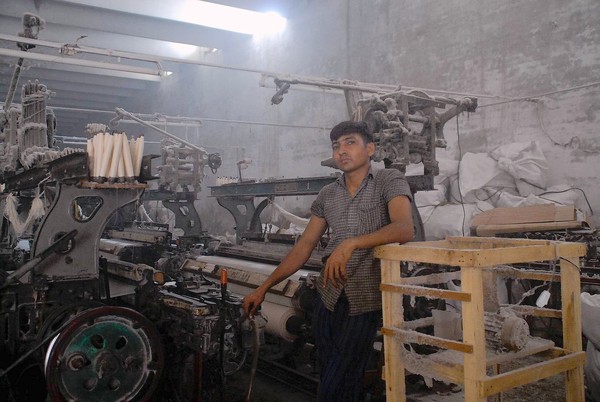
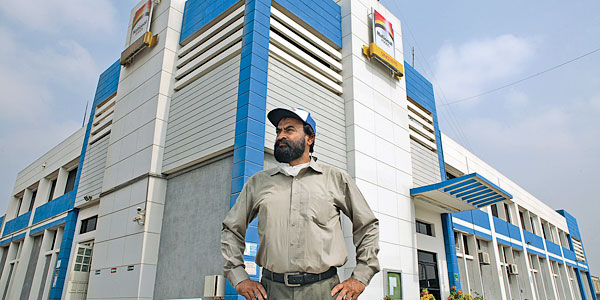
The machine operators lean back lazily on rolls of cotton fabric, shooing flies from their sweat-soaked tunics as their boss, Abdul Latif, paces between rows of silent electric looms covered in lint.

The textile plant owner knows it’s just one of several rolling blackouts that will darken his plant today, as they have every day for four years. Along his street, other textile plants have either closed or begun selling their looms for scrap. Latif scrapes by, but the outages have cut his plant’s output in half.

“The situation is very bad,” Latif says. “We’re losing contracts because of these outages. We can’t deliver on time. If it continues like this, we may have to shut down.”

One of Pakistan’s biggest scourges has nothing to do with suicide bombers or militants wielding Kalashnikov assault rifles. Because the country cannot produce the electricity needed to support a population of 177 million, the government intentionally shuts down power in staggered intervals, often for hours at a time.

The rolling blackouts are most frequent during the summer, when the whir of air conditioners in 100-plus-degree heat boosts demand for power. Apart from districts with top government and military offices, virtually every neighborhood and village suffers.

The stopgap policy prevents the country’s moribund economy from getting off the ground. And as long as the economy sputters, millions of Pakistanis remain mired in poverty and joblessness, leaving the country’s disaffected youth vulnerable to recruitment by Islamist militant groups.

President Asif Ali Zardari’s government has given Pakistanis little reason to hope for a solution anytime soon. This summer, government officials said that it would take at least seven years to build up the electricity generation capacity needed to eliminate the blackouts.

Various factors explain Pakistan’s power woes. During Gen. Pervez Musharraf’s rule from 1999 to 2008, strong economic growth fueled an upsurge in consumer spending that had Pakistanis flocking to stores to buy air conditioners, refrigerators and other appliances. But Musharraf failed to pump money into boosting generation capacity to keep up with demand and the country’s booming population.

Zardari inherited the massive gap between supply and demand, but his cash-strapped administration hasn’t moved fast enough on hydroelectric dam projects and has yet to shore up the country’s aging distribution network.

Other factors make the situation even worse. About 15% of the electricity generated is lost to theft, says Ejaz Qureshi, a spokesman for the state-owned Pakistan Electric Power Co. In addition, the government often fails to pay its bills to private power producers, which means those companies can’t buy sufficient fuel for their plants. At times, they cut off electricity to the offices of government agencies that owe them money.

The havoc wrought by the shortfall is particularly acute in the country’s textile industry, a pillar of Pakistan’s fragile economy.

Faisalabad, Pakistan’s third-largest city and home to its textile sector, has seen 200 of its 4,000 textile plants close in the last three years because of the blackouts, says Wahid Raamay, chairman of the city’s Council of Loom Owners and a plant owner.

During that period, 100,000 workers have been laid off, about 10% of the city’s textile work force, Raamay says.

Plant owners forced out of business face a grim future. In a country where many people distrust banks, many plant owners sell their personal property — gold, jewelry, cars — to buy the machinery needed to start the business. If their plants close, they may find themselves at rock bottom.

“They all used to have good cars, good homes, and now everything has disappeared,” Raamay says. “Now they ride motorcycles to get around.”

Five months ago, Malik Mohammed Kashif was forced to shut down his plant, lay off 80 workers and sell his 66 looms to scrap dealers.

On a sun-baked afternoon, Kashif strolls through his darkened, empty building and winces as he speaks of the future.

“As for me, I’m finished,” says Kashif, a 30-year-old father of four. “With the shutdown, we lost $350,000, nearly everything we had. We’re at the bottom now because of this.”

This summer, public anger over ceaseless power outages boiled over. In Mianwali, in Punjab province, throngs of demonstrators calling for a stop to the outages clashed with baton-wielding police in early July. Two people were killed and 22 were injured. In Karachi, four people were killed during protests and work stoppages in early June that brought sections of Pakistan’s largest city to a standstill.

In Faisalabad, the extent of blackout-induced layoffs in the textile industry has reached the point that plant owners often work the looms alongside their laborers.

At Latif’s plant, workers paid by the hour say the outages cut their already meager wages in half. Machine operator Mehmood Hussain makes $4.65 a day when the blackouts don’t occur and $2.32 when they do. For a family of seven reliant on his income, the difference is huge.

“It’s a critical situation now,” Hussain says. “We can’t buy decent food or buy clothes for ourselves. And there’s no way out. Looms are all we know.”

One group, however, prospers from the textile industry’s misery: the scrap dealers. Their stalls on the edge of the city are filled with grease-covered gears and flywheels stacked next to piles of wooden rollers and spool holders.

Dealer Mohammed Sharif says he sometimes buys up to 100 looms a day, paying just $290 for machines that cost plant owners $1,500.

“When the textile plants suffer, our business booms,” Sharif says. At the same time, he knows the scavenging can’t last indefinitely.

“If looms continue to shut down at this rate, a day will come when we won’t have any business at all. What will we do then?”

Noting that three in four terror suspects are acquitted in Pakistan, the United States has doubts its key ally would make any headway in prosecuting key plotters of 2008 Mumbai terror attacks.

“The accused in numerous high-profile terrorism incidents involving US victims had all been acquitted by the Pakistani legal system,” US State Department noted in its 2010 Country Reports on Terrorism, published last week.

“The Federal Bureau of Investigation has assisted with the respective prosecutions,” the report said. FBI had assisted India in the investigation of the Mumbai terrorist attack as six Americans were among the 166 victims.

The report found that while Pakistan maintained it was committed to prosecuting those accused of terrorism, a study of its Anti-Terrorism Court’s rulings last year disclosed “that Pakistan remained plagued by an acquittal rate of approximately 75 per cent”, and a legal system “almost incapable of prosecuting suspected terrorists”.

It complained that a new anti-terror bill, which would allow its security agencies to hold suspects for 90 days before bringing them to court and give them a freer hand to use electronic surveillance had not progressed in the country’s National Assembly.

Although Islamabad had increased pressure on money-launders and unofficial ‘hawala’ money transfer agents, “deficiencies remained,” the report found.

“Notably, the criminalisation of the financing of terrorist acts committed against foreign governments and international organisations was ambiguous, as was the criminalisation of financing groups that have not been explicitly banned by the government or designated by the UN,” it stated.

Pakistan’s “weak implementation” of a UN Security Council resolution which lists banned terrorist organisations remained a concern.

The report also criticises Islamabad’s failure to outlaw militant Islamic terror groups which escape bans by changing their names.

China launches communications satellite for Pakistan

As Reported by The South Asian News Agency

The year 2011 marks 60 years of diplomatic relationship between China and Pakistan. This all-weather relationship has largely withstood ‘the test of time’.

Both states recognize the relevance of their cooperation in areas like security, trade and culture. All these years China has mostly followed the ‘friend of Pakistan policy’. From the Indian perspective the focus of their cooperation, which has mostly revolved around security issues, has been a source of anxiety. Apart from the question of direct military aid, India must also take note of China’s assistance to Pakistan in the field of science and technology as well since it has long-term strategic implications. China launched Pakistan’s first communications satellite (PAKSAT-1R) on August 12, 2011 on a Long March-3B carrier rocket. This event demonstrates the deepening in technological cooperation between these two states. For China this was also an event to display the capabilities of its rapidly growing commercial satellite industry.

Over the years Pakistan has largely demonstrated a copycat syndrome (with reference to India) as far as programmes of strategic importance are concerned. Pakistan’s technological and industrial base is not well-established in comparison with India. Therefore, to match India, Pakistan has relied on foreign (overt or covert) help. In certain cases Pakistan also developed underground networks to ‘manage’ hardware/technology. However, Pakistan’s investments in space technologies have been minimal. This is somewhat surprising particularly, because it has a reasonably well-developed missile programme which, in fact, could have helped at least partially to build up an indigenous space programme.

Pakistan’s lack of interest in space technology could be due to three reasons. Firstly, the Pakistani focus on long-term investments in technology has predominantly been military specific over the years. The use of technology for social, educational and scientific needs was not the prime focus. Secondly, Pakistan appears to have failed to anticipate the long-term strategic importance of space technologies. What is more surprising is the failure to understand the importance of space technologies particularly, in the background of the country’s nuclear ambitions. Thirdly, because of superfluous investments in military hardware, Pakistan was unable to make investments in space technology. Also, the state appears to have failed to realise the future commercial relevance of a space programme.

Against this backdrop the launch of the made in China PAKSAT-1R with 30 transponders for the purposes of communications services marks a new beginning. This satellite would take care of broadband Internet, telecom and broadcasting services. It is expected to cover South Asia, Europe, West Asia and eastern Africa and is also likely to help in weather monitoring. Being a communication satellite its dual-use nature could offer strategic defence applications as well. Pakistan has been collaborating with China in the space arena since the 1990s. Its first satellite Badr-1 was launched by China on July 16, 1990 (on a Long March 2E rocket). However, during the span of the last two decades, Pakistan’s space programme has not made any significant progress baring two more satellite launches with outside help. Pakistan’s space agency called Space and Upper Atmosphere Research Commission (SUPARCO) was established in 1961 as a committee. It was upgraded into a Commission in 1981. But it has failed to make any significant progress.

The August 2011 launch of a communication satellite opens a new chapter in Pakistan’s space history. Today, Pakistan has no launch vehicle of its own to launch satellites of any type. It has a long way to go in developing expertise in this arena as well as in satellite manufacture though the very first satellite was developed indigenously. Pakistan also needs to invest in the development of Spaceport and ground stations. All this will take time and its dependence on China is expected to increase in coming years.

Since their border settlement pact of March 3, 1963 the relationship between these two neighbours of India has been steadily growing. In the field of space there was a pause for almost two decades particularly, in the high-end projects like satellite launches. However, during these years a certain degree of collaboration was underway for personnel training and infrastructure development. Pakistan’s inadequacy in the space field offers China an opportunity to take their strategic partnership to a higher plane and also simultaneously maintain its own commercial interests.

For the last couple of years China has been using space technology to further its geopolitical as well as commercial interests. Now, Pakistan offers it an opportunity to use space engagement for strategic purposes as well. China has begun to help states like Nigeria and Venezuela with their satellite programmes. Also, recently China signed a deal with Bolivia for building and launching a satellite. In comparison with the western space agencies, China offers better commercial deals. Also, China has earned a prestige for its space programme with various successful space launches. Naturally, various developing states in the world are looking towards China.

China’s space programme is surging ahead at a much faster rate than India’s. Pakistan’s space programme is likely to remain in infancy for some more time to come. However, nuclear Pakistan is likely to pursue its space agenda (with China’s help) with more vigour in the future. On the military front, it is bound to benefit from various Chinese programmes like the navigational programme (COMPASS constellation). India needs to look at these developments seriously. Till date Pakistan’s space capabilities were probably not factored into India’s strategic planning, but that must change

Pakistan May Be Standing in Way of Polio’s Eradication

By Uri Friedman for The Atlantic Wire

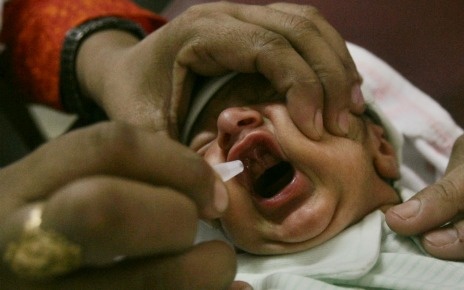
Several Pakistani news outlets today are dissecting a troubling finding from the U.N. Children’s Fund: the 63 cases of polio diagnosed in the country so far this year are nearly double the 36 detected during the same period last year. The highly contagious viral disease, which attacks the nervous system and can cause paralysis or even death, is most evident in the province of Balochistan and has now spread to other areas that haven’t been infected for the past five years. The U.N., which is trying to eradicate the disease by delivering oral vaccines to children, says that these findings suggest Pakistan could be the “last polio reservoir worldwide”–the country standing in the way of eliminating only the second global epidemic disease after smallpox.

This isn’t the first time Unicef has made the claim. In a 2003 report, for example, the organization called Pakistan “polio’s last frontier.” But what’s particularly troubling now is that while the number of cases is dropping in India, Nigeria, and Afghanistan–which, along with Pakistan account for over 90 percent of cases–the disease is spreading in Pakistan (in fact Pakistani President Asif Ali Zardari has declared polio a national emergency). Pakistan’s Express-Tribune cites administrative blunders, resistance of local populations, security challenges for vaccination teams, and Pakistan’s proximity to polio-infected Afghanistan as reasons why the country appears to be losing a battle against polio that “we can simply not afford to lose.” Other reports say anti-vaccine messages from radical clerics and the absence of a national ministry of health are also to blame. The recent revelation that the CIA set up a fake vaccination program in Pakistan to collect DNA from Osama bin Laden’s family members, Reuters notes, may only make immunization drives more difficult.

All that being said, Pakistan isn’t the only obstacle preventing the international community from finally eradicating polio. In an April report, the Global Polio Eradication Initiative announced that the project, which was launched by Unicef and other organizations, didn’t have the funding necessary to reach its goal of stamping out the last remnants of the disease by 2012. The report also noted that polio had reappeared in four disease-free countries–Chad, Angola, Democratic Republic of Congo and South Sudan–and called the state of Kano in northern Nigeria, where rumors were circulating that the polio vaccine would sterilize children, “a smouldering risk that could yet undermine the whole eradication effort.”

How to Succeed in Business in Pakistan

By Naween Mangi for Bloomberg Businessweek

Muhammad Azhar Ali, factory manager for National Foods in Karachi, Pakistan, has a set work routine. At dawn he calls his production managers, who live in different parts of this sprawling city of 18 million on the Arabian Sea, to find out whether outbreaks of violence have rendered any areas dangerous.

If conditions seem especially risky, Ali slips two wallets into his pocket—one real and the other filled with expired credit cards and loose change, ready to hand over if bandits hold him up. He’s been held up once. He checks to make sure he isn’t riding in the same car as the day before, usually shunning his company-provided Toyota Corolla (a favorite vehicle for Pakistan’s upper-middle class) for his own less conspicuous Suzuki Cultus hatchback.

Finally, Ali and his driver head out to meet the 15 buses that have picked up employees at different collection points. Once all the buses have assembled at the rendezvous, Ali leads the convoy 50 kilometers from the city center to National Foods’ main plant. When the convoy arrives at 7:45 a.m. after a 90-minute drive, the workers line up outside a boundary wall topped with barbed wire and go through a body search as guards armed with shotguns look on. Ali monitors the security check on closed-circuit television from his office. The workday is about to begin. He has been up for more than three hours.

“Anyone else in my position in another country would have half the work I do,” says Ali, 49, who has worked at the company, Pakistan’s largest maker of spices and pickles, for over 25 years. “If I didn’t have to spend so much time figuring all this out, I would be looking at ways to enhance productivity.”

Companies across Pakistan’s industrial heartland are struggling to cope with rising insecurity, incessant power outages, and government corruption and inefficiency. Pakistan has lost 35,000 civilians in terrorist attacks since 2006. The war on the Taliban has cost $68 billion in destroyed infrastructure, higher security costs, lost foreign investment, and more.

Karachi has suffered retaliatory attacks from the Taliban such as the 16-hour siege at a naval air base in May that left 10 guards dead. Firefights erupt almost daily between the followers of Pakistan’s numerous political parties. Gunmen killed 664 people in the city between Jan. 1 and June 30, according to the Edhi Foundation, a charitable operator of ambulances. A Karachi resident is almost three times more likely to be killed by a bullet than in a road accident.

Gun battles lead to factory shutdowns in the city almost every month. The government hopes to boost economic growth from 2.4 percent in the last fiscal year to 4.2 percent this year. Growth needs to be 7 percent or more to accommodate all the young people joining the workforce. Large-scale manufacturing contracted 2.3 percent in May, vs. a year ago. Only 1.5 million of 180 million people pay taxes. Many of National Foods’ rivals pay no taxes as they sell unbranded spices bulked up with brick dust. “Working in Pakistan is like always being in a nightmare,” says Abid Muhammad Ganatra, director of finance for the nation’s biggest cement maker, Lucky Cement, in Karachi. “We have to work constantly to mitigate the pressures, to develop strategies to ensure growth. That’s why top management usually has sleeplessness.”

Some companies still manage to grow. At publicly traded National Foods, sales rose 23 percent to 7.4 billion rupees ($81 million) in the fiscal year ended June 30. In the company’s first year, in 1970, revenue was only 5,000 rupees. “Back then, it was a one-room operation where red chili, coriander, and turmeric were manually ground,” says Shakaib Arif, chief operating officer. “Now we make 60 million packets a year with 2,000 employees.”

Political violence is not National Foods’ worst problem. “The biggest challenge by far is energy,” says Arif, 38. Demand for electricity in Pakistan is three times supply. President Asif Ali Zardari is trying to attract independent power producers to Pakistan and has big plans to build hydroelectric plants.

Companies cannot wait. “We have created a mix of power we get from the grid, and what we can generate using our gas and diesel generators,” Ali says. “It costs three times as much to produce the power through generators.” Many factory floor, office, and bathroom lights are kept off to compensate. Ali often visits the powerhouse, a room at the plant that contains huge German-made diesel generators. Scarcity of fuel is a frequent worry. Bigger companies like Lucky Cement don’t rely on the national grid at all. It started generating its own power in 1996 and can produce 150 megawatts from its plants.

Karachi’s residents have taken to the streets this summer, burning tires and disrupting traffic to protest outages lasting days at a time. “In the morning I assess my workers,” says Sajjad Farooqi, who supervises National Foods’ weighing department. “If I find someone is stressed out because he hasn’t slept all night without electricity or that inflationary pressures are causing strain in his family, I have to change his shift and give him easier work.” Inflation averaged 15.5 percent over the last three years because of rising food and energy prices as well as record government borrowing.

National Foods tries to attend to the cultural and economic needs of its workers. A subsidized canteen sells a meal of curry and flatbread for as little as 25 rupees, while a prayer room accommodates 200. Separate working areas exist for women, an unusual perk in a Pakistani factory. Adult literacy classes are available. “We have to provide workers with incentives because they are facing a lot of pressures,” says Khalid Mahmud, who oversees 175 workers in the pickling operation. “Every month I give my most productive worker two T-shirts, 1,000 rupees, and take them to dinner. These prize winners are then keen to help us out when less workers show up and we need to meet production targets.”

The company joined 13 other factories earlier this year to hire a security patrol. A driver, a supervisor, and three armed agents patrol the streets from 7 p.m. to 7 a.m. in an open jeep, stopping at each factory to ensure the guards are not asleep. “We have to plan knowing we are in a war zone,’’ says National Foods Chairman Abdul Majeed. Last year the company was warned by the Karachi police that Taliban fighters had entered the city and were looking for factory jobs to support themselves and their families until they returned to battle. National Foods stepped up its screening and referral process.

The country’s lack of security takes its toll. “Every time I stop at a light, I look around me and think a gunman is about to come,” says Arif, who drives in a small car when visiting the Karachi factory. “I’ve already been held up three or four times.” Ali, the factory manager, has his own way of handling the tension. “When I get into the car in the morning, I close my eyes and rest. I don’t want to know if any gunman is coming. I let my driver take all the stress.”

The bottom line: Violence and energy shortages strain Pakistan’s economy, which is expected to grow 4 percent this year, well below India’s 8 percent rate.

Obama, Zardari Discuss Strained US-Pakistani Ties

As Reported by The Voice of America

U.S. President Barack Obama called his Pakistani counterpart, Asif Ali Zardari, Wednesday to discuss strained bilateral relations and the situation in the region.

A Pakistani statement said the two leaders agreed to take appropriate action to repair the ties between Washington and Islamabad on the basis of mutual respect and mutual benefit.  It also said President Obama appreciated Pakistan’s effort in the fight against militancy.

President Zardari said the fight against extremism was in Pakistan’s own interest and that it had to fight it to the finish.

The two presidents also agreed on “regular contacts and interaction at appropriate levels for the resolution of issues.”

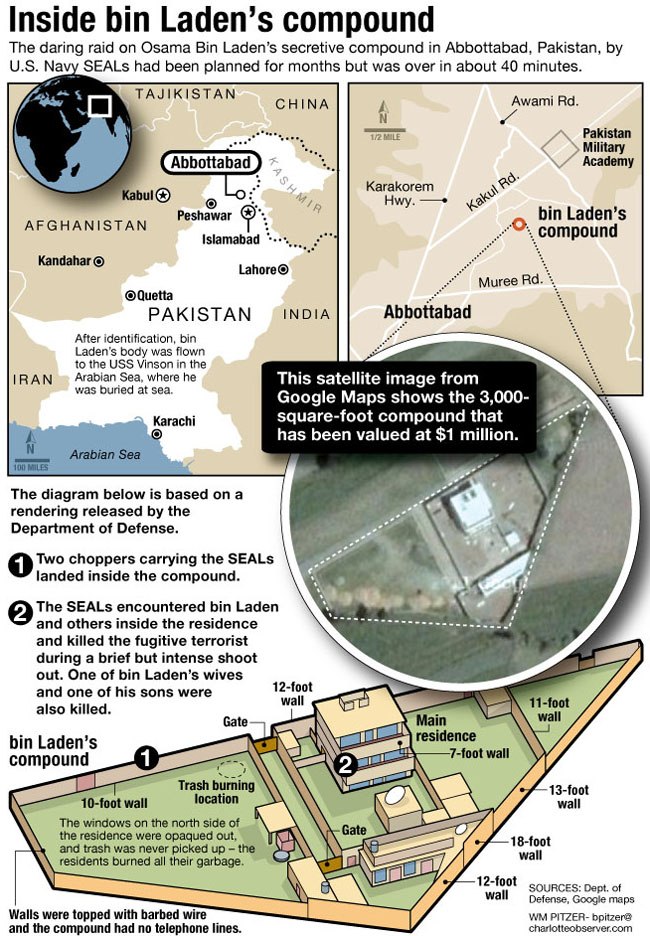
Ties between the two countries worsened significantly after the May 2 raid by U.S. special forces that killed Osama bin Laden in the northern Pakistani city of Abbottabad.  The military operation has embarrassed Islamabad, which was not informed beforehand of the raid.

Also Wednesday, Pakistan’s army said it was questioning four more officers about suspected ties to the banned Islamic extremist group, Hizb-ut-Tahrir.

Army spokesman Major General Athar Abbas said the four army majors are being questioned for suspected links with the group, but have not been detained.

The interrogation of the officers comes a day after the army said it detained Brigadier General Ali Khan over his links to the group.

Hizb-ut-Tahrir is an international Islamist organization that calls for a return to a pan-Islamic Caliphate under Islamic law.  Although the group does not advocate violence, it is believed to have links to militant groups.

Many critics in Pakistan and around the world say the Pakistani military is deeply infiltrated by extremist groups, making suspect its loyalty in the international effort against terrorism.

The discovery of Osama bin Laden in Pakistan has raised questions as to whether members of Pakistan’s military or intelligence knew the al-Qaida leader was hiding out not far from the capital.

Pakistan Orders an Inquiry After Troops Kill a Teenager

By Salman Masood for The New York Times

President Asif Ali Zardari of Pakistan ordered an investigation on Thursday into the shooting death of an apparently unarmed teenager by paramilitary troops in the southern port city of Karachi. The shooting, which was captured on video and broadcast on national television, has led to protests and has been condemned by political parties and human rights groups.

It was the second time in recent weeks that a video has shown paramilitary troops using extreme force against civilians. Last month, five Chechens were gunned down in Quetta, Pakistan.

The shootings are sure to feed complaints that Pakistan’s security forces are too aggressive and sometimes bypass the sluggish and corrupt judicial system. Pakistan’s military leaders are also still embarrassed by the American raid on Osama bin Laden’s compound in Abbottabad, which the armed forces did not detect.

The victim of the Karachi shooting, Sarfraz Shah, whose age was given as 18 or 19, was stopped by paramilitary troops on Wednesday and accused of being involved in an attempted robbery in a nearby park.

A spokesman for the troops said a gun had been taken from him, but in the video, Mr. Shah does not appear to be armed when he is shot.

The recording shows the young man begging for mercy before being led toward a group of troops. One points his gun at Mr. Shah before firing several shots. Mr. Shah crouches, asking forgiveness while bleeding profusely.

“My hand is gone,” Mr. Shah shouts. “Take me to the hospital.” The troops step back, out of the video frame. A government official said five of the troops had been arrested.

Mr. Shah was buried on Thursday in Karachi, accompanied by protests from family members.

The shootings in Quetta last month were also recorded. The police and paramilitary troops initially reported that the victims, three women and two men, were suicide bombers. They were killed near a checkpoint on the outskirts of Quetta, the capital of Baluchistan Province in southwestern Pakistan, in a volley of fire as police officers stood by.

Video from local television networks showed one young woman raising her arm, as if to try to stop the gunfire. No weapons were recovered on the victims. An investigation of that shooting is under way.

The Pakistani security forces have repeatedly been accused of misusing their power. The army was accused of extrajudicial killings during a military operation to drive out militants that began in the Swat Valley in 2009. The army denied the allegations.

The country’s powerful intelligence agencies have also been accused of illegally detaining hundreds of terrorism suspects. And military intelligence has been accused of gross human rights violations in Baluchistan, where a separatist insurgency by Baluch nationalists has long simmered.

Pakistani Rangers, the group involved in Mr. Shah’s death, are controlled by the Interior Ministry. Rehman Malik, the country’s interior minister, announced the arrests in the case on Thursday evening, but he also accused Mr. Shah of being part of a gang involved in robberies, according to the local news media.

Mr. Malik said Mr. Shah had tried to steal a woman’s purse and was caught by guards in the park before being handed over to the Rangers.

The Rangers have been deployed in Karachi for several years and help the local law enforcement authorities in maintaining peace in the city, which is riven by political, ethnic and sectarian tensions.

Afridi Asks Zardari For Help

As Reported by The AFP

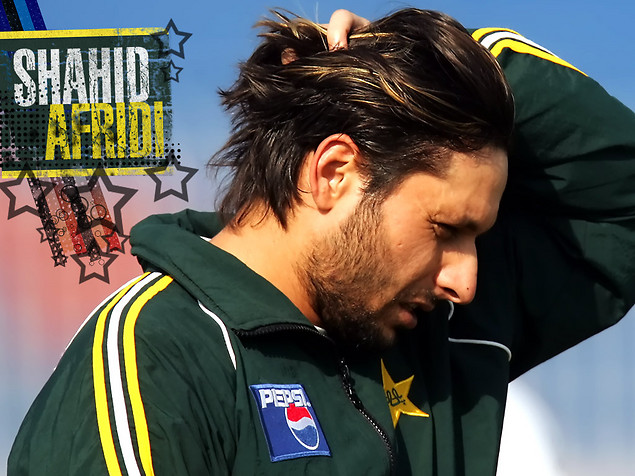
Former captain Shahid Afridi appealed to President Asif Ali Zardari for help on Wednesday after his central contract was suspended when he announced his retirement from international cricket. “I have appealed to the president to intervene urgently, also deal with other issues and save the game from getting into more crises,” Afridi told AFP by telephone from Southampton.

Afridi confirmed that the England and Wales Cricket Board stopped him from playing after the PCB revoked its permission.
“The captaincy was not an issue as I have already played under senior players, but it was a matter of self respect and honour which was hurt,” said Afridi who refused to speak about the PCB sanctions.

The opposition Pakistan Muslim League-N party has already submitted an adjournment motion in the national assembly against Afridi’s punishment.
Former Pakistan captain Imran Khan, who now heads his own opposition party, said the PCB was not run professionally.
“The board is not run like an institution,” Khan told a television channel. “Afridi feels injustice is done so he has taken a decision and you don’t change four-five captains in a year.”

“Just recently everyone was praising Afridi after he led Pakistan to the semi-final of the World Cup and then suddenly this happened,” said Khan. “The board is also run on ad-hoc basis like the country,” he added.
The Muttahida Qaumi Movement (MQM), which belongs to the coalition government headed by Zardari’s Pakistan People’s Party, also objected to the sanctions on Afridi. “President Zardari should take notice of the biased attitude of the board,” said MQM leader Farooq Sattar. “You don’t treat national heroes like this.”

Sports Minister Shaukatullah Khan lashed out at PCB chairman Ijaz Butt over the “injustice” and said he would discuss the matter with Prime Minister Yousuf Raza Gilani.

Abdul Ghaffar Qureshi, who heads the sports committee in the upper house of parliament, demanded Butt’s sacking.
“A change in the PCB is imperative,” said Qureshi. “Butt has not allowed any captain to settle so it will be better to sack him.”

The 31-year-old all-rounder, dumped as one-day captain following a row with coach Waqar Younis last month, quit international cricket in protest at his treatment by the Pakistan Cricket Board (PCB).
In response, the PCB suspended his central contract and revoked all his no-objection certificates, meaning he will not be officially permitted to play overseas.

The move will stop him from playing for Hampshire in England’s Twenty20 league and in next month’s Sri Lankan Premier League.
Afridi said that he came to know about his removal from the team’s captaincy through media and the board did not bother to inform him about that decision.

U.S., Pakistan, Through Thick and Thin

By Gerald F Seib for The Wall Street Journal

One diplomat long involved in the tempestuous U.S.-Pakistan relationship likens it to a Catholic marriage: There may be problems, but divorce isn’t an option.

And so it is that, almost a month after U.S. Navy SEALs entered Pakistan to kill Osama bin Laden, the two troubled partners find themselves not in divorce court but in an awkward but unmistakable process of reconciliation.

Signs of healing are popping up. Despite its anger and embarrassment at being left in the dark about the bin Laden raid, Pakistan’s intelligence service has begun cooperating again on a series of sensitive matters. Meanwhile, Secretary of State Hillary Clinton and Joint Chiefs of Staff Chairman Mike Mullen have just held the obligatory kiss-and-make-up talks in Pakistan, which U.S. officials describe as blunt but useful in moving forward.

And despite widespread anger in Congress over Pakistan’s harboring, either willfully or unknowingly, the world’s leading terrorist, Obama administration officials seem to be squelching the desire to extract revenge by cutting Pakistan’s aid.

There remains the danger of a rupture, and there still could be long-term damage. Street-level anger on both sides means the relationship can’t stand too many more shocks just now.

In particular, it seems likely that one result of the trauma will be a scaling back of the drone wars—America’s use of armed drones to launch strikes inside Pakistan to attack operatives of the Taliban movement fighting U.S. forces next door in Afghanistan.

The drones likely will continue to be used against top Taliban leaders when found, but less often against lower-priority targets, and probably under new and clearer rules of cooperation with the Pakistanis, say those familiar with the effort.

Still, the reality is that the two countries don’t have much choice but to move on. Regardless of how much love is flowing at any moment, they simply need each other.

The American war against al Qaeda globally and against Taliban insurgents in Afghanistan simply can’t be won without the cooperation of Pakistan. Much as Americans are infuriated by the way elements of Pakistan’s government and intelligence service hedge their bets by playing both sides in the struggle against extremism, there’s no doubt that Pakistani intelligence has been crucial in the fight.

For its part, Pakistan has, in its fit of pique over the bin Laden raid, made its best show of playing the China card to demonstrate to the U.S. that Pakistanis can find good, powerful friends in Beijing if Americans don’t treat them better. By coincidence, this has been proclaimed, officially by the two countries, the year of China-Pakistan friendship, which is a useful card for Pakistan to play right now.

But Pakistan’s post-raid overture showed the limits of the China option as much as anything else. Pakistani Prime Minister Yousuf Raza Gilani made a four-day trip to China soon after the bin Laden operation, and came away with a Chinese pledge to speed up delivery of some previously promised fighter jets.

Mr. Gilani’s other takeaway from his visit promptly proved dubious. His defense minister announced that Pakistan had invited China to take over management of a big Pakistani port at Gwadar, and to build a new naval base there. In response, the Chinese said, essentially, “We have no idea what you’re talking about.” Whatever was discussed, it appears to be less than originally advertised.

Pakistanis as well as Americans know China has its limits as an alternative big-power friend for Islamabad. American aid can’t easily be replaced, and China doesn’t tend to dole out assistance easily. Meanwhile, the U.S. is the top market for Pakistani exports, while China ranks fifth. China’s big textile industry actually is a key international competitor to Pakistan’s own textile sector.

Ultimately, the Chinese are less likely to be helpful to Pakistan in the war against extremism than will the U.S. China tends to use partnerships abroad to solve its problems, not to help friends solve theirs.

In the meantime, real and meaningful steps have resumed in the U.S.-Pakistani intelligence relationship. Pakistan has allowed American officials to speak with the bin Laden wives found in his compound. It has returned the tail section of a U.S. helicopter lost in the raid; there was stealth technology embedded in it—technology the U.S. feared an angry Pakistan might instead share with China.

And Pakistan has agreed to allow American officials into the bin Laden compound to search for more intelligence on al Qaeda operations run from there.

The U.S. now seeks more help in fighting the Taliban inside Pakistan, and there will be a three-way American-Afghan-Pakistani meeting to discuss Afghanistan next month.

All isn’t bliss between Washington and Islamabad—not by a long shot—but those aren’t the actions of partners headed their separate ways.

With Friends Like Pakistan…

By Manzer Munir for Pakistanis for Peace

Many people in Pakistan these days are wondering why their nation often finds itself on the wrong side of recent history. First, there is the continued and unjust imprisonment of a Christian Pakistani woman named Asia Bibi who has been languishing in jail for nearly two years. She has been given a death sentence for allegedly making derogatory remarks about the prophet Muhammad.

Then there was the killing of Salman Taseer, who was the then sitting governor of Punjab, Pakistan’s most populous province, by one of his own bodyguards for his outspoken support for Asia’s rights and her freedom. Instead of swift punishment and public outcry at his actions, the killer, Malik Mumtaz Hussain Qadri, was showered with rose petals by some cheering members of the bar association of Lahore when he came to the courthouse for formal charges of murder. Yes, members of the judiciary were cheering his unilateral action of murdering another human being simply for his support towards a condemned non Muslim woman’s rights.

You can only imagine the warped sense of logic and justice in a country where lawyers cheer the cold blooded murder of an innocent man whose only crime was to come at the aid of a condemned Christian mother of two children.

Fast forward to a few months later, the extremists managed to assassinate the only Christian member of President Asif Ali Zardari’s government when the Minister for Minority Affairs, Shahbaz Bhatti, was killed in a hail of bullets by unknown gunmen who then managed to escape on their motorcycle. Bhatti being a Christian as well as a minister in the government, had campaigned for the release of Asia as well as for the repeal of the blasphemy laws in Pakistan that at help promote a culture of state sanctioned hatred against religious minorities in Pakistan.

The culture of fear and hatred as well as violence against the religious minorities has progressively gotten worse along with the security situation inside the country in the last ten years. If there is anything that has been proven by some of these recent events in Pakistan, it is only that the country has become the undisputed global hotbed of extremism, fanaticism, and Islamic militancy in the Muslim world. It has now morphed into a country where the Wahhabi and Salafi fanatics have successfully used fear and hate to silence the majority moderate Barelvi and Sufi Muslims of Pakistan.

When powerful moderate voices like those of Bhatti and Taseer are silenced despite having heavy protection, how safe can the common man feel about his life if he chooses to speak up against the radicals within Islam? To kill someone is against Islamic belief at its core, unless it is done in self defense but you would be hard pressed to hear that view from the religious fanatics in Pakistan. They have justified killing others over many insane reasons such as making derogatory remarks about Islam or the prophet Muhammad. They also rationalize the killing of someone over a family’s honor, thus honor killings where often young women are killed if they are deemed to have brought dishonor to their family. These radical Islamists will even want someone dead for simply uttering disparaging remarks against Islam or its prophet. It is both ironic and hypocritical to see that the same derogatory remarks towards other figures such as Jesus, Moses, Abraham or other prophets of the Quran do not meet the same outcry nor receive the same impassioned response from the masses as when Islam or its prophet Muhammad are criticized.

The seeds of this current fanaticism fanning the flames of hatred were planted during an earlier conflict, this one involving the Soviets against an under matched adversary in Afghanistan. It was during this time in the ‘80’s when the Pakistani dictator, General Zia ul Haq, was in power and he accepted American aid from the Reagan administration in thwarting the threat from the 1979 Soviet invasion of neighboring Afghanistan. At the time, Pakistan’s ISI worked very closely with these “freedom fighters” waging what many thought was a just jihad against a communist foe who disallowed all religious worship. In fact, a good movie to rent right now to put some of these current events in perspective would be Charlie Wilson’s War starring Tom Hanks which details this era of Pakistan-US relations and cooperation against a common enemy in the Soviets.

The trouble now however is that in this current uneasy alliance between Pakistan and the US, there is not a common enemy, at least not as how it is viewed by many in Pakistan, which recently was polled to be the most anti-American nation in the world. Even though radical Islam and fanaticism is as much a threat to Pakistan’s sovereignty and prosperity as it is to the United States, India has always been seen as the big threat by its army and rulers. Pakistan has long seen Afghanistan as a country offering it strategic depth in any future wars with India. Thus, its interests in Afghanistan do not coincide with those of the United States.

The Pakistani media also constantly feeds a steady news diet of bombings by the Taliban/Haqqani network as well as any one of the other fill-in-the-blank militants groups seemingly operating freely from within its borders. There is also the regular news reports of US drone attacks and NATO actions in the AfPak region, as well as the all ubiquitous and constant threat faced from India, who is still seething from the Mumbai bombings in 2008, which were blamed on Pakistani trained terrorists. To further add insult to their injury, not a single leader of the Lashkar E Taiba has been convicted in Pakistan for the attacks in Mumbai that claimed 174 deaths and seriously injured several hundred others.

To the Indians, the perpetrator of their version of 9/11 is not an Arab from Yemen named Osama, but rather a whole nation state with whom it has fought three wars in 60 years and who is a long time sworn enemy with which it shares a long border. Too often it is rightly assumed by many that Pakistan will not act against Lashkar E Taiba and other openly anti-Indian militant groups because these groups are seen as a strategic asset for use against India. Only the fear of an all out nuclear war between the two nations by a trigger happy Pakistan placated India enough so that New Delhi did not immediately take military action against Pakistan after the Mumbai attacks.

So this culture of fear from all enemies both foreign and domestic to Pakistan’s sovereignty is now at an all time high within the nation. With a several decade long war on its western border in Afghanistan as well as the constant threat from its arch enemy to the east in India, Pakistan has never felt more threatened or squeezed. This pressure is now only going to get ratcheted higher since last week’s killing of Osama Bin Laden at a compound in a suburb of Islamabad, Pakistan. Living for five years undetected in the compound, Bin Laden was less than a mile away from the Kakul Military Academy in Abbottabad, Pakistan’s version of the famed American military college of West Point, when he was killed by a US Navy Seal team.

For the world’s most wanted terrorist to hide in plain sight in such a manner and for so many years, rightly points a lot of suspicion on Pakistan. Long suspected by many intelligence analysts, elements within Pakistan’s spy agency, the ISI, naturally now attracts a lot of suspicion in their possible involvement in the whole affair. There are strong voices and calls within the US Congress to halt all aid to Pakistan in light of Bin Laden’s death. We certainly can assume that any other country in the world found to be harboring terrorists would already have been labeled a state sponsor of terrorism and would be facing immediate sanctions from the international community. “You are either with us or against us” were the words so famously uttered by then President Bush to Pakistan specifically after 9/11. But due to Pakistan’s importance for a successful pullout from Afghanistan of US troops, as well as its strategic position within the Islamic world, neither side can afford to cut off relations with each other.

Although the Obama administration stopped short of claiming that the corrupt civilian government of Zardari was directly involved in protecting and sheltering Bin Laden, all signs point to complicity to some extent by some segments within Pakistan’s hierarchy. There is near unanimous agreement among many in Washington, and this is true on both sides of the aisle, that there are many sympathizers of the Taliban and Al Qaeda within the ranks of the army and the intelligence agencies of Pakistan.

Having driven the Soviets out of the region with the help of militant jihadi groups like the Taliban, no doubt a cadre of army and intelligence officers must have come to espouse the belief that it is in Pakistan’s best interests to have a religiously frenzied force available to use as a weapon against India in a future conflict also. In fact, Pakistan has always had this policy of seeking strategic depth in Afghanistan against India.

The death of Osama Bin Laden in Pakistan by Special Forces of the American military illustrates just what a duplicitous game the country has been playing with the United States and more importantly with itself. In the war on terror America lost nearly 3,000 citizens in the attacks on 9/11. In that same period stretching the last ten years, Pakistan has lost nearly 31,000 citizens to terrorist attacks by the Taliban, Al Qaeda and other militant groups. So it has always been in Pakistan’s best interests to fight the militant threat brewing in its borders the last two decades that has claimed so many lives and caused so much instability.

The murders of Salman Taseer and Shahbaz Bhatti illustrates the dire situation within Pakistani society where many young underprivileged men gravitate towards Osama Bin Laden’s ideology of hate against the US, which is seen by many, as the aggressor in an already very anti-American country. Also western ideas, religious and political liberties, and freedoms, such as those for women in western society, are all seen by the Islamic clergy and religious establishment as being against Islamic doctrine and clashing with the Muslim way of life. Therefore, the madrassahs and the masjids continue to espouse rhetoric against the American and European way of life which is seen as contradicting the teachings of the Quran. Even moderate Muslims and their sites of worship have come under heavy attack by the militants as witnessed by a new strategy of attacking Sufi Muslim shrines and mosques. Pakistan may not want to admit it, but there is a raging war going on within itself for the control of Islam and the attack on moderate Islam by the extremists within the religion.

The Bin Laden killing makes Pakistan seem either highly incompetent about knowledge his whereabouts or at the very least appear to be deeply complicit in sheltering and keeping him hidden while the United States launched the biggest manhunt in US history. At this point, the United States justly feels betrayed and distrustful towards anyone in the Pakistani establishment. After all, how are they to know who now to trust in the army or the civilian government?

It is imperative that Pakistan mount an immediate and urgent investigation that has the full cooperation and assistance of the US so that both countries can discover the source of this support system that Bin Laden has had from within Pakistan. Certainly, some heads do need to roll in Islamabad over this. Whether those resignations be of the current ISI chief, Ahmad Shuja Pasha, head of the army, General Ashfaq Parvez Kayani, or Zardari and Gilani themselves, as some accountability needs to occur. This is important not just for the sake of American-Pakistani relations, but just as importantly for the benefit of the Pakistani populace who is both deeply embarrassed by breach of Pakistan’s sovereignty, but also for the intelligence failure by the government of Pakistan at Osama’s whereabouts. Until and unless Pakistan makes this investigation a top priority, USA and Pakistan relations will continue to slide downhill and will mire further in distrust.

Pakistan must realize that in this global war against religious Islamic fanaticism, it cannot continue to speak from both sides of its mouth. Not when everything, including its very existence is at stake. It cannot at once be both a front line ally in the war against terror and receive billions of dollars in US aid, and at the same time, be found to shelter or allow terrorists and militant organizations safe havens and allow them to operate within its territory.

It is up to Pakistan to salvage a quickly deteriorating situation. However at the time of publication of this article, it seems that President Asif Ali Zardari’s government is off to a horrible start in mending fences with the US. First the name and identity of the CIA station chief in Pakistan was leaked by someone in the ISI to members of the local press. This leak compromised his mission and even poses a danger to his life as the anonymity of all operatives is a necessary requirement in intelligence work.

Then later in the day, in remarks given by Pakistan’s Prime Minister Yousuf Raza Gilani to its Parliament, he defiantly stated that neither Pakistan’s army nor its intelligence agency should be suspected by the Obama administration for providing support to Bin Laden. Gilani also went as far as to say that any future unilateral action by the US or any other nation inside Pakistan’s territory will be met with like force. I thought to myself, did he really just that? Did Pakistan just threaten the United States? It is appalling to see the political posturing now being done by the Pakistani government and the long term negative consequences they will have on the nation.

For a country that is receiving nearly $3.5 billion in US aid yearly, these are very tough words that will undoubtedly only make the strained relations between the two countries worse. Pakistan should realize that United States wants to feel that it can trust it to be a full partner in the fight against militancy and extremism. And unless this distrustful and at times, very adversarial relationship changes, the United States cannot help but feel that with friends like Pakistan, it does not need enemies!

-Manzer Munir, a proud Pakistani American and peace activist, is the founder of Pakistanis for Peace and blogs at http://www.PakistanisforPeace.com as well at other websites as a freelance journalist and writer. 

Pakistan’s Man in Washington

 By Chris Frates for Politico

 As Pakistan’s top Washington lobbyist, it’s Mark Siegel’s job to convince U.S. officials not to take out their anger on the country despite the fact that Osama bin Laden spent at least five years living in relative comfort outside Islamabad.

It’s not an easy sell.

Lawmakers from across the political spectrum wonder aloud how the world’s No. 1 terrorist could be living in plain sight unbeknownst to the Pakistanis. Siegel has to make the pitch that it’s in America’s national security interests to continue its relationship with Pakistan and to keep the billions of dollars in foreign aid flowing.

It’s a message that Siegel’s firm, Locke Lord, is getting paid good money to sell; the firm brings in almost $1 million a year representing Pakistan.

In addition to Siegel, the firm has about half a dozen lobbyists representing the country including Harriet Miers, an aide to former President George W. Bush and a one-time U.S. Supreme Court nominee.

Siegel is uniquely positioned to make the country’s case to skeptics on the Hill. He’s been friends with Pakistani President Asif Ali Zardari’s family for almost three decades and has a direct line to Islamabad.

“The Pakistanis insist to me that they were not aware that Osama bin Laden was at that venue. The president made that very clear to me,” Siegel told POLITICO after speaking with Zardari this week. “I think if they had known, they would have been happy to nab him themselves.”

His connection to Zardari isn’t lost on those he lobbies, like House Homeland Security Chairman Peter King, who met with Siegel on Tuesday.

“It wasn’t so much what Mark was saying to me on Tuesday, it was what I was saying to him knowing, or feeling confident that it was going to go directly back to the president,” said King (R-N.Y.). “There is a real question of credibility and trust and faith. You can’t have the No. 1 mass murderer of Americans living in plain view in Pakistan all these years while Pakistan is claiming to be our ally and getting $3 billion a year.”

Pakistan, King said, must investigate and credibly explain how bin Laden was able to go undected and demonstrate that its intelligence services and military have not been penetrated by al Qaeda.

“Mark’s basic job is almost to tread water, to keep everything afloat until something can be done,” King said. “I think he’s trying to prevent something from happening too quickly to have the relationship severed. He wants to make sure that he keeps it together and so you can have extensive talks between the two governments.”

But King’s not the only one critical of Pakistan these days.

The Obama administration – which didn’t give its ally a heads up that Americans would be swooping into their country to take out bin Laden for fear of leaks – has been describing the relationship between the two countries with the ambiguous “it’s complicated” tag usually reserved for Facebook profiles.

And Senate Armed Services Chairman Carl Levin told ABC News Thursday that he thinks high-level Pakistani intelligence knew of bin Laden’s whereabouts and he has “no doubt” the country knows the location of other top-level targets.

“None of the people on the Hill are suggesting to me that anybody in the civilian government knew that Osama was there,” Siegel said, drawing a distinction between Zardari and the country’s military and intelligence branches.

Tony Podesta, a lobbyist who represents Egypt, knows something of representing a vilified client that is nevertheless a U.S. military ally in an unstable part of the world.

“You want to take it back to the long term strategic interests of the U.S. and to facts rather than supposition. It makes no long term strategic sense for any kind of reckless decisions to be made at this moment,” Podesta said. “That’s where he’ll leave it.”

Siegel has been friends with Zardari’s family for almost three decades, having met Zardari’s late wife, Benazir Bhutto, in 1984 when a mutual friend asked him to host a dinner party for her. The two would go on to write a book together and when Bhutto became prime minister, Siegel represented her government.

This week, Siegel said he has been reminding lawmakers that Pakistan has been a strong ally and that President Barack Obama and other administration officials have praised the country’s cooperation in fighting al Qaeda and terrorism. Pakistan itself has been a victim of terrorism – 30,000 civilians have been killed by terrorists in the last decade, he added.

Even before this week’s killing of bin Laden, Locke Lord has been active on the Hill. In February and March, firm lobbyists accompanied the Pakistani Ambassador Husain Haqqani on meetings with House Speaker John Boehner, Senate Foreign Relations Committee Chairman John Kerry, House Armed Services Committee Chairman Buck McKeon, House Intelligence Committee Chairman Mike Rogers, and Kay Granger, chairwoman of the House appropriations subcommittee on state-foreign operations.

Last year, the firm successfully lobbied for $1.5 billion in economic and social aid over the next five years — a sum that has to be reauthorized each year. The firm is also lobbying to secure foreign aid and create duty-free “reconstruction opportunity zones” inside Pakistan’s tribal lands and Afghanistan.

Raid Sparks Question: Is Pakistan Doing Enough?

As Reported By CNN

The United States wants answers from Pakistan about how Osama Bin Laden could have lived in that country — near a major military base not far from the capital — without the government knowing.

The United States is asking Pakistan for information on who built and owned the compound where bin Laden lived, two senior U.S. officials said Wednesday. The United States also wants to know about security at the compound, in the city of Abbottabad.

Pakistani government officials have insisted that they did not know Bin Laden’s whereabouts. They reacted angrily to news that CIA Director Leon Panetta told U.S. legislators in a closed-door hearing that “either they (the Pakistanis) were involved or incompetent. Neither place is a good place to be.”

“What worse statement can come than that we heard from Panetta?” a senior Pakistani intelligence official said. “I am afraid this statement is totally regrettable. (Panetta) of all people knows how much we have been doing.”

The official, who did not want to be named, said his country had been generously sharing intelligence with their American counterparts.

“We have been sharing everything with them, but they have been selectively sharing with us,” the official said. “They are entirely dependent on what we provided them. Why were details (of the operation to kill bin Laden) not shared with us?”

Pakistan has argued that it has provided valuable intelligence information and worked with the United States to capture or kill numerous al Qaeda members and other Islamic extremists.

Yet the questions around bin Laden’s presence in Pakistan has exacerbated an already rocky relationship between the two nations.

Many Obama administration officials, lawmakers and observers from across the political spectrum want to know how bin Laden — based at a compound in the military garrison city of Abbottabad — could have eluded Pakistani capture, or whether the government or elements of it harbored bin Laden.

They want to know whether Pakistan is firmly backing the fight against terror or is supportive of militants fighting against troops in Afghanistan.

In Islamabad Tuesday, Marc Grossman, the special U.S. representative on Afghanistan and Pakistan, met with Pakistan’s president Asif Ali Zardari, the head of the ISI military intelligence Gen. Ahmed Pasha, and military chief Gen. Ashfaq Kayani. During that visit, which was scheduled before the killing of bin Laden, Grossman discussed the operation with the officials, the State Department confirms.

Those officials say the Pakistani officials expressed surprise that bin Laden was living at the compound and the U.S. officials tell CNN they are taking that at face value until more information is available.

The United States has a “complicated but important relationship” with Pakistan, White House press secretary Jay Carney said Tuesday.

Carney told reporters that U.S. officials need to learn more about the “support network” that sustained bin Laden in Pakistan. But he also warned against “tarring” everyone in Pakistan’s government because of the revelation that bin Laden had been living so close to Islamabad.

There has also been “a great deal of important cooperation” in the fight against Islamic extremism, he said. “The idea that these kinds of complications exist is not new.”

But Rep. Peter King, the New York Republican who is chairman of the Committee on Homeland Security, said “this can’t be allowed to go on.”

In comments Tuesday at a House subcommittee hearing on Pakistan, King noted that bin Laden’s compound was near a headquarters for the Pakistani intelligence services.

“There are two possibilities and one answer,” King said. “One is that it was a direct facilitation by elements of the Pakistani government, or Pakistani intelligence is entirely inept, and that has not proven to be the case over the years.”

According to two sources who were in the closed-door briefing with Panetta Tuesday on Capitol Hill, the CIA director echoed King’s concerns.

Panetta made clear, the sources said, that he and other administration officials are trying to get to the bottom of which it was — involvement or incompetence — on the part of the Pakistanis.

In an interview with TIME magazine, Panetta explained why the Pakistanis were not told of the bin Laden mission “It was decided that any effort to work with the Pakistanis could jeopardize the mission,” he said. “They might alert the targets.”

At King’s hearing, Seth Jones of the Rand Corporation told the panel that bin Laden’s presence in Pakistan showed that “at the very least, there has not been a high priority in targeting senior al Qaeda leaders” in the country.

“Based on the threat streams coming from this area, those interests have to change in my view,” Jones said. Another terrorism expert, Frederick Kagan of the American Enterprise Institute, said mistrust between the United States and Pakistan runs both ways, with Pakistani officials fearful that the United States will abandon the region after eliminating bin Laden.

“It is essential that we find ways not only to communicate our frustration to Pakistan,” Kagan said, but also to say “we’re not leaving.”

The United States has regarded Pakistan as a top ally in the fight against the Taliban, al Qaeda, the Haqqani Network and other Pakistan-based militants who have launched attacks against international and Afghan troops in Afghanistan. At Tuesday’s hearing, experts also identified Lashkar-e-Taiba as a major emerging threat from Pakistan to the Indian subcontinent and beyond.

According to the U.S. Government Accountability Office, the United States has provided $18 billion in foreign assistance and reimbursements to Pakistan, two-thirds of which are security-related.

The administration and lawmakers have praised the Pakistanis for their anti-terrorism efforts, but at the same time some lawmakers suspect the country hasn’t been robust enough in going after terrorists. Some say elements of Pakistan’s intelligence services — the Inter-Services Intelligence or ISI — have close ties with militants.

Sen. Dianne Feinstein, the California Democrat and chairwoman of the Senate Intelligence Committee, agrees that they have been “good at going after some terrorists” but have “very subtly walked both sides of the street.”

“That’s of concern to many of us, I think, because you have to declare yourself,” she told reporters, noting that the issue of Pakistan will be addressed by her committee.

Denis McDonough, who is President Barack Obama’s deputy national security adviser, told CNN that despite legitimate questions about what Pakistani authorities knew, the United States needed to maintain the relationship.

“We obviously recognize that nobody has sacrificed more in this war against al Qaeda than the Pakistanis,” McDonough said. “Al Qaeda had declared war, in fact, on the Pakistani government, have threatened and continues to threaten to try to get their hands on nuclear material in that country. … So they obviously have a lot at stake in this fight. So we’re going to continue to work with them and continue to try to partner with them against al Qaeda, because we recognize that it’s not only in our interests, but in their interests.”

Asked if the U.S. funding to Pakistan should continue, McDonough said such investments bolster U.S. security.

“We’ll continue to try to work with them to train, to try to target the common threat that we face from al Qaeda,” McDonough said, adding: “Nobody has greater concern about our ability to … carry out the fight against al Qaeda than the president. We’re going to continue to do that, either with our Pakistani friends or alone. But this is too big a fight for us to give it up.”

McDonough also said he agreed with the reported quote by Panetta that the United States decided not to share intelligence with Pakistan in the run-up to the Monday raid that led to bin Laden’s death because of fears of a leak. Sen. Richard Lugar, the top Republican on the Senate Foreign Relations Committee, also cited concern that some Pakistani officials might alert bin Laden.

“This is one reason we did not inform the Pakistanis of our actions,” Lugar said, while noting “there were probably many who were very uncomfortable about the presence likewise.”

The Pakistani government on Tuesday “categorically” denied reports that its leadership “had any prior knowledge” of the U.S. operation against bin Laden

One ISI official denied any complicity in hiding bin Laden, saying one failure and embarrassment doesn’t negate its “track record” of capturing more al Qaeda members than anyone else.

“Yes, we did fail to locate him. Yes, we are embarrassed. But that does not mean we are incompetent and straddling the fence,” the official said. “Had we known that OBL was there we would have raided it and handed him over to the U.S. to silence the critics talking about the complicity of the ISI.”

The United States is reviewing intelligence seized in the compound to determine whether bin Laden received support inside Pakistan, a senior U.S. official told CNN. This comes amid discussions in Washington over the extent of the Pakistani intelligence service’s knowledge of his whereabouts and whether it provided him sanctuary.

Lugar was asked in Washington why taxpayers should support money for Pakistan.

“It’s a very complex country. A very complex set of officials,” the Indiana senator said. “To try to obtain perfection in terms of who the recipients ought to be is out of the question. It’s a question of if there are goals we can achieve if we have some accountability of the money.”

Former Secretary of State Condoleezza Rice told CNN on Tuesday that Pakistan has been an “important partner in counterterrorism cooperation and we’ve had very important cooperation from them.”

But she questions how bin Laden could “hide in plain sight in that kind of compound without the knowledge of high-ranking officials.”

“We have captured many, many al Qaeda operatives in Pakistan, including Khalid Sheikh Mohammed, so Pakistan has been a cooperating counterterrorism partner,” Rice said, making reference to the mastermind of the 9/11 attacks. “But everyone knows that there are elements within Pakistan that are still tied to extremism, that has been a concern, and it is very important now that the Pakistanis take a hard look at how this possibly could have happened,”

Mark Quarterman, director of the Program on Crisis, Conflict, and Cooperation at the Center for Strategic and International Studies and an expert on Pakistan, said there have been strong differences between Washington and Islamabad over U.S. drone strikes in the tribal region and calls to remove CIA operatives in the country. The bin Laden operation and the issues surrounding it add to the tension, he said.

“I would not be surprised if there are questions on Capitol Hill about continued level of support to Pakistan, about the U.S. relationship with Pakistan and the consideration of the nature of that relationship and how we handle it going forward,” he said.

The Pakistan government and the ISI supported the Taliban when it controlled Afghanistan during the 1990s, but the government broke ties with the Taliban after the 9/11 attacks. American officials have consistently indicated that there are rogue ISI elements supportive of militants.

One reason Pakistanis also have supported militants in the tribal region is that the fighters are seen as serving as a bulwark for Pakistani interests. That includes a focus against the influence of longtime rival India in Afghanistan, Quarterman said.

“The Pakistanis are hedging their bets,” he said. “They know the United States isn’t there to stay.”

Jamie Metzl, executive vice president of the Asia Society, said the onus will be on Pakistan to do a thorough investigation to assess what happened with bin Laden.

“If Pakistan denies any official involvement with bin Laden, it will be difficult to prevent a backlash among members of the U.S. Congress who will believe that Pakistan is playing a double game,” Metzl said.

Metzl also says Pakistan’s fear is that India will increase influence in Afghanistan and surround Pakistan, and that calculation has led Pakistan to keep militants under its sway.

Mike Rogers, a Michigan Republican who is chairman of the House Select Intelligence Committee, said Pakistan and the United States have “a very funny relationship.”

Pakistan dispatched “troops into the tribal areas at our request” and “took thousands and thousands of casualties trying to fight Taliban and al Qaeda elements,” Rogers said on CNN’s “American Morning.”

“There are some concerns about their ISI being penetrated, their intelligence services being penetrated, but at the same time,” he said, “we’ve got to have them.”


-CNN’s Joe Sterling, Jill Dougherty, Elise Labott, Zain Verjee, Ted Barrett, Elise Labott, Alan Silverleib, Tom Cohen and Nick Paton Walsh contributed to this report

Pakistan’s president denies harboring bin Laden

By Nahal Toosi and Zarar Khan for The Associated Press

Pakistan’s leader denied suggestions that his country’s security forces sheltered Osama bin Laden as Britain demanded Tuesday that Islamabad answer for how the al-Qaida chief lived undetected for six years in a large house in a garrison town close to the capital.

But in a nod to the complexities of dealing with a nuclear-armed, unstable country that is crucial to success in the war in neighboring Afghanistan, British Prime Minister David Cameron said having “a massive row” with Islamabad over the issue would not be in Britain’s interest.

A day after U.S. commandos killed bin Laden, reporters were allowed within the 15-foot, barbed-wire-topped walls of the compound for the first time. But the doors of the house were sealed shut and police were in no mood to open them.

Local residents showed off small parts of what appeared to be a U.S. helicopter that Washington said malfunctioned and was disabled by the American strike team as they retreated. A small servant’s room outside the perimeter showed signs of violent entry and had been briskly searched, clothes and bedding tossed to the ground. Its wall clock was on the floor, the time stuck at 2:20, when the U.S. team would have been on the ground in the early hours of Monday.

Asif Ali Zardari’s comments, in a Washington Post opinion piece Monday, were Pakistan’s first formal response to suspicions raised by U.S. officials and others. Those suspicions could further sour relations between Islamabad and its Western backers at a key point in the war in Afghanistan.

Bin Laden was killed close to a military academy in the bustling northwestern town of Abbottabad, not in the remote Afghan border region where intelligence assessments had assumed he had been holed up. That was quickly taken as a sign of possible collusion with the country’s powerful security establishment, which Western officials have long regarded with a measure of suspicion despite several notable al-Qaida arrests in the country since 2001.

“Some in the U.S. press have suggested that Pakistan lacked vitality in its pursuit of terrorism, or worse yet that we were disingenuous and actually protected the terrorists we claimed to be pursuing. Such baseless speculation may make exciting cable news, but it doesn’t reflect fact,” Zardari wrote.

Ties between the two nominal allies were already strained amid U.S. accusations that the Pakistanis are supporting militants in Afghanistan and Pakistani anger over American drone attacks and spy activity on its soil. They came to head in late January after a CIA contractor shot and killed two Pakistan’s, in what Washington said was self-defense.

Senior U.S. officials did not directly accuse Pakistan of collusion, but made it clear they had concerns.

“People have been referring to this as hiding in plain sight,” Obama’s counterterrorism chief John Brennan told reporters Monday. “Clearly, this was something that was considered as a possibility. Pakistan is a large country. We are looking right now at how he was able to hold out there for so long and whether or not there was any type of support system within Pakistan that allowed him to stay there.”

Lawmakers were more direct.

U.S. Senate Armed Services Committee Chairman Carl Levin said Pakistan’s intelligence and army have “got a lot of explaining to do,” given that bin Laden was holed up in such a large house with surrounding buildings, the fact that its residents took the unusual step of burning their garbage and avoiding any trash collection.

“It’s hard to imagine that the military or police did not have any ideas what was going on inside of that,” Levin said.

Cameron, who has also made supporting Pakistan a major foreign policy commitment, echoed those concerns.

“Those are questions we have to ask, those are questions we will want answered and we will be asking that question of everyone in Pakistan and the Pakistani government,” Cameron told BBC radio before acknowledging the West’s limited leverage against Islamabad.

“We could go down the route of having some massive argument, massive row with Pakistan, but I assess our relationship with Pakistan and it is my very clear view that it is in out interests to work with the government and people of Pakistan to combat terrorism, combat extremism and help development in that country.”

Suspicions were also aired in many Pakistan’s media and on the street Tuesday.

“That house was obviously a suspicious one,” said Jahangir Khan, who was buying a newspaper in Abbottabad. “Either it was a complete failure of our intelligence agencies or they were involved in this affair.”

Pakistan’s security establishment has yet to explain how bin Laden was able to live there undetected, and given that it is rarely transparent about what it does, it might never do so. Asked about the raid, Pakistani Foreign Secretary Salman Bashir said it was time to move on.

“The issue of Osama bin Laden is history and I think we do now want to keep ourselves mired in the past,” he told reporters.

U.S. officials have said that Pakistani officials were not told about the early morning helicopter raid until the strike team had killed bin Laden had returned to Afghanistan from where they took off from, citing security reasons.

Many Pakistanis were surprised at how this was possible, especially when initial reports stated that the choppers took off from a Pakistani air base. Some were angry that the country’s sovereignty had been violated — an especially sensitive issue given the unpopularity of America here.

Zardari said it “was not a joint operation” — the kind of which has been conducted in the past against lesser terror suspects in Pakistan — but that Pakistani cooperation, in a general sense, had helped lead them to bin Laden.

“A decade of cooperation and partnership between the United States and Pakistan led up to the elimination of Osama bin Laden as a continuing threat to the civilized world,” he said.

President Barack Obama also said the country’s anti-terror alliance had helped in the run-up to the operation, but did not thank Pakistan when he announced the death of bin Laden.

The death has raised fears of revenge attacks, both in Pakistan — which has seen hundreds of suicide attacks by al-Qaida and its allies since 2007 — and internationally. The U.S Embassy said its missions in Pakistan would remain closed to the public until further notice.

War in Afghanistan is Destabilising Pakistan, Says President

By Simon Tisdall for The Guardian

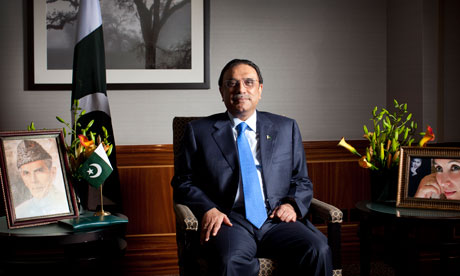
The war in Afghanistan is destabilising Pakistan and seriously undermining efforts to restore its democratic institutions and economic prosperity after a decade of military dictatorship, Pakistan’s president, Asif Ali Zardari, has told the Guardian.

Speaking during an exclusive interview in the imposing presidential residence in Islamabad, Zardari also pointed to widespread concern in Pakistan at the slow pace of efforts to end the Afghan conflict, and said some US politicians showed limited understanding of the impact of American policies.

“Just as the Mexican drug war on US borders makes a difference to Texas and American society, we are talking about a war on our border which is obviously having a huge effect. Only today a suicide bomber has attacked a police compound in Baluchistan. I think it [the Afghan war] has an effect on the entire region, and specially our country,” Zardari said.

Asked about harsh criticism of Pakistan’s co-operation in the “war on terror” published in a White House report last week, Zardari said Pakistan always listened to Washington’s views. But he suggested some members of Congress and the US media did not know what they were talking about when it came to Pakistan.

“The United States has been an ally of Pakistan for the last 60 years. We respect and appreciate their political system. So every time a new parliament comes in, new boys come in, new representatives come in, it takes them time to understand the international situation. Not Obama, but the Congress, interest groups and the media get affected by ‘deadline-itis’ [over ending the Afghan war],” Zardari said.

“I think it is maybe 12 years since America has become engaged in Afghanistan and obviously everybody’s patience is on edge, especially the American public, which is looking for answers. There are no short-term answers and it is very difficult to make the American taxpayer understand.”

With less than three months left before Barack Obama has promised to begin withdrawing US troops from Afghanistan, the White House recriminations reflected the growing pressures on all three governments to agree a workable, long-term strategy. The report complained bitterly that after years of US funding of the Pakistani military, “there remains no clear path towards defeating the insurgency” inside Pakistan.

It criticised as ineffectual Pakistani army operations in some areas of the western tribal belt bordering Afghanistan, which are believed to be used as safe havens by Afghan Taliban and al-Qaida elements.

A congressional panel also weighed in this week, urging the Obama administration to abandon Pakistan in favour of India. “Pakistan is about to go broke or collapse,” said Gary Ackerman, a New York Democrat.

Zardari suggested that if that assertion were true, the interventionist policies of the US and other foreign governments in south Asia would be a significant contributory factor. Pakistan had been in a state of “security alert” for several decades, he said.

“Our emphasis has been on security rather than our commerce and we need commerce for our survival.

“We have all the gas in the world waiting to go through to markets in India and the Red Sea but it cannot be brought in until Afghanistan is settled. So Afghanistan is a growth issue for us. I think most of the time, the quantification of the effect of the war is not calculated [by the US].

“Prices are going up, obviously we are a high fuel-importing country, and fuel prices are going up. Because of the war situation, the industry in one of our provinces has practically closed down … When one whole sector is not working, there is an effect on the other sectors.”

According to senior intelligence officials, the “war on terror” has cost the Pakistani economy approximately $68bn (£42bn) since 2001.

More than 33,300 Pakistani civilians and military personnel have been killed or seriously injured. Last year’s record-breaking floods added to the strain on the economy.

Zardari said the security situation was also undercutting efforts to strengthen democratic institutions bypassed or overturned during the military rule of his predecessor, General Pervez Musharraf. “Democracy is evolving. It’s a new democracy. It takes time to bring institutions back. Destroying institutions during a decade of dictatorial regime is easy … So there is a political impact as well as an economic impact.”

Pakistani officials say relations with the US reached a “low ebb” following the recent row over Raymond Davis, a CIA contractor who shot dead two Pakistanis; a CIA drone attack in Pakistan’s tribal areas last month that accidentally killed dozens of civilian elders meeting in a jirga (council), and Pakistan’s suspicions that it is being excluded from discussions about an Afghan peace deal.

Zardari, who is expected to visit Washington next month, said he would ask Obama to share drone technology with Pakistan so future attacks could be planned and directed under a “Pakistani flag”. Although this request had been turned down in the past, he said he was hopeful the Americans would be more receptive this time, given the huge anger and rising anti-American feeling that the drone attacks were causing.

Zardari and other senior government officials said all parties felt a sense of growing urgency about forging an inclusive peace settlement in Afghanistan, but the process must be “Afghan-led”. Pakistan was ready to play its part, consistent with its national interest, they said.

Salman Bashir, Pakistan’s foreign secretary, said: “Everybody is gradually coming round to our point of view that this requires greater diplomatic pressure. There is no military solution in Afghanistan.”

Pakistan Expresses “Total Solidarity and Support” to Quake, Tsunami-hit Japan

As Reported by Asian News International

Pakistan has expressed its “total solidarity and support” to the government and people of Japan in the aftermath of the devastating earthquake and tsunami that hit the country on Friday.

“We are deeply shocked over the terrible news of the strong earthquake and tsunami that has hit Japan. At this time of great trial, I wish you to know that the Government and people of Pakistan stand with you and the Japanese people in total solidarity and support,” President Asif Ali Zardari said in his condolence message to Emperor Akihito of Japan.

“Our profound sympathy and condolences to all those who lost their loved ones. Pakistan stands ready to provide any assistance to help our Japanese friends overcome the effects of this enormous natural calamity,” he added.

Prime Minister Yousaf Raza Gilani also expressed solidarity with the Japanese government and its people.

In a message to his Japanese counterpart Naoto Kan, Gilani said: “We stand ready to help, in any manner, to alleviate the suffering and assist our Japanese friends to overcome effects of this terrible natural calamity.”

Pakistan Confronts Deepening Radicalism in Wake of Assassination

By Sarah A Topol for AOL News

ISLAMABAD, Pakistan — When Vice President Joe Biden made his surprise visit to Pakistan this week to shore up the battle against the Taliban and al-Qaida, he warned against the implications of increasing radicalism in Pakistani society in light of the assassination of a liberal governor by his bodyguard.

“The governor was killed simply because he was a voice of tolerance and understanding,” Biden said at a news conference Wednesday. “As you know all too well … societies that tolerate such actions end up being consumed by those actions.”

But when President Barack Obama meets Pakistani President Asif Ali Zardari later today in Washington to discuss counter-terrorism in Pakistan’s lawless frontier, he greets a president facing a new fight against radicalism deep in the heart of Pakistan’s urban centers.

Since Mumtaz Qadri unloaded over two-dozen bullets into Salmaan Taseer’s back because the outspoken liberal called the country’s blasphemy laws a “black law,” ecstatic crowds have flocked to shower Qadri with rose petals at his court appearances. Facebook fan pages and a fawning YouTube video cropped up within hours of the murder.

The glorification of a confessed killer by the masses has shocked the country’s small liberal minority. But most troubling has been the reaction of Pakistan’s urban middle class, whose support the United States needs in its war against terror and against the Taliban in neighboring Afghanistan.

From lawyers to tech-savvy Web users, the reaction of the educated middle class has most clearly illuminated the toehold that Islamic extremists have found when it comes to religious issues in Pakistan, even as the country continues to resist the allure of Islamic militants. Some see the reaction of the middle class as the expression of latent social outrage over how Islam is treated by the West, combined with a growing confusion over how to follow their faith in the modern world. This dormant indignation has found an outlet in the murder of a liberal governor.

“Taseer is a victim of religious extremism, but this religious extremism is wrapped up in a class and culture war, between the have-nots and the have, between the socially disposed and the possessors of society, between the globally connected and the globally disconnected,” Mosharraf Zaidi, a political analyst and policy development adviser in Islamabad, told AOL News.

Zaidi sees the convergence of educated Muslims around Qadri as a sign of confusion among the middle class over how to rationalize their modern lifestyle with Islamic tenets, prompting them to defer to radical right-wing mullahs when it comes to certain religious issues, like blasphemy.

“The Islamic narrative in Pakistan is dominated by a small religious establishment who has no viability electorally and who has limited social appeal. But on a number of specific issues they’re able to tap into something much deeper than what’s apparent in a day-to-day situation that awakens the inner radical,” Zaidi said. “The middle class is increasingly susceptible to the symbolism of the little guy taking on the big guy.”

Among Qadri’s most stalwart supporters are some of the same jurists who staged months of protests against Pakistan’s military dictator in 2007 and 2008, when Gen. Pervez Musharraf removed the country’s chief justice.

“We were supporting rule of law, the supremacy of the constitution and the independence of the judiciary,” said Mohammad Faisal Malik, who notes he was an active participant in the movement. “It was the most memorable year of my life.”

Dressed in a dapper black suit, Malik has a neat mustache and carefully styled sideburns that don’t suggest a picture of extremism taking root in Pakistan’s judicial system. But today he is among the group of lawyers who have been throwing garlands and chanting slogans in support of Qadri outside the district courthouse in Rawalpindi, and he is also one of the 500 lawyers signed on to represent Qadri.

Malik does not see a contradiction in supporting both the rule of law and a man who took the law into his own hands.

“Mr. Qadri reacted under certain provocation, feeling hurt from the remarks of the deceased governor. He acted like any Muslim will act when anyone uses filthy language against our prophet. … We were chanting and raising slogans against all those sectors that are using objectionable language against Muslims, against our holy prophet and against our religion. That was our message,” Malik explains in nearly flawless English, expressing a sense of global victimhood common among his compatriots.

In Pakistan, the day-to-day injustices in an impoverished society find no legal outlet. Corruption here is rife, and the rich can bribe their way out of anything. The lawyers supporting Qadri express an understanding of why the security guard picked up a gun.

“He took the law into his own hands when he thought he was helpless. He’s not in a position to initiate criminal proceedings against Mr. Taseer, so he reacted in this manner,” Malik said.

But some say the passivity of the educated class toward radical strains is not merely a product of a class and culture struggle but part of a larger generational gap in Pakistani society. Under the rule of Gen. Mohammad Zia ul-Haq in the 1980s, Pakistan underwent an Islamization campaign as the military dictator sought to unify the country and encourage jihadists to fight against Indian control of Kashmir and the Soviet occupation of Afghanistan. Today, some suggest, the younger generation is the product of state-sponsored radicalization.

“The state as a machinery is supporting and promoting religious extremism, and it happens through various means. It happens through media messages, it happens through textbooks,” said Marvi Sirmed, a human rights activist and blogger.

“The literate, quasi-educated urban population is the most vulnerable to these extremist propagandas, because they are exposed to electronic media and the outside world through social networking,” Sirmed said. “And I see a lot of stuff coming out through these sources that if you are naive, they can make you a suicide bomber very easily.”

It is this middle class, struggling with its faith in an age of global media and inter-connectivity, that the U.S. needs to win over, and it is precisely this sector it appears to be losing.

Pakistan’s middle class sees the United States not as a model of liberal values to be followed but rather as a country that inflicts repeated indignities upon Pakistanis’ culture and sense of worth with its military forays into the region in the past 10 years.

“We have to pay attention to the narrative of indignity, because it’s fueling things that start only as rhetorical and verbal but could very well link to Faisal Shahzad’s Nissan Pathfinder,” said Zaidi, referring to the failed Times Square bomber, an educated Pakistani who knew the United States only too well.