Posts Tagged ‘ Bangladeshis ’

At Least 161 Dead in Bangladesh Building Collapse

By Julhas Alam for The Associated Press
Image

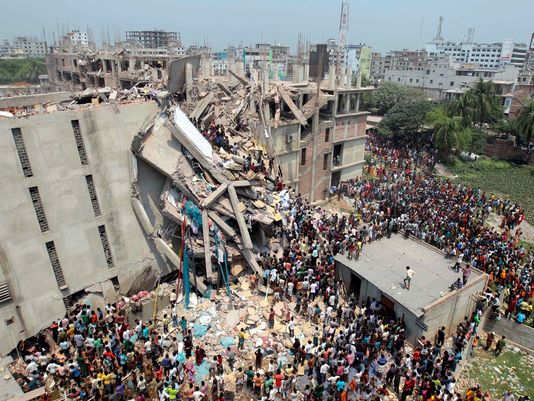
Rescuers tried to free people believed trapped in the concrete rubble of a building housing mainly garment factories that collapsed in Bangladesh a day after workers complained cracks had developed in the structure. The death toll jumped Thursday to 161 after searchers worked through the night.

“Many” people are still trapped, said the rescue operations leader, army Brig. Gen. Mohammed Siddiqul Alam Shikder said Thursday morning. A clearer picture of the rescue operation would be available by afternoon he said.

Searchers cut holes in the jumbled mess of concrete with drills or their bare hands, passing water and flashlights to those pinned inside the building near Bangladesh’s capital of Dhaka.

“I gave them whistles, water, torchlights. I heard them cry. We can’t leave them behind this way,” said fire official Abul Khayer. Rescue operations illuminated by floodlights continued through the night.

The disaster came less than five months after a factory fire killed 112 people and underscored the unsafe conditions in Bangladesh’s massive garment industry.

Workers said they had hesitated to go to into the building on Wednesday morning because it had developed such large cracks a day earlier that it even drew the attention of local news channels.

Abdur Rahim, who worked on the fifth floor, said a factory manager gave assurances that there was no problem, so employees went inside.

“After about an hour or so, the building collapsed suddenly,” Rahim said. He next remembered regaining consciousness outside.

On a visit to the site, Home Minister Muhiuddin Khan Alamgir told reporters the building had violated construction codes and “the culprits would be punished.”

Local police chief Mohammaed Asaduzzaman said police and the government’s Capital Development Authority have filed separate cases of negligence against the building owner.

Asaduzzaman said nearly 100 bodies have been handed to their families as of Thursday morning.

Among the textile businesses in the building were Phantom Apparels Ltd., New Wave Style Ltd., New Wave Bottoms Ltd. and New Wave Brothers Ltd., which make clothing for major brands including The Children’s Place, Dress Barn, and Primark.

Jane Singer, a spokeswoman for The Children’s Place, said that “while one of the garment factories located in the building complex has produced apparel for The Children’s Place, none of our product was in production at the time of this accident.”

“Our deepest sympathies go out to the victims of this terrible tragedy and their families,” Singer said in a statement.

Dress Barn said that to its knowledge, it had “not purchased any clothing from that facility since 2010. We work with suppliers around the world to manufacture our clothing, and have a supply chain transparency program to protect the rights of workers and their safety.”

Primark, a major British clothing retailer, confirmed that one of the suppliers it uses to produce some of its goods was located on the second floor of the building.

In a statement emailed to the Associated Press, Primark said it was “shocked and deeply saddened by the appalling incident.” It added that it has been working with other retailers to review the country’s approach to factory standards and will now push for this review to include building integrity.

Meanwhile, Primark’s ethical trade team is working to collect information, assess which communities the workers come from, and to provide support “where possible.”

John Howe, Cato’s chief financial officer and executive vice president, told The Associated Press that it didn’t contract with any of the factories directly but it’s currently investigating what its “ties” were.

Howe said that one of Cato’s domestic importers could have used one of the factories to fulfill some of the orders the retailer had placed. It’s expected to have more information by Thursday.

Spanish retailer Mango denied reports it was using any of the suppliers in the building. However, in an email statement to the AP, it said that there had been conversations with one of them to produce a batch of test products.

Kevin Gardner, a spokesman at Wal-Mart Stores, Inc., the second-largest clothing producer in Bangladesh, said the company is investigating to see if a factory in the building was currently producing for the chain.

“We remain committed and are actively engaged in promoting stronger safety measures, and that work continues,” Gardner added.

Workers said they didn’t know what specific clothing brands were being produced in the building because labels are attached after the products are finished.

Charles Kernaghan, executive director of the Institute for Global Labour and Human Rights, which has an office in nearby Dhaka, says his staff is investigating the situation. He’s hoping his team, working with local workers’ groups, will be able to find out which brands were having their products made at the time of the collapse.

“You can’t trust many buildings in Bangladesh,” Kernaghan said. “It’s so corrupt that you can buy off anybody and there won’t be any retribution.”

Sumi, a 25-year-old worker who goes by one name, said she was sewing jeans on the fifth floor with at least 400 others when the building fell.

“It collapsed all of a sudden,” she said. “No shaking, no indication. It just collapsed on us.”

She said she managed to reach a hole in the building where rescuers pulled her out.

Tens of thousands of people gathered at the site, weeping and searching for family members. Firefighters and soldiers with drilling machines and cranes worked with volunteers to search for survivors.

An enormous section of the concrete structure appeared to have splintered like twigs. Colorful sheets of fabric were tied to upper floors so those inside could climb or slide down and escape.

Rescuers carried the body of a young boy from the building, but it was not immediately clear what he had been doing inside. The building, in the Dhaka suburb of Savar, housed a bank and various shops in addition to the garment factories.

An arm jutted out of one section of the rubble. A lifeless woman covered in dust could be seen in another.

Rahim said his mother and father, who worked with him in the factory, were trapped inside.

Mosammat Khurshida wailed as she looked for her husband. “He came to work in the morning. I can’t find him,” she said. “I don’t know where he is. He does not pick up his phone.”

The morgue of the medical college echoed with the sobs of people waiting for the bodies of their loved ones. “Where’s my mother? Where’s my mother? Tell me, tell me, oh Allah, oh Allah!” Rana Ahmed cried.

The November fire at the Tazreen garment factory drew international attention to working conditions in Bangladesh’s $20 billion-a-year textile industry. The country has about 4,000 garment factories and exports clothes to leading Western retailers. The industry wields vast power in the South Asian nation.

Tazreen lacked emergency exits, and its owner said only three floors of the eight-story building were legally built. Surviving employees said gates had been locked and managers had told them to go back to work after the fire alarm went off.

Pakistanis for Peace Editor’s Note– This shoddy building, lack of code enforcement and corruption in developing South Asian nations like Bangladesh, India and Pakistan is deplorable and some agency like the UN or IMF should hold these countries responsible to save their citizens lives as they do not care to do so by themselves. Our condolences to all affected by the needless tragedy and huge loss of innocent lives.
Cutting Hillary Clinton Some Slack

By Mosharraf Zaidi for The News International

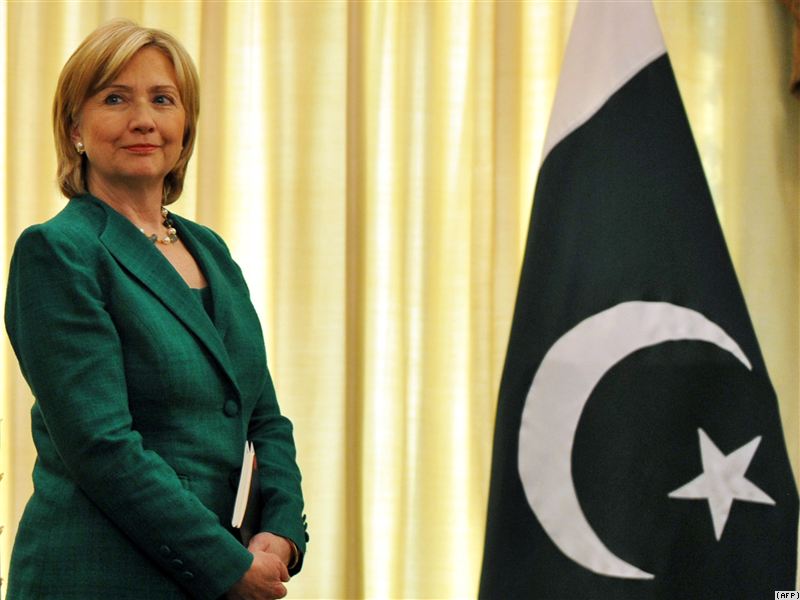
Poor Americans. This is the fellow that Secretary of State Hillary Clinton has to stand beside as she tries to squeeze more juice out of a Kerry-Lugar Bill that had its lifeblood squeezed out of it last year by the Pakistani establishment, when it first became US law. The frustration from that reaction still riles the Americans. So much so that Hillary Clinton, who is a role model and an inspiration, can’t seem to let go. On every trip she reproduces a Bin Laden outburst that is militarily and strategically irrelevant for the US, but that serves as an enduring cancerous tumour for America’s public diplomacy goals in Pakistan.

Still. Mrs Clinton needs to be cut some slack. Her tireless advocacy for health care around the world, and her enduring compassion for South Asians — Indians, Pakistanis, Bangladeshis, Muslims, Hindus, men, children, and most of all, women — is singularly unique among either Democrats or Republicans.

The western media seems as fabulously smitten by Mrs Clinton as I am. The wires, the newspapers and the electronic media all reported Mrs Clinton’s announcement of the allocation of $500 million worth of projects as headline news, when really, it represents the fulfilment of only one-third of Kerry-Lugar-Berman’s sacred covenant with the Pakistani people. One of the most telling things about that covenant? It was signed by the US House of Representatives and the US Senate. It was, in short, a covenant between the US government and the American people, with the US government acting as a proxy for the Pakistani people.

Perhaps now Pakistanis can better understand the frustration of the John Kerrys, the Hillary Clintons and the Richard Holbrookes of the earth. Top US policymakers have fought for over two years to win the Kerry-Lugar Bill. Since then, two things have kept that money from flowing into Pakistan. The first is Mr Holbrooke’s decision to dispense with the Clintonian (Bill, not Hill) model of US aid disbursement through large contracting firms that Americans often refer to as Beltway Bandits. That decision, while long overdue, was rushed and was made in the wrong country, at the wrong time. American development assistance, which is not routed solely through USAID, but often through half a dozen different US departments (or ministries), has been in desperate need of an overhaul for years. But to attempt to reform the instrument of aid delivery in Pakistan, at the climax of Obama’s war in Afghanistan, has been a disastrous decision. The American international aid community is so removed and so distant from the mainstream of western assistance thinking (spearheaded by the OECD and captured in the Paris Declaration) that it doesn’t quite know how to deal with large sums of money without the Beltway Bandits. This has meant that the Kerry-Lugar money has been parked in Washington DC, with a clear destination, but no vehicle to take it there.

The second thing that has kept the Kerry-Lugar money from being spent is the government of Pakistan itself. Pakistan has no clarity whatsoever about what its development priorities are. It required the intervention of the military chief back in March to summon the federal secretaries to begin to articulate a wishlist of pet projects this government would like to see come to fruition. Indecision and the absence of any coherent development strategy within Pakistan have meant that the US government has had to try to figure out what Pakistan wants, kind of on its own. This may seem like comedy noire, but it’s really not funny at all.

The problem with Pakistani government today is that it doesn’t enjoy the competent stability it once used to through the bureaucracy. Today’s Pakistan’s bureaucracy, while made up of individually brilliant officers, is a collection of inward-looking dinosaurs that cannot see beyond their GOR houses, their I-8 plots and their post-retirement benefits. Those officers, in years past, used to be the eyes and ears of oft-changing governments that would seek the guidance of senior bureaucrats in the federal ministries and at the provincial headquarters. While there’s been no discernable change in the quality of governance that democratically elected politicians can render, there has been a severe nosedive in the quality of officers available to either the federal or provincial governments.

Part of the reason for the exodus of top-tier officers during the Musharraf era was the curtailment of powers of district managers, under decentralised local governments. But the decentralisation argument is a red-herring for a much more fundamental shift in Pakistani bureaucracy. While being a CSP or DMG officer was an instrument of social mobility in the 1970s or 1980s, it is now a barrier to the personal and professional growth of officers. Many of Pakistan’s brightest officers can afford to be well-paid UN, World Bank and IMF staffers. Many others can do even better at Wall Street and on Madison Avenue. Still others can be brilliant academics. Across the board, since 1999 we have seen exactly this. An exodus of top-shelf talent that might have been able to deal with rents, with incompetence, and with the heat, but not with the disrespect that the military and political class have for educated Pakistanis in the employ of the government of Pakistan.

So how does all this relate to Mrs Clinton’s troubles in Pakistan? Simple. No matter how democratically legitimate, when the blind lead the blind, there is a problem of vision. Pakistani politicians are so disconnected from any kind of global narrative that it will be a generation before we produce a Chidambaram, a Krishna or a Mukherjee that can win elections without the help of their gaddi (see: Shah Mehmood Qureshi), or the kindness of the Arbab Ghulam Rahims of the world (see: Shaukat Aziz). The nauseating outburst of the foreign minister on Friday was a demonstration that winning an election does not enable you to win an argument. In short, Pakistan’s current political class cannot muster politically legitimate actors that are also competent at statecraft.

Enter the advisory class. This is where the Husain Haqqanis, the Shaukat Tarins and the Dr Hafeez Shaikhs enter the fray. No fake degrees here. Only pedigree. Their problem is of an entirely different nature. They don’t have any stake in Pakistani politics — they enter as unknowns at the thaana kuthchehri and galli-mohalla level, and they leave as unknowns at the thaana kuthchehri and galli-mohalla level. They can talk about all the right kinds of reform, but they can’t deliver. More worryingly, their reform-speak is often deluded, because it is devoid of any political rigour. “Let’s clip military powers by marketing bold ideas in Washington DC, instead of Rawalpindi.” Well. We’ve seen how that has turned out. “Let’s raise taxes!” Sure. Because nobody else has ever thought of that! “Let’s improve education.” Sure. Because it takes genius to figure out that education is a problem. Advice that is anchored in Rubinomics and Bretton Woods theology has been failing Pakistan for the entire duration of Pakistan’s lifetime. This should hardly be a surprise. It never works anywhere.

And that is why Shah Mehmood Qureshi is wrong, again. Perceptions won’t change. $500 million worth of pet projects is a supremely sweet gesture. But even $500 billion worth of aid, delivered through Beltway Bandits, NGOs, budget support or otherwise can’t change the lives of Pakistanis. Only organic reform can achieve such noble goals. When the strategic dialogue in October picks up where this one leaves, Pakistan will still have no CT strategy, no development strategy, an inflated defence budget, no civil service reform, and no hate-speech legislation. All the money in the world can’t change that. And that’s not Hillary Clinton’s fault. That one’s on us.