Posts Tagged ‘ Hillary Clinton ’

Progress, For a Price, in Pakistan

By Doyle McManus for The Los Angeles Times
In 2001, on the eve of the U.S. invasion of Afghanistan, President George W. Bush gave Pakistan’s then-leader, Gen. Pervez Musharraf, a choice: He was either with us or against us. Musharraf chose to become an ally, but the question ever since has been whether that shotgun marriage can mature into a healthy adult relationship. At times, the prospect has seemed far from reach.

The world’s second-most-populous Muslim country is caught in a brutal internal struggle between extremism and moderation. Most of its people tell pollsters they don’t like the United States and wish we’d go away. The tribesmen of its western frontier shelter Osama bin Laden and the leaders of Afghanistan’s Taliban. And the United States can’t forget how, in the 1980s, Pakistan built nuclear weapons — and then later exported nuclear technology to North Korea and Iran.

But in recent months, there has been progress in the relationship. Military and intelligence cooperation between the United States and Pakistan has increased significantly. Pakistan has allowed the CIA to increase its missile strikes against Al Qaeda and Taliban targets in Pakistani territory. Pakistani authorities have arrested several Taliban leaders and allowed U.S. intelligence officers to question them. And now Pakistan is offering to increase its own military operations in North Waziristan, the presumed lair of Bin Laden. All that cooperation came at a price, of course: a flood of U.S. military and economic aid.

And last week, the Pakistanis came to Washington to press for more. The academic criticism of the U.S.-Pakistani relationship is that it is “transactional” — nothing more than a series of bargains between buyers and sellers who don’t trust each other much. That’s still mostly true. Pakistan’s delegation arrived with a 56-page shopping list covering everything from military equipment to education and cultural exchanges. And one Pakistani official, asked during the visit whether his government was truly willing to act against the havens that allow the Taliban to maintain bases in Pakistan, replied frankly: “Yes — but at a price.”

After a series of meetings with Secretary of State Hillary Rodham Clinton, Pakistan’s ebullient foreign minister, Shah Mehmood Qureshi, declared: “I think we are going to move from a relationship to a partnership.” But he used the future tense. In the meantime, there are things to work out. Pakistan is clearly worried about what happens when the United States begins pulling troops out of Afghanistan in 2011.

Although Obama administration officials have tried to reassure Pakistan that Washington’s commitment to the region is for the long haul, uncertainty remains. “Our fear is . . . that we get into a fight with these guys [the Taliban], and you walk away, and we’re still there,” a Pakistani official said. Pakistan’s powerful army chief of staff, Gen. Ashfaq Kayani, spent part of his time in Washington visiting Congress with PowerPoint slides to show that Pakistan has committed more troops to its fight against insurgents than the United States has on the ground in Afghanistan, and that it has suffered almost 30,000 killed and wounded in the process.

According to U.S. officials, Kayani made a strong case that Pakistan can do more if it gets more modern military equipment from the United States, especially helicopters to ferry troops into the rugged badlands where Al Qaeda and the Taliban hide. The United States has helped Pakistan acquire some helicopters, but not as many and not as quickly as the Pakistanis would like. U.S. officials said they would try to speed the delivery of more. In the past, U.S. officials complained that Pakistan used much of its U.S. military aid to bolster its eastern front with India instead of its fight with internal insurgents; but since Pakistan’s 2009 offensive in the Swat Valley, that criticism has been stilled.

The delegation also added a new item to Islamabad’s wish list: a nuclear agreement under which the United States would help Pakistan develop its civilian nuclear energy industry — to mirror a similar U.S. agreement with India, Pakistan’s longtime enemy. The United States told the Pakistanis that would have to wait. The memory of having to clamp sanctions on Pakistan for its nuclear weapons program is still too fresh. But it was a sign of improving relations that the idea wasn’t rejected completely.

 In 2001, the United States sought a new relationship with Pakistan mostly because it was next to Afghanistan — and thus a country we would need for moving military supplies and basing drones. But that thinking has slowly evolved. In the long run, with its population of 170 million people — not to mention its cache of nuclear weapons — Pakistan is more important than Afghanistan.

“We’re engaging with Pakistan because we’re afraid of it,” says Christine Fair, a Pakistan expert at Georgetown University. “It’s the scariest country in the region. Because of Afghanistan, it’s been treated as if it were a subsidiary issue. But Pakistan should be the primary issue.” The Americans are working hard to convince the Pakistanis that they are interested in Pakistan’s stability for its own sake, not just because it’s next door to Afghanistan. The Pakistanis are working hard to convince the Americans that they are committed to defeating the extremists in their midst. It’s not a strategic relationship yet. If it’s a partnership, it’s still a wary one. But that’s progress.
US-Pakistan Talks Mark ‘Intensification’ of Partnership

By Suzanne Presto for Voice of America News

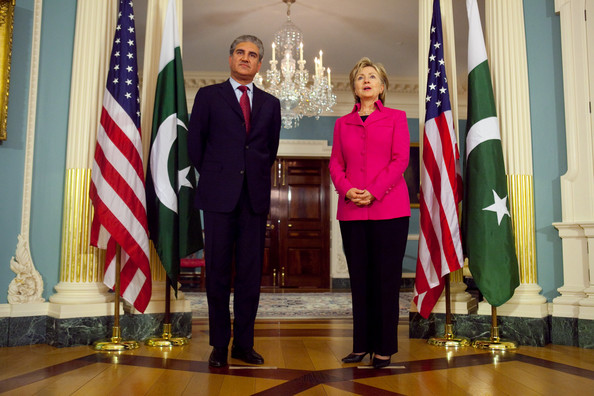
The United States and Pakistan will hold their first strategic dialogue at the ministerial level in Washington next Wednesday (March 24). U.S. Special Representative for Afghanistan and Pakistan Richard Holbrooke told reporters at the State Department Friday that these talks mark a “major intensification” of the U.S.-Pakistan partnership. Wednesday’s talks will be co-chaired by Secretary of State Hillary Clinton and Pakistani Foreign Minister Shah Mehmood Qureshi.

Holbrooke says delegations from both sides will include senior officials of their nation’s defense, diplomacy, finance and agriculture departments. The U.S. delegation will also include aid and trade officials, and Pakistan’s will include officials who handle water, power and social issues.
“This is a partnership that goes far beyond security, but security is an important part of it,” he said. Holbrooke told reporters Friday that U.S. officials want to see aid money for Pakistan distributed more quickly.

“We are doing more. We will announce more. We want to do as much as the Congress will support,” Holbrooke said. The Obama administration has made improving and broadening relations with Pakistan a top priority, but U.S. policies and drone strikes targeting militants in the region remain unpopular. Holbrooke said the U.S. supports Pakistan as it seeks to strengthen democratic institutions and economic development, handle energy and water problems, as well as defeat extremists. “Everyone is aware of the popular public-opinion polls, and we think that our support for Pakistan deserves more recognition among the people,” he added.

Speaking to reporters in Islamabad Thursday, Foreign Minister Qureshi said Pakistani and U.S. officials have been talking a lot, and in his words, “the time has come to walk the talk.” Holbrooke responded to Qureshi’s statement that next week’s talks would be a good opportunity to rebuild confidence and trust on both sides. “The first time I went to Pakistan, Foreign Minister Qureshi introduced me to the phrase “trust deficit,” and so I have heard it many times,” he said. “The last time I was there, we both said in a press conference that we thought we had made huge advances in that,” Holbrooke added. Secretary of State Clinton last visited Pakistan in October, where she spoke with officials and students alike.

Holbrooke said there are plans to hold the next set of strategic talks in Pakistan, likely within the next six months. He underscored that these bilateral talks do not replace the trilateral talks among the U.S., Pakistan and Afghanistan which he said are expected to resume later this year.

United States Pledges Millions in Emergency Aid for Pakistani Refugee Crisis

Islamabad, Pakistan- The United States pledged an additional $110 million in aid to Pakistan on Tuesday as over two million Pakistani citizens fled the onslaught from the Pakistani army on the Taliban in the Swat region and northern areas of Pakistan. Secretary of State Hillary Clinton announced the new aid package which includes radios, tents, blankets, emergency generators, medical supplies and food aid for the people who have left their homes in the region due to the heavy fighting between the Pakistani army and the militants.

Most of the aid will be given directly to the United Nations and its humanitarian agencies operating in the region as there is still suspicion on the part of the Obama administration that giving it directly to Pakistan may risk in having some of it being squandered as it has happened in the past. The administration is also urging average Americans and especially Pakistani Americans to aid the effort by donating aid to relief agencies operating in Pakistan.

The Obama administration has also set up a texting service by which people can use their cellphone to pledge $5 to the people of Swat by texting the word “Swat” to 20222 on any cellphone in the US. Secretary Clinton herself contributed $5 by using the same service from her cell phone. A million people giving $5 through this service would equal an additional $5 million for the people of Swat she said and it would be a significant contribution from ordinary citizens to show they care about what is happening.

She praised the Pakistani government in fighting the Taliban and taking the fight to them. This was in stark contrast to her earlier assessment of the situation last month when she told Congress that “the Pakistani government was abdicating to the Taliban.” She stated that there is a real national change in mood within Pakistan and that both the people and the government now realize that the threat from the Taliban is not only isolated to the remote northern areas of Pakistan, but that rather their reach and their violence has recently extended to all the major cities like Lahore and Karachi as well which are mega cities of millions of people.

Indeed the earlier actions of the government of President Asif Ali Zardari ranging from making treaties that did not last with the Taliban to relinquishing control of parts of the Swat valley to the them as well as allowing Islamic Shariah law to appease the Islamic extremists, only showed the inconsistencies and failures of their policies. There is a saying in Pakistan that translates into “Those who are swayed by physical punishment, do not change with words.” The Taliban have shown that they are not fit to be dealt with through diplomacy and dialogue but rather only understand the power of the fist.

It is very encouraging that both the Pakistani government is finally seemingly serious about tackling the Taliban inside its borders and also that the US is earnest in helping assist the Pakistanis in this battle. Secretary Clinton herself acknowledged that US policy towards Pakistan the past three decades has been very “incoherent.”

With a dedicated, determined and ever growing mutual threat like the Taliban as a common enemy, it is high time that both sides got their resources together and went after the militants with all their might.

It is never too late to stand up to evil and we at Pakistanis for Peace are very encouraged that the fight is finally being brought to the Taliban. It seems the recent meeting between Zardari and President Obama yielded some very good agreements and we hope that there is no letting up until the Taliban are destroyed and disbanded. This is where the global “War on Terror” will be fought and where it will be won.

Reporting by Manzer Munir for http://www.PakistanisforPeace.com