Posts Tagged ‘ Hillary Clinton ’

Pakistan Shifted Emphasis Away From India Border, says US

As reported by The Economic Times

WASHINGTON: Pakistan was shifting its emphasis away from its eastern border with India, a decision it had taken on its own because of a “definite shift” in Islamabad’s military posture brought about by fundamental changes within the country, the US has said.

It said while it does want Islamabad to act more aggressively against extremists within Pakistan it played little role in Islamabad’s decision to move its troops away from the border with India.

“First of all, how Pakistan decides to deploy its military forces is a decision for Pakistan,” State Department spokesman P. J. Crowley told reporters Friday what role the US had played in the movement of 140,000 troops away from the Pakistani-Indian border as mentioned by Secretary of State Hillary Clinton.

“We’ve made no secret of our desire to see Pakistan take more aggressive action against extremist elements within its own borders,” he said. “That is a threat to Pakistan itself.”

“And as the Secretary said, we have seen Pakistan shift its emphasis away from the Pakistani-Indian border and more aggressively to the Swat Valley and other areas where these extremists operate.”

“And no military has suffered more significant casualties in undertaking these operations than Pakistan. But these were obviously decisions for Pakistan to make,” Crowley said.

“But the context of increasing dialogue and reducing tensions between Pakistan and India is something that we have stressed in our dialogue with both countries,” he said.

Asked if Clinton was making an announcement, Crowley said: “Yeah, we’ve seen a definite shift in the Pakistani military’s posture. (But), it wasn’t an announcement.”

“I think it was a reflection of fundamental changes that have occurred in Pakistan as part of our strategic dialogue and our cooperation on dealing with the threat on both sides of the Afghan-Pakistan border.”

Asked about India’s role in Afghanistan after the recent review of the US Af-Pak strategy, Crowley said: “Well, we do have a regional strategy. India has legitimate interest in helping with the future of Pakistan.

“It has contributed significantly to development and reconstruction projects within Afghanistan. And we encourage that activity, even as we stress the importance of dialogue between India, Pakistan, Afghanistan, other countries. So no efforts like this are misunderstood,” he said.

Richard Holbrooke: The Death of a Peacemaker

By Manzer Munir for Pakistanis for Peace

President George H.W. Bush once described him as the “most persistent advocate I’ve ever run into.” President Obama’s special envoy to Afghanistan and Pakistan, Ambassador Richard Holbrooke, died earlier today after complications from heart surgery. He was a gifted diplomat and a tough negotiator who was considered one of the superstars of international diplomacy. Richard Holbrooke died Monday evening at George Washington University Hospital after doctors had performed emergency surgery Saturday to repair a tear in his aorta, the largest artery in the human body responsible for carrying blood from the heart to all parts of the body.

Described only days ago by President Obama as a “towering figure in American diplomacy,” Holbrooke was a career diplomat who started his career in 1962 as an officer during the Vietnam War where he initially worked at the US Agency of International Development. He continued to work on Vietnam issues during the war under President Lyndon B. Johnson and was a part of the delegation that presided in Paris for the peace negotiations to end the war. He also served as the director of the Peace Corps in Morocco in the early 1970’s as well as the assistant secretary of state for East Asian and Pacific Affairs in the Carter administration. He was in charge of US ties with China when relations between the two countries were “normalized” in late 1978.

Later in his career, he also held senior positions at a few prestigious Wall Street firms before returning to diplomacy under the Clinton administration. During this time he was credited with his most illustrious achievement to date when he helped orchestrate the Dayton peace agreement which ended the horrific war and genocide in Bosnia. He later went on to write a memoir titled “To End a War” and become somewhat of a celebrity in the Balkans, and is widely believed to have become the Secretary of State under Hillary Clinton if she had won. He also went on to serve as the US ambassador to Germany as well as the United Nations under President Bill Clinton before being tapped by the incoming Obama administration with the herculean task of being the special envoy of the United States to Afghanistan and Pakistan.

His last assignment was arguably his most difficult as he himself stated that “There’s no Slobodan Milosevic. There’s no Palestinian Authority. There is a widely dispersed group of people that we roughly call the enemy. There’s also al Qaeda, with which there’s no possibility of any discussion at all.” He mentioned that in the AfPak region, (a term he is credited with having coined), there are a range of militant groups such as the Afghan Taliban, the Pakistani Taliban, the Haqqani Network, Lashkar-e-Taiba, and that “an expert could add another 30.”

Such was the difficulty of his last assignment that some close to him are speculating whether the high level of stress and travels associated with shuttling between Washington, Kabul and Islamabad might have been a factor in causing a tear in his aorta. Certainly the complex and high strung meetings with Karzai and Zardari as well as the delicate balancing acts of diplomacy along with military operations in a region of the world described as “the most dangerous in the world” possibly took a toll on his health.

But to those that knew Richard Holbrooke, he was a man capable of taking on and winning the challenges of this and any difficult assignment as he had done so many times in his career. A New York Times reporter once wrote “if you want somebody to pull the trigger, or close a deal, think Holbrooke.”

Tonight in Washington DC, President Obama, Secretary Clinton, and the thousands of employees of the US State Department mourn the death of this icon of American diplomacy and celebrate his lifelong service to the United States and the American people in search of peace in troubled spots the world over. Meanwhile, thousands of miles away, a job vacancy has sadly opened up in the dangerous AfPak region of the world for an assignment that no one is capable of fulfilling quite like Mr Holbrooke. For the sake of the success in the Afghan war, peace and stability in Pakistan and securing America’s vital national interests in the region and around the world, let us hope that his successor will be half as capable a diplomat and negotiator as the late Richard C. Holbrooke, truly a giant of American diplomacy.

–Manzer Munir, a proud Pakistani American and peace activist, is the founder of Pakistanis for Peace and blogs at http://www.PakistanisforPeace.com as well at other websites as a freelance journalist and writer.

Obama Prays for Holbrooke’s Recovery

As Reported by The Associated Press

Richard Holbrooke, the Obama administration’s diplomatic point man for Afghanistan and Pakistan, remained in critical condition Saturday night after surgery to repair a tear in his aorta. President Barack Obama Saturday expressed support for Holbrooke’s family in the difficult hour and prayed for his recovery.

“Earlier today, I spoke to Richard Holbrooke’s wife Kati and told her that Michelle and I are praying for Richard. Richard Holbrooke is a towering figure in American foreign policy, a critical member of my Afghanistan and Pakistan team, and a tireless public servant who has won the admiration of the American people and people around the world. I know that Secretary Clinton, Admiral Mullen, Tom Donilon, and other members of our team have been with him at George Washington hospital, and we continue to pray for his recovery, and support his family in this difficult time,” Obama said in the statment.

Holbrooke, 69, was rushed to George Washington University Hospital on Friday morning after he had chest pains during a meeting with Secretary of State Hillary Rodham Clinton, The Washington Post reported. He was almost immediately taken into surgery that extended for 21 hours into Saturday, the paper added.

With Holbrooke in intensive care only blocks away, President Obama’s senior national security advisers met at the White House on Saturday to discuss a major internal assessment of the war in Afghanistan. Obama will review the assessment Monday, with release to the public scheduled for later in the week.

Meanwhile, according to the Post, the U.S. administration officials said that Holbrooke’s condition would not affect the war review, compiled over the past month by the National Security Council staff from assessments made by Holbrooke and his staff and by the military coalition led by Gen Patreaus.

Holbrooke’s long diplomatic experience has given him a unique perspective within the administration and has positioned him perhaps better than anyone to navigate the often messy intersection of diplomacy, counterinsurgency and politics, the newspaper noted. Holbrooke, the newspaper reported, has been a strong advocate of a negotiated settlement of the war and of massive increases in development and governance aid. Under his direction, the number of U.S. civilian officials in Afghanistan has more than tripled, to exceed 1,000. He experienced health problems in August, when he underwent treatment for heart problems.

‘Bhutto’: For Pakistan’s Heroine, A Hagiography

By Ella Taylor for National Public Radio

A new documentary about Benazir Bhutto lets a full hour go by before entertaining the mildest doubts about its subject, the hugely popular prime minister of Pakistan who was assassinated on her triumphant return to Karachi from exile in 2007.

Bhutto is smart and thorough on the inflamed history of Pakistan. But as a portrait of the first woman elected head of state in an Islamic nation, it comes closer to hero-worship than to considered biography. Front-loaded with glowing testimonials from family and FOB’s East and West, the movie gives a startling degree of face time to its own co-producer, Mark Siegel, a political consultant and close friend of Bhutto who co-authored a book with her.

The director, Duane Baughman, also a political consultant, helped get Michael Bloomberg and Hillary Clinton elected, so he knows how to brand a public figure, dead or alive.

Not that this particular public figure needs much enlarging. Bhutto’s sense of mission and her personal courage, as she returned again and again to try and democratize a nation whose military leaders blithely murdered their opposition, are beyond dispute. Like her adored father Zulfikar Ali Bhutto, Pakistan’s first democratically elected head of state (and the creator of its nuclear program), she struggled to bring basic services to a country mired in poverty, illiteracy and chronic conflict across its volatile borders with India, Afghanistan and Iran — to say nothing of its ambivalent dependency on a United States worried to death by the Taliban, al-Qaida and the enriched uranium in Pakistan’s nuclear arsenals.

About Bhutto’s failings and mistakes, however, the film is discreet to the point of squeamishness. Luckily, this magnificently complicated woman’s contradictions tumble out anyway. Almost despite itself, the movie offers a riveting melodrama about a daddy’s girl born into a close but feuding Western-educated dynasty known both for its populist politics and its champagne tastes. (The Bhuttos were thought of — admiringly, Baughman implies, though given the straits in which most Pakistanis live, one wonders — as the Kennedys of Pakistan.)

From grieving family and friends (inevitably, Arianna Huffington was a pal at Oxford), we learn of a serious-minded young woman freed from her burqa by Dad while still in her teens. At Harvard, where she roomed with Kathleen Kennedy, she absorbed feminism and leftist politics.

After Bhutto’s murder, her husband, Asif Ali Zardari, became co-chairman of the Pakistan People’s Party — and the nation’s new president. After Bhutto’s murder, her husband, Asif Ali Zardari, became co-chairman of the Pakistan People’s Party — and the nation’s new president.
Yet later she willingly submitted to an arranged marriage with a Karachi playboy-entrepreneur, Asif Ali Zardari, who has been Pakistan’s president since the fall of Pervez Musharraf in 2008. She prayed to Allah in public, yet worked hard to bring schooling to girls in an Islamic state vehemently opposed to rights for women.

Bhutto inherited her father’s charm, charisma and elegant tailoring, as well as his preference for backroom wheeler-dealing. Remarkably, her father chose Benazir over her two brothers as his successor, and her political career eerily echoed his, zigzagging between triumph, prison, exile and return to repeated rapturous welcomes from adoring masses.

Bookended by footage of the sniper fire and suicide bombing that killed her, Bhutto faithfully follows the hectic arcs of her life and death. Yet the movie glides smoothly past the corruption charges — never proved or disproved — that led to Bhutto’s exile and her husband’s imprisonment, effectively dismissing them as trumped up by her enemies. Much time is spent, meanwhile, on the moving but sentimental memories of her tearful family, topped up with new but unedifying audiotapes of Bhutto herself outlining her ideals, the harshness of her incarceration in a Pakistani prison and the loneliness of exile in Dubai.

Bhutto could stand a less adulatory tone — and more reliable skeptics than her clearly disgruntled niece, for instance, when it comes to topics such as Bhutto’s role in the mysterious plane crash that killed the military dictator responsible for her father’s murder. Despite herself, and for all her efforts toward reconciliation, Bhutto proved an enormously polarizing figure.

Perhaps she had no choice, in a country so riven by internal strife and external threat. At its best, Bhutto is a fascinating study in the difficulties of bringing democracy to a radically unstable nation plagued by its colonial legacy, by the cowboy politics of a dictatorial military, by daily terrorism and the sporadic interventions of world powers arguably less interested in rural voting rights than in pushing their own interests on the global stage.

Bhutto’s untimely death at 54 years old was a private tragedy and a tremendous loss for a country desperate for moderate leadership. But she was a heroine, not a saint. Eliding this distinction, Bhutto unwittingly diminishes her.

Pakistani Peace Builders Turn Cultural Diplomacy to Flood Relief

By Carrie Loewenthal Massey for America.gov

When Pakistani Americans Mahnaz Fancy and Zeyba Rahman launched Pakistani Peace Builders ( PPB ) in May, they did so to bring Pakistani music and heritage to American audiences. An independent cultural diplomacy campaign, PPB aimed to counteract stereotypes and misperceptions of Pakistanis that Fancy and Rahman saw becoming more prominent.

“The only way we know how to make a difference is to show the other face of Pakistan,” she added. “We as Pakistani Americans are very concerned about being misread and misconstrued.”

Exposing Pakistan’s rich cultural roots “is a really important way of explaining that the fundamentalists are a minority,” Fancy said.

In July, New York City delighted in a celebration of one aspect of Pakistani tradition at PPB’s first event, a hugely successful festival of Sufi music. Nearly 25 musicians representing different regions of Pakistan performed a free, outdoor show in Union Square, one of the most popular public spaces in Manhattan.

“It was an unbelievable experience. … People needed some way to feel good about themselves as Pakistani Americans,” Fancy said.

And then the floods came.

PPB immediately added a humanitarian angle to its cultural mission following the devastating floods that struck Pakistan in late July, killing 1,800 people, affecting more than 20 million others and destroying crops across the country. Building on the momentum generated by the Sufi festival, the PPB partnered with ML Social Vision, the venture philanthropy arm of Washington-based ML Resources, to start Relief4Pakistan, a grass-roots effort to mobilize funds for relief in the flood affected areas.

“As we were wrapping up the concert and the floods hit, I just kept getting phone calls from people all over [the United States] saying, ‘What do we do? How do we respond?’” said Fancy. “People had ideas of packing food and sending it. [The pace] was insane in that initial moment.”

To give donors some direction, Relief4Pakistan sends donations to Mercy Corps, a Seattle, Washington-based nongovernment organization. Mercy Corps has an established reputation and experience on the ground in Pakistan, according to Fancy. Some of Mercy Corps’ efforts include providing safe drinking water, setting up water filtration units and distributing food and relief materials.

Using Facebook and personal networks to encourage support and raise money, Relief4Pakistan has raised nearly $150,000 in aid since August.

“We’ve had donors from all over the place. We’ve had friends hosting events and sending the proceeds,” Fancy said.

Celebrity endorsements have helped bring in funds as well. Aasif Mandvi, an Indian-born, British-raised comedian and cast member of the popular U.S. television program The Daily Show, hosted a stand-up comedy night to benefit Relief4Pakistan, and Pakistani-American actor Faran Tahir — whose credits include Iron Man ( 2008 ) and Star Trek ( 2009 ) — has also joined the campaign.

Relief4Pakistan’s second phase of flood assistance launches in November with a major reconstruction project. The effort will focus on Bangla Ichha Union Council, a four-village area in the Rojhan subdistrict of the Rajanpur district in southern Punjab. According to Fancy, 95 percent of the 40,000 people living in the villages depend on their own crops for sustenance, and their fields remain ravaged by the floods.

“Our first goal is to plant at least 1,000 acres of wheat by the end of November. We want to raise money to get seeds and fertilizer for some of the most vulnerable people, those that own less than five acres of land,” Fancy said.

To complete the project, Relief4Pakistan is partnering with Operation USA, a Los Angeles–based relief agency that “shares our philosophy that development ought to be done by empowering the local community to learn skills and develop a sustainable strategy to take care of themselves,” explained Fancy. Relief4Pakistan and Operation USA are reaching out to local Pakistani organizations to tap their resources and train the community members in necessary skills.

Relief4Pakistan will raise funds through Facebook again, but has also already engaged a wider circle of American philanthropists, Fancy said. Their goal is to build a sort of global village, a network of people worldwide coming together to help, and Fancy hopes the model of “the power of a global village” will set a precedent for other successful relief efforts.

“We’re really riffing off of [Secretary of State] Hillary Clinton’s ‘It takes a village to raise a child.’ … Our overarching goal is to appeal to the humanity of the wider donor public,” said Fancy. “It takes effort from Pakistani Americans and Pakistanis in other countries … it’s the responsibility of each member of this global village.”

At the height of its flood relief efforts, PPB has not forgotten its mission of cultural diplomacy. In fact, much fundraising continues to come from film screenings, art exhibitions and comedy performances showcasing the talents of Pakistani artists.

“Part of our cultural mission is using culture to humanize [Pakistan] and at the same time putting it into action through these much needed flood relief efforts,” Fancy said.

PPB plans to hold more cultural events beyond those dedicated to flood relief. The organization would like to hold the Sufi music festival annually, expanding it to include artists from other South Asian countries.

“[We want] to show what Sufism is in other parts of the world. Pakistan is a microcosm of a larger issue, which is the whole Muslim world,” Fancy said. “Muslims in [South Asia] have been remarkably liberal and secular in comparison to what people think they are.”

Through PPB, Fancy, who is 41 years old, will keep working to transform the younger Pakistani-American generation’s misconceptions of the Muslim world.

“I find it so distressing that people of our parents’ generation know much more about Pakistan than our generation,” she said.

And she worries that the knowledge the younger generation has gained from the media has left it grossly misled about Pakistani and Muslim identities.

“This sense of being primitive and tribal is not the true modern history of this part of the world,” Fancy said. “It’s only true of the minority that has taken the loudspeaker and is misbroadcasting lots of things they think are collective traits [of Muslims], but they’re not.”

( This is a product of the Bureau of International Information Programs, U.S. Department of State. Web site: http://www.america.gov )

Top of the Agenda at US-Pakistan Meetings: Mending Relations

By Howard LaFranchi for The Christian Science Monitor

If Osama bin Laden is really living comfortably in a house in northwest Pakistan, can we finally get him?

One might assume that the question would come up during this week’s three-day “strategic dialogue” between the United States and Pakistan – given the news out of NATO earlier this week that the Al Qaeda leader is no longer believed to be roughing it in a remote, no-man’s-land cave.

But instead, topic No. 1 at the three days of Washington meetings that begin Wednesday is likely to be relations-mending.

US-Pakistan ties, already roiled by frequent US drone attacks in Pakistani territory, suffered an abrupt setback over a NATO helicopter attack on the Pakistan-Afghanistan border late last month that killed several Pakistani soldiers. The US apologized for the incident, but not before the Khyber pass border crossing was closed and dozens of bottled-up trucks transporting fuel and supplies to NATO troops in Afghanistan were torched.

It is in the still-touchy aftermath of the border incident that the US is expected to offer Pakistan a multiyear, multibillion-dollar security package aimed at enhancing the ability of Pakistani security forces to take on domestic Islamist militants.

The US already offers Pakistan about $1.5 billion a year in military assistance through what is now a year-to-year program. The proposal to be presented at this week’s meetings is for a package of military hardware, training, and counterinsurgency materials stretching over several years – something the Pakistanis have been seeking for a while. Secretary of State Hillary Rodham Clinton had said at the last session of the US-Pakistan strategic dialogue in Islamabad in July that the US was “working on a multiyear package.”

Such a package for security assistance would presumably mirror a five-year, $7.5 billion development assistance package for Pakistan that the US approved last year.

US officials acknowledge that Pakistani security forces are stretched thin – especially after the summer’s devastating floods – and could use more supplies and training if they are to go after militants in their havens. But at the same time, US officials continue to harbor suspicions that some of the Taliban and other militant groups, in particular those involved in fighting in neighboring Afghanistan, continue to enjoy protection from certain elements of the Pakistani security structure.

The claim from a NATO official about Mr. bin Laden, reported by CNN, included the widely held contention that the Al Qaeda leadership is protected by elements within the Pakistani intelligence services.

Earlier this month, the White House submitted an assessment of Pakistan to Congress that is critical of the country’s antimilitancy campaign and suggests its existing capacities would allow it to do much more to confront the Taliban and Al Qaeda. A softer version of that assessment was offered at the State Department this week, when spokesman P.J. Crowley commended Pakistan for “aggressive action within its borders” before adding, “Clearly, this is an ongoing threat, and more needs to be done.”

At a State Department briefing Tuesday, the deputy US special representative for Afghanistan and Pakistan, Frank Ruggiero, said that while the Pakistanis have taken “some substantial steps” against organizations threatening the security of both countries, the US will call on Pakistan to do more – such as taking its campaign into North Waziristan.

Confronted with America’s you-can-do-more attitude, the Pakistanis are responding with requests of their own. Pakistan’s foreign minister, Shah Mehmood Qureshi, has a list of things he says the US could do to build his country’s confidence in the US partnership. Among them are a civilian nuclear energy deal like the one the US has signed with India, a wider door for Pakistani products to enter the US, and more US pressure on India to resolve issues of interest to both India and Pakistan, such as Kashmir.

Mr. Qureshi, who is to meet with Secretary Clinton on Friday, has already previewed the proudly independent tone he is likely to employ when meeting with senior Obama administration officials.

“We are an ally, not a satellite,” Qureshi said Monday in comments at Harvard University’s Institute of Politics in Cambridge, Mass. “We have to protect our borders. You have to respect our sovereignty,” he said, alluding to the recent helicopter border shooting.

Qureshi said the “trust deficit” affecting relations between the two countries has been furthered by such interventions in Pakistani territory, although he acknowledged that the outpouring of US relief assistance after the summer flooding was viewed much more positively.

Meeting Pakistanis, U.S. Will Try to Fix Relations

By Mark Landler and Eric Schmitt for The New York Times

WASHINGTON — As Pakistani civilian and military leaders arrive here this week for high-level meetings, the Obama administration will begin trying to mend a relationship badly damaged by the American military’s tough new stance in the region.

Among the sweeteners on the table will be a multiyear security pact with Pakistan, complete with more reliable military aid — something the Pakistani military has long sought to complement the five-year, $7.5 billion package of nonmilitary aid approved by Congress last year. The administration will also discuss how to channel money to help Pakistan rebuild after its ruinous flood.

But the American gestures come at a time of fraying patience on the part of the Obama administration, and they will carry a familiar warning, a senior American official said: if Pakistan does not intensify its efforts to crack down on militants hiding out in the tribal areas of North Waziristan, or if another terrorist plot against the United States were to emanate from Pakistani soil, the administration would find it hard to persuade Congress or the American public to keep supporting the country.

“Pakistan has taken aggressive action within its own borders. But clearly, this is an ongoing threat and more needs to be done,” the State Department spokesman, Philip J. Crowley, said Monday. “That will be among the issues talked about.”

The Pakistanis will come with a similarly mixed message. While Pakistan is grateful for the strong American support after the flood, Pakistani officials said, it remains frustrated by what it perceives as the slow pace of economic aid, the lack of access to American markets for Pakistani goods and the administration’s continued lack of sympathy for the country’s confrontation with India.

Other potentially divisive topics are likely to come up, too, including NATO’s role in reconciliation talks between President Hamid Karzai of Afghanistan and the Taliban. Pakistani officials say they are nervous about being left out of any political settlement involving the Taliban.

Still, in a relationship suffused by tension and flare-ups — most recently over a NATO helicopter gunship that accidentally killed three Pakistani soldiers and Pakistan’s subsequent decision to close a supply route into Afghanistan — this regular meeting, known here as the strategic dialogue, serves as a lubricant to keep both countries talking.

At this meeting, Secretary of State Hillary Rodham Clinton will formally introduce the new American ambassador to Pakistan, Cameron Munter. Mr. Munter, who recently served in Iraq, replaces Anne W. Patterson, who just wrapped up her tour of duty in Islamabad.

“No country has gotten more attention from Secretary Clinton than Pakistan,” said Richard C. Holbrooke, the administration’s special representative for Afghanistan and Pakistan. Pakistan’s delegation will be led by its foreign minister, Shah Mahmood Qureshi, but much of the attention will be on another official, the military chief, Gen. Ashfaq Parvez Kayani, who is viewed by many as the most powerful man in Pakistan.

White House and Pentagon officials said one immediate goal of this meeting was to ease the tensions that led Pakistan to close the border crossing at Torkham, halting NATO supplies into Afghanistan. Officials on both sides said that acrimony from the border flare-up had already receded, soothed by the multiple apologies that American officials made to Pakistan last week.

Last week, Adm. Mike Mullen, the chairman of the Joint Chiefs of Staff, said that General Kayani had assured him that Pakistan’s army would tackle the North Waziristan haven, but on Pakistan’s timetable. In an interview, Pakistan’s ambassador to the United States, Husain Haqqani, said, “Our American partners understand that we have 34,000 troops in North Waziristan. Our soldiers have been engaged in flood relief after history’s worst floods. It is not a question of lack of will.”

The new security pact would have three parts: the sale of American military equipment to Pakistan, a program to allow Pakistani military officers to study at American war colleges and counterinsurgency assistance to Pakistani troops.

Currently, the United States spends about $1.5 billion a year to provide this same assistance, but it is doled out year by year. The new agreement, if endorsed by Congress, would approve a multiyear plan assuring stability and continuity in the programs, although Congress would continue to appropriate the financing on a yearly basis. “This is designed to make our military and security assistance to Pakistan predictable and to signal to them that they can count on us,” said a senior official.

At the last dialogue in Islamabad in July, Mrs. Clinton presented more than $500 million in economic aid, including plans to renovate hospitals, upgrade hydroelectric dams, improve water distribution and help farmers export mangoes. But the floods upended those plans, and officials said they now planned to redirect funds to more urgent needs.

This week’s meeting will also be shadowed by a new eruption of political instability in Pakistan: the government of President Asif Ali Zardari is locked in a confrontation with the Supreme Court over the court’s demand that senior ministers be fired on corruption charges. Analysts said they were less worried about the atmospherics than the underlying differences in perspective. The administration’s public contrition for the cross-border attack has largely resolved that issue, said Daniel S. Markey, senior fellow for India, Pakistan and South Asia at the Council on Foreign Relations.

But Mr. Markey said he saw potential friction stemming from the American openness to reconciliation with the Taliban. With the United States facilitating rather than guiding the talks, he said, there could be poor coordination between the Afghans, NATO and others — all of which would rattle the Pakistanis.

“Washington is opening the door to a range of negotiations with groups that it has discouraged Pakistan against working with in the past,” he said. “This sends a mixed signal, and cannot help but encourage hedging on Islamabad’s part.”

Another potential bone of contention is one of President Obama’s nuclear objectives: a global accord to end the production of new nuclear fuel. Pakistan has led the opposition to the accord. And without its agreement, the treaty would be basically useless.

Mr. Qureshi blamed the United States for the situation, saying Washington signed a civilian nuclear accord with India that discriminated against Pakistan. “You have disturbed the nuclear balance,” he said in a recent interview in New York, “and we have been forced to develop a new strategy.”

For Better or Worse, White House Bets on Pakistan’s Civilian Government

Reported by Josh Rogin for Foreign Policy magazine

The Obama administration has always been clear that the path to winning the war in Afghanistan goes through Pakistan. But if Bob Woodward’s new book is accurate, the White House considers its war effort much more dependent on the success and survival of Pakistan’s civilian government than was previously known.

Woodward’s “Obama’s Wars,” which hit bookstores Monday, sheds new light on the Obama administration’s vast outreach to the Pakistani civilian government led by President Asif Ali Zardari. It paints a picture of an administration working hard to court the Pakistanis while remaining somewhat confused about Pakistani thinking on a range of issues.

Obama himself was confused about the nature of Pakistani intentions during two crucial decision points in his administration’s Afghan policy — the March 2009 strategy rollout and the deliberations in November 2009, which resulted in a troop surge and a huge expansion of covert operations in Pakistan. However, based on advice from the majority of his key advisers, he nonetheless tried to entice Pakistan to commit to a deep and long-term partnership with the United States by offering the Zardari government incentive after incentive, with relatively few pressures.

According to Woodward’s account, the centrality of Pakistan was championed early on by Bruce Riedel, the Brookings scholar who was brought on as a key figure in the Obama administration’s March 2009 Afghanistan strategy review.

Riedel, who referred to Islamist extremists in Pakistan as the “real, central threat” to U.S. national security, personally convinced Obama, only two months after he took office, that Pakistan needed to be the centerpiece of his new strategy. Riedel’s plan involved arming the Pakistani military for counterinsurgency and increasing economic and other forms of aid to the civilian government. This marked the beginning of the term “Af-Pak,” which drove the administration’s belief that stability in Afghanistan and Pakistan were inextricably linked.

Riedel’s Pakistan focus was not due to his confidence that the civilian government could control the military and intelligence services. In fact, he referred to Army Chief of Staff Gen. Ashfaq Parvez Kayani as a “liar” with regards to the activities of the secretive Inter Services Intelligence agency (ISI), which is widely suspected of aiding the Taliban insurgency. Then Director of National Intelligence Dennis Blair reportedly echoed Riedel’s views on this matter.

Inside the administration, Blair argued that Obama was approaching Pakistan with too many carrots and not enough sticks. He at one point advocated bombing inside Pakistan and conducting raids there without the Pakistani government’s approval. “I think Pakistan would be completely, completely pissed off and they would probably take actions against us … but they would probably adjust,” he once told Obama.

Obama, however, opted to pursue a less confrontational path. He concluded the central task would be convincing the Pakistani leadership to throw its lot in with the United States He said at the time of the initial strategy review in March 2009, “that we had to have a serious heart-to-heart with Pakistani civilian, military and intelligence leaders.”

Later that year, when making the decision to send an additional 30,000 “surge” troops to Afghanistan, Obama knew that his plans to also expand the U.S. military presence in Pakistan and widen drone strikes would be a hard sell to the Zardari government. In an attempt to sweeten the deal, Obama framed the policy as a new “strategic partnership” with Pakistan, even tying the success of the U.S. mission in Afghanistan to the survival of Zardari and the legacy of his deceased wife Benazir Bhutto.

“I know that I am speaking to you on a personal level when I say that my commitment to ending the ability of these groups to strike at our families is as much about my family’s security as it is about yours,” Obama wrote in a letter to Zardari delivered by National Security Advisor Jim Jones and counterterrorism advisor John Brennan.

Zardari’s response to that letter reinforced what many in the administration already suspected: Pakistan’s government was in the grips of an internal struggle over whether to embrace the United States. Zardari’s initial response focused heavily on India, though the Pakistani president only referred obliquely to his country’s strategic rival. Woodward reports that the White House believed the letter was written by the Pakistani military and the ISI. However, the Zardari government did end up accepting Obama’s offer.

Obama’s top advisors told the U.S. president that he would have to accept something short of complete success in convincing Pakistan to turn away from its longstanding obsession with the military threat it perceives from India.

When Obama had a meeting with Zardari in May 2009, he told the Pakistani president the he did not want U.S. taxpayers to be funding Pakistan’s military buildup against India “We are trying to change our world view,” Zardari told Obama, “but it’s not going to happen overnight.”

At times, Obama was downright puzzled by his advisors’ advice regarding Pakistan. For example, intelligence reports confirmed that Pakistani officials were afraid that the United States would leave Afghanistan too early, as they believed had occurred after the end of the resistance to the Soviet regime in the 1980s. On the other hand, Pakistan worried that if the United States was too involved in Afghanistan, it might aid in the establishment of a larger Afghan army than Islamabad was comfortable with.

“What am I to believe?” Obama asked his senior staff. Secretary of State Hillary Clinton, Special Representative Richard Holbrooke, and Defense Secretary Robert Gates all told him these were the types of contradictions that were commonplace when dealing with Pakistan.

For its part, the Pakistani government was just as confused and puzzled by the Obama administration. Woodward recounts one anecdote, in which Zardari tells the former U.S. Ambassador to Afghanistan Zalmay Khalilzad that he believed the United States was involved in orchestrating attacks by the Pakistani Taliban against the Pakistani civilian government.

Pakistan’s Ambassador to Washington Husain Haqqani, a key go-between, tried several times to explain to the Obama administration how to court Pakistani leaders, comparing the dynamic to “a man who is trying to woo a woman.”

“We all know what he wants from her. Right?” Haqqani said in a meeting with Jones, Deputy National Security Advisor Tom Donilon and the NSC’s Gen. Doug Lute.

“But she has other ideas. She wants to be taken to the theater. She wants that nice new bottle of perfume,” Haqqani told them. “If you get down on one knee and give the ring, that’s the big prize. And boy, you know, it works.”

Haqqani said the “ring” was official U.S. recognition of Pakistan’s nuclear program as legitimate. He also warned that the Pakistanis would always ask for the moon as a starting point in negotiations. He compared it to the salesmanship of rug merchants.

“The guy starts at 10,000 and you settle for 1,200,” Haqqani told the Obama team. “So be reasonable, but never let the guy walk out of the shop without a sale.”

Although the Obama administration has had some success improving the relationship between the two governments, Pakistan’s civilian leadership still faces a series of difficulties in its goal of exerting control over its entire national security structure. Stability has also been threatened by the enormous pressures resulting from the war that it is waging inside its own borders, and political attacks leveled against it from the media and the courts. Zardari’s perceived sluggish response to the devastating flood crisis has cost him even more credibility among the Pakistani public.

But while the end of Zardari regime has often been predicted, it appears that he will remain in place for the foreseeable future. The Obama administration, meanwhile, is aware of how crucial his cooperation remains for the success of the mission in Afghanistan.

When Woodward sat down for his interview with Obama earlier this year, he asked the president if the situation was still that Pakistan is the centerpiece of the U.S. strategy. “It continues to this day,” Obama replied.

Pakistan: Study Shows Appreciation for US Disaster Aid

By Howard LaFranchi for The Christian Science Monitor

A survey of Pakistanis living near the worst-hit areas of 2005 earthquake finds enduring positive attitudes toward foreigners, including Americans.

Is all that foreign aid flowing into Pakistan in the aftermath of last month’s massive floods changing the way Pakistanis feel about the West, and in particular the United States?

Public opinion surveys conducted in Pakistan in the past have suggested that the country’s very low opinion of Westerners and Americans in particular doesn’t improve much as a result of sudden foreign largesse in response to a natural disaster.

But a new study plumbing the views of more than 28,000 households in 126 villages in the part of Pakistan devastated by a massive earthquake in 2005 finds that attitudes toward foreigners, including Americans, shifted significantly to the positive and in an enduring manner as a result of assistance from abroad.

“What we found is that trust in foreigners changes in response to action,” says Tahir Andrabi, a political economist at Pomona College in Claremont, Calif., who organized the study with Jishnu Das, a World Bank research economist. “The big picture from our work says that what you do on the ground as a country and a people really does matter.”

Debate over the impact of foreign aid and what role it plays in improving America’s image abroad has bubbled ever since the 9/11 terrorist attacks and the ensuing national probing around the theme of “Why do they hate us?” Surveys showed that opinions of America improved sharply among Indonesians after significant US assistance flowed in following the 2004 tsunami. But similar polls in Pakistan suggested that minor improvements in America’s rock-bottom image after the 2005 earthquake were soon lost.

Subsequent surveys of Pakistani opinion also have suggested no lasting improvement in views of the US and Americans. The question is resurfacing once again in the wake of the summer’s centennial floods and the significant assistance the US has provided.

At a ministerial meeting at the United Nations in New York Sunday, Secretary of State Hillary Rodham Clinton announced that the US has provided about $345 million in what was initially rescue and emergency aid efforts and which has now shifted to relief and early recovery work. The American military was involved in the rescue of more than 15,000 people and in delivering more than 7 million pounds of food and other supplies, she said.

In particular, a Pakistan Relief Fund created especially for individual Americans to make $10 donations over their cell phones has brought in $2 million, Secretary Clinton said. That sum will be matched by Proctor and Gamble and will go towards new water purification projects in flood-stricken areas.

Not only is such assistance appreciated, but Mr. Andrabi found in his study that affected populations remember who provided assistance – and retain a positive image of foreigners because of it – years after the disaster. Andrabi and the World Bank’s Mr. Das carried out their study in 2009, four years after the earthquake.

“What really struck me is that the image of foreigners remained so positive in many of these households a considerable length of time after the disaster, and also over a period that included things that tarnished Westerners’ image generally in Pakistan,” he adds. Such harmful factors include the controversy over the Danish cartoons depicting the prophet Muhammad, the growing use of US drones in Pakistan in targeted attacks on Taliban leaders, and rising terrorist violence across the country that many Pakistanis attribute to stepped-up US involvement in domestic issues.

In particular, Andrabi’s study finds that trust of foreigners rose higher the closer people lived to the quake’s fault line, while the level of trust in national institutions did not vary over the wider quake-effected region. That suggests to Andrabi that the concentration of foreign assistance in the most devastated areas – often in places where few foreigners had traveled before – was retained by locals as a positive expression of global concern. Previous polling of Pakistani attitudes sought to reflect national views.

The Andrabi survey shows that while the affected populations understood that the US and other foreign countries were operating from a mix of motivations, most people did not see the assistance as “a cynical attempt by Americans to win hearts and minds,” Andrabi says.

“Hillary Clinton speaks about a ‘shared humanity’ that is behind the US relief effort, and I think most people see it that way,” he says. “People are smart enough to understand that America has multiple faces, we all do,” he adds. “But what they seem to have concluded is that the basic motivation is human.”

Clinton Invokes Climate Change Debate to Explain Pakistan Floods

As Reported by Fox News

Secretary of State Hillary Clinton and other officials are pointing to the devastating floods in Pakistan and other extreme weather events as signs that climate change is getting worse.

Clinton, in an interview with Pakistan’s Dawn TV, said “there is a linkage” between the recent spate of deadly natural disasters and climate change.

“You can’t point to any particular disaster and say, ‘it was caused by,’ but we are changing the climate of the world,” she said.

Clinton said that on top of the Pakistan floods, which have forced millions out of their homes, the forest fires in Russia stand as another example. She said there’s no “direct link” between the disasters in Pakistan and Russia but that “when you have the changes in climate that affect weather that we’re now seeing, I think the predictions of more natural disasters are unfortunately being played out.”

Climate change skeptics say the planet is going through natural phases — the kind it’s gone through for eons. Pakistan, in particular, is prone to flooding and is routinely drenched by the monsoon rains. Some officials have partially blamed deforestation and inferior levee systems for the historic flooding which has affected one-fifth of the country’s landmass and triggered nearly a half-billion dollars in international aid commitments.

Scientists who study climate change tend to offer more nuance in their explanations of the possible link to a rise in greenhouse gas emissions. They generally say that no one natural disaster can be chalked up to man-caused climate change, but that it can contribute to those disasters happening more frequently and more intensely.

Both the U.N. International Panel on Climate Change and the World Meteorological Organization reiterated that point in light of the Pakistan floods. WMO climate data chief Omar Baddour was quoted saying it’s “too early to point to a human fingerprint” behind the recent disasters but climate change may be “exacerbating the intensity” of them.

But some government officials have shown little equivocation in directly linking the Pakistan disaster with climate change.

Shah Mehmood Qureshi, Pakistan’s foreign minister, said Thursday that his country’s flooding “reconfirms our extreme vulnerability to the adverse impacts of climate change.”

The flooding and Russian forest fires, which were sparked following a severe drought, coincide with record heat elsewhere in addition to downpours and landslides in China.

The renewed concerns over climate change come after international talks on a new treaty to reduce greenhouse gas emissions fell short at a summit last December in Copenhagen. Talks over climate change legislation have also stalled in the U.S. Congress.

U.S. Strategy in Pakistan Is Upended by Floods

By Mark Landler for The New York Times
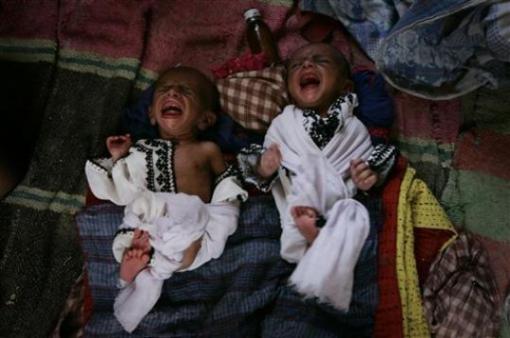
WASHINGTON — The floods in Pakistan have upended the Obama administration’s carefully honed strategy there, confronting the United States with a vast humanitarian crisis and militant groups determined to exploit the misery, in a country that was already one of its thorniest problems.

While the administration has kept its public emphasis on the relief effort, senior officials are busy assessing the longer-term strategic impact. One official said the disaster would affect virtually every aspect of the relationship between the United States and Pakistan, and could have ripple effects on the war in Afghanistan and the broader American battle against Al Qaeda.

With Pakistan’s economy suffering a grievous blow, the administration could be forced to redirect parts of its $7.5 billion economic aid package for Pakistan to urgent needs like rebuilding bridges, rather than more ambitious goals like upgrading the rickety electricity grid.

Beyond that, the United States will be dealing with a crippled Pakistani government and a military that, for now, has switched its focus from rooting out insurgents to plucking people from the floodwaters. The Pakistani authorities, a senior American official said, have been “stretched to the breaking point” by the crisis. Their ragged response has fueled fears that the Taliban will make gains by stepping in to provide emergency meals and shelter.

“It certainly has security implications,” said another official who, like others interviewed for this article, spoke on the condition of anonymity because he was not authorized to discuss internal policy deliberations. “An army that is consumed by flood relief is not conducting counterinsurgency operations.”

On Thursday, the United Nations will convene a special meeting devoted to the floods, hoping to galvanize what has been a lackluster global response. Secretary of State Hillary Rodham Clinton is expected to announce that American public aid has surpassed $100 million, an official said.

“We’re obviously not oblivious to the political and strategic implications of this catastrophe, but right now, we are fully focused on the emergency relief effort and trying to get a good assessment of the needs,” said the administration’s special representative to the region, Richard C. Holbrooke.

Noting that several weeks remain in the monsoon season, Mr. Holbrooke said, “Worse may be yet to come.”

The disaster comes after a period in which the administration seemed to have made strides in repairing the American relationship with Pakistan. Mrs. Clinton visited Islamabad in July with a long list of pledges, including the upgrading of several power plants and a plan to promote Pakistani mangoes. Now, these projects seem almost beside the point.

“Before, there were power plants in need of refurbishment,” said Daniel S. Markey, senior fellow for India, Pakistan and South Asia at the Council on Foreign Relations. “Now there are power plants underwater.”

In recent days, the United States has sent 15 helicopters, rescuing nearly 6,000 people. On Wednesday, military cargo planes delivered 60,000 pounds of food and other relief supplies, bringing total deliveries to 717,000 pounds. The speed and scale of the effort, officials in both countries said, have helped bolster the checkered American image in Pakistan.

In another hopeful sign, officials said Pakistan and India had been in close touch about the floodwaters, some of which are flowing into Pakistan from India. Such communication, between historic archenemies, could augur reduced tension in other areas, one of the officials said.

Against that, however, are the staggering dimensions of the disaster. A senior Pakistani official told the administration on Tuesday that the next flood surge was likely to inundate much of Punjab, the densely populated region that borders India and produces much of Pakistan’s food.

So far, this official said, the greatest damage has been in regions that are also hotbeds for Islamic insurgents, which has set back the army’s fight against extremist groups. Local governments in those places have largely collapsed, leaving the army as the only source of authority.

With 20 million people displaced from their homes, the Pakistani authorities are girding themselves for an immense migration to the major cities, which they fear could sow further instability.

“Americans have not yet registered the enormity of the crisis,” Pakistan’s ambassador to the United States, Husain Haqqani, said in a telephone interview from Islamabad, the capital.

Pakistani and American officials said reports of hard-line Islamic charities providing relief were exaggerated. One pointed out that the floods had hurt the insurgents as well: there was a report of small arms and ammunition belonging to a militant group floating in the water.

Still, people in both countries warned that if rebuilding and rehabilitation efforts bogged down, the Taliban and other militant groups would try to take advantage of it. “The real test is, can their government provide the most fundamental services?” said an administration official.

Parallels to this crisis are hard to find. One official cited the example of the Indonesian province of Aceh, which had been racked by a three-decade insurgency fought by the separatist Free Aceh Movement. After the tsunami swept through in 2004, killing 170,000 people, the separatists and the Indonesian government quickly signed a peace treaty, in August 2005.

There are, however, big differences between a localized separatist group and an international jihadist movement.

“If the flood proves to tilt the balance of power in Pakistan, it’s more likely to tilt toward the militants than toward the government,” said Bruce Riedel, a former intelligence official who helped the administration formulate its initial policy for Pakistan and Afghanistan.

Already, Pakistan’s president, Asif Ali Zardari, has been exposed to withering criticism at home for going on a trip to Europe during the early days of the flood. American officials said they were determined not to get drawn into the dispute, noting that in any event, Mr. Zardari had been stripped of many of his powers in a recent constitutional change.

Decisions on how the flood will affect American economic aid may be influenced by a trip to Pakistan by Senator John Kerry, the Massachusetts Democrat who co-sponsored the five-year nonmilitary assistance package with Senator Richard G. Lugar, Republican of Indiana.

Senator Kerry, accompanied by Dan Feldman, a deputy to Mr. Holbrooke, is scheduled to tour the flooded areas on Thursday. Mr. Kerry has said he is open to redirecting aid money, though some analysts said they were skeptical that Congress would approve additional financing. Military aid may also come under scrutiny, according to administration officials.

“Every dimension of our relationship — politics, economics, security — is going to see major shifts as a result of this historic disaster,” said Lt. Gen. Douglas Lute, the White House coordinator for Afghanistan and Pakistan. “All the tools of diplomacy have to be examined in light of this new reality.”

Clinton Adds to Curious History of Mango Diplomacy

By Sebastian Abbot for The Associated Press

When U.S. Secretary of State Hillary Rodham Clinton offered Pakistan help last week in exporting mangoes to the U.S. in a bid to dampen anti-American sentiment, it marked the latest chapter in the fruit’s curious history of diplomacy and intrigue.

Clinton’s offer came three years after the Bush administration opened up the U.S. market to Indian mangoes in exchange for allowing Harley-Davidson to sell its famed motorcycles in India – a deal that generated goodwill as the two countries finalized a civilian nuclear agreement.

Washington’s mango-powered diplomacy this time around is part of a broader $7.5 billion aid effort that is meant to improve the image of the U.S. in Pakistan, a move officials hope will provide the Pakistani government with greater room to cooperate on turning around the war in Afghanistan.

“I have personally vouched for Pakistani mangoes, which are delicious, and I’m looking forward to seeing Americans be able to enjoy those in the coming months,” Clinton said during her visit to Islamabad last week.

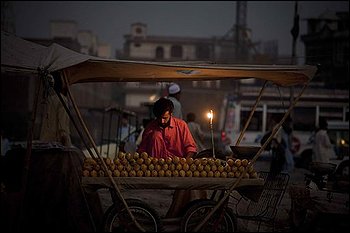
The prominence of mangoes in South Asian diplomacy should come as no surprise since scientists believe the sweet and fleshy orange fruit originated in the region before Buddhist monks and Persian traders introduced the plant to other areas of the world.

Pakistan and India recognize the mango as their national fruit, and summer in both countries is defined by the sights and sounds of vendors hawking piles of soft, sweet-smelling mangoes or pureeing them to create refreshing drinks that cut through the scorching heat.

Officials from both countries have exchanged crates of mangoes over the years in an attempt to soften tensions between the nuclear-armed rivals that have fought three wars since the partition of British India created the two nations a little over 60 years ago.

Former Pakistani President Zia ul-Haq may have begun the tradition when he swapped mangoes in the early 1980s with the Indian prime minister at the time, Indira Gandhi. The exchange took place several years before ul-Haq was killed in a plane crash that conspiracy theorists blame on a crate of mangoes placed on board moments before takeoff that was supposedly sprayed with a poisonous gas that killed the pilots and other passengers.

But like almost everything else, mangoes have also been a source of tension between Pakistan and India since the two countries view each other as competitors in the export market. Indians and Pakistanis argue over who grows the best mangoes – a debate that resembles the tussle between Lebanon and Israel over who can claim the mashed chickpea dish hummus as their own.

If all goes to plan, Americans will get a chance to conduct their own taste test once Pakistani mangoes break into the U.S. market. The U.S. plans trial shipments later this year and has pledged to support a three-year program to promote the export of Pakistani mangoes by sea to America, the world’s largest importer of the fruit. The initiative is part of a $21 million program to boost Pakistan’s agriculture. The U.S. will help finance hot water treatment facilities, sorting and grading machines and cold storage facilities.

India, meanwhile, is the world’s largest mango producer with about 13 million tons each year, far exceeding all other countries, including Pakistan, which comes in fifth place with about 1.6 million tons. But both countries have struggled to build the necessary infrastructure to really boost exports.

“Farmers are very grateful for the U.S. help,” said Muzaffar Khan Khakwani, the owner of a mango farm near the central Pakistani city of Multan that is benefiting from American aid. “It’s not just the financial help. It’s the capacity building and the exposure of farmers to well managed orchards.”

But it remains to be seen how quickly Pakistan can benefit from Clinton’s recently announced initiative. India had trouble with logistics and pricing when it first tried to export its mangoes to the U.S.

It is even more uncertain whether U.S. aid will really dent anti-American sentiment in Pakistan and motivate the government to step up support for the Afghan war, a move the Pakistanis have resisted for years.

As an Indian proverb says, “You can’t hurry a mango tree to ripen its fruit.”


Going After the Haqqani Network

From the Editors of The Express Tribune

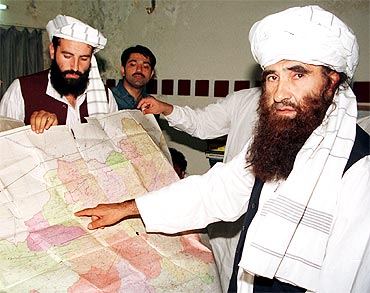
The question of the Haqqani network and how it is to be handled continues to fester. The US special envoy, Richard Holbrooke, this time in London, has suggested that Pakistan needs to go after the group with more force. The warning from Mr Holbrooke will have dashed hopes, raised during Hillary Clinton’s visit, that Washington was prepared to go along with a Pakistani strategy of dialogue with the network — led by Jalaluddin Haqqani and his son Sirajuddin. Links between the Pakistani intelligence forces and the Haqqanis have existed since the Afghan war and they have never been explicitly denied by either party. The elder Haqqani made his name as a formidable mujahideen commander during the Soviet occupation of Afghanistan when he was a member of Maulvi Yunis Khalis’s Hizb-i-Islami. He was also, according to American investigative journalist Steve Coll (who recently wrote Ghost Wars : The Secret History of the CIA, Afghanistan and Bin Laden, from the Soviet Invasion to September 10, 2001), offered a major role in the government by Afghan President Hamid Karzai some years ago.

For Islamabad, the pressure is on again. The Haqqani network is seen in Afghanistan as a key problem; it has carried out numerous attacks there. Washington believes Pakistan needs to do more to support the efforts against the militants in that country. The Pakistan military meanwhile, following its operation in South Waziristan, has avoided any move into North Waziristan – despite some gentle nudging from the US – reportedly following the intervention of the Haqqanis. They are also said to be facilitating talks with other militant factions across the conflict zone.

This brings us to an old issue: that of ‘good’ and ‘bad’ militants. It is clear that in the minds of the Pakistani military and the agencies allied to it this line of distinction continues to exist. Of course, Washington is in many ways responsible for creating this. The ghosts of the Afghan war, the alliance it formed with the mujahideen fighting the former Soviets and the engagement of Pakistan’s agencies, notably the ISI, are today coming back to haunt it. This is not to say that the CIA didn’t have its own connections to some of these actors in the past, but the point that is missed by most people is that it is America which calls the shots in this part of the world (or perhaps in most other parts as well).

There is a need for Islamabad to think things through. The division of militants into various camps, for example, so-called ‘good’ Taliban versus so-called ‘bad’ Taliban, has to stop. Essentially, these men of violence do more harm than good. The fact that a particular faction directs its wrath outside the country and avoids targeting Pakistani security forces should not be enough to cast it in the role of an ally. The effort against militancy does need to be seen in the wider regional context, and not as a matter of narrow allegiances and temporary agreements. The people who make decisions in Islamabad should keep in mind just how unsuccessful past efforts to do deals with the militants have been — with such attempts giving groups making up the complex Taliban network in the North a chance to reorganise and strengthen themselves on more than one occasion. There is reason to believe that this has contributed to the terrorism that has claimed thousands of lives. Even if the Haqqani network did not itself send out the bombers it has acted to back forces that have played a part in encouraging militant trends. The so-called Quetta Shura, led by the elusive Mullah Omar, is among these.

This having been said, Washington too needs also to review its own demands. There have been mixed signals over recent weeks. It is possible there is a lack of clarity on strategy within the US capital. This of course means the confusion in Islamabad has grown. A clear course of action needs to be planned in unison so the militants that Washington helped nurture can be driven away.

Cutting Hillary Clinton Some Slack

By Mosharraf Zaidi for The News International

Poor Americans. This is the fellow that Secretary of State Hillary Clinton has to stand beside as she tries to squeeze more juice out of a Kerry-Lugar Bill that had its lifeblood squeezed out of it last year by the Pakistani establishment, when it first became US law. The frustration from that reaction still riles the Americans. So much so that Hillary Clinton, who is a role model and an inspiration, can’t seem to let go. On every trip she reproduces a Bin Laden outburst that is militarily and strategically irrelevant for the US, but that serves as an enduring cancerous tumour for America’s public diplomacy goals in Pakistan.

Still. Mrs Clinton needs to be cut some slack. Her tireless advocacy for health care around the world, and her enduring compassion for South Asians — Indians, Pakistanis, Bangladeshis, Muslims, Hindus, men, children, and most of all, women — is singularly unique among either Democrats or Republicans.

The western media seems as fabulously smitten by Mrs Clinton as I am. The wires, the newspapers and the electronic media all reported Mrs Clinton’s announcement of the allocation of $500 million worth of projects as headline news, when really, it represents the fulfilment of only one-third of Kerry-Lugar-Berman’s sacred covenant with the Pakistani people. One of the most telling things about that covenant? It was signed by the US House of Representatives and the US Senate. It was, in short, a covenant between the US government and the American people, with the US government acting as a proxy for the Pakistani people.

Perhaps now Pakistanis can better understand the frustration of the John Kerrys, the Hillary Clintons and the Richard Holbrookes of the earth. Top US policymakers have fought for over two years to win the Kerry-Lugar Bill. Since then, two things have kept that money from flowing into Pakistan. The first is Mr Holbrooke’s decision to dispense with the Clintonian (Bill, not Hill) model of US aid disbursement through large contracting firms that Americans often refer to as Beltway Bandits. That decision, while long overdue, was rushed and was made in the wrong country, at the wrong time. American development assistance, which is not routed solely through USAID, but often through half a dozen different US departments (or ministries), has been in desperate need of an overhaul for years. But to attempt to reform the instrument of aid delivery in Pakistan, at the climax of Obama’s war in Afghanistan, has been a disastrous decision. The American international aid community is so removed and so distant from the mainstream of western assistance thinking (spearheaded by the OECD and captured in the Paris Declaration) that it doesn’t quite know how to deal with large sums of money without the Beltway Bandits. This has meant that the Kerry-Lugar money has been parked in Washington DC, with a clear destination, but no vehicle to take it there.

The second thing that has kept the Kerry-Lugar money from being spent is the government of Pakistan itself. Pakistan has no clarity whatsoever about what its development priorities are. It required the intervention of the military chief back in March to summon the federal secretaries to begin to articulate a wishlist of pet projects this government would like to see come to fruition. Indecision and the absence of any coherent development strategy within Pakistan have meant that the US government has had to try to figure out what Pakistan wants, kind of on its own. This may seem like comedy noire, but it’s really not funny at all.

The problem with Pakistani government today is that it doesn’t enjoy the competent stability it once used to through the bureaucracy. Today’s Pakistan’s bureaucracy, while made up of individually brilliant officers, is a collection of inward-looking dinosaurs that cannot see beyond their GOR houses, their I-8 plots and their post-retirement benefits. Those officers, in years past, used to be the eyes and ears of oft-changing governments that would seek the guidance of senior bureaucrats in the federal ministries and at the provincial headquarters. While there’s been no discernable change in the quality of governance that democratically elected politicians can render, there has been a severe nosedive in the quality of officers available to either the federal or provincial governments.

Part of the reason for the exodus of top-tier officers during the Musharraf era was the curtailment of powers of district managers, under decentralised local governments. But the decentralisation argument is a red-herring for a much more fundamental shift in Pakistani bureaucracy. While being a CSP or DMG officer was an instrument of social mobility in the 1970s or 1980s, it is now a barrier to the personal and professional growth of officers. Many of Pakistan’s brightest officers can afford to be well-paid UN, World Bank and IMF staffers. Many others can do even better at Wall Street and on Madison Avenue. Still others can be brilliant academics. Across the board, since 1999 we have seen exactly this. An exodus of top-shelf talent that might have been able to deal with rents, with incompetence, and with the heat, but not with the disrespect that the military and political class have for educated Pakistanis in the employ of the government of Pakistan.

So how does all this relate to Mrs Clinton’s troubles in Pakistan? Simple. No matter how democratically legitimate, when the blind lead the blind, there is a problem of vision. Pakistani politicians are so disconnected from any kind of global narrative that it will be a generation before we produce a Chidambaram, a Krishna or a Mukherjee that can win elections without the help of their gaddi (see: Shah Mehmood Qureshi), or the kindness of the Arbab Ghulam Rahims of the world (see: Shaukat Aziz). The nauseating outburst of the foreign minister on Friday was a demonstration that winning an election does not enable you to win an argument. In short, Pakistan’s current political class cannot muster politically legitimate actors that are also competent at statecraft.

Enter the advisory class. This is where the Husain Haqqanis, the Shaukat Tarins and the Dr Hafeez Shaikhs enter the fray. No fake degrees here. Only pedigree. Their problem is of an entirely different nature. They don’t have any stake in Pakistani politics — they enter as unknowns at the thaana kuthchehri and galli-mohalla level, and they leave as unknowns at the thaana kuthchehri and galli-mohalla level. They can talk about all the right kinds of reform, but they can’t deliver. More worryingly, their reform-speak is often deluded, because it is devoid of any political rigour. “Let’s clip military powers by marketing bold ideas in Washington DC, instead of Rawalpindi.” Well. We’ve seen how that has turned out. “Let’s raise taxes!” Sure. Because nobody else has ever thought of that! “Let’s improve education.” Sure. Because it takes genius to figure out that education is a problem. Advice that is anchored in Rubinomics and Bretton Woods theology has been failing Pakistan for the entire duration of Pakistan’s lifetime. This should hardly be a surprise. It never works anywhere.

And that is why Shah Mehmood Qureshi is wrong, again. Perceptions won’t change. $500 million worth of pet projects is a supremely sweet gesture. But even $500 billion worth of aid, delivered through Beltway Bandits, NGOs, budget support or otherwise can’t change the lives of Pakistanis. Only organic reform can achieve such noble goals. When the strategic dialogue in October picks up where this one leaves, Pakistan will still have no CT strategy, no development strategy, an inflated defence budget, no civil service reform, and no hate-speech legislation. All the money in the world can’t change that. And that’s not Hillary Clinton’s fault. That one’s on us.

Clinton Reaffirms US Commitment to Pakistan

By Ayaz Gul for The Voice of America

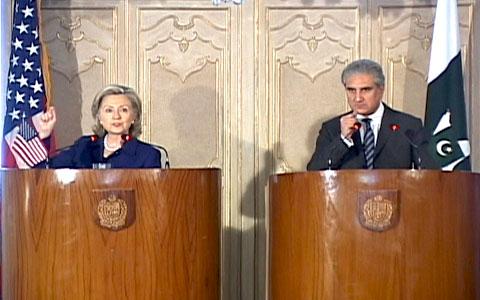
Concluding a second round of the so-called U.S.-Pakistan strategic dialogue in Islamabad, Secretary of State Hillary Clinton on Monday announced more than $500 million in several new aid programs for Pakistan.

The string of new projects unveiled by Clinton during a joint press conference with Pakistani Foreign Minister Shah Memood Qureshi are designed to help Pakistan meet its energy needs and boost power generation, health and agricultural development. The programs are the first to be launched under U.S legislation passed last year tripling civilian aid for Pakistan to $7.5 billion during the next five years.

Secretary Clinton said the United States hopes the new aid will translate into real life improvements for families and communities, describing them as long-term investments in Pakistan’s future.

“We are committed to building a partnership with Pakistan that of course strengthens security and protects the people of Pakistan, but goes far beyond security,” Clinton said. “We want to help you drive economic growth and prosperity, strengthen your democratic government institutions and expand access to the tools of opportunity.”

Pakistan is playing a key role in the international fighting against Taliban insurgents in Afghanistan. But public opinion in Pakistan still views U.S. motives with a considerable amount of suspicion. The skepticism stems from the U.S decision to abandon support for Pakistan after Soviet forces withdrew from Afghanistan.

But Secretary Clinton says she can see positive change resulting from what she called deeper and broader bilateral engagements in recent years.

“We have moved beyond a standoff of our misunderstandings that were allowed to fester and not addressed… to a position where we are engaged in the most open dialogue that I think our two countries have ever had,” she said.

Foreign minister Qureshi also agreed that the enhanced U.S cooperation in various fields such as energy, power, health, agricultural and education sector is critical for changing the public perception in Pakistan.

“The opinion of the United States will change when the people of Pakistan see that their lives have changed,” said Mr. Qureshi.

Sunday, Clinton attended the signing of a landmark trade deal reached by Pakistan and Afghanistan, after years of negotiations. The United States has been pushing Afghan and Pakistani leaders to improve bilateral relations it says will contribute to the fight against extremists.

Secretary Clinton’s next stop as part of her Asia trip will be Kabul, where she will attend an international conference on Tuesday.

At the news conference in Islamabad, she reiterated that insurgents who wish to reconcile must lay down their arms, renounce partnership with al-Qaida and accept Afghanistan’s constitution.

“It seems to us that there will be some who are willing to meet those conditions and others who are not. And we would strongly advise our friends in Afghanistan to deal with those who are committed to a peaceful future where their ideas can compete in the political arena through the ballot box, not through the force of arms.”

Taliban insurgents have stepped up attacks against Afghan and U.S-led coalition forces in recent months. More than 50 foreign troops have died in July while the previous month was the deadliest for international forces since the war against Taliban and its allies began nine years ago.