Posts Tagged ‘ India ’

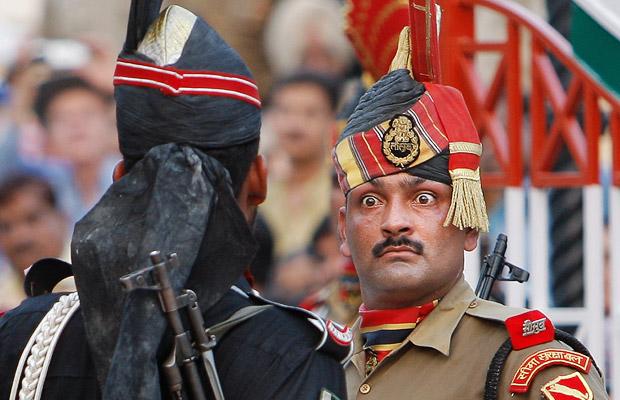
India, Pakistan Peaceniks Hold Candlelight Vigil on Wagah Border

By Sawinder Singh for ANI

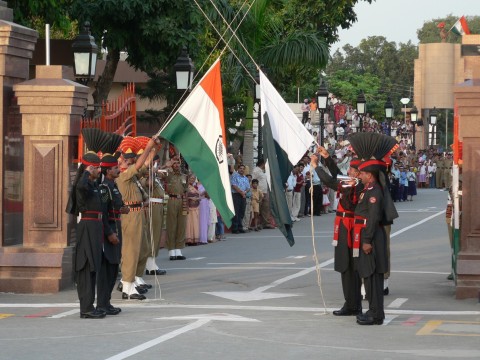
Several intellectuals and peace activists from India and Pakistan held a candlelight vigil at Wagah border crossing in on the eve of Independence Day.

The objective of this annual event is to spread the message of peace and brotherhood on the occasion of the Independence Day celebrations of the two neighbouring countries-India and Pakistan.

The midnight vigil on August 14-15 was held on the 63rd Independence Day celebrations of both the countries.

Bollywood Film Producer-Director Mahesh Bhatt, veteran Indian journalist-writer Kuldeep Nayar, Aitzaz Ahsan, former Pakistan Supreme Court Bar Association President and many social activists participated in the midnight vigil.

The participants carrying candlelights and torches marched to the Wagah Border raising slogans of Long Live India-Pakistan Friendship.

“Borders should be open and it should be soft and let people meet from both the countries. Because when people of both the countries will meet then governments will come under pressure and the situation will improve,” said Kuldeep Nayyar.

“Both countries can prosper only if there is a good relationship between them, we have to remove the poverty. Both countries are stricken with acute poverty, unemployment and hunger. Both the countries need to reduce their expenditure on weapons and then only we can reduce poverty and for that it is necessary to have peace, friendship and brotherhood,” added Aitzaz Ahsan, former Pakistan Supreme Court Bar Association President.

On this occasion, a music concert was also held.

India and Pakistan achieved independence from Britain on the midnight of August 14, 1947. While Pakistan celebrates its Independence Day on August 14, India marks its Independence Day on August 15.

This year Pakistan did not celebrate its independence day as a tribut to victims of recent floods in the country.

India Hints at Pakistan Role in Kashmir Unrest

By Nigam Prusty for Reuters

India’s interior minister hinted on Friday that Pakistan could be behind weeks of violent anti-India protests in the disputed Kashmir region, a move that could hurt the nuclear-armed rivals’ attempts to improve ties.

This is the first time New Delhi has linked Pakistan to the violence in Kashmir that has killed nearly 50 people since June. Earlier India had said Pakistan-based militants were inciting trouble in Kashmir, a region divided between India and Pakistan and which both claim in full.

“Pakistan appears to have altered its strategy in influencing events in Jammu and Kashmir,” Palaniappan Chidambaram told the Indian parliament during a debate on the protests, among the biggest since a separatist revolt against Indian rule broke out in 1989.

“It is possible that they believe that relying upon civilian unrest will pay them better dividends. But I am confident if we are able to win the hearts and minds of the people … those designs can be foiled.”

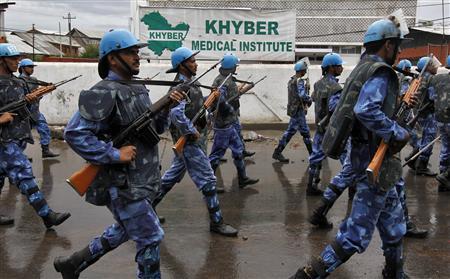
There were fresh pro-independence protests in several places in Kashmir on Friday. At least two people were wounded when police opened fire on thousands of protesters in Sopore town in north Kashmir.

The minister’s comments could be seen by Islamabad as a provocation, damaging prospects for improving ties that plummeted after the 2008 Mumbai attacks that killed 166 people and derailed a sluggish four-year-old peace process with Pakistan.

So far, the latest violence in Kashmir has appeared to have little impact on relations.

The two sides last held peace talks in July and those ended in acrimony over the attacks, even though the dialogue itself is seen as a tentative step towards improving ties.

Divided Kashmir remains at the heart of the dispute between India and Pakistan, with both sides claiming the Himalayan region in full. They have fought two of their three wars over it.

India accuses Pakistan of fuelling unrest in Kashmir, but Islamabad says it only lends moral support to what it calls Kashmir’s independence movement which has killed tens of thousands of people.

In June, India blamed Pakistan-based Lashkar-e-Taiba (LeT) militants for the Mumbai attacks, but Kashmiri separatists say protests by crowds of mainly Muslim youths are generally spontaneous.

LeT was founded in 1990 to fight Indian rule in Kashmir and is based in Pakistan’s Punjab province.

Militant violence has fallen dramatically in recent years but popular protests have continued. In 2008, the region witnessed the biggest protests against Indian rule in two decades.

Kashmiri separatists want to carve out an independent homeland or merge with predominantly Muslim Pakistan.

Cross-Border Unions: How Indo-Pakistani Marriages Prosper

By Vinita Bharadwaj for The National-UAE

While relations between their countries may be at an all-time low, Indians and Pakistanis who marry each other often find extended family ties confound their nations’ mutual hostility.

It is a truth universally acknowledged, that when two South Asians wed, they not only marry each other, they also marry into each other’s family.

And family matters between Indians and Pakistanis might be expected to be highly charged, given those two countries’ mutual antipathy for more than 60 years.

“When an Indian marries a Pakistani, it’s a loaded event that can only be matched by the energy of a cricket match between the two countries,” says Amra Hyder, a Pakistani.

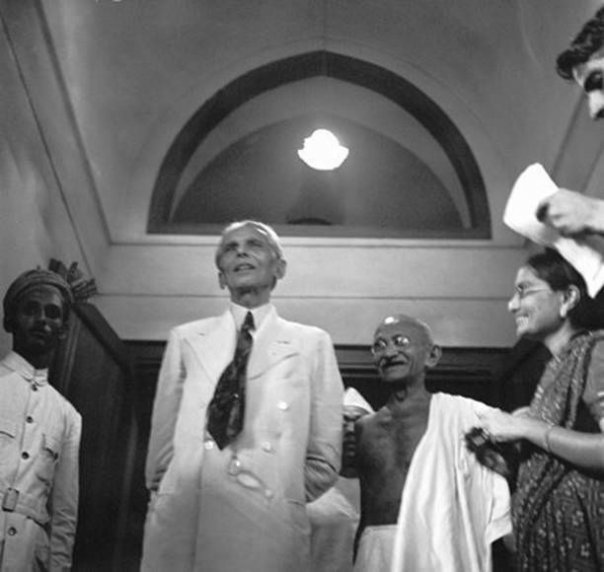
The partition of British India into Pakistan and India is historically recorded as the largest human migration ever. It displaced millions and forced people of a common culture to choose a new geography and subscribe overnight to the idea of previously non-existent nations.

Most tragically, it split families. The ghosts of the 1947 partition loom large in the psyches of both countries’ modern histories that include three wars, a continuing dispute over Kashmir and terrorism.

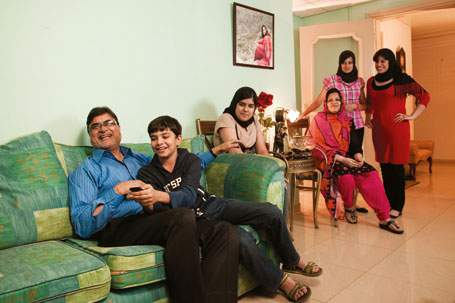
Amra is originally from Pakistan and is married to Zulfiqar Hyder, who hails from India. Amra and Zulfiqar, now Canadian citizens, have lived in Sharjah with their four children since 2006.

In 1992, when the gregarious, romantic 23-year-old Amra married the 33-year old Zulfiqar, a studious man from India, she did not quite know what to expect – from married life, her in-laws and most importantly, her husband’s country. “I also never would have imagined I would be apologetic for both countries’ ridiculous obsession with ‘Shonia’,” she says of the media brouhaha over the recent nuptials of the Pakistani cricketer Shoaib Malik and the Indian tennis player Sania Mirza.

For long before the Malik-Mirza marriage, thousands of Indians and Pakistanis, mostly from families divided by the 1947 partition, have been marrying each other.

The difference is that now these marital alliances are formed outside the extended family circuit. Amra and Zulfiqar did not have an arranged marriage, and neither of them had any intention of settling in either India or Pakistan. They opted to overcome predictable visa hassles by initially residing in the UAE soon after their wedding, and migrated to Canada in 1996 to obtain citizenship, in the hope that it would ease their trips between India and Pakistan.

 
Masooma Syed, from Lahore, met her Keralan husband Sumedh Rajendran at an artists’ residency programme in Delhi. ‘I knew he understood me perfectly.’ Charla Jones

The couple first met in Abu Dhabi at a mutual friend’s party, and married within a year. The wedding took place in Karachi, with Zulfiqar’s entire family flying in from the northern Indian city of Lucknow. “It was a lovely wedding,” Amra recalls, adding that the questioning – albeit, in jest – began soon after they were married. “It was like, ‘Now you’re an Indian daughter-in-law’ and ‘Who will you support in cricket’ or even ‘Who will you support in war’?”

Her response was simple. “I married an Indian, not India. Having said that, I have been welcomed so warmly and given unbelievable respect by Indians, whenever I visit. My relationship with the people, I cherish. The politics, I don’t care for.”

Amra grew up in Abu Dhabi and returned to Lahore for university. Her childhood perception of Indians was to lump them all as people from the Southern Indian state of Kerala. “It was so wrong,” she says regretfully admitting to an error of judgment on her part, “but I honestly never really gave it any thought.” Although her grandfather was an active political leader – initially in the Indian independence struggle and later in the Muslim League, which pressed for Pakistan’s creation – she was uninterested in matters of politics.

On numerous trips to Northern India in the last 18 years, Amra has returned amazed by the cultural similarities she has observed between Indians – including non-Muslims – and her community in Pakistan. “We speak the same kind of language, we appreciate the same food, we like the same clothes, we place the same importance on family values. We even share similar pre-wedding festivities. It’s hardly an alien experience,” she says.

The differences were more to do with class and little do with the country. “Compared to my husband’s childhood, mine was very privileged. He is a self-made man and has single-handedly contributed to his family’s success. If I had to get used to anything, it was holidaying in a home that would experience power cuts and water shortages.”

Amra and Zulfiqar’s children – Hira (17), Anum (13), Zahra (11) and Ali (10) – describe themselves as desi, a generic, originally sanskrit, term used by South Asian immigrants that loosely denotes their origins. They are an animated group and debate the definition of desi among themselves, as their parents look on proudly. The conclusion: among younger generations in urban settings, desi communities have spawned a culture bound by a fondness for Bollywood, cricket, South Asian food and fused elements of their upbringing at home with the globalised, western outlook they are exposed to outside.

Having said that, India and Pakistan enjoy enormous cultural riches – largely attributable to their ethnic, regional and linguistic diversity. Both countries together are akin to the European Union – with each of their provinces having their own quirks, tastes and sensibilities. These subtleties within communities are apparent when embedded among the people in their own land.

Shadab Raza, from Lucknow, India, his Pakistani wife Sana Zehri and their six-year-old son Ali have relatives on both sides of the border. ‘There’s never been this India-Pakistan mentality in our families,’ Shadab said. Siddharth Siva / Arabian Eye

Masooma Syed, an artist from Lahore, lives in Delhi with her husband Sumedh Rajendran, also an artist, but from the south of India. They were introduced to each other at an artists’ residency programme in the Indian capital Delhi in 2003. Following that, they would arrange to meet in Manchester, Sri Lanka and New York before finally geting married in July 2008.

Their cultural backgrounds could not be more different, as are their temperaments and artistic styles. “And yet, I knew he understood me perfectly,” says Masooma of the decision to marry across the border and step into the cumbersome world of visas, soon after exchanging wedding vows in Sri Lanka.

“We never thought about a third country [to live in]. Sumedh has lived in Delhi for the last 15 years and I’ve had absolutely no problem in adjusting to living here. It’s just like Lahore. Ironically, I find Sumedh is more of a foreigner in his own country’s capital than I am. We have discussed moving to a neutral country, especially if visa regulations became tighter, but then as artists all our inspirations stem from this region. Relocating would uproot those emotions and we wonder what impact that would have on our work.”

Kerala, where Sumedh is from, however, is an altogether different milieu. “The first time Masooma visited, she was stunned,” says Sumedh.

“I thought to myself, how lucky am I to be able to see and discover these different facets of India,” she says recalling her reaction to the abundant greenery, the aromatic spices, the swaying coconut palms and the simple people.

But since marrying Sumedh, Masooma has found herself saddled with the unexpected baggage of acting as an ambassador of sorts for both countries. “It’s annoying at times,” she says. “And really it’s all because of immature media reportage in one country about the other. So I end up having to either justify, explain or make excuses for India when in Pakistan or vice versa. I’m not used to being accountable to anyone and this new role is quite tiring, even if it does come with special treatment in some instances.”
The challenges within an Indo-Pak marriage, according to Masooma, seem to be similar to any mixed-culture marriage. Except that among South Asian communities, tradition dictates the wife follows the husband to his home, or homeland. In the specific India-Pakistan context of the 21st century, the complications of visas and work permits make it harder for educated women to carve out an identity for themselves in their new environment. “It’s definitely much easier to be in a third country – either resident or citizen – when in an Indo-Pak marriage. Also, in today’s world, the younger generations of Indians and Pakistanis are meeting and interacting abroad, first as students and then as professionals. Marriages between different faiths among this demographic is on the rise and logistics is no longer a deterrent to falling in love.”

Masooma has been visiting India since 2003 and as an artist she has travelled, exhibited and worked in both countries. “I go through the same motions as all Pakistani nationals applying for an Indian visa. It’s a process and is easy or difficult depending entirely on how you want to look at it,” she says. In early June, the Indian government announced it was relaxing the requirements for granting the extension of long-term visas to four categories of Pakistani nationals, including Pakistani women married to Indian nationals and staying in India. The announcement was welcomed by individuals in her situation.

Her current visa is a ‘visit visa’ valid for nine months that is split into three visits of 90 days each. She has to exit India after each ‘visit’, but says it suits her work commitments that require her to travel abroad. “And I can visit my family in Lahore,” she adds.

Pakistani nationals issued visas to India are typically allowed to visit a maximum of three cities and must report to a police station on arrival and before leaving for their next destination. Masooma is now exempted from the police reporting, as she is a regular traveller between India and Pakistan and is also now married to an Indian national. “I’m allowed to visit more than three cities each time, but it will be a while before I am given complete freedom to travel like any other foreigner,” she says.

She could apply for a residence permit, but would be compelled to stay in India until the paperwork is completed, but it’s diffiuclt to predict how long that would take. Nationality, however, remains a touchy issue, particularly among the educated and liberal women of either country, who see no reason in giving up the passport of the country they originally belong to.

“Unfortunately, political relations keep changing and this spills over into visas and affects people-to-people relationships,” says Zulfiqar Hyder, a staunch believer in encouraging contact between the two countries. The Hyder family hold Canadian passports, but they still have to apply for visas to visit India and Pakistan.

In the wake of the David Headley arrest – a US citizen of Pakistani origin – over his alleged terrorist connections and involvement in the 2008 Mumbai attack, Zulfiqar says having the Canadian passport makes little difference towards easing the process. “I’m trying to get a PIO (Person of Indian Origin) card for the children,” he says of the document issued by the Indian government that functions as a long-term multiple entry visa. As things stand, the foreign spouse of an Indian national is eligible for the PIO card, but the spouses from Pakistan are not, effectively ruling out Amra and her two elder daughters, as they were previously travelling on her passport. “I don’t understand the logic that my children cannot get the PIO card, because their mother is Pakistani,” says Zulfiqar.

The national security argument does not resonate with him as much as it does with Amra. “Frankly, if my family can be assured of safe travel, I don’t mind a little more waiting or dealing with a bit more bureaucracy,” she says. He shakes his head furiously, looks at me and asks: “Did the 26/11 terrorists enter India with passports? Did they? How did they enter India?”

They arrived by night. Across the Arabian Sea, first on a small boat, then a hijacked fishing trawler and finally entered Mumbai’s waters on a rubber dinghy.

Visa-related policies in both countries are updated depending on the warmth or frostiness of the political relationship. Shadab Raza, a 35-year old Indian also from Lucknow, married Pakistani national Sana Zehri, who grew up in the UAE. They have a six-year-old son who has an Indian passport. The families arranged their marriage, as Shadab’s maternal aunts live in Pakistan. “There’s never been this India-Pakistan mentality in our families, because we have relatives on both sides of the border,” says Shadab.

Sana’s ancestry can be traced back to Lucknow, as her grandparents migrated to Pakistan at the time of the partition. On her first visit to the city after her marriage, she visited the ancestral home of her grandparents and filmed it to share with them. “I filmed the house, the neighbourhood and some of the people recorded messages for them. When they watched the video they were consumed by nostalgic sadness. I think partition hurt their generation the most. Our parents to a lesser extent, but they still feel the impact of it as they grew up hearing about it from their parents and visiting immediate relatives in the other country. For my generation, the degree of the trauma is even more reduced, because we haven’t experienced much of the consequences of it directly,” she says.

Shadab and Sana’s son, Ali, however, is quite clear about where he is from. “India,” he says firmly.

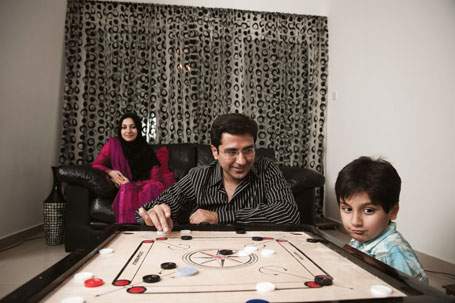
Sana laughs and recalls an incident of him wanting a carrom board specifically ‘made in India’. “My father-in-law had to get the lettering customised because the shop, where they bought it didn’t sell carrom boards with a ‘made in India’ label,” she says. In the meantime, Ali brings out his carrom board and empties out the coins from their container. He then calls out to Shadab to come and play with him.

“There’s never been this India-Pakistan mentality in our families, because we have relatives on both sides of the border,” says Shadab sitting down at the board, across from Ali, who flicks the large striker coin towards the arrangement of smaller black and white coins stacked by colour in the centre of the board. The two towers collapse, some of the coins disperse in four directions, but none of them is pocketed.

“What a mess,” exclaims Ali.
Krishna Arrives in Pakistan, Calls Visit ‘a New Beginning’

By Omer Farooq Khan for The Times of India

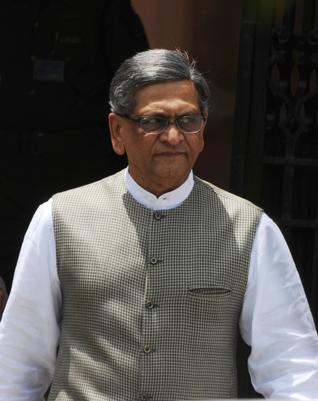
Indian external affairs minister S M Krishna, who arrived in Islamabad on Wednesday, said that he is on a mission to restore trust and increase confidence between the two countries.

“We hope to discuss all issues of mutual interest and concern that can contribute to restoring trust and building confidence in our bilateral relationship,” Krishna told journalists as he arrived here.

During his three-day visit, Krishna will hold talks with his Pakistani counterpart Shah Mahmood Qureshi on Thursday and will also meet President Asif Ali Zardari and PM Yusuf Raza Gillani. S M Krishna looks forward seeking progress on the issue of terrorism being raised by the Indian home minister P Chidambaram with his Pakistani counterpart Rehman Malik last month in Islamabad.

“I also look forward to receiving feedback on the issues raised by our home minister (P Chidambaram) during his visit to Pakistan last month on our core concern of terrorism, particularly in the light of the discussions our home minister had in Pakistan in the context of interrogation of David Headley regarding the Mumbai terrorist attack,” he said.

Krishna described his visit as important as it marks a new beginning of journey to build a prosperous, friendly and cooperative relationship between the two countries.

India is committed to resolving all issues with Pakistan through peaceful dialogue based on mutual trust and confidence, Krishna said.

“I brought a message of peace and friendship from the people of India and we hope to undertake this voyage of peace, however long and arduous, jointly with the government and people of Pakistan,” he said.
Pakistan’s foreign minister Shah Mehmood Qureshi has said that he will raise with Krishna the issue of alleged human rights in Jammu and Kashmir.

“We are approaching the meeting with a positive mindset,” Qureshi said.

The Krishna-Qureshi talks on Thursday will be the third major contact between the two countries in within a month.

Home minister Chidambaram conveyed India’s concerns and expectations on terrorism to Pakistani leadership last month when he visited Islamabad.

The Indian and Pakistani prime ministers met in April on the sidelines of a regional summit in Bhutan, which set in motion the process to revive suspended contacts at different levels of government.

Breaking Pakistan’s Sufi Heart

By Mira Sethi for The Wall Street Journal

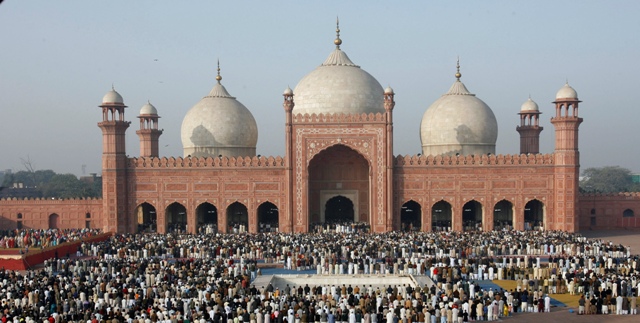
The two suicide bombers chose midnight on July 1, when the throng of worshipers in the ancient Data Darbar shrine in Lahore, Pakistan, was at its peak, to blow themselves up. Forty-five people were killed and 175 were injured. The attack on the 1,000-year-old center of Sufi Islam—the religion’s mystical, unorthodox face—was the first Taliban attack of its kind in Punjab province, the heartland of the country’s moderate, majority Barelvi sect.

The day after the attack on the shrine, Lahore’s students, politicians, traders and housewives took to the streets in loud, visceral protest. Major commercial centers were shut down, and in a rare show of sympathy, students from religious seminaries blocked roads and burned a few tires.

Pakistanis are now asking themselves: Is this America’s war or is it ours too? How can we fight it? Why did our military nurture these warriors for three decades and why has it turned against them now? How and when are we going to be at peace with our neighbors, especially India with which the military is obsessed and for whom these non-state actors were originally spawned?

To understand why this attack is so shocking, one must first look at Pakistan’s religious history. The majority of Pakistanis are Barelvis, who respect the inclusive traditions of the Sufis who brought Islam to the Indian Subcontinent. This is completely unlike the harsh version of Islam imported from Wahabi Saudi Arabia after the petro-dollar boom in the Middle East in the 1970s.

So the bombing of the Sufi shrine has symbolic resonance: Sufism has always thrived as a reaction to the politics of the state. In modern Turkey Sufism grew as a response to Ataturk’s secularism; in the Soviet Union, it grew as resistance to the state’s official policy of promoting atheism; in Algeria, it was a reaction to French colonialism. In Pakistan, Sufism has thrived as an alternative to the state-sponsored Wahabi Islam of the Deobandi jihadi sect.

If there’s one thing that Pakistanis are proud of, it’s their Sufi heritage. The shrine attacked in Lahore housed the tomb of one of the most famous Sufis to have ever lived, Ali Hajwiri, affectionately known by Lahoris as Data—one who facilitates the fulfillment of aspirations. Hajwiri wrote a seminal text in Sufi thought, the Kashf-al-Mahjub or “Unveiling of the Hidden.” An early example of Sufi doctrine, the book’s importance has grown over the centuries.

Although not a native of Lahore, Hajwiri decided to settle in the city for the last 34 years of his life at the end of the 11th century. Even then, Lahore’s fame as a center of culture was widespread. It was known for its old fortified city, a nourishing river, and a collection of free-spirited artists, artisans, and musicians. During his 34 years of residence, Hajwiri became a revered dervish, offering an inclusive mystical path to Lahore’s non-Muslim population, many of whom were subject to a punishing caste hierarchy.

Hajwiri’s shrine remained protected through centuries of rising and falling empires in the Punjab. Even the Sikh marauder Maharaja Ranjit Singh left the shrine untouched as he plundered many of Lahore’s riches.

In attacking Hajwiri’s shrine, the Taliban have grossly miscalculated. They had hoped to provoke anger at the Pakistani government for fighting America’s war. Instead they have managed to convince more and more Pakistanis that this is now their war, not just America’s.

A Pakistani American Celebrates July 4

By Manzer Munir for Pakistanis for Peace

Thousands of Pakistani Americans celebrate the July 4 Independence Day holiday with their friends and families across the United States today. As different as Pakistan and the United States may be as countries and societies, one thing they both have in common is that both countries were founded on religious reasons. Unfortunately, that is where their similiarites end as the religious freedom experience in these present day countries varies greatly.

The earliest settlers of these United States were in fact Europeans who felt persecuted in the old countries of Europe for their religious beliefs. Many of these Puritans came to America in search of religious freedom.  Their hope was to escape the religious persecution they were facing in their countries and so the United States was founded on religious grounds.

Pakistan too is a country that sees the basis of its founding for a religious purpose. The nationalist movement for an independent India from British rule also caused communal conflicts between the Hindus and Muslims as there were calls by many Muslim leaders for a separate country for the Muslims of India since many felt being a minority in a Hindu dominated country would come at the expense of their rights. So a separate country for the Muslims of India and for their right to practice their religion gained momentum and indeed on August 14, 1947, the Islamic Republic of Pakistan became independent, a country founded on religious freedom for the Muslims of India.

This is not to deny the fact that Muslims still exist in India and are free to practice their religion under a Hindu dominated country. In fact, there are more Muslims in India than there are in present day Pakistan. However, many Muslims at the time of partition felt that they would be freer to practice Islam in a Muslim country rather than a Hindu one. It is an open debate whether people in Pakistan today have more freedom to practice their religion. If you are a member of either a minority Muslim group as Shiite or if you happen to be a Christian, Hindu, Sikh or Jew In Pakistan today, you have far less freedom of religion than a comparable religious group in present day India. There is absolutely a very low level of tolerance in Pakistan today for other religions or ways of life different than the majority group.

The promise of religious freedom that saw the founding of both Pakistan and the United States has seen the two countries go separate ways in realizing the dream of each countries forefathers. While the American Founding Fathers dream of a nation that respects freedom of religion and honors a separation between church and state held true, Pakistan unfortunately  has become a country that has become intolerant of other religions. Many religious minorities such as Christians, Hindus, and even Muslim Ahmadis are routinely persecuted or attacked by Muslims who see these groups as infidels and heathens and not merely as human beings with different religious beliefs. The influx of Taliban and religious extremists inside Pakistan has further made life difficult for anyone who is not a devout Sunni Muslim. On many occasions, the police does not investigate or prosecute attacks on religious minorities by various extremist groups leading to a constant fear of their lives and properties.

As Pakistani as well as Muslim Americans across the United States today celebrate the the July 4 holiday, they are keenly aware  that their brethren back in their original countries are not as free to practice their religion, speak their minds, and or protest peacefully as they are able to do in the United States. For this nation indeed guarantees freedom and liberty for all and not just a certain religious or ethnic group.

That is why Pakistani Americans such as myself and Muslim Americans across the US are appreciative of the fact that in this, our adopted country, our religious and civic freedoms are safe guarded in that greatest of living documents, the US Constitution. I have long felt that after the three great religious books of the Torah, the Bible, and the Koran, the US Constitution is the next best thing that man ever wrote down on paper. The Founding Fathers of America were indeed some of the greatest minds in history for crafting a document that continues to make the United States the freest country in the world and one that stayed true to its founding of liberty and freedom for all. Happy Birthday America, May you have many more!

–Manzer Munir, a proud Pakistani American plans to celebrate the July 4 Independence Day with family and friends at a picnic with fireworks and by watching a parade.

Vengeful New Militant Group Emerges in Pakistan

By Kathy Gannon for The Associated Press

Pakistani authorities now believe a dangerous new militant group, out to avenge a deadly army assault on a mosque in Islamabad three years ago, has carried out several major bombings in the capital previously blamed on the Taliban.

The emergence of the Ghazi Force was part of the outrage among many deeply religious Pakistani Muslims over the July 2007 attack by security forces against the Lal Masjid, or Red Mosque, a stronghold of Islamic militants.

The fierce attack, in which scores of young, heavily armed religious students died, inspired a new generation of militants. These Pakistanis have turned against a government they felt has betrayed them and, to their dismay, backed the U.S. role in neighboring Afghanistan.

The brief but bloody history of the Ghazi Force illustrates the unintended results of Pakistan’s policy of promoting Islamic extremists to fight India in the disputed area of Kashmir. That policy — which Pakistan denies it pursues — now threatens regional stability as the U.S. and Pakistan’s other Western partners pour billions of dollars into the country to stop the rise of Islamic militancy.

The new group is made up of relatives of students who died in the Red Mosque assault. It is named after the students’ leader, Maulana Abdul Rashid Ghazi, who was also killed. The mosque’s religious school, or madrassa, had been a sanctuary for militants opposed to Pakistan’s support of the U.S.-run war in Afghanistan.

Private television stations broadcast vivid scenes of the assault — commandos in black fatigues rapelling down ropes, the crackle of gunfire, bodies of black-shrouded girls carried out through the smoldering gates. Those images stunned the nation, especially families of the students and Pakistanis with deep religious feelings.

“Before the Lal Masjid, militants hadn’t yet declared war on the state of Pakistan. That changed with Lal Masjid,” said Zahid Hussain, author and terrorism expert who has written extensively about Pakistan.

Islamabad’s inspector general of police, Kalim Imam, told The Associated Press that the Ghazi Force was behind most of the deadliest attacks in the capital during the last three years. The attacks targeted the military, the Inter-Services Intelligence agency or ISI — which had ties to a number of militants — and a five-star hotel frequented by foreigners and the Pakistani elite.

The Ghazi Force helped recruit a security official who blew himself up inside the office of the World Food Program last October, killing five people, according to Imam. The force also sent a suicide bomber in September 2007 into the mess hall of the commando unit that attacked the Red Mosque, killing 22 people, he said.

Ghazi Force members may also have been involved in the audacious June 9 attack north of the capital that killed seven people and destroyed 60 vehicles ferrying supplies to NATO and U.S. soldiers next door in Afghanistan, Imam said.

Many of those attacks had been attributed to the Pakistani Taliban, which operates in the remote tribal areas of the northwest along the border with Afghanistan. There is evidence of close ties between the Ghazi Force and the Pakistani Taliban, which the government has vowed to crush.

The Ghazi Force is believed to be headquartered in the Orakzai region of the border area, where the leader of the Pakistan Taliban, Hakimullah Mehsud, held sway for years. The leader of the Ghazi Force is believed to be Maulana Niaz Raheem, a former student at the Red Mosque.

Anger over the bloodshed at the mosque was all the greater because many of the militants and their supporters felt betrayed by a government that had once supported them. Both Ghazi and his brother Maulana Abdul Aziz Ghazi, who was freed on bail this year after two years in jail, were widely believed to have been on the payrolls of both the government and the ISI intelligence service.

Their father, Maulana Mohammed Abdullah, enjoyed a close relationship with the late President Mohammad Zia ul-Haq, and the mosque was a center for recruiting volunteers to fight against the Soviets in Afghanistan in the 1980s.

As opposition grew to Pakistan’s support of the U.S. role in Afghanistan, the mosque became a center of religious agitation against the government, with armed students taking over the complex and police laying siege.

A former senior official in the Interior Ministry told The Associated Press that the police wanted to storm the mosque and end the siege at its outset, send the students home and shut down the religious school and a neighboring library until tempers cooled.

President Gen. Pervez Musharraf refused, the official said, even though police knew that members of al-Qaida’s affiliate organization Jaish-e-Mohammed, which is banned in Pakistan, were bringing in weapons for the students.

Musharraf relented and ordered the assault after militants kidnapped several Chinese nationals running a massage parlor in Islamabad, accusing them of prostitution. The death toll remains in dispute. Red Mosque officials say hundreds died. The government says fewer than 100 were killed.

In a rare interview, Abdul Aziz Ghazi told AP he warned the government that an assault on the mosque would unleash forces that no one could control.

“I have been in jail. I did not form this force and I don’t condone the violence but they are angry at the injustices done,” he said this week.

Although the assault turned many Islamic hard-liners against the government, Pakistan remains unwilling to break all ties to the militants, instead following a high-risk strategy of coddling “good militants” while fighting those deemed “bad militants,” analysts say.

“The military and the ISI have given importance to these militants as assets. But those who have openly declared war, and there is no chance of them returning back to the state, the army is going after them,” said Manzar Jameel, a terrorism expert and researcher on the growth of extremism in Pakistan. “Yet they still believe that some are still assets and that they can keep control of the assets. It’s a failure of strategy.”

Army spokesman Maj. Gen. Athar Abbas denies any assistance to militant groups, saying past ties have long since been severed. He says the Ghazi Force is among the groups the 120,000 Pakistani soldiers waging war in the tribal regions are fighting.

Yet Anatol Lieven, a terrorism expert with the Department of War Studies at London’s King College, said it’s clear that the ISI continues to protect some militant groups, even if it has broken with others.

In a June report, the Rand Corporation think tank also alleged that Pakistan’s military and intelligence still support some militant groups “as a tool of its foreign and domestic policy.”

“A key objective of U.S. policy must be to alter Pakistan’s strategic calculus and end its support to militant groups,” the report said.

Christine Fair, a co-author of that report and an assistant professor at Georgetown University’s Center for Peace and Security Studies, said the battle against extremists in Pakistan is mired in layers of subterfuge by Pakistani intelligence and a “mystifying” acceptance by the CIA of Pakistan’s “good-militant, bad-militant” policy.

She said U.S. intelligence knows Pakistan protects one group — Lashkar-e-Taiba, which India blames for the 2008 Mumbai assault and Afghanistan accuses of masterminding deadly attacks against the Indian Embassy in Kabul.

“Lashkar-e-Taiba remains intact. I have had conversations with … officials in Washington. It is not their priority. Lashkar-e-Taiba is not an issue,” she said in an interview. “Yet Lashkar-e-Taiba has been attacking us in Afghanistan since 2004.”

Aisam-Rohan Reach Wimbledon Quarter-Finals: Next Stop, Wagah

By Sehar Tariq for All Things Pakistan

Pakistan’s stellarly good-looking tennis champ Aisam-ul-Haq Qureshi became the first Pakistani to reach the quarter-finals at Wimbledon when along with his Indian partner Rohan Bopannahe beat Lucas Lacko of Slovakia and Sergiy Stakhovsky of Ukraine in straight sets in the Mens’ Double. Their straight set victory – 7-5, 7-6 (7-4), 6-2- in the Round of 16 now take them to the Mens’ Doubles Quarterfinals, and already place them in the top-8.

It was only two years ago that Aisam – who is Pakistan No. 1 and World No. 43 for Men’s Doubles –  became the first Pakistani to play at Wimbledon since 1976. Since then he has been steadily improving his game, including beating a doubles duo with Roger Federer in it last year. The news report in Dawn points out that “the Pakistani number one and world number 42 is a grass-court specialist and has been improving his performance at the world’s most prestigious tennis tournament in the last few years.”

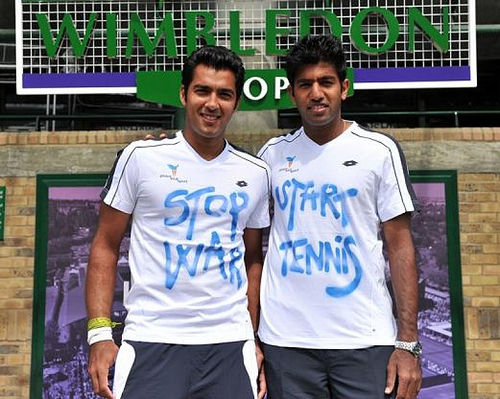
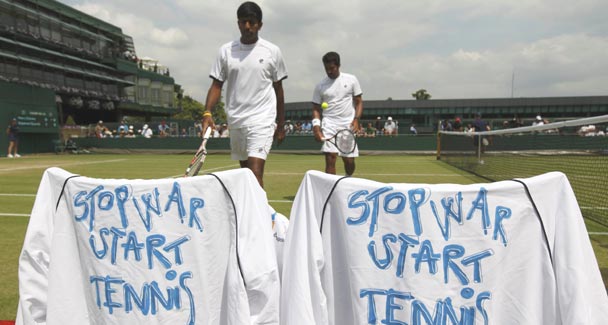
But Pakistani Aisam-ul-Haq Qureshi and his doubles partner Rohan Bopanna from India are also attracting a lot of attention for where they come from, and what they are doing together. The unlikely Indo-Pak pair have been playing as one team and they have been sporting tennis jackets that say “Stop War Start Tennis.” Now they have suggested a novel idea of a tennis match played at the Wagah border.

The world is not used to seeing India and Pakistan step onto any field as one team so the unlikely duo have been making headlines. And they are making full and good use of it by promoting the game of Tennis in the cricket dominated subcontinent and spreading the message of peace. Aisam and Rohan met at the age of 16 at a tennis camp and they have been good friends ever since. They are a good example of how friendship can overcome barriers or race, religion and nationality. While their international tennis playing status has allowed them to remain friends and see each other frequently, there are thousands of people on both sides of the border who long and yearn to see the people and places they once loved and knew as home but have been unable to see for over 60 years due to cruel visa regimes and heartless politicians who drive wedges deeper and wider between India and Pakistan for personal gain.

According to a report in the Guardian , the two tennis players want to play a tennis match at Wagah, the border separating India and Pakistan. The border will serve as the net. Aisam will play on the Indian side and Rohan will play on the Pakistani side of the border. I want very much for the two to win the Quarter-Finals at Wimbledon, but maybe even more than that I want to see them playing at Wagah Border Crossing!

The tennis stars are trying to turn this fantastic idea into reality. And at this point in time, I think that is exactly what the two countries need. Their performance at Wimbledon and the recent positive vibes coming from the governments as well as civil society in both India and Pakistan makes this a very good time to pursue this idea.

I don’t know much about tennis but I really want this match to happen! I will go to watch. And I promise to read up everything I can and ask anyone I can to help me understand the game better so I am prepared to watch the war of tennis at the border. And I’m sure a lot of other Pakistanis will too. As will many Indians. We all love a little bit of healthy competition with the Indians!

I don’t know how one goes about organizing a tennis match at an international border. But I wish I knew how to do it. So if any of you have ideas, please help.

I would like to see some Indo-Pak tennis and also some regional peace and good will. And while I watch this match, I will put aside my intensely competitive patriotic feelings and cheer loudly for Rahul Bopanna. So Rohan, you try to make this tennis match happen – and we the 170 million people of Pakistan will cheer you on with all our might!

As both Aisam and Rohan have been saying: Its time to “Stop War Start Tennis!”

World Cup 2010: Football’s India vs Pakistan

By Paul Beckett for The Wall Street Journal

It is standard for newspapers, including ours, to include the following sentence in almost any story about India and Pakistan: The two countries have fought three wars since Independence in 1947. You do not read the same about England and Germany: The two countries have fought two World Wars since 1914. Except at times like this.

For a series of reasons, part historical part psychological, there may be no match up in soccer that is quite equivalent to England versus Germany. Not for the quality of the football although Germany last night ran over England at the FIFA World Cup 2010 with some of the best football of the tournament so far, winning 4-1. Germany now advances to the quarter finals.

Nor does the significance of the game come from the fervor of football in each country. Yes, both are football crazy but there are plenty of countries that take football as seriously, if not more so, as these two do.

But there may be no bigger game when it comes to two nations who view each other as former enemies, now allies and rivals. Indeed, it is hard to imagine any other sporting event where two major nations weave so much national drama into men running around on grass, with the possible exception of when India and Pakistan play at cricket.

Why is this so?

India and Pakistan may have been separated at birth, but England and Germany have their own shared attributes (which certainly don’t get any attention at times like this): They are both northern, beer-drinking, sausage-eating nations; Britain’s current monarchy, the House of Windsor, has German origins; they may be more alike as nations than England is when compared with any nation outside the British Isles (just don;t tell the English.)

Of course, the situations have as many similarities as they do differences. England and Germany are friendly nations (despite what you read in the British press at times like this) bound together by the European Union and NATO. “It is high time to forget (World War II),” said Germany coach Joachim Loew, according to the Associated Press. “This is year 2010, we are all in the EU and it’s highly inappropriate to raise this subject.”

India and Pakistan, meanwhile, are caught in a diplomatic netherworld between war and peace that only now is showing signs of some thaw.

England and Germany, overall, have prospered in the past few decades, even if Germany’s industrial might means its economy has eclipsed that of the U.K.; India has prospered while Pakistan has struggled as the two nations took dramatically different courses, politically and economically, post Independence.

Yet there are times when sport comes to represent something that defines relations, seizes national imaginations and confirms dearly-held stereotypes, and that is the case with England versus Germany at football and India versus Pakistan at cricket.

It is not that the fans of either team hate the fans of the other (despite what you read in the British press at times like this.) It is a strange mix of respect, rivalry, historic ties, insecurities, bluster, hope, fear and a desire to read deeper meaning in a game of football that makes these games so compelling.

It is a time when entire nations stop to watch. When everything else is eclipsed in favor of one game and people want to think they are watching something that will go down in the history books, a marker of where they were when.

“It’s insane, the roads are completely empty here right now,” an Indian friend said in a text from London before yesterday’s kick-off. When Miroslav Klose in the 20th minute pierced a sloppy England defense to score, he followed with: “And the pub goes quiet.”

England also got the required controversial referee’s decision that will let it, as a nation, worry over its beads for years: a shot by Frank Lampard that clearly bounced over the line but which was not allowed as a goal.

That would have equalized the game at 2-2 and who knows what would have happened next, mate, it would have done the England team no end of good mate, you hear what I’m saying, it’s all about the psychology and that was devastating for the lads, just devastating wasn’t it and I’m not saying that Germany didn’t outplay them, mate, but you’re never gonna win when the ref’s an #%^& and mine’s a pint of lager.

“Fabio’s flops are battered in Bloemfontein,” said The Sun, a reference to English manager Fabio Capello. The headline ran on top of a picture of Frank Lampard realizing he hadn’t scored. “Three Lions Muller-ed by Germans…and the Ref,” said The Mirror, a reference to Thomas Muller, who scored goals three and four for Germany and the referee. Imagine an umpiring decision that incorrectly dismisssed Sachin Tendulkar from the crease against Pakistan.

This was a matchup that probably carried greater weight for England than for Germany, even before the opening whistle. Germany has had the better of England in big tournaments in the last several years. Germany also took a famously young side to these World Cup finals; many of them will return four years from now.

Not so England. Only are handful – and not including Steven Gerrard, John Terry, or Mr. Lampard – are likely to have a shot at Brazil 2014.

And now England can sink into its other national sport: getting depressed over the underperformance of its football team. As my friend in London texted: “All you hear is the german girl laughing. Totally quiet otherwise. This is amazing.” Not long after, he added: “This really tortured drunk guy screamed at Rooney at that last corner. And then put his head in his hands. Awesome.”

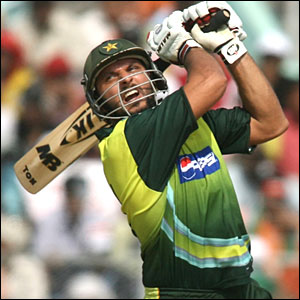
Afridi for Resumption of Indo-Pak Bilateral Cricket Series

As reported on Sify.com

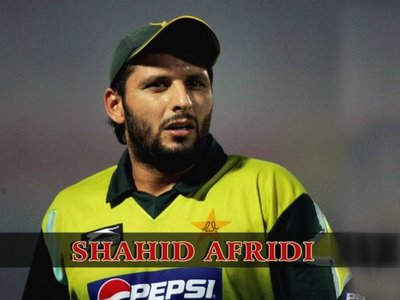
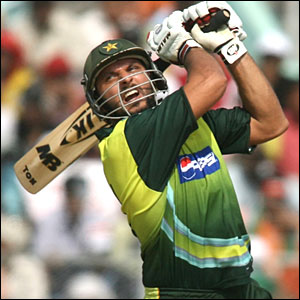
Following coach Waqar Younis’ call for resumption of bilateral cricket series between India and Pakistan, skipper Shahid Afridi also wants more encounters with the arch rivals.

Afridi said India and Pakistan must play against each other more often, which would help in toning down the heightened tension between the two neighbouring nations.

“I have always enjoyed playing against India and I have been saying we should play more often against each other as it will only help improve relations,” The Nation quoted Afridi, as saying.

Pakistan and India last played in the ICC Champions Trophy in South Africa in September 2009.

The newly appointed captain added that he was eagerly looking forward to the match against India in the Asia Cup, starting June 15 in Sri Lanka.

Afridi, however, pointed out that Pakistan’s opening match against Sri Lanka would also hold great importance.

“Certainly, the event will not be easy and the team would have to start it on a winning note to lift its morale. As a captain I would try my every bit to cash in on every opportunity to win,” he said.

Earlier, Waqar had also lamented the lack of bilateral series between India and Pakistan.

“I want to see the two teams revive bilateral cricket ties and for now I am eagerly awaiting their clash in the Asia Cup in Sri Lanka,” Waqar had said.

“It should be a great match as any contest between the two teams produces top quality cricket. It is unfortunate we are not playing against each other more often as Indo-Pak matches are watched by people all over the world and they are great for the sport,” he added.

India and Pakistan are scheduled to fight it out on June 20 in Dambulla.

India, Pakistan and the Musical Gurus of Peace

By Varun Soni for The Huffington Post

In July, India and Pakistan will begin a new round of talks in hopes of reviving their diplomatic efforts and renewing their peace process. While there are many pressing political issues to discuss, these talks could also be a remarkable opportunity for an innovative public diplomacy initiative between the nuclear neighbors. Although public diplomacy is often thought of as a form of state-to-state engagement, it also has the power to engage populations on a person-to-person level as well, especially in the age of social media and networking. Given the fact that many Indians and Pakistanis sing the same songs and listen to the same music, there is a unique opportunity now to promote popular music as a form of public diplomacy.

Although India and Pakistan are politically divided, their cultural roots still bind them together. Nowhere is this more apparent than Punjab — a region that was partitioned to create the modern nation-states of India and Pakistan in 1947, and further divided into the Indian states of Haryana and Himachal Pradesh in the 1960s. Despite these geopolitical divisions, Punjabis in both India and Pakistan remain united by “Punjabiyat,” a shared cultural heritage that has developed over millennia.

The historical Punjab is the only region in South Asia where Hindus, Muslims, and Sikhs are all represented in large numbers. Even as Punjab’s history is one of conflict and communalism, it is also one of overlapping musical and religious traditions. For example, the Guru Granth Sahib, the Sikh canonical text, contains within it not only the devotional compositions of Guru Nanak and his Sikh successors, but also verses from poets now considered Hindu and Muslim, such as Namdev and Baba Farid. Likewise, the Sikh devotional music of kirtan draws from similar lyrical sources and employs a similar instrumentation as Hindu bhajan music and Sufi qawwali music. For contemporary musicians, the devotional syncretism of Punjab remains a powerful model for how music can provide an encompassing framework for both unity and diversity.

Earlier this year, I interviewed the Sufi rock star Salman Ahmad as part of a USC book launch series focused on religion, popular culture, and diplomacy. As the founder of Junoon, Pakistan’s most popular rock band, Ahmad discussed his experiences performing in both India and Pakistan and explained how rock and roll empowers and connects the youth in both countries. In the name of rock-and-roll diplomacy, Ahmad organized last year’s Concert for Pakistan at the UN General Assembly Hall as a way of raising money and awareness for the three million internally displaced people of the Swat Valley in Pakistan. Inspired by George Harrison and Ravi Shankar’s famous Concert for Bangladesh, the Concert for Pakistan brought together prominent Indian and Pakistani musicians, diplomats, and entrepreneurs in solidarity and support for Swat.

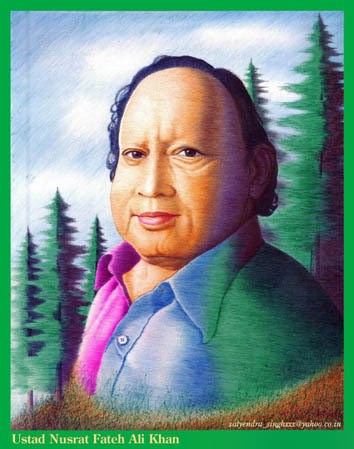
Another powerful moment in India-Pakistan musical diplomacy occurred in August of 1997, when India and Pakistan celebrated their fiftieth anniversaries of independence as nation-states. In order to commemorate this occasion, the virtuoso Indian music composer A.R. Rahman recorded with the late great Pakistani qawwali singer Nusrat Fateh Ali Khan. Together, the most famous musician from India and the most famous musician from Pakistan composed “Gurus of Peace,” an impassioned plea for peace between India and Pakistan. “Gurus of Peace” proved prescient, as the following year both India and Pakistan tested nuclear weapons, prompting President Clinton to call the India-Pakistan border the world’s most dangerous region. But A.R. Rahman and Nusrat Fateh Ali Khan had reminded the region the year earlier that India and Pakistan could unite through musical fusion instead of divide over nuclear fusion.

In the 1950s, the US State Department began sponsoring jazz luminaries, such as Duke Ellington and Dizzy Gillespie, to perform concerts overseas and serve as American cultural ambassadors. This public diplomacy initiative was aimed at winning the hearts and minds of potential allies in the Cold War, but the concerts also connected communities and ideas at a person-to-person level, and inspired artistic movements throughout the world. Likewise, India and Pakistan should sponsor and promote a series of musical concerts, workshops, and exchanges as a way of creating connections and engaging communities on a non-state level. Musical diplomacy certainly has its limits and should only be one part of a broader public diplomacy strategy, but after more than 60 years of missed public diplomacy opportunities, it’s time for India and Pakistan to follow the lead of A.R. Rahman and Nusrat Fateh Ali Khan and give music a chance.

Islam in the Indian Subcontinent and the Rise of Sects

By Nagwa Malik 

Islam, a religion described by many as a religion of peace, and by many again a religion of terrorism. Why this huge controversy? Simple. Islam is a religion of peace and fortunately or unfortunately it goes past creed, race, cast, color or country, through all the continents and like the Chinese whisper, the meaning gets scrambled along the way.

But if we examine Islam in the Indian subcontinent alone we find various colors within this one religion. In fact I am amazed to see that the amount of misinformation, lack of information and incomplete knowledge is so high in this area of the world that most of the sects are generated from within this boundary alone. Islam is one, it is a sign of unity, so the thought of any sect violates the essence of the religion. The Quran itself states that creating sects in Islam is Haram (forbidden).

This is one fact that we  as Muslims do not seem to realize. Why are these sects formed and continue to grow? Because every individual interprets the traditions of the Prophet (pbuh) and even the Quran in a different light and in doing so everyone seems to think they have hit upon something new and that something new has to be the real truth. They go around preaching in their excitement of having learnt what they think is unknown to anyone else, and thus a sect is formed. Did you know that there are more sects within the Islamic religion in this part of the world than the rest of the world put together?

I am very sad to point out that where every scholar from every part of the world will agree upon certain basics of Islam, these very basics will be found challenged and put through controversy by only writers of the subcontinent.  Similarly this question about challenging hadith or the concept of it has been only and only from this part of the world in the same way does the production of hadiths that do not exist in the first place at all. These two extremes are born from within our very country, and nowhere else in the world.

People realise their lack of knowledge at a rather later stage in life usually 40 above and decide to conduct a research. This usually comes out rather worse for the rest of the human race, for they do not do a complete research, but pick on that one single idea that has clicked and instead of trying to find out the truth, only start justifying their idea as the truth. This leads to rather disastrous results which is why Islam practised in the subcontinent is not the fundamental basics of Islam. You know the saying: a half truth is worse than a lie. A very small example of this is the recent wave of ideology that whatever is in the Quran is Islam, and there is no other source. That the Quran is complete and nothing is left unexplained. The idea continues with the denouncement of Hadith or the Prophet’s tradition. How bizarre can one get in trying to understand religion, only to denounce that very fundament of religion? It is true that Quran touches on every subject and completely defines the Muslim code of life, but not everything is put to print. Some things have been left to the Prophet (pbuh) to practise and to explain.

There are four basics of Islam which are not to be tampered with when conducting any research, and these four are undisputed by every scholar in the world except again the few in the subcontinent who think they have hit the jack pot…rather the opposite if you ask me; these four are Quran, Hadith, Ijma and Qiyas. These basics form the Shariah. The present legal system followed by the west and rather poorly by the subcontinent is actually based on this very foundation of Islam and Islamic legal system. The tradition of cross referencing a case, reading from the statute, citing previous cases all stem from the four basic references of Islam. To denounce anyone is to denounce the religion itself. So one has to be very careful before one forms rather ingenious theories about understanding Islam.

A tip for all new researchers: try to avoid reading books written by local writers first, or try to avoid reading them at all, for they base their books on controversies. Instead pick up authentic writers accepted all over the world for their deep and accurate research work. Try reading old writers who have been authenticated by the Islamic panel internationally. It should be noticed that people in Pakistan and India are less informed about their religion than other Muslim countries, and those who have had a basic education of Islam abroad hold a more solid and clear view of Islam whereas unfortunately in the subcontinent this is not so. Abroad there is only one book, one rule, one religion, whereas in the subcontinent there are many books, many rules and many sects. We need to eradicate this flaw within our system.  When we go for the pilgrimage we find that the pilgrims from around the world are mostly young but only pilgrims from the subcontinent are old. That explains a lot doesn’t it? For a country called the Islamic Republic of Pakistan we are curiously very unfamiliar with Islam and its basic teachings.

Before we go about getting excited over our incomplete research works and start preaching them, please do understand a rule of Islam which says misinformation is a sin.  It is suggested, then, that once it is sure that a thorough research is conducted in the right way, and the three stages of basic research have been passed through, then and only then should one allow oneself to preach. Also, one must try practising it first. Too often people who claim to be righteous Muslims  are ones who inevitably do not fully practice what they preach. We must remember the saying: neem hakeem khatara-e-jaan, neem mullah khatara-e-imaan. (A half baked physician is a danger to your life and a half baked mullah is a danger to your faith).

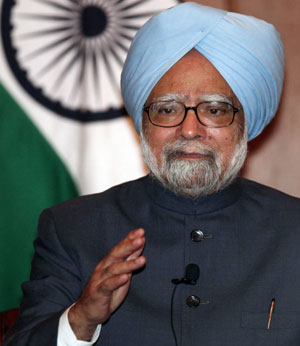
Indian PM Manmohan Singh Renews Kashmir Talks Offer

As reported by BBC

Indian Prime Minister Manmohan Singh has renewed an offer of talks with Kashmiri separatists who shun violence. He made the comments during a visit to a university in Indian-administered Kashmir. He is on a two-day trip to the state to review development schemes. Separatists have called a shutdown. The PM has disappointed those who expected him to announce a political package, the BBC’s Altaf Hussain in Srinagar says.

“We felt that the people of the state are not only interested in financial assistance and development projects, but also desire a political process that meets their aspirations,” Mr Singh told gathering at the agricultural university in Srinagar.

“We want to take the dialogue process forward. We are ready to talk to representatives of all sections who are opposed to terrorism and violence,” he said. ‘Strict instruction’  The prime minister repeated his government’s policy of “zero tolerance” for human rights violations.

“The security forces in Jammu and Kashmir have been strictly instructed to respect the rights of the civilians. We’ll act to remove any deficiency in the implementation of these instructions,” he said. The PM’s visit was greeted by protests against human rights violations  The prime minister’s visit came a day after the Indian army suspended a senior officer accused of killing three civilians in a staged gun battle.

The incident happened at Machhil near the Line of Control, the de facto border which separates Indian-administered Kashmir from Pakistani-administered Kashmir, in April. The Muslim-majority Kashmir Valley staged a total shutdown to protest against the prime minister’s visit. The strike was called by a hardline separatist leader Syed Ali Shah Geelani.

Mr Singh’s visit has also disappointed the moderate faction of the separatist Hurriyat Conference, headed by Mirwaiz Umar Farooq, our correspondent says. Mr Farooq had urged the prime minister to announce a political package during his visit.

He had demanded withdrawal of troops from cities and towns and release of political prisoners to facilitate talks between the separatist leadership and the government, our correspondent adds. Violence has declined in Kashmir in recent years, but analysts say militants opposed to Indian rule are now trying to regroup. There has been a spate of clashes in recent months along the LoC. Hundreds of thousands of Indian troops are based in Kashmir, where there has been a two decade-old insurgey against Indian rule.

India, Pakistan And U.S. Strategic Dialogue

By Apoorva Shah for The American Enterprise Institute

At this week’s first U.S.-India Strategic Dialogue in Washington, D.C., talks between the two countries will cover the spectrum of bilateral and multilateral issues, from trade and economic cooperation to terrorism and regional security. 

American participants may even feel the need to bring up India’s strained relationship with Pakistan. But it would serve them well to first consider a Times of India story from earlier this year, which went almost unreported in the United States.

According to an interview in the Indian newspaper with former Pakistani foreign minister Khurshid Mahmud Kasuri, India and Pakistan in 2007 were days away from reaching a comprehensive accord on their territorial dispute over Kashmir, the axis of the countries’ six-decade-long rivalry and casus belli of three wars between the two nations.

Kasuri, Pakistani leader General Pervez Musharraf’s chief diplomat from 2002 to 2007, said in April that the secret deal had been in progress for more than three years and would have led to a full demilitarization of both Indian- and Pakistani-occupied areas of Kashmir and would have awarded the region a package of loose sovereignty at a point “between complete independence and autonomy.” Not only were Indian and Pakistani leaders on board (including, most importantly, the Pakistani military), so was every Kashmiri leader except for one hard-line separatist, Syed Ali Shah Gilani.

The accord was slated to be signed during Indian Prime Minister Manmohan Singh’s scheduled visit to Islamabad in February and March of 2007, but before the trip ever occurred, a country-wide lawyers’ protest in Pakistan had turned into a broader opposition campaign against General Musharraf. The rest of the year would be one of the most tumultuous in Pakistan’s history, marked by the siege of the Red Mosque in July, the return of former Prime Minister Benazir Bhutto in October and her subsequent assassination in December, and the return of popular leader Nawaz Sharif from exile in September.

By August of the following year, public opposition had peaked, and Musharraf was forced to resign his post as president, ending his decade-long tenure as leader of Pakistan. After Musharraf’s ouster, it appears that the deal had lost much of its momentum.

Then in November, the accord suffered another setback as ten Lashkar-e-Taiba terrorists took India’s largest city, Mumbai, hostage for almost 72 hours, killing more than 160 people and injuring scores more. The attack was quickly coined “India’s 9/11,” and the evidence pointed directly to Pakistan, where the gunmen had been trained and equipped.

In protest, India cut off all diplomatic talks with Pakistan almost immediately; there were even rumors that the country was preparing military action against its northern neighbor. Within a span of less than two years, the India-Pakistan relationship had traveled the spectrum from apparent rapprochement and compromise to mutual suspicion and renewed hostility.

Since then, the signs have only appeared to worsen: for example, in 2009, when Indian Army chief General Deepak Kapoor publicly introduced revisions to his country’s “cold start” military strategy.

This military modernization and training program, which was developed in response to the army’s sluggish mobilization to the Pakistani border following the December 2001 terrorist attacks on the Indian parliament, remained mostly under the radar for most of the early 2000s, relegated to defense journals and the occasional news article.

It was only following the 2008 attacks that “cold start” began to receive renewed attention from the media on both sides of the border and was more publicly discussed by Indian military officials like General Kapoor. Indeed, it appeared as if the next breakthrough in Indo-Pak relations would occur through hard rather than soft power.

Concomitantly, India and Pakistan’s post-Mumbai attempts to return to diplomatic talks also appeared fraught with danger and seemed to only fuel more discord rather than reconciliation.

In February this year, Indian Foreign Secretary Nirupama Rao and her Pakistani counterpart Salman Bashir resumed high-level talks for the first time since November 2008, but both sides appeared unprepared (they could not even agree on the specific subject of the talks prior to sitting down) and spent more time bickering through separate press conferences.

For example, while Bashir accused India of covertly supplying weapons to militants in Pakistan’s Balochistan province, Rao complained that Pakistan had “not gone far enough” in the 2008 Mumbai attack investigation. As India presented a dossier of evidence against one of the Mumbai attack perpetrators, Pakistan responded by calling it a “piece of literature not a dossier.”

It’s hard to see how any progress could be made on improving Indo-Pakistani relations in the midst of this hostility. But does Kasuri’s revelation provide hope that a resolution on Kashmir could be revived? First, excepting Musharraf and Kasuri, many of the supporters of the failed 2007 accord—including Pakistani Army Chief of Staff Ashfaq Kayani, Pakistan’s current track II special negotiator Riaz Mohammed Khan, and, on the Indian side, Prime Minister Singh—still hold high-level positions in their respective governments.

And second, the secrecy of the original deal shows that outward indifference, or even enmity, between the two countries can belie an internal desire for change. In a relationship where hostility is status quo and where amicable relations seem aberrant if not bizarre, a furtive accord lets ruling elites make slow, institutional changes in the relationship while preserving outward form and precedent. It also allows deal-makers to keep tempestuous domestic politicians and party leaders at arms length while deliberating sensitive issues.

Even India’s traditionally hyperactive media seems to understand: A subsequent editorial in the Times of India noted, “the fact that such a deal exists emphasizes the importance of maintaining contact with Islamabad.”

So what can we expect in the months ahead? Indian officials will undoubtedly continue to pressure Pakistan to confront Lashkar-e-Taiba and other terrorist groups that plan to attack India, and another attack could indeed result in Indian military action. There will also be more bickering between the sides—on water rights, “most-favored-nation” clauses, and even cricket.

Yet the revelation of the secret deal should be both a lesson and a sign of hope. It is a lesson because it proves that progress on an entrenched conflict like Kashmir can occur without the United States’ public mediation.

American officials at the U.S.-India Strategic Dialogue this week should keep in mind that the accord was pursued during the final years of the Bush administration, in which the United States made it a point to separate the U.S.-India relationship from the more sensitive Indo-Pak relationship.

It is a sign of hope because, despite the outward appearance of discord between the countries, internally, leaders on both sides have—at least at some point in recent memory—wanted to move forward on a resolution.

As Pakistan continues its domestic offensive against terrorists and India pursues closer economic engagement with its northern neighbor, wanting change may be the best sign that change is on the way.

Time to end the impasse with Pakistan

By Siggharth Varadarajan for The Hindu.com

Forget Kashmir and terrorism or even Afghanistan and water, the current stalemate between India and Pakistan is all down to one word. Both countries publicly say that Dialogue is the only way forward. Yet each is paralysed by the name Composite’. New Delhi is so allergic to it that it will not accept its use, while Islamabad has become so attached to the C word that it insists there can be nothing else.

This Indian allergy and Pakistani attachment is paradoxical, since the composite dialogue approach has suited India more than it has Pakistan. Under the guise of moving ahead simultaneously on all issues, the framework has allowed progress on trade and other subjects considered important by New Delhi, even as the status quo on major disputes like Kashmir and Siachen key concerns for Islamabad has held. Of course, the dialogue did not end cross-border terrorism or extinguish the links between the Pakistani security agencies and violent extremism as some on the Indian side might have hoped. But that was always an improbable shot given the DNA of the Pakistani establishment. Over time, India has realised the best way to deal with the threat of terror is by strengthening its internal capabilities while utilising engagement as a lever for influencing Pakistan’s behaviour over the long run.

The two most important issues for the Pakistani side today going by its public statements are Kashmir and water. But here’s the paradox: the composite dialogue, from its point of view, has produced no forward movement whatsoever on these two fronts. In four and a half rounds of talks within that framework, the total amount of time spent by the two foreign secretaries in discussing the Kashmir dispute has perhaps been 10 hours. During which neither side did anything beyond restating its national positions. As for water, it does not even figure as a separate head under this format. The only water-related dispute covered by the composite dialogue is the Tulbul navigation project, also known as the Wullar barrage. There, too, progress has been insignificant.

In contrast to the composite dialogue framework, the back channel between Satinder Lambah and Tariq Aziz was far more effective and productive. Between 2004 and 2007, the two special envoys, who reported directly to Prime Minister Manmohan Singh and General Pervez Musharraf respectively, discussed Kashmir for hundreds of hours. More significantly, their exertions produced a framework solution that was cleared on the Indian side by the Cabinet Committee on Security and on the Pakistani side by the Corps Commanders conference, before domestic political difficulties triggered by his dismissal of the chief justice forced Musharraf to back off. As for water, the Indus Water Commissioners have been meeting continuously for more than 40 years and their forum represents the best platform for Pakistan because all the Indian projects it opposes on the Indus, Chenab and Jhelum rivers can be referred to an outside arbitrator whose decisions are final and binding. Compared to such a powerful dispute resolution mechanism, the existing dialogue framework is surely inferior. And yet, even though Islamabad’s best shot at making progress on water and Kashmir lies outside the composite dialogue, it has got locked into a situation where it is refusing any form of engagement or talks other than that.

Now let’s consider India. The Indian position has been in a state of flux since it suspended the composite dialogue following the terrorist attacks on Mumbai in November 2008. Broadly speaking, however, India has maintained that there can be no resumption of the composite dialogue till Pakistan moves to punish the Mumbai conspirators and dismantles the infrastructure of terror on its soil. In September last year, Prime Minister Manmohan Singh made a distinction between meaningful dialogue on disputes, which would have to await Pakistani action on terrorism, and talks on humanitarian and other issues. Since then, the Indian position has evolved further. When Pakistan’s Foreign Secretary, Salman Bashir, was invited to Delhi in February 2010, India clarified that while its own priority was terrorism, it was ready to discuss all issues with Pakistan. That is still the official Indian position. At a press conference on April 22, Foreign Secretary Nirupama Rao said dialogue represents a concrete method to move forward in our relationship It is always useful. It helps clear the atmosphere and especially between neighbors, such as India and Pakistan. Dialogue is really the only way forward.

But if India believes dialogue is really the way forward, why is it unable to accept Pakistan’s call for the composite dialogue to be resumed? The paradox here is that from the traditional Indian perspective, the composite dialogue has worked pretty well. Discussions on Kashmir have not led to any change in the territorial status quo but have provided a cover for India to move ahead with other parts of the bilateral agenda that suit it more, like trade and cross-border confidence-building measures. And if the Indian side is opposed to talks on the water issue’, the composite framework of dialogue is ideal because water does not figure as a standalone topic under any of the subject heads. Despite this, India is the one saying no to composite’ dialogue.

India suspended the composite dialogue in order to get Pakistan to take action against terrorism. Some action has been taken but the Manmohan Singh government rightly believes that Pakistan can and must do more. It also knows the continued absence of dialogue is unlikely to produce greater action on the terrorism front and might even be counter-productive. Yet it fears the resumption of the suspended dialogue will be seen as a sign of weakness by the Opposition.

India’s options have been further complicated by the hardening of the Pakistani position on cooperation and dialogue since November 2009, when Barack Obama’s new AfPak policy dealt the military establishment in Rawalpindi a stronger hand in the Afghan endgame. Even as the Pakistan army has stepped up its offensive against the Tehreek-e-Taliban and, to a lesser extent, anti-American extremists on its border with Afghanistan, it has played up the India threat’ card to balance the perception that it is too subservient to the U.S. The rhetoric on water, the Azm-e-Nau III exercises, the loosening of the leash on Lashkar-e-Taiba chief Hafiz Saeed and the increase in infiltration across the Line of Control are all evidence of the hardening of the Pakistani military’s attitude. At the same time, the domestic political situation in Pakistan is fluid. The 18th amendment to the constitution has opened up the possibility of the civilian government and the provinces strengthening themselves vis-a-vis the military. The revival of the Benazir Bhutto assassination case in the wake of the recent U.N. report could also provide political ammunition against the establishment.

In the run up to this week’s Saarc summit in Bhutan, where Prime Minister Manmohan Singh will meet Yusuf Raza Gilani on the sidelines, Indian officials are resigned to keeping the bilateral relationship in a holding pattern.’ Their logic is that if relations cannot improve, then they should not be allowed to deteriorate either. As a short-term strategy, the holding pattern strategy works fine. There are always small things that can be done at that level too. But an aeroplane cannot circle the runway endlessly. The longer it is up in the air, the greater is the likelihood of a disastrous descent. That is why planning for an orderly landing is a much better strategy.

In Thimphu, Dr. Singh must try and find a way of doing that. One possibility is for the two prime ministers to task their foreign secretaries with reviewing what has been accomplished on the terrorism front as well as in the last few rounds of the composite dialogue, with a view to expediting the resolution of existing problems and disputes. Such a mandate would foreground the necessity of a dialogue addressing all outstanding issues while sidestepping, for the moment, any nomenclatural disagreement. It would accomplish the stated Indian objective while allowing Mr. Gilani to return without having surrendered Islamabad’s stand on the resumption of the composite dialogue.

Parallel to this process, the Prime Minister should meet with the leaders of all major political parties in order to explain the reasons why India and Pakistan need to end the current stalemate. Finally, a strict moratorium on grandstanding and posturing, finger-pointing and name-calling is necessary. When the Prime Minister is directly crafting India’s approach to Pakistan, ministers, officials and anonymous sources’ must not confuse the public with contradictory messages and statements.