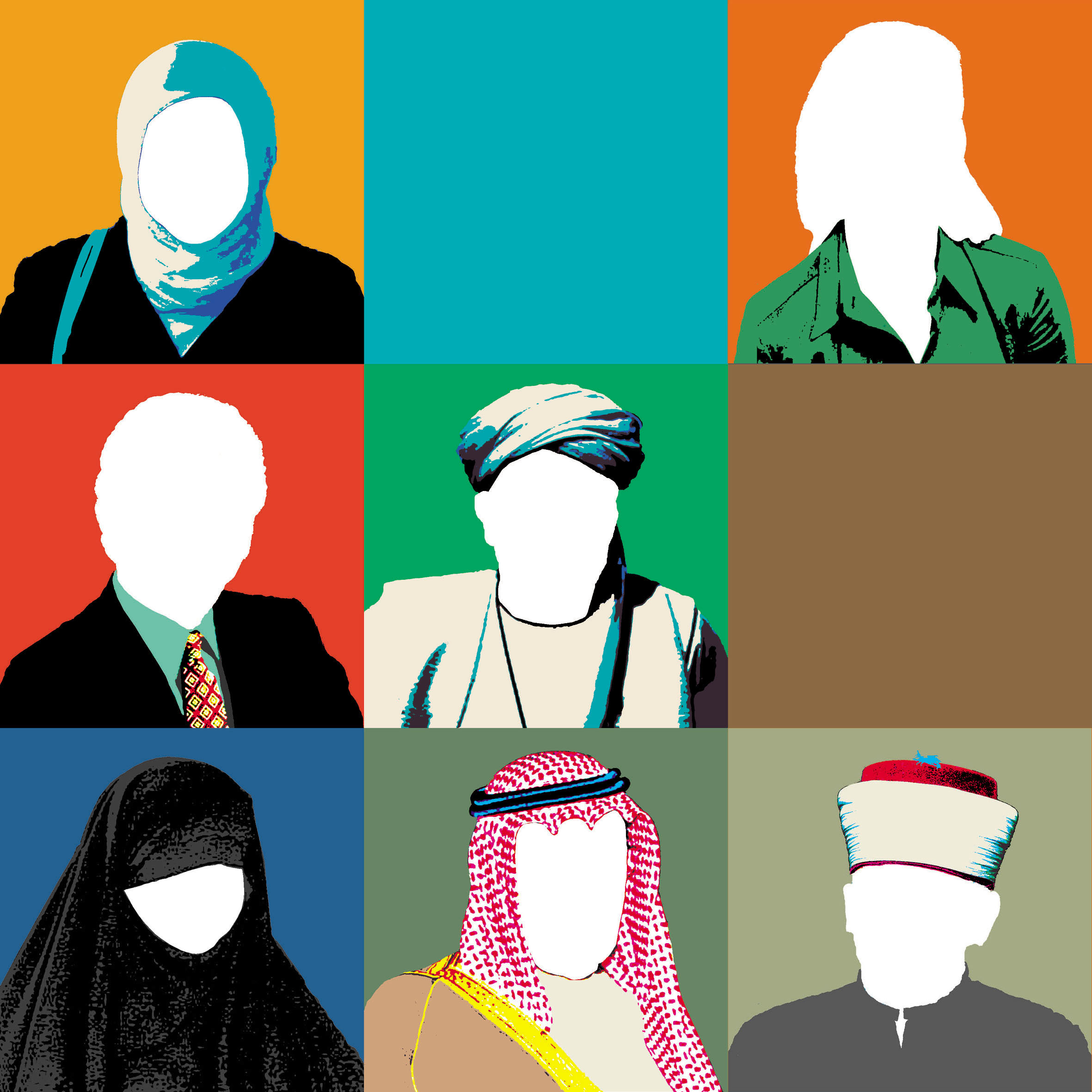
Posts Tagged ‘ Islam ’

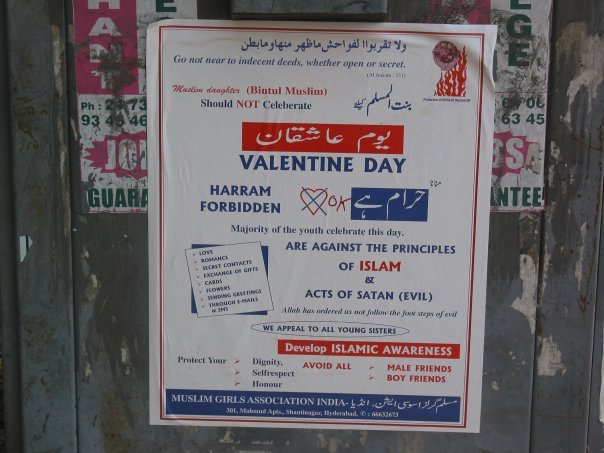
Valentine’s Day in Islam?

By Paul Salahuddin Armstrong Co-Director, Association of British Muslims

I was asked to share my views on Valentine’s Day. Personally, I really don’t see what’s the problem that some people seem to have with this celebration. The fact that it’s a Western, originally Christian festival is in all honesty, completely besides the point. We should celebrate Love everyday!

Many cultures have something similar, a day to celebrate love, to send a message of love to your beloved – a person whom you would like to marry or is already your husband or wife. Seriously, what’s wrong with that? What could possibly be wrong with that?
The only argument I’ve heard against Valentine’s Day, is the same one I hear about every other festival besides the two Eids – it’s not part of Islam. Well, sorry, if that’s the best these people can come up with, it’s a pathetic argument – cars and aeroplanes aren’t technically part of Islam either, but we still use them!

More to the point, a Muslim can celebrate any festival, even the social aspect of those of other religions, as long as this doesn’t mean they end up committing shirk – i.e. worshipping another deity besides God or associating partners with God – and this is the position of the mainstream scholars of Al-Azhar University in Egypt.

Indeed, for the vast majority of people who celebrate it, Valentine’s Day isn’t even that religious, rather it’s just a wonderful opportunity to show loved ones how much you appreciate them – which is something every Muslim should do anyway, even if they do not celebrate Valentine’s Day!

Pakistanis for Peace Editor’s Note– Finally, a Muslim perspective on Valentine’s Day that we can agree with! As compared to many other articles that decry Valentine’s Day as a pagan holiday and it is shirk to celebrate it, Paul has succinctly yet effectively given a great differing Muslim angle on this day as compared to the Orthodox Muslim view.

For Many in Pakistan, a Television Show Goes Too Far

By Declan Walsh for The New York Times

One morning last week, television viewers in Pakistan were treated to a darkly comic sight: a posse of middle-class women roaming through a public park in Karachi, on the hunt for dating couples engaged in “immoral” behavior.

Panting breathlessly and trailed by a cameraman, the group of about 15 women chased after — sometimes at jogging pace — girls and boys sitting quietly on benches overlooking the Arabian Sea or strolling under the trees. The women peppered them with questions: What were they doing? Did their parents know? Were they engaged?

Some couples reacted with alarm, and tried to scuttle away. A few gave awkward answers. One couple claimed to be married. The show’s host, Maya Khan, 31, demanded to see proof. “So where is your marriage certificate?” she asked sternly.

This hourlong spectacle, broadcast live on Samaa TV on Jan. 17, set off a furious reaction in parts of Pakistan. Outrage sprang from the Internet and percolated into the national newspapers, where writers slammed Ms. Khan’s tactics as a “witch hunt.”

“Vigil-aunties,” read one headline, referring to the South Asian term “aunty” for older, bossy and often judgmental women.

Now, the protests are headed to court. On Friday, four local nongovernment organizations will file a civil suit against Samaa TV in Pakistan’s Supreme Court, hoping to galvanize the country’s top judges into action.

“Journalists don’t have the right to become moral police,” said Adnan Rehmat of Intermedia, a media development organization that is among the petitioners. “We need to draw a line.”

Images of moral vigilantes prowling the streets have an ominous resonance in Pakistan, where many still recall the dark days of the Islamist dictator Gen. Mohammad Zia ul-Haq in the 1980s, when the police could demand to see a couple’s nikkahnama — wedding papers — under threat of imprisonment.

But the strong reaction is also drawn from a pressing contemporary worry: that the budding television media, seen as a force for democracy and greater social freedom for much of the past decade, have lost their way as part of a cutthroat battle for ratings.

“It really aggravates me that the media is using their power to intrude and invade our privacy, often with no good reason,” said Mehreen Kasana, a 22-year-old American-educated blogger from Lahore, who wrote a widely circulated protest against the Samaa TV show.

The controversy has rekindled a debate about the direction of Pakistan’s TV industry. Since liberalization in 2000, the sector has exploded from one channel — the state-controlled one — to more than 80 today, 37 of which carry national or local current affairs.

The media revolution has transformed social and political boundaries: in 2007, feisty coverage played a central role in pushing Pervez Musharraf toward the exit; in recent weeks it helped guard against a possible military coup.

But television is also a lucrative business controlled by powerful, largely unaccountable tycoons. Last year Pakistan’s television stations had advertising revenues of more than $200 million, according to Aurora, an industry journal — 28 percent more than the previous year.

Amid stiff competition for viewers, channels have relied on populist measures — rowdy political talks shows and, in recent times, vigilante-style “investigative” shows modeled on programs in neighboring India.

Some have a noble objective: holding to account crooked public servants, police officers and even fellow journalists. But others have veered into territory that could be described as Pakistan’s answer to Jerry Springer — voyeuristic, mawkish and intrusive.

In recent months, one reporter screamed at a man accused of child rape as he awaited trial outside a courthouse; another hectored a man said to be a self-confessed necrophile inside a jail cell; and a TV reporter “raided” a gathering of whisky drinkers, even though alcohol flows freely at many media parties.

Abbas Nasir, a former head of Dawn News television, said he was “nauseated” by some coverage.

“Hosts are under pressure to bring in ratings, and there is carte blanche to do the most bizarre things,” he said.

Another critic derided such reporters as “pussycat vigilantes” because they avoided challenging rich or powerful Pakistanis, whose Western-style lifestyles go unexamined.

“They only go after the people they know will not bite back,” said Nadeem Farooq Paracha, a culture writer.

Ms. Khan’s show touched a raw nerve because it combined simmering concern over media ethics with wider fears about society’s conservative tilt. Even General Zia’s son was appalled. In answer to a question on Twitter, Ijaz ul-Haq, a politician from Punjab Province, said he was “still in shock by what I’ve heard about her show.”

In a telephone interview on Tuesday, Ms. Khan rejected her critics, calling them “an elite class that don’t even watch my show,” and said the show merely intended to highlight the dangers that unaccompanied youths face in Karachi.

She also denied that there was anything unusual about asking couples for their wedding certificate — even though she does not carry one. All of “Pakistan knows me and my wedding pictures,” she said. “So I don’t have to.”

But on Wednesday, Samaa TV issued a formal apology for her show, followed by a short clip of Ms. Khan, sitting on a bed, offering an apology of sorts. “I never intended to make you teary-eyed or hurt you,” she said.

The furor has renewed long-standing demands for media regulation. With the state-run Pakistan Media Regulatory Authority seen as ineffective, the organizations approaching the Supreme Court on Friday hope the judiciary can help. “We need to hold the media to account,” Mr. Rehmat said.

But others argue that involving the courts, with their history of heavy-handed interventions, could open the door to state licensing of free speech. “It could backfire,” said Beena Sarwar, a journalist who helped rally protests against Ms. Khan’s show. “The media needs to do this themselves.”

Amid the polemic, there is one bright spot: the use of Twitter and Facebook to stoke debate has shown how, even as social space contracts in a turbulent society, the virtual space is opening up new possibilities.

But so far, the use of social media has been largely confined to the country’s English-speaking minority. It was striking how little attention Ms. Khan’s show received in the Urdu media, which is read or watched by the vast majority of Pakistanis.

“My real worry is that Pakistan is moving rightwards, and this time the face won’t have a beard,” said Mr. Nasir, the former head of Dawn News television. “And before people know it, they won’t know what’s hit them.”

Pakistanis for Peace Editor’s Note- Samaa Tv and host Maya Khan ought to be ashamed of themselves for calling this program journalism. Vulture reporting is more appropriate. Highly intrusive and showing a complete disregard for private citizens who are meeting in a public place is no place for a TV channel.  This certainly strengthens the religious extremists in Pakistan, shoving their brand of austere Wahaabi Islam down the throats of the majority Barelvi/Sufi population of Pakistan.

Meanwhile the Pakistani Telecom Authority is curtailing freedom of speech by mandating mobile phone operators to ban certain ‘dirty’ words, as the Pakistan Electronic Media Regulatory Authority lacks the moral and legal mindset to stop a television channel on trampling citizen’s privacy and freedoms. They should shut this show immediately and get this so called ‘reporter’ off the air.

An American Muslim’s Thanksgiving

By Dr. Faheem Younus for The Huffington Post

I know how much I didn’t know 15 years ago.

After landing at the John F. Kennedy Airport in New York as an exchange visitor, I was faced with a culture shock. I knew the word “Manhattan” but I didn’t know what it actually meant. Was it a fruit? A car? A newspaper? I knew the name Michael Jordan but I didn’t know who he actually was. A singer? A scientist? A politician? I knew Thanksgiving was an important holiday in America but I didn’t know what to do on thanksgiving? Eat? Pray? Love?

Don’t forget. This was 1996, when internet was not ubiquitous and search engines meant using a pillow sized book called Yellow Pages. But despite spending a lot of time, the Yellow Pages could not expand my understanding of the above three queries.

So I did what we doctors do best: read a book. It was a book about American cultural literacy.

Reading about the history of thanksgiving, however, opened up a Pandora’s Box of controversies. Is it a Christian holiday? Is it a secular holiday? Is giving thanks to God a good idea or should we be thanking our fellow human beings? Or is it a reminder of the “genocide of the native Americans” and therefore should not be celebrated at all.

This was all too complicated for a medical doctor who was now having second thoughts about learning the history of Manhattan or Michael Jordan. “Who knows … they may turn out to be just as controversial?” I thought.

Which left me with the loaded question: What should I, as a Muslim in America, do on Thanksgiving?

One good thing about medical residency was that sometime a holiday would simply pop-up on your schedule and you literally had to do something with it. So my first reaction to “do something” with my first Thanksgiving was to thank God. Thank Him for giving me peace, security and opportunity in America.

To that end, I found a rainbow of Quranic verses exhorting Muslims to thank God in various ways. Here is one for each color in the rainbow.

Want a promising violet, try: “… If you are grateful, I will, surely, bestow more favors on you;” (14:8); How about an acknowledging indigo: “(Abraham was) thankful for His bounties; God chose him and He guided him unto a straight path” (16:121); Or the true blue thanks of another prophet “Assuredly, he (Noah) was a grateful servant” (17:3); Or a the combination of a green encouragement with a yellow warning: “Remember Me so that I will remember you, and give thanks to Me and do not be ungrateful to Me” (2:152); Or consider the simply orange truth: Surely, Allah is gracious towards mankind, but most of them are not thankful…’ (10:61); and if all fails, here is the red hot chastisement: “If you are thankful I will add more unto you. But if you show ingratitude My punishment is terrible indeed” (14:7).

But God was simply missing from most American Thanksgiving celebrations. Why? Because many atheists claim that giving thanks to our fellow human beings, those who make a true difference in our day to day lives, is more important than thanking a nebulous (in their opinion) entity.

There is much credence, (in my opinion), to the atheist’s point of view of thanking our fellow humans. Prophet Muhammad also reminded Muslims, “The one who does not give thanks for a small blessing will not give thanks for a great blessing, and the one who does not give thanks to people will not give thanks to Allah” (Abu Dawud). By helping the poor, respecting the elders, giving up his seat for a guest, showing unconditional love and exercising fairness in every day affairs, the prophet taught Muslims an important lesson. Thank you is not just a word; it’s an attitude.

Making the thanksgiving holiday a focal point of the Native American controversy is an over simplification. So I will leave it for a separate discussion.

15 years later, as a naturalized US citizen, there is much that I still don’t know about a lot of things. But I do know what an American Muslim should do on Thanksgiving: Give thanks.

Let’s thank our beautiful country, let’s thank our living constitution, and let’s thank the people around us. Only then can we truly thank God.

By the way, adding Turkey with stuffing, cranberry sauce, gravy, and a pumpkin pie to the day would be a fantastic idea too.

Faheem Younus is the Adjunct Faculty for Religion, CCBC; Clinical Associate Professor of Medicine, UMD

This is not Prophet Muhammad’s Islam

By Manzer Munir for Pakistanis for Peace

The steady stream of negative news about the twisted way Islam is being practiced around the world seems to never end. In my view, it is not how the Prophet would have wanted his followers to behave.

Just when I thought I was beginning to get used to the ridiculousness of the news coming out of Saudi Arabia, where a religious edict is trying to force women there with beautiful eyes to  completely cover up their face in order to stop the temptation of the men, along comes the grim news of Gulnaz  from Afghanistan. If you are not familiar with Gulnaz’s story, let me give you the facts.

Two years ago, in 2009, Gulnaz, a 19 year old single girl who lived with her elderly mother in Afghanistan, was brutally raped by her cousin’s husband. To describe the events, she recalls that on this day, the rapist came into her house when her mother left for a brief visit to the hospital. “He had filthy clothes on as he does metal and construction work. When my mother went out, he came into my house and he closed doors and windows. I started screaming, but he shut me up by putting his hands on my mouth,” she said.

Afterwards, she hid what had happened out of shame and fear, as shockingly there is no difference seen between women who are raped and women who commit actual adultery.  In Afghanistan and in many conservative Muslim countries, any sex outside marriage, whether the guilty party is single or married is considered adultery by the society and the justice system.

A few weeks after her rape, she began to vomit and started showing signs of pregnancy with her attacker’s child. Instead of sympathy and proof of her ordeal, she was charged and found guilty of adultery by the courts and for having sex outside marriage and was sentenced to twelve years in prison. She has already served two years and even gave birth to her rapist’s child, a little girl, in Kabul’s Badam Bagh jail where sadly, her innocent daughter is being raised in captivity alongside the unfortunate mother.

Rather than being freed from jail and given justice for her painful ordeal, the only way out of the dishonor of rape or adultery for her is incredibly only by marrying her attacker. In Afghan culture, and indeed in most Muslim communities, this is believed to be the only way to restore a woman’s honor, by marrying the man who she had sex with, damned be the fact whether it was willingly or unwillingly!

Sadly in many Muslim countries, rape remains a common form of violence against women. In addition, women are often blamed for being the victim of rape. Islam however, views rape as a violent crime against the victim, against society, and against God. The perpetrator who commits a crime is morally and legally responsible for that crime and should be held accountable. The victim, who is an unwilling partner in the sex act and so should bear neither blame nor stigma associated with the unfortunate act. To either ostracize or condemn the victim because she was compelled to engage in sexual intercourse is against the laws of Islam since the victim was an unwilling, and therefore a blameless, participant.

As common as her story and circumstances are for a woman in Afghanistan, the world has only learned of it due to a chance foreign documentary.  Gulnaz’s ordeal came to light because of a dispute between filmmakers and the European Union who hired the crew to film a documentary on the improving situation of women’s rights in Afghanistan and the assistance that the EU has been providing in the better treatment of women in the country. It was only when the documentarians came across her story and the grave injustice being done to Gulnaz and indeed by some accounts, hundreds of women across Afghanistan in similar circumstances, that the EU decided to cancel the project out of fear of harming their relations with Afghan government and institutions. Officially the EU states that it fears for the safety of the women in the film as they could be identified and face reprisals but many human rights organizations believe it is due to the fact that the film shows Afghan justice system in a poor light and the EU is concerned about the Afghan government’s sensitivities to the situation. It is despicable that the EU is more concerned with the sensitivities of the Afghan government rather than fighting for justice for Gulnaz.

Customs such as these in Afghanistan or the recent religious ruling in Saudi Arabia warning women to cover their attractive eyes, or the continued religious persecution of Christians and other minorities in Pakistan through the egregious blasphemy laws as seen in the case of Aasia Bibi, only serve to illustrate to many within and outside Islam the tremendous challenges that exist in what is right and what is logically very wrong and goes against all sense of justice and common sense, not to mention the very essence of Islam.

I am certainly not arguing for making any changes in the Quran or interpretations of religious text or any wholesale revisions whatsoever. That would not only be blasphemous but also counterproductive and unnecessary. Furthermore,  a big part of the beauty of our religion stems from the fact that it has remained unchanged as we Muslims believe that mutations and changes in both the Bible and the Torah necessitated the need for a third Abrahamic religion, Islam,  to arrive some 1400+ years ago to “set the record straight” after all the changes over the years in the two earlier Holy Books. Instead, I believe the only thing that needs to occur is the realization amongst the leaders and countries of the Organization of Islamic Conference (OIC) that in this day and age, there are certain rights and freedoms that should be guaranteed to citizens of all countries of the world and this does not require any changes in the great religion but rather some simple changes in the current laws.

Aristotle once said that “You can judge a nation by the way it treats its most vulnerable citizens”. You could be a Hindu or a Christian in Pakistan, a woman in Afghanistan or Saudi Arabia or a homosexual or transgendered person in Iran, you do not deserve to lose your life or liberty under the guise of religious laws. Allah almighty is a just and fair God in Islam, just as he is in the Christian and Jewish faiths. He most certainly would never condone the treatment of Gulnaz, Aasia Bibi and countless other poor souls who are being mistreated under the banner of Islam.

I am not a religious scholar and nor do I profess to know everything I need to know about Islam, Christianity and many other religions. Some may even question my faith and belief in calling myself Muslim simply because I am asking these tough questions, and in their version of Islam, you never question, you simply obey. Lest they forget, Islam also clearly states to seek knowledge and to be just and fair and respectful of other religions.  “Surely those who believe and those who are Jews and the Sabians and the Christians whoever believes in Allah and the last day and does good — they shall have no fear nor shall they grieve.” (Quran 5:69)

I am however certain that the Prophet Muhammad (peace be upon him) would indeed be very upset with the current state of affairs of most Muslim countries when it comes to morality, religious freedoms,  respect for other religions and the treatment of women. Sadly, I do not see the changes necessary coming into being voluntarily by these nations, I believe it is incumbent of the benefactors of these nations, such as the United Nations, United States, the European Union, China and other trading partners, to push for better treatment of women and religious minorities in many Muslim countries of the world.  It is high time that they pressure these nations into enacting basic rights and freedoms for all people, regardless of their race, religion, gender, and sexual orientation. It must become a precursor to being a part of the civilized nations of the world and in being a member of the world community of nations. Freedom after all is what the Arab Spring is all about!

-Manzer Munir, a proud American of Pakistani descent, is a practicing Sufi Muslim and member of Muslims for Progressive Values, he is also the founder of Pakistanis for Peace and blogs at www.PakistanisforPeace.com as well at other websites as a freelance journalist and writer.

Pak Bans Dirty Texting: Just Say No To Monkey Crotch

By Shivam Vij for FirstPost

You cannot SMS ullu chod in Pakistan anymore. Nor can you SMS monkey crotch if you had any reason to do so.

The Pakistan Telecommunication Authority (PTA) has banned 1,795 expletives on SMS, ordering telecom companies to filter out SMS-es containing these offending words with effect from 21 November 2011. The letter includes a list of 1,109 English words, more pornographic terms than expletives, and another 586 Urdu words which are more colourful sexual expletives of the standard South Asian kind rather than the plain garden variety pornography.

A letter from the PTA, dated 14 November and signed by its Director General (Services), Muhammed Talib Doger invokes the “Protection from Spam, Unsolicited, Fraudulent and Obnoxious Communication Regulations, 2009″ to pass the order.

The Pakistan Telecommunication Authority (PTA) has banned 1,795 expletives on SMS, ordering telecom companies to filter out SMS-es containing these offending words with effect from 21 November 2011. Vivek Prakash/Reuters
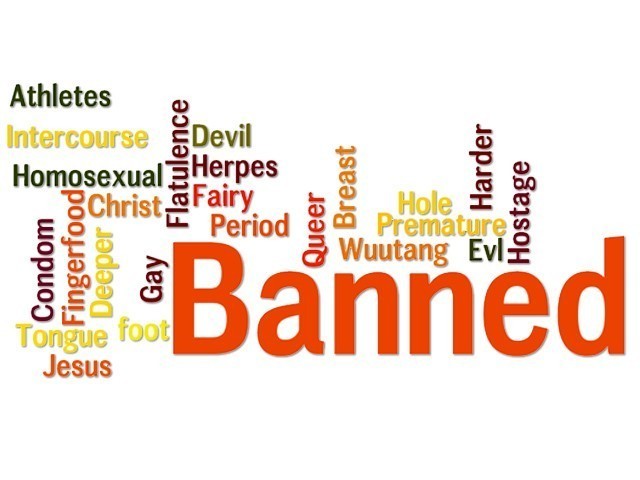
The Pakistani Twitterverse was on fire last night as the two lists make for hilarious reading. The English list begins with A.S.S. and ends with yellowman. Some words sound harmless (crap and crappy), others bizarre (Jesus Christ, flatulence, murder, monkey crotch). Many are commonly used obscene words (“FUCK YOU”) and care has been taken to account for alternative spellings (biatch, muthafucka). While many spelling variations of ‘masturbation’ are on it, the correct spelling is not. Most words seem to be designed to prevent ‘sexting’ or sending sexually explicit texts (sexy, lick me, do me, S&M, lotion and porn). The list comes down on anal sex as much as vaginal sex. But it isn’t just sex. By banning drunken they perhaps hope to reduce alcoholism.

The Express Tribune points out, “While much of the list contains expletives, a number of words to be banned include medical terms, terms used by particular minority groups, common words from the English language and rap group, Wu Tang Clan.” The ‘medical terms’ include athelete’s foot, breast, intercourse, condom and period. The ‘daily use’ terms include hole, hostage and harder. Words like gay and homosexual don’t surprise but it’s curious why wuutang raised the censor’s hackles.

In fact, thanks to this helpful compendium many Pakistanis are finding their expletive vocabulary enhanced. @UroojZia asked what bumblefuck and ladyboog meant.

@Zakoota said the lists should be required reading in schools to give children the vocabulary to describe politicians and cricketers. With the amount of phrases that include the word “BUTT”, @KhaLeak wondered if Aijaz Butt was banned as well.

The Urdu list has standard gaalis also popular in north India, but many of them may not be familiar to Indians (such as “dani mani fudi chus“). Some are unfamiliar even to Pakistanis. @FurhanHussain said the presence of Punjabi gaalis in the Urdu list amounted to cheating, but others noted that there is no list of Sindhi and Punjabi language expletives, a grievous omission given that the Punjabi language is particularly full of colourful expletives.

“Padosi ki aulaad” doesn’t sound very obscene. There are some 15 spelling and gender variations of ‘kanjar’, a popular Pakistani expletive meaning dancing girls, often also used to describe cross-dressing or men dancing like women. Some of the Urdu ones are quite creative. There are four variations of “Chipkali ke gaand ke pasine” and some are inexplicable (“Nimbu sharbat“, “carrom board”) and some are zoologically bizarre (“ullu chod” or owl fucker). Some are rather vanilla everyday terms like “Buckwaas” (nonsense) and “Bewakoof” (foolish).

There were so many oddball terms in there at first people though it was a spoof. However, Shahzad Ahmad, an internet rights activist who tweets as @bytesforall, said he confirmed with a source at the PTA that the list was real. The Express Tribune story referred to above has been updated to quote a PTA spokesperson who denied knowledge of any letter and said that the PTA “does not take such decisions and only passes on the instructions to licensees once a decision is taken by a ministerial committee.” The PTA, which is also in the news for directing ISPs to block access to 1,71,261 pornographic sites, is said to have convened a meeting this morning to discuss the uproar.

It’s unclear how telecom companies who cannot even filter out commercial spam will be able to handle this new morality burden. But Pakistanis, used to growing online censorship administered by the PTA, took little time to come up with the obvious workaround to the SMS censorship. The offending words are numbered on the blacklist. Many including @SamadK came up with the idea, “Now instead of typing the whole gaali you just need to send the number. Thank you PTA for making is even lazier.”

Many have already started testing it: @KhanDanish tweeted “I hope Imran Farhat 143 doesn’t do 471 in Friday’s match. #Urdu.”

The Urdu list is here and the English list here.

Muslims in America: A mosque rehabilitates its image

Conversations / Live Q&A Washington Post

ABOUT THE HOST
Imam Johari Abdul-Malik
Imam Johari Abdul-Malik serves as the director of Community Outreach for the Dar Al-Hijrah Islamic Center. He was the first Muslim Chaplain installed at Howard University. The imam is the former chair of Government Relations for the Muslim Alliance in North America [MANA founded by Imam Siraj Wahhaj] and is the founding President of the Muslim Society of Washington, DC Inc and Associate Imam of First Hijrah Islamic Center in Washington, DC.

Known nationally for his fundraising efforts for masjids, schools and relief organizations, Imam Johari is a founding member of the Muslim Advocacy Commission of Washington, D.C. and “Muslim Men Against Domestic Violence” [MMADV] and has edited a book on”What Islam Says About Domestic Violence”.
ABOUT THE TOPIC
Dar Al-Hirjah is one of the largest mosques in America, and it can be linked to many terrorism suspects in some way. Imam Johari Abdul-Malik discussed the Dar Al-Hijrah mosque, rehabilitating the mosque’s image after 9-11, how 9-11 has affected Muslim life in America, and more.

Read: Imam serves as public face of an embattled mosque
IMAM JOHARI ABDUL-MALIK :
Salaam-Shalom-OmShanti-Peace,

I would like to thank The Washington Post and especially William Wan and Jahi for their work on this article. I pray that it will inspire more bridge building

– September 19, 2011 11:03 AM Permalink
Q.
CHANGES IN SENSITIVITIES
What are examples of what you have heard from fellow Muslims to any changes in how they have been treated since 2001? How much of a difference has there been? How often do they find themselves in a situation where someone has said or done something offensive or hurtful?
– September 19, 2011 10:43 AM Permalink
A.
IMAM JOHARI ABDUL-MALIK :
The overall experience has actually been positive. However, the negative experiences have been structural (Homeland Security, etc) but I expect that those things will change with time. I am a very positive person and I expect things to continue to only get better

– September 19, 2011 11:06 AM
Q.
AMERICAN MUSLIMS
Salaam alaykum, Imam Johari I am a devout American Muslim woman (and a convert like yourself), but after reading this, I would be terrified to attend your masjid. Instead of honoring your women, you make them go through a separate entrance in the back, for what? To protect men from seeing their wives and daughters? In the time of the Prophet, peace be upon him, men and women prayed in the same space. So my question is this, how can you hope to move from simply defending your community to integrating them into the country at large? This type of isolation and anger only breeds mistrust and silently encourages the behavior of men like Aulaqi. I truly wish you luck and will pray for your community. Please believe that there is another way. My masjid in Brooklyn is nothing like this.
– September 19, 2011 10:57 AM Permalink
A.
IMAM JOHARI ABDUL-MALIK :
I agree with you that the architecture of the mosque is not women friendly. I am working first to change to minds of people who attend the mosque and then we have to work on reconstructing the bricks to be more women and family friendly.

– September 19, 2011 11:09 AM
Q.
SHARIA
Do you agree with sharia?
– September 19, 2011 11:02 AM Permalink
A.
IMAM JOHARI ABDUL-MALIK :
Firstly, “sharia” for me, is similar to keeping kosher for Jews. I don’t believe that my beliefs or practices should be enforced on others. In short, I don’t believe that stoning or cutting off hands are what the Qur’an intended for the 21st century

– September 19, 2011 11:09 AM
Q.
PEDOPHILIA
Do you think its OK for a 53 year old man to marry a 6 year old girl? If so, why?
– September 19, 2011 11:03 AM Permalink
A.
IMAM JOHARI ABDUL-MALIK :
I would advise you not to do!

– September 19, 2011 11:10 AM
Q.
COEXISTENCE
What kind of outreach are you doing to local Christians and Jews?

– September 19, 2011 11:09 AM Permalink
A.
IMAM JOHARI ABDUL-MALIK :
We have been working with several churches and synagogues in the DC metro area for the past decade and have built many strong relationships…

– September 19, 2011 11:13 AM
HALEY CRUM :
What’s the most common question you usually get?

– September 19, 2011 11:15 AM Permalink
IMAM JOHARI ABDUL-MALIK :
The most common question to me is as a convert “how did you become a muslim?”.

– September 19, 2011 11:15 AM
Q.
FGM
Where do you stand on female genital mutilation?
– September 19, 2011 11:05 AM Permalink
A.
IMAM JOHARI ABDUL-MALIK :
FGM: Is not a practice of Islam and although many cultures before Islam practiced it and this unislamic practice continues. I am working with relief organizations and interfaith organizations to end this horrible pracitice.

– September 19, 2011 11:15 AM
IMAM JOHARI ABDUL-MALIK :
I wanted to mention here that it is my hope that terms such as “non-Muslim” and “Muslim World” will cease to be used as I see those terms as divisive. I always make it a point to correct anyone that I hear use these terms. I prefer “people of other faiths/traditions” when speaking of those that do not share my faith

– September 19, 2011 11:21 AM Permalink
Q.
AMERICAN MUSLIMS
But how do we change hearts and minds? Especially in a climate that seems to have grown more hostile to us? It’s difficult to tell other Muslims, especially conservative immigrants that they should embrace change and their new country when we’re being told we can’t build mosques. Park51 (aka the supposed Ground Zero mosque) is the perfect example. We worked so hard and against so much opposition for this place. Yet when I attended services a couple Fridays ago, a community member began berating a young Muslim woman for leading two male journalists in for both being uncovered and talking to a man. It’s humiliating.
– September 19, 2011 11:17 AM Permalink
A.
IMAM JOHARI ABDUL-MALIK :
I have learned so much from the examples of great people and the prophet Muhammad and Jesus (peace be upon them). We have to increase our efforts for the positive, try to understand the other. New immigrants have their baggage as everyone does. Dr. King said, ‘Let us overcome them with our capacity’ to love

– September 19, 2011 11:30 AM
HALEY CRUM :
What has the Muslim community done for America lately – is America a better place because of Muslims? – rickdumbronski

– September 19, 2011 11:30 AM Permalink
IMAM JOHARI ABDUL-MALIK :
First of all, there is single “Muslim community”. There are many different “communities” of Muslims with many diverse ethnic groups and sects. Secondly, there are Muslims in the US Armed Services and working within Homeland Security (including the FBI) that are serving their country with honor. Thirdly, there are many Muslim civilians that are working with law enforcement and are the very key to keeping us safe from terror plots. Without the help of Muslims, it would be much more difficult to fight terror

– September 19, 2011 11:30 AM
Q.
HOW TO COMBAT SHARIA STEREOTYPES?
I’m a humanistic Jew, and while I do not practice traditional Jewish law, I’m well versed in them. I personally don’t see a difference between Sharia and the Talmudic laws that also dictate not just keeping kosher, but divorces, shabbat, how, when, and where to pray, conversions, and all other sorts of elements of daily life. There are orthodox rabbinic courts, Beit Dins, that are sometimes used as alternative dispute resolution mechanisms instead of regular secular courts. The Catholic Church has ecclesiastical courts that gives annulments and hears other similar sorts of cases. How can we better express that Sharia is no different from the rules and institutions of other systems?
– September 19, 2011 11:21 AM Permalink
A.
IMAM JOHARI ABDUL-MALIK :
You are right on brother! We all need to speak this truth from the hill tops. Criminal law needs to stay in the hands of law enforcement.

– September 19, 2011 11:32 AM
Q.
THE ETHICS OF A FAIR FIGHT
Salam dear brother. Islam, as a way of life, prescribes an appropriate way to deal with oppression and systemic injustice. While it was recently reported that Muslims in the U.S. are less likely to justify attacks on civilians (Source – http://www.gallup.com/poll/148763/Muslim-Americans-No-Justification-Violence.aspx) than other groups, there are specific limits on what is acceptable when engaging against an oppressive military, even in self defense. Could you provide an example of a just war, at level of a country, based in what Islam teaches us? Could you provide an example that could apply to daily life at an individual level? Salam!
– September 19, 2011 11:28 AM Permalink
A.
IMAM JOHARI ABDUL-MALIK :
The “just war” theory seems to have only been applied to justify war. As they say, “war is hell”.

– September 19, 2011 11:37 AM
Q.
SHOUDLN’T YOU LEAVE THE COUNTRY?
In view of the past associations like Awlawki and the obvious distrust with which you and your mosque are held, don’t you think it is time you moved to a country like Pakistan or Yemen where you would find a more positive response to your preachings? Face the facts you don’t really fit in here.
– September 19, 2011 11:29 AM Permalink
A.
IMAM JOHARI ABDUL-MALIK :
I take great issue with the hate speech of Anwar Awlawki.

I’m from Brooklyn, NY. I am the decendent of enslaved Africans – I have every right to live in my own country. The first amendment affords me the right and responsibility to practice my faith alone with my fellow Americans.

– September 19, 2011 11:37 AM
Q.
TRUST
Mosques are places of public worship. What is wrong with the FBI monitoring places of interest in these times of distrust and international Islamic terrorism? Muslims in the West must accept a reasonable amount of observation given the facts. Muslims rooting out and identifying the dangerous extremists amongst them is not an unreasonable expectation of the non-Muslim citizenry. Trust has to be built by both sides. – Cretius

– September 19, 2011 11:19 AM Permalink
A.
IMAM JOHARI ABDUL-MALIK :
I agree that trust works both ways. My issue is the engagement with the leadership of the mosque as a partnership. I have worked with law enforcement on many cases but they only come to me after the fact. There have been instances where had they been a partner early on perhaps our security as a nation could be better secured. I like president Obamas new a approach – “Empowering Local Partners to prevent violentextremism in the US” . We are safer when we work together.

– September 19, 2011 11:37 AM
Q.
MUSLIME IN THE WEST
Many Muslims who came in an earlier age, assimilated well — but the new iimmigrnts refuse to assimilate but continue to wear Muslim dress, demand we set aside muslim holidays in our schools etc. don’t you think these muslims would be better off staying in a country which is predominately muslim.?
– September 19, 2011 11:37 AM Permalink
A.
IMAM JOHARI ABDUL-MALIK :
The question remains: Is American the great melting pot or the mulligan stew.

In the melting pot – all of the ingredients get boiled down.

I believe that what makes the great dish are the spices of every culture that adds to the favors of America, while still being able to identify the fruits.

– September 19, 2011 11:42 AM
Q.
ON TO THE NEXT
Do you think people view Muslims as “the enemy” now and will move on to another religion/ culture when the next big attack happens from another group? Is this a vicious cycle?

– September 19, 2011 11:40 AM Permalink
A.
IMAM JOHARI ABDUL-MALIK :
While Islam is the issue of time, we should not be in denial about the violence that is besieging our societies. All ideologies that promote violence as a mechanism for social change are dangerous whether they are so-called Muslims, White Supremist or drug cartels….non-violent resistance for social change must become the new revolution.

– September 19, 2011 11:46 AM
Q.
PART OF THE PROBLEM.
Don’t you think that your and your mosque are part of the problem and not part of the solutions? After all when you see the number of terrorists who have passed through your mosque, how can you not see yourself as part of the problem?
– September 19, 2011 11:45 AM Permalink
A.
IMAM JOHARI ABDUL-MALIK :
knowledge is power! I think the article addresses this issue well. I believe that my work is to counter-radicalization.

– September 19, 2011 11:52 AM
Q.
AMERICAN A MELTING POT FOR WESTERN EUROPE
The American melting pot, a description beloved of so many who know no history, forget that that melting was for people from W. Europe who came from similar backgrounds as Americans. The melting pot image lack veracity when you include non Westeners in the picture – it is they who have created the problem and ripped appart the melting pot immage.

– September 19, 2011 11:48 AM Permalink
A.
IMAM JOHARI ABDUL-MALIK :
With the melting pot only being for W Europeans, you are forgetting that there were slaves that were brought here from Africa 400 years ago. What is to happen to their decendents? We must work together -ALL OF US – and build bridges and not fantasize about an all white country that will never happen

– September 19, 2011 11:55 AM
IMAM JOHARI ABDUL-MALIK :
This has been a wonderful conversation and only increases the need for more dialogue and understanding. I would like to thank the Post for this wonderful medium of exchange – The On-Line Chat. Please share your experience with you friends and family –

‘You have been created into tribes and nations that you might know each other..verily the best among you are those who have faith and good deeds’-Quran

How Many Sufis Are There in Islam?

By Stephen Schwartz for The Huffington Post

Devotees of Sufism, the spiritual interpretation of Islam, face problems wherever they are found. In the West, many self-styled Sufis have never become Muslim, know little of the religious background of the Sufi way, and give Sufism a reputation as simply another flavor of New-Age, “weekend” mysticism. In Muslim lands, especially in the Arab core countries, classic Sufi authors may be praised while living Sufi teachers are derided as un-Islamic charlatans. And in some places, Sufis are imprisoned and murdered.

As a Muslim Sufi adherent, however, I am troubled especially by another expression of contempt very widely cast against Sufism by Islam-hating amateur experts in the West. That is the claim of Sufi irrelevance. Since the horror of Sept. 11, now almost a decade past, the identification of a moderate and contemplative form of Islam, which can oppose radical and fundamentalist doctrines, has seemed of considerable importance both for the moral health of Muslim believers and for the security of non-Muslims and Muslims alike. But the Sufi alternative to Islamist extremism is neglected or even disparaged, typically, by Muslim and non-Muslim commentators.

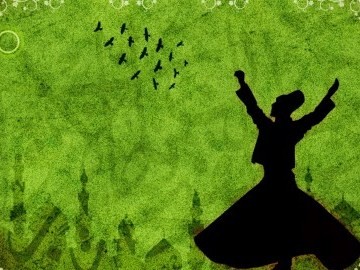
Western misperception of the importance of Sufis in Islamic life is complicated by lack of clarity as to who and what Sufis are. Sufis often enjoy great prestige with the mass of Muslims, based on Sufi examples of personal humility in fervor for God and Sufi preaching of love for humanity. But Sufis are not, mainly, other-worldly, exotic individuals or groups that spend all their time absorbed in semah (ecstatic turning on one foot and other forms of dance).

Some Sufis withdraw from the daily affairs of society, but others pursue satisfaction of the Creator by seeking social justice through improvement of popular education and services to the needy, such as housing of the homeless and free distribution of food. Rather than disappearing in a misty aura of meditation, numerous Sufis around the Muslim world contribute actively to defense of the victims of oppression.

Sufis may also take on the risky challenge of overt political engagement. This has been seen most strikingly in Turkish developments over the past two decades. Turkish Sufis were suppressed by the secularist regime established in the 1920s, but flourished in clandestinity, and have now emerged to lead Islamist parties and to assume positions in government. How the relations between Turkish Islamist politicians and Turkish and Kurdish Sufis will evolve remains to be seen.

Essential principles shared by most Muslim Sufis include emphasis on commonalities with other faiths and traditions, which has contributed to improved relations between Muslims and Jews, Christians, Buddhists and other non-Islamic believers. Commentators concerned to denigrate Islam altogether have asserted that Sufis, even if they embody moderation and mutual respect among people of religion, comprise no more than 5 percent of the world’s Muslims. Since the importance of Sufism stands, in the minds of many Westerners, on demographic measurement, let us therefore ask: How many Sufis are found in the Muslim world?

I would first observe that Sufis are present, persistently, in every Muslim population, including those where they were persecuted the longest: Saudi Arabia. Although the Saudi kingdom prohibited and punished possession of Sufi books and the practice of Sufi observances, the country always possessed a thriving Sufi underground with access to the heights of power. Before his elevation to the throne in 2005, then-Saudi Crown Prince, and now King Abdullah, who favored Sufis, gained them the right to hold zikr (remembrance of God by vocal or silent chanting, singing and bodily movements) in their homes.

In some countries Sufism is praised as an item of a proud heritage while it is repressed in daily life. The most obvious such example is that of Iran. The clerical regime established by Ayatollah Ruhollah Khomeini could not act easily against Sufis, since so many famous Sufis — such as Jalaladdin Rumi, the 13th century author believed by many to be, currently, the most widely read poet in the West — wrote in Persian, and Sufi texts became the national literature of the Iranians.

But while the Tehran clerics honor the Sufis of the past, they repress Sufis in the present. Sufis have most often functioned as an alternative to clerical authority in Islam, and widely represented Iranian Sufi bodies like the Nimatullahi-Gonabadi dervish order and the “hidden,” Kurdish-speaking Ahl-e Haqq or “people of truth” have sustained a difficult challenge to the Iranian authorities. Iranian Sufis have been arrested and disappeared into the obscurity of the prisons, with some doubtless dealt a fatal destiny.

As certain Islamic countries are ambivalent about Sufism, in other Muslim societies we see variations in the intensity of Sufi “activism.” Analyzing Islamic Sufism, I have generally divided Muslim territories between those in which Sufism has a deep but informal influence in local Islam, in contrast with those where it has a well-established institutional presence.

In the great Eurasian expanses, Islam is widely permeated by Sufi teachings and customs. From my travels, observation and participation in Muslim life, I have seen and experienced that Sufi-oriented Islam is prevalent among Slavic and Russian Turkic Muslims, dominant in Central Asia, and widely-represented in South Asia and in Southeast Asia. Across this heartland, Sufi authors are studied and throngs of pilgrims visit Sufi shrines or otherwise commemorate the lives of Sufi saints.

Elsewhere the spiritual heritage is maintained by powerful, organized orders, sometimes called “brotherhoods” although they typically include female disciples. These are prominent in North Africa, French-speaking West Africa, East Africa, the Albanian lands, plus Syria, Iraq, Kurdistan and Iran.

In Turkey, most Muslims are Sufi either by identification with the normative Sunnism subsidized by the state, which exalted Sufis and places the works of Rumi in all Turkish mosques, or by participation in Sufi orders as well as widespread, part-time study circles and other voluntary communities that teach an esoteric Islam. Others are involved in more singular phenomena like the Turkish-Kurdish, Shia-Sufi-shamanist Alevi movement. As a different variant in the Sufi continuum, Indonesia possesses a Sufi civic movement of national scope — the Nahdatul Ulama (NU) organization. Returning to South Asia, organized Sufism there is enacted with a backdrop of a broader, “cultural” Sufism and is under bloody attack by radicals.

Aggregating Sufi-influenced Muslims with active Muslim Sufis from Senegal to Singapore, I believe it is realistic to claim a large plurality, at least, of the world’s 1.3-plus billion Muslims. This should be a source of optimism for those who seek conciliation, rather than confrontation, between the world’s religions, affecting positively both the direction of Islam and the image of Islam among non-Muslims. For these reasons, more concentrated attention on the Sufis by social-science investigators and other experts would be welcome.

Muslims Are the Most Loyal American Religious Group, New Poll Says

As reported by The Christian Science Monitor

After the 9/11 attacks, Muslim Americans faced intense scrutiny, both individually and from federal agencies such as the Federal Bureau of Investigation. Obama is credited with helping smooth tensions through his outreach to the US Muslim community and his effort to end the Iraq war responsibly. The poll shows that 83 percent of Muslim Americans – more than any other religious group – say the war was a “mistake.”

Despite the positive signs, “there are still obstacles” for Muslim Americans, Ms. Mogahed says. “They embrace American values and democratic principles but aren’t sure if the rest of American embraces them,” she says.

Some 56 percent of Protestants said American Muslims had no sympathy for Al Qaeda, the lowest number of any faith group. By comparison, 63 percent of Catholics and 70 percent of Jews thought Muslim Americans had no sympathies for Al Qaeda.

“That’s certainly a challenge for the [US Muslim] community – to have their loyalty questioned by such a large number of their fellow Americans,” Mogahed says.

Those challenges, however, have not led Muslim Americans to try to affect change at the ballot box. They are the least likely religious group to vote, with just 65 percent of Muslims in America are registered. One reason is age: The average age of a Muslim-American is 35, while the average American Protestant is 55. Younger people tend to be less politically active, Mogahed says.

Another reason is affiliation: Poll findings show that the majority of Muslim Americans say that none of the leading Muslim organizations in the US, such as the Council on American-Islamic Relations or the Islamic Society of North America, represents their interests.

With the 2012 election around the corner, Mogahed says political parties that want to reach out to Muslim-American voters might be better off establishing partnerships with local mosques than focusing on winning endorsements from national advocacy organizations. This is especially relevant considering that Muslim Americans who attend a religious service once a week are two times more likely to be politically active than those who attend less frequently, the poll found.

“The mosque should be more the mobilization engine” for get-out-the-vote drives than it has been in the past, she says.bThe poll surveyed 2,482 adults, 475 of whom were Muslim. For Muslims, there was a margin of sampling error of plus or minus 7 percentage points.

Florida Men Accused of Aiding Pakistani Taliban

By Gardiner Harris for The New York Times

The F.B.I. on Saturday arrested three Pakistani-Americans, including father and son imams from South Florida mosques, charging them with providing financing and other material support to the Pakistani Taliban.
Related

Three people living in Pakistan were also charged in the indictment, which was made public by Wilfredo A. Ferrer, the United States attorney for the Southern District of Florida. The F.B.I. said that the indictment grew out of a review of suspicious financial transactions and other evidence and not from an undercover sting operation. The arrests seem to be unrelated to the raid that killed Osama bin Laden a week ago.

The four-count indictment charges that the six sought to aid the Pakistani Taliban’s fight against the Pakistani government and its allies, including the United States, by supporting acts of murder, kidnapping and maiming in Pakistan and elsewhere in order to displace the government and establish strict Islamic law known as Shariah.

“Today, terrorists have lost another funding source to use against innocent people and U.S. interests,” said John V. Gillies, the special agent in charge of the F.B.I.’s Miami office.

Five of the six people charged are related. Arrested in the United States were Hafiz Muhammed Sher Ali Khan, 76, of Miami; and two of his sons, Izhar Khan, 24, of Miami; and Irfan Khan, 37, of North Lauderdale.

Hafiz Khan is the imam at the Miami Mosque, also known as the Flagler Mosque. Izhar Khan is an imam at the Jamaat Al-Mu’mineen Mosque in Margate, Fla. Hafiz and Izhar Khan were arrested Saturday in South Florida, while Irfan Khan was arrested in Los Angeles. All three are originally from Pakistan.

The three people residing in Pakistan who were charged were Amina Khan, Hafiz Khan’s daughter, and Alam Zeb, her son, as well as Ali Rehman, also known as Faisal Ali Rehman. A statement from prosecutors said that the defendants were assisted “by others in the United States and Pakistan.”

The indictment said that the six transferred money to the Pakistani Taliban that was intended to buy guns and sustain militants and their families. Hafiz Khan is also accused of supporting the Pakistani Taliban through a madrasa, or Islamic school, that he founded and controlled in the Swat Valley region of Pakistan. He was charged with using the madrasa to provide shelter and other support for the Pakistani Taliban and sending children from his madrasa to learn to kill Americans in Afghanistan.

The indictment does not charge the mosques with any wrongdoing. The Muslim Communities Association of South Florida announced that that Hafiz Khan had been suspended indefinitely from his mosque.

“Our organizations, together through the Coalition of South Florida Muslim Organizations, has been working with the U.S. Attorney’s Office and the Miami F.B.I. office,” the association said in a statement released Saturday afternoon, “and appreciate the efforts of law enforcement to root out potential sources and supporters of terrorism.”

“We stand together with the U.S. attorney, Wilfredo Ferrer, and the men and women of the F.B.I., and have been and will be cooperating with law enforcement to our fullest ability,” it added.

The F.B.I. news release took pains to describe the charges as reflecting only the actions of the defendants, not of their mosques or Islam. “Let me be clear that this is not an indictment against a particular community or religion,” Mr. Ferrer said. “Instead, today’s indictment charges six individuals for promoting terror and violence through their financial and other support of the Pakistani Taliban. Radical extremists know no boundaries; they come in all shapes and sizes and are not limited by religion, age or geography.”

“The indictment does not charge the mosques themselves with any wrongdoing,” it continued, “and the individual defendants are charged based on their provision of material support to terrorism, not on their religious beliefs or teachings.”

The inclusion of those statements were “well appreciated” by the Muslim community in South Florida, said Asad Ba-Yunus, who is a legal adviser to the Muslim Communities Association of South Florida.

“We have been working with the U.S. attorney’s office over last few months” to improve relations, Mr. Ba-Yunus said, adding that he had spoken with the office Saturday morning before the indictment was announced.

The charges against the Florida men accusing them of supporting the Pakistani Taliban but not actually carrying out operations themselves are the most common types of terrorism prosecutions that United States authorities have pursued since the attacks of Sept. 11, 2001. Of the 50 leading terrorism cases since those attacks, about 70 percent have involved financing or other support to terrorist groups, according to the Center on Law and Security at the New York University School of Law.

The Pakistani Taliban were officially designated as a terrorist organization by the State Department on Aug. 12, 2010.

The Pakistani Taliban are closely allied with Al Qaeda, and is responsible for a series of attacks against Pakistani police and military targets in recent years. Pakistani authorities believe a splinter group of the Pakistani Taliban was responsible for the suicide attack in northwestern Pakistan on Friday that killed more than 80 cadets from a government paramilitary force. According to American officials, the Pakistani Taliban have been involved in or claimed responsibility for attacks on United States interests, including an attack on a military base in Khost, Afghanistan, along the border with Pakistan, and a suicide bombing against the consulate in Peshawar, Pakistan.

American officials say the failed attempt to detonate a car bomb in Times Square last May was developed and financed by the Pakistani Taliban. The convicted bomb plotter, Faisal Shahzad, contacted the Pakistani Taliban via computer to confer with handlers over what he had done, the government wrote in court papers in September.

Pakistanis for Peace Editor’s Note– As peace loving Americans of Pakistani descent, we are upset to hear that some members of the US Muslim community would want to do the great nation of the Unites States harm. If found guilty, we hope that they are severly punished and a message is sent to anyone else intending to do us harm. We commend the FBI and the Department of Justice in these arrests and in keeping the American homeland safe.

Sindh Saves the Day

By Nadeem F Paracha for Dawn
Plans are afoot to build the world’s first ever international Sufi university near Bhit Shah in Sindh. The main purpose of the institution would be to promote interfaith and intercultural education to tackle extremism in the country.

Such a thought and project could only have come about in Sindh. Especially in the context of what Pakistan has beengoing through in the last many years.

Not only have the country’s other provinces – especially the Punjab and Khyber Pakhtunkhwa (KP) – become central targets of horrid terrorist attacks by extremist organisations, the Punjab in particular has also been witnessing a steady growth of faith-based conservatism within its urban middle and lower middle-classes.

When extremists (calling themselves ‘Punjabi Taliban’) attacked the famous Sufi shrine, Data Darbar in Lahore late last year, economist and political analyst, Asad Sayeed, made a rather insightful observation.

He said that had such an attack on the Darbar taken place twenty years ago, thousands of Lahorites would have poured out to protest.

But not anymore. The attack on one of Punjab’s most popular Sufi shrines was simply treated as just another terrorist attack.

Though it is now clear that the Wahabi/Deobandi extremists have been going around blowing up Sufi shrines frequented by the majority Barelvi Muslims, the Barelvi leadership has looked elsewhere, putting the blame on the ever-elusive ‘foreign hands.’

Journalist and intellectual Khaled Ahmed once wrote a telling tongue-in-cheek article about the annual gathering of the Dawat-i-Islami in Multan.

The Dawat is the Barelvi equivalent of the Deobandi Tableeghi Jamat. Both these outfits are considered to be non-political organisations who are more interested in evangelizing their respective versions of Islam and its rituals. One should also mention that both these (sub-continental) strains of Islam accuse one another of being ‘flawed Muslims.’

Ahmed wrote how after Dawat’s huge congregation in Multan, when police found some bullet-riddled bodies of Dawat members, the outfit’s main leadership simply refused to acknowledge the glaring evidence that pointed towards the involvement of an opposing Sunni sect’s organisation in the murders.

Ahmed adds that Dawat leaders began babbling about ‘outside forces (RAW, CIA, Mossad)’ who wanted to create disharmony between Pakistan’s Barelvi majority and the Deobandi and Wahabi sects.

Barelvis: From moderate to militant

One can understand the above-mentioned episode as an example of the confusion Barelvi spiritual leadership has gone through since the 1980s.

From its inception in the 18th century and until about the mid-1980s, the Barelvi sect was largely apolitical in orientation, non-Jihadist and followers of some of the most relaxed dictates of the Hanafi madhab – the first of the four main Islamic schools of law that is also considered to be the most moderate.

‘Barelvi Islam’ (as it is sometimes called) is purely a sub-continental phenomenon that fuses elements of Indian Sufism with the folk and populist strains of various cultures that exist in the sub-continent.

It is also called the ‘folk Islam’ of the region in which a high degree of tolerance exists between various faiths, sects, classes and ethnicities and in which the puritanical aspects of other Islamic sects are eschewed and even rejected.

The Sufi shrine and an intense reverence of the Prophet (PBUH) play a central role in Barelvi Islam. Its populist and moderate make-up helped it become the majority Sunni sect amongst the Muslims of the sub-continent.

Two of its leading opponents have been the Sunni Deobandi sect (also a product of the subcontinent) and the Saudi-inspired Wahabism.

Both have accused Barelvis of ‘adopting Hindu rituals and practices’ and assorted ‘heresies.’

In spite of being the majority sect amongst Sunni Muslims in Pakistan, ‘Barelvi Islam’ hardly ever had a coherent political expression in shape of a mass-based political party or organisation.

Its spiritual leadership remained pro-Jinnah (unlike Deobandi organizations of undivided India), and various Pakistani political leaders have continued to appeal to the symbolism and lingo associated with various populist aspects of Barelvi-ism.

Zulfikar Ali Bhutto and his Pakistan Peoples Party (PPP) was the most successful in this respect.

Bhutto was also one of the first leading Pakistani political figures to undertake the act of regularly visiting various famous Sufi shrines in Sindh and Punjab.

Barelvis are in the majority in Sindh and the Punjab, whereas Deobandis are largely centred in Khyber Pakthunkhwa and in the Pushtun-dominated areas of Balochistan.

Until the 1970s Barelvi-ism also prevailed among many of Sindh and Punjab’s urban middle-classes, especially those who considered themselves to be progressive and likely supporters of secular politics.

However, the arrangement in this context was suddenly disturbed with the arrival of the Ziaul Haq dictatorship in 1977.

Dipped in the political Islam of scholar and Jamat-i-Islami (JI) chief Abul Ala Mauddudi, Zia soon moved towards infiltrating the spiritual and political nerve centres of Barelvi-ism in an attempt to ‘reform’ them.

Barelvi dominance across the country’s religious landscape reminded him of Z A. Bhutto’s populism (which he, like JI, considered to be ‘vulgar’ and ‘un-Islamic’), and from 1979 onwards Pakistan under Zia also became one of the leading client states of Saudi-generated Wahabi propaganda and aid.

Stunned by the ‘Islamic revolution’ in the Shia-dominated Iran in 1979, Saudi Arabian monarchy and its Wahabi Sunni religious elite began seeing Pakistan’s Barelvi-dominated make-up as venerable to Shia-ism’s revolutionary symbolism and also of socialist propaganda, especially with the arrival of Soviet forces in Afghanistan.

At least that was one of the reasons used by Zia and his Saudi allies to draw the United States into giving Pakistan billions of dollars worth of aid and arms.

With the aid also came Wahabi propaganda literature and preachers who along with Pakistani Deobandi and Wahabi spiritual and political groups began setting up madressas and mosques.

These madressas operated as institutions that would indoctrinate young Pakistanis – most of whom were immersed in the non-Jihadi traditions of Barelvi-ism – and prepare them for Jihad against Soviet forces in Afghanistan.

Bralevi tradition had also not been very kind to the ulema and the clergy.

To address this, Zia also began describing famous Sufi saints as ulema and banned (in the media) all criticism and humour aimed at the clergy.

The Afghan war, Saudi propaganda, the mushrooming of Deobandi and Wahabi madressas and televangelists, and a concentrated campaign by the Zia regime to equate the dictatorship’s capitalist-Islamist makeup as something in accordance with the Shariah and with ‘Jinnah and Iqbal’s vision,’ had a telling impact on Pakistan’s religious sociology.

In the Khyber-Pakhtunkhwa many moderate and progressive Deobandi strains that had prevailed in the province began sliding into the sect’s more radical dictates, coming closer to the puritanical Wahabi and Salafi ideas about faith.

This slide was celebrated by the Punjab-dominated military as a successful blow to the secular and ‘treacherous’ Pukhtun separatist tendencies.

In the Punjab, the province benefited the most from Zia’s Punjab-centric capitalist maneuvers. This coupled with unprecedented remittances coming from Pakistanis who had begun going to Arab Gulf states to work from the 1970s onwards, gave birth to new moneyed classes.

Many from the petty-bourgeoisie and bourgeoisie sections began moving away from their Barelvi heritage and towards more puritanical strains of faith.

Their Barelvi past now reminded them of their lower status and economic modesty, whereas they began relating their enhanced economic standing with the adoption of the more puritanical strains of Islam.

That’s why the growth of puritanical Islamist and sectarian organizations that Punjab saw under Zia, a lot of their local funding came from Punjab’s nouveau-riche and petty-bourgeois trader classes.

Interestingly, it was also the same classes that also pushed the Barelvi leadership to become more conservative and radical. Those sections of the Punjabi petty-bourgeoisie that stuck to Barelvi-ism encouraged their spiritual leadership to compete with the Puritanism and radicalism of the growing number of Deobandi and Wahabi groups.

This trend saw the first ever emergence of radical Barelvi groups. In the early 1980s, the Dawat-i-Islami was formed to counterbalance the growth of the Deobandi Tableeghi Jamaat that had begun making deep inroads into Punjab’s bourgeoisie and the military.

The Dawat discouraged the Barelvis from indulging in antics associated with the region’s folk Islam, emphasising an increased reverence of holy personalities and encouraging holding of recitals of naats and milads instead of quwalis and dhamals. The last two became associated with the practices of the lower-class Barelvis.

In 1992, emerged the Sunni Thereek (ST). A Barelvi outfit that emerged from the splintering of the oldest Barelvi Islamic political party, the Jamiat Ulema Pakistan (JUP).

Such occurrences did not really help the Barelvi sect defend its traditions in the face of the state-sponsored Deobandi and Wahabi onslaught –  rather, these organisations began turning Barelvi-ism into an equally anti-pluralistic and militant political phenomenon.

Sindh saves the day?

By the 1990s, Zia’s manoeuvres and Saudi involvement in reshaping Pakistan’s religious tradition had seen Khyber Pakhtunkhwa and Punjab become hostage to various violent Deobandi/Wahabi outfits and new-born Barelvi reactionary-ism.

The Punjab also saw a rise in the use of reactionary political and religious narratives within its lower-middle and middle-classes, whereas in Balochistan attempts were being made (by intelligence agencies) to neutralize secular Baloch nationalist militancy with the help of puritanical evangelical outfits. The agencies had already done this successfullyin Khyber Pakhtunkhwa in the 1980s.

But what happened in Sindh? Barelvi-ism in Sindh (outside Karachi) has always been a lot more secular and pluralistic than the Bareilvi-ism in the Punjab.

Its  sociology  in Sindh heavily revolves around the staunchly secular historicity that the province’s famous scholar, GM Syed’s literary work generated.

He described a highly pluralistic and secular reading of Sufism as being the cultural and religious make-up of the Sindhis and it is this narrative that still rules the roost in the province’s social and religious psyche.

This is one of the reasons why Zia completely failed to impose his version of Islam here. Also, just like the majority of the Baloch who equate puritanical Islam with the ‘Punjabi civil-military elite,’ so does the socio-political discourse in Sindh.

On the other hand, in Karachi, though Zia-backed Deobandi and Wahabi radical outfits did manage to find a foothold, two things have always worked against these outfits here.

The first is the fact that the sprawling ethnic, sectarian and religious diversity found in Karachi actually absorbs and neutralizes any attempt by an outfit to impose its version of Islam.

Secondly, MQM, a party that first emerged as a mohajir nationalist group, adopted almost the same populist Barelvi symbolism and lingo as Bhutto did in the 1970s.

Also, the other two big political parties in the city too are secular: the PPP and ANP.

Though the Sunni Thereek (ST) has managed to infiltrate some sections of MQM’s support, ST is Barelvi and anti-Taliban (albeit reactionary).

In spite of the rampant crime and ethnic tensions that are a constant in Karachi, it will not be an overstatement to claim that Karachi along with the rest of Sindh today stands to be perhaps the only (ragged) sanctuaries in present-day Pakistan that are (comparatively-speaking) largely free of the factors that have created opportunities in the Punjab and KP for violent extremist activity as well as for reactionary conservatism to now become a mainstay in Punjab’s bourgeois psyche.
Global Sufi Fest Attracts Thousands

As Reported by the Times of India

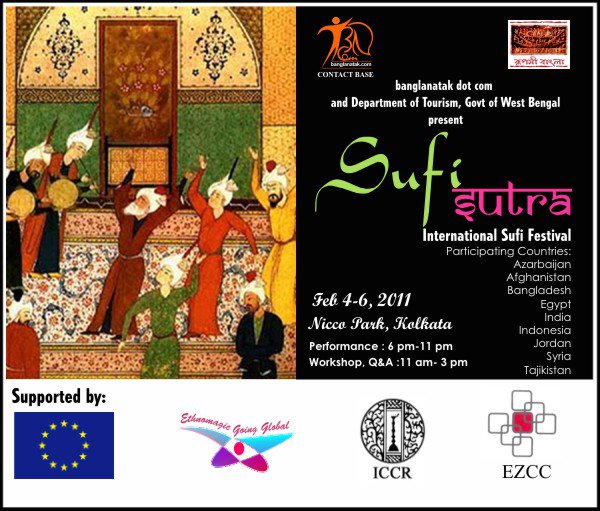
Soulful renderings of Sufi music by wandering minstrels from different parts of the world left the listeners spellbound here at the three-day ‘Sufi Sutra’ which ended on Sunday.

Besides Indians, Sufi singers and musicians from Afghanistan, Bangladesh, Egypt, Iran, Syria and Tajikistan presented mystic Islam through songs, dance and poetry.

Notwithstanding the current political turmoil back home, an eight-member Egyptian Mawlawyiah troupe enthralled the audience by an audio-visual of music and circular dervish dance whirling around singers in a circle.

A Bangladeshi team, led by Anusheh Anadil, sang the household songs of the famous 18th century poet-philosopher Fakir Lalon Shah, on whom based the recent Golden Peacock winning Bengali film ‘Moner Manush’.

The ‘bauls’ and ‘fakirs’ of West Bengal’s Nadia and Murshidabad districts were huge hits by their spontaneous, simple and meaningful lyrics.

Another Bengal team led by Armaan Fakir presented the little-known ‘Bangla Qawwali’. Traditionally performed at the Dargahs, the devotional songs had ‘Dhol’ and ‘Khol’ as percussions replacing Tabla.

The first Sufi ensemble also included the ‘Warsi Brothers’ from Hyderabad, Delhi’s ‘Druv Sangari’ and team, ‘Mirs’ from Bikaner and ‘Haji Md Ahmed Khan Warsi’s team from Uttar Pradesh.

“It is a peace concert in times of violence. We want to bring a convergence of ideas about truth, harmony, self-belief and peace through music. It is a celebration of the quest for the divine through love,” organiser Amitava Bhattacharya said.

Besides musical performances, the festival included workshops and exhibitions to showcase the traditional culture, beliefs and music of the Sufi mystics.

“We had more than 10,000 people at the open-air concert, while more than 700 people, including young students, learnt about Sufism at the pre-concert workshops,” Bhattacharya said.

The event would also help the poor musicians, most of whom were from the rural areas, to earn a livelihood, he said.  The festival was organised by Banglanatak.com in collaboration.

Pakistanis for Peace Editor’s Note– It’s a sad reality that singers from a  country rich in Sufi history and traditions like Pakistan, are  unable to attend this festival due to the 60+ year friction between the two brothers India and Pakistan. They are two halves of one nation.

Cultural exchanges like these, billions in cross border trade, Bollywood and Lollywood collaborations, sports matches, etc are just some of the things the two are missing out on due to their relations. We hope one day peace can finally come to this ancient and holy land that is the subcontinent.

The Founding Fathers and Islam

By James H Hutson for The Library of Congress

With more than 55 million items, the Library’s Manuscript Division contains the papers of 23 presidents, from George Washington to Calvin Coolidge. In this article, Manuscript Division Chief James Hutson draws upon the papers of Washington, Thomas Jefferson and other primary documents to discuss the relationship of Islam to the new nation.

Many Muslims feel unwelcome in the United States in the aftermath of September 11, according to newspaper reports. Anecdotal evidence suggests that substantial numbers of Americans view their Muslim neighbors as an alien presence outside the limits of American life and history. While other minorities—African Americans, Hispanics and Native Americans—were living within the boundaries of the present United States from the earliest days of the nation, Muslims are perceived to have had no part in the American experience.

Readers may be surprised to learn that there may have been hundreds, perhaps thousands, of Muslims in the United States in 1776—imported as slaves from areas of Africa where Islam flourished. Although there is no evidence that the Founders were aware of the religious convictions of their bondsmen, it is clear that the Founding Fathers thought about the relationship of Islam to the new nation and were prepared to make a place for it in the republic.

In his seminal Letter on Toleration (1689), John Locke insisted that Muslims and all others who believed in God be tolerated in England. Campaigning for religious freedom in Virginia, Jefferson followed Locke, his idol, in demanding recognition of the religious rights of the “Mahamdan,” the Jew and the “pagan.” Supporting Jefferson was his old ally, Richard Henry Lee, who had made a motion in Congress on June 7, 1776, that the American colonies declare independence. “True freedom,” Lee asserted, “embraces the Mahomitan and the Gentoo (Hindu) as well as the Christian religion.”

In his autobiography, Jefferson recounted with satisfaction that in the struggle to pass his landmark Bill for Establishing Religious Freedom (1786), the Virginia legislature “rejected by a great majority” an effort to limit the bill’s scope “in proof that they meant to comprehend, within the mantle of its protection, the Jew and the Gentile, the Christian and Mahometan.” George Washington suggested a way for Muslims to “obtain proper relief” from a proposed Virginia bill, laying taxes to support Christian worship. On another occasion, the first president declared that he would welcome “Mohometans” to Mount Vernon if they were “good workmen” (see page 96). Officials in Massachusetts were equally insistent that their influential Constitution of 1780 afforded “the most ample liberty of conscience … to Deists, Mahometans, Jews and Christians,” a point that Chief Justice Theophilus Parsons resoundingly affirmed in 1810.

Toward Islam itself the Founding generation held differing views. An evangelical Baptist spokesman denounced “Mahomet” as a “hateful” figure who, unlike the meek and gentle Jesus, spread his religion at the point of a sword. A Presbyterian preacher in rural South Carolina dusted off Grotius’ 17th century reproach that the “religion of Mahomet originated in arms, breathes nothing but arms, is propagated by arms.” Other, more influential observers had a different view of Muslims. In 1783, the president of Yale College, Ezra Stiles, cited a study showing that “Mohammadan” morals were “far superior to the Christian.” Another New Englander believed that the “moral principles that were inculcated by their teachers had a happy tendency to render them good members of society.” The reference here, as other commentators made clear, was to Islam’s belief, which it shared with Christianity, in a “future state of rewards and punishments,” a system of celestial carrots and sticks which the Founding generation considered necessary to guarantee good social conduct.

“A Mahometan,” wrote a Boston newspaper columnist, “is excited to the practice of good morals in hopes that after the resurrection he shall enjoy the beautiful girls of paradise to all eternity; he is afraid to commit murder, adultery and theft, lest he should be cast into hell, where he must drink scalding water and the scum of the damned.” Benjamin Rush, the Pennsylvania signer of the Declaration of Independence and friend of Adams and Jefferson, applauded this feature of Islam, asserting that he had “rather see the opinions of Confucius or Mohammed inculcated upon our youth than see them grow up wholly devoid of a system of religious principles.”

That ordinary citizens shared these positive views is demonstrated by a petition of a group of citizens of Chesterfield County, Va., to the state assembly, Nov. 14, 1785: “Let Jews, Mehometans and Christians of every denomination enjoy religious liberty…thrust them not out now by establishing the Christian religion lest thereby we become our own enemys and weaken this infant state. It is mens labour in our Manufactories, their services by sea and land that aggrandize our Country and not their creeds. Chain your citizens to the state by their Interest. Let Jews, Mehometans, and Christians of every denomination find their advantage in living under your laws.”

The Founders of this nation explicitly included Islam in their vision of the future of the republic. Freedom of religion, as they conceived it, encompassed it. Adherents of the faith were, with some exceptions, regarded as men and women who would make law-abiding, productive citizens. Far from fearing Islam, the Founders would have incorporated it into the fabric of American life.

James H. Hutson is chief of the Manuscript Division and the author of many books, including, most recently, “Religion and the Founding of the American Republic,” 1998.

Sufi Islam: Reclaiming Muslim Spirituality

By Fahad Faruqui for The Huffington Post

After two bombs recently claimed dozens of innocent lives at the shrine of esteemed Sufi Ali Hajviri, fingers were pointed at the al-Qaeda-linked militants who see Sufism as the work of heretics. The New York Sufi Music Festival was brought to U.S. to showcase the spiritual dimension of Islam and the rich heritage of Pakistan, counteracting a view that Pakistan is predominantly a country known for its terror factories. Sadly, the image of militants waging war is overwhelming and hard to supersede.

Hearing Abida Parveen sing Bulleh Shah’s ecstatic poetry, which enriched the centuries-old Sufi tradition of the Indus valley, made me realize how the Islamists have stripped away spirituality from the religion and left believers with rituals, sketchy interpretations of the divine laws and fear of God’s wrath. Sufi Muslims of the subcontinent, who converted to Islam in the pre-partition era, were drawn to the Sufi path of knowledge that has been hijacked by the al-Qaeda ideology of violence.

The rapturous quality of Sufi poetry continues to fascinate me, but the very idea of loving and seeking God while listening to radical mullahs (like the clerics of Red Mosque) is deeply troubling. Prostration to God devoid of spirituality is no different from doing sit-ups. Surely, the label Sufi is not necessary. What’s important is the sentiment. It helps the cause of clarity to call those on the path “Sufis” rather than “mystics,” which will more likely conjure images of Aladdin on his flying carpet.

Islam is the fastest-growing religion but has too few religious scholars with requisite understanding to link rituals and divine laws to creative spiritual ascension. I reached a level of comfort with my faith through good guidance from prominent Muslim thinkers such as Hamza Yusuf, Faraz Rabbani and Zaid Shakir, who drink deeply of the Quran’s spring of wisdom.

Faith is ineffable; so is our search for God. Ecstatic poetry and Sufi treatises speaking of “annihilation of self” and “Oneness with the Creator” are merely tools to evoke the Sufi sentiment, which is not peculiar to Islam. Teresa of Avila’s “Libro de la Vida,” Bulleh Shah’s ecstatic poetry, Allama Iqbal’s intimate conversation with God in “Shikwa” (complaint) and Mansoor Al-Hallaj’s proclamation “Anal-Haq” (I am the Truth) are all expressions of the acquired wisdom gleaned from deep introspection.

Though unsuccessful, Iqbal tried to revive the true spirit of Islam. He was quick in identifying that the hardline mullah was a hopeless case. But the Sufis were either consumed in “other worldliness” or digressing from the core of Sufism. For Iqbal, a profound religious experience is one that benefits humanity, which is most unlikely if the seeker retreats to constant seclusion.

Saudi Arabia’s government is often accused of demolishing tombs of the companions of the prophet, fearing veneration of graves, and of discouraging Muslims from praying at prominent sites like the Cave of Hira (where Muhammed received his first revelation). Why they discourage is another column, but one thing is certain: visiting graves and sites mentioned in the Quran will not miraculously lead to divine illumination. The essence of Sufism is to dig into the depths of your soul to seek the One. In the shrines of Sufi masters in the subcontinent, one can expect to find numerous vagabonds pretending to be Sufis, who earn a living by giving false hopes to troubled wives, jobless men and childless couples. This defeats the premise of Sufism — absolute reliance on Almighty.

In a phone conversation, a prominent Sufi scholar, William Chittick, said, “The core of Sufism is to strive for nearness to God.” Even though God is absolutely Other, he presupposes a direct relationship with the seeker. No doubt. Allah says in the Quran (50:16): “I am closer to you than your jugular vein.”

It is our egos that have created boundaries between sects within Islam and ensuring rivalries with non-Muslims. Reviving the spiritual dimension of Islam may be the only way to fight intolerant radical elements internally.

Aasia Bibi and Impurities in the Land of the Pure

By Manzer Munir for Pakistanis for Peace

The case of Aasia Noreen aka Aasia Bibi illustrates how far Pakistan has to go to secure freedoms for its religious minorities. Christians and Hindus are not the only minorities who are persecuted for their beliefs but it is also Muslim minorities such as the Ismailis, Ahmadis, and Shiites who are routinely harassed, discriminated and also killed. Sadly, it is the case of Aasia Bibi that has brought some much needed attention to Pakistan’s sad state of affairs towards the treatment of its religious minorities.

Several sections of Pakistan’s Criminal Code consist of its blasphemy laws and of all the Muslim countries of the world that have anti-blasphemy laws, Pakistan’s anti-blasphemy laws are by far the strictest. There is section 295 that forbids damaging or defiling a place of worship or a sacred object. Then there is section 295-A that “forbids outraging religious feelings.” There is also 295-B which prohibits defiling the Qu’ran and was originally punishable by life imprisonment but has since been amended to up to three years imprisonment.

No section of the blasphemy law is more controversial or harder to prove than Article 295-C, the law that Aasia Bibi is allegedly charged with having broken. In respect to prophet Muhammad, this statute states that ” Whoever by words, either spoken or written, or by visible representation, or by any imputation, innuendo, or insinuation, directly or indirectly defiles the sacred name of the Holy Prophet Muhammad shall be punished with death, or imprisonment for life and shall also be liable to a fine.”

Aasia’s case and charges against her started almost a year and a half ago when there was a quarrel over a bowl of water in a dusty village in the heart of Pakistan’s Punjab province. A group of women were working the fields in the heat of the Pakistani sun when one of them, Aasia Bibi, dipped her glass in the communal bucket of drinking water to fetch herself and others a glass of water to drink and immediately was rebuffed by the other women who claimed that the water was now unclean as it had been touched by a non-Muslim. According to witnesses, instead of quietly bowing her head and taking the indignities, Aasia’s crime was that she mounted a strong defense of her faith and remained steadfast in her demeanor that she did nothing wrong. Too often in Pakistan, the blasphemy laws are used against religious minorities to settle personal vendettas and old scores according to Pakistan’s Human Rights Watch, a watchdog group monitoring the case.

The news traveled fast in Aasia’s village of Ittan Wali, in Punjab’s Sheikhupura district that a Christian woman had insulted the prophet. The local mullah got on the mosque loudspeakers, urging the “faithful” to take action against Aasia Bibi. In sad but familiar pattern, her defense of her faith was somehow twisted into an accusation of blasphemy, according to her family and others familiar with the case. Soon as a mob gathered outside her home ready to take the law into their own hands and handing out vigilante justice, the police moved in and took her into custody. But instead of protecting her, they charged her with insulting Islam and its prophet under the blasphemy laws.

And then on Nov. 8, after suffering 18 months in prison, Aasia Bibi was sentenced to death by a district court, making her the first person to be handed the death penalty in Pakistan under the blasphemy laws. Many before her over the years have been charged, but punishment had been commuted to lesser penalties than the death sentence imposed on Aasia Bibi. No concrete evidence was ever presented against Aasia, according to Pakistan’s Human Rights Watch. Instead, the district judge relied on the testimonies of three other women, all of whom were hostile towards her.

Unfortunately this is a common insult hurled at many of Pakistan’s 2 million Christians who make up just 1.59% of the total population. Often, Christians in Pakistan are discriminated and persecuted and many times only get the lowest of the low jobs such as street sweepers, janitorial and sanitation workers. In fact, in Pakistan, the term ‘Chura‘ has become synonym with the Christian community as it relates to an unclean person akin to how the untouchables or Dalit community is seen in India. In India however, the Dalits are not subjected to arcane state blasphemy laws geared towards religious minorities as in Pakistan or are threatened with their lives at the hands of the Hindu majority.

As discussed in a couple of my previous articles, Taliban 1o1, History and Origins and Taliban 201, The Rise of the Pakistani Taliban, the Islamization of Pakistan started under the late General Zia ul Haq of Pakistan who took over the leadership of the country through a military coup in 1977 when he hung the deposed and democratically elected Prime Minister Zulfiqar Ali Bhutto. Earlier in 1973, the 1973 Constitution of Pakistan had declared that “Islam shall be the religion of the Pakistan” and had systematically begun the process of restricting the participation of religious minorities in government and politics.

Before General Zia, there were only two reported cases of blasphemy. Since the death sentence was inserted in 1986 into the Penal Code for the blasphemy laws, this number has now reached 962 — including 340 members of the Ahmadi Muslim community, 119 Christians, and 14 Hindus. A close examination of the cases reveals the blasphemy laws are often invoked to settle personal scores, or they are used by Islamist extremists as cover to persecute religious minorities, sadly with the help of the state under these laws.

General Zia began this policy of Islamization of Pakistan in conjunction with his support for the war against the Russians and assistance to the Afghan Mujahedeen as well as the building of thousands of madrassahs or religious schools across Afghanistan and Pakistan which nurtured the young men into what later became the Taliban. Many of these blasphemy laws fully came into being under his reign, although some were around since as early as more than 100 years prior when the British drew up the Indian Penal Code of 1860 which was initially an ill foreseen aim at keeping the peace among the many fractured faiths of the subcontinent. For instance, section 295-A, which “forbids outraging religious feelings”, could have been applied against a Muslim who insulted a Hindu or a Hindu who taunted a Sikh or Christian or vice versa. However under Zia, the blasphemy laws were expanded and almost exclusively applied against Muslim minorities such as the Ahmadis, Islamilis and Shiites as well as against the Christian and Hindu populations.

Recently, a religious ‘leader’ came out and has offered over $6000 to anyone who can kill Aasia Bibi while she awaits her punishment in police custody. Outrage and denunciations on this case are coming from across the world as many people are appalled at the sad state of rights for religious minorities in Pakistan. The Pope has intervened also asking for clemency for Aasia Bibi from Pakistan’s President Asif Ali Zardari. Against all manner of reason and justice, Lahore’s High Court recently issued an order on November 29, 2o1o, preventing Zardari from exercising his constitutional authority to pardon Aasia Bibi.

In a country rife with violence and chaos and one that has become synonymous with terror the world over, the case of Aasia Bibi is yet another dark stain on the country’s image around the world. The Taliban and the extremist groups ravaging Pakistan can be explained as being a violent minority and do not and should not reflect on the nation as a whole as the majority of people in Pakistan are opposed to them and their views of Islam. But the blasphemy laws, for as long as they have stayed on the books in Pakistan and in the constitution, cannot and should not be excused in any shape or form. These laws need to be repealed and the constitution needs to be amended in an emergency manner so that Aasia Bibi and other religious minority citizens of Pakistan are not subjected to cruel and subjective laws that are almost exclusively used against minorities to settle scores, personal vendettas, and instill terror in less than 3 percent of the country that is not part of the religious majority of Sunni Muslims.

There needs to be international pressure placed on Pakistan from the United Nations, the United States, Europe and others to modify the constitution immediately and to pardon this 45 year old mother of five children. It is ironic that in a country where many people sympathize with Osama’s Al Qaeda and profess to hate the west with one hand, they decry with the other why not enough western aid has came to their country when it recently saw the worst flooding in its history. Can you blame the American citizens, the Europeans or citizens of any other Christian nation from hesitating to give aid to a country that not only plays a duplicitous game when it comes to terrorists and terror havens but also treats Christians and other religious minorities in the manner as in the case of Aasia Bibi?

The name Pakistan literally translates into “The Land of the Pure”. And as a child growing up I was told that the meaning of Pakistan’s flag is this: “The green is a traditional Islamic color and the crescent moon and star are also Islamic symbols. The white stripe represents the non-Muslim minority and religious groups of Pakistan and there place in the country.” In my view, as long as the nation sanctions and tolerates these utterly unjust and biased blasphemy laws, the religious minorities of Pakistan clearly have no place in this land of the ‘pure’.

-Manzer Munir, a proud Pakistani American and peace activist, is the founder of Pakistanis for Peace and blogs at www.PakistanisforPeace.com as well at other websites as a freelance journalist and writer.

Majority of Muslims Reject Al-Qaeda

As Reported by Sandra Johnson for The Daily Mail

Muslims in many parts of the Islamic world overwhelmingly reject al Qaeda, support a large role for their faith in government and believe democracy is preferable to any other kind of political structure, according to a new survey released by Pew Research Center’s Global Attitudes Project.

The study also found falling support for suicide bombings, as well as mixed attitudes towards Hamas and Hezbollah, Islamic groups designated as terrorist organizations by Western governments but which operate extensive social services networks in parts of the Muslim world.

The survey, conducted this spring in Jordan, Lebanon, Nigeria, Indonesia, Egypt, Pakistan and Turkey, found that only in Nigeria did Muslim populations have anything approaching a favorable view of al Qaeda, with 49 percent expressing positive views and 34 percent holding an unfavorable opinion.

At least seven in 10 Muslims had unfavorable views of the group in Egypt, Turkey and Lebanon, as did lesser majorities in Jordan and Indonesia, according to the study.

But views of Hamas and Hezbollah were more mixed. Both groups got favorable ratings from a majority of Jordanian Muslims, with 60 percent supporting Hamas and 55 percent holding favorable views of Hezbollah, Pew reported.

Muslims in every nation but Turkey expressed a positive feeling about Islam’s influence in their nation’s politics. More than nine in 10 Indonesian Muslims said its influence is positive, as did more than eight in 10 Egyptian and Nigerian Muslims. In Jordan, 76 percent of Muslims approved of Islam’s influence, as did 69 percent in Pakistan and 58 percent in Lebanon.

In Turkey, 38 percent had a positive opinion of Islam’s influence in political life.

At the same time, majorities of Muslims in every country but Turkey said they were concerned about Islamic extremism in the world and their own countries.

Democracy was favored by a majority of Muslims in every country but Pakistan, although even there it received the largest share of responses. Lebanese Muslims were most favorable toward democracy, followed by those in Turkey, Jordan, Nigeria, Indonesia and Egypt.

Support for suicide bombing had also fallen by double digits since 2002 in every country except Turkey, where it was never well-received among Muslims, according to the study.