Beijing Agrees to Operate a Key Port, Pakistan Say
By Jeremy Page for The Wall Street Journal
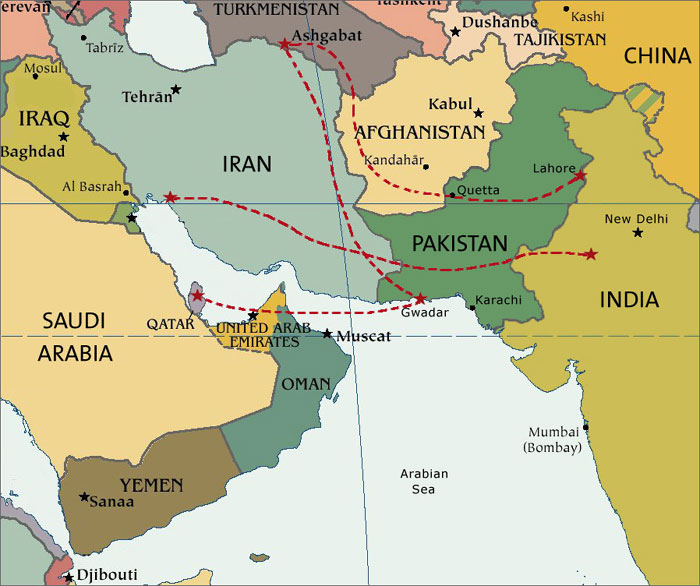
Pakistan’s defense minister said China has agreed to take over operation of the strategically positioned but underused port of Gwadar, and that Islamabad would like the Chinese to build a base there for the Pakistani navy.
Ahmad Mukhtar gave no clear timetable on the possible change at Gwadar, on Pakistan’s western coast, which is currently managed by a Singaporean government company. But his statement Saturday is the latest illustration of how Pakistan is portraying China as a powerful alternative ally and aid source if the U.S. scales down military assistance for Islamabad in the aftermath of Osama bin Laden’s killing.
China is eager to expand its influence in Pakistan over the long term, but is wary of the country’s chronic instability, which was highlighted late Sunday when a Pakistani naval base was attacked in the western port of Karachi, about 300 miles southeast of Gwadar.
Mr. Mukhtar made the announcement after accompanying Prime Minister Yusuf Raza Gilani on a visit to China last week. During that visit, Pakistani officials say, Beijing agreed to expedite delivery of a second batch of 50 jointly developed JF-17 fighter jets to Pakistan, possibly within six months.
The fighter agreement prompted India’s defense minister, A.K. Antony, to express serious concern in a meeting with reporters late Friday about the growing defense ties between China and Pakistan, and to assert that India’s only possible response was to build up its own military arsenal.
Attempts on Sunday to contact Mr. Antony and other Indian officials for comment about Gwadar were unsuccessful. In the past, Indian officials have expressed concern that China plans to use Gwadar as a staging post for naval operations in the Indian Ocean, the Arabian Sea and beyond.
China’s Foreign Ministry didn’t immediately respond to a request to comment.
China—Pakistan’s biggest arms supplier—provided 80% of the initial $248 million funding for the construction of Gwadar, a former fishing village in the southwestern province of Baluchistan whose 47-foot-deep port is the only one in Pakistan capable of handling the biggest cargo ships.
Pakistani officials say Gwadar will be a trade hub for Central Asia and a transit point for Chinese oil imports, most of which are now shipped via the Malacca Strait, making them vulnerable to piracy or naval blockades.
China and Pakistan also have discussed plans to build an oil pipeline from Gwadar to northwestern China, and two new stretches of railway extending the Pakistani network to Gwadar at one end, and to the Chinese border at the other.
Some U.S. and Indian military officials see Gwadar more as part of a so-called “string of pearls” naval strategy, wherein China has also funded construction or upgrades of ports in Sri Lanka, Bangladesh and Myanmar.
China, however, says its involvement in these ports is only commercial. Some experts question the commercial and military value of Gwadar because of a long-running separatist insurgency in Baluchistan and the high cost of building and maintaining a pipeline and railway.
Construction of Gwadar started in 2002 and finished in 2007. Since then it has been operated by Singapore’s PSA International under a 40-year contract, for which a Chinese company also had bid.
But the port has attracted far less traffic than it is designed for over the last four years, due in large part to opposition from politicians in Baluchistan, who say local people get insufficient benefit from the port and other commercial projects, relative to the central government.
PSA’s contract has been challenged in Pakistan’s courts and in September, Adm. Noman Bashir, the country’s naval chief, called for it to be reviewed. Pakistani officials also say the Singaporean government hasn’t pushed hard enough for Pakistan to become a full dialogue partner within the Association of Southeast Asian Nations, as India is, taking part in some talks and meetings.
Mr. Mukhtar’s statement said the Chinese government had agreed to Pakistan’s request that it take over operation of Gwadar when PSA’s “term of agreement” expired, according to the state-run Associated Press of Pakistan.
“We are grateful to the Chinese government for constructing Gwadar Port. However, we will be more grateful to the Chinese government if a naval base is being constructed at the site of Gwadar for Pakistan,” Mr. Mukhtar was quoted as saying.
A spokesman for PSA declined to comment.
While hailing its close ties with Pakistan last week, China was more reserved in its public statements to avoid antagonizing the U.S. and India and becoming too embroiled in Pakistan’s problems, political analysts say.
But sSome analysts also say China sees an opportunity in the aftermath of bin Laden’s death and the expected drawdown of U.S. troops in Afghanistan to expand its influence in Pakistan as part of a long-term plan to contain India, open new trade routes, and enable its navy to operate further afield.
“China is trying to undercut the U.S.’s numerous interests in Pakistan,” said Brahma Chellaney, professor of strategic studies at the Centre for Policy Research in New Delhi. “Gwadar was the linchpin of [the] ‘string of pearls’ strategy and the latest news adds to that. India faces a unique challenge that no other country does. Its two nuclear armed neighbors are closely aligned and are stepping up joint military programs. India will have to step up its deterrent capabilities.”
Mr. Mukhtar said in his statement Saturday that Pakistan had also asked for an unspecified number of 4,400-ton frigates on a “credit basis” from China, and for the Chinese government to train Pakistani personnel on submarines.
He also asked China to induct the JF-17 into the Chinese air force in order to encourage overseas sales of the relatively cheap, multipurpose fighter jet. He said that China “subscribed” to Pakistan’s request to buy a more advanced Chinese fighter jet called the FC-20, also known as the J10, but didn’t give further details.


You must be logged in to post a comment.