Posts Tagged ‘ Khyber ’

Bomb Strikes Shiite March in Pakistan

As Reported by The Associated Press
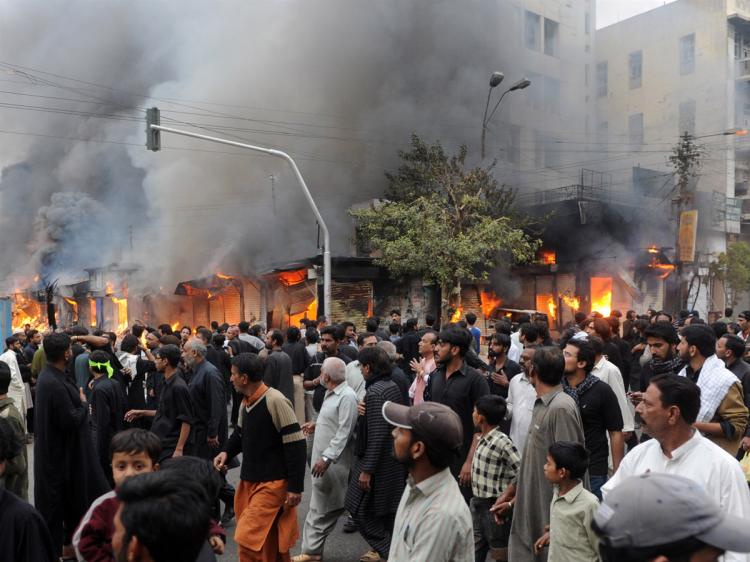
Three bombs ripped through a Shiite Muslim religious procession in the eastern Pakistani city of Lahore on Wednesday, killing 25 people and wounding about 150 others, officials said.

The explosions appeared to be the latest in a string of attacks by Sunni extremists against the minority Shiites they consider infidels. Allied with al-Qaida and the Taliban, the bombers are also seeking to destabilize Pakistan’s U.S.-backed government.

The blasts were the first major attacks since Pakistan was hit by devastating floods more than a month ago. Lahore, the country’s political capital and home to much of its military elite, has been regularly targeted by militants over the past two years.

The bombs exploded at three separate sites Wednesday evening as 35,000 Shiites marched through the streets of Lahore in their traditional mourning procession for the caliph Ali, one of Shiite Islam’s most respected holy men.

Prime Minister Yousuf Raza Gilani condemned the blasts in a statement and said the attackers would not escape justice.

After the blasts, the marchers erupted in fury, setting fire to a police station, another police facility, two police cars and three motorcycles, said Zulfiqar Hameed, a senior police officer. Police lobbed tear gas canisters at the crowd and fired shots in the air to disperse the assailants, he said.

The first blast was a time bomb that exploded in the street near a well-known Shiite building, Hameed said. Footage of that explosion shown on Geo television showed a small blast erupting amid a crowd of people on the street followed by a large plume of smoke. Hundreds of people fled from the blast, while others rushed to carry the wounded to safety.

Minutes later, with the streets in chaos, a male suicide bomber who appeared about 18 years old tried to force his way into an area where food was being prepared for the marchers to break the traditional Ramadan fast and exploded, Hameed said. Soon after, another suicide bomber detonated himself at an intersection near the end of the procession.

Abbas Kumaili, a prominent Shiite scholar as well as a senator, called for three days of mourning over the attack and lashed out at the bombers.

”They are our enemies, both Shiites and Sunnis should remain united and foil their evil designs,” he said.

The blasts killed 25 people and wounded about 150 others, said Sajjad Bhutta, a top local government official.

Hours earlier, three people were wounded in a shooting near a similar Shiite procession in the southern city of Karachi, but senior police officer Iqbal Mahmood said the incident did not target the march.

Islamist extremists have a history of attacking Shiites, non-Muslims and others they deem unacceptable.

In July, twin suicide attacks at Pakistan’s most popular Sufi shrine killed 42 people. Another suicide bomber wounded eight worshippers at a Shiite mosque in eastern Pakistan.

Meanwhile, a bomb exploded near a police vehicle in the town of Shabqadar in northwest Pakistan, killing one passer-by and wounding 15 people including one police officer, police officer Nisar Khan said.

The bombings came after Pakistan army jets and helicopters targeted militant hide-outs near the Afghan border, killing 60 people identified as insurgents or their family members, including children, said security officials and a witness.

The attacks occurred Tuesday and Wednesday in different parts of the region.

There was no independent confirmation of the casualty figures because the area is too dangerous for outsiders to visit.

The raids Tuesday took place in several villages in Teerah Valley in the Khyber region and killed 45 people, the officials said. One official said some vehicles rigged with explosives had also been destroyed. He could not say how many.

He described the dead as insurgents, but said it was possible that people living with them could also have been killed. Separately, an intelligence officer said some women and children had been killed in the attacks.

Jihad Gul, who lives near one of the villages, said he had seen the bodies of at least 20 women and children.

Army spokesman Maj. Gen. Athar Abbas said reports of civilian casualties were unconfirmed.

The security officials spoke on condition of anonymity because they were not authorized to speak to the media.

An air attack Wednesday in the adjoining district of Orakzai killed 15 suspected militants and wounded 10 others, according to local government official Jamil Khan and a brief army statement.

Pakistan’s army has been fighting Islamist militants in different parts of the northwest for more than two years.

Militants who fled major operations in the South Waziristan and Orakzai tribal regions are believed to have set up new bases in Khyber, about 60 miles (100 kilometers) northwest of the main city in the region, Peshawar.

Officials: Pakistan Flood Deaths Top 1100‎

As Reported By CNN

The devastating floods in Pakistan have killed more 1,100 people, Pakistani government officials told CNN on Sunday. Another 30,000 people were stuck on their rooftops and in higher areas as they tried to escape rushing floodwaters, a United Nations official said Sunday.

“We’ve got the government sending boats and helicopters to try to reach people and bring them to safety at the same time as trying to deliver emergency relief,” said Nicki Bennett, a senior humanitarian affairs officer for the U.N.

Damaged roads and bridges have made rescuing stranded residents difficult, she said, noting that even a U.N. warehouse where the organization stores food, blankets, soaps and bucks is partially underwater. “As we are trying to reach people, we have to battle with the ongoing access problems,” she said. The rescue and recovery efforts of the Pakistan flooding could become more complicated as weather officials predict more monsoon rains starting Monday.

The Pakistan Meteorological Department said Sindh, Punjab, Kashmir, eastern parts of Khyber-Pakhtunkhwa and eastern parts of Balochistan would receive monsoon rains. Areas along the Indus River would be badly affected due to extremely high flood conditions.

The number reflects those killed only in Khyber Pakhtunkhwa province, previously known as the North West Frontier Province, said spokesman Mian Iftikhar Hussain. Flooding has also been reported in Pakistani-controlled Kashmir. Twenty-five deaths were recorded there Friday, Hussain said.

A Pakistani Red Crescent official told CNN that the number of people affected by the floods has risen to nearly 2.5 million people, with infrastructure receiving major damage. Rushing water also has washed away thousands of acres of crops, government buildings, businesses, schools, bridges and homes, officials said.

The United States will assist in relief efforts by bringing in 50,000 meals, rescue boats and helicopters, 12 pre-fabricated steel bridges and water filtration units, the embassy in Islamabad said.

According to Geo TV, 150 people are missing in a northwestern province, and 3,700 homes were swept away. Forty-seven bridges in Swat have been destroyed or damaged.

Geo TV also said 3,000 are in a camp in Nowshera and are without enough water and food. Displaced residents are unhappy with the government response, Geo TV said. Trains have also been delayed, frustrating commuters.

“They have made this a joke,” a commuter told the network. “There are young children here, but there is no water, nor is there any seating. They have taken our ticket money. Yet after every few minutes they change the train timings. They are playing a game of lies and deceit.”

Pakistani Interior Minister Rehman Malik visited Khyber Pakhtunkhwa on Saturday and found tourists and local residents trapped because of the heavy floods, the state-run Associated Press of Pakistan reported.

President Asif Ali Zardari said all available resources would be used to help those stranded by the waters, the APP reported.

Many of the victims died when flood waters swept away hundreds of mud houses in parts of Swat Valley and the districts of Shangla and Tank, according to Bashir Ahmed Bilour, a provincial minister in Khyber Pakhtunkhwa.

Hussain said flooding has cut off the Swat Valley and the districts of Shangla and Peshawar. There is no way to get to these areas by road, he said.

The Pakistani Air Force has been helping with rescue efforts, spokesman Tariq Yazdanie said in an interview on Pakistani TV. The recent torrential rains have broken all previous records of rainfall in the country, he said.

The United Nations said there is a need for help in providing emergency shelter, food, drinking water and sanitation facilities. Its agencies are geared to help with these issues.

The European Commission is providing 30 million euros ($39 million) to help the people affected by the flooding.

U.S. Embassy officials in Pakistan said the United States has committed $10 million to support flood relief priorities, four inflatable rescue boats, two water filtration units that can fulfill the daily water requirements of up to 10,000 people, and 12 pre-fabricated steel bridges to temporarily replace damaged bridges.

U.S. officials have also provided more than 51,000 halal meals (military rations tailored for people of Islamic faith) and another 62,000 will arrive Sunday.

In addition, the U.S. provided helicopters to support the Ministry of Interior’s rescue operations.

The same weather system is also responsible for flooding in bordering Afghanistan, where 65 people have died, and 61 were injured since Thursday, according to Abdul Matin Adrak, head of disaster management for Afghanistan.

The flooding started Thursday and continued for more than six hours. Rescue teams were able to access all the flooded villages using ministry of defense helicopters. Food and equipment was donated and transferred to the affected people by ISAF and Afghan Security forces.

U.S. Air Force Lt. Col. Greg “Boomer” Roberts, adviser to the Afghan Air Force, told CNN Sunday morning that the Afghan air force rescued about 2,000 villagers who were stranded. Roberts accompanied the air force during their rescue mission in the Kunar province — a known insurgent stronghold.

“They knew they could accomplish their mission. When we came into the area and the Taliban made their presence known, they continued … and picked up 2,000 people who were definitely overcome by the floods. And they did it right there in full view of the Taliban.

“There’s not a doubt in my mind that some of the folks we picked up are Taliban,” he said, adding that most were probably looking for employment with the organization. He said the rescue mission is the type of move that could sway people away from the Taliban and toward the Afghan government.