Occupy: Out of Zuccotti Park And Into The Streets
By Eugene Robinson for The Washington Post
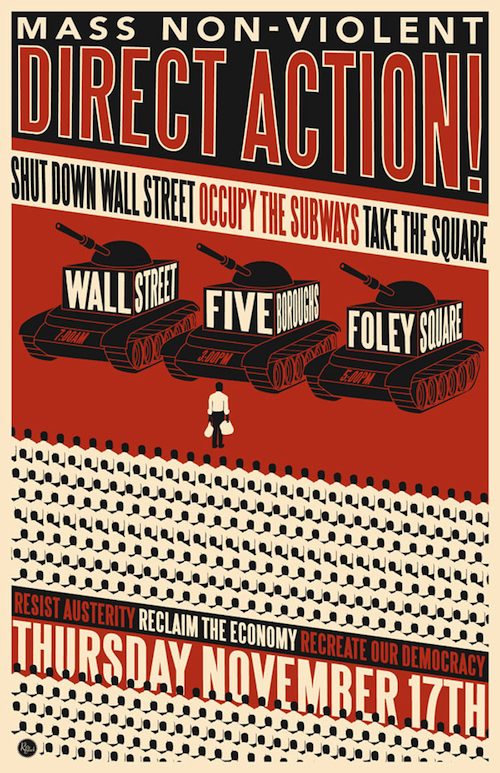
Occupy Wall Street may not occupy Zuccotti Park anymore, but it refuses to surrender its place in the national discourse. Up close, you get the sense that the movement may have only just begun.
Demonstrators staged a “day of action” Thursday, following the eviction of their two-month-old encampment this week. The idea was, well, to occupy Wall Street in a literal sense — to shut down the financial district, at least during the morning rush hour.
For the most part, it didn’t work. Entrances to some subway stations were blocked for a while, and traffic was more of a mess than usual. But police turned out in force, erecting barricades that kept protesters from getting anywhere near their main target, the New York Stock Exchange. Captains of commerce may have been hassled and inconvenienced, but they weren’t thwarted.
There was some pushing and shoving, resulting in a few dozen arrests. Coordinated “day of action” protests were held in other cities. They did not change the world.
A big failure? No, quite the opposite.
Lower Manhattan was swarming not just with demonstrators and police but with journalists from around the world — and with tourists who wanted to see what all the fuss was about. A small, nonviolent protest had been amplified into something much bigger and more compelling, not by the strength of its numbers but by the power of its central idea.
There is a central idea, by the way: Our financial system has been warped to serve the interests of a privileged few at the expense of everyone else.
Is this true? I believe the evidence suggests that it is. Others might disagree. The important thing is that because of the activism of the Occupy Wall Street protests — however naive, however all-over-the-map — issues of unfairness and inequality are being discussed.
This is a conversation we haven’t been having for the past 30 years. For politicians — and those who pay lavishly to fund their campaigns — the discussion is destabilizing because it does not respect traditional alignments. For example, white working-class voters are supposed to be riled up against Democrats for policies such as affirmative action and gun control. They’re not supposed to get angry with Republicans for voting to bail out the banks and then flatly ruling out the idea of relief on underwater mortgages.
How people feel about fairness — the 1 percent at the top versus the other 99 percent — has nothing to do with how they feel about limiting abortion or banning assault weapons. It has nothing to do with whether people think racism is a thing of the past or a continuing scourge. Fairness can’t be dismissed as some sort of first step toward socialism, unless we’re willing to concede that capitalism and fairness are fundamentally incompatible. I don’t believe this is the case. Maybe some of the Occupy protests’ most vocal opponents would like to disagree.
In Midtown Manhattan, many blocks from Zuccotti Park, famously jaded New Yorkers were eager to talk about Occupy Wall Street. Buttonholing people at random, I found a lot of support for the decision by Mayor Michael R. Bloomberg (I) to clear the park of tents, sleeping bags and other appurtenances of a permanent settlement. But I also found a lot of agreement with the protesters — even if not everyone had the same idea about just what the protesters were saying.
“Yeah, they were talking a lot of crazy stuff, some of them,” said Ramon Henriquez, owner of a limousine company, who was idling on Central Park South behind the wheel of one of his cars. “Some of them, when they’d do that crazy human microphone thing, they would talk about socialism. I didn’t like that at all. But I liked what they said about the banks.”
He remembered one Occupy speaker asking what would happen if every homeowner decided to skip a month on the mortgage, instead putting the money in escrow — just to get the banks’ attention. “You saw what happened with the debit-card fee,” he said, referring to Bank of America’s abandoned attempt to squeeze new revenue out of account holders. “They listened because they had to listen.”
The erstwhile occupiers of Zuccotti Park swear that they aren’t going anywhere — that they’ll get back into the park one way or another. But they’ve done something more important: They’ve gotten into people’s heads.


You must be logged in to post a comment.