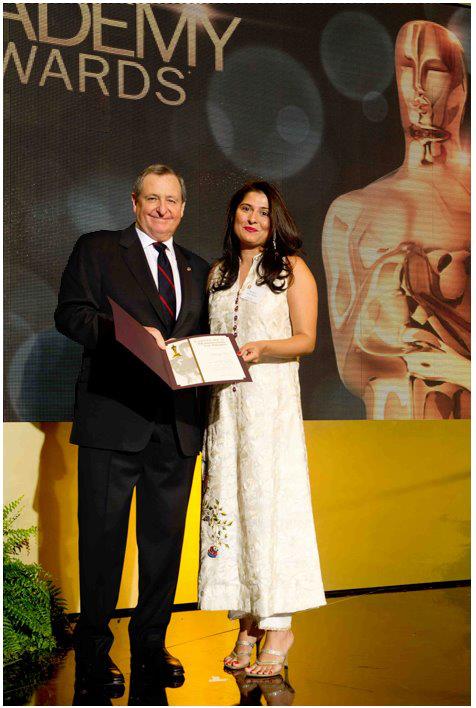
On Monday morning, Pakistanis awoke to news that their country had just won its first Oscar. Sharmeen Obaid-Chinoy and her co-director Daniel Junge received the award for best documentary in the short-subject category for “Saving Face.” The film chronicles the work of the British-Pakistani plastic surgeon Mohammad Jawad, who performs reconstructive surgery on women who were attacked with acid.
The media in Pakistan couldn’t get enough of the story. Television channels repeatedly broadcast footage of Obaid-Chinoy receiving her award. Fans posted on their Facebook pages pictures of the filmmaker on the red carpet. Her acceptance speech was tweeted and retweeted: “To all the women in Pakistan who are working for change, don’t give up on your dreams — this is for you.”
Politicians tried to share the limelight. Altaf Hussain, the head of the Karachi-based M.Q.M. party, congratulated Obaid-Chinoy publicly. Prime Minister Yousaf Raza Gilani announced that she would be given a civilian award for making Pakistan proud and catalyzing social change.
The chain restaurant Nando’s, which specializes in grilled chicken, even designed an advertising campaign riffing on the documentary’s name: “From one hot chick to another: Thanks for Saving our Face.”
But Obaid-Chinoy’s triumph, a rare piece of good news out of Pakistan, also reveals the extent to which Pakistanis have become accustomed to feeling dejected.
For once, Pakistan is making headlines for a positive achievement, not another terrorist attack, political squabble or natural disaster. For Pakistanis who have been struggling to restore their country’s flailing image, it’s a relief to see a talented, young Pakistani woman receiving a coveted international award — and hobnobbing with George Clooney. As the cultural critic Nadeem F. Paracha put it in a tweet, “Viva la @sharmeenochiony! The pride of Pakistan is in their artistes & intellectuals. Not in bombs and bans!”
But what does it say about a country that it would rejoice at attracting global attention for rampant violations of women’s rights?
Pakistan is the world’s third-most dangerous country for women. Over 150 Pakistani women are the victims of acid attacks each year. Activists for women’s rights claim that only 30 percent of acid cases are reported and that this form of violence is extremely widespread because acid is easily available and inexpensive. Last year, the government passed the Acid Control and Acid Crime Prevention Bill, which imposes on attackers prison terms from 14 years to life and fines of up to one million rupees (about $11,000). But the new law has yet to be rigorously implemented, and attitudes toward women’s rights are far from reformed.
Obaid-Chinoy’s film highlights these problems — hardly a point of pride for Pakistanis.
Once the Oscar high subsides, Pakistanis will have to contend with the fact that their nation remains notorious for its challenges, violence against women included. Then the question will be, can the hundreds of thousands of Pakistanis who rooted for Obaid-Chinoy at the Academy Awards muster the same enthusiasm to tackle the problems that her work exposes?
Huma Yusuf is a columnist for the Pakistani newspaper Dawn and was the 2010-11 Pakistan Scholar at the Woodrow Wilson International Center for Scholars in Washington.
For a 3-year-old who has yet to master the use of the personal pronoun, Elmo is a whiz at foreign languages. Already fluent in Chinese, German, Hindi, Spanish and Arabic, among others, the fluffy red icon has just picked up Urdu, the most common language in Pakistan. At a time when the U.S.-Pakistani relationship is at its worst in more than a decade, Sesame Street — the quintessential American children’s television program — has burst onto the Pakistani scene in a flurry of fake fur, feathers and infectious ditties about the letter alef, or A.
With its background of ripening wheat, banyan trees and a center stage that features a village snack shop overflowing with exotic fruits and vegetables, the set of Sim Sim Hamara, as it is called in Pakistan, may seem far removed from the urban street scene familiar to most Americans. But the lovable Muppets, child actors and messages of tolerance are pure Sesame. And they have all been brought to life in Pakistan with the help of a $20 million, five-year grant from USAID.
Developed in 1969 by TV producer and early-childhood-education advocate Joan Cooney, Sesame Street was designed to tap the addictive qualities of television to bring early literacy education to American preschoolers. The “quaint” American streetscape, as Cooney then called it, has since grown into the “longest street in the world,” with more than 20 unique programs worldwide, according to Sesame Workshop’s senior vice president of global education Charlotte Frances Cole. Some features dubbed segments lifted from the American version; others, like Sim Sim Hamara, which means Our Sesame, are created in partnership with local production teams to reflect native culture. In Pakistan, Big Bird and Oscar have been replaced by a self-involved crocodile and a donkey with rock-star ambitions. “Children have to be able to recognize their environment and their friends if they are going to learn,” says Faizaan Peerzada, who directs Sim Sim Hamara from a studio just outside the city of Lahore. “So we had to give Elmo Pakistani citizenship.”
On a tour of the workshop where the show’s Muppets are made, Peerzada, a master puppeteer with more than 40 years of experience directing educational puppet shows for Pakistani children for the Rafi Peer Theatre Workshop, slips his hand into a limp, feathered pocket of gray felt. Even without eyes, the unfinished puppet springs to life with the mannerisms of an owl, swiveling its head to listen as Peerzada expounds on Sim Sim’s potential with evangelical zeal. Underfunded and neglected for more than 30 years, Pakistan’s education system is in a parlous state. The recently released Annual Status of Education report in Pakistan reveals that nearly 60% of school-age children can’t read, or even do basic, two-digit subtraction problems. For a country where 35% of the population is under the age of 14, the consequences are enormous.
“As a nation, Pakistan has failed its children,” says Peerzada. If Sesame Street brought the joy of learning to generations of American preschoolers, why can’t it help teach Pakistan’s 66 million children under the age of 14 how to read? he asks. “Our children deserve this. All children deserve this,” he says. Obviously a television program that airs twice a week can’t compensate for missing teachers and limited school access, but it’s a start. “To me, Sim Sim Hamara is a gift to Pakistani children, and a window into homes that might think their children are better employed in the fields than at school,” says Peerzada.
Like the original, Sim Sim Hamara is a half-hour-long program divided into skits, song segments and celebrity appearances designed to appeal to a wide spectrum of Pakistani society. The Muppets caper with live actors on a set that combines features recognizable across the country, a kind of Pakistani Main Street that doesn’t stand out as belonging to any particular region. A dhaba, the ubiquitous snack-and-grocery shop that is the center of any Pakistani community, stands in for Mr. Hooper’s store, and is manned (or womanned) by a heavily made up Muppet auntie who anchors the show with amusing lessons about manners, safety and healthy eating. In an effort to promote tolerance in a country marked by ethnic divisions, the Muppets’ skin colors range from brown to pale orange.
Most striking, however, considering Pakistan’s male-dominated society, is the lead character, Rani, a 6-year-old female Muppet who captains the cricket team and who is passionate about science and reading. In a country where only 22% of Pakistani girls complete primary school, Rani is a model of female empowerment. But it doesn’t stop there. The rest of the show’s characters encourage Rani’s quest for knowledge — “Where does the sun go every evening?” was a recent one — modeling acceptance of women’s progress for a wider society. “You are not just teaching little girls that they can have dreams,” says Sesame Workshop executive vice president Sherrie Westin. “You are also teaching boys that it’s O.K. for girls to have those dreams.”
Of course progressive values in one culture can be interpreted as transgressive in another. Sim Sim Hamara has the added burden of being sponsored by the U.S. in a country where American meddling is viewed with increasing hostility. For that reason, the program’s authors have had to broach sensitive issues with subtle creativity. One recent segment opened with a despondent Baily, the would-be rock-star donkey, who decided he would never sing again because someone told him it would make him grow horns. “This is how we get at the idea of mullahs who are against singing,” explained one of the producers. The skit ended with the appearance of one of Pakistan’s most famous rock stars leading the whole cast in an uplifting song about believing in your self, entitled, fittingly, “Faith.”
Teachers who see it as a way to promote literacy at home have praised Sim Sim Hamara, as do children who have never really had a program to call their own. “I find that those who regularly watch Sim Sim Hamara know more about health and body parts and their functions,” says Islamabad school principal Masart Sadiq. “They get lots of ideas about careers, which they discuss with their teachers too.” Aniqa Khan, a 12-year-old from Rawalpindi, says she now wants to be a pilot, like Munna, Rani’s 5-year-old Muppet co-star. “He is excellent at math, which inspires me to spend more time on math.”
So far, and against fears in a country where the assassination of a governor accused of blasphemy was celebrated in the streets, there has been no negative response to Sim Sim Hamara. “I think my biggest fear was that the program would be misunderstood before it even aired,” says Peerzada. “People might have thought it was some kind of brain-washing project. But at the end of the day, all we are doing is teaching a child to count.”
The same could not be said of reactions to the program in the U.S., where Fox News in October dubbed Sim Sim Hamara a boondoggle for Elmo and conservative commentators quickly took up the cause. But as Sesame Workshop’s Westin points out, $20 million pays for a lot more than Elmo’s Urdu lessons and a plane ticket to Pakistan. It covers a state-of-the-art studio, high-definition digital-video equipment that won’t be obsolete in a few years, and the foundations of an educational institution that, if all goes to plan, will provide Pakistani children with the basic-literacy building blocks that have been the mainstay of early-childhood education in America for more than four decades. Current estimates say that Sim Sim Hamara is reaching more than 3.5 million Pakistani children who have no other access to preschool education. “This is a smart investment,” says Westin. “Early-childhood education is one of the most effective ways to build stability in any country. An investment like this is not only going to benefit Pakistan, but our children as well. If we can help to create a more peaceful world, that is a benefit to all of our children.” And that sounds like something Elmo would love, in any language.
Pakistanis for Peace Editor’s Note– We commend this great project by the United States government and the USAID program. The $20 million grant and this educational program will not only help the children of Pakistan who are not provided an adequate educational system by their own government but a program like this goes a long ways in the betterment of ties between the United States and Pakistan and leaves a lasting legacy for the area’s children for years to come.


You must be logged in to post a comment.