Posts Tagged ‘ Pakistan Army ’

On the ground: For border village, peace is a beautiful dream

By Taha Siddiqui for The Express Tribune

We left behind everything when we came to this side, but not for such living conditions. Some of our family that stayed behind in India now mock us about our migration,” says Haji Shahzad.

Shahzad, in his early 70s, is a resident of Bhanoo Chak, a village located on the Indo-Pak border.
“The border force here has made our lives miserable. We live not under the threat of India but this force. Day and night, we have to live by their rules,” Shahzad says.

Bhanoo Chak, a village occupied by Sikhs who fled at the time of partition, is an hour’s drive from central Lahore and is closest in distance to the border.

“We just want peace so that there is relaxation on the border and we can have normal lives again,” adds Shahzad.
Mostly farmers, these men are not allowed to roam around freely after 6pm and need to acquire no-objection certificates before constructing anything on their property.

Many of these villagers have families that were divided in the partition in 1947 and wish to go meet them.
“We have family in Rajasthan. They want to come visit us and we want to go and visit them too. But we have to go through bureaucratic hurdles that we have stopped making the effort,” says Shahzad.

Pakistan Rangers Colonel Osman Siddiqui, who is in charge of the Wagah Border area, says that without checks and balances, he cannot trust anyone in the area. “The border is a sensitive spot, and to stop smuggling and unwanted people from crossing over, we have devised a system where we allow men to roam in these areas only between 6am and 6pm,” he says.

When asked if he will ease the policy in case the Pakistan-India dialogue is successful, he replied that national policy and local policy are different subjects. “When a change happens in the national policy, we can see. But for now, the policy will stay the same since the force needs to be vigilant,” he said.

Many villagers believe that if Pakistani and Indian leaders sincerely wanted peace, an accord could be reached today. They also do not fear another war with India.

“In 1965, Indian forces destroyed our homes. There were planes overhead and even the Pakistan Army had little idea what was going on,” says Mohammad Tayyab, who was barely seven years old at the time. “But today, we cannot expect the same as we are now a nuclear state.”
Still, the villagers are always on their toes. “Every time Pakistan Army increases its presence on the border area, I fear I may have to leave home again,” says Tayyab, who moved his family out of the village during a standoff in 2002.

For some, however, peace is just a far-fetched but beautiful dream. “Peace is not possible, even though it will be good for both our countries. We will [finally] be living with no fear,” says Azeem impatiently, during a short break from a cricket match.

Pakistan Troops Caught on Film Shooting Unarmed Teenager Dead

By Barry Neild for The Guardian

Pakistan’s security forces are facing criticism after paramilitary troops were caught on camera apparently shooting dead a teenager at point-blank range.

The footage, broadcast repeatedly on local television, is likely to further undermine faith in the country’s powerful security establishment, which is already facing allegations it helped conceal Osama bin Laden.

The video, captured by a cameraman from Pakistan’s Awaz television channel, shows a youth, identified as Sarfaraz Shah, arguing with paramilitary rangers in Karachi. The 18-year-old appears to plead for mercy before being shot at close quarters. He then falls to the ground and screams in pain as blood pools beneath his legs.

Zohra Yusuf, head of Pakistan’s independent Human Rights Commission, condemned the killing as “another indication of law enforcement personnel becoming increasingly trigger happy.”

She said the violence depicted in the video was a trend seen across Pakistan that reflected the impunity of the country’s law enforcers.

Pakistan’s prime minister, Yousuf Raza Gilani, said an inquiry would be launched and the culprits punished. Six members of the paramilitary Rangers, who are controlled by the interior ministry, have since been arrested.

Major general Aijaz Chaudhry, who commands the force, described the incident as “deplorable”. “The Rangers have no authority to kill any unarmed individual and they can fire only in self-defence,” he said. “On completion of the inquiry, all those found responsible will be given strict punishment.”

The incident is likely to further dent public faith in the government’s ability to control its security forces at a time when the US ally is facing questions about how bin Laden could have hidden for so long without the complicity of intelligence officials.

“What we saw on television shows that now there is the law of the jungle in this country and no one is accountable for his action or deeds. This is pathetic,” Mohammad Sultan, a retired soldier, told Reuters.

“What we are seeing is visual records of what we have long documented, which is the culture of impunity in the Pakistani law enforcement agencies,” said Ali Dayan Hasan, a researcher for Human Rights Watch. “What is becoming clear is that the free for all, the culture of wanton abuse and killing, is becoming untenable in the age of new media and cell phone cameras.”

In one media interview, a man identified as Salik Shah, the victim’s brother, said: “My brother was a victim of barbarism, brutality and aggression and everyone has seen it. The innocent young man was begging for his life regardless of whether he had done anything wrong. He was asking to be pardoned by the rangers; despite his repeated requests they did not listen to him, they did not arrest him, instead they were adamant about killing him and in the end they did.”

Hundreds of people showed up at Shah’s funeral a day after his death and denounced the Rangers. Some shouted “Rangers, murderers!” and others carried signs that said “Down with the Karachi Rangers.”

The video’s broadcast comes a few days after a prominent journalist was tortured to death after reporting claims about al-Qaida. Military intelligence officials have rejected claims they played a role in the killing.

Pakistan’s Daily Times newspaper said the military, paramilitary forces, police and intelligence agencies “who confidently violate human rights” should be held accountable for their actions.

“The security and law enforcement forces that do not respect the law themselves are inviting anarchy, which arguably is already under way,” it said in an editorial.

Last year, a video emerged of two teenage brothers being beaten to death before being strung up on a metal pole in broad daylight as police personnel looked on.

Pakistan Orders an Inquiry After Troops Kill a Teenager

By Salman Masood for The New York Times

President Asif Ali Zardari of Pakistan ordered an investigation on Thursday into the shooting death of an apparently unarmed teenager by paramilitary troops in the southern port city of Karachi. The shooting, which was captured on video and broadcast on national television, has led to protests and has been condemned by political parties and human rights groups.

It was the second time in recent weeks that a video has shown paramilitary troops using extreme force against civilians. Last month, five Chechens were gunned down in Quetta, Pakistan.

The shootings are sure to feed complaints that Pakistan’s security forces are too aggressive and sometimes bypass the sluggish and corrupt judicial system. Pakistan’s military leaders are also still embarrassed by the American raid on Osama bin Laden’s compound in Abbottabad, which the armed forces did not detect.

The victim of the Karachi shooting, Sarfraz Shah, whose age was given as 18 or 19, was stopped by paramilitary troops on Wednesday and accused of being involved in an attempted robbery in a nearby park.

A spokesman for the troops said a gun had been taken from him, but in the video, Mr. Shah does not appear to be armed when he is shot.

The recording shows the young man begging for mercy before being led toward a group of troops. One points his gun at Mr. Shah before firing several shots. Mr. Shah crouches, asking forgiveness while bleeding profusely.

“My hand is gone,” Mr. Shah shouts. “Take me to the hospital.” The troops step back, out of the video frame. A government official said five of the troops had been arrested.

Mr. Shah was buried on Thursday in Karachi, accompanied by protests from family members.

The shootings in Quetta last month were also recorded. The police and paramilitary troops initially reported that the victims, three women and two men, were suicide bombers. They were killed near a checkpoint on the outskirts of Quetta, the capital of Baluchistan Province in southwestern Pakistan, in a volley of fire as police officers stood by.

Video from local television networks showed one young woman raising her arm, as if to try to stop the gunfire. No weapons were recovered on the victims. An investigation of that shooting is under way.

The Pakistani security forces have repeatedly been accused of misusing their power. The army was accused of extrajudicial killings during a military operation to drive out militants that began in the Swat Valley in 2009. The army denied the allegations.

The country’s powerful intelligence agencies have also been accused of illegally detaining hundreds of terrorism suspects. And military intelligence has been accused of gross human rights violations in Baluchistan, where a separatist insurgency by Baluch nationalists has long simmered.

Pakistani Rangers, the group involved in Mr. Shah’s death, are controlled by the Interior Ministry. Rehman Malik, the country’s interior minister, announced the arrests in the case on Thursday evening, but he also accused Mr. Shah of being part of a gang involved in robberies, according to the local news media.

Mr. Malik said Mr. Shah had tried to steal a woman’s purse and was caught by guards in the park before being handed over to the Rangers.

The Rangers have been deployed in Karachi for several years and help the local law enforcement authorities in maintaining peace in the city, which is riven by political, ethnic and sectarian tensions.

Pakistan’s Nuclear Surge

By Andrew Bast for Newsweek

Even in the best of times, Pakistan’s nuclear-weapons program warrants alarm. But these are perilous days. At a moment of unprecedented misgiving between Washington and Islamabad, new evidence suggests that Pakistan’s nuclear program is barreling ahead at a furious clip.

According to new commercial-satellite imagery obtained exclusively by NEWSWEEK, Pakistan is aggressively accelerating construction at the Khushab nuclear site, about 140 miles south of Islamabad. The images, analysts say, prove Pakistan will soon have a fourth operational reactor, greatly expanding plutonium production for its nuclear-weapons program.

“The buildup is remarkable,” says Paul Brannan of the Institute for Science and International Security. “And that nobody in the U.S. or in the Pakistani government says anything about this—especially in this day and age—is perplexing.”

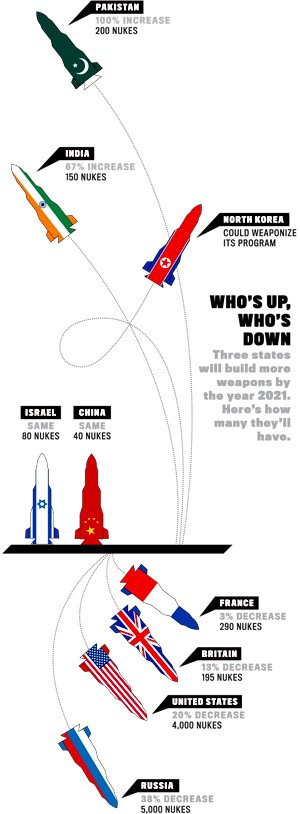
Unlike Iran, which has yet to produce highly enriched uranium, or North Korea, which has produced plutonium but still lacks any real weapons capability, Pakistan is significantly ramping up its nuclear-weapons program. Eric Edelman, undersecretary of defense in the George W. Bush administration, puts it bluntly: “You’re talking about Pakistan even potentially passing France at some point. That’s extraordinary.”

Pakistani officials say the buildup is a response to the threat from India, which is spending $50 billion over the next five years on its military. “But to say it’s just an issue between just India and Pakistan is divorced from reality,” says former senator Sam Nunn, who co-chairs the Nuclear Threat Initiative. “The U.S. and Soviet Union went through 40 years of the Cold War and came out every time from dangerous situations with lessons learned. Pakistan and India have gone through some dangerous times, and they have learned some lessons. But not all of them. Today, deterrence has fundamentally changed. The whole globe has a stake in this. It’s extremely dangerous.”

It’s dangerous because Pakistan is also stockpiling fissile material, or bomb fuel. Since Islamabad can mine uranium on its own territory and has decades of enrichment know-how—beginning with the work of nuclear scientist A. Q. Khan—the potential for production is significant.
Although the White House declined to comment, a senior U.S. congressional official who works on nuclear issues told NEWSWEEK that intelligence estimates suggest Pakistan has already developed enough fissile material to produce more than 100 warheads and manufacture between eight and 20 weapons a year. “There’s no question,” the official says, “it’s the fastest-growing program in the world.”

What has leaders around the world especially worried is what’s popularly known as “loose nukes”—nuclear weapons or fissile material falling into the wrong hands. “There’s no transparency in how the fissile material is handled or transported,” says Mansoor Ijaz, who has played an active role in back-channel diplomacy between Islamabad and New Delhi. “And the amount—they have significant quantities—is what’s so alarming.”

That Osama bin Laden was found in a Pakistani military community, and that the country is home to such jihadi groups as Lashkar-e-Taiba, only heightens concerns. “We’ve looked the other way from Pakistan’s growing program for 30 years,” says Sharon Squassoni, a director at the Center for Strategic and International Studies. What we’re facing, she says, is “a disaster waiting to happen.”

A Defense Department official told NEWSWEEK that the U.S. government is “confident that Pakistan has taken appropriate steps toward securing its nuclear arsenal.” But beyond palliatives, few in Washington want to openly discuss the nightmare scenario of terrorists getting hold of nuclear material or weapons. “The less that is said publicly, the better,” says Stephen Hadley, national-security adviser to President George W. Bush. “But don’t confuse the lack of public discussion for a lack of concern.”

The bomb lends the Pakistanis a certain diplomatic insouciance. Nukes, after all, are a valuable political tool, ensuring continued economic aid from the United States and Europe. “Pakistan knows it can outstare” the West, says Pakistani nuclear physicist Pervez Hoodbhoy. “It’s confident the West knows that Pakistan’s collapse is too big a price to pay, so the bailout is there in perpetuity. It’s the one thing we’ve been successful at.”

Pakistani leaders defend their weapons program as a strategic necessity: since they can’t match India’s military spending, they have to bridge the gap with nukes. “Regretfully, there are several destabilizing developments that have taken place in recent years,” Khalid Banuri of Pakistan’s Strategic Plans Division, the nuclear arsenal’s guardian, wrote in response to NEWSWEEK questions. Among his country’s concerns, Banuri pointed to India’s military buildup and the U.S.’s -civilian nuclear deal with India.

“Most Pakistanis believe the jihadist scenario is something that the West has created as a bogey,” says Hoodbhoy, “an excuse, so they can screw us, defang, and denuclearize us.”

“Our program is an issue of extreme sensitivity for every man, woman, and child in Pakistan,” says former Pakistani president Pervez Musharraf, adding that the nukes are “well dispersed and protected in secure locations.” When asked whether the U.S. has a role to play in securing the arsenal, Musharraf said: “A U.S. role to play? A U.S. role in helping? Zero role. No, sir. It is our own production?.?.?.?We have not and cannot now have any intrusion by any element in the U.S.” To guard its “strategic assets,” Pakistan employs two Army divisions—about 18,000 troops—and, as Musharraf drily puts it, “If you want to get into a firefight with the forces guarding our strategic assets, it will be a very sad day.”

For now, the White House appears to have made a tacit tradeoff with Islamabad: for your cooperation in Afghanistan, we’ll leave you to your own nuclear devices. “People bristle at the suggestion, but it follows, doesn’t it?” says Rolf Mowatt-Larssen, formerly the CIA’s chief officer handling terrorism and weapons of mass destruction. “The irony is that the U.S. presence in Afghanistan and Pakistan, and the money we’re giving them to fight terrorism, could inadvertently aggravate the very problem we’re trying to stop. After all, terrorism and nukes is the worst-case scenario.”

With this fourth nuclear facility at Khushab coming online as early as 2013, and the prospect of an accelerated nuclear-weapons program, the U.S. is facing a diplomatic dilemma. “The Pakistanis have gone through a humiliation with the killing of Osama bin Laden,” says Nunn. “That’s never a time to corner somebody. But with both recent and preexisting problems, we are in a race between cooperation and catastrophe. Both sides need to take a deep breath, count to 10, and find a way to cooperate.”

Pakistan’s Hypocrisy Has Run Its Course; It Needs A New Relationship With U.S.

By Ahmed Humayun
Best Defense department of frenemy relations

The U.S.-Pakistan relationship has long been volatile, but recent weeks have witnessed an unprecedented level of open discord between the two countries. On April 11, Lt. Gen. Ahmad Pasha, the head of Pakistan’s ISI, met with American officials and demanded that the United States sharply limit its counterterrorism efforts inside Pakistan. Just two days later the CIA launched drone strikes in Pakistan’s tribal areas, provoking angry protests from Pakistani officials. And in a sign that Washington is determined not to back down, last week Admiral Mullen, chairman of the Joint Chiefs, publicly chastised the ISI for its “longstanding relationship” with the Haqqani network, one of the prime targets of the drone campaign.

Pakistan’s recent criticisms are partially a response to the rising public backlash against America’s counterterrorism operations. Till now, Pakistan has tacitly cooperated with the drone campaign while reluctantly permitting a few CIA agents and special operations forces to enter the country. At the same time, Islamabad has publicly denied cooperating with Washington due to domestic political sensitivities. In the aftermath of the Raymond Davis incident, however, this always-fragile pretence has become untenable. (Raymond Davis, a CIA contractor, killed two Pakistanis with possible links to the ISI in broad daylight in January. Three months later, the subsequent media frenzy has not diminished. )

No state wants its territory to be a hunting ground for covert foreign operatives. Still, the fulminations of some in Pakistan omit critical context. The Pakistani state’s ambivalent attitude towards extremist groups — acting against some while tolerating or supporting others — has forced the United States to take proactive action. The rights of sovereignty also come with duties: if Pakistan is indulgent of or incapable of acting against anti-American terrorist groups, then foreign preventive counterterrorism should be assessed more soberly by Pakistanis.

To complicate matters further, elements in Pakistan’s security establishment have deliberately stoked public sentiment. Extensive leaks to the Pakistani press about the government’s demands to the United States hint at a desire to exert pressure on Washington through exploiting populist anger. For the ISI, this diplomatic crisis is a unique opportunity to obtain long desired strategic concessions from the United States. Among other things, the ISI does not want militant groups favored by Islamabad under America’s microscope — especially those perceived to defend Pakistani interests in Afghanistan.

This is a dangerous strategy. It is premised on the mistaken assumption that the United States is unwilling to increase pressure on Pakistan. If the Pakistani government faces domestic political constraints, this is no less true of the United States. Sentiment in the U.S. Congress is already heavily tilted against Pakistan. If reports about Pakistan’s entanglement with extremist groups persist, or in the worst case scenario, an attack on the United States by a Pakistan-based terror group succeeds, Washington will find it difficult to avoid taking harsh actions. Loose talk by some Pakistani politicians about cutting off supply routes to U.S. forces in Afghanistan is similarly self-defeating. It is in Pakistan’s long-term interests to prevent an irrevocable rupture with the United States.

At the same time, Washington should appraise the scope of its direct counterterrorism drive within the broader effort to stabilize Pakistan. According to U.S. officials, the drone campaign has been remarkably successful in weakening militant networks; in private, some Pakistani military and political leaders also acknowledge the program’s efficacy. That may be the case, but displays of U.S. coercive force on Pakistani soil — especially those involving U.S. personnel on the ground — have also accentuated the most extreme tendencies in that country’s public discourse. They have empowered those in Pakistan who maintain that the war on terror is America’s war, not Pakistan’s struggle, and that the United States has fundamentally hostile aims towards Pakistan.

Policymakers might shrug their shoulders at conspiracy theories. That would be short-sighted. The fact is that the United States cannot directly extinguish the threat posed by Pakistan-based terrorism. U.S. forces can certainly kill a few extremists through drone strikes or ground operations. But the militant threat is geographically dispersed: not only do insurgent sanctuaries infest the isolated border regions, terrorist networks are also embedded in the heavily populated areas of the Punjabi heartland. Some of these groups have deep roots stretching back decades and enjoy local political cover. Kinetic action by a deeply unpopular foreign power will not uproot them.

The single most decisive factor in disrupting Pakistani militancy will be the willingness of the state and society to commit to a long-term struggle. Only Pakistan can overcome the jihadi Frankenstein it has spawned through a combination of stepped up military force, political dialogue, and local governance. The impact of U.S. policies on the internal Pakistani debate about militancy should therefore be factored heavily into Washington’s policymaking calculus.

Pakistan is making progress — however halting or incomplete — in adopting a more robust anti-militant posture. Since 2009, its military offensives in the tribal areas have degraded insurgent sanctuaries at a heavy price in blood and treasure. Pakistani intelligence has also helped the United States capture numerous high-level al Qaeda operatives. The Obama administration’s economic assistance to Pakistan and its diplomatic efforts to stabilize the country’s fractious politics have contributed to these advances. Going forward, the core policy challenge is to generate the political will inside Pakistan that will expand these activities. Right now, Washington’s ability to do so is vitiated by Pakistani paranoia.

In the short term, Islamabad and Washington need to negotiate a new counterterrorism relationship. The old strategy of ambiguous private compromise veiled by public dissembling has run its course. Pakistan’s legitimate concerns should be weighed against the immediate threat to the American homeland and to U.S. forces in Afghanistan. This is a herculean task given the underlying strategic differences, but the alternative is likely to be much starker.

Ahmed Humayun is a fellow at the Institute for Social Policy and Understanding (ISPU) and senior analyst at Georgetown University’s Emerging Threats Project. He can be reached at ahmed.a.humayun@gmail.com .

Pakistan Army To Restore “Peace” in Bahrain?

By Aijaz Ahmed for Indus Herald

Pakistan and Bahrain are seriously considering ways and means and possible repercussions of Pakistan’s military and intelligence agencies’ help to the later in restoring “peace” in politically disturbed areas. Foreign Minster of Bahrain Sheikh Khalid bin Ahmed Al-Khalifa is to arrive in Pakistan on Tuesday to discuss the matter, highly placed sources have confided to Indus Herald. The Saudi led Gulf Cooperation Council (GCC) has already approved deployment of Peninsula Shield Force in the Kingdom of Bahrain to crush the movement for democracy that is getting stronger with every passing day. Assurances from King Hammad to introduce some reforms with regards to civil liberties and democratic and human rights have not succeeded so far to calm down anger among people demonstrating for a democratic system. Interestingly the reaction of the world community, the United States, Saudi Arabia and Pakistan is totally different on the situation as compared to the reaction demonstrated on the situation in Libya.

Pakistan has already expressed its support for the GCC decision, and that too on Saudi pressure, a source at the foreign office revealed. The economically hard-pressed Pakistan had no other way but to follow the Saudi demands as the holy kingdom has assured a sizable support in meeting the economic challenges ahead, the foreign office source added. However, Pakistan’s nauseating defense of its endorsement to GCC intervention in Bahrain to deploy Peninsula Shield Force isn’t finding any takers. Majority of foreign policy commentators and experts are not ready to buy Pakistani endorsement but people having close relations with PML-N including the likes of Shamshad Ahmed Khan, Tariq Fatmi and Riaz Khokhar are intriguingly silent on the support that Pakistan has diplomatically provided to Bahrain on the behest of Saudi Arabia. The sole reason for the silence of these former ‘babus’ of Foreign Office and some other “well informed experts” lies behind the special relationship that PML-N leader Mian Nawaz Sharif enjoys with the Royal family of the holy land.

Pakistan desired return of peace, security and stability to Middle East that had been hit by political upheaval, the newly designated foreign office spokesperson Ms Tahmina Janjua observed while briefing the media the other day. “As far as Bahrain is concerned, it was an internal decision of the GCC. The GCC decided on the basis of its founding principles that security forces would go to Bahrain,” said Foreign Office Spokesperson in her stammering voice while replying to hard hitting questions on Bahrain though her words did not match the principles of ‘non-intervention and non-interference in domestic affairs of others’ that she had painstakingly learnt during her 27 years long diplomatic career. This was not the first time that Foreign Office stood up for Bahrain’s monarchy. Foreign Secretary Salman Bashir had earlier praised the Bahraini Monarch on March 1. While the protestors were being tear-gassed and shot at, he had said: “We … admire the progress made by Bahrain under the leadership of His Majesty King Hamad bin Isa Al-Khalifa.”

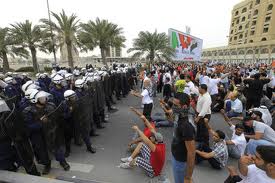
The current political upheaval is a geniune cause of concern for Pakistan as there are some 65,000 Pakistanis in Bahrain, some of whom are working with Bahraini security services, the FO sources maintained adding that the security of King of Bahrain, the major installations, the Royal Family and the state dignitaries is prime responsibility of the Pakistanis employed in the Bahraini security services. Perhaps this was the reason that a number of Pakistanis became vistims of the public anger and some of them were seriously injured earlier this month during the violent protest of people on streets. Reports received from the tiny Gulf Kingdom suggest that the xenophobic attacks against Pakistani expatriates earlier this month were commited as Pakistani policemen had been at frontlines of riot police that attacked demonstrators.

In an atmosphere where common Pakistanis are quite unsafe in the Kingdom, Pakistan has not only quietly endorsed the intervention, but allowed the welfare wings of its military forces – Fauji Foundation and Bahria Foundation – to recruit about 1000 guards to bolster Bahrain’s security apparatus and the recruitment was not made secretly, instead the process was completed in very open way.

The reasons for the uprising in Bahrain are said to be more than just the political, the sources further revealed. The detailed analysis of the situation reflects that the political upheaval is being financed by some external factors and the sources point their fingers towards some hard core religious elements having strong presence in Pakistan and also towards the Iranian Government, thus both Saudi Arabia and Bahrain intend to use good offices of Pakistan Army and its intelligence wings to play their ole in bringing in peace and stability in the Gulf State.

Foreign Office has confirmed that the The Foreign Minister of Bahrain will discuss security cooperation and internal political situation of the country with Pakistani leadership. During his hectic visit, he will meet President Zardari, Prime Minister Yusuf Raza Gillani, State Minister for Foreign Affairs, and the military leadership in a very short span of time. The two sides will discuss further strengthening security cooperation and additional steps, sources revealed. Bahrain may formally furnish a request for Pakistan army contingents to be deployed with the GCC Shield Force in troubled areas as well as a request to ISI and Military Intelligence (MI) for using their good offices to establish contacts and facilitate parlays between the Bahrain Government and the right wing forces as well as in direct talks between Iran and Bahrain, sources confided with confidentiality. ‘Pakistan is the only country that can help Bahrain in bringing in the political stability in the country and thus a request is expected to be made for an active Pakistani role in the greater regional and trans regional interest’, sources said. But any decision will be taken keeping the sensitivities and threats in mind, the sources assured.

Meanwhile some brain storming is being done between Pakistan and Saudi Arabia for revival of an already expired defense agreement between Pakistan and the Kingdom of Saudi Arabia and an initial discussion has been made during the recent visit of Saudi National Security Chief, however few changes will be made in the previous agreement if any progress in this regard is made, sources in the diplomatic circles maintained.

Pakistan Army Propaganda Drama Set for TV

By Khurram hahzad for The Associated Press

Pakistan’s Taliban-fighting soldiers are set for celebrity status with the launch of a multi-million-dollar glossy television drama hailing army victories over militants.

Emotive tales of 11 “brave Pakistanis” battling an Islamist insurgency that is plaguing Pakistan and neighbouring Afghanistan, will air on the small screen in an army-funded drama that casts the anti-terror fight in a positive light.

Focused on the heroism of soldiers fighting a key air and ground offensive in the northwestern Swat valley in 2009, one tale looks at the deeds of soldier Hawaldar Naeem Asghar who died fighting an insurgent checkpoint.

Asghar, portrayed as a hardworking soldier from peasant roots, sacrifices his life to overcome Taliban dug in to a hilltop, during operations in the town of Mingora to flush militants from the picturesque valley.

Throwing grenades from his bunker without success, Asghar is depicted abandoning cover and climbing the hill, tossing more explosives on his way as bullets rain down from the rebels’ post.

The checkpoint is destroyed, but Asghar is killed.

“Hawaldar Asghar’s story is a common man’s story. It’s a message to the public that everybody can play a role in the fight against extremism,” says Sajjad Saji, one of the drama serial’s writers.

“It is filmed to encourage the common people in this war,” he adds.

Urged by its key but critical ally the United States to launch further operations in the lawless tribal areas bordering Afghanistan, the army wants to show the sacrifices it has already endured in the war on terror.

“The basic purpose is to reveal the deeds of bravery of our soldiers, officers and civilians who are at the front of this war…. This drama shows the human face of the war,” says Major General Athar Abbas, head of the army’s publicity wing.

“The nation should own these stories of bravery and sacrifice, they should be proud of our sons and daughters of the land who created these true stories with their blood and defended the motherland.”

One of the filmmakers, who would not be named, said the high-end production was a “multi-million-dollar” effort, but refused to put a precise figure on costs.

The production, peppered with special effects, was filmed amid rugged verdant hills and forests close to the Swat valley — scene of major operations by Pakistan’s military in 2009 to rid the area of rampant militancy.

“We travelled extensively to film this serial. A crew of more than 35 people with trucks of luggage roamed in the forests and hills for months to show the reality,” said Khawar Azhar, the show’s executive producer.

The former tourism hotspot of Swat slipped out of government control after a radical cleric led an uprising in July 2007, beheading opponents, burning schools and fighting to enforce a harsh brand of Islamic law.

Pakistan launched a blistering air and ground offensive in the valley after militants marched out of Swat and advanced to within 100 kilometres (60 miles) of the capital Islamabad in April 2009.

After heavy fighting that displaced an estimated two million people, the military declared the region back under army control last summer and efforts have begun to revive the local economy amid sporadic outbreaks of violence.

Television productions are one of the tools adopted by the military’s publicity wing to polish its image and boost recruitment and morale at a key juncture in anti-Taliban efforts and with religious conservatism on the rise.

Accused by US-based Human Rights Watch of carrying out collective punishments on relatives of militants since it re-established control over the Swat valley, the army knows the importance of securing local hearts and minds.

More than 4,000 people have been killed in Taliban and Al Qaeda-linked attacks since government forces launched an attack against militants in a mosque in Islamabad in 2007.

The television drama depicts the bitter divide between Pakistan’s opposing cultures as the moderate middle class fights religious extremism in a country fractured by deep regional political divided.

In other episodes the film makers show the victims of Taliban power — one girl is subject to brutal gang rape by militants, while in another a young boy is brain-washed into becoming a suicide bomber.

Envoy Insists Pakistan Will Tackle Terrorists As Attack Kills 3

By Nasir Habib for Cnn

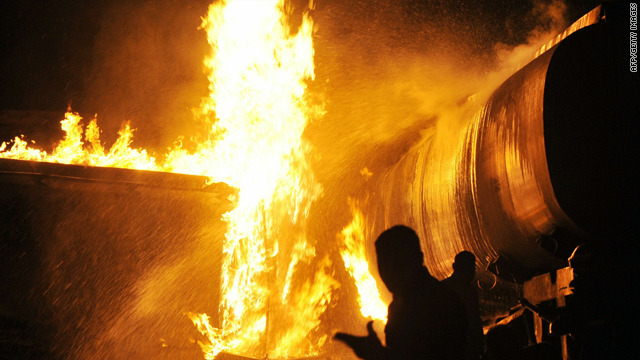
Islamabad, Pakistan (CNN) — Gunmen in Pakistan opened fire on oil trucks bound for NATO forces in Afghanistan, setting some 20 vehicles on fire and killing three, police said Monday. The attack came shortly after Pakistan’s ambassador to the United States vowed his country would go after terrorists on its soil.

Naeem Iqbal, a police spokesman, said five people were wounded in the attack on tankers parked on a main road outside a housing complex near the capital city of Islamabad. Efforts to put out the blaze are ongoing, he said.

Bin Yamin, a deputy police chief, said eight gunmen entered the area on Monday around 12:15 a.m. local time. He said they told people near the trucks to run away and that most did. Then they opened fire.

The tankers were parked in the vicinity of an oil refinery where they were going to go to pick up fuel for NATO forces in Afghanistan, Yamin said. Video images of the scene showed firefighters working to put out flames that stood out in the night against the overturned trucks.

On Sunday, Pakistan’s ambassador to the United States insisted his country would go after terrorists on its soil and needed only “technical” help from Washington, not U.S. troops on the ground.

Husain Haqqani, told CNN’s “State of the Union” that Pakistan would reopen a NATO supply route into Afghanistan “relatively quickly,” probably in less than a week.

Pakistan halted the convoys Thursday after officials blamed cross-border NATO helicopter fire for the deaths of three Pakistani soldiers. Haqqani said the United States and Pakistan were investigating the killings together. He said Pakistan will move against militants on its own schedule, not Washington’s.

“Pakistan is saying we will take care of all terrorists on the Pakistani side of the border, but we will do it on our timeline,” Haqqani said Sunday. “We cannot always follow a timeline that our allies set for us, because we are allies, not a satellite.”

Pakistan has lodged protests against NATO helicopter incursions into its territory — which the International Security Assistance Force says its rules of engagement permit — and is very sensitive about reported U.S. drone strikes in Pakistan.

There were a record number of drone strikes last month, according to a CNN count. On Saturday, three suspected drone strikes killed 18 people.

Pakistani intelligence officials said 10 people died in one drone strike targeting a militant hideout, four people died when a vehicle was struck, and four others were killed when another hideout was targeted.

All three occurred in the Data Khel area of North Waziristan. The intelligence officials did not want to be named because they are not authorized to speak to the media.

Security analysts have described North Waziristan as a haven for various factions of Afghan and Pakistani Taliban and al Qaeda militants. The majority of reported strikes this year have hit targets in the district, a mountainous tribal area on Pakistan’s border with Afghanistan, analysts said.

The United States does not officially acknowledge that it has unmanned aircraft firing missiles at suspected militants in Pakistan, but it is the only country operating in the area that is known to have the ability to do so.

Ambassador Haqqani also said Pakistan couldn’t do everything Washington wants “because sometimes we don’t have the capacity and sometimes we don’t have the means.” He said Pakistan’s geography makes it hard to hit militants.

“Sometimes people in the U.S. think … that it’s all flat land with everything visible. Not even the drones can identify everyone in North Waziristan because of the complexity of terrain,” Haqqani said.

Haqqani also argued that Pakistani politicians, just like U.S. counterparts, are constrained by public opinion. “All politics is local and the local situation in Pakistan is that the United States is not very popular amongst our public,” he said. “The fact remains that an elected democratic government in Pakistan is limited by public opinion to the extent of what it can do,” he said.

Pakistan Extends Gen. Kayani’s Term

By Zahid Hussain for The Wall Street Journal

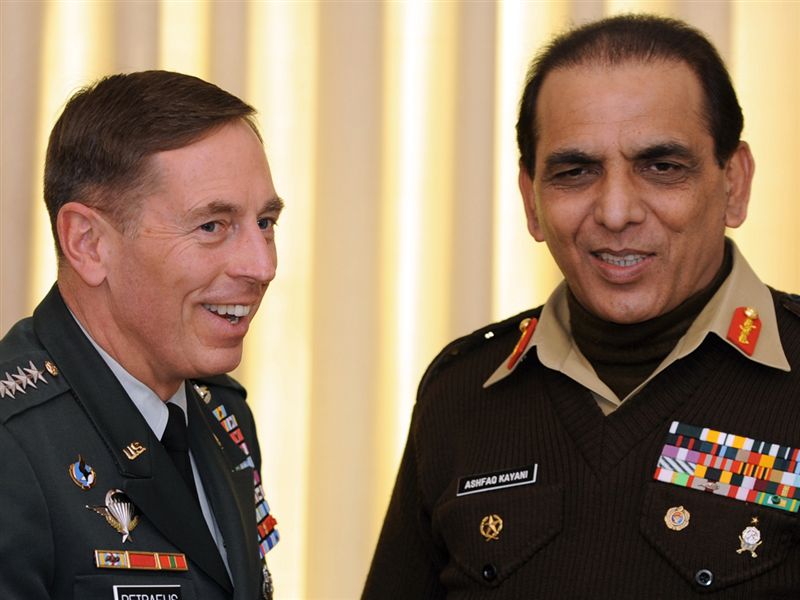
Pakistan’s civilian government late Thursday extended the term of army chief General Ashfaq Kayani for three more years to ensure continuity in the military leadership at a crucial stage in the country’s battle against Islamic militants.  The announcement was made by Prime Minister Yousuf Raza Gilani in a televised speech.

“The decision is taken to maintain continuity in the military’s command as the country is passing through very critical times,” Mr. Gilani said. Gen. Kayani, 58 years old, was appointed army chief in December 2007 and was to retire at the end of the year under normal tenure limitations.

The general has won praise for leading two successful military operations against Islamic militants last year in Pakistan’s Swat Valley and South Waziristan tribal region. But militants have regrouped in many areas and continue to unleash suicide strikes across the country.

More than 50,000 Pakistani troops are still engaged in fighting al Qaeda backed Islamic militants in the Pakistan’s troubled northwestern region, which borders Afghanistan. They are aided by unmanned U.S. drone strikes.

The war is seen as a crucial piece of the ongoing conflict in Afghanistan as many Taliban fighters use Pakistan’s tribal regions as a safe haven.

A senior government official said Gen. Kayani’s good rapport with Gen. David Petraeus, the commander of North Atlantic Treaty Organization forces in Afghanistan, and other American military leaders was a major factor in the decision to extend his term.

“He has worked closely with the current American military leadership and it is important for both Pakistan and the U.S. at this point for Gen. Kayani to stay at the helm,” said the official.

Other analysts agreed continuity was important at the current juncture of the war. “His leadership is crucial at the time when Pakistani army is fighting a decisive battle against the militants,” said Hasan-Askari Rizvi, an independent defense analyst.

Still, the extension of his tenure is likely to raise concerns among some pro-democracy activists about the pre-eminent role of the military in Pakistan.

The country has a democratically elected civilian government under President Asif Ali Zardari. But the country has been ruled more by military leaders in its 63-year history, most recently between 1999 and 2008.

Mr. Zardari’s government faces growing opposition and some analysts fear the army may step in again if they deem it necessary. Gen. Kayani, though, has focused on fighting militants. “We have to defeat them decisively,” he said during a recent discussion with a group of journalists.

Gen. Kayani received his commission in the Pakistani army in 1971. He served as the chief of Inter-Services Intelligence, Pakistan’s powerful spy agency, before his elevation to army chief.

Vengeful New Militant Group Emerges in Pakistan

By Kathy Gannon for The Associated Press
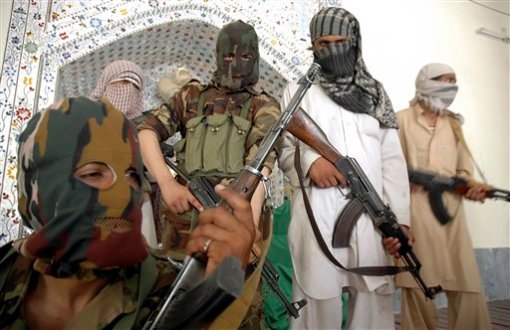
Pakistani authorities now believe a dangerous new militant group, out to avenge a deadly army assault on a mosque in Islamabad three years ago, has carried out several major bombings in the capital previously blamed on the Taliban.

The emergence of the Ghazi Force was part of the outrage among many deeply religious Pakistani Muslims over the July 2007 attack by security forces against the Lal Masjid, or Red Mosque, a stronghold of Islamic militants.

The fierce attack, in which scores of young, heavily armed religious students died, inspired a new generation of militants. These Pakistanis have turned against a government they felt has betrayed them and, to their dismay, backed the U.S. role in neighboring Afghanistan.

The brief but bloody history of the Ghazi Force illustrates the unintended results of Pakistan’s policy of promoting Islamic extremists to fight India in the disputed area of Kashmir. That policy — which Pakistan denies it pursues — now threatens regional stability as the U.S. and Pakistan’s other Western partners pour billions of dollars into the country to stop the rise of Islamic militancy.

The new group is made up of relatives of students who died in the Red Mosque assault. It is named after the students’ leader, Maulana Abdul Rashid Ghazi, who was also killed. The mosque’s religious school, or madrassa, had been a sanctuary for militants opposed to Pakistan’s support of the U.S.-run war in Afghanistan.

Private television stations broadcast vivid scenes of the assault — commandos in black fatigues rapelling down ropes, the crackle of gunfire, bodies of black-shrouded girls carried out through the smoldering gates. Those images stunned the nation, especially families of the students and Pakistanis with deep religious feelings.

“Before the Lal Masjid, militants hadn’t yet declared war on the state of Pakistan. That changed with Lal Masjid,” said Zahid Hussain, author and terrorism expert who has written extensively about Pakistan.

Islamabad’s inspector general of police, Kalim Imam, told The Associated Press that the Ghazi Force was behind most of the deadliest attacks in the capital during the last three years. The attacks targeted the military, the Inter-Services Intelligence agency or ISI — which had ties to a number of militants — and a five-star hotel frequented by foreigners and the Pakistani elite.

The Ghazi Force helped recruit a security official who blew himself up inside the office of the World Food Program last October, killing five people, according to Imam. The force also sent a suicide bomber in September 2007 into the mess hall of the commando unit that attacked the Red Mosque, killing 22 people, he said.

Ghazi Force members may also have been involved in the audacious June 9 attack north of the capital that killed seven people and destroyed 60 vehicles ferrying supplies to NATO and U.S. soldiers next door in Afghanistan, Imam said.

Many of those attacks had been attributed to the Pakistani Taliban, which operates in the remote tribal areas of the northwest along the border with Afghanistan. There is evidence of close ties between the Ghazi Force and the Pakistani Taliban, which the government has vowed to crush.

The Ghazi Force is believed to be headquartered in the Orakzai region of the border area, where the leader of the Pakistan Taliban, Hakimullah Mehsud, held sway for years. The leader of the Ghazi Force is believed to be Maulana Niaz Raheem, a former student at the Red Mosque.

Anger over the bloodshed at the mosque was all the greater because many of the militants and their supporters felt betrayed by a government that had once supported them. Both Ghazi and his brother Maulana Abdul Aziz Ghazi, who was freed on bail this year after two years in jail, were widely believed to have been on the payrolls of both the government and the ISI intelligence service.

Their father, Maulana Mohammed Abdullah, enjoyed a close relationship with the late President Mohammad Zia ul-Haq, and the mosque was a center for recruiting volunteers to fight against the Soviets in Afghanistan in the 1980s.

As opposition grew to Pakistan’s support of the U.S. role in Afghanistan, the mosque became a center of religious agitation against the government, with armed students taking over the complex and police laying siege.

A former senior official in the Interior Ministry told The Associated Press that the police wanted to storm the mosque and end the siege at its outset, send the students home and shut down the religious school and a neighboring library until tempers cooled.

President Gen. Pervez Musharraf refused, the official said, even though police knew that members of al-Qaida’s affiliate organization Jaish-e-Mohammed, which is banned in Pakistan, were bringing in weapons for the students.

Musharraf relented and ordered the assault after militants kidnapped several Chinese nationals running a massage parlor in Islamabad, accusing them of prostitution. The death toll remains in dispute. Red Mosque officials say hundreds died. The government says fewer than 100 were killed.

In a rare interview, Abdul Aziz Ghazi told AP he warned the government that an assault on the mosque would unleash forces that no one could control.

“I have been in jail. I did not form this force and I don’t condone the violence but they are angry at the injustices done,” he said this week.

Although the assault turned many Islamic hard-liners against the government, Pakistan remains unwilling to break all ties to the militants, instead following a high-risk strategy of coddling “good militants” while fighting those deemed “bad militants,” analysts say.

“The military and the ISI have given importance to these militants as assets. But those who have openly declared war, and there is no chance of them returning back to the state, the army is going after them,” said Manzar Jameel, a terrorism expert and researcher on the growth of extremism in Pakistan. “Yet they still believe that some are still assets and that they can keep control of the assets. It’s a failure of strategy.”

Army spokesman Maj. Gen. Athar Abbas denies any assistance to militant groups, saying past ties have long since been severed. He says the Ghazi Force is among the groups the 120,000 Pakistani soldiers waging war in the tribal regions are fighting.

Yet Anatol Lieven, a terrorism expert with the Department of War Studies at London’s King College, said it’s clear that the ISI continues to protect some militant groups, even if it has broken with others.

In a June report, the Rand Corporation think tank also alleged that Pakistan’s military and intelligence still support some militant groups “as a tool of its foreign and domestic policy.”

“A key objective of U.S. policy must be to alter Pakistan’s strategic calculus and end its support to militant groups,” the report said.

Christine Fair, a co-author of that report and an assistant professor at Georgetown University’s Center for Peace and Security Studies, said the battle against extremists in Pakistan is mired in layers of subterfuge by Pakistani intelligence and a “mystifying” acceptance by the CIA of Pakistan’s “good-militant, bad-militant” policy.

She said U.S. intelligence knows Pakistan protects one group — Lashkar-e-Taiba, which India blames for the 2008 Mumbai assault and Afghanistan accuses of masterminding deadly attacks against the Indian Embassy in Kabul.

“Lashkar-e-Taiba remains intact. I have had conversations with … officials in Washington. It is not their priority. Lashkar-e-Taiba is not an issue,” she said in an interview. “Yet Lashkar-e-Taiba has been attacking us in Afghanistan since 2004.”

Pressure Builds on Pakistan’s Military

By Omar Waraich for Time.com

“When in doubt, do nothing” could have served as the Pakistani military’s unofficial motto until now on the tricky question of tackling militant strongholds in the tribal badlands of North Waziristan. But doing nothing may no longer be an option, now that the Obama Administration is blaming the failed Times Square bomb attack on the Pakistani Taliban, or Tehrik-e-Taliban Pakistan (TTP). Washington has long cajoled the Pakistani army to extend its campaign against militants on its own soil into North Waziristan, where the TTP leadership has set up shop amid a viper’s nest of militant groups that include al-Qaeda, but the generals have until now demurred, claiming a lack of resources. Following reports that Times Square bombing suspect Faisal Shahzad was trained by TTP elements in North Waziristan, the pressure on Pakistan from Washington has sharply increased, leaving the Pakistani military leadership in an increasingly uncomfortable position.

On May 7, the top U.S. military commander in Afghanistan, General Stanley McChrystal, met with Pakistan’s army chief, General Ashfaq Kayani, reportedly to coax Pakistan into moving into North Waziristan. And on May 9, Secretary of State Hillary Clinton sternly warned of “very severe consequences” for Pakistan if an attack similar to the one tried in Times Square were to prove successful.

Pakistanis are already embarrassed at the fact that Shahzad was not only born in Pakistan and is alleged to have been trained there, but is also the son of a retired senior military officer. More alarming still is the apparent move by the TTP, until now a domestic insurgency directed at the Pakistani state, to target a U.S. city in retaliation for drone attacks in Pakistan. That leaves Pakistan’s political and military leadership to find a response sensitive to both the needs of a key ally and the concerns of a skeptical public.

Wary of U.S. motives at the best of times, Pakistani public opinion was rankled by Clinton’s warning. Even liberal newspapers committed to fighting militancy warned of the statement’s unintended effects. “Ms. Clinton’s comments are unfortunate and will rekindle suspicions here that America is no real friend of Pakistan,” said an editorial in Dawn, Pakistan’s leading newspaper. The fear is that those who oppose the campaign against jihadist militancy will turn Pakistani ire at Clinton’s perceived bullying to their advantage in the battle for Pakistani hearts and minds.

But while an offensive launched under pressure from the U.S. could antagonize the Pakistani public, there could be an even greater backlash should the U.S. decide to take matters into its own hands. This year alone has seen at least 32 U.S. drone strikes in Pakistan, principally at targets in North Waziristan, and that program — which infuriates many Pakistanis — is set to continue. While the authorities may be able to absorb the political fallout from the increasingly accurate drone strikes, their real worry is that Washington might decide to send its own ground forces into North Waziristan. “[The presence of U.S. troops] would be truly disastrous,” says Aftab Sherpao, who served as Interior Minister under former military ruler General Pervez Musharraf. The mere presence of foreign soldiers, he believes, would inflame public opinion to dangerous proportions, weakening the hand of the civilian government and the army. In September 2008, the only known case of an American boots-on-the-ground operation triggered a chorus of outrage, led by General Kayani himself.

Even if the U.S. refrained from expanding its own actions on Pakistani soil, the generals and politicians also fear that failure to act could jeopardize the flow of hundreds of millions of dollars in civilian and military aid from Washington. Given the risks that follow from doing nothing, Pakistan will have to take action. “The army realizes that it must go into North Waziristan,” says retired Pakistani general and analyst Talat Masood. “They have been looking at this option for quite some time, but they have been hesitant, as they are overstretched.” Tens of thousands of Pakistani troops are already fanned out across the northwest and the tribal areas in an effort to consolidate gains made in recent offensives. “Washington should appreciate that we have covered a lot of area,” insists Sherpao, the former Interior Minister. “There have been operations in Swat, Bajaur, Mohmand and South Waziristan. We cannot move troops from the eastern border because there’s no comfort as far as India is concerned.” As the military’s decision to test-fire two ballistic missiles at the weekend demonstrates, India remains its principal focus.

The Pakistani military has long drawn a distinction between the Taliban, and related insurgent groups, using its soil as a base from which to attack NATO forces in Afghanistan and those waging war on the Pakistani state. The Afghanistan-oriented groups have been allowed to operate largely unmolested in keeping with Pakistan’s desire to recover lost influence in Afghanistan, while the military has gone after the TTP. But as the army pushed into the TTP’s strongholds in South Waziristan, the group moved north, into territory controlled by Hafiz Gul Bahadur — a militant leader who enjoys a fragile nonaggression pact with the Pakistan army. “It’s a very complex area,” says Masood, “particularly because there are elements there that are not so hostile to the Pakistani military.” By that he means the Haqqani network, an al-Qaeda linked Afghan Taliban group deemed one of the most dangerous confronting the U.S. in Afghanistan but viewed as a strategic asset by Pakistan’s intelligence services. “The army will prefer to take a limited operation, one that is confined to the Mehsud areas,” says Masood, referring to TTP leader Hakimullah Mehsud.

But North Waziristan is only one part of the jihadist infrastructure that enables terror attacks beyond Pakistan’s borders. As Shahzad’s alleged story — making contact with militant elements in Karachi before heading off to North Waziristan for training — demonstrates, there are jihadist groups seeded throughout the country, and they’re strengthening their cooperative ties with one another.

Dismantling that infrastructure will take years, say Pakistani analysts and politicians. “You can’t start operations against all these groups simultaneously,” says Sherpao. “You have to proceed step by step. You have to consolidate your gains first, then move on to the next target.” But the Shahzad case, says Sherpao, should serve as a wake-up call. “The political and military leadership have to sit down now and devise a serious response,” he says. “Otherwise, it will become very difficult.”

Pakistan steps up offensive in Swat Valley as Obama meets Zardari and Karzai

Swat Valley, Pakistan- Pakistani armed forced launched ground and air attacks against more than 7000 Taliban militants in the troubled northwestern Swat valley in Pakistan killing dozens of militants. As the fragile peace treaty between the Pakistani government and the Taliban militants broke down in the last few weeks, the fighting has intensified in the region and there are reports of some 500,000 civilians from the region who have become refugees and have fled the area.


Meanwhile, Pakistani President Asif Ali Zardari met with US President Obama and Afghanistan’s President Hamid Karzai in Washington DC over how to tackle the Taliban and militant threat in their countries. The administration of President Obama is urging both countries to step up the fight against the insurgents. The US wants to see a sustained operation in the Swat valley as earlier short and inconclusive offensives have not done any damage to the Taliban’s strength and organization in the region. The area has become a haven for the Taliban and Al-Qaeda fighters who are blamed for the up tick in the violence in the region.


There appears to be a shift in the popular perception of the average Pakistani after the Taliban were blamed for a series of bloody terrorist attacks in the heartland province, Punjab. Also a widely broadcast video last month of the Taliban insurgents beating a woman in the Swat valley have hardened the stance of the ordinary citizen against the Taliban. It seems as though the authorities have finally realized the intensity and danger of the threat posed from the militants and there is widespread hope both within Pakistan and abroad that this time the government of Zardari will be more resolute in dealing with the danger posed by the Taliban.


The situation in Afghanistan and especially Pakistan is seen as the most pressing foreign policy issue facing the Obama administration as a failed Pakistani state will be a catastrophic situation for the region and the world. The fear is that an unchecked Taliban will be successful in toppling the weak government of Zardari and turn Pakistan into a failed state like Somalia. And in a country with nuclear weapons, militant groups like the Taliban and Bin Laden’s Al Qaeda and trouble on both the eastern border with India and the western with Afghanistan, this is not an outcome that the Obama administration would ever want to see come true. There is hope that with the trilateral meetings with Afghanistan, Pakistan and the US in Washington DC this week, a renewed focus and strategy on tackling the Taliban will be successful in ending the militant threat from the Taliban. At the very least one hopes that it will be successful in weakening their power and in sending them scurrying back into the mountains.


As reported by Manzer Munir for http://www.PakistanisforPeace.com