Posts Tagged ‘ Pakistan ’

Did Pakistan Have Reporter Killed?

By Jennifer Epstein for Politico

In another possible blow to U.S.-Pakistan relations after the killing of Osama bin Laden, Obama administration officials believe that the country’s intelligence service ordered the “barbaric and unacceptable” killing of a journalist who had written about ties between the country’s military and Al Qaeda militants, according to a report Tuesday.

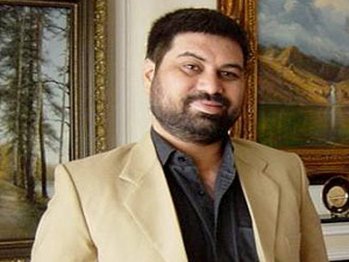
Intelligence surrounding the late May killing of Pakistani reporter Saleem Shahzad, 40, suggests that senior officials at Pakistan’s Directorate for Inter-Services Intelligence ordered the murder to silence his criticism, The New York Times reported Tuesday, citing two senior US administration officials.

American officials consider the intelligence to be “reliable and conclusive,” the Times said, with one official describing the actions of the spy agency, known as the ISI, as “barbaric and unacceptable.” Shahzad suffered 17 lacerated wounds, a ruptured liver and two broken ribs in the deadly attack.

Relations between the United States and Pakistan have become increasingly frayed since the early May killing of bin Laden in a Pakistani town with a heavy military presence, where he’d been holed up for several years. U.S. officials suspect that some members of the military and the ISI helped harbor him there, even if top Pakistani officials truly were kept in the dark about bin Laden’s presence there.

The Times’s report comes after journalists and others within Pakistan accused the ISI of being behind Shahzad’s death, and since the Pakistani government – under pressure — launched an investigation of the killing.

A Pakistani official, meanwhile, shot down the Times’s report.

“There is an international conspiracy to malign the law enforcement agencies and security forces,” Pakistani information minister Firdous Ashiq Awan said Tuesday, the Hindustan Times reported.

The allegations made by the Obama administration “are part of that conspiracy,” she said.

Awan also said that “good relations are in the interest of both” the United States and Pakistan, though “everybody safeguards their own interests” in a conflict and there have been some “ups and downs.”

In Pakistan, Truck Decoration a High-Octane Art Movement

By James Parchman for The New York Times

MURIDKE, Pakistan — Here on the historic Grand Trunk Road, some 40 miles north of Lahore and a few hours south of the former bin Laden hideout of Abbottabad, a mosque’s call to Friday afternoon prayers was overwhelmed by Pakistani pop music spilling from open-air markets. The barks of bus conductors calling out destinations added to the din.

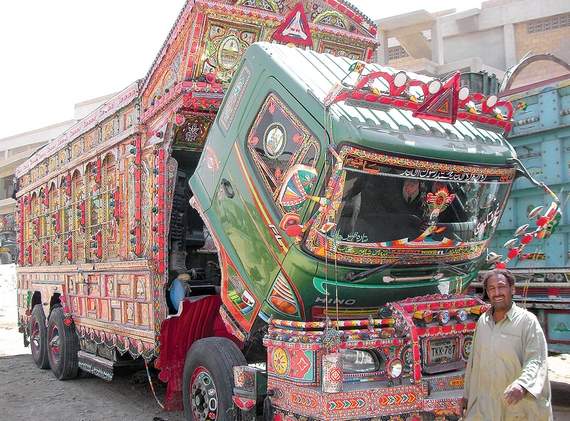
The passing parade of motorized rickshaws, farm tractors, buses and highway cargo trucks looked as if a re-enactment of ’60s peaceniks making the pilgrimage to Woodstock might be under way. A panorama of red, yellow and green, mixed with plastic whirligigs, polished mahogany doors and gleaming stainless steel cover plates, was a magical sight for a visitor with a love for anything on wheels.

It was not only the variety of vehicles — all are common across South Asia — that elicited this reaction, or even their Partridge-Family-meets-Ken-Kesey color schemes. Rather, it was the fascinating quantity and surrealistic detail of their decoration, unlike anything I’d seen in my travels around the world.

A deeper understanding of the origins and meanings of the decoration craft was gained over days of mingling with the truck drivers and the owners of decorating shops in Karachi, Lahore and Peshawar.

Karachi, situated on the Arabian Sea, is Pakistan’s major seaport. It is also the cargo hub of the country, and with 13 million people has a great many local and intercity buses. As such, the city supports a considerable customizing industry: When Saudi Aramco World magazine published an article about the trade in 2005, more than 50,000 people in Karachi were said to be employed decorating buses and trucks.

What I found at the Pakistani workshops was a pride of design and a willingness to answer questions — and to show off their creations to a former long-haul trucker.

Sparing no expense

At a driver’s cafe near Karachi’s 3-mile-long International Truck Yard (where I turned down an offer of boiled camel meat and cow-leg soup) workers took me by the hand to the shop of Masallah the truck decorator. My Dockers and Rockports were as out of place as their long-shirted, working-class shalwar kameez outfits and leather sandals, called chappals, would have been in one of New York City’s outer boroughs.

But my full beard may have helped in gaining their confidence and a look inside their truck cabs. Government safety agencies equivalent to OSHA were nowhere to be seen in the truck yards, and workers, many of whom were children of the owners, were being showered with sparks from their grinders and cutting torches.

Many of the trucks being outfitted at Masallah’s carried identification plates from Balochistan province. Their owners were prospering thanks to a steady demand for hauling loaded sea containers from Karachi’s port to landlocked Afghanistan. Their cargo, typically including supplies for U.S. and NATO military operations, make a trip of 500 miles by the southern route to Kandahar or 1,200 miles by a northern route to Kabul.

Pakistani truck owners can easily spend more on their trucks than on their homes. One driver from the Gwadar area of Balochistan told me he had just bought a Hino truck chassis for the equivalent of $35,000 and brought it straight to Masallah’s workshop. There he might spend another $25,000 for its body, paint and decoration. During the several weeks required to complete the work, he would sleep inside or under the truck, on his bedroll.

Adding decorative touches like ribbons, spinners, flags and polished steel cutouts in the shape of animals to a small bus costs an owner at least $800. This is considered an advertising expense; a highly decorated bus is usually the first choice of customers when there are several options.

Nissan and Hino tandem-axle trucks of the flat-front cabover design, many assembled in Pakistan, are the popular choices for cargo-haulers today, replacing the revered Vauxhall Bedford, a British model with a traditional cab. The Bedford was the mainstay of Pakistan’s cargo network since the early days of Pakistan’s independence.

The Bedford is still prized for its sturdy chassis and ability to continuously haul outsize loads. Many have bodywork with a high-crowned front prow, which lends itself to decoration and gives the truck the look of a sailing ship.

As is the case in the United States, offering a sharply decorated truck can be a powerful incentive for recruiting drivers. Pakistani bus and truck owners usually allow their drivers, whose average wages are about $75 a month, to work out their own designs in conjunction with the owner of the decoration shop.

Big business

Predictably, mass production has changed the business over the years. Adornments are no longer exclusively handmade.

“Pakistani buses were originally decorated using carved woodwork and individual paintings,” said Kurram Awan, the owner of a small shop of truck-decorating supplies in Lahore.

“Now, my shop sells over 1,000 different items, including braids, reflectors, flashing lights and antennas,” he said.

He added that the Pashtun drivers (Pashto speakers from the border region between Afghanistan and Pakistan) spent the most on decorations.

Durriya Kazi, an artist and teacher in Karachi, has long been a proponent of Pakistan’s folk art. She sees bus and truck decorating as an integral part of that tradition, noting the importance of distinguishing between sculpture as defined by the art gallery and the rich activity of actually making things that exists all over Pakistan.

In 2006, Kazi was instrumental in a program intended to spread Pakistan’s bus decoration skills to Melbourne, Australia, where a tram was transformed into a replica of a minibus used on Karachi’s W-11 route, resplendent in all its finery.

Another Pakistani with expertise in the subject is Jamal Elias of the University of Pennsylvania, a professor and the author of “On Wings of Diesel: Trucks, Identity and Culture in Pakistan” (Oneworld, 2011). His book explores the tradition of Pakistani truck decoration, and looks deeper into the “nature of response to religious imagery in popular Islamic culture.”

In an e-mail, Elias said that the creative inputs of decorators included several major themes, which could be combined across the cab and body of the truck or bus. These include Islamic religious images like the horse of Muhammad and depictions of the mosques at Mecca.

Other possibilities include images of a fish, representing good fortune, or the elegant eyes of a woman, representing beauty.

In This Country, Religious Freedom Is Real

By Imran Hayee for The StarTribune

My childhood memories of celebrating Independence Day are no different than those of my fellow citizens — except that it was on Aug. 14th instead of July 4th.

I grew up in Pakistan, which obtained its independence from British rule on Aug. 14, 1947.

As a child, I marked Independence Day year after year without having a clue about what independence really meant. As I grew older, I read from a speech of Muhammad Ali Jinnah, Pakistan’s founder, which he had delivered immediately after the nation’s independence was announced.

“You are free; you are free to go to your temples,” he said. “You are free to go to your mosques or to any other places of worship in this State of Pakistan. You may belong to any religion or cast or creed — that has nothing to do with the business of the State.”

This was Jinnah’s dream, the founding principle behind the independence of Pakistan as he himself stated in the same landmark speech: “We are all citizens and equal citizens of one State. We should keep that in front of us as our ideal and you will find that in due course, Hindus would cease to be Hindus and Muslims would cease to be Muslims, not in the religious sense, because that is the personal faith of each individual, but in the political sense as citizens of the State.”

Growing up in Pakistan, as a Muslim, I never saw Jinnah’s dream materializing. The constitution of Pakistan defines who is a Muslim — any “impersonator” is subject to imprisonment or death. Temples, churches and mosques not ascribing to a single distorted version of Islam are routinely attacked.

What caused the secular ideology of Jinnah to take this U-turn?

Soon after the nation’s creation in 1947, and Jinnah’s demise a year later, Pakistan’s rulers succumbed to the demands of religious extremists who wanted to convert Pakistan into a puritanical fundamentalist state.

Gradually, the monster of religious fundamentalism grew large enough to devour Jinnah’s philosophy of spreading freedom and equality.

I never experienced independence until I came to America 18 years ago. For the first time — when Independence Day was being celebrated on July 4th instead of Aug. 14th — I wanted to rejoice once again.

I was unaware of the history behind America’s Independence Day, but still, I saw freedom and equality prevail all around me. I could freely go to my mosque without having to fear the state’s interference.

As I learned more about the history behind July 4th, it reminded me of the same philosophy of freedom and equality that Jinnah dreamed for Pakistan. What made the difference in America was that its rulers never succumbed to extremists’ demands.

Rather, its forefathers risked their wealth and lives to uphold the principles of freedom and equality. Their sacrifices paved the way for a Muslim like me to emigrate from a Muslim country and practice Islam the way I wanted to but could not do in the country of my birth.

More recently, while some European countries have banned building minarets on mosques and the wearing of veils by Muslim women, U.S. courts have struck down any such attempted restrictions as unconstitutional.

Addressing the Muslim world in Cairo, President Obama proudly announced, “Freedom in America is indivisible from the freedom to practice one’s religion. That is why there is a mosque in every state of our union, and over 1,200 mosques within our borders. That is why the U.S. government has gone to court to protect the right of women and girls to wear hijab, and to punish those who would deny it.”

As a Muslim-American, I feel proud and honored to be in America and find many reasons to celebrate Independence Day on July 4th. Among others, let me add that the founding principles of America’s Constitution are in perfect harmony with the Qur’an.

The Qur’an (2:257) proclaims, “There is no compulsion in religion. Surely, the right way has become distinct from error.” It further declares fundamental human equality: “O mankind, We have created you from male and female; and We have made you into tribes and sub-tribes that you may recognize one another” (Qur’an 49:14).

These golden principles of freedom and equality have been implemented — in America. In fact, I find the American Constitution to be more Islamic than the constitution of Pakistan or of any other Muslim country in the world today.

Imran Hayee is a professor of engineering at the University of Minnesota Duluth.

Pakistan’s First Astronaut: A Star Is Launched

By Maha Mussadaq for The Express Tribune

Namira Salim’s star is about to launch as she is set to become Pakistan’s first astronaut. Her maiden voyage will be in 2012.

Talking to The Express Tribune, Salim said this was a dream come true for her. All her hard work and training will soon pay off. Although the date for the launch is not yet fixed, she says her team is ready.

“I got my first telescope when I was 14 years old,” says Salim. Holding a Master’s in international affairs from Columbia University, Salim was an active member of astronomy clubs in college and university and was also the first female member of the Amateur Astronomy Society of Pakistan. Rather than being a hindrance, Salim says that her gender always gave her an edge over her male counterparts.

Salim, who divides her time between Dubai and Paris, was feted for her groundbreaking achievements by President Zardari, who awarded her the Tamgha-e-Imtiaz for excellence in sports.

Sir Richard Branson, chairman of the Virgin Group, officially launched Salim as a Virgin Galactic Founder Astronaut in Dubai in March 2006. Hearing of this, the Ministry of Information and Broadcasting dubbed her the first Pakistani astronaut.

She is also the First Asian to skydive from an altitude higher than the peak of Mount Everest, at 29,480 feet. Salim also hoisted the national flags of Pakistan, the UAE, Monaco, the EU and a universal peace flag at the North Pole on April 21, 2007 and at the South Pole on January 10, 2008. She is the first Pakistani to trek to both the North and South Poles.

Salim’s space voyage will be the second flight launched into space by Branson. The mogul himself and his family will go on the first flight. Her flight will be launched from the space port in Mojave Desert in California sometime next year. “We will be in space for a few hours and then come back,” said Salim.

Pakistan Kicks U.S. Off Air Base

By Farhan Bokhari for CBS News

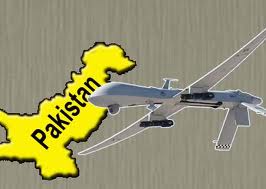
The U.S. faces the challenge of quickly establishing alternative facilities from which to launch drone aircraft inside Afghanistan after Pakistan ordered U.S. personnel and hardware out of a base believed to have been used in the past for CIA drones, two senior Western defense officials tell CBS News.

Concern mounted Wednesday over the future of Pakistan’s clandestine support for Washington’s use of drones after the country’s defense minister announced Pakistan had told the U.S. to vacate the small Shamsi air base in the southwestern Baluchistan province.

Only “Pakistani aircraft will be flown from Shamsi in future,” Pakistani defense minister Chaudhary Ahmed Mukhtar told reporters. “No U.S. aircraft will fly from Shamsi.”

“U.S. personnel will not be allowed to use the Shamsi air base,” a senior Pakistani government official added to CBS News.

Another senior Pakistani official, who spoke Thursday to CBS News on condition of anonymity, said there previously “have been U.S. activities at the Shamsi air base. All those activities are being ceased now.”

The news comes as the Obama administration details its new strategy for combating extremism across the globe — a strategy which shifts the focus sharply away from the large-scale ground operations espoused by President George W. Bush, to smaller “surgical” strikes, like drone attacks.

The official refused to specify the types of U.S. activities that have now been ceased at Shamsi.

Pakistan has always publicly criticized the U.S. for carrying out attacks using pilotless drones, and has never acknowledged that it cooperates with Washington on the use of such aircraft. The drones have become widely unpopular across Pakistan after some of the attacks reportedly resulted in civilian casualties, including women and children.

“The damage to the U.S. drone program will not be substantial. But Pakistan’s decision is a setback for efforts to improve U.S. relations with Pakistan,” a senior Western defense official based in Islamabad told CBS, also speaking on the condition of anonymity. “It will take some time for the Americans to establish the program in Afghanistan. It can be done.”

Relations between the U.S. and Pakistan have remained frosty since U.S. Navy SEALs killed Osama bin Laden in the country’s northern city of Abbottabad.

That attack was undertaken without the U.S. offering advanced information to Pakistan, out of fear that militant sympathizers in Pakistan’s intelligence and security establishment might have alerted al Qaeda or the Taliban.

The 2nd May operation has been followed by a hardening of attitude by Pakistan’s influential military, which claims the attack violated Pakistan’s sovereignty. In reaction to the raid, Pakistan has already ordered more than 150 U.S. military trainers to leave the country.

Cost Of Wars In Iraq, Afghanistan, Pakistan To Reach $3.7 Trillion: Report

By Elise Foley for The Huffington Post

Costs of War: 225,000 Lives and up to US$4 Trillion from Watson Institute on Vimeo.

WASHINGTON — The United States will have spent a total of $3.7 trillion on wars in Iraq, Afghanistan and Pakistan, costing 225,000 lives and creating 7.8 million refugees, by the time the conflicts end, according to a report released on Wednesday by Brown University.

The report, written by more than 20 economists, political scientists, lawyers, anthropologists and humanitarian personnel for Brown’s Watson Institute for International Studies, gives staggering estimates for the cost of military action in those three countries. Nearly ten years since U.S. troops first entered Afghanistan, the report estimates the final cost of all three conflicts will be between $3.7 trillion and $4.4 trillion — far higher than the $1 trillion price tag referenced by President Barack Obama earlier this year. The report estimates the U.S. government has already spent between $2.3 trillion to $2.7 trillion and will spend at least a trillion more over the next fifty years.

In a video op-ed exclusive to HuffPost, some of the report’s authors explained the high costs — both past and future — of the wars.

Long-term obligations to war veterans will cause the price tag of the conflicts to climb for decades after troops have returned home. The report puts the cost of health care for veterans at between $600 to $950 billion, not peaking until the 2050s.

“Wars, in a sense, are never over when they’re over,” Catherine Lutz, a Brown University anthropologist, said in the video op-ed. “They go on for decades, and the peak costs for this war will be incurred forty years from now.”

Because the wars have had no true front-lines, there have been a huge number of injuries, primarily to young people serving in the military. There has been a particularly large amount of casualties in Pakistan, the report says.

“The costs have been borne unevenly,” Lutz said. “The military families, contractor families, the people of Iraq and Afghanistan and Pakistan, have borne a tremendous cost.”

Even just paying the interest on the United States’ war debt will be a large endeavor, according to the report, at a time when the country is set to exceed its current debt limit of $14.29 trillion. The government has already paid about $185 billion in interest on war spending, and could accrue another $1 trillion — an amount not included in the $3.7 trillion estimate — in interest by 2020, according to the report.

“We have borrowed virtually all of the money that has been used to pay for the Iraq and Afghanistan conflicts, and that has been very expensive, adding at least $1.5 trillion to our national debt,” Linda Bilmes, an economist with Harvard University, said in the video op-ed.

Now the country is at a decision point, aligned with the current showdown over a deal to raise the debt ceiling by August.

“There is immense and urgent requirement to learn from the experience of the past decade and to try to ensure we don’t make the same mistakes all over again,” Andrew Bacevich, a Boston University military historian and veteran, said in the video.

Nominee Questions Pakistan’s Battle Plan

By Julian E Barnes for The Wall Street Journal

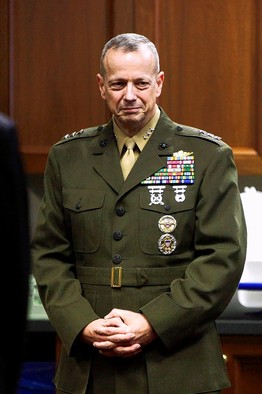
WASHINGTON—The Marine general chosen by President Barack Obama to lead the Afghanistan war raised doubts about Pakistan’s willingness to go after militants who cross the Afghan border to attack U.S. and allied troops.

In a confirmation hearing before the Senate Armed Services Committee, Lt. Gen. John Allen also said he believed that the Afghan insurgency’s momentum has been halted and even reversed in key parts of the country, and backed Mr. Obama’s troop drawdown plans.

But Pakistan, as a haven for militants, looms large over the war in Afghanistan. Gen. Allen said Pakistan continues to “hedge” against a precipitous U.S. withdrawal from Afghanistan by supporting anti-American militant groups, including the Haqqani network.

The statements were a rare public show of military skepticism about Pakistan’s intentions, reflecting the military’s increasing view that relations with Pakistan are deteriorating.

Gen. Allen, deputy commander of the U.S. Central Command, argued that it would be ultimately in Islamabad’s interest to expel militant groups from their sanctuaries in Pakistan.

“We will encourage and will continue to encourage our Pakistani friends to bring pressure to bear upon those safe havens,” he said. “It’s not just good for the outcome of our strategy and for the president’s vision on the outcome in Afghanistan; it’s good for Pakistan as well.”

Appearing alongside Gen. Allen, Adm. William McRaven, nominated to lead Special Operations Command, also said Pakistan is unlikely to move against the frontier militant havens anytime soon.

The admiral oversaw the Navy SEAL team that last month killed Osama bin Laden at his hideout in a Pakistani garrison town.

The officers’ testimony shined a light on the fragile state of U.S.-Pakistan relations, which have grown combative in the wake of the bin Laden raid.

Military leaders have made plain they are displeased with the declining cooperation by Pakistan, but insist the U.S. can’t walk away from the relationship.

“We’re giving them $4 billion,” said Sen. Scott Brown (R., Mass.). “And yet sometimes we don’t know if they’re in or they’re out, are they with us or [are] they not?”

After Adm. McRaven said Taliban leader Mullah Mohammad Omar is likely hiding in Pakistan, Sen. Lindsey Graham (R., S.C.) demanded Pakistan hand him over.

Pakistani officials have said limited military capacity—not lack of will—is inhibiting their operations against militant groups.

Gen. Allen said he backs President Obama’s decision to pull 10,000 troops out of Afghanistan this year, and the remaining 23,000 surge troops by the end of next summer. After the drawdown, the U.S. would still have 68,000 troops in the country, he said.

But he acknowledged that the military didn’t recommend a drawdown schedule as aggressive as the one Mr. Obama chose.

Under questioning from Sen. Joe Lieberman (I., Conn.), a critic of the Obama administration’s drawdown plan, Gen. Allen suggested that if conditions deteriorate he would advise Mr. Obama to alter the plan.

“It is my responsibility to the chain of command and to our commander-in-chief to ensure—should I be concerned about the progress or the execution of the campaign—that I so advise the chain of command,” he said.

Neither the Afghan Taliban nor the Haqqani network has directly targeted the Pakistani government. And Islamabad remains wary of a hasty U.S. withdrawal and sees the militant networks as potential future allies in Afghanistan.

Gen. Allen said even as troops leave Afghanistan, the military would continue to implement its current counterinsurgency strategy, which is aimed at protecting civilians from the insurgents while helping the government extend its reach and legitimacy.

Sen. Graham asked if Gen. Allen would have enough forces to continue that strategy, which requires large numbers of troops to secure population centers.

“How can we maintain counterinsurgency if all the surge forces have gone?” Sen. Graham asked.

The End of AfPak

By Scott Malcomson for The New York Times

Remember how after 9/11, Osama bin Laden’s attacks on us could be linked to almost anything, from shopping habits to the rediscovery of Western values to carbon-pricing schemes? Something similar appears to be happening with Bin Laden’s death. Jihadism sure isn’t what it used to be. After 10 years, it seems, the time has come to go home. Troops are and will be coming back to the United States from Iraq and Afghanistan. The military budget will be cut. The outgoing secretary of defense feels able to openly mock NATO because, presumably, he thinks he can afford to — because it doesn’t matter all that much. The global war on terror is being downgraded from Armageddon to something more out of Leviticus: a tricked-out police action, just as John Kerry, in this magazine, always said it should be. On Sunday, Helene Cooper and Mark Landler reported that “American success in the counterterrorism campaign would seem to bolster arguments for a swift withdrawal from Afghanistan.” By Tuesday morning, they were reporting that President Obama would announce his withdrawal plans on Wednesday. Meanwhile, a Harris poll revealed that 51 percent of Americans and 54 percent of Britons believed “the death of Bin Laden meant it was time to bring troops from their countries home.”

That isn’t quite how it looked when I was in Washington a few weeks ago and spoke with about a dozen current and former American officials and with Pakistanis. The impression they each gave was that American withdrawal would be speeded not because of Bin Laden’s death but because of Pakistan’s reaction to it. After the initial shock, Pakistan’s (government-influenced) press latched onto a narrative of “national humiliation” as a result of the American raid, rather than, say, one of jubilation at the demise of a killer whose fantasies have brought Pakistan nothing but misery. A younger generation of military officers — Pakistan is dominated by its military — seemed at times about to revolt in reaction to the insult to Pakistan’s sovereignty. And the Inter Services Intelligence (I.S.I.), Pakistan’s ubiquitous military intelligence outfit, reacted, as was subsequently reported, by scouring the neighborhood around Bin Laden’s house for … evidence of how the C.I.A. found out he was there, and to determine who had been helping the Americans.

Finally, the Pakistan government did not respond to the Bin Laden raid by pressing its new advantage and rolling up terrorist networks across the land. No, it did not do that at all. So Secretary of State Hillary Rodham Clinton and Admiral Mike Mullen, chairman of the joint chiefs of staff, went to Islamabad and on May 27 presented a list of demands. These included the arrest or elimination of Ayman al-Zawahiri (of Al Qaeda), Ilyas Kashmiri (a long-sought semi-free-agent and former Pakistani military man), Sirajuddin Haqqani (of the AfPak-border based Haqqani network) and Atiya Abdur Rahman (Al Qaeda), and the shutting down of bomb factories in Pakistan.

By June 3, Kashmiri was dead. But this promising start now seems isolated. The other wanted men are still at large. The bomb-makers might well be getting tipped off. The revolt by younger Pakistani officers seemed only to get worse.

In short, the U.S. and Pakistan are really not getting along. Among members of Congress, beating up Pakistan has become ritualized; Senators McCain and Rogers were doing it again on the Sunday programs. I wondered: How many times can Pakistan be abandoned? As Bruce Riedel, a former C.I.A. officer and the head of President Obama’s first major AfPak review, shows in his excellent new book, “Deadly Embrace: Pakistan, America and the Future of Islamist Jihad,” embrace and abandonment have formed the pattern of American-Pakistani relations since the majority-Muslim nation was formed out of the breakup of British India in 1947. Harry Truman’s lack of interest yielded to Dwight Eisenhower’s enthusiasm for Pakistan as an anti-Communist bulwark and a base for spying on the Soviets. The relationship was and remained built around security and intelligence. Lyndon Johnson reversed course when India and Pakistan went to war in 1965; he cut off both, but Pakistan had, unlike India, been a strong ally, and it felt betrayed. This set the pattern: ultimately, Pakistan was tactical and India was strategic.

Now, after almost 10 years of intense engagement, Pakistan and the U.S. appear set for another split; at least that was the consensus among the officials I spoke with. There was a pervasive sadness in these conversations. It was due in part to the sheer human effort that has gone into the U.S.-Pakistan relationship. A lot of spies and soldiers and diplomats and politicians have put years of their lives into making “AfPak” work, which requires making Pak work. A lot (not all) of that effort seems to be going down the drain, along with much of the billions of taxpayer dollars that financed it.

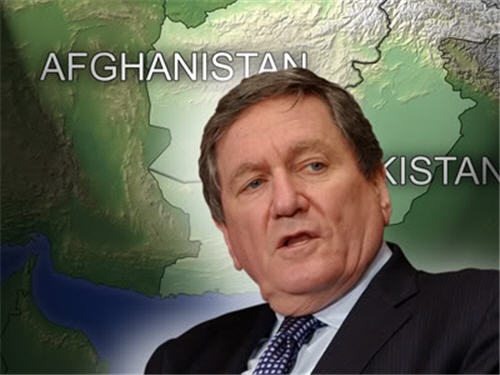
There is also personal sadness in that the AfPak effort was associated toward the end with Richard Holbrooke, whose death late last year brought the foreign-policy world up short. Holbrooke did not take great care of himself, so objectively his death could not be entirely a surprise, and among people over 70 the reactions I heard were more of the well-what-did-you-expect variety. But in the 35-to-65 range it was different. Holbrooke represented, very attractively, the assertion of youth and hope against experience. Even at 69 he had a distinct eagerness, even boyishness, alongside the baritone gravitas. He attracted bright young people. He could be young and old at the same time. Once he was gone, that sort of generational bridging disappeared. (Older figures are few in this administration.) The sense of continuity (as well as of optimism) is weakening. There’s something missing now.

There was also a sense of ideological loss of direction. For all their differences, Bill Clinton and George W. Bush shared a tangible optimism about American governmental involvement abroad. President Obama is different, and even if he weren’t the national mood is. The people’s representatives in Congress are vying to bring troops home faster, and if there is an internationalist remaining in the House he or she is keeping quiet. The Republican candidates for president seem to have settled on anti-war isolationism as a winning position. Obama’s great strength in foreign policy — his ability to repackage, and optimize, American power in a multipolar world — is the strategy that dare not speak its name, or it will bring accusations of “declinism.”

Finally, there is the tremendous sadness of Pakistan itself. The country doesn’t have enough water. It lacks the electricity to develop its industries. Literacy, by some reckonings, is actually declining. Democracy has been restored but the government is hardly stable. The one truly semi-stable institution, the military, is struggling against itself, just as Pakistanis are dividing, and attacking each other on an increasing scale (which is saying something).

But, in a way, the saddest thing of all, from a foreign-policy point of view — Pakistani or American — is that the one great card Pakistan has to play is to make itself a problem. Pakistan formed itself into a regional player through building its army, running terrorist proxies in Kashmir and Afghanistan, indulging in enough Islamist millenarianism to make itself frightening, and developing nuclear weapons. None of these strategies have a good future. But in the absence of a long-term committed relationship — what Holbrooke promoted as a “strategic partnership” — with the United States or, perhaps, with China, Pakistan is left with fear as its most successful export.

There was some discussion in Washington as to whether Mullah Omar’s name was on that list that Clinton and Mullen presented in Islamabad. It almost doesn’t matter. The doubt itself is the message: Pakistan stays valuable because it has terrorist “ties” or “links” or “proxies” or whatever. As national existential dilemmas go, Pakistan’s is particularly nightmarish. The U.S. will leave them to it — abandonment again — and choose the happier relationship with India. Secretary Clinton will be at the regional forum of the Association of Southeast Asian Nations in late July, helping to take her longtime initiative of eastward Indian engagement, and the integration of the United States into East Asian political structures, to a new level. This is part of a long-term strategy of accommodating the rise of China and of India.

And Pakistan, after 10 years, will be left behind; as the line in Washington goes, “There is no good solution.”

Of Babra and other Sharifs

By Asif Noorani for Dawn

Way back in 1915, when M F Hussain (Maqbool Fida Hussain) was born his mother named him Maqbool (which means popular). She had no idea that her son, born in a modest household, would become the most well known South Asian painter of the late 20th and early 21st century.

But not all names bring good luck to those who have to live with them. I had a clerk working for me, whose name was Raees (rich) but the man led a difficult life in the monetary sense. So was a man called Akhtar Nawab. He had neither the finances nor the mindset of a nawab. Haseena is a common name among the fair sex, but most girls with that name are anything but. Haseena Moin was charming in her salad years and is still quite pleasant to look at.

What is true of names is also true of surnames. The one Sharif (noble) who really deserved the surname was Babra Sharif. Even when she was at the peak of her career, the model turned actress (the unisex term actor was not used in her heyday for a female of the species) was on the dot for her shooting. She never threw tantrums like some popular film stars do. She never spoke ill of anybody including those who, out of sheer jealousy, lost no opportunity to make snide remarks about her. When the time came for her to call it a day, she retired gracefully, unlike our politicians in power who are forced to leave disgracefully from their offices.

But not all Sharifs are noble like her. In fact I have yet to come across anyone with that name or surname who could live up to it. Babara used no unkind words for her rivals, but this person (shh! no names please, make your own guess) left no opportunity to pass disparaging remarks about a lady with whom he once played a game of musical chairs. One afternoon he came to the Karachi Press Club, where he went on and on, speaking ungallantly against the first and so far the only woman prime minister in the country. The speech over, a callow journalist not known to be a good judge of human beings, invited the guest to visit the book fair in the club’s backyard. “I am sorry I have an important meeting to attend,” he said and took off in one of the four limos that were parked outside the club.

The same journalist, out of sheer curiosity, followed the fleet of cars on his humble motorbike and you know where did our favourite Sharif go to? “It’s elementary, my dear Watson,” Sherlock Holmes would have said. Our friend was seen downing a large glass at the Punjab Lassi House at Burnes Road. In those days mobile phones, with cameras, were not available otherwise the young journo would have had a prize photograph.

While on Sharifs, I must refer to the news item that appeared in the June 17 issue of a respected English daily. It had a screaming headline: “Shahbaz richest member of Punjab assembly”. In the introductory paragraph, the report said that the Punjab chief minister has assets of Rs 489.64 million in the country and abroad. The details are mind-boggling. But the question remains, is it merely a tip of the iceberg? Those who follow him, in the list of declarations made in 2010, also fall into the category of filthy rich. These were the figures submitted to the Election Commission by the members of the Punjab Assembly. What would have been no less relevant was the figure of the taxes that they pay. Sadly, those figures which should be abysmally low are not mentioned. Don’t you think such declaration should come from the head of the state and the head of the government also?

Perhaps, mine is a case of jealousy. I still move around in my old and but reliable Suzuki Khyber. I paid more income tax than what the chief executive of the country paid. The tax figures paid by him and some other bigwig were revealed in a report, published in the newspapers according to the NAB, when Gen Pervez Musharraf elbowed him out of his office. I have no bungalow. I live in an apartment. The fault is mine. I was always more interested in books than in lassi. So, why crib?

Asif Noorani, a seasoned journalist, is the writer of three best-selling books including ‘Boom, Boom Shahid Afridi’.

The views expressed by this blogger and in the following reader comments do not necessarily reflect the views and policies of the Dawn Media Group.

Pak Sailors Thank India, On Way Home

Mateen Hafeez for The Times of India

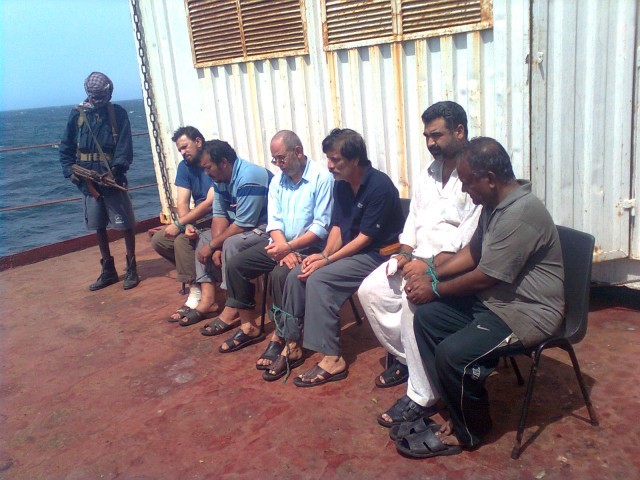
Five Pakistani hostages, who were held captive by Somali pirates for five months and rescued by the Indian Navy, will finally leave for Pakistan on Monday. The hostages had been languishing at Yellow Gate police station after their ‘consular access’ process got stuck in diplomatic channels of the two countries.

TOI was the first to report about the hostages’ plight and the problems in the consular access programmme. A team from the Pakistani High Commission then landed up at the Yellow Gate police station and completed the formalities. Earlier, this was scheduled to be done at Tihar jail in Delhi as the hostages were wrongly labeled ‘prisoners’. The men are Aurangzeb Balloch, his brother Sajjad, Farhad Aalam Khan, Mohammed Umair and Lal Bakhsh.

“We are excited to go home. There were some problems in our travel to Pakistan but the Yellow Gate police took care of us properly. We have no words to thank the Indian police and those who helped make our journey to Pakistan easy,” said Aurangzeb, a resident of Karachi. The other hostages were also jubilant when asked about their return to Pakistan. “In the last three months we saw the lanes and bylanes of this city. It’s very similar to Karachi. The people, places, food and roads here are similar to Karachi. Initially, we were afraid that we may be kept in India, but now we have a positive feeling about this country and its people who loved us,” said Sajjad, another hostage. “We watched the World Cup matches between India and Pakistan in the police station. When India won the final against Sri Lanka, we were happy. We never faced any discrimination here,” added Lal Bakhsh.

The hostages were part of an Iranian fishing trawler, Al-Murtuza. The ship was hijacked by AK-47 borne Somali pirates from the Ballochistan sea in November. “We would get insufficient food after we were captured by the pirates,” added Farhad.

The five men were provided food, chai and clothes. Sometimes they managed to get cigarettes. The policemen even gave their phones to the hostages so they could speak to their families in Pakistan. To speed up the process to send them home, Ansar Burny, former human rights minister in Pakistan, filmmaker Mahesh Bhatt and Abraham Mathai, state minorities commission vice-chairperson, worked together. “We spoke to Gurudas Kamat, the Union minister of state for home and he arranged consular access. The process was speeded up due to his efforts,” said Bhatt.

On the ground: For border village, peace is a beautiful dream

By Taha Siddiqui for The Express Tribune

We left behind everything when we came to this side, but not for such living conditions. Some of our family that stayed behind in India now mock us about our migration,” says Haji Shahzad.

Shahzad, in his early 70s, is a resident of Bhanoo Chak, a village located on the Indo-Pak border.
“The border force here has made our lives miserable. We live not under the threat of India but this force. Day and night, we have to live by their rules,” Shahzad says.

Bhanoo Chak, a village occupied by Sikhs who fled at the time of partition, is an hour’s drive from central Lahore and is closest in distance to the border.

“We just want peace so that there is relaxation on the border and we can have normal lives again,” adds Shahzad.
Mostly farmers, these men are not allowed to roam around freely after 6pm and need to acquire no-objection certificates before constructing anything on their property.

Many of these villagers have families that were divided in the partition in 1947 and wish to go meet them.
“We have family in Rajasthan. They want to come visit us and we want to go and visit them too. But we have to go through bureaucratic hurdles that we have stopped making the effort,” says Shahzad.

Pakistan Rangers Colonel Osman Siddiqui, who is in charge of the Wagah Border area, says that without checks and balances, he cannot trust anyone in the area. “The border is a sensitive spot, and to stop smuggling and unwanted people from crossing over, we have devised a system where we allow men to roam in these areas only between 6am and 6pm,” he says.

When asked if he will ease the policy in case the Pakistan-India dialogue is successful, he replied that national policy and local policy are different subjects. “When a change happens in the national policy, we can see. But for now, the policy will stay the same since the force needs to be vigilant,” he said.

Many villagers believe that if Pakistani and Indian leaders sincerely wanted peace, an accord could be reached today. They also do not fear another war with India.

“In 1965, Indian forces destroyed our homes. There were planes overhead and even the Pakistan Army had little idea what was going on,” says Mohammad Tayyab, who was barely seven years old at the time. “But today, we cannot expect the same as we are now a nuclear state.”
Still, the villagers are always on their toes. “Every time Pakistan Army increases its presence on the border area, I fear I may have to leave home again,” says Tayyab, who moved his family out of the village during a standoff in 2002.

For some, however, peace is just a far-fetched but beautiful dream. “Peace is not possible, even though it will be good for both our countries. We will [finally] be living with no fear,” says Azeem impatiently, during a short break from a cricket match.

Aman ki Asha’s Gift of Life to Six-Year Old Muzaffar

By Lubna J. Naqvi for The News International

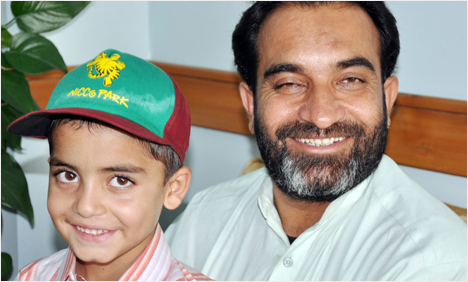
He has the cutest smile. One that was nearly wiped out forever by a congenital heart disease that his parents had no means of getting treated in Pakistan.

Muzaffar Ahmed Khan was only three years old he developed a seemingly never-ending severe chest congestion and cold. His father Rozay Khan, a teacher at a private school in Loralai, took the boy to a medical specialist the nearest big city in Quetta, 260 km away – a long road trip by any standards, and more so for a sick child. The trip led to a doctor diagnosing the boy as having a congenital heart condition. The treatment – risky and expensive heart surgery – was way beyond the reach of his father.

The boy lived on with the help of various medications, but without the required surgery, he was not expected to live much longer. The despair and pain of the family, and the discomfort of the sick child, can only be imagined.

It was a news report in the daily Jang of October 2, 2010 that set them on a path they will forever be grateful for. The paper had a report about a nine-year old Pakistani boy Muhammad Sufiyan, who also had a congenital heart problem. The report said that Rotary International and Aman ki Asha had taken Sufiyan to India where he underwent a successful operation at Manipal Hospital, Bangalore. Suddenly there was hope.

Rozay Khan contacted the Rotary Club representatives in Quetta, and provided them with Muzaffar’s medical documents. Things began to move. The Rotary officials contacted their counterparts in India and sent them the documents. Within a week the family was asked to make arrangements to travel.

Muzaffar was to be accompanied by his father and uncle Qaisar Khan. The Indian High Commission granted their visas within three days. Aziz Memon (President King Group) former governor of Rotary Club helped expedite the travel and other logistics.

They flew to Mumbai on May 5, 2011, and the next day, to Kolkata. There was some difficulty at the immigration, says Rozay Khan, but Rotary representatives in India helped smooth their way.

On May 7 Muzaffar was admitted to Kolkata’s Rabindranath Tagore International Institute of Cardiac Sciences. He underwent a two-and-a-half hour operation on May 11. He was discharged on May 19, with a month’s medication and a directive to avoid lifting heavy items for some time.

The doctors said that Muzaffar should get a medical examination after six months to be on the safe side, but that he was now perfectly healthy. It was like a miracle.

Barely a month later, Muzaffar and his father and uncle visited Aman ki Asha in Karachi on June 4, a day after they returned from India. If one had not been told, there were no signs that this smiling boy had so recently undergone a serious operation. He sat there beaming at us, shyly looking out from underneath long lashes that fringed his mischievous eyes. He would have pranced around the room like any other seven-year old, but was restrained by his father, who held him in his lap throughout the visit. Muzaffar was restless, and probably bored, but seemed to enjoy the attention.

Rozay Khan glowed with happiness at his son’s rapid recovery. A huge weight had been lifted off him, and his wife, who had been worried sick about their son, as his condition didn’t look too good before leaving for India. The first thing he did after Muzaffar’s successful operation was to call his wife over the phone. “It was an emotional time for all of us, but it has passed – all because of Aman ki Asha and Rotary Club.”

Rozay Khan was all praise for India. “I was given so much love and warmth in India that I didn’t even feel I was away from home,” he said.

“The Indians were very hospitable. They treated us just like brothers; they did so much for us that at times we were embarrassed. The hospital staff gave Muzaffar so much love and affection also. It was like we were still in Pakistan. Except for some of the people who didn’t speak Urdu or Hindi in Kolkata, I wouldn’t have known I wasn’t in Pakistan.”

Muzaffar’s uncle added that the Indians were amazed to hear them speaking Urdu – which they thought was Hindi. “They would ask us where we learnt to speak Hindi, and I would laugh and say we were not speaking Hindi we were speaking Urdu.”

He found the Indian people to be very interested in Pakistan. “They asked us so many questions and said they would love to come visit. However they lamented that they knew it would be impossible because of the visa issues. I told them that they should come, and be my family’s guests and see Pakistan.”

“So many people told us to convey their message through the media and Aman ki Asha to Pakistani authorities to ease travel to Pakistan,” said Rozay Khan. “They should do away with the obstacles that travellers have to face if they want to travel from India to Pakistan and vice versa.”

He said that in the nearly two months they spent in India they did not encounter any hostility – only got love and hospitability. “When people got to know that we had come for Muzaffar’s operation they were extra nice, even friendlier, more helpful and hospitable.”

Muzaffar gained health, love and friends across the border. His family wishes that the people of both countries were allowed to interact and visit each other more. They are grateful to Aman ki Asha and Rotary club for helping give Muzaffar a new life.

“We wish,” said Rozay Khan, “that the path of peace continues between the two countries through Aman ki Asha’s efforts. And we pray that we see peace between our two countries so we can visit our new friends again, and have them visit us.”

— Lubna J. Naqvi

Help Muzaffar’s dream come true

When total strangers from India and Pakistan joined hands to help Muzaffar, they did more than help save a life. They sparked off a determination in his family to get a good education for Muzaffar. They want him to be able to enter medical college and become a doctor himself. If anyone would like to contribute and help sponsor Muzaffar’s education to enable him to one day help others, please contact Aman ki Asha – amankiasha@ janggroup.com.pk

Obama, Zardari Discuss Strained US-Pakistani Ties

As Reported by The Voice of America

U.S. President Barack Obama called his Pakistani counterpart, Asif Ali Zardari, Wednesday to discuss strained bilateral relations and the situation in the region.

A Pakistani statement said the two leaders agreed to take appropriate action to repair the ties between Washington and Islamabad on the basis of mutual respect and mutual benefit.  It also said President Obama appreciated Pakistan’s effort in the fight against militancy.

President Zardari said the fight against extremism was in Pakistan’s own interest and that it had to fight it to the finish.

The two presidents also agreed on “regular contacts and interaction at appropriate levels for the resolution of issues.”

Ties between the two countries worsened significantly after the May 2 raid by U.S. special forces that killed Osama bin Laden in the northern Pakistani city of Abbottabad.  The military operation has embarrassed Islamabad, which was not informed beforehand of the raid.

Also Wednesday, Pakistan’s army said it was questioning four more officers about suspected ties to the banned Islamic extremist group, Hizb-ut-Tahrir.

Army spokesman Major General Athar Abbas said the four army majors are being questioned for suspected links with the group, but have not been detained.

The interrogation of the officers comes a day after the army said it detained Brigadier General Ali Khan over his links to the group.

Hizb-ut-Tahrir is an international Islamist organization that calls for a return to a pan-Islamic Caliphate under Islamic law.  Although the group does not advocate violence, it is believed to have links to militant groups.

Many critics in Pakistan and around the world say the Pakistani military is deeply infiltrated by extremist groups, making suspect its loyalty in the international effort against terrorism.

The discovery of Osama bin Laden in Pakistan has raised questions as to whether members of Pakistan’s military or intelligence knew the al-Qaida leader was hiding out not far from the capital.

Suspicions Rise as Pakistan Bomb Labs Empty Before Raids

By Thom Shanker for The New York Times

For the second time this month, bomb-making factories in Pakistan were evacuated shortly after American intelligence officials notified Pakistani security forces of their existence, fueling suspicions that such intelligence is being shared with insurgents.

It remains unclear whether the evacuations — four of them in the past month alone — were the result of deliberate or inadvertent leaks or were planned in advance of the intelligence sharing as part of a mobile production operation.

But the disclosure, which appeared in an article by The Associated Press over the weekend, prompted senior members of Congress on Sunday to accuse Pakistan of playing a double game by aiding the United States on some counterterrorism operations while also maintaining ties to violent, extremist organizations operating from its territory.

The comments, by legislators who specialize in intelligence matters and military affairs, were just the latest expression of distrust between Washington and Islamabad after a series of bruising episodes, notably the secret American raid that killed Osama bin Laden.

However — as with everything having to do with Pakistan, terrorism and espionage — it remained unclear how or whether the militants learned of the American intelligence, which came with a request from Washington for local security forces to raid the explosives laboratories. Pakistani security forces routinely inform tribal elders before raids, in order to keep the peace with them, and it is possible that these village leaders in turn tipped off fellow Pashtuns among the insurgents.

Representative Mike Rogers, a Republican of Michigan and the chairman of the House Intelligence Committee, having returned from meetings in Pakistan last week, said Sunday on the CBS program “Face the Nation” that “I am more pessimistic coming out of this trip than I have been in the past.”

He expressed deep skepticism that the Pakistani military and the nation’s spy agency, the Inter-Services Intelligence, or ISI, were fully partners with the United States in battling terrorists and insurgents on their side of the border with Afghanistan.

“Pakistan needs to understand that there is no such thing as a good terrorist,” Mr. Rogers said. “They’re playing this very dangerous game of destabilization by having elements of the ISI and the army sympathetic to the Taliban and Al Qaeda elements.”

He was joined by Senator John McCain of Arizona, the ranking Republican on the Senate Armed Services Committee, in calling for a reassessment of American financial assistance to Pakistan.

“After all, the United States is investing billions and billions of dollars in Pakistan,” Mr. McCain said on the ABC program “This Week.” “And taxpayers have a right to have a return on that.”

He said “the most frustrating aspect of this whole issue” was ISI’s continuing relations with two insurgent organizations, the Taliban and the Haqqani network, a Taliban ally based in the Pakistan tribal area of North Waziristan. “So it seems to me that to restore our confidence in our relationship with Pakistan, they have to make certain steps,” Mr. McCain said. “And we have to sort of set up some benchmarks as to what we expect.”

All four of the bomb factories — which made improvised explosive devices, or I.E.D.’s, the largest killer of American troops in Afghanistan — were evacuated before Pakistani security forces could take action against them. Information on two of the locations, in Pakistan’s tribal areas, was shared only in the past week, and insurgents packed up and left both sites within days.

A range of senior American intelligence officials, diplomats and military officers have visited Pakistan since the May 2 raid that killed Bin Laden; the mission outraged Pakistan’s government and citizens because it was carried out without first informing the government in Islamabad.

The goal of these high-level visits has been to halt the erosion of the relationship and to offer new opportunities for cooperation. Some have described those offers as tests of Pakistan’s will to be a full partner and act on shared information to pursue terrorists and insurgents.

The Pakistan military spy agency has arrested more than 30 people who fed information about the Bin Laden compound to the Central Intelligence Agency in the months leading up to the raid, fueling further distrust between the two nations.

On “This Week” on Sunday, Pakistan’s ambassador to the United States, Husain Haqqani, defended the arrests. “No one is being punished,” he said, adding: “When something like this happens, you want to know what happened and how, and who was involved.”

Slain Pakistani’s Daughter Takes Up His Cause

By Nahal Toosi for The Associated Press
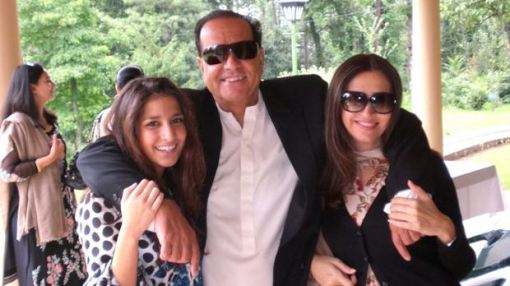
A day after her father was gunned down by an Islamist extremist, a grieving Shehrbano Taseer wrote on Twitter, “A light has gone out in our home today.” It wasn’t long before the 22-year-old realized something else: Her father’s death had lit a fire in her.

In the months since, the daughter of the late Punjab province Gov. Salmaan Taseer has emerged as one of Pakistan’s most outspoken voices for tolerance. Through her writing and speaking, she warns any audience who will listen of the threat of Islamist extremism, and impatiently waits for her father’s killer to be brought to justice.

And yes, sometimes she gets scared. She’s received threats from militants, who’ve warned her to remember her father’s fate.

“These extremists, they want to tell you how to think, how to feel, how to act,” says Taseer, a slim, elegant young woman with intense brown eyes. “It has made me more resolute that these people should never win.”

Salmaan Taseer was assassinated on Jan. 4 at a market in Islamabad by one of his own bodyguards. The confessed killer, Mumtaz Qadri, boasted that he’d carried out the slaying because the outspoken politician — a liberal in Pakistani terms — wanted to change blasphemy laws that impose the death sentence for insulting Islam.

To the horror of Taseer’s supporters, many Pakistanis praised the assassin. Islamist lawyers showered Qadri with rose petals, and major Muslim groups, even ones considered relatively moderate, said Taseer deserved to die because, in their view, speaking out against the blasphemy laws was tantamount to blasphemy itself.

Two months after Taseer’s killing, gunmen killed Shahbaz Bhatti, the sole Christian minister in the government and another opponent of the blasphemy laws, which have often been used against Pakistan’s Christian minority. Bhatti’s killers left a note promising to target others who pushed to change the laws.

Shehrbano Taseer still has trouble remembering those first moments and days after her father’s death — her brother telling her their father was gone, the rush of grief, the hundreds of people flooding her family’s home in the eastern city of Lahore. Mostly, it’s a blur.

“I’d never lost anyone in my life, not a friend or anyone,” she says. “For everyone else it was the governor and their leader and this man, and it was this big, sexy story and it was so sensationalist. But for me, it was my father.”

Taseer majored in government and film at Smith College in Northampton, Massachusetts, and is by profession a journalist. She spends much of her time now writing columns and traveling in and beyond Pakistan to speak about Islamist extremism.

Salmaan Taseer, a father of seven, was not afraid to be blunt — a trait that attracted both enmity and grudging respect. On Twitter, Salmaan Taseer openly taunted and trashed extremists, once tweeting that he’d never back down on the blasphemy issue, “even if I’m the last man standing.”

His daughter, who tweets under the handle shehrbanotaseer, is more gentle but just as firm. Her more than 9,000 followers on Twitter often receive notes that criticize Pakistan’s discriminatory laws, especially blasphemy claims that have reached the courts since her father’s death.

When she singles out a politically marginalized community, either on Twitter or her other outreach, Taseer recalls how well her father treated that group, how he was often the only public official to visit their homes after an attack or publicly speak on their behalf.

Once, Salmaan Taseer took his daughter along on a visit to meet Mukhtar Mai, a Pakistani woman whose case attracted international attention because of allegations that she was gang-raped on the orders of a village council. The governor asked Mai to put her hand on his daughter’s head, so that Shehrbano Taseer could gain the same courage to stand up for her rights.

Like her father and Bhatti, the Christian leader, Taseer wants the blasphemy laws amended to prevent their misuse.

The laws are vaguely written, and often used to persecute minorities or settle rivalries, rights activists say. The state has not executed anyone under the law, but the accused may spend years in custody. Some defendants have been killed by extremists after being freed by the courts.

But Taseer has found that many Muslims, even moderate, liberal ones, are extremely sensitive about blasphemy.

She recalls giving a speech in England when a woman in the audience suggested that her father deserved what he got because he was so blunt about the topic.

“I said, ‘I don’t care what he said, and I don’t care how he said it. He didn’t deserve to be shot and killed for it,'” Taseer says.

She’s dismayed at the toll extremism is taking on Pakistan by spawning violence or an intolerant mindset. She’s also disappointed at how few Pakistani leaders are willing to take a public stand against extremism or how many find some reason to excuse it.

She bemoans how for decades moderate or liberal leaders in Pakistan have appeased the religious right for short-lived political gains — whether it was by banning alcohol and nightclubs or passing laws that discriminate against certain religious sects.

Unlike many Pakistani politicians, she’s willing to criticize the role Saudi Arabia has played in funding numerous hardline Islamist schools in Pakistan. And she’s quick to note that the United States as well as Pakistan says little about it — after all, it needs Saudi Arabia’s oil.

Pakistan has a tradition of dynastic politics. The most famous political family has been that of the Bhuttos, which spawned former Prime Minister Benazir Bhutto, also assassinated by Islamist extremists. Salmaan Taseer was a member of the Bhutto-led Pakistan People’s Party.

Shehrbano Taseer says she views Pakistan as an enticing challenge akin to a Rubik’s Cube because of its many, convoluted problems. But she says she has no plans to run for office. “It’s such a dirty profession,” she says, laughing.

Sherry Rehman, a People’s Party lawmaker who also has been threatened for speaking out against the blasphemy laws, says Shehrbano Taseer will “chart her own future.”

“She’s found a torch to carry, and she will do it,” Rehman says. “It’s what her father would have wanted.”

Taseer is frustrated with the Pakistani justice system’s delays in processing the case of Qadri, her father’s confessed killer.

Pakistan’s courts have very low conviction rates, even in terrorism cases. Qadri’s confession may not be enough to persuade a court to punish him, considering the threats facing any judge who dares pass such a judgment.

Taseer wants the former bodyguard to spend his life in prison, in solitary confinement. A death sentence is “too easy,” and a conviction would send a warning to other would-be assassins, she says.

“In Pakistan, we have very few brave and honest leaders,” she says. “We need our heroes alive.”