Posts Tagged ‘ Pervez Musharraf ’

Musharraf Moves to Mend US-Pakistan Relations

By Lydia Mulvany for The Mimami Hearld

Former Pakistani President Pervez Musharraf said Thursday that his country wasn’t complicit in hiding Osama bin Laden but was “extremely negligent” for not knowing that the al-Qaida leader was living a 75-mile drive from the Pakistani capital.

Speaking in Washington, the former military dictator sought to heal a U.S.-Pakistani relationship that’s become badly strained since the American raid May 2 that killed bin Laden, saying mutual interests in the global war on terrorism bound the countries and that blaming each other was counterproductive.

“The United States and Pakistan must restore trust,” Musharraf told an audience at the Woodrow Wilson International Center for Scholars. “Confrontation would be most unwise.”

The bin Laden incident pushed U.S.-Pakistani relations to their lowest point in years. American officials weren’t happy when, after a decade-long hunt, they found al-Qaida’s leader living in a garrison town so close to Islamabad. Pakistani officials were outraged that they weren’t told about the unilateral raid beforehand.

Since the raid, Pakistan has restricted visas for American officials and expelled military trainers. The U.S. has cut off $800 million, about one-third of its aid to Pakistan’s military. The U.S. has long complained of ties between Pakistan’s military and insurgent groups that have attacked American-led forces in neighboring Afghanistan.

But Musharraf said that if Pakistani intelligence had colluded with bin Laden, it also would have known that the CIA was operating a safe house nearby and whisked the al-Qaida leader away. He described bin Laden’s high-walled compound in the town of Abbottabad as a normal dwelling that wouldn’t have raised suspicion.

He also claimed that Abbottabad – which is home to a major military college that’s been described as Pakistan’s West Point, as well as other military installations – wasn’t a garrison town but a touristy resort area with many colleges.

The recent raid was a “violation of sovereignty,” Musharraf said, echoing a widespread Pakistani complaint. He added that Pakistani antipathy toward the U.S. also stems from the American campaign of drone strikes on militant targets, which reportedly have caused civilian casualties, as well as lingering bitterness over U.S. sanctions for developing nuclear weapons in the 1990s.

The way forward for Pakistan, Musharraf said, is to show that it isn’t complicit with terrorists and to deal with domestic extremism. It also needs to establish an honest, stable government in the 2013 elections, said the former leader, who’s expected to mount a run for president.

Musharraf, who seized power in a military coup in 1999 and resigned in 2008, embodied the frustration and contradictions of American policy toward Pakistan.

Mark Quarterman, a senior adviser at the Center for Strategic and International Studies, a nonpartisan Washington research center, said that many wanted to see Musharraf as a modern, progressive leader: He wasn’t an extremist, his wife and daughter didn’t wear veils and the family even had a dog, an animal many Muslims view as impure. Ultimately, however, Musharraf’s rule was a military dictatorship and, according to many experts, he didn’t do enough to rein in Taliban militants who were operating in remote corners of Pakistan.

Military Puppet. Or Rising Star?

By Rubab Shirazi for Tehelka Magazine

If The unfolding political crisis in Pakistan does not upset junior foreign and economic affairs minister Hina Rabbani Khar’s elevation as full-fledged foreign minister, she appears all set to travel to New Delhi for meeting her Indian counterpart SM Krishna this month for the ministerial meeting of the resumed dialogue process. Her promotion is needed to remove the protocol hitch for the ministerial meeting.

When Khar, 34, became the minister of state for foreign affairs in February, hardly any eyebrows were raised — more so because the ceremonial position has been used since 2004 to accommodate scions of influential families in the Federal Cabinet. Khar’s entry was instead seen as a bid by the government to prioritise the economic aspect in its diplomacy.

But the news of her elevation was met with strong criticism because she was seen as being too young and raw to handle complex foreign policy issues, even though she had been part of the Cabinet since 2004. For a good part of her political career, which started with her election as member of the National Assembly in 2003, Khar has been a low-key politician.

In a country that already has an accidental president (Asif Ali Zardari) and prime minister (Yousuf Raza Gilani), it wouldn’t be a surprise if the foreign minister is also accidental. If things go as planned, she would take oath this month as Pakistan’s 26th foreign minister and bag the honour of being the first woman to hold the post. But, Foreign Office (FO) bureaucrats, who derisively refer to her as “the girl” in private, say that she is no match for most who have occupied this crucial post.

Khar comes from a privileged background, being the daughter of well-known politician Ghulam Noor Rabbani Khar and niece of infamous playboy and former Punjab governor Ghulam Mustafa Khar. The latter’s wife Tehmina Durrani wrote My Feudal Lord, which caused controversy by describing her abusive and traumatic marriage with Ghulam Mustafa and her experience of life in a patriarchal society. Despite her feudal upbringing, Khar graduated from Pakistan’s best business school, Lahore University of Management Sciences and obtained her masters in hospitality from the University of Massachusetts.

Khar’s likely appointment is coming at a time when the country’s foreign relations are not in the best of shape — the alliance with the US is withering away fast; cross-border controversies are marring Pak-Afghan bonhomie; and though the Indo-Pakistan dialogue is progressing, the Thimphu spirit is fading as indicated by recent bilateral meetings.

Even if Khar succeeds in getting the post, diplomatic observers think she will not be the real decision maker — the power would still lie with the military. Having an inexperienced person like Khar as the FO boss, who would depend heavily on bureaucracy for policy as well as administrative matters, suits the military establishment at Rawalpindi GHQ in maintaining its control over Pakistan’s foreign policy.

Unlike her predecessor Shah Mehmood Qureshi, who lost his job for taking a hardline position on immunity for CIA operative Raymond Davis (involved in fatally shooting two youth in January), Khar isn’t thought to be independent minded.

No one at the FO knows about Khar’s views on important issues like relations with the US, Europe, India, Afghanistan and about the War on Terror. She hasn’t given any interviews or delivered speeches on foreign policy ever since she moved to the FO in February, even though she was the de facto boss during this time.

Though much has been written about her meteoric rise in politics, she still remains an enigma. Her credentials for being considered for the crucial post are her two stints as minister of state for economic affairs; a brief assignment as special assistant to the prime minister on finance, revenue and economic affairs; and more lately her FO job.

No one knows Khar’s views on important issues like the war on terror, Indo-Pak relations, or the strained partnership with the US

According to her curriculum vitae, foreign affairs was not a subject of interest until lately. She avows interest in finance, economic affairs and agriculture development. But, quite contrary to her fondness for the three subjects, she runs an upscale restaurant in Lahore. Her husband Feroze Gulzar is a textile industrialist. For most of her career, Khar had been dealing with international loans and grants. Foreign Service officials, who don’t want to be named, caution that real-time diplomacy is a different ball game.

Administrative chaos at the FO, another officer says, grew under the overachieving lady, who had been promoted by the PPP government as an astute manager. Khar was responsible for economic affairs during Gen Pervez Musharraf’s regime. Economic mismanagement turned out to be the major cause of the defeat of her previous party, PML(Q), in the 2008 elections. Fearing that she wouldn’t be given a party ticket, she changed her loyalties weeks before the polls and joined the PPP.

IF SUCCESSFUL in achieving the prized foreign ministership, it would not be the first time she would be filling someone’s shoes. In 2003, she contested elections in place of her father, who couldn’t run for National Assembly as he was not a graduate; in 2009 she became the first woman minister to present the federal budget because former finance minister Shaukat Tarin was not an elected Parliamentarian.

Her inexperience aside, party colleagues say that Khar is deceptively wily and ambitious as they point to how she smartly outmanoeuvered other contenders in the race for the foreign ministry, including former law minister Babar Awan, former foreign minister Sardar Assef Ali and National Assembly speaker Dr Fehmida Mirza — all political heavyweights.

One of her weaknesses is that she isn’t a media darling. Searching online for her interviews turns up a little-known Saturday Post article, that too dated several years ago. On this count, she would turn out to be a weak and ineffectual representative of her country’s foreign policy. In her first media appearance alongside a visiting US functionary Thomas Nides, Khar was unimpressive. Foreign Secretary Salman Bashir hurriedly scripted a few lines for her to deliver before PTV cameras, but according to one official, she struggled with it. Days later, when speaking to the media alongside UK Foreign Secretary William Hague, when she was asked about the prospects of a peace deal with Afghan Taliban, Khar started speaking about a failed peace deal with militants in Swat to prove Islamabad’s commitment to peace with militants. Pakistan, she probably forgot, does not equate Afghan and local Taliban. The government has been treating the two entities differently.

Online discussion boards have been filled with negative comments on her expected elevation. “What a farce. We are at one of the most critical junctures in our foreign affairs, so we decide to hand out perhaps the most important portfolio to a 34-year-old with a degree in hospitality management!” reads a posting on a discussion platform called Pakistan Defense.

What goes in her favour is that apart from allegations by her critics of tax evasion, something normal for a Pakistani politician, she has no major controversies attached to her name.

Pakistan’s Nuclear Surge

By Andrew Bast for Newsweek

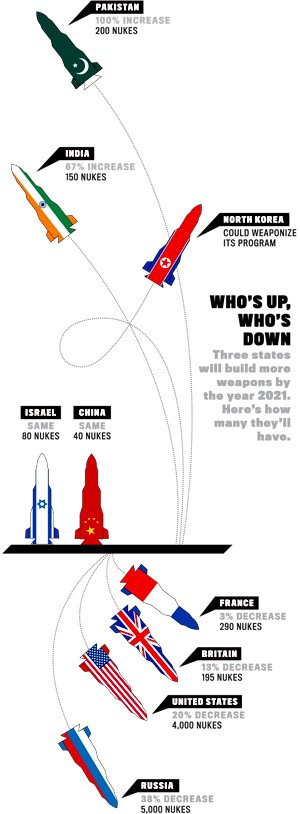
Even in the best of times, Pakistan’s nuclear-weapons program warrants alarm. But these are perilous days. At a moment of unprecedented misgiving between Washington and Islamabad, new evidence suggests that Pakistan’s nuclear program is barreling ahead at a furious clip.

According to new commercial-satellite imagery obtained exclusively by NEWSWEEK, Pakistan is aggressively accelerating construction at the Khushab nuclear site, about 140 miles south of Islamabad. The images, analysts say, prove Pakistan will soon have a fourth operational reactor, greatly expanding plutonium production for its nuclear-weapons program.

“The buildup is remarkable,” says Paul Brannan of the Institute for Science and International Security. “And that nobody in the U.S. or in the Pakistani government says anything about this—especially in this day and age—is perplexing.”

Unlike Iran, which has yet to produce highly enriched uranium, or North Korea, which has produced plutonium but still lacks any real weapons capability, Pakistan is significantly ramping up its nuclear-weapons program. Eric Edelman, undersecretary of defense in the George W. Bush administration, puts it bluntly: “You’re talking about Pakistan even potentially passing France at some point. That’s extraordinary.”

Pakistani officials say the buildup is a response to the threat from India, which is spending $50 billion over the next five years on its military. “But to say it’s just an issue between just India and Pakistan is divorced from reality,” says former senator Sam Nunn, who co-chairs the Nuclear Threat Initiative. “The U.S. and Soviet Union went through 40 years of the Cold War and came out every time from dangerous situations with lessons learned. Pakistan and India have gone through some dangerous times, and they have learned some lessons. But not all of them. Today, deterrence has fundamentally changed. The whole globe has a stake in this. It’s extremely dangerous.”

It’s dangerous because Pakistan is also stockpiling fissile material, or bomb fuel. Since Islamabad can mine uranium on its own territory and has decades of enrichment know-how—beginning with the work of nuclear scientist A. Q. Khan—the potential for production is significant.
Although the White House declined to comment, a senior U.S. congressional official who works on nuclear issues told NEWSWEEK that intelligence estimates suggest Pakistan has already developed enough fissile material to produce more than 100 warheads and manufacture between eight and 20 weapons a year. “There’s no question,” the official says, “it’s the fastest-growing program in the world.”

What has leaders around the world especially worried is what’s popularly known as “loose nukes”—nuclear weapons or fissile material falling into the wrong hands. “There’s no transparency in how the fissile material is handled or transported,” says Mansoor Ijaz, who has played an active role in back-channel diplomacy between Islamabad and New Delhi. “And the amount—they have significant quantities—is what’s so alarming.”

That Osama bin Laden was found in a Pakistani military community, and that the country is home to such jihadi groups as Lashkar-e-Taiba, only heightens concerns. “We’ve looked the other way from Pakistan’s growing program for 30 years,” says Sharon Squassoni, a director at the Center for Strategic and International Studies. What we’re facing, she says, is “a disaster waiting to happen.”

A Defense Department official told NEWSWEEK that the U.S. government is “confident that Pakistan has taken appropriate steps toward securing its nuclear arsenal.” But beyond palliatives, few in Washington want to openly discuss the nightmare scenario of terrorists getting hold of nuclear material or weapons. “The less that is said publicly, the better,” says Stephen Hadley, national-security adviser to President George W. Bush. “But don’t confuse the lack of public discussion for a lack of concern.”

The bomb lends the Pakistanis a certain diplomatic insouciance. Nukes, after all, are a valuable political tool, ensuring continued economic aid from the United States and Europe. “Pakistan knows it can outstare” the West, says Pakistani nuclear physicist Pervez Hoodbhoy. “It’s confident the West knows that Pakistan’s collapse is too big a price to pay, so the bailout is there in perpetuity. It’s the one thing we’ve been successful at.”

Pakistani leaders defend their weapons program as a strategic necessity: since they can’t match India’s military spending, they have to bridge the gap with nukes. “Regretfully, there are several destabilizing developments that have taken place in recent years,” Khalid Banuri of Pakistan’s Strategic Plans Division, the nuclear arsenal’s guardian, wrote in response to NEWSWEEK questions. Among his country’s concerns, Banuri pointed to India’s military buildup and the U.S.’s -civilian nuclear deal with India.

“Most Pakistanis believe the jihadist scenario is something that the West has created as a bogey,” says Hoodbhoy, “an excuse, so they can screw us, defang, and denuclearize us.”

“Our program is an issue of extreme sensitivity for every man, woman, and child in Pakistan,” says former Pakistani president Pervez Musharraf, adding that the nukes are “well dispersed and protected in secure locations.” When asked whether the U.S. has a role to play in securing the arsenal, Musharraf said: “A U.S. role to play? A U.S. role in helping? Zero role. No, sir. It is our own production?.?.?.?We have not and cannot now have any intrusion by any element in the U.S.” To guard its “strategic assets,” Pakistan employs two Army divisions—about 18,000 troops—and, as Musharraf drily puts it, “If you want to get into a firefight with the forces guarding our strategic assets, it will be a very sad day.”

For now, the White House appears to have made a tacit tradeoff with Islamabad: for your cooperation in Afghanistan, we’ll leave you to your own nuclear devices. “People bristle at the suggestion, but it follows, doesn’t it?” says Rolf Mowatt-Larssen, formerly the CIA’s chief officer handling terrorism and weapons of mass destruction. “The irony is that the U.S. presence in Afghanistan and Pakistan, and the money we’re giving them to fight terrorism, could inadvertently aggravate the very problem we’re trying to stop. After all, terrorism and nukes is the worst-case scenario.”

With this fourth nuclear facility at Khushab coming online as early as 2013, and the prospect of an accelerated nuclear-weapons program, the U.S. is facing a diplomatic dilemma. “The Pakistanis have gone through a humiliation with the killing of Osama bin Laden,” says Nunn. “That’s never a time to corner somebody. But with both recent and preexisting problems, we are in a race between cooperation and catastrophe. Both sides need to take a deep breath, count to 10, and find a way to cooperate.”

India’s Own Operation Geronimo?

By Ashok K Mehta for The Wall Street Journal

Every time there is a Pakistan-sourced terrorist attack in India, the reaction in the world’s largest democracy is predictable. Demands range from “hot pursuit” of the terrorists across the border to cries for all-out war. In the last decade, analysts have proposed other alternatives: surgical air strikes, a limited armored offensive and covert operations. The latter option seems especially inviting after U.S. special forces took out Osama bin Laden last Sunday.

These demands for strong action are in stark contrast with the way the Indian government has responded to these attacks: pursuing bland diplomacy. The starker this contrast gets, the more complicated it will be for New Delhi to implement a foreign policy that is assertive, yet careful and deterrent, in the future. Instead, if the government displays the requisite will and capabilities for a targeted strike today, it can avoid the need for an actual strike later.

History offers some perspective. After the Pakistani-based Lashkar-e-Taiba (LeT) and Jaish-e-Mohammed attacked New Delhi’s Parliament in December 2001, the U.S. had to step in quickly to prevent armed clashes between the arch rivals. In May 2002, following yet another terrorist attack and after months of coercive diplomacy by both New Delhi and Washington, Pakistani dictator Pervez Musharraf offered a very strong assurance that his country’s territory would not be used to host attacks against India. This assurance was conveyed to New Delhi by then-U.S. Deputy Secretary of State Richard Armitage, who said that terrorism emanating from Pakistan would end “permanently, irreversibly, visibly and to the satisfaction of India.”

New Delhi bought that assurance and started to reach out to Islamabad diplomatically. Yet its pattern of responses since 2002 has led to six more terrorist attacks originating in Pakistan. All Islamabad has done is give similar reassurances.

After the attack on Mumbai in November 2008, India found itself in the same trap. It issued the usual protests accompanied by vague threats of retaliation and called off the dialogue that had started a few years ago. But Islamabad denied any state complicity. At that point, India’s strategic-affairs and military community noted that New Delhi had to raise Pakistan’s costs of encouraging cross-border terrorism.

However, by 2009, the Manmohan Singh government’s energies were focused on sending dossiers of evidence to Islamabad, pointing to proof of LeT’s hand in the Mumbai attacks. Pakistan’s civilian government stalled on them. Still, Mr. Singh staked his reputation on trying to start a dialogue. Earlier this year it began, most visibly at the sidelines of the cricket world cup.

These diplomatic back-and-forths have not yielded results. Despite playing nice, Islamabad has snubbed its neighbor’s friendliness. Last week, Pakistan’s government called India’s demand for the Mumbai 2008 suspects “familiar and outdated.”

What should New Delhi do then? Even with the world’s fourth largest military, India has failed to deter Pakistan’s cross-border terrorism. Now, the success of America’s Operation Geronimo in killing bin Laden has whetted its appetite to do more. Last week, when asked if India could pull off a similar mission, India’s armed service chiefs replied in the affirmative.

This could well be bravado on the chiefs’ part, because India suffers from fundamental deficiencies. For one, India’s political leadership has been risk-averse. Even before the two sides fought a limited war in Kashmir in 1999, New Delhi had already announced that it would never cross the Line of Control, the de facto border. This tied the Indian army’s hands when Pakistan crossed this amorphous line and claimed Indian soil as its down. More broadly, India has a history of strategic restraint, which means its diplomatic and military strategy hasn’t been focused on assertively achieving select goals.

As a result, India has invested in neither the legal architecture nor the physical capabilities to pull off an Operation Geronimo. For instance, U.S. counterterrorism policy declares that terrorists in breach of U.S. laws who are harbored by any state will be brought back for prosecution through “induced cooperation” and, when necessary, force. India needs something like this. Such laws would give its counterterror operators legal cover as well as set the ground for dealing with other gray legalities in the war on terror.

Then there’s the question of what intelligence and arms India can put on the ground. Its human intelligence across the border and experience in foreign clandestine operations is weak. Unlike the U.S.—which probably maintains an estimated 3,000-4,000 intelligence operatives in Pakistan—India has been scaling back its intelligence infrastructure inside that country for the past 15 years. In the late 1990s, then-Prime Minister Inder Kumar Gujral consciously dismantled this infrastructure as part of a new doctrine for peace, a grave strategic error.

Equipment- and training-wise, too, India falls short. Indian commandos freed the Mumbai hostages with much clumsiness over a prolonged 72-hour operation in November 2008, making some wonder how they would operate in alien environments.

None of this is to suggest that India should prosecute an operation similar to Geronimo in coming months. But being ready for one is necessary. It sends a strong psychological deterrent to those in Pakistan’s intelligence services who may sympathize with and assist the likes of LeT—just like possessing more tanks and fighter jets deters a conventional military threat. It suggests to Islamabad that New Delhi has the necessary political will.

Preparing for such small operations can prevent larger debacles in the future. Unless Pakistan’s military-jihadi complex is completely dismantled, it can still pose a threat to India. And the more that threat looms large and the less India prepares to stay ahead of it, there could come a day when a big terrorist attack makes India’s electorate—infuriated with its government’s bland version of diplomacy—scream for blood.

Political pressure could then compel an Indian prime minister to hurriedly send in a team of commandos without any direction. Worse, it could hurl the subcontinent into full-scale war.

Mr. Mehta is a retired major general of the Indian Army and founder member of India’s Defence Planning Staff.

Pakistan Police Officers to be Arrested Over Death of Benazir Bhutto

By Delacn Walsh for The Guardian

A Pakistani court has ordered the arrest of two senior police officers in connection with Benazir Bhutto’s assassination, reviving hopes for a breakthrough in Pakistan’s most pressing political mystery.

An anti-terrorism court ordered the arrest of Rawalpindi’s former police chief, Saud Aziz, and his deputy Khurram Shahzad, who ordered the crime scene to be washed down less than two hours after the killing, destroying critical evidence.

“They were responsible for Bhutto’s security,” said special investigator Chaudhry Zulfiqar. “They ordered the crime scene to be hosed down despite resistance from other officials.”

A strongly-worded UN report into Bhutto’s death last April said the decision to wash the crime scene did “irreparable damage” to the subsequent investigation. Investigators speculated that Aziz had been influenced by powerful military intelligence agencies.

Aziz and Khurram, who are now retired from the police, could not be contacted today. They are due to be formally charged on 11 December along with five men already in custody.

The warrants are the latest twist in a torturously slow police investigation. Three years after Bhutto was killed in a suicide blast as she left an election rally in Rawalpindi on 27 December 2007, Pakistanis have little idea of who was behind her death.

Pervez Musharraf, who was president at the time, initially blamed Taliban leader Baitullah Mehsud, but officials from Bhutto’s party, the PPP, have said that other forces, possibly including elements of Pakistan’s powerful military, played a role in her death.

Bhutto’s widower, President Asif Zardari, has vowed to unveil her killers, but made little progress in an investigation bogged down by controversy, recrimination and conspiracy theories – one popular rumour in Pakistan has it that Zardari himself was responsible.

The three-man UN investigation into the killing, headed by Chilean diplomat Heraldo MuĂąoz, published its report last April in an effort to bring some clarity. It dismissed the allegations against Zardari and blamed Musharraf for failing to protect Bhutto, while accusing police and intelligence officials of hampering the investigation into her death.

The UN team said that Aziz stalled the investigation for two days after Bhutto’s death, deliberately prevented a postmortem on her body, and gave the order to sanitise the crime scene just 100 minutes after Bhutto’s death. As a result crucial DNA evidence was lost and investigators gathered just 23 pieces of evidence instead of the “thousands” that would be expected, MuĂąoz’s team noted.

The UN focused on the actions of Aziz, who witnesses said was “constantly talking on his mobile phone” as doctors scrambled to save Bhutto’s life in a Rawalpindi hospital.

The UN received “credible information” that the Pakistani intelligence agencies had intervened. But Aziz refused to say who he spoke with, and tried to blame the failure to carry out an autopsy on Zardari – something that was “highly improper”, the UN said. “It suggests a preconceived effort to prevent a thorough examination of Ms Bhutto’s remains.”

The strongly-worded report represented a watershed in moribund efforts to solve the mystery of Bhutto’s death – Pakistan’s greatest political trauma since the dictator General Zia-ul-Haq died in mysterious circumstances in 1988. But it fell short of identifying those behind her death, and government efforts to advance the probe has since floundered.

Bhutto’s own party has been split by divisions. Last week Zardari suspended the membership of Naheed Khan, Bhutto’s confidante, following simmering tensions that included criticism of his failure to find Bhutto’s killers. Critics have also raised questions about the role of Rehman Malik, Bhutto’s security chief and now Pakistan’s interior minister.

The main suspect in custody remains a teenager from the tribal belt accused of helping the Bhutto assassins. His case, and those of the police officers, will be heard in camera at Adiala jail outside Rawalpindi.

But the government has not probed the role of the other parties mentioned in the UN report – former president Pervez Musharraf, currently in exile in London, and the intelligence services that are considered beyond the control of the civilian authorities.

India Denies Visa to Former Pakistan President Musharraf

By Anjana Pasricha for The Voice of America

Indian officials have confirmed that former Pakistani President Pervez Musharraf has been denied a visa. They did not give a reason.

Mr. Musharraf had been invited to speak at a seminar organized by business professionals in New Delhi.

Several of Mr. Musharraf’s supporters, who were planning to visit India with him, were also denied a visa. The former Pakistani military ruler, who lives in Britain, is attempting a political comeback and launched a political party in October.

Foreign affairs observers say that India wants to avoid providing a platform for Mr. Musharraf’s political ambitions, which they believe would be sending a wrong message to the civilian government in Islamabad.

“With Mr. Musharraf threatening to go back to Pakistan to start a political career, the Indian government is not very comfortable with helping him enlarge his political portfolio or image,” said Bharat Karnad, a strategic affairs analyst with the independent Center for Policy Research in New Delhi.

New Delhi has also been irked by Mr. Musharraf’s recent comments that India is responsible for creating unrest in Pakistan’s south-western Balochistan province, and that India is trying to create an anti-Pakistan Afghanistan.

Mr. Musharraf was army chief when India and Pakistan came close to a fourth war in 1999. Later, when he became Pakistan’s military ruler, the South Asian rivals embarked on a peace process which lowered tensions and led to a ceasefire along their tense Kashmir border.

That ceasefire is still holding. But the peace process remains stalled since the November 2008 terror attacks in Mumbai, which India says were planned by the Pakistan-based Lashkar-e-Taiba.

Karnad says New Delhi is unlikely to resume a full-fledged peace dialogue with its rival until its repeated calls to clamp down on groups directing terror at India are heeded.

“There has to be something on the ground is what Delhi wants by way of reassurance before it gets into thinking of resuming the composite dialogue,” added Karnad. “There is no give on Pakistan’s part, so there is unlikely to be any movement in Delhi.”

The top Indian demand is that Islamabad speed up the trial of the Lashkar-e-Taiba operatives it accuses of planning the Mumbai attacks.

India, Pak Almost Agreed on K-deal: Musharraf

 As Reported by The Press Trust of India

Former military ruler Pervez Musharraf on Friday said India and Pakistan were “moving forward towards drafting an agreement” on Kashmir during his tenure and that Prime Minister Manmohan Singh was genuinely committed to peace in the region. “I was certainly trying for it (peace).

And we were reaching success. I have always praised Prime Minister (of India) for his sincerity to reach peace,” said Musharraf, in an interview with NPR. Manmohan Singh and we almost reached peace on all the three issues…the third one, Kashmir, we had made some certain parameters and we were moving forward towards drafting an agreement,” he added. “Unfortunately, that was not to be, but I tried my best.”

Noting that peace is the only way forward, Musharraf noted that the deadlock on Kashmir was rendering the South Asian Association for Regional Cooperation (SAARC) useless.

“And I think the way forward is peace for the sake of world, which thinks that this is a nuclear flash point; for the sake of SAARC, which is impotent because of the conflict because of India and Pakistan,” said the former president.

“And for the sake of bilateral Pakistan-India advantages socio-economic advantages which will flow from peace between the two countries,” he noted.

Musharraf is in the US to drum up support for his comeback, which he announced earlier this year by launching a new political party — the All Pakistan Muslim League that would contest elections in 2013. Earlier this week, he accused India of trying to create an “anti-Pakistan Afghanistan.” “If I’m allowed to be very, very frank, India’s role in Afghanistan is to create an anti-Pakistan Afghanistan, said Musharraf, speaking at the Council on Foreign Relations on Tuesday.

Today, he characterised the narrative of the Indo-Pak dispute as “impartial”. “So, unfortunate reality, why I have to be so emotional about it, is every time it is Pakistan who is a rogue,” he said.

“Indian bomb is not a Hindu bomb. Pakistan bomb is a Islamic bomb. I think we are being very impartial, we are being very unfair to Pakistan…”

Pakistan Looks Ahead to End of Afghan War

By Olivia Ward for The Toronto Star

As NATO forces prepare to pull out of Afghanistan, worries about the country falling back to Taliban control are paramount. But in neighbouring Pakistan, where suicide bombings and brazen attacks on security forces have become regular occurrences, the stakes are also high.

“What happens in Afghanistan affects us and vice-versa,” says Akbar Zeb, Pakistan’s High Commissioner to Canada. “We have four million Afghan refugees still living in Pakistan, and it’s in our interest to have a stable country where we can send them back. A Taliban takeover won’t be just detrimental to Afghanistan. It would harm Pakistan and the whole region.”

Zeb said that under the civilian government of President Asif Ali Zardari, relations have improved with Afghanistan, and contrary to reports of friction, there are “frequent contacts” between the two countries that would be helpful in creating stability.

But he added that Canada, and other Western countries, should not repeat the mistakes of the post-Soviet era, when the West lost interest in Afghanistan and Pakistan as soon as the Soviet troops withdrew.

During the rule of Pakistan’s military leader, President Pervez Musharraf, groups of Taliban-linked militants got a foothold in Pakistan, but were not seen as a danger to the country until internal attacks began to spread. Former prime minister Benazir Bhutto was assassinated, and suicide bombings took the lives of hundreds of civilians. Under pressure from the U.S., the Pakistani military began a massive campaign against the Taliban along the Afghan border.

“We have managed to clear a lot of areas from the Taliban,” said Zeb. “Military campaigns are the only language they understand. But they alone won’t help to win the war. We have border regions with a lot of poverty, and backward elements that have been ignored for a long time.”

Canada has announced support for road and rail projects linking Afghanistan and Pakistan to speed trade between the two countries.

“It’s a very good initiative, but scope is limited,” said Zeb.”We wish the projects were larger and not just (confined to) those that involve both Afghanistan and Pakistan.”

Talks with Islamabad are also ongoing on the use of ports in Karachi for shipping out Canadian troops and military supplies from Afghanistan.

But as the war continues, Pakistan has also been urged to be tougher on the Taliban. In the past two years it has carried out attacks against the militants in its border regions with some success, while American-launched drone strikes have killed high-ranking Taliban. The catastrophic floods that wiped out some of the most important agricultural areas of Pakistan brought a temporary truce, but militant attacks have resumed since the waters receded.

Last week, talk of a peace deal between the notorious Taliban-linked Haqqani network, and an opposing tribe in the remote northwest raised fears that it could open the way for Taliban access to strategic border areas. But the U.S. has also urged a Pakistani offensive against the network in North Waziristan, a volatile region where 400,000 civilians are vulnerable to displacement.

According to Pakistani officials, the country has lost some 7,000 security forces in a decade of fighting the militants — more than three times the coalition deaths in Afghanistan. Meanwhile 30,000 Pakistani civilians have died. The border region, a tangle of mutually hostile tribes, remains a haven for militants.

“It’s a difficult balance for Pakistan,” said Zeb. “Foreign troops may leave, and for them Afghanistan is a distant land. We’re Afghanistan’s neighbours. We helped with the fighting in the decade-long war against the Soviets. And we have to live with the outcome of this war.”

Pakistan’s Musharraf is Launching a Long-Shot, Long-Distance Bid to be President Again

By Zain Shauk for The Houston Chronicle

Former Pakistani President Pervez Musharraf hopes to retake the leadership of his country, and he is actively campaigning — in Texas.

Musharraf, who relinquished his presidency in 2008, has a set of Houston meetings planned this week with wealthy Pakistani-Americans and corporate leaders.

He is scheduled to meet today with former President George H.W. Bush and Joanne King Herring, a longtime advocate for development in Afghanistan and Pakistan who was played by actress Julia Roberts in the film Charlie Wilson’s War.

Musharraf, a London resident, announced this month the creation of a new political party and a plan to run in Pakistan’s 2013 parliamentary elections.

But he has kicked off his campaign in the U.S., a decision that could say more about the perceived influence of the Pakistani-American community in cities such as Houston than Musharraf’s chances for success, experts say.

Musharraf said he believes connecting with Pakistanis in America will give him enough backing — financially and politically — to carry him to victory in Pakistan.

“I do need financial support, and I would ask the American Pakistani diaspora to support me … because I see darkness in Pakistan,” Musharraf said. “Because I don’t see a political party or a leader in Pakistan to be able to tackle the problems that Pakistan is facing.”

While Musharraf enjoys backing from the Pakistani-American elite, experts say he will be hard-pressed to develop a political base within his country and likely does not stand a chance against more established parties.

He is also in no position to campaign within Pakistan. Safety is a concern after multiple assassination attempts during his presidency, and he would likely face prosecution in connection with several criminal cases currently pending in Pakistani courts, experts said.

Still, Musharraf’s interest in wooing deep-pocketed Pakistani-Americans is revealing, said Walter Andersen, associate director of the South Asia program at Johns Hopkins University.

Not only do Pakistani-Americans play a role in financially supporting candidates, but their meetings in America are covered by Pakistani news media and seem to give politicians the idea that they are gaining traction, Andersen said.

Former Prime Ministers Benazir Bhutto and Nawaz Sharif also visited U.S. communities while campaigning, he said.

“Whether it works is not important,” Andersen said. “The perception among them (politicians) is that it works.”

Wide-ranging itinerary
U.S. communities don’t play a visible role in Pakistani elections, but Musharraf could stand to gain from his current North America tour, said Jamal Elias, an expert on contemporary Pakistan and chairman of the religious studies department at the University of Pennsylvania.

Musharraf’s itinerary will include stops in Chicago, New York, San Francisco and Toronto. He visited Dallas last week.

“Appearing statesman-like is going to help him in Pakistan,” Elias said. “It’s not going to build a constituency, but it may help him.”

There are more than 75,000 people of Pakistani origin in the Houston area, which includes more than 800 doctors, executives in the energy and information technology industries and scores of business owners, according to the Consulate of Pakistan in Houston.

Many of them have in the past contributed financially to political parties in Pakistan and will likely do so again, said M.J. Khan, a former Houston city councilman and member of the Pakistani community.

Khan said he does not send money to Pakistani political candidates, but knows U.S. residents in Houston and elsewhere who do. “They’re an educated community, and they send a lot of resources to Pakistan,” Khan said. “So I think every politician in Pakistan feels the Pakistani-American community is an important group to reach out to.”

Tactics questioned
Some community members – including Sajjad Burki, president of a Houston chapter for a political party headed by Pakistani cricket star Imran Khan – were not sure of the former president’s legitimacy as a candidate. Burki questioned Musharraf’s campaign tactics and priorities.

“It doesn’t make sense for him to be creating a political party and campaigning abroad rather than campaigning in Pakistan,” he said.

Herring, who is hoping to build support for Musharraf’s candidacy, said she planned to back him because of his support for her development efforts in Afghanistan.

“I think that Musharraf is interested in my plan,” Herring said. “I know he is. He supports it.”

Seeks ‘legitimacy’
Musharraf, a retired general, said he hopes a possible election to office will give him “the legitimacy that maybe I didn’t have in the past” as someone who had seized control of the government in a 1999 military coup.

He spent much of a luncheon Tuesday discussing the threats to Pakistan created by instability and lack of development in Afghanistan. Asked how he would solve that and a host of other challenges, Musharraf paused and smiled at his audience.

“First of all, get me elected,” he said.

Musharraf Says Plans to Form New Party, Contest Pakistan Elections in 2013

By Simeon Bennett for Bloomberg News

Pervez Musharraf, the former president of Pakistan, said he plans to form a new political party and contest elections scheduled for 2013, before seeking to become prime minister or president.

“A time has come in Pakistan where we need to introduce a new political culture, a culture which can take Pakistan forward on a correct democratic path, not an artificial, make-believe democratic path,” Musharraf, 67, said in an interview with the British Broadcasting Corp.

Musharraf, a former army chief who seized power in 1999 and became a U.S. ally against terrorism, stepped down as president in 2008 to avoid impeachment charges for illegally seizing power and mishandling the economy. He left Pakistan after resigning and now lives in London, according to the BBC.

Police in Pakistan last August issued charges against him for unlawfully keeping top judges under house arrest in 2007, when he imposed emergency rule in the country.

Musharraf said if he returns to Pakistan he will face some legal cases, may risk being killed, and will answer every allegation against him, the BBC reported.

Opinion polls, which show Musharraf’s popularity is low in Pakistan, can be manipulated, he said, adding that his popularity is increasing.

“As far as Pakistan as a state and the people of Pakistan are concerned, we did wonders for them in those seven years, which should be compared with the 50 years of the past,” Musharraf said.

Vengeful New Militant Group Emerges in Pakistan

By Kathy Gannon for The Associated Press
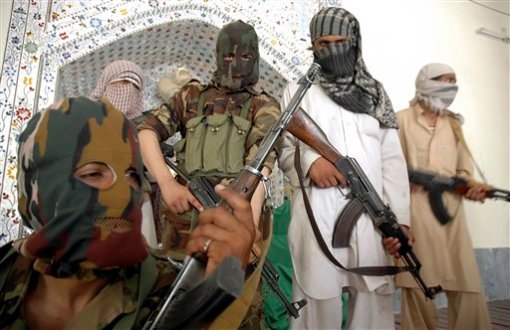
Pakistani authorities now believe a dangerous new militant group, out to avenge a deadly army assault on a mosque in Islamabad three years ago, has carried out several major bombings in the capital previously blamed on the Taliban.

The emergence of the Ghazi Force was part of the outrage among many deeply religious Pakistani Muslims over the July 2007 attack by security forces against the Lal Masjid, or Red Mosque, a stronghold of Islamic militants.

The fierce attack, in which scores of young, heavily armed religious students died, inspired a new generation of militants. These Pakistanis have turned against a government they felt has betrayed them and, to their dismay, backed the U.S. role in neighboring Afghanistan.

The brief but bloody history of the Ghazi Force illustrates the unintended results of Pakistan’s policy of promoting Islamic extremists to fight India in the disputed area of Kashmir. That policy — which Pakistan denies it pursues — now threatens regional stability as the U.S. and Pakistan’s other Western partners pour billions of dollars into the country to stop the rise of Islamic militancy.

The new group is made up of relatives of students who died in the Red Mosque assault. It is named after the students’ leader, Maulana Abdul Rashid Ghazi, who was also killed. The mosque’s religious school, or madrassa, had been a sanctuary for militants opposed to Pakistan’s support of the U.S.-run war in Afghanistan.

Private television stations broadcast vivid scenes of the assault — commandos in black fatigues rapelling down ropes, the crackle of gunfire, bodies of black-shrouded girls carried out through the smoldering gates. Those images stunned the nation, especially families of the students and Pakistanis with deep religious feelings.

“Before the Lal Masjid, militants hadn’t yet declared war on the state of Pakistan. That changed with Lal Masjid,” said Zahid Hussain, author and terrorism expert who has written extensively about Pakistan.

Islamabad’s inspector general of police, Kalim Imam, told The Associated Press that the Ghazi Force was behind most of the deadliest attacks in the capital during the last three years. The attacks targeted the military, the Inter-Services Intelligence agency or ISI — which had ties to a number of militants — and a five-star hotel frequented by foreigners and the Pakistani elite.

The Ghazi Force helped recruit a security official who blew himself up inside the office of the World Food Program last October, killing five people, according to Imam. The force also sent a suicide bomber in September 2007 into the mess hall of the commando unit that attacked the Red Mosque, killing 22 people, he said.

Ghazi Force members may also have been involved in the audacious June 9 attack north of the capital that killed seven people and destroyed 60 vehicles ferrying supplies to NATO and U.S. soldiers next door in Afghanistan, Imam said.

Many of those attacks had been attributed to the Pakistani Taliban, which operates in the remote tribal areas of the northwest along the border with Afghanistan. There is evidence of close ties between the Ghazi Force and the Pakistani Taliban, which the government has vowed to crush.

The Ghazi Force is believed to be headquartered in the Orakzai region of the border area, where the leader of the Pakistan Taliban, Hakimullah Mehsud, held sway for years. The leader of the Ghazi Force is believed to be Maulana Niaz Raheem, a former student at the Red Mosque.

Anger over the bloodshed at the mosque was all the greater because many of the militants and their supporters felt betrayed by a government that had once supported them. Both Ghazi and his brother Maulana Abdul Aziz Ghazi, who was freed on bail this year after two years in jail, were widely believed to have been on the payrolls of both the government and the ISI intelligence service.

Their father, Maulana Mohammed Abdullah, enjoyed a close relationship with the late President Mohammad Zia ul-Haq, and the mosque was a center for recruiting volunteers to fight against the Soviets in Afghanistan in the 1980s.

As opposition grew to Pakistan’s support of the U.S. role in Afghanistan, the mosque became a center of religious agitation against the government, with armed students taking over the complex and police laying siege.

A former senior official in the Interior Ministry told The Associated Press that the police wanted to storm the mosque and end the siege at its outset, send the students home and shut down the religious school and a neighboring library until tempers cooled.

President Gen. Pervez Musharraf refused, the official said, even though police knew that members of al-Qaida’s affiliate organization Jaish-e-Mohammed, which is banned in Pakistan, were bringing in weapons for the students.

Musharraf relented and ordered the assault after militants kidnapped several Chinese nationals running a massage parlor in Islamabad, accusing them of prostitution. The death toll remains in dispute. Red Mosque officials say hundreds died. The government says fewer than 100 were killed.

In a rare interview, Abdul Aziz Ghazi told AP he warned the government that an assault on the mosque would unleash forces that no one could control.

“I have been in jail. I did not form this force and I don’t condone the violence but they are angry at the injustices done,” he said this week.

Although the assault turned many Islamic hard-liners against the government, Pakistan remains unwilling to break all ties to the militants, instead following a high-risk strategy of coddling “good militants” while fighting those deemed “bad militants,” analysts say.

“The military and the ISI have given importance to these militants as assets. But those who have openly declared war, and there is no chance of them returning back to the state, the army is going after them,” said Manzar Jameel, a terrorism expert and researcher on the growth of extremism in Pakistan. “Yet they still believe that some are still assets and that they can keep control of the assets. It’s a failure of strategy.”

Army spokesman Maj. Gen. Athar Abbas denies any assistance to militant groups, saying past ties have long since been severed. He says the Ghazi Force is among the groups the 120,000 Pakistani soldiers waging war in the tribal regions are fighting.

Yet Anatol Lieven, a terrorism expert with the Department of War Studies at London’s King College, said it’s clear that the ISI continues to protect some militant groups, even if it has broken with others.

In a June report, the Rand Corporation think tank also alleged that Pakistan’s military and intelligence still support some militant groups “as a tool of its foreign and domestic policy.”

“A key objective of U.S. policy must be to alter Pakistan’s strategic calculus and end its support to militant groups,” the report said.

Christine Fair, a co-author of that report and an assistant professor at Georgetown University’s Center for Peace and Security Studies, said the battle against extremists in Pakistan is mired in layers of subterfuge by Pakistani intelligence and a “mystifying” acceptance by the CIA of Pakistan’s “good-militant, bad-militant” policy.

She said U.S. intelligence knows Pakistan protects one group — Lashkar-e-Taiba, which India blames for the 2008 Mumbai assault and Afghanistan accuses of masterminding deadly attacks against the Indian Embassy in Kabul.

“Lashkar-e-Taiba remains intact. I have had conversations with … officials in Washington. It is not their priority. Lashkar-e-Taiba is not an issue,” she said in an interview. “Yet Lashkar-e-Taiba has been attacking us in Afghanistan since 2004.”

Former President Musharraf of Pakistan Charged with Illegal Detention of Judges

Islamabad, Pakistan- Pakistan’s Supreme Court has ruled Tuesday that former President Pervez Musharraf acted illegally in detaining and dismissal of judges in 2007 during Pakistan’s political crisis and now faced arrest if he returns from exile.

Musharraf, who now lives in London, could face up to three years in prison if he is convicted. This charge against him is the latest setback and although he could post bail if arrested, many analysts doubt that he would come back to face the charges.  The Supreme Court, led by Chief Justice Iftikhar Mohammed Chaudhry, one of the 60 judges sacked by Musharraf during the national state of emergency, concluded that Musharraf violated the constitution when he dismissed the judges and now is charged with violating the constitution.

Musharraf’s actions at the time were widely seen as an attempt by him from preventing the Supreme Court from declaring him ineligible to holding the posts of president and head of the army at the same time.  He ordered the detention of 60 judges including Chief Justice Chaudhry at their homes, a move that is now seen as being illegal by the courts and the Islamabad police.“He is formally charged now,” said Hakim Khan, a police official in Islamabad, the Pakistani capital. “If he comes to Pakistan, he can be arrested.”

Experts are further stating that this ruling also opens the door for Musharraf to be charged with possible treason, a crime that is punishable with a death penalty. The Supreme Court has left it up to the Pakistani parliament to decide whether to pursue the charge against Musharraf.

The two main political parties in power in Pakistan are split on whether to pursue a charge of treason against Musharraf.  The party of President Asif Ali Zardari, the Pakistan People’s Party (PPP) has not shown much interest in pursuing a treason case against the former president. The opposition party of the former Prime Minister Nawaz Sharif, the Pakistan Muslim League-N party (PML-N) wants to have charges of treason brought against Musharraf.

Musharraf’s harsh dictatorial rule along with his actions against the lawyers and judges in 2007 led to a grass roots movement of lawyers that became crucial in forcing Musharraf to give up his role as the army chief and then eventually drove him out of office as the president also leading to elections won by the widow of Benazir Bhutto, Asif Ali Zardari.

Musharraf was wrong in dismissing the judiciary and in curtailing many institutions of Pakistan that seemed to be a danger to his rule. He had come to power in a bloodless coup that was supported by many people of Pakistan as he went up against a corrupt and ineffective administration of then Prime Minister Nawaz Sharif. He did make some positive changes in the country including backing the US war on terror after September 11 attacks and stepping up and bringing pressure on the Taliban in the country which to that point Pakistan had supported in neighboring Afghanistan.  However, he undoubtedly made the biggest mistake of all when he took on the judicial branch of the government and decided to dismiss anyone who disagreed with him or seemed to be a threat to his power.  Now it seems that this ruling will prevent him from coming to Pakistan as he at the very least faces three years for breaking the constitution and possibly the death penalty if charges of treason are brought against him.

Reporting by Manzer Munir for http://www.PakistanisforPeace.com