Posts Tagged ‘ Peshawar ’

The Continuous Struggle Along Pakistan’s Frontier

By David Ignatius for The Wall Street Journal
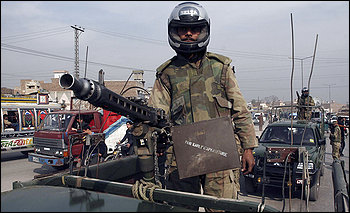
In the same week when U.S. helicopters mistakenly killed three members of Pakistan’s Frontier Corps near the Afghan border, American Special Forces were training members of that same force on how to use radios, sniper rifles and other counterinsurgency tools at a remote base here.

Pakistanis and Americans don’t talk much about this joint training camp, northwest of Peshawar about 20 miles from Afghanistan. But the program is a symbol of the weird duality of the relationship — a mix of public distance and private cooperation that’s awkward for both sides.

“We have good relations; it’s going very well,” Col. Ahsan Raza, the camp commander, said when I visited Tuesday afternoon, two days before the fatal U.S. cross-border attack. But the Pakistani commandant was eager not to appear too close to America, stressing that the U.S. trainers were supplying technical skills, not running the show.

Both sides view the program here as a success story. But the joint effort masks a tension that is only likely to deepen in coming months.

Pakistan wants to use the 70,000-strong Frontier Corps to stabilize the Federally Administered Tribal Areas, or FATA, and halt the domestic Taliban insurgency. The United States, struggling in Afghanistan, wants Pakistan to help seal the border and destroy the sanctuaries used by al-Qaeda and the Afghan Taliban. The two sides talk as if their goals are identical, but they aren’t. The differing priorities became clear in conversations last week with Pakistani commanders.

Warsak is a pet project of Maj. Gen. Tariq Khan, the commander of the Frontier Corps. At his headquarters in the ancient Bala Hissar fortress in Peshawar, the traditional garb of the tribal “scouts,” as they’re called, makes you wonder whether the days of the British Raj ever really ended. Behind Khan’s desk is a plaque bearing the names of his predecessors back to 1907.

Khan argues that it’s time for Pakistan to move from big military offensives in the tribal areas to what he calls “policing” actions. “No steamroller operations,” he says.

Lt. Gen. Asif Yasin Malik, who commands the Pakistani army in the western border areas and is Khan’s boss, makes the same point. “Don’t expect major new kinetic operations,” he says. “We have changed gears to a softer approach.”

This can’t be comforting to Gen. David Petraeus, the U.S. commander in Afghanistan. He is said to have concluded, after several months in Kabul, that more Pakistani pressure on the havens is crucial for American success. That’s the basic conflict — an overstretched America wants a Pakistani surge in the tribal areas; an overstretched Pakistan just wants to keep the peace.

Khan’s strategy is an updated version of the old British approach: work through the tribal chiefs, or maliks, keep the roads open and pound any renegades back into line. He wants to maintain order through three tiers of force: local militias, known as “levies,” recruited by the maliks; the Frontier Corps dispersed across the FATA; and the big guns of the Pakistani army.

Working with the American trainers at Warsak, Khan has devised some smart tactics: Private vehicles in the FATA will have electronic chips that register their movements. The scouts will report suspicious activities on their American-made radios, and the snipers will blow away any miscreants using their American-made sniper rifles. To demonstrate that order is returning, the burly Khan, the scion of a princely Pashtun family, took a car trip last summer through the FATA with his wife and daughter.

Khan’s enthusiasm is infectious: “There are no safe havens in my area of responsibility — I can take you anywhere, any place, anytime.” That sidesteps the fact that North and South Waziristan, the main trouble spots, are still the responsibility of the army.

Driving down the roads of the border areas, you sometimes have the sense that you are traveling back in time. But that “back to the future” strategy is a temporary fix, at best. Pakistan, with U.S. support, should be moving forward, not in reverse. The years of war have shattered the old tribal order, and the long-run goal should be to bring the tribal areas into a modern Pakistan, rather than let them fester on their own.

U.S. drone attacks and other firepower can keep the insurgents on the run, but they won’t bring stability. Neither will Tariq Khan’s snipers. Somehow, the people in this desolate region have to feel they have a stake in a future that’s something other than continuous warfare.
Bomb Strikes Shiite March in Pakistan

As Reported by The Associated Press

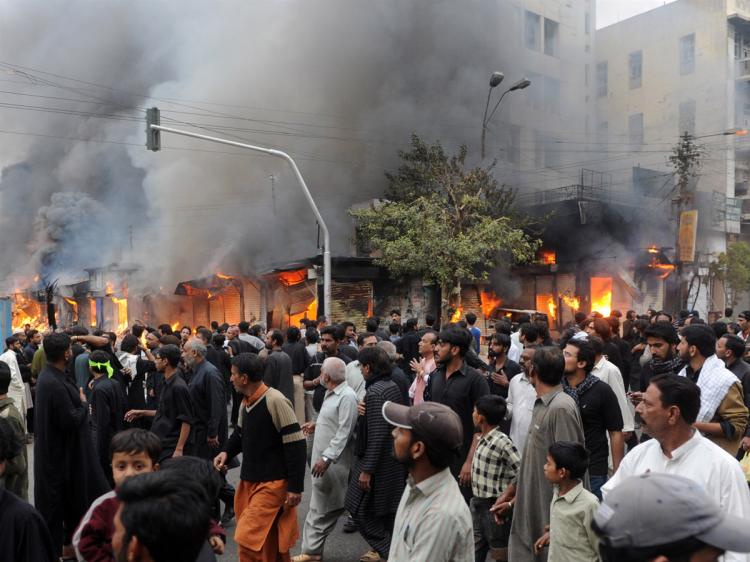
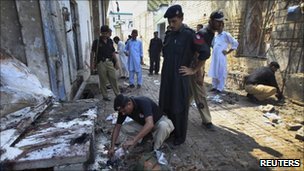
Three bombs ripped through a Shiite Muslim religious procession in the eastern Pakistani city of Lahore on Wednesday, killing 25 people and wounding about 150 others, officials said.

The explosions appeared to be the latest in a string of attacks by Sunni extremists against the minority Shiites they consider infidels. Allied with al-Qaida and the Taliban, the bombers are also seeking to destabilize Pakistan’s U.S.-backed government.

The blasts were the first major attacks since Pakistan was hit by devastating floods more than a month ago. Lahore, the country’s political capital and home to much of its military elite, has been regularly targeted by militants over the past two years.

The bombs exploded at three separate sites Wednesday evening as 35,000 Shiites marched through the streets of Lahore in their traditional mourning procession for the caliph Ali, one of Shiite Islam’s most respected holy men.

Prime Minister Yousuf Raza Gilani condemned the blasts in a statement and said the attackers would not escape justice.

After the blasts, the marchers erupted in fury, setting fire to a police station, another police facility, two police cars and three motorcycles, said Zulfiqar Hameed, a senior police officer. Police lobbed tear gas canisters at the crowd and fired shots in the air to disperse the assailants, he said.

The first blast was a time bomb that exploded in the street near a well-known Shiite building, Hameed said. Footage of that explosion shown on Geo television showed a small blast erupting amid a crowd of people on the street followed by a large plume of smoke. Hundreds of people fled from the blast, while others rushed to carry the wounded to safety.

Minutes later, with the streets in chaos, a male suicide bomber who appeared about 18 years old tried to force his way into an area where food was being prepared for the marchers to break the traditional Ramadan fast and exploded, Hameed said. Soon after, another suicide bomber detonated himself at an intersection near the end of the procession.

Abbas Kumaili, a prominent Shiite scholar as well as a senator, called for three days of mourning over the attack and lashed out at the bombers.

”They are our enemies, both Shiites and Sunnis should remain united and foil their evil designs,” he said.

The blasts killed 25 people and wounded about 150 others, said Sajjad Bhutta, a top local government official.

Hours earlier, three people were wounded in a shooting near a similar Shiite procession in the southern city of Karachi, but senior police officer Iqbal Mahmood said the incident did not target the march.

Islamist extremists have a history of attacking Shiites, non-Muslims and others they deem unacceptable.

In July, twin suicide attacks at Pakistan’s most popular Sufi shrine killed 42 people. Another suicide bomber wounded eight worshippers at a Shiite mosque in eastern Pakistan.

Meanwhile, a bomb exploded near a police vehicle in the town of Shabqadar in northwest Pakistan, killing one passer-by and wounding 15 people including one police officer, police officer Nisar Khan said.

The bombings came after Pakistan army jets and helicopters targeted militant hide-outs near the Afghan border, killing 60 people identified as insurgents or their family members, including children, said security officials and a witness.

The attacks occurred Tuesday and Wednesday in different parts of the region.

There was no independent confirmation of the casualty figures because the area is too dangerous for outsiders to visit.

The raids Tuesday took place in several villages in Teerah Valley in the Khyber region and killed 45 people, the officials said. One official said some vehicles rigged with explosives had also been destroyed. He could not say how many.

He described the dead as insurgents, but said it was possible that people living with them could also have been killed. Separately, an intelligence officer said some women and children had been killed in the attacks.

Jihad Gul, who lives near one of the villages, said he had seen the bodies of at least 20 women and children.

Army spokesman Maj. Gen. Athar Abbas said reports of civilian casualties were unconfirmed.

The security officials spoke on condition of anonymity because they were not authorized to speak to the media.

An air attack Wednesday in the adjoining district of Orakzai killed 15 suspected militants and wounded 10 others, according to local government official Jamil Khan and a brief army statement.

Pakistan’s army has been fighting Islamist militants in different parts of the northwest for more than two years.

Militants who fled major operations in the South Waziristan and Orakzai tribal regions are believed to have set up new bases in Khyber, about 60 miles (100 kilometers) northwest of the main city in the region, Peshawar.

Officials: Pakistan Flood Deaths Top 1100‎

As Reported By CNN

The devastating floods in Pakistan have killed more 1,100 people, Pakistani government officials told CNN on Sunday. Another 30,000 people were stuck on their rooftops and in higher areas as they tried to escape rushing floodwaters, a United Nations official said Sunday.

“We’ve got the government sending boats and helicopters to try to reach people and bring them to safety at the same time as trying to deliver emergency relief,” said Nicki Bennett, a senior humanitarian affairs officer for the U.N.

Damaged roads and bridges have made rescuing stranded residents difficult, she said, noting that even a U.N. warehouse where the organization stores food, blankets, soaps and bucks is partially underwater. “As we are trying to reach people, we have to battle with the ongoing access problems,” she said. The rescue and recovery efforts of the Pakistan flooding could become more complicated as weather officials predict more monsoon rains starting Monday.

The Pakistan Meteorological Department said Sindh, Punjab, Kashmir, eastern parts of Khyber-Pakhtunkhwa and eastern parts of Balochistan would receive monsoon rains. Areas along the Indus River would be badly affected due to extremely high flood conditions.

The number reflects those killed only in Khyber Pakhtunkhwa province, previously known as the North West Frontier Province, said spokesman Mian Iftikhar Hussain. Flooding has also been reported in Pakistani-controlled Kashmir. Twenty-five deaths were recorded there Friday, Hussain said.

A Pakistani Red Crescent official told CNN that the number of people affected by the floods has risen to nearly 2.5 million people, with infrastructure receiving major damage. Rushing water also has washed away thousands of acres of crops, government buildings, businesses, schools, bridges and homes, officials said.

The United States will assist in relief efforts by bringing in 50,000 meals, rescue boats and helicopters, 12 pre-fabricated steel bridges and water filtration units, the embassy in Islamabad said.

According to Geo TV, 150 people are missing in a northwestern province, and 3,700 homes were swept away. Forty-seven bridges in Swat have been destroyed or damaged.

Geo TV also said 3,000 are in a camp in Nowshera and are without enough water and food. Displaced residents are unhappy with the government response, Geo TV said. Trains have also been delayed, frustrating commuters.

“They have made this a joke,” a commuter told the network. “There are young children here, but there is no water, nor is there any seating. They have taken our ticket money. Yet after every few minutes they change the train timings. They are playing a game of lies and deceit.”

Pakistani Interior Minister Rehman Malik visited Khyber Pakhtunkhwa on Saturday and found tourists and local residents trapped because of the heavy floods, the state-run Associated Press of Pakistan reported.

President Asif Ali Zardari said all available resources would be used to help those stranded by the waters, the APP reported.

Many of the victims died when flood waters swept away hundreds of mud houses in parts of Swat Valley and the districts of Shangla and Tank, according to Bashir Ahmed Bilour, a provincial minister in Khyber Pakhtunkhwa.

Hussain said flooding has cut off the Swat Valley and the districts of Shangla and Peshawar. There is no way to get to these areas by road, he said.

The Pakistani Air Force has been helping with rescue efforts, spokesman Tariq Yazdanie said in an interview on Pakistani TV. The recent torrential rains have broken all previous records of rainfall in the country, he said.

The United Nations said there is a need for help in providing emergency shelter, food, drinking water and sanitation facilities. Its agencies are geared to help with these issues.

The European Commission is providing 30 million euros ($39 million) to help the people affected by the flooding.

U.S. Embassy officials in Pakistan said the United States has committed $10 million to support flood relief priorities, four inflatable rescue boats, two water filtration units that can fulfill the daily water requirements of up to 10,000 people, and 12 pre-fabricated steel bridges to temporarily replace damaged bridges.

U.S. officials have also provided more than 51,000 halal meals (military rations tailored for people of Islamic faith) and another 62,000 will arrive Sunday.

In addition, the U.S. provided helicopters to support the Ministry of Interior’s rescue operations.

The same weather system is also responsible for flooding in bordering Afghanistan, where 65 people have died, and 61 were injured since Thursday, according to Abdul Matin Adrak, head of disaster management for Afghanistan.

The flooding started Thursday and continued for more than six hours. Rescue teams were able to access all the flooded villages using ministry of defense helicopters. Food and equipment was donated and transferred to the affected people by ISAF and Afghan Security forces.

U.S. Air Force Lt. Col. Greg “Boomer” Roberts, adviser to the Afghan Air Force, told CNN Sunday morning that the Afghan air force rescued about 2,000 villagers who were stranded. Roberts accompanied the air force during their rescue mission in the Kunar province — a known insurgent stronghold.

“They knew they could accomplish their mission. When we came into the area and the Taliban made their presence known, they continued … and picked up 2,000 people who were definitely overcome by the floods. And they did it right there in full view of the Taliban.

“There’s not a doubt in my mind that some of the folks we picked up are Taliban,” he said, adding that most were probably looking for employment with the organization. He said the rescue mission is the type of move that could sway people away from the Taliban and toward the Afghan government.

Pakistan Suicide Bomber Targets Mourners

As Reported by BBC News

A suicide bomb near Peshawar has killed seven people near a gathering mourning a cabinet minister’s son murdered in a suspected Taliban attack, police say.

About 20 people were also injured when the bomber struck on foot near the home of Provincial Information Minister Mian Iftikhar Hussain in the town of Pabbi. Three policemen and four civilians died. The minister was not among the mourners.

The Taliban has told the BBC it killed his 28-year-old only son two days ago. The suicide bomber detonated his explosives near a mosque where people had gathered in mourning on Monday.

Police said the attacker was dropped off by a man on a motorcycle near the minister’s home in the town, 26km (16 miles) east of Peshawar.

“He [the bomber] was a young boy,” senior police officer Liaquat Ali told news agency Reuters.

“He was trying to cross the checkpost but when our policemen caught him, he exploded himself.”

Mian Iftikhar Hussain is considered the provincial government’s most outspoken critic of the Taliban militants who have carried out dozens of bombings in the area.

BBC Islamabad correspondent Ilyas Khan, whose hometown is Pabbi, says the minister and other VIPs were probably not the direct targets of this blast, as it was well known they were gathering at a college building several kilometres away.

Our correspondent says the militants may have been sending a message that they can reach Mr Hussain’s home should they choose.

A spokesman for the Pakistani Taliban, Ehsabullah Ehsan, has told the BBC the group was responsible for gunning down the minister’s son, Rashid Hussain, near his home in Pabbi on Saturday.

The town is close to the home village of Pakistani-American Faisal Shahzad, who admitted to trying to blow up New York’s Times Square in May.

Bombs and attacks blamed on Taliban and al-Qaeda-linked militants have killed more than 3,500 people across Pakistan, it is estimated, since government troops besieged a radical mosque in Islamabad in July 2007.

Much of the violence has focused on north-west Pakistan’s border area with Afghanistan, where US and Nato troops are battling to turn around a nine-year war against the Taliban.

The Pakistan America Peace Through Music Project

A Musical Journey to Peace, Freedom and Understanding
(A Collaboration of The Sonic Peace Makers and SHINE HUMANITY)

The following information in this article is taken from the Peace Through Music webpage on Global Giving at:  http://www.globalgiving.org/projects/peace-through-music/  

Peace Through Music (#5719)

Mention Pakistan today and what comes to the minds of most Americans is terrorism, poverty, and hopelessness. That’s all they see in the news. But Pakistan also has one of the world’s most diverse and rich cultures, equaled only by its spectacular natural beauty as home to part of Kashmir, the Khyber Pass and high mountain peaks like K2. Once upon a time in the not so distant past, Texan gun enthusiasts brought their prized antique revolvers to Peshawar’s gun smiths to make copies, actor Robert DeNiro posed for pictures with restaurant owners while vacationing in Chitral, and Mick Jagger tested his dance skills with Lahore’s most well-known Mujra dancers. And many of Pakistan’s greatest musicians and singers like Nusrat Fateh Ali Khan regularly collaborated with their counterparts in Europe and America such as Peter Gabriel and Pearl Jam’s Eddie Vedder.

Two decades ago, we failed to uphold our principles and fulfill a moral obligation to help rebuild Afghanistan and assist Pakistan with the painful aftermath of the Soviet-Afghan war, which included millions of Afghan refugees who still reside in Pakistan. In stark contrast, we helped rebuild our enemies Germany and Japan after WWII, but inexplicably abandoned our friends after the war in Afghanistan, a key factor in allowing extremists to begin their destructive swarm across Afghanistan and Pakistan’s western frontier and become a grave threat to the security and stability of the entire world. But today, while the wounds are deep and the challenges are great, the forces of light and sonic harmony are again on the ascendance. Pakistan today is home not just to 11 music video channels and has one of the most innovative and vibrant music scenes anywhere in the world. A country that has produced some of the greatest sitar and tabla players is today home of some of the finest singers, guitar shredders and drummers. Music pioneers like Junoon, the godfathers of “Sufi Rock,” are joined by Qawwali rockers like Mekaal Hasan and Aaroh, indie projects like Peshawar’s Sajid and Zeeshan, and Heavy Metal innovators like Akash and Karavan. In recent years Atif Aslam has become the most successful Pop singer in all of South Asia with a growing following world-wide.

The Pakistan America Peace Through Music Project was inspired by the work of Greg Mortenson (author of the bestseller “Three Cups of Tea” and “Stones Into Schools”) and is based, among other things, on world music pioneer Manu Dibango’s declaration that musicians are “all from the same tribe” regardless of their race, nationality or religion and John Coltrane’s belief in the power of music to spread peace and harmony. Building on the millennia-long tradition of musical and cultural exchange in Pakistan and South and Central Asia more broadly, we will bring a group of leading musicians from the U.S. to Pakistan led by guitarist/producer Lanny Cordola (House of Lords, Giuffria, The Beach Boys), drummer/producer Matt Sorum (Guns ‘n’ Roses, Velvet Revolver), singer/guitarist Todd Shea and many others for a month long musical caravan throughout the country, creating and performing with some of Pakistan’s most well known, talented and innovative artists such as Atif Aslam, Shehzad Roy, Strings, Arieb Azhar, Abda Parveen, Ustad Fateh Ali Khan, Rustam Fateh Ali Khan, Beo Rana Zafar and celebrated record producer Rohail Hyatt (Vital Signs, Coke Studio). The inspiring poetry of Allama Iqbal and other revered poets will be prominently featured as an artistic and cultural base for the musical collaboration. Later on in the year, the Pakistani musicians will come to the U.S. for performances and events joined by their American comrades (including members of Guns ‘n’ Roses, Velvet Revolver, Red Hot Chili Peppers, etc.), which will also include time for more song writing and recording. Both the Pakistani and American “legs” of the gathering will be filmed for a documentary. The music and film will then be completed and released for sale on CDs & DVDs.

Goals
The project’s goals will be to bring Americans and Pakistanis closer together by erasing misconceptions and raising awareness of the diversity and beauty of Pakistan and its people, ultimately revealing the commonalities between Pakistani/Muslim and American cultures, to show Americans the Pakistan they never see in the mainstream media and to support Pakistan’s courageous artistic community, as well as raise funds and awareness to help establish and equip music schools and fund innovative health and education projects across Pakistan and Afghanistan. Once the initial project has been released, the music will continue with a series of collaborations with musicians and artists from all over the world to bring people together and help people in need.

Help bring people from all over the world closer together through a musical journey designed to erase misconceptions and build bridges of Peace and understanding between Human Beings.
Go to http://www.globalgiving.org/projects/peace-through-music and donate to the project.

More Information About this Project
Project Needs and Beneficiaries
SHINE Humanity and The Sonic Peacemakers need your support to help raise the funding needed to produce, record, film and document musical collaborations between singers and musicians from all over the world to promote peace and support humanitarian aid projects.

Activities
Musical fusion and celebration of diverse cultures will erase misconceptions and raise funding which will lead to a lasting positive effect on vulnerable children in developing nations, and help create a better, safer world for all Humanity

Funding Information
Total Funding Received to Date: $9,620
Remaining Goal to be Funded: $490,380
Total Funding Goal: $500,000

Why this Project is Important
Potential Long Term Impact

Project Message
“Music has incredible power to inspire and energize Human Beings to bridge divides and create a better world”
– Todd Shea, Chief Operating Officer

Who is Running This Project
Contact
Todd Shea
Executive Director
8020 N. Nob Hill Road
#201
Tamarac, FL 33321
Pakistan
Email: toddshea@cdrspakistan.org

Project Sponsor
GlobalGiving
Organization
Comprehensive Disaster Response Services
Chikar Rural Health Center
Chikar, Dist. Muzaffarabad 131000
Pakistan
011-92-300-502-9705
http://www.ShineHumanity.org

Additional organizations worthy of your donations
http://www.penniesforpeace.org/
http://www.ikat.org/

Pakistan Suicide Bombing Death Toll Jumps to 102

By Riaz Khan and Nahal Toosi for The Associated Press

The death toll from twin suicide bombings in Pakistan jumped to 102 with 115 people wounded on Saturday, making it the deadliest attack this year in the country.

Authorities continued to remove debris from the site of the attack in the village of Yakaghund in a northwest tribal region, after two bombers struck seconds apart Friday near a government office.

One of the bombs appeared fairly small but the other was huge, officials said. At least one bomber was on a motorcycle.

The attackers detonated their explosives near the office of Rasool Khan, a deputy Mohmand administrator who escaped unharmed. Tribal elders, including those involved in setting up militias to fight the Taliban, were in the building, but none was hurt, according to Mohmand chief administrator Amjad Ali Khan.

Video footage showed dozens of men searching through piles of yellow brick and mud rubble for survivors. Women and children were among the victims.

Mohmand is one of several areas in Pakistan’s lawless tribal belt where Taliban and al-Qaida members are believed to be hiding.

Abdul Wadood, 19, was sitting in a vehicle at the time of the bombings.

“I only heard the deafening blast and lost consciousness,” said Wadood, who was being treated for head and arm wounds in Peshawar, the main city in the northwest, about 15 miles (25 kilometers) away. “I found myself on a hospital bed after opening my eyes. I think those who planned or carried out this attack are not humans.”

Some 70 to 80 shops were damaged or destroyed, while damage to a prison building allowed 28 prisoners — ordinary criminals, not militants — to flee, said Rasool Khan, who gave the casualty figures.

Friday’s was the deadliest attack this year in Pakistan. On New Year’s Day, a suicide car bomber struck a sports event near a meeting of tribesmen who supervise an anti-Taliban militia near the South Waziristan tribal area, killing 96 people.

Near the attack site, officials had been distributing wheelchairs Friday to disabled people and equipment to poor farmers, Amjad Ali Khan said. It was unclear how many participants in that event were among the victims.

Pakistani Taliban spokesmen could not be immediately reached after the attack. There were scattered reports the militant group’s branch in Mohmand had claimed responsibility and said it was targeting the elders.

The Pakistani army has carried out operations in Mohmand, but it has been unable to extirpate the militants. Its efforts to rely on citizen militias to take on the militants have had limited success there.

Nevertheless, there have been fewer attacks in Pakistan this year than in previous years — most notably in the northwest. In the last three months of 2009, more than 500 people were killed in a surge of attacks in the country.

Deadly blasts hit Sufi shrine in Lahore

By Syed Shoaib Hasan for The BBC

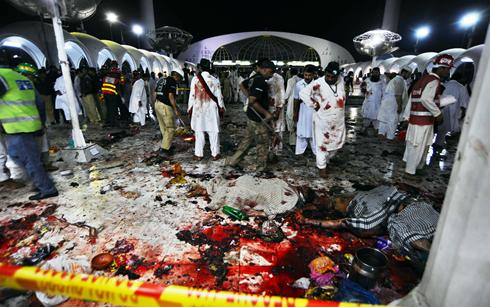
Suicide bombers have launched a deadly attack on a Sufi shrine in the eastern Pakistani city of Lahore. At least 35 people died in the blasts at the popular Data Darbar shrine late on Thursday evening, officials say. At least 175 other people were hurt in the blasts, believed to be the first targeting a shrine in Lahore. Thousands of people were visiting the shrine at the time, officials say. It holds the remains of a Persian Sufi saint, Abul Hassan Ali Hajvery.

Although no-one has yet said they carried out the attack, Taliban militants and their Punjabi jihadi allies have been involved in several such bombings in the northern Khyber Pakhtoonkhwa province. The shrine is largely frequented by members of the majority Barelvi sect, who are seen as heretics by the Taliban. Most of the Taliban belong to the rival Deoband Sunni sect, which strongly disapproves of worship at shrines. Many are also allied to the Sipah-e-Sahaba, and its armed splinter group, Lashkar-e-Jhangvi, which seeks to turn Pakistan into a Deoband Sunni state.

The shrine is visited by hundreds of thousands of people each year from both Sunni and Shia traditions of Islam. At least two attackers were involved, although police initially said three explosions had been heard.  The impact of the blasts ripped open the courtyard of the shrine. Rescue workers could be seen clambering over the rubble as they carried out the victims. Khusro Pervez, commissioner of Lahore, said two of the attacks took place in the main courtyard and one in the lower level of the shrine.

The first attacker struck in the underground area where visitors sleep and prepare themselves for prayer, he said. As people fled, a second bomber detonated his explosives in the upstairs area. Officials say they believe the bombers used devices packed with ball-bearings to maximise the impact of their attack.  A volunteer security guard at the shrine described scenes of devastation.

“It was a horrible scene,” said Mohammed Nasir. “There were dead bodies all around with blood and people were crying.” The attack is the biggest on a Sufi shrine in Pakistan since militant attacks began in 2001.  No group has said it carried out the attack, but correspondents say the attacks continue a growing trend among militants to target members of other sects as well as minorities.

Lahore has been hit by a series of bomb attacks, including a suicide blast at anti-terrorist offices in March, when at least 13 people died. In May, more than 90 people were killed in a double attack on the minority Ahmadi sect in the city.

Earlier, security chiefs had been congratulating themselves after what was the first month in two years in which there had been no suicide bombings in Pakistan, the BBC’s Aleem Maqbool reports from Islamabad.

They said it was proof the militant networks had been disrupted. Most Pakistanis knew the battle against militancy in this country was far from over, he adds. Last year Pakistan launched a major military offensive against militant strongholds in South Waziristan.  In December the military said they had achieved victory, but subsequent reports have suggested the militants remain active in the region.

American Arrested in Pakistan was on Solo Mission to Hunt Bin Laden

By Manzer Munir for Pakistanis for Peace

Gary Brooks Faulkner, a 51 year old construction worker from California was arrested by Pakistani police Monday night with a pistol, night vision goggles, and a 40 inch sword and apparently on a mission to kill Osama Bin Laden in revenge for the September 11 attacks on the US.

Faulkner was captured by the Pakistani police in the city of Chitral in the northwestern region of Pakistan near the Afghanistan border. According to a senior police officer, Faulkner was carrying religious Christian books and was reportedly on a mission to avenge the victims of the 9-11 attacks in New York, Washington and Pennsylvania.

According to Pakistani officials, Faulkner arrived in Pakistan on June 3 and stayed in a local hotel in an area of Pakistan known for its spring festivals and frequented by foreign tourists also. Apparently this was Mr. Faulkner’s sixth trip to Pakistan since 2002. At a press conference in his present state of Colorado, Faulkner’s brother Scott Faulkner, a physician, stated that his brother Gary was “on a mission.”

“He’s not crazy,” Dr. Faulkner said of his brother. “He’s not a psychopath. He’s not a sociopath.” Because of Osama Bin Laden’s security and Gary Faulkner’s kidney condition, Dr Faulkner did not believe he would see his brother again as he dropped him off at the airport prior to his flight to Pakistan this month. “I did not think I was going to see my brother again,” Dr. Faulkner said. “That’s the nature of going to Pakistan and hunting a wanted man who is surrounded by people with automatic weapons.”

Dr Faulkner stated that his brother underwent kidney dialysis three times a week and that if he killed or capture Bin Laden, he would use the reward money to live the rest of his life in Nicaragua helping build houses for the homeless.

According to Pakistani police, Mr Faulkner disappeared from his hotel Sunday night and away from the posted police guards, who are customarily there for the security of foreigners. When he checked out without informing police, officers began looking for him, according to the top police officer in the Chitral region, Mumtaz Ahmad Khan. He was in custody after a 10 hour search in a forest area in a high security zone close to the border with Afghanistan. He surrendered without any resistance and was flown to Peshawar where members of the United States embassy were notified of the arrest of an American.

“We initially laughed when he told us that he wanted to kill Osama bin Laden,” Khan said. But when officers seized the weapons and night-vision equipment, “our suspicion grew.” He said the American was trying to cross into the nearby Afghan region of Nuristan.

Chitral and Nuristan are among several rumored hiding places for bin Laden along the mountainous border between Afghanistan and Pakistan. He is currently being questioned by members of Pakistan’s intelligence officials according to reports and is in Peshawar where at present he has not been charged with any wrongdoing.

Whether Faulkner was there on a half baked suicidal, Rambo style mission or he truly believed he could be successful in finding and infiltrating Osama’s inner circle in order to capture or kill him remains to be seen. Nonetheless, it is a testament to the American “Can-do” spirit that a patriotic yet perhaps disillusioned and aging construction worker could take it upon himself to go to dangerous areas of Pakistan in order to avenge the victims of September 11. Whether he is simply crazy or foolish, one can not deny his desire to capture one of the most wanted man in history. We can only dream of the possibilities of real capture or death of Bin Laden if the majority of people in the Afghanistan-Pakistan region wanted to capture Osama and the terrorist Taliban leaders like Mullah Omar and others who shelter him.