Posts Tagged ‘ Punjab ’

Assassinations are a blemish on Pakistan’s soul

By Shahina Siddiqui for The Montreal Gazette
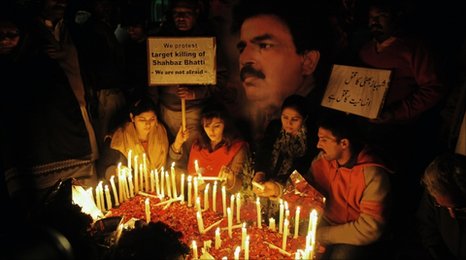
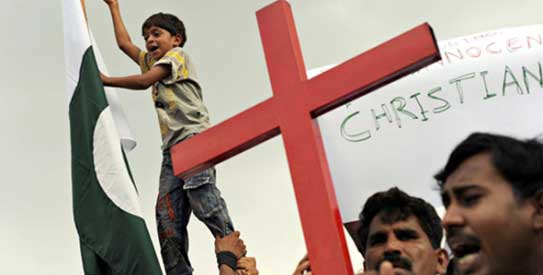
The assassination by terrorists of Pakistan’s federal minister for minorities, Shahbaz Bhatti, follows the brutal killing of Punjab Governor Salman Taseer a couple of months ago. Both were targeted by extremists because they called for the reformation of Pakistan’s controversial blasphemy laws. These and other attacks on Christians and Muslims in the name of blasphemy laws is a blemish on the national soul of Pakistan that cannot be washed away by empty rhetoric and the muted cowardly condemnations by the political and religious leadership in Pakistan.

There is no place for laws in Muslim countries that are the very antithesis of the spirit, soul, and letter of Islamic law. Prophet Muhammad in his lifetime was insulted, ridiculed and physically hurt, and yet he never ordered, condoned or recommended the killing or even harming of these individuals. There are documented cases where the prophet intervened to save the perpetrators from the wrath of his companions. We do not honour the prophet by murdering the innocent in his name. We honour him by practising compassion and dealing with mercy toward all of God’s creation, yes, even those who hurt us.

There is no justification for the blasphemy laws in the form they exist in Pakistan. The misuse and abuse of these laws have caused the security of religious minorities to deteriorate and be exploited, and it has become a licence to kill people, to destroy property and to create havoc for personal and political interests.

The terrorists are using this law to paralyze an entire nation into submitting to their whims through fear and trauma. The inept political leaders of Pakistan are more interested in maintaining their power and control on the country’s wealth then in actually working for the betterment of their country. The few who dare to stand up to this injustice find themselves isolated and without support.

The genuine religious leaders, on the other hand, are afraid to be labelled by these pseudo-religious terrorists as supporters of blasphemers, and thereby fear losing their own support base, their lives and their reputations. The socalled religious political parties are supporting these laws unconditionally, manipulating the love the masses have for their faith and their prophet, to ensure their own popularity and political gains.

In such a vacuum of moral, religious and human courage the terrorists thrive, the extremists dance in the streets and the ordinary Pakistanis struggle to survive. This ugly situation in Pakistan calls for an uprising of the silent majority. But the disconnect between rural and urban, rich and poor, and the excruciating poverty and illiteracy are barriers that make this an unlikely scenario.

Pakistanis, unlike their coreligionists in the Middle East, face brutality on many fronts: the war on terror that is consuming the country’s resources, the drone attacks that are killing hundreds of innocent civilians, the Talibanbacked terrorists who kidnap, torture, brainwash and blackmail poor rural youth into becoming suicide bombers who target fellow Pakistanis on an alarmingly frequent basis.

The indifference of the ruling elite – political and feudal – and the tyrannical pseudoreligious extremists seem to have paralyzed this nation into a pathological resignation to its “fate.” There is no credible leadership at the national level that is nurturing national pride, identity and vision. The people are adrift, holding on to any straw, no matter how fragile, that will keep them afloat.

In spite of these many challenges, however, I am confident – having observed firsthand the courage, resilience and moral strength of non-governmental organizations, selfless philanthropy by the affluent, and the development and growth of civil society – that Pakistanis will rise and can defend their nation. They must, however, break the chains of fear that are choking their conscience, and stand up for justice.

My prayer is for Pakistan to realize the vision of its founder, Mohammad Ali Jinnah: a vision in which all Pakistanis are granted freedom and security to practise their religions and maintain their places of worship, and where all Pakistanis thrive together, as equals under the law, regardless of ethnicity, gender and religion.
Pakistan: Yet another Christian accused of blasphemy

By Speroforum for Spero News

A Christian woman, Agnes Nuggo, was accused of blasphemy and arrested in the Diocese of Faisalabad, in the Punjab province of Pakistan. The Catholic Church, which is handling the case, expressed “extreme concern”  over the affair.

The Commission for Justice and Peace in the diocese reported that Agnes (50) is married to Bashir Masih, has children and lives in the Christian quarter of Waris Pura. She was accused of blasphemy after a dispute over a piece of land that had already created controversy with his relatives. Some Muslim neighbours accused her of having made insulting statements against the Prophet Mohammed and against Islam. On 16 February, the local police registered a FIR (First Information Report) pursuant to art. 295/a of the Criminal Code and arrested her. Agnes professes her innocence and says the accusations are completely fabricated.

Fr. Nisar Barkat, Director of the Justice and Peace Commission in Faisalabad, reported “Bishop Joseph Coutts has become aware of the case and asked me to follow it closely.” Fr. Nisar was in court and obtained a copy of the complaint against Agnes, who will have her first court hearing in two weeks. The church will find her a lawyer and will take care of her family.

According to some sisters who know Agnes personally “the case is quite complicated: the woman was lured into a trap. Some people wanted to take revenge on her, because in the past Agnes had agreed to testify in court for money.””

Fr. Pascal Paulus, a Dominican priest in the Waris Pura area, said that “the situation is critical for us Christians. We need to be very careful. The Islamic radicals want to exploit these cases to attack the Christian minorities. We are exposed to spurious attacks, which have already been happening.”

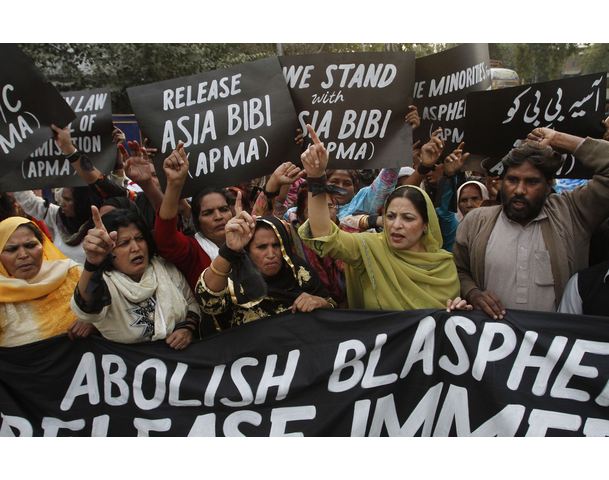
Asia Bibi, another Christian woman accused of blasphemy, has been imprisoned for several months and has been condemend to death under Islamic law, Haroon Barket Masih of the Masihi Foundation said of Nuggo, “She is a new Asia Bibi. Agnes’ case is one of many cases of persecution that continue to occur. Most of the episodes don’t leave a trace and do not reach the clamour of the spotlight. Only when the victims’ families trust in the Churches, foundations and NGOs, then the injustices come to light. Families often keep silent for fear of retaliation. And institutions are absent: in this situation, what can Christians do?”

Rosemary Noel, head of the Pakistan Catholic Women’s Organisation said, “Being a Christian woman in Pakistan is a dual challenge. Even the status of women is itself exposed to discrimination, violence and abuse. Women struggle to gain access to education and the world of work. Those Christians are doubly discriminated against. They are considered as objects by Muslims and suffer all sorts of abuse and injustice to general indifference.”

According to data provided by the Justice and Peace Commission of the Pakistani Bishops, including Agnes, there have been 16 Christian women accused and imprisoned between 1987 and 2010 (in addition to a Muslim woman and a Hindu), but many other cases escape inclusion, because they did not end with a formal complaint.

Who is behind the war on Sufism?

By Dr Ehsan Azari Stanizi for Eurasia Review News & Analysis

On October 25, 2010 an al-Qaida affiliated militant group turned a majestic Sufi shrine into a bloodbath in the Punjab province of Pakistan, by detonating bombs hidden in milk cans, killing and wounding scores of innocent people. This was the latest of a spate of gruesome attacks on Sufism and dead Sufi saints this year alone, leaving hundreds of innocent people killed or wounded. Such violence has brought a new upheaval to Islam, shaking its ethical and moral foundations and reducing it to a merely a radical political ideology.

The ideological driving force behind this violence is religious extremism which considers everyone outside its ideological league, Muslim or non Muslim, dead or alive, as an enemy and an infidel deserving to be killed. The fanatics blow up ancient relics, Sufi heritage, Sufi shrines and the Sufi way of life everywhere they can. They want to micromanage social, cultural and individual life. They condemn gatherings and ceremonies in Sufi saints’ graves, shaving beards, wearing charms, music and painting as heresy. All this is like the Chinese Cultural Revolution of the 1960s.

The history of Islam is not alien to violence against Sufism. The root of the current upheaval lies in Wahhabism, which has been gradually institutionalised from a tiny band of theologians into a political ideology by the Saudi ruling dynasty. The Wahhabi religious movement was originated by Mohammad Ibn Abdul Wahhab (1703-1792), essentially to challenge the influence of the Ottoman Empire in the Arabian Peninsula. The Saudi petrodollars and Pakistani military ruling elite have helped the spread of this fanatical form of Islam.

In addition, the vision of this ideology was empowered in the Middle East and South Asia by another extremist movement known as the Muslim Brotherhood which originally emerged in Egypt in the 1920s. The Brotherhood copied much of its ideological agenda, political structure, revolutionary features and a violent persuasion from Marxism. Like the latter during the Cold War era, the Brotherhood’s ultimate objective has been to topple the state by violent means and extend a radical ideology to the West. The Iranian revolution of late 1970s gave further impetus to this ideology, which began to justify the export of Islamic revolution as an Islamic obligation everywhere in the world.

Like Saudi rulers, the secular Pakistani cunning and sly generals began to use the most lethal religious radicals for domestic security and as a tool to promote its foreign policy in Afghanistan and India. Pakistan served also as a gateway for the spread of Wahhabism in the region. At present they are pinching American coins in return for carrying out the Pashtun genocide.

As it was hinted, war on Sufism is not a new phenomenon. Hussein Al-Halaj, a great Sufi poet and teacher was condemned for heresy when in a state of mystical trance he exclaimed, “I am the Truth”. He was cut to pieces and his remains were burnt by a mob in Baghdad in 922 AD. He was the first Sufi martyr.

During the 17th-century Persian Safavid Empire, Sufis were suppressed, during the Indian Moguls, it flourished but in the twentieth-century the die-hard Turkish secular leader Kamal Atatürk banned Sufi monasteries and Sufi rituals in Turkey.

Sufism (comes from Arabic noun, suf, literary meaning course wool and the Sufi is the one wearing woolen garments) is the name of Islamic mysticism. The word Sufism was coined in the West for the first time by the German scholar August Tholuck in 1821. It has been divided into two practical and theoretical parts: To those who practice it, Sufism means a quick spiritual foray into a space where the presence of the divine could be experienced. To those who are concerned with its theory, it is a mystical and spiritual theology, a body of knowledge and an epistemology interwoven with Islamic metaphysical texts.

The Sufi philosophy was developed and promoted by the medieval Muslim philosophers such as Ibn-Arabi, Averroës (known in Islamic world as Ibn-i-Rushd), Avicenna and Farabi, who, for their Islamic Aristotelianism, were often referred to as the Oriental Peripatetics. This school of thought was greatly saturated with Plato and Aristotelian metaphysics. The Sufis also have created a vast body of a literary and poetic heritage.

As an elixir of wisdom and an intellectual Yoga, Sufism has been known, cherished and even practised in the West since time immemorial. It is hard to find a single great Western poet or thinker who has not been inspired by Sufism. Dr Johnson loved Sufi Oneness and pantheism; Voltaire in Candid saw Sufi philosophy as an antidote to religious extremism of his time. Goethe loved Sufi poetry, Richard Burton and Robert Graves were keen on practicing Sufism.

Sufism was cherished by Australia’s greatest poet professor Alec Derwent Hope. Hegel draws on Sufi thought in his works. Danish fairy-tale writer Hans Christian Andersen was the first who brought the news about the Sufi music and dance known as “Whirling Dervishes” to Europe.

Nobel laureate, Doris Lessing is the doyen of contemporary Sufis in the West. She identifies Western admiration of Sufism since the 1960s as ‘a Sufi craze,’ and ‘Sufi bandwagon’. For Lessing, Sufism was a kind of universal feeling, emotion, a quick fix and an access with no intermediary. “Sufism is something one experiences on one’s own,” she would say. In my own lectures in Australia and Europe, I came across with an enormous interest in Sufi philosophy and literature.

The al-Qaida zealots and the Pakistani militants will never win over Sufism. They might destroy their tombs on earth but cannot steal away Sufism from the hearts of people in the East and the West.

The 13th-century great Sufi poet and the founder of the Whirling Dervishes, Rumi knew this. He believed that fanatics will never extinguish the Sufi torch or destroy Sufi tombs as he says “when we are dead, see not our tombs in the earth, but find it in the hearts of the people.” And the 17th-century Pashtun Sufi poet Rahman Baba, known in the West as the Nightingale-of-Peshawar to the vandals:

We are all one body, whoever tortures another, wounds himself.

Last spring (2010), his mausoleum was bombed by the Punjabi Taliban. Rumi declared the Sufi manifesto of universal love, tolerance of nonbelievers, pluralism and interfaith harmony in one of his quatrains:

Come, come whoever you are, An unbeliever, a fire or idol-worshiper, come, Our convent is not of desperation, Even if you have broken your vows a hundred time,
Come, come again.

Thou Shalt not Mock or It May Cost You Your Life!

By Manzer Munir for Pakistanis for Peace

In the wake of the murder of Salmaan Taseer, the Governor of Punjab a couple weeks back, I did a great deal of contemplation about the situation in Pakistan and the current state of affairs of Pakistan and indeed in much of the Muslim world.

The current situation, especially in Pakistan and when it concerns the rights of the non-Muslims, is apparently the worst of anywhere in the Muslim world. Indeed, the plight of Asia Bibi, (also known as Aasia, Ayesa Noreen) Islam and Islamic Blasphemy laws have come under rightful scrutiny as of late.

One question that tugs at the heart of the debate for me is why is it that Muslims seem to get so very offended to the point they want to KILL you over a remark or something that comes out of your mouth? As Americans, we wonder to ourselves, “Haven’t they ever heard of sticks and stones may break my bones, but words don’t hurt me?!

Sadly, what the fundamentalist preachers at all the podiums of their Friday sermon or khutbah, nor any of their brethren on the run and in caves like the Taliban and Al Qaeda fail to realize that we are all God’s children. And God, Allah, Yahweh, Jesus, or whatever name you assign him, he is One and the same God of all religions. He is too big to fit into just one religion, concept, version or story of him.

And we all are his creations. Not one of us is superior over the other in his eyes and he judges us all equally. To him, the children of these three religions and its offspring’s are all related to each other. Adam being the first man, then Eve, and then all the Biblical figures and names such as Noah, Abraham, Moses, Jesus, yes especially Jesus. He is their Messiah too!

Jesus, in fact is mentioned some 28 times in the Muslim holy book, Qu’ran whereas their own prophet Muhammad is mentioned only 4 times. And the fact that Jesus is also considered by Muslims to be the Messiah, it is sad that his followers should get such abject treatment in Pakistan and sadly, many Muslim countries.

If only the bad guys realized the connections between Christians and Jesus only then would a Pakistani Christian woman, suffering needlessly in a cell tonight going on 2 years away from her children in solitude, and constantly fearful for her life, would see her horrific ordeal come to an end.

These people are incapable of understanding basic rights, freedoms and even the unhindered concept of free will. No, they are primitive minded in their their spiritual and daily lives. They fail to see that a Christian’s God and a Muslim’s God are the one and the same. And he never would agree to laws like Pakistan’s Blasphemy laws at all. Why? Well because the Muslim God is known first and foremost as a Gracious, Merciful, Compassionate God.

In fact, the Arabic phrase Bismillah ir-Rahman ir-Rahim is a beautifully poetic phrase which offers both deep insight and brilliant inspiration to the average Muslim who says it countless times as he or she starts each day and till they rest their head to sleep. “ It has often been said that the phrase Bismillah ir-Rahman ir-Rahim contains the true essence of the entire Qur’an, as well as the true essence of all religions. Muslims often say this phrase when embarking on any significant endeavor and the phrase is considered by some to be a major pillar of Islam. This expression is so magnificent and so concise that all except one chapter of the Qur’an begins with the words Bismillah ir-Rahman ir-Rahim.”

The common translation:”In the name of God, most Gracious, most Compassionate” essentially is saying that God is compassionate, and full of grace. So how would this God punish Asia Bibi? What would he do if he is so full of compassion and mercy? Would he even punish her? And if he is such a gracious and a compassionate God, then wouldn’t he feel that nearly a two year jail sentence in solitary is already far more than her crime not to mention being away from husband and children and being worried about mob vengeance on her or the death penalty?

That God may act in a multitude of ways and we cannot ever know till said Judgment Day. That is what Judgment Day is all about after all. In fact, this is probably one day when the man upstairs works overtime judging all of us mankind, from the beginning with Adam to the last standing comes till Tribulation and the End of Days. It is only he, the Creator who will do the judging and this is something that the men with the loudspeakers who climb to the top of the minaret five times a day to call the faithful to prayers, just do not really understand, in my opinion. They apparently constantly seem to forget and pass judgment from the pulpit and this in turn helps set the “popular” opinion amongst the ultra-religious faithful of Pakistan’s society.

My only prayer to this Creator is that may he keep Asia Bibi safe tonight and continue to give her strength. And if God should call her home and have her die a death at the hands of the real savages those that not only kill but shockingly, in your name, then please Allah grant her heaven just as you should governor Salmaan Taseer, a man who was only defending the rights of all your children, including those of other faiths. He was being compassionate and gracious towards a fellow human being God, as he was only trying to emulate his creator, You Lord. Ameen.

And while you are at it Lord, will you also please let the imam at the microphone know that “Thou shall not mock, should not cost you your life.” Afterall, “Thou shall not kill is one of your top 10 commandments, whereas mocking prophets or religious figures does not make the list!

Manzer Munir, a proud Pakistani American and peace activist, is a Sufi Muslim who is also the founder of Pakistanis for Peace and blogs at www.PakistanisforPeace.com and at other websites such as www.DigitalJournal.com, www.Allvoices.com, www.Examiner.com and www.open.salon.com as a freelance journalist and writer. He asks that you like the Official Facebook Page of Pakistanis for Peace to get the latest articles as they publish here: http://www.facebook.com/home.php#!/pages/Pakistanis-for-Peace/141071882613054

Islamists Rally for Pakistan’s Blasphemy Laws

By Zahid Hussain for The Washington Post

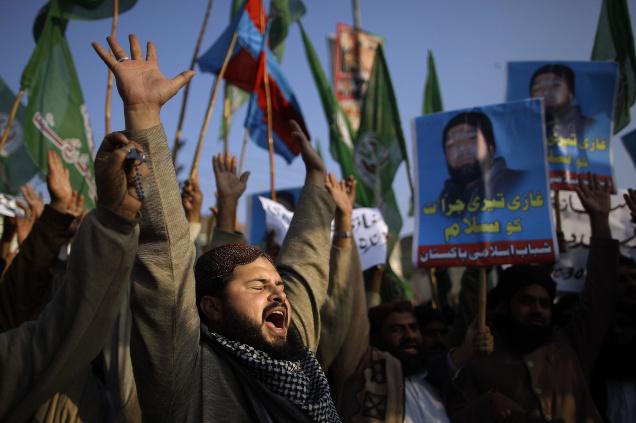
Tens of thousands of Islamists rallied Sunday in Pakistan’s southern port city of Karachi in support of the nation’s controversial blasphemy laws, and clerics threatened to kill anyone who challenged them.

Security was tightened around the house of Sherry Rehman, a former federal minister, who was threatened with death by radical clerics for moving a bill in the parliament last month to amend the blasphemy laws, which currently sentence to death anyone found guilty of insulting Islam.

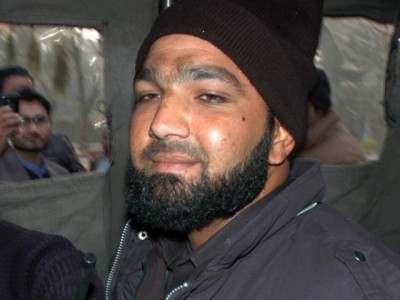
The blasphemy laws have been in the spotlight since the murder last week of Salmaan Taseer, governor of Punjab province and a critic of the laws, who was shot by a member of his security detail. The shooter, Mumtaz Qadri, later said he killed Mr. Taseer because of the politician’s opposition to the laws. Mr. Taseer was a member of the Pakistan People’s Party, which runs the governing coalition, and was close to President Asif Ali Zardari.

The killing highlighted the extent to which extremist Islam has permeated Pakistan’s middle class and those close to the political elite even as the country grapples with an insurgency from the Pakistan Taliban and other violent Islamist groups. And it has deepened the polarization between moderate and radical Muslims throughout Pakistan. Radical clerics have seized the opportunity to whip up a campaign against moderate and progressive politicians, intellectuals and journalists.

Speakers at the Karachi rally sought to justify Mr. Taseer’s assassination, saying the killer fulfilled his obligation as a Muslim. “We will defend the assassin in the court,” declared Fazalur Rehman, the leader of Jamiat-e-Ulema Islam, a radical Islamic group that recently quit the coalition government after one of its ministers was sacked after publicly accusing a cabinet colleague of corruption.

The rally was organized by an alliance of hard-line Islamic groups including Jamaat-ud-Dawa, which the United Nations has said acts as a front for the outlawed terror group Lashkar-e-Taiba. Lashkar-e-Taiba is accused of masterminding the November 2008 terrorist attacks on Mumbai, which left more than 160 dead. Many demonstrators Sunday carried portraits of Mr. Qadri, who killed Mr. Taseer in a fashionable shopping district of Islamabad. Mr. Qadri has been hailed by Islamists as a great Islamic warrior.

Mr. Taseer had provoked the ire of radical clerics for publicly supporting a Christian woman who has been sentenced to death by a Pakistani court for allegedly making derogatory remarks against Islam’s prophet. The controversial laws have often been used against Christians and other non-Muslim communities, something that Ms. Rehman is seeking to prevent with a private bill she introduced last month.

A cleric of the Sultan Mosque in Karachi in his sermon on Friday called Ms. Rehman an “infidel” for suggesting changes in the blasphemy laws. A pamphlet signed by several Islamic clerics named her for supporting blasphemy. And some hard-line clerics have issued a “fatwa” demanding death to Ms. Rehman, a senior member of parliament of the Pakistan People’s Party.

Ms. Rehman said she is under pressure from the administration to leave the country until the situation calms down. “I am not going anywhere and [will] face the threat,” she said in a telephone interview.

Salman Taseer Assassination Points to Pakistani Extremists’ Mounting Power

By Karin Brulliard for The Washington Post

One of Pakistan’s most openly progressive politicians was gunned down Tuesday in an act that violently highlighted extremists’ tightening grip on the country even as the beleaguered government struggled to stay in power.

The killing of Salman Taseer, apparently at the hands of one of his own guards, marked the most prominent political assassination in Pakistan since former prime minister Benazir Bhutto’s death three years ago.

The razor-tongued governor of Pakistan’s most populous province was known for speaking out on behalf of women and religious minorities, and his slaying stunned the nation and alarmed U.S. officials. It also further rocked Taseer’s ruling Pakistan People’s Party, which is desperately trying to keep its government afloat following a key ally’s defection to the opposition Sunday.

The secular PPP condemned the killing and promised a swift investigation, but its weakened position undermines its ability to crack down on religious extremists.

In timing that underscored those limitations, Taseer was shot in an upscale area of Islamabad as Pakistan’s main opposition party was across town demanding that the government agree within three days to implement a list of reforms, or risk collapse.

After the killing, the party of former prime minister Nawaz Sharif said it would allow three additional days for the changes, including a slash in government spending and the reversal of unpopular fuel price increases.

Taseer was a chief ally of President Asif Ali Zardari, who in 2008 appointed him governor of Punjab, Pakistan’s wealthiest province. But Sharif’s party rules the province, making Taseer’s assassination a blow to the federal government’s influence there.

Secretary of State Hillary Rodham Clinton condemned the killing in a statement Tuesday, saying she had met Taseer and “admired his work to promote tolerance and the education of Pakistan’s future generations.”

Taseer’s apparent killer cited his boss’s stance against a controversial anti-blasphemy law in justifying his actions. As the embattled, pro-U.S. PPP sought in recent days to win back defecting allies that also include a small Islamic party, it had already said it would not support a proposal to change the blasphemy statutes. That left Taseer one of the few vocal champions of the move, which hard-line religious organizations had labeled a Western conspiracy.

The laws have drawn scrutiny since a Christian woman was sentenced to death in November for allegedly criticizing the Muslim prophet Muhammad. Taseer had called for her pardon, leading religious groups to denounce him as an “apostate” and burn effigies of him during a nationwide strike last week in support of the law. One Muslim cleric has offered $6,000 to anyone who kills the woman, who remains in jail.

Even as Pakistani television stations were dominated Tuesday by commentators condemning rising religious intolerance, supporters of Taseer’s arrested guard, Mumtaz Qadri, 26, created a page for him on Facebook. Page visitors called him a “hero” and praised his “awesome job.” No major unrest over the killing was reported, but authorities said they were on high alert.

“This shows how the religious extremists want to impose their agenda to terrorize the society,” Shahbaz Bhatti, the federal minister for minorities affairs and also a proponent of changing the laws, said in an interview. “This cowardly act cannot stop us who are raising our voice.”

Yet in a country where Taliban militants increasingly flex their muscles through bombings, religious hard-liners have great power to intimidate even though polls show that their views are not widely shared. Last week’s strike by Islamic organizations drew few supporters to the streets, but shops in major cities closed – and many merchants said they did so under threat.

Human rights activists say the blasphemy laws are also abused by extremists, who use them as a tool to persecute minorities or opponents by bullying police and courts into arrests and convictions. The laws were strengthened during the 1980s rule of Islamist military dictator Gen. Zia ul-Haq.

Taseer lamented the power of the religious mob in an interview last summer following bombings of mosques belonging to the Ahmadi sect, whose members identify themselves as Muslims but are barred by the constitution from “posing” as such. Taseer – whose appointed position gave him little direct power in Punjab – condemned the provincial government of Sharif’s center-right PML-N for what he called its tolerance of radical religious groups.

“Extremist people are not in the majority,” Taseer said at the time. “This is a very narrow minority, but . . . they are always prepared to do and die. That is their strength.”

On Dec. 24, he had posted on his Twitter account: “My observation on minorities: A man/nation is judged by how they support those weaker than them not how they lean on those stronger.”

Authorities said Taseer’s guard, a member of an elite Punjab provincial police force that provides VIP security, shot the governor multiple times outside the Kohsar market in Islamabad, a small shopping plaza near his residence that is frequented by foreigners. The guard proudly surrendered to police afterward, according to local news reports.

Most political parties condemned the killing, and the government announced a three-day mourning period, during which political activity would be suspended. Zardari, to whom Taseer was close, called the assassination “ghastly.”

“The governor of Punjab was the bravest person in our government, and the stands he took for women, minorities and on the blasphemy law were incredibly brave and will never be forgotten,” Farahnaz Ispahani, a Zardari spokeswoman, said in an interview.

Taseer, who began his political career as a PPP student activist, was a successful businessman who played polo and smoked heavily. With his flashy sunglasses and frequent Twitter dispatches, Taseer, 66, cut a rather shocking figure in a country dominated by conservative social mores.

Critics assailed him for fathering a child with an Indian journalist while he was still married to the mother of his other children. In 2008, minor scandals broke out when opponents published photos online of him holding wine glasses at parties and of one of his daughters wearing shorts and dancing.

Despite the alleged gunman’s confession, Taseer’s killing was sure to be swept up in the conspiracy theories that permeate Pakistani politics, particularly in times of turmoil. Interior Minister Rehman Malik said investigators would seek to determine whether the suspect acted alone or was “asked” to carry out the attack.

In the hours after the killing, some criticism centered on the PML-N-led Punjab government, which provided Taseer’s police guard. There was no indication Tuesday night that the party played a role.

But the PML-N might yet bring down the PPP, whose government faces growing criticism over corruption, a floundering economy and a ham-handed response to last year’s devastating floods. The ruling party’s coalition partner, the Muttahida Qaumi Movement, withdrew from the government Sunday, weakening its mandate by depriving it of a parliamentary majority.

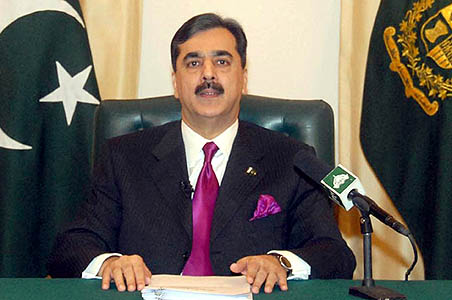
A united opposition could pass a vote of no confidence in Prime Minister Yousaf Raza Gillani, leading to his ouster and potentially triggering early elections. That has appeared unlikely, because of divisions among opposition parties. But Sharif threatened Tuesday to “ask the opposition parties to come forward and we will give them our full support” if the government does not show progress on reforms within 45 days, according to the Associated Press.

Like many in the PPP, Taseer often criticized opposition parties for stoking political instability in a country that has been ruled by the military for half its 63-year history and where an elected government has never completed its term.

Religious extremism, Taseer said last summer, would be quashed only by the “continuous, functional position of a democratic system.”

A Brave Man Killed

A New York Times Editorial

Some twisted person has created a Facebook page in support of Malik Mumtaz Hussain Qadri, the bodyguard accused of assassinating Salman Taseer, the governor of Pakistan’s Punjab province. Mr. Taseer was a brave man who had called for the repeal of Pakistan’s outrageous anti-blasphemy law.

Whoever killed Mr. Taseer must be condemned and repudiated, not extolled. Otherwise, Pakistan will certainly continue on a downward spiral in which intolerance and self-destruction triumph.

The governor’s death is a tragedy not just for Pakistan but for all who understand that just and stable societies need honest debate and full respect for minorities. Pakistan cannot afford to lose any fair-minded leaders, especially at a time when it is struggling with a virulent insurgency, an unraveling economy and an unraveling central government.

Mr. Taseer — a longtime ally of President Asif Ali Zardari and his wife, Benazir Bhutto, who was assassinated in 2007 — was Pakistan’s most prominent defender of the rights of women and minorities. He had pressed hard for repeal of the blasphemy law, which imposes a mandatory death sentence on anyone convicted of insulting Islam.

The law is popular with the Muslim majority but is routinely manipulated to settle personal rivalries and persecute minorities. And Mr. Taseer had been particularly outspoken, calling for leniency for a Christian mother of four who was sentenced to death under the law, in a case that stemmed from a dispute in her village.

Pakistani officials, who have the bodyguard in custody, say he killed Mr. Taseer because of the governor’s opposition to the blasphemy law. But there are far too many unanswered questions: Did the suspect act alone? Why did the Punjab police assign a religious conservative to protect Mr. Taseer? News reports first said nine bullets were fired into Mr. Taseer, and hospital officials later said he was hit 24 times. Yet other members of the security detail did not shoot to stop Mr. Qadri, who surrendered with his hands up.

Pakistani authorities need to investigate thoroughly and share their full findings with the Pakistani people.

The United States and the international community must make clear their outrage over this killing. So must every Pakistani. The country’s political leaders and the Pakistani media also need to consider whether the way they have shaped the debate on the blasphemy law — some have argued that mentioning reform is blasphemy punishable by death — is further fueling conflict.

Ultimately, only Pakistanis can save their nation, and they must answer the more profound questions: Do they want a country in which Muslims and non-Muslims can peacefully co-exist? Or one in which religious zealots, espousing the most intolerant interpretation of Islam, kill anyone brave enough to defend the defenseless? That would be the true blasphemy.

Blasphemy Trials in Pakistan Reveal a Broken Justice System

By Karin Brulliard and Shaiq Hussain for The Washington Post

With its single dirt road, friendly residents and abundance of drowsing donkeys, this village hardly seems a hotbed of religious radicalism.

Nevertheless, four years ago, dozens of angry townspeople marched and chanted, “Death to the blasphemer!” Their demands were answered. Two years later, court records show, a teenaged Muslim named Muhammad Shafique was sentenced to hang for cursing the Prophet Muhammad and tossing pages of the Koran onto “cow dung and urine.”

Today, an air of regret permeates Kulluwal. Shafique’s accusers fled town, and their relatives now say the allegations were lies. Many residents call the case a setup fueled by political and personal rivalries. But as Shafique waits on death row, his appeal stuck in Pakistan’s glacial courts, no one is quite sure what to do.

“The situation at that time was emotional. It was the responsibility of the police to sift through the facts and find the truth,” said Chaudhry Safraz Ahmed, 42, a community leader whose father was one of Shafique’s accusers. “That did not happen. And Shafique is behind bars.”

Pakistan is in the midst of a heated debate over its ban on blasphemy following the sentencing to death last month of a Christian woman, Asia Bibi. The pope condemned that sentence, which has not yet been carried out. Human rights organizations, meanwhile, have demanded the repeal of a law that they say is used to harass religious and sectarian minorities in this Sunni Muslim-majority nation.

But blasphemy cases, about half of which involve Muslim suspects such as Shafique, also point to a more fundamental problem with grave implications for the nation’s U.S.-backed fight against militancy: Pakistan’s broken justice system, corrupt and lacking in expertise, often rewards vendettas and encourages radicalism.

In this system, religious extremism is less an epidemic than a menacing shadow – just as it is across Pakistan, an unstable democracy where Islamist threats often eclipse the majority’s more peaceful views.

The law against blasphemy – which encompasses vaguely worded prohibitions on insults against Islam – gives radicals a tool with which to bully those who don’t share their hardline religious views. Legal experts say lawyers, witnesses and authorities are frequently intimidated into helping to enforce the law, leading to injustices that bolster militants’ anti-government arguments.

“These are the kind of provisions that allow space for extremists to act with impunity,” Ali Dayan Hasan, a Pakistan-based representative for Human Rights Watch, said of the blasphemy law. “This country is, in that sense, at a crossroads where it is time for people to stand up.”

Just what happened on the evening of March 17, 2006, in this agrarian corner of Punjab province remains in dispute. It took a court in the nearby city of Sialkot 73 hearings over 27 months to gather enough testimony for a verdict. Lawyers’ strikes, witnesses’ absences and a funeral caused delays. In the end, the key evidence against Shafique, now 22, was witness accounts and soiled scraps of pages from a Koran, which the judge deemed impossible to fake.

“The question arises whether . . . a Muslim can think to smear the pages of the Holy Book with cow dung and urine just to create an evidence to involve his opponents,” the judge wrote in 2008. “Not an iota of evidence has been produced by the accused in this regard.”

But Shafique’s family, along with many others in Kulluwal, cite two reasons for such a plot. Shafique, an aspiring electrician, had accused his brother’s wife of adultery. And her alleged paramour had powerful allies, among them a town politician with his own motive: Shafique’s brother was challenging him in a village election.

Whatever the case, word of Shafique’s alleged rampage spread, and a crowd beat him viciously, residents recalled. Qari Qadir, the village imam, said he declined requests to announce the offense over his mosque’s loudspeaker, fearing a “serious situation.” Instead, he led a march the next day at which protesters demanded that police file charges.

“Everybody was against him,” said Ahmed, the community leader. “The police thought it could become a law-and-order situation if they did not take action.”

According to court records, two main accusers – the politician and Ahmed’s father – did not testify. Four young men who did gave nearly identical statements about seeing Shafique curse the prophet and rip the Koran.

Shafique testified that the charges were personal and political, and that he “heatedly” loved Allah.

The court sentenced Shafique to join about 7,600 others in Pakistan on death row, about 60 of whom are convicted blasphemers, according to the Human Rights Commission of Pakistan. The country has not executed anyone since 2008, and blasphemy cases are often overturned on appeal.

But for many, that potential reprieve is little help. Suspects are often murdered in prison or after release, a fact one Pakistani court used to justify the blasphemy law – in prison, it reasoned, suspects are protected from public rage.

Blasphemy was outlawed during British colonial rule but made a capital crime in the 1980s under the Islamist military rule of Mohammed Zia ul-Haq. Now, the law is being scrutinized; a bill in parliament would shorten sentences, require evidence that the crime was committed intentionally and introduce punishment for false accusation.

But while recent international attention has galvanized opponents of the current law, it has also roused defenders. Conservative religious parties have threatened mayhem if the law is changed, an idea they deem a Western conspiracy. One cleric in northwest Pakistan went further, promising $6,000 to anyone who kills Bibi, the Christian woman.

Amid this debate, Mirza Shahid Baig, Shafique’s lawyer, sticks to technical arguments. The wrong police investigated, he said, and there was no serious look at Shafique’s side of the story.

“I am a very true lover of the holy prophet, but this case was totally false,” Baig said one recent afternoon at his dusty basement office in the bustling city of Lahore. “Whether the law is correct or not correct according to the morality, this is not my job.” In Kulluwal, most everyone seems to agree that a blasphemer deserves death. But they are certain Shafique was not one.

The investigators and witnesses who testified against him have all left town, and no one else recalls seeing Shafique’s alleged rampage. Ahmed said his father is ready to recant in court.

“This is a baseless charge,” said Ahmed, calmly sipping tea with Shafique’s parents on a recent day. “The issue is religious, so it had an influence on the police. It interfered with the investigation.”

Another resident, Mohammed Ibrahim, is the brother of the politician who accused Shafique and the father of one youth who testified. Ibrahim said his son has since told him he was pressured to lie, and that his brother forced police to file charges.

“He thought of himself as important, as someone who could not be challenged politically,” Ibrahim said of his brother, who, he added, has moved to Canada. To some Kulluwal residents, the whole affair proves elders should resolve disputes, not courts.

Shafique, meanwhile, writes letters to his family from solitary confinement. In one recent missive, he said that prison guards avoid touching him. He understands, he wrote, for he reserves no sympathy for blasphemers.

“My heart weeps for the innocent ones,” he wrote. “But I have no words of sympathy for the sinners . . . I would have killed them myself if I could.”

Aasia Bibi and Impurities in the Land of the Pure

By Manzer Munir for Pakistanis for Peace

The case of Aasia Noreen aka Aasia Bibi illustrates how far Pakistan has to go to secure freedoms for its religious minorities. Christians and Hindus are not the only minorities who are persecuted for their beliefs but it is also Muslim minorities such as the Ismailis, Ahmadis, and Shiites who are routinely harassed, discriminated and also killed. Sadly, it is the case of Aasia Bibi that has brought some much needed attention to Pakistan’s sad state of affairs towards the treatment of its religious minorities.

Several sections of Pakistan’s Criminal Code consist of its blasphemy laws and of all the Muslim countries of the world that have anti-blasphemy laws, Pakistan’s anti-blasphemy laws are by far the strictest. There is section 295 that forbids damaging or defiling a place of worship or a sacred object. Then there is section 295-A that “forbids outraging religious feelings.” There is also 295-B which prohibits defiling the Qu’ran and was originally punishable by life imprisonment but has since been amended to up to three years imprisonment.

No section of the blasphemy law is more controversial or harder to prove than Article 295-C, the law that Aasia Bibi is allegedly charged with having broken. In respect to prophet Muhammad, this statute states that ” Whoever by words, either spoken or written, or by visible representation, or by any imputation, innuendo, or insinuation, directly or indirectly defiles the sacred name of the Holy Prophet Muhammad shall be punished with death, or imprisonment for life and shall also be liable to a fine.”

Aasia’s case and charges against her started almost a year and a half ago when there was a quarrel over a bowl of water in a dusty village in the heart of Pakistan’s Punjab province. A group of women were working the fields in the heat of the Pakistani sun when one of them, Aasia Bibi, dipped her glass in the communal bucket of drinking water to fetch herself and others a glass of water to drink and immediately was rebuffed by the other women who claimed that the water was now unclean as it had been touched by a non-Muslim. According to witnesses, instead of quietly bowing her head and taking the indignities, Aasia’s crime was that she mounted a strong defense of her faith and remained steadfast in her demeanor that she did nothing wrong. Too often in Pakistan, the blasphemy laws are used against religious minorities to settle personal vendettas and old scores according to Pakistan’s Human Rights Watch, a watchdog group monitoring the case.

The news traveled fast in Aasia’s village of Ittan Wali, in Punjab’s Sheikhupura district that a Christian woman had insulted the prophet. The local mullah got on the mosque loudspeakers, urging the “faithful” to take action against Aasia Bibi. In sad but familiar pattern, her defense of her faith was somehow twisted into an accusation of blasphemy, according to her family and others familiar with the case. Soon as a mob gathered outside her home ready to take the law into their own hands and handing out vigilante justice, the police moved in and took her into custody. But instead of protecting her, they charged her with insulting Islam and its prophet under the blasphemy laws.

And then on Nov. 8, after suffering 18 months in prison, Aasia Bibi was sentenced to death by a district court, making her the first person to be handed the death penalty in Pakistan under the blasphemy laws. Many before her over the years have been charged, but punishment had been commuted to lesser penalties than the death sentence imposed on Aasia Bibi. No concrete evidence was ever presented against Aasia, according to Pakistan’s Human Rights Watch. Instead, the district judge relied on the testimonies of three other women, all of whom were hostile towards her.

Unfortunately this is a common insult hurled at many of Pakistan’s 2 million Christians who make up just 1.59% of the total population. Often, Christians in Pakistan are discriminated and persecuted and many times only get the lowest of the low jobs such as street sweepers, janitorial and sanitation workers. In fact, in Pakistan, the term ‘Chura‘ has become synonym with the Christian community as it relates to an unclean person akin to how the untouchables or Dalit community is seen in India. In India however, the Dalits are not subjected to arcane state blasphemy laws geared towards religious minorities as in Pakistan or are threatened with their lives at the hands of the Hindu majority.

As discussed in a couple of my previous articles, Taliban 1o1, History and Origins and Taliban 201, The Rise of the Pakistani Taliban, the Islamization of Pakistan started under the late General Zia ul Haq of Pakistan who took over the leadership of the country through a military coup in 1977 when he hung the deposed and democratically elected Prime Minister Zulfiqar Ali Bhutto. Earlier in 1973, the 1973 Constitution of Pakistan had declared that “Islam shall be the religion of the Pakistan” and had systematically begun the process of restricting the participation of religious minorities in government and politics.

Before General Zia, there were only two reported cases of blasphemy. Since the death sentence was inserted in 1986 into the Penal Code for the blasphemy laws, this number has now reached 962 — including 340 members of the Ahmadi Muslim community, 119 Christians, and 14 Hindus. A close examination of the cases reveals the blasphemy laws are often invoked to settle personal scores, or they are used by Islamist extremists as cover to persecute religious minorities, sadly with the help of the state under these laws.

General Zia began this policy of Islamization of Pakistan in conjunction with his support for the war against the Russians and assistance to the Afghan Mujahedeen as well as the building of thousands of madrassahs or religious schools across Afghanistan and Pakistan which nurtured the young men into what later became the Taliban. Many of these blasphemy laws fully came into being under his reign, although some were around since as early as more than 100 years prior when the British drew up the Indian Penal Code of 1860 which was initially an ill foreseen aim at keeping the peace among the many fractured faiths of the subcontinent. For instance, section 295-A, which “forbids outraging religious feelings”, could have been applied against a Muslim who insulted a Hindu or a Hindu who taunted a Sikh or Christian or vice versa. However under Zia, the blasphemy laws were expanded and almost exclusively applied against Muslim minorities such as the Ahmadis, Islamilis and Shiites as well as against the Christian and Hindu populations.

Recently, a religious ‘leader’ came out and has offered over $6000 to anyone who can kill Aasia Bibi while she awaits her punishment in police custody. Outrage and denunciations on this case are coming from across the world as many people are appalled at the sad state of rights for religious minorities in Pakistan. The Pope has intervened also asking for clemency for Aasia Bibi from Pakistan’s President Asif Ali Zardari. Against all manner of reason and justice, Lahore’s High Court recently issued an order on November 29, 2o1o, preventing Zardari from exercising his constitutional authority to pardon Aasia Bibi.

In a country rife with violence and chaos and one that has become synonymous with terror the world over, the case of Aasia Bibi is yet another dark stain on the country’s image around the world. The Taliban and the extremist groups ravaging Pakistan can be explained as being a violent minority and do not and should not reflect on the nation as a whole as the majority of people in Pakistan are opposed to them and their views of Islam. But the blasphemy laws, for as long as they have stayed on the books in Pakistan and in the constitution, cannot and should not be excused in any shape or form. These laws need to be repealed and the constitution needs to be amended in an emergency manner so that Aasia Bibi and other religious minority citizens of Pakistan are not subjected to cruel and subjective laws that are almost exclusively used against minorities to settle scores, personal vendettas, and instill terror in less than 3 percent of the country that is not part of the religious majority of Sunni Muslims.

There needs to be international pressure placed on Pakistan from the United Nations, the United States, Europe and others to modify the constitution immediately and to pardon this 45 year old mother of five children. It is ironic that in a country where many people sympathize with Osama’s Al Qaeda and profess to hate the west with one hand, they decry with the other why not enough western aid has came to their country when it recently saw the worst flooding in its history. Can you blame the American citizens, the Europeans or citizens of any other Christian nation from hesitating to give aid to a country that not only plays a duplicitous game when it comes to terrorists and terror havens but also treats Christians and other religious minorities in the manner as in the case of Aasia Bibi?

The name Pakistan literally translates into “The Land of the Pure”. And as a child growing up I was told that the meaning of Pakistan’s flag is this: “The green is a traditional Islamic color and the crescent moon and star are also Islamic symbols. The white stripe represents the non-Muslim minority and religious groups of Pakistan and there place in the country.” In my view, as long as the nation sanctions and tolerates these utterly unjust and biased blasphemy laws, the religious minorities of Pakistan clearly have no place in this land of the ‘pure’.

-Manzer Munir, a proud Pakistani American and peace activist, is the founder of Pakistanis for Peace and blogs at www.PakistanisforPeace.com as well at other websites as a freelance journalist and writer.

Pakistani Peace Builders Turn Cultural Diplomacy to Flood Relief

By Carrie Loewenthal Massey for America.gov

When Pakistani Americans Mahnaz Fancy and Zeyba Rahman launched Pakistani Peace Builders ( PPB ) in May, they did so to bring Pakistani music and heritage to American audiences. An independent cultural diplomacy campaign, PPB aimed to counteract stereotypes and misperceptions of Pakistanis that Fancy and Rahman saw becoming more prominent.

“The only way we know how to make a difference is to show the other face of Pakistan,” she added. “We as Pakistani Americans are very concerned about being misread and misconstrued.”

Exposing Pakistan’s rich cultural roots “is a really important way of explaining that the fundamentalists are a minority,” Fancy said.

In July, New York City delighted in a celebration of one aspect of Pakistani tradition at PPB’s first event, a hugely successful festival of Sufi music. Nearly 25 musicians representing different regions of Pakistan performed a free, outdoor show in Union Square, one of the most popular public spaces in Manhattan.

“It was an unbelievable experience. … People needed some way to feel good about themselves as Pakistani Americans,” Fancy said.

And then the floods came.

PPB immediately added a humanitarian angle to its cultural mission following the devastating floods that struck Pakistan in late July, killing 1,800 people, affecting more than 20 million others and destroying crops across the country. Building on the momentum generated by the Sufi festival, the PPB partnered with ML Social Vision, the venture philanthropy arm of Washington-based ML Resources, to start Relief4Pakistan, a grass-roots effort to mobilize funds for relief in the flood affected areas.

“As we were wrapping up the concert and the floods hit, I just kept getting phone calls from people all over [the United States] saying, ‘What do we do? How do we respond?’” said Fancy. “People had ideas of packing food and sending it. [The pace] was insane in that initial moment.”

To give donors some direction, Relief4Pakistan sends donations to Mercy Corps, a Seattle, Washington-based nongovernment organization. Mercy Corps has an established reputation and experience on the ground in Pakistan, according to Fancy. Some of Mercy Corps’ efforts include providing safe drinking water, setting up water filtration units and distributing food and relief materials.

Using Facebook and personal networks to encourage support and raise money, Relief4Pakistan has raised nearly $150,000 in aid since August.

“We’ve had donors from all over the place. We’ve had friends hosting events and sending the proceeds,” Fancy said.

Celebrity endorsements have helped bring in funds as well. Aasif Mandvi, an Indian-born, British-raised comedian and cast member of the popular U.S. television program The Daily Show, hosted a stand-up comedy night to benefit Relief4Pakistan, and Pakistani-American actor Faran Tahir — whose credits include Iron Man ( 2008 ) and Star Trek ( 2009 ) — has also joined the campaign.

Relief4Pakistan’s second phase of flood assistance launches in November with a major reconstruction project. The effort will focus on Bangla Ichha Union Council, a four-village area in the Rojhan subdistrict of the Rajanpur district in southern Punjab. According to Fancy, 95 percent of the 40,000 people living in the villages depend on their own crops for sustenance, and their fields remain ravaged by the floods.

“Our first goal is to plant at least 1,000 acres of wheat by the end of November. We want to raise money to get seeds and fertilizer for some of the most vulnerable people, those that own less than five acres of land,” Fancy said.

To complete the project, Relief4Pakistan is partnering with Operation USA, a Los Angeles–based relief agency that “shares our philosophy that development ought to be done by empowering the local community to learn skills and develop a sustainable strategy to take care of themselves,” explained Fancy. Relief4Pakistan and Operation USA are reaching out to local Pakistani organizations to tap their resources and train the community members in necessary skills.

Relief4Pakistan will raise funds through Facebook again, but has also already engaged a wider circle of American philanthropists, Fancy said. Their goal is to build a sort of global village, a network of people worldwide coming together to help, and Fancy hopes the model of “the power of a global village” will set a precedent for other successful relief efforts.

“We’re really riffing off of [Secretary of State] Hillary Clinton’s ‘It takes a village to raise a child.’ … Our overarching goal is to appeal to the humanity of the wider donor public,” said Fancy. “It takes effort from Pakistani Americans and Pakistanis in other countries … it’s the responsibility of each member of this global village.”

At the height of its flood relief efforts, PPB has not forgotten its mission of cultural diplomacy. In fact, much fundraising continues to come from film screenings, art exhibitions and comedy performances showcasing the talents of Pakistani artists.

“Part of our cultural mission is using culture to humanize [Pakistan] and at the same time putting it into action through these much needed flood relief efforts,” Fancy said.

PPB plans to hold more cultural events beyond those dedicated to flood relief. The organization would like to hold the Sufi music festival annually, expanding it to include artists from other South Asian countries.

“[We want] to show what Sufism is in other parts of the world. Pakistan is a microcosm of a larger issue, which is the whole Muslim world,” Fancy said. “Muslims in [South Asia] have been remarkably liberal and secular in comparison to what people think they are.”

Through PPB, Fancy, who is 41 years old, will keep working to transform the younger Pakistani-American generation’s misconceptions of the Muslim world.

“I find it so distressing that people of our parents’ generation know much more about Pakistan than our generation,” she said.

And she worries that the knowledge the younger generation has gained from the media has left it grossly misled about Pakistani and Muslim identities.

“This sense of being primitive and tribal is not the true modern history of this part of the world,” Fancy said. “It’s only true of the minority that has taken the loudspeaker and is misbroadcasting lots of things they think are collective traits [of Muslims], but they’re not.”

( This is a product of the Bureau of International Information Programs, U.S. Department of State. Web site: http://www.america.gov )

Christian Woman Sentenced to Death in Pakistan

By Waqar Hussain for The AFP

 A Pakistani court has sentenced to death a Christian mother of five for blasphemy, the first such conviction of a woman and sparking protests from rights groups Thursday.

Asia Bibi, 45, was sentenced Monday by a local court in Nankana district in Pakistan’s central province Punjab, about 75 kilometres (47 miles) west of the country’s cultural capital of Lahore.

Pakistan has yet to execute anyone for blasphemy, but the case spotlights the Muslim country’s controversial laws on the subject which rights activists say encourages Islamist extremism in a nation wracked by Taliban attacks.

Asia’s case dates back to June 2009 when she was asked to fetch water while out working in the fields. But a group of Muslim women labourers objected, saying that as a non-Muslim, she should not touch the water bowl.

A few days later the women went to a local cleric and alleged that Asia made made derogatory remarks about the Prophet Mohammed. The cleric went to local police, who opened an investigation.

She was arrested in Ittanwalai village and prosecuted under Section 295 C of the Pakistan Penal Code, which carries the death penalty.

Sentencing her to hang, Judge Naveed Iqbal “totally ruled out” any chance that Asia was falsely implicated and said there were “no mitigating circumstances”, according to a copy of the verdict seen by AFP.

Husband Ashiq Masih, 51, told AFP that he would appeal her death sentence, which needs to be upheld by the Lahore high court, the highest tribunal in Punjab, before it can be carried out.

“The case is baseless and we will file an appeal,” he said.

The couple have two sons and three daughters.

Rights activists and minority pressure groups said it was the first time that a woman had been sentenced to hang in Pakistan for blasphemy, although a Muslim couple were jailed for life last year.

Human rights activists want the controversial legislation repealed, saying it is exploited for personal enmity and encourages Islamist extremism. “The blasphemy law is absolutely obscene and it needs to be repealed in totality,” Human Rights Watch spokesman Ali Dayan Hasan told AFP.

“It is primarily used against vulnerable groups that face social and political discrimination. Heading that category are religious minorities and heterodox Muslim sects,” he said.

Asked about Asia’s case at a press conference in Islamabad on Thursday, visiting Italian Foreign Minister Franco Frattini said he was unaware of the details but would raise the matter with Pakistan’s minorities minister.

“The Italian position has always been against the death penalty,” he told reporters. He said he raised the problems faced by Christian minorities during his talks with his Pakistani counterpart Shah Mehmood Qureshi.

“I believe they should not misuse the law of blasphemy to discriminate against religious minorities and this is a point I share with my colleague — this is a key point for me.”

Around three percent of Pakistan’s population of 167 million is estimated to be non-Muslim. Last July, two Christian brothers accused of writing a blasphemous pamphlet critical of the Prophet Mohammed were shot dead outside a court in Punjab.

Pastor Rashid Emmanuel, 32, and his brother Sajjad, were killed as they left a court hearing in Faisalabad city, where hundreds of Muslim protesters had demanded they be sentenced to death.

Pakistanis for Peace Editor’s Note– Pakistan’s blasphemy laws are absolutely egregious and need to be repealed. Not only are minorities such as Christians and Hindus in Pakistan subjected to these outrageously unjust laws, but Muslim minorities such as the Ahmadis and Ismailis are also time and time again subjected to and singled out for unfair treatment under the guise of these BS laws. The white color in Pakistan’s flag is supposed to represent the minorities within this Islamic republic. Until and unless these blasphemy laws are repealed and Pakistan’s constitution is amended, the religious minorities within Pakistan will never get a fair shake, regardless of how much they are represented in the flag.

Police: Plot to Kill Pakistan PM Uncovered

By Frederik Pleitgen for CNN

Several people have been seized in a plot to kill Pakistan’s prime minister, and the suspects claim they were getting orders from a militant in the country’s volatile tribal region, police said.

Police official Babar Bakhat Qureshi told CNN that officers arrested several suspects who were plotting to attack the compound of Pakistani Prime Minister Yousaf Raza Gilani.

Shabir Anwar, Gilani’s press secretary, had no comment on the alleged plot because it is a security matter.

The plot to strike the compound, located in the Punjab provincial city of Multan, was in its “final planning stages,” Qureshi said. The location is about 395 kilometers, or 245 miles, southeast of the nation’s capital, Islamabad.

The suspects were planning to use a car bomb for the attack, and that they had acquired large amounts of fertilizer to manufacture an improvised explosive device, since confiscated by police, he said.

A vehicle for the attack had not been acquired yet.

The police confiscated one kilogram of gold and and two and a half kilograms of silver, which the men were going to sell to fund the plot, the official said.

Qureshi said the suspects have confessed that they were getting their orders and instructions from Kari Imram, a leader of a Taliban offshoot group from Miran Shah in North Waziristan. Drone strikes said to be conducted by the United States have targeted militants in North Waziristan, one of seven of the county’s tribal districts.

The arrests were made after police stopped three suspects traveling on two motorcycles near Multan in the town of Ahmed Pur Sharkia on a check during a police patrol. Questioning led police to other suspects.

Suicide Attack in NW Pakistan Kills 17 People

By Uaz Mohammad for The Associated Press

A Taliban suicide bomber detonated a car in an alley behind a police station in a strategically important town in northwestern Pakistan on Monday, killing at least 17 police and civilians in an explosion that shattered the station and neighboring homes.

About 40 people were wounded in the attack in Lakki Marwat, which sits on the main road between Punjab province, Pakistan’s largest and most prosperous, and the North and South Waziristan tribal regions.

A Pakistani army offensive pushed many militants out of South Waziristan in October. The militants still control much of North Waziristan, where U.S. drone aircraft have been conducting a campaign of targeted killings.

Hours after the attack, officials said a suspected U.S. missile strike had killed three alleged militants in North Waziristan, home to the Haqqani network, a militant group battling U.S. and NATO forces in Afghanistan.

Two Pakistani intelligence officials told The Associated Press that a missile hit a vehicle in the Datta Khel area on the Afghan border Monday evening. The officials spoke on condition of anonymity because they were not authorized to release the information

In Lakki Marwat, rescue workers and police officials were digging through rubble at the station, police official Ghulam Mohammad Khan said. Nine police officers, four adult civilians and four children going to school were slain in the attack.

Police official Liaquat Ali said 45 police were in the building when the bomber struck.

“I said my morning prayers and we went to sleep, then suddenly there was a big bang. All the debris fell on us,” police official Ikramullah Khan told The Associated Press from a bed in a nearby hospital, where many of the wounded lay wailing in pain as relatives comforted each other.

Emergency workers and local residents used cranes to move the rubble of the mostly destroyed police station. Books and a schoolbag could be seen in the wreckage and the twisted frames of a motorcycle and a car sat nearby. A neighborhood shop and mosque also were partly destroyed.

The Pakistani Taliban claimed responsibility for the attack, saying they targeted the police for encouraging residents to set up militias to fight the militants – known locally as lashkars. The group pledged to carry out additional attacks unless the militias disbanded.

“After the police, we will attack those active in forming anti-Taliban lashkars if they have not given up their activities,” Taliban spokesman Ahsanullah Ahsan told The Associated Press by telephone from an undisclosed location.

The police chief of Lakki Marwat district was killed in a suicide bombing several months ago and militants have carried out a string of attacks in the area since then.

In recent days, militants have launched attacks across the nation aimed at destabilizing the country and weakening a civilian government already struggling with a massive flooding that has displaced millions and caused widespread destruction.

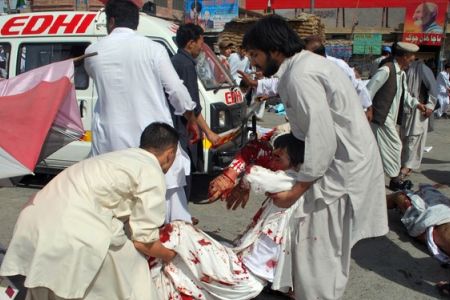
The deadliest have targeted minority Shiite Muslims. A suicide bombing killed at least 43 Shiite Muslims at a procession in the southwestern city of Quetta on Friday. Two days earlier, a triple suicide attack killed 35 people at a Shiite ceremony in the eastern city of Lahore.

Both were claimed by the Pakistani Taliban, whose commander Qari Hussain Mehsud threatened Friday that his group would wage imminent attacks in the U.S. and Europe.

On the same day, Pakistani intelligence officials said two suspected U.S. missile strikes had killed at least seven people in North Waziristan, which is largely controlled by the Haqqani network, one of the main groups battling Americans in neighboring Afghanistan.

Aid Flooded Pak by Withdrawing Army

By Swaminathan S Anklesaria Aiyar for The Times of India

Pakistan is suffering its greatest human tragedy since Partition. The floodwaters of the Indus are an incredible 20 miles wide, sweeping away entire towns, villages and farms. Over 20 million people have been displaced, far more than the nine million displaced by Partition in 1947. The immediate death count of 1,500 will soon increase hugely through disease and deprivation. Rehabilitation could cost $100 billion.

Some Indians might be perverse enough to rejoice that an enemy has been hit by a natural disaster — an act of God, as it were — and will be crippled economically for years. But most Indians will surely want to help their neighbours. In these traumatic times, we need to think of Pakistanis as humans in distress, not foes.

Even those who cannot think beyond realpolitik should see that the floods are potentially a strategic disaster for India too. Flood damage will create a fertile breeding ground for Islamist militancy. Islamist NGOs with links to terrorist groups like the Lashkar-e-Taiba and Jaish-e-Mohammed are at the very forefront of flood relief efforts and hence are gaining popularity. Meanwhile, the civil administration is seen as corrupt and ineffective. President Asif Zardari has further ruined his low reputation by going on foreign junkets.

The Pakistani army has in the last year battled some, though by no means all, militant groups in Swat and FATA (federally administered tribal areas). But much of the infrastructure built to reach the remote tribal areas has been destroyed by the floods. Besides, the Pakistani army is redirecting its efforts in the region, from combating militants to combating flood damage. The militants are re-occupying the resultant political vacuum.

The ISI recently came out with a study suggesting that Islamist militants had become a greater threat to the country than India. Flood damage can only deepen that perception. True, the army wants to back the Afghan Taliban even while battling the Pakistani Taliban, and this results in muddled thinking and sabotage of peace initiatives. The resolution of these contradictions is not in sight.

One day, the Pakistani army and the ISI will have no choice but to confront the reality that Islamist militants are Frankensteins that threaten their own creator. The ISI’s assessment should bring that day somewhat closer.
In the light of both human and strategic considerations, how can India help Pakistan? Individual contributions from Indian citizens must be encouraged, and red tape thwarting contributions in cash and kind must be cut. But the Indian government should not offer more than a modest amount of food and financial aid. Pakistan requires billions of dollars for relief and rehabilitation, so anything India offers will be a drop in the ocean.

Besides, recipients are rarely grateful for alms: they resent being supplicants, and suspect the motives of the donors. The US saved India from mass starvation after the twin droughts of 1965 and 1966 by giving record food aid. But this won the US very few friends and stoked resentment from many who felt India’s independence was being compromised. The US will once again be the chief donor to Pakistan, but will gain virtually no popularity or gratitude.

If food and financial aid will not help much, how can India best help Pakistan? The best way will be for the Indian Army to unilaterally withdraw from the border in Punjab, Rajasthan and Gujarat. This will pose no military risk whatsoever: flood-stricken Pakistan cannot possibly embark on military adventures against India. But the withdrawal of Indian troops will mean that the Pakistan army loses all excuses to avoid diverting manpower and financial resources from the border to flood relief and rehabilitation. This will cost India nothing, yet will release very large resources within Pakistan. Its impact on the Pakistani psyche will be significant. Even analysts who distrust Pakistan agree widely that India has no alternative to diplomatic engagement: cutting off ties will not win any minds and hearts there. Unilateral withdrawal will itself be a form of engagement, and will encourage other forms.

The wrong strategy will be to try to negotiate a mutual withdrawal of troops. Withdrawal must be unilateral and immediate. Defence hawks will express dismay that India is so soft on an enemy that encourages terrorism. But unilateral withdrawal will be a flood relief measure, not a military surrender. In the bargain, it will oblige Pakistan to withdraw its own troops and redeploy them for flood relief: its public opinion will be outraged otherwise.

Dr Manmohan Singh, you say we must be proactive in the peace process with Pakistan. The tragic floods there have given you an opportunity to be proactive in a way that will not come again. Go for it.

U.S. Strategy in Pakistan Is Upended by Floods

By Mark Landler for The New York Times

WASHINGTON — The floods in Pakistan have upended the Obama administration’s carefully honed strategy there, confronting the United States with a vast humanitarian crisis and militant groups determined to exploit the misery, in a country that was already one of its thorniest problems.

While the administration has kept its public emphasis on the relief effort, senior officials are busy assessing the longer-term strategic impact. One official said the disaster would affect virtually every aspect of the relationship between the United States and Pakistan, and could have ripple effects on the war in Afghanistan and the broader American battle against Al Qaeda.

With Pakistan’s economy suffering a grievous blow, the administration could be forced to redirect parts of its $7.5 billion economic aid package for Pakistan to urgent needs like rebuilding bridges, rather than more ambitious goals like upgrading the rickety electricity grid.

Beyond that, the United States will be dealing with a crippled Pakistani government and a military that, for now, has switched its focus from rooting out insurgents to plucking people from the floodwaters. The Pakistani authorities, a senior American official said, have been “stretched to the breaking point” by the crisis. Their ragged response has fueled fears that the Taliban will make gains by stepping in to provide emergency meals and shelter.

“It certainly has security implications,” said another official who, like others interviewed for this article, spoke on the condition of anonymity because he was not authorized to discuss internal policy deliberations. “An army that is consumed by flood relief is not conducting counterinsurgency operations.”

On Thursday, the United Nations will convene a special meeting devoted to the floods, hoping to galvanize what has been a lackluster global response. Secretary of State Hillary Rodham Clinton is expected to announce that American public aid has surpassed $100 million, an official said.

“We’re obviously not oblivious to the political and strategic implications of this catastrophe, but right now, we are fully focused on the emergency relief effort and trying to get a good assessment of the needs,” said the administration’s special representative to the region, Richard C. Holbrooke.

Noting that several weeks remain in the monsoon season, Mr. Holbrooke said, “Worse may be yet to come.”

The disaster comes after a period in which the administration seemed to have made strides in repairing the American relationship with Pakistan. Mrs. Clinton visited Islamabad in July with a long list of pledges, including the upgrading of several power plants and a plan to promote Pakistani mangoes. Now, these projects seem almost beside the point.

“Before, there were power plants in need of refurbishment,” said Daniel S. Markey, senior fellow for India, Pakistan and South Asia at the Council on Foreign Relations. “Now there are power plants underwater.”

In recent days, the United States has sent 15 helicopters, rescuing nearly 6,000 people. On Wednesday, military cargo planes delivered 60,000 pounds of food and other relief supplies, bringing total deliveries to 717,000 pounds. The speed and scale of the effort, officials in both countries said, have helped bolster the checkered American image in Pakistan.

In another hopeful sign, officials said Pakistan and India had been in close touch about the floodwaters, some of which are flowing into Pakistan from India. Such communication, between historic archenemies, could augur reduced tension in other areas, one of the officials said.

Against that, however, are the staggering dimensions of the disaster. A senior Pakistani official told the administration on Tuesday that the next flood surge was likely to inundate much of Punjab, the densely populated region that borders India and produces much of Pakistan’s food.

So far, this official said, the greatest damage has been in regions that are also hotbeds for Islamic insurgents, which has set back the army’s fight against extremist groups. Local governments in those places have largely collapsed, leaving the army as the only source of authority.

With 20 million people displaced from their homes, the Pakistani authorities are girding themselves for an immense migration to the major cities, which they fear could sow further instability.

“Americans have not yet registered the enormity of the crisis,” Pakistan’s ambassador to the United States, Husain Haqqani, said in a telephone interview from Islamabad, the capital.

Pakistani and American officials said reports of hard-line Islamic charities providing relief were exaggerated. One pointed out that the floods had hurt the insurgents as well: there was a report of small arms and ammunition belonging to a militant group floating in the water.

Still, people in both countries warned that if rebuilding and rehabilitation efforts bogged down, the Taliban and other militant groups would try to take advantage of it. “The real test is, can their government provide the most fundamental services?” said an administration official.

Parallels to this crisis are hard to find. One official cited the example of the Indonesian province of Aceh, which had been racked by a three-decade insurgency fought by the separatist Free Aceh Movement. After the tsunami swept through in 2004, killing 170,000 people, the separatists and the Indonesian government quickly signed a peace treaty, in August 2005.

There are, however, big differences between a localized separatist group and an international jihadist movement.

“If the flood proves to tilt the balance of power in Pakistan, it’s more likely to tilt toward the militants than toward the government,” said Bruce Riedel, a former intelligence official who helped the administration formulate its initial policy for Pakistan and Afghanistan.

Already, Pakistan’s president, Asif Ali Zardari, has been exposed to withering criticism at home for going on a trip to Europe during the early days of the flood. American officials said they were determined not to get drawn into the dispute, noting that in any event, Mr. Zardari had been stripped of many of his powers in a recent constitutional change.

Decisions on how the flood will affect American economic aid may be influenced by a trip to Pakistan by Senator John Kerry, the Massachusetts Democrat who co-sponsored the five-year nonmilitary assistance package with Senator Richard G. Lugar, Republican of Indiana.

Senator Kerry, accompanied by Dan Feldman, a deputy to Mr. Holbrooke, is scheduled to tour the flooded areas on Thursday. Mr. Kerry has said he is open to redirecting aid money, though some analysts said they were skeptical that Congress would approve additional financing. Military aid may also come under scrutiny, according to administration officials.

“Every dimension of our relationship — politics, economics, security — is going to see major shifts as a result of this historic disaster,” said Lt. Gen. Douglas Lute, the White House coordinator for Afghanistan and Pakistan. “All the tools of diplomacy have to be examined in light of this new reality.”