Archive for March, 2011

Iran Calls Saudi Troops in Bahrain ‘Unacceptable’

By Ethan Bronner and Michael Slackman for The New York Times
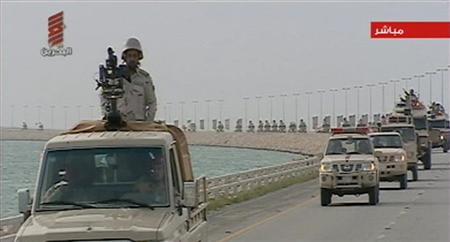
A day after Saudi Arabia’s military rolled into Bahrain, the Iranian government branded the move “unacceptable” on Tuesday, threatening to escalate a local political conflict into a regional showdown with Iran.

“The presence of foreign forces and interference in Bahrain’s internal affairs is unacceptable and will further complicate the issue,” Ramin Mehmanparast, the Iranian Foreign Ministry spokesman told a news conference in Tehran, according to state-run media.

Even as predominantly Shiite Muslim Iran pursues a determined crackdown against dissent at home, Tehran has supported the protests led by the Shiite majority in Bahrain.

“People have some legitimate demands and they are expressing them peacefully,” Mr. Memanparast said. “It should not be responded to violently.”

“We expect their demands be fulfilled through correct means,” Mr. Mehmanparast added. Iran’s response — while anticipated — showed the depth of rivalry across the Persian Gulf in a contest that has far-reaching consequences in many parts of the Middle East.

On Monday, Iranian state-run media went so far as to call the troop movement an invasion. Saudi Arabia has been watching uneasily as Bahrain’s Shiite majority has staged weeks of protests against a Sunni monarchy, fearing that if the protesters prevailed, Iran, Saudi Arabia’s bitter regional rival, could expand its influence and inspire unrest elsewhere.

The Saudi decision to send in troops on Monday could further inflame the conflict and transform this teardrop of a nation in the Persian Gulf into the Middle East’s next proxy battlefield between regional and global powers. On Tuesday, there was no immediate indication that the Saudi forces were confronting protesters in the central Pearl Square — the emblem of the Bahrain protest much as Cairo’s Tahrir Square assumed symbolic significance in the Egyptian uprising.

Several hundred protesters camped out there on what seemed initially to be a quiet day with little traffic on the streets as the details of the deployment by Bahrain’s neighbors — and their mission — remained ill-defined.

On Monday, about 2,000 troops — 1,200 from Saudi Arabia and 800 from the United Arab Emirates — entered Bahrain as part of a force operating under the aegis of the Gulf Cooperation Council, a six-nation regional coalition of Sunni rulers that has grown increasingly anxious over the sustained challenge to Bahrain’s king, Hamad bin Isa al-Khalifa. “This is the initial phase,” a Saudi official said. “Bahrain will get whatever assistance it needs. It’s open-ended.”

The decision is the first time the council has used collective military action to help suppress a popular revolt — in this case a Shiite popular revolt. It was rejected by the opposition, and by Iran, as an “occupation.” Iran has long claimed that Bahrain is historically part of Iran.

The troops entered Bahrain at an especially combustible moment in the standoff between protesters and the monarchy. In recent days protesters have begun to move from the encampment in Pearl Square, the symbolic center of the nation, to the actual seat of power and influence, the Royal Court and the financial district. As the troops moved in, protesters controlled the main highway and said they were determined not to leave.

“We don’t know what is going to happen,” Jassim Hussein Ali, a member of the opposition Wefaq party and a former member of Parliament, said in a phone interview. “Bahrain is heading toward major problems, anarchy. This is an occupation, and this is not welcome.”

Rasool Nafisi, an academic and Iran expert based in Virginia, said: “Now that the Saudis have gone in, they may spur a similar reaction from Iran, and Bahrain becomes a battleground between Saudi and Iran. This may prolong the conflict rather than put an end to it, and make it an international event rather than a local uprising.”

An adviser to the United States government, who spoke on the condition of anonymity because he was not authorized to talk to the press, agreed. “Iran’s preference was not to get engaged because the flow of events was in their direction,” he said. “If the Saudi intervention changes the calculus, they will be more aggressive.”

Though Bahrain said it had invited the force, the Saudi presence highlights the degree to which the kingdom has become concerned over Iran’s growing regional influence, and demonstrates that the Saudi monarchy has drawn the line at its back door. Oil-rich Saudi Arabia, a close ally of Washington, has traditionally preferred to operate in the shadows through checkbook diplomacy. It has long provided an economic lifeline to Bahrain.

But it now finds itself largely standing alone to face Iran since its most important ally in that fight, Hosni Mubarak of Egypt, has been ousted in a popular uprising. Iran’s ally, Hezbollah, recently toppled the Saudi-backed government of Lebanon — a symbol of its regional might and Saudi Arabia’s diminishing clout.

But Bahrain is right at Saudi Arabia’s eastern border, where the kingdoms are connected by a causeway.

The Gulf Cooperation Council was clearly alarmed at the prospect of a Shiite political victory in Bahrain, fearing that it would inspire restive Shiite populations in Saudi Arabia and Kuwait to protest as well. The majority of the population in Saudi Arabia’s eastern provinces, where the oil is found, is Shiite, and there have already been small protests there.

“If the opposition in Bahrain wins, then Saudi loses,” said Mustafa el-Labbad, director of Al Sharq Center for Regional and Strategic Studies in Cairo. “In this regional context, the decision to move troops into Bahrain is not to help the monarchy of Bahrain, but to help Saudi Arabia itself .”

The Bahrain government said that it had invited the force in to help restore and preserve public order. The United States — which has continued to back the monarchy — said Monday that the move was not an occupation. The United States has long been allied with Bahrain’s royal family and has based the Navy’s Fifth Fleet in Bahrain for many years.

Though the United States eventually sided with the demonstrators in Egypt, in Bahrain it has instead supported the leadership while calling for restraint and democratic change. The Saudi official said the United States was informed Sunday that the Saudi troops would enter Bahrain on Monday.

Saudi and council officials said the military forces would not engage with the demonstrators, but would protect infrastructure, government offices and industries, even though the protests had largely been peaceful. The mobilization would allow Bahrain to free up its own police and military forces to deal with the demonstrators, the officials said.

The Gulf Cooperation Council “forces are not there to kill people,” said a Saudi official, speaking on the condition of anonymity because he was not authorized to talk to the press. “This is a G.C.C. decision; we do not violate international law.”

But the officials also acknowledged that it was a message to Iran. “There is no doubt Iran is involved,” said the official, though no proof has been offered that Iran has had anything to do with the political unrest.

Political analysts said that it was likely that the United States did not object to the deployment in part because it, too, saw a weakened monarchy as a net benefit to Iran at a time when the United States wants to move troops out of Iraq, where Iran has already established an influence.

The military force is one part of a Gulf Cooperation Council effort to try to contain the crisis in Bahrain that broke out Feb. 14, when young people called for a Day of Rage, fashioned after events in Egypt and Tunisia. The police and then the army killed seven demonstrators, leading Washington to press Bahrain to remove its forces from the street.

The royal family allowed thousands of demonstrators to camp at Pearl Square. It freed some political prisoners, allowed an exiled opposition leader to return and reshuffled the cabinet. And it called for a national dialogue.

But the concessions — after the killings — seemed to embolden a movement that went from calling for a true constitutional monarchy to demanding the downfall of the monarchy. The monarchy has said it will consider instituting a fairly elected Parliament, but it insisted that the first step would be opening a national dialogue — a position the opposition has rejected, though it was unclear whether the protesters were speaking with one voice.

The council moved troops in after deciding earlier to help prop up the king with a contribution of $10 billion over 10 years, and said that it might increase that figure. But if the goal was to intimidate Iran, or the protesters, that clearly was not the first response.

Bahrain’s opposition groups issued a statement: “We consider the entry of any soldier or military machinery into the Kingdom of Bahrain’s air, sea or land territories a blatant occupation.”

Pakistan Expresses “Total Solidarity and Support” to Quake, Tsunami-hit Japan

As Reported by Asian News International

Pakistan has expressed its “total solidarity and support” to the government and people of Japan in the aftermath of the devastating earthquake and tsunami that hit the country on Friday.

“We are deeply shocked over the terrible news of the strong earthquake and tsunami that has hit Japan. At this time of great trial, I wish you to know that the Government and people of Pakistan stand with you and the Japanese people in total solidarity and support,” President Asif Ali Zardari said in his condolence message to Emperor Akihito of Japan.

“Our profound sympathy and condolences to all those who lost their loved ones. Pakistan stands ready to provide any assistance to help our Japanese friends overcome the effects of this enormous natural calamity,” he added.

Prime Minister Yousaf Raza Gilani also expressed solidarity with the Japanese government and its people.

In a message to his Japanese counterpart Naoto Kan, Gilani said: “We stand ready to help, in any manner, to alleviate the suffering and assist our Japanese friends to overcome effects of this terrible natural calamity.”

In Pakistan, Justifying Murder for Those Who Blaspheme

By Aryn Baker for Time

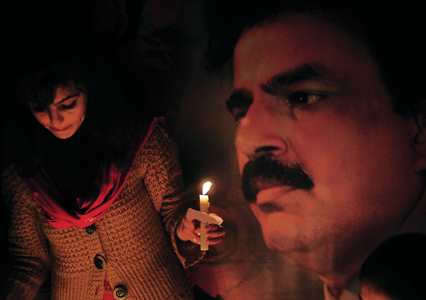
“I believe in Jesus Christ who has given his own life for us,” the doomed man said, staring straight into the video camera. “And I am ready to die for a cause.” Shahbaz Bhatti had no hesitation in his voice as he responded to a question about threats from the Taliban and al-Qaeda. “I’m living for my community … and I will die to defend their rights.” It was his last answer in a four-month-old self-produced video that was to be broadcast in the event of his death. But the radicals had the final say. On March 2, Bhatti, Pakistan’s Minister for Minority Affairs, was shot dead in Islamabad. Pamphlets scattered on the ground claimed the act for a new alliance of “the organization of al-Qaeda and the Punjabi Taliban” and asserted that other infidels and apostates would meet the same fate.

Bhatti’s death had been foretold not just by himself but also in the nation’s response to a previous assassination, that of Punjab governor Salmaan Taseer on Jan. 4. Taseer, a self-made millionaire, had turned his largely ceremonial post into a platform for a campaign to amend Pakistan’s blasphemy laws. Bhatti, the only Christian in the Cabinet, refused to be a token and swore to battle intolerance. Both men supported clemency for Aasia Noreen, a Christian woman who had been accused of blasphemy and sentenced to death. Taseer’s stance on the issue infuriated a large part of the population that, thanks to religious leaders and school curriculums, believes that blasphemy is a sin deserving of execution. In the weeks leading up to his assassination, Taseer had been denounced at Friday prayers, excoriated in the media and largely abandoned by his Pakistan People’s Party (PPP) for fears that his campaign would prove politically toxic. The witch hunt culminated in a bodyguard’s pumping 27 rounds into his head and chest in the parking lot of a popular Islamabad shopping center.

Within hours of Taseer’s death, telephone text messages celebrating his assassination made the rounds. “Justice has been done,” read one. “If you love the Prophet, pass this on.” A Facebook fan page for assassin Malik Mumtaz Hussain Qadri garnered more than 2,000 members before site administrators shut it down. Even the leaders of state-funded mosques refused to say funeral prayers for the slain governor. When Qadri was transferred to a local jail, he was garlanded with roses by hundreds of lawyers — the vanguard of a movement that in 2008 helped unseat a military dictator — offering to take on his case for free.

At his court appearance a few days later, Qadri told the judge that he believed in a Pakistan where loyalty to the Prophet eclipses all other rights. According to Taseer’s daughter Shehrbano, her father “wanted an egalitarian society where open debate is protected and people are not killed for speaking out.” And Bhatti dreamed of a nation true to founder Muhammad Ali Jinnah’s vision, one where “you are free to go to your temples, you are free to go to your mosques or to any other place of worship.” Which vision prevails — Qadri’s or Taseer and Bhatti’s — will decide the future of the country.

The Roots of Extremism

 
It is not news that Pakistan has a lunatic fringe. What is disturbing is that after Taseer’s murder, when the silent majority finally spoke up, it praised Qadri, not his victim. The public reaction exploded the myth of Pakistan’s moderate Islam; Qadri belongs to a mainstream sect that routinely condemns the Taliban. “The Pakistan we saw in the wake of Taseer’s killing is the real Pakistan,” says Amir Muhammad Rana of the Pak Institute for Peace Studies. For the past two years, Rana’s organization has conducted in-depth interviews with a broad spectrum of Pakistani citizens. “They might dress Western and eat at McDonald’s, but when it comes to religion, most Pakistanis have a very conservative mind-set.”

Pakistan’s religious parties rarely do well at the polls — a fact often cited by those countering concerns that the country is going fundamentalist — but their street power is considerable. The furor over blasphemy appears to be partly in response to significant losses for the religious right in the 2008 elections. With the current government on the verge of collapse and popular sentiment against the PPP mounting, the religious parties are betting on significant gains if fresh elections are called. The case of Raymond Davis, a CIA contractor accused of killing two Pakistanis during what appears to have been a botched attempt to rob him, demonstrates the state of Pakistan’s politics. It has gone virtually unremarked in Pakistan that Qadri, a confessed murderer, has been hailed as a national hero, while Davis — who, whatever his background, seems to have been acting in self-defense — is considered worthy of the death penalty. Over the past few weeks, street rallies led by the religious right have simultaneously called for the release of Qadri and the hanging of Davis. (Read: “Pakistan’s Christians Mourn, and Fear for Their Future.”)

Using religion to shore up political support is nothing new in Pakistan. Founded as a Muslim nation carved from a newly independent India in 1947, Pakistan has long struggled to unite a diverse population divided by language, culture and ethnicity. Islam was the common denominator, but Jinnah was famously enigmatic about its role in government.

Then, in 1977, Muhammad Zia-ul-Haq, an Islamist military general, overthrew the democratically elected government of Zulfikar Ali Bhutto, who was already retrenching his secular vision of Pakistan in an effort to win religious support. To further appease Muslim religious leaders, Zia-ul-Haq strengthened the colonial-era blasphemy laws, mandating that breaches should be answered by the death penalty. Since then, more than 1,274 cases have been lodged. As repeating blasphemous words could be considered to be perpetuating the crime, many cases are accepted without evidence, a system well primed for the pursuit of vendettas. That nobody has yet been executed by court order is hardly reassuring: 37 of the accused have been killed by vigilantes. (In 1929, Jinnah famously defended an illiterate carpenter who shot to death a Hindu publisher accused of blasphemy. The plea failed, and after the carpenter was hanged, Taseer’s father was one of the pallbearers.)

The Uses of Blasphemy
When a nation rises up in support of a murderer instead of his victim, it’s hard not to believe it is heading down a dangerous path. “What is happening now won’t matter in five years,” says Shehrbano Taseer. “It will matter in 25 years. What we are seeing now is the fruit of what happened 30 years ago. If people had stood up against [Zia-ul-Haq], we would not be here today. Because of that silence we have madrasahs spewing venom, a true Islam threatened by the same people who claim to serve it, and a cowed majority too afraid to speak.”

President Asif Ali Zardari, an old friend of Taseer’s, condemned the murders but didn’t go to either funeral. After paying his respects to Taseer’s family, Interior Minister Rehman Malik gave an impromptu press conference outside Taseer’s house during which he announced that he too would kill any blasphemer “with his own hands.” A few days later, the Prime Minister announced that he would drop the issue of the blasphemy laws altogether. Meanwhile, the government is under pressure to go through with Aasia’s sentence, and now her two champions are dead.

Reaction to Bhatti’s murder has been muted, characterized mostly by denial. What little newspaper coverage there was focused on security lapses or the role of the country’s Christian community rather than on the motives of the killer. On television talk shows, members of the religious parties and right-wing commentators spun a conspiracy theory that alleged that Bhatti’s murder had been “a plot” hatched by “outside forces” to “divert attention from the Raymond Davis affair.” There was no mention of the fact that Bhatti was campaigning alongside Taseer on the issue of blasphemy.

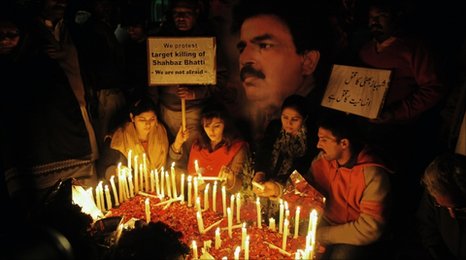
The PPP was founded in 1967 with the goal of bringing secular democracy to a nation under military rule. It vowed to give power to the people and promised to protect the nation’s downtrodden. That Pakistan’s most progressive party — one that has already endured the assassination of former Prime Minister Benazir Bhutto — should cave in the face of religious fundamentalism speaks volumes about the strength of the religious right. A candlelight vigil promoting a progressive Pakistan a few days after Taseer’s assassination drew nearly 1,000 supporters; a religious rally in Karachi the same day had 40,000 in the street chanting Qadri’s name. “Taseer’s murderer was tried in the court of public opinion, and he has emerged a hero,” says a woman shopping for vegetables in the same market where the governor was killed. “If someone kills me because I criticize Qadri, will he too be called a hero?” She declined to give her name. (Read: “Murder in Islamabad: Pakistan’s Deepening Religious Divide.”)

Of course, few Pakistanis would ever go as far as Taseer’s or Bhatti’s killers. But their ambivalence can easily be manipulated. “Just because we are religious does not mean we will all be reaching for guns the next time someone says something wrong,” says Malik Khan, a university student who spent a recent afternoon at a shrine in Lahore dedicated to a revered Islamic saint. “But Salmaan Taseer was an extremist as well. He should not have touched the blasphemy law.” Khan received a text message praising Qadri and exhorting him to pass it along. It posed a moral quandary: “I don’t agree with the message,” he says. “But I love the Prophet. My thumb hesitated a long time over the delete button.” In the end, he passed the hate along.

Qadri himself was the religious-minded youngest son of a family just stepping into the middle class. Like his brother, he joined the special-forces branch of the Punjab police in 2002. He had been flagged as a security risk because of his strong religious leanings but was nevertheless appointed to Taseer’s security detail when he visited Islamabad. In his confession, Qadri said he had been inspired by the teachings of his local mullah, Hanif Qureshi. At a rally a few days later, Qureshi claimed credit for motivating Qadri. “He would come to my Friday prayers and listen to my sermons,” he said. Then he repeated his point: “The punishment for a blasphemer is death.”

But is it? Two weeks after Taseer’s murder, I visited Qari Muhammad Zawar Bahadur, the head of one of Pakistan’s mainstream religious groups and a co-signer of a statement that advised Muslims not to show “grief or sympathy on the death of the governor, as those who support blasphemy of the Prophet are themselves indulging in blasphemy.” For more than an hour, he justified his group’s stance, telling me that the Koran was clear on the issue. I asked Bahadur to show me the exact verse that detailed the punishments for blasphemy. He mumbled that “there are several passages,” as if there were so many, he couldn’t decide which one to quote. When pressed further, he consulted a Koran and read aloud a passage that spoke of killing a man who had once harmed the Prophet.

That verse has routinely been dismissed by leading Islamic scholars as referring to a specific case and having nothing to do with blasphemy. They say there is no definition of blasphemy in the Koran, nor any prescription for its punishment. “Nobody challenges these mullahs, and that is our problem,” says Omar Fazal Jamil, who runs a p.r. firm in Lahore. “We can’t invoke liberal secular values anymore. I have to have the knowledge to contradict these men who distort our religion for their own political gain. I have to be able to say, ‘No, this did not happen, this is not right, and show me where it says in the Koran that blasphemers should be shot on sight.’ ”

The Sin of Silence
In the absence of such challenges, those favoring religious intolerance will continue to have things go their way. In late 2007, Benazir Bhutto released an updated manifesto for her father’s party. “The statutes that discriminate against religious minorities and are sources of communal disharmony will be reviewed,” it said. Less than a month later she was dead, killed in a bomb attack just 13 km from where both Taseer and Bhatti were murdered. Her death was an opportunity to rally the nation against the forces of extremism. Instead the party focused on consolidating power. The manifesto remains an empty promise, and two more voices of tolerance have been silenced. For evil to prevail, goes the old aphorism, all that is required is for good men to do nothing.

— With reporting by Ershad Mahmud / Lahore and Omar Waraich / Rawalpindi

The Myth of ‘Moderate Pakistan’

By Sadanand Dhume for The Wall Street Journal

It’s time to bury the myth of moderate Pakistan. You know the one: the notion, repeated ad nauseam in magazine articles, think-tank reports and congressional testimony—as though saying it often enough will make it true—that Pakistan is an essentially tolerant country threatened by a rising tide of fundamentalism. Here’s a news flash: The tide has risen.

The most recent reminder of this came last Wednesday in Islamabad, when suspected Taliban militants shot dead Shahbaz Bhatti, Pakistan’s 42-year-old minister for minority affairs and the only Christian in the overwhelmingly Muslim nation’s cabinet. His crime? Supporting the repeal of a barbaric blasphemy law that makes insulting the prophet Muhammad punishable by death.

The law is often used to settle scores with hapless religious minorities, especially Christians such as Asia Bibi, an illiterate peasant sentenced to hang last year after she allegedly badmouthed the prophet during a row with Muslim coworkers. Bhatti’s assassination comes two months after a bodyguard murdered Punjab Gov. Salmaan Taseer for visiting Ms. Bibi in jail and speaking out against abuse of the law.

To be fair, Pakistan’s claim to relative moderation has been kept alive thus far by more than just wishful thinking. Overtly Islamist parties such as the Jamaat-e-Islami have rarely commanded more than a fraction of the national vote. Women enjoy freedoms in the public square that their counterparts in Saudi Arabia and Iran could only dream of. At great personal risk, a small but courageous group of activists, intellectuals and politicians speak out publicly against bigotry and religious intolerance.

Scratch the surface, however, and a bleaker picture emerges. Islamist parties may not garner large-scale electoral support, but Islamist ideas are widely tolerated by mainstream political parties. The major opposition party, former Prime Minister Nawaz Sharif’s Pakistan Muslim League, flaunts its closeness to sundry Islamists, including Jamaat-ud-Dawa, the parent organization of the international terrorist group Lashkar-e-Taiba.

Ostensibly secular, the ruling Pakistan Peoples Party supported both Kashmiri militancy and the Afghan Taliban in the past. In its current incarnation it appears permanently cowed by the country’s legion of vocal fundamentalists. President Asif Ali Zardari failed to attend the funerals of either Taseer or Bhatti. His government has made it clear that it will not touch the controversial blasphemy law. Interior Minister Rehman Malik declared that he would personally kill anyone who dared blaspheme Muhammad’s name.

As for Pakistan’s undeniably brave activists and intellectuals, unfortunately they appear to have more admirers overseas than among their compatriots. Hand-wringing in the pages of Dawn and the Friday Times, two of the country’s leading English-language newspapers, has not prevented Mumtaz Qadri, Taseer’s murderer, from becoming a national hero.

Not surprisingly, anti-American sentiment—often a reliable shorthand for a society’s paranoia and self-loathing—is rampant. According to the Pew Global Attitudes Project, American favorability ratings stood at 17% last year, the lowest of all countries surveyed. On the streets, bloodcurdling yells for the execution of alleged Central Intelligence Agency operative Raymond Davis, accused of killing two Pakistanis in January, have prevented the government from granting Mr. Davis the diplomatic immunity that the U.S. claims he is entitled to. This despite personal pleas by President Barack Obama and Sen. John Kerry.

By now the reasons for Pakistan’s predicament are well known. They include the intolerance embedded in the nation’s founding idea of a separate “land of the pure” for Indian Muslims, the malign shadow of Saudi Arabia on religious life, blowback from the anti-Soviet jihad of the 1980s, and the overwhelming influence that the army and its thuggish intelligence wing, the Inter-Services Intelligence, wield on national life. The army’s very motto, Jihad-fi-Sabilillah, or jihad in the path of Allah, is an exhortation to holy war.

For the international community, the long road to fixing Pakistan begins with the simple recognition that the country’s true face is not the urbane intellectual making reasoned arguments, but the frenzied mob showering rose petals on a murderer for his services to the faith. Over time, Pakistan can only be saved by re- arranging the basic building blocks of the country.

This means backing provincial autonomy and linguistic identity as an alternative to the centralized pan-Islamism used by the military and its supporters to weld the country together. It means deploying social networks and satellite television to open the door to reasonable discourse about religion. It means channeling aid to ensure that children are no longer taught to glorify Islamic conquest and reflexively mistrust the West and India. It means accepting that the most poisonous madrassas—such as Jamia Binoria in Karachi and Darul Uloom Haqqania outside Peshawar—must be shuttered if they can’t be reformed.

Needless to say, none of this will be easy. But the consequences of the alternative—pandering to fundamentalists while blaming outsiders for all the country’s ills—can be seen in the freshly turned soil of Bhatti’s grave.

-Sadanand Dhume is a resident fellow at the American Enterprise Institute and a columnist for WSJ.com.

Sindh Saves the Day

By Nadeem F Paracha for Dawn

Plans are afoot to build the world’s first ever international Sufi university near Bhit Shah in Sindh. The main purpose of the institution would be to promote interfaith and intercultural education to tackle extremism in the country.

Such a thought and project could only have come about in Sindh. Especially in the context of what Pakistan has beengoing through in the last many years.

Not only have the country’s other provinces – especially the Punjab and Khyber Pakhtunkhwa (KP) – become central targets of horrid terrorist attacks by extremist organisations, the Punjab in particular has also been witnessing a steady growth of faith-based conservatism within its urban middle and lower middle-classes.

When extremists (calling themselves ‘Punjabi Taliban’) attacked the famous Sufi shrine, Data Darbar in Lahore late last year, economist and political analyst, Asad Sayeed, made a rather insightful observation.

He said that had such an attack on the Darbar taken place twenty years ago, thousands of Lahorites would have poured out to protest.

But not anymore. The attack on one of Punjab’s most popular Sufi shrines was simply treated as just another terrorist attack.

Though it is now clear that the Wahabi/Deobandi extremists have been going around blowing up Sufi shrines frequented by the majority Barelvi Muslims, the Barelvi leadership has looked elsewhere, putting the blame on the ever-elusive ‘foreign hands.’

Journalist and intellectual Khaled Ahmed once wrote a telling tongue-in-cheek article about the annual gathering of the Dawat-i-Islami in Multan.

The Dawat is the Barelvi equivalent of the Deobandi Tableeghi Jamat. Both these outfits are considered to be non-political organisations who are more interested in evangelizing their respective versions of Islam and its rituals. One should also mention that both these (sub-continental) strains of Islam accuse one another of being ‘flawed Muslims.’

Ahmed wrote how after Dawat’s huge congregation in Multan, when police found some bullet-riddled bodies of Dawat members, the outfit’s main leadership simply refused to acknowledge the glaring evidence that pointed towards the involvement of an opposing Sunni sect’s organisation in the murders.

Ahmed adds that Dawat leaders began babbling about ‘outside forces (RAW, CIA, Mossad)’ who wanted to create disharmony between Pakistan’s Barelvi majority and the Deobandi and Wahabi sects.

Barelvis: From moderate to militant

One can understand the above-mentioned episode as an example of the confusion Barelvi spiritual leadership has gone through since the 1980s.

From its inception in the 18th century and until about the mid-1980s, the Barelvi sect was largely apolitical in orientation, non-Jihadist and followers of some of the most relaxed dictates of the Hanafi madhab – the first of the four main Islamic schools of law that is also considered to be the most moderate.

‘Barelvi Islam’ (as it is sometimes called) is purely a sub-continental phenomenon that fuses elements of Indian Sufism with the folk and populist strains of various cultures that exist in the sub-continent.

It is also called the ‘folk Islam’ of the region in which a high degree of tolerance exists between various faiths, sects, classes and ethnicities and in which the puritanical aspects of other Islamic sects are eschewed and even rejected.

The Sufi shrine and an intense reverence of the Prophet (PBUH) play a central role in Barelvi Islam. Its populist and moderate make-up helped it become the majority Sunni sect amongst the Muslims of the sub-continent.

Two of its leading opponents have been the Sunni Deobandi sect (also a product of the subcontinent) and the Saudi-inspired Wahabism.

Both have accused Barelvis of ‘adopting Hindu rituals and practices’ and assorted ‘heresies.’

In spite of being the majority sect amongst Sunni Muslims in Pakistan, ‘Barelvi Islam’ hardly ever had a coherent political expression in shape of a mass-based political party or organisation.

Its spiritual leadership remained pro-Jinnah (unlike Deobandi organizations of undivided India), and various Pakistani political leaders have continued to appeal to the symbolism and lingo associated with various populist aspects of Barelvi-ism.

Zulfikar Ali Bhutto and his Pakistan Peoples Party (PPP) was the most successful in this respect.

Bhutto was also one of the first leading Pakistani political figures to undertake the act of regularly visiting various famous Sufi shrines in Sindh and Punjab.

Barelvis are in the majority in Sindh and the Punjab, whereas Deobandis are largely centred in Khyber Pakthunkhwa and in the Pushtun-dominated areas of Balochistan.

Until the 1970s Barelvi-ism also prevailed among many of Sindh and Punjab’s urban middle-classes, especially those who considered themselves to be progressive and likely supporters of secular politics.

However, the arrangement in this context was suddenly disturbed with the arrival of the Ziaul Haq dictatorship in 1977.

Dipped in the political Islam of scholar and Jamat-i-Islami (JI) chief Abul Ala Mauddudi, Zia soon moved towards infiltrating the spiritual and political nerve centres of Barelvi-ism in an attempt to ‘reform’ them.

Barelvi dominance across the country’s religious landscape reminded him of Z A. Bhutto’s populism (which he, like JI, considered to be ‘vulgar’ and ‘un-Islamic’), and from 1979 onwards Pakistan under Zia also became one of the leading client states of Saudi-generated Wahabi propaganda and aid.

Stunned by the ‘Islamic revolution’ in the Shia-dominated Iran in 1979, Saudi Arabian monarchy and its Wahabi Sunni religious elite began seeing Pakistan’s Barelvi-dominated make-up as venerable to Shia-ism’s revolutionary symbolism and also of socialist propaganda, especially with the arrival of Soviet forces in Afghanistan.

At least that was one of the reasons used by Zia and his Saudi allies to draw the United States into giving Pakistan billions of dollars worth of aid and arms.

With the aid also came Wahabi propaganda literature and preachers who along with Pakistani Deobandi and Wahabi spiritual and political groups began setting up madressas and mosques.

These madressas operated as institutions that would indoctrinate young Pakistanis – most of whom were immersed in the non-Jihadi traditions of Barelvi-ism – and prepare them for Jihad against Soviet forces in Afghanistan.

Bralevi tradition had also not been very kind to the ulema and the clergy.

To address this, Zia also began describing famous Sufi saints as ulema and banned (in the media) all criticism and humour aimed at the clergy.

The Afghan war, Saudi propaganda, the mushrooming of Deobandi and Wahabi madressas and televangelists, and a concentrated campaign by the Zia regime to equate the dictatorship’s capitalist-Islamist makeup as something in accordance with the Shariah and with ‘Jinnah and Iqbal’s vision,’ had a telling impact on Pakistan’s religious sociology.

In the Khyber-Pakhtunkhwa many moderate and progressive Deobandi strains that had prevailed in the province began sliding into the sect’s more radical dictates, coming closer to the puritanical Wahabi and Salafi ideas about faith.

This slide was celebrated by the Punjab-dominated military as a successful blow to the secular and ‘treacherous’ Pukhtun separatist tendencies.

In the Punjab, the province benefited the most from Zia’s Punjab-centric capitalist maneuvers. This coupled with unprecedented remittances coming from Pakistanis who had begun going to Arab Gulf states to work from the 1970s onwards, gave birth to new moneyed classes.

Many from the petty-bourgeoisie and bourgeoisie sections began moving away from their Barelvi heritage and towards more puritanical strains of faith.

Their Barelvi past now reminded them of their lower status and economic modesty, whereas they began relating their enhanced economic standing with the adoption of the more puritanical strains of Islam.

That’s why the growth of puritanical Islamist and sectarian organizations that Punjab saw under Zia, a lot of their local funding came from Punjab’s nouveau-riche and petty-bourgeois trader classes.

Interestingly, it was also the same classes that also pushed the Barelvi leadership to become more conservative and radical. Those sections of the Punjabi petty-bourgeoisie that stuck to Barelvi-ism encouraged their spiritual leadership to compete with the Puritanism and radicalism of the growing number of Deobandi and Wahabi groups.

This trend saw the first ever emergence of radical Barelvi groups. In the early 1980s, the Dawat-i-Islami was formed to counterbalance the growth of the Deobandi Tableeghi Jamaat that had begun making deep inroads into Punjab’s bourgeoisie and the military.

The Dawat discouraged the Barelvis from indulging in antics associated with the region’s folk Islam, emphasising an increased reverence of holy personalities and encouraging holding of recitals of naats and milads instead of quwalis and dhamals. The last two became associated with the practices of the lower-class Barelvis.

In 1992, emerged the Sunni Thereek (ST). A Barelvi outfit that emerged from the splintering of the oldest Barelvi Islamic political party, the Jamiat Ulema Pakistan (JUP).

Such occurrences did not really help the Barelvi sect defend its traditions in the face of the state-sponsored Deobandi and Wahabi onslaught –  rather, these organisations began turning Barelvi-ism into an equally anti-pluralistic and militant political phenomenon.

Sindh saves the day?

By the 1990s, Zia’s manoeuvres and Saudi involvement in reshaping Pakistan’s religious tradition had seen Khyber Pakhtunkhwa and Punjab become hostage to various violent Deobandi/Wahabi outfits and new-born Barelvi reactionary-ism.

The Punjab also saw a rise in the use of reactionary political and religious narratives within its lower-middle and middle-classes, whereas in Balochistan attempts were being made (by intelligence agencies) to neutralize secular Baloch nationalist militancy with the help of puritanical evangelical outfits. The agencies had already done this successfullyin Khyber Pakhtunkhwa in the 1980s.

But what happened in Sindh? Barelvi-ism in Sindh (outside Karachi) has always been a lot more secular and pluralistic than the Bareilvi-ism in the Punjab.

Its  sociology  in Sindh heavily revolves around the staunchly secular historicity that the province’s famous scholar, GM Syed’s literary work generated.

He described a highly pluralistic and secular reading of Sufism as being the cultural and religious make-up of the Sindhis and it is this narrative that still rules the roost in the province’s social and religious psyche.

This is one of the reasons why Zia completely failed to impose his version of Islam here. Also, just like the majority of the Baloch who equate puritanical Islam with the ‘Punjabi civil-military elite,’ so does the socio-political discourse in Sindh.

On the other hand, in Karachi, though Zia-backed Deobandi and Wahabi radical outfits did manage to find a foothold, two things have always worked against these outfits here.

The first is the fact that the sprawling ethnic, sectarian and religious diversity found in Karachi actually absorbs and neutralizes any attempt by an outfit to impose its version of Islam.

Secondly, MQM, a party that first emerged as a mohajir nationalist group, adopted almost the same populist Barelvi symbolism and lingo as Bhutto did in the 1970s.

Also, the other two big political parties in the city too are secular: the PPP and ANP.

Though the Sunni Thereek (ST) has managed to infiltrate some sections of MQM’s support, ST is Barelvi and anti-Taliban (albeit reactionary).

In spite of the rampant crime and ethnic tensions that are a constant in Karachi, it will not be an overstatement to claim that Karachi along with the rest of Sindh today stands to be perhaps the only (ragged) sanctuaries in present-day Pakistan that are (comparatively-speaking) largely free of the factors that have created opportunities in the Punjab and KP for violent extremist activity as well as for reactionary conservatism to now become a mainstay in Punjab’s bourgeois psyche.

Bangladesh Stun England in Chittagong Thriller

By Azad Majumdar for Reuters News Agency

Two unheralded Bangladeshi tail-enders with ice in their veins played the innings of their lives to subject England to yet another giant-killing act on Friday.

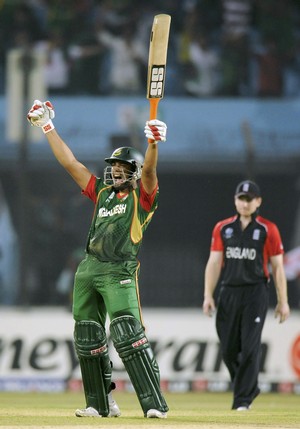
Shafiul Islam (24) and Mahmudullah (21) defied the nerve-jangling pressure to forge an unbeaten 58-run ninth wicket stand to complete a two-wicket Group B victory that even their captain did not think they could pull off.

“I never believed they can win it for us. It’s only after hitting the winning run that I believed they have done this,” said Bangladesh skipper Shakib Al Hasan, whose house was stoned by irate fans after the team’s defeat by West Indies last week.

At 169-8, Bangladesh’s chase for a 226-run victory target on a tricky track looked so doomed that even some of their ardent followers exited the Zahur Ahmed Chowdhury Stadium shaking their heads, not realising the drama that was about to unfold.

Aided by England’s profligate bowlers who conceded 33 extras, including 23 wides, in the see-saw contest, both the tail-enders kept going before Mahmudullah drove Tim Bresnan through covers to seal the match with one over to spare and trigger wild celebrations.

Tamim Iqbal (38), Imrul Kayes (60) and Shakib (32) chipped in with useful cameos but Shafiul and Mahmudullah were the toast of the nation.

Wary of the dew factor, Shakib won a good toss and opted to field and he had reasons to feel vindicated when the English bowlers struggled to grip the wet ball in the evening.

England’s batting was also inconsistent and if it had not been for the knocks by Jonathan Trott (67) and Eoin Morgan (63), they might not have even scored 225 all out.

They looked completely shackled by the home team bowlers, managing just four boundaries in the first 20 overs.

Once again, they could not make the most of their batting powerplay either, managing just 33 runs and losing two wickets.

MISSED OPPORTUNITY
Defending a below-par total, English bowlers seemed to have turned the table on their hosts before being thwarted by Bangladesh’s spectacular rearguard resistance.

“We are very disappointed, it was a missed opportunity for us,” rued England skipper Andrew Strauss, admitting problems both in the batting and bowling departments.

Consistency has been a real problem for the team which narrowly escaped an upset against the Netherlands, tied with India, went down to Ireland before losing to Bangladesh here.

“These defeats hurt, there’s no doubt about it,” said Strauss, whose side could have sealed a place in the last eight if they had won Friday’s match.

“But you’ve got to channel that frustration and make sure you channel it the right way and come out and beat the next side you’re playing against. It’s a big game for us (against the West Indies) and we’re going to have to win it.”

England now need to win their final match against the West Indies on March 17 to be sure of a quarter-final place while Bangladesh next face Netherlands on Monday and then South Africa on March 19. Wins would take them through.

What’s My Dad Doing on Facebook

By Michael Franco for Francopolis.com

When I received a friend request from my dad, I was, frankly, weirded out. But the inherent distance of online communication somehow allowed us to express affection in ways that are too awkward in person.

My dad and I are Facebook friends. That sounds like a completely ridiculous thing to say. I mean, we’re friends in the real world, so why wouldn’t we be Facebook friends? But that’s not the reason it sounds ridiculous. No, it sounds ridiculous because I see my dad practically every single day of my life, but I’m closer to the virtual him than the actual him. Strange, right? How is that even possible?

My father, you see, comes from a generation of men — perhaps the last — for whom expressing affection towards their children can be awkward, particularly children of the same sex. This, I’m sure, has something to do with evolving gender roles and what it means to “be a man”. For my dad’s generation — the early baby boomers — being a man meant providing a family with essentials, not emoting all over the place. Men were to be sturdy and stoic, not soft and sensitive.

I also get the impression that my dad wasn’t too close with his parents. His mother seemed distant; his father eccentric – neither the personification of affection. When I think back to my father’s interactions with his parents before they passed, words like “cordial” and “businesslike” come to mind. He was kind to them because he’s a kind person, but I never got the impression that he was maintaining fulfilling relationships. In light of that, I’m surprised he even knew how to express affection to my brother and me.

This doesn’t mean my dad never showed his love for us when we were growing up. I can recall countless acts he performed to express his affection. When he would take a day off from work, for example, he would spend it ironing our clothes and cooking dinner. My brother and I didn’t even care if our clothes were ironed, but I knew that was my dad’s way of saying that he loved us. Who, after all, takes off from work to iron Nike t-shirts and prepare roast chicken in garlic gravy?

But I could probably count the number of times my father has told me he loves me on my twenty digits, and that’s simply no big deal to me. I’ve never once thought that he doesn’t; I’ve just always known that some things are easy to feel but harder to say. There have been many times, in fact, when I have wanted to tell my dad I love him but have felt that it would be too awkward to do so. Guys can be funny that way.

So when I received a Facebook friend request from my dad, I was, frankly, weirded out. I’ve been accustomed to keeping my dad close, but not too close. Sunday night dinner? Sure. Friday night pub crawl? No thanks. In accepting his request, I would give my dad insight into my entire life: my interactions with friends, my comings and goings, my random thoughts, my likes, my dislikes, what I “like” and “unlike”, the random compliments I give my girlfriend (who, ironically, doesn’t even have a Facebook account)… This simple request felt more like an invasion.

And yet, I knew I had no option but to “friend” my dad. What conceivable excuse could I have to not? Before I clicked on “Accept”, though, I took the time to review my past posts and photos to “clean up” my profile. I even thought about starting a whole new profile for friends and keeping the one I had for people like my dad and my boss – people for whom I reserve the persona that, otherwise, only gets used when I attend Mass every few years.

In the end, though, I decided to let my dad simply be like any other Facebook friend because, well, he’s my dad. At first, however, I wasn’t sure how to virtually interact with him. I was even scared to look at his profile. Would he post creepy photos of him and my mom drinking martinis and standing too close to one another at creepy parties for creepy people of their age? Would he have bizarre, unacceptable interests, like scrapbooking or watching American Idol? Would he be socially awkward, posting head-scratching comments on others’ posts?

All the worrying was for naught. My dad, turns out, is completely normal. What’s more, accepting his friend request allowed the two of us to communicate more than we ever have before. While I have always talked to my mother on a daily basis, neither my dad nor myself have ever felt comfortable just picking up the phone and diving into conversation. Again, the generational divides.

But on my Facebook page, my dad was suddenly showing interest in my life: complimenting me on accomplishments, posting comments on my posts, taking notice of the things that are my life. Somehow, the inherent distance of online communication allowed him to express affection in ways that are too awkward in person, and that has given us things to talk about in our face-to-face interactions.

One day, for example, he commented about my blog, not realizing that I spend many evenings in front of the computer. “I like your blog,” he said. “I didn’t know you blogged. Is there a way for me to add it to my favorites? I really like your articles.” And just yesterday he complimented me about a piece I wrote for an online magazine, telling me I did a good job. No matter how old you are, hearing your father express interest in your interests is flattering, nice. And if he weren’t my “friend”, he might never know of my writing pursuits.

I’ve also learned a lot about my dad because of our newfound “friendship”. Through his Facebook page, for example, he has revealed an astute humor I never knew he possessed. One night, my girlfriend and I couldn’t keep from cracking up at his profile picture: a shot of him sitting on a toilet in the middle of a driveway, scarf wrapped around his neck and stocking cap on his head, posed like Rodin’s “The Thinker”. Why was a toilet in the middle of a driveway? What was my dad doing sitting on it on an obviously cold day? Most of all, why would my dad make this his profile picture, his way of greeting the online world? It was genius, that’s why, and it turns out my dad has a genius wit.

The best part of having my dad as a Facebook friend, though, is that it keeps the family in constant contact with one another. If I post a picture of my son that’s particularly funny or charming, my parents will comment on it or call to get the full story. If I comment about an exciting happening during my day, my parents will ask me about it when I talk to them later in the day. These moments – relatively small but meaningful nonetheless – would go by without being shared if not for Facebook.

No, I don’t necessarily buy into the notion that the Internet has made the world smaller in every single circumstance, bringing everyone closer together in every conceivable way. In many ways, it has done just the opposite, giving people the means to seclude themselves in their virtual lives rather than participating in their actual lives — as well as draw rigid ideological lines that purposely exclude large portions of the world.

But for all the ridiculous, overblown assertions that the Internet can erase divisions and bring people together, sometimes it actually does. Some people, for instance, join couch surfing groups and travel around the world, staying with complete strangers with a shared love of travel. Others join online communities and talk to people from foreign countries, learning about cultures that, without the Internet, they’d never have the chance to experience.

And then there’s me: I accepted my dad’s friend request and found out that in addition to being a great dad, he’s also pretty damn cool. Maybe that Friday night pub crawl is in our future yet. Perhaps a virtual beer first…

Japan’s 8.9 Earthquake “Historic” says Geophysicist

By Caroline Kyungae Smith for The Chicago Tribune

“Japan’s earthquake will be considered a great quake,” said Dale Grant, a geophysicist with the US Geological Survey in Golden, Colo. “Japan has never seen this before.”

Any quake above an 8 in magnitude is considered a great quake, Grant said. Damage can span from hundreds to thousands of miles.

The quake was centered about 80 miles east of Japan.

A few days earlier, Japan was hit with a 7.2 earthquake that many are saying was the precursor to today’s quake, he said.

“A 7.2 quake has 80 or 90 times less energy than an 8.9 quake,” he said.

As of 3 a.m., there were at least 12 aftershocks following the earthquake, with the highest aftershocks measuring 7.1 and 6.8, Grant said.

“This is what we’d expecte from an 8.9 earthquake.”

The greater concern is the tsunami that was triggered by the quake, he said. “Tsunamis can travel up to 450 miles per hour,” he said.

“Warnings have been issued for the Hawaiian Islands,” he said. “We’ll probably see an impact.”

The biggest earthquakes in recent history occurred last year in Chile at 8.8 and in 2004 in Indonesia at 9.1, Grant said.

Afridi Tells Pakistan to Learn New Zealand Lessons

As Reported by Agence France-Presse

Pakistan captain Shahid Afridi on Wednesday urged his team to learn the lessons of the 110-run defeat against New Zealand.

The Black Caps rode on a brilliant unbeaten 131 by Ross Taylor to post a challenging 302-7 before Tim Southee removed the top order with a burst of three early wickets to bowl Pakistan out for 192.

“There were quite a few lessons to be learned from the defeat, especially those chances we gave to Taylor and when you give such chances to a player like him he makes you pay,” said Afridi.

Wicketkeeper Kamran Akmal let Taylor off twice in the same Shoaib Akhtar over – once when the batsman was on nought and then on eight – allowing two straightforward chances to slip past him.

Afridi said his bowlers were poor in the death overs when New Zealand plundered 139 runs off the last 10 overs.

“I think the way we started with the ball was good, but then the missed chances maybe demoralised the bowlers and they were very poor in the end,” said Afridi.

Afridi hoped his top order batsmen will show improvement in the next game, against Zimbabwe on Monday.

“Our top order did not work well although we have given them the time to settle down and this was the first time we were chasing. We need to learn how to bat while chasing,” said Afridi.

“Taylor took the game away from us although the bowlers had reverse swing. But the way he played was brilliant and he took the game away from us,” said the Pakistan captain.

Pakistan now have six points from four matches, second in Group A behind New Zealand who also have six points but a better net run-rate.

Co-hosts Sri Lanka (five points from four) and Australia (five from three) are third and fourth respectively.

Our Noblest Selves

By Marvi Sirmed for Newsweek Pakistan

Be careful. After the assassination of Shahbaz Bhatti, federal minister for minorities, on March 2 and of Salmaan Taseer, governor of the Punjab, two months before that, friends and family put out the same, simple message. Be careful. But with two brave men slain so violently and so publicly, can we afford to be careful?

Everything changed after the governor’s assassination. For Taseer’s killer, there are shrines on Facebook and rose petals. For those of us who, accurately, refer to Taseer as a martyr, there is concern from well-wishers—and death threats from others. Lawyers lined up in the hundreds to defend and garland Taseer’s self-confessed killer, while cleric after another refused to lead his funeral services. The right’s pundits called Qadri a ghazi or holy warrior, while state-owned Pakistan Television dropped shaheed or martyr for Taseer within hours of his death. Qadri supporters brandished their bloody hands at rallies that pulled in tens of thousands, while those who mourn Taseer and what he represented struggled to manage mere hundreds at vigils. The polarization and plight of Pakistan have never before been so painfully obvious.

Like Taseer, Bhatti, too, gave his life up for a cause that must be owned by those who run our country. But people everywhere are being careful. And this just won’t do.

Bhatti was one of those rare public figures who never sought the spotlight, who spoke softly, who had no skeletons in his closet. Bhatti could have played it safe. He began receiving death threats after the Gojra massacre. These picked up after he championed the cause of Aasia Noreen, a Christian mother convicted under the blasphemy laws, which the Pakistan Peoples Party had committed to review in order to prevent their misuse. After Taseer’s death, Bhatti could have played it safe and gone quiet. He did not. He was not “careful.” He was laid to rest in Faisalabad on March 4 with thousands turning out to honor him.

What can we do? We need to be honest with ourselves. Bhatti was killed by a group that calls itself the Punjabi Taliban. Punjab Chief Minister Shahbaz Sharif has taken exception to interior minister Rehman Malik highlighting this fact. Terrorists are a national problem, they are not Punjabis or Sindhis, says Sharif, who is also the home minister of his province. What more has to happen before the chief minister, a compassionate man by most accounts, finally acknowledges that we have a problem in the Punjab?

Second, we need to stop passing the buck and offering contrition practiced for television. Prime Minister Yousaf Raza Gilani reportedly offered his resignation to the cabinet the day Bhatti was assassinated. There have been two shocking high-profile murders in Islamabad in as many months and not a single soul has been sacked. There’s no shortage of candidates who deserve the ax. Let’s start with the state-employed clerics who refused to perform Taseer’s last rites.

Third, name and shame the members of Parliament who refused to raise their hands in prayer for Taseer and Bhatti. There was a prayer for Taseer in the National Assembly, but, infamously, not in the Senate. Bhatti got two minutes of silence in the National Assembly on March 3 and a walkout from all parties—including, oddly, the ruling party—against the government’s failure to protect Bhatti, but no prayers. What have we come to when we cannot bring ourselves to pray for the departed and their devastated families? This is not coldhearted or remotely Islamic, but pure evil.

Fourth, we need to enforce a strict ban on hate speech. Incitement to murder, character assassination and hate words cannot be provided mainstream platforms—whether print or electronic—under the pretense of free speech. Some channels promoted the false impression that Taseer had blasphemed, and they publicized fatwas against him. They also hyped up pro-Qadri rallies. It never came to light that these processions, while big, were limited to three cities. Responsibility will not suddenly dawn on our lawless media. To keep television honest and to counter the state’s halfhearted ban on militant groups, corporations need to step up and withhold ad spend from channels providing support to the jihadists. Consumers can then hold these corporations accountable by buying or boycotting their products.

The brave among us refuse to be careful when they see the rapid undoing of their motherland, and whose faith in man’s goodness speaks to our noblest selves. We are not a nation of murderers and monsters, but we sure are close.

Sirmed is a rights activist in Islamabad.

Bombing kills 25 Near Intelligence Office in Eastern Pakistan

By Karen Brulliard for The Washington Post

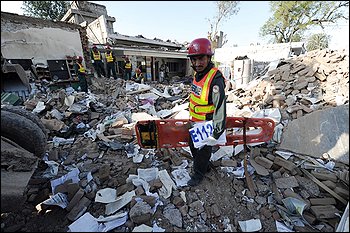
ISLAMABAD, PAKISTAN – A car bomb exploded near an office of Pakistan’s main intelligence agency in the eastern city of Faisalabad on Tuesday, killing 25 people in the type of militant attack that is growing more common in the country’s populous heartland.

A spokesman for the Pakistani Taliban asserted responsibility for the attack and said it was aimed at the intelligence office, the Associated Press reported.

Police said the bomb, which was detonated at a gas station, sparked additional explosions of natural gas cylinders, compounding the damage. The blast destroyed parts of several businesses, including an office of the national airline, and wounded at least 100 people.

Sectarian violence is common in Faisalabad, Pakistan’s third-largest city and a textile-producing hub, but Tuesday’s blast was the first major militant attack there. Militants have often carried out bombings in other large cities, including Lahore, about 80 miles to the east. The attacks regularly target Pakistan’s security forces, who in recent years have mounted counterterrorism offensives against insurgent hideouts in the mountainous northwest.

Now, Pakistani authorities and analysts say, violent extremist organizations are spreading across Punjab province, of which Lahore is the capital.

Southern Punjab is home to militant groups that traditionally focused attacks on Indian targets but are now thought to be deepening ties to Taliban factions in Pakistan and Afghanistan.

The car bombing occurred nearly a week after the assassination of federal cabinet minister Shahbaz Bhatti, which a group calling itself the Punjabi Taliban said it had carried out.

Bhatti, a Christian, had spoken out against Pakistan’s anti-blasphemy laws, which are enforced most stringently in Punjab. The laws are defended by religious groups, which say that violators of the statutes – and supporters of the violators – deserve death.

Life in India on International Women’s Day

Amruta Mehta for The Guardian

A child of the late 80s and 90s, I was a young girl when satellite television was introduced in India.

It brought along an overdose of Bollywood, soaps and reality TV, which I feel has been brutal on India’s girls. In response to youth culture prompted by these changes, the moral police has been raising its head, targeting young girls.

Perhaps it is due to the ubiquity of information and dramatisation of the news media, but I feel that violence against women in India has increased greatly during my lifetime. While it has become increasingly easier for urban Indian women to work even after marriage, the expectations on them remain cripplingly unrealistic.

As I sought out strong Indian female role models while growing up, I found that phenomenally powerful women abound. India’s first female police officer, Kiran Bedi, has influenced tens of thousands through radical prison reforms, daring to question the practices of generations of men before her. She is bringing India’s women centre-stage in the fight against corruption. Women are CEOs of large companies, philanthropists, and icons of style and grace.

We’re a country of over a billion people, with a large young population, deep socioeconomic disparities, and an ancient democratic tradition. It should come as no surprise that youth movements working for equality are everywhere. The promise that India’s girls hold can be felt in the electrifying energy around young female doctors and IT workers, and girls who ferociously compete for the best grades with their male classmates.

I was the first girl in my extended family to travel abroad alone for study. For this, my mother faced much character assassination. I have been lucky to have had parents who responded by trusting me unconditionally.

These are the people we must celebrate on International Women’s Day: apparently ordinary men and women who blaze trails at the risk of violence and ostracism. Development progresses due to them, inch by inch, from one generation to another.

I do believe that our time has come. I believe in my generation – and I hope you will too.

–Amruta Mehta, a respected group member of Pakistanis for Peace, is from Mumbai, India, and lives in the Netherlands, where she works in scientific media.

Not much Islamic about Islamic Pakistan

By Haroon Siddiqui for The Toronto Star

In the failing state of Pakistan, a junior cabinet minister is killed. Shahbaz Bhatti was a member of the Christian minority. He had taken up the cause of a poor Christian woman condemned to death for allegedly defaming Islam. He knew he was a marked man. But on a recent visit to Canada, where his brother lives, he said he was determined to carry on.

Eight weeks ago, a veteran politician was gunned down for the same sin. He, too, had championed the woman’s cause and condemned the blasphemy law that imposes the death penalty for insulting Islam or the Prophet Muhammad. Salman Taseer was the governor of Punjab, the most populous and prosperous province, and an influential billionaire tycoon, a socialite and an unrepentant liberal in a society that’s becoming militantly conservative. He was a Muslim.

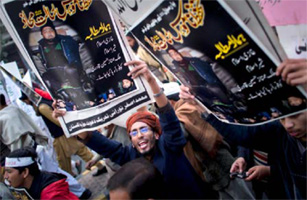
Bhatti was gunned down by unknown assailants. Taseer was assassinated by a member of the elite security unit assigned to guard him. More shockingly, the assassin was hailed a hero. Hundreds turned up at his house, chanting “we salute your bravery.” About 500 clerics signed a statement calling him “a true soldier of Islam.” When he appeared in court, young lawyers showered rose petals and kissed him. At a rally in cosmopolitan Karachi, marchers waved his portrait.

This is a sick society. There’s little Islamic about the Islamic Republic of Pakistan.

The blasphemy law may have been enacted by the British colonials in 1860. But it was toughened by the Muslim rulers of Pakistan in the name of Islam. And both in its wording and implementation, the law violates the most basic principles of Islamic jurisprudence. In allowing hearsay evidence and innuendo, it ignores the necessity of incontrovertible proof for a finding of guilt.

The act is allowed to be abused in personal and property disputes. (A majority of those charged have been Muslims, according to the Human Rights Commission of Pakistan, a voluntary organization). Or it is wielded as a weapon in political and religious vendettas. In one particularly horrific case, two Christian brothers were framed with a handwritten note defaming the Prophet, found in a marketplace with their home address and phone number.

Yet local police and magistrates dare not toss out such trumped-up charges. Cases have to be taken to higher courts to be overturned. Not a single person has been executed under the act. Yet more than 30 people charged or acquitted have been killed.

Under Islamic law, such jungle justice constitutes a greater crime than the alleged original one. It is deemed particularly egregious when the innocents prosecuted are poor and powerless.

The blasphemy law is just one of many flashpoints.

Christian churches have been bombed. So have been mosques belonging to the minority Ahmadi sect, deemed heretic. So also mosques of the minority Shiite Muslim sect. So also Sufi shrines, along with the devotees who turn up for the anniversary festivals of dance and music dedicated to those saints.

Not just that.

Pakistani Taliban and other militants have been killing fellow Muslims who won’t side with them. Such attacks were once restricted to the remote Afghan-Pakistan border but now they are routine in the populated south. Tens of thousands have been killed, including Benazir Bhutto, assassinated in December of 2007.

Yet the government is too weak to provide basic security and too corrupt to care — both egregious Islamic crimes. The politicians and the bureaucrats are not the only ones on the take. Too many clerics are also money-grabbing machines.

Several reasons are proffered for this sad state of affairs.

One is that Pakistan has had too many military dictators, and that the longest-serving one, Zia ul-Haq (1977-88) Islamized Pakistan, which he did. But he did so in tandem with the American-led effort to Islamize the war against the Soviet occupation of Afghanistan. Another inconvenient truth is that while the military used jihadist proxy militias against India and Afghanistan, political parties use them as vote banks and to flex street muscle.

The secular-Islamic divide is also cited. Yet both religious and secular elites have pandered to extremists. It was the wine-sipping prime minister Zulfiqar Ali Bhutto who in the 1970s restricted liquor and declared the Ahmadi sect non-Muslim. It is his People’s Party, once again in power, that abandoned backbencher Sherry Rahman after she proposed amendments to the blasphemy law.

Meanwhile, the economy is in ruins. Inflation is rampant, the currency is losing value and the central bank is printing more rupees.

Don’t be surprised if Pakistanis begin clamouring, yet again, for the return of the military to power.

Haroon Siddiqui is the Star’s editorial page editor emeritus. His column appears on Thursday and Sunday. hsiddiqui@thestar.ca

Assassinations are a blemish on Pakistan’s soul

By Shahina Siddiqui for The Montreal Gazette

The assassination by terrorists of Pakistan’s federal minister for minorities, Shahbaz Bhatti, follows the brutal killing of Punjab Governor Salman Taseer a couple of months ago. Both were targeted by extremists because they called for the reformation of Pakistan’s controversial blasphemy laws. These and other attacks on Christians and Muslims in the name of blasphemy laws is a blemish on the national soul of Pakistan that cannot be washed away by empty rhetoric and the muted cowardly condemnations by the political and religious leadership in Pakistan.

There is no place for laws in Muslim countries that are the very antithesis of the spirit, soul, and letter of Islamic law. Prophet Muhammad in his lifetime was insulted, ridiculed and physically hurt, and yet he never ordered, condoned or recommended the killing or even harming of these individuals. There are documented cases where the prophet intervened to save the perpetrators from the wrath of his companions. We do not honour the prophet by murdering the innocent in his name. We honour him by practising compassion and dealing with mercy toward all of God’s creation, yes, even those who hurt us.

There is no justification for the blasphemy laws in the form they exist in Pakistan. The misuse and abuse of these laws have caused the security of religious minorities to deteriorate and be exploited, and it has become a licence to kill people, to destroy property and to create havoc for personal and political interests.

The terrorists are using this law to paralyze an entire nation into submitting to their whims through fear and trauma. The inept political leaders of Pakistan are more interested in maintaining their power and control on the country’s wealth then in actually working for the betterment of their country. The few who dare to stand up to this injustice find themselves isolated and without support.

The genuine religious leaders, on the other hand, are afraid to be labelled by these pseudo-religious terrorists as supporters of blasphemers, and thereby fear losing their own support base, their lives and their reputations. The socalled religious political parties are supporting these laws unconditionally, manipulating the love the masses have for their faith and their prophet, to ensure their own popularity and political gains.

In such a vacuum of moral, religious and human courage the terrorists thrive, the extremists dance in the streets and the ordinary Pakistanis struggle to survive. This ugly situation in Pakistan calls for an uprising of the silent majority. But the disconnect between rural and urban, rich and poor, and the excruciating poverty and illiteracy are barriers that make this an unlikely scenario.

Pakistanis, unlike their coreligionists in the Middle East, face brutality on many fronts: the war on terror that is consuming the country’s resources, the drone attacks that are killing hundreds of innocent civilians, the Talibanbacked terrorists who kidnap, torture, brainwash and blackmail poor rural youth into becoming suicide bombers who target fellow Pakistanis on an alarmingly frequent basis.

The indifference of the ruling elite – political and feudal – and the tyrannical pseudoreligious extremists seem to have paralyzed this nation into a pathological resignation to its “fate.” There is no credible leadership at the national level that is nurturing national pride, identity and vision. The people are adrift, holding on to any straw, no matter how fragile, that will keep them afloat.

In spite of these many challenges, however, I am confident – having observed firsthand the courage, resilience and moral strength of non-governmental organizations, selfless philanthropy by the affluent, and the development and growth of civil society – that Pakistanis will rise and can defend their nation. They must, however, break the chains of fear that are choking their conscience, and stand up for justice.

My prayer is for Pakistan to realize the vision of its founder, Mohammad Ali Jinnah: a vision in which all Pakistanis are granted freedom and security to practise their religions and maintain their places of worship, and where all Pakistanis thrive together, as equals under the law, regardless of ethnicity, gender and religion.

Pakistan must put their act together before it’s too late

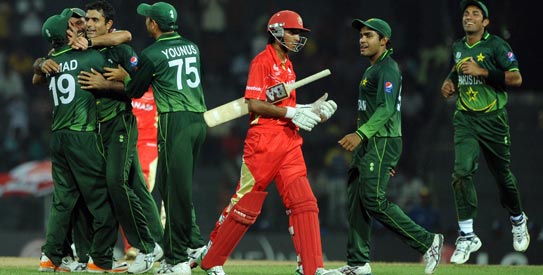
Phew! What a close shave that was for Pakistan. The batsmen were self destructing at will and had done enough to lose the game and open a fresh can of worms. An unexpected loss against the minnows and against heavy odds could have been interpreted as intentional by the rumour mongers and portrayed Pakistan in bad light.

And it wouldn’t have been difficult to convince the cricket world to believe it as true gospel, as unfortunately it has developed a jaundiced view to everything regarding Pakistan cricket.

Canada, who were not only raw with their skills but in an unfamiliar territory to create history, got tensed up and could not close out the game.

Pakistan batting was technically poor. Most of the batsmen were caught on the crease, playing across the line and falling prey to their own mistakes rather than opponents’ craft. In fact the team technicians read the pitch poorly and blindly made the decision to bat first on a moist track. Good teams are not only about bat and ball but about good support staff who can prepare a brief for the captain consisting of healthy options and intelligent analysis. Remember, big thinkers of the game and not big names make for a winning formula in the dressing room.

In seaming conditions, the openers were quickly thrown out of rhythm. Ahmed Shehzad’s brazen aggression at times borders on cockiness.

His pattern of attack on the day was ill suited for the conditions. He takes uncalculated risks and gives the impression of a spoilt millionaire at a roulette table! Nobody wants him to sacrifice his aggression but lot of people want him to curb his urge to be a kamikaze pilot on a suicide mission.

Hafeez is a utility article. Bit like a sofa cum bed he adjusts and adapts to the demands of the game. He has not yet set the world on fire in this World Cup but Pakistan must not panic and think to uncouple the two openers. In the 1992 Cup, in our losses to India, South Africa and West Indies, we made the mistake of trying three different opening combinations which unsettled the entire team.

Afridi as a leader had a mixed outing. While his sleight of hand once again amazed the batsmen, his captaincy spell was rather flat. In a low scoring game with choices curtailed, a constant dose of pressure and aggression could have earned Pakistan an early win. But Afridi, in the middle overs, unwisely chose to sit in and attacked with just four fielders in the circle.

Most captains in ODIs seem to operate with a rigid mind and a set routine to clog up runs and through it suffocate batsmen. They don’t seem to have a plan for unconventional situations that demand for out of box thinking.

Andrew Strauss, the other day against Ireland was caught out because of lack of intent to pick wickets. Afridi needs to be more innovative as a leader, bit like his batting and bowling, and open up to all kinds of plans rather than following a basic dated one. Trying to super impose a particular game plan on all situations cannot work.

Good thing about the win was how Pakistan fought tooth and nail till the end. They were feisty on the field and did not surrender to the pressure of the situation. Umar Gul looked to be at home with the new ball and Saeed Ajmal did not look rusty in his first outing.

Daryl Harper, the umpire, though was completely out of tune and had four reviews turned against him. His time is up as it’s not a one off instance of poor umpiring but a trial of shocking 18 months out in the center.

Umpires are like players and can have good and bad days on the field, but when a lean patch in the late years of a career start to stretch to longer cycles, then it is time to hang up the boots and exit gracefully.

—The writer is a former Pakistan captain.