Archive for March, 2011

Uniting Pakistan’s Minority and Majority

By Mohsin Hamid for The Express Tribune
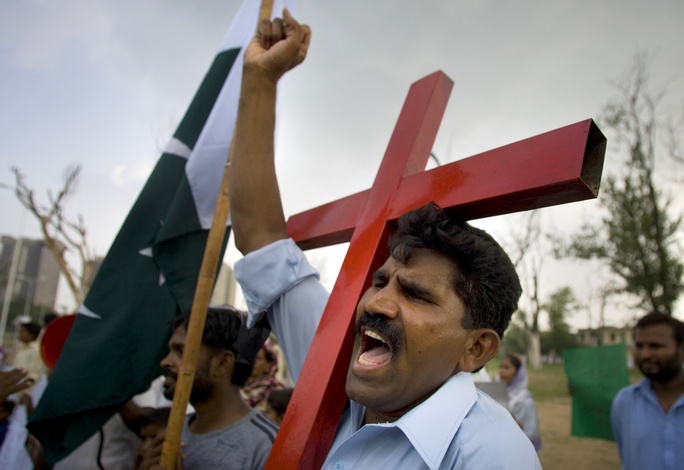
There’s a nurse I know in Lahore. She’s tall and stocky, middle-aged. She is on call 24 hours a day and works six days a week. She’s also a freelance headhunter, placing cooks and drivers and maids. She sleeps little. She has five children she hopes to give better lives. Last year, she donated time and money to flood victims.

She is a Pakistani Christian. And on Wednesday, I saw her weep.

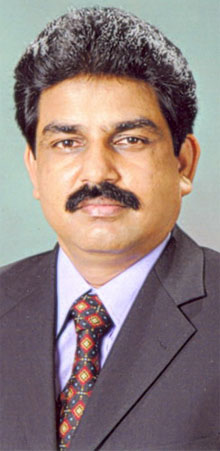
She was staring at a TV set. It was reporting the assassination of Shahbaz Bhatti, Pakistan’s federal minister for minorities, a Roman Catholic. “What’s going to happen to Christians in this country?” she asked me.

I had no answer. But her question is searingly important. A country should be judged by how it treats its minorities. To the extent it protects them, it stands for the ennobling values of empathy and compassion, for justice rooted, not in might, but in human equality, and for civilisation instead of savagery.

Pakistan ought to be exemplary in this regard. After all, ours is a nation of minorities: A patchwork of cultures, ethnicities, languages and sects. Since independence, we’ve tried to use Islam to bind us together, to undo our inherent and pervasive minority-ness. After the country split in 1971, these appeals to religion expanded under ZA Bhutto and reached previously unimaginable extents under Ziaul Haq. They have continued to intensify ever since.

One problem with this approach, of course, has been that our religious minorities, a twentieth of our population, have been left out of our grand national narratives. Five per cent may seem like a small proportion, but in absolute numbers it includes almost 10 million Pakistanis, which equals everyone in Tunisia, or one-and-half times all of Libya. If Pakistan’s religious minorities were a country, they would be more populous than half the members of the UN.

So how have they been treated by Pakistan? Shamefully. They are looked down upon, discriminated against, physically threatened and not infrequently killed. They are second-class citizens in every sense. Nor has our state offered them much support. Indeed, our state has been actively involved in their oppression.

None of this is new, of course. So, for those of us fortunate enough to belong to the religious majority, does it even matter?

Yes. Desperately. Minority relations are a microcosm of society. Each individual human being is, after all, a minority of one. And, as Pakistan becomes a country at war with its minorities, it is becoming a country at war with its individuals, with itself, with you and with me, with the human desire to be allowed to believe what we believe. In this direction lies Orwellian Newspeak, an inability to say what we mean, a condition of external dishonesty that inevitably leads to internal dishonesty. Orwell imagined the result of this to be something he called doublethink: People holding “simultaneously two opinions which cancelled out, knowing them to be contradictory and believing in both of them.”

I find it difficult to imagine a better description of many of our TV talk show hosts — or much of our public discourse — today.

There are three main political positions we hear over and over in Pakistan, and all three are suffused with doublethink. There is the national security position: ‘America is our enemy; America should give us more aid.’ The privileged liberal position: ‘There should be equal rights for all; I should not have to share my riches with the poor.’ And the (remarkably similar) ambitious cleric position: ‘Religion makes us all equal; only I decide what religion says.’

It is unsurprising that the privileged liberal position is the one most often associated with attempts to protect the rights of religious minorities in our country. It is also unsurprising that it has been largely unpersuasive.

The good news, from a religious minority standpoint, is that the other positions are equally incoherent. (The bad news is that they are much more willing to resort to violence in support of their arguments.)

What Pakistan’s religious minorities need, therefore, is a new position, a position that champions equality while, and this is the tricky part, also championing equality. In other words, a position that dispenses with the illusion that equality can be enhanced in a society prostrate before either its rich or its clerics.

Such a position would also be to the benefit of the country’s economic majority, its poor. For they, too, are looked down upon, discriminated against, physically threatened and not infrequently killed. They, too, are second-class citizens. They, too, have been actively oppressed by our state.

At its heart, our country’s toxic treatment of its religious minorities is intertwined with its toxic treatment of its impoverished majority. Both groups suffer from the denial of our common humanity. And that, paradoxically, offers great hope. For we can reject false dichotomies between our clerical and our liberal positions, between our minorities and our majority. We can begin the search for common ground that has eluded us as a nation thus far.

We might, for example, shift from disputes over blasphemy laws to actually delivering due process of law, from arguments over curbing radical madrassas to actually building a high-quality state education system, from alternately buying off and fighting tribal chieftains to actually empowering local tribespeople.

Our problems are not insurmountable. Pakistan is, simply put, a land that mistreats its minorities and its majority. It is ripe for a revolution, except that it already has many trappings of democracy: Elected assemblies, free media, independent judges. A revolution in our thinking and behaviour, brought about by sustained pressure from below, is what is really called for.

Let us be clear: The messy but effective compromises we require can only come about through the dramatically improved functioning of our democracy. But a better-functioning democracy is feared by many with vested interests who benefit from the impaired system we currently have. They must be convinced otherwise.

Above all, we must convince our powerful national security state. Rationally, it is clear that under our current policies, Pakistan is becoming ever less secure. The stability and growth that a well-functioning democracy could bring is our country’s best chance of escaping from its ‘eagerly-dependent-on-enemy-America’ strategic incoherence. Unless, that is, our national security doublethink really boils down to this: ‘I will protect you; you are the threat.’

For the sake of our vulnerable, which is to say, in different ways, just about all of us, I hope this is not the case. Too much Pakistani blood has already been shed and too many Pakistanis have already gone to bed hungry.
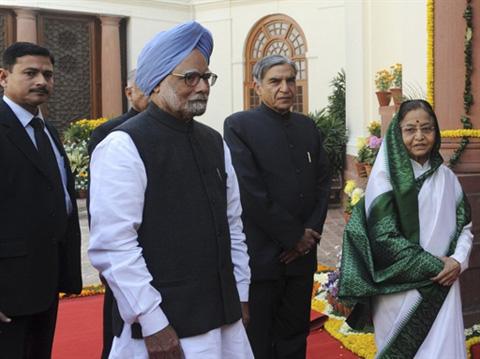

Dialogue Key to Peace with Pakistan, Says India

By Anjana Pasricha for The Voice of America

As India and Pakistan get ready to restart peace talks after more than two years, Prime Minister Manmohan Singh says dialogue is the only way to resolve their differences.  The embattled Indian leader is also vowing to tackle inflation and punish those guilty of corruption — two issues which have put his government on the ropes at home.

Speaking to parliament Thursday, Prime Minister Singh said South Asia will not realize its potential unless India-Pakistan relations are normalized. India is willing to discuss all outstanding issues with Pakistan, he said.

But, striking a cautious note, he expressed hope that Islamabad will give up allowing its territory to be used for terrorist activity directed at India.

“I sincerely hope and believe that the new ruling classes of Pakistan would grasp the hands of our friendship and recognize that whatever our differences, terror as an instrument of state policy, is something no civilized society ought to be using,” he said. “I am not saying that we have today an atmosphere in which negotiations can go forward, but there are hopeful signs.”

Earlier this month, both countries decided to restart a peace process, which New Delhi had put on hold after blaming Pakistan-based Islamic militants for mounting the 2008 terror attacks in Mumbai. The foreign secretaries of the two countries will meet in the Indian capital in March. Their foreign ministers are to meet by July.

Singh’s comments on the peace talks with Pakistan came during an address to parliament, in which he outlined the priorities facing his government.

He pledged to lower inflation from 10 percent to seven percent by the end of the year. Food inflation is even higher and has emerged as a major worry in a country with millions of poor people.

Singh has promised to bring a new food security bill in parliament to ensure that poor people are protected from rising food prices.

Inflation has to be tackled in a manner that it does not hurt the economy, which the prime minister says is growing well.

“If we had a ham-handed [heavy] approach, we could have killed the growth process which is the only source of providing jobs for our youth. So, this delicate balance has to be preserved between control of inflation and protection of employment,” he said.

The Indian leader also vowed to crack down on those guilty of corruption in connection with sale of telecom spectrum, in 2008, and the organization of the Commonwealth Games in New Delhi, last year. Allegations that officials siphoned off billions of dollars have put the spotlight on corrupt practices in government contracts.

With the two corruption scandals dominating headlines in recent months, Singh expressed fears that the wrong impression may be going out.

“The message should not go out that India is adrift, that India has lost its way, that the enthusiasm for getting this country moving forward is something that is no longer in evidence,” he said.

The Congress-led government was voted back to power in 2009, but is facing a rising wave of discontent both becauseof high food prices and the high-profile graft scandals.

Obama Condemns Assassination in Pakistan

As reported by The Associated Press

President Barack Obama on Wednesday condemned the assassination of the only Christian member of Pakistan’s government, calling the slaying of Shabaz Bhatti a “horrific act of violence.”

Republicans and Democrats in Congress echoed Obama’s outrage, hours after Bhatti was gunned down outside his mother’s home. His slaying came just weeks after the killing of liberal politician Salman Taseer. The two men had pushed to change laws that impose the death penalty for insulting Islam.

“He is literally a modern-day martyr,” said Rep. Frank Wolf, R-Va., at a Capitol Hill news conference.

Bhatti, a campaigner for human rights causes, had been aware of threats to his life. Obama said Bhatti “fought for and sacrificed his life for the universal values that Pakistanis, Americans and people around the world hold dear” — including rights to free speech and religious freedom.

Assailants from al-Qaida and the Pakistani Taliban Movement in Punjab province claimed responsibility, calling Bhatti an “infidel Christian.”

Obama said that whoever committed the crime should be brought to justice, and people who share Bhatti’s vision of tolerance and religious freedom should live free of fear.

Secretary of State Hillary Rodham Clinton, who recently met Bhatti, called him “a patriot and a man of courage and conviction.” She said in a statement that the United States remains committed to working with the government and people of Pakistan “to build a more stable and prosperous future for all — a future in which violent extremists are no longer able to silence the voices of tolerance and peace.”

More than half a dozen lawmakers, many of whom knew Bhatti, called on the Pakistan government to change the laws. Rep. Chris Smith, R-N.J., who said he prayed with Bhatti, said the events need to be a “game-changing moment.”

“No matter what your religion, his murder is an affront to God,” said Rep. Jim McGovern, D-Mass.

They showed a videotaped message from Bhatti in which he said he received death threats and was “ready to die” for the country’s often persecuted Christian and other non-Muslim minorities.

Rep. Howard Berman, D-Calif., said Bhatti’s death reflects the growing climate of intolerance in Pakistan and urged all Pakistanis to stand united against violence and intolerance.

What motives led to Shahbaz Bhatti’s murder in Pakistan?

By Aamer Ahmed Khan for BBC

It is hard to find an immediate motive behind the murder of Pakistan’s Minorities Affairs Minister Shahbaz Bhatti.

The courageous battle he had vowed to fight against the country’s draconian blasphemy laws had already been abandoned by the government in the wake of Punjab governor Salman Taseer’s murder.

In fact, the final surrender had come from no less a person than Pakistan’s prime minister who had only last month pleaded with a large gathering of religious personalities to believe him when he said that his government had no intention of reviewing the blasphemy laws.

And unlike the slain governor – a veteran politician, a high profile socialite and one of the president’s many billionaire friends – Mr Bhatti neither had the status nor the political clout to influence the state’s agenda.

Some evidence of that also comes from the eerie silence on social media, from the extremists’ side.

All that one sees are some anguished rants from some of Pakistan’s best known liberals, many of whom are not even resident in the country.

Even hours after the assassination, we have seen none of the fierce onslaught against free speech that erupted on social media within minutes after Mr Taseer’s murder.

Nor have we seen eulogies of his killers mushrooming on Facebook as they did after Mr Taseer’s murder. It is a silence smug in the knowledge that their agenda is not at risk.

So why kill a man who considered himself – and was indeed considered by the world around him – to be so ineffective that he had not even bothered to seek proper security for himself, despite being constantly threatened by Pakistan’s millions of faceless fanatics?

The answer perhaps lies in the difference between the commitment of the government and the extremists to their respective agendas.

Politics v ideology

The government had unambiguously decided to lay off the blasphemy laws after Mr Taseer’s murder, its ministers hinting privately that it was a hornets’ nest best left untouched.

The country’s liberal political and social leadership had meekly followed suit and perhaps understandably so.

In their silence had rested a hope that by abandoning their agenda to rationalise any legislation-feeding extremism, they would perhaps be able to keep the extremists quiet.

It was never about any ideological commitment, just hard, cold politics that made tactical sense.

For the extremists though, it is all about ideology. It didn’t matter if Mr Bhatti’s battle had proved to be a non-starter or if he was an ineffective and powerless minister.

What mattered was that he had spoken against blasphemy laws in the past and was likely to do so again if a situation arose. That made him a legitimate target, not to be tolerated, not to be ignored.

Mr Taseer had said that he would continue to fight against blasphemy laws even if he was the last man standing. He could not stand for long.

And the ideology that led to his assassination has now sent another determined and deadly message to the state – that it will continue to fight till the last liberal falls.

This is how different the two commitments are. And for the liberals in Pakistan, this is how hopeless the situation seems to be.

Pakistan plan to spread the grief

As reported by Agence France-Presse

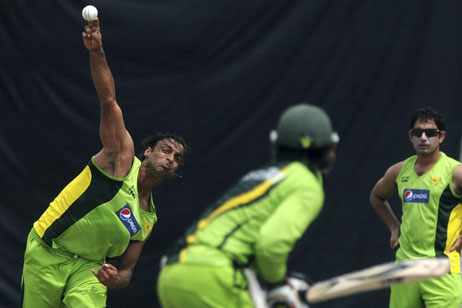
Pakistan are still reeling from the cricket corruption scandal that has dogged the side since last summer, but Shoaib Akhtar has warned that he and his teammates plan to take out their frustrations over the affair on their World Cup opponents.

Salman Butt, Pakistan’s then Test captain, and the bowlers Mohammad Asif and Mohammad Aamer were banned by the International Cricket Council (ICC) last month, after being found guilty of spot-fixing, which depleted Pakistan’s bowling options just two weeks before the start of the World Cup.

But Akhtar said the loss of the trio has helped unite the squad and galvanised them to push for a second World Cup victory to replicate their 1992 success.

“We are a hurt side so we are here to hurt others,” Akhtar said yesterday. “It’s better that it happened to us because every time a controversy happens it gathers us together and what better situation than before a World Cup?”

Pakistan beat co-hosts Sri Lanka by 11 runs in their last match after seeing off Kenya by 205 runs in their opening game.

Akhtar, 35, admitted he was missing Aamer and Asif but said others have stepped up.

“Obviously without Aamer and Asif we have suffered badly, they were the best with the new ball, it’s unfortunate what happened to them. Had they been with us it would have been the most lethal bowling attack,” he said.

“But the way [Umar] Gul and [Abdul] Razzaq have been bowling, the way [Wahab] Riaz is bowling, we can still do a much better job as we have variety in our attack.”

Akhtar, who has taken 246 wickets in 162 one-day internationals, said he had changed his bowling style to maintain his fitness, concentrating on accuracy rather than the pure pace that in the past regularly saw him bowl in excess of 100mph.

“I left this race of bowling at 100mph a long time ago,” he said. “I am nearing 36 now and am more mature, so I am focusing more on getting wickets now than bowling fast. But I crossed 98mph the other day.”

He said he is enjoying the chance to perform on the world stage after injury and discipline problems left him sidelined four years ago.

But he warned his teammates – who next face Canada in Colombo on Thursday – not to be over confident after beating Sri Lanka. “We have to move on and we shouldn’t get complacent,” he said.

Peace In One Pakistani Tribal Valley Offers Hope

Reported by Abubakar Siddique for Radio Free Europe Radio Liberty
A fragile peace is taking root in Pakistan’s western Kurram tribal region after nearly four years of sectarian warfare between Shi’ite and Sunni Muslims.

Some have criticized a recent peace pact by saying that it is less about forging a lasting peace than about facilitating insurgents’ infiltration into neighboring Afghanistan. But the local population appears committed to making it work.

Success could have far-reaching implications. If peace is possible in a hotbed like Kurram, then it could serve as a model for millions suffering from war in other tribal areas.

‘Many People Were Injured’

Resident Noor Janan’s situation is typical. He lost his budding business in 2007 when clashes broke out between Shi’a and Sunnis in Parachinar. Rioting in the small border city, which serves as the headquarters of Kurram, soon devolved into sectarian war.

As the Sunni population of Parachinar was forced out, the city’s mostly Shi’a population was hemmed in — trapped by retreating Sunnis who blocked the main road to the outside and set siege on the city.

Janan’s priorities changed remarkably. For the past four years his main obligation has not been to look after his wife and four children, but to man frontline trenches and care for the sick and the injured.

Children displaced by fighting stand in line and wait for handouts in 2010.

“Many people were injured and many houses were destroyed,” he said. “I did all in my power to help my people.”

Janan is Turi — a tribe of 500,000 whose adherence to Shi’ite Islam makes it unique among Pashtuns. The Turis occupy a sliver of tribal territory known as the Parrot’s Beak that extends westward across Afghanistan’s eastern border. On the Pakistani side, Parachinar is positioned within striking distance of Kabul, which is just 100 kilometers to its east.

For the most part, the Turis lived in harmony with neighboring Sunni tribes for centuries, with a handful of exceptions. In the 1980s, predominantly Sunni Afghan Islamist guerillas attempted to overrun the strategically important region.

In 2007, a fierce sectarian war broke out when the Sunni Taliban attempted to conquer the Parachinar. More than 3,000 people have died and thousands more injured in the ensuing fighting. Some Sunnis blame Iran for the development, claiming the clerical regime supported and radicalized their Shi’a neighbors.

Both Sides Committed

Animosity remains high, but a cease-fire worked out in early February and backed by Islamabad offers proof that Shi’a and Sunni alike are committed to peace.

Middle-aged businessman Munir Khan Orakzai, who represents the Sunni population of the lower half of Kurram in Pakistan’s parliament, said that both sects realize that they have fought a useless cause that killed many innocent people. “There can be no logical end to this [sectarian violence],” he said. “That’s why people concluded this agreement.”

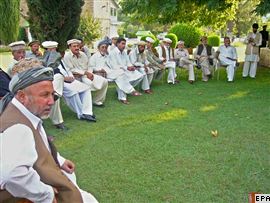
Tribal elders and government representatives attend a peace conference in Parachinar in 2008.

A peace agreement was signed before, in 2008, but it lacked government support and rival factions had one eye on possible military gains.

Under the new agreement, Islamabad is promising rehabilitation for the thousands of displaced families, and the deployment of additional troops to guard key routes.

Work Of The Haqqanis?

Skeptics abound. Pakistani pundits suggested that the deal was worked out by the Haqqanis — a large Pashtun family from Afghanistan whose elderly patriarch Jalaluddin Haqqani emerged as one of the most effective guerilla commanders in the 1980s.

His son, Sirajuddin Haqqani, now controls thousands of fighters and facilitates relations between Al-Qaeda Arabs, extremist Afghans, Pakistanis, and Central Asians out of his sanctuary in North Waziristan, which adjoins Kurram to the south. Considering the Haqqanis anti-Shi’ite bent and outsider status, any role in an agreement would be rejected by Kurram’s Shi’a.

Sajid Hussain Turi, a young lawmaker representing the region’s Shi’ite population in the Pakistani parliament, adamantly rejected any Haqqani role. “We, the Turis, have lost 1,200 people and more than 5,000 of our people were injured in this,” he said. “There is no question of involving people in this process that would ultimately harm us.”

Turi said that the weakened position of the Taliban, in disarray after years of military operations, opened the door to peace. He said that even local Sunni allies of the Taliban now see the futility of their military campaign.

Key intermediaries have high hopes for sustainable peace in Kurram. Waris Khan Afridi, a respected tribal leader from the neighboring Khyber tribal district, was among the mediators who put in countless hours bringing the two sides together.

Unforgettable Scene

On February 5, Afridi led the first civilian convoy of hundreds of vehicles to mark the break of Parachinar’s siege. He described an unforgettable scene of thousands of Sunni and Shi’ite villagers welcoming his entourage. “It was like they all were freed from prison that day,” he said.

Now, Afridi said, Pashtun tribes in neighboring tribal valleys are poised to follow the Kurram example. “We have always said that force is not a solution for anything and that the military operations will not solve our problems,” he said.

“Peace in Kurram,” Afridi said, “will positively affect all the tribal areas, the [neighboring] province of Khyber Pakhtunkhwa, and the whole country.”