Posts Tagged ‘ Afghans ’

Decade After 9/11, Afghans Languish in Pakistan

By Qasim Nauman and Rebecca Conway for Reuters
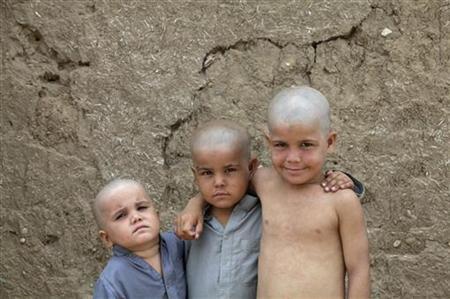
When Ghulum Nabi’s father heard U.S.-backed troops toppled Afghanistan’s Taliban after the September 11, 2001, attacks, he rushed to their family home in an Afghan refugee camp in Pakistan to spread the news.

Perhaps, one day they could all return to a peaceful and prosperous Afghanistan supported by a Western superpower.

After 10 years of U.S.-led efforts to pacify one of the world’s most turbulent countries, Afghan refugees in Pakistan have little hope for stability in their homeland.

“I grew up here and Pakistan is my country. When my father pushes me to go back to visit, I end up having a fight with him. I’m never going to live there. I want to get Pakistani nationality. This is my home,” said Nabi, 22, who runs a crockery shop.

“It doesn’t matter if it is America or anyone else trying to watch over Afghanistan. I will still be looking around to see if anyone is pointing a gun at me.”

Afghan President Hamid Karzai would welcome a return of the millions of Afghans living in Pakistan.

It would be a vote of confidence in his administration, which faces many problems, from widespread allegations of state corruption, to a resilient Taliban.

SOVIET INVASION TRIGGERED LIFE OF UNCERTAINTY

Many of the refugees are skilled labourers who could boost reconstruction and help revive a weak economy if they return. But it’s unlikely to happen.

Most of the refugees in Pakistan arrived after the Soviet invasion of Afghanistan in 1979. The conflict that followed consumed their homeland. After the mujahideen warriors defeated the Russians, warlords turned on each other and tore Afghanistan apart.

Many refugees fear a repeat of that chaos as a U.S. troop withdrawal looms.

Some would like to go home but feel they can’t. Others regard Pakistan as home despite its many disadvantages. Without proper Pakistani identification cards, Afghans can’t open bank accounts or buy or lease property.

Many are openly mistreated by Pakistanis who have little fear of being held to account.

On August 14, the anniversary of Pakistan’s independence, Saeed Anwar’s landlord showed up with three men armed with AK-47 assault rifles at his clothing shop at a busy bazaar in the city of Haripur, home to 80,000 Afghan refugees who live in camps.

“They threw around my merchandise and said I need to pay them a 300,000 Pakistani rupees ($3,450) advance on the rent. I had already paid the rent,” said Anwar, wearing traditional, loose Pakistani trousers.

“I went to the police to register a case. But when they see a dispute between a Pakistani and an Afghan, they automatically assume the Afghan has done something wrong.”

Still, many Afghans believe its wiser, and safer, to just accept the frequent humiliation than return to a homeland still shattered, despite a long U.S.-led military campaign against militancy and billions of dollars in Western aid.

Afghans — from elders who vividly remember the first Soviet gunship helicopters in Afghanistan, to teenagers who have only visited a few times — work for Pakistanis as welders or carpenters and tailors in Haripur and other cities.

Most of them prefer to run their own small businesses, from food carts to car dealerships. It’s the only sense of independence they have in the camps which consist of small cement and mud housing units near a reservoir.

The elders have set up a jirga, or tribal gathering, to settle internal disputes, as is done in much of Afghanistan. Cricket games are the only form of entertainment and leisure activity for most youths.

Two years ago Pakistan agreed to let displaced Afghans stay until the end of 2012, after a resurgence of militant violence along the Pakistan-Afghanistan border hindered repatriation.

Still, people like Sherullah, whose nine children were born in Pakistan, feel vulnerable. What if Pakistan asks them to leave one day?

“There is a lot of confusion. If there’s one thing I want, it’s for this confusion to go away, for us to know if we will be staying or not,” said Sherullah, who was cutting women’s clothing in his tailor shop.

“There are many people living here that can afford to build a proper house but don’t want to. They think ‘what if next year we are told to leave?’. So they continue to live in mud houses.”

Aside from 1.7 million officially registered Afghans in Pakistan, there are an additional 800,000 with no documentation.

According to the United Nations, Pakistan is home to the world’s largest refugee population, mostly Afghans, who strain the country’s troubled economy.

Pakistan would like to repatriate them.

There are, however, few incentives for refugees to head back to Afghanistan. So life in camps may drag on for many years.

Even though the U.S. disengagement is gradual, it brings back painful memories of what was widely seen as American abandonment of Afghanistan after the Soviet exit in 1989. Warlords soon took over and bloodshed returned.

Haji Aslam, 65, an elder in one of the camps, has seen conflict in Afghanistan over the last 30 years — from the battlefields where he fought the Soviets to what he sees today on his television screen. He is betting on the Taliban to prevail once the Americans leave.

“Even if just 10 Taliban show up, the Afghan government will flee Kabul,” said Aslam, a man with a white beard wearing a traditional flat Afghan cap. “In Pakistan, I am at peace. I know my children are safe.”
Peace In One Pakistani Tribal Valley Offers Hope

Reported by Abubakar Siddique for Radio Free Europe Radio Liberty
A fragile peace is taking root in Pakistan’s western Kurram tribal region after nearly four years of sectarian warfare between Shi’ite and Sunni Muslims.

Some have criticized a recent peace pact by saying that it is less about forging a lasting peace than about facilitating insurgents’ infiltration into neighboring Afghanistan. But the local population appears committed to making it work.

Success could have far-reaching implications. If peace is possible in a hotbed like Kurram, then it could serve as a model for millions suffering from war in other tribal areas.

‘Many People Were Injured’

Resident Noor Janan’s situation is typical. He lost his budding business in 2007 when clashes broke out between Shi’a and Sunnis in Parachinar. Rioting in the small border city, which serves as the headquarters of Kurram, soon devolved into sectarian war.

As the Sunni population of Parachinar was forced out, the city’s mostly Shi’a population was hemmed in — trapped by retreating Sunnis who blocked the main road to the outside and set siege on the city.

Janan’s priorities changed remarkably. For the past four years his main obligation has not been to look after his wife and four children, but to man frontline trenches and care for the sick and the injured.

Children displaced by fighting stand in line and wait for handouts in 2010.

“Many people were injured and many houses were destroyed,” he said. “I did all in my power to help my people.”

Janan is Turi — a tribe of 500,000 whose adherence to Shi’ite Islam makes it unique among Pashtuns. The Turis occupy a sliver of tribal territory known as the Parrot’s Beak that extends westward across Afghanistan’s eastern border. On the Pakistani side, Parachinar is positioned within striking distance of Kabul, which is just 100 kilometers to its east.

For the most part, the Turis lived in harmony with neighboring Sunni tribes for centuries, with a handful of exceptions. In the 1980s, predominantly Sunni Afghan Islamist guerillas attempted to overrun the strategically important region.

In 2007, a fierce sectarian war broke out when the Sunni Taliban attempted to conquer the Parachinar. More than 3,000 people have died and thousands more injured in the ensuing fighting. Some Sunnis blame Iran for the development, claiming the clerical regime supported and radicalized their Shi’a neighbors.

Both Sides Committed

Animosity remains high, but a cease-fire worked out in early February and backed by Islamabad offers proof that Shi’a and Sunni alike are committed to peace.

Middle-aged businessman Munir Khan Orakzai, who represents the Sunni population of the lower half of Kurram in Pakistan’s parliament, said that both sects realize that they have fought a useless cause that killed many innocent people. “There can be no logical end to this [sectarian violence],” he said. “That’s why people concluded this agreement.”

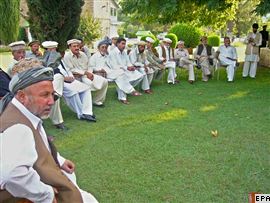
Tribal elders and government representatives attend a peace conference in Parachinar in 2008.

A peace agreement was signed before, in 2008, but it lacked government support and rival factions had one eye on possible military gains.

Under the new agreement, Islamabad is promising rehabilitation for the thousands of displaced families, and the deployment of additional troops to guard key routes.

Work Of The Haqqanis?

Skeptics abound. Pakistani pundits suggested that the deal was worked out by the Haqqanis — a large Pashtun family from Afghanistan whose elderly patriarch Jalaluddin Haqqani emerged as one of the most effective guerilla commanders in the 1980s.

His son, Sirajuddin Haqqani, now controls thousands of fighters and facilitates relations between Al-Qaeda Arabs, extremist Afghans, Pakistanis, and Central Asians out of his sanctuary in North Waziristan, which adjoins Kurram to the south. Considering the Haqqanis anti-Shi’ite bent and outsider status, any role in an agreement would be rejected by Kurram’s Shi’a.

Sajid Hussain Turi, a young lawmaker representing the region’s Shi’ite population in the Pakistani parliament, adamantly rejected any Haqqani role. “We, the Turis, have lost 1,200 people and more than 5,000 of our people were injured in this,” he said. “There is no question of involving people in this process that would ultimately harm us.”

Turi said that the weakened position of the Taliban, in disarray after years of military operations, opened the door to peace. He said that even local Sunni allies of the Taliban now see the futility of their military campaign.

Key intermediaries have high hopes for sustainable peace in Kurram. Waris Khan Afridi, a respected tribal leader from the neighboring Khyber tribal district, was among the mediators who put in countless hours bringing the two sides together.

Unforgettable Scene

On February 5, Afridi led the first civilian convoy of hundreds of vehicles to mark the break of Parachinar’s siege. He described an unforgettable scene of thousands of Sunni and Shi’ite villagers welcoming his entourage. “It was like they all were freed from prison that day,” he said.

Now, Afridi said, Pashtun tribes in neighboring tribal valleys are poised to follow the Kurram example. “We have always said that force is not a solution for anything and that the military operations will not solve our problems,” he said.

“Peace in Kurram,” Afridi said, “will positively affect all the tribal areas, the [neighboring] province of Khyber Pakhtunkhwa, and the whole country.”

Meeting Pakistanis, U.S. Will Try to Fix Relations

By Mark Landler and Eric Schmitt for The New York Times

WASHINGTON — As Pakistani civilian and military leaders arrive here this week for high-level meetings, the Obama administration will begin trying to mend a relationship badly damaged by the American military’s tough new stance in the region.

Among the sweeteners on the table will be a multiyear security pact with Pakistan, complete with more reliable military aid — something the Pakistani military has long sought to complement the five-year, $7.5 billion package of nonmilitary aid approved by Congress last year. The administration will also discuss how to channel money to help Pakistan rebuild after its ruinous flood.

But the American gestures come at a time of fraying patience on the part of the Obama administration, and they will carry a familiar warning, a senior American official said: if Pakistan does not intensify its efforts to crack down on militants hiding out in the tribal areas of North Waziristan, or if another terrorist plot against the United States were to emanate from Pakistani soil, the administration would find it hard to persuade Congress or the American public to keep supporting the country.

“Pakistan has taken aggressive action within its own borders. But clearly, this is an ongoing threat and more needs to be done,” the State Department spokesman, Philip J. Crowley, said Monday. “That will be among the issues talked about.”

The Pakistanis will come with a similarly mixed message. While Pakistan is grateful for the strong American support after the flood, Pakistani officials said, it remains frustrated by what it perceives as the slow pace of economic aid, the lack of access to American markets for Pakistani goods and the administration’s continued lack of sympathy for the country’s confrontation with India.

Other potentially divisive topics are likely to come up, too, including NATO’s role in reconciliation talks between President Hamid Karzai of Afghanistan and the Taliban. Pakistani officials say they are nervous about being left out of any political settlement involving the Taliban.

Still, in a relationship suffused by tension and flare-ups — most recently over a NATO helicopter gunship that accidentally killed three Pakistani soldiers and Pakistan’s subsequent decision to close a supply route into Afghanistan — this regular meeting, known here as the strategic dialogue, serves as a lubricant to keep both countries talking.

At this meeting, Secretary of State Hillary Rodham Clinton will formally introduce the new American ambassador to Pakistan, Cameron Munter. Mr. Munter, who recently served in Iraq, replaces Anne W. Patterson, who just wrapped up her tour of duty in Islamabad.

“No country has gotten more attention from Secretary Clinton than Pakistan,” said Richard C. Holbrooke, the administration’s special representative for Afghanistan and Pakistan. Pakistan’s delegation will be led by its foreign minister, Shah Mahmood Qureshi, but much of the attention will be on another official, the military chief, Gen. Ashfaq Parvez Kayani, who is viewed by many as the most powerful man in Pakistan.

White House and Pentagon officials said one immediate goal of this meeting was to ease the tensions that led Pakistan to close the border crossing at Torkham, halting NATO supplies into Afghanistan. Officials on both sides said that acrimony from the border flare-up had already receded, soothed by the multiple apologies that American officials made to Pakistan last week.

Last week, Adm. Mike Mullen, the chairman of the Joint Chiefs of Staff, said that General Kayani had assured him that Pakistan’s army would tackle the North Waziristan haven, but on Pakistan’s timetable. In an interview, Pakistan’s ambassador to the United States, Husain Haqqani, said, “Our American partners understand that we have 34,000 troops in North Waziristan. Our soldiers have been engaged in flood relief after history’s worst floods. It is not a question of lack of will.”

The new security pact would have three parts: the sale of American military equipment to Pakistan, a program to allow Pakistani military officers to study at American war colleges and counterinsurgency assistance to Pakistani troops.

Currently, the United States spends about $1.5 billion a year to provide this same assistance, but it is doled out year by year. The new agreement, if endorsed by Congress, would approve a multiyear plan assuring stability and continuity in the programs, although Congress would continue to appropriate the financing on a yearly basis. “This is designed to make our military and security assistance to Pakistan predictable and to signal to them that they can count on us,” said a senior official.

At the last dialogue in Islamabad in July, Mrs. Clinton presented more than $500 million in economic aid, including plans to renovate hospitals, upgrade hydroelectric dams, improve water distribution and help farmers export mangoes. But the floods upended those plans, and officials said they now planned to redirect funds to more urgent needs.

This week’s meeting will also be shadowed by a new eruption of political instability in Pakistan: the government of President Asif Ali Zardari is locked in a confrontation with the Supreme Court over the court’s demand that senior ministers be fired on corruption charges. Analysts said they were less worried about the atmospherics than the underlying differences in perspective. The administration’s public contrition for the cross-border attack has largely resolved that issue, said Daniel S. Markey, senior fellow for India, Pakistan and South Asia at the Council on Foreign Relations.

But Mr. Markey said he saw potential friction stemming from the American openness to reconciliation with the Taliban. With the United States facilitating rather than guiding the talks, he said, there could be poor coordination between the Afghans, NATO and others — all of which would rattle the Pakistanis.

“Washington is opening the door to a range of negotiations with groups that it has discouraged Pakistan against working with in the past,” he said. “This sends a mixed signal, and cannot help but encourage hedging on Islamabad’s part.”

Another potential bone of contention is one of President Obama’s nuclear objectives: a global accord to end the production of new nuclear fuel. Pakistan has led the opposition to the accord. And without its agreement, the treaty would be basically useless.

Mr. Qureshi blamed the United States for the situation, saying Washington signed a civilian nuclear accord with India that discriminated against Pakistan. “You have disturbed the nuclear balance,” he said in a recent interview in New York, “and we have been forced to develop a new strategy.”

Slain American Volunteers Were Devoted to Service

By Laura King and Ashley Powers for The Los Angeles Times

They were a disparate group of American altruists who had long cared for the poor and ailing, thrown together on a mission to provide medical help in the most daunting and needy of places.

Last week, the six Americans were among 10 volunteers shot to death in a remote swath of Afghanistan while returning from an aid mission, a tragic end to their years of risk-laden service in the war-ravaged and impoverished nation.

Tom Little, for one, remained in Afghanistan through its brutal civil war in the 1990s, talking his way through checkpoints manned by various ethnic militias, and saving the lives of co-workers who might otherwise have been dragged from the car and killed.

Colorado dentist Thomas Grams often traveled with a bodyguard and told friends how he’d persuaded a tribal leader to bring his mother in for a dental exam by agreeing that she’d peel back as little of her burka as possible.

“He was just there out of kindness,” Katy Shaw, a friend of Grams, said Sunday, her voice catching. “I can’t get my arms around why someone would do that to a group of people trying to be helpful.”

The Taliban has claimed responsibility for the ambush in a rugged, isolated valley, which also killed two Afghan men, a German woman and a British woman working with the International Assistance Mission. The Taliban accused the Christian group’s volunteers of proselytizing and spying for Western military forces, which the charity vehemently denied.

The charity team, which had been providing eye care and other health services to villagers, had hiked over a steep mountain pass into neighboring Nuristan province, where insurgents had been battling Afghan and Western forces. Police theorized that the assailants might have followed them back from there.

Two other Afghan members of the group escaped the massacre: an interpreter who had left before the ambush and a driver who told police he recited verses from the Koran as he pleaded for his life. Afghan authorities are still questioning the driver about his account of the incident, and police said it would take two days for investigators to reach the scene of the killings.

The Western military condemned the attack as part of a pattern of insurgent behavior that exacerbated the suffering of Afghan civilians.

“This is something the Afghan population has to face,” said Brig. Gen. Josef Blotz, a spokesman for NATO’s International Security Assistance Force. “Because of these brutal, indiscriminate and absolutely deranged tactics and activities of the Taliban, international aid workers and nongovernmental organizations can’t do their job, which is so necessary for this country.”

The bodies of the slain American volunteers were flown by helicopter to the Afghan capital on Sunday from Badakhshan province, in Afghanistan’s northeast, the U.S. Embassy said. FBI agents in Kabul helped identify the victims and aid groups released most of their names. One American had not yet been publicly identified.

“We are heartbroken by the loss of these heroic, generous people,” U.S. Secretary of State Hillary Rodham Clinton said in Washington.

Even before deplaning in Afghanistan, the team’s members had devoted themselves to helping the world’s most destitute. Grams, 51, was a prime example.

In 2001, he became the first dentist to join a volunteer group in Denver that whisks teams of dentists around the world. At weeklong clinics, they provided children free cleanings, fillings, extractions and tooth-brushing lessons — always without toothpaste, in case the villagers ran out.

Tall, blondish “Doctor Tom,” who usually manned the first of six chairs, stuck out among his thousands of Indian and Nepalese patients. But he’d put them at ease by pulling down his mask and sharing a toothy grin.

“In America, the view is that the dentist gives you pain,” said Laurie Mathews, Global Dental Relief’s director. “In these countries, he only relieves pain.”

Grams so enjoyed aid work that, a few years back, he gave up his dental practice. He’d also started traveling to Afghanistan periodically with other charity groups. It was no surprise to Mathews that Grams ended up in one of the country’s far-flung corners: Once, to treat patients on Mt. Everest, they’d hauled dental equipment to a Buddhist monastery on rented yaks.

“His life mattered,” Mathews said. “He is defined by more than how it ended.”

Another victim, Cheryl Beckett, 32, was a former senior class president in Ohio with a sharp sense of humor and a strong Christian faith, said her grandmother Jean Fink. Both characteristics helped the aid worker power through the last six years, with Beckett educating Afghan villagers in nutritional gardening and mother-child health, and herself in the local languages.

She had this love for the people and she immersed herself in their culture,” Fink said. “Cheryl was as beautiful inside as she was outside.”

Since 2008, Glen Lapp, a former nurse and real estate agent from Pennsylvania, had helped manage a program that delivered eye care to Afghanistan’s remote areas. In a report for the Christian aid group Mennonite Central Committee, he’d written that workers must continue “treating people with respect and with love and trying to be a little bit of Christ in this part of the world.”

“He just had a real sense of peace … toward the Afghan people,” said John Williamson, a fellow relief worker who talked to Lapp last month. Lapp, 40, told Williamson that he believed the country’s security situation was improving, and that he had high hopes for peace.

The British victim, Karen Woo, had given up a private medical practice in London to work in Afghanistan on mother-child health.

The deaths rattled the tightknit world of Afghanistan aid groups, which had already been struggling to weigh a deteriorating security situation against enormous humanitarian needs.

“People would walk long distances, sometimes carrying the old and sick on their backs, to see the doctors, getting glasses, treatment and minor surgery,” Kate Clark of the Afghanistan Analysts Network wrote in a eulogy for the victims. “And many considered blind, literally getting their sight back.”

Two of the victims — Little, a 61-year-old optometrist, and his longtime associate Dan Terry, 64 — were both fathers of three, and both had worked in Afghanistan for decades and were fluent in Dari. The men told friends that, over time, they’d made peace with the battle-scarred country’s inherent dangers.

In the dingy halls of the Kabul eye hospital where the bespectacled Little spent much of his working life, the sorrow was palpable. Co-workers and patients paid emotional tribute to a man they described as kind, caring and determined to aid Afghans whose eye ailments might otherwise have condemned them to a lifetime of misery and poverty.

“God only knows why anyone would hurt them,” said a woman named Bibi Sheerrin, who was recovering from cataract surgery. “They were trying to help us.”