Archive for July, 2011

‘Bol’ set for an Eid Release in India

By the Editors of BollySpice

Talented director Shoaib Mansoor is back with a hard hitting social drama tittled ‘Bol’ after his critically acclaimed and award winning ‘Khuda Kay Liye’.

Eros International’s ‘Bol’, in association with Geo Films and Shoman Productions is the story of a girl, a daughter who stands up and challenges the age old societal norms of treating women as lesser beings.

The movie stars renowned Pakistani actress Humaima Malick in the lead and singing sensation Atif Aslam and Iman Ali along with many other renowned Pakistani actors.

The movie which released in Pakistan on 24th June along with Double Dhamaal has been declared a super hit as it has received a tremendous opening and grossed about 49 lacs on the first day beating many high grossers like Ready and My Name Is Khan. (Ready’s first day grossing was 40 lacs).

The movie has received outstanding reviews that talk about how the director Shoaib Mansoor who explores the rights of women and treads no-go areas like homosexuality and the life of eunuchs besides Shia-Sunni dynamics in a nation dominated by Sunnis.

Produced by Shahid Jamal and Shoaib Mansoor, ‘Bol’ is based in Lahore & aims at highlighting the sorry plight of women who are treated as a worthless burden to a family in most parts of the society.

‘Bol’ is slated for an Eid release on 31st August in India and rest of the world.

In Ahmadis’s Desert City, Pakistan Closes In

By Myra MacDonald for Reuters
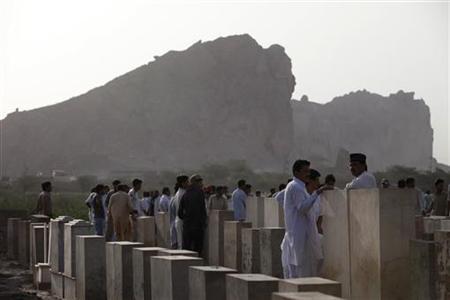
At the office of what claims to be one of Pakistan’s oldest newspapers, workers scan copy for words it is not allowed to use — words like Muslim and Islam.

“The government is constantly monitoring this publication to make sure none of these words are published,” explains our guide during a visit to the offices of al Fazl, the newspaper of the Ahmadiyya sect in Pakistan.

This is Rabwah, the town the Ahmadis built when they fled the killings of Muslims in India at Partition in 1947, and believing themselves guided by God, chose a barren stretch of land where they hoped to make the Punjab desert bloom.

Affluent and well-educated, they started out camping in tents and mud huts near the river and the railway line.

Now they have a town of some 60,000 people, a jumble of one- and two-storey buildings, along with an Olympic size swimming pool, a fire service and a world class heart institute.

Yet declared by the state in the 1970s to be non-Muslims, they face increasing threats of violence across Pakistan as the country strained by a weakening economy, an Islamist insurgency and internecine political feuds, fractures down sectarian and ethnic lines.

“The situation is getting worse and worse,” says Mirza Khurshid Ahmed, amir of the Ahmadi community in Pakistan. “The level of religious intolerance has increased considerably during the last 10 years.”

The town, renamed Chenabnagar by the state government since “Rabwah” comes from a verse in the Koran, is now retreating behind high walls and razor wire, awaiting the suicide bombers and fedayeen gunmen who police tell them are plotting attacks.

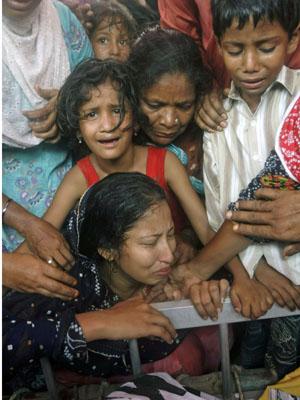
Last May, 86 people were killed in two Ahmadi mosques in Lahore, capital of Punjab; others were attacked elsewhere in the province. Many fled to Rabwah where the community gives them cheap housing and financial support.

Among them is 15-year-old Iqra from Narewal, whose shopkeeper father was stabbed to death last year as the family slept. “I was sleeping in another room when my father was attacked,” she begins in a small voice, pulling a black scarf across her face to cover her mouth in the style of Ahmadi women.

“The attacker wanted to kill all the Ahmadis in Narewal,” her brother Zeeshan continues. “My elder brother tried to help my father and he was stabbed and wounded too.”

Later police found the attacker hiding in a mosque. He had believed the mullahs when they told him that all Ahmadis were “wajib ul qatl”, or deserving of death.

BATTLEGROUND FOR POWER
The Ahmadis follow the teachings of Mirza Ghulam Ahmad, who in the town of Qadian in late 19th century British India called for a revival of a “true Islam” of peace and justice. His teachings were controversial with Muslims and Christians alike.

He argued that Jesus did not die on the cross but escaped and travelled to India and was buried in Kashmir. And he claimed to be the metaphorical second coming of Jesus, destined to put Muslims back on the true path.

Many Muslims were offended by the suggestion he had come as a prophet, breaching a basic tenet of Islam that there can be no prophet after Mohammad, whose teachings are believed to be based literally on the word of God, perfect and therefore final.

Yet his call for peace, hard work, temperance, education and strong community bonds resonated, and over the years the proselytizing movement acquired millions of followers worldwide.

At home, however, their history has been intimately bound up in Pakistan’s own descent from its relatively optimistic birth.

Lacking a coherent national identity, it has become a battleground for competing political, religious and ethnic groups seeking power by attacking others.

“The mistake of the Ahmadis was that they showed their political strength,” said an Ahmadi businessman in Lahore.

Better education he said, meant they obtained good positions in the army and civil service at first; strong community bonds made them an influential force in politics up to the 1970s.

But they also made an easy target for the religious right who could whip up anti-Ahmadi sentiment for political gain.

Ahmadis follow two different schools of thinking, but will argue, often with detailed references to the Koran in both Arabic and English, that they do not dispute the finality of the Prophet Mohammad. Their erudite theological arguments, however, had little chance against the power of the street.

After anti-Ahmadi violence, they were declared non-Muslims in 1974. In the 1980s, their humiliation was completed when legal provisions barred them from associating themselves with Islam, for example by using the call to prayer or naming their place of worship a “masjid” or mosque.

“You can say you don’t consider me to be a Muslim but you can’t force me to also say I am not a Muslim,” complains Ahmed, the amir, the pain clear in his voice.

Yet in the newspaper office in Rabwah, a white board displays the words they are not allowed to use — they could be accused of blasphemy, which carries the death penalty.

SPREADING TO OTHER SECTS
Many Pakistanis, if you ask about treatment of the Ahmadis, shrug it off — it’s an old story, they say, dredged up by westerners who do not appreciate the importance of the finality of the Prophet.

Yet there are signs the attitudes first directed toward Ahmadis are spreading to other sects. In a country which is majority Sunni, and where insurgents follow Sunni Islam, Shi’ites and even Sufi shrines have been bombed.

A 2010 study by Pakistani analyst Ayesha Siddiqa of students in elite colleges found that while 60 percent said the government was right to declare Ahmadis non-Muslims, a sizeable 18 percent believed Shi’ites were also non-Muslims.

These and other findings led her to conclude that radicalism was growing even among the educated youth — it is often, wrongly, blamed on poverty — which in its extreme form could lead people into violence.

Their tendency, she wrote, to see different groups with an unquestioned bias, she wrote, “especially coated with religious overtones or padded with religious belief prepares the mind to accept the message from militant organizations.”

In the nearest town to Rabwah, the central square as been renamed “Khatme Nubuwwat” Chowk, meaning the finality of the Prophet. Beyond, low jagged hills spike up above the dusty land, the summits of much bigger rock formations below the surface.

Many of the Ahmadis had been active supporters of the movement which created Pakistan and when they first came here they were inspired by a verse in the Koran, describing “an elevated land of green valleys and springs of running water.”

Now they are surrounded by a very different country.

Rabwah itself is open to the outside world — despite the high walls guarding individual houses, it is not a walled town.

“Under the circumstances we try to take the best measures we can to protect ourselves,” says the amir. “But what we can do is very limited. We don’t have a mindset or training for that.

And in any case, he adds, “How many people can leave Pakistan or Rabwah?”
Mumbai Counts Its Losses

As Reported by The Hindustan Times

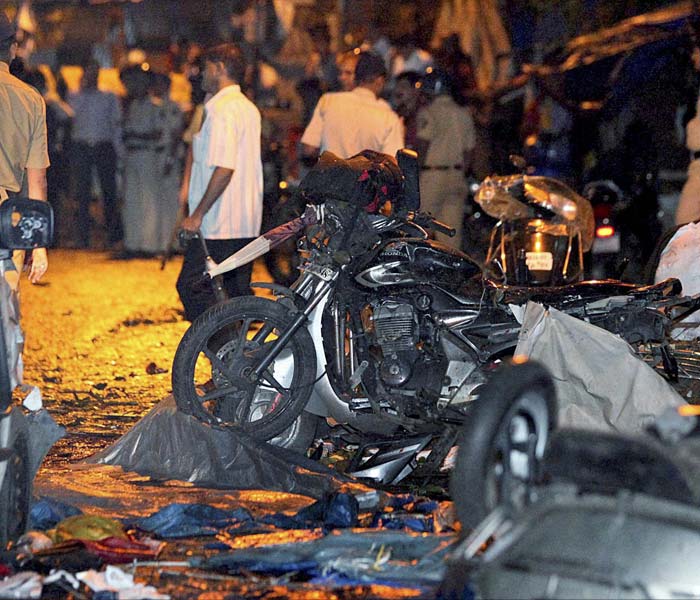
The improvised explosive devices (IEDs) used in the triple bombings were not crude but prepared with “some level of sophistication”, the government said as investigators scrambled for clues on a rain-soaked Thursday and a weary Mumbai picked up the pieces after yet another terror strike.

A day after 17 people were killed and 131 injured when synchronised blasts rocked India’s financial capital, striking the congested areas of Dadar, Zaveri Bazaar and Opera House within minutes of each other, there was no breakthrough on who was behind it.

“We will ensure no matter wherever the accused are, we will identify them and bring them to book,” Maharashtra Anti-Terrorism Squad (ATS) chief Rakesh Maria vowed, appealing for faith and trust.

In a flurry of activity, Prime Minister Manmohan Singh and Congress chief Sonia Gandhi headed for Mumbai. Home minister P. Chidambaram reached on Wednesday night and opposition leader LK Advani on Thursday morning.

Resigned, outraged or simply stoic, Mumbaikars rallied around to battle the crisis, 31 months after the Nov 26-28, 2008 terror assault, India’s worst. They waited outside morgues to claim the bodies of their kin, lined up at hospitals or packed into trains and buses to go about their daily work.

“I am a Mumbaikar and we shall not be scared by these terror attacks. Like me, lakhs of co-commuters are in the trains, buses and roads. It actually helps gives strength to each other,” Archana Shukla said as she went to work.

In Zaveri Bazaar, Mumbai’s most popular address for jewellery that on Wednesday saw its third terror strike, merchants were shocked. But said firmly they were staying put.

“What is the point in shifting base? Are other business locations safer?” asked Raju Solanki, a gold jeweller.

That was a question even experts were loathe to answer as investigators began unravelling the conspiracy behind this latest assault by yet unknown terrorists.

Various agencies, including the National Security Guard (NSG), the Central Forensic Science Laboratory (CFSL) and the National Investigation Agency (NIA) and Mumbai Police, were involved in the probe.

According to union home secretary RK Singh, the ammonium nitrate-based IEDs were “not crude” but indicated “some level of sophistication”.

A top doctor at one of the hospitals where the bodies of the dead were taken for a post mortem said an electric circuit, that may have triggered the blast, was found on one of them, leading to speculation that it may have been a suicide bomber at work.

Sources said traces of ammonium nitrate, also confirmed by Chidambaram, and fuel had been found in the explosives.

“Ammonium nitrate was used with a timer. The fact that they all took place within minutes of each other — eight-to-10 minutes — shows that it was a coordinated terror attack,” Chidambaram said.

The CCTV footage holds the key. Sources told IANS that some of the footage was marred by the rain and bad light Wednesday evening.

Hours after visiting the terror sites, Chidambaram said 131 people had been taken to 13 hospitals with injuries. He said one severed head was also found at the site that could take the death toll to 18.

Addressing a press conference in Mumbai, he admitted there was no prior intelligence input.

Quick to seize the initiative, BJP leader Advani pointed the needle of suspicion towards Pakistan.

“It is a policy failure not intelligence failure. There have been repeated attacks on Mumbai, this is a failure of policy,” Advani told reporters.

Advani quoted reports of a probable link between the blast and the Indian Mujahideen (IM) and said even if it were behind the attack it was being sustained by Pakistan.

“The last attack on our land is proved to have been engineered by the ISI (Inter-Services Intelligence),” Advani said.

“So far as India is concerned, the government of India should shed its ambivalence to terrorism,” Advani said.

Pakistan’s foreign minister comes to New Delhi for talks July 26-27 and external affairs minister SM Krishna said the terror strikes would not impact the strategic dialogue.

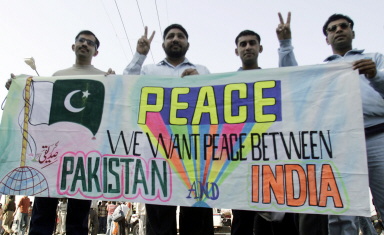
The timing of the attack has raised suspicions in informed strategic circles over whether the serial blasts were engineered by those who wanted to derail the peace process in the subcontinent.

Pakistanis for Peace Editor’s Note– We at Pakistanis for Peace are saddened by this loss of life and would like to let our Indian friends know that we as Pakistanis for Peace stand in solidarity with India against acts of terror.

Pakistan to Approve $1 Billion Boost for Wind Energy Production

By Ben Edwards and Haris Anwar for Bloomberg News

Pakistan is ready to approve a Norwegian company’s request to build a 150-megawatt wind farm, the first part of a $1 billion plan that could boost by a third the announced capacity for clean-energy power plants.

Pakistan is seeking to diversify its energy supplies away from oil and gas and boost electricity production. The nation has a power deficit of 3.6 gigawatts a day, or more than the output of two nuclear reactors, triggering 12-hour blackouts that cause riots and close factories in cities nationwide.

The Alternative Energy Development Board is willing to allow a project proposed by NBT AS, a Lysaker-based clean energy company that plans to build the facility in the Sindh province “wind corridor” north of Karachi, according to Said Arif Alauddin, chief executive of the government agency.

“They came to us saying they have got the money and relationship with the Chinese and they want to invest,” Alauddin said from the port city of Karachi. “As soon as they pay the fee, we will issue that letter to them. We will be able to give them the land if we can see they can deliver.”

Pakistan has almost 1 gigawatt of projects under construction or with financing agreed and 498.5 megawatts more of wind programs announced, according to Bloomberg New Energy Finance data. Only 6 megawatts of wind energy facilities are operating in the nation. It’s the ninth-poorest in the Asia- Pacific region with a 2009 gross domestic product per capita of $2,609, according to Bloomberg data.

Chinese Financing
NBT Chief Executive Officer Joar Viken said he plans to tap financing for his project from one of three Chinese turbine makers that his company is talking with about supplying machinery for the facilities.

“We think Pakistan is a very good environment and has a very good framework,” Viken said in a phone interview from New York. “Because we get everything in U.S. dollars, we don’t have a huge currency risk.”

Viken said NBT would issue a tender to Goldwind Science & Technology Co., Sinovel Wind Group Co. and China Energine International Holdings Ltd. (1185) to supply the turbines. Each of the companies have credit lines with the China Development Bank Corp., a state-owned lender.

“Goldwind now is actively seeking more cooperation opportunities with domestic as well as foreign wind farm developers to expand Goldwind’s presence in overseas markets,” Thomas Yao, a spokesman for the company, said in an e-mail. “Norway’s NBT AS is among the international opportunities we are currently considering.”

A spokesman for China Energine, who asked not to be named in line with company policy, said he doesn’t know about the talks and can’t comment. Officials at Sinovel couldn’t be reached.

Financing ‘Feasible’
The financing arrangements are “feasible” because the Chinese turbine makers would not develop the projects themselves, said Eduardo Tabbush, an industry analyst at Bloomberg New Energy Finance in London.

“This is something we’ve seen happening more and more,” Tabbush said.

NBT envisions developing as much as 650 megawatts of wind power in Pakistan over the next few years. It already has purchased land suitable for 50 megawatts in Sindh province and is seeking a partnership with Zulfikar Ali Bhutto Institute of Science and Technology, a university in Karachi, for land for the other 100 megawatts, Alauddin said.

Support Mechanism
Alauddin said NBT has proposed to install as much as 250 megawatts of capacity over the next two years. He said the government board is working “very hard” to provide the Norwegian company with an “upfront tariff” that would help guarantee a price for power sold from the wind farms.

The last tariff it approved was worth about 13 U.S. cents a kilowatt-hour, he said.

The board could approve an additional 500-megawatt project if NBT is able to line up funding from a Chinese partner where it has existing wind developments.

NBT already has two wind power projects working in China with AEI China Power Ltd. and China Datang Corp. Renewable Power Co., Viken said. Another is under construction, and further developments are planned.

Pakistan is seeking to derive at least 5 percent of its energy from renewable sources by 2030, the development board said in March. Last year, 53 percent came from natural gas, 30 percent from oil and the rest from coal, nuclear and hydropower, according to data from BP Plc. The London-based oil company didn’t measure any sources of renewable energy there.

The country’s electricity shortfall reaches as much as 3,628 megawatts per day, according to demand-supply data available on the ministry of power and water website.

Pakistan threatens to withdraw troops from Afghan border over US aid reduction

By Rob Crilly for The Telegraph

Pakistan has warned it will withdraw troops from the Afghan border where they are fighting Taliban and al-Qaeda-linked insurgents if the US does not reinstate $800m in military assistance which has been suspended amid a worsening diplomatic row.

The cash includes $300m to reimburse the Pakistan military for deploying troops in the mountainous tribal areas close to Afghanistan.

Chaudhry Ahmad Mukhtar, the country’s defence minister, said without it Pakistan could not afford to keep troops at 1,100 checkpoints near the mountainous border.

“The next step would be that the government or the armed forces will pull back the forces from the border areas,” he told the Express 24/7 news channel. “We cannot afford to keep military out in the mountains for such a long period.”

Officials say 147,000 troops are deployed in the tribal areas, where they are engaged in operations against Taliban and al-Qaeda cells.

Relations between the two countries have been fraught ever since they were forced into an awkward alliance in the aftermath of 9/11. This year they have plunged to new depths.

You might like:Prince Harry’s new girlfriend is his cousin (eight times removed)29 Jun 2011(Telegraph News)
News of the World final crossword has a message for ‘ catastrophe’ Rebekah Brooks10 Jul 2011(Telegraph News)
As Gordon and Sarah Brown learnt of son’s illness, The Sun editor Rebekah Brooks called to say she knew11 Jul 2011(Telegraph News)

Pakistan’s military officers are furious that the Pentagon did not inform them of a covert raid to kill or capture Osama bin Laden in May in the town of Abbottabad, only 30 miles from the capital Islamabad.

Since then they have stepped up condemnation of CIA drone strikes against terror suspects and expelled American military trainers, as they try noisily to distract domestic attention from their own failure to find bin Laden or spot the American helicopters as they flew through Pakistani air space.

In return, US officials have questioned Pakistan’s commitment to tackling militants and accused the government of assassinating a troublesome journalist.

At the weekend it emerged that the Pentagon was to end a third of its annual $2.7bn assistance to the Pakistan military.

In Washington, Colonel David Lapan, Pentagon spokesman, said the military aid could be resumed if Pakistan increased the number of visas for US personnel and reinstated the training missions.

However, analysts in Islamabad said such threats would be counterproductive and warned of an anti-American backlash.

“The US needs to treat Pakistan as a country it’s not trying to bully into submission,” said Cyril Almeida, a columnist with Dawn newspaper.

In the meantime, the US has begun using land routes through Central Asia to resupply troops in Afghanistan in case Pakistan shuts the Khyber Pass to convoys carrying food and fuel.

A fresh wave of drone attacks may also exacerbate tension. At least 45 suspected militants were killed by missiles in Pakistan’s northwest, according to local intelligence officials on Tuesday, one of the largest death tolls to date in the controversial air bombing campaign.

US Suspends Pakistan Military Aid as Diplomatic Relations Worsen

By Saeed Shah for The Guardian

The Pakistan military declared it did not need US military aid as the White House confirmed that it would withhold some $800m (£498m) in assistance to the country’s armed forces.

The row will worsen the already poisonous relationship between the two “allies”, which since the unilateral US raid to kill Osama bin Laden in May has lurched towards breakdown.

Pakistan recently expelled US military trainers from the country, limited the ability of US diplomats and other officials to get visas, and restricted CIA operations on its territory. “The Pakistani relationship is difficult but it must be made to work over time. But until we get through these difficulties we will hold back some of the money that the American taxpayers have committed to give them,” William Daley, the White House chief-of-staff, told ABC News on Sunday.

At stake is Pakistani co-operation against al-Qaida, the Taliban and other extremist groups, which the increasingly bitter relationship is putting at risk. Much of al-Qaida’s remaining leadership is believed to be hiding in Pakistan, while Pakistani territory is used as a safe haven by Afghan Taliban and the allied Haqqani network, fighting across the border in Afghanistan.

The new US defence secretary, Leon Panetta, said over the weekend that he believed Bin Laden’s successor, Ayman al-Zawahiri, was in Pakistan’s tribal area and “he’s one of those we would like to see the Pakistanis target”. Pakistan responded by asking for the US to share the intelligence on Zawahiri’s whereabouts.

Nuclear-armed Pakistan is meanwhile fighting its home-grown extremists in the tribal area on the border with Afghanistan, where a new offensive was launched earlier this month. Major General Athar Abbas, the chief spokesman for the Pakistan military, said that the military had received no formal notification of any aid being cut. He also pointed out that the army chief, General Ashfaq Kayani, had already declared that cash reimbursements to the military, known as coalition support funds, should go instead to the civilian government, where there was more need.

“We have conducted our [anti-extremist] military operations without external support or assistance,” said Abbas. “Reports coming out of the US are aimed at undermining the authority of our military organisations.”

Critical stories about Pakistan are leaked on an almost daily basis to the American press, riling Pakistani public and official opinion against Washington. Many in Pakistan believe there is a concerted American effort to weaken Pakistan and its armed forces, which are some of the largest in the world.

For Washington, Pakistan’s refusal to launch an offensive against the Haqqani network and suspicions that Bin Laden benefited from some kind of official support to live in Pakistan has corroded ties.

There are also questions hanging over future civilian aid, which is meant to provide $1.5bn a year in economic help.

Cyril Almeida, a columnist with Pakistan’s Dawn newspaper, said the country was in danger of becoming internationally isolated, while US policy towards Pakistan was muddled.

“The US can’t decide they if they want to stay in this relationship or cut Pakistan off,” he said. “These leaks and pressure tactics just confirm to the army generals the view that America is no friend of Pakistan and it wishes Pakistan harm.”

Since 2001, the US has provided $21bn in civilian and military assistance, including $4.5bn in the 2010-2011 financial year, as aid was increased under the Obama administration. Two proposed bills in Congress over the last week, which were voted down, would have cut off aid to Pakistan altogether.

Pakistan’s economy is spiralling downwards, with electricity shortages shutting down industry, and rising food and fuel prices causing protests on the streets. Karachi, the country’s economic powerhouse, is often shut down by ethnic gang violence, which has claimed more than 100 lives in the current spate of bloodshed.

Pak, India Talks to Mark New Beginning

By Hameed Shaheen for The Pakistan Observer

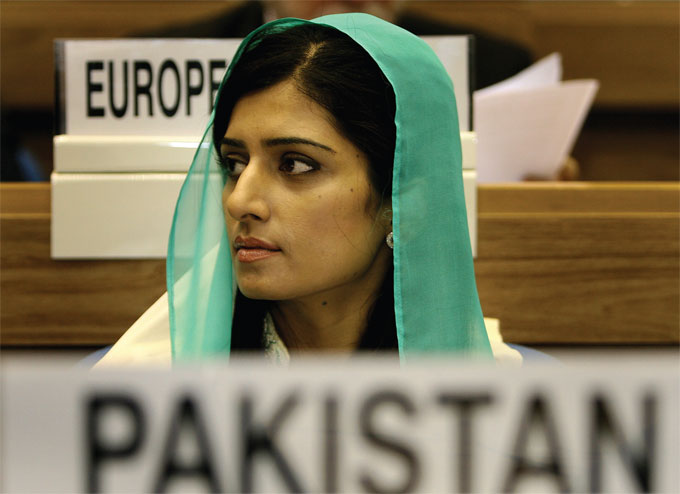
The outcome from the forthcoming July 26-27 talks between Foreign Ministers of Pakistan and India in New Delhi is expected to usher in a new beginning in the bilateral relations of both countries. The optimism is hyped by the recent statements of Pakistan Prime Minister Syed Yusuf Raza Gilani describing India as “most important neighbour” and a recent TV interview of Indian Foreign Secretary Nirupuma Rao displaying growing realization of her country for the continuity of dialogue with Pakistan. Much before these scheduled talks Pakistan’s Minister of State for Foreign Affairs Ms Hina Rabbani Khar is sure to be upgraded to full minister status.

Prior to the 2-day Delhi meetings of the Foreign Ministers on July 26-27, 2011, Foreign Secretaries of both countries will meet on July 25, 2011, in New Delhi to fine tune recommendations of two separate technical groups on trans-Kashmir trade and travel CBMS and nukes CBMs.

The additional trans-Kashmir travel and trade CBMs likely to be announced at the conclusion of the Foreign Ministers meeting on July 27, 2011, are opening of Skardu-Kargil passengers bus service, increasing the current run of Muzaffarabad-Srinagar bus service from weekly to bi-weekly duration and upping trading days from 2-day per week to 4-day a week besides making it bankable trade.

The expert level panel from both countries consisting of Ms Sehra H Akberi, DG South Asia of Pakistan and Y K Sinha JS from India is likely meet by middle of next week in Delhi.

Kashmiris strongly demand opening of Sialkot-Suchet Garh railway service for trading Sialkot industrial products to occupied Jammu and beyond. In pre-1947 era the major business market and education center of Jammu was Sialkot.

Pakistan Issues Shoot-On-Sight Order as Karachi Violence Escalates

As Reported by The Voice of America

Pakistani security forces have been ordered to shoot on sight when confronting disorders in Karachi, where days of political and ethnic violence have left up to 85 people dead.

About 1,000 additional police and paramilitary forces were deployed in Karachi on Friday with new orders to shoot any armed “miscreants” they encounter.

Interior Minister Rehman Malik told reporters that dozens of suspects have been detained in connection with a series of targeted killings since Monday. At least 34 people died on Thursday alone when gunmen opened fire on buses.

Police say the killings are part of clashes between political groups in Sindh province, including the Muttahida Qaumi Movement and its rival, the Awami National Party (ANP).

The MQM largely represents the Urdu-speaking community, and until last month was part of the ruling coalition in Sindh. ANP represents ethnic Pashtuns. Both those groups and the ruling Pakistan People’s Party are believed to have links to armed groups in Karachi.

Shops were closed and streets were deserted in the southern port city Friday after the MQM called for a day of mourning and protest rallies.

MQM leader Raza Haroon has said his movement’s supporters are being targeted because the party quit the coalition.

The Human Rights Commission of Pakistan says 490 people were victims of targeted killings in Karachi in the first half of this year.

On Friday, Pakistani Prime Minister Yousuf Raza Gilani appealed for peace and security in Karachi, saying it was important for the economic development of the country.

U.S. Ambassador to Pakistan Cameron Munter called on all parties to refrain from further violence and work toward a “peaceful resolution of differences.”

Amnesty International criticized the government’s order for security forces to “shoot on sight” armed men involved in the violence. The rights group said Friday that by giving troops such power the government is effectively declaring Karachi “a war zone” and encouraging further lawlessness and violence, citing what it said was the army’s record of human rights violations.

About 18 million people live in Karachi, the country’s economic hub. The city also has been the scene of sectarian violence between Sunni and Shi’ite Muslims and militant attacks.

Meanwhile, in Pakistan’s northwest, military officials say troops backed by jets have killed 11 militants in the Kurram tribal region along the Afghan border. Officials say nearly 50 militants have been killed in Kurram since a military operation began there this week.

Military Puppet. Or Rising Star?

By Rubab Shirazi for Tehelka Magazine

If The unfolding political crisis in Pakistan does not upset junior foreign and economic affairs minister Hina Rabbani Khar’s elevation as full-fledged foreign minister, she appears all set to travel to New Delhi for meeting her Indian counterpart SM Krishna this month for the ministerial meeting of the resumed dialogue process. Her promotion is needed to remove the protocol hitch for the ministerial meeting.

When Khar, 34, became the minister of state for foreign affairs in February, hardly any eyebrows were raised — more so because the ceremonial position has been used since 2004 to accommodate scions of influential families in the Federal Cabinet. Khar’s entry was instead seen as a bid by the government to prioritise the economic aspect in its diplomacy.

But the news of her elevation was met with strong criticism because she was seen as being too young and raw to handle complex foreign policy issues, even though she had been part of the Cabinet since 2004. For a good part of her political career, which started with her election as member of the National Assembly in 2003, Khar has been a low-key politician.

In a country that already has an accidental president (Asif Ali Zardari) and prime minister (Yousuf Raza Gilani), it wouldn’t be a surprise if the foreign minister is also accidental. If things go as planned, she would take oath this month as Pakistan’s 26th foreign minister and bag the honour of being the first woman to hold the post. But, Foreign Office (FO) bureaucrats, who derisively refer to her as “the girl” in private, say that she is no match for most who have occupied this crucial post.

Khar comes from a privileged background, being the daughter of well-known politician Ghulam Noor Rabbani Khar and niece of infamous playboy and former Punjab governor Ghulam Mustafa Khar. The latter’s wife Tehmina Durrani wrote My Feudal Lord, which caused controversy by describing her abusive and traumatic marriage with Ghulam Mustafa and her experience of life in a patriarchal society. Despite her feudal upbringing, Khar graduated from Pakistan’s best business school, Lahore University of Management Sciences and obtained her masters in hospitality from the University of Massachusetts.

Khar’s likely appointment is coming at a time when the country’s foreign relations are not in the best of shape — the alliance with the US is withering away fast; cross-border controversies are marring Pak-Afghan bonhomie; and though the Indo-Pakistan dialogue is progressing, the Thimphu spirit is fading as indicated by recent bilateral meetings.

Even if Khar succeeds in getting the post, diplomatic observers think she will not be the real decision maker — the power would still lie with the military. Having an inexperienced person like Khar as the FO boss, who would depend heavily on bureaucracy for policy as well as administrative matters, suits the military establishment at Rawalpindi GHQ in maintaining its control over Pakistan’s foreign policy.

Unlike her predecessor Shah Mehmood Qureshi, who lost his job for taking a hardline position on immunity for CIA operative Raymond Davis (involved in fatally shooting two youth in January), Khar isn’t thought to be independent minded.

No one at the FO knows about Khar’s views on important issues like relations with the US, Europe, India, Afghanistan and about the War on Terror. She hasn’t given any interviews or delivered speeches on foreign policy ever since she moved to the FO in February, even though she was the de facto boss during this time.

Though much has been written about her meteoric rise in politics, she still remains an enigma. Her credentials for being considered for the crucial post are her two stints as minister of state for economic affairs; a brief assignment as special assistant to the prime minister on finance, revenue and economic affairs; and more lately her FO job.

No one knows Khar’s views on important issues like the war on terror, Indo-Pak relations, or the strained partnership with the US

According to her curriculum vitae, foreign affairs was not a subject of interest until lately. She avows interest in finance, economic affairs and agriculture development. But, quite contrary to her fondness for the three subjects, she runs an upscale restaurant in Lahore. Her husband Feroze Gulzar is a textile industrialist. For most of her career, Khar had been dealing with international loans and grants. Foreign Service officials, who don’t want to be named, caution that real-time diplomacy is a different ball game.

Administrative chaos at the FO, another officer says, grew under the overachieving lady, who had been promoted by the PPP government as an astute manager. Khar was responsible for economic affairs during Gen Pervez Musharraf’s regime. Economic mismanagement turned out to be the major cause of the defeat of her previous party, PML(Q), in the 2008 elections. Fearing that she wouldn’t be given a party ticket, she changed her loyalties weeks before the polls and joined the PPP.

IF SUCCESSFUL in achieving the prized foreign ministership, it would not be the first time she would be filling someone’s shoes. In 2003, she contested elections in place of her father, who couldn’t run for National Assembly as he was not a graduate; in 2009 she became the first woman minister to present the federal budget because former finance minister Shaukat Tarin was not an elected Parliamentarian.

Her inexperience aside, party colleagues say that Khar is deceptively wily and ambitious as they point to how she smartly outmanoeuvered other contenders in the race for the foreign ministry, including former law minister Babar Awan, former foreign minister Sardar Assef Ali and National Assembly speaker Dr Fehmida Mirza — all political heavyweights.

One of her weaknesses is that she isn’t a media darling. Searching online for her interviews turns up a little-known Saturday Post article, that too dated several years ago. On this count, she would turn out to be a weak and ineffectual representative of her country’s foreign policy. In her first media appearance alongside a visiting US functionary Thomas Nides, Khar was unimpressive. Foreign Secretary Salman Bashir hurriedly scripted a few lines for her to deliver before PTV cameras, but according to one official, she struggled with it. Days later, when speaking to the media alongside UK Foreign Secretary William Hague, when she was asked about the prospects of a peace deal with Afghan Taliban, Khar started speaking about a failed peace deal with militants in Swat to prove Islamabad’s commitment to peace with militants. Pakistan, she probably forgot, does not equate Afghan and local Taliban. The government has been treating the two entities differently.

Online discussion boards have been filled with negative comments on her expected elevation. “What a farce. We are at one of the most critical junctures in our foreign affairs, so we decide to hand out perhaps the most important portfolio to a 34-year-old with a degree in hospitality management!” reads a posting on a discussion platform called Pakistan Defense.

What goes in her favour is that apart from allegations by her critics of tax evasion, something normal for a Pakistani politician, she has no major controversies attached to her name.

Did Pakistan Have Reporter Killed?

By Jennifer Epstein for Politico

In another possible blow to U.S.-Pakistan relations after the killing of Osama bin Laden, Obama administration officials believe that the country’s intelligence service ordered the “barbaric and unacceptable” killing of a journalist who had written about ties between the country’s military and Al Qaeda militants, according to a report Tuesday.

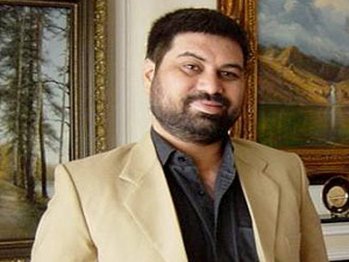
Intelligence surrounding the late May killing of Pakistani reporter Saleem Shahzad, 40, suggests that senior officials at Pakistan’s Directorate for Inter-Services Intelligence ordered the murder to silence his criticism, The New York Times reported Tuesday, citing two senior US administration officials.

American officials consider the intelligence to be “reliable and conclusive,” the Times said, with one official describing the actions of the spy agency, known as the ISI, as “barbaric and unacceptable.” Shahzad suffered 17 lacerated wounds, a ruptured liver and two broken ribs in the deadly attack.

Relations between the United States and Pakistan have become increasingly frayed since the early May killing of bin Laden in a Pakistani town with a heavy military presence, where he’d been holed up for several years. U.S. officials suspect that some members of the military and the ISI helped harbor him there, even if top Pakistani officials truly were kept in the dark about bin Laden’s presence there.

The Times’s report comes after journalists and others within Pakistan accused the ISI of being behind Shahzad’s death, and since the Pakistani government – under pressure — launched an investigation of the killing.

A Pakistani official, meanwhile, shot down the Times’s report.

“There is an international conspiracy to malign the law enforcement agencies and security forces,” Pakistani information minister Firdous Ashiq Awan said Tuesday, the Hindustan Times reported.

The allegations made by the Obama administration “are part of that conspiracy,” she said.

Awan also said that “good relations are in the interest of both” the United States and Pakistan, though “everybody safeguards their own interests” in a conflict and there have been some “ups and downs.”

In Pakistan, Truck Decoration a High-Octane Art Movement

By James Parchman for The New York Times

MURIDKE, Pakistan — Here on the historic Grand Trunk Road, some 40 miles north of Lahore and a few hours south of the former bin Laden hideout of Abbottabad, a mosque’s call to Friday afternoon prayers was overwhelmed by Pakistani pop music spilling from open-air markets. The barks of bus conductors calling out destinations added to the din.

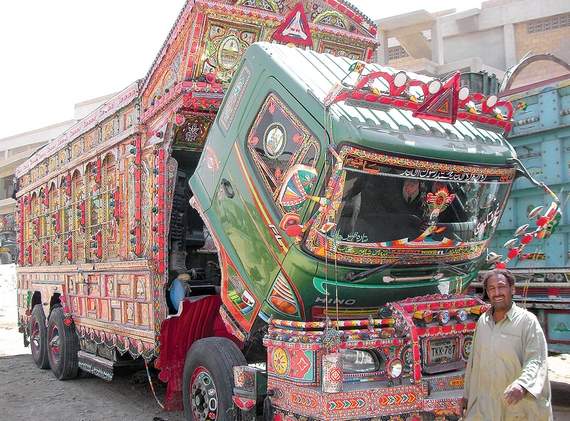
The passing parade of motorized rickshaws, farm tractors, buses and highway cargo trucks looked as if a re-enactment of ’60s peaceniks making the pilgrimage to Woodstock might be under way. A panorama of red, yellow and green, mixed with plastic whirligigs, polished mahogany doors and gleaming stainless steel cover plates, was a magical sight for a visitor with a love for anything on wheels.

It was not only the variety of vehicles — all are common across South Asia — that elicited this reaction, or even their Partridge-Family-meets-Ken-Kesey color schemes. Rather, it was the fascinating quantity and surrealistic detail of their decoration, unlike anything I’d seen in my travels around the world.

A deeper understanding of the origins and meanings of the decoration craft was gained over days of mingling with the truck drivers and the owners of decorating shops in Karachi, Lahore and Peshawar.

Karachi, situated on the Arabian Sea, is Pakistan’s major seaport. It is also the cargo hub of the country, and with 13 million people has a great many local and intercity buses. As such, the city supports a considerable customizing industry: When Saudi Aramco World magazine published an article about the trade in 2005, more than 50,000 people in Karachi were said to be employed decorating buses and trucks.

What I found at the Pakistani workshops was a pride of design and a willingness to answer questions — and to show off their creations to a former long-haul trucker.

Sparing no expense

At a driver’s cafe near Karachi’s 3-mile-long International Truck Yard (where I turned down an offer of boiled camel meat and cow-leg soup) workers took me by the hand to the shop of Masallah the truck decorator. My Dockers and Rockports were as out of place as their long-shirted, working-class shalwar kameez outfits and leather sandals, called chappals, would have been in one of New York City’s outer boroughs.

But my full beard may have helped in gaining their confidence and a look inside their truck cabs. Government safety agencies equivalent to OSHA were nowhere to be seen in the truck yards, and workers, many of whom were children of the owners, were being showered with sparks from their grinders and cutting torches.

Many of the trucks being outfitted at Masallah’s carried identification plates from Balochistan province. Their owners were prospering thanks to a steady demand for hauling loaded sea containers from Karachi’s port to landlocked Afghanistan. Their cargo, typically including supplies for U.S. and NATO military operations, make a trip of 500 miles by the southern route to Kandahar or 1,200 miles by a northern route to Kabul.

Pakistani truck owners can easily spend more on their trucks than on their homes. One driver from the Gwadar area of Balochistan told me he had just bought a Hino truck chassis for the equivalent of $35,000 and brought it straight to Masallah’s workshop. There he might spend another $25,000 for its body, paint and decoration. During the several weeks required to complete the work, he would sleep inside or under the truck, on his bedroll.

Adding decorative touches like ribbons, spinners, flags and polished steel cutouts in the shape of animals to a small bus costs an owner at least $800. This is considered an advertising expense; a highly decorated bus is usually the first choice of customers when there are several options.

Nissan and Hino tandem-axle trucks of the flat-front cabover design, many assembled in Pakistan, are the popular choices for cargo-haulers today, replacing the revered Vauxhall Bedford, a British model with a traditional cab. The Bedford was the mainstay of Pakistan’s cargo network since the early days of Pakistan’s independence.

The Bedford is still prized for its sturdy chassis and ability to continuously haul outsize loads. Many have bodywork with a high-crowned front prow, which lends itself to decoration and gives the truck the look of a sailing ship.

As is the case in the United States, offering a sharply decorated truck can be a powerful incentive for recruiting drivers. Pakistani bus and truck owners usually allow their drivers, whose average wages are about $75 a month, to work out their own designs in conjunction with the owner of the decoration shop.

Big business

Predictably, mass production has changed the business over the years. Adornments are no longer exclusively handmade.

“Pakistani buses were originally decorated using carved woodwork and individual paintings,” said Kurram Awan, the owner of a small shop of truck-decorating supplies in Lahore.

“Now, my shop sells over 1,000 different items, including braids, reflectors, flashing lights and antennas,” he said.

He added that the Pashtun drivers (Pashto speakers from the border region between Afghanistan and Pakistan) spent the most on decorations.

Durriya Kazi, an artist and teacher in Karachi, has long been a proponent of Pakistan’s folk art. She sees bus and truck decorating as an integral part of that tradition, noting the importance of distinguishing between sculpture as defined by the art gallery and the rich activity of actually making things that exists all over Pakistan.

In 2006, Kazi was instrumental in a program intended to spread Pakistan’s bus decoration skills to Melbourne, Australia, where a tram was transformed into a replica of a minibus used on Karachi’s W-11 route, resplendent in all its finery.

Another Pakistani with expertise in the subject is Jamal Elias of the University of Pennsylvania, a professor and the author of “On Wings of Diesel: Trucks, Identity and Culture in Pakistan” (Oneworld, 2011). His book explores the tradition of Pakistani truck decoration, and looks deeper into the “nature of response to religious imagery in popular Islamic culture.”

In an e-mail, Elias said that the creative inputs of decorators included several major themes, which could be combined across the cab and body of the truck or bus. These include Islamic religious images like the horse of Muhammad and depictions of the mosques at Mecca.

Other possibilities include images of a fish, representing good fortune, or the elegant eyes of a woman, representing beauty.

In This Country, Religious Freedom Is Real

By Imran Hayee for The StarTribune

My childhood memories of celebrating Independence Day are no different than those of my fellow citizens — except that it was on Aug. 14th instead of July 4th.

I grew up in Pakistan, which obtained its independence from British rule on Aug. 14, 1947.

As a child, I marked Independence Day year after year without having a clue about what independence really meant. As I grew older, I read from a speech of Muhammad Ali Jinnah, Pakistan’s founder, which he had delivered immediately after the nation’s independence was announced.

“You are free; you are free to go to your temples,” he said. “You are free to go to your mosques or to any other places of worship in this State of Pakistan. You may belong to any religion or cast or creed — that has nothing to do with the business of the State.”

This was Jinnah’s dream, the founding principle behind the independence of Pakistan as he himself stated in the same landmark speech: “We are all citizens and equal citizens of one State. We should keep that in front of us as our ideal and you will find that in due course, Hindus would cease to be Hindus and Muslims would cease to be Muslims, not in the religious sense, because that is the personal faith of each individual, but in the political sense as citizens of the State.”

Growing up in Pakistan, as a Muslim, I never saw Jinnah’s dream materializing. The constitution of Pakistan defines who is a Muslim — any “impersonator” is subject to imprisonment or death. Temples, churches and mosques not ascribing to a single distorted version of Islam are routinely attacked.

What caused the secular ideology of Jinnah to take this U-turn?

Soon after the nation’s creation in 1947, and Jinnah’s demise a year later, Pakistan’s rulers succumbed to the demands of religious extremists who wanted to convert Pakistan into a puritanical fundamentalist state.

Gradually, the monster of religious fundamentalism grew large enough to devour Jinnah’s philosophy of spreading freedom and equality.

I never experienced independence until I came to America 18 years ago. For the first time — when Independence Day was being celebrated on July 4th instead of Aug. 14th — I wanted to rejoice once again.

I was unaware of the history behind America’s Independence Day, but still, I saw freedom and equality prevail all around me. I could freely go to my mosque without having to fear the state’s interference.

As I learned more about the history behind July 4th, it reminded me of the same philosophy of freedom and equality that Jinnah dreamed for Pakistan. What made the difference in America was that its rulers never succumbed to extremists’ demands.

Rather, its forefathers risked their wealth and lives to uphold the principles of freedom and equality. Their sacrifices paved the way for a Muslim like me to emigrate from a Muslim country and practice Islam the way I wanted to but could not do in the country of my birth.

More recently, while some European countries have banned building minarets on mosques and the wearing of veils by Muslim women, U.S. courts have struck down any such attempted restrictions as unconstitutional.

Addressing the Muslim world in Cairo, President Obama proudly announced, “Freedom in America is indivisible from the freedom to practice one’s religion. That is why there is a mosque in every state of our union, and over 1,200 mosques within our borders. That is why the U.S. government has gone to court to protect the right of women and girls to wear hijab, and to punish those who would deny it.”

As a Muslim-American, I feel proud and honored to be in America and find many reasons to celebrate Independence Day on July 4th. Among others, let me add that the founding principles of America’s Constitution are in perfect harmony with the Qur’an.

The Qur’an (2:257) proclaims, “There is no compulsion in religion. Surely, the right way has become distinct from error.” It further declares fundamental human equality: “O mankind, We have created you from male and female; and We have made you into tribes and sub-tribes that you may recognize one another” (Qur’an 49:14).

These golden principles of freedom and equality have been implemented — in America. In fact, I find the American Constitution to be more Islamic than the constitution of Pakistan or of any other Muslim country in the world today.

Imran Hayee is a professor of engineering at the University of Minnesota Duluth.

Pakistan’s First Astronaut: A Star Is Launched

By Maha Mussadaq for The Express Tribune

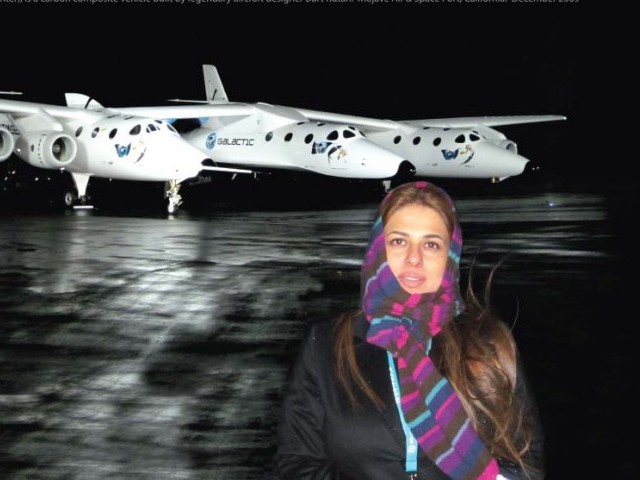
Namira Salim’s star is about to launch as she is set to become Pakistan’s first astronaut. Her maiden voyage will be in 2012.

Talking to The Express Tribune, Salim said this was a dream come true for her. All her hard work and training will soon pay off. Although the date for the launch is not yet fixed, she says her team is ready.

“I got my first telescope when I was 14 years old,” says Salim. Holding a Master’s in international affairs from Columbia University, Salim was an active member of astronomy clubs in college and university and was also the first female member of the Amateur Astronomy Society of Pakistan. Rather than being a hindrance, Salim says that her gender always gave her an edge over her male counterparts.

Salim, who divides her time between Dubai and Paris, was feted for her groundbreaking achievements by President Zardari, who awarded her the Tamgha-e-Imtiaz for excellence in sports.

Sir Richard Branson, chairman of the Virgin Group, officially launched Salim as a Virgin Galactic Founder Astronaut in Dubai in March 2006. Hearing of this, the Ministry of Information and Broadcasting dubbed her the first Pakistani astronaut.

She is also the First Asian to skydive from an altitude higher than the peak of Mount Everest, at 29,480 feet. Salim also hoisted the national flags of Pakistan, the UAE, Monaco, the EU and a universal peace flag at the North Pole on April 21, 2007 and at the South Pole on January 10, 2008. She is the first Pakistani to trek to both the North and South Poles.

Salim’s space voyage will be the second flight launched into space by Branson. The mogul himself and his family will go on the first flight. Her flight will be launched from the space port in Mojave Desert in California sometime next year. “We will be in space for a few hours and then come back,” said Salim.

John Lennon- Imagine

Pakistan Kicks U.S. Off Air Base

By Farhan Bokhari for CBS News

The U.S. faces the challenge of quickly establishing alternative facilities from which to launch drone aircraft inside Afghanistan after Pakistan ordered U.S. personnel and hardware out of a base believed to have been used in the past for CIA drones, two senior Western defense officials tell CBS News.

Concern mounted Wednesday over the future of Pakistan’s clandestine support for Washington’s use of drones after the country’s defense minister announced Pakistan had told the U.S. to vacate the small Shamsi air base in the southwestern Baluchistan province.

Only “Pakistani aircraft will be flown from Shamsi in future,” Pakistani defense minister Chaudhary Ahmed Mukhtar told reporters. “No U.S. aircraft will fly from Shamsi.”

“U.S. personnel will not be allowed to use the Shamsi air base,” a senior Pakistani government official added to CBS News.

Another senior Pakistani official, who spoke Thursday to CBS News on condition of anonymity, said there previously “have been U.S. activities at the Shamsi air base. All those activities are being ceased now.”

The news comes as the Obama administration details its new strategy for combating extremism across the globe — a strategy which shifts the focus sharply away from the large-scale ground operations espoused by President George W. Bush, to smaller “surgical” strikes, like drone attacks.

The official refused to specify the types of U.S. activities that have now been ceased at Shamsi.

Pakistan has always publicly criticized the U.S. for carrying out attacks using pilotless drones, and has never acknowledged that it cooperates with Washington on the use of such aircraft. The drones have become widely unpopular across Pakistan after some of the attacks reportedly resulted in civilian casualties, including women and children.

“The damage to the U.S. drone program will not be substantial. But Pakistan’s decision is a setback for efforts to improve U.S. relations with Pakistan,” a senior Western defense official based in Islamabad told CBS, also speaking on the condition of anonymity. “It will take some time for the Americans to establish the program in Afghanistan. It can be done.”

Relations between the U.S. and Pakistan have remained frosty since U.S. Navy SEALs killed Osama bin Laden in the country’s northern city of Abbottabad.

That attack was undertaken without the U.S. offering advanced information to Pakistan, out of fear that militant sympathizers in Pakistan’s intelligence and security establishment might have alerted al Qaeda or the Taliban.

The 2nd May operation has been followed by a hardening of attitude by Pakistan’s influential military, which claims the attack violated Pakistan’s sovereignty. In reaction to the raid, Pakistan has already ordered more than 150 U.S. military trainers to leave the country.