Archive for the ‘ Afghanistan ’ Category

Pakistan is Not America’s Enemy

 By Ryan Crocker for The Wall Street Journal
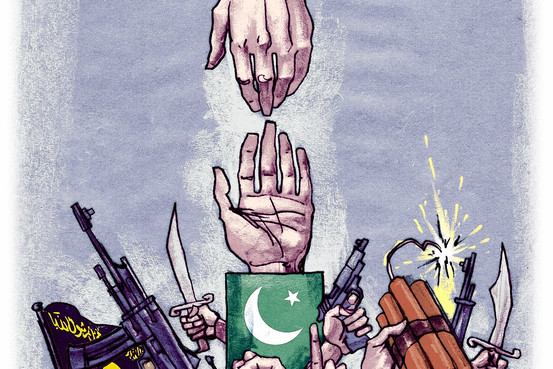
 The news from Pakistan is grim. NATO helicopters engage suspected militants inside Pakistan, killing three, only to discover they are Pakistani soldiers. The angry Pakistani government blocks NATO fuel shipments at the Khyber Pass, and militants attack the stalled trucks. An Obama administration report to Congress charges that the Pakistanis aren’t doing enough against the Taliban and al Qaeda. Press accounts quote unnamed officials asserting that elements in Pakistani intelligence are encouraging the Taliban to step up attacks on NATO forces. And Bob Woodward cites President Obama as saying “the cancer is in Pakistan.”

One could easily conclude that we are describing an enemy, not an ally. Many in Pakistan feel the same way. And yet the prospects for stabilizing Afghanistan, defeating al Qaeda and preventing further attacks on the United States are a direct function of that strained alliance. It is time for a collective deep breath.

Pakistan’s historical narrative focuses on how the U.S. worked with Pakistanis and Afghans to drive the Soviets from Afghanistan in the 1980s: We succeeded—and then we left. And on our way out, we slapped sanctions on Pakistan, ending all security and economic assistance because of the country’s nuclear program, which we had known about since 1974 when Pakistan’s prime minister announced it publicly. We left Pakistan alone to deal with a destabilizing civil war in Afghanistan, and when the Taliban emerged as a dominant force in the mid-1990s, Islamabad supported them as a means of ending the conflict.

Then came 9/11 and the U.S. was back. Pakistanis welcomed the renewed assistance. But a constant question I heard while serving as ambassador to Pakistan from 2004-2007 was “How long will you stay this time, and what mess will you leave us with when you go?” For a fragile state with innumerable problems, including a vicious internal insurgency, these are existential questions.

Never in Pakistan’s six decades of existence has the U.S. sustained a long-term, strategic commitment in the country. The Bush administration recognized this and enacted security and economic assistance programs designed to make a long-term difference in education, health care and governance. In 2006, I argued successfully for a five-year assistance package for Pakistan’s Federally Administered Tribal Areas (FATA), which are notable both for chronic underdevelopment and extremism. The Obama administration has built on this, and last year’s Kerry-Lugar bill provided $7.5 billion in assistance over five years. So we have the architecture in place to build a strategic relationship.

Still, short-term pressures risk undermining long-term strategy. When I was ambassador, voices in Congress, the media and even the administration were constantly calling for the U.S. to get tough on Pakistan, make Pakistanis do more, threaten them with consequences. Such exhortations were—and remain—generally counterproductive, as they fuel fears that the U.S. will again abandon Pakistan.

The U.S. can better work with Pakistan if we improve our understanding of history: Given its rivalry with India and its organic disunity, which dates back to its founding, Pakistan fears for its basic survival. The country has always had a difficult relationship with Afghanistan, not least because in the 19th century the British deliberately drew the Pakistani-Afghan border, the so-called Durand Line, in order to divide the Pashtun people. Today Pashtuns make up Afghanistan’s largest community, but there are more Pashtuns in Pakistan.

The Durand Line also set the groundwork for the tribal areas, which are legally distinct from the rest of Pakistan because the British could never exert direct control over them. No central authority ever has. Winston Churchill’s first published work, “The Story of the Malakand Field Force,” is about fierce tribesmen declaring jihad against a Western army. It could be a contemporary account.

So what does this mean in concrete terms?

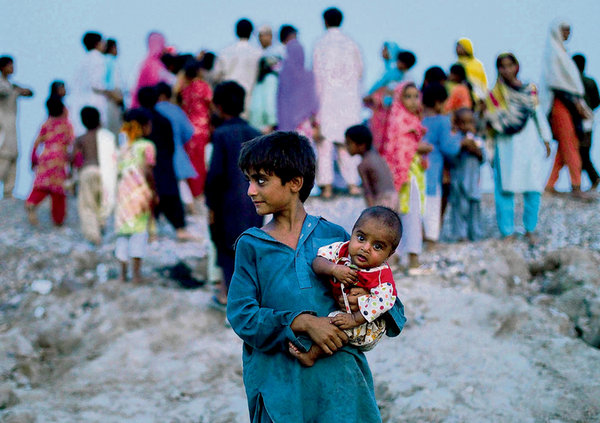
First, the U.S. should appreciate Pakistan’s challenges and support its government in dealing with them. This summer’s devastating floods have disappeared from the U.S. media but will continue to wreak havoc in Pakistan for a long time to come. In 2005 and 2006, after an earthquake in Kashmir killed almost 80,000 Pakistanis, the U.S. organized the largest relief operation since the Berlin Airlift. The floods’ death toll is lower, but their long-term damage will be far greater. U.S. support should be commensurate.

Second, the U.S. should not carry out cross-border military actions, which I strongly resisted as ambassador. They are clearly counterproductive, and not just because we hit the wrong target. If NATO can carry out military actions in Pakistan from the west, Pakistanis wonder, what stops India from doing the same from the east? There are other options, including drone strikes, which the U.S. is now coordinating more closely with Pakistanis.

Third, with Pakistan’s government (as with Afghanistan’s), we must be private in our criticism and public in our support

Private talks should deepen regarding challenges like the insurgent Haqqani network in North Waziristan, and we need to listen at least as much as we lecture.Fourth, any talks between the U.S. or Afghanistan and the Taliban must be transparent to the Pakistanis. A nightmare for Islamabad is the prospect that the Americans and Afghans come to some accommodation with Taliban elements that would leave them hostile to Pakistan. If Pakistan is not part of the process, we will be working at cross-purposes and only the Taliban will benefit.

Pakistan’s arrest of Taliban leader Abdul Ghani Baradar—at a time when he had begun reconciliation talks with Afghan authorities—underscored the risks of leaving Islamabad out of the loop. Going forward, the timing and nature of talks with the Taliban should be set by Afghans, Pakistanis and Americans working together.

None of this will be easy, but it is essential. A sustained U.S.-Pakistani partnership after the Soviet withdrawal from Afghanistan could have produced a very different history than the one we wrestle with today. Writing a different future requires making long-term commitments—on both sides of the Durand Line.

Mr. Crocker, the dean of Texas A&M’s George Bush School of Government and Public Service, was U.S. ambassador to Pakistan from 2004 to 2007 and U.S. ambassador to Iraq from 2007 to 2009.
How to End the War in Afghanistan

As Reported on CNN

New York (CNN) — Afghan President Hamid Karzai has started talks with representatives of the Taliban, a move that analyst Fareed Zakaria says could bring an end to the nine-year-long war.

Karzai convened a meeting Thursday with the Afghan Peace Council, which was formed to help negotiate with the Taliban. Referring to the militants, Karzai said, “I call on them once again to use this opportunity and say ‘yes’ to this endeavor. I want them to come and bring peace to this land.”

The author and host of CNN’s “Fareed Zakaria GPS” spoke to CNN on Thursday. Here is an edited transcript:

CNN: Hamid Karzai has launched a council to help negotiate with the Taliban? What’s the significance of that step?

Fareed Zakaria: I think it’s about time. If you look at any good study of civil wars, what you find is that most of them end in a negotiated settlement. Maybe because Americans have the memory of our civil war in which the North crushes the South, we somehow think that that’s how civil wars end. But that’s actually is very unusual.

What normally happens is some kind of settlement that is negotiated in which the losers are reintegrated into the political order. Civil wars are unlike normal wars, because the winners and losers are going to have to live with one another.

CNN: How does that apply to Afghanistan?

Zakaria: The Taliban, which is mounting this insurgency, is not a foreign element within the body politic. The Taliban is basically the political representative of the conservative elements of the Pashtun community.

The Pashtuns are 50 percent of Afghanistan. … It is a political force in Afghanistan. Coming to terms with it politically and seeing if there’s some way it can be reintegrated into the political order makes sense. You’re not going to kill every member of the Taliban. They’re not going to be exiled to a foreign land. They’re going to be there at the end of the day so it’s better to to have them in the tent.

CNN: The U.S. military view seems to be that the talks haven’t yielded progress so far, and a senior defense official told CNN, “We don’t think the Taliban believe that they’re losing to the degree that they’d come to terms in large numbers.” Are the talks premature because the effects of the U.S. military buildup haven’t been felt yet?

Zakaria: First the very fact that the Taliban are coming to the table in a way they had not been willing to before suggests that they are feeling some pressure.

But I also think you can’t get too hung up with this idea that you have to negotiate from a position of strength. Ideally we would have them totally prostrate on the floor and that would be the time to negotiate. But the reality is that this is a very mixed military campaign. I don’t know if it’s going to be dramatically better one year from now or three years from now.

This is a little like somebody who owns a stock, who says, it’s at six now, I need to sell it, but I’m going to wait till it goes to eight. Well maybe it will go to eight, maybe it will go to four.

You might as well start talking at this point. First of all you learn a lot in the process of negotiations. And secondly, the military campaign could move in many different directions. If the surge starts succeeding even more, that will be reflected in our negotiating posture.

CNN: Is there an idea yet of what a negotiated settlement might involve?

Zakaria: It seems as though the Taliban demands are that they want all foreign troops out. They don’t want to accept the Afghan constitution and they don’t want to lay down their arms.

Now those are obviously their opening demands. Foreign troops aren’t going to be out, but one could point out that President Obama has said there is going to be a reduction of foreign forces next year.

On the Afghan constitution, there is a compromise there where there could be a few amendments to the constitution. But on laying down their arms, that it seems to me you can’t really compromise, they would have to lay down their arms. Could some elements be integrated into the militia, or the Afghan national army? Perhaps — that’s what happened in Iraq.

CNN: Isn’t there also a clashing conception of society, with the Taliban being a closed society that doesn’t recognize an elevated role for women as opposed to a potentially democratic kind of society that’s envisioned by the Afghan constitution?

Zakaria: Yes, it is the kind of society envisioned by the Afghan constitution. But Afghanistan is a fairly conservative society. While the extreme elements of the Taliban have draconian visions which are obviously not supported by the Afghans — the polls bear this out — it’s also true that on issues of women’s rights and some of the more progressive elements of the Afghan constitution, the Karzai government is in a minority and those rights are not popularly supported.

There are clashing visions, but there is probably a reality of Afghanistan which is a lot more progressive and open than the Taliban believe but is still a society that is somewhat conservative, and often tribal, and with very traditional views on something like women’s rights.

The key is creating a situation where these rights are guaranteed but not fetishizing it. For example, one of the things the Afghan constitution has is a requirement for 25 percent representation of women in parliament. We don’t have such a requirement either in the U.S. Constitution or in the amendments. Many European countries don’t.

Is it conceivable that something like that could be compromised? Perhaps, and that’s the kind of thing where we’d have to be creative in coming up with a solution that moderates and some elements of the Taliban could live with.

CNN: Is this an honorable exit for the United States?

Zakaria: I think so, and it’s not really an exit, it’s a reduction in our forces and in our role. And I think it would be appropriate. We’ve been there for nine years. It’s not the only battleground, the only place where al Qaeda operates. There are many more members of al Qaeda in Pakistan than in Afghanistan.

You’re trying to create a political settlement, and a self-sustaining political framework in Afghanistan that can survive the departure of American troops. And finally you’re leaving enough troops in there where you could still prosecute a fairly vigorous counterterrorism operation against those elements of the Taliban or al Qaeda that continue to plot and plan to do violence to civilians, foreigners, westerners.

And I do think, if we could get this kind of a settlement, it would be an honorable way for the United States to begin reducing its exposure in Afghanistan.

Fareed Zakaria is an author and foreign affairs analyst who hosts “Fareed Zakaria GPS” on CNN

Envoy Insists Pakistan Will Tackle Terrorists As Attack Kills 3

By Nasir Habib for Cnn

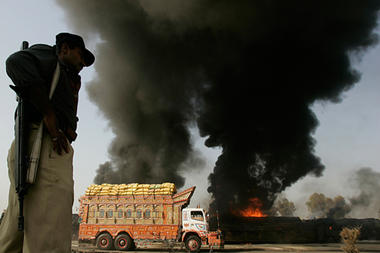
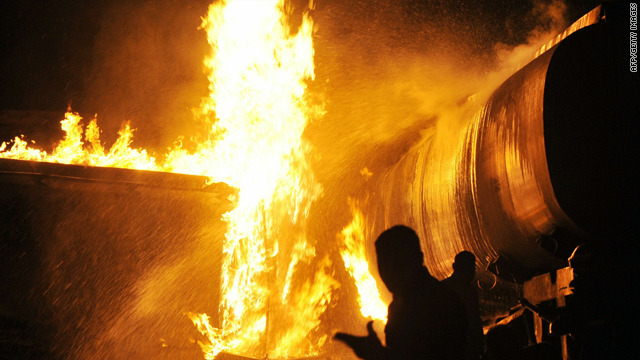
Islamabad, Pakistan (CNN) — Gunmen in Pakistan opened fire on oil trucks bound for NATO forces in Afghanistan, setting some 20 vehicles on fire and killing three, police said Monday. The attack came shortly after Pakistan’s ambassador to the United States vowed his country would go after terrorists on its soil.

Naeem Iqbal, a police spokesman, said five people were wounded in the attack on tankers parked on a main road outside a housing complex near the capital city of Islamabad. Efforts to put out the blaze are ongoing, he said.

Bin Yamin, a deputy police chief, said eight gunmen entered the area on Monday around 12:15 a.m. local time. He said they told people near the trucks to run away and that most did. Then they opened fire.

The tankers were parked in the vicinity of an oil refinery where they were going to go to pick up fuel for NATO forces in Afghanistan, Yamin said. Video images of the scene showed firefighters working to put out flames that stood out in the night against the overturned trucks.

On Sunday, Pakistan’s ambassador to the United States insisted his country would go after terrorists on its soil and needed only “technical” help from Washington, not U.S. troops on the ground.

Husain Haqqani, told CNN’s “State of the Union” that Pakistan would reopen a NATO supply route into Afghanistan “relatively quickly,” probably in less than a week.

Pakistan halted the convoys Thursday after officials blamed cross-border NATO helicopter fire for the deaths of three Pakistani soldiers. Haqqani said the United States and Pakistan were investigating the killings together. He said Pakistan will move against militants on its own schedule, not Washington’s.

“Pakistan is saying we will take care of all terrorists on the Pakistani side of the border, but we will do it on our timeline,” Haqqani said Sunday. “We cannot always follow a timeline that our allies set for us, because we are allies, not a satellite.”

Pakistan has lodged protests against NATO helicopter incursions into its territory — which the International Security Assistance Force says its rules of engagement permit — and is very sensitive about reported U.S. drone strikes in Pakistan.

There were a record number of drone strikes last month, according to a CNN count. On Saturday, three suspected drone strikes killed 18 people.

Pakistani intelligence officials said 10 people died in one drone strike targeting a militant hideout, four people died when a vehicle was struck, and four others were killed when another hideout was targeted.

All three occurred in the Data Khel area of North Waziristan. The intelligence officials did not want to be named because they are not authorized to speak to the media.

Security analysts have described North Waziristan as a haven for various factions of Afghan and Pakistani Taliban and al Qaeda militants. The majority of reported strikes this year have hit targets in the district, a mountainous tribal area on Pakistan’s border with Afghanistan, analysts said.

The United States does not officially acknowledge that it has unmanned aircraft firing missiles at suspected militants in Pakistan, but it is the only country operating in the area that is known to have the ability to do so.

Ambassador Haqqani also said Pakistan couldn’t do everything Washington wants “because sometimes we don’t have the capacity and sometimes we don’t have the means.” He said Pakistan’s geography makes it hard to hit militants.

“Sometimes people in the U.S. think … that it’s all flat land with everything visible. Not even the drones can identify everyone in North Waziristan because of the complexity of terrain,” Haqqani said.

Haqqani also argued that Pakistani politicians, just like U.S. counterparts, are constrained by public opinion. “All politics is local and the local situation in Pakistan is that the United States is not very popular amongst our public,” he said. “The fact remains that an elected democratic government in Pakistan is limited by public opinion to the extent of what it can do,” he said.

The Continuous Struggle Along Pakistan’s Frontier

By David Ignatius for The Wall Street Journal

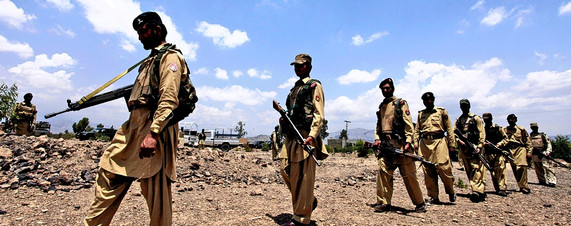
In the same week when U.S. helicopters mistakenly killed three members of Pakistan’s Frontier Corps near the Afghan border, American Special Forces were training members of that same force on how to use radios, sniper rifles and other counterinsurgency tools at a remote base here.

Pakistanis and Americans don’t talk much about this joint training camp, northwest of Peshawar about 20 miles from Afghanistan. But the program is a symbol of the weird duality of the relationship — a mix of public distance and private cooperation that’s awkward for both sides.

“We have good relations; it’s going very well,” Col. Ahsan Raza, the camp commander, said when I visited Tuesday afternoon, two days before the fatal U.S. cross-border attack. But the Pakistani commandant was eager not to appear too close to America, stressing that the U.S. trainers were supplying technical skills, not running the show.

Both sides view the program here as a success story. But the joint effort masks a tension that is only likely to deepen in coming months.

Pakistan wants to use the 70,000-strong Frontier Corps to stabilize the Federally Administered Tribal Areas, or FATA, and halt the domestic Taliban insurgency. The United States, struggling in Afghanistan, wants Pakistan to help seal the border and destroy the sanctuaries used by al-Qaeda and the Afghan Taliban. The two sides talk as if their goals are identical, but they aren’t. The differing priorities became clear in conversations last week with Pakistani commanders.

Warsak is a pet project of Maj. Gen. Tariq Khan, the commander of the Frontier Corps. At his headquarters in the ancient Bala Hissar fortress in Peshawar, the traditional garb of the tribal “scouts,” as they’re called, makes you wonder whether the days of the British Raj ever really ended. Behind Khan’s desk is a plaque bearing the names of his predecessors back to 1907.

Khan argues that it’s time for Pakistan to move from big military offensives in the tribal areas to what he calls “policing” actions. “No steamroller operations,” he says.

Lt. Gen. Asif Yasin Malik, who commands the Pakistani army in the western border areas and is Khan’s boss, makes the same point. “Don’t expect major new kinetic operations,” he says. “We have changed gears to a softer approach.”

This can’t be comforting to Gen. David Petraeus, the U.S. commander in Afghanistan. He is said to have concluded, after several months in Kabul, that more Pakistani pressure on the havens is crucial for American success. That’s the basic conflict — an overstretched America wants a Pakistani surge in the tribal areas; an overstretched Pakistan just wants to keep the peace.

Khan’s strategy is an updated version of the old British approach: work through the tribal chiefs, or maliks, keep the roads open and pound any renegades back into line. He wants to maintain order through three tiers of force: local militias, known as “levies,” recruited by the maliks; the Frontier Corps dispersed across the FATA; and the big guns of the Pakistani army.

Working with the American trainers at Warsak, Khan has devised some smart tactics: Private vehicles in the FATA will have electronic chips that register their movements. The scouts will report suspicious activities on their American-made radios, and the snipers will blow away any miscreants using their American-made sniper rifles. To demonstrate that order is returning, the burly Khan, the scion of a princely Pashtun family, took a car trip last summer through the FATA with his wife and daughter.

Khan’s enthusiasm is infectious: “There are no safe havens in my area of responsibility — I can take you anywhere, any place, anytime.” That sidesteps the fact that North and South Waziristan, the main trouble spots, are still the responsibility of the army.

Driving down the roads of the border areas, you sometimes have the sense that you are traveling back in time. But that “back to the future” strategy is a temporary fix, at best. Pakistan, with U.S. support, should be moving forward, not in reverse. The years of war have shattered the old tribal order, and the long-run goal should be to bring the tribal areas into a modern Pakistan, rather than let them fester on their own.

U.S. drone attacks and other firepower can keep the insurgents on the run, but they won’t bring stability. Neither will Tariq Khan’s snipers. Somehow, the people in this desolate region have to feel they have a stake in a future that’s something other than continuous warfare.

Pakistan Furious With US Over Fatal Raid, But There’s Little It Can Do

By Howard LaFranchi for The Christian Science Monitor

Pakistan has always bristled at US airstrikes inside its territory, but a helicopter gunship attack earlier this week that killed three Pakistani border guards has led to new frictions and exposed heightened sensitivities over Pakistan’s growing dependence on American support.

US and Pakistani officials have until now managed to paper over unresolved differences over how to deal with insurgents who attack US and NATO forces in Afghanistan from their command-and-control centers in neighboring Pakistan. But this time Pakistan closed a vital supply route for provisioning US and NATO forces in Afghanistan, causing US military and civilian leaders to scramble to attempt to undo the action.

US officials predict the border crossing – one of two Pakistani crossings used by NATO to move supplies into Afghanistan – will reopen soon. The Pakistani government, largely dependent on the US and the West, has no other choice, analysts agree. But the move to close the border crossing, they add, lays bare the government’s inability to react strongly to violations of its sovereignty.

“They don’t have too many cards to play without hurting themselves,” says Marvin Weinbaum, a former State Department Pakistan expert now at the Middle East Institute in Washington. Closing border crossings used by the US “in some ways is their trump card, but they are not really going to play it.”

“They know full well that if they persevered with this, they’d be putting the whole relationship with the US in jeopardy,” he says.

US and Pakistan: uneasy alliance

About three-quarters of the supplies for the 120,000-strong NATO force in Afghanistan move through Pakistan. The US, meanwhile, provides Pakistan with about $2 billion in military aid annually.

The cross-border attack came at a time when the US was already stepping up unmanned drone attacks on Taliban and insurgent refuges inside Pakistan. The US launched a record number of these attacks in August.

The NATO helicopter attack that killed the three border guards – the fourth such manned cross-border strike in about a week – is part of an upswing in manned aircraft strikes. It reflects new NATO willingness to enter Pakistani airspace to pursue insurgents fleeing to refuge across the border.

But Pakistan’s tit-for-tat action also suggests a civilian government that is weak and desperate to demonstrate to the Pakistani public – already estranged by government corruption and an ineffective flood response – that it is standing up to the deeply unpopular Americans.

“I want to assure the entire nation from this house that we will consider other options if there is interference in the sovereignty of our country,” Prime Minister Yusuf Raza Gilani said Friday in a speech to parliament.

Mr. Gilani’s comments, in which he repeated Pakistan’s commitment to fighting Islamist extremists that have targeted the country’s civilian government, came a day after he took a call from Sen. John Kerry, chairman of the Senate Foreign relations Committee, seeking to smooth out the rough patch in US-Pakistan relations.

A reminder of the fragility of the Pakistani supply line came Friday when gunmen attacked a convoy of NATO fuel tankers, burning as many as 40 vehicles.

How to ‘walk back’ now?

The key now will be some US effort allowing the Pakistanis to “walk back” from the border closing while saving face, Mr. Weinbaum says.

“If they [in the government] hadn’t shown some backbone here it could have really been devastating for them,” he says. “But now they will have to walk back on this, and the key will be the way they do it.”

“The US can help them do that,” he adds.

One possibility is a joint investigation into the incident.

Continuing deterioration in the Pakistani government’s standing with the public has led to speculation of a military coup.

But Weinbaum says he doesn’t see the military itching to topple the civilian leadership. “Yes, the military is putting pressure on the government, but the way I see it the military leadership really does want the government to do better,” he says. Pointing to the Pakistani military chief, Gen. Ashfaq Kayani, he adds, “He would welcome the government being able to stand up more so that his hand isn’t forced.”

For Better or Worse, White House Bets on Pakistan’s Civilian Government

Reported by Josh Rogin for Foreign Policy magazine

The Obama administration has always been clear that the path to winning the war in Afghanistan goes through Pakistan. But if Bob Woodward’s new book is accurate, the White House considers its war effort much more dependent on the success and survival of Pakistan’s civilian government than was previously known.

Woodward’s “Obama’s Wars,” which hit bookstores Monday, sheds new light on the Obama administration’s vast outreach to the Pakistani civilian government led by President Asif Ali Zardari. It paints a picture of an administration working hard to court the Pakistanis while remaining somewhat confused about Pakistani thinking on a range of issues.

Obama himself was confused about the nature of Pakistani intentions during two crucial decision points in his administration’s Afghan policy — the March 2009 strategy rollout and the deliberations in November 2009, which resulted in a troop surge and a huge expansion of covert operations in Pakistan. However, based on advice from the majority of his key advisers, he nonetheless tried to entice Pakistan to commit to a deep and long-term partnership with the United States by offering the Zardari government incentive after incentive, with relatively few pressures.

According to Woodward’s account, the centrality of Pakistan was championed early on by Bruce Riedel, the Brookings scholar who was brought on as a key figure in the Obama administration’s March 2009 Afghanistan strategy review.

Riedel, who referred to Islamist extremists in Pakistan as the “real, central threat” to U.S. national security, personally convinced Obama, only two months after he took office, that Pakistan needed to be the centerpiece of his new strategy. Riedel’s plan involved arming the Pakistani military for counterinsurgency and increasing economic and other forms of aid to the civilian government. This marked the beginning of the term “Af-Pak,” which drove the administration’s belief that stability in Afghanistan and Pakistan were inextricably linked.

Riedel’s Pakistan focus was not due to his confidence that the civilian government could control the military and intelligence services. In fact, he referred to Army Chief of Staff Gen. Ashfaq Parvez Kayani as a “liar” with regards to the activities of the secretive Inter Services Intelligence agency (ISI), which is widely suspected of aiding the Taliban insurgency. Then Director of National Intelligence Dennis Blair reportedly echoed Riedel’s views on this matter.

Inside the administration, Blair argued that Obama was approaching Pakistan with too many carrots and not enough sticks. He at one point advocated bombing inside Pakistan and conducting raids there without the Pakistani government’s approval. “I think Pakistan would be completely, completely pissed off and they would probably take actions against us … but they would probably adjust,” he once told Obama.

Obama, however, opted to pursue a less confrontational path. He concluded the central task would be convincing the Pakistani leadership to throw its lot in with the United States He said at the time of the initial strategy review in March 2009, “that we had to have a serious heart-to-heart with Pakistani civilian, military and intelligence leaders.”

Later that year, when making the decision to send an additional 30,000 “surge” troops to Afghanistan, Obama knew that his plans to also expand the U.S. military presence in Pakistan and widen drone strikes would be a hard sell to the Zardari government. In an attempt to sweeten the deal, Obama framed the policy as a new “strategic partnership” with Pakistan, even tying the success of the U.S. mission in Afghanistan to the survival of Zardari and the legacy of his deceased wife Benazir Bhutto.

“I know that I am speaking to you on a personal level when I say that my commitment to ending the ability of these groups to strike at our families is as much about my family’s security as it is about yours,” Obama wrote in a letter to Zardari delivered by National Security Advisor Jim Jones and counterterrorism advisor John Brennan.

Zardari’s response to that letter reinforced what many in the administration already suspected: Pakistan’s government was in the grips of an internal struggle over whether to embrace the United States. Zardari’s initial response focused heavily on India, though the Pakistani president only referred obliquely to his country’s strategic rival. Woodward reports that the White House believed the letter was written by the Pakistani military and the ISI. However, the Zardari government did end up accepting Obama’s offer.

Obama’s top advisors told the U.S. president that he would have to accept something short of complete success in convincing Pakistan to turn away from its longstanding obsession with the military threat it perceives from India.

When Obama had a meeting with Zardari in May 2009, he told the Pakistani president the he did not want U.S. taxpayers to be funding Pakistan’s military buildup against India “We are trying to change our world view,” Zardari told Obama, “but it’s not going to happen overnight.”

At times, Obama was downright puzzled by his advisors’ advice regarding Pakistan. For example, intelligence reports confirmed that Pakistani officials were afraid that the United States would leave Afghanistan too early, as they believed had occurred after the end of the resistance to the Soviet regime in the 1980s. On the other hand, Pakistan worried that if the United States was too involved in Afghanistan, it might aid in the establishment of a larger Afghan army than Islamabad was comfortable with.

“What am I to believe?” Obama asked his senior staff. Secretary of State Hillary Clinton, Special Representative Richard Holbrooke, and Defense Secretary Robert Gates all told him these were the types of contradictions that were commonplace when dealing with Pakistan.

For its part, the Pakistani government was just as confused and puzzled by the Obama administration. Woodward recounts one anecdote, in which Zardari tells the former U.S. Ambassador to Afghanistan Zalmay Khalilzad that he believed the United States was involved in orchestrating attacks by the Pakistani Taliban against the Pakistani civilian government.

Pakistan’s Ambassador to Washington Husain Haqqani, a key go-between, tried several times to explain to the Obama administration how to court Pakistani leaders, comparing the dynamic to “a man who is trying to woo a woman.”

“We all know what he wants from her. Right?” Haqqani said in a meeting with Jones, Deputy National Security Advisor Tom Donilon and the NSC’s Gen. Doug Lute.

“But she has other ideas. She wants to be taken to the theater. She wants that nice new bottle of perfume,” Haqqani told them. “If you get down on one knee and give the ring, that’s the big prize. And boy, you know, it works.”

Haqqani said the “ring” was official U.S. recognition of Pakistan’s nuclear program as legitimate. He also warned that the Pakistanis would always ask for the moon as a starting point in negotiations. He compared it to the salesmanship of rug merchants.

“The guy starts at 10,000 and you settle for 1,200,” Haqqani told the Obama team. “So be reasonable, but never let the guy walk out of the shop without a sale.”

Although the Obama administration has had some success improving the relationship between the two governments, Pakistan’s civilian leadership still faces a series of difficulties in its goal of exerting control over its entire national security structure. Stability has also been threatened by the enormous pressures resulting from the war that it is waging inside its own borders, and political attacks leveled against it from the media and the courts. Zardari’s perceived sluggish response to the devastating flood crisis has cost him even more credibility among the Pakistani public.

But while the end of Zardari regime has often been predicted, it appears that he will remain in place for the foreseeable future. The Obama administration, meanwhile, is aware of how crucial his cooperation remains for the success of the mission in Afghanistan.

When Woodward sat down for his interview with Obama earlier this year, he asked the president if the situation was still that Pakistan is the centerpiece of the U.S. strategy. “It continues to this day,” Obama replied.

Revisiting Pakistan’s ‘Strategic Depth’

By Syed Nadir El Edroos for The Express Tribune

Two words that hold our country hostage is our policy of maintaining ‘strategic depth’ in Afghanistan. Apart from referring to a poorly titled adult film, the policy envisages to protect Pakistan’s eastern borders from unwanted Indian influence.

However, the consequences of continuing with this policy and differentiating between the ‘good’ and the ‘bad’ Taliban, has led to accusations of Pakistan playing a ‘double-game’  in Afghanistan. For many the accusation has become quite stale and repetitive. It seems to have become an open secret, with many accepting it as a reality, a part of the status-quo for dealing with the troubles in the region.

Whether the policy has been successful is debatable. The military’s and the ISI’s continued links with the Haqqani network ensures that they are a sought after broker for any back channel attempt to woo the Taliban.

The strategy aims to maintain Pakistani influence in/over Afghanistan, and to thwart alleged Indian designs. However, the policy has at the same time made Pakistan quite unpopular with large segments of the Afghan establishment. Interfering in Afghanistan’s affairs, while demanding an end to foreign influence in Pakistan is met with much ridicule in foreign capitals; it reeks of hypocrisy.

The policy is also questionable, as it breeds violence, and is responsible for the deaths of thousands in Pakistan and Afghanistan. As the violence continues, Pakistan is sure to be in the news, accused for fostering, abating or at the very least tolerating continued bloodshed to maintain its interests.

The result is the ‘image deficit’ that haunts Pakistan. The dismal public response to the floods in Pakistan for example was attributed to this effect. It has also been more difficult for our economic managers to garner favourable trade concessions and development grants. Winning over wider public support remains a problem, as Pakistan remains associated with fostering rather than curtailing violence in Afghanistan. Politicians in the west are portrayed as weak by the right-wing media, such as Fox News in the US, for taking initiatives to support Pakistan.

Look at any article posted on any western news outlet. The comments question the calls for sympathy for Pakistan as we are branded as supporters of terrorism, who inflict material and physical damage on their interests.

An alternative strategy

There needs to be an alternative to our current strategy. The alternative need not be between defending Pakistan from India or bowing before it and allowing it a free hand in Afghanistan. We need to engage with both Afghanistan and India to leverage our geographic position to develop strategic depth with positive connotations.

The US, Afghanistan and India have been pressing Pakistan to allow the transit of Indian goods over Pakistan through to Afghanistan and vice versa for years. I say, let the goods pass, hell put them on the trains. That will help to give our faltering railways a financial shot in the arm. Extend the Iran-Pakistan pipeline into India, let the gas flow. Transit fees galore! Rather than questioning Indian development aid to Afghanistan we should support it. Geographically it’s more of an advantage for us, as any increase in economic activity in Afghanistan will immediately suck in Pakistani exports.

What would the advantages be? Imagine the headlines. Pakistan would look like the peace builder, shunning international criticism and situating itself as committed to the development of an Afghan state. We would also be seen on the diplomatic offensive vis-à-vis India. With Pakistan offering so many incentives, India will have to respond in the affirmative. After all India is cultivating its image as a regional and global superpower, the ball will firmly be in India’s court. It cannot be seen rebuffing genuine gestures from its old foe.

Importantly, a policy that leverages our geographic position economically rather than militarily negates any association with violence.  We would be treated as victims rather than the guilty.

If India is indeed developing consulates across Afghanistan housing RAW agents that ferment trouble in Pakistan, improved economic ties will help shed a spotlight on the functioning of these consulates. As Pakistan becomes vital for transporting Indian-Afghanistan exports and imports to each other, minimising any threat to these links will become a primary concern for Indian traders. This will build added pressure on those who dare concoct nefarious designs to fuel militancy in Balochistan for example.

India can switch on and off the belligerent rhetoric as India’s economy has little or no interests in Pakistan. However, a Pakistan which is vital for Indian trade, supply of resources etc will have no choice but to tone down any sabre rattling that seems to be a cyclical part of Pakistan-India relations.

So where does Pakistan’s security come in?

In any period of belligerent hostility Pakistan will have the ability to cut of energy and trade links. Containers can be seized, Indian traders in Pakistan arrested, and diplomatically we can garner support by portraying ourselves of peace. We have gone the extra mile to foster our relations with India and support a viable Afghanistan. India would be seen as the aggressor. How is that for maintaining strategic depth?

Our present policy allows for India’s security establishment to deal with her interests in Afghanistan ignoring any media or public scrutiny. A policy that places economic links at its foundations will open up Indian policy on Pakistan and Afghanistan and the actions of its security agencies to wider scrutiny. The competition between competing interests will insure that whatever policy is actually implemented is a watered down compromise that is not a real threat to Pakistan.

We have to find alternatives to the status-quo. With the nation reeling under flooding, terrorism and economic stagnation we are more dependent on foreign assistance than at any point in our history. They are not many variables that we can control for. We can’t control how the foreign press paints us, how we are perceived abroad etc. However, what little we can do to help alter these perceptions, we must. And this does not have to lead to subjugation to Indian influence that many right wing commentators would suggest.

If we are to continue with our obsession with thwarting Indian designs, can we please do it in a manner that doesn’t hold us all hostage to violence and paint us as terrorist?

Shaping global opinion is a long term effort which must start sooner than later. Our challenges for the future, access to water, natural disasters caused by climate change and development depends in a large part to interaction and support of our neighbours and the international community. Politics and security needs are always a concern, but we must get society at large, the world over on our sign. We are not the cause but the victims. Strategic depth? Sure, but by other means.

God Bless Islam with Courageous Leadership

By Ebrahim Moosa for Religion Dispatches

As Muslim Americans and millions around the world celebrate the end of Ramadan 2010 what will they pray for? What was the spiritual harvest of the month of fasting, prayer, deep reflection, and discipline? Given the growing hostility directed towards Muslims in the United States and the horrible deeds perpetrated by persons aligned to Islam on 9/11 and elsewhere in the world, I for my part, will be making two prayers.

The first is to urge Muslims to affirm their solidarity with all of humanity. The words of this prayer come from a tradition of the Prophet Muhammad. It reads:

Oh Allah, Lord (Rabb) of all things. I testify that You alone are the Lord of the world, Lord of all things… I testify that all servants of God are one family… Make me and my family truthful to you in every moment of life in this world and the next. Oh powerful and generous one, hear and respond to my prayers…

My second prayer is that God bless Islam with a religious leadership that has a modicum of Solomonic wisdom and tons of moral courage.

Why these two prayers? I think many Muslims have forgotten the message of humanism and solidarity with all creation that are the cornerstones of Islam. All servants of God are part of a single family, the Prophet Muhammad taught. So how can faiths be at war, if only to serve earthly gods? Many of our religious leaders have forgotten that our theologies, teachings, and practices were means to serve a transcendent Creator; not for idolatrous ends. Many of the most prominent Muslim religious and moral authorities the world over—clergy, intellectuals, scholars, politicians—have, through silence and inaction, invited a plague of craven violence on a number of Muslim societies. In a manner of speaking, in many places, the asylum is in charge of the mosque. Religious leaders are more interested in cowing to public adulation through demagoguery than in showing courage and exhorting people to piety and sanity.

Check if the sermon in the`Id al-Fitr (End of Fasting) sermon at your mosque hinted at the cowardly acts of al-Qaeda who killed thousands on September 11 and elsewhere. Or if deeds of the Somalian Shabab who killed dozens of Ugandans watching a soccer World Cup match in the suburbs of Kampala caused outrage. Has anyone been able to keep track of the death toll inflicted in Pakistan by Taliban suicide bombers, who most recently killed more than 60 people in Quetta because they were Shi’a? Did anyone even notice that a radical Muslim group in India chopped off the hand of a Catholic professor in the state of Kerala in July for apparently offending the image of the Prophet Muhammad in an exam questionnaire?

`Id is a day of celebration with family and friends. But it is unconscionable if Muslims do not think seriously and act in unison about the deep moral crises afflicting our communities here and abroad. To think critically is not to bow to the hate of the Islamophobes, it is a sign of strength and faith. Those who claim that there are no “moderate” Muslim voices denouncing acts of violence committed by Muslims are wrong, and yes, there are many good things happening in Muslim societies that do not make the headlines. Yet it is delusional to think that the evil masquerading as faith does not erode the belief and values each Muslim.

To Muslim Americans I say, next time you wonder why young men like the Times Square bomber Faisal Shahzad become entangled in conspiracies to commit acts of violence in this country and abroad please ask the following questions: What is the qualification of the imam at your mosque? Is he enriched by the best of American and Islamic culture, in tune with his environment, or is he preaching a theology no longer even appropriate for people in Iran, Egypt, or Pakistan? Does he teach the tradition creatively and help people think imaginatively? Or does he focus on impieties and promote the virtues of paraphernalia like the dress code and the mandatory length of facial hairs? If the imam is as wise as the religious leader in the Canadian sitcom Little Mosque on the Prairie, it will be a huge step up.

Mosque committees share their burden of responsibility too. Often they appoint preachers by applying the lowest and cheapest standard; theological diversity is frequently absent and enlightened thinking is considered too challenging and burdensome for them to contemplate. Will the smart Muslims in America and around the world stand up and be counted?

-Originally printed on Sep 9, 2010 for Religion Dispatches. Ebrahim Moosa is a professor of Islamic Studies at Duke University and an author of several books on Islam.

No Change Seen in Pakistan’s View of India Threat

By Myra MacDonald for Reuters

The Pakistan army is unlikely to change its assessment of the threat from India despite heavy demands on its troops to provide flood relief while also fighting Islamist militants, a senior security official said.

The Wall Street Journal said this month Pakistan’s Inter-Services Intelligence (ISI) agency had decided — for the first time in the country’s history — that Islamist militants had overtaken India as the greatest threat to national security.

But the security official suggested this was a misinterpretation of the stance of the Pakistan army, which views the threat from militants and India in very different ways, rather than comparing them against each other.

“These are two mutually exclusive threats. The magnitude, the type, is quite different. One is an internal threat which is insidious, difficult to quantify. It is a clear and present danger. This is a very serious threat,” he said. “The other is a conventional threat. What has India done, politically and militarily, for this threat to have been reduced?”

Another official said the threat from India had if anything increased into both a conventional and unconventional threat, as it used its presence in Afghanistan to support those fighting against the Pakistani state in its western border regions.

India denies accusations by Islamabad that it backs separatists in Baluchistan province, which borders Afghanistan, saying it is interested only in promoting Afghan development.

With flooding which has uprooted some 6 million people further destabilizing a country already battling militants, the WSJ report raised the possibility the Pakistan army might revise its assessment of the threat from its much bigger neighbor.

It keeps the bulk of its troops on the Indian border.

INDIAN FLOOD RELIEF

India has promised Pakistan $5 million in flood relief and analysts there see no chance of it exploiting its nuclear rival’s current vulnerability by raising tensions on the border.

“At this time no one is thinking of anything other than how to help them get over the suffering and the damage,” said retired Brigadier Gurmeet Kanwal at the Center for Land Warfare Studies.

“The Pakistanis should feel free to pull out their troops for flood relief as and when they want. The Indian Army obviously cannot give any written guarantees but our DGMO (Director General of Military Operations) could reassure his counterpart that we have no intention of attacking them at such a time.”

The DGMO’s of the two countries talk by phone once a week, mainly to clear up misunderstandings over any ceasefire violations on the Line of Control dividing disputed Kashmir.

But the security official said that Pakistan’s military deployment was based on its assessment of India’s potential offensive strength. “The configuration of any defense force is based on enemy’s capabilities and not intentions,” he said.

Pakistan has taken more casualties in its battle with Islamist militants than in all its wars against India combined — the two countries have fought three full-scale wars since independence in 1947 along with other smaller conflicts.

Yet for Pakistan to drop its guard against India would require progress on political disputes, including over Kashmir, officials say.

India broke off a peace process with Pakistan after the 2008 attack on Mumbai by Pakistan-based militants and despite several attempts the two countries have been unable to get their talks back on track again.

And even while Pakistan fights militants on its western border with Afghanistan, it remains wary of sudden Indian retaliation should there be another Mumbai-style attack on India.

“This enforced attention to the western border has made the Pakistan army reassess its priorities,” said western military analyst Brian Cloughley, an expert on the Pakistan army.

“But it still does not wish to drop its guard to the east, especially as the there is still the threat of a swift and dramatic attack if a terrorist outrage in India is determined by India to have been planned in Pakistan.”

Pakistan has said it cannot guarantee there will be no more attacks on India, arguing that it too is a victim of bombings.

Crisis in Kashmir

By Ashok K Metha for The Wall Street Journal

A few months ago, Pakistan was virtually begging India to restart the dialogue process between the two governments, suspended after the 2008 Mumbai terrorist attack. Now Pakistani spokesman Abdul Basit asserts that Pakistan will not agree to “any preconditions for resuming the dialogue process.” Why did Islamabad’s attitude change?

The answer lies in two cities: Srinagar and Kabul.

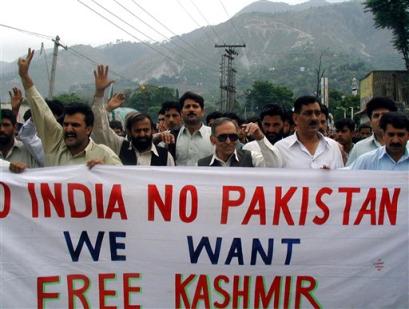
With 62 civilian deaths in the ongoing rioting in the capital city Srinagar and two districts, over the past couple months Kashmir has witnessed a fresh uprising against the symbols of the state. Kashmiris are using every avenue they have—from stones to the Internet—to demand azaadi, or freedom. The mostly spontaneous upheaval involves young men, women and even children. Kashmiris want freedom from corruption, bad governance and the overbearing presence of soldiers.

For decades Pakistan has been trying to wrest Kashmir away from India by sponsoring insurgency. But today, thanks to the ineffective administration in Srinagar, Pakistan doesn’t have to try very hard. After the security forces managed to restore law and order three years ago, India failed to take the political initiative, and frittered away its gains. The result is widespread disillusionment. At a ceremony commemorating India’s Independence Day this month, a local policeman threw a shoe at Omar Abdullah, chief minister of Jammu and Kashmir, whose grandfather Sheikh Abdullah ratified the state’s accession to India.

Up until 2008, the state had a lot going for it: several round-table meetings for self rule and confidence-building measures, periodic release of economic packages, annual visits by Prime Minister Manmohan Singh, conferences connecting the people and quiet dialogue with moderate and hardline separatist leaders. The ceasefire on the Line of Control was holding, and a four-point formula for resolving the Kashmir dispute hammered out with Pakistan through back channels seemed as good as done.

Indian security personnel beat detained Kashmiri Muslim protesters in Srinagar, India.
Mysteriously, the peace process then ground to a halt. The India-Pakistan dialogue began unraveling soon after Gen. Pervez Musharraf left the scene. The new Pakistani Army Chief, Gen. Ashfaq Kayani, a Fort Leavenworth graduate and favorite of the U.S. establishment, reversed the process of reconciliation. The ceasefire has become shaky, and the Pakistani government’s rhetoric on Kashmir has returned to the rights of the people to self determination and “diplomatic and moral support to Kashmir in their legitimate struggle no matter how brutally Indian forces try to suppress it.”

The reason Gen. Kayani feels emboldened to take a harder line is easy to discern. Tensions deepened after the U.S. elevated Pakistan from “major non-NATO ally” to the linchpin of its Afghan exit strategy, and excluded India from a political solution in Afghanistan. Despite the denials of U.S. Af-Pak point man Richard Holbrooke, the Afghanistan-Pakistan free trade agreement has only underscored India’s irrelevance to Kabul.

Civilian strife in the Kashmir Valley will only strengthen Pakistan’s case that resumption of a dialogue on Kashmir alone will enable a more focused fight against the Taliban on the Western frontier. This is not entirely true, as the Pakistan Army has already redeployed to the west 52% of its offensive and 45% of its defensive forces previously devoted to facing down India.

The priority for Delhi is to stop the stone-throwing in Kashmir. Every death—one recent fatality was a child of eight years old—is fresh cause for protests. On an hour’s notice, 10,000 people will come out on the streets to join the funeral procession of someone they don’t know. Further, Kashmir’s moderate Islam is being radicalized by the hardline Jamaat-e-Islami, which has made even separatist leaders irrelevant. No one is willing to talk unconditionally anymore.

Delhi will have to start from scratch in rolling back alienation by reaching out to youth. Yet Rahul Gandhi, India’s prime-minister-in-waiting and supposedly its youth leader, has not reached out to his favorite constituency in Kashmir. Neither has Congress President Sonia Gandhi or Prime Minister Manmohan Singh visited Srinagar since the troubles began in June. Until a few months back, Kashmir was the most violence-free state in India, as security forces had significantly marginalized insurgent and terrorist groups over the last three years.

Islamabad is not about to take over Kashmir—according to a survey by London-based think tank Chatham House last month, just 2% of the population favors joining Pakistan. But as the cry for azaadi grows louder, no one has a clue when this uprising is going to stop. Even as the faithful observe Ramadan, Delhi needs to do something before U.S. President Barack Obama’s scheduled visit in November.

Pakistan Fight Stalls for U.S.

By Julian Barnes for The Wall Street Journal

The U.S. military has stopped lobbying Pakistan to help root out one of the biggest militant threats to coalition forces in Afghanistan, U.S. officials say, acknowledging that the failure to win better help from Islamabad threatens to damage a linchpin of their Afghan strategy.

Until recently, the U.S. had been pressing Islamabad to launch major operations against the Haqqani network, a militant group connected to al Qaeda that controls a key border region where U.S. defense and intelligence officials believe Osama bin Laden has hidden.

The group has been implicated in the Dec. 30 bombing of a CIA base in Khost, a January assault on Afghan government ministries and a luxury hotel in Kabul, and in the killing of five United Nations staffers in last year’s raid on a U.N. guesthouse.

But military officials have decided that pressing Pakistan for help against the group—as much as it is needed—is counterproductive.

U.S. officials believe elements of Pakistan’s intelligence agency, Inter-Services Intelligence, are continuing to protect the Haqqani network to help it retain influence in Afghanistan once the U.S. military eventually leaves the country. U.S. officials say the support includes housing, intelligence and even strategic planning,

During a trip to Pakistan last month, Adm. Michael Mullen, chairman of the Joint Chiefs of Staff, chose not to raise the issue of an offensive against the Haqqani network—a departure from the message U.S. defense officials delivered earlier this year.

The U.S. also had intensified the pressure for Pakistani operations in North Waziristan in May after the attempted bombing of New York’s Times Square was linked to militants in Pakistan.

Pakistan officials reject the U.S. conclusions about their efforts. They say they are taking significant action against militants in North Waziristan. They say their intelligence service has severed all ties with the Haqqani network. Islamabad points to a series of surgical strikes the Pakistani military has executed in North Waziristan, and say they have ratcheted up those efforts in recent months in a precursor toward more aggressive moves.

Pakistan’s operations complement a Central Intelligence Agency drone campaign targeting militants in North Waziristan, a Pakistani official said.

Defense Secretary Robert Gates praised the Pakistani effort to rout al Qaeda and other militants from Swat and South Waziristan. “Are they doing a lot to help us? The answer is yes,” Mr. Gates said Thursday.

U.S. officials acknowledged the recent Pakistani operations, but discounted their value against the Haqqani network.

A U.S. defense official said that most of the raids have been against the Pakistani Taliban, a militant group that poses no direct threat to U.S. forces in Afghanistan, but opposes the Pakistani government.

Pakistan has failed to act on detailed intelligence about the Haqqanis provided in recent months, said a senior military official. “Our forces have put a significant dent in the Haqqani network,” said the official. “It would be good if the [Pakistanis] would do the same on their side.”

U.S. officials say they have concluded that making more demands, public or private, on Islamabad to start a military offensive against the Haqqani network will only strain U.S.-Pakistani relations.

The Haqqani network has decades-long ties with al Qaeda leaders that date back to their days of fighting the Soviets in Afghanistan prior to al Qaeda’s formation.

The network now is believed to provide al Qaeda with protection, shelter and support in North Waziristan. The group’s historic base is in Afghanistan’s Khost province and it remains the most potent insurgent force in the eastern part of the country and is closely aligned with the Taliban.

The number of al Qaeda fighters in Afghanistan is thought to be very small, under 100; Haqqani network fighters number in the thousands.

The U.S. shift partly is in recognition that the Pakistanis simply may not have the military capacity to expand operations enough to secure the North Waziristan area, one U.S. official acknowledged.

Pakistani efforts in North Waziristan so far are too small to have a significant impact, said Bruce Riedel, a former CIA analyst who headed the Obama administration’s first review of U.S. policy toward Afghan and Pakistan.

“It is mostly show to keep the Americans happy,” he said.

In the wake of Pakistan’s recent flooding, U.S. officials also are concerned the Pakistanis may ratchet back counterterrorism operations as they redeploy troops to help respond to a burgeoning humanitarian crisis.

U.S. defense officials now argue the only way to convince Pakistan to take action in North Waziristan is to weaken the Haqqani network so much that Pakistan sees little value in maintaining an alliance with the group—though they acknowledge that will be harder without Pakistani help.

The U.S. military has stepped up its own operations against the Haqqani network since April, and most significantly in the last two weeks, according to military officials. Strikes have significantly reduced the Haqqani network’s ability to mount attacks in Kabul and outside their traditional tribal areas of eastern Afghanistan, said senior U.S. military officials.

In eastern Afghanistan, a task force of elite troops assigned to target the Haqqani network conducted 19 operations in April, 11 in May, 20 in June and 23 in July. The high pace continued in the first week of August with seven operations.

The Haqqanis threatened to disrupt an international conference in Kabul last month, but were not able to make good on the threat.

U.N. Appeals for Pakistan Aid as Rains Threaten More Flooding

By Saeed Shah for The McClatchy Newspapers

The United Nations appealed Wednesday for $459 million in emergency aid for Pakistan as fresh monsoon rains raised fears that new flooding could drive more people from their homes, deepening the humanitarian catastrophe.

Storms lashed the mountainous northwest, close to the border with Afghanistan, and the northeastern Gilgit region, swelling rivers that empty into the central Indus River before it reaches the city of Sukkur in southern Sindh province, which already is full of people displaced from surrounding areas.

More flooding would prevent vital repairs to Indus River embankments and dikes that protect farmland, allowing water to spread even further when the fresh flows reach Sukkur sometime next week, officials warned.

“Once this peak passes, another flood is being formed in the mountains and then a third,” Sindh’s irrigation minister, Saifullah Dharejo, said in an interview. “If we cannot plug the breaches (in the embankments), the water will keep expanding out.”

“This is a grave situation,” he said.

Sindh is now the focus of the worst floods in Pakistan’s history. They reached the province after washing down the Indus River Valley, powered by unusually fierce monsoon rains that began in northern areas of the country some three weeks ago.

The deluge has left a trail of devastation, destroying roads, bridges and other infrastructure and overwhelming the government’s ability to cope. It’s affected some 14 million people, of whom an estimated 1,600 have been killed and about 2 million left homeless.

The overwhelmingly Muslim country of 170 million, a key U.S. ally in the fight against terrorism, already had been struggling to cope with an economic crisis and Islamic militants allied with al-Qaida when the disaster hit.

The United Nations appealed Wednesday for emergency aid, warning that even those who had been saved from drowning were threatened with sickness and hunger.

“If we don’t act fast enough, many more people could die,” John Holmes, the U.N. humanitarian aid chief, said in New York. He called the disaster “one of the most challenging that any country has faced in recent years.”

In Sukkur, the head of Sindh’s provincial government, Qaim Ali Shah, dismissed the amount of international aid pledged so far as “peanuts.”

The U.S. will be beefing up its assistance to the relief effort with 19 helicopters from the U.S.S. Peleliu, an amphibious assault vessel that is deploying off the Pakistani port city of Karachi, Secretary of Defense Robert Gates announced Wednesday in Tampa, Fla. The helicopters will be used to distribute food aid and ferry displaced people.

The ship’s aircraft will replace six U.S. military helicopters that were diverted from missions in Afghanistan.

At the Sukkur Barrage, 1.13 million cubic feet of water per second was rushing through the 66 gates of the mile-wide flood-control barrier, which the former British colonial government built on the Indus River in 1932.

Experts think that the flooding at Sukkur probably will ebb Thursday, but with more rain falling in the north, the water will remain high and the next onslaught of flooding could push it even higher, they said.

“Rainfall (in the north) takes about a week to reach Sukkur,” said Muzammil Qureshi, a retired engineer formerly in charge of irrigation for Sindh. “All five rivers converge before Sukkur.”

The onslaught has burst dike banks, drowning hundreds of thousands of acres of farmland in Sindh alone.

Only from the air do the scale of the disaster and the remoteness of the affected villages become apparent.

A McClatchy Newspapers reporter toured the region around Sukkur on a Pakistani army helicopter and saw mile after mile of water, swamp-like in some places, like the open sea in others. Thatched roofs and the tops of trees rose above the water. The outlines of abandoned villages were just visible beneath the surface.

The helicopter pilots had been diverted from battling Taliban militants in the Waziristan region bordering Afghanistan. Around 60,000 Pakistani troops are participating in rescue efforts, raising concerns about the country’s anti-terrorism campaign.

When the helicopter swooped low, it became apparent that there were people struggling to survive in the watery landscape, marooned in dozens of villages on slightly raised ground. Women, men and children could be seen in waist-high water, their buffaloes wallowing in groups.

Hundreds of people had taken refuge on raised embankments, built to hold irrigation channels or dirt roads, but they were stranded without food or shelter from the ferocious sun. Goats, donkeys and trunks of possessions kept them company.

While the military continues to rescue people, many others are refusing to leave their villages, hoping for the water to recede. However, the fresh onslaught that’s on its way from the north could make survival all but impossible.

Slain American Volunteers Were Devoted to Service

By Laura King and Ashley Powers for The Los Angeles Times

They were a disparate group of American altruists who had long cared for the poor and ailing, thrown together on a mission to provide medical help in the most daunting and needy of places.

Last week, the six Americans were among 10 volunteers shot to death in a remote swath of Afghanistan while returning from an aid mission, a tragic end to their years of risk-laden service in the war-ravaged and impoverished nation.

Tom Little, for one, remained in Afghanistan through its brutal civil war in the 1990s, talking his way through checkpoints manned by various ethnic militias, and saving the lives of co-workers who might otherwise have been dragged from the car and killed.

Colorado dentist Thomas Grams often traveled with a bodyguard and told friends how he’d persuaded a tribal leader to bring his mother in for a dental exam by agreeing that she’d peel back as little of her burka as possible.

“He was just there out of kindness,” Katy Shaw, a friend of Grams, said Sunday, her voice catching. “I can’t get my arms around why someone would do that to a group of people trying to be helpful.”

The Taliban has claimed responsibility for the ambush in a rugged, isolated valley, which also killed two Afghan men, a German woman and a British woman working with the International Assistance Mission. The Taliban accused the Christian group’s volunteers of proselytizing and spying for Western military forces, which the charity vehemently denied.

The charity team, which had been providing eye care and other health services to villagers, had hiked over a steep mountain pass into neighboring Nuristan province, where insurgents had been battling Afghan and Western forces. Police theorized that the assailants might have followed them back from there.

Two other Afghan members of the group escaped the massacre: an interpreter who had left before the ambush and a driver who told police he recited verses from the Koran as he pleaded for his life. Afghan authorities are still questioning the driver about his account of the incident, and police said it would take two days for investigators to reach the scene of the killings.

The Western military condemned the attack as part of a pattern of insurgent behavior that exacerbated the suffering of Afghan civilians.

“This is something the Afghan population has to face,” said Brig. Gen. Josef Blotz, a spokesman for NATO’s International Security Assistance Force. “Because of these brutal, indiscriminate and absolutely deranged tactics and activities of the Taliban, international aid workers and nongovernmental organizations can’t do their job, which is so necessary for this country.”

The bodies of the slain American volunteers were flown by helicopter to the Afghan capital on Sunday from Badakhshan province, in Afghanistan’s northeast, the U.S. Embassy said. FBI agents in Kabul helped identify the victims and aid groups released most of their names. One American had not yet been publicly identified.

“We are heartbroken by the loss of these heroic, generous people,” U.S. Secretary of State Hillary Rodham Clinton said in Washington.

Even before deplaning in Afghanistan, the team’s members had devoted themselves to helping the world’s most destitute. Grams, 51, was a prime example.

In 2001, he became the first dentist to join a volunteer group in Denver that whisks teams of dentists around the world. At weeklong clinics, they provided children free cleanings, fillings, extractions and tooth-brushing lessons — always without toothpaste, in case the villagers ran out.

Tall, blondish “Doctor Tom,” who usually manned the first of six chairs, stuck out among his thousands of Indian and Nepalese patients. But he’d put them at ease by pulling down his mask and sharing a toothy grin.

“In America, the view is that the dentist gives you pain,” said Laurie Mathews, Global Dental Relief’s director. “In these countries, he only relieves pain.”

Grams so enjoyed aid work that, a few years back, he gave up his dental practice. He’d also started traveling to Afghanistan periodically with other charity groups. It was no surprise to Mathews that Grams ended up in one of the country’s far-flung corners: Once, to treat patients on Mt. Everest, they’d hauled dental equipment to a Buddhist monastery on rented yaks.

“His life mattered,” Mathews said. “He is defined by more than how it ended.”

Another victim, Cheryl Beckett, 32, was a former senior class president in Ohio with a sharp sense of humor and a strong Christian faith, said her grandmother Jean Fink. Both characteristics helped the aid worker power through the last six years, with Beckett educating Afghan villagers in nutritional gardening and mother-child health, and herself in the local languages.

She had this love for the people and she immersed herself in their culture,” Fink said. “Cheryl was as beautiful inside as she was outside.”

Since 2008, Glen Lapp, a former nurse and real estate agent from Pennsylvania, had helped manage a program that delivered eye care to Afghanistan’s remote areas. In a report for the Christian aid group Mennonite Central Committee, he’d written that workers must continue “treating people with respect and with love and trying to be a little bit of Christ in this part of the world.”

“He just had a real sense of peace … toward the Afghan people,” said John Williamson, a fellow relief worker who talked to Lapp last month. Lapp, 40, told Williamson that he believed the country’s security situation was improving, and that he had high hopes for peace.

The British victim, Karen Woo, had given up a private medical practice in London to work in Afghanistan on mother-child health.

The deaths rattled the tightknit world of Afghanistan aid groups, which had already been struggling to weigh a deteriorating security situation against enormous humanitarian needs.

“People would walk long distances, sometimes carrying the old and sick on their backs, to see the doctors, getting glasses, treatment and minor surgery,” Kate Clark of the Afghanistan Analysts Network wrote in a eulogy for the victims. “And many considered blind, literally getting their sight back.”

Two of the victims — Little, a 61-year-old optometrist, and his longtime associate Dan Terry, 64 — were both fathers of three, and both had worked in Afghanistan for decades and were fluent in Dari. The men told friends that, over time, they’d made peace with the battle-scarred country’s inherent dangers.

In the dingy halls of the Kabul eye hospital where the bespectacled Little spent much of his working life, the sorrow was palpable. Co-workers and patients paid emotional tribute to a man they described as kind, caring and determined to aid Afghans whose eye ailments might otherwise have condemned them to a lifetime of misery and poverty.

“God only knows why anyone would hurt them,” said a woman named Bibi Sheerrin, who was recovering from cataract surgery. “They were trying to help us.”

Pakistanis’ Anger Grows as Flood Damage Mounts

By Adam B Ellick for The New York Times

The damage from Pakistan’s worst floods in generations mounted on Monday as rescue operations continued and public fury rose in the country’s most volatile province.

The official death toll remains under 800, but on Monday the minister of information in Khyber-Pakhtunkhwa Province, formerly the North-West Frontier Province, estimated the true number to be 1,500. Another provincial official said 1.4 million people had lost their homes. As much as 70 percent of the region’s livestock is gone.

The number of people affected by the floods is 2.5 million, the International Federation of Red Cross and Red Crescent Societies said.

“The next week is critical. With further heavy rains there is a real danger that the flooding will spread further south into Sindh Province,” Ateeb Siddiqui, director of operations with the Pakistan Red Crescent Society, said in a statement.

The displaced are clustered in hundreds of schools, largely fending for themselves for food and drinking water. Pakistani television channels showed survivors voicing venomous anger toward a government that has provided little immediate aid.

Meanwhile, President Asif Ali Zardari landed in France for talks with the French government.

“People think that the government is not providing anything to them,” said Adnan Khan, an official at the government’s disaster-relief management office. “But the scale is so high and huge that we cannot cater to all of the people.”

The growing frustration with the government adds to its troubles in dealing with the province, which abuts Afghanistan in Pakistan’s north and is a pivotal battleground against the Islamic militants operating in both countries.

For the past year, the government and the military have been engaged in a campaign to restore public services, trying to rebuild trust after more than two million people were displaced last year when government forces launched a major offensive against militants. But the reconstruction efforts have been painfully slow, and the public mood has shifted from frustrated to furious.

Analysts said the government’s flood relief effort would not only serve as another test of public trust, but would also most likely be exploited as a wedge by foreign governments and militant organizations.

Last summer, hard-line Islamist charities ended up providing significant aid to the displaced, while Pakistani authorities were unable to deliver enough help but refused to allow American agencies to deliver more. The authorities did not want to be associated with the United States, widely blamed here for many of the country’s ills.

That has not changed. For the moment, the United States, which has pledged $10 million in aid for flood victims and has donated thousands of meals, is handing over the supplies for Pakistan to deliver. The United States is also sending 2 water filtration systems, 7 helicopters and 12 prefabricated bridges.

One of the priorities is rebuilding a crucial bridge in Dir district, which remains largely cut off and where thousands are feared trapped or dead. And in Upper Swat, mules were being used to shuttle food rations across high waters to the hungry, an official said.

What Can Happen in a War

By Andrea Woo for The Vancouver Sun

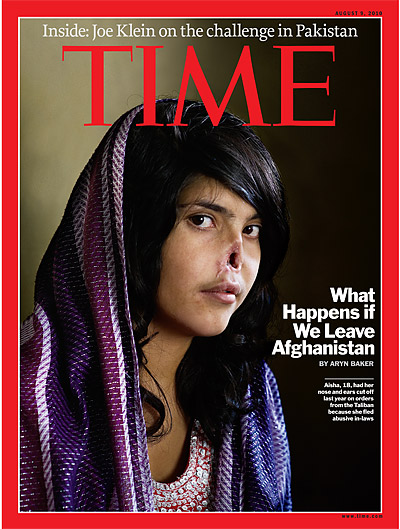
She looks back from the cover with an inscrutable gaze, her dark eyes intensified by the black hair that spirals out in thick curls from under her patterned purple head scarf. Her top is red and sequined; her mouth expressionless and slightly agape.

Where 18-year-old Aisha’s nose should be, however, is a hole: After attempting to flee abusive family members in Afghanistan, a Taliban commander sentenced Aisha to have her nose and ears cut off.

The powerful portrait is the front cover of the Aug. 9 Time magazine, accompanied by a story titled, “What Happens if We Leave Afghanistan.” In it, author Aryn Baker argues that the withdrawal of the U.S. military and its allies could result in a revival of the Taliban at a devastating cost to the nation’s women.

Christopher Schneider, an assistant professor of sociology at the University of B.C. whose research includes media studies, said the image is an obvious — and effective — attempt to garner attention.

“Things like sex and violence, our culture is so saturated with these kinds of images and symbols that people have become somewhat accustomed to them,” Schneider said.

“Something like this would probably tend to capture people’s perspectives or views in a way that, say, scantily clad woman on the cover of Time magazine might.” Photographer Jodi Bieber said in a video posted on the magazine’s website that Aisha’s beauty struck her.

“I said to her, ‘You know, you are really such a beautiful woman, and I could never understand or know how you’re feeling by having your nose and ears cut off,'” Bieber said.

“‘But what I can do is show you as beautiful in this photograph.’ I could have made a photograph with her looking or being portrayed more as the victim, and I thought, ‘No. This woman is beautiful.'”

In an accompanying editorial, managing editor Richard Stengel defended the image selection, saying he thought “long and hard” about whether to use it for the cover. “Bad things do happen to people, and it is part of our job to confront and explain them,” he wrote.

“In the end, I felt that the image is a window into the reality of what is happening — and what can happen — in a war that affects and involves all of us. I would rather confront readers with the Taliban’s treatment of women than ignore it. I would rather people know that reality as they make up their minds about what the U.S. and its allies should do in Afghanistan.”

Donald Gutstein, an adjunct professor at Simon Fraser University’s school of communications, whose research includes media analysis, said the image is unquestionably powerful, but its message misleading.

“It says that if Canada and the U.S. leave Afghanistan, this [mutilation] will be happening all over the place,” Gutstein said. “However, it happened while the U.S. and Canada were there, so what does that really tell us?”

Aisha is now in a secret women’s shelter in Kabul and is protected by armed guards, Stengel noted in his editorial. She will soon head to the U.S. for reconstructive surgery sponsored by the Grossman Burn Foundation.