We left behind everything when we came to this side, but not for such living conditions. Some of our family that stayed behind in India now mock us about our migration,” says Haji Shahzad.
Shahzad, in his early 70s, is a resident of Bhanoo Chak, a village located on the Indo-Pak border.
“The border force here has made our lives miserable. We live not under the threat of India but this force. Day and night, we have to live by their rules,” Shahzad says.
Bhanoo Chak, a village occupied by Sikhs who fled at the time of partition, is an hour’s drive from central Lahore and is closest in distance to the border.
“We just want peace so that there is relaxation on the border and we can have normal lives again,” adds Shahzad.
Mostly farmers, these men are not allowed to roam around freely after 6pm and need to acquire no-objection certificates before constructing anything on their property.
Many of these villagers have families that were divided in the partition in 1947 and wish to go meet them.
“We have family in Rajasthan. They want to come visit us and we want to go and visit them too. But we have to go through bureaucratic hurdles that we have stopped making the effort,” says Shahzad.
Pakistan Rangers Colonel Osman Siddiqui, who is in charge of the Wagah Border area, says that without checks and balances, he cannot trust anyone in the area. “The border is a sensitive spot, and to stop smuggling and unwanted people from crossing over, we have devised a system where we allow men to roam in these areas only between 6am and 6pm,” he says.
When asked if he will ease the policy in case the Pakistan-India dialogue is successful, he replied that national policy and local policy are different subjects. “When a change happens in the national policy, we can see. But for now, the policy will stay the same since the force needs to be vigilant,” he said.
Many villagers believe that if Pakistani and Indian leaders sincerely wanted peace, an accord could be reached today. They also do not fear another war with India.
“In 1965, Indian forces destroyed our homes. There were planes overhead and even the Pakistan Army had little idea what was going on,” says Mohammad Tayyab, who was barely seven years old at the time. “But today, we cannot expect the same as we are now a nuclear state.”
Still, the villagers are always on their toes. “Every time Pakistan Army increases its presence on the border area, I fear I may have to leave home again,” says Tayyab, who moved his family out of the village during a standoff in 2002.
For some, however, peace is just a far-fetched but beautiful dream. “Peace is not possible, even though it will be good for both our countries. We will [finally] be living with no fear,” says Azeem impatiently, during a short break from a cricket match.
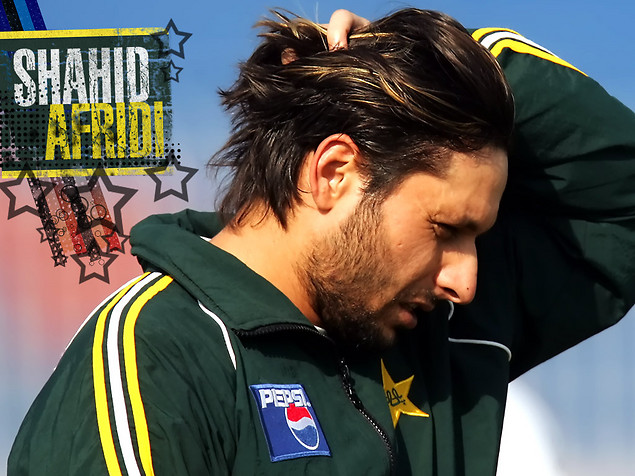
Former captain Shahid Afridi appealed to President Asif Ali Zardari for help on Wednesday after his central contract was suspended when he announced his retirement from international cricket. “I have appealed to the president to intervene urgently, also deal with other issues and save the game from getting into more crises,” Afridi told AFP by telephone from Southampton.
Afridi confirmed that the England and Wales Cricket Board stopped him from playing after the PCB revoked its permission.
“The captaincy was not an issue as I have already played under senior players, but it was a matter of self respect and honour which was hurt,” said Afridi who refused to speak about the PCB sanctions.
The opposition Pakistan Muslim League-N party has already submitted an adjournment motion in the national assembly against Afridi’s punishment.
Former Pakistan captain Imran Khan, who now heads his own opposition party, said the PCB was not run professionally.
“The board is not run like an institution,” Khan told a television channel. “Afridi feels injustice is done so he has taken a decision and you don’t change four-five captains in a year.”
“Just recently everyone was praising Afridi after he led Pakistan to the semi-final of the World Cup and then suddenly this happened,” said Khan. “The board is also run on ad-hoc basis like the country,” he added.
The Muttahida Qaumi Movement (MQM), which belongs to the coalition government headed by Zardari’s Pakistan People’s Party, also objected to the sanctions on Afridi. “President Zardari should take notice of the biased attitude of the board,” said MQM leader Farooq Sattar. “You don’t treat national heroes like this.”
Sports Minister Shaukatullah Khan lashed out at PCB chairman Ijaz Butt over the “injustice” and said he would discuss the matter with Prime Minister Yousuf Raza Gilani.
Abdul Ghaffar Qureshi, who heads the sports committee in the upper house of parliament, demanded Butt’s sacking.
“A change in the PCB is imperative,” said Qureshi. “Butt has not allowed any captain to settle so it will be better to sack him.”
The 31-year-old all-rounder, dumped as one-day captain following a row with coach Waqar Younis last month, quit international cricket in protest at his treatment by the Pakistan Cricket Board (PCB).
In response, the PCB suspended his central contract and revoked all his no-objection certificates, meaning he will not be officially permitted to play overseas.
The move will stop him from playing for Hampshire in England’s Twenty20 league and in next month’s Sri Lankan Premier League.
Afridi said that he came to know about his removal from the team’s captaincy through media and the board did not bother to inform him about that decision.
It has been over three months since the Arab Spring arrived on Libyan shores. The Libyan Civil War started there in February of 2011 after Ben Ali of Tunisia and Hosni Mubarak of Egypt begrudgingly relinquished power in the neighboring North African nations. At first it had appeared that Mubarak would resort to thuggery and despotic abuse of his powers. But due to the brave people in Tharir Square in Cairo, he eventually was forced out by the Egyptian army and under American pressure once the Obama administration calibrated their stance to not support a long time ally in Mubarak and instead follow the popular opinion of the people of Egypt against his autocratic rule.
Unfortunately for the people of Libya, Muammar Gaddafi is not ready to step down from over 40 years at the helm of Libyan society. His army brutally quashed a rebellion against his rule and when it appeared that many thousands more would be killed by his troops, the US and NATO forces intervened and bombed Libyan government forces. The standoff between the Libya forces of Gaddafi and the US and NATO bombings have left Libyans in the middle as their nation continues to suffer several months into the fighting.
A brutal dictator like that who cares more about holding onto power than the fate of his nation does not deserve any honors. Instead he deserves to be tried for murdering many innocent people and if found guilty he should be hanged.
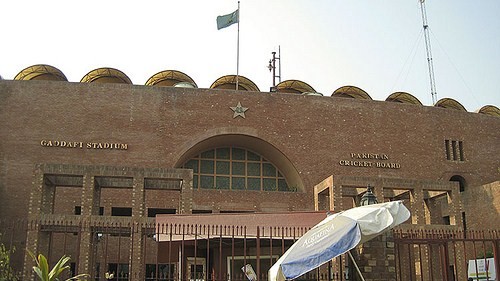
Therefore it is a shame that in Pakistan, one of the country’s most important stadium continues to bare the name of the Butcher of Tripoli. Yes, Gaddafi stadium in Lahore, a venue for many Pakistan Cricket Board sanctioned domestic and international cricket matches, is named after the Libyan dictator.
The stadium was built in 1959 and was originally named Lahore Stadium. However it was renamed in 1974 to Gaddafi stadium in honor of the Libyan ruler who had given a speech in favor of Pakistan’s right to pursue nuclear weapons at a meeting of the Organization of Islamic States Conference (OIC). The stadium also houses the headquarters of the Pakistan Cricket Board (PCB).
But now, as Qaddafi continues to kill his own people in the most brutal of ways, it is time that Pakistan’s Cricket Board changes the name of the country’s premier stadium back to Lahore stadium since honoring this man responsible for indiscriminately killing his fellow citizens unnecessarily further looks negatively upon Pakistan.
A country that already has a grave public relations image problem can surely give itself a break by doing something as simple as changing the name of this stadium. Afterall, what does it say of Pakistan if it continues to honor a man like Gaddafi? Do Pakistanis not care that this man is responsible for killing thousands of his own people?
It is time to put pressure on the Pakistan Cricket Board and on the government to immediately change the name of the stadium. I know that Pakistan has many other problems inside this fractured and unstable nation to think that changing the name of Gaddafi stadium can fix all that ails the country. Nay, it is merely a drop in the bucket. There are countless other problems facing the country that are too many and too complex to list here. But one easy fix the country can do to help improve its image is to change the name of this stadium.
There is absolutely no reason that the stadium should be associated with a lunatic such as Qaddafi. The name should never have been changed to begin with no matter what support he gave to Pakistan’s nuclear aspirations. He has never been a good or stable leader. In fact, the man is thought to have been directly responsible for numerous acts of terrorism in the 1970’s and ’80’s including the Pan Am Lockerbie bombing. And this was BEFORE he started killing his own people in order to quash a rebellion against his rule!
In light of the many recent embarrassments for the nation such as Osama Bin Laden’s hiding in their country, the continued imprisonment of Asia Bibi, the killings of Salmaan Taseer and Shahbaz Bhatti, Pakistanis must decide whether or not they want to join the community of nations or become a pariah state much like North Korea, Libya and Iran. Changing the name of the stadium is a small step, but it is indeed a step in the right direction.
–Manzer Munir, a proud Pakistani American and peace activist, is the founder of Pakistanis for Peace and blogs at http://www.PakistanisforPeace.com as well at other websites as a freelance journalist and writer.
It is 3pm in a small British bar in the tourist state of Goa about 550km south of Bombay – where the country’s cricketers are harrying Sri Lanka’s batsmen in the early overs of the World Cup final.
It is 28 years since India last won this most cherished of titles in a nation so crazy about the game. There are fewer than nine hours to go until it does so again. But we don’t know that yet.
Mohinder Amarnath, the man of the match in the 1983 World Cup, is certain, however, that the moment has arrived to repeat his team’s success. Every Indian can realise their dreams through the 11 men on the field today, he says.
He need not have worried. Corrin, the eponymous owner of the Goan bar, is reaching for a brush, and dipping it into the pot of orange acrylic paint on the table in front of her. She holds the arm of the little Indian girl in front of her, draws the first rectangle of the national flag, hands the brush to Sonny, the barman, and watches him draw the white and green stripes. The girl, the daughter of the beautician who runs the shop upstairs, beams, delighted, and skips away to show off her affirmation of support for the home team.
In the street outside, a truck thunders by, horn blaring, Indian flags fluttering in from the cab. The picture is repeated across the country; millions are glued to their televisions or radios, donning their replica shirts, daubing themselves in the national colours. India is partying; each successful delivery from its bowlers greeted by a round of beating drums. The country that has made cricket its national game is certain that this year, finally, it will capture the ultimate prize, the World Cup.
India is certain that this is no more than it is due. It has already celebrated what many in the country regard as the real final, victory over its most reviled opponent, the notoriously unpredictable – unless you happen to be a friendly bookmaker – Pakistan team, which on Wednesday managed to throw away a magnificent bowling performance to lose ignominiously.
And India was desperate for this victory; the humiliation of the Commonwealth Games corruption scandal was still fresh; the country’s recent diplomatic successes – not least towards a permanent seat on the UN Security Council – has been overshadowed by fresh concerns about its aspiration to be regarded as a first world nation.
This is a nation demanding international approval: buoyed by the news that projections now show it will overtake China as the world’s most populous nation by 2030, there is a sense that its time has come.
As Saturday dawned, prayers were said, puja [offerings to the gods] were made, anything to give the Indian team an edge. Across the country, people painted themselves in the blue of the national team strip or in the orange, white and green of the flag, and prepared to party.
Bars and hotels hiked prices and charged admission to the more rarefied environments. In many places, TV screens were set up and even when the big screen was not an option, the nation gathered anywhere that a television was on, peering over each other’s shoulders to catch a glimpse of the match.
In Corrins’, even Sonny was applauding as Sri Lanka upped the ante in their final overs, smashing the ball hither and thither. Then a nation of – according to the new census figures – 1.2 billion fell silent as top batsman Sehwag fell to the second ball of the Indian innings.
Yet important as the game was, some felt that there was a sense of anticlimax after the Pakistan game. “The excitement among people is lacking,” Manoj Kumar, a hotel manager, told the Times of India.
Not so among the Sri Lankans, who had sidled into the final without the fireworks of the Indian progress. Captain Kumar Sangakkara pulled no punches when he explained what it meant to a country even more desperate for international approval after the end of three decades of bloody civil war: “It means everything. We have come through a very tough period. A lot of people have laid down lives for our country. In this new future, hopefully we can take home the World Cup, and that will be even more occasion for celebration.”
Gautam Gambhir, the Indian batsman who stabilised the nation’s innings after the loss of influential opener Sehwag, was no less compelling when he told a news channel that India had to win to honour the dead of the 2008 terrorist attacks in Mumbai: “For me it will be dedicated to the people who lost their lives in the 26/11 massacre.”
For India, the desire to be taken seriously by other nations in sport is perhaps more important than diplomatic point-scoring. Like its neighbour China, it has been unable to translate a mass of bodies into international sporting success. In terms of international trade, it has come on in leaps and bounds, yet still it is unable to project that power into other fields.
Such desperation for success was reflected in the way many in the country fell back on superstition in their desire to ensure success. One fan, Ritangshu Bhattacharya, from Delhi, assured journalists that he would be attempting to tip the odds in India’s favour by defying nature: “I won’t pee in the entire match… I feel whenever I go to the loo, a wicket falls or India drops a catch.”
Even his stoicism was outdone by one politician from the state of Madhya Pradesh, who stood from 10am to 10pm during the India-Pakistan match.
In Corrins’, there is no doubt about who should have won: “You have to support the team, don’t you?,” she said. “We live here, we have to support the local team, however it goes.”
It is 10.45pm, and MS Dhoni, the Indian captain, is hammering the ball to the boundary again. Six to win, two overs. There are fireworks going off everywhere, drowning out the commentary. India knows it has won. It is the Pakistan game all over again: victory from defeat, India defiant.
Six runs, and he smacks it over the boundary. The fireworks explode. In the cities, there is madness; in the villages, too, people are hugging and screaming. The firecrackers are exploding, the night a blur of colour. India wins.
India and Pakistan had a brief bout of acrimony with both complaining that a staffer each posted at their diplomatic missions in Islamabad and New Delhi respectively were detained by the host country and later let off.
While Pakistan today claimed that a driver of its mission in New Delhi was “arrested” for unspecified reasons on Wednesday, the Ministry of External Affairs took up the matter of a ‘missing’ Indian High Commission official in Islamabad. “A driver from the High Commission was arrested. (He) has been released. We have protested,” Pakistan Foreign Office spokesperson Tehmina Janjua told PTI in Islamabad, without giving details.
However, sources in New Delhi said that on Wednesday evening a Pakistani High Commission driver was seen near the Chandigarh cantonment area and when confronted, he tried to escape. “In the process, he sustained some bruises/injury on his knee and back. He was questioned and thereafter released.Before being released, a medical check-up was conducted which showed him in good health,” sources told PTI.
Just hours after the incident, an official in Indian High Commission went ‘missing’ in Islamabad, sources said, adding there was no immediate official confirmation on his whereabouts from the Pakistan side. However, the media reported detention of the Indian official, prompting Foreign Secretary Nirupama Rao to take up the matter with her Pakistani counterpart Salman Bashir. “Apart from Indian High Commission raising the issue with Pakistan Foreign Ministry in Islamabad, the Ministry of External Affairs in New Delhi took up the issue with Pakistan High Commission seeking the safety, security and well-being of the Indian official,” sources said.
The official was later handed over to the Indian High Commission in Islamabad, sources said. Though the sources did not divulge the name of the Indian official, some reports identified him as Anand Sharma, working in the consular section of the High Commission.
The incident involving the Pakistani driver occurred at a time when the Prime Ministers of India and Pakistan were in Mohali, holding “extremely positive” conversation on the sidelines of the pulsating cricket World Cup semi-final between the two countries. The incident of the Indian official was being seen as a tit-for-tat to the Chandigarh incident.
A lucky 85 from Sachin Tendulkar was followed by a disciplined bowling effort as India beat Pakistan by 29 runs in a high-stakes semifinal Wednesday to progress to the World Cup final against Sri Lanka.
Pakistan was dismissed for 231 in the last over chasing 261, sparking wild celebrations among the 28,000 people inside the Punjab Cricket Association Stadium and across the nation of more than 1 billion people.
Pakistan had done well earlier to peg India back to 260-9 after Virender Sehwag’s flying start, with left-arm pace bowler Wahab Riaz taking a career-best 5-46.
The victory continued a streak for India, which has beaten Pakistan in all five World Cup head-to-heads dating back to 1992.
The game was touted as a duel between India’s batting lineup and Pakistan’s bowling attack, but Pakistan’s shoddy fielding was eventually the difference between the two sides.
Tendulkar was let off four times, giving him the opportunity to knit together a challenging total for India and the bowlers then ensured a third World Cup final appearance for the 1983 champion.
“Going back to Mumbai, especially for this event, is a wonderful occasion,” Tendulkar said of playing a World Cup final on his home ground. “All I want to say is, we want to be calm, focus on our job and get the job done.”
India piled the pressure on a Pakistan batting lineup which failed to produce a single century in the tournament.
Pakistan’s early promise was slowed down in the middle overs as Yuvraj made early inroads and the bowlers slowly took control, marshaled well by captain Mahendra Singh Dhoni. All five Indian bowlers finished with two wickets each.
The only time Pakistan looked capable of the chase was when openers Kamran Akmal and Mohammad Hafeez were at the crease.
Kamran Akmal slashed a ball from Zaheer Khan straight to Yuvraj at point after making 19, while Hafeez went for an unnecessary scoop off Munaf Patel and was caught behind for 43.
Yuvraj then dismissed Asad Shafiq and Younis Khan and Pakistan was reduced to 106-4 by the 26th over.
Umar Akmal added some interest with a 24-ball 29 and Misbah-ul-Haq made a late charge of 56, but with the ball not coming on to the bat too well later in the day, it was always going to be difficult for them.
“I want to say sorry to my nation. We tried our level best,” Pakistan skipper Shahid Afridi said. “I want to congratulate the Indian cricket and all of the Indian nation for this great victory. We wish them well in the final.”
In the first innings, Riaz exposed India’s traditional weakness against left-arm seamers, striking at crucial junctures. He accounted for a dangerous looking Sehwag (38) and an in-form Yuvraj for a first-ball duck, as the famed Indian batting struggled against his swing.
Pakistan also made Tendulkar wait for his 100th international century despite dropping the world’s best batsman four times. Tendulkar also had an lbw decision overturned on referral and survived a close stumping appeal in what has to be one of his luckiest innings ever.
Tendulkar faced 115 balls and hit 11 fours even as Riaz pegged back the Indian middle order with the dismissals of Virat Kohli (nine) and Yuvraj off successive deliveries.
The stakes are massive, the pressure unbearable and Mohali is burning with Pak-India fever. As if the contest needed more spice, we now have the small matter of two prime ministers catching up with each other at the ground, looking to de freeze the bilateral dialogue over cricket diplomacy.
The world is seeing the power of India-Pakistan cricket. All those people in positions, who were cold and indifferent towards it, are now queueing up to use the occasion to cash in. The governments, the media and the ICC have been given enough evidence in the past also of the unfathomable strength of Indo-Pak match-up, to know that uncoupling the two can mean a turbulent world and a colorless cricket calendar. Yet, all of them allowed the most passionate cricket duel to get stuck by petty politics.
The game at Mohali can have significant repercussions for the players. A loss will be remembered like a tsunami aftermath. On the other hand, a win can, like a wedding video, linger on the minds for eternity. A performance against India is never forgotten and that’s such a strong point to motivate the players and deflect pressure. This game is all about nerves and who jangles them first. The greater the wait the higher the anxiety and it’s been a long break for both teams.
Listening to cricket pundits on channels, calling home to impress the folks that all is under control and filling the fans with high hopes must be taking a toll on the system. The players would be desperate to go out in the middle to settle the racket in the mind and settle the issue on the field.
People fear the Indian crowd and how their pressure will play up on the players. From playing in India I know that the one sided pro India crowd can in fact give you a high because you are fighting them against the odds, and draw from experience the moments when you have beaten them.
It’s such a great feeling when you box them into dead silence, stroke after stroke! I am sure most of our players have sampled that experience and will be motivated to repeat it for their fans.
Captains, at times, worry in normal situations about lack of effort and skill from the team. Afridi will not have any such issues at Mohali. The game gets raised by the players who tend to play above themselves against India. The captain has to remain cool and, in any eventuality, remain dignified. At the end of the day it’s only a game of cricket.
We may or may not win this but our team has certainly won the hearts of the people. Whether they go to Mumbai or Karachi, we need to give them a heroes welcome for they have bonded us together as one!
It’s the million dollar question that a billion people are asking: How can India beat Pakistan? Setting aside the obvious answers such as score more runs and get more wickets, there are some key areas where India can gain an advantage over its fiercest rival.
Indian and Pakistani cricket fans with a replica of the Cricket World Cup trophy. Unsettle Shahid Afridi – Pakistan’s captain has been an inspirational presence at this World Cup. He is the tournament’s leading wicket taker, with 21 scalps already to his name, comfortably ahead of the second-top bowler, India’s Zaheer Khan on 17. Afridi oozes charisma but he is prone to tantrums – it’s not uncommon seeing him shouting at teammates when things go wrong in the field, as is all too often the case with Pakistan – so India should try to frustrate him. Afridi is the nerve center of the Pakistan team, and if he is exasperated then negativity will spread to the other players.
Nullify Umar Gul – Afridi may have taken the most wickets, but Gul has been Pakistan’s most lethal pace bowler and looks on top of his game with 14 wickets (joint fifth with South Africa’s Imran Tahir in the tournament rankings). Gul has been so important to Pakistan’s campaign, particularly bearing in mind the team was stripped of two key bowling assets – Mohammad Asif and Mohammad Amir – ahead of the World Cup. The track at Mohali should favor pace bowlers over spin (will this mean we’ll see the Rawalpindi Express Shoaib Akhtar?), so the Pakistanis will be heavily reliant on another good showing from Gul, who has been effective with both the new and the old ball. If India’s excellent batsmen can nullify the ever aggressive Gul, Pakistan’s armory will be significantly weakened.
Silence Younis Khan – The big-hitting middle-order batsman has had a relatively quiet World Cup by his standards, scoring 172 runs in six innings, though that includes a 72 against a very fine Sri Lanka. He often saves his best for India so the co-hosts should be on guard if or when he comes to the crease. Out of his six career centuries, three have been made against India, including one at Mohali, the venue for Wednesday’s semifinal. India will do well to keep him contained.
Bat to Potential – India has a wonderful batting lineup but there’s a nagging feeling we haven’t seen the best of it at this World Cup. Sachin Tendulkar, Virender Sehwag and Yuvraj Singh are among the tournament’s top 10 run scorers, but India’s other batsmen haven’t consistently backed up the trio’s good work. Captain Mahendra Singh Dhoni hasn’t done much at all with the bat – his top score so far is 34 – though he has often come to the crease when his only option was to have a bit of a slog. All the batsmen in this star-studded lineup will need to play at least one great innings if India is to beat Pakistan and go on to win the World Cup final in Mumbai on April 2.
Support Zaheer Khan – India’s bowling was seen as a weakness at the start of this World Cup and it remains a concern. Zaheer Khan has been a revelation but the other pace bowlers need to give him better support. Munaf Patel was targeted by the Australians, particularly Brad Haddin, and it will be interesting to see if India’s coach Gary Kirsten selects him for the semifinal. Shanthakumaran Sreesanth and Ashish Nehra could get a call-up, but both have had their problems this tournament. Left-armer Nehra was hurt in the match against South Africa when he failed to defend 13 runs in the final over, while Sreesanth hasn’t featured since the opening match against Bangladesh when he returned disappointing figures of 0 for 53 from just five overs.
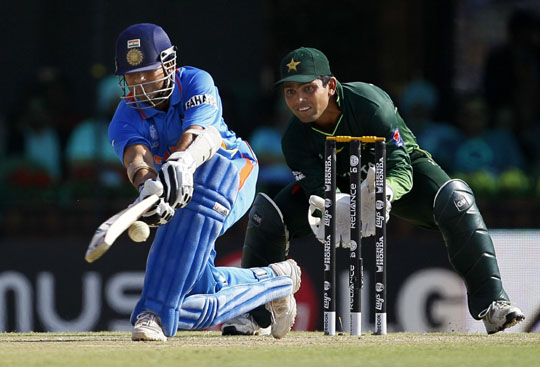
Kamran Akmal – It’s harsh to single out the Pakistani wicket-keeper, but he is prone to lapses that make him look like he has smeared his gloves in butter. Akmal put in a much improved performance in the quarterfinal against the West Indies, but India will be hoping he has another bad day at the office and gives the hosts a few reprieves.
Ignore the hype – Ok, that’s like telling a skydiver to relax and enjoy the view after his parachute has failed, but India must try to focus on the task at hand and not get carried away by the enormity of this match and the weight of expectation from a billion or so fans.
And how can Pakistan beat India?
Hide Sachin Tendulkar’s bat.
Also, Pakistan needs to silence the home crowd. The stadium in Mohali is small, with capacity for only 27,500 spectators, but they’ll be so loud it’ll seem like there are 10 times that many people. If Pakistan gets some early wickets or an early batting partnership, the home crowd will become restless and that will put India under pressure. Pakistan has the quality and talent to beat the best in the world, but it’s the kind of side that needs momentum and confidence. That will come if the team unsettles India early in the match.
Still, hiding Tendulkar’s bat wouldn’t be a bad tactic. And while they’re at it, they should probably take Sehwag’s and Yuvraj’s too.
With one stroke, India banished the ghosts of the 2003 final and the fantastic win at Motera virtually ended an era of Aussie dominance. Earlier this year, Ponting’s men lost the Ashes and now the World Cup, but like all great players, Punter left an indelible mark on the tournament with a century in what probably was his last CWC game.
While we rejoice the Indian win, let us show some grace and salute the Aussies for their achievements on the field that, sadly, has been sullied by the behaviour of some of the players. The sheer outpouring of emotions by Yuvraj and Raina after the winning boundary hit was indicative of the value the Indian team attaches to any win against the Aussies. Yes, it is always special to beat a top side even if it is on its way down.
India vs Australia: Turning point and Top performers
If anybody thought Australia are the favourites to win the Cup, then such presumption was based on the team’s track record of three consecutive triumphs, two of them under Ponting’s captaincy. As it turned out, pace, hitherto Australia’s biggest weapon, was unable to deliver and the absence of a quality spinner, much less a pair of them, eventually hurt them far more than their opponents.
On a Motera pitch that was on the slower side and assisting spin, the Aussies went at the Indians with a bevy of fast bowlers hoping to exploit the well-known weakness against the rising delivery. It was a ploy that boomeranged on the Aussies whose lone specialist spinner Krejza was just about club standard.
The fact that the three Aussie slow bowlers Krejza, Clarke and Hussey, sent down only 17 overs as against 33 by their Indian counterparts accurately reflects the difference in approach of the two teams. I feel that proved to be the decisive factor.
I am sure, Ponting would have given his arm to have a Shane Warne bowling during the Yuvraj-Raina partnership that eventually turned the game around for India or for that matter a Hayden or Gilchrist to light up their fragile batting.
India end Australia`s 12-year reign to reach semis
So, having lost to the two top sub-continental sides, Pakistan (in the league phase) and India, the Aussies return home well and truly beaten, leaving the two neighbours in a face-off at Mohali next week.
Although the Pakistanis also have beaten the Aussies, the Indian win came under far greater pressure and in a knock-out situation that offered no safety net. As such, I would rate the Motera win much higher than the one in Colombo where the Aussies fell for 176 to Pakistani spinners.
Of course, all that is history now that India and Pakistan clash at Mohali in a game that can be equated to a Brazil vs Argentina football game in terms of interest, rivalry and of course, the immense pressure on the teams to deliver.
For all that, I will still back India who I feel are better equipped than Pakistan, be it in batting or bowling with the teams being on par at fielding. The spin quotient virtually gets negated since it is a staple diet for the rival batsmen while it is not as if the two teams have a Lee or a Tait or a Johnson in their ranks to trouble anyone with searing pace. It is India’s superior batting line-up that could well tilt the scales.
Further, it will also boil down to the collective character and resilience to withstand the pressure of expectations. I have covered more than my share of Indo-Pak sporting encounters in some of the major sports to say that the levels of passion and emotions among the rival players defy words. You have to be in it to know it.
Since the rivalry between the two neighbours transcends sports and given the historical political enmity (never mind the diplomatic mumbo-jumbo to the contrary), even a sporting victory or defeat that is a mere pinhead in the big picture of life, triggers mass euphoria as if it were a Kargil.
The players themselves might not admit it in public, but the irrefutable fact is the adrenaline rush is greater and the emotions are on the boil among the contestants. It will never be ”just another game” regardless of at what stage the two teams meet and it being a World Cup semi-final, one can imagine the pressure on the players.
World Cup 2011
Under the circumstances, the saying that cricket is played more in the mind than on the field cannot be any truer in an Indo-Pak contest. We have said this before, but needs to be reiterated that ultimately, the team that blinks first will lose. The cricketing aspects such as team combination, technique, strategy and what have you, are secondary.
In effect, the stakes, like it or not, admit it or not, are much more than cricketing gains or losses. So, tighten your seatbelts and on to Mohali!
So much for close contests in the World Cup quarterfinals. In the first knock-out match Wednesday, Pakistan thrashed the West Indies by 10 wickets thanks to an inspirational bowling performance spearheaded by Mohammad Hafeez (2 for 16) and captain Shahid Afridi (4 for 30).
The West Indies batsmen were simply unable to cope with Pakistani spin, slumping to 111 all out – the team’s third-worst batting performance in World Cup history.
In one dramatic spell, the West Indies went from an already troubling 69 for 4 to an utterly disastrous 71 for 8 as Afridi & Co. showed no mercy (much like the dreaded advertisements on television after every wicket).
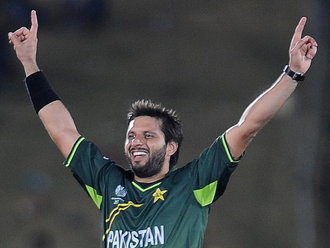
Afridi’s bowling at this tournament has been phenomenal. He is easily the top bowler with a handsome tally of 21 wickets, and his trademark celebration – arms outstretched with his two index fingers pointing to the heavens – could very well be the lasting image of the 2011 World Cup.
The West Indies team looked out of the game as soon as danger man Chris Gayle was caught by Afridi for eight. Shivnarine Chanderpaul, recalled to the team for the quarterfinal, was the only player to offer any real resistance, but he still couldn’t score fast enough and was left stranded on 44 not out at the end of the innings.
It took Pakistan just under 21 overs to reach the West Indies’ meek total, without the loss of a single wicket. Fresh from his great bowling performance, Hafeez clubbed 61 runs, while much improved wicket-keeper Kamran Akmal notched up 47. The two simply poured buckets of salt in weeping West Indian wounds.
It was humiliating for the West Indies. Not only did it mark the end of the team’s World Cup campaign, the abject performance could also have tragically hammered yet another nail into the coffin of Caribbean cricket. Despite its gloriously rich history, the sport there has been in rapid decline for more than a decade and the team’s latest efforts won’t have helped a bit.
But credit must go to Pakistan. If the team continues to play like this, Pakistan will win the World Cup. These players have to contend with so much more than other sportsmen – from the security situation back home to the involvement of former teammates in betting scandals. So while Wednesday’s match was depressing for the West Indies, for Pakistan, it was truly inspirational. And what better a day for it than March 23 – Pakistan’s Republic Day – which commemorates the signing of the Lahore Resolution back in 1940.
One more thing: If Australia loses tomorrow, we can look forward to the mother of all World Cup semifinals – India vs. Pakistan in Mohali on March 30.
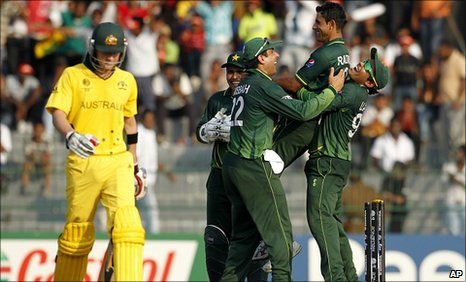
Australia’s 34-match unbeaten run in the Cricket World Cup dating back to 1999 was finally broken by Pakistan on Saturday when Ricky Ponting’s team were beaten by four wickets.
Australia, who have won the last three World Cups during the run and were unbeaten in five matches in Group A in this tournament, were skittled out for 176.
Pace bowler Brett Lee raised hopes of an Australian fightback when he got rid of opener Mohammad Hafeez in the third over but his haul of four for 28 could not prevent Pakistan from cruising to victory with 54 balls to spare.
“We certainly had a tough game today. We didn’t do ourselves any favours. I thought our batting effort was particularly ordinary,” said Ponting, who suffered his first World Cup defeat as captain.
“We stuck at it really well with the ball. I thought the guys bowled really well and gave ourselves a bit of a sniff when we got them six down but not enough runs on the board.”
Saturday’s result threw the tournament wide open as there is no undefeated team left in the competition heading into next week’s knockout stages.
Australia had already qualified for the quarter-finals but will now finish third in the group rather than top, a place now occupied by Pakistan.
“It’s a different sort of enjoyment playing against Australia. They may be World Champions but there was no pressure on us so we pulled it off today,” Umar Akmal said after finishing unbeaten on 44.
Ponting’s men struggled for momentum through out their innings after opting to bat first.
Pakistan’s pace and spin attack, backed up by sharp fielding, never allowed the Australian batting to settle down.
A 63-run second wicket stand between Brad Haddin (42) and Ponting (19), who failed once again with the bat, was the only notable partnership in the Australian innings.
Michael Clarke (34) and Steve Smith (25) were the only other batsmen to make any worthwhile contributions on a difficult surface that offered spin and some uneven bounce which the Australian batsmen failed to cope with.
Paceman Umar Gul (3-30) bowled superbly with both the new and the old ball for the 1992 champions, who were the last team to defeat Australia in a World Cup match in 1999.
Gul made the first breakthrough by bowling Shane Watson for nine and returned to clean up the tail by taking the wickets of Jason Krezja and Lee.
Saturday’s Group A match between Pakistan and Australia is a tough one to predict, as is generally the case when Pakistan plays. One team – Australia – epitomizes consistency and solidity, while the other – Pakistan – is about as well-adjusted and reliable as a moody teenager.
On its day, Pakistan is one of the best sides at this World Cup, but on other occasions the team looks disorganized and uninterested. That’s one of the reasons why Pakistan is such a fascinating team to watch – you never quite know what you’re going to get.
This unpredictability can work in its favor as opponents struggle to form and stick to a game plan. Of all the sides at the World Cup, Australia is the most capable of dealing with Pakistan’s maverick approach, but it will have to tread carefully and blow off the rust that has tinged its performances thus far.
If the likes of Shahid Afridi and Shoaib Akhtar – two players who are such fun to watch – perform well, then Pakistan is in with a chance of upsetting Australia in Colombo and ending its incredible 34-match unbeaten run in World Cup cricket.
Australia has been prowling quietly but menacingly on the verges of this tournament, snapping up victims, while other teams – particularly in Group B – struggle to gain momentum and avoid upsets. But the Australians aren’t the threat they once were, and their World Cup record looks more vulnerable than in previous tournaments when the team boasted superstars like the Waugh brothers, Shane Warne, Glenn McGrath and Adam Gilchrist.
Australia’s captain Ricky Ponting is out of sorts with the bat and angry in the field. It looked like he was ready to thump Steven Smith when his teammate bumped into him as he took a catch in Wednesday’s match against Canada.
Smith is looking increasingly at ease in the Australian squad, but he’d do well to tread a little carefully, particularly when near Ponting’s toes. The Sydney-born youngster is a player of great promise and is now a regular in the Australian team, but he is yet to really shine. He needs a big performance, otherwise he risks slipping into nearly-man territory.
Pakistan has had its ups and downs this World Cup, from the heights of beating Sri Lanka to the lows of collapsing against New Zealand and a Ross Taylor batting onslaught. Australia beat New Zealand convincingly, while the match against Sri Lanka was cut short by a huge thunderstorm, an unfortunate outcome as the game was shaping up nicely and Australia, for once, looked like it had a tough opponent to deal with.
The weather forecast for tomorrow isn’t promising, but hopefully the rain will stay away from Colombo as matches between teams like Australia and Pakistan are the big occasions that make the World Cup so special.
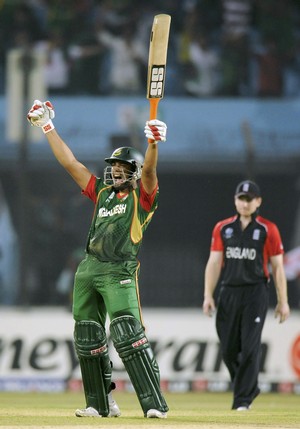
Two unheralded Bangladeshi tail-enders with ice in their veins played the innings of their lives to subject England to yet another giant-killing act on Friday.
Shafiul Islam (24) and Mahmudullah (21) defied the nerve-jangling pressure to forge an unbeaten 58-run ninth wicket stand to complete a two-wicket Group B victory that even their captain did not think they could pull off.
“I never believed they can win it for us. It’s only after hitting the winning run that I believed they have done this,” said Bangladesh skipper Shakib Al Hasan, whose house was stoned by irate fans after the team’s defeat by West Indies last week.
At 169-8, Bangladesh’s chase for a 226-run victory target on a tricky track looked so doomed that even some of their ardent followers exited the Zahur Ahmed Chowdhury Stadium shaking their heads, not realising the drama that was about to unfold.
Aided by England’s profligate bowlers who conceded 33 extras, including 23 wides, in the see-saw contest, both the tail-enders kept going before Mahmudullah drove Tim Bresnan through covers to seal the match with one over to spare and trigger wild celebrations.
Tamim Iqbal (38), Imrul Kayes (60) and Shakib (32) chipped in with useful cameos but Shafiul and Mahmudullah were the toast of the nation.
Wary of the dew factor, Shakib won a good toss and opted to field and he had reasons to feel vindicated when the English bowlers struggled to grip the wet ball in the evening.
England’s batting was also inconsistent and if it had not been for the knocks by Jonathan Trott (67) and Eoin Morgan (63), they might not have even scored 225 all out.
They looked completely shackled by the home team bowlers, managing just four boundaries in the first 20 overs.
Once again, they could not make the most of their batting powerplay either, managing just 33 runs and losing two wickets.
MISSED OPPORTUNITY
Defending a below-par total, English bowlers seemed to have turned the table on their hosts before being thwarted by Bangladesh’s spectacular rearguard resistance.
“We are very disappointed, it was a missed opportunity for us,” rued England skipper Andrew Strauss, admitting problems both in the batting and bowling departments.
Consistency has been a real problem for the team which narrowly escaped an upset against the Netherlands, tied with India, went down to Ireland before losing to Bangladesh here.
“These defeats hurt, there’s no doubt about it,” said Strauss, whose side could have sealed a place in the last eight if they had won Friday’s match.
“But you’ve got to channel that frustration and make sure you channel it the right way and come out and beat the next side you’re playing against. It’s a big game for us (against the West Indies) and we’re going to have to win it.”
England now need to win their final match against the West Indies on March 17 to be sure of a quarter-final place while Bangladesh next face Netherlands on Monday and then South Africa on March 19. Wins would take them through.
Pakistan captain Shahid Afridi on Wednesday urged his team to learn the lessons of the 110-run defeat against New Zealand.
The Black Caps rode on a brilliant unbeaten 131 by Ross Taylor to post a challenging 302-7 before Tim Southee removed the top order with a burst of three early wickets to bowl Pakistan out for 192.
“There were quite a few lessons to be learned from the defeat, especially those chances we gave to Taylor and when you give such chances to a player like him he makes you pay,” said Afridi.
Wicketkeeper Kamran Akmal let Taylor off twice in the same Shoaib Akhtar over – once when the batsman was on nought and then on eight – allowing two straightforward chances to slip past him.
Afridi said his bowlers were poor in the death overs when New Zealand plundered 139 runs off the last 10 overs.
“I think the way we started with the ball was good, but then the missed chances maybe demoralised the bowlers and they were very poor in the end,” said Afridi.
Afridi hoped his top order batsmen will show improvement in the next game, against Zimbabwe on Monday.
“Our top order did not work well although we have given them the time to settle down and this was the first time we were chasing. We need to learn how to bat while chasing,” said Afridi.
“Taylor took the game away from us although the bowlers had reverse swing. But the way he played was brilliant and he took the game away from us,” said the Pakistan captain.
Pakistan now have six points from four matches, second in Group A behind New Zealand who also have six points but a better net run-rate.
Co-hosts Sri Lanka (five points from four) and Australia (five from three) are third and fourth respectively.
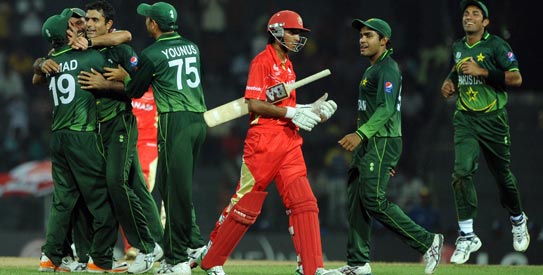
Phew! What a close shave that was for Pakistan. The batsmen were self destructing at will and had done enough to lose the game and open a fresh can of worms. An unexpected loss against the minnows and against heavy odds could have been interpreted as intentional by the rumour mongers and portrayed Pakistan in bad light.
And it wouldn’t have been difficult to convince the cricket world to believe it as true gospel, as unfortunately it has developed a jaundiced view to everything regarding Pakistan cricket.
Canada, who were not only raw with their skills but in an unfamiliar territory to create history, got tensed up and could not close out the game.
Pakistan batting was technically poor. Most of the batsmen were caught on the crease, playing across the line and falling prey to their own mistakes rather than opponents’ craft. In fact the team technicians read the pitch poorly and blindly made the decision to bat first on a moist track. Good teams are not only about bat and ball but about good support staff who can prepare a brief for the captain consisting of healthy options and intelligent analysis. Remember, big thinkers of the game and not big names make for a winning formula in the dressing room.
In seaming conditions, the openers were quickly thrown out of rhythm. Ahmed Shehzad’s brazen aggression at times borders on cockiness.
His pattern of attack on the day was ill suited for the conditions. He takes uncalculated risks and gives the impression of a spoilt millionaire at a roulette table! Nobody wants him to sacrifice his aggression but lot of people want him to curb his urge to be a kamikaze pilot on a suicide mission.
Hafeez is a utility article. Bit like a sofa cum bed he adjusts and adapts to the demands of the game. He has not yet set the world on fire in this World Cup but Pakistan must not panic and think to uncouple the two openers. In the 1992 Cup, in our losses to India, South Africa and West Indies, we made the mistake of trying three different opening combinations which unsettled the entire team.
Afridi as a leader had a mixed outing. While his sleight of hand once again amazed the batsmen, his captaincy spell was rather flat. In a low scoring game with choices curtailed, a constant dose of pressure and aggression could have earned Pakistan an early win. But Afridi, in the middle overs, unwisely chose to sit in and attacked with just four fielders in the circle.
Most captains in ODIs seem to operate with a rigid mind and a set routine to clog up runs and through it suffocate batsmen. They don’t seem to have a plan for unconventional situations that demand for out of box thinking.
Andrew Strauss, the other day against Ireland was caught out because of lack of intent to pick wickets. Afridi needs to be more innovative as a leader, bit like his batting and bowling, and open up to all kinds of plans rather than following a basic dated one. Trying to super impose a particular game plan on all situations cannot work.
Good thing about the win was how Pakistan fought tooth and nail till the end. They were feisty on the field and did not surrender to the pressure of the situation. Umar Gul looked to be at home with the new ball and Saeed Ajmal did not look rusty in his first outing.
Daryl Harper, the umpire, though was completely out of tune and had four reviews turned against him. His time is up as it’s not a one off instance of poor umpiring but a trial of shocking 18 months out in the center.
Umpires are like players and can have good and bad days on the field, but when a lean patch in the late years of a career start to stretch to longer cycles, then it is time to hang up the boots and exit gracefully.







You must be logged in to post a comment.