Archive for the ‘ Desi ’ Category

Muslim American Artists Strive to Bridge a Chasm

By Thalia Gigerenzer for The New York Times

When Wajahat Ali, a young Muslim American playwright from Fremont, needed to build an audience for his work, he produced his plays in cramped Pakistani restaurants in the East Bay and used Facebook to get the word out.

His play “The Domestic Crusaders” went on to open at the Berkeley Repertory Theater in 2005, and then moved to Off Broadway. Now, family members who were initially skeptical of Mr. Ali’s decision to pursue writing see great power in his profession.

Mr. Ali said his uncle had told him that he wished he had “made his son into a journalist,” because “after 30 years of living in this country, I turn on the TV and see myself as a terrorist.”

Mr. Ali is one of a growing number of Bay Area artists who are reimagining one of the country’s most complicated compound identities: Muslim American.

At a time when Islam has been heavily politicized, many Muslim artists say they hope the arts can expand understanding of their faith among non-Muslims as well as bridge American and Islamic traditions.

“We’re at a point where Islam is really being defined in this country, and it’s going to be through the arts,” said Javed Ali, founder of Illume, a Muslim online news, arts and culture magazine based in Newark that serves as one of the central nodes of the Bay Area Muslim American network.

Bay Area Islamic organizations, including the much-heralded Zaytuna College in Berkeley, have embraced the shift toward culture. In January, the Islamic Cultural Center of Northern California will open a new gallery in the center to showcase Muslim artists.

The cultural center, in Oakland, decided to increase its arts programs six months ago, said Ali Sheikholeslami, its executive director. The center regularly hosts an event called “Islam and Authors,” which invites authors to discuss topics related to Islam.

“We want to break through common stereotypes and present the whole spectrum of Muslim reality,” said the cultural center’s marketing and development director, Jason van Boom.

Hatem Bazian, one of the Islamic scholars behind Zaytuna College, the first Muslim liberal arts institution in this country, echoed that thought.

“In American society,” Mr. Bazian said, “artistic expression is the way we narrate our story, so Muslims are beginning to draw their own narrative.”

The Bay Area’s Muslim population, estimated to be 250,000, is one of the most diverse in the United States.

Mr. Bazian, who is also a senior lecturer at the departments of Near Eastern and ethnic studies at the University of California, Berkeley, said the wide mix of ethnicities and large number of converts in the Bay Area’s Muslim population “creates synergies” that can be seen in new art forms that break ethnic molds.

Some local artists have taken an online entrepreneurial approach to Islam. Khadija O’Connell, a Hayward resident, started her Web-based arts and craft business, Barakah Life, in 2003 as a way to bring a modern, handcrafted aesthetic to Muslim items most commonly found in gaudy, imported styles.

Ms. O’Connell relies on online tools like blogging and Facebook to promote ideas like her pop-up crescent moon cards that would look at home on the popular crafts site Etsy.

“People used to adapt neutral Christmas ornaments, like stars, and hang them up for Ramadan,” recalled Ms. O’Connell, who converted to Islam in college. “I wanted to bring new traditions to Muslims living in the West.”

For local Muslim American artists whose art has been deemed “radical” by more conservative Muslims, the road has not been an easy one.

Audience members walked out of an early November U.C. Berkeley performance of the play “Hijabi Monologues,” which features the stories of Muslim women and contains sexual references. “I’ve spent more time and energy negotiating with the community whether music is haraam [“forbidden”] than putting out content,” said Anas Canon, a convert and the founder of the record label and Muslim artist collective Remarkable Current, which includes the Bay Area MC/spoken word artist Baraka Blue. The label’s music ranges from soul to hip hop and has collaborated with artists such as Mos Def.

When Remarkable Current, which is based in both Oakland and Los Angeles, recently held a masquerade-themed book-signing with a D.J. in an Oakland home, debate erupted online ostensibly over men and women in costumes interacting together. An impassioned Facebook note condemning the event unleashed heated comments from Muslims across the Bay Area.

In the wake of controversies like the one over a proposed Muslim cultural center near ground zero in New York City, some second-generation Muslims’ art is tinged with a sense of urgency.

“Our narrative has been stolen from us,” Wajahat Ali said, referring to the common depiction of Muslims in the American news media.

The tendency of his parents’ generation to push their children to prestigious professions like medicine and business discouraged creative voices, he said.

But Bay Area Muslim artists are fast creating new narratives. Mr. Ali’s play, which depicts a modern Pakistani-American family, is featured in McSweeney’s literary magazine this month.

For many years, Mr. Ali said, he had described the local arts scene as “latent, with a heartbeat.” But now, he said, “it’s dancing.”
What Sufi Festivals Mean to the People

By Sohail Abid at http://sohailabid.com/

It is the beginning of the Hijri year. A time that matters to me for two reasons: remembering Hussain’s determination and the Sufi festivals that will be held throughout the year across Pakistan. And this year I want to do something special: to attend all the Sufi festivals and document each of them! Wish I had undertaken this project earlier in my life when the festivals were held without any fear but I wasn’t mature enough to see what they mean to the people. I, like others, considered them ‘stupid’ and ‘superstitious’ but that’s so untre. Let’s see how:

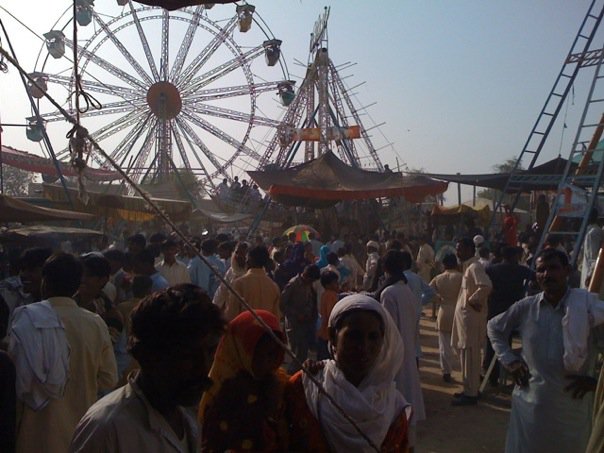
The people who actually go to the Sufi festivals don’t really call them by their urban name, Urs. They call them “mela” and it includes all kinds of activities, not just paying salam to the dead Sufi. They are *festivals* for the people, occasions to rejoice.

Last weekend, when I was on a field trip in a remote Punjabi village, a girl told me, “If you were here a couple of weeks ago, you could see our dance, Sammi; there was a wedding. We are the best in Punjab in Sammi dance! Oh, you can come to the mela next month.” Now this place, Danabad, is a small village. They remember the Sufi festival as the time they will have dance, musical concert, and what not.

On a similar visit to Chakwal, when I asked a young boy about their activities, he was so excited about this race and kabbadi they have each year. When: “during the mela”!

You see, to the people the Sufi festivals do not mean “worshipping the graves”, as some conservatives would like to put it. It is the time people await to shop, play, dance, and attend live concerts. And that’s what I would like to document because they are the events that matter to the people and keep them going. Wish me luck!

Sohail Abid is a writer, an entrepreneur, a software engineer, a cultural analyst, and a lover of all things folk. He lives in Islamabad Pakistan and manages several websites and businesses as a freelance software developer. We at Pakistanis for Peace are proud to call him a friend of the site.

Break for the Border: Indo-Pakistan Tennis Duo’s Dream for Peace

As Reported by CNN

One half Indian, the other Pakistani, they are the most talked-about partnership in tennis.

Dubbed “the Indo-Pakistan Express,” Rohan Bopanna and Aisam-Ul-Haq Qureshi hope to end their breakthrough year with a showdown at the infamous Wagah border that divides their countries.

Bopanna, an Indian Hindu, and Qureshi, a Pakistani Muslim also aged 30, reached their first major doubles final at the U.S. Open in September and climbed to eighth in the world rankings.

Yet their work off the court has attracted just as much attention as they try to soften the often-fractious relationship between their two nations since partition in 1947.

The pair have been honored with a string of awards for their humanitarian work in the past 12 months, and are determined to start picking up tournament titles in 2011.

But a showpiece clash at the notorious border crossing that hosts a nightly pageant between India and Pakistan’s border forces would be the perfect way to carry their “Stop War, Start Tennis” campaign into the new year.

“We’re thinking how to get to a wider audience and spread the message of peace through our partnership and thought,” Qureshi told CNN’s Open Court.

“How about playing a match at the Wagah border, with Rohan playing on the Pakistani side and me on the Indian side for a gesture of friendship?

“At the U.S. Open the ambassadors to the United Nations for Pakistan and India both came to watch the semifinals and finals. That was a huge deal because normally you don’t see two diplomats cheering for one cause — it was a really positive sign. I just hope in the near future we can have that match at the border, that would be great.”

The village of Wagah, near the Indian city of Amritsar and the Pakistani city of Lahore, is the only road border crossing between the two countries, and the daily ceremony — which includes a lot of strutting, stamping and saluting — regularly attracts a crowd of thousands.

A match there could be a watershed moment for a pairing that first emerged in 2003 but did not make a major impact until this season.

Their burgeoning partnership on court is allied to a deep-rooted desire to strengthen links between two countries which have a long and deep distrust of each other.

“We’re both brand ambassadors for an organization called Peace and Sport,” Bopanna said. “Right now we’re trying to see if we can help tennis in both our countries, promote it and keep the sport growing as much as we can.”

As well as receiving the Arthur Ashe Humanitarian of the Year award at the recent ATP World Tour Finals in London, they were also given the Peace and Sport Award for 2010 at a glittering ceremony in Monaco.

I’ve always told him I think he’s the most popular Indian guy in Pakistan this year!
–Aisam-Ul-Haq Qureshi on Rohan Bopanna

The citation read: “Their commitment to promoting peace between the two countries and their conviction that peace was possible was shown amply during the year.”

Joel Bouzou, president of the Peace and Sport Foundation, added of the proposed Wagah match: “The sport is ready for peace. Will the two governments rise to the occasion?”

Their partnership may have attracted plenty of headlines but for Qureshi, teaming up with his Indian counterpart made perfect sense.

“I’ve been playing with Indian players ever since I started playing tennis,” he said.

“Unfortunately there are not that many Pakistanis on the tour, and playing with an Indian was actually the most natural thing that came to me — having the same language, most of the time having the same dinner, Indian or Pakistani foods in the evening.

“The first time I ever traveled to India when I was 16, I was one of the top [Pakistani] juniors and he was one of the top juniors in India and that’s how I got to know him.

“Knowing his attacking style of play, I always knew if we played together we’d be able to make a really good impact. I think results clearly show in that way I was right, though normally he tells me that I am always wrong!”

As well as their run to the final of the U.S. Open, where they were beaten by the Bryan brothers from America, they also enjoyed success at Wimbledon which made them household names back home.

“This year we made the quarterfinal at Wimbledon and that was very, very big in Pakistan,” Qureshi said. “I’ve always told him I think he’s the most popular Indian guy in Pakistan this year!

“I can thank him enough for that because obviously without him I wouldn’t have been able to achieve all those goals, and with him being my best friend on the tour it makes it the icing on the cake. It’s been a great journey so far.”

Amir Khan Does Enough to Retain Title

By Lance Pugmire for The LA Times

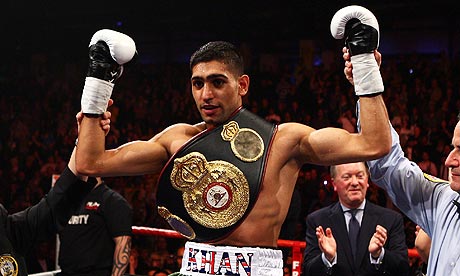
Amir Khan stood on his greatest American stage Saturday, and the fact that he remained standing is why he retained his World Boxing Assn. junior-welterweight world title against Marcos Maidana.

Withstanding a brutal 10th-round assault by the tough, hard-hitting Argentine, England’s Khan convincingly answered allegations that he has no chin and otherwise produced a sensational display of speed and flurry punching to win a unanimous decision by scores of 114-111 (judges Jerry Roth and C.J. Ross) and 113-112 (Glenn Trowbridge).

“I’m a boxer, I know I’m going to get hit.” Khan, 24, said in the Mandalay Bay ring. “He’s a strong puncher. I took everything he gave me.”

Khan (24-1) knocked down Maidana in the opening round, unleashing a quick flurry that closed with a hard left to the body that brought an obvious groan of pain from the challenger.

Maidana (29-2), who had knocked out 27 opponents, couldn’t match Khan’s punching or foot speed, but he did catch the Briton of Pakistani heritage often, like in the second round, when he erupted with uppercuts and rights.

Maidana threw 767 punches to Khan’s 603, but landed only 156 to Khan’s 273. Khan won four of the first five rounds on the judges’ scorecards.

Maidana’s response was pressure that backed up Khan in the sixth and seventh rounds, and dimmed some of the champion’s earlier shine.

The eighth and ninth rounds went Khan’s way and he appeared en route to quieting the critics who still bark about his first-round knockout loss in 2008, producing a resilient, entertaining style that the sport has needed from a young star who previously fought in Europe and first came to the U.S. earlier this year.

This was more than that polite introduction; it was an all-out brawl that produced the epic 10th round in which Maidana appeared poised for a knockout in the first minute.

Maidana staggered the champion to the point he was grasping for support from anywhere — a ring rope, referee Joe Cortez, Maidana — to stay upright.

At one point, it appeared tears were coming from Khan’s eyes as Maidana battered him without abandon. All three judges scored the round 10-8 for Maidana, astounding given that Khan was not knocked down.

The sense afterward was that Khan was more thrilled by his display of toughness than his defensive lapses.

“I’m sure everyone watching my fight knows I’ve made mistakes,” Khan said. “But I worked hard and came back stronger than ever. He’s a strong fighter and punches hard. My chin was tested and I proved today I’ve got a chin.”

Maidana couldn’t get Khan in the 11th round, either, and the champion rallied late in the 12th round with impressive combinations, walking with his arms raised into the embrace of trainer Freddie Roach at the bell.

Trained by the Best, Amir Khan puts 140-pound Title on the Line

By Bob Velin for Usa Today

The way Amir Khan sees it, he’s spent a lot of time sparring with the best pound-for-pound boxer in the world, and is trained by arguably the No. 1 trainer in the world.

So anything that Argentine power puncher Marcos Maidana throws his way Saturday night at the MGM Grand, well, Khan, who puts his 140-pound title on the line (HBO, 9:30 p.m. ET), has already seen it, or will know how to deal with it. You want speed? Few fighters are quicker than Manny Pacquiao, whom Khan sparred with in the Philippines when Pacquiao was training to fight Antonio Margarito in November. Khan says Pacquiao told him, “I’m the fastest guy he’s ever sparred with.”

How about power, Maidana’s forte? We know how Pacquiao re-arranged Margarito’s face that night in Cowboys Stadium last month. Khan’s trainer, Freddie Roach, who is also Pacquiao’s cornerman, says Khan more than held his own against Pacquiao, and, in fact, laid some pretty good licks on the eight-division world champion.

“Yeah, Freddie likes us to spar when we’re both 100%, and when we don’t take it easy on each other,” Khan said by phone last week. “It’s better for me to get that experience and see how far I am from being pound-for-pound the best fighter in the world, which is my ambition. So, yeah, I really did well against Manny, and it was a good, controlled spar. I controlled it when I wanted to control it.”

Maidana says he feels his power can overcome Khan’s speed. “The speed doesn’t bother me because I know I have 12 rounds,” says Maidana. “But I know one thing, when I hit him with one of the my hands, the fight is over.” Khan says Roach has brought out the best in him as a fighter.
“There were times when I used to fight with my heart too much, and I have to use my brains a little bit more,” says Khan. “I’ve got the boxing skills to do that, you know, with the background of the amateurs, and going to the Olympics and everything. Freddie’s taught me to use my brain and think about things more.”

Khan (23-1, 17 KOs) respects the punching power of Maidana (29-1, 27 KOs), but says, “(Maidana’s) a lot slower than me, he’s very predictable and I think somebody’s got to punch him at the right time.” They have one common opponent: Andriy Kotelnik, who handed Maidana his only loss in February 2009, while Khan scored a near shutout victory against Kotelnik in July 2009.

As for Maidana, Khan says he and Roach have worked on the 27-year-old Argentine’s weaknesses and they expect to exploit those weaknesses.
“I think with boxers at that level, they’re always going to (have) their habits. You’re not going to change,” says Khan. “He can try to change his tactics and stuff, but I think his habits are always going to be there. We know exactly what (Maidana) does wrong, and we’ve just got to capitalize on that. We’ve also been working on the stuff I do wrong. I’ll be watching fights with Freddie and I’ll make a lot of mistakes in fights so we’ve been correcting them as well. So (Maidana) can think I make this mistake and that mistake, but he’s going to be fighting a different Amir Khan on the 11th.”

Roach says Khan has changed his style since his shocking first-round knockout by Breidis Prescott as a lightweight in 2008, the only loss of his career, a loss that led some to believe that Khan does not have a strong chin. Roach says he’s a completely different fighter now. “The thing is, he knows how to set things up now,” says Roach. “He just doesn’t go in there and look for a one-punch knockout. He knows how to break a person down and he knows how to work behind his jab and … reach for the body. He’s just become a completely different fighter. We haven’t lost a round since we’ve been together (at the beginning of 2009). I mean, we haven’t lost one round.”

Khan says he expects to stay at 140 pounds for another 12-15 months before he moves up to welterweight. But first there are some outstanding junior welterweights out there he’d like to fight. “You’ve got Timothy Bradley and Devon Alexander, there’s a lot of big names in that division,” says Khan, who just turned 24 this week. “Fighting them would be good for boxing, because that’s what people want, people want young fighters to fight (each other). They want explosive fighters instead of fighters past their peak.”

Both Khan and Richard Schaefer, the CEO of Golden Boy Promotions, which has Khan under contract, say his next fight will probably be in his native England. There had been talk that a good opponent for Khan to rebuild his popularity in England would be undefeated Brit lightweight John Murray (30-0, 18 KOs). Khan says that won’t happen because he and Murray are not on the same level. “I would get a lot of criticism for that because I’m a world-class fighter and he’s on a domestic level,” says Khan. “I want to fight world-class fighters, and I don’t think he’s in that category.”

Khan says when he moves up to welterweight, there’s no way he’d fight Pacquiao because they have become such good friends, and they share the same trainer. However, “with the strength and power and technique I have, I could fight a Floyd Mayweather,” he says.

Aasia Bibi and Impurities in the Land of the Pure

By Manzer Munir for Pakistanis for Peace

The case of Aasia Noreen aka Aasia Bibi illustrates how far Pakistan has to go to secure freedoms for its religious minorities. Christians and Hindus are not the only minorities who are persecuted for their beliefs but it is also Muslim minorities such as the Ismailis, Ahmadis, and Shiites who are routinely harassed, discriminated and also killed. Sadly, it is the case of Aasia Bibi that has brought some much needed attention to Pakistan’s sad state of affairs towards the treatment of its religious minorities.

Several sections of Pakistan’s Criminal Code consist of its blasphemy laws and of all the Muslim countries of the world that have anti-blasphemy laws, Pakistan’s anti-blasphemy laws are by far the strictest. There is section 295 that forbids damaging or defiling a place of worship or a sacred object. Then there is section 295-A that “forbids outraging religious feelings.” There is also 295-B which prohibits defiling the Qu’ran and was originally punishable by life imprisonment but has since been amended to up to three years imprisonment.

No section of the blasphemy law is more controversial or harder to prove than Article 295-C, the law that Aasia Bibi is allegedly charged with having broken. In respect to prophet Muhammad, this statute states that ” Whoever by words, either spoken or written, or by visible representation, or by any imputation, innuendo, or insinuation, directly or indirectly defiles the sacred name of the Holy Prophet Muhammad shall be punished with death, or imprisonment for life and shall also be liable to a fine.”

Aasia’s case and charges against her started almost a year and a half ago when there was a quarrel over a bowl of water in a dusty village in the heart of Pakistan’s Punjab province. A group of women were working the fields in the heat of the Pakistani sun when one of them, Aasia Bibi, dipped her glass in the communal bucket of drinking water to fetch herself and others a glass of water to drink and immediately was rebuffed by the other women who claimed that the water was now unclean as it had been touched by a non-Muslim. According to witnesses, instead of quietly bowing her head and taking the indignities, Aasia’s crime was that she mounted a strong defense of her faith and remained steadfast in her demeanor that she did nothing wrong. Too often in Pakistan, the blasphemy laws are used against religious minorities to settle personal vendettas and old scores according to Pakistan’s Human Rights Watch, a watchdog group monitoring the case.

The news traveled fast in Aasia’s village of Ittan Wali, in Punjab’s Sheikhupura district that a Christian woman had insulted the prophet. The local mullah got on the mosque loudspeakers, urging the “faithful” to take action against Aasia Bibi. In sad but familiar pattern, her defense of her faith was somehow twisted into an accusation of blasphemy, according to her family and others familiar with the case. Soon as a mob gathered outside her home ready to take the law into their own hands and handing out vigilante justice, the police moved in and took her into custody. But instead of protecting her, they charged her with insulting Islam and its prophet under the blasphemy laws.

And then on Nov. 8, after suffering 18 months in prison, Aasia Bibi was sentenced to death by a district court, making her the first person to be handed the death penalty in Pakistan under the blasphemy laws. Many before her over the years have been charged, but punishment had been commuted to lesser penalties than the death sentence imposed on Aasia Bibi. No concrete evidence was ever presented against Aasia, according to Pakistan’s Human Rights Watch. Instead, the district judge relied on the testimonies of three other women, all of whom were hostile towards her.

Unfortunately this is a common insult hurled at many of Pakistan’s 2 million Christians who make up just 1.59% of the total population. Often, Christians in Pakistan are discriminated and persecuted and many times only get the lowest of the low jobs such as street sweepers, janitorial and sanitation workers. In fact, in Pakistan, the term ‘Chura‘ has become synonym with the Christian community as it relates to an unclean person akin to how the untouchables or Dalit community is seen in India. In India however, the Dalits are not subjected to arcane state blasphemy laws geared towards religious minorities as in Pakistan or are threatened with their lives at the hands of the Hindu majority.

As discussed in a couple of my previous articles, Taliban 1o1, History and Origins and Taliban 201, The Rise of the Pakistani Taliban, the Islamization of Pakistan started under the late General Zia ul Haq of Pakistan who took over the leadership of the country through a military coup in 1977 when he hung the deposed and democratically elected Prime Minister Zulfiqar Ali Bhutto. Earlier in 1973, the 1973 Constitution of Pakistan had declared that “Islam shall be the religion of the Pakistan” and had systematically begun the process of restricting the participation of religious minorities in government and politics.

Before General Zia, there were only two reported cases of blasphemy. Since the death sentence was inserted in 1986 into the Penal Code for the blasphemy laws, this number has now reached 962 — including 340 members of the Ahmadi Muslim community, 119 Christians, and 14 Hindus. A close examination of the cases reveals the blasphemy laws are often invoked to settle personal scores, or they are used by Islamist extremists as cover to persecute religious minorities, sadly with the help of the state under these laws.

General Zia began this policy of Islamization of Pakistan in conjunction with his support for the war against the Russians and assistance to the Afghan Mujahedeen as well as the building of thousands of madrassahs or religious schools across Afghanistan and Pakistan which nurtured the young men into what later became the Taliban. Many of these blasphemy laws fully came into being under his reign, although some were around since as early as more than 100 years prior when the British drew up the Indian Penal Code of 1860 which was initially an ill foreseen aim at keeping the peace among the many fractured faiths of the subcontinent. For instance, section 295-A, which “forbids outraging religious feelings”, could have been applied against a Muslim who insulted a Hindu or a Hindu who taunted a Sikh or Christian or vice versa. However under Zia, the blasphemy laws were expanded and almost exclusively applied against Muslim minorities such as the Ahmadis, Islamilis and Shiites as well as against the Christian and Hindu populations.

Recently, a religious ‘leader’ came out and has offered over $6000 to anyone who can kill Aasia Bibi while she awaits her punishment in police custody. Outrage and denunciations on this case are coming from across the world as many people are appalled at the sad state of rights for religious minorities in Pakistan. The Pope has intervened also asking for clemency for Aasia Bibi from Pakistan’s President Asif Ali Zardari. Against all manner of reason and justice, Lahore’s High Court recently issued an order on November 29, 2o1o, preventing Zardari from exercising his constitutional authority to pardon Aasia Bibi.

In a country rife with violence and chaos and one that has become synonymous with terror the world over, the case of Aasia Bibi is yet another dark stain on the country’s image around the world. The Taliban and the extremist groups ravaging Pakistan can be explained as being a violent minority and do not and should not reflect on the nation as a whole as the majority of people in Pakistan are opposed to them and their views of Islam. But the blasphemy laws, for as long as they have stayed on the books in Pakistan and in the constitution, cannot and should not be excused in any shape or form. These laws need to be repealed and the constitution needs to be amended in an emergency manner so that Aasia Bibi and other religious minority citizens of Pakistan are not subjected to cruel and subjective laws that are almost exclusively used against minorities to settle scores, personal vendettas, and instill terror in less than 3 percent of the country that is not part of the religious majority of Sunni Muslims.

There needs to be international pressure placed on Pakistan from the United Nations, the United States, Europe and others to modify the constitution immediately and to pardon this 45 year old mother of five children. It is ironic that in a country where many people sympathize with Osama’s Al Qaeda and profess to hate the west with one hand, they decry with the other why not enough western aid has came to their country when it recently saw the worst flooding in its history. Can you blame the American citizens, the Europeans or citizens of any other Christian nation from hesitating to give aid to a country that not only plays a duplicitous game when it comes to terrorists and terror havens but also treats Christians and other religious minorities in the manner as in the case of Aasia Bibi?

The name Pakistan literally translates into “The Land of the Pure”. And as a child growing up I was told that the meaning of Pakistan’s flag is this: “The green is a traditional Islamic color and the crescent moon and star are also Islamic symbols. The white stripe represents the non-Muslim minority and religious groups of Pakistan and there place in the country.” In my view, as long as the nation sanctions and tolerates these utterly unjust and biased blasphemy laws, the religious minorities of Pakistan clearly have no place in this land of the ‘pure’.

-Manzer Munir, a proud Pakistani American and peace activist, is the founder of Pakistanis for Peace and blogs at www.PakistanisforPeace.com as well at other websites as a freelance journalist and writer.

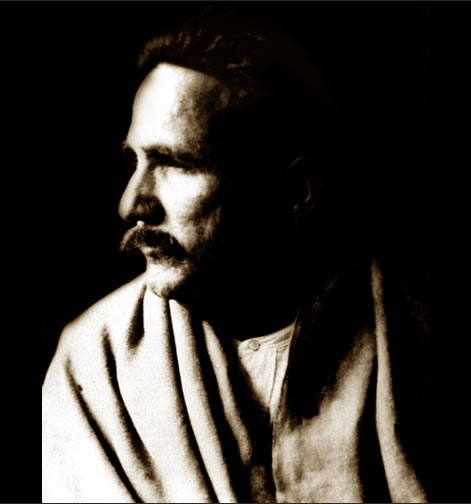
Allama Iqbal: The Great philosopher Poet of Pakistan

By G. Sabir for Iqbal Academy Scandinavia

Nature gives birth to great philosophers and poets when the need arises. Natural calamities, wars, epidemics, storms and earthquakes etc causing human sufferings have always given birth to creative minds. Plato was born in 420 BC when his country had almost been ruined as a result of Peloponnesian war. Iqbal was born in 1877 AD when the inhabitants of India were suffering from miseries and deaths while struggling for the Independence of their country from British rule.

The people of Muslim community of India were the worst hit. They were being crushed ruthlessly. At that time Iqbal’s poetry played miraculous role. It awakened the people from slumbering hopelessness, made them stood on their own feet. They were united and then fought courageously for Independence with the result that they achieved a free homeland for them within a few years time.

Creative thinker

This means that despite being a creative thinker, Iqbal was addressing the situation at hand. The ideas he enunciated, though intrinsically creative in themselves and abiding in appeal beyond a particular time and place, were yet primarily meant to salvage the bleak Muslim situation in India and the world at large. This makes Iqbal, in a sense, oriented towards the Indian Muslim psyche and situation.

This framework makes his periodic forays into discussing and suggesting solutions to the problems of the Muslim world at large and his consuming concern with the ‘Reconstruction of Religious Thought in Islam’ (1930) – a logical extension of his role as a modern Muslim ideologue, attempting to analyze and, see Muslim India’s problems and predicament on a wider canvas and in a total context. After all, Iqbal regarded India, if only because of the Muslim numerical strength, as ‘the greatest Muslim country in the world’, to quote his own words. These tasks, both critical and onerous as they were, he fulfilled squarely.

Effective medium

His emotion-leaden and soul-lifting poetry was the medium Iqbal chose to bring his people a new awareness of the depths of degradation to which they had fallen, to diagnose their ailments, their predicament and the prime cause of their decline and to warn them of the dire consequences if they failed to mend themselves in good time. A more effective medium he could not have possibly chosen.

For one thing, poetry is the most powerful medium for touching the deepest emotions of people and for driving a message into their subconscious. For another, the Indian Muslims had been among the most poetry-oriented people in the wold, with a long tradition of readily taking to heart what was written in verse. Political orations may stir and audience into action, but their impact is bound to be restricted to a particular audience and dissipate with time and events. In contrast, a poetic message seeps through the ethos of a nation, working on its psyche all the while.

Political leaders

Hence Iqbal achieved through his poems what a thousand speeches could not. But for the silence mental preparation that had gone on for long decades, the people would not have responded to the call of political leaders – in this case, especially of Jinnah during the 1937-47 epochal decade. No wonder, the pandals of the League sessions from Lucknow (1937) onwards were plastered with Iqbal’s couplets, calling on Muslims to rise and take their destiny in their own. Iqbal was quoted oft and on to rouse Muslims to a new awareness of their destiny. All this had an electrifying effect on the audience since Iqbal, though generally complex and couched in an appropriate idiom, was, straightforward and yielded clear guidelines.

Besides being a poet of extraordinary merit, Iqbal was a thinker of a high order. Thus, while Syed Ahmed Khan, Maulana Mohammed Ali and Jinnah provided political leadership to Muslims, Iqbal took upon himself the task of setting the intellectual tone for Muslim thought and action. (Previously, this was done by Sir Syed’s, writing and the Aligarh school). In addressing himself to this task, Iqbal brought a revolution in Muslim thinking at various levels, he also made a significant contribution to keeping them stolidly anchored to their pristine ideology and historical legacy.

New consciousness

His role in awakening the Muslims to a new consciousness began in 1899 when he recited a poem at the annual session of the Anjuman-i-Islam, Lahore. His moving ‘Nala-i-Yatim’ was symbolic of the echoing cry of the faceless masses of the Indian Muslims, who had long felt themselves sidelined neglected.

What pained him most was the impact of nationalism on various Muslim countries, eroding the pan-Islamic concept, enfeebling the Muslim world and laying it open to European aggression and exploitation.

To the ailments the Muslim world was afflicted with, Iqbal found the solution in Islam and its message. In order to reach the innermost recesses of their consciousness, he invoked the past glory of Islam, telling Muslims of the accomplishments of their ancestors. In so doing, he tried to fight off the prevalent slough of despondency, raising drooping spirit of Muslims and replacing it with a sense of soaring confidence.

Message of hope

Next, he gave them a message of hope. He told them that they could still redeem themselves if they could only recapture their soul and regain their pristine moral and spiritual values.

He emphasized the imperative need to develop human qualities and the right type of character. He attributed their degeneration to their taking to a life of passivity and resignation for several generations. That debilitating trend could be reversed by opting for initiative and endeavour which, he believed, Islam stood for. To him, an active, struggling non-believer was preferable to a sleeping Muslim.

But if Muslims were to be beckoned to a new destiny, they must first be confirmed as Muslims and they must own up their pristine values. This was all he more necessary in the context of the rise of positivism and skepticism, which posed a serious challenge to the modern Muslim.

Modern Muslim

To Iqbal, the task before the modern Muslim is to re-think the whole system of Islam without completely breaking with the past. And this crucial task he undertook in a series of lectures since compiled as ‘The Reconstruction of Religious Thought in Islam’ (1930). In these he argued that Islam represented a philosophy of action, for faith without action was a life bereft of any significance. Seldom does a poet exert such profound influence on the course of history and in changing the destiny of a nation. But Iqbal did because his accomplishments extended far beyond the realm of mere imagination and into the sphere of objective realities, because in the final years of his eventful life he donned the mantle of an ideologue, besides being a national poet. And, to be sure, all of Iqbal’s efforts throughout the whole span of his active life were directed towards the regeneration of Muslims and the resurgence of Islam.

Human rights

The question, ‘do we need Iqbal today?’ The reply is a clear ‘Yes’. It is a need of the time, because the honour of humanity is at stake. The preachers of human rights are abusing humanity. Masses of men are being trampled ruthlessly under the heavy feet of the powerful. There is dearth of love in the world these days. Iqbal is a messenger of love. His message of love is universal… the humanity needs him.. we do need him without any doubt.

The Nexus of US-India-Pakistan Relations

By Manzer Munir for Pakistanis for Peace

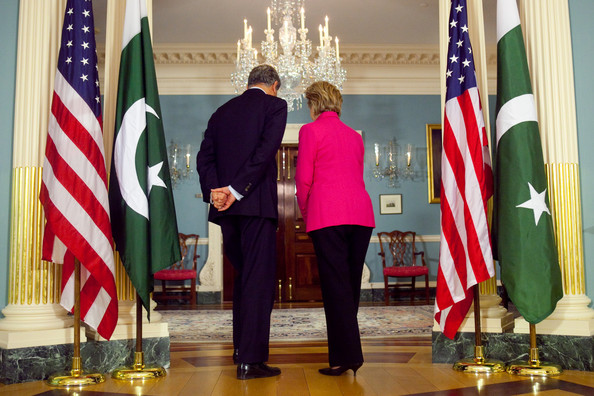
As President Obama wraps up his visit to India in the next day, a couple of things are important to point out about relations between the United States and India as well as how Pakistan fits into the equation.

The balance of power between India and the US still lies with the United States, however, India is set to make more and more gains in becoming more influential as its economy grows and as the United States looks to it to counter China in Asia.

The strategic partnership between the two countries and the importance of India for the United States is going to become vital as America uses India to contain China’s influence in the region and around the world.

We do believe that President Obama is correct in stating that relations between the two countries warrant being called the defining relationship of the century as there is no other country that compliments the United States presently in the world as does India. Not only do both countries share democratic ideals and a multiethnic population, but both countries are also increasingly dependent on each other’s economies. Add to this the nuclear cooperation as well as America’s support for India to get a permanent seat on the UN Security Council, and it becomes evident that this relationship will continue to grow over time.

President Obama has offered criticism on Pakistan already but is careful in trying to walk the tight rope act that is India-Pakistan relations. There are certainly more behind the scene steps taking place that will chide Pakistan into doing more. But in our view, the single most important thing that the US and the Obama administration can do is to help India and Pakistan come back to the table to get the peace process moving along. There is widespread agreement with the President’s assessment that a prosperous and stable Pakistan is in the best interests of India, Afghanistan and the region. In this effort, we believe there needs to be done more by all parties involved.

India’s argument has always been that the terrorist infrastructure and support for some anti-India militant groups needs to end before New Delhi will resume the peace process with Pakistan.

India should not refuse extensive trade relationships with the US due to American support of Pakistan as it does not do anything to help India. India realizes the situation both inside Pakistan and America’s dependency of the Pakistan Army’s support in flushing out the Taliban. It would go against India’s interests if it put its relationship and advancement with the United States as being dependent on American support for Pakistan and its vital assistance in the war in Afghanistan and on terror.

Peace between India and Pakistan and in the Kashmir valley is the only solution to both the conflict between the two nations as well as it is in America’s interests for both countries and the region. Furthermore, peace between the two countries will allow both Pakistan’s full focus on the Afghan border in helping American troops against the Taliban as well as the elimination of anti-India militant groups within Pakistan, many of whom are alleged to still be receiving support from elements within Pakistan’s ISI spy agency, much to India’s chagrin.

Obama Calls for India – Pakistan Peace

By Andrew Buncombe for NZ Hearald

Barack Obama has called on India and Pakistan to renew their efforts to find peace, even as he said Islamabad was not moving quickly enough to counter militants operating from inside its borders.

In comments that appeared to underscore the high-wire act of diplomacy the US president is trying to pull off while on the three-day visit to India, Mr Obama said Washington would not act as an intermediary between the two countries.

However, he told a group of students in Mumbai: “My hope is that over time, trust develops between the two countries, that dialogue begins, perhaps on less controversial issues, building up to more controversial issues. There are more Pakistanis who’ve been killed by terrorists inside Pakistan than probably anywhere else.”

The president has received criticism from some opposition parties in India after he failed to directly mention Pakistan when he arrived in India on Saturday and spoke of the 2008 attacks at the Taj Hotel and other locations in Mumbai, that left more than 160 people dead.

In the aftermath of the attacks, the so-called “composite dialogue” peace process between India and Pakistan was put on hold and while there have been a series of high-level meetings, the relationship between the two remains tense.

The president, who stayed at the seafront hotel in what aides said was a clear sign of solidarity, had talked about the militants and the terror they wrought, but was criticised by the right-wing Bharatiya Janata Party (BJP) for failing to attribute the blame to Pakistan.

Asked why he had not done so, Mr Obama reflected a reality in which the US is paying billions of dollars to Pakistan in aid as it pushes it to do more against militants responsible for cross-border strikes in Afghanistan.

“Pakistan is a strategically important country, not just for America, but for the world,” he said. “India and Pakistan can prosper and live side by side. This can happen and this should be the ultimate goal. The US can be a partner but cannot impose this process. India and Pakistan have to arrive at an understanding.”

Mr Obama started his visit to India, one of four countries he is including on a tour through Asia, by announcing more than 20 deals he said were worth up to $10bn and would help support 50,000 US jobs.

He also said the US was to relax export controls over sensitive technology, a demand of India’s that will help deepen ties between the two countries. The president is to hold formal talks today with India’s prime minister, Manmohan Singh.

On a domestic level, Mr Obama also recognised he needed to make “midcourse corrections” in the aftermath of last week’s mid-term elections if he is going to win over a frustrated and divided electorate.

Pakistan Looks Ahead to End of Afghan War

By Olivia Ward for The Toronto Star

As NATO forces prepare to pull out of Afghanistan, worries about the country falling back to Taliban control are paramount. But in neighbouring Pakistan, where suicide bombings and brazen attacks on security forces have become regular occurrences, the stakes are also high.

“What happens in Afghanistan affects us and vice-versa,” says Akbar Zeb, Pakistan’s High Commissioner to Canada. “We have four million Afghan refugees still living in Pakistan, and it’s in our interest to have a stable country where we can send them back. A Taliban takeover won’t be just detrimental to Afghanistan. It would harm Pakistan and the whole region.”

Zeb said that under the civilian government of President Asif Ali Zardari, relations have improved with Afghanistan, and contrary to reports of friction, there are “frequent contacts” between the two countries that would be helpful in creating stability.

But he added that Canada, and other Western countries, should not repeat the mistakes of the post-Soviet era, when the West lost interest in Afghanistan and Pakistan as soon as the Soviet troops withdrew.

During the rule of Pakistan’s military leader, President Pervez Musharraf, groups of Taliban-linked militants got a foothold in Pakistan, but were not seen as a danger to the country until internal attacks began to spread. Former prime minister Benazir Bhutto was assassinated, and suicide bombings took the lives of hundreds of civilians. Under pressure from the U.S., the Pakistani military began a massive campaign against the Taliban along the Afghan border.

“We have managed to clear a lot of areas from the Taliban,” said Zeb. “Military campaigns are the only language they understand. But they alone won’t help to win the war. We have border regions with a lot of poverty, and backward elements that have been ignored for a long time.”

Canada has announced support for road and rail projects linking Afghanistan and Pakistan to speed trade between the two countries.

“It’s a very good initiative, but scope is limited,” said Zeb.”We wish the projects were larger and not just (confined to) those that involve both Afghanistan and Pakistan.”

Talks with Islamabad are also ongoing on the use of ports in Karachi for shipping out Canadian troops and military supplies from Afghanistan.

But as the war continues, Pakistan has also been urged to be tougher on the Taliban. In the past two years it has carried out attacks against the militants in its border regions with some success, while American-launched drone strikes have killed high-ranking Taliban. The catastrophic floods that wiped out some of the most important agricultural areas of Pakistan brought a temporary truce, but militant attacks have resumed since the waters receded.

Last week, talk of a peace deal between the notorious Taliban-linked Haqqani network, and an opposing tribe in the remote northwest raised fears that it could open the way for Taliban access to strategic border areas. But the U.S. has also urged a Pakistani offensive against the network in North Waziristan, a volatile region where 400,000 civilians are vulnerable to displacement.

According to Pakistani officials, the country has lost some 7,000 security forces in a decade of fighting the militants — more than three times the coalition deaths in Afghanistan. Meanwhile 30,000 Pakistani civilians have died. The border region, a tangle of mutually hostile tribes, remains a haven for militants.

“It’s a difficult balance for Pakistan,” said Zeb. “Foreign troops may leave, and for them Afghanistan is a distant land. We’re Afghanistan’s neighbours. We helped with the fighting in the decade-long war against the Soviets. And we have to live with the outcome of this war.”

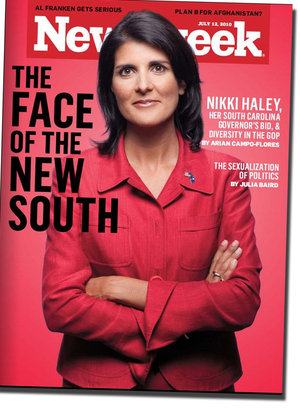
India Link in US: Nikki Haley Creates History as First Woman Governor

As Reported by The Hindustan Times

Parents of both Nikki Randhawa Haley, who on Tuesday won the governor’s election in South Carolina, and Bobby Jindal, the other Indian American governor of Lousiana, were born to immigrants from Punjab. Nikki Haley is the first woman and the second person of Indian origin after Bobby Jindal to become governor in the US. Jindal won the top job in Louisiana state in 2007.

While Nikki’s father Ajit Singh came to the US from Amritsar, Bobby Jindal’s (who name before his conversion to Christianity was Piyush Amrit Jindal) father Amar Jindal came from Malerkotla, not far from Amritsar.

Nikki’s victory is another sweet moment for Amritsar because the first Indian American Congressman Dalip Singh Saund, who served three terms (1957-1963) in the US Congress from California, also came from that city, the home of the Golden Temple, Sikhism’s most famous shrine.

Nikki, whose family is running a garment showroom called Exotica International in West Columbia since 1976, has been serving as a legislator in the South Carolina state assembly since 2004.

“I don’t do anything halfway – I’m in this race to win,” Nikki had told IANS in July taking time off her busy campaign for raising money.

“I am confident that come November, the people of South Carolina will send me to the Governor’s Mansion.

“When they (voters) do, I will immediately get to work to give them progress that makes them proud.”

Asked whether her Sikh background will matter in the race, she had said,”What matters most in South Carolina – and I imagine elsewhere in the country – is not the personalities of the candidates but the message they carry.

“Our message of bringing good government back to the people of this state, creating jobs by reforming our tax code so it’s flatter and fairer, and reminding government of the value of a dollar resonates with all the people of this state.

“I am very proud of my background and how I was raised. Just as in 2004 (when her opponents had raised the issue of background) I will hold my head up high and focus on what I can do for the people of this state.”

Nikki beat Democrat Vincent Sheheen who tried to steal her conservative agenda by projecting himself as “pro-life, pro-gun rights and pro-jobs”.

Pakistanis for Peace Editor’s  Note 11/03/2010– We at Pakistanis for Peace want to congratulate Nikki Haley for winning the governorship of South Carolina in a very tough and hard fought race. Both as an American as well as ethnically being a person from the Indian subcontinent aka Desi, we are proud to see her elected to serve as governor, despite disagreeing with her party on many issues.

Her rise as well as that of Governor Bobby Jindal of Louisiana to the top of American politics is a source of pride for all Desis, be they Indian, Pakistani, Bengali, etc. We invite people of all races, ethnicities, and backgrounds to join our Facebook group at Pakistanis for Peace and strengthen those who support peace between India and Pakistan and around the world. To join, clik  http://www.facebook.com/group.php?gid=37793413510&v=wall

Unending Love By Rabindranath Tagore

I seem to have loved you in numberless forms, numberless times…In life after life, in age after age, forever. My spellbound heart has made and remade the necklace of songs, That you take as a gift, wear round your neck in your many forms,In life after life, in age after age, forever.

Whenever I hear old chronicles of love, it’s age-old pain, It’s ancient tale of being apart or together. As I stare on and on into the past, in the end you emerge, Clad in the light of a pole-star piercing the darkness of time: You become an image of what is remembered forever.

You and I have floated here on the stream that brings from the fount. At the heart of time, love of one for another. We have played along side millions of lovers, shared in the same Shy sweetness of meeting, the same distressful tears of farewell-Old love but in shapes that renew and renew forever.

Today it is heaped at your feet, it has found its end in you The love of all man’s days both past and forever: Universal joy, universal sorrow, universal life. The memories of all loves merging with this one love of ours – And the songs of every poet past and forever~ 

– Rabindranath Tagore was the first non-European to win the Nobel Prize as he won in Literature. He was a de facto Poet Laureate of his day before India’s independence from Britain and this is Pakistanis for Peace’s homage to the man and to the human sentiment of love. 

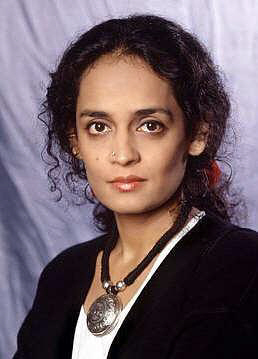
Arundhati’s Statement From Srinagar: Full Text

By Arundhati Roy
October 26, 2010
Noted Indian Hindu writer Arundhati Roy Tuesday said her speeches supporting the call for azadi were what “millions” in Kashmir say every day and were “fundamentally a call for justice”. Following is the full text of the statement that she has issued.
 
“I write this from Srinagar, Kashmir. This morning’s papers say that I may be arrested on charges of sedition for what I have said at recent public meetings on Kashmir. I said what millions of people here say every day. I said what I, as well as other commentators have written and said for years. Anybody who cares to read the transcripts of my speeches will see that they were fundamentally a call for justice. I spoke about justice for the people of Kashmir who live under one of the most brutal military occupations in the world; for Kashmiri Pandits who live out the tragedy of having been driven out of their homeland; for Dalit soldiers killed in Kashmir whose graves I visited on garbage heaps in their villags in Cuddalore; for the Indian poor who pay the price of this occupation in material ways and who are now learning to live in the terror of what is becoming a police state.  

“Yesterday I traveled to Shopian, the apple-town in South Kashmir which had remained closed for 47 days last year in protest against the brutal rape and murder of Asiya and Nilofer, the young women whose bodies were found in a shallow stream near their homes and whose murderers have still not been brought to justice. I met Shakeel, who is Nilofer’s husband and Asiya’s brother. We sat in a circle of people crazed with grief and anger who had lost hope that they would ever get ‘insaf’—justice—from India, and now believed that Azadi—freedom— was their only hope. I met young stone pelters who had been shot through their eyes. I traveled with a young man who told me how three of his friends, teenagers in Anantnag district, had been taken into custody and had their finger-nails pulled out as punishment for throwing stones.

“In the papers some have accused me of giving ‘hate-speeches’, of wanting India to break up. On the contrary, what I say comes from love and pride. It comes from not wanting people to be killed, raped, imprisoned or have their finger-nails pulled out in order to force them to say they are Indians. It comes from wanting to live in a society that is striving to be a just one. Pity the nation that has to silence its writers for speaking their minds. Pity the nation that needs to jail those who ask for justice, while communal killers, mass murderers, corporate scamsters, looters, rapists, and those who prey on the poorest of the poor, roam free.”

Arundhati Roy is a novelist, essayist and human rights activist. She won a Booker Prize in 1997 for her novel, The God of Small Things. For more on her read http://en.wikipedia.org/wiki/Arundhati_Roy

Pakistanis for Peace Editor’s Note– Arundhati Roy’s courageous plea to her country is to be lauded. Although branded a traitor by many in India and within the government, she knows that she stands for peace, justice and fairness for all humanity. She wants self determination for all Kashmiris, be they Muslim, Hindu, Buddhist or Christian.

We at Pakistanis for Peace want nothing more than peace between India and Pakistan and therefore understand that Kashmir is the one and single most important issue between the two countries. Solve it and you do not have the threat of cross border attacks, friction, animosity, perpetual war and a tense border between two neighbors of nearly 2,000 miles. If we continue to ignore it then it will eventually be the crisis that starts a 4th and possibly nuclear war between the two neighbors. A war that neither the neighborhood nor the world can afford.

Meet Nikki Haley, the Next Indian American Governor of a US State

By Manzer Munir for Pakistanis for Peace

Nikki Haley is not destined to be the first Indian American governor of a US state. No that honor already belongs to Governor Bobby Jindal of Louisiana. Haley however is poised to do something greater and that is to become the first minority female governor as she competes for South Carolina’s highest office on Tuesday November 2.

Already the first Indian to hold office in South Carolina, she currently serves as a member of the South Carolina House of Representatives from the 87th district. A past president of the National Association of Women Business Owners, she is a CFO and an accountant by trade who worked in her mother’s apparel business that has grown into a multi-million dollar company.

Although born to Sikh parents, she converted to Methodism after marrying her husband Michael Haley and describes herself as a Christian. Her religious conversion as well as her ethnicity has not hampered her dreams of becoming the first female governor of South Carolina.  Neither have allegations of extramarital affairs or reports of paying taxes late.

Nikki Haley’s candidacy received a boost when Sarah Palin and Tea Party officials gave her their backing for the election and she is leading her opponent, Democrat Vincent Sheheen, in most polls. If she wins, this will not be the first time she has won in a state where politics is mainly a male run enterprise. In 2004, she challenged and won against Rep. Larry Koon who was South Carolina legislature’s longest serving member, having served 30 years in the House. She is a tough lady who also happens to have a concealed weapons permit and strongly supports gun rights, a staple of Republican Party values.

Aside from Haley, an unprecedented number of Indian Americans are contesting for office this year across the country. There is Manan Trivedi in Pennsylvania running for the House of Representatives in the state legislature. Others running for house seats in their states are Ami Bera in California, Raj Goyle in Kansas, Ravi Sangisetty in Louisiana, where Bobby Jindal is the governor, and Surya Yalamanchili in Ohio.

After making inroads into American boardrooms with top jobs in the corporate world such as Vikram Pandit, the CEO at Citibank and Indra Nooyi, the boss at PepsiCo, Indian Americans are exploring opportunities in politics which is good for America as more involvement by minorities in public service makes the country stronger and shows that there is room for everyone at the top. Many other minorities also can take encouragement from her candidacy and be mindful that race and ethnicity is not always a barrier for running for office and that the right candidate and platform can land a person in the governor’s mansion.

Should Nikki Haley be successful in winning the governorship of South Carolina, she will instantly become one of the rising young stars of the Republican Party and a face for women leaders the world over. Regardless where you stand on the political aisle, her candidacy and subsequent election will be a turning point in the US for Indian Americans and South Asians who have become an indispensable part of the nation’s fabric.

Pakistanis for Peace Editor’s  Note 11/03/2010– We at Pakistanis for Peace want to congratulate Nikki Haley for winning the governorship of South Carolina in a very tough and hard fought race. Both as an American as well as ethnically being a person from the Indian subcontinent aka Desi, we are proud to see her elected to serve as governor, despite disagreeing with her party on many issues.

Her rise as well as that of Governor Bobby Jindal of Louisiana to the top of American politics is a source of pride for all Desis, be they Indian, Pakistani, Bengali, etc. We invite people of all races, ethnicities, and backgrounds to join our Facebook group at Pakistanis for Peace and strengthen those who support peace between India and Pakistan and around the world. http://www.facebook.com/group.php?gid=37793413510&v=wall

Off-Court Honour for IndoPak Express

As Reported by Dawn

The two South Asian players who paired up to form a formidable force in men’s doubles tennis have been rewarded for their efforts by the Peace and Sport Organization.

Aisam-ul-Haq Qureshi and Rohan Bopanna were announced as the winners of ‘Peace and Sport Image of the Year’ award by the World Peace and Sport Forum on Friday.

The award is given to the best image of fraternity through sport or a symbolic moment showing the ability of sport to advance peace in the world and to encourage reconciliation among peoples.

“The Peace and Sport Image of the Year Award will be given to India’s Rohan Bopanna and Pakistan’s Aisam-ul-Haq Qureshi – two tennis players who managed to bring the political authorities in their respective countries closer, through their own history of personal friendship and commitment,” a statement issued by Peace and Sport said.

The duo’s ‘Stop War, Start Tennis’ campaign made a breakthrough achievement this year, when they managed to bring together the Pakistani and Indian ambassadors to the United Nations.

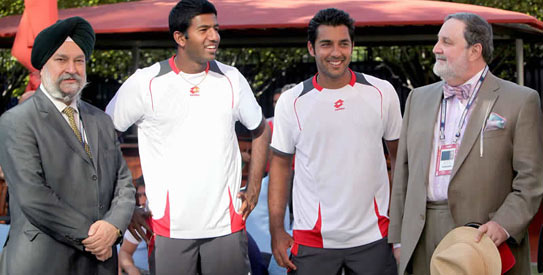
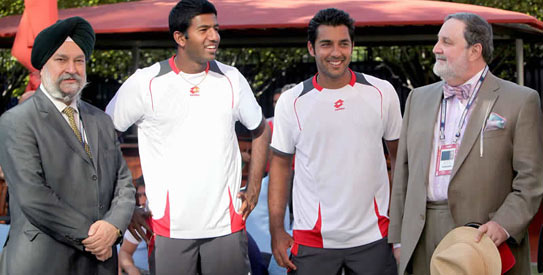
Hardeep Singh Puri (India) and Abdullah Hussain Haroon (Pakistan) watched from the stands as the IndoPak Express contested in the men’s doubles semi-finals and final of the US Open 2010 in New York last month.

The winning image, taken by Jay Mandal for the ATP World Tour, shows the two players chatting with the two ambassadors after their semi-final win at the Billie Jean King National Tennis Center in New York.

Based on worldwide open voting competition and jury’s decision the image was declared the winner, having received 60 per cent of the votes cast globally.

Rohan (Hindu) and Aisam (Muslim) have played in a doubles team for three years and are building their careers together, despite historical hostilities that divide India and Pakistan. Motivated by their friendship, they decided to actively campaign for peace between their two nations.

During several events on the ATP World Tour 2010, they wore warm-up gear displaying the slogan “Stop War, Start Tennis”, thus affirming their belief that friendship between India and Pakistan is possible.

“The message of peace given by Rohan and Aisam is a unique source of inspiration for young people in their respective countries, but its significance does not stop there. They use their charisma and their sporting success to raise awareness amongst the entire international community, their fellow athletes and political authorities in their countries, as we saw at the US Open. I hope that their appeal will lead the way to new rapprochement initiatives,” Joel Bouzou, President and Founder of Peace and Sport said.

“Sport’s greatest victory is not measured in terms of medals. It is measured by its ability to positively change people’s lives and bring them hope. And that’s exactly what Rohan and Aisam succeed in doing. They demonstrate what champions can achieve when they use their celebrity for a good cause.”

The players’ next humanistic goal is to organize a friendly tennis match at the Wagah border, the only checkpoint that exists between India and Pakistan. This symbolic event, supported by Peace and Sport, will incarnate the wish of Indian and Pakistani young people to live in peace.

Other contestants for this year’s award were, “Young Pentathletes bridge the gap between the USA and Cuba,” “Nelson Mandela, hero of the anti-apartheid struggle and symbol of the 2010 World Cup,” and “Iran and the USA forget their differences on a basketball pitch.”

The award will be presented to the duo by Prince Albert II of Monaco at a grand gala ceremony on December 2.