Archive for the ‘ Desi ’ Category

Indian Hockey Fans in Seventh Heaven

By Richie Verma for The Times of India
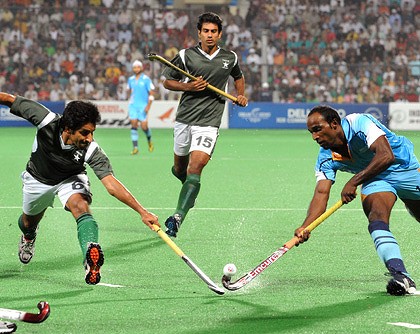
NEW DELHI: Cricket is no longer the only sport that brings out the patriotic fervour of Indian fans. India’s victory against neighbouring country Pakistan in the hockey match at the Major Dhyan Chand National Stadium on Sunday brought out a frenzy in the crowd with spectators going wild cheering for the country, dancing in the stalls and waving the Tricolour.

Hardly surprising, given that the India-Pakistan hockey match had been billed as the highest point of the Commonwealth Games and it lived up to that tag every bit. Tickets had been sold out days in advance and even after the match had begun, a few hopefuls were still walking around the stadium hoping to get inside by some miracle.

The celebrations spilled onto the streets and continued much after the match was over, with thrilled fans cheering loudly and screaming on top of their voice. Kids with their faces painted white, saffron and green, women with flags and loud men wearing team India shirts were all that could be seen in the streets around the National Stadium. Traffic cops had a tough time trying to ensure the crowd didn’t affect vehicular movement as crazy fans went dancing right on the middle of the road. The cheers could be heard from quite a distance away.

Nilesh, Samar, Ajay, Pradeep and Varun — a group of five friends from an engineering college in Ghaziabad — were too busy screaming about India’s victory to notice the glares of passersby. “It’s a great day for us and this match was worth every effort it took us to get here, the wait in the queue and going with the mob inside the stadium. We all feel so proud to be Indian,” said Samar. Sakshi Mittal from Rajouri Garden added: “It’s an ego massage for India. The applause every time India made a goal was mindblowing.” Her husband, Akhil, added: “Of course, this has a lot to do with this being an India-Pakistan match. Everyone wanted to be a part of it.”

The almost deafening silence in the field every time Pakistan scored, was a sharp contrast to the lusty cheering the contingent had received during the opening ceremony. In fact, the number of spectators who rooted for Pakistan were minimal and included mostly journalists and some Pakistani dignitaries though the last of the four goals that the subcontinental neighbours notched up was classified by many as “brilliant”. “I personally feel that the other team should have received more support from the audience. When India made a goal, the crowd would go mad but when it was Pakistan’s goal, there was silence,” said B R Pandey, a resident of Rohini, who had come to watch the match.

Loud Cheers for Pakistan, British Team Sports Indian Look

By Shivani Kala for The Indian Express

The loudest applause, predictably, was reserved for the Indian contingent. But what surprised many, perhaps even the participating athletes, was that the 60,000-plus crowd chose Pakistan for the second-loudest cheer.

If sheer crowd applause was any measure of the popularity of the participating countries, the 54-member Pakistani delegation, distinct in their green coats, was by far the most loved after India. Of course, the Indian delegation, led by flag-bearer Abhinav Bindra, was received with a standing ovation across the stadium, with even President Pratibha Patil and Prince Charles standing up to welcome the participants. UPA chairperson Sonia Gandhi was the last to sit down after the resounding applause that lasted several minutes.

In contrast, to the embarrassment of the Organising Committee (OC), as soon as its chairman Suresh Kalmadi stepped on stage to make the opening remarks, a rather cold silence descended, following by distinct booing. The only exception was when he mentioned Delhi Chief Minister Sheila Dikshit, whose name was greeted with loud cheers.

Besides Pakistan, other cricket-playing countries also received loud cheers. In fact, the British participants struck a chord with the host country with their choice of outfit — white kurta with the signature Nehru collar and a red jacket. The marching members of the 371-strong contingent turned out in the best of fashion inspired by India.

Pakistan Should Celebrate Gandhi’s Life, Legacy and Contributions

By Manzer Munir for Pakistanis for Peace

Mohandas Karamchand Gandhi, who was born 141 years ago today on October 2, 1869, is a revered figure in India as well as in many countries around the world for his peaceful civil disobedience techniques that succeeded in granting India its independence from Britain. He is also credited by Martin Luther King Jr., the American civil rights leader, as an inspiration in using similar peaceful protests to change unjust laws against blacks and other minorities in the United States. These protests and opposition eventually led to the Civil Rights Act of 1965 being passed granting all Americans of every ethnicity equal freedoms and protection in the eyes of the law.

Gandhi’s birthday, October 2nd, is celebrated by the United Nations as International Day of Non-Violence. He is an admired figure in India where his contributions for the freedom of his countrymen is celebrated on stamps, currency, and folklore. Gandhi is also appreciated in many other countries outside the Indian subcontinent. Statues of him are found in such disparate places like New York’s Union Square, Gandhi Square in Moscow, the Johannesburg city center in South Africa, and even as far away as Waikiki Hawaii where a statue to the leader stands in Kapiolani Park in Honolulu.  

Yet in Pakistan, a country that also benefitted from Gandhi’s movement for independence, he is vilified and not thought of highly. Many in Pakistan blame Gandhi for his failing to prevent the deaths of thousands of Muslims during the religious violence the precipitated the independence of both countries. In many Pakistani books he is depicted as a villain; however few people know that he died because of his great favour for Pakistan and that he was seen by right wing Hindu groups as someone who was concerned with the appeasement of the Muslims of India.

India’s first prime minister, Jawaharlal Nehru, had refused to give Pakistan their share of the money that was due to them after partition. But Gandhi went on a fast till death to protest against this injustice against the newly created Pakistani state and this pressure led to Nehru’s agreeing to pay the money so direly needed by the new Muslim nation.

He was assassinated by a young Hindu fanatical, Nathuram Godse, who felt that M.K. Gandhi was more of a hindrance to India than an asset. Godse, like many fanatical right wing Hindus felt that Gandhi was solely responsible for the partition of India into a country for Hindus and one country for the Muslims and he felt that he was a traitor to other Hindus.

Sadly, this man who ultimately gave his life in the cause of others is not very appreciated in Pakistan and neither are his contributions for freedom and independence from the British colonizers taught to today’s school children. In a country rife with violence, intolerance and instability, many Pakistanis can learn a great deal in the lessons of brotherhood and peaceful co-existence preached by Mahatma, the great soul. He would be the perfect anti-Taliban in today’s Pakistan, a country inflamed by animosity and hatred between all ethnic and religious groups. His ideas of tolerance and harmony with others would go a long way against the barbaric views of the Taliban, the enemies of man.

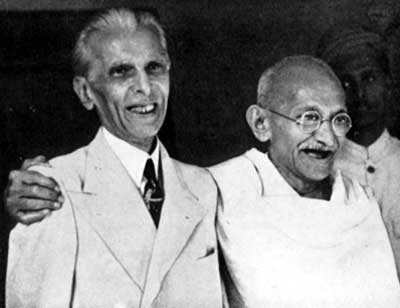
His belief that violence was not a solution towards any objective would benefit today’s Pakistani society if his message was given importance and taught at an early age. His reasoning towards peace and nonviolence lead him to once say that “An eye for an eye leaves the whole world blind.”  In today’s chaotic and violent Pakistan, there is a lot that my fellow Pakistanis can learn from this man and how he lived his life with humility, simplicity and non-violence as well as towards his service of others. More people inside Pakistan should be taught about Gandhi as he is as much responsible for Pakistan’s independence from Britain as was Jinnah, the founder of the country.

-Manzer Munir, a proud Pakistani American and peace activist, is the founder of Pakistanis for Peace and blogs at www.PakistanisforPeace.com as well at other websites as a freelance journalist and writer.

Indian-Pakistan Friendship Blooms Amid Games Chaos

By Amlan Chakraborty for Reuters

India has received support from an unlikely source as it races to finish preparations for the Commonwealth Games in New Delhi which start are due to start Sunday.

Following recent concerns about unhygienic athlete accommodation, security and an epidemic of Dengue Fever, in part blamed on stagnant water around unfinished construction sites, sports administrators in neighboring Pakistan are unwavering in their support for the troubled Games.

“When you host something like this, there will be issues but I’m confident it will be a success,” Lal Chand, Pakistan’s deputy chef-de-mission told Reuters by phone.

“We always had very good relation with the Indian Olympic Association and supported them. We will be arriving in full force to spread the message of peace and goodwill,” he said.

Politically, relations between the nuclear-armed neighbors, who have fought three wars, were frozen when Pakistan-based militants attacked the Indian City of Mumbai in 2008, killing 166 people.

However that has not appeared to be the case for sport and Games Organizing committee chief Suresh Kalmadi earlier this year thanked Pakistan for supporting India’s bid to host the October 3-14 event.

“Pakistan supported us to the hilt to get the Commonwealth Games to India. We can never forget their support,” Kalmadi had said in June.

‘TWO-WAY BATTLE’

“We and Canada were locked in a two-way battle for getting the hosting rights and Pakistan supported us in our bid.”

Even when complaints about dirty and unhygienic facilities at the Games Village was drawing flak from all corners, Pakistan hockey player Rehan Butt came out in support for the organisers.

“…I feel that the issue is blown out of proportion in this case. There were problems during the Manchester Games (in 2002) as well where we stayed in a university hostel,” Butt was quoted as saying by the Press Trust of India news agency.

“That was the worst experience but we did not complain. We, India and Pakistan, never do that.”

Sports historian Boria Majumdar provided a perspective on what brings the bitter neighbors closer in sport.

“I’m not surprised, after all India and Pakistan have inherited the same culture. Historically, they have always put up a united stand in international sport,” said Majumdar.

“Even when politicians were at loggerheads, sports bridged the gap,” he said.

In 1987, then Pakistan President Mohammad Zia-ul-Haq visited India for a cricket match, using the trip to help defuse tensions between the neighbors over a massive Indian military exercise held near the border just months before. The same year, the two countries jointly hosted the cricket World Cup.

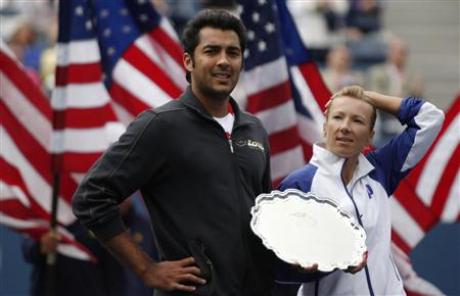
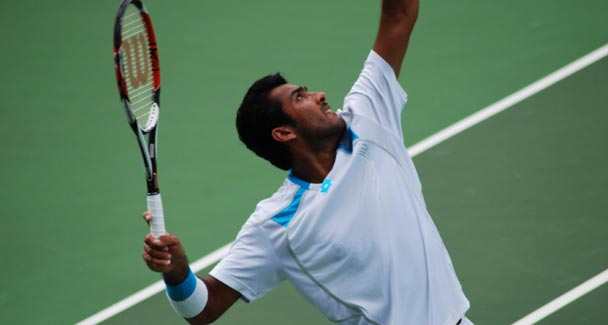
The tennis duo of Rohan Bopanna from India and his Pakistani partner Aisam-ul Qureshi were U.S. Open men’s doubles finalists earlier this month.

India’s foreign minister S.M. Krishna has invited his Pakistani counterpart to watch the Commonwealth Games, and said he hoped it could also give them a chance to move on their peace dialogue.

Pakistan’s Strange Response Towards Indian Aid offer

by Omer Farooq Khan for The Times of India

The worst floods in Pakistan’s history provided a good opportunity for both the South Asian nations to come closer. Accepting Indian aid offers half-heartedly and that too after US insistence, Pakistan has given an impression that it is convinced that its policy on India cannot change.

Pakistan’s initial response to the Indian offer of five million dollars was a positive one but then it was unsure how to respond. It took several days for Pakistan to finally accept the offer, saying that the aid had to come through the UN. Now, a total of $25 million Indian assistance for flood relief efforts in Pakistan has to be spent by the UN.

Pakistan’s foreign minister Shah Mehmood Qureshi had said that the delay was due to the sensitivities involved in the relationship with India. Even, a section of policymakers, conspiracy theorists in media and some India-centric elements within the Pakistani establishment blamed India for opening floodgates of its dam to inundate Pakistan’s cities and towns. While building public opinion, they did not care that their contention was technically wrong. The fact is that the rivers that caused destruction in Pakistan do not originate in India.

Some defence analysts argue that Pakistan’s strange response towards India’s aid offer was meant not to get obliged. “Pakistan reacted politically towards Indian humanitarian gesture. The destruction is so colossal that petty politics must be avoided. Pakistan asks for help and when it is offered by a neighbour, its ego comes its way. The main hurdle was that Pakistan did not want to be obliged,” argues defence analyst General Talat Masood.

Kamran Shafi, Dawn’s columnist says that Indian-centric approach within the security establishment and intelligence agencies was the main predicament that the government accepted Indian offer half heartedly. “Values and wisdom demand that politics must be kept aside at time of tragedy. Pakistan needed to have warmly welcomed neighbour’s goodwill gesture.”

India and Pakistan have made major efforts in recent months to build confidence in their relations, which were badly strained by the Mumbai 2008 terror attacks that India blamed on militants from Pakistan. If Indian civil society, volunteers and NGO’s were allowed to do relief work in the flood affected areas, this could have been an ideal confidence building measure in the relations of the two countries.

Certainly, it would have served the spirit of Thimphu where Pakistani PM Yusuf Raza Gilani and his Indian counterpart Manmohan Singh tasked their top diplomats to create CBMs. An opportunity is still not lost if governments, media and civil societies in both the countries come forward and create enough space to use this calamity into an opportunity.

-Editor’s Note for Pakistanis for Peace- The writer is spot on with his analysis of Pakistan’s aid offer from India. During times of a humanitarian crisis of biblical proportions, its political response was petty and irresponsible to its citizens. Furthermore, half heartedly accepting several days after the response does little to build on the goodwill. Either accept it right away with gratitude (our advice) or reject it outright. It did neither and so was ineffective in either cause. The politicians of Pakistan continue to show their incompetence by ineffectively managing the affairs of the country both domestically and internationally.

Prominent Pakistani Politician Murdered Outside His London Home

By Laura Roberts and Heidi Blake for The Telegraph

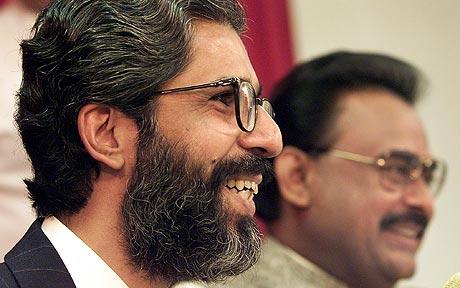
Imran Farooq, a prominent Pakistani politician, has been murdered outside his home in London. Dr Farooq, 50, was repeatedly stabbed in the head and neck during the assault in Edgware, north London.

He was a leading member of the Muttahida Quami Movement (MQM) party, which is one of the largest in Pakistan.

There were suggestions from Pakistan that he may have known his killer. When police arrived at the scene, they found Dr Farooq’s body outside his house.

A spokesman for the Metropolitan Police said officers attended an address in Green Lane, Edgware, shortly before 5.30pm after reports of a serious assault. “On arrival, officers found a single Asian man aged 50 with multiple stab wounds and head injuries,” the spokesman said.

“Paramedics attended the man but he was pronounced dead at the scene.”

Next of kin have been informed and no arrests have been made.

Dr Farooq was expected to attend a birthday celebration at the MQM headquarters on London’s Edgware Road on Thursday night but the event was cancelled at the last minute. Police said it was too early to know if the murder was politically motivated.

The politician claimed asylum in Britain after spending seven years on the run as one of Pakistan’s most wanted fugitives. He was accused of a range of charges, including murder and torture.

He has not returned to Pakistan since his arrival in England in 1992.

He claimed that year that he was wanted “dead or alive”.

“This gave licence and impunity to every individual in Pakistan to assassinate me,” he said.

Dr Farooq said he spent more than seven years in hiding in Karachi, southern Pakistan. He continued: “It was impossible for me to remain in Pakistan due to the continued threat on my life and liberty.”

He insisted the claims against him in Pakistan were politically motivated and continued his involvement with the party from Britain.

Last month Raza Haider, another MQM member, was gunned down with his guard as he attended a funeral near the centre of Karachi. The killing triggered violence in which dozens of people were killed and at least 100 wounded.

Azeem Tariq, the former chairman, was murdered in Karachi 13 years ago. Intruders entered his home and shot him as he slept.

MQM, based in Karachi, is the fourth largest party in Pakistan and is part of the ruling coalition government. It has a strong anti-Taliban stance, although rivals accuse it of exaggerating the threat of the Taliban.

The party represents mainly descendants of Urdu-speaking migrants from India who settled in Pakistan when it was created in 1947.

A statement on the MQM website said the party had declared a ten-day period of mourning in Pakistan and around the world.

London has played host to many of Pakistan’s exiled politicians. Gen Pervez Musharraf, the former president, lives in self-imposed exile in London.

Hero’s Welcome for Aisam

By Umar Farooq for The Express Tribune

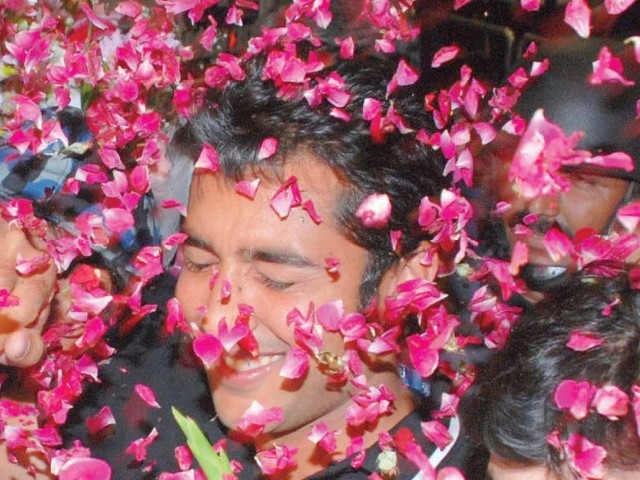
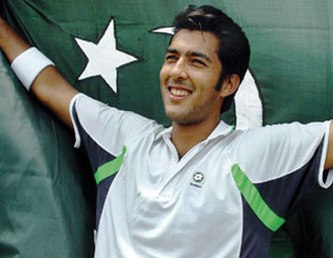
LAHORE: Aisamul Haq Qureshi returned home to a hero’s welcome with thousands of fans greeting him at Lahore airport to catch a glimpse of the Pakistan tennis sensation.

Aisam, who reached the finals of the US Open men’s doubles and mixed doubles events, became the first player from his country to achieve the feat.

“I feel like a winner,” said Aisam, who partnered Indian player Rohan Bopanna. “I might not have won the US Open title but the reception here has made me feel like I won the Grand Slam event.”

Though the Pakistan-India pair went down against top-seeds Mike and Bob Bryan 7-6, 7-6, Aisam won the hearts of millions of fans through a moving speech at the closing ceremony, acting as an ambassador of peace on behalf of the country. The 30-year-old also climbed to a career-best number six in the ATP Doubles  team World Rankings.

“Following the recent success, I am now eying the number one spot in the doubles rankings,” said Aisam, whose welcome was held in collaboration with the Pakistan Tennis Federation (PTF) and the Punjab Lawn Tennis Association.

Meanwhile, partner Bopanna was happy with the success and admitted a lot of hard work went into the win.

“This entire year was a transition period for us. We started thinking seriously about doubles, put our heads and our games together and started getting good results,” said Bopanna to The Hindu. “We were combining well and knew it was only a matter of time that comfort with each other would translate into wins.”

However, Bopanna, 30, admitted that he was nervous about playing the doubles final.

“It was a huge moment for me to play the final at Arthur Ashe Stadium. Aisam had already played the mixed doubles final there, so I was the nervous one. But as soon as I hit the first ball, everything was fine.”

A new source of inspiration

The PTF has hailed Aisam’s success and termed the 30-year-old as a ‘source of inspiration for the youth of the country’.

“He indeed is the new hero of Pakistan and I am proud of him,” said the PTF President Dilawar Abbas. “His performance and achievement is remarkable and appreciated by all Pakistanis.

“I believe sportsmen are the best ambassadors of peace and goodwill and Aisam’s gesture in the ceremony has won many hearts.

“It not only helps the country but this will boost the scope of sports in the country.

“What Aisam said in the ceremony was enough for the government to take a cue from,” said Abbas.

Aisam’s mother, a former national tennis champion, and his sister Shiza Qureshi, also a tennis player, were proud of Aisam’s achievements.

“He is a winner for us,” said Nosheen Ahtisham. “Winning and losing is part of the game. But to reach this far is impressive enough. The pair competed well throughout the match and it was touch and go in the end.”

Aisam-Ul-Haq Qureshi Delivers Message of Peace at U.S. Open After Indo-Pak Express Suffers Defeat

By Stefan Bondy for NY Daily News

Aisam-Ul-Haq Qureshi delivered his message loud and peacefully, and it had nothing to do with forehands or backhands, or even the doubles title he failed to win.

As a Muslim from Pakistan playing in the U.S. Open doubles final, he said New York needed his words the most, as post-9/11 counsel. So the 30-year-old grabbed the microphone and addressed the estimated 15,000 at Arthur Ashe Stadium – probably the biggest crowd to watch a Grand Slam doubles final – and made sure the moment wasn’t lost.

“I want to say something on behalf of all Pakistanis,” he said following Friday’s 7-6 (5), 7-6 (4) defeat to the Bryan brothers, Bob and Mike. “Every time I come here, there’s a wrong perception about the people of Pakistan.

“They are very friendly, very loving people. We want peace in this world as much as you guys.”

The crowd cheered. By now, such poignancy is expected from Qureshi and, to a lesser extent, his doubles partner, Rohan Bopanna of India. Together, they’ve formed the politically charged tandem known as the Indo-Pak Express, breaking down barriers with their kinship and jettisoning expectations with their recent play.

Their respective neighboring countries have warred with and terrorized each other since the 1940s, citing religion as their great chasm. But Qureshi and Bopanna, a Hindu, represent peace, both on and off the court. Indian and Pakistani fans filled pockets of Arthur Ashe Friday, arriving as early as two hours before the match. U.N. ambassadors from both countries sat side-by-side in the President’s Box – the second straight match they’ve attended together – cheering the same unexpected struggle their team brought to the greatest doubles team of all time, the Bryan brothers. The 16th-seeded Qureshi and Bopanna followed up their run to the Wimbledon quarterfinals with five wins in Flushing.

“They’ve proven that when Indians and Pakistanis get together we can raise fire,” Pakistan ambassador Abdullah Hussain Haroon said. “I think on a people-to-people basis, they’re setting an example that the politicians should follow.”

Prize money and rankings were never a motivating factor, Qureshi said, only good news for his flood-stricken countrymen and a platform to express his message of American misunderstanding. He also defended the decision to build a mosque near the World Trade Center site.

“For me, as a Muslim, that’s what makes America the greatest country in the world – freedom of religion, freedom of speech,” Qureshi said. “If the mosque is built, I think it’s a huge gesture to all the Muslim community out there in the world. I would really appreciate it.”

Pakistan, which borders Afghanistan, has long been considered a headquarters of Al Qaeda.

Qureshi said he’s been stopped at airport immigration “every time” in New York – three hours at a time – including after his latest flight for the Open. And on the eve of the ninth anniversary of the 9/11 attacks, he wanted to defend his country’s masses.

“Since September 11, every time I come to the States or western countries I feel people have the wrong impression about Pakistan as a terrorist nation,” Qureshi said. “I just wanted to declare that we are very friendly, loving and caring people, and we want peace in this world as much as Americans and the rest of the world wants.

“There are extremists in every religion, but just because of them you cannot judge the whole country as a terrorist nation. I just wanted to get this message across as a Pakistani.”

Qureshi Uses U.S. Open Platform to Call For Understanding

By Matt Majendie for Reuters

Pakistan’s Aisam-ul-Haq Qureshi used the platform of the U.S. Open to deliver a message of peace on the eve of the ninth anniversary of the September 11 attacks in New York and Washington.

Qureshi lost in Friday’s men’s doubles final alongside India’s Rohan Bopanna, the other half of a unique partnership nicknamed the “Indo-Pak Express.”

In his on-court after-match speech, Qureshi said: “I feel there’s a very wrong perception of Pakistan as a terrorist country.

“We are a very peace-loving country and we want peace as much as you.”

Peace has very much been the message of Bopanna and Qureshi since their doubles partnership began with them sporting “Stop War, Start Tennis” sweatshirts in a bid to improve relations between their two countries.

Qureshi delved further into the message he was trying to get across at Arthur Ashe Stadium after the 7-6 7-6 defeat to Americans Bob and Mike Bryan.

“Since September 11, every time I come to the States or Western countries, I feel people have the wrong impression about Pakistan as a terrorist nation,” he said.

“There are extremists I think in every religion but, just because of them, you can’t judge the whole country as a terrorist nation.

“I just want to get this message across as a Pakistani.”

Qureshi said he vividly recalled the moment of the 2001 attacks in New York, which resulted in the deaths of nearly 3,000 people.

An up-and-coming tennis player at the time, he had been at a training camp in Holland when he saw events unfold at the World Trade Center in lower Manhattan.

“It was strange but I was going through the channels and I actually thought it was a movie or something,” he recalled. “I switched the channel again and then felt like it was the same movie on a different channel.

“I was kind of confused. Everything was mostly in Dutch so I couldn’t really understand. Then I actually realized what had happened. It was a very shocking moment.”

Aisam-ul-Haq Qureshi – An Unlikely Hero For Pakistani Fans

As Reported by Reuters

KARACHI: For a nation devastated by floods, rocked by terrorism and embarrassed over a cricket corruption scandal, Pakistanis are pinning their hopes on an unlikely sporting star to give the country something to cheer.

Pakistani Muslims will celebrate Eid this weekend and also pray that Aisam-ul-Haq Qureshi can add to the festivities by becoming the first tennis player from his country to win a grand slam title.

Tennis tends to slip under the radar in cricket-mad Pakistan but Qureshi has already raised the sport’s profile by breaking new ground for his country after reaching the US Open mixed doubles final and semi-finals of the men’s doubles event.

“I know how important my performances are right now for my countrymen. I am eager to give them something to celebrate about after the floods and cricket scandal,” Qureshi told a local television channel from New York.

“I am really proud to become the first Pakistani to reach the knockout stage of a grand slam event but my job is still not finished as yet,” he said.

Pakistani cricket fans have been left disheartened by the latest controversy to befall the side, a spot-fixing and betting scandal in England that has led to the suspension of test skipper Salman Butt, and pacemen Mohammad Amir and Mohammad Asif.

CONTROVERSIAL PAST

Qureshi, who is ranked 34th in the ITF men’s doubles rankings, is also no stranger to controversy but has shaken off the problems to flourish as a player.

In 2002, he faced the wrath of his countrymen and national tennis federation for partnering Israel’s Amir Hadad in the doubles event at Wimbledon and the US Open.

He was also criticised when he started his current doubles partnership with India’s Rohan Bopanna three years ago, but Qureshi remains unbowed by any negativity and has always maintained that sport was above caste, creed or politics.

“He has always been a strong character and once he makes up his mind he will not change it,” his mother Nausheen Ehtesham said, adding that her son had the ability to triumph in New York.

“We all need some good news and I am confident my son can do it,” she said.

Pakistan Davis Cup coach Rashid Malik acknowledges that Qureshi’s strong tennis background, his grandfather Khawaja Iftikhar was an all- India champion, and his parents have been a source of great support.

“I think Qureshi always had talent but also had the advantage of parents who supported and financed him. In Pakistan, tennis is not taken seriously as a career although we have talent,” Malik said.

For the last three years, Qureshi has concentrated on a doubles career after attaining a highest ranking of 125th in singles but Malik believes it is still not too late for the 30-year-old to make an impact on his own.

“He just has to work on his fitness and raise its level to do well in singles,” Malik said.

Qureshi is partnering Czech Kveta Peschke in the mixed doubles at Flushing Meadows.

100 fishermen Released From Pak Jails Reach City

As Reported by The Times of India

Another batch of nearly 100 fishermen, who were captured by Pakistan and released a couple of days ago, reached Rajkot on Sunday afternoon from where they departed for their respective towns, officials said.

Senior fisheries official VS Mali said earlier a batch of 100 fishermen had come Saturday and now another batch of 100 fishermen has reached here.

Pakistan has decided to release 442 Indian fishermen of which 200 have already been released. Remaining 241 would be released in next one week in two batches, the official said.

One of the fishermen, Babu Rana, said though he had been in fishing business for last two decade, after spending days in Pakistan jail, he has decided to give up fishing. “I am the only earning person in my family and I cannot afford to be in jail. I have decided to give up fishing,” Babu said, adding he would like to work in a farm.

Another fisherman Shamji Koli said he would choose any other business but never go for fishing in future. Most of the fishermen denied being tortured by Pakistan jail authorities but admitted that the quality of food given to them was not up to the mark.

Who is a Pakistani?

By Saleem H Ali for The Express Tribune

The recent exchange of polarised articles, following the Sialkot tragedy, have left me perplexed. Both sides have exhibited tremendous scorn for each other and questioned the authenticity of the ‘other’s’ commitment to Pakistan. The existential conflict which these articles exhibited remind me of a painting by the famous French artist Paul Gauguin which hangs in the Museum of Fine Arts in Boston titled: D’où Venons Nous? Que Sommes Nous? Où Allons Nous? Which translates as Where Do We Come From? What Are We? Where Are We Going? Gauguin painted this huge canvas in 1897 while living as a French expatriate in Tahiti.  He questioned his own identity in this colonial.

The crises that are befalling Pakistan are also leading the country to ask such similar questions. So what exactly does it mean to be a Pakistani? First, let us be clear that nationalism is an inherently synthetic phenomenon and there is nothing ‘natural’ about any form of nationalism. Those who suggest that somehow a larger Indian subcontinent was “natural nationalism” following colonial departure forget the motley assemblage of bitterly divided princely states that existed during much of the subcontinent’s history.

Human rights laws and international norms are increasingly critical of nationalism along ethnic lines. At a practical level, the most defining “natural” element of nationalism is language — because communication is the most essential element of human relations. We can look different and overcome our prejudices if we can communicate effectively.

Language is clearly a fracturing factor in Pakistani perceptions of their identity. Most of the readers of Pakistan’s English newspapers rarely read an Urdu daily. Gone are the days when poets like Faiz could be professors of English but write poetry in Urdu, allowing for an exchange of ideas across social strata that had been defined by language. A few veteran journalists such as Khaled Ahmed have to translate Urdu articles for the ‘Angraizi-walas’ who stumble through an occasional headline in the vernacular press. We are further divided by supremacist views about provincial languages. The only way out is for more Pakistanis to become multilingual at levels of proficiency that allow us to interact with the popular culture of communities across the nation.

Another fracture that is apparent regarding Pakistani identity is connection to the physical land and residence within the country. Often resident Pakistanis dismiss those of us who live abroad as being unauthentic “sell-outs” and somehow lesser citizens. Yet in a world of structural inequality, diaspora communities are a seminal way of development. Consider the citizens of Lebanon — 70 per cent of whom reside outside their country but share a passion for their homeland. No doubt empathy and connection are important and getting a good dose of load shedding and local angst is often needed for an expatriate’s reality check. However, we should not question each other’s commitment and sincerity in this regard.

Perhaps the most potent fracture in Pakistan’s identity crisis remains religion. Pakistan, Israel, and East Timor are the only three countries to have been formed in modern times on the primary basis of religious nationalism. This is where we need to exert the most effort in peace-building. Such action does not mean we disparage religion, but rather that embrace a more pluralistic understanding of our dominant faith.

Going back to Gauguin’s painting, we should move beyond his first two questions and spend more time in considering his third question: Where are we going? Let’s quell the cynicism, sarcasm and innuendo and work on clear solutions for the problems that will define the future of Pakistan.

-Saleem H Ali is a professor of environmental planning at the University of Vermont, USA

Republican Accuses Indian American Challenger of Playing Race Card

As Reported By The Hindu

A Democratic Indian American Congressional candidate for the November elections to the US House of Representatives has been accused by his rival of playing the race card.

“The only one who has played the race card here is him, by going to Indian-American groups to raise money,” Mark Campbell, spokesman of sitting Republican Congressman Jim Gerlach, told Congressional newspaper ‘The Hill’ in an interview.

As per latest news reports, Geralch is facing a tough challenge from Democrat Manan Tridevi in his Pennsylvania 6th District. Democratic National Committee Chairman Tim Kaine is headed to Philadelphia to raise money for him.

Cutting across party lines, the community, which has one of the highest per capita incomes across all the ethnic groups in the US, are contributing significantly for all the six Indian American candidates who are running for a record number of Congressional seats this year.

“Dr Manan Trivedi is running a campaign focused on the Pennsylvania families and businesses struggling in this economy. Gerlach, on the other hand, is making these ethnic charges to distract voters from his record of supporting the economic policies that created this recession,” Kathy Kulkarni, president of the Indian American Leadership Initiative (IALI), said in a statement.

Noting that Trivedi is now one of the Democratic Party’s top Congressional candidates, IALI said: “Let’s make Jim Gerlach regret the day his campaign attacked the Indian American community.”

It also urged the community to make a generous contribution to Trivedi’s campaign.

Terming it as an incredible accusation to make in an American political campaign where it is quite common for candidates from both parties to seek support from ethnic organisations, IALI said: “You would never see Gerlach attack an Italian American, Jewish American or Greek American candidate for raising money from their ethnic communities.”

It is ludicrous for Gerlach to say an Indian American candidate should live by different rules, Kulkarni said.

“His campaign statement shows disdain for the Indian American community and the Congressman should apologise immediately,” Kulkarni demanded.

In an election which has seen the largest number of Indian Americans running for office, this is not the first time that a candidate has experienced an attack by his/her political opponent in racial or ethnic lines.

Last month in Kansas, Republican Mike Pompeo apologised to his main rival Democrat Raj Goyle after his campaign tweeted a link to a blog post that included a racial slur aimed at Goyle and labelled President Obama as a Muslim.

The Pompeo campaign said the link to the post was sent in an error. “The statements of the blogger in no way reflect my views,” the Republican said in a statement. “There is no place in campaigns or in public discourse for language of this nature,” he added.

In California, Democratic nominee and Indian American Ami Bera returned the USD 250 received from a donor affiliated with the Council on American Islamic Relations (CARI), a group whom his Republican rivals alleged is linked with terrorists.

CARI, however, has denied these charges.

Bera has alleged that his rival Republican Congressman Dan Lungren’s campaign has been using the diversionary tactics of “fear and race” in order to deflect from jobs, the economy and healthcare — what his campaign is all about.

Lungern’s campaign denies such an allegation.

“Was it race-baiting when Barbara Boxer withdrew an award from the very same CAIR executive director? Bera is a rookie candidate making rookie mistakes,” a spokesman of Lungern told ’The Hill’

The other three Indian Americans running for the Congress are Reshma Saujani, who is giving a tough primary challenge to Congressman Carolyn Maloney in New York; Ravi Sangisetty, running for the seat left open by Congressman Charlie Melancon and Surya Yalamanchili who is challenging Republican Congressman Jean Schmidt in Ohio.

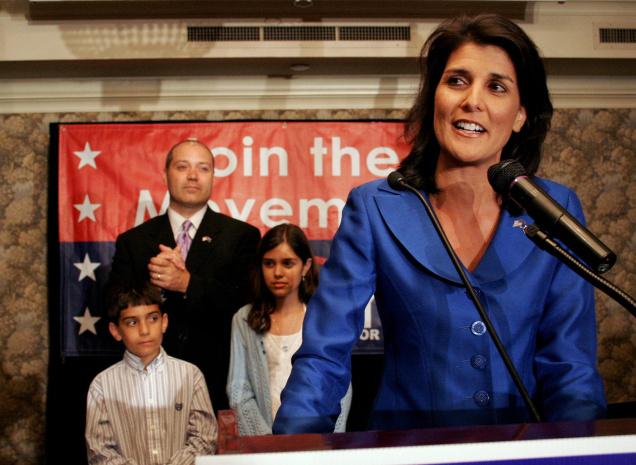
While all the six Indian American candidates running for the seats in US House of Representative are Democrats, leading the community is the Republican Nikki Haley who is running for the gubernatorial race.

Grandsons of Mahatma Gandhi and Sir Abdullah Haroon Appeal for Pakistan Flood Relief

As reported by The United Nations

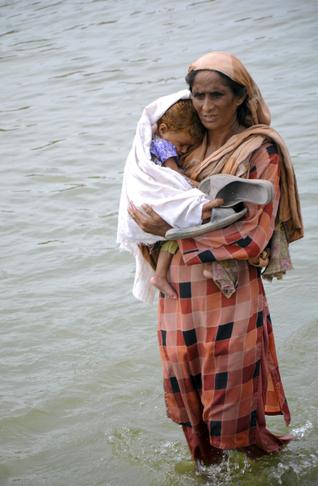
Miseries of millions unleashed by unprecedented floods in Pakistan brought together grandsons of two famous men in the Indian sub-continent to raise money for the sufferers.

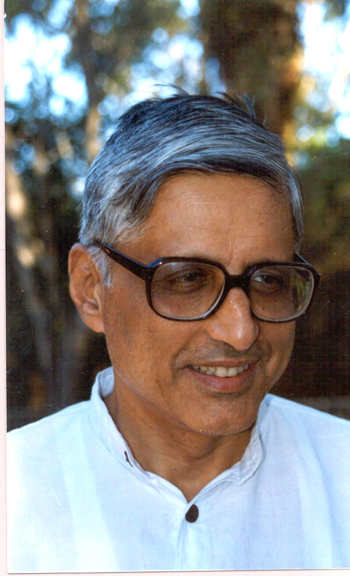
Rajmohan Gandhi, grandson of Mahatma Gandhi and Abdullah Hussain Haroon, Pakistani ambassador to the UN, reached across the lines of history to make a joint appeal here to people to open their wallets to help the flood devastated people of Pakistan.

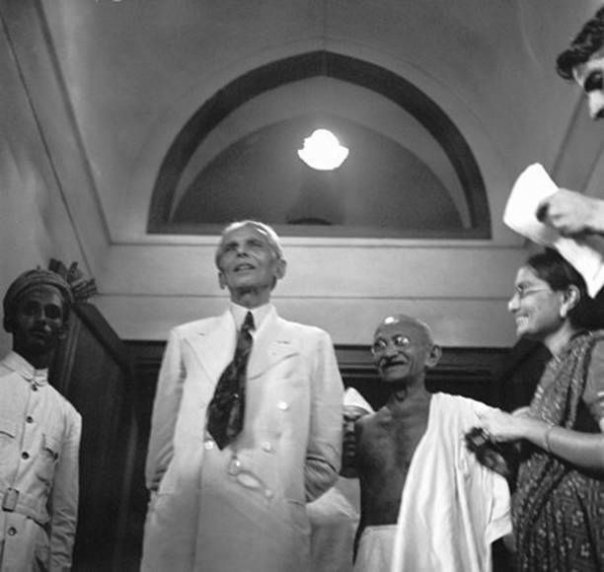
Acknowledging the gesture of Gandhi’s grandson, Hussain Haroon said Mahatma Gandhi was not only the father of nation to Indians, but also for Pakistanis and the people of entire sub-continent.

Appearing in a joint appeal at the UN headquarters, the Pakistani ambassador introduced Rajmohan saying “Mahatma Gandhi had a very special relationship with all of the Indian sub-continent and also the Muslims” and noted that their grandfathers were very personal friends.

Hussain’s grandfather Sir Abdullah Haroon was a close associate of Mohammad Ali Jinnah, whom the founder of Pakistan described as one of the strongest pillars of Muslim League.

But Haroon acknowledged that though Gandhi and his grandfather were on opposite side of the political spectrum, yet they had immense strength and respect for each other.

“My grandfather Sir Abdullah Haroon was a very personal friend of his (Gandhi), and when my grandfather passed away, we still have Gandhi’s letter where he said to my grandmother, I would have trusted your husband with a blank check,” Haroon said, making reference to the history.

And many a time Mahatma Gandhi proved his selflessness, he asserted.

“When I remember the fledgling Pakistani state did not receive its share from the then newly formed Indian government, the Mahatma went on a fast unto death in Delhi, and the Indian government had to buckle down and pay Pakistan its share,” the Pakistani ambassador acknowledged.

“When the Hindu-Muslim riots took place in Calcutta, he not only went there with Huseyn Shaheed Suhrawardy, he brought together both elements, and the rioting stopped in the city because he was fasting until it would stop. And people realised that it had to stop,” he said, adding it was because of one of these very reasons that he was assassinated.

Adding his voice to the appeal for generous support for the people of Pakistan, Rajmohan Gandhi said, “Now, in this catastrophe, as in all wars and conflicts, the poorest are once more the prime sufferers, losing not a portion of what they had, but all they had. Their sorrows are unrecorded, their heroism unsung, their pain unremembered. I pray that this flood will help us in South Asia to reorder our priorities.”

It’s Not Just Cricket

By Alan Black for The Huffington Post

The English in their empire conquests to India and Pakistan brought the game of cricket in their armory, best understood as complicated. With the pavilion hosting tea, the sound of the leather ball on the willow bat soon spread across the verdant lands of the subcontinent. The locals embraced a game played by spectacularly white men with unimpeachable manners, in spectacularly white clothes.

Today, India and Pakistan are as mad for cricket as they are for being at each others nuclear throats. Cricket has helped keep the peace by allowing Indians and Pakistanis to throw cricket balls at each other. But while democratic India has become a stage for Western capital and its values, Pakistan sinks deeper into a sticky wicket of terrorism, biblical style floods and now something disabling and disastrous for the nation’s identity — the Pakistani national cricket team, the pride of the nation, have been caught red handed in a betting scandal that has knocked the tea cups off the saucers, spoiling the cucumber sandwiches.

Currently, Pakistan is playing England at the home of cricket in London, a sporting venue grandly named Lords. Over the last weekend, a national UK newspaper revealed a sting operation conducted by undercover journalists, who paid a man around $250,000 for information on when certain Pakistan players on the field were going to cheat. The operative, it is claimed, is linked to illegal gambling syndicates. Sure enough, the players cheated on cue and the sounds of the London bobbies running to catch the villains came shortly after. Now, the Pakistanis require something slightly stronger than tea — high powered lawyers will be a start, maybe a stolen plane to make their getaway.

For years, Pakistani cricket has been suspect. Investigators in the past were stumped and failed to prove what seemed obvious to any sentient viewer — Pakistan was cheating, throwing games to cash in on payments from gambling crime, the cricket version of baseball’s Black Socks. Pakistan has been on the back foot over the claims denying it as a conspiracy against them. But this scandal has bowled them out. The News of the World has all the evidence on videotape. It’s irrefutable — in flagrante delicto.

The London police and cricket’s governing authority are using much diplomatic nuance at this stage of the criminal investigation, Only recently, the British Prime Minister David Cameron insulted Pakistan while he was visiting their enemy, India. And now this! Cheats at Lords, the home of English cricket. This stain on the linen will provide more ammo for the prejudice merchants loading another flare to fire at poor old Pakistan — how can you trust them?

Should Pakistan be banned from international cricket, somewhat unlikely but possible if the poison goes all the way to the top of their game, the impact back home will be enormous. For millions of Pakistanis, cricket is more important than life or death. It is Pakistan’s rope to the world. A chance to show how great they are at a tremendously demanding and skillful sport. Add one more disaster to a nation seriously down on its luck.