Archive for the ‘ Desi ’ Category

With Friends Like Pakistan…

By Manzer Munir for Pakistanis for Peace
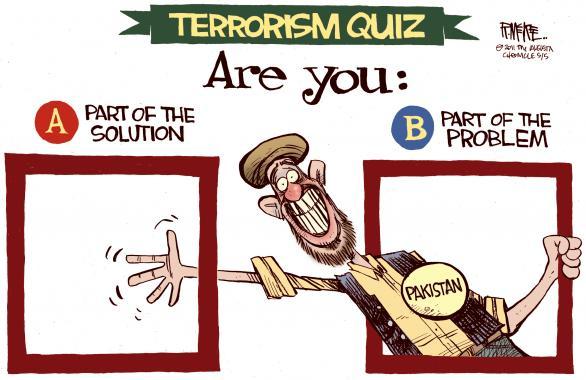
Many people in Pakistan these days are wondering why their nation often finds itself on the wrong side of recent history. First, there is the continued and unjust imprisonment of a Christian Pakistani woman named Asia Bibi who has been languishing in jail for nearly two years. She has been given a death sentence for allegedly making derogatory remarks about the prophet Muhammad.

Then there was the killing of Salman Taseer, who was the then sitting governor of Punjab, Pakistan’s most populous province, by one of his own bodyguards for his outspoken support for Asia’s rights and her freedom. Instead of swift punishment and public outcry at his actions, the killer, Malik Mumtaz Hussain Qadri, was showered with rose petals by some cheering members of the bar association of Lahore when he came to the courthouse for formal charges of murder. Yes, members of the judiciary were cheering his unilateral action of murdering another human being simply for his support towards a condemned non Muslim woman’s rights.

You can only imagine the warped sense of logic and justice in a country where lawyers cheer the cold blooded murder of an innocent man whose only crime was to come at the aid of a condemned Christian mother of two children.

Fast forward to a few months later, the extremists managed to assassinate the only Christian member of President Asif Ali Zardari’s government when the Minister for Minority Affairs, Shahbaz Bhatti, was killed in a hail of bullets by unknown gunmen who then managed to escape on their motorcycle. Bhatti being a Christian as well as a minister in the government, had campaigned for the release of Asia as well as for the repeal of the blasphemy laws in Pakistan that at help promote a culture of state sanctioned hatred against religious minorities in Pakistan.

The culture of fear and hatred as well as violence against the religious minorities has progressively gotten worse along with the security situation inside the country in the last ten years. If there is anything that has been proven by some of these recent events in Pakistan, it is only that the country has become the undisputed global hotbed of extremism, fanaticism, and Islamic militancy in the Muslim world. It has now morphed into a country where the Wahhabi and Salafi fanatics have successfully used fear and hate to silence the majority moderate Barelvi and Sufi Muslims of Pakistan.

When powerful moderate voices like those of Bhatti and Taseer are silenced despite having heavy protection, how safe can the common man feel about his life if he chooses to speak up against the radicals within Islam? To kill someone is against Islamic belief at its core, unless it is done in self defense but you would be hard pressed to hear that view from the religious fanatics in Pakistan. They have justified killing others over many insane reasons such as making derogatory remarks about Islam or the prophet Muhammad. They also rationalize the killing of someone over a family’s honor, thus honor killings where often young women are killed if they are deemed to have brought dishonor to their family. These radical Islamists will even want someone dead for simply uttering disparaging remarks against Islam or its prophet. It is both ironic and hypocritical to see that the same derogatory remarks towards other figures such as Jesus, Moses, Abraham or other prophets of the Quran do not meet the same outcry nor receive the same impassioned response from the masses as when Islam or its prophet Muhammad are criticized.

The seeds of this current fanaticism fanning the flames of hatred were planted during an earlier conflict, this one involving the Soviets against an under matched adversary in Afghanistan. It was during this time in the ā€˜80’s when the Pakistani dictator, General Zia ul Haq, was in power and he accepted American aid from the Reagan administration in thwarting the threat from the 1979 Soviet invasion of neighboring Afghanistan. At the time, Pakistan’s ISI worked very closely with these ā€œfreedom fightersā€ waging what many thought was a just jihad against a communist foe who disallowed all religious worship. In fact, a good movie to rent right now to put some of these current events in perspective would be Charlie Wilson’s War starring Tom Hanks which details this era of Pakistan-US relations and cooperation against a common enemy in the Soviets.

The trouble now however is that in this current uneasy alliance between Pakistan and the US, there is not a common enemy, at least not as how it is viewed by many in Pakistan, which recently was polled to be the most anti-American nation in the world. Even though radical Islam and fanaticism is as much a threat to Pakistan’s sovereignty and prosperity as it is to the United States, India has always been seen as the big threat by its army and rulers. Pakistan has long seen Afghanistan as a country offering it strategic depth in any future wars with India. Thus, its interests in Afghanistan do not coincide with those of the United States.

The Pakistani media also constantly feeds a steady news diet of bombings by the Taliban/Haqqani network as well as any one of the other fill-in-the-blank militants groups seemingly operating freely from within its borders. There is also the regular news reports of US drone attacks and NATO actions in the AfPak region, as well as the all ubiquitous and constant threat faced from India, who is still seething from the Mumbai bombings in 2008, which were blamed on Pakistani trained terrorists. To further add insult to their injury, not a single leader of the Lashkar E Taiba has been convicted in Pakistan for the attacks in Mumbai that claimed 174 deaths and seriously injured several hundred others.

To the Indians, the perpetrator of their version of 9/11 is not an Arab from Yemen named Osama, but rather a whole nation state with whom it has fought three wars in 60 years and who is a long time sworn enemy with which it shares a long border. Too often it is rightly assumed by many that Pakistan will not act against Lashkar E Taiba and other openly anti-Indian militant groups because these groups are seen as a strategic asset for use against India. Only the fear of an all out nuclear war between the two nations by a trigger happy Pakistan placated India enough so that New Delhi did not immediately take military action against Pakistan after the Mumbai attacks.

So this culture of fear from all enemies both foreign and domestic to Pakistan’s sovereignty is now at an all time high within the nation. With a several decade long war on its western border in Afghanistan as well as the constant threat from its arch enemy to the east in India, Pakistan has never felt more threatened or squeezed. This pressure is now only going to get ratcheted higher since last week’s killing of Osama Bin Laden at a compound in a suburb of Islamabad, Pakistan. Living for five years undetected in the compound, Bin Laden was less than a mile away from the Kakul Military Academy in Abbottabad, Pakistan’s version of the famed American military college of West Point, when he was killed by a US Navy Seal team.

For the world’s most wanted terrorist to hide in plain sight in such a manner and for so many years, rightly points a lot of suspicion on Pakistan. Long suspected by many intelligence analysts, elements within Pakistan’s spy agency, the ISI, naturally now attracts a lot of suspicion in their possible involvement in the whole affair. There are strong voices and calls within the US Congress to halt all aid to Pakistan in light of Bin Laden’s death. We certainly can assume that any other country in the world found to be harboring terrorists would already have been labeled a state sponsor of terrorism and would be facing immediate sanctions from the international community. ā€œYou are either with us or against usā€ were the words so famously uttered by then President Bush to Pakistan specifically after 9/11. But due to Pakistan’s importance for a successful pullout from Afghanistan of US troops, as well as its strategic position within the Islamic world, neither side can afford to cut off relations with each other.

Although the Obama administration stopped short of claiming that the corrupt civilian government of Zardari was directly involved in protecting and sheltering Bin Laden, all signs point to complicity to some extent by some segments within Pakistan’s hierarchy. There is near unanimous agreement among many in Washington, and this is true on both sides of the aisle, that there are many sympathizers of the Taliban and Al Qaeda within the ranks of the army and the intelligence agencies of Pakistan.

Having driven the Soviets out of the region with the help of militant jihadi groups like the Taliban, no doubt a cadre of army and intelligence officers must have come to espouse the belief that it is in Pakistan’s best interests to have a religiously frenzied force available to use as a weapon against India in a future conflict also. In fact, Pakistan has always had this policy of seeking strategic depth in Afghanistan against India.

The death of Osama Bin Laden in Pakistan by Special Forces of the American military illustrates just what a duplicitous game the country has been playing with the United States and more importantly with itself. In the war on terror America lost nearly 3,000 citizens in the attacks on 9/11. In that same period stretching the last ten years, Pakistan has lost nearly 31,000 citizens to terrorist attacks by the Taliban, Al Qaeda and other militant groups. So it has always been in Pakistan’s best interests to fight the militant threat brewing in its borders the last two decades that has claimed so many lives and caused so much instability.

The murders of Salman Taseer and Shahbaz Bhatti illustrates the dire situation within Pakistani society where many young underprivileged men gravitate towards Osama Bin Laden’s ideology of hate against the US, which is seen by many, as the aggressor in an already very anti-American country. Also western ideas, religious and political liberties, and freedoms, such as those for women in western society, are all seen by the Islamic clergy and religious establishment as being against Islamic doctrine and clashing with the Muslim way of life. Therefore, the madrassahs and the masjids continue to espouse rhetoric against the American and European way of life which is seen as contradicting the teachings of the Quran. Even moderate Muslims and their sites of worship have come under heavy attack by the militants as witnessed by a new strategy of attacking Sufi Muslim shrines and mosques. Pakistan may not want to admit it, but there is a raging war going on within itself for the control of Islam and the attack on moderate Islam by the extremists within the religion.

The Bin Laden killing makes Pakistan seem either highly incompetent about knowledge his whereabouts or at the very least appear to be deeply complicit in sheltering and keeping him hidden while the United States launched the biggest manhunt in US history. At this point, the United States justly feels betrayed and distrustful towards anyone in the Pakistani establishment. After all, how are they to know who now to trust in the army or the civilian government?

It is imperative that Pakistan mount an immediate and urgent investigation that has the full cooperation and assistance of the US so that both countries can discover the source of this support system that Bin Laden has had from within Pakistan. Certainly, some heads do need to roll in Islamabad over this. Whether those resignations be of the current ISI chief, Ahmad Shuja Pasha, head of the army, General Ashfaq Parvez Kayani, or Zardari and Gilani themselves, as some accountability needs to occur. This is important not just for the sake of American-Pakistani relations, but just as importantly for the benefit of the Pakistani populace who is both deeply embarrassed by breach of Pakistan’s sovereignty, but also for the intelligence failure by the government of Pakistan at Osama’s whereabouts. Until and unless Pakistan makes this investigation a top priority, USA and Pakistan relations will continue to slide downhill and will mire further in distrust.

Pakistan must realize that in this global war against religious Islamic fanaticism, it cannot continue to speak from both sides of its mouth. Not when everything, including its very existence is at stake. It cannot at once be both a front line ally in the war against terror and receive billions of dollars in US aid, and at the same time, be found to shelter or allow terrorists and militant organizations safe havens and allow them to operate within its territory.

It is up to Pakistan to salvage a quickly deteriorating situation. However at the time of publication of this article, it seems that President Asif Ali Zardari’s government is off to a horrible start in mending fences with the US. First the name and identity of the CIA station chief in Pakistan was leaked by someone in the ISI to members of the local press. This leak compromised his mission and even poses a danger to his life as the anonymity of all operatives is a necessary requirement in intelligence work.

Then later in the day, in remarks given by Pakistan’s Prime Minister Yousuf Raza Gilani to its Parliament, he defiantly stated that neither Pakistan’s army nor its intelligence agency should be suspected by the Obama administration for providing support to Bin Laden. Gilani also went as far as to say that any future unilateral action by the US or any other nation inside Pakistan’s territory will be met with like force. I thought to myself, did he really just that? Did Pakistan just threaten the United States? It is appalling to see the political posturing now being done by the Pakistani government and the long term negative consequences they will have on the nation.

For a country that is receiving nearly $3.5 billion in US aid yearly, these are very tough words that will undoubtedly only make the strained relations between the two countries worse. Pakistan should realize that United States wants to feel that it can trust it to be a full partner in the fight against militancy and extremism. And unless this distrustful and at times, very adversarial relationship changes, the United States cannot help but feel that with friends like Pakistan, it does not need enemies!

-Manzer Munir, a proud Pakistani American and peace activist, is the founder of Pakistanis for Peace and blogs at http://www.PakistanisforPeace.com as well at other websites as a freelance journalist and writer.Ā 

Pakistan’s Hypocrisy Has Run Its Course; It Needs A New Relationship With U.S.

By Ahmed Humayun
Best Defense department of frenemy relations

The U.S.-Pakistan relationship has long been volatile, but recent weeks have witnessed an unprecedented level of open discord between the two countries. On April 11, Lt. Gen. Ahmad Pasha, the head of Pakistan’s ISI, met with American officials and demanded that the United States sharply limit its counterterrorism efforts inside Pakistan. Just two days later the CIA launched drone strikes in Pakistan’s tribal areas, provoking angry protests from Pakistani officials. And in a sign that Washington is determined not to back down, last week Admiral Mullen, chairman of the Joint Chiefs, publicly chastised the ISI for its “longstanding relationship” with the Haqqani network, one of the prime targets of the drone campaign.

Pakistan’s recent criticisms are partially a response to the rising public backlash against America’s counterterrorism operations. Till now, Pakistan has tacitly cooperated with the drone campaign while reluctantly permitting a few CIA agents and special operations forces to enter the country. At the same time, Islamabad has publicly denied cooperating with Washington due to domestic political sensitivities. In the aftermath of the Raymond Davis incident, however, this always-fragile pretence has become untenable. (Raymond Davis, a CIA contractor, killed two Pakistanis with possible links to the ISI in broad daylight in January. Three months later, the subsequent media frenzy has not diminished. )

No state wants its territory to be a hunting ground for covert foreign operatives. Still, the fulminations of some in Pakistan omit critical context. The Pakistani state’s ambivalent attitude towards extremist groups — acting against some while tolerating or supporting others — has forced the United States to take proactive action. The rights of sovereignty also come with duties: if Pakistan is indulgent of or incapable of acting against anti-American terrorist groups, then foreign preventive counterterrorism should be assessed more soberly by Pakistanis.

To complicate matters further, elements in Pakistan’s security establishment have deliberately stoked public sentiment. Extensive leaks to the Pakistani press about the government’s demands to the United States hint at a desire to exert pressure on Washington through exploiting populist anger. For the ISI, this diplomatic crisis is a unique opportunity to obtain long desired strategic concessions from the United States. Among other things, the ISI does not want militant groups favored by Islamabad under America’s microscope — especially those perceived to defend Pakistani interests in Afghanistan.

This is a dangerous strategy. It is premised on the mistaken assumption that the United States is unwilling to increase pressure on Pakistan. If the Pakistani government faces domestic political constraints, this is no less true of the United States. Sentiment in the U.S. Congress is already heavily tilted against Pakistan. If reports about Pakistan’s entanglement with extremist groups persist, or in the worst case scenario, an attack on the United States by a Pakistan-based terror group succeeds, Washington will find it difficult to avoid taking harsh actions. Loose talk by some Pakistani politicians about cutting off supply routes to U.S. forces in Afghanistan is similarly self-defeating. It is in Pakistan’s long-term interests to prevent an irrevocable rupture with the United States.

At the same time, Washington should appraise the scope of its direct counterterrorism drive within the broader effort to stabilize Pakistan. According to U.S. officials, the drone campaign has been remarkably successful in weakening militant networks; in private, some Pakistani military and political leaders also acknowledge the program’s efficacy. That may be the case, but displays of U.S. coercive force on Pakistani soil — especially those involving U.S. personnel on the ground — have also accentuated the most extreme tendencies in that country’s public discourse. They have empowered those in Pakistan who maintain that the war on terror is America’s war, not Pakistan’s struggle, and that the United States has fundamentally hostile aims towards Pakistan.

Policymakers might shrug their shoulders at conspiracy theories. That would be short-sighted. The fact is that the United States cannot directly extinguish the threat posed by Pakistan-based terrorism. U.S. forces can certainly kill a few extremists through drone strikes or ground operations. But the militant threat is geographically dispersed: not only do insurgent sanctuaries infest the isolated border regions, terrorist networks are also embedded in the heavily populated areas of the Punjabi heartland. Some of these groups have deep roots stretching back decades and enjoy local political cover. Kinetic action by a deeply unpopular foreign power will not uproot them.

The single most decisive factor in disrupting Pakistani militancy will be the willingness of the state and society to commit to a long-term struggle. Only Pakistan can overcome the jihadi Frankenstein it has spawned through a combination of stepped up military force, political dialogue, and local governance. The impact of U.S. policies on the internal Pakistani debate about militancy should therefore be factored heavily into Washington’s policymaking calculus.

Pakistan is making progress — however halting or incomplete — in adopting a more robust anti-militant posture. Since 2009, its military offensives in the tribal areas have degraded insurgent sanctuaries at a heavy price in blood and treasure. Pakistani intelligence has also helped the United States capture numerous high-level al Qaeda operatives. The Obama administration’s economic assistance to Pakistan and its diplomatic efforts to stabilize the country’s fractious politics have contributed to these advances. Going forward, the core policy challenge is to generate the political will inside Pakistan that will expand these activities. Right now, Washington’s ability to do so is vitiated by Pakistani paranoia.

In the short term, Islamabad and Washington need to negotiate a new counterterrorism relationship. The old strategy of ambiguous private compromise veiled by public dissembling has run its course. Pakistan’s legitimate concerns should be weighed against the immediate threat to the American homeland and to U.S. forces in Afghanistan. This is a herculean task given the underlying strategic differences, but the alternative is likely to be much starker.

Ahmed Humayun is a fellow at the Institute for Social Policy and Understanding (ISPU) and senior analyst at Georgetown University’s Emerging Threats Project. He can be reached at ahmed.a.humayun@gmail.com .

Pakos- Pakistan Zindabad

Khan Enjoys Early Finish

From Sky Sports

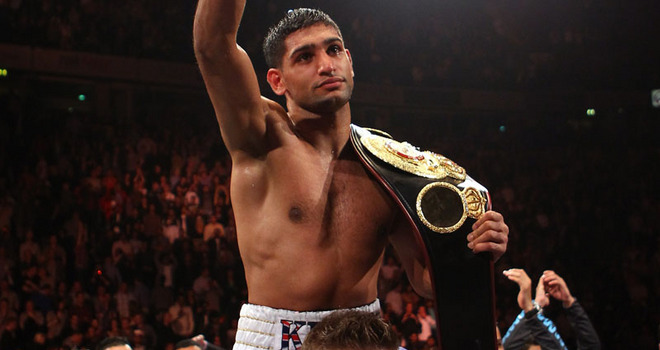
Amir Khan retained his WBA light-welterweight title after a controversial technical points decision over Paul McCloskey in Manchester.

The bout was halted during the sixth round after the challenger was deemed unable to continue due to a cut caused by a clash of heads. Khan was a unanimous victor on the scorecards, with all three judges awarding him a comfortable 60-54 win.

McCloskey’s awkward southpaw style meant the champion did not have it all his own way but there was no doubt who was on top at the time of the fight’s premature end.

But after the contest there was protestations from the McCloskey camp that the cut was not bad enough to warrant the stoppage.

The opening stages of the contest were tentative, with Khan looking to come forward but finding his fast hands matched by the reflexes of the previously unbeaten McCloskey.

Khan looked to be more settled in the second as he landed in bunches, but McCloskey stood firm and landed a left of his own at the end of the round. The challenger even had Khan on the back foot at times and caught him with another winging left hand in the third.

Khan began to fire again in the fourth, landing a sharp right and crisp left before attacking with hooks in the early stages of the fifth. McCloskey’s defences seemed to be weakening in the sixth as Khan landed an impressive flurry but the fight was soon over.

After an accidental clash of heads, referee Luis Pabon called for the doctor, who advised the official to bring an end to the bout.

On the undercard, Leicester binman Rendell Munroe made a winning return to action after his unsuccessful world title challenge by claiming a unanimous points win over Andrei Isaeu.

Craig Watson lost his British welterweight title to Lee Purdy the later claimed a fifth-round stoppage win in their contest.

The ā€œIndo-Pak Expressā€ Overthrows No. 2 Seeds to Reach Semis in Monte Carlo

By Erin Frauenhofer for 10SBalls.com

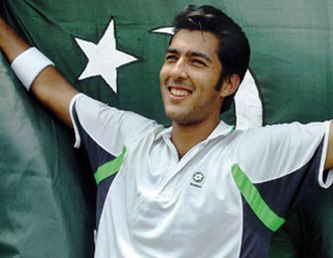
The India/Pakistan pairing of Rohan Bopanna and Aisam-ul-Haq Qureshi made waves at the Monte Carlo Masters with a quarterfinal upset over No. 2 seeds Daniel Nestor of Canada and Max Mirnyi of Belarus. With a 6-1, 7-5 victory on Friday, the sixth-seeded duo advanced to Saturday’s semifinals, where the pair will play Argentina’s Juan Ignacio Chela and Brazil’s Bruno Soares.

Bopanna and Qureshi took command in the first set, breaking Nestor’s serve and holding steady on their own serve to take a 4-1 lead. The ā€œIndo-Pak Express,ā€ as the pair has been dubbed, remained in control for the rest of the set, breaking Mirnyi to give Qureshi the opportunity to serve for the set. Bopanna and Qureshi won the game to wrap up the first set handily, in only 21 minutes.

Nestor and Mirnyi displayed a stronger performance in the second set, after suffering an early break to fall behind 1-2. They rallied back to break Bopanna and Qureshi in the next game, and both pairs held serve for the next four games, until Nestor and Mirnyi were broken once again.

At 5-4, Bopanna and Qureshi had their first chance to serve for the match, but Nestor and Mirnyi battled back to even the score with a break. Bopanna and Qureshi retaliated in the next game with another break to take a 6-5 lead.

Serving for the match for the second time, with victory nearly in sight, Bopanna and Qureshi dropped the first two points of the game but recovered to close out the match. Bopanna and Qureshi broke their opponents a total of five times during the match and lost their serve twice.

Friday’s win was the second victory of the tournament for Bopanna and Qureshi. After receiving a bye in the first round, Bopanna and Qureshi notched a 7-6 (4), 6-3 win over the American/Netherlands Antilles duo of Eric Butorac and Jean-Julien Rojer to reach the quarterfinals.

Chela and Soares have recorded three wins in the tournament thus far. The duo took a straight-set win in the quarterfinals, defeating Ukranian Sergiy Stakhovsky and Russian Mikhail Youzhny, 6-4, 6-3. In the previous round, the pair upset No. 8 seeds Robert Lindstedt of Sweden and Horia Tecau of Russia by a score of 6-2, 6-4. Earlier, Chela and Soares had prevailed in a three-set first-round match, outlasting Michal Mertinak of Slovakia and Dick Norman of Belgium, 6-2, 3-6, 10-7.

Monte Carlo is the first clay-court Masters tournament for the Indo-Pak Express, and the duo has high hopes for the French Open. Bopanna and Qureshi’s strong showings this year and efforts toward peace between their countries have earned them an enthusiastic and steadily growing following.

Bopanna and Qureshi have made recent headlines for their request to play an exhibition match on the India-Pakistan border in an attempt to foster reconciliation efforts between the two nations. As part of a ā€œStop War, Start Tennisā€ campaign, the duo plans to string a net across the Wagah border crossing and switch sides during the match.

Religious Harmony: Thousands of Indian Sikhs Arrive for Baisakhi

As Reported By The Express Tribune

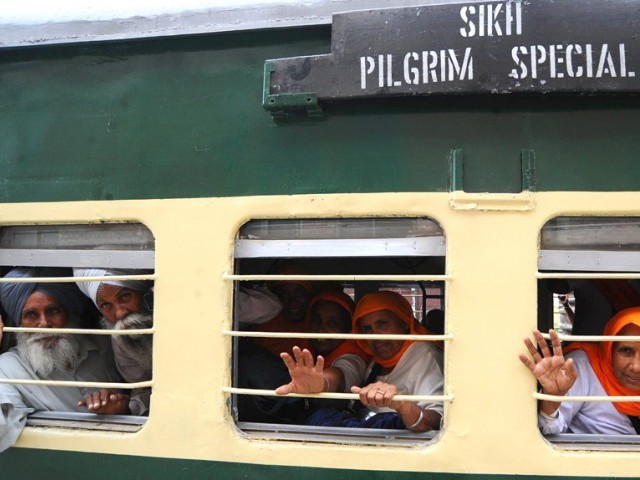
Over 2,000 Sikh yatrees from India arrived at the Wagah railway station on Monday to attend the 312th Baisakhi festival.
The pilgrims, who arrived via special trains, will be taken to the recently-renovated

gurudwara at Punja Sahib in Hassan Abdal where the festival begins today (Tuesday). As many as 13,000 Sikh men and women, from Pakistan and India, are expected to participate in the festival, which marks the commencement of the Sikh new year.

On April 14, the pilgrims will go to Nankana Sahib, the birthplace of Guru Nanak, and return to Dera Sahib, Lahore, on April 17. They will also visit Dera Rohri Sahib, Aimanabad, and Kartarpur in Narowal, before they return to India on April 20.

The Evacuee Trust Property Board (ETPB) has made special arrangements to provide free transport, accommodation and food to the pilgrims during their 10-day stay. Stalls of immigration, customs and a medical camp have been set up at the railway station.

India Continues to Dominate Pakistan’s Strategic Thinking: US

As Reoported By The Times of India

Pakistan’s efforts to launch a comprehensive fight against terrorism are greatly hampered by its perceived threat perception against India, US President Barack Obama has said in a new report to Congress.

“As India continues to dominate their strategic threat perception, large elements of Pakistan’s military remain committed to maintaining a ratio of Pakistani to Indian forces along the eastern border,” Obama said in the third-quarterly report to the Congress on Afghanistan and Pakistan sent yesterday.

“This deprives the Pakistani COIN (counter-insurgency) fight of sufficient forces to achieve its ‘clear’ objectives and support the ‘hold’ efforts and causing available Army forces to be bogged down with ‘hold’ activities because there are insufficient trained civilian law enforcement personnel to assume that responsibility,” Obama said in his 38-page unclassified (rpt) unclassified version of the report.

Due to flood in Pakistan last year the offensive military operations Pakistan had envisioned for KP (Khaibar Pakhtoonwah) and the Federally Administered Tribal Areas (FATA) in the second half of 2010 were overtaken by events, he said.

“Militants were impacted by the floods as well, so we did not observe significant offensive actions on their side, but as Pakistani forces ceased offensive operations, extremists extended their control to areas without sufficient Pakistani central government-provided security and governance,” he wrote.

Between October 1 and December 31, 2010, Obama said Pakistani security forces remained largely static, generally focusing on maintaining the security of previously cleared areas in the FATA and KP and continuing to support flood relief operations.

There were small but notable security operations in November and December in Orakzai Agency and Dir District, but no major operations.

National attention during the reporting period focused on the need for continued flood relief and the start of early recovery efforts, he said.

“The military served as a force of stability during the monsoons, ensuring that Pakistani and international emergency resources were available for rescue and relief operations. The Pakistan Army, Air Force, and Navy committed large numbers of personnel and resources to the flood relief operations throughout October and November,” he said.

The civilian government’s response suffered from a lack of coordination and reflected broader shortcomings in the government’s ability to execute the civilian “hold” and “build” phases of COIN.

The last quarter of 2010 saw no progress on effectively executing the COIN cycle in KP and the FATA.

India’s World Cup Cricket Victory: The Measure of a Nation

By Gethin Chamberlain for The Guardian

It is 3pm in a small British bar in the tourist state of Goa about 550km south of Bombay – where the country’s cricketers are harrying Sri Lanka’s batsmen in the early overs of the World Cup final.

It is 28 years since India last won this most cherished of titles in a nation so crazy about the game. There are fewer than nine hours to go until it does so again. But we don’t know that yet.

Mohinder Amarnath, the man of the match in the 1983 World Cup, is certain, however, that the moment has arrived to repeat his team’s success. Every Indian can realise their dreams through the 11 men on the field today, he says.

He need not have worried. Corrin, the eponymous owner of the Goan bar, is reaching for a brush, and dipping it into the pot of orange acrylic paint on the table in front of her. She holds the arm of the little Indian girl in front of her, draws the first rectangle of the national flag, hands the brush to Sonny, the barman, and watches him draw the white and green stripes. The girl, the daughter of the beautician who runs the shop upstairs, beams, delighted, and skips away to show off her affirmation of support for the home team.

In the street outside, a truck thunders by, horn blaring, Indian flags fluttering in from the cab. The picture is repeated across the country; millions are glued to their televisions or radios, donning their replica shirts, daubing themselves in the national colours. India is partying; each successful delivery from its bowlers greeted by a round of beating drums. The country that has made cricket its national game is certain that this year, finally, it will capture the ultimate prize, the World Cup.

India is certain that this is no more than it is due. It has already celebrated what many in the country regard as the real final, victory over its most reviled opponent, the notoriously unpredictable – unless you happen to be a friendly bookmaker – Pakistan team, which on Wednesday managed to throw away a magnificent bowling performance to lose ignominiously.

And India was desperate for this victory; the humiliation of the Commonwealth Games corruption scandal was still fresh; the country’s recent diplomatic successes – not least towards a permanent seat on the UN Security Council – has been overshadowed by fresh concerns about its aspiration to be regarded as a first world nation.

This is a nation demanding international approval: buoyed by the news that projections now show it will overtake China as the world’s most populous nation by 2030, there is a sense that its time has come.

As Saturday dawned, prayers were said, puja [offerings to the gods] were made, anything to give the Indian team an edge. Across the country, people painted themselves in the blue of the national team strip or in the orange, white and green of the flag, and prepared to party.

Bars and hotels hiked prices and charged admission to the more rarefied environments. In many places, TV screens were set up and even when the big screen was not an option, the nation gathered anywhere that a television was on, peering over each other’s shoulders to catch a glimpse of the match.

In Corrins’, even Sonny was applauding as Sri Lanka upped the ante in their final overs, smashing the ball hither and thither. Then a nation of – according to the new census figures – 1.2 billion fell silent as top batsman Sehwag fell to the second ball of the Indian innings.

Yet important as the game was, some felt that there was a sense of anticlimax after the Pakistan game. “The excitement among people is lacking,” Manoj Kumar, a hotel manager, told the Times of India.

Not so among the Sri Lankans, who had sidled into the final without the fireworks of the Indian progress. Captain Kumar Sangakkara pulled no punches when he explained what it meant to a country even more desperate for international approval after the end of three decades of bloody civil war: “It means everything. We have come through a very tough period. A lot of people have laid down lives for our country. In this new future, hopefully we can take home the World Cup, and that will be even more occasion for celebration.”

Gautam Gambhir, the Indian batsman who stabilised the nation’s innings after the loss of influential opener Sehwag, was no less compelling when he told a news channel that India had to win to honour the dead of the 2008 terrorist attacks in Mumbai: “For me it will be dedicated to the people who lost their lives in the 26/11 massacre.”

For India, the desire to be taken seriously by other nations in sport is perhaps more important than diplomatic point-scoring. Like its neighbour China, it has been unable to translate a mass of bodies into international sporting success. In terms of international trade, it has come on in leaps and bounds, yet still it is unable to project that power into other fields.

Such desperation for success was reflected in the way many in the country fell back on superstition in their desire to ensure success. One fan, Ritangshu Bhattacharya, from Delhi, assured journalists that he would be attempting to tip the odds in India’s favour by defying nature: “I won’t pee in the entire match… I feel whenever I go to the loo, a wicket falls or India drops a catch.”

Even his stoicism was outdone by one politician from the state of Madhya Pradesh, who stood from 10am to 10pm during the India-Pakistan match.

In Corrins’, there is no doubt about who should have won: “You have to support the team, don’t you?,” she said. “We live here, we have to support the local team, however it goes.”

It is 10.45pm, and MS Dhoni, the Indian captain, is hammering the ball to the boundary again. Six to win, two overs. There are fireworks going off everywhere, drowning out the commentary. India knows it has won. It is the Pakistan game all over again: victory from defeat, India defiant.

Six runs, and he smacks it over the boundary. The fireworks explode. In the cities, there is madness; in the villages, too, people are hugging and screaming. The firecrackers are exploding, the night a blur of colour. India wins.

India, Pakistan back to bickering after Mohali bonhomie

As Reported by IBN Live

India and Pakistan had a brief bout of acrimony with both complaining that a staffer each posted at their diplomatic missions in Islamabad and New Delhi respectively were detained by the host country and later let off.

While Pakistan today claimed that a driver of its mission in New Delhi was “arrested” for unspecified reasons on Wednesday, the Ministry of External Affairs took up the matter of a ‘missing’ Indian High Commission official in Islamabad. “A driver from the High Commission was arrested. (He) has been released. We have protested,” Pakistan Foreign Office spokesperson Tehmina Janjua told PTI in Islamabad, without giving details.

However, sources in New Delhi said that on Wednesday evening a Pakistani High Commission driver was seen near the Chandigarh cantonment area and when confronted, he tried to escape. “In the process, he sustained some bruises/injury on his knee and back. He was questioned and thereafter released.Before being released, a medical check-up was conducted which showed him in good health,” sources told PTI.

Just hours after the incident, an official in Indian High Commission went ‘missing’ in Islamabad, sources said, adding there was no immediate official confirmation on his whereabouts from the Pakistan side. However, the media reported detention of the Indian official, prompting Foreign Secretary Nirupama Rao to take up the matter with her Pakistani counterpart Salman Bashir. “Apart from Indian High Commission raising the issue with Pakistan Foreign Ministry in Islamabad, the Ministry of External Affairs in New Delhi took up the issue with Pakistan High Commission seeking the safety, security and well-being of the Indian official,” sources said.

The official was later handed over to the Indian High Commission in Islamabad, sources said. Though the sources did not divulge the name of the Indian official, some reports identified him as Anand Sharma, working in the consular section of the High Commission.

The incident involving the Pakistani driver occurred at a time when the Prime Ministers of India and Pakistan were in Mohali, holding “extremely positive” conversation on the sidelines of the pulsating cricket World Cup semi-final between the two countries. The incident of the Indian official was being seen as a tit-for-tat to the Chandigarh incident.

How Can India Beat Pakistan?

By Will Davies for The Wall Street Journal

It’s the million dollar question that a billion people are asking: How can India beat Pakistan? Setting aside the obvious answers such as score more runs and get more wickets, there are some key areas where India can gain an advantage over its fiercest rival.

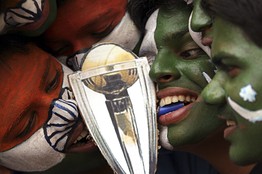
Indian and Pakistani cricket fans with a replica of the Cricket World Cup trophy. Unsettle Shahid Afridi – Pakistan’s captain has been an inspirational presence at this World Cup. He is the tournament’s leading wicket taker, with 21 scalps already to his name, comfortably ahead of the second-top bowler, India’s Zaheer Khan on 17. Afridi oozes charisma but he is prone to tantrums – it’s not uncommon seeing him shouting at teammates when things go wrong in the field, as is all too often the case with Pakistan – so India should try to frustrate him. Afridi is the nerve center of the Pakistan team, and if he is exasperated then negativity will spread to the other players.

Nullify Umar Gul – Afridi may have taken the most wickets, but Gul has been Pakistan’s most lethal pace bowler and looks on top of his game with 14 wickets (joint fifth with South Africa’s Imran Tahir in the tournament rankings). Gul has been so important to Pakistan’s campaign, particularly bearing in mind the team was stripped of two key bowling assets – Mohammad Asif and Mohammad Amir – ahead of the World Cup. The track at Mohali should favor pace bowlers over spin (will this mean we’ll see the Rawalpindi Express Shoaib Akhtar?), so the Pakistanis will be heavily reliant on another good showing from Gul, who has been effective with both the new and the old ball. If India’s excellent batsmen can nullify the ever aggressive Gul, Pakistan’s armory will be significantly weakened.

Silence Younis Khan – The big-hitting middle-order batsman has had a relatively quiet World Cup by his standards, scoring 172 runs in six innings, though that includes a 72 against a very fine Sri Lanka. He often saves his best for India so the co-hosts should be on guard if or when he comes to the crease. Out of his six career centuries, three have been made against India, including one at Mohali, the venue for Wednesday’s semifinal. India will do well to keep him contained.

Bat to Potential – India has a wonderful batting lineup but there’s a nagging feeling we haven’t seen the best of it at this World Cup. Sachin Tendulkar, Virender Sehwag and Yuvraj Singh are among the tournament’s top 10 run scorers, but India’s other batsmen haven’t consistently backed up the trio’s good work. Captain Mahendra Singh Dhoni hasn’t done much at all with the bat – his top score so far is 34 – though he has often come to the crease when his only option was to have a bit of a slog. All the batsmen in this star-studded lineup will need to play at least one great innings if India is to beat Pakistan and go on to win the World Cup final in Mumbai on April 2.

Support Zaheer Khan – India’s bowling was seen as a weakness at the start of this World Cup and it remains a concern. Zaheer Khan has been a revelation but the other pace bowlers need to give him better support. Munaf Patel was targeted by the Australians, particularly Brad Haddin, and it will be interesting to see if India’s coach Gary Kirsten selects him for the semifinal. Shanthakumaran Sreesanth and Ashish Nehra could get a call-up, but both have had their problems this tournament. Left-armer Nehra was hurt in the match against South Africa when he failed to defend 13 runs in the final over, while Sreesanth hasn’t featured since the opening match against Bangladesh when he returned disappointing figures of 0 for 53 from just five overs.

Kamran Akmal – It’s harsh to single out the Pakistani wicket-keeper, but he is prone to lapses that make him look like he has smeared his gloves in butter. Akmal put in a much improved performance in the quarterfinal against the West Indies, but India will be hoping he has another bad day at the office and gives the hosts a few reprieves.

Ignore the hype – Ok, that’s like telling a skydiver to relax and enjoy the view after his parachute has failed, but India must try to focus on the task at hand and not get carried away by the enormity of this match and the weight of expectation from a billion or so fans.

And how can Pakistan beat India?

Hide Sachin Tendulkar’s bat.

Also, Pakistan needs to silence the home crowd. The stadium in Mohali is small, with capacity for only 27,500 spectators, but they’ll be so loud it’ll seem like there are 10 times that many people. If Pakistan gets some early wickets or an early batting partnership, the home crowd will become restless and that will put India under pressure. Pakistan has the quality and talent to beat the best in the world, but it’s the kind of side that needs momentum and confidence. That will come if the team unsettles India early in the match.

Still, hiding Tendulkar’s bat wouldn’t be a bad tactic. And while they’re at it, they should probably take Sehwag’s and Yuvraj’s too.

Islamophobia and Radicalization

By James Zogby for Counter Punch

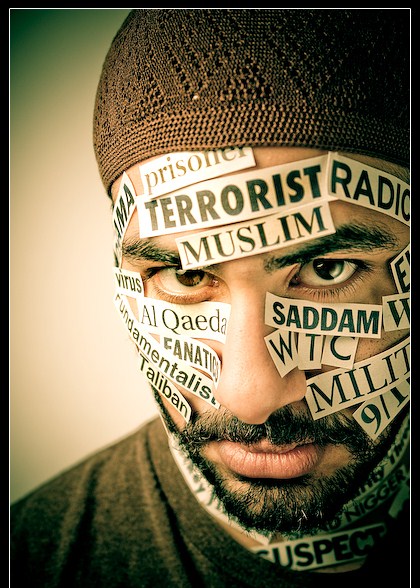
Let me state quite directly: Islamophobia and those who promote it are a greater threat to the United States than Anwar Al-Awlaqi and his rag-tag team of terrorists.

On one level, Al-Awlaqi, from his cave hide out in Yemen, can only prey off alienation where it exists. Adopting the persona of a latter-day Malcolm X (though he seems not to have read the last chapters of the “Autobiography” or learned the lessons of Malcolm’s ultimate conversion), he appears street-smart, brash, self- assured and assertive — all of the assets needed to attract lost or wounded souls looking for certainty and an outlet for their rage. Like some parasites, Al-Awlaqi cannot create his own prey. He must wait for others to create his opportunities, which until now have been isolated and limited: a disturbed young man here, an increasingly deranged soldier there.

Islamophobia, on the other hand, if left unchecked, may serve to erect barriers to Muslim inclusion in America, increasing alienation, especially among young Muslims. Not only would such a situation do grave damage to one of the fundamental cornerstones of America’s unique democracy, it would simultaneously and rapidly expand the pool of recruits for future radicalisation.

I have often remarked that America is different, in concept and reality, from our European allies. Third generation Kurds in Germany, Pakistanis in the UK, or Algerians in France, for example, may succeed and obtain citizenship, but they do not become German, British or French. Last year, I debated a German government official on this issue. She kept referring to “migrants” — a term she used to describe all those of Turkish descent living in her country — regardless of the number of generations they had been there. Similarly, following their last election, a leading British newspaper commented on the “number of immigrants” who won seats, without noting that many of those “immigrants” were third generation citizens.

America has prided itself on being different. Being “American” is not the possession of a single ethnic group, nor does any group define “America”. Not only do new immigrants become citizens, they also secure a new identity. More than that, as new groups become American and are transformed, the idea of “America” itself has also changed to embrace these new cultures.

Within a generation, diverse ethnic and religious groups from every corner or the globe have become Americans, dramatically changing America in the process. Problems remain and intolerant bigots, in every age, have reared up against new groups, but history demonstrates that, in the end, the newcomers have been accepted, incorporated and absorbed into the American mainstream.

This defines not only our national experience, but our defining narrative as well. When immigrant school children in Europe learn French, German or British history, they are learning their host’s history. In the US, from the outset, we are taught that this is “our new story” — that it includes all of us, and has included us all, from the beginning.

It is because new immigrants and diverse ethnic and religious communities have found their place and acceptance in the American mainstream that the country, during the last century, survived and prospered despite being sorely tested with world wars, economic upheaval and bouts with internal strife. During this time we had to contend with anti-black, anti-Asian, anti-Catholic, anti-Jewish, anti-immigrant, and anti-Japanese movements. In the end, after creating their moment of pain, these efforts have always lost.

They lose, but they don’t always go away. The Islamophobia we are witnessing today is the latest campaign by bigots to tear apart the very fabric of America. We know the groups promoting it. First, there is the well-funded “cottage industry”, on the right, of groups and individuals with a long history of anti-Arab or anti-Muslim activity. Some of the individuals associated with these efforts have been given legitimacy as commentators on “terrorism”, “radicalisation” or “national security concerns”, despite their obvious bias and even obsession with all things Arab or Muslim (in this, they remind me of good old-fashioned anti-Semites who never tired of warning of Jewish threats or conspiracies or who while always claiming to like individual Jews rallied against any and all Jewish organisations).

If these “professional bigots” have provided the grist, the mill itself was run by the vast network of right-wing talk radio and TV shows and websites, and prominent preachers who have combined to amplify the anti-Muslim message nationwide. Their efforts have done real damage. They have tormented decent public servants, created protests that have shuttered legitimate institutions, fomented hate crimes, and produced fear in the Muslim community.

In just the past two years, we have seen a dramatic upsurge in the activity of these bigots. More ominously, their cause has been embraced by national political leaders and by elements in the Republican Party, who appear to have decided, in 2010, to use “fear of Islam” as a base-building theme and a wedge issue against Democrats for electoral advantage.

In the past, only obscure or outrageous members of congress (like North Carolina’s Sue Myrick who expressed nervousness and insecurity because of “who was owning all those 7/11’s”; or Colorado’s Tom Tancredo who once warned that he “would bomb Mecca”) were outspoken Islamophobes. After the National Republican Congressional Campaign Committee embraced opposition to Park 51 as a campaign theme, it is hard to find a leading Republican who has not railed on some issue involving Islam or Muslims in the US.

The net impact here is that this current wave of Islamophobia has both played to the Republican base while firming up that base around this agenda. The polling numbers are striking and deeply disturbing. Some 54 per cent of Democrats have a favourable attitude towards Muslims, while 34 per cent do not. Among Republicans, on the other hand, only 12 per cent hold a favourable view of Muslims, with 85 per cent saying they have unfavourable views. Additionally, 74 per cent of Republicans believe “Islam teaches hate” and 60 per cent believe that “Muslims tend to be religious fanatics”.

The danger here is that to the degree that this issue has become a partisan — and in some cases a proven vote getter — issue for the Republican Party, it will not go away any time soon. The longer we are plagued by this bigotry, and the displays of intolerance it breeds (the anti-mosque building demonstrations or the anti-Sharia law efforts now spreading across the country) the longer young Muslims will feel that the “promise of America” does not include them, and they will feel like aliens in their own country.

It is this concern that has prompted many inter-faith religious groups and leaders and a diverse coalition of ethnic and civil rights organisations to so vigorously oppose Congressman Peter King’s (R-NY) hearings that will deal with the radicalisation of American Muslims later this week. They know, from previous statements made by King, of his personal hostility to American Muslims. They also know that what King is doing will only aggravate an already raw wound, creating greater fear and concern among young Muslims who have already witnessed too much bigotry and intolerance.

What they should also know is that in the process of targeting a religion in this way, and engaging in this most “un-American activity”, King and company are, in fact, opening the door for increased alienation and future radicalisation. Al-Awlaqi must be smiling from inside his cave.

-Dr James Zogby is president of the Arab American Institute and is a Roman Catholic of Lebanese descent and brother of prominent American political pollster and founder of Zogby Polls, John Zogby.

In Pakistan, Justifying Murder for Those Who Blaspheme

By Aryn Baker for Time

“I believe in Jesus Christ who has given his own life for us,” the doomed man said, staring straight into the video camera. “And I am ready to die for a cause.” Shahbaz Bhatti had no hesitation in his voice as he responded to a question about threats from the Taliban and al-Qaeda. “I’m living for my community … and I will die to defend their rights.” It was his last answer in a four-month-old self-produced video that was to be broadcast in the event of his death. But the radicals had the final say. On March 2, Bhatti, Pakistan’s Minister for Minority Affairs, was shot dead in Islamabad. Pamphlets scattered on the ground claimed the act for a new alliance of “the organization of al-Qaeda and the Punjabi Taliban” and asserted that other infidels and apostates would meet the same fate.

Bhatti’s death had been foretold not just by himself but also in the nation’s response to a previous assassination, that of Punjab governor Salmaan Taseer on Jan. 4. Taseer, a self-made millionaire, had turned his largely ceremonial post into a platform for a campaign to amend Pakistan’s blasphemy laws. Bhatti, the only Christian in the Cabinet, refused to be a token and swore to battle intolerance. Both men supported clemency for Aasia Noreen, a Christian woman who had been accused of blasphemy and sentenced to death. Taseer’s stance on the issue infuriated a large part of the population that, thanks to religious leaders and school curriculums, believes that blasphemy is a sin deserving of execution. In the weeks leading up to his assassination, Taseer had been denounced at Friday prayers, excoriated in the media and largely abandoned by his Pakistan People’s Party (PPP) for fears that his campaign would prove politically toxic. The witch hunt culminated in a bodyguard’s pumping 27 rounds into his head and chest in the parking lot of a popular Islamabad shopping center.

Within hours of Taseer’s death, telephone text messages celebrating his assassination made the rounds. “Justice has been done,” read one. “If you love the Prophet, pass this on.” A Facebook fan page for assassin Malik Mumtaz Hussain Qadri garnered more than 2,000 members before site administrators shut it down. Even the leaders of state-funded mosques refused to say funeral prayers for the slain governor. When Qadri was transferred to a local jail, he was garlanded with roses by hundreds of lawyers — the vanguard of a movement that in 2008 helped unseat a military dictator — offering to take on his case for free.

At his court appearance a few days later, Qadri told the judge that he believed in a Pakistan where loyalty to the Prophet eclipses all other rights. According to Taseer’s daughter Shehrbano, her father “wanted an egalitarian society where open debate is protected and people are not killed for speaking out.” And Bhatti dreamed of a nation true to founder Muhammad Ali Jinnah’s vision, one where “you are free to go to your temples, you are free to go to your mosques or to any other place of worship.” Which vision prevails — Qadri’s or Taseer and Bhatti’s — will decide the future of the country.

The Roots of Extremism

Ā 
It is not news that Pakistan has a lunatic fringe. What is disturbing is that after Taseer’s murder, when the silent majority finally spoke up, it praised Qadri, not his victim. The public reaction exploded the myth of Pakistan’s moderate Islam; Qadri belongs to a mainstream sect that routinely condemns the Taliban. “The Pakistan we saw in the wake of Taseer’s killing is the real Pakistan,” says Amir Muhammad Rana of the Pak Institute for Peace Studies. For the past two years, Rana’s organization has conducted in-depth interviews with a broad spectrum of Pakistani citizens. “They might dress Western and eat at McDonald’s, but when it comes to religion, most Pakistanis have a very conservative mind-set.”

Pakistan’s religious parties rarely do well at the polls — a fact often cited by those countering concerns that the country is going fundamentalist — but their street power is considerable. The furor over blasphemy appears to be partly in response to significant losses for the religious right in the 2008 elections. With the current government on the verge of collapse and popular sentiment against the PPP mounting, the religious parties are betting on significant gains if fresh elections are called. The case of Raymond Davis, a CIA contractor accused of killing two Pakistanis during what appears to have been a botched attempt to rob him, demonstrates the state of Pakistan’s politics. It has gone virtually unremarked in Pakistan that Qadri, a confessed murderer, has been hailed as a national hero, while Davis — who, whatever his background, seems to have been acting in self-defense — is considered worthy of the death penalty. Over the past few weeks, street rallies led by the religious right have simultaneously called for the release of Qadri and the hanging of Davis. (Read: “Pakistan’s Christians Mourn, and Fear for Their Future.”)

Using religion to shore up political support is nothing new in Pakistan. Founded as a Muslim nation carved from a newly independent India in 1947, Pakistan has long struggled to unite a diverse population divided by language, culture and ethnicity. Islam was the common denominator, but Jinnah was famously enigmatic about its role in government.

Then, in 1977, Muhammad Zia-ul-Haq, an Islamist military general, overthrew the democratically elected government of Zulfikar Ali Bhutto, who was already retrenching his secular vision of Pakistan in an effort to win religious support. To further appease Muslim religious leaders, Zia-ul-Haq strengthened the colonial-era blasphemy laws, mandating that breaches should be answered by the death penalty. Since then, more than 1,274 cases have been lodged. As repeating blasphemous words could be considered to be perpetuating the crime, many cases are accepted without evidence, a system well primed for the pursuit of vendettas. That nobody has yet been executed by court order is hardly reassuring: 37 of the accused have been killed by vigilantes. (In 1929, Jinnah famously defended an illiterate carpenter who shot to death a Hindu publisher accused of blasphemy. The plea failed, and after the carpenter was hanged, Taseer’s father was one of the pallbearers.)

The Uses of Blasphemy
When a nation rises up in support of a murderer instead of his victim, it’s hard not to believe it is heading down a dangerous path. “What is happening now won’t matter in five years,” says Shehrbano Taseer. “It will matter in 25 years. What we are seeing now is the fruit of what happened 30 years ago. If people had stood up against [Zia-ul-Haq], we would not be here today. Because of that silence we have madrasahs spewing venom, a true Islam threatened by the same people who claim to serve it, and a cowed majority too afraid to speak.”

President Asif Ali Zardari, an old friend of Taseer’s, condemned the murders but didn’t go to either funeral. After paying his respects to Taseer’s family, Interior Minister Rehman Malik gave an impromptu press conference outside Taseer’s house during which he announced that he too would kill any blasphemer “with his own hands.” A few days later, the Prime Minister announced that he would drop the issue of the blasphemy laws altogether. Meanwhile, the government is under pressure to go through with Aasia’s sentence, and now her two champions are dead.

Reaction to Bhatti’s murder has been muted, characterized mostly by denial. What little newspaper coverage there was focused on security lapses or the role of the country’s Christian community rather than on the motives of the killer. On television talk shows, members of the religious parties and right-wing commentators spun a conspiracy theory that alleged that Bhatti’s murder had been “a plot” hatched by “outside forces” to “divert attention from the Raymond Davis affair.” There was no mention of the fact that Bhatti was campaigning alongside Taseer on the issue of blasphemy.

The PPP was founded in 1967 with the goal of bringing secular democracy to a nation under military rule. It vowed to give power to the people and promised to protect the nation’s downtrodden. That Pakistan’s most progressive party — one that has already endured the assassination of former Prime Minister Benazir Bhutto — should cave in the face of religious fundamentalism speaks volumes about the strength of the religious right. A candlelight vigil promoting a progressive Pakistan a few days after Taseer’s assassination drew nearly 1,000 supporters; a religious rally in Karachi the same day had 40,000 in the street chanting Qadri’s name. “Taseer’s murderer was tried in the court of public opinion, and he has emerged a hero,” says a woman shopping for vegetables in the same market where the governor was killed. “If someone kills me because I criticize Qadri, will he too be called a hero?” She declined to give her name. (Read: “Murder in Islamabad: Pakistan’s Deepening Religious Divide.”)

Of course, few Pakistanis would ever go as far as Taseer’s or Bhatti’s killers. But their ambivalence can easily be manipulated. “Just because we are religious does not mean we will all be reaching for guns the next time someone says something wrong,” says Malik Khan, a university student who spent a recent afternoon at a shrine in Lahore dedicated to a revered Islamic saint. “But Salmaan Taseer was an extremist as well. He should not have touched the blasphemy law.” Khan received a text message praising Qadri and exhorting him to pass it along. It posed a moral quandary: “I don’t agree with the message,” he says. “But I love the Prophet. My thumb hesitated a long time over the delete button.” In the end, he passed the hate along.

Qadri himself was the religious-minded youngest son of a family just stepping into the middle class. Like his brother, he joined the special-forces branch of the Punjab police in 2002. He had been flagged as a security risk because of his strong religious leanings but was nevertheless appointed to Taseer’s security detail when he visited Islamabad. In his confession, Qadri said he had been inspired by the teachings of his local mullah, Hanif Qureshi. At a rally a few days later, Qureshi claimed credit for motivating Qadri. “He would come to my Friday prayers and listen to my sermons,” he said. Then he repeated his point: “The punishment for a blasphemer is death.”

But is it? Two weeks after Taseer’s murder, I visited Qari Muhammad Zawar Bahadur, the head of one of Pakistan’s mainstream religious groups and a co-signer of a statement that advised Muslims not to show “grief or sympathy on the death of the governor, as those who support blasphemy of the Prophet are themselves indulging in blasphemy.” For more than an hour, he justified his group’s stance, telling me that the Koran was clear on the issue. I asked Bahadur to show me the exact verse that detailed the punishments for blasphemy. He mumbled that “there are several passages,” as if there were so many, he couldn’t decide which one to quote. When pressed further, he consulted a Koran and read aloud a passage that spoke of killing a man who had once harmed the Prophet.

That verse has routinely been dismissed by leading Islamic scholars as referring to a specific case and having nothing to do with blasphemy. They say there is no definition of blasphemy in the Koran, nor any prescription for its punishment. “Nobody challenges these mullahs, and that is our problem,” says Omar Fazal Jamil, who runs a p.r. firm in Lahore. “We can’t invoke liberal secular values anymore. I have to have the knowledge to contradict these men who distort our religion for their own political gain. I have to be able to say, ‘No, this did not happen, this is not right, and show me where it says in the Koran that blasphemers should be shot on sight.’ ”

The Sin of Silence
In the absence of such challenges, those favoring religious intolerance will continue to have things go their way. In late 2007, Benazir Bhutto released an updated manifesto for her father’s party. “The statutes that discriminate against religious minorities and are sources of communal disharmony will be reviewed,” it said. Less than a month later she was dead, killed in a bomb attack just 13 km from where both Taseer and Bhatti were murdered. Her death was an opportunity to rally the nation against the forces of extremism. Instead the party focused on consolidating power. The manifesto remains an empty promise, and two more voices of tolerance have been silenced. For evil to prevail, goes the old aphorism, all that is required is for good men to do nothing.

— With reporting by Ershad Mahmud / Lahore and Omar Waraich / Rawalpindi

The Myth of ‘Moderate Pakistan’

By Sadanand Dhume for The Wall Street Journal

It’s time to bury the myth of moderate Pakistan. You know the one: the notion, repeated ad nauseam in magazine articles, think-tank reports and congressional testimony—as though saying it often enough will make it true—that Pakistan is an essentially tolerant country threatened by a rising tide of fundamentalism. Here’s a news flash: The tide has risen.

The most recent reminder of this came last Wednesday in Islamabad, when suspected Taliban militants shot dead Shahbaz Bhatti, Pakistan’s 42-year-old minister for minority affairs and the only Christian in the overwhelmingly Muslim nation’s cabinet. His crime? Supporting the repeal of a barbaric blasphemy law that makes insulting the prophet Muhammad punishable by death.

The law is often used to settle scores with hapless religious minorities, especially Christians such as Asia Bibi, an illiterate peasant sentenced to hang last year after she allegedly badmouthed the prophet during a row with Muslim coworkers. Bhatti’s assassination comes two months after a bodyguard murdered Punjab Gov. Salmaan Taseer for visiting Ms. Bibi in jail and speaking out against abuse of the law.

To be fair, Pakistan’s claim to relative moderation has been kept alive thus far by more than just wishful thinking. Overtly Islamist parties such as the Jamaat-e-Islami have rarely commanded more than a fraction of the national vote. Women enjoy freedoms in the public square that their counterparts in Saudi Arabia and Iran could only dream of. At great personal risk, a small but courageous group of activists, intellectuals and politicians speak out publicly against bigotry and religious intolerance.

Scratch the surface, however, and a bleaker picture emerges. Islamist parties may not garner large-scale electoral support, but Islamist ideas are widely tolerated by mainstream political parties. The major opposition party, former Prime Minister Nawaz Sharif’s Pakistan Muslim League, flaunts its closeness to sundry Islamists, including Jamaat-ud-Dawa, the parent organization of the international terrorist group Lashkar-e-Taiba.

Ostensibly secular, the ruling Pakistan Peoples Party supported both Kashmiri militancy and the Afghan Taliban in the past. In its current incarnation it appears permanently cowed by the country’s legion of vocal fundamentalists. President Asif Ali Zardari failed to attend the funerals of either Taseer or Bhatti. His government has made it clear that it will not touch the controversial blasphemy law. Interior Minister Rehman Malik declared that he would personally kill anyone who dared blaspheme Muhammad’s name.

As for Pakistan’s undeniably brave activists and intellectuals, unfortunately they appear to have more admirers overseas than among their compatriots. Hand-wringing in the pages of Dawn and the Friday Times, two of the country’s leading English-language newspapers, has not prevented Mumtaz Qadri, Taseer’s murderer, from becoming a national hero.

Not surprisingly, anti-American sentiment—often a reliable shorthand for a society’s paranoia and self-loathing—is rampant. According to the Pew Global Attitudes Project, American favorability ratings stood at 17% last year, the lowest of all countries surveyed. On the streets, bloodcurdling yells for the execution of alleged Central Intelligence Agency operative Raymond Davis, accused of killing two Pakistanis in January, have prevented the government from granting Mr. Davis the diplomatic immunity that the U.S. claims he is entitled to. This despite personal pleas by President Barack Obama and Sen. John Kerry.

By now the reasons for Pakistan’s predicament are well known. They include the intolerance embedded in the nation’s founding idea of a separate “land of the pure” for Indian Muslims, the malign shadow of Saudi Arabia on religious life, blowback from the anti-Soviet jihad of the 1980s, and the overwhelming influence that the army and its thuggish intelligence wing, the Inter-Services Intelligence, wield on national life. The army’s very motto, Jihad-fi-Sabilillah, or jihad in the path of Allah, is an exhortation to holy war.

For the international community, the long road to fixing Pakistan begins with the simple recognition that the country’s true face is not the urbane intellectual making reasoned arguments, but the frenzied mob showering rose petals on a murderer for his services to the faith. Over time, Pakistan can only be saved by re- arranging the basic building blocks of the country.

This means backing provincial autonomy and linguistic identity as an alternative to the centralized pan-Islamism used by the military and its supporters to weld the country together. It means deploying social networks and satellite television to open the door to reasonable discourse about religion. It means channeling aid to ensure that children are no longer taught to glorify Islamic conquest and reflexively mistrust the West and India. It means accepting that the most poisonous madrassas—such as Jamia Binoria in Karachi and Darul Uloom Haqqania outside Peshawar—must be shuttered if they can’t be reformed.

Needless to say, none of this will be easy. But the consequences of the alternative—pandering to fundamentalists while blaming outsiders for all the country’s ills—can be seen in the freshly turned soil of Bhatti’s grave.

-Sadanand DhumeĀ is a resident fellow at the American Enterprise Institute and a columnist for WSJ.com.

Life in India on International Women’s Day

Amruta Mehta for The Guardian

A child of the late 80s and 90s, I was a young girl when satellite television was introduced in India.

It brought along an overdose of Bollywood, soaps and reality TV, which I feel has been brutal on India’s girls. In response to youth culture prompted by these changes, the moral police has been raising its head, targeting young girls.

Perhaps it is due to the ubiquity of information and dramatisation of the news media, but I feel that violence against women in India has increased greatly during my lifetime. While it has become increasingly easier for urban Indian women to work even after marriage, the expectations on them remain cripplingly unrealistic.

As I sought out strong Indian female role models while growing up, I found that phenomenally powerful women abound. India’s first female police officer, Kiran Bedi, has influenced tens of thousands through radical prison reforms, daring to question the practices of generations of men before her. She is bringing India’s women centre-stage in the fight against corruption. Women are CEOs of large companies, philanthropists, and icons of style and grace.

We’re a country of over a billion people, with a large young population, deep socioeconomic disparities, and an ancient democratic tradition. It should come as no surprise that youth movements working for equality are everywhere. The promise that India’s girls hold can be felt in the electrifying energy around young female doctors and IT workers, and girls who ferociously compete for the best grades with their male classmates.

I was the first girl in my extended family to travel abroad alone for study. For this, my mother faced much character assassination. I have been lucky to have had parents who responded by trusting me unconditionally.

These are the people we must celebrate on International Women’s Day: apparently ordinary men and women who blaze trails at the risk of violence and ostracism. Development progresses due to them, inch by inch, from one generation to another.

I do believe that our time has come. I believe in my generation – and I hope you will too.

–Amruta Mehta, a respected group member of Pakistanis for Peace, is from Mumbai, India, and lives in the Netherlands, where she works in scientific media.

India and Pakistan Are United by Language and History, Divided by Commerce

By Karin Brulliard for The Washington Post

In India, where it is made, Fair and Handsome men’s skin lightening cream sells for $1.25 a tube.

But by the time it hits the shelf at Sajid Khan’s shop in this city’s old marketplace, it has traversed 2,000 miles of sea and land, been smuggled over the Hindu Kush and marked up 25 percent.

Pakistan and India share language, culture, history and an 1,800-mile border; they are South Asia’s largest economies. What they barely share is trade – officially at least, because of a quasi-blockade that dates from partition in 1947, and all but chokes off commerce under a dizzying web of rules.

The hurdles have spurred off-the-books trade, much of it shipped through third parties in such places as Dubai, where products are re-labeled as imports from other lands – journeys that result in 40-to-70-percent markups. Only recently did Pakistan make its first export to India by truck: a load of gypsum rock.

But economists, business groups and U.S. officials are pushing to loosen at least the most maddening restrictions, and they are hopeful that the two nations’ decision two weeks ago to resume peace talks might help. Free trade, they say, would benefit both India and Pakistan and might help to ease tensions whose gravity is reflected in rival nuclear arsenals.

“Economics 101 dictates that countries’ major trading partners should be their neighbors,” said Shuja Nawaz, director of the South Asia Center at the Washington-based Atlantic Council. “To change the dialogue from a zero-sum game to a positive, win-win outcome for both India and Pakistan, you need to start with the low-hanging fruit of opening trade and tourism.”

For a Pakistani economy in tatters, experts say, a freer flow of goods from India would allow cheaper access to products and raw materials, and could open up India, with its enormous population, to exports of Pakistan products such as cement.

Some research indicates that bilateral trade – currently at about $2 billion a year, less than 1 percent of each country’s total trade – could swell 20 to 50 times under more liberal policies. Estimates of illicit trade range from $2 billion to $10 billion a year.

But for now, progress creeps. India admits all Pakistani products, but Pakistani firms complain that stringent standards and paperwork make many exports unviable. Pakistan, for its part, allows a slowly expanding list of Indian products that now includes artificial kidneys, camphor, parachutes and 1,931 other items – but not Fair and Handsome cream, which is instead legally exported from Kolkata to landlocked Afghanistan, via the Pakistani port of Karachi, then smuggled back into Pakistan.

Travel restrictions are another barrier. Businessmen in both countries say they wait months for visas that allow travel only within major cities in the other country – preventing visits to rural factories or farms – where they are often tailed by intelligence agents.

Then there is the logistic muddle of land trade at the one border crossing, midway between Lahore and the Indian city of Amritsar. The twice daily cargo train involves an engine switch: A train carrying Pakistani exports, for example, can enter mere miles into India, at which point the Pakistani engine and conductors are replaced by an Indian ones before continuing inland. With so few trains, exporters wait months for cargo space.

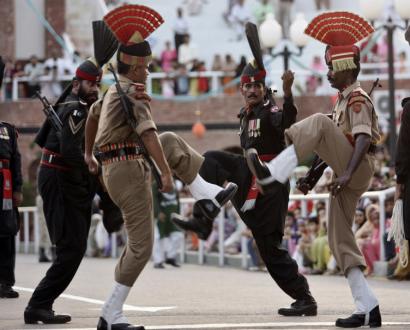
Trucks have only eight hours each day to cross, because each afternoon the two-lane road is overtaken by Indian and Pakistani border guards’ theatrical gate-closing ceremony. Even then, trucks must stop just past the frontier, where porters transfer the goods to local trucks. That is an advancement: Before 2007, trucks were barred from crossing at all, and laborers lugged all cargo across the boundary on their heads.

The little existing trade often falls victim to what look like political whims. In December, cargo trains sat idle for three weeks while Indian conductors awaited the visas that allow them to park just inside Pakistan.

That same month, spiraling onion prices prompted India to drop import tariffs and standards for the staple, triggering a surge in Pakistani onion exports. But Pakistan abruptly halted overland sales amid concerns about a domestic shortage.

“I had 400 trucks stuck on the other side,” said Rajdeep Uppal, a trader who is vice president of the Amritsar Exporters Council. “For a week these onions were standing there, and eventually they had to be sold within Pakistan for half the price. Who loses? Both the countries.”

Tensions aside, scenes of goodwill abound along the border. Pakistani and Indian train conductors sip tea and gripe about red tape together. Satanam Singh, a turbaned Indian driver – wearing a regulation yellow vest stamped “Indian Driver” – beamed as laborers unloaded his ginger on the Pakistani side. Coming to Pakistan, he gushed, was delightful compared with Mumbai, where the language is different and people hostile.

“It is a strange feeling, like I am going to a strange land,” said a smiling Mohammed Zafar, a Pakistani whose vibrantly painted truck, brimming with dates, was about to make its virgin voyage across the Indian frontier. “I am very happy.”

Here in Lahore, just 20 miles from the Indian border, Khan’s shop was the pioneer in a winding lane of stores now crammed with Indian silk and cosmetics – all smuggled into Pakistan illegally.

He said he would welcome friendlier business relations, even if they lessened the luxury value of his stock. Even his Afghan smuggler, who stopped by on a recent evening, agreed, on grounds that it would lessen the need to bribe border officials.

Among some merchants, skepticism about trade prospects remains, with Pakistanis fearing that open trade would lead to a glut of cheap Indian imports. S.M. Akhter, a top Indian customs official at the border, said national security concerns must trump market demands.

But despite the tangle of rules, some trade is quietly rising. Tahir Habib Cheema, the top Pakistani customs official at the border, said he realized last year that truck exports from Pakistan were allowed, but that “status quo” and “fear” had prevented them. He decided to change that – without notifying his bosses.

A comedy of errors ensued. By Oct. 7, Cheema had found one willing exporter and one importer. After hiccups on each side, a meeting at the frontline was arranged.

All parties agreed, Cheema said – and then the truck would not start. Someone proposed pushing it into India, an idea that was nixed by border guards who said the pushers would need visas. Finally, another vehicle nudged the truck over the line.

“This was something for the national cause,” Cheema said proudly. Since then, he added, Pakistani trucks have exported $2.5 million worth of products to India. He expects that to escalate this spring, when the two nations open a dedicated truck passage.

Correspondent Rama Lakshmi contributed to this article from New Delhi.