Archive for the ‘ Islam ’ Category

Florida Men Accused of Aiding Pakistani Taliban

By Gardiner Harris for The New York Times
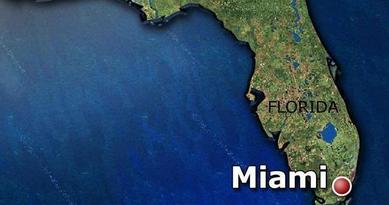
The F.B.I. on Saturday arrested three Pakistani-Americans, including father and son imams from South Florida mosques, charging them with providing financing and other material support to the Pakistani Taliban.
Related

Three people living in Pakistan were also charged in the indictment, which was made public by Wilfredo A. Ferrer, the United States attorney for the Southern District of Florida. The F.B.I. said that the indictment grew out of a review of suspicious financial transactions and other evidence and not from an undercover sting operation. The arrests seem to be unrelated to the raid that killed Osama bin Laden a week ago.

The four-count indictment charges that the six sought to aid the Pakistani Taliban’s fight against the Pakistani government and its allies, including the United States, by supporting acts of murder, kidnapping and maiming in Pakistan and elsewhere in order to displace the government and establish strict Islamic law known as Shariah.

“Today, terrorists have lost another funding source to use against innocent people and U.S. interests,” said John V. Gillies, the special agent in charge of the F.B.I.’s Miami office.

Five of the six people charged are related. Arrested in the United States were Hafiz Muhammed Sher Ali Khan, 76, of Miami; and two of his sons, Izhar Khan, 24, of Miami; and Irfan Khan, 37, of North Lauderdale.

Hafiz Khan is the imam at the Miami Mosque, also known as the Flagler Mosque. Izhar Khan is an imam at the Jamaat Al-Mu’mineen Mosque in Margate, Fla. Hafiz and Izhar Khan were arrested Saturday in South Florida, while Irfan Khan was arrested in Los Angeles. All three are originally from Pakistan.

The three people residing in Pakistan who were charged were Amina Khan, Hafiz Khan’s daughter, and Alam Zeb, her son, as well as Ali Rehman, also known as Faisal Ali Rehman. A statement from prosecutors said that the defendants were assisted “by others in the United States and Pakistan.”

The indictment said that the six transferred money to the Pakistani Taliban that was intended to buy guns and sustain militants and their families. Hafiz Khan is also accused of supporting the Pakistani Taliban through a madrasa, or Islamic school, that he founded and controlled in the Swat Valley region of Pakistan. He was charged with using the madrasa to provide shelter and other support for the Pakistani Taliban and sending children from his madrasa to learn to kill Americans in Afghanistan.

The indictment does not charge the mosques with any wrongdoing. The Muslim Communities Association of South Florida announced that that Hafiz Khan had been suspended indefinitely from his mosque.

“Our organizations, together through the Coalition of South Florida Muslim Organizations, has been working with the U.S. Attorney’s Office and the Miami F.B.I. office,” the association said in a statement released Saturday afternoon, “and appreciate the efforts of law enforcement to root out potential sources and supporters of terrorism.”

“We stand together with the U.S. attorney, Wilfredo Ferrer, and the men and women of the F.B.I., and have been and will be cooperating with law enforcement to our fullest ability,” it added.

The F.B.I. news release took pains to describe the charges as reflecting only the actions of the defendants, not of their mosques or Islam. “Let me be clear that this is not an indictment against a particular community or religion,” Mr. Ferrer said. “Instead, today’s indictment charges six individuals for promoting terror and violence through their financial and other support of the Pakistani Taliban. Radical extremists know no boundaries; they come in all shapes and sizes and are not limited by religion, age or geography.”

“The indictment does not charge the mosques themselves with any wrongdoing,” it continued, “and the individual defendants are charged based on their provision of material support to terrorism, not on their religious beliefs or teachings.”

The inclusion of those statements were “well appreciated” by the Muslim community in South Florida, said Asad Ba-Yunus, who is a legal adviser to the Muslim Communities Association of South Florida.

“We have been working with the U.S. attorney’s office over last few months” to improve relations, Mr. Ba-Yunus said, adding that he had spoken with the office Saturday morning before the indictment was announced.

The charges against the Florida men accusing them of supporting the Pakistani Taliban but not actually carrying out operations themselves are the most common types of terrorism prosecutions that United States authorities have pursued since the attacks of Sept. 11, 2001. Of the 50 leading terrorism cases since those attacks, about 70 percent have involved financing or other support to terrorist groups, according to the Center on Law and Security at the New York University School of Law.

The Pakistani Taliban were officially designated as a terrorist organization by the State Department on Aug. 12, 2010.

The Pakistani Taliban are closely allied with Al Qaeda, and is responsible for a series of attacks against Pakistani police and military targets in recent years. Pakistani authorities believe a splinter group of the Pakistani Taliban was responsible for the suicide attack in northwestern Pakistan on Friday that killed more than 80 cadets from a government paramilitary force. According to American officials, the Pakistani Taliban have been involved in or claimed responsibility for attacks on United States interests, including an attack on a military base in Khost, Afghanistan, along the border with Pakistan, and a suicide bombing against the consulate in Peshawar, Pakistan.

American officials say the failed attempt to detonate a car bomb in Times Square last May was developed and financed by the Pakistani Taliban. The convicted bomb plotter, Faisal Shahzad, contacted the Pakistani Taliban via computer to confer with handlers over what he had done, the government wrote in court papers in September.

Pakistanis for Peace Editor’s Note– As peace loving Americans of Pakistani descent, we are upset to hear that some members of the US Muslim community would want to do the great nation of the Unites States harm. If found guilty, we hope that they are severly punished and a message is sent to anyone else intending to do us harm. We commend the FBI and the Department of Justice in these arrests and in keeping the American homeland safe.
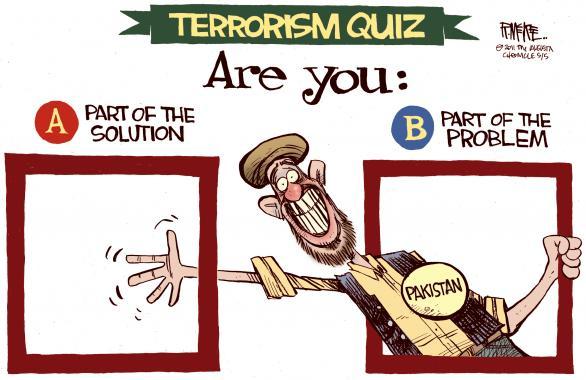
With Friends Like Pakistan…

By Manzer Munir for Pakistanis for Peace

Many people in Pakistan these days are wondering why their nation often finds itself on the wrong side of recent history. First, there is the continued and unjust imprisonment of a Christian Pakistani woman named Asia Bibi who has been languishing in jail for nearly two years. She has been given a death sentence for allegedly making derogatory remarks about the prophet Muhammad.

Then there was the killing of Salman Taseer, who was the then sitting governor of Punjab, Pakistan’s most populous province, by one of his own bodyguards for his outspoken support for Asia’s rights and her freedom. Instead of swift punishment and public outcry at his actions, the killer, Malik Mumtaz Hussain Qadri, was showered with rose petals by some cheering members of the bar association of Lahore when he came to the courthouse for formal charges of murder. Yes, members of the judiciary were cheering his unilateral action of murdering another human being simply for his support towards a condemned non Muslim woman’s rights.

You can only imagine the warped sense of logic and justice in a country where lawyers cheer the cold blooded murder of an innocent man whose only crime was to come at the aid of a condemned Christian mother of two children.

Fast forward to a few months later, the extremists managed to assassinate the only Christian member of President Asif Ali Zardari’s government when the Minister for Minority Affairs, Shahbaz Bhatti, was killed in a hail of bullets by unknown gunmen who then managed to escape on their motorcycle. Bhatti being a Christian as well as a minister in the government, had campaigned for the release of Asia as well as for the repeal of the blasphemy laws in Pakistan that at help promote a culture of state sanctioned hatred against religious minorities in Pakistan.

The culture of fear and hatred as well as violence against the religious minorities has progressively gotten worse along with the security situation inside the country in the last ten years. If there is anything that has been proven by some of these recent events in Pakistan, it is only that the country has become the undisputed global hotbed of extremism, fanaticism, and Islamic militancy in the Muslim world. It has now morphed into a country where the Wahhabi and Salafi fanatics have successfully used fear and hate to silence the majority moderate Barelvi and Sufi Muslims of Pakistan.

When powerful moderate voices like those of Bhatti and Taseer are silenced despite having heavy protection, how safe can the common man feel about his life if he chooses to speak up against the radicals within Islam? To kill someone is against Islamic belief at its core, unless it is done in self defense but you would be hard pressed to hear that view from the religious fanatics in Pakistan. They have justified killing others over many insane reasons such as making derogatory remarks about Islam or the prophet Muhammad. They also rationalize the killing of someone over a family’s honor, thus honor killings where often young women are killed if they are deemed to have brought dishonor to their family. These radical Islamists will even want someone dead for simply uttering disparaging remarks against Islam or its prophet. It is both ironic and hypocritical to see that the same derogatory remarks towards other figures such as Jesus, Moses, Abraham or other prophets of the Quran do not meet the same outcry nor receive the same impassioned response from the masses as when Islam or its prophet Muhammad are criticized.

The seeds of this current fanaticism fanning the flames of hatred were planted during an earlier conflict, this one involving the Soviets against an under matched adversary in Afghanistan. It was during this time in the ‘80’s when the Pakistani dictator, General Zia ul Haq, was in power and he accepted American aid from the Reagan administration in thwarting the threat from the 1979 Soviet invasion of neighboring Afghanistan. At the time, Pakistan’s ISI worked very closely with these “freedom fighters” waging what many thought was a just jihad against a communist foe who disallowed all religious worship. In fact, a good movie to rent right now to put some of these current events in perspective would be Charlie Wilson’s War starring Tom Hanks which details this era of Pakistan-US relations and cooperation against a common enemy in the Soviets.

The trouble now however is that in this current uneasy alliance between Pakistan and the US, there is not a common enemy, at least not as how it is viewed by many in Pakistan, which recently was polled to be the most anti-American nation in the world. Even though radical Islam and fanaticism is as much a threat to Pakistan’s sovereignty and prosperity as it is to the United States, India has always been seen as the big threat by its army and rulers. Pakistan has long seen Afghanistan as a country offering it strategic depth in any future wars with India. Thus, its interests in Afghanistan do not coincide with those of the United States.

The Pakistani media also constantly feeds a steady news diet of bombings by the Taliban/Haqqani network as well as any one of the other fill-in-the-blank militants groups seemingly operating freely from within its borders. There is also the regular news reports of US drone attacks and NATO actions in the AfPak region, as well as the all ubiquitous and constant threat faced from India, who is still seething from the Mumbai bombings in 2008, which were blamed on Pakistani trained terrorists. To further add insult to their injury, not a single leader of the Lashkar E Taiba has been convicted in Pakistan for the attacks in Mumbai that claimed 174 deaths and seriously injured several hundred others.

To the Indians, the perpetrator of their version of 9/11 is not an Arab from Yemen named Osama, but rather a whole nation state with whom it has fought three wars in 60 years and who is a long time sworn enemy with which it shares a long border. Too often it is rightly assumed by many that Pakistan will not act against Lashkar E Taiba and other openly anti-Indian militant groups because these groups are seen as a strategic asset for use against India. Only the fear of an all out nuclear war between the two nations by a trigger happy Pakistan placated India enough so that New Delhi did not immediately take military action against Pakistan after the Mumbai attacks.

So this culture of fear from all enemies both foreign and domestic to Pakistan’s sovereignty is now at an all time high within the nation. With a several decade long war on its western border in Afghanistan as well as the constant threat from its arch enemy to the east in India, Pakistan has never felt more threatened or squeezed. This pressure is now only going to get ratcheted higher since last week’s killing of Osama Bin Laden at a compound in a suburb of Islamabad, Pakistan. Living for five years undetected in the compound, Bin Laden was less than a mile away from the Kakul Military Academy in Abbottabad, Pakistan’s version of the famed American military college of West Point, when he was killed by a US Navy Seal team.

For the world’s most wanted terrorist to hide in plain sight in such a manner and for so many years, rightly points a lot of suspicion on Pakistan. Long suspected by many intelligence analysts, elements within Pakistan’s spy agency, the ISI, naturally now attracts a lot of suspicion in their possible involvement in the whole affair. There are strong voices and calls within the US Congress to halt all aid to Pakistan in light of Bin Laden’s death. We certainly can assume that any other country in the world found to be harboring terrorists would already have been labeled a state sponsor of terrorism and would be facing immediate sanctions from the international community. “You are either with us or against us” were the words so famously uttered by then President Bush to Pakistan specifically after 9/11. But due to Pakistan’s importance for a successful pullout from Afghanistan of US troops, as well as its strategic position within the Islamic world, neither side can afford to cut off relations with each other.

Although the Obama administration stopped short of claiming that the corrupt civilian government of Zardari was directly involved in protecting and sheltering Bin Laden, all signs point to complicity to some extent by some segments within Pakistan’s hierarchy. There is near unanimous agreement among many in Washington, and this is true on both sides of the aisle, that there are many sympathizers of the Taliban and Al Qaeda within the ranks of the army and the intelligence agencies of Pakistan.

Having driven the Soviets out of the region with the help of militant jihadi groups like the Taliban, no doubt a cadre of army and intelligence officers must have come to espouse the belief that it is in Pakistan’s best interests to have a religiously frenzied force available to use as a weapon against India in a future conflict also. In fact, Pakistan has always had this policy of seeking strategic depth in Afghanistan against India.

The death of Osama Bin Laden in Pakistan by Special Forces of the American military illustrates just what a duplicitous game the country has been playing with the United States and more importantly with itself. In the war on terror America lost nearly 3,000 citizens in the attacks on 9/11. In that same period stretching the last ten years, Pakistan has lost nearly 31,000 citizens to terrorist attacks by the Taliban, Al Qaeda and other militant groups. So it has always been in Pakistan’s best interests to fight the militant threat brewing in its borders the last two decades that has claimed so many lives and caused so much instability.

The murders of Salman Taseer and Shahbaz Bhatti illustrates the dire situation within Pakistani society where many young underprivileged men gravitate towards Osama Bin Laden’s ideology of hate against the US, which is seen by many, as the aggressor in an already very anti-American country. Also western ideas, religious and political liberties, and freedoms, such as those for women in western society, are all seen by the Islamic clergy and religious establishment as being against Islamic doctrine and clashing with the Muslim way of life. Therefore, the madrassahs and the masjids continue to espouse rhetoric against the American and European way of life which is seen as contradicting the teachings of the Quran. Even moderate Muslims and their sites of worship have come under heavy attack by the militants as witnessed by a new strategy of attacking Sufi Muslim shrines and mosques. Pakistan may not want to admit it, but there is a raging war going on within itself for the control of Islam and the attack on moderate Islam by the extremists within the religion.

The Bin Laden killing makes Pakistan seem either highly incompetent about knowledge his whereabouts or at the very least appear to be deeply complicit in sheltering and keeping him hidden while the United States launched the biggest manhunt in US history. At this point, the United States justly feels betrayed and distrustful towards anyone in the Pakistani establishment. After all, how are they to know who now to trust in the army or the civilian government?

It is imperative that Pakistan mount an immediate and urgent investigation that has the full cooperation and assistance of the US so that both countries can discover the source of this support system that Bin Laden has had from within Pakistan. Certainly, some heads do need to roll in Islamabad over this. Whether those resignations be of the current ISI chief, Ahmad Shuja Pasha, head of the army, General Ashfaq Parvez Kayani, or Zardari and Gilani themselves, as some accountability needs to occur. This is important not just for the sake of American-Pakistani relations, but just as importantly for the benefit of the Pakistani populace who is both deeply embarrassed by breach of Pakistan’s sovereignty, but also for the intelligence failure by the government of Pakistan at Osama’s whereabouts. Until and unless Pakistan makes this investigation a top priority, USA and Pakistan relations will continue to slide downhill and will mire further in distrust.

Pakistan must realize that in this global war against religious Islamic fanaticism, it cannot continue to speak from both sides of its mouth. Not when everything, including its very existence is at stake. It cannot at once be both a front line ally in the war against terror and receive billions of dollars in US aid, and at the same time, be found to shelter or allow terrorists and militant organizations safe havens and allow them to operate within its territory.

It is up to Pakistan to salvage a quickly deteriorating situation. However at the time of publication of this article, it seems that President Asif Ali Zardari’s government is off to a horrible start in mending fences with the US. First the name and identity of the CIA station chief in Pakistan was leaked by someone in the ISI to members of the local press. This leak compromised his mission and even poses a danger to his life as the anonymity of all operatives is a necessary requirement in intelligence work.

Then later in the day, in remarks given by Pakistan’s Prime Minister Yousuf Raza Gilani to its Parliament, he defiantly stated that neither Pakistan’s army nor its intelligence agency should be suspected by the Obama administration for providing support to Bin Laden. Gilani also went as far as to say that any future unilateral action by the US or any other nation inside Pakistan’s territory will be met with like force. I thought to myself, did he really just that? Did Pakistan just threaten the United States? It is appalling to see the political posturing now being done by the Pakistani government and the long term negative consequences they will have on the nation.

For a country that is receiving nearly $3.5 billion in US aid yearly, these are very tough words that will undoubtedly only make the strained relations between the two countries worse. Pakistan should realize that United States wants to feel that it can trust it to be a full partner in the fight against militancy and extremism. And unless this distrustful and at times, very adversarial relationship changes, the United States cannot help but feel that with friends like Pakistan, it does not need enemies!

-Manzer Munir, a proud Pakistani American and peace activist, is the founder of Pakistanis for Peace and blogs at http://www.PakistanisforPeace.com as well at other websites as a freelance journalist and writer. 

Syria Steps Up Crackdown; International Outcry Grows

As Reported by Voice of America

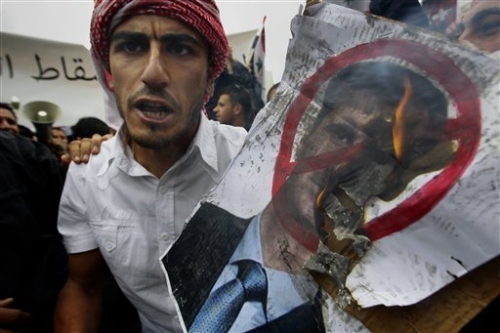
Syria has intensified its bloody military crackdown on pro-democracy demonstrators, as international criticism against the government’s action mounts. Gunfire continued Tuesday in the flashpoint city of Daraa, where an armed assault to end anti-government protests was in its second day.

Human rights activists say at least 34 people have been killed and dozens more arrested since Syrian troops and tanks entered the city at dawn Monday to crush the demonstrations.

Residents were said to be too afraid to venture out in Daraa. Electricity, water and telecommunications to the city remain cut.

Also Tuesday, thousands of riot police deployed near the coastal city of Banias and in two areas on the outskirts of the Syrian capital. Activists say clashes have been especially brutal near the town of Douma. Demonstrators who attempted to enter Damascus from there during the last two weeks were met with bullets.

More than 400 people have been killed since pro-democracy protests erupted last month. The Syrian rights organization Sawasiah said Tuesday the government has arrested at least 500 people during the ensuing crackdown.

Also Tuesday, the international response to Syrian President Bashar al-Assad’s brutal crackdown intensified. The U.S. ambassador to the United Nations accused the Syrian leader of “disingenuously blaming outsiders” for the protests.

Susan Rice also reiterated that Washington has evidence of active Iranian support for what she called Syria’s “abhorrent and deplorable” crackdown on peaceful demonstrators. She said the “outrageous use of violence to quell protests” must end now.

U.N. Secretary-General Ban Ki-moon also condemned “the continuing violence against peaceful demonstrators,” including the use of tanks and live fire that have “killed and injured hundreds of people.” The U.N. chief has called for an independent inquiry into the violence.

But Syria’s U.N. envoy said Damascus is capable of undertaking its own transparent investigation into the deaths of anti-government protesters, rejecting outside assistance.

Bashar Ja’afari also said the U.N. Security Council “should not rely on media reports” when making its decisions. Britain, France, Germany and Portugal asked the council to condemn Syria’s crackdown in a draft statement circulated on Tuesday.

Ja’afari told reporters Syria regrets civilian casualties, but said the unrest has “hidden agendas,” adding that some foreign governments are attempting to destabilize the country.

Earlier Tuesday, ltalian Prime Minister Silvio Berlusconi and French President Nicolas Sarkozy urged Syria to “show moderation” and halt the “violent repression” of peaceful demonstrations.

Turkish Prime Minister Recep Tayyip Erdogan telephoned Mr. Assad and urged him to show restraint. British Foreign Secretary William Hague said the European Union is exploring possibilities for action against Syria, including asset freezes and targeted travel bans on the country’s leadership.

While U.S. officials have condemned the violence against Syrian citizens, Defense Secretary Robert Gates and his British counterpart, Liam Fox, played down the likelihood of a Libya-style intervention in Syria.

At a joint news conference in Washington Tuesday, Fox said the world’s response to popular revolts across the Middle East and North Africa must reflect the circumstances in each country. Gates made a similar point, saying that although the U.S. applies its values to all countries in the region, its actions will not always be the same.

A U.S. State Department official said Tuesday that, for now, Washington will limit its response to diplomacy and possible sanctions.

Terry Jones Jailed for Dearborn Mosque Protests

By Marilisa Kinney Sachteleben for Yahoo News

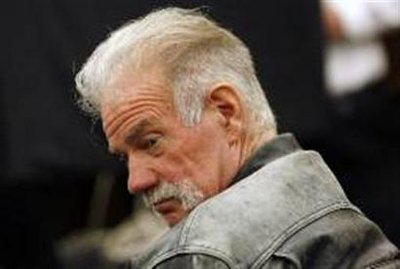
Terry Jones, outspoken pastor of Dove World Outreach Center in Gainesville, Fla., and host of “Burn a Quran Day” was jailed in Detroit on Friday for protesting outside a Dearborn, Mich., mosque. Jones refused to pay his $1 peace bond.

Jones operates Dove World Outreach Center, a mission that proclaims to spread the word of God. Dove World Outreach was started by Don Northrup in 1986 as an apostolic, evangelical Christian ministry.

The DWOC history page reads like many fundamental protestant ministries. It talks about apostolic anointing, teaching and training missionaries to spread the gospel.

DWOC discusses a five-fold plan for bringing God’s Word into the world. It wasn’t outlined clearly, but the five prongs likely included mission work, Bible reading, prayer, teaching and preaching.

This five-fold ministry was the focus of DWOC. Since Jones has taken over, there is less talk about the five-fold plan. DWOC has morphed into one main mission: to take out Muslims and the Islamic faith. Instead of the gospel, DWOC preaches a straw man doctrine of fear. The site is funded by sales of Muslim-bashing paraphernalia in their store. T-shirts, baseball caps, coffee mugs all sport one legend: “Islam is of the Devil.” The “bookstore” sells one book only, written by Jones, called “Islam is of the Devil.”

The website is coated with fear-mongering, anti-Muslim propaganda. Followers are exhorted to erect wooden yard signs reading “Islam is of the Devil.” There are scheduled protests at mosques, like Dearborn’s Islamic Institute of Knowledge and American Moslem Bekkha Center. Jones’ hosts his annual inflammatory (term used literally and figuratively) “Burn a Quran Day”.

I am opposed on many grounds to Jones and DWOC’s activities, not the least of which is constitutional. Jones has a right to protest, guaranteed him by the Constitution of the United States. He does not have a right to slander or libel. Muslims have a right to worship as they chose, also guaranteed them by the Constitution.

I am a Catholic Christian. I do not see it as my Christian vocation to hate Muslims. Quite the opposite. It will likely be said, by activists like Jones, that I must not be a Christian if I defend Islam. My faith is based in love, not fear, however, and my God loves the whole world. I refuse to retaliate and say that Terry Jones can’t call himself a Christian and hate Muslims. I don’t believe it’s my place to judge whether a person has faith or not. However, I do question the tenets of said faith. Look at the name of Terry Jones’ ministry:

Dove: The dove is a Biblical symbol of peace, sacrifice and of the third Person of the Holy Trinity, the Holy Spirit. When the Holy Spirit descended at Pentecost, believers of many nations where there and heard in their own tongue. The Holy Spirit ignited a fire, but it was a fire of love, not hate.

World: from the Latin, “mundi”; comprised of people of all race, creed, color, religion or lack thereof.

Outreach: If I reach out to hit and hurt someone, they will shy away. In order for an out-stretched hand to be accepted, it must come in love. True outreach (or mission work) is done in compassion, nurturing, ministerial and loving way. I exhort Terry Jones to check out St. Paul on the subject.

I don’t see how wearing a hat and tee-shirt saying “Islam is of the Devil”, is promoting peace or promulgating any doctrine but hate. I smell ignorance-based fear in Terry Jones and DWOC.

Jones is starting to show a lot of similarities to Westboro Baptist Church. These are the nice people who brought you “God Hates Jews”, “Priests Rape Boys”, God Hates Fags and Beast Obama.

Low-key Easter Preparations for Pakistan’s Christians

By Kamran Haider for Reuters

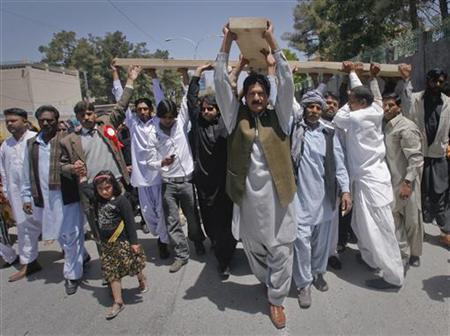
Christians in the small Pakistani town of Gojra are making low-key preparations for Easter this year.

Residents of the neighbourhood, known as Christian Colony, in the town in Punjab province, are haunted by memories of a 2009 attack by a Muslim mob in which seven members of a family were killed and dozens of houses torched.

A few days before Easter, which Christians believe marks the resurrection of Jesus Christ three days after his crucifixion, bare-foot children played cricket in the town’s dusty alleys while some men chatted on a bench under a tree.

“If we celebrate it with a fanfare, we fear somebody might get annoyed and attack us,” said Khalid Anjum, 45, the owner of a small snooker hall. The only sign of the approach of Easter was a few young men rehearsing hymns in St. Mary’s Catholic Church.

“Fear is there but we cannot give up our religion,” said Wilson Rafiq, the leader of the group of singers, who plays a traditional drum set known as a tabla.

Pakistan was founded in 1947 as a home for the Muslims of South Asia at the end of British colonial rule, with the country’s founding father, Mohammad Ali Jinnah, promising that all communities would be able to worship freely.

But today, Jinnah’s pledge of religious tolerance often seems hollow as religious violence increases. Religious minorities account for about 4 percent of Pakistan’s 170 million people, with about three quarters of members of religious minorities Christian.

The independent Human Rights Commission said at least 100 people from minority communities were killed in 2010. The bloodiest attack was on Ahmadis, a sect that mainstream Muslims consider heretical, when 86 people were killed.

This year, the liberal Muslim governor of Punjab province, Salman Taseer, and Christian Minorities Minister Shahbaz Bhatti, were killed in separate shootings for speaking out against a blasphemy law aimed at defending Islam.

Under the law, anyone who speaks ill of Islam and the Prophet Mohammad commits a crime and faces the death penalty but human rights activists say the law’s vague wording has led to its misuse, often against members of minority religions.

Compounding a climate of fear, Islamist militants, angered by Pakistan’s alliance with the United States since 2001, have carried periodic attacks on minorities as part of a campaign to destabilise the state.

“FEAR IN THEIR HEARTS”

In Gojra’s Christian Colony, the level of fear has increased since the sentencing Monday of a Muslim to death for shooting dead two Christians who had been accused of blasphemy.

Rather then welcoming what some people might see as justice, Christians fear that if the sentence is carried out, it will only mean more trouble for them. “Things will only get worse. If one is punished, someone else will stand up to take revenge for him,” said housewife Shahida Kashif.

“My kids still get scared whenever there’s a small disturbance. They says ‘mother, they’ve come. They’ll set fire to our houses again’. They still have fear in their hearts,” she said, referring to memories of the 2009 riot.

A mob of about 1,000 Muslims, incensed by rumours that a Christian had desecrated the Koran, rampaged through the neighborhood, firing guns and throwing petrol bombs.

Hameed Pannum Khan was shot dead and six members of his family, including two women and two children, were burnt to death when their hut was torched.

Authorities blamed militants linked to al Qaeda and the Taliban for the violence. Abdul Khaliq Kashmiri, a Muslim prayer leader, was locked up for 15 months on charges of inciting the attack.

He was recently released after Christians, fearing his continued detention would only make things worse for them, told authorities they had no proof of his involvement. Kashmiri denied any part in it and appealed for tolerance.

“Everybody should follow their own religion and should stop slinging mud at others,” he said. Christian Allah Rakha, a relative of the family killed in 2009 said the hatred had to stop for the sake of future generations.

“We all should get rid of this evil,” said Rakha, 70, sitting on a threadbare sofa in the drawing room of his single story home. “If we talk of revenge we’ll never have peace.”

Why Pakistan’s Taliban Target the Muslim Majority

By Omar Waraich for Time

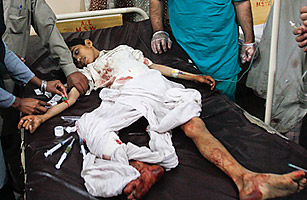
Although Pakistan’s headlines are dominated by the violent excesses of Taliban extremists, the majority of Pakistanis subscribe to the more mystical Sufi tradition of the country’s Barelvi school of Islam. And attacks on their places of worship are becoming depressingly familiar. Last Sunday, two bombers attacked the 13th Century Sakhi Sarwar shrine, near the southern Punjabi town of Dera Ghazi Khan, slaughtering 50 people and injuring twice as many. Mercifully, two other bombers failed to detonate their devices, preventing even higher casualties. Still, it was the deadliest assault yet on a Sufi shrine in Pakistan — and the sixteenth in the last two years.

The Pakistani Taliban swiftly claimed responsibility for the attack, as they have done for each previous one. Pakistan’s Taliban claims the mantle of the hardline Deobandi tradition, with many beliefs in common with the austere Wahabism of Saudi Arabia. They regard the Barelvi, who comprise more than three quarters of Pakistan’s Sunni Muslims, as irredeemable heretics. The Barelvis favor a more tolerant approach to Islam, promoting a cult of the Prophet and incorporate folkloric traditions such as seeking intercession from rural saints. Sakhi Sarwar, a mystic who is also revered by some Hindus and Sikhs, is said to grant women a son — a local legend that rouses anger among Islam’s more literalist adherents, who ascribe such powers only to Allah.

Tensions between Deobandis and Barelvis have punctuated most of Pakistan’s history. But with the arrival of al-Qaeda in the country a decade ago, local militants forged links with the global jihadists, their sectarianism sharpened to accept al-Qaeda’s “takfiri” worldview that deems adherents of other strains of Islam as deviant apostates worthy of death.

One reason for the uptick in sectarian-based terror attacks may be that the militants’ ability to strike the high profile urban targets that once grabbed global headlines has been diminished by Pakistani military offensives in their strongholds over the past two years. “It has become harder for the militants to strike hard targets,” says security analyst Ejaz Haider. “Some lessons have been learned from the previous attacks.”

So, the militants have, over the past two years, more keenly focused on sectarian attacks. Traditional Shi’ite processions are now routinely targeted by suicide bombers. In May 2010, two mosques of the minority Ahmedi sect were targeted in Lahore, killing 93 people. And there’s been an escalation of bombings directed against the majority Barelvis. After attacks on two of their most prominent shrines, Data Darbar in Lahore’s old city and Abdullah Shah Ghazi in Karachi, Barelvis came out on to the streets, wielding weapons and vowing revenge against the Taliban. They did not extend blame to the broader spectrum of Deobandis, perhaps wisely evading the beginnings of a more gruesome sectarian conflict that Pakistan can ill-afford.

Not all Barelvis are the models of peace and tolerance that some have portrayed them to be. It was a Barelvi, Mumtaz Qadri, that assassinated Punjab Governor Salmaan Taseer in January, for his opposition to Pakistan’s prejudicial blasphemy laws. The assassination was applauded by 500 Barelvi scholars in a joint statement. And the Sunni Tehreek, a Barelvi militant outfit, rewarded Qadri’s family and threatened Taseer’s daughter. While they may favor a more permissive vision of Islam, certain Barelvis are quite capable of violence where they feel the Prophet has been dishonored.

The campaign to defend Pakistan’s blasphemy laws from reform has, in fact, united Barelvis and Deobandis since last November. Barelvi anti-Taliban rhetoric was also put on pause. “We had seen the Barelvis getting ready to organize a campaign against the Taliban,” observes analyst Nasim Zehra, “but they got sidetracked by the blasphemy issue and this was forgotten.” Until last month’s assassination of Minorities Minister Shahbaz Bhatti, the religious right was able to frequently draw tens of thousands on to the streets.

Sectarian hatred aside, rural shrines are a far easier terror target than the more heavily guarded state and economic targets in the cities. Suicide bombers, especially the teenage boys favored by militants, can often evade notice before they reach the target. A crowded space helps secure the militants’ aim of causing high casualties. In the case of the Sakhi Sarwar bombers, they only had travel to a relatively short and unimpeded distance from North Waziristan to the edge of Punjab.

The bombings may also be an attempt to relieve pressure from sporadic Army actions against militants in the northern tip of the tribal areas. “Just to remain alive there, the militants have to try and force the government’s hand into diminishing pressure,” says analyst Haider. “To counter that pressure, they mount attacks in the mainland in the hope of securing some deal back in the tribal areas.” By targeting shrines across the country, the militants are able to demonstrate their enduring geographical reach and expose the state’s vulnerabilities.

The bad news is that the state is in a poor position to respond. After the latest bombings, Barelvi leaders denounced the Punjab provincial government for failing to provide security at shrines. The Punjab government dismisses the charge. “It’s happening all over,” says Ahsan Iqbal, a leading politician from the Pakistan Muslim League-N, the ruling party in Punjab. “This is not something that is province-specific.” Iqbal casts blame on the federal government for failing to share intelligence. The federal government reverses the charge, and argues that the law and order is a provincial responsibility. What no one seems to be focusing on is the desperate need to enhance the police’s capacity, with better equipment, counterterrorism training and an intelligence gathering network that reaches deep into Pakistan’s remote areas.

A Nation Overloaded with Religion

By Tanzeel for Tanzeelism

Frequent assassinations of Pakistan People’s Party leaders have not only shaken the ideology of this country but left a clear cut message for Government to avoid any confrontation against strengthening religious lobby in Pakistan.

The Tehreek e Taliban and Al Qaeda backed groups in Pakistan especially in Punjab are after the ruling party and eradicating its moderate forces one by one. As a result the PPP systematically takes back seat, and gets blackmailed by the religious forces.
Government’s evident policy shift from the party manifesto of ensuring religious harmony among all faiths in the wake of doctrine of necessity further pushes nation in the hands of extremists.

From the assassination of Benazir Bhutto to Shehbaz Bhatti, the message is clear. Let Taleban pursuit their agenda of violent Islam and whoever comes in between will become history.

In such horrific circumstances when even the ruling party leaders are not safe how unarmed liberal forces would dare voice their opinion seems to be a big ask. As a result the clouds of insanity steadily prevailing and a common man is reluctant to counter them not because of being blithe but for his own safety resulting mass surrender of journalists, civil society, liberal political forces and minority rights groups against religious forces.

A common Pakistani despite wanting to express deep displeasure is suppressed by the bearded gun totted black sheep who are gelled up in the society to take necessary ‘religious measures’ against those who prefer humanity over religion.

Salman Taseer’s assassination by his own security guard Mumtaz Qadri and the subsequent showering of rose petals by lawyers’ community is one of the shocking examples of deep rooted religious fanaticism within our society. Be it media, armed forces, politics (not to mention the historical speech of Punjab Chief Minister Shehbaz Shareef during which he proudly endorsed the agenda of Taleban), judiciary, education or even sports.

In my view the traces of religious terrorism can be found back during partition campaign when the voices of independent ‘Muslim Land’ were on rise.

At that time some of the Muslims might had opted the idea of migrating to separate land due to vested interests but by and large it was the dominating religious sentiment that caused division with the objective of turning Pakistan into the “Fort of Islam” comprised by majority of Muslims.

Two- Nation Theory which clearly rejects any of idea co existence of Muslims with Hindus is a true depiction of Pakistan’s current situation where Muslims are unable to coexist with other sects let alone religions and ethnicities.

Today, I being a moderate Muslim who is deeply concerned about his country’s image foresee not only the bleak future of Pakistan but raises the doubts whether creation of Pakistan was really an apt approach.

‘Quran on trial’ more despicable than book burning

By Douglas Sharp for Protestants for the Common Good

Given the global attention received last fall by the Florida pastor who announced that he would burn the Quran on the anniversary of 9/11, I was frankly surprised to learn that he had found a way to break his promise and burn one anyway.

Pastor Terry Jones and his congregation at Dove World Outreach Center had managed to stay below the national media radar; most people probably forgot about them in places other than their community of Gainesville, Florida. But they have certainly been caught in the radar now, having done something even more daring and despicable than the demeaning act of burning a copy of the Quran.

The pastor held court with the Quran as the defendant. On March 20, 2011, he set himself up as the judge, invited a Muslim who had converted to Christianity to serve as prosecuting attorney and the president of the Islamic Center of Texas to act as defense attorney. “Expert” witnesses included other Muslims who had converted to Christianity.

What were the charges? In his video on the Stand Up America website, Pastor Jones said, “We are accusing the Quran of murder, rape, deception, being responsible for terrorist activities all around the world. We are accusing the Koran of these violent acts.”

Anticipating a “guilty” verdict, the question announced in advance on the lawn of the church’s property was whether the Quran should be burned, drowned, shredded, or shot. Following the jury’s rendering of the verdict, the Quran was soaked in kerosene and ignited, like charcoal in a barbeque pit.

In spite of all the absurdity and chicanery of this “mock trial” and the sophomoric behavior of its master-mind, I find this whole affair to be not at all amusing. To the contrary, it is not only a shameful display of religious bigotry and ignorance, but also a burlesque-like mockery of our system of jurisprudence. All things considered, it is frighteningly childish act.

What I find so alarming about this act is the extent to which Jones and his flock have gone to accomplish now what they set out to do last fall. All the reasons given then for not burning a copy of the Quran still apply: inflaming the Muslim world, aiding and abetting Al-Qaeda’s recruitment, putting U.S. military personnel forces at greater risk, etc.

But surrounding oneself with the accoutrements of justice and feigning to sit in judgment on the sacred literature of 23 percent of the world’s population, about whom you really—and evidently—know next to nothing, is a most disturbing demonstration of antipathy in search of a venue in order to attract attention and stoke further the barbeque pit of mind-numbing evil.

Shahbaz Bhatti, Modern Day Martyr in Pakistan

By Terry Mattingly for The Pocono Record

In the early days of Christianity, martyrs often gave their final testimonies of faith to Roman leaders before they were crucified, burned or fed to lions.
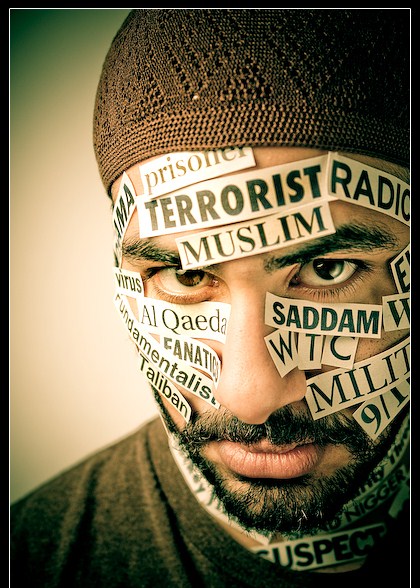
Times being what they are, Shahbaz Bhatti turned to Al-Jazeera and YouTube. The only Christian in Pakistan’s Cabinet knew it was only a matter of time before his work as minister for minority affairs got him killed. Threats by the Taliban and al-Qaida kept increasing.

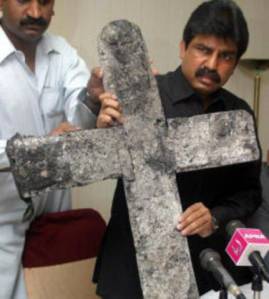
“I want to share that I believe in Jesus Christ, who has given his own life for us. I know what is the meaning of the cross and I follow him on the cross,” said Bhatti, in a startlingly calm video recorded several weeks before his assassination on March 2.

“When I’m leading this campaign against the sharia laws for the abolishment of blasphemy law, and speaking for the oppressed and marginalized persecuted Christian and other minorities, these Taliban threaten me. … I’m living for my community and suffering people and I will die to defend their rights. So these threats and these warnings cannot change my opinion and principles.”

The last straw was almost certainly the Catholic statesman’s defense of Asia Bibi, a Christian mother of five who was sentenced to death last November for the crime of blasphemy after she publicly defended her faith in a village argument. The verdict — which must be upheld by a higher court — further polarized a tense nation and sparked a global firestorm.

Then again, in 2009 Bhatti received the U.S. Commission on International Religious Freedom’s first medallion for the promotion of religious freedom. A year later, he met with Pope Benedict XVI to discuss interfaith work and religious liberty in Pakistan. Bhatti was not hiding his convictions.

The blasphemy laws in question went into effect in 1986, during the dictatorship of Gen. Muhammad Zia-ul-Haq. They ban, among other actions, the use of “derogatory remarks, etc; in respect of the Holy Prophet. Whoever by words, either spoken or written or by visible representation, or by any imputation, innuendo or insinuation, directly or indirectly, defiles the sacred name of the Holy Prophet Mohammed (PBUH) shall be punished with death, or imprisonment for life, and shall also be liable to fine.”

These blasphemy laws have been used against hundreds of Muslim dissenters and Ahmadi sect members, whose approach to Islam is specifically attacked in the laws. In practice, conversion from Islam to another faith is considered blasphemy, as are attempts to advocate or defend minority faiths, such as Christianity or Hinduism.

Vigilantes often kill those formally or informally accused of blasphemy — making trials irrelevant.

This was the case with Bhatti’s death in a wave of machine-gun fire into his unarmored car. Pakistani officials had denied his request for an armored car, despite the constant threat of drive-by shootings.

Formalities were also irrelevant on Jan. 4, when Salmaan Taseer, the governor of Pakistan’s Punjab Province, was assassinated by one of his bodyguards. This outspoken Muslim also defended Bibi and called for reform in the use of blasphemy laws.

Adoring crowds showered Taseer’s assassin with rose petals and garlands as he arrived to face a magistrate, while moderate Muslim leaders remained silent. Pakistan’s legislators observed a moment of silence for Bhatti, since it probably would have been fatal for anyone to offer a prayer in his honor.

After all, pamphlets left by those who killed Bhatti warned that they would keep fighting “all the world’s infidels, crusaders, Jews and their operatives within the Muslim brotherhood. … This is the fate of that cursed man. And now, with the grace of Allah, the warriors of Islam will pick you out one by one and send you to hell, God willing.”

Apparently, many radicals in Pakistan have concluded — a perfect Catch-22 — that it is blasphemy to oppose the blasphemy laws.

Meanwhile, the Pakistani conference of Catholic bishops is preparing to render a judgment of its own. Later this month the bishops will review a proposal to ask the Vatican to designate Bhatti as a martyr.

“Bhatti is a man who gave his life for his crystalline faith in Jesus Christ,” Bishop Andrew Francis of Multan told a Vatican news agency. “It is up to us, the bishops, to tell his story and experience to the church in Rome, to call for official recognition of his martyrdom.”

-Terry Mattingly is director of the Journalism Center at the Council for Christian Colleges and Universities.

Islamophobia and Radicalization

By James Zogby for Counter Punch

Let me state quite directly: Islamophobia and those who promote it are a greater threat to the United States than Anwar Al-Awlaqi and his rag-tag team of terrorists.

On one level, Al-Awlaqi, from his cave hide out in Yemen, can only prey off alienation where it exists. Adopting the persona of a latter-day Malcolm X (though he seems not to have read the last chapters of the “Autobiography” or learned the lessons of Malcolm’s ultimate conversion), he appears street-smart, brash, self- assured and assertive — all of the assets needed to attract lost or wounded souls looking for certainty and an outlet for their rage. Like some parasites, Al-Awlaqi cannot create his own prey. He must wait for others to create his opportunities, which until now have been isolated and limited: a disturbed young man here, an increasingly deranged soldier there.

Islamophobia, on the other hand, if left unchecked, may serve to erect barriers to Muslim inclusion in America, increasing alienation, especially among young Muslims. Not only would such a situation do grave damage to one of the fundamental cornerstones of America’s unique democracy, it would simultaneously and rapidly expand the pool of recruits for future radicalisation.

I have often remarked that America is different, in concept and reality, from our European allies. Third generation Kurds in Germany, Pakistanis in the UK, or Algerians in France, for example, may succeed and obtain citizenship, but they do not become German, British or French. Last year, I debated a German government official on this issue. She kept referring to “migrants” — a term she used to describe all those of Turkish descent living in her country — regardless of the number of generations they had been there. Similarly, following their last election, a leading British newspaper commented on the “number of immigrants” who won seats, without noting that many of those “immigrants” were third generation citizens.

America has prided itself on being different. Being “American” is not the possession of a single ethnic group, nor does any group define “America”. Not only do new immigrants become citizens, they also secure a new identity. More than that, as new groups become American and are transformed, the idea of “America” itself has also changed to embrace these new cultures.

Within a generation, diverse ethnic and religious groups from every corner or the globe have become Americans, dramatically changing America in the process. Problems remain and intolerant bigots, in every age, have reared up against new groups, but history demonstrates that, in the end, the newcomers have been accepted, incorporated and absorbed into the American mainstream.

This defines not only our national experience, but our defining narrative as well. When immigrant school children in Europe learn French, German or British history, they are learning their host’s history. In the US, from the outset, we are taught that this is “our new story” — that it includes all of us, and has included us all, from the beginning.

It is because new immigrants and diverse ethnic and religious communities have found their place and acceptance in the American mainstream that the country, during the last century, survived and prospered despite being sorely tested with world wars, economic upheaval and bouts with internal strife. During this time we had to contend with anti-black, anti-Asian, anti-Catholic, anti-Jewish, anti-immigrant, and anti-Japanese movements. In the end, after creating their moment of pain, these efforts have always lost.

They lose, but they don’t always go away. The Islamophobia we are witnessing today is the latest campaign by bigots to tear apart the very fabric of America. We know the groups promoting it. First, there is the well-funded “cottage industry”, on the right, of groups and individuals with a long history of anti-Arab or anti-Muslim activity. Some of the individuals associated with these efforts have been given legitimacy as commentators on “terrorism”, “radicalisation” or “national security concerns”, despite their obvious bias and even obsession with all things Arab or Muslim (in this, they remind me of good old-fashioned anti-Semites who never tired of warning of Jewish threats or conspiracies or who while always claiming to like individual Jews rallied against any and all Jewish organisations).

If these “professional bigots” have provided the grist, the mill itself was run by the vast network of right-wing talk radio and TV shows and websites, and prominent preachers who have combined to amplify the anti-Muslim message nationwide. Their efforts have done real damage. They have tormented decent public servants, created protests that have shuttered legitimate institutions, fomented hate crimes, and produced fear in the Muslim community.

In just the past two years, we have seen a dramatic upsurge in the activity of these bigots. More ominously, their cause has been embraced by national political leaders and by elements in the Republican Party, who appear to have decided, in 2010, to use “fear of Islam” as a base-building theme and a wedge issue against Democrats for electoral advantage.

In the past, only obscure or outrageous members of congress (like North Carolina’s Sue Myrick who expressed nervousness and insecurity because of “who was owning all those 7/11’s”; or Colorado’s Tom Tancredo who once warned that he “would bomb Mecca”) were outspoken Islamophobes. After the National Republican Congressional Campaign Committee embraced opposition to Park 51 as a campaign theme, it is hard to find a leading Republican who has not railed on some issue involving Islam or Muslims in the US.

The net impact here is that this current wave of Islamophobia has both played to the Republican base while firming up that base around this agenda. The polling numbers are striking and deeply disturbing. Some 54 per cent of Democrats have a favourable attitude towards Muslims, while 34 per cent do not. Among Republicans, on the other hand, only 12 per cent hold a favourable view of Muslims, with 85 per cent saying they have unfavourable views. Additionally, 74 per cent of Republicans believe “Islam teaches hate” and 60 per cent believe that “Muslims tend to be religious fanatics”.

The danger here is that to the degree that this issue has become a partisan — and in some cases a proven vote getter — issue for the Republican Party, it will not go away any time soon. The longer we are plagued by this bigotry, and the displays of intolerance it breeds (the anti-mosque building demonstrations or the anti-Sharia law efforts now spreading across the country) the longer young Muslims will feel that the “promise of America” does not include them, and they will feel like aliens in their own country.

It is this concern that has prompted many inter-faith religious groups and leaders and a diverse coalition of ethnic and civil rights organisations to so vigorously oppose Congressman Peter King’s (R-NY) hearings that will deal with the radicalisation of American Muslims later this week. They know, from previous statements made by King, of his personal hostility to American Muslims. They also know that what King is doing will only aggravate an already raw wound, creating greater fear and concern among young Muslims who have already witnessed too much bigotry and intolerance.

What they should also know is that in the process of targeting a religion in this way, and engaging in this most “un-American activity”, King and company are, in fact, opening the door for increased alienation and future radicalisation. Al-Awlaqi must be smiling from inside his cave.

-Dr James Zogby is president of the Arab American Institute and is a Roman Catholic of Lebanese descent and brother of prominent American political pollster and founder of Zogby Polls, John Zogby.

Iran Calls Saudi Troops in Bahrain â€˜Unacceptable’

By Ethan Bronner and Michael Slackman for The New York Times

A day after Saudi Arabia’s military rolled into Bahrain, the Iranian government branded the move “unacceptable” on Tuesday, threatening to escalate a local political conflict into a regional showdown with Iran.

“The presence of foreign forces and interference in Bahrain’s internal affairs is unacceptable and will further complicate the issue,” Ramin Mehmanparast, the Iranian Foreign Ministry spokesman told a news conference in Tehran, according to state-run media.

Even as predominantly Shiite Muslim Iran pursues a determined crackdown against dissent at home, Tehran has supported the protests led by the Shiite majority in Bahrain.

“People have some legitimate demands and they are expressing them peacefully,” Mr. Memanparast said. “It should not be responded to violently.”

“We expect their demands be fulfilled through correct means,” Mr. Mehmanparast added. Iran’s response — while anticipated — showed the depth of rivalry across the Persian Gulf in a contest that has far-reaching consequences in many parts of the Middle East.

On Monday, Iranian state-run media went so far as to call the troop movement an invasion. Saudi Arabia has been watching uneasily as Bahrain’s Shiite majority has staged weeks of protests against a Sunni monarchy, fearing that if the protesters prevailed, Iran, Saudi Arabia’s bitter regional rival, could expand its influence and inspire unrest elsewhere.

The Saudi decision to send in troops on Monday could further inflame the conflict and transform this teardrop of a nation in the Persian Gulf into the Middle East’s next proxy battlefield between regional and global powers. On Tuesday, there was no immediate indication that the Saudi forces were confronting protesters in the central Pearl Square — the emblem of the Bahrain protest much as Cairo’s Tahrir Square assumed symbolic significance in the Egyptian uprising.

Several hundred protesters camped out there on what seemed initially to be a quiet day with little traffic on the streets as the details of the deployment by Bahrain’s neighbors — and their mission — remained ill-defined.

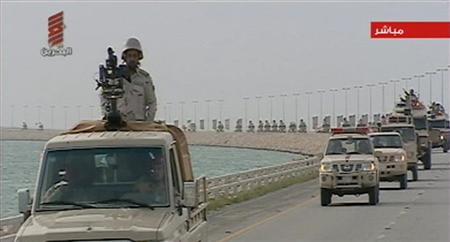
On Monday, about 2,000 troops — 1,200 from Saudi Arabia and 800 from the United Arab Emirates — entered Bahrain as part of a force operating under the aegis of the Gulf Cooperation Council, a six-nation regional coalition of Sunni rulers that has grown increasingly anxious over the sustained challenge to Bahrain’s king, Hamad bin Isa al-Khalifa. “This is the initial phase,” a Saudi official said. “Bahrain will get whatever assistance it needs. It’s open-ended.”

The decision is the first time the council has used collective military action to help suppress a popular revolt — in this case a Shiite popular revolt. It was rejected by the opposition, and by Iran, as an “occupation.” Iran has long claimed that Bahrain is historically part of Iran.

The troops entered Bahrain at an especially combustible moment in the standoff between protesters and the monarchy. In recent days protesters have begun to move from the encampment in Pearl Square, the symbolic center of the nation, to the actual seat of power and influence, the Royal Court and the financial district. As the troops moved in, protesters controlled the main highway and said they were determined not to leave.

“We don’t know what is going to happen,” Jassim Hussein Ali, a member of the opposition Wefaq party and a former member of Parliament, said in a phone interview. “Bahrain is heading toward major problems, anarchy. This is an occupation, and this is not welcome.”

Rasool Nafisi, an academic and Iran expert based in Virginia, said: “Now that the Saudis have gone in, they may spur a similar reaction from Iran, and Bahrain becomes a battleground between Saudi and Iran. This may prolong the conflict rather than put an end to it, and make it an international event rather than a local uprising.”

An adviser to the United States government, who spoke on the condition of anonymity because he was not authorized to talk to the press, agreed. “Iran’s preference was not to get engaged because the flow of events was in their direction,” he said. “If the Saudi intervention changes the calculus, they will be more aggressive.”

Though Bahrain said it had invited the force, the Saudi presence highlights the degree to which the kingdom has become concerned over Iran’s growing regional influence, and demonstrates that the Saudi monarchy has drawn the line at its back door. Oil-rich Saudi Arabia, a close ally of Washington, has traditionally preferred to operate in the shadows through checkbook diplomacy. It has long provided an economic lifeline to Bahrain.

But it now finds itself largely standing alone to face Iran since its most important ally in that fight, Hosni Mubarak of Egypt, has been ousted in a popular uprising. Iran’s ally, Hezbollah, recently toppled the Saudi-backed government of Lebanon — a symbol of its regional might and Saudi Arabia’s diminishing clout.

But Bahrain is right at Saudi Arabia’s eastern border, where the kingdoms are connected by a causeway.

The Gulf Cooperation Council was clearly alarmed at the prospect of a Shiite political victory in Bahrain, fearing that it would inspire restive Shiite populations in Saudi Arabia and Kuwait to protest as well. The majority of the population in Saudi Arabia’s eastern provinces, where the oil is found, is Shiite, and there have already been small protests there.

“If the opposition in Bahrain wins, then Saudi loses,” said Mustafa el-Labbad, director of Al Sharq Center for Regional and Strategic Studies in Cairo. “In this regional context, the decision to move troops into Bahrain is not to help the monarchy of Bahrain, but to help Saudi Arabia itself .”

The Bahrain government said that it had invited the force in to help restore and preserve public order. The United States — which has continued to back the monarchy — said Monday that the move was not an occupation. The United States has long been allied with Bahrain’s royal family and has based the Navy’s Fifth Fleet in Bahrain for many years.

Though the United States eventually sided with the demonstrators in Egypt, in Bahrain it has instead supported the leadership while calling for restraint and democratic change. The Saudi official said the United States was informed Sunday that the Saudi troops would enter Bahrain on Monday.

Saudi and council officials said the military forces would not engage with the demonstrators, but would protect infrastructure, government offices and industries, even though the protests had largely been peaceful. The mobilization would allow Bahrain to free up its own police and military forces to deal with the demonstrators, the officials said.

The Gulf Cooperation Council “forces are not there to kill people,” said a Saudi official, speaking on the condition of anonymity because he was not authorized to talk to the press. “This is a G.C.C. decision; we do not violate international law.”

But the officials also acknowledged that it was a message to Iran. “There is no doubt Iran is involved,” said the official, though no proof has been offered that Iran has had anything to do with the political unrest.

Political analysts said that it was likely that the United States did not object to the deployment in part because it, too, saw a weakened monarchy as a net benefit to Iran at a time when the United States wants to move troops out of Iraq, where Iran has already established an influence.

The military force is one part of a Gulf Cooperation Council effort to try to contain the crisis in Bahrain that broke out Feb. 14, when young people called for a Day of Rage, fashioned after events in Egypt and Tunisia. The police and then the army killed seven demonstrators, leading Washington to press Bahrain to remove its forces from the street.

The royal family allowed thousands of demonstrators to camp at Pearl Square. It freed some political prisoners, allowed an exiled opposition leader to return and reshuffled the cabinet. And it called for a national dialogue.

But the concessions — after the killings — seemed to embolden a movement that went from calling for a true constitutional monarchy to demanding the downfall of the monarchy. The monarchy has said it will consider instituting a fairly elected Parliament, but it insisted that the first step would be opening a national dialogue — a position the opposition has rejected, though it was unclear whether the protesters were speaking with one voice.

The council moved troops in after deciding earlier to help prop up the king with a contribution of $10 billion over 10 years, and said that it might increase that figure. But if the goal was to intimidate Iran, or the protesters, that clearly was not the first response.

Bahrain’s opposition groups issued a statement: “We consider the entry of any soldier or military machinery into the Kingdom of Bahrain’s air, sea or land territories a blatant occupation.”

In Pakistan, Justifying Murder for Those Who Blaspheme

By Aryn Baker for Time

“I believe in Jesus Christ who has given his own life for us,” the doomed man said, staring straight into the video camera. “And I am ready to die for a cause.” Shahbaz Bhatti had no hesitation in his voice as he responded to a question about threats from the Taliban and al-Qaeda. “I’m living for my community … and I will die to defend their rights.” It was his last answer in a four-month-old self-produced video that was to be broadcast in the event of his death. But the radicals had the final say. On March 2, Bhatti, Pakistan’s Minister for Minority Affairs, was shot dead in Islamabad. Pamphlets scattered on the ground claimed the act for a new alliance of “the organization of al-Qaeda and the Punjabi Taliban” and asserted that other infidels and apostates would meet the same fate.

Bhatti’s death had been foretold not just by himself but also in the nation’s response to a previous assassination, that of Punjab governor Salmaan Taseer on Jan. 4. Taseer, a self-made millionaire, had turned his largely ceremonial post into a platform for a campaign to amend Pakistan’s blasphemy laws. Bhatti, the only Christian in the Cabinet, refused to be a token and swore to battle intolerance. Both men supported clemency for Aasia Noreen, a Christian woman who had been accused of blasphemy and sentenced to death. Taseer’s stance on the issue infuriated a large part of the population that, thanks to religious leaders and school curriculums, believes that blasphemy is a sin deserving of execution. In the weeks leading up to his assassination, Taseer had been denounced at Friday prayers, excoriated in the media and largely abandoned by his Pakistan People’s Party (PPP) for fears that his campaign would prove politically toxic. The witch hunt culminated in a bodyguard’s pumping 27 rounds into his head and chest in the parking lot of a popular Islamabad shopping center.

Within hours of Taseer’s death, telephone text messages celebrating his assassination made the rounds. “Justice has been done,” read one. “If you love the Prophet, pass this on.” A Facebook fan page for assassin Malik Mumtaz Hussain Qadri garnered more than 2,000 members before site administrators shut it down. Even the leaders of state-funded mosques refused to say funeral prayers for the slain governor. When Qadri was transferred to a local jail, he was garlanded with roses by hundreds of lawyers — the vanguard of a movement that in 2008 helped unseat a military dictator — offering to take on his case for free.

At his court appearance a few days later, Qadri told the judge that he believed in a Pakistan where loyalty to the Prophet eclipses all other rights. According to Taseer’s daughter Shehrbano, her father “wanted an egalitarian society where open debate is protected and people are not killed for speaking out.” And Bhatti dreamed of a nation true to founder Muhammad Ali Jinnah’s vision, one where “you are free to go to your temples, you are free to go to your mosques or to any other place of worship.” Which vision prevails — Qadri’s or Taseer and Bhatti’s — will decide the future of the country.

The Roots of Extremism

 
It is not news that Pakistan has a lunatic fringe. What is disturbing is that after Taseer’s murder, when the silent majority finally spoke up, it praised Qadri, not his victim. The public reaction exploded the myth of Pakistan’s moderate Islam; Qadri belongs to a mainstream sect that routinely condemns the Taliban. “The Pakistan we saw in the wake of Taseer’s killing is the real Pakistan,” says Amir Muhammad Rana of the Pak Institute for Peace Studies. For the past two years, Rana’s organization has conducted in-depth interviews with a broad spectrum of Pakistani citizens. “They might dress Western and eat at McDonald’s, but when it comes to religion, most Pakistanis have a very conservative mind-set.”

Pakistan’s religious parties rarely do well at the polls — a fact often cited by those countering concerns that the country is going fundamentalist — but their street power is considerable. The furor over blasphemy appears to be partly in response to significant losses for the religious right in the 2008 elections. With the current government on the verge of collapse and popular sentiment against the PPP mounting, the religious parties are betting on significant gains if fresh elections are called. The case of Raymond Davis, a CIA contractor accused of killing two Pakistanis during what appears to have been a botched attempt to rob him, demonstrates the state of Pakistan’s politics. It has gone virtually unremarked in Pakistan that Qadri, a confessed murderer, has been hailed as a national hero, while Davis — who, whatever his background, seems to have been acting in self-defense — is considered worthy of the death penalty. Over the past few weeks, street rallies led by the religious right have simultaneously called for the release of Qadri and the hanging of Davis. (Read: “Pakistan’s Christians Mourn, and Fear for Their Future.”)

Using religion to shore up political support is nothing new in Pakistan. Founded as a Muslim nation carved from a newly independent India in 1947, Pakistan has long struggled to unite a diverse population divided by language, culture and ethnicity. Islam was the common denominator, but Jinnah was famously enigmatic about its role in government.

Then, in 1977, Muhammad Zia-ul-Haq, an Islamist military general, overthrew the democratically elected government of Zulfikar Ali Bhutto, who was already retrenching his secular vision of Pakistan in an effort to win religious support. To further appease Muslim religious leaders, Zia-ul-Haq strengthened the colonial-era blasphemy laws, mandating that breaches should be answered by the death penalty. Since then, more than 1,274 cases have been lodged. As repeating blasphemous words could be considered to be perpetuating the crime, many cases are accepted without evidence, a system well primed for the pursuit of vendettas. That nobody has yet been executed by court order is hardly reassuring: 37 of the accused have been killed by vigilantes. (In 1929, Jinnah famously defended an illiterate carpenter who shot to death a Hindu publisher accused of blasphemy. The plea failed, and after the carpenter was hanged, Taseer’s father was one of the pallbearers.)

The Uses of Blasphemy
When a nation rises up in support of a murderer instead of his victim, it’s hard not to believe it is heading down a dangerous path. “What is happening now won’t matter in five years,” says Shehrbano Taseer. “It will matter in 25 years. What we are seeing now is the fruit of what happened 30 years ago. If people had stood up against [Zia-ul-Haq], we would not be here today. Because of that silence we have madrasahs spewing venom, a true Islam threatened by the same people who claim to serve it, and a cowed majority too afraid to speak.”

President Asif Ali Zardari, an old friend of Taseer’s, condemned the murders but didn’t go to either funeral. After paying his respects to Taseer’s family, Interior Minister Rehman Malik gave an impromptu press conference outside Taseer’s house during which he announced that he too would kill any blasphemer “with his own hands.” A few days later, the Prime Minister announced that he would drop the issue of the blasphemy laws altogether. Meanwhile, the government is under pressure to go through with Aasia’s sentence, and now her two champions are dead.

Reaction to Bhatti’s murder has been muted, characterized mostly by denial. What little newspaper coverage there was focused on security lapses or the role of the country’s Christian community rather than on the motives of the killer. On television talk shows, members of the religious parties and right-wing commentators spun a conspiracy theory that alleged that Bhatti’s murder had been “a plot” hatched by “outside forces” to “divert attention from the Raymond Davis affair.” There was no mention of the fact that Bhatti was campaigning alongside Taseer on the issue of blasphemy.

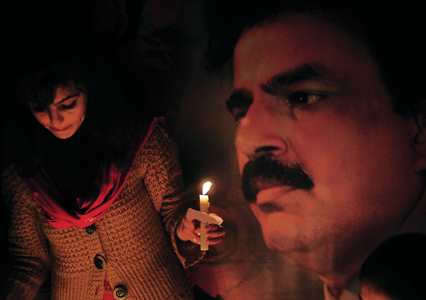
The PPP was founded in 1967 with the goal of bringing secular democracy to a nation under military rule. It vowed to give power to the people and promised to protect the nation’s downtrodden. That Pakistan’s most progressive party — one that has already endured the assassination of former Prime Minister Benazir Bhutto — should cave in the face of religious fundamentalism speaks volumes about the strength of the religious right. A candlelight vigil promoting a progressive Pakistan a few days after Taseer’s assassination drew nearly 1,000 supporters; a religious rally in Karachi the same day had 40,000 in the street chanting Qadri’s name. “Taseer’s murderer was tried in the court of public opinion, and he has emerged a hero,” says a woman shopping for vegetables in the same market where the governor was killed. “If someone kills me because I criticize Qadri, will he too be called a hero?” She declined to give her name. (Read: “Murder in Islamabad: Pakistan’s Deepening Religious Divide.”)

Of course, few Pakistanis would ever go as far as Taseer’s or Bhatti’s killers. But their ambivalence can easily be manipulated. “Just because we are religious does not mean we will all be reaching for guns the next time someone says something wrong,” says Malik Khan, a university student who spent a recent afternoon at a shrine in Lahore dedicated to a revered Islamic saint. “But Salmaan Taseer was an extremist as well. He should not have touched the blasphemy law.” Khan received a text message praising Qadri and exhorting him to pass it along. It posed a moral quandary: “I don’t agree with the message,” he says. “But I love the Prophet. My thumb hesitated a long time over the delete button.” In the end, he passed the hate along.

Qadri himself was the religious-minded youngest son of a family just stepping into the middle class. Like his brother, he joined the special-forces branch of the Punjab police in 2002. He had been flagged as a security risk because of his strong religious leanings but was nevertheless appointed to Taseer’s security detail when he visited Islamabad. In his confession, Qadri said he had been inspired by the teachings of his local mullah, Hanif Qureshi. At a rally a few days later, Qureshi claimed credit for motivating Qadri. “He would come to my Friday prayers and listen to my sermons,” he said. Then he repeated his point: “The punishment for a blasphemer is death.”

But is it? Two weeks after Taseer’s murder, I visited Qari Muhammad Zawar Bahadur, the head of one of Pakistan’s mainstream religious groups and a co-signer of a statement that advised Muslims not to show “grief or sympathy on the death of the governor, as those who support blasphemy of the Prophet are themselves indulging in blasphemy.” For more than an hour, he justified his group’s stance, telling me that the Koran was clear on the issue. I asked Bahadur to show me the exact verse that detailed the punishments for blasphemy. He mumbled that “there are several passages,” as if there were so many, he couldn’t decide which one to quote. When pressed further, he consulted a Koran and read aloud a passage that spoke of killing a man who had once harmed the Prophet.

That verse has routinely been dismissed by leading Islamic scholars as referring to a specific case and having nothing to do with blasphemy. They say there is no definition of blasphemy in the Koran, nor any prescription for its punishment. “Nobody challenges these mullahs, and that is our problem,” says Omar Fazal Jamil, who runs a p.r. firm in Lahore. “We can’t invoke liberal secular values anymore. I have to have the knowledge to contradict these men who distort our religion for their own political gain. I have to be able to say, ‘No, this did not happen, this is not right, and show me where it says in the Koran that blasphemers should be shot on sight.’ ”

The Sin of Silence
In the absence of such challenges, those favoring religious intolerance will continue to have things go their way. In late 2007, Benazir Bhutto released an updated manifesto for her father’s party. “The statutes that discriminate against religious minorities and are sources of communal disharmony will be reviewed,” it said. Less than a month later she was dead, killed in a bomb attack just 13 km from where both Taseer and Bhatti were murdered. Her death was an opportunity to rally the nation against the forces of extremism. Instead the party focused on consolidating power. The manifesto remains an empty promise, and two more voices of tolerance have been silenced. For evil to prevail, goes the old aphorism, all that is required is for good men to do nothing.

— With reporting by Ershad Mahmud / Lahore and Omar Waraich / Rawalpindi

Sindh Saves the Day

By Nadeem F Paracha for Dawn

Plans are afoot to build the world’s first ever international Sufi university near Bhit Shah in Sindh. The main purpose of the institution would be to promote interfaith and intercultural education to tackle extremism in the country.

Such a thought and project could only have come about in Sindh. Especially in the context of what Pakistan has beengoing through in the last many years.

Not only have the country’s other provinces – especially the Punjab and Khyber Pakhtunkhwa (KP) – become central targets of horrid terrorist attacks by extremist organisations, the Punjab in particular has also been witnessing a steady growth of faith-based conservatism within its urban middle and lower middle-classes.

When extremists (calling themselves ‘Punjabi Taliban’) attacked the famous Sufi shrine, Data Darbar in Lahore late last year, economist and political analyst, Asad Sayeed, made a rather insightful observation.

He said that had such an attack on the Darbar taken place twenty years ago, thousands of Lahorites would have poured out to protest.

But not anymore. The attack on one of Punjab’s most popular Sufi shrines was simply treated as just another terrorist attack.

Though it is now clear that the Wahabi/Deobandi extremists have been going around blowing up Sufi shrines frequented by the majority Barelvi Muslims, the Barelvi leadership has looked elsewhere, putting the blame on the ever-elusive ‘foreign hands.’

Journalist and intellectual Khaled Ahmed once wrote a telling tongue-in-cheek article about the annual gathering of the Dawat-i-Islami in Multan.

The Dawat is the Barelvi equivalent of the Deobandi Tableeghi Jamat. Both these outfits are considered to be non-political organisations who are more interested in evangelizing their respective versions of Islam and its rituals. One should also mention that both these (sub-continental) strains of Islam accuse one another of being ‘flawed Muslims.’

Ahmed wrote how after Dawat’s huge congregation in Multan, when police found some bullet-riddled bodies of Dawat members, the outfit’s main leadership simply refused to acknowledge the glaring evidence that pointed towards the involvement of an opposing Sunni sect’s organisation in the murders.

Ahmed adds that Dawat leaders began babbling about ‘outside forces (RAW, CIA, Mossad)’ who wanted to create disharmony between Pakistan’s Barelvi majority and the Deobandi and Wahabi sects.

Barelvis: From moderate to militant

One can understand the above-mentioned episode as an example of the confusion Barelvi spiritual leadership has gone through since the 1980s.

From its inception in the 18th century and until about the mid-1980s, the Barelvi sect was largely apolitical in orientation, non-Jihadist and followers of some of the most relaxed dictates of the Hanafi madhab – the first of the four main Islamic schools of law that is also considered to be the most moderate.

‘Barelvi Islam’ (as it is sometimes called) is purely a sub-continental phenomenon that fuses elements of Indian Sufism with the folk and populist strains of various cultures that exist in the sub-continent.

It is also called the ‘folk Islam’ of the region in which a high degree of tolerance exists between various faiths, sects, classes and ethnicities and in which the puritanical aspects of other Islamic sects are eschewed and even rejected.

The Sufi shrine and an intense reverence of the Prophet (PBUH) play a central role in Barelvi Islam. Its populist and moderate make-up helped it become the majority Sunni sect amongst the Muslims of the sub-continent.

Two of its leading opponents have been the Sunni Deobandi sect (also a product of the subcontinent) and the Saudi-inspired Wahabism.

Both have accused Barelvis of ‘adopting Hindu rituals and practices’ and assorted ‘heresies.’

In spite of being the majority sect amongst Sunni Muslims in Pakistan, ‘Barelvi Islam’ hardly ever had a coherent political expression in shape of a mass-based political party or organisation.

Its spiritual leadership remained pro-Jinnah (unlike Deobandi organizations of undivided India), and various Pakistani political leaders have continued to appeal to the symbolism and lingo associated with various populist aspects of Barelvi-ism.

Zulfikar Ali Bhutto and his Pakistan Peoples Party (PPP) was the most successful in this respect.

Bhutto was also one of the first leading Pakistani political figures to undertake the act of regularly visiting various famous Sufi shrines in Sindh and Punjab.

Barelvis are in the majority in Sindh and the Punjab, whereas Deobandis are largely centred in Khyber Pakthunkhwa and in the Pushtun-dominated areas of Balochistan.

Until the 1970s Barelvi-ism also prevailed among many of Sindh and Punjab’s urban middle-classes, especially those who considered themselves to be progressive and likely supporters of secular politics.

However, the arrangement in this context was suddenly disturbed with the arrival of the Ziaul Haq dictatorship in 1977.

Dipped in the political Islam of scholar and Jamat-i-Islami (JI) chief Abul Ala Mauddudi, Zia soon moved towards infiltrating the spiritual and political nerve centres of Barelvi-ism in an attempt to ‘reform’ them.

Barelvi dominance across the country’s religious landscape reminded him of Z A. Bhutto’s populism (which he, like JI, considered to be ‘vulgar’ and ‘un-Islamic’), and from 1979 onwards Pakistan under Zia also became one of the leading client states of Saudi-generated Wahabi propaganda and aid.

Stunned by the ‘Islamic revolution’ in the Shia-dominated Iran in 1979, Saudi Arabian monarchy and its Wahabi Sunni religious elite began seeing Pakistan’s Barelvi-dominated make-up as venerable to Shia-ism’s revolutionary symbolism and also of socialist propaganda, especially with the arrival of Soviet forces in Afghanistan.

At least that was one of the reasons used by Zia and his Saudi allies to draw the United States into giving Pakistan billions of dollars worth of aid and arms.

With the aid also came Wahabi propaganda literature and preachers who along with Pakistani Deobandi and Wahabi spiritual and political groups began setting up madressas and mosques.

These madressas operated as institutions that would indoctrinate young Pakistanis – most of whom were immersed in the non-Jihadi traditions of Barelvi-ism – and prepare them for Jihad against Soviet forces in Afghanistan.

Bralevi tradition had also not been very kind to the ulema and the clergy.

To address this, Zia also began describing famous Sufi saints as ulema and banned (in the media) all criticism and humour aimed at the clergy.

The Afghan war, Saudi propaganda, the mushrooming of Deobandi and Wahabi madressas and televangelists, and a concentrated campaign by the Zia regime to equate the dictatorship’s capitalist-Islamist makeup as something in accordance with the Shariah and with ‘Jinnah and Iqbal’s vision,’ had a telling impact on Pakistan’s religious sociology.

In the Khyber-Pakhtunkhwa many moderate and progressive Deobandi strains that had prevailed in the province began sliding into the sect’s more radical dictates, coming closer to the puritanical Wahabi and Salafi ideas about faith.

This slide was celebrated by the Punjab-dominated military as a successful blow to the secular and ‘treacherous’ Pukhtun separatist tendencies.

In the Punjab, the province benefited the most from Zia’s Punjab-centric capitalist maneuvers. This coupled with unprecedented remittances coming from Pakistanis who had begun going to Arab Gulf states to work from the 1970s onwards, gave birth to new moneyed classes.

Many from the petty-bourgeoisie and bourgeoisie sections began moving away from their Barelvi heritage and towards more puritanical strains of faith.

Their Barelvi past now reminded them of their lower status and economic modesty, whereas they began relating their enhanced economic standing with the adoption of the more puritanical strains of Islam.

That’s why the growth of puritanical Islamist and sectarian organizations that Punjab saw under Zia, a lot of their local funding came from Punjab’s nouveau-riche and petty-bourgeois trader classes.

Interestingly, it was also the same classes that also pushed the Barelvi leadership to become more conservative and radical. Those sections of the Punjabi petty-bourgeoisie that stuck to Barelvi-ism encouraged their spiritual leadership to compete with the Puritanism and radicalism of the growing number of Deobandi and Wahabi groups.

This trend saw the first ever emergence of radical Barelvi groups. In the early 1980s, the Dawat-i-Islami was formed to counterbalance the growth of the Deobandi Tableeghi Jamaat that had begun making deep inroads into Punjab’s bourgeoisie and the military.

The Dawat discouraged the Barelvis from indulging in antics associated with the region’s folk Islam, emphasising an increased reverence of holy personalities and encouraging holding of recitals of naats and milads instead of quwalis and dhamals. The last two became associated with the practices of the lower-class Barelvis.

In 1992, emerged the Sunni Thereek (ST). A Barelvi outfit that emerged from the splintering of the oldest Barelvi Islamic political party, the Jamiat Ulema Pakistan (JUP).

Such occurrences did not really help the Barelvi sect defend its traditions in the face of the state-sponsored Deobandi and Wahabi onslaught –  rather, these organisations began turning Barelvi-ism into an equally anti-pluralistic and militant political phenomenon.

Sindh saves the day?

By the 1990s, Zia’s manoeuvres and Saudi involvement in reshaping Pakistan’s religious tradition had seen Khyber Pakhtunkhwa and Punjab become hostage to various violent Deobandi/Wahabi outfits and new-born Barelvi reactionary-ism.

The Punjab also saw a rise in the use of reactionary political and religious narratives within its lower-middle and middle-classes, whereas in Balochistan attempts were being made (by intelligence agencies) to neutralize secular Baloch nationalist militancy with the help of puritanical evangelical outfits. The agencies had already done this successfullyin Khyber Pakhtunkhwa in the 1980s.

But what happened in Sindh? Barelvi-ism in Sindh (outside Karachi) has always been a lot more secular and pluralistic than the Bareilvi-ism in the Punjab.

Its  sociology  in Sindh heavily revolves around the staunchly secular historicity that the province’s famous scholar, GM Syed’s literary work generated.

He described a highly pluralistic and secular reading of Sufism as being the cultural and religious make-up of the Sindhis and it is this narrative that still rules the roost in the province’s social and religious psyche.

This is one of the reasons why Zia completely failed to impose his version of Islam here. Also, just like the majority of the Baloch who equate puritanical Islam with the ‘Punjabi civil-military elite,’ so does the socio-political discourse in Sindh.

On the other hand, in Karachi, though Zia-backed Deobandi and Wahabi radical outfits did manage to find a foothold, two things have always worked against these outfits here.

The first is the fact that the sprawling ethnic, sectarian and religious diversity found in Karachi actually absorbs and neutralizes any attempt by an outfit to impose its version of Islam.

Secondly, MQM, a party that first emerged as a mohajir nationalist group, adopted almost the same populist Barelvi symbolism and lingo as Bhutto did in the 1970s.

Also, the other two big political parties in the city too are secular: the PPP and ANP.

Though the Sunni Thereek (ST) has managed to infiltrate some sections of MQM’s support, ST is Barelvi and anti-Taliban (albeit reactionary).

In spite of the rampant crime and ethnic tensions that are a constant in Karachi, it will not be an overstatement to claim that Karachi along with the rest of Sindh today stands to be perhaps the only (ragged) sanctuaries in present-day Pakistan that are (comparatively-speaking) largely free of the factors that have created opportunities in the Punjab and KP for violent extremist activity as well as for reactionary conservatism to now become a mainstay in Punjab’s bourgeois psyche.

Our Noblest Selves

By Marvi Sirmed for Newsweek Pakistan

Be careful. After the assassination of Shahbaz Bhatti, federal minister for minorities, on March 2 and of Salmaan Taseer, governor of the Punjab, two months before that, friends and family put out the same, simple message. Be careful. But with two brave men slain so violently and so publicly, can we afford to be careful?

Everything changed after the governor’s assassination. For Taseer’s killer, there are shrines on Facebook and rose petals. For those of us who, accurately, refer to Taseer as a martyr, there is concern from well-wishers—and death threats from others. Lawyers lined up in the hundreds to defend and garland Taseer’s self-confessed killer, while cleric after another refused to lead his funeral services. The right’s pundits called Qadri a ghazi or holy warrior, while state-owned Pakistan Television dropped shaheed or martyr for Taseer within hours of his death. Qadri supporters brandished their bloody hands at rallies that pulled in tens of thousands, while those who mourn Taseer and what he represented struggled to manage mere hundreds at vigils. The polarization and plight of Pakistan have never before been so painfully obvious.

Like Taseer, Bhatti, too, gave his life up for a cause that must be owned by those who run our country. But people everywhere are being careful. And this just won’t do.

Bhatti was one of those rare public figures who never sought the spotlight, who spoke softly, who had no skeletons in his closet. Bhatti could have played it safe. He began receiving death threats after the Gojra massacre. These picked up after he championed the cause of Aasia Noreen, a Christian mother convicted under the blasphemy laws, which the Pakistan Peoples Party had committed to review in order to prevent their misuse. After Taseer’s death, Bhatti could have played it safe and gone quiet. He did not. He was not “careful.” He was laid to rest in Faisalabad on March 4 with thousands turning out to honor him.

What can we do? We need to be honest with ourselves. Bhatti was killed by a group that calls itself the Punjabi Taliban. Punjab Chief Minister Shahbaz Sharif has taken exception to interior minister Rehman Malik highlighting this fact. Terrorists are a national problem, they are not Punjabis or Sindhis, says Sharif, who is also the home minister of his province. What more has to happen before the chief minister, a compassionate man by most accounts, finally acknowledges that we have a problem in the Punjab?

Second, we need to stop passing the buck and offering contrition practiced for television. Prime Minister Yousaf Raza Gilani reportedly offered his resignation to the cabinet the day Bhatti was assassinated. There have been two shocking high-profile murders in Islamabad in as many months and not a single soul has been sacked. There’s no shortage of candidates who deserve the ax. Let’s start with the state-employed clerics who refused to perform Taseer’s last rites.

Third, name and shame the members of Parliament who refused to raise their hands in prayer for Taseer and Bhatti. There was a prayer for Taseer in the National Assembly, but, infamously, not in the Senate. Bhatti got two minutes of silence in the National Assembly on March 3 and a walkout from all parties—including, oddly, the ruling party—against the government’s failure to protect Bhatti, but no prayers. What have we come to when we cannot bring ourselves to pray for the departed and their devastated families? This is not coldhearted or remotely Islamic, but pure evil.

Fourth, we need to enforce a strict ban on hate speech. Incitement to murder, character assassination and hate words cannot be provided mainstream platforms—whether print or electronic—under the pretense of free speech. Some channels promoted the false impression that Taseer had blasphemed, and they publicized fatwas against him. They also hyped up pro-Qadri rallies. It never came to light that these processions, while big, were limited to three cities. Responsibility will not suddenly dawn on our lawless media. To keep television honest and to counter the state’s halfhearted ban on militant groups, corporations need to step up and withhold ad spend from channels providing support to the jihadists. Consumers can then hold these corporations accountable by buying or boycotting their products.

The brave among us refuse to be careful when they see the rapid undoing of their motherland, and whose faith in man’s goodness speaks to our noblest selves. We are not a nation of murderers and monsters, but we sure are close.

Sirmed is a rights activist in Islamabad.

Not much Islamic about Islamic Pakistan

By Haroon Siddiqui for The Toronto Star

In the failing state of Pakistan, a junior cabinet minister is killed. Shahbaz Bhatti was a member of the Christian minority. He had taken up the cause of a poor Christian woman condemned to death for allegedly defaming Islam. He knew he was a marked man. But on a recent visit to Canada, where his brother lives, he said he was determined to carry on.

Eight weeks ago, a veteran politician was gunned down for the same sin. He, too, had championed the woman’s cause and condemned the blasphemy law that imposes the death penalty for insulting Islam or the Prophet Muhammad. Salman Taseer was the governor of Punjab, the most populous and prosperous province, and an influential billionaire tycoon, a socialite and an unrepentant liberal in a society that’s becoming militantly conservative. He was a Muslim.

Bhatti was gunned down by unknown assailants. Taseer was assassinated by a member of the elite security unit assigned to guard him. More shockingly, the assassin was hailed a hero. Hundreds turned up at his house, chanting “we salute your bravery.” About 500 clerics signed a statement calling him “a true soldier of Islam.” When he appeared in court, young lawyers showered rose petals and kissed him. At a rally in cosmopolitan Karachi, marchers waved his portrait.

This is a sick society. There’s little Islamic about the Islamic Republic of Pakistan.

The blasphemy law may have been enacted by the British colonials in 1860. But it was toughened by the Muslim rulers of Pakistan in the name of Islam. And both in its wording and implementation, the law violates the most basic principles of Islamic jurisprudence. In allowing hearsay evidence and innuendo, it ignores the necessity of incontrovertible proof for a finding of guilt.

The act is allowed to be abused in personal and property disputes. (A majority of those charged have been Muslims, according to the Human Rights Commission of Pakistan, a voluntary organization). Or it is wielded as a weapon in political and religious vendettas. In one particularly horrific case, two Christian brothers were framed with a handwritten note defaming the Prophet, found in a marketplace with their home address and phone number.

Yet local police and magistrates dare not toss out such trumped-up charges. Cases have to be taken to higher courts to be overturned. Not a single person has been executed under the act. Yet more than 30 people charged or acquitted have been killed.

Under Islamic law, such jungle justice constitutes a greater crime than the alleged original one. It is deemed particularly egregious when the innocents prosecuted are poor and powerless.

The blasphemy law is just one of many flashpoints.

Christian churches have been bombed. So have been mosques belonging to the minority Ahmadi sect, deemed heretic. So also mosques of the minority Shiite Muslim sect. So also Sufi shrines, along with the devotees who turn up for the anniversary festivals of dance and music dedicated to those saints.

Not just that.

Pakistani Taliban and other militants have been killing fellow Muslims who won’t side with them. Such attacks were once restricted to the remote Afghan-Pakistan border but now they are routine in the populated south. Tens of thousands have been killed, including Benazir Bhutto, assassinated in December of 2007.

Yet the government is too weak to provide basic security and too corrupt to care — both egregious Islamic crimes. The politicians and the bureaucrats are not the only ones on the take. Too many clerics are also money-grabbing machines.

Several reasons are proffered for this sad state of affairs.

One is that Pakistan has had too many military dictators, and that the longest-serving one, Zia ul-Haq (1977-88) Islamized Pakistan, which he did. But he did so in tandem with the American-led effort to Islamize the war against the Soviet occupation of Afghanistan. Another inconvenient truth is that while the military used jihadist proxy militias against India and Afghanistan, political parties use them as vote banks and to flex street muscle.

The secular-Islamic divide is also cited. Yet both religious and secular elites have pandered to extremists. It was the wine-sipping prime minister Zulfiqar Ali Bhutto who in the 1970s restricted liquor and declared the Ahmadi sect non-Muslim. It is his People’s Party, once again in power, that abandoned backbencher Sherry Rahman after she proposed amendments to the blasphemy law.

Meanwhile, the economy is in ruins. Inflation is rampant, the currency is losing value and the central bank is printing more rupees.

Don’t be surprised if Pakistanis begin clamouring, yet again, for the return of the military to power.

Haroon Siddiqui is the Star’s editorial page editor emeritus. His column appears on Thursday and Sunday. hsiddiqui@thestar.ca