Archive for the ‘ Islam ’ Category

Time to Repeal the Blasphemy Law

By Nasim Zehra for The Express Tribune

In June 2008, Asiya Bibi, a Pakistani farm worker and mother of five, fetched water for others working on the farm. Many refused the water because Asiya was Christian. The situation got ugly. Reports indicate Asiya was harassed because of her religion and the matter turned violent. Asiya, alone in a hostile environment, naturally would have attempted to defend herself but was put in police custody for her protection against a crowd that was harming her.

However, that protection move turned into one that was to earn Asiya a death sentence. A case was filed against her under sections 295-B and C of the Pakistan Penal Code, claiming that Asiya was a blasphemer. Her family will appeal against the judgment in the Lahore High Court.

The Asiya case raises the fundamental question of how Pakistan’s minorities have been left unprotected since the passage of the blasphemy law. There may have been no hangings on account of the law but it has facilitated the spread of intolerance and populist rage against minorities, often leading to deaths. There is also a direct link between the Zia-ist state’s intolerance against minorities and the rise of criminal treatment of Ahmadis.

Cases have ranged from the Kasur case to the more recent Gojra case, from the mind-boggling row of cases between 1988-1992 against 80-year-old development guru Dr Akhtar Hameed Khan, to the case of the son of an alleged blasphemer, an illiterate brick kiln worker who was beaten to death by a frenzied mob.

Although doctor sahib faced prolonged mental torture, he was saved from the maddening rage that has sent to prison, and in some cases devoured, many innocent, poor and hence unprotected Pakistanis.

There is a long list, prepared by the Human Rights Commission of Pakistan, of unjust punishments handed down to Pakistani citizens whose fundamental rights the state is obliged to protect. Beyond punishments, minorities live in constant fear of being lethally blackmailed by those who want to settle other scores.

Yet most political parties have refrained from calling for the law’s repeal or improvement in its implementation mechanism. When, in the early 90s, I asked Nawaz Sharif sahib to criticise the hounding of Dr Khan, his response was a detailed recall of the story in which Prophet Muhammad (pbuh) went to ask after the health of a non-Muslim woman who repeatedly threw garbage over him. He condemned what was happening but said politics prevented him from doing so publicly. Later, General Musharraf, advised by other generals, reversed his announcement of changing the law’s implementation mechanism. Small crowds protested against it. Among politicians, very few exceptions include the PPP parliamentarian Sherry Rehman and, more recently, the ANP’s Bushra Gohar, who asked for its amendment and repeal.

Already sections of the judiciary have been critical of flawed judgements passed by lower courts in alleged blasphemy cases. Recently in July, Lahore High Court Chief Justice Khawaja Sharif quashed a blasphemy case against 60-year-old Zaibunnisa and ordered her release after almost 14 years in custody. According to the judgment, the “treatment meted out to the woman was an insult to humanity and the government and the civil organisations should be vigilant enough to help such people.” Surely the Bench should know the plethora of abuses that Pakistan’s minorities have suffered because of an evidently flawed law.

A message more appropriate, perhaps, would be to repeal the black law that grossly undermines the Constitution of Pakistan and indeed the teachings of Prophet Muhammad, one of the most tolerant and humane law-givers humankind has known. This environment of populist rage, fed by the distorted yet self-serving interpretation of religion principally by Zia and a populist mixing of religion and politics by a politically besieged Zulfikar Ali Bhutto, must be emphatically challenged. A collective effort to roll back these laws must come from parliament, the lawyers’ forums, the judiciary, civil society groups and the media.

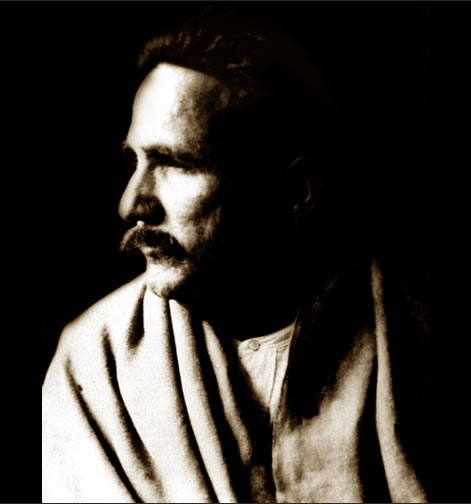
Allama Iqbal: The Great philosopher Poet of Pakistan

By G. Sabir for Iqbal Academy Scandinavia

Nature gives birth to great philosophers and poets when the need arises. Natural calamities, wars, epidemics, storms and earthquakes etc causing human sufferings have always given birth to creative minds. Plato was born in 420 BC when his country had almost been ruined as a result of Peloponnesian war. Iqbal was born in 1877 AD when the inhabitants of India were suffering from miseries and deaths while struggling for the Independence of their country from British rule.

The people of Muslim community of India were the worst hit. They were being crushed ruthlessly. At that time Iqbal’s poetry played miraculous role. It awakened the people from slumbering hopelessness, made them stood on their own feet. They were united and then fought courageously for Independence with the result that they achieved a free homeland for them within a few years time.

Creative thinker

This means that despite being a creative thinker, Iqbal was addressing the situation at hand. The ideas he enunciated, though intrinsically creative in themselves and abiding in appeal beyond a particular time and place, were yet primarily meant to salvage the bleak Muslim situation in India and the world at large. This makes Iqbal, in a sense, oriented towards the Indian Muslim psyche and situation.

This framework makes his periodic forays into discussing and suggesting solutions to the problems of the Muslim world at large and his consuming concern with the ‘Reconstruction of Religious Thought in Islam’ (1930) – a logical extension of his role as a modern Muslim ideologue, attempting to analyze and, see Muslim India’s problems and predicament on a wider canvas and in a total context. After all, Iqbal regarded India, if only because of the Muslim numerical strength, as ‘the greatest Muslim country in the world’, to quote his own words. These tasks, both critical and onerous as they were, he fulfilled squarely.

Effective medium

His emotion-leaden and soul-lifting poetry was the medium Iqbal chose to bring his people a new awareness of the depths of degradation to which they had fallen, to diagnose their ailments, their predicament and the prime cause of their decline and to warn them of the dire consequences if they failed to mend themselves in good time. A more effective medium he could not have possibly chosen.

For one thing, poetry is the most powerful medium for touching the deepest emotions of people and for driving a message into their subconscious. For another, the Indian Muslims had been among the most poetry-oriented people in the wold, with a long tradition of readily taking to heart what was written in verse. Political orations may stir and audience into action, but their impact is bound to be restricted to a particular audience and dissipate with time and events. In contrast, a poetic message seeps through the ethos of a nation, working on its psyche all the while.

Political leaders

Hence Iqbal achieved through his poems what a thousand speeches could not. But for the silence mental preparation that had gone on for long decades, the people would not have responded to the call of political leaders – in this case, especially of Jinnah during the 1937-47 epochal decade. No wonder, the pandals of the League sessions from Lucknow (1937) onwards were plastered with Iqbal’s couplets, calling on Muslims to rise and take their destiny in their own. Iqbal was quoted oft and on to rouse Muslims to a new awareness of their destiny. All this had an electrifying effect on the audience since Iqbal, though generally complex and couched in an appropriate idiom, was, straightforward and yielded clear guidelines.

Besides being a poet of extraordinary merit, Iqbal was a thinker of a high order. Thus, while Syed Ahmed Khan, Maulana Mohammed Ali and Jinnah provided political leadership to Muslims, Iqbal took upon himself the task of setting the intellectual tone for Muslim thought and action. (Previously, this was done by Sir Syed’s, writing and the Aligarh school). In addressing himself to this task, Iqbal brought a revolution in Muslim thinking at various levels, he also made a significant contribution to keeping them stolidly anchored to their pristine ideology and historical legacy.

New consciousness

His role in awakening the Muslims to a new consciousness began in 1899 when he recited a poem at the annual session of the Anjuman-i-Islam, Lahore. His moving ‘Nala-i-Yatim’ was symbolic of the echoing cry of the faceless masses of the Indian Muslims, who had long felt themselves sidelined neglected.

What pained him most was the impact of nationalism on various Muslim countries, eroding the pan-Islamic concept, enfeebling the Muslim world and laying it open to European aggression and exploitation.

To the ailments the Muslim world was afflicted with, Iqbal found the solution in Islam and its message. In order to reach the innermost recesses of their consciousness, he invoked the past glory of Islam, telling Muslims of the accomplishments of their ancestors. In so doing, he tried to fight off the prevalent slough of despondency, raising drooping spirit of Muslims and replacing it with a sense of soaring confidence.

Message of hope

Next, he gave them a message of hope. He told them that they could still redeem themselves if they could only recapture their soul and regain their pristine moral and spiritual values.

He emphasized the imperative need to develop human qualities and the right type of character. He attributed their degeneration to their taking to a life of passivity and resignation for several generations. That debilitating trend could be reversed by opting for initiative and endeavour which, he believed, Islam stood for. To him, an active, struggling non-believer was preferable to a sleeping Muslim.

But if Muslims were to be beckoned to a new destiny, they must first be confirmed as Muslims and they must own up their pristine values. This was all he more necessary in the context of the rise of positivism and skepticism, which posed a serious challenge to the modern Muslim.

Modern Muslim

To Iqbal, the task before the modern Muslim is to re-think the whole system of Islam without completely breaking with the past. And this crucial task he undertook in a series of lectures since compiled as ‘The Reconstruction of Religious Thought in Islam’ (1930). In these he argued that Islam represented a philosophy of action, for faith without action was a life bereft of any significance. Seldom does a poet exert such profound influence on the course of history and in changing the destiny of a nation. But Iqbal did because his accomplishments extended far beyond the realm of mere imagination and into the sphere of objective realities, because in the final years of his eventful life he donned the mantle of an ideologue, besides being a national poet. And, to be sure, all of Iqbal’s efforts throughout the whole span of his active life were directed towards the regeneration of Muslims and the resurgence of Islam.

Human rights

The question, ‘do we need Iqbal today?’ The reply is a clear ‘Yes’. It is a need of the time, because the honour of humanity is at stake. The preachers of human rights are abusing humanity. Masses of men are being trampled ruthlessly under the heavy feet of the powerful. There is dearth of love in the world these days. Iqbal is a messenger of love. His message of love is universal… the humanity needs him.. we do need him without any doubt.

Righteous Among the Nations: Muslims Who Saved Jews from Holocaust

By Tim Townsend for The St. Louis Dispatch

In 2003, Norman Gershman was looking for some of the righteous.

What he found astonished the investment banker-turned-photographer, and led him toward a project now on display in a St. Louis synagogue.

The Righteous Among Nations are gentile rescuers who make up “a small minority who mustered extraordinary courage to uphold human values,” according to Yad Vashem, Israel’s Holocaust memorial museum.

They are, the museum says, “the few who helped Jews in the darkest time in their history.”

Gershman’s story begins during the Holocaust and involves Albanian Muslims — villagers, peasants and farmers — who risked their lives and the lives of their families to shelter Jews fleeing Nazi Germany.

Italy invaded Albania in 1939 and occupied the country until the overthrow of Benito Mussolini in 1943. Germany then took over the Albanian occupation. Before the war, Gershman estimates from his research, only about 200 Jews lived in Albania, a country that is about 70 percent Muslim.

During the years of occupation, 10 times as many Jews streamed into Albania to escape persecution from Poland, Yugoslavia, Czechoslovakia, Greece and Italy. Gershman says it was the only country in Europe where the Jewish population grew by the end of the war.

Most of the hidden Jews either fled to Israel or back to their native countries after the war. Albania’s postwar communist regime made it impossible for the Jews who had been hidden to stay in touch with the Albanian Muslims who had provided shelter.

In 2003, New Jersey native Gershman heard hints of the story and began doing research, eventually traveling to Albania to begin interviewing those Muslims who took part and who were still alive. Gershman said it wasn’t just Muslim families who shielded Jews from the Nazis, but also Orthodox and Catholic families.

All of them were motivated by an Albanian code of honor called “besa,” a concept that can be translated into “keeping the promise,” Gershman says. The Albanian villagers were motivated to risk their lives by the simple concept of helping one’s neighbor.

“We chose to focus on the Muslims because, who ever heard of Muslims saving Jews?” Gershman said in a telephone interview from Israel, where he is at work on his next project.

Gershman’s research eventually led to an exhibit of his photographs, “Besa: A Code to Live By,” which opened recently at Congregation Temple Emanuel, and a book, Besa: Muslims Who Saved Jews in World War II.

The exhibit makes the case that the Muslim Albanian villagers who sheltered Jews from deportation to concentration camps did so from a sense of religious obligation.

“Besa is a cultural idea, but for the Muslims in Albania it was ingrained in their faith as well,” Gershman said.

Ahmet Karamustafa, professor of history and religious studies at Washington University, said saving a life is a universally acknowledged Muslim value.

Protecting a life, Karamustafa said, “has always ranked at the very top of moral and legal categories articulated by legal and theological scholars in Islam.”

The exhibit has been traveling the world since 2006, opening in Yad Vashem in Israel, the United Nations in New York, and synagogues, mosques, college campuses and Holocaust museums from Turkey to El Paso, Texas.

The exhibit of 30 photographs includes one of Lime Balla, born in 1910, who told Gershman that a group of 17 Jews came from the capital city of Tirana to her village of Gjergi in 1943 during the holy month of Ramadan.

“We divided them amongst the villagers,” Balla said, according to Gershman. “We were poor. We had no dining table, but we didn’t allow them to pay for food or shelter. We grew vegetables for all to eat. For 15 months, we dressed them as farmers like us. Even the local police knew.”

David Sherman, president of Temple Emanuel, said the synagogue “decided it could be an opportunity to educate the public about this piece of history that was a model of dialogue and tolerance.”

The synagogue’s rabbi, Justin Kerber, said one of the Reform congregation’s goals with the exhibit is to combat a common depiction of the modern relationship between Jews and Muslims.

“There’s so much coverage about Muslim-Jewish strife and conflict,” Kerber said. “It’s important to tell people that’s not the whole story, and these are examples of Muslim-Jewish respect, tolerance and love. This was a good opportunity for us to be part of that conversation.”

‘Islam in a Nutshell’ Explained at Episcopal Church

By Mitchell Landsberg for The Los Angeles Times

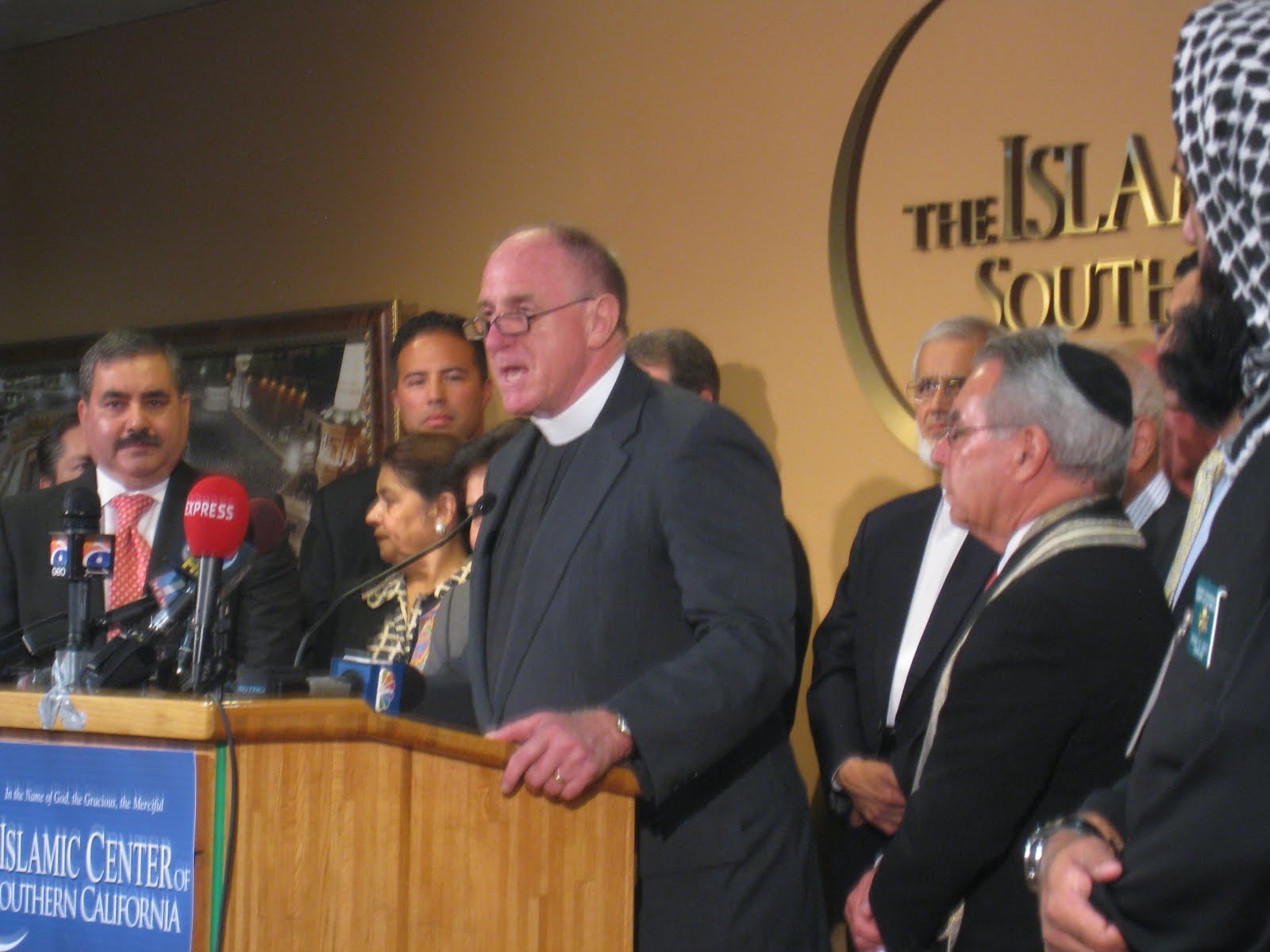
The Rev. J. Edwin Bacon, rector of All Saints Church in Pasadena, had just returned from vacation when he heard about a Florida pastor who was threatening to burn copies of the Koran, Islam’s holy book.

“I was disgusted,” said Bacon, whose Episcopal church is known for its progressive stance on many issues, interfaith relations among them. He said he thought: “Rather than burning Korans, we should be studying them.”

The Koran burning never took place. But from Bacon’s reaction was born “Islam 101,” a speaker series that ended Saturday with a lecture by Dr. Maher Hathout, senior advisor to the Muslim Public Affairs Council and a leading voice of Muslims in Southern California.

About 75 people went to the church to hear Hathout give a brief overview of “Islam in a nutshell,” then answer questions from a friendly audience that seemed concerned about both Muslim extremism and American hostility toward Islam.

Hathout told the audience that as the “new kid on the block” among the three Abrahamic faiths, which include Judaism and Christianity, Islam has had two options: “to be accepted by other religions or to fight with them.”

He continued: “We are now discovering … that we can be different without fighting, or it will be a miserable life. And it is a miserable life right now, if you ask me.”

Hathout expressed horror at the discovery of explosives bound from Yemen to the United States, part of a suspected Al Qaeda terrorist plot. He said terrorism violates Islamic theology and could ultimately destroy Islam. By using it “to defend Islam, you sacrifice Islam,” he said.

At the same time, Hathout complained about the use of the term “Muslim terrorist.” No one ever says a “Christian terrorist” bombed an abortion clinic, he said, adding, “They will not give the religious adjective to that person.”

And he said he is angered by people who say that moderate Muslims have been too reluctant to denounce extremism.

“If I shout and you don’t hear me, it means you are deaf,” he said. “It doesn’t mean I didn’t shout.”

All Saints is not alone in reaching out to the Muslim community in an attempt to better understand Islam. In the years since Sept. 11, 2001, numerous churches and synagogues, generally those associated with the progressive or liberal wings of their faiths, have invited Muslim speakers or partnered with Islamic organizations on interfaith events.

During the question-and-answer session, one member of the audience observed that if Hathout were to attend a “Christianity 101” lecture at All Saints, it would be different than a similar lecture at an evangelical church. She wondered if the same were true of Islam. Hathout said there is diversity within Islam, but also boundaries that cannot be crossed.

The question also spoke to another point: To a large degree, Saturday’s event was a meeting of like-minded sensibilities. There probably weren’t any prospective Koran burners in the audience. Hathout wasn’t changing minds so much as informing them.

Bacon acknowledged as much afterward. “I’ve always thought that preaching to the choir is a very important thing,” he said, “because the choir needs to be radicalized. On one level, you want to get the message taught. But on another level, you want them to be equipped and empowered to go out and courageously act.”

Those who attended the three-lecture series, he said, will be better able to explain to others that “most of the 1.6 billion Muslims in the world view their religion as a religion of peace, not as a religion of terrorism.”

“This is the real Islam,” he said.

Bill O’Reilly’s Full Of It..

By Gotham Chopra for The Huffington Post

A clip from The view is making the rounds today showing hosts Joy Behar and Whoopi Goldberg walking off set after engaging in a heated dialogue with guest Bill O’Reilly.

I’ve been talking dogs so long that it almost slipped my attention before I realized that this is the stuff I live for. Commenting on blustery (Fox) commentators like O’Reilly and Sean Hannity and just how unperceptive and misdirected they really are.

The gist of it: O’Reilly’s view that the Ground Zero Mosque should not be constructed because 1) 70% of Americans allegedly are against it and 2) Because Muslims killed Americans on 9/11. (His words, not mine)

1) So what? 65% of Americans also admit to knowing little or nothing about Islam. Crossover with O’Reilly’s aforementioned 70%? I’ll bet. Let’s not be led astray by the admittedly ignorant and misinformed.

Btw – those 70% are perfectly welcome to line up across the street and peaceably protest. Along with Muslims and everyone else practicing their faith free of persecution and prejudice, it’s one of the great privileges our constitution affords us. Yeah America!!!

2) Declaring Muslims killed Americans on 9/11 is dangerously inflammatory. Radicals who happened to be Muslim killed Americans and well over a dozen other nationalities that fateful and tragic day. By Mr. O’Reilly’s logic, Christians shouldn’t be allowed to build churches in Oklahoma City because Tim McVeigh was, after all, Christian and killed 168 people there. Wait, what? Yeah…

Here’s the thing: there are 1.3 billion Muslims in the world and growing. We can either go Bill’s way which is to perpetuate misconception, ignorance, conflict, rage, antagonism, and moral arrogance or we can engage in dialogue, empathy, creative conflict resolution and non-violent communication and possible create a more secure and sustainable future for our grandchildren. And yes, it will take time because evolution always does.

I’ll take the latter, but know Mr. O’Reilly will take the former because, he after all has ratings and book sales to consider…which I indeed empathize with.

You can buy Walking Wisdom wherever books are sold 🙂

Gotham Chopra, is the founder of Liquid Comics, the author of Walking Wisdom and other fine books, and the son of Dr. Deepak Chopra.

Islam: A Religion of Love

By William C Chittick for The Huffington Post

In the field of religious studies, the word “religion” is commonly understood to designate a worldview along with the various cultural phenomena that embody it, such as doctrine, ritual and art. In this broad sense of the term, everyone has a “religion,” whether acknowledged or not.

By studying the religions of others we can hope to gain a bit of distance from the unquestioned worldviews that underlie our own thinking. Such study is much like learning a new language — we gradually come to see the strengths and weaknesses of our own way of talking and writing. So also each religion, including the atheistic versions, has its own genius and its own limitations.

It seems fairly clear that most thoughtful people nowadays think that we live in interesting times. Some look to other worldviews precisely to gain insight into their own lives. This is a major factor in the great popularity of religious studies in North American universities. The fact that Rumi has become a household name points in the same direction.

Part of Islam’s intellectual heritage is a vast literature exploring and elucidating the nature of love, that most precious of human experiences. Now that I have been offered this forum and told to write about anything I feel like, well, I feel like talking about love. My two previous posts and the responses to them have highlighted the fact that most people have already made up their minds as to the nature of “true Islam.” So let me turn to something that most people, Muslim or not, typically leave out of their understanding of Islam, not least because of their obsession with the world of politics and catastrophes.

Ibn Qayyim al-Jawziyya was a famous theologian from Baghdad who died in 1350. Part of his fame lies in the fact that he was the leading disciple of one of the most cantankerous theologians of Islamic history, Ibn Taymiyya, a favorite of Sunni ideologues. Surprisingly for those who think that people of this ilk were narrow-minded bigots, Ibn Qayyim dedicated a large part of his prolific output to love, compassion, forgiveness and other such mild-mannered themes.

In one of his many books, written late in life — Ighathat al-lahfan, “Aid for the Sorrowful” — Ibn Qayyim says that the root of Islam is “love for God, intimacy with Him, and yearning to encounter Him.” He also says, “The revealed books of God, from the first to the last, revolve around the commandment to love.”

Remember that Muslim scholars traditionally spoke of “124,000 prophets,” beginning with Adam and ending with Muhammad. What Ibn Qayyim is trying to say is that every true religion — that is, all the religions established by the 124,000 prophets — are founded on love. It makes no difference who these prophets were or where they lived. When Muslims settled down in China, for example, they soon recognized that Confucius had been a prophet.

Claiming that “love” is the heart of Islam or of religion generally is not unusual in the Islamic context. Another example is provided by the major Sunni scholar Rashid al-Din Maybudi, who completed the longest pre-modern Persian commentary on the Quran in 1126. In explaining why the Quran calls itself “a book from God” (verse 2:89), he says that the book deserves to be titled “the eternal love” and that its content is “the story of love and lovers.”

One hundred years after Maybudi and as many years before Ibn Qayyim, Rumi’s famous teacher, Shams-i Tabrizi (who disappeared in the year 1247), said that the Quran is “a book of love,” or “a love letter” from God. He explained that if lawyers, philosophers and theologians fail to see it this way, that is because they are too preoccupied with their own specialties. First, you need to love God rather than law or theology or philosophy (or politics). Then, you should read the book. It is worth noting here that Shams, despite his reputation as an unlearned rascal of spirituality, was a professional Quran-teacher.

No one is surprised to hear that Rumi saw the Quran as a book of love, but most seem to think that Rumi was out of kilter with the Islamic mainstream. Nothing could be further from the truth. It is no accident that his six-volume epic poem in celebration of love, the Mathnawi, has often been called “the Quran in the Persian language.”

Shams al-Din Muhammad, the greatest and most beloved of Persian poets, provides another example. He is known by his chosen pen name, “Hafiz,” a word that designates someone who has memorized the Quran. Anyone familiar with his poetry knows that it is permeated with love and beauty, so much so that native-speakers can become intoxicated simply by listening to it. Hafiz holds that all religion and indeed, all human striving, is rooted in love. One verse will have to suffice:

Everyone, sober or drunk, is seeking a beloved,
everywhere, mosque or synagogue, is the house of love.

Muslim scholars who talk about love as the heart of Islam and of religion generally take the position that God’s love and compassion motivated him to create human beings so that they could love him in return. The goal of creation is to bring lovers into existence, and the goal of lovers — that is, you, me and everyone else — is to escape false loves and return to what we really love. This, for them, is the key message of the Quran, “the story of love and lovers.”

William C. Chittick, is a Professor of Religious Studies, Department of Asian and Asian American Studies, State University of New York, Stony Brook. For a survey of the role of love in religion generally, including his essay on Islam, see the volume edited by Jeff Levin and Stephen G. Post, Divine Love: Perspectives from the World’s Religious Traditions.

Muslim-Jewish Evening Raises $$ For Pakistanis

By Cristina Costantini for The New Haven Independent

Farhan and Shahida Soomro became American citizens on Friday. Originally from the Sindh Province in Pakistan, they have lived in the U.S. for ten years. Two days after becoming Americans, they held an event with their friends Ron Miller and his wife Cathie Miller to raise money and awareness about the floods which have ravaged their province in Pakistan. “It’s been a busy weekend!” said Shahida Soomro.

The event—“An Evening to Support Pakistani Flood Relief at the Community Foundation for Greater New Haven”—was held Sunday night at the Community Foundation for Greater New Haven on Audubon.

The Soomro family is Muslim; the Miller family, of Westville, is Jewish. The idea for the event, a “Jewish-Muslim collaboration,” came about over a dinner with old friends, Cathie Miller said. The Millers then sought the support of the Social Action Committees of the Temple Emanuel of Greater New Haven and the Congregation Mishkan Israel of Hamden, which were instrumental in the organization of the event.

After guests Sunday night enjoyed a wide spread of ethnic foods, Farhan Soomro opened the presentation by relaying the severity of the crisis. While the Soomro family was not present during the flooding, they have stayed in constant contact with their relatives in the region. With a fifth of Pakistan underwater, 20 million people displaced, and two million homes destroyed, Soomro explained, farmers have lost two seasons of crops and the Pakistani government cannot meet the food and shelter demands the disaster has triggered.

The event raised about $3,000.

Timothy Rogers, the director of charitable gifts for Save the Children in Westport described to guests where their donations would go. “We have been in Pakistan for 31 years now,” said Rogers. “What are we doing in Pakistan now? We’re providing emergency medical care, we’re distributing tents, shelter kits, food, and other supplies, we’re distributing water purification tablets, and bed nets.”

According to Cathie Miller, Save the Children was chosen as the charity for the event because over 90 percent of money donated goes to direct relief, and the Soomros have heard anecdotal evidence from their relatives and friends in the Sindh province that Save the Children has been effective in the region.

Rogers raised questions about the lack of American response and media coverage to the tragedy. Americans have given disproportionally less than other developed nations in the world. Although Save the Children has sent about $46 million to help alleviate suffering in Pakistan, the American public’s contribution makes up only $2.3 million of this total. Norwegian citizens, a country with a much smaller population, has already donated over $4 million in assistance funds through Save the Children. Rogers posited that donations might be down because of “donor fatigue due to recent tragedies” or because of a lack of media coverage. Ron Miller linked the trend to Islamophobia.

“I think even though we don’t want to say it, Americans have a hard time understanding and appreciating Muslims,” Miller said. “And one of the reasons that, myself as a Jew, and I’ve talked with various synagogues which they are present here today, is the importance for both Jews and Muslims and Muslims and Americans to come to grips with who we are, what our cultures are and what our values are. One of our reasons for doing this, was in our small way, a Muslim family, and a Jewish family, over dinner decided to try to do something to show that that gulf doesn’t exist between us and our Muslim colleagues.”

One audience member admitted her initial hesitations about donating to the cause. “My knee-jerk reaction, when I heard about this event, was how do I know my money isn’t going to go to the Taliban? Of course this was ignorant, and I really think the reason we don’t talk about this flood is that our government is struggling with Pakistan,” she said.

A Pakistani member of the audience responded to her comments, suggesting that crisis alleviation in the area is one of the best ways to win a war of ideas: “The Pakistani people realize that Save the Children is coming from the American people. Winning the hearts and minds is the key thing, our policy makers have allocated $30 million to public diplomacy work in Pakistan. It should be a no-brainer that if we use our resources to help get their homes together that this will be much more effective.”

“This is a great opportunity for us to change and affect the hearts and the minds of the Pakistani people,” he concluded.

The event drew around 50 guests.

Donations are still being accepted. Checks can be made out to “Save the Children” with a memo note: “Pakistani Flood.” In order to count as a part of the Greater New Haven response to this disaster the check must be sent to The Community Foundation for Greater New Haven, 70 Audubon Str., New Haven 06510 Attn: Lee Cruz. All donations will be sent to Save the Children within the week.

Sufi Shrine in Pakistan Is Hit by a Lethal Double Bombing

By Huma Imtiaz for The New York Times

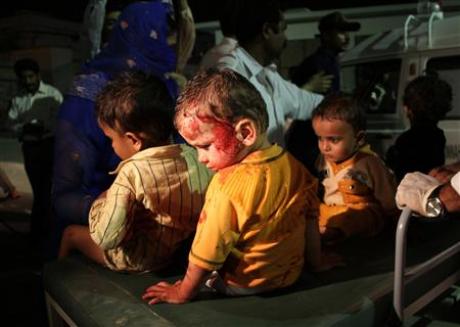
KARACHI, Pakistan — A nearly simultaneous double explosion that may have been the work of suicide bombers struck a crowded Sufi shrine in Pakistan’s main port city of Karachi on Thursday evening, killing at least 7 people and wounding 65, officials and rescue workers said. Pakistani women mourn the death of a child killed in an attack on the shrine Sufi Saint Abdullah Shah Ghazi.

It was the first attack on the shrine, the grave of the Sufi saint Abdullah Shah Ghazi, and it appeared to be an effort by hard-line militants in Pakistan to strike at the heart of Sufism, the moderate, more flexible blend of Islam practiced by most Pakistanis.

The attack came three months after militants struck one of the country’s most important Sufi shrines in the city of Lahore, which left at least 42 people dead.

The first blast at the Karachi shrine occurred at the main gate. Police officials said that within 25 seconds, the second blast hit the steps leading up to the saint’s grave.

Rescuers said three children were among the dead.

Dr. Seemi Jamali, deputy director of the emergency ward at Jinnah Hospital in Karachi, where the wounded were taken, said “many of them have severe injuries, trauma to the head and neck.”

Television channels showed body parts strewn at the site and chaotic scenes of unnerved, sobbing survivors.

The home minister of Sindh Province, Zulfiqar Mirza, told reporters that the severed heads of two suspected suicide bombers had been recovered from the site. Police officials were more circumspect, saying it was premature to conclude that the attack was by suicide bombers.

Local TV channels reported later that Tehreek-e-Taliban, or Movement of Taliban, an umbrella group of militants, had claimed responsibility for the attack. The group is known to have trained cohorts of suicide bombers for attacks in Pakistan and Afghanistan.

The attackers apparently chose Thursday night because it is one of the most crowded times of the week at the shrine, when hundreds throng to seek blessings from the saint and to receive free food.

The government closed all shrines in the city after the bombings.

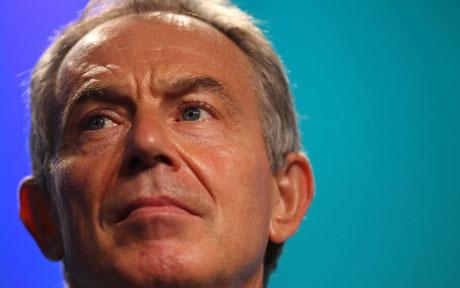
The West is Being ‘Outmanoeuvred’ by Violent Islamist Extremists: Tony Blair

By John Swaine for The Telegraph

In a speech in New York, the former prime minister said that warnings over the past week of new terrorist plots against Europe should remind people that they remain under threat.

Mr Blair said a “narrative” that Muslims were under attack from the US and its allies, who act out of support for Israel, had been allowed to take hold, aided by “websites and blogs”.

A fresh confrontation is needed because it will be impossible to defeat extremism “without defeating the narrative that nurtures it”, he said.

“The practitioners of extremism are small in number. The adherents of the narrative stretch far broader into parts of mainstream thinking,” Mr Blair told the Washington Institute for Near East Policy.

“It is a narrative that now has vast numbers of assembled websites, blogs and organizations.” Mr Blair said it was “absurd” that some people were surprised at how powerful Islamist extremist groups were, given the amount of funding they received and indoctrination they spread.

“Measure, over the years, the paucity of our counter-attack in the name of peaceful coexistence,” he said. “We have been outspent, outmaneuvered and out-strategized.”

Mr Blair said a tendency to “sympathize” with extremism was not only dangerous but also disempowering for moderate Muslims, because it made people resent them as much as extremists.

He said he was “intrigued” by the fact that western leaders, including Barack Obama, the US President, felt the need to condemn Terry Jones, a pastor who threatened to burn a Koran.

“Suppose an Imam, with thirty followers, in Karachi was to burn a bible,” he said. “I can barely imagine a murmur of protest. It wouldn’t be necessary for the President of Pakistan to condemn it because no one here would remotely consider he supported it.”

The former prime minister also called on the west to make it “crystal clear” to Iran that their acquisition of a nuclear bomb would be unacceptable to the entire “civilized world”.

“Go and read the speech of Iran’s President to the United Nations just days ago here in New York, and tell me that is someone you want with a nuclear bomb,” he told those who disagree.

He stressed that the achievement of a peace settlement between Israel and Palestine would remove “much of the poison which the extremists use”.

And he defended his decision to invade Iraq and Afghanistan, saying: “whatever you think of the original action, we enabled the people to choose their Government”.

Mr. Blair last night appeared on the Late Show with David Letterman on American television. He said that satirists like Letterman had been wrong to paint George W. Bush as unintelligent. “You don’t get to this position by being a fool,” he said.

Female Imams Blaze Trail Amid China’s Muslims

By Louisa Lim for National Public Radio

It is 5:50 in the morning, and dark shadows scurry through narrow alleys to the mosque, as the call to prayer echoes from a minaret in Kaifeng. This city in central China’s Henan province has an Islamic enclave, where Muslims have lived for more than 1,000 years.

In an alleyway called Wangjia hutong, women go to their own mosque, where Yao Baoxia leads prayers. For 14 years, Yao has been a female imam, or ahong as they are called here, a word derived from Persian.

As she leads the service, Yao stands alongside the other women, not in front of them as a male imam would. But she says her role is the same as a male imam. “The status is the same,” Yao says confidently. “Men and women are equal here, maybe because we are a socialist country.”                                        

Yao Baoxia is a female ahong, or imam, at Wangjia Hutong Women’s Mosque in Kaifeng, in central China. She sits alongside believers during prayers, not in front of them like male imams. She believes male and female imams are equal in their role as teachers and leaders of prayers. Yao Baoxia is a female ahong, or imam, at Wangjia Hutong Women’s Mosque in Kaifeng, in central China. She sits alongside believers during prayers, not in front of them like male imams. She believes male and female imams are equal in their role as teachers and leaders of prayers.

China has an estimated 21 million Muslims, who have developed their own set of Islamic practices with Chinese characteristics. The biggest difference is the development of independent women’s mosques with female imams, something scholars who have researched the issue say is unique to China.

Yao studied to become an imam for four years, after being laid off from her job as a factory worker. First she studied under a female imam, then with a male imam alongside male students.

Her main role is as a teacher, she says. “When people come to pray, they don’t know how to chant the Quran, so my job is teaching people about Islam, helping them to study one line at a time and leading the prayers,” she says.

Mosques Began As Quranic Schools

The modest courtyard of Wangjia Hutong Women’s Mosque contains within it the entire history of China’s mosques for females. It’s the oldest surviving women’s mosque in China, with one gray plaque high up on a wall dating back to 1820.

Like other women’s mosques, it began as a Quranic school for girls. These sprang up in the late 17th century in central China, including Shanxi and Shandong provinces. They morphed into women’s mosques about 100 years ago, starting in Henan province. Remembering her own childhood, 83-year-old Tang Guiying says even then the women’s mosque was the only place a girl could receive education.

“I didn’t go to school when I was small,” she chuckles. “We were all too poor; none of us girls studied. But I came here to play and study. The old imam was very, very old — she was 80-something, and she had bound feet.”

Tang is sitting in the mosque’s washroom as she talks. This is where women conduct ritual ablutions before prayer. This space — and the mosque itself — doubles as a social center for these women, the heart of a community. In Kaifeng, there are 16 women’s mosques, one-third the number of mosques for males.

A Unique Chinese Tradition

Shui Jingjun, of the Henan Academy of Social Sciences and co-author of a book on the phenomenon, says that so far there are no women’s mosques in other countries. In most of the Muslim world, women pray behind a partition or in a separate room, but in the same mosque as men.

Shui points out that the women’s mosques in China are administered independently, by women for women, in addition to being legally separate entities in some cases. “After reform and opening up [in 1979], some female mosques registered independently, which shows the equality of male and female mosques,” she explains.

Controversy still rages in the Muslim world about whether women can be imams. In 2006, Morocco became the first country in the Arab world to officially sanction the training of female religious leaders.

China is the only country to have such a long history of female imams. However, there are things that, according to the customary practices of Chinese Muslims, female imams can’t do.

They can’t, for instance, lead funeral rituals or wash male corpses. Forty miles away in the provincial capital of Zhengzhou, white-sashed mourners wail as they process through the streets carrying the coffin from a mosque. No female imams are participating.

Opposition Still Exists To Women’s Roles

In central China, most Muslims support the female mosques, but there is some resistance closer to China’s border with Pakistan and Afghanistan, closer to the harder-line Wahhabi and Salafi influences.

“Historically in northwestern China, there were no female mosques,” says Shui, the researcher. “There was resistance because people thought that building female mosques was against the rules of religion. But in central China and most provinces, people think it’s a good innovation for Islam.”

In the past decade, some women’s mosques have been established in northwest China. The phenomenon appears to be spreading, helped politically by the Islamic Association of China, a state-controlled body that regulates Islam and issues licenses to practice to male and female imams alike.

This is part of the anomaly that is religion in China — the atheist Chinese authorities are endorsing a practice some Muslims find unacceptable. While there is broad support among Kaifeng’s Muslims for female mosques and imams, there is also some opposition.

“The education of Islamic women is a very important job,” says Guo Baoguang, of the Islamic Association of Kaifeng. But he admits that he has been criticized for organizing religious education forums for Muslim men and women to take part in together.

“There were some criticisms that women ought to be in the home, and ought not take part in social activities. I think these criticisms are too conservative, and don’t account of the importance of women’s education in Islam,” he says.

Guo believes that when it comes to female imams, China is leading the way.”Given the fast development of China’s economy, and as its political status rises, I think Chinese Islam will become more important in the Islamic world,” Guo says. “The developments Chinese Islam has made, like the role played by Chinese women, will be more accepted by Muslims elsewhere in the world.”

Greatest Challenge Is Economic

In the women’s mosques, most of the faithful are elderly. Young women with families often don’t have the time to worship, especially given the lengthy purification rituals several times a day.

Third-generation imam Sun Chengying, who has been practicing for 21 years, worries about the future.

“I haven’t had any students since 1996,” she says, shaking her head. “Women don’t want be imams anymore, because the salaries in the mosques are too low. No one is willing to do it.”

Female imams sometimes earn as little as $40 a month, one-third of what can be earned in other jobs. Younger women need to earn more to support their families. And so it appears the future of female imams in China is threatened — not by the state, not by resistance from inside Islam, but by the forces of market economics.

-Pakistanis for Peace Editor’s Note- Chinese Muslim female imams are unique to China but this practice of allowing female imams is one that should be encouraged throughout the Muslim world. Female imams as well as increased rights for women in Islam across the board will only help strengthen Muslim societies.

Arabs Must Recognize Israel’s Right to Exist

By Manzer Munir for Pakistanis for Peace

New York – President Obama delivered his speech to the United Nations General Assembly Thursday in New York and it focused largely on his desire to see the Middle East peace process proceed ahead despite all the difficulties. 

Mr. Obama stated that he wanted it to succeed in accomplishing the peace that has eluded the Arabs and the Israelis for over 60 years. Realizing that there are many obstacles and hurdles ahead during tough negotiations for diplomats from both sides, he stated his concerns and his hopes for the road ahead.

“I hear those voices of skepticism, but I ask you to consider the alternative,” Obama said. If no peace agreement is reached, he added, “then the hard realities of demography will take hold. More blood will be shed. This Holy Land will remain a symbol of our differences, instead of our common humanity.”

“I refuse to accept that future,” he added. “And we all have a choice to make. Each of us must choose the path of peace. …We can say that this time will be different – that this time we will not let terror, or turbulence, or posturing, or petty politics stand in the way.”

“If we do, when we come back here next year, we can have an agreement that will lead to a new member of the United Nations – an independent, sovereign state of Palestine, living in peace with Israel,” Obama said to a loud applause by the delegates of all the countries at the United Nations.

In order for this to happen, the Arabs must first recognize Israel’s right to exist and the right of the Jewish people to claim specifically a part of the Holy Land as theirs. I know, it sounds so basic and a no- brainer. But surprisingly a large portion of the Arab world does not believe in Israel’s right to exist and specifically their right to exist in the southern Levant area which makes up the majority of the area for present day Israel. They want to ignore history and all the Biblical and historical evidence of Jewish settlement and claims to the land. They point to the migration of many Jews all over the world the last few hundred years as reason enough as to why they no longer can call Israel home.

Some Arabs demand that the Jewish homeland should be in Germany. After all, they claim, it is where so many of them were killed by Hitler and the main reason that precipitated the need to allow the Zionists of Europe and America, post World War II, to demand a home for the Jews. Why should the Palestinians pay for the crimes of the Europeans they argue?

Others have blamed the British and the Balfour Declaration when in 1917 the British Foreign Secretary, Arthur James Balfour, declared in a letter to Baron Rothschild, a leader of the British Jewish community for a need for a home for the Jews when he stated: “His Majesty’s government view with favor the establishment in Palestine of a national home for the Jewish people, and will use their best endeavors to facilitate the achievement of this object, it being clearly understood that nothing shall be done which may prejudice the civil and religious rights of existing non-Jewish communities in Palestine, or the rights and political status enjoyed by Jews in any other country.”

Quite simply, no other place makes any sense whatsoever. First of all, there is extensive mentioning of the land of Israel that is promised to the Jews in the Bible as well as the Hebrew texts, not to mention the Qur’an. All three identify geographic areas in present day Israel that has historically been identified as the homeland of the Jews. Jewish people do not even make up more than 1% of any country’s overall population other than in United States (2.2% of overall population), Canada (1.2% of population), France (1% of population) and Israel (75% of population). That means that for the rest of the world, each country’s Jewish population is not even one half of one percent of the overall population of that nation! Where else would the Arabs have them go? Certainly not Germany where many claim that they should be settled since that is where over 6 million of them were killed in the holocaust. The United States actually has more Jews in its boundaries than are currently residing in all of Israel. So they cannot very well say that they should go there as over half the population already lives here.

Most people do not realize that the Jewish population of the world is very small compared to Christianity or Islam. There are an estimated 15 million Jews around the world including in Israel. By comparison, there are over 2.1 billion Christians and nearly 1.5 billion Muslims. Nearly 105 countries of the world are majority Christian nations while there are perhaps at best 55 majority Muslim countries on the planet. Did you ever wonder how many majority Jewish countries of the world are there?  There is just one. Israel.

This is one of the great religions of the world and also one of the oldest monotheistic beliefs aside from Zoroastrianism, and came at a time when polytheistic beliefs were more prevalent as a human concept of divinity. No doubt, both Christianity and Islam owe a great deal of their religious thoughts and laws to the early Hebrew laws and traditions. In fact, large parts of both the Bible and the Qur’an constitute the Old Testament, also known as the Torah, the Jewish holy book and the scriptures revealed to Moses.

Jewish contributions to humanity have been disproportionate and staggering when one realizes that as less than one half of one percent of the world’s populations, the Jews have made immense advances in nearly every field that has benefitted the whole world. We can go from Albert Einstein’s advances in physics to Jonas Salk’s polio vaccine, discuss Galileo’s contributions in astronomy to Freud’s understanding of the mind. We could illustrate how Baruch Spinoza’s rationalist ideas and philosophies laid the groundwork for The Enlightenment of the 18 century or marvel at the brilliant filmmaking of 21st century Jews like Steven Spielberg and Oliver Stone. The list of Jewish contributions and the value of their culture to man’s history cannot be ignored.

What also cannot be ignored is that historically these are a persecuted people. The troubles that they faced in ancient Egypt as illustrated in the Bible as well as the deaths and expulsions during the Spanish Inquisition are part of their sad history. They faced persecution at the hands of both Christians and Muslims during the Crusades and at the time of the Papal States as well as during Muslim rule when they were subjected to the jizya (a per capita tax imposed on free adult non-Muslim males). The worst crimes nonetheless happened in the 20th century leading up to World War II when millions were killed in the Holocaust in Germany by Hitler’s Nazism and by Stalinist Russia.

So as the Israelis and Palestinians, as well as the other Arab countries, sit down over the next couple of weeks to resolve once and for all the Middle East conflict, the Arab street and indeed the entire Muslim world, must come to a realization and acceptance of the fact that the state of Israel has a right to exist; and has a right to exist in this ancient land as much as the Palestinians, who also have the rights to parts of this holy soil that is so important to all three religions. No doubt, historically and Biblically, the Palestinians can make similar claims also. Except, in Israel’s case, there is no other nation for the Jews, whereas, there are 55 others for Muslims. It is only with this undeniable understanding that true and lasting peace will ever be achieved and it can clear the way for a two state solution that President Obama envisions and one that will allow the normalization of relations between Israel, the Arab and the entire Muslim world. 

As perhaps the most famous Jew of all time, Jesus, once said, “Greet ye one another with a kiss of charity and may peace be with you.” Indeed, Shalom and Salaam equal peace and that can finally be achieved once there is mutual respect and acceptance of the right of the other to exist.

–Manzer Munir, a proud Pakistani American and peace activist, looks forward to a day when there will be peace between Israel and all the Muslim countries of the world, including Pakistan. He is the founder of Pakistanis for Peace and blogs at www.PakistanisforPeace.com as well at other websites as a free lance journalist and writer.

Message to Muslims: I’m Sorry

By Nicholas D Kristof for The New York Times

Many Americans have suggested that more moderate Muslims should stand up to extremists, speak out for tolerance, and apologize for sins committed by their brethren.

Go to Columnist Page »That’s reasonable advice, and as a moderate myself, I’m going to take it. (Throat clearing.) I hereby apologize to Muslims for the wave of bigotry and simple nuttiness that has lately been directed at you. The venom on the airwaves, equating Muslims with terrorists, should embarrass us more than you. Muslims are one of the last minorities in the United States that it is still possible to demean openly, and I apologize for the slurs.

I’m inspired by another journalistic apology. The Portland Press Herald in Maine published an innocuous front-page article and photo a week ago about 3,000 local Muslims praying together to mark the end of Ramadan. Readers were upset, because publication coincided with the ninth anniversary of 9/11, and they deluged the paper with protests.

So the newspaper published a groveling front-page apology for being too respectful of Muslims. “We sincerely apologize,” wrote the editor and publisher, Richard Connor, and he added: “we erred by at least not offering balance to the story and its prominent position on the front page.” As a blog by James Poniewozik of Time paraphrased it: “Sorry for Portraying Muslims as Human.”

I called Mr. Connor, and he seems like a nice guy. Surely his front page isn’t reserved for stories about Bad Muslims, with articles about Good Muslims going inside. Must coverage of law-abiding Muslims be “balanced” by a discussion of Muslim terrorists?

Ah, balance — who can be against that? But should reporting of Pope Benedict’s trip to Britain be “balanced” by a discussion of Catholic terrorists in Ireland? And what about journalism itself?

I interrupt this discussion of peaceful journalism in Maine to provide some “balance.” Journalists can also be terrorists, murderers and rapists. For example, radio journalists in Rwanda promoted genocide.

I apologize to Muslims for another reason. This isn’t about them, but about us. I want to defend Muslims from intolerance, but I also want to defend America against extremists engineering a spasm of religious hatred.

Granted, the reason for the nastiness isn’t hard to understand. Extremist Muslims have led to fear and repugnance toward Islam as a whole. Threats by Muslim crazies just in the last few days forced a Seattle cartoonist, Molly Norris, to go into hiding after she drew a cartoon about Muhammad that went viral.

And then there’s 9/11. When I recently compared today’s prejudice toward Muslims to the historical bigotry toward Catholics, Mormons, Jews and Asian-Americans, many readers protested that it was a false parallel. As one, Carla, put it on my blog: “Catholics and Jews did not come here and kill thousands of people.”

That’s true, but Japanese did attack Pearl Harbor and in the end killed far more Americans than Al Qaeda ever did. Consumed by our fears, we lumped together anyone of Japanese ancestry and rounded them up in internment camps. The threat was real, but so were the hysteria and the overreaction.

Radicals tend to empower radicals, creating a gulf of mutual misunderstanding and anger. Many Americans believe that Osama bin Laden is representative of Muslims, and many Afghans believe that the Rev. Terry Jones (who talked about burning Korans) is representative of Christians.

Many Americans honestly believe that Muslims are prone to violence, but humans are too complicated and diverse to lump into groups that we form invidious conclusions about. We’ve mostly learned that about blacks, Jews and other groups that suffered historic discrimination, but it’s still O.K. to make sweeping statements about “Muslims” as an undifferentiated mass.

In my travels, I’ve seen some of the worst of Islam: theocratic mullahs oppressing people in Iran; girls kept out of school in Afghanistan in the name of religion; girls subjected to genital mutilation in Africa in the name of Islam; warlords in Yemen and Sudan who wield AK-47s and claim to be doing God’s bidding.

But I’ve also seen the exact opposite: Muslim aid workers in Afghanistan who risk their lives to educate girls; a Pakistani imam who shelters rape victims; Muslim leaders who campaign against female genital mutilation and note that it is not really an Islamic practice; Pakistani Muslims who stand up for oppressed Christians and Hindus; and above all, the innumerable Muslim aid workers in Congo, Darfur, Bangladesh and so many other parts of the world who are inspired by the Koran to risk their lives to help others. Those Muslims have helped keep me alive, and they set a standard of compassion, peacefulness and altruism that we should all emulate.

I’m sickened when I hear such gentle souls lumped in with Qaeda terrorists, and when I hear the faith they hold sacred excoriated and mocked. To them and to others smeared, I apologize.

God Bless Islam with Courageous Leadership

By Ebrahim Moosa for Religion Dispatches

As Muslim Americans and millions around the world celebrate the end of Ramadan 2010 what will they pray for? What was the spiritual harvest of the month of fasting, prayer, deep reflection, and discipline? Given the growing hostility directed towards Muslims in the United States and the horrible deeds perpetrated by persons aligned to Islam on 9/11 and elsewhere in the world, I for my part, will be making two prayers.

The first is to urge Muslims to affirm their solidarity with all of humanity. The words of this prayer come from a tradition of the Prophet Muhammad. It reads:

Oh Allah, Lord (Rabb) of all things. I testify that You alone are the Lord of the world, Lord of all things… I testify that all servants of God are one family… Make me and my family truthful to you in every moment of life in this world and the next. Oh powerful and generous one, hear and respond to my prayers…

My second prayer is that God bless Islam with a religious leadership that has a modicum of Solomonic wisdom and tons of moral courage.

Why these two prayers? I think many Muslims have forgotten the message of humanism and solidarity with all creation that are the cornerstones of Islam. All servants of God are part of a single family, the Prophet Muhammad taught. So how can faiths be at war, if only to serve earthly gods? Many of our religious leaders have forgotten that our theologies, teachings, and practices were means to serve a transcendent Creator; not for idolatrous ends. Many of the most prominent Muslim religious and moral authorities the world over—clergy, intellectuals, scholars, politicians—have, through silence and inaction, invited a plague of craven violence on a number of Muslim societies. In a manner of speaking, in many places, the asylum is in charge of the mosque. Religious leaders are more interested in cowing to public adulation through demagoguery than in showing courage and exhorting people to piety and sanity.

Check if the sermon in the`Id al-Fitr (End of Fasting) sermon at your mosque hinted at the cowardly acts of al-Qaeda who killed thousands on September 11 and elsewhere. Or if deeds of the Somalian Shabab who killed dozens of Ugandans watching a soccer World Cup match in the suburbs of Kampala caused outrage. Has anyone been able to keep track of the death toll inflicted in Pakistan by Taliban suicide bombers, who most recently killed more than 60 people in Quetta because they were Shi’a? Did anyone even notice that a radical Muslim group in India chopped off the hand of a Catholic professor in the state of Kerala in July for apparently offending the image of the Prophet Muhammad in an exam questionnaire?

`Id is a day of celebration with family and friends. But it is unconscionable if Muslims do not think seriously and act in unison about the deep moral crises afflicting our communities here and abroad. To think critically is not to bow to the hate of the Islamophobes, it is a sign of strength and faith. Those who claim that there are no “moderate” Muslim voices denouncing acts of violence committed by Muslims are wrong, and yes, there are many good things happening in Muslim societies that do not make the headlines. Yet it is delusional to think that the evil masquerading as faith does not erode the belief and values each Muslim.

To Muslim Americans I say, next time you wonder why young men like the Times Square bomber Faisal Shahzad become entangled in conspiracies to commit acts of violence in this country and abroad please ask the following questions: What is the qualification of the imam at your mosque? Is he enriched by the best of American and Islamic culture, in tune with his environment, or is he preaching a theology no longer even appropriate for people in Iran, Egypt, or Pakistan? Does he teach the tradition creatively and help people think imaginatively? Or does he focus on impieties and promote the virtues of paraphernalia like the dress code and the mandatory length of facial hairs? If the imam is as wise as the religious leader in the Canadian sitcom Little Mosque on the Prairie, it will be a huge step up.

Mosque committees share their burden of responsibility too. Often they appoint preachers by applying the lowest and cheapest standard; theological diversity is frequently absent and enlightened thinking is considered too challenging and burdensome for them to contemplate. Will the smart Muslims in America and around the world stand up and be counted?

-Originally printed on Sep 9, 2010 for Religion Dispatches. Ebrahim Moosa is a professor of Islamic Studies at Duke University and an author of several books on Islam.

For Imam in Muslim Center Furor, a Hard Balancing Act

By Anne Barnard for The New York Times
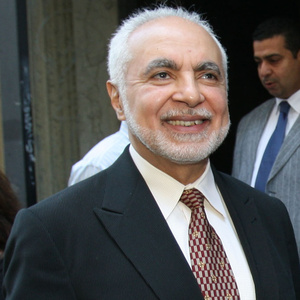
Not everyone in the Cairo lecture hall last February was buying the imam Feisal Abdul Rauf’s message. As he talked of reconciliation between America and Middle Eastern Muslims — his voice soft, almost New Agey — some questioners were so suspicious that he felt the need to declare that he was not an American agent.

Muslims need to understand and soothe Americans who fear them, the imam said; they should be conciliatory, not judgmental, toward the West and Israel.

But one young Egyptian asked: Wasn’t the United States financing the speaking tour that had brought the imam to Cairo because his message conveniently echoed United States interests?

“I’m not an agent from any government, even if some of you may not believe it,” the imam replied. “I’m not. I’m a peacemaker.”

That talk, recorded on video six months ago, was part of what now might be called Mr. Abdul Rauf’s prior life, before he became the center of an uproar over his proposal for a Muslim community center two blocks from the World Trade Center. He watched his father, an Egyptian Muslim scholar, pioneer interfaith dialogue in 1960s New York; led a mystical Sufi mosque in Lower Manhattan; and, after the Sept. 11 attacks, became a spokesman for the notion that being American and Muslim is no contradiction — and that a truly American brand of Islam could modernize and moderate the faith worldwide.

In recent weeks, Mr. Abdul Rauf has barely been heard from as a national political debate explodes over his dream project, including, somewhere in its planned 15 stories, a mosque. Opponents have called his project an act of insensitivity, even a monument to terrorism.

In his absence — he is now on another Middle East speaking tour sponsored by the State Department — a host of allegations have been floated: that he supports terrorism; that his father, who worked at the behest of the Egyptian government, was a militant; that his publicly expressed views mask stealth extremism. Some charges, the available record suggests, are unsupported. Some are simplifications of his ideas. In any case, calling him a jihadist appears even less credible than calling him a United States agent.

Growing Up in America

Mr. Abdul Rauf, 61, grew up in multiple worlds. He was raised in a conservative religious home but arrived in America as a teenager in the turbulent 1960s; his father came to New York and later Washington to run growing Islamic centers. His parents were taken hostage not once, but twice, by American Muslim splinter groups. He attended Columbia University, where, during the Six-Day War in 1967 between Israel and Arab states like Egypt, he talked daily with a Jewish classmate, each seeking to understand the other’s perspective.

He consistently denounces violence. Some of his views on the interplay between terrorism and American foreign policy — or his search for commonalities between Islamic law and this country’s Constitution — have proved jarring to some American ears, but still place him as pro-American within the Muslim world. He devotes himself to befriending Christians and Jews — so much, some Muslim Americans say, that he has lost touch with their own concerns.

“To stereotype him as an extremist is just nuts,” said the Very Rev. James P. Morton, of the Church of St. John the Divine, in Manhattan, who has known the family for decades.

Since 9/11, Mr. Abdul Rauf, like almost any Muslim leader with a public profile, has had to navigate the fraught path between those suspicious of Muslims and eager to brand them as violent or disloyal and a Muslim constituency that believes itself more than ever in need of forceful leaders.

One critique of the imam, said Omid Safi, a professor of religious studies at the University of North Carolina, was that he had not been outspoken enough on issues “near and dear to many Muslims,” like United States policy on Israel and treatment of Muslims after 9/11, “because of the need that he has had — whether taken upon himself or thrust upon him — to be the ‘American imam,’ to be the ‘New York imam,’ to be the ‘accommodationist imam.’ ”

Akbar Ahmed, chairman of Islamic studies at American University, said Mr. Abdul Rauf’s holistic Sufi practices could make more orthodox Muslims uncomfortable, and his focus on like-minded interfaith leaders made him underestimate the uproar over his plans.

“He hurtles in, to the dead-center eye of the storm simmering around Muslims in America, expecting it to be like at his mosque — we all love each other, we all think happy thoughts,” Mr. Ahmed said.

“Now he has set up, unwittingly, a symbol of this growing tension between America and Muslims: this mosque that Muslims see as a symbol of Islam under attack and the opponents as an insult to America,” he added. “So this mild-mannered guy is in the eye of a storm for which he’s not suited at all. He’s not a political leader of Muslims, yet he now somehow represents the Muslim community.”

Andrew Sinanoglou, who was married by Mr. Abdul Rauf last fall, said he was surprised that the imam had become a contentious figure. His greatest knack, Mr. Sinanoglou said, was making disparate groups comfortable. At the wedding, he brought together Mr. Sinanoglou’s family, descended from Greek Christians thrown out of Asia Minor by Muslims, and his wife’s conservative Muslim father.

“He’s an excellent schmoozer,” Mr. Sinanoglou said of the imam.

Mr. Abdul Rauf was born in Kuwait. His father, Muhammad Abdul Rauf, graduated from Cairo’s Al-Azhar University, the foremost center of mainstream Sunni Muslim learning. He was one of many scholars Egypt sent abroad to staff universities and mosques, a government-approved effort unlikely to have tolerated a militant. He moved his family to England, studying at Cambridge and the University of London; then to Malaysia, where he eventually became the first rector of the International Islamic University of Malaysia.

As a boy, Feisal absorbed his father’s talks with religious scholars from around the world, learning to respect theological debate, said his wife, Daisy Khan. He is also steeped in Malaysian culture, whose ethnic diversity has influenced an Islam different than that of his parents’ homeland.

In 1965, he came to New York. His father ran the Islamic Center of New York; the family lived over its small mosque in a brownstone on West 72nd Street, which served mainly Arabs and African-American converts. Like his son, the older imam announced plans for a community center for a growing Muslim population — the mosque eventually built on East 96th Street. It was financed by Muslim countries and controlled by Muslim diplomats at the United Nations — at the time a fairly noncontroversial proposition. Like his son, he joined interfaith groups, invited by Mr. Morton of St. John the Divine.

Hostage Crisis

Unlike his son, he was conservative in gender relations; he asked his wife, Buthayna, to not drive. But in 1977, he was heading the Islamic Center in Washington when he and Buthayna were taken hostage by a Muslim faction; it was his wife who challenged the gunmen on their lack of knowledge of Islam.

“My husband didn’t open his mouth, but I really gave it to them,” she told The New York Times then.

Meanwhile, the younger Mr. Abdul Rauf studied physics at Columbia. At first, he recalled in interviews last year, it was hard to adjust to American social mores. By 1967, he and a Yale student, Kurt Tolksdorf, had bonded at summer school over their shared taste in women and fast cars. But Mr. Tolksdorf said his friend never subscribed to the “free love” of the era.

When the 1967 war broke out in the Middle East, Mr. Tolksdorf said, Mr. Abdul Rauf reacted calmly when Israeli students tried to pick a fight. A classmate, Alan M. Silberstein, remembers debating each day’s news over lunch.

“He was genuinely trying to understand the interests of American Jews — what Israel’s importance was to me,” he said. “There was a genuine openness.”

In his 20s, Mr. Abdul Rauf dabbled in teaching and real estate, married an American-born woman and had three children. Studying Islam and searching for his place in it, he was asked to lead a Sufi mosque, Masjid al-Farah. It was one of few with a female prayer leader, where women and men sat together at some rituals and some women do not cover their hair. And it was 12 blocks from the World Trade Center.

Divorced, he met his second wife, Ms. Khan, when she came to the mosque looking for a gentler Islam than the politicized version she rejected after Iran’s revolution. Theirs is an equal partnership, whether Mr. Abdul Rauf is shopping and cooking a hearty soup, she said, or running organizations that promote an American-influenced Islam.

A similar idea comes up in the video of his visit to Cairo this year. Mr. Abdul Rauf, with Ms. Khan, unveiled as usual, beside him, tells a questioner not to worry so much about one issue of the moment — Switzerland’s ban on minarets — saying Islam has always adapted to and been influenced by places it spreads to. “Why not have a mosque that looks Swiss?” he joked. “Make a mosque that looks like Swiss cheese. Make a mosque that looks like a Rolex.”

In the 1990s, the couple became fixtures of the interfaith scene, even taking a cruise to Spain and Morocco with prominent rabbis and pastors.

Mr. Abdul Rauf also founded the Shariah Index Project — an effort to formally rate which governments best follow Islamic law. Critics see in it support for Taliban-style Shariah or imposing Islamic law in America.

Shariah, though, like Halakha, or Jewish law, has a spectrum of interpretations. The ratings, Ms. Kahn said, measure how well states uphold Shariah’s core principles like rights to life, dignity and education, not Taliban strong points. The imam has written that some Western states unwittingly apply Shariah better than self-styled Islamic states that kill wantonly, stone women and deny education — to him, violations of Shariah.

After 9/11, Mr. Abdul Rauf was all over the airwaves denouncing terrorism, urging Muslims to confront its presence among them, and saying that killing civilians violated Islam. He wrote a book, “What’s Right With Islam Is What’s Right With America,” asserting the congruence of American democracy and Islam.

That ample public record — interviews, writings, sermons — is now being examined by opponents of the downtown center.

Those opponents repeat often that Mr. Abdul Rauf, in one radio interview, refused to describe the Palestinian group that pioneered suicide bombings against Israel, Hamas, as a terrorist organization. In the lengthy interview, Mr. Abdul Rauf clumsily tries to say that people around the globe define terrorism differently and labeling any group would sap his ability to build bridges. He also says: “Targeting civilians is wrong. It is a sin in our religion,” and, “I am a supporter of the state of Israel.”

“If I were an imam today I would be saying, ‘What am I supposed to do?’ ” said John Esposito, a professor of Islamic studies at Georgetown University. “ ‘Can an imam be critical of any aspect of U.S. foreign policy? Can I weigh in on things that others could weigh in on?’ Or is someone going to say, ‘He’s got to be a radical!’ ”
Aisam-Ul-Haq Qureshi Delivers Message of Peace at U.S. Open After Indo-Pak Express Suffers Defeat

By Stefan Bondy for NY Daily News

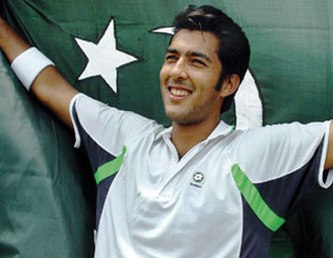
Aisam-Ul-Haq Qureshi delivered his message loud and peacefully, and it had nothing to do with forehands or backhands, or even the doubles title he failed to win.

As a Muslim from Pakistan playing in the U.S. Open doubles final, he said New York needed his words the most, as post-9/11 counsel. So the 30-year-old grabbed the microphone and addressed the estimated 15,000 at Arthur Ashe Stadium – probably the biggest crowd to watch a Grand Slam doubles final – and made sure the moment wasn’t lost.

“I want to say something on behalf of all Pakistanis,” he said following Friday’s 7-6 (5), 7-6 (4) defeat to the Bryan brothers, Bob and Mike. “Every time I come here, there’s a wrong perception about the people of Pakistan.

“They are very friendly, very loving people. We want peace in this world as much as you guys.”

The crowd cheered. By now, such poignancy is expected from Qureshi and, to a lesser extent, his doubles partner, Rohan Bopanna of India. Together, they’ve formed the politically charged tandem known as the Indo-Pak Express, breaking down barriers with their kinship and jettisoning expectations with their recent play.

Their respective neighboring countries have warred with and terrorized each other since the 1940s, citing religion as their great chasm. But Qureshi and Bopanna, a Hindu, represent peace, both on and off the court. Indian and Pakistani fans filled pockets of Arthur Ashe Friday, arriving as early as two hours before the match. U.N. ambassadors from both countries sat side-by-side in the President’s Box – the second straight match they’ve attended together – cheering the same unexpected struggle their team brought to the greatest doubles team of all time, the Bryan brothers. The 16th-seeded Qureshi and Bopanna followed up their run to the Wimbledon quarterfinals with five wins in Flushing.

“They’ve proven that when Indians and Pakistanis get together we can raise fire,” Pakistan ambassador Abdullah Hussain Haroon said. “I think on a people-to-people basis, they’re setting an example that the politicians should follow.”

Prize money and rankings were never a motivating factor, Qureshi said, only good news for his flood-stricken countrymen and a platform to express his message of American misunderstanding. He also defended the decision to build a mosque near the World Trade Center site.

“For me, as a Muslim, that’s what makes America the greatest country in the world – freedom of religion, freedom of speech,” Qureshi said. “If the mosque is built, I think it’s a huge gesture to all the Muslim community out there in the world. I would really appreciate it.”

Pakistan, which borders Afghanistan, has long been considered a headquarters of Al Qaeda.

Qureshi said he’s been stopped at airport immigration “every time” in New York – three hours at a time – including after his latest flight for the Open. And on the eve of the ninth anniversary of the 9/11 attacks, he wanted to defend his country’s masses.

“Since September 11, every time I come to the States or western countries I feel people have the wrong impression about Pakistan as a terrorist nation,” Qureshi said. “I just wanted to declare that we are very friendly, loving and caring people, and we want peace in this world as much as Americans and the rest of the world wants.

“There are extremists in every religion, but just because of them you cannot judge the whole country as a terrorist nation. I just wanted to get this message across as a Pakistani.”