Archive for the ‘ Muslims ’ Category

Michele Bachmann and Muslim Witch Hunts

By Haris Tarin for The CNN

It is difficult being an American Muslim engaged in civic activities, let alone working in government or politics. We Muslims must always second-guess what we say, guard against people questioning our loyalty and make sure that nobody thinks we are trying to infiltrate the government to sabotage it from within and hand it over to the Muslim Brotherhood.

Most Americans would dismiss these accusations, especially the last one, as outrageous conspiracy theories written by loonies on their blogs. Yet American Muslim public servants are facing these charges from sitting members of Congress. The sad reality is that it has been happening for a decade, and has been met with complete indifference from the media and the public.

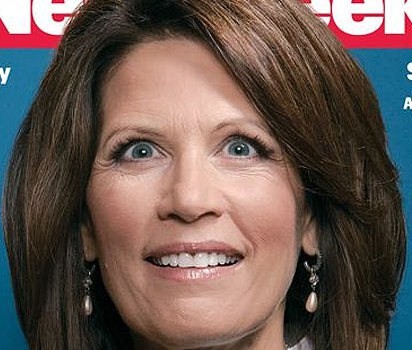
Recently, Rep. Michele Bachmann, briefly the front-runner for GOP presidential candidate, sent letters to the State Department, Department of Justice and the Department of Homeland Security asking them to investigate American Muslim organizations, individuals and government employees to determine if they are infiltrating the government and sabotaging it from within. This week, Newt Gringrich wrote an op-ed defending Bachmann’s request.

Bachmann and her friends — Republican representatives Trent Franks of Arizona, Louie Gohmert of Texas, Tom Rooney of Florida and Lynn Westmoreland of Georgia — pulled out all the stops. They not only hurled these outrageous claims at our organization, the Muslim Public Affairs Council, and others like ours, but also accuse Secretary of State Hillary Clinton’s deputy chief-of-staff of being part of the conspiracy.

Huma Abedin, married to former New York Rep. Anthony Weiner, has served Clinton since she was the first lady. The slurs against her are beyond malicious. They accuse Abedin’s late father and her family of being a part of an international conspiracy seeking to sabotage the United States.
This latest witch hunt comes as no surprise to those of us in public life. This is a natural next step for hate mongers. First, people who do not have mainstream political backing start the rumors. Next, if we take a page from Sen. Joseph McCarthy’s 1950s playbook, the rumors become accusations leveled by the most politically privileged. It’s simple — the more accusations thrown at American Muslims trying to serve their country, the harder it is for them to be hired and the more politicians shy away from engaging them.

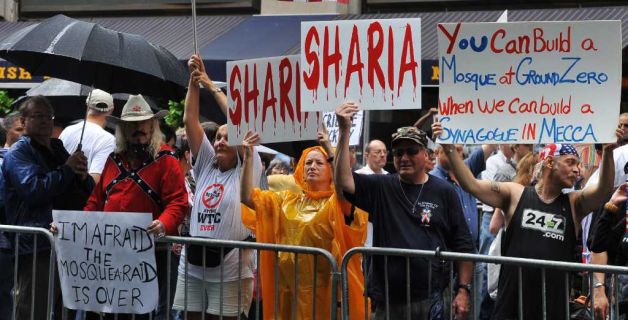
For years, we have watched presidential candidates talking about their discomfort with appointing Muslims to senior positions in government. We have seen them sparring over our ethics and principles. Legislation against Sharia law has been introduced in 20 states, frightening residents into thinking Sharia is an imminent threat. President Obama still faces vicious and pointed accusations of being a Muslim, as though it were a slur.
These attacks are real and hurt people’s lives. Public servants have been forced out of jobs, with suspicion shadowing them. Very few public officials have had the courage to publicly condemn the escalating witch hunt. Will this latest absurdity finally force our politicians and policy-makers to not only defend someone like Huma Abedin, whose public service needs no defense, but also all American Muslims who serve this country every day?

A few Republicans have rallied to Abedin’s side. This week, Ed Rollins, Bachmann’s former campaign chief, denounced her in an op-ed on Fox News. Speaker of the House John Boehner defended Abedin’s character.

Arizona Republican Sen. John McCain felt compelled to stand on the floor of the Senate and denounce the accusations. “Ultimately, what is at stake in this matter is larger even than the reputation of one person. This is about who we are as a nation, and who we aspire to be,” he said.
The question is whether this incident will serve as a tipping point. Will our political and religious leaders and the media push back against Islamophobes whose clear agenda is to marginalize American Muslims? Will this wave of McCarthyism be exposed, condemned and made politically unacceptable? Will American Muslim public servants be able to serve their country without suspicion?
Every year, my organization brings 25 young American Muslim leaders to Washington to help them better understand policy making. The majority are inspired to develop careers in government and public service.

Yet every year I ask myself: Are these individuals better off in banking, medicine and less high-profile careers? Am I exposing them to a career that will be tarnished by the likes of Michele Bachmann? In the end, I still believe that the sacrifice to serve this nation and make America a better place is worth the headache, and heartache, of dealing with bigots — including those in Congress.

Haris Tarin is the director of the Washington office of the Muslim Public Affairs Council.

Religion Journal: For Ramadan, India Goes it Alone

By Joanna Sugden for The Wall Street Journal

Muslims start the month-long daytime fast of Ramadan Friday. But not in India.

While most of the world’s Muslims look to Saudi Arabia or follow astronomical calculations to determine when the new moon of the ninth lunar month has arrived – marking the start of Ramadan – India follows the declaration of its own Central Moon Sighting Committee.

“Geographical differences mean we are a day behind Saudi Arabia in terms of lunar months, so we are expecting to start on Saturday,” says Syed Tariq Bukhari, a member of the committee and general secretary of the advisory council at Old Delhi’s Jama Masjid, one of the country’s most important mosques.

At sunset Friday, the 29th day of the eighth lunar month, 21 senior leaders from Delhi’s mosques will meet to decide whether the new moon has been sighted. In the Muslim calendar, months are either 29 or 30 days long.

“It is very difficult to spot a new moon, particularly on the 29th day of the month because it appears for a very short time and is a very thin sliver,” Mr. Bukhari said, adding that the best time to spot a new moon is half an hour before sunset.

“If naturally we are not able to see it because it’s cloudy then we coordinate with the other committees of other cities who have similar geographic circumstances,” Mr. Bukhari said.

The committee then waits for a Shahadah or Islamic witness who has seen the new moon. “The appearance of the witness should be according to Sharia law, which means having a beard and his neighbors should know him as a dependable person as far as being a witness is concerned,” Mr. Bukhari added.

If no credible Islamic witness comes forward, the committee waits until between 80 and 90 other witness statements on sightings are collected by moon sighting committees across the country. Then it declares the start of Ramadan.

If the moon isn’t sighted at all in the last days of the lunar month, the committee waits until the first day of the ninth lunar month – which this year is on Sunday – to declare that Ramadan has begun. It announces the start of the fast via the media, to the government and over loud speakers from mosques.

Zasarul Islam Khan, president of the All India Muslim Majlis-e-Mushawarat, an umbrella body for Muslim organizations, says the timing of Ramadan should always be based on local sightings of the moon.

“Outside the Subcontinent they are following Saudi Arabia, which is technically wrong. The scholars say that you should wait to see the new moon physically before starting Ramadan,” he told India Real Time.

Mosques in the southern Indian state of Kerala go by Saudi Arabian timings because they have close links with the Middle East, according to Mr. Bukhari. Those in the northern state of Jammu and Kashmir go by Pakistan’s declaration as they are more geographically in line with the country, he adds.

The Fiqh Council of North America, which rules on matters of Islamic jurisprudence, says Muslims should follow precise astrological calculations to decide the start of the fast.

In sunlight hours during Ramadan, Muslims refrain from food, water, sex, smoking and oral medicine in order to bring desire under self-control and to focus on prayer and Allah.

This year, the fast coincides with the London Olympics, so Muslim athletes will have to decide whether to observe it and risk a dent in their performance or exempt themselves and carry out the fast once they finish the competition.

Maher Abu Rmeileh, a Palestinian Judo champion who is competing at the Games, told the BBC that he would not be observing Ramadan this year. “Scholars recommended me not to fast and said that I represented my nation not just myself, so once I return from the games I will have to make up for it,” he said.

Such a clash only happens once every 44 years and the International Olympic Committee has said it will look into the possibility of avoiding such a conflict in future, once London 2012 is over.

People exempt from fasting include pregnant women, children who haven’t reached puberty, menstruating women, breast-feeding women, the elderly, travelers and the chronically ill.

Mr. Khan said those who are sick or elderly are allowed to give to charity instead of fasting. If they are determined to observe Ramadan, they should consult their doctor, he added.

Joanna Sugden is freelance journalist living in Delhi. Before coming to India in 2011 she spent four-and-a-half years as a reporter at The Times of London, covering religion and education. You can follow her on Twitter @jhsugden.

15,000 Muslims To Attend Memorial-Day Weekend Islamic Convention Targeting Anti-Shariah Movement

As Reported by The Associated Press

HARTFORD, Conn. (AP) — Some 15,000 Muslims are expected to attend a weekend convention in Hartford dedicated to religious freedom.

The theme of the campaign by the Islamic Circle of North America was chosen in response to a wave of bills introduced in statehouses around the country to ban the use of Shariah law and other foreign legal codes

A vice president of the group, Naeem (NY-eem) Baig, says such proposals are motivated by deep-rooted hatred toward Muslims. He says the convention is part of a nationwide campaign that also aims to educate Muslim-Americans about Shariah laws that were rarely discussed here even two or three years ago.

The gathering will take place from Saturday through Monday at a Hartford convention center. Connecticut’s capital is hosting the annual convention for the seventh consecutive year.

Pakistanis for Peace Editor’s Note– My fellow Americans, Happy Memorial Day to all of you across this great land as we think of our fallen those who defended it and the US constitution, which we Americans all pledge allegiance to. It contains perhaps the greatest words man penned to paper and within its words lie in our freedoms that the men and women of the United States Armed Forces died to provide us. May their sacrifice never be in vain and may we continue to be free, all of us~ Manzer Munir

Pakistan Blocks Twitter Over Cartoon Contest

By Salman Masood for The New York Times

The Pakistani government blocked access to the social networking service Twitter on Sunday, after publicly holding Twitter responsible for promoting a blasphemous cartoon contest taking place on Facebook, officials said.

A government spokesman was quoted by local news media as saying that the government had been in talks with Twitter to remove “objectionable” material but that there had been no results.

“The material was promoting a competition on Facebook to post images of Islam’s Prophet Muhammad,” said Mohammad Yaseen, chairman of the Pakistan Telecommunication’s Authority, was quoted as saying. He was also quoted as saying that Facebook had agreed to allay the concerns of the Pakistani government.

Blasphemy is an issue that roils sentiment easily in Pakistan. Blasphemy allegations have often resulted in violent riots, and religious minorities in Pakistan have long maintained that the country’s blasphemy laws are used to settle personal scores.

Facebook was banned for two weeks in 2010 after protests erupted in the country over a similar cartoon contest on Facebook to draw the Prophet Muhammad. After a high court ordered the government to ban Facebook, the government was quick to ban YouTube and hundreds of other Web sites and services.

Speculation that the government intended to suspended Facebook and Twitter again had been swirling around for the past couple of days. However, this time around there have been no major public protests over the contest that Pakistani officials have expressed concerns about.

The ban has caught Twitter users by surprise.

“I never heard of any caricatures on Twitter,” said Arif Rafiq, an adjunct scholar at Middle East Institute and a commentator on Pakistani politics, who has a Twitter following of more than 10,000 users. “Now this ban will be promoting whatever caricatures were posted on it.”

Responding to a question last night, Rehman Malik, the country’s interior minister, had denied that ban on social networking sites was in the offing.

“The government of Pakistan’s ban on Twitter is ill advised, counterproductive and will ultimately prove to be futile as all such attempts at censorship have proved to be,” said Ali Dayan Hasan, Pakistan director at Human Rights Watch, in a press statement. “The right to free speech is nonnegotiable, and if Pakistan is the rights-respecting democracy it claims to be, this ban must be lifted forthwith. Free speech can and should only be countered with free speech.”

Critics said that the blocking of the micro-blogging site could actually be a part of longstanding government plan to muzzle media freedom and could be related to the vociferous opposition and criticism that is heaped on the country’s security apparatus in Twitter debates.

“Twitter is a place where fierce opposition to Pakistan’s security agencies is expressed,” said Raza Rumi, a widely read columnist and an adviser at the Jinnah Institute, a public policy center based in Islamabad.

“There is a clear trend,” Mr. Rumi said, “that the Pakistani military and spy agency get a strong critique from Pakistanis themselves, something that does not happen in mainstream media where people are generally shy to express such views.”

Activists supporting minority rights have established a strong voice on Twitter, and advocates for the Baluch people, who are demanding greater rights and a share of the natural-resources wealth in the southwestern province of Baluchistan, have also used it to spread their message.

Pakistan’s Deputy Attorney General Works Off Taliban’s Sins at Gurdwaras and Shrines

By Rakhi Chakrabarty for Aman Ki Asha

A man in a maroon kurta sits hunched on the floor on Sunday afternoon,polishing the shoes of devotees at a room in Delhi’s Gurdwara Rakabganj.
It’s a common sight in gurdwaras, except that this man is Pakistan’s deputy attorney general, Muhammad Khurshid Khan, who had requested he be allowed to perform seva (community service) at the shrine.

Khan, 62, is an eminent lawyer and a devout Muslim from Pakistan’s Peshawar province. He was recently in Delhi for a judicial conference. “I have been very keen to visit various places of worship here to promote harmony between India and Pakistan,” says Khan.
Khan’s tryst with temples and gurdwaras began in 2010 to “heal the wounds of minorities in Pakistan by becoming their sevadar (performer of service)”.

For him, it was a “penance” for crimes committed by the Taliban. In February that year, the Taliban had kidnapped three Sikhs from Peshawar and demanded a $235,000 ransom. Pakistan army rescued two of them, but the third, Jaspal Singh, was beheaded by the captors. It was after the killing, that Khan first performed service at a gurdwara in Peshawar. “I seek harmony among all religions,” says Khan, citing Pakistan’s pluralistic heritage.

“I am a Muslim, not a terrorist; I am a Khan, not a terrorist; I am from Pakistan, but not a terrorist.” This is Pakistani deputy attorney general Muhammad Khurshid Khan’s humble submission as he visits gurdwaras across New Delhi and performs seva (community service).
The Taliban, he says, has plundered Pakistan’s pluralistic heritage. “But I want to tell the world it’s unfair to tarnish a whole community for the sins of a few,” says the Pakhtoon who ran for Pakistan’s National Assembly twice.

In Delhi for a conference (along with some 200 members of the Supreme Court Bar Association of Pakistan), Khan, accompanied by Surinder Singh, a Delhi-based businessman whose father was a comrade of Subhas Chandra Bose, polished shoes at Gurdwara Sisganj and visited Birla Temple and Hanuman Mandir.

Khan told TOI that he turned to other faiths after the Taliban beheaded Jaspal Singh in Peshawar in February 2010. “When I visited the house of Jaspal, I was filled with remorse.” The killing weighed on his conscience.

He was perturbed that violence in the name of Islam brought a bad name not only to Muslims and Pakistan but also to his people, the Pakhtoons.
The next day, he went to Gurdwara Bhai Joga Singh in Peshawar and sat on the steps. He could hear the chants wafting out of the shrine. “I felt peace,” he says.The lawyer started reading about Guru Nanak and approached a member of the gurdwara management committee to allow him the opportunity for seva. After discussions, the gurdwara management committee allowed to perform seva.

“For two months, I went to the gurdwara daily before the maghrib azaan (call to prayer at sunset) and polished shoes of devotees. Sevadari is ibaadat (worship),” he says.In Delhi, Khan also went to Jantar Mantar in the hope of meeting Anna. He sent his visiting card and waited for close to an hour but could not meet Anna. But he left the place “charmed”. “It is amazing. This is democracy,” he said.
On his way back to Pakistan, he will visit the Golden Temple at Amritsar for the ‘Jora Ghar Seva (polishing shoes of devotees). He had written to PM Manmohan Singh last year to allow him a chance to perform seva at Amritsar.

“I am yet to get a reply,” he said.He has performed similar service at Hindu temples and joins church prayers every Sunday in Pakistan. “I live in a rigid society. But the ulema have never criticised me. The Hadees says anything good must be spread all around,” said Khan.
His gesture has been appreciated by Muslims and as well as religious minorities in Pakistan.

Islam & the NYPD

By Dr Qanta A Ahmed for NY Post

The relentless campaign to paint the NYPD as Islamophobic is itself an offense to Islam. In fact, our faith compels American Muslims to stand with the NYPD — both to protect the faith, and by its direct dictates.

Let me be clear: By investigating Islamist sympathizers who seek to curtail the freedoms of all Americans, the NYPD is aggressively protecting the freedoms and privileges that Muslims enjoy in America (freedoms that aren’t available even in the birthplace of Islam).

Islamism is distinct from the beliefs the majority of Islam’s 1.6 billion followers hold dear. The cry of “Islamophobia” is often merely an effort to silence those of us who seek to communicate this distinction, or to express concerns about Islamism. Most Muslims are spiritually private, committed persons active in their societies without a subversive political agenda. Think of them as pluralistic Muslims.

Because America’s religious freedom is protected by constitutional ideals, Muslims can pursue this pluralistic life — an American life that makes private space for faith, in parallel to public roles. Indeed, Muslims in America are freer to do this than Muslims in Pakistan (where my family is from), Saudi Arabia (where I have lived) or even Indonesia, because each of these Muslim-majority countries imposes laws restricting the practice of religion.

In many ways, Muslims are best able to follow their Islam — to become Muslim in the fullest sense — here in America, because of this nation’s astonishing, constitutionally guaranteed freedoms.

Political Islamism — variously called radical Islam, jihadism or Islamic fundamentalism — is completely different. In contrast to our centuries-old faith, it’s a modern political project that seeks to return any society to a supposed “scriptural foundation” of the Muslim community, removing existing forms of government and laws.

Sound like a war? Well, in the wider world and here in America, there is indeed a war afoot — a war of ideas, a “Battle for the Soul of Islam,” as my colleague, American Islamic Forum for Democracy president Zudhi Jasser, has termed it.

In this battle, the Islamist thrives — citing freedom of speech, claiming disadvantaged civil rights, exploiting the privileges that a liberal democracy accords him. Often operating via advocacy groups or “Islamic societies” that purport to represent mainstream Muslims, he or she truly serves a political agenda centered on replacing liberal democracy with fundamentalist theocracy.

In fact, the Koran is explicit on the loyalties a Muslim must accord his host nation, mandating a Muslim’s duty to be an unwavering and loyal patriot:
O ye who believe! Obey Allah, and obey His Messenger and those who are in authority from among you. (Ch.4: V.60).

That verse demands the Muslim express loyalty to any ruling authority. This isn’t a suggestion, this is mandated Islamic duty.
The Koran does not state leadership specified as Muslim. Leadership is whomsoever is empowered in the society where the Muslim finds himself. For us here, that includes loyalty to the NYPD, the FBI and their work to safeguard our highest authority — the principles of our liberal democracy.
Can any one group speak for the entire American Muslim community? Islam is diverse — especially in America. Islamism isn’t. The sooner we understand this, the better — because at stake are America’s ideals.

America’s extraordinary freedoms afford us an ability to define our own expressions of Islam as Muslims in a way that no Muslim-majority nation secures for any Muslim anywhere today. We must preserve these values, and join the NYPD, in understanding the Islamist threat to these values.
This means we must support, not vilify, our policemen and -women, our federal agents and our police commissioner — especially when they gather and interpret information they need to preserve us and our values.

How many devout Muslims were among the thousands killed on 9/11? Let us never forget that Islamists — moving among the broader Muslim and secular communities — have wrought atrocities in this city and around the world, and seek to do so again.
If you choose to smear the NYPD for its work to protect us and our society, so too you choose to smear me, a pluralistic patriotic Muslim in America, for demanding an honest discourse.

Dr. Qanta Ahmed practices medicine in New York. She is the author of “In the Land of Invisible Women.”
Twitter: @MissDiagnosis

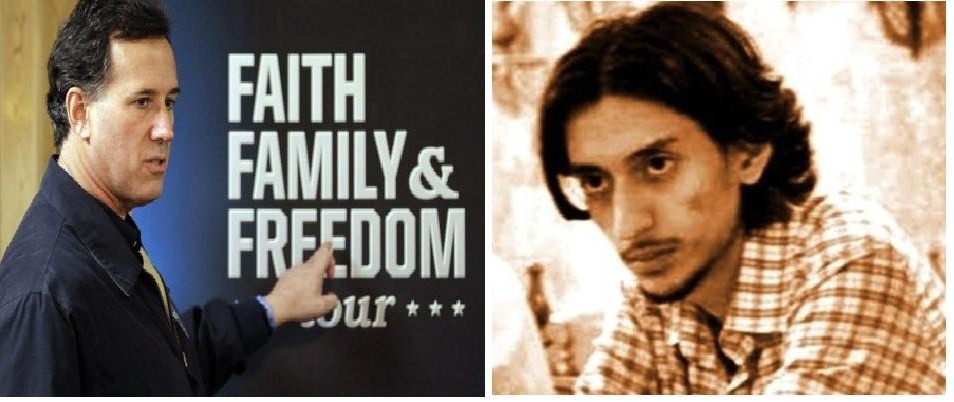
Rick Santorum, Meet Hamza Kashgari

By George Packer for The New Yorker

President Kennedy’s 1960 speech on religious freedom makes Rick Santorum “throw up.” “What kind of country do we live in that says only people of nonfaith can come into the public square and make their case?” Santorum says. It’s a central part of his campaign strategy to distort such things as a Kennedy speech, or an Obama speech, to whip up outrage at the supposed war on religious people in America. Here’s what Kennedy said:

I believe in an America where the separation of church and state is absolute; where no Catholic prelate would tell the President—should he be Catholic—how to act, and no Protestant minister would tell his parishioners for whom to vote; where no church or church school is granted any public funds or political preference, and where no man is denied public office merely because his religion differs from the President who might appoint him, or the people who might elect him… I believe in a President whose religious views are his own private affair.

Kennedy said much more, but this is the strongest passage of that famous campaign speech to a group of ministers in Houston, in which he argued that the election of a Catholic President who believed in the Constitution shouldn’t concern any American who believed in the Constitution—and, Santorum says, “That makes me throw up.” Santorum’s rhetorical eloquence is about equal to his analytical skill. Kennedy had nothing to say against believers entering public life, or believers bringing their religious conscience to bear on public policy. He spoke against any move to make religion official. The Constitution speaks against this, too—Article VI establishes an oath to the Constitution as the basis for public office, and explicitly prohibits a religious test, while the First Amendment forbids the official establishment of religion and protects its free practice. Santorum claims to be a constitutionalist, but that’s just rhetoric and opportunism. Santorum believes in a religious test—that may be all he believes in. (Mitt Romney believes in a religious test of a slimy, halfway, Romneyesque variety: in 2007, he reportedly dismissed the idea of appointing a Muslim to his Cabinet, saying, “Based on the numbers of American Muslims [as a percentage] in our population, I cannot see that a Cabinet position would be justified.” So does Newt Gingrich, who has made atheist-baiting a central part of his political business.)

Kennedy seemed to have someone like Santorum in mind when he warned, “For while this year it may be a Catholic against whom the finger of suspicion is pointed, in other years it has been—and may someday be again—a Jew, or a Quaker, or a Unitarian, or a Baptist. It was Virginia’s harassment of Baptist preachers, for example, that led to Jefferson’s statute of religious freedom. Today, I may be the victim, but tomorrow it may be you—until the whole fabric of our harmonious society is ripped apart at a time of great national peril.” In 1960, it would have been hard to imagine how thoroughly religious sectarianism and intolerance would infect American politics, and especially one major party. The outcry over Obama’s policy on health insurance and contraception has almost nothing to do with that part of the First Amendment about the right to free religious practice, which is under no threat in this country. It is all about a modern conservative Kulturkampf that will not accept the other part of the religion clause, which prohibits any official religion.

Santorum, like most conservatives these days, says he is a constitutionalist. Jefferson wrote, and Madison worked to pass, the Commonwealth of Virginia’s Bill for Establishing Religious Freedom, which held that “all men shall be free to profess, and by argument to maintain, their opinions in matters of religion, and that the same shall in no wise diminish, enlarge, or affect their civil capacities.” Jefferson included an even stronger phrase that was eventually struck out by amendment: “the opinions of men are not the object of civil government, nor under its jurisdiction.” Presumably, all of this originalist nonsense makes Rick Santorum heave, gag, vomit, and puke.

What makes me throw up is the story of Hamza Kashgari. It’s a shame that every American doesn’t know his name. He’s a young, slender, philosophical-minded columnist and blogger from Saudi Arabia who, earlier this month, dared to tweet phrases of an imagined conversation with the Prophet Mohammad: “I have loved things about you and I have hated things about you and there is a lot I don’t understand about you…I loved the rebel in you…I will not pray for you.” Within twenty-four hours, more than thirty thousand furious replies had been posted on Twitter. Within a few days, more than twenty thousand people had signed on to a Facebook page called “Saudi People Want Punishment for Hamza Kashgari.” (So much for Arab liberation by social media.) One commenter wrote, “The only choice is for Kashgari to be killed and crucified in order to be a lesson to other secularists.”

Kashgari backed down, apologized profusely, and continued to be attacked. He went into hiding. Clerics and government officials threatened him with execution for blasphemy. He fled to Malaysia, hoping to continue to fly to New Zealand, where he would ask for asylum. But Malaysian officials, behaving against law and decency, had him detained at the airport and sent back to Saudi Arabia, where he was promptly arrested. Since mid-February there’s been no word of Kashgari. The Saudis have said they will put him on trial. What a pity there’s no First Amendment to protect him.
If only he had more powerful friends—if only Christopher Hitchens were still alive—Hamza Kashgari would be called the Saudi Rushdie. There would be a worldwide campaign to pressure the Saudis into releasing him. The United States would offer him asylum and quietly push our friends the Saudis into letting him go. But we’ve come to expect these things from our friends the Saudis.

We’ve come to expect these things from the Muslim world. We expect Afghans to riot for days and kill Americans and each other because a few NATO soldiers were stupid enough to burn copies of the Koran along with other objects discarded from a prison outside Kabul. Yes, those soldiers were colossally, destructively insensitive. Yes, we should know by now. Yes, the reaction has a lot to do with ten years of war and occupation and civilian deaths and marines urinating on Taliban corpses. Still, can we have a little outrage at the outrage? Can we reaffirm that human lives are more sacred than books? Can we point out that every time something like this happens, there’s a manufactured and whipped-up quality to much of the hysteria, which has its own cold political calculation (not unlike the jihad against secularists by Sean Hannity and other Salafist mouthpieces)?

Saudi Arabia needs an absolute separation of religion and state so that Hamza Kashgari can say things that other people don’t like without having to flee for his life. Afghanistan needs it, too, and so does Pakistan, so that mob violence and political assassination can’t enjoy the encouragement of religious authorities and the tolerance or acquiescence of government officials. And America needs it so that our Presidents’ religious views remain their own private affairs, and Rick Santorum and his party can’t impose dominion of one narrow, sectarian, Bible-based idea of the public good over a vast, pluralist, heterodox, freedom-loving democracy.

Welcome To The First Annual Celebrity Religion Swap

By Wajahat Ali for Salon.com

Muslims worldwide groaned upon hearing the news that Oliver Stone’s son, Sean, converted to Islam while filming a documentary in Iran.

Although we — the collective 1.5 billion Muslims worldwide — assume Sean Stone is a fine, upstanding man and sincerely wish him spiritual contentment, we earnestly ask Allah why Islam only attracts controversial celebs (in this case, the son of a controversial celeb) who further tarnish our already toxic brand name?

We plead to the heavens for an answer as to why he converted in Iran, of all places, which is currently the most feared and loathed country in America and about as popular as herpes.

We have patiently endured, oh, Allah.

We miraculously survived Mike Tyson, who converted to Islam while incarcerated, and then angrily threatened Lennox Lewis in an infamous interview: “I want your heart. I will eat his children. Praise be to Allah.”

Awesome.

Islam has the lowest favorability rating of any religion in America. If Islam were a world economy, it would be Greece. If it were a professional athlete, it would be San Francisco 49ers punt returner Kyle Williams, who muffed two critical punts, which helped the New York Giants reach the Super Bowl. If Islam went to the prom, it would be the ugly girl with freckles and an overbite standing in the corner with a bucket of pig’s blood teetering precariously over its head. If Islam were a Republican presidential candidate, it would be Newt Gingrich.

A diverse jirga of American Muslim leaders decided “enough was enough” and held an emergency meeting at Lowes’ Home Improvement store in Dearborn, Mich., to strategize how to bolster Islam’s faltering image.

A consensus emerged that we needed to draft popular, mainstream celebrities whose successful addition to our starting lineup would boost our international brand name. After all, 1,400 years of civilization and the religious practices of 1.5 billion solely rest on the tanned shoulders of the rich, famous and beautiful.

Inspired by comedian Dave Chappelle, one of the few Muslim converts who could be considered a net gain, the Muslims held a “Religious Draft” this week, inviting major religions to participate on hallowed ground: McDonald’s.

The following is a summary of the proceedings.

THE FIRST ROUND PICK

Since it was universally accepted Islam was the 2011 Indianapolis Colts of world religions, they had first pick.

Predictably, the Muslims drafted free agent Liam Neeson, who recently said, “There are 4,000 mosques in [Istanbul]. Some are just stunning and it really makes me think about becoming a Muslim.” The Irish actor is experiencing a pop cultural rebirth as the 21st century embodiment of uncompromising, kick-ass masculinity and sage paternalism. On behalf of Muslims, he took revenge against France, which recently caved into hysteria and banned the burqa. Neeson single-handedly destroyed the entire country with his bare fists in the blockbuster action film “Taken.” Muslims believe Neeson will help rebrand them as Jedi Knights, due to his portrayal of Jedi Qui-Gon in “Star Wars: The Phantom Menace,” and replace their current image as Dark Lords of the Sith.

Rumors circulated that many Evangelical Christians felt slighted by this pick since Muslims stole their digital Avatar of Jesus: Neeson voices “Aslan the Lion” from the “Narnia” movies.

The rest of the day’s picks were organized according to different types of celebrity.

ATHLETES

In a surprise move, the Buddhists requested Mike Tyson from the Muslims. Exhausted from voluntarily suffering for the past 2,500 years, the Buddhists decided Tyson’s crushing right uppercut could “really eff up China.”

In turn, the Buddhists decided to offer the Beastie Boys — the aging, versatile, hip-hop trio from Brooklyn – sensing they peaked with their 1998 “Hello Nasty” album. The Muslims accepted, acknowledging the songs “Sabotage” and “Shake Your Rump” as perennial favorites in Egypt and Lebanon.

The Buddhists selflessly threw in Richard Gere and DVD copies of “American Gigolo” to sweeten the deal.

The Jews intervened and said they wanted the Beastie Boys back on their team. They offered the Muslims Ben Roethlisberger, two-time Super Bowl champion quarterback of the Pittsburgh Steelers. Having read about Big Ben’s dubious history of sexual impropriety, the Muslims passed, but decided to donate Mike D of the Beastie Boys to the Jews as a truce offering. Allegedly, the Muslims could never forgive Mike D for the horribly weak rhyme “Everybody rappin’ like it’s a commercial, acting like life is a big commercial” on the song “Pass the Mic.”

The Jews accepted the offer.

The Muslims, feeling emboldened, made an ambitious pitch to the Christians for Denver Broncos quarterback Tim Tebow, who “just wins.”

Muslims offered former NBA all-star Shaquille O’Neal, who fell from their graces after he acted as a giant genie in the box-office bomb “Kazaam.” They also threw in Mahmoud Abdul-Rauf, the controversial Denver Nuggets star who converted to Islam and refused to stand for “The Star-Spangled Banner” before games. The Christians were initially enticed, seeing this as a perfect “born-again” moment, but they passed.

The Muslims went aggressive and promised they wouldn’t supplant the Constitution with Shariah and replace the White House with minarets unless Tebow and Mel Gibson crossed over.

The Christians, anxious to excommunicate Gibson, agreed. For the 2012 NFL season, Tebowing will now consist of prostrating and praising Allah after every touchdown. The Christians asked the Muslims to preserve Tebow’s chastity and not introduce him to Miss USA Rima Fakih or hot Arab women from the reality TV show “All-American Muslim”; the Muslims said they’d try, but they promised nothing.

COMEDIANS

The Jews made a play for comedian Dave Chappelle, a Muslim, citing his hit series on Comedy Central “Chappelle’s Show” as a creative juggernaut that still influences the masses — especially several rabbis, who apparently love saying, “I’m Rick James, bitch!” after performing circumcisions.

The Muslims immediately rejected the offer, saying Chappelle is perhaps the only living proof that Muslims can be intentionally funny.

Instead, they offered Iranian President Mahmoud Ahmadinejad as an example of an unintentional comedian and provocateur in exchange for Israel cooling down its dangerous rhetoric of a preemptive strike on Iran.

Furthermore, the Muslims offered the newly acquired Mel Gibson straight up for Jerry Seinfeld.

The Mormons tried to intercept Seinfeld by playing one of their highest cards: “Napoleon Dynamite” actor Jon Heder. The Jews pretended not to hear this mockery and allowed the Mormons to slink away with some shred of remaining dignity.

The Jews finalized a deal with the Muslims and rumors have circulated since that Mel and Ahmadinejad are under house arrest in Tel Aviv, forced to watch “The Chosen” and “Fiddler on the Roof” on repeat while listening to Jerry Lewis perform comedy.

MUSICIANS

Sensing friendly relations, the Jews humbly approached the Muslims for rapper Ice Cube, citing his immense street cred and respect from the hip-hop and African-American communities. The Jews conceded the Matisyahu experiment, although initially promising, had failed, as the Hasidic reggae rapper never lived up to his “King Without a Crown” potential.

The Muslims mulled it over for a considerable time. The jirga decided they would retain eternal rights to Cube’s 1993 hit single “It Was a Good Day” from his multi-platinum album “Predator,” but ultimately release him because he inexplicably starred in the awful family comedy “Are We There Yet?”

Muslims in return asked the Jews for Kabbalah-worshipping Madonna, sensing serious comeback potential after her excellent Super Bowl halftime show.

Catholics made a request for multi-talented actor and hip-hop artist Mos Def from the Muslims, who soundly rejected any and all future offers, stating the entirety of the Middle East and North Africa could never bear to part with Def’s song “Ms. Fat Booty.”

Instead, Muslims counter-offered with alternative rock artist Everlast, whose 1998 single “What It’s Like” has made a surprising comeback on radio stations due to the economic recession. The Catholics still remember Everlast as the lead singer of the hip-hop band House of Pain, who produced the classic party anthem “Jump Around,” before his conversion to Islam. The Catholics accepted; South Asian Muslims danced to “Jump Around” one last time; and the Muslims in return received Taylor Swift and her legions of pubescent female fans, along with her former boyfriend Taylor Lautner, who played the ethnic werewolf in the “Twilight” movies.

The Muslims had finally secured their most promising young-adult celebrity.

POLITICIANS

The Mormons halfheartedly offered Mitt Romney. The Evangelicals promised Michele Bachmann and her lifetime supply of blinks. The Catholics, out of sheer desperation and embarrassment, bartered Newt Gingrich and his third wife, Callista.

The Muslims decided to stick with their boy, Barack Hussein Obama, in hopes of retaining the White House in 2012.

MISCELLANEOUS

Muslims threw a Hail Mary and asked fundamentalist Christians for Chuck Norris, who so thoroughly kicked the Middle East’s entire ass during the ’80s. The Muslims respected Norris for his ability to fire an Uzi, perform a roundhouse kick and wave an American flag at the same time. In return, Muslims offered the infamous WWF wrestler the Iron Sheikh and even agreed to teach the Christians the impregnable camel clutch. Norris, humbled by the offer, respectfully declined, and admitted that although he enjoyed killing hordes of fictional Arabs in jingoistic action movies like “Delta Force,” he currently fancied himself an intellectual and activist committed to exposing the nonexistent threat of Shariah infiltrating America. The Muslims were saddened, but collectively agreed to watch Norris in the summer action film “Expendables 2.”

The Hindus decided to play their strongest card, actress Julia Roberts, and made a request for journalist Lauren Booth, former British Prime Minister Tony Blair’s sister in law, who converted to Islam in 2010. The Hindus saw her as the perfect revenge and giant, henna-painted middle finger to England for the British Empire’s previous colonization and exploitation of India’s resources. The Muslims thought this was reasonable and now the “Pretty Woman” flashes her million-dollar smile behind a burqa.

THE CHOSEN ONE

Finally, the draft ended with all the religions coveting “the chosen one,” who would single-handedly redeem their public image both at home and abroad.

The Mormons offered former Republican presidential candidate Jon Huntsman, highlighting his excellent Chinese and fine hair. The Muslims initially offered NBA Hall of Famer and current cultural ambassador Kareem Abdul Jabbar. They sweetened the deal and threw in President Obama. The Jews presented Steven Spielberg and his entire film library. The Hindus humbly offered Bollywood actors Amitabh Bachan, Aishwarya Rai and a picture of Gandhi signed by Ben Kingsley. The Buddhists presented Tina Turner, Herbie Hancock and Tiger Woods.

But, it was sadly to no avail.

The Christians and Church of New York decided to keep NBA superstar and New York Knicks point guard Jeremy Lin. Rumors circulated that they were talking to China about a potential trade to ensure the ambitious superpower does not ask the United States to repay its debt, thus financially crippling and utterly destroying our great nation.

All in all, “it was a good day” for the Muslims in the first Religious Draft.

Wajahat Ali is a playwright, attorney, journalist and essayist. His award winning play”The Domestic Crusaders,” was published by McSweeney’s in 2011. He is the lead author of “Fear Inc., Roots of the Islamophobia Network in America.” He is currently writing a pilot for HBO. He is co-editing the anthology “All American: 45 American Men on Being Muslim” published in June 2012. More Wajahat Ali

Pakistan is a Nation at Odds With Itself, U.S.

By Stephen Magagnini for The Sacremento Bee
KARACHI, Pakistan — On a moonlit Thursday night in February, a television network executive hosted an elegant affair for journalists and diplomats at his villa above the Arabian Sea.

Karachi’s privileged dined on lamb, shrimp, chicken, mutton and fettuccine in mushroom sauce, and were surprised by a quartet of wandering minstrels, soulful Sufi poets who serenade for their supper, uncorking ballads about love.

On the south side of this city of 18 million, a group of Afghan refugees, who scrape out a living collecting cardboard and other recyclables in a slum straddling a swamp of open sewage, were mopping up gravy with roti – Pakistani bread.

About 900 Afghans live in this fetid slum, down the street from poor Pakistanis and water buffalo. They earn about $60 a month and survive on bottled water, chewing tobacco and roti.

“We’re happy in Pakistan,” said 33-year-old Shaezhad, leader of a cardboard collection station. “We get food and respect.”

At the party across town, talk-show hosts and other Pakistani elites blew cigarette smoke into the faces of U.S. journalists, criticizing U.S. foreign policy and the toll the war in Afghanistan has taken on their country.

Many Pakistanis resent American aggression in the region and want more respect from U.S. policymakers, but they don’t hold individual Americans responsible. Yet everywhere we went, we were held to answer for U.S. wars and Americans’ deep misunderstanding of Pakistan.

“You are arrogant, playing video games with our lives,” Abdul Moiz Jaferii, political analyst for CNBC Pakistan, said over lunch one day in Karachi. He was referring to U.S. drone attacks that have killed Pakistani and Afghan civilians.

“And we hate America because the U.S. has always been the biggest, closest ally of the military dictators. You have done nothing to help democracy.”

The impact of the war in Afghanistan has permeated nearly every pore of this country of 180 million. More than 2 million Afghan refugees have fled to Pakistan, and some have brought a culture of violence. Since 9/11, 35,000 Pakistanis have been killed in terrorist attacks by suicide bombers and other war-related violence, according to Pakistan’s intelligence agency. The victims include 6,000 soldiers and 29,000 civilians.

The unpredictable violence and the kidnapping of foreign workers have created a climate of fear in this country. We weren’t allowed to visit villages outside urban areas, where 40 percent of Pakistanis live. Two shotgun-wielding security guards protected our buses in Islamabad, Lahore and Karachi. We entered our hotels through metal detectors and were rarely allowed to interact with average citizens in public places.

Pakistan – strategically located between Afghanistan, India, China and Iran and influenced by Saudi Arabia – remains an enigma to many Americans, who aren’t sure whether it’s friend or foe, democracy or military dictatorship.

Pakistan has provided critical support to NATO troops in the Afghan war – drones are launched from here, NATO supplies are sent through this country, and Pakistani troops have helped recapture terrorist strongholds along the volatile Afghan border.

But distrust of the United States in the wake of deadly drone attacks and the deaths of 24 Pakistani soldiers in a cross-border battle in November is such that rather than calling for more U.S. aid to build needed power plants, schools and hospitals, a growing number of Pakistanis want nothing to do with the United States. The government of Punjab – Pakistan’s most powerful state with about 90 million people – has decided to reject U.S. aid.

The killing of Osama bin Laden by U.S. Navy SEALs in Abbottabad in the heart of this country embarrassed and angered the Pakistan military and made Americans question why bin Laden was allowed to live in essentially a resort town. Some U.S. politicians have called for an end to the $18 billion in financial aid pledged since 9/11.

An Islamic republic?

Some of the world’s largest, most beautiful mosques are here, and to celebrate the Prophet Muhammad’s birthday on Feb. 4, 10,000 people named Muhammad gathered in prayer in Karachi.

We saw few women wearing hijabs, or head coverings, except those at Islamabad’s Faisal Mosque, which can hold 10,000 people for Juma, or Friday prayer.

Professional women drive cars, dress like their counterparts in U.S. cities and run government ministries, clinics and newsrooms. Women, who constitute 52 percent of the population, are increasingly getting advanced degrees. There’s a Pakistani proverb: “Every girl who goes to university gets a husband.”

Despite Islam’s ban on liquor, at a party in Islamabad guests of both sexes repaired to a speakeasy in the basement to drink wine or Johnny Walker Black and smoke cigars.

Though most marriages are still arranged, as many as 20 percent are “love marriages,” said Samina Parvez, director general of the government’s external publicity agency. “The divorce rate is also increasing – it’s about 10 or 15 percent,” Parvez said. “The majority of us are not practicing Muslims.”

Kamoran Sani, sales and marketing director for the Sheraton Hotel in Karachi, declared, “What you’ve heard about the Islamic Republic of Pakistan’s a big farce. There are orgies, voyeurs’ lounges, raves.”

A diverse nation

Pakistan didn’t become a nation until the British sliced India into Muslim and Hindu majority states in 1947. Pakistan – an Urdu acronym for Punjab, Afghania, Kashmir, Sindh province and Baluchistan (“stan” means nation) – varies wildly from region to region.

“There is no such thing as Pakistan,” Jaferii said. “First comes your family, then your clan, third your region, fourth your province – the nation comes a distant fifth.”

Much of rural Pakistan is a feudal society dating back to the 13th century. Mullahs, or religious leaders, still invoke blasphemy laws exacting punishment against those accused of insulting Islam. Last year, the governor of Punjab was killed by his bodyguard for criticizing the law as he sought a pardon for a Christian woman sentenced to death.

But Pakistan has tremendous religious and ethnic diversity. Muslims include Sunnis, Shiites, Ismaelis, Ahmadis and Sufis – each practicing their own brand of Islam. At Lahore University of Management Sciences, I chatted with Muslims, Hindus and Christians who were all friends.

From the Sufi love poems to Pashtun folk songs about social justice, music plays a key role in Pakistani identity.

In the center of Karachi there’s a Catholic church – St. Patrick’s Cathedral, built by the Jesuits in 1931. There’s a Jewish cemetery. Sikhs worship throughout Pakistan. The ancient city of Taxila was occupied by Alexander the Great and reflects Persian, Moghul, Buddhist and Christian traditions.

Pakistan’s future

Sixty percent of Pakistan’s population is under age 30; half is under age 20. Half the kids haven’t been to school, and fifth-grade students are reading at a second-grade level, said Nadeem ul-Haq, deputy chairman of the government’s planning commission.

“We have 2 million kids a year entering the labor force. What are these kids going to do?” ul-Haq said. There is no building boom to provide jobs, and foreign investments have been scared away by terrorism.

“Entrepreneurship is the key thing we need to focus on,” he said. “Overseas Pakistanis have been very entrepreneurial, sending back $13 billion a year to their poorer relatives.”

From 7-Elevens to Silicon Valley firms and venture capital funds, ex-pat Pakistanis are thriving in the United States. The 500,000 Pakistanis in the United States, including 100,000 in California, send $100 million a year to charities in Pakistan, said Ahson Rabbani, CEO of I-Care, which connects donors with 30 nonprofits.

In Northern California, Pakistanis raised more than $100,000 for Pakistani flood relief efforts spearheaded by cricket star Imran Khan, who may lead the country if his party wins the next election. Khan has gained credibility by building a cancer hospital for the poor in honor of his late mother. His party includes a women’s wing that has direct access to him.

Philanthropy is playing a growing role in Pakistan, financing schools in poor villages and slums. The Citizens Foundation is educating 100,000 students.

“I mentored six girls,” said Karachi journalist Samia Saleem. “One was 13 and said she didn’t want to get married – she wants to be a teacher.”

Ali Shah Haider, 17, wants to be a commercial pilot. “I sleep from 2 p.m. until 4:30 p.m., then go to work at the textile factory from 8 p.m. to 5 a.m. to support my family – there are 12 of us. I do my homework between shifts.”

A nation’s dreams

Though life seems cheap in Pakistan, the people are upbeat survivors who often describe life as bo hat acha, which means “great!” in Urdu, their main language.

Last year 1,575 people were killed in Karachi, where 2 million weapons are in circulation, said Francisco Quinones of Arcis International Security. A doctor was killed in Karachi the day before we landed. Violence has been blamed on the Taliban, rival political gangs, Sunni and Shia militants, rogue security forces, and Afghan refugees.

Some refugees have been recruited by the Taliban. Others like Shaezhad, who collects recyclables in the slums of Karachi, are glad to be alive under the green and white crescent flag of this country.

Still, he wants to go home to Afghanistan. “We want our land back, we want to live with respect and we want employment.”

Azhar Abbas, the managing director of Geo TV news who hosted the party in Karachi, said that “democracy is taking hold” in his Pakistan despite the violence many here believe followed the U.S. war on terror.

The business editor of daily newspaper the News, Amir Zia, said the United States can still play a positive role in Pakistan. “If Americans pull out without getting the job done, the Islamic extremists will say it’s a victory and will become much more organized.”

But at the National Defense University, business and technology expert Bilal Munshi called Pakistan “a psychologically scarred nation suffering from a mass form of PTSD (post-traumatic stress disorder).”

If the 4 million young people entering the workforce each year get jobs, “we will be a power … but if they don’t see a future they’re going to pick up the gun, and you’re going to be in real trouble.”

The U.S. can help develop Pakistani schools, Bilal said, “but don’t interfere in our internal affairs – let us do things our way.”
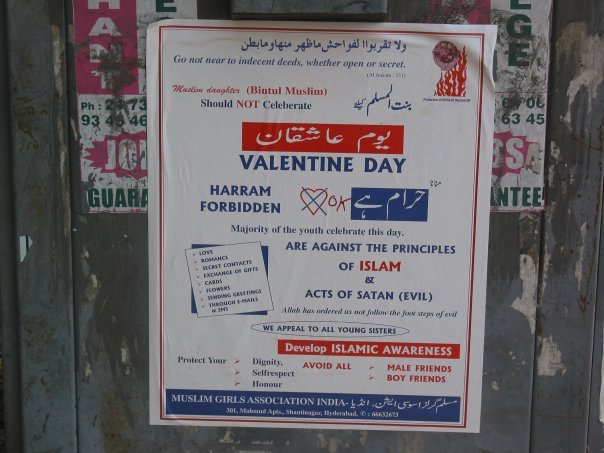
Valentine’s Day in Islam?

By Paul Salahuddin Armstrong Co-Director, Association of British Muslims

I was asked to share my views on Valentine’s Day. Personally, I really don’t see what’s the problem that some people seem to have with this celebration. The fact that it’s a Western, originally Christian festival is in all honesty, completely besides the point. We should celebrate Love everyday!

Many cultures have something similar, a day to celebrate love, to send a message of love to your beloved – a person whom you would like to marry or is already your husband or wife. Seriously, what’s wrong with that? What could possibly be wrong with that?
The only argument I’ve heard against Valentine’s Day, is the same one I hear about every other festival besides the two Eids – it’s not part of Islam. Well, sorry, if that’s the best these people can come up with, it’s a pathetic argument – cars and aeroplanes aren’t technically part of Islam either, but we still use them!

More to the point, a Muslim can celebrate any festival, even the social aspect of those of other religions, as long as this doesn’t mean they end up committing shirk – i.e. worshipping another deity besides God or associating partners with God – and this is the position of the mainstream scholars of Al-Azhar University in Egypt.

Indeed, for the vast majority of people who celebrate it, Valentine’s Day isn’t even that religious, rather it’s just a wonderful opportunity to show loved ones how much you appreciate them – which is something every Muslim should do anyway, even if they do not celebrate Valentine’s Day!

Pakistanis for Peace Editor’s Note– Finally, a Muslim perspective on Valentine’s Day that we can agree with! As compared to many other articles that decry Valentine’s Day as a pagan holiday and it is shirk to celebrate it, Paul has succinctly yet effectively given a great differing Muslim angle on this day as compared to the Orthodox Muslim view.

Study: US Muslims Don’t Want Shariah, Either

By Omar Sacirbey for The Houston Chronicle

North American Muslims are more than satisfied with the secular legal system and do not want a set of parallel courts for Islamic law, according to a new study of U.S. and Canadian Muslims by a Washington-based think tank.

The study, by University of Windsor law professor Judy Macfarlane for the Institute for Social Policy and Understanding, refutes critics’ claims that American Muslims want to impose Shariah, or Islamic law.

In fact, the study indicates that Muslims are just as unwilling to accept Islamic law as non-Muslims.

Macfarlane interviewed 212 Muslim Americans, including 41 imams and 70 community leaders who used aspects of Shariah in their daily lives. The other 101 interviewees were divorced Muslim men and women. About a quarter of the interviewees were from Canada, and the rest from the United States.

“Aside from formal religious observance, American Muslims relate to their Shariah responsibilities primarily through rituals of marriage and divorce,” Macfarlane wrote.

“They see these as compatible with the civil law – almost all the respondents in this study married and divorced twice, once in Islam and once in law – and will use the courts where they cannot agree outcomes, just like any other couple.”

When asked whether they thought American courts should apply Shariah to non-Muslims in the legal system, all of the respondents answered no. Just three of the 41 imams said they wanted parallel Shariah tribunals where Muslims could handle civil issues like marriage, divorce, and inheritance.

Macfarlane began her research after a Muslim group in Ontario petitioned the provincial government in 2003 to establish a separate Islamic family tribunal where Muslims could get binding legal decisions on family law issues. The Ontario government denied the request, and later that year abolished similar tribunals for Catholic and Jewish citizens that had been allowed in 1991.ˇ

The study follows a Jan. 10 decision by a federal appeals court that upheld a lower court’s ruling to overturn a 2010 Oklahoma constitutional amendment to prohibit judges from using Shariah in their deliberations.

Tennessee and Louisiana have passed similar laws, while 20 other states are considering such legislation.

Jews Honour Muslim Rescuers

By Mario Toneguzzi for The Calgary Herald

Calgary’s Jewish community is honouring Muslims who rescued Jews during the Holocaust.

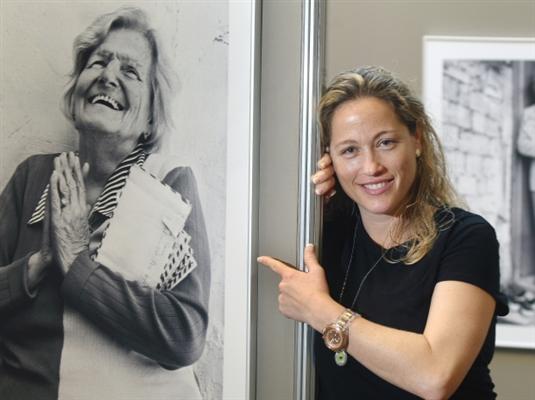
In commemoration of International Holocaust Remembrance Day, the Calgary Jewish Federation, in association with the Canadian Society for Yad Vashem, is presenting the Yad Vashem exhibition Besa: A Code of Honor — Muslim Albanians who Rescued Jews During the Holocaust.

The photographic exhibition opened Friday and will remain open through Feb. 11 at the Calgary Jewish Community Centre, 1607 90th Ave. S.W.

“We are very pleased to be sharing this inspiring and visually stunning exhibit with the Calgary community at large,” said Adam Singer, president of the Calgary Jewish Federation.

“Historically, there have been many examples of Jews and Muslims living side by side as neighbours and friends. The 17 Albanian Muslims featured in the exhibit are among 63 who have been recognized by the state of Israel as Righteous Among the Nations. The courageous acts of all rescuers, carried out under perilous circumstances, set a moving example. We want to get the message out that every one of us has the potential to emulate the humanity and bravery celebrated by renowned photographer Norman Gershman in the Besa exhibit.”

The Calgary showing of Besa was made possible through grants from the Calgary Foundation and Citizenship and Immigration Canada.

Singer said Besa means “to keep the promise” by taking responsibility for others, especially in peril.

Close to 24,000 individuals from around the world have been named Righteous Among the Nations by Yad Vashem, Israel’s world centre for Holocaust research, documentation, education and commemoration.

Admission is free to the exhibit and everyone is welcome.

“One message, obviously, is that the Holocaust happened and it’s been recognized by the United Nations,” Singer said. “It’s important to bear in mind that as years pass and the Second World War becomes more distant in time from the present, we lose, of course, first-hand accounts. The survivors are dying off and at some point will no longer be with us. And there’s a tendency to not want to remember things like the Holocaust. That’s a natural and even normal human desire not to think about bad things that happened in the past.

“So it’s critical that we take active steps to ensure that there is collective recollection of what happened. And collective recollection not only of the terrible things that were done, but also the great things.

“The other thing is that there seems to be a narrative these days that Jews and Muslims are enemies and this exhibit helps remind us that that’s only a small part of a centuries-old narrative in which Jews and Muslims are not enemies, but in fact are neighbours and friends and people who help each other.”

A Bronx Tale

By Ted Regencia and Lindsay Minerva for Tablet Mag

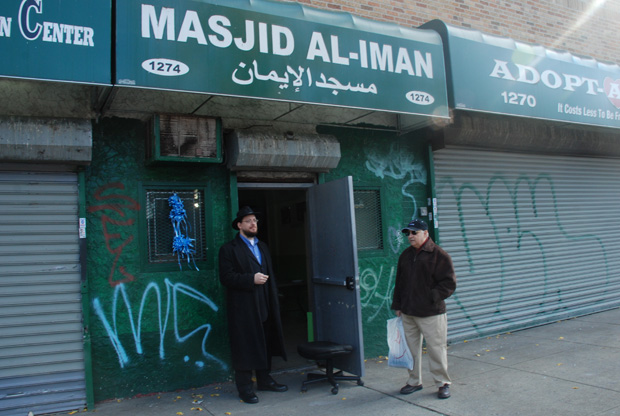
Near the corner of Westchester Avenue and Pugsley Street in Parkchester, just off the elevated tracks of the No. 6 train, Yaakov Wayne Baumann stood outside a graffiti-covered storefront on a chilly Saturday morning. Suited up in a black overcoat with a matching wide-brimmed black fedora, the thickly bearded 42-year-old chatted with elderly congregants as they entered the building for Shabbat service.

The only unusual detail: This synagogue is a mosque.

Or rather, it’s housed inside a mosque. That’s right: Members of the Chabad of East Bronx, an ultra-Orthodox synagogue, worship in the Islamic Cultural Center of North America, which is home to the Al-Iman mosque.

“People have a misconception that Muslims hate Jews,” said Baumann. “But here is an example of them working with us.”

Indeed, though conventionally viewed as adversaries both here and abroad, the Jews and Muslims of the Bronx have been propelled into an unlikely bond by a demographic shift. The borough was once home to an estimated 630,000 Jews, but by 2002 that number had dropped to 45,100, according to a study by the Jewish Community Relations Council. At the same time, the Muslim population has been increasing. In Parkchester alone, there are currently five mosques, including Masjid Al-Iman.

“Nowhere in the world would Jews and Muslims be meeting under the same roof,” said Patricia Tomasulo, the Catholic Democratic precinct captain and Parkchester community organizer, who first introduced the leaders of the synagogue and mosque to each other. “It’s so unique.”

The relationship started years ago, when the Young Israel Congregation, then located on Virginia Avenue in Parkchester, was running clothing drives for needy families, according to Leon Bleckman, now 78, who was at the time the treasurer of the congregation. One of the recipients was Sheikh Moussa Drammeh, the founder of the Al-Iman Mosque, who was collecting donations for his congregants—many of whom are immigrants from Africa. The 49-year-old imam is an immigrant from Gambia in West Africa who came to the United States in 1986. After a year in Harlem, he moved to Parkchester, where he eventually founded the Muslim center and later established an Islamic grade school. Through that initial meeting, a rapport developed between the two houses of worship, and the synagogue continued to donate to the Islamic center, among other organizations.

But in 2003, after years of declining membership, Young Israel was forced to sell its building at 1375 Virginia Ave., according to a database maintained by Yeshiva University, which keeps historical records of synagogues. Before the closing, non-religious items were given away; in fact, among the beneficiaries was none other than Drammeh, who took some chairs and tables for his center.

Meanwhile, Bleckman and the remaining members moved to a nearby storefront location, renting it for $2,000 a month including utilities. With mostly elderly congregants, Young Israel struggled to survive financially and, at the end of 2007, was forced to close for good. The remaining congregants were left without a place to pray. During the synagogue’s farewell service, four young men from the Chabad Lubavitch world headquarters in Crown Heights showed up. Three months earlier, Bleckman, then chairman of the synagogue’s emergency fund, had appealed for help from the Chabad.

“The boys from the Chabad said they came to save us,” said Bleckman. “We were crying.”

At this point, Chabad took over the congregational reins from Young Israel, with members officially adopting the new name Chabad of East Bronx. Still, for the next six to seven weeks, Bleckman said they could not even hold a service because they had nowhere to hold it.

When Drammeh learned of their plight, he immediately volunteered to accommodate them at the Muslim center at 2006 Westchester Ave.—for free.

“They don’t pay anything, because these are old folks whose income are very limited now,” said Drammeh, adding that he felt it was his turn to help the people who had once helped him and his community. “Not every Muslim likes us, because not every Muslim believes that Muslims and Jews should be like this,” Drammeh said, referring to the shared space. But “there’s no reason why we should hate each other, why we cannot be families.” Drammeh in particular admires the dedication of the Chabad rabbis, who walked 15 miles from Brooklyn every Saturday to run prayer services for the small Parkchester community.

For the first six months, congregants held Friday night Sabbath services inside Drammeh’s cramped office. As more people began joining the congregation, Drammeh offered them a bigger room where they could set up a makeshift shul. (When it’s not in use, students from the Islamic school use it as their classroom.) Inside the synagogue, a worn, beige cotton curtain separates the men and women who attend the service. A solitary chandelier hangs just above the black wooden arc that holds the borrowed Torah, which is brought weekly from the Chabad headquarters. A large table covered with prayer books stands in the center, and a picture of the Lubavitcher Rebbe is displayed prominently on a nearby wall. During Shabbat, when Jewish congregants are strictly prohibited from working, they have to rely on the Muslim workers at the center or on Drammeh to do simple chores such as turning on the light and switching on the heater.

At first, it did not make sense, said Hana Kabakow, wife of Rabbi Meir Kabakow. “I was surprised,” said the 26-year-old congregant who was born and raised in Israel. “But when I came here I understood.” The Kabakows have been coming to the service from Brooklyn for the last two years.

Harriet Miller, another congregant, said she appreciated the center’s accommodating the synagogue. “They are very sweet people,” said the 79-year-old Bronx native and long-time resident of Parkchester, who added that she welcomes the new Muslim immigrants in her neighborhood: “We were not brought up to hate.”

Drammeh also understands the importance of teaching tolerance more broadly, and for turning the school—which was itself founded at the nearby St. Helena Catholic Church on, of all days, Sept. 11, 2001—into a model of sorts for religious tolerance in New York.

“We’re not as divided as the media portrays us to be,” Drammeh said. “Almost 90 percent of Jewish, Muslim, and Christian teachings are the same.”

His latest project involves introducing fifth-grade Jewish and Islamic school students to each other’s religious traditions. Other participants of the program, now in its sixth year, include the Solomon Schechter School of Manhattan, the Al Ihsan Academy of Queens, and the Kinneret Day School of Riverdale. At the end of the program, students organize an exhibit that shows family artifacts of their respective cultures and religion. The principal of the Islamic school, who is also Sheik Drammeh’s wife, said that even after the program ended, the participants became “fast friends” and would visit each other’s homes.

“They would have birthday parties together,” Shireena Drammeh said. “When someone invites you to their house, I mean, that says it all right there and then.”

While the Jewish congregants are thankful for their new home, they hope that one day they can rebuild their own synagogue. That day may be far off: Even now that they have space to worship, they still struggle to operate. They don’t have proper heating inside, and the portable working heater could not reach the separate area where the elderly women are seated, forcing them to wear their jackets during the entire service. Congregants are appealing for financial support from the Jewish community and other congregations.

But Leon Bleckman and others say they now also have loftier goals, including reviving the Jewish presence in the neighborhood and reaffirming the positive relationship with their Muslim friends. “We are able to co-exist together side by side in the same building,” said Assistant Rabbi Avi Friedman, 42. “That’s sort of like a taste of the future world to come—the messianic future where all people live in peace.”

Ted Regencia is a digital media student at the Columbia Journalism School. His Twitter feed is at @tedregencia. Lindsay Minerva, a digital media student at the Columbia Graduate School of Journalism, is an intern at Newsweek. Her Twitter feed is at @lindsayminerva.


Pakistanis for Peace Editor’s Note– A story like this illustrates the good in all of us. A few months ago, we highlighted an article on Heartsong Church in Cordova, Tennessee where Christians in that part of the US welcomed a Muslim community that was undergoing construction of their mosque nearby. Now this kind deed is being passed forward to another flock of faithful when Muslims in New York are offering a helping hand to Jewish members of their community. This is the type of love for one another God of all religions wants and appreciates. May God bless them all.

Moment Terror Suspect, 25, Arrested Over ‘Bomb Plot’ in Florida Was Caught on Camera Brawling With Christian Protesters

As Reported by The Daily Mail

A Muslim accused of plotting to bomb locations in the U.S. has apparently been identified as the same man assaulting Christian protesters in a video posted online.

Sami Osmakac, 25, an immigrant from Kosovo, was said to have been planning an attack in Tampa, Florida using a car bomb, machine guns and other explosives.

In the first video clip, a man who appears to be Osmakac, confronted Christian protesters and assaulted one outside the Tampa Bay Times Forum – leaving the man bleeding from the mouth. He was later arrested by police.

In the second video with the title ‘Convert to Islam NOW! To all Atheist Christian (Non-Muslims)’ a man who looks and sounds like Osmakac threatened members of other religions.

The message from Abdul Samia, believed to be one of Osmakac’s aliases, warns viewers to convert to Islam ‘before it is too late’.  The YouTube videos were posted in December 2010 and in April last year.

Sami Osmakac, a naturalized U.S. citizen, was charged yesterday with one count of attempted use of a weapon of mass destruction.

Osmakac, of Pinellas County, Florida, allegedly bought explosives and guns from an undercover FBI agent, which had been made unusable. He allegedly told the officer that he wanted to ‘die the Islamic way’ in attacks at locations in Ybor City and South Tampa.

After being tipped off in September, the five-month investigation culminated with a sting operation at the weekend. Shortly before his arrest he made a video of himself explaining his motives for carrying out the planned attack, authorities said.

In the eight-minute video he is seen cross-legged on the floor with a pistol in his hand and an AK-47 gun behind him. He said in the video that Muslim blood was more valuable than that of people who do not believe in Islam, according to a criminal complaint.

Osmakac allegedly added that he wanted ‘payback’ for wrong that was done to Muslims and bring terror to his ‘victims’ hearts’ in Tampa.

A confidential source allegedly told federal officials in September 2011 that Osmakac wanted Al Qaeda flags. Two months later he talked with the source and ‘discussed and identified potential targets in Tampa’ that he wanted to attack, authorities said.

Osmakac allegedly wanted help getting the firearms and explosives for the attacks, and was put in touch with an undercover FBI employee.

Last month Osmakac met with the agent and allegedly told him that he wanted to buy weapons including an AK-47-style machine gun. He also allegedly wanted Uzi submachine guns, high capacity magazines, grenades and explosive belt.

Osmakac gave the agent a $500 down payment for the items in a later meeting and outlined his intentions to build bombs, authorities said.

Osmakac allegedly said at another meeting earlier this month that he wanted to bomb night clubs, a business and the Operations Center of the Hillsborough County Sheriff’s Office. It is also believed he wanted to blow up an Irish pub and Starbucks coffee shop.

-Pakistanis for Peace Editor’s Note– We are glad that the authorities apprehended Sami Osmakac before he was able to allegedly carryout any of the attacks that he is accused of planning. Congratulations to the Hillsborough Police Department in Tampa along with the federal authorities. Loss of any life and certainly innocent loss of life goes against the fundamental nature of our being at Pakistanis for Peace. Bring a Pakistani American as well as a Muslim American, attacks attempted or carried out by other American Muslims such as Faisal Shahzad or even Maj. Nidal Hasan, and now Sam Osmakc, hits at the heart of our peaceful American dreams. As a result of the whacked out few, we as a whole are marginalized. But until these terrorists and wanna be terrorists are all taken off the street, the war on terror must go on~

All American Muslims Better Get Ready for a New Reality

By Nida Khan for The Huffington Post

While many Muslims (and people outside the faith for that matter) were heavily embedded in a debate over the controversy surrounding hardware store Lowe’s and its recent decision to remove ads from TLC’s reality show All American Muslim, a more detrimental attack against their future was all but finalized. Reversing an earlier decision to veto provisions of the National Defense Authorization Act (NDAA) for 2012, President Obama made the disturbing announcement that he would sign this legislation into law and thereby solidify the ability of the military and other factions to indefinitely detain anyone they deem an enemy of the state. And on New Year’s Eve, the President unfortunately made good on this promise with the stroke of his pen. At a time when the United States is grossly engaged in both active combat and covert drone campaigns in a multitude of Muslim nations, and when loosely defined terms like ‘terrorist’ can be arbitrarily thrown about, Muslims specifically — and all of society generally — shouldn’t take this disturbing development lightly.

In post-9/11 America, many have sadly grown accustomed and tolerant to routine practices of racial profiling, bias and even attacks against Muslims and those perceived to be Muslim. But in addition to blatant violence, workplace discrimination and subliminal acts of racism, Muslims have also become aware of another nuance that other Americans may not even realize exists — hesitation to give to charity. Because of fear that any charitable Muslim organization or mosque could suddenly be called out for links to a lone extremist faction (whether it’s justified or not), many pulled their money and cut back on donations to the extent that long-established charities found it virtually impossible to survive. Usually without any valid reason, many stopped supporting Muslim aide groups for the simple notion that anyone, anywhere could at any moment single out that organization and in turn put all those who gave money out of goodwill at risk for associating with them. The victims in all this? The impoverished and destitute in many “third world” countries.

At the same time, tragically, other active Muslims who were entrenched in the community or worked in an organizing capacity (much like our president once did for the disenfranchised), ceased their activities over trepidation as to how their efforts towards equality could one day be misconstrued for something nefarious. The climate of society forced many followers of the Islamic faith to alter their involvement on a plethora of levels. Even today, as forces like the NYPD keep Muslims under intrusive surveillance and continued cases of FBI entrapment emerge, many have stopped attending mosques or interacting too much within the community out of sheer apprehension over unwarranted government action. It is an unfortunate reflection of how marginalized groups often times suffer under the radar without a representative voice in government and in the mainstream.

Throughout modern history, we’ve had other instances of outrageous fear mongering, bias and injustice against those whose patriotism we questioned. Though it is rarely covered in classrooms, the internment of hundreds of thousands of Japanese and those of Japanese ancestry during WWII is a perfect example. Literally rounded up and “excluded” from living in the cities and towns they resided in, these “suspicious” individuals were interned in camps because their allegiance to the country “could not be determined.”

In 1950, at the height of the great red scare, Congress passed the Internal Security Act which required the American Communist Party, affiliated organizations and all ‘subversives’ to get fingerprinted and officially register with the Attorney General. This draconian law was so outrageous that then-President Harry Truman even vetoed it (though Congress overruled his veto in the end). The truly tragic and troubling thing about today’s NDAA is that President Obama isn’t even attempting to veto it anymore; he is instead giving it his stamp of approval. Even though the president stated that he has “serious reservations” regarding the detention, interrogation and prosecution of suspected terrorists, and even though he emphasizes that his administration will not indefinitely militarily detain American citizens without trial, what happens after he is no longer in office? Future leaders of the free world, after all, have absolutely no obligation to honor Obama’s signing statement, nor follow in his footsteps.

Yes, our first African American president has changed much of the vitriolic language used when covering the topic of terrorism, and yes he has taken great caution to ensure that Muslims and terror itself are not juxtaposed together. For that, he should be commended. But by finalizing the ability of any president to deem persons — including U.S. citizens (if they so interpret this bill) — an enemy that could then be indefinitely detained without charge or without trial, he sets into motion a frightening precedent. As a former constitutional law professor, President Obama should be inherently aware of the impending ramifications.

During the struggle for civil rights, many journalists, activists and those vocal citizens working alongside Martin Luther King Jr., Malcolm X and other leaders suddenly found themselves targeted for their activities. Countless advocates became political prisoners and others saw their careers and lives ruined. Now at a time when we already have legislation like the Patriot Act renewed, and warrantless wiretapping is openly put into practice, this defense act not only indoctrinates AUMF (2001 Authorization for use of Military Force) and many activities that were previously in existence, but it also leaves open the possibility of silencing anyone on a level with which we never even imagined.

As American Muslims, we’re happy that some are starting to ease the negative imaging and stereotyping against us, and are instead open to learning more about what the Islamic faith truly stands for. As a routinely alienated group, we’re overly ecstatic when a program like All American Muslim actually portrays us in a light other than that of some extremist radical. But while we should embrace the boycott of Lowe’s for its open bigotry, and praise folks like Russell Simmons for stepping up to the plate to purchase ads for the program, we should put just as much focus into the potential of someone like a Newt Gingrich or Rick Santorum taking over the White House and having full reign to detain whomever he pleases. Just remember the Bush-era verbiage of “you’re either with us or against us” and the atmosphere of intolerance that permeated under his presidency, and couple that with the ability of someone with his mentality being able to willfully determine any one of us a “traitor,” lock us up and throw away the key.

If Muslims scaled back their activities in the community and their charitable donations out of paranoia over the unrealistic possibility of being tied to something suspicious, just imagine the fear that will ensue if anyone can be instantly and militarily detained over accusations where the burden of proof won’t even be on the accuser. It is indeed an alarming scenario that can (and in all likelihood will) give new meaning to the term reality — no TV required.

Nida Khan is an independent journalist and producer working in print, radio and TV. As a news correspondent for WRKS 98.7 Kiss FM NY, she has covered everything from Barack Obama’s presidential campaign to protests for the defense of Sean Bell.