Archive for the ‘ Pakistan ’ Category

Amir Khan Can’t Get Floyd Mayweather Out Of His Head

By David Anderson for The Daily Mirror

HE may have taken a couple of wrong turn here and there, but Amir Khan insists he is on track for a 2012 showdown with Floyd Mayweather Junior. Just as Ricky Hatton became obsessed with Pretty Boy, so Khan can’t get him out of his head.

Freddie Roach may have floated the idea of a possible clash between Khan and his pal and gym-mate Manny Pacquiao, but Mayweather is the one he wants.

Khan’s plan was to unify the light-welterweight division against Timothy Bradley in his July 23 date before stepping up to face Mayweather at welterweight next year.

His plan took a hit when Bradley refused to honour their agreement to meet and instead the Bolton fighter will take on IBF champ Zab Judah at Las Vegas’ Mandalay Bay.

Khan says fighting Judah is not too much of a detour from his path towards Mayweather and reckons they could still meet next year.

His new plan is to beat Judah, have one more fight in the autumn before taking on the winner of Mayweather v WBC welterweight champ Victor Ortiz in 2012.

Khan is convinced Mayweather will beat Ortiz on September 17 in what will be his first fight for nearly 18 months and then their paths will finally meet.

“I’m hoping to get Zab Judah out of the way and look good against him, then get one more fight at the end of the year,” Khan said. “Then I’d like to fight the winner of Ortiz-Mayweather, maybe next year.”

Khan could get his wish and Mayweather is currently with his US promoter Golden Boy, which removes one massive hurdle from the negotiations.

As ever with Mayweather, it all comes down to money and if he feels he would get enough from fighting Khan, he will take on the Athens silver medallist.

Khan will have to get in line, though, and there is the small matter of Mayweather v Pacquaio which is still unresolved.

Some of the bitterness between the two camps has gone and that megafight is looking more likely than it has done for 18 months. Khan may have to wait his turn and Pacquiao would love a showdown with Pretty Boy to be his swansong.

Khan can wait and as we keep having to remind ourselves, he’s still only 24.

He’s still developing under Roach’s tutelage at the Wild Card gym and maybe it wouldn’t be a bad thing if he had time to improve even more before facing Mayweather.

Nominee Questions Pakistan’s Battle Plan

By Julian E Barnes for The Wall Street Journal

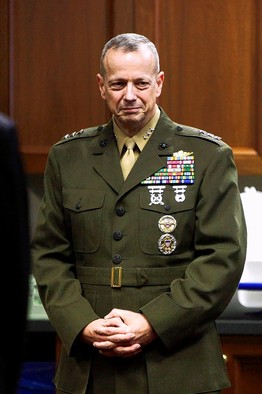
WASHINGTON—The Marine general chosen by President Barack Obama to lead the Afghanistan war raised doubts about Pakistan’s willingness to go after militants who cross the Afghan border to attack U.S. and allied troops.

In a confirmation hearing before the Senate Armed Services Committee, Lt. Gen. John Allen also said he believed that the Afghan insurgency’s momentum has been halted and even reversed in key parts of the country, and backed Mr. Obama’s troop drawdown plans.

But Pakistan, as a haven for militants, looms large over the war in Afghanistan. Gen. Allen said Pakistan continues to “hedge” against a precipitous U.S. withdrawal from Afghanistan by supporting anti-American militant groups, including the Haqqani network.

The statements were a rare public show of military skepticism about Pakistan’s intentions, reflecting the military’s increasing view that relations with Pakistan are deteriorating.

Gen. Allen, deputy commander of the U.S. Central Command, argued that it would be ultimately in Islamabad’s interest to expel militant groups from their sanctuaries in Pakistan.

“We will encourage and will continue to encourage our Pakistani friends to bring pressure to bear upon those safe havens,” he said. “It’s not just good for the outcome of our strategy and for the president’s vision on the outcome in Afghanistan; it’s good for Pakistan as well.”

Appearing alongside Gen. Allen, Adm. William McRaven, nominated to lead Special Operations Command, also said Pakistan is unlikely to move against the frontier militant havens anytime soon.

The admiral oversaw the Navy SEAL team that last month killed Osama bin Laden at his hideout in a Pakistani garrison town.

The officers’ testimony shined a light on the fragile state of U.S.-Pakistan relations, which have grown combative in the wake of the bin Laden raid.

Military leaders have made plain they are displeased with the declining cooperation by Pakistan, but insist the U.S. can’t walk away from the relationship.

“We’re giving them $4 billion,” said Sen. Scott Brown (R., Mass.). “And yet sometimes we don’t know if they’re in or they’re out, are they with us or [are] they not?”

After Adm. McRaven said Taliban leader Mullah Mohammad Omar is likely hiding in Pakistan, Sen. Lindsey Graham (R., S.C.) demanded Pakistan hand him over.

Pakistani officials have said limited military capacity—not lack of will—is inhibiting their operations against militant groups.

Gen. Allen said he backs President Obama’s decision to pull 10,000 troops out of Afghanistan this year, and the remaining 23,000 surge troops by the end of next summer. After the drawdown, the U.S. would still have 68,000 troops in the country, he said.

But he acknowledged that the military didn’t recommend a drawdown schedule as aggressive as the one Mr. Obama chose.

Under questioning from Sen. Joe Lieberman (I., Conn.), a critic of the Obama administration’s drawdown plan, Gen. Allen suggested that if conditions deteriorate he would advise Mr. Obama to alter the plan.

“It is my responsibility to the chain of command and to our commander-in-chief to ensure—should I be concerned about the progress or the execution of the campaign—that I so advise the chain of command,” he said.

Neither the Afghan Taliban nor the Haqqani network has directly targeted the Pakistani government. And Islamabad remains wary of a hasty U.S. withdrawal and sees the militant networks as potential future allies in Afghanistan.

Gen. Allen said even as troops leave Afghanistan, the military would continue to implement its current counterinsurgency strategy, which is aimed at protecting civilians from the insurgents while helping the government extend its reach and legitimacy.

Sen. Graham asked if Gen. Allen would have enough forces to continue that strategy, which requires large numbers of troops to secure population centers.

“How can we maintain counterinsurgency if all the surge forces have gone?” Sen. Graham asked.

The End of AfPak

By Scott Malcomson for The New York Times

Remember how after 9/11, Osama bin Laden’s attacks on us could be linked to almost anything, from shopping habits to the rediscovery of Western values to carbon-pricing schemes? Something similar appears to be happening with Bin Laden’s death. Jihadism sure isn’t what it used to be. After 10 years, it seems, the time has come to go home. Troops are and will be coming back to the United States from Iraq and Afghanistan. The military budget will be cut. The outgoing secretary of defense feels able to openly mock NATO because, presumably, he thinks he can afford to — because it doesn’t matter all that much. The global war on terror is being downgraded from Armageddon to something more out of Leviticus: a tricked-out police action, just as John Kerry, in this magazine, always said it should be. On Sunday, Helene Cooper and Mark Landler reported that “American success in the counterterrorism campaign would seem to bolster arguments for a swift withdrawal from Afghanistan.” By Tuesday morning, they were reporting that President Obama would announce his withdrawal plans on Wednesday. Meanwhile, a Harris poll revealed that 51 percent of Americans and 54 percent of Britons believed “the death of Bin Laden meant it was time to bring troops from their countries home.”

That isn’t quite how it looked when I was in Washington a few weeks ago and spoke with about a dozen current and former American officials and with Pakistanis. The impression they each gave was that American withdrawal would be speeded not because of Bin Laden’s death but because of Pakistan’s reaction to it. After the initial shock, Pakistan’s (government-influenced) press latched onto a narrative of “national humiliation” as a result of the American raid, rather than, say, one of jubilation at the demise of a killer whose fantasies have brought Pakistan nothing but misery. A younger generation of military officers — Pakistan is dominated by its military — seemed at times about to revolt in reaction to the insult to Pakistan’s sovereignty. And the Inter Services Intelligence (I.S.I.), Pakistan’s ubiquitous military intelligence outfit, reacted, as was subsequently reported, by scouring the neighborhood around Bin Laden’s house for … evidence of how the C.I.A. found out he was there, and to determine who had been helping the Americans.

Finally, the Pakistan government did not respond to the Bin Laden raid by pressing its new advantage and rolling up terrorist networks across the land. No, it did not do that at all. So Secretary of State Hillary Rodham Clinton and Admiral Mike Mullen, chairman of the joint chiefs of staff, went to Islamabad and on May 27 presented a list of demands. These included the arrest or elimination of Ayman al-Zawahiri (of Al Qaeda), Ilyas Kashmiri (a long-sought semi-free-agent and former Pakistani military man), Sirajuddin Haqqani (of the AfPak-border based Haqqani network) and Atiya Abdur Rahman (Al Qaeda), and the shutting down of bomb factories in Pakistan.

By June 3, Kashmiri was dead. But this promising start now seems isolated. The other wanted men are still at large. The bomb-makers might well be getting tipped off. The revolt by younger Pakistani officers seemed only to get worse.

In short, the U.S. and Pakistan are really not getting along. Among members of Congress, beating up Pakistan has become ritualized; Senators McCain and Rogers were doing it again on the Sunday programs. I wondered: How many times can Pakistan be abandoned? As Bruce Riedel, a former C.I.A. officer and the head of President Obama’s first major AfPak review, shows in his excellent new book, “Deadly Embrace: Pakistan, America and the Future of Islamist Jihad,” embrace and abandonment have formed the pattern of American-Pakistani relations since the majority-Muslim nation was formed out of the breakup of British India in 1947. Harry Truman’s lack of interest yielded to Dwight Eisenhower’s enthusiasm for Pakistan as an anti-Communist bulwark and a base for spying on the Soviets. The relationship was and remained built around security and intelligence. Lyndon Johnson reversed course when India and Pakistan went to war in 1965; he cut off both, but Pakistan had, unlike India, been a strong ally, and it felt betrayed. This set the pattern: ultimately, Pakistan was tactical and India was strategic.

Now, after almost 10 years of intense engagement, Pakistan and the U.S. appear set for another split; at least that was the consensus among the officials I spoke with. There was a pervasive sadness in these conversations. It was due in part to the sheer human effort that has gone into the U.S.-Pakistan relationship. A lot of spies and soldiers and diplomats and politicians have put years of their lives into making “AfPak” work, which requires making Pak work. A lot (not all) of that effort seems to be going down the drain, along with much of the billions of taxpayer dollars that financed it.

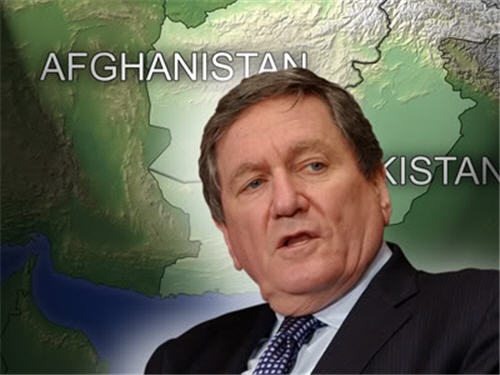
There is also personal sadness in that the AfPak effort was associated toward the end with Richard Holbrooke, whose death late last year brought the foreign-policy world up short. Holbrooke did not take great care of himself, so objectively his death could not be entirely a surprise, and among people over 70 the reactions I heard were more of the well-what-did-you-expect variety. But in the 35-to-65 range it was different. Holbrooke represented, very attractively, the assertion of youth and hope against experience. Even at 69 he had a distinct eagerness, even boyishness, alongside the baritone gravitas. He attracted bright young people. He could be young and old at the same time. Once he was gone, that sort of generational bridging disappeared. (Older figures are few in this administration.) The sense of continuity (as well as of optimism) is weakening. There’s something missing now.

There was also a sense of ideological loss of direction. For all their differences, Bill Clinton and George W. Bush shared a tangible optimism about American governmental involvement abroad. President Obama is different, and even if he weren’t the national mood is. The people’s representatives in Congress are vying to bring troops home faster, and if there is an internationalist remaining in the House he or she is keeping quiet. The Republican candidates for president seem to have settled on anti-war isolationism as a winning position. Obama’s great strength in foreign policy — his ability to repackage, and optimize, American power in a multipolar world — is the strategy that dare not speak its name, or it will bring accusations of “declinism.”

Finally, there is the tremendous sadness of Pakistan itself. The country doesn’t have enough water. It lacks the electricity to develop its industries. Literacy, by some reckonings, is actually declining. Democracy has been restored but the government is hardly stable. The one truly semi-stable institution, the military, is struggling against itself, just as Pakistanis are dividing, and attacking each other on an increasing scale (which is saying something).

But, in a way, the saddest thing of all, from a foreign-policy point of view — Pakistani or American — is that the one great card Pakistan has to play is to make itself a problem. Pakistan formed itself into a regional player through building its army, running terrorist proxies in Kashmir and Afghanistan, indulging in enough Islamist millenarianism to make itself frightening, and developing nuclear weapons. None of these strategies have a good future. But in the absence of a long-term committed relationship — what Holbrooke promoted as a “strategic partnership” — with the United States or, perhaps, with China, Pakistan is left with fear as its most successful export.

There was some discussion in Washington as to whether Mullah Omar’s name was on that list that Clinton and Mullen presented in Islamabad. It almost doesn’t matter. The doubt itself is the message: Pakistan stays valuable because it has terrorist “ties” or “links” or “proxies” or whatever. As national existential dilemmas go, Pakistan’s is particularly nightmarish. The U.S. will leave them to it — abandonment again — and choose the happier relationship with India. Secretary Clinton will be at the regional forum of the Association of Southeast Asian Nations in late July, helping to take her longtime initiative of eastward Indian engagement, and the integration of the United States into East Asian political structures, to a new level. This is part of a long-term strategy of accommodating the rise of China and of India.

And Pakistan, after 10 years, will be left behind; as the line in Washington goes, “There is no good solution.”

Of Babra and other Sharifs

By Asif Noorani for Dawn

Way back in 1915, when M F Hussain (Maqbool Fida Hussain) was born his mother named him Maqbool (which means popular). She had no idea that her son, born in a modest household, would become the most well known South Asian painter of the late 20th and early 21st century.

But not all names bring good luck to those who have to live with them. I had a clerk working for me, whose name was Raees (rich) but the man led a difficult life in the monetary sense. So was a man called Akhtar Nawab. He had neither the finances nor the mindset of a nawab. Haseena is a common name among the fair sex, but most girls with that name are anything but. Haseena Moin was charming in her salad years and is still quite pleasant to look at.

What is true of names is also true of surnames. The one Sharif (noble) who really deserved the surname was Babra Sharif. Even when she was at the peak of her career, the model turned actress (the unisex term actor was not used in her heyday for a female of the species) was on the dot for her shooting. She never threw tantrums like some popular film stars do. She never spoke ill of anybody including those who, out of sheer jealousy, lost no opportunity to make snide remarks about her. When the time came for her to call it a day, she retired gracefully, unlike our politicians in power who are forced to leave disgracefully from their offices.

But not all Sharifs are noble like her. In fact I have yet to come across anyone with that name or surname who could live up to it. Babara used no unkind words for her rivals, but this person (shh! no names please, make your own guess) left no opportunity to pass disparaging remarks about a lady with whom he once played a game of musical chairs. One afternoon he came to the Karachi Press Club, where he went on and on, speaking ungallantly against the first and so far the only woman prime minister in the country. The speech over, a callow journalist not known to be a good judge of human beings, invited the guest to visit the book fair in the club’s backyard. “I am sorry I have an important meeting to attend,” he said and took off in one of the four limos that were parked outside the club.

The same journalist, out of sheer curiosity, followed the fleet of cars on his humble motorbike and you know where did our favourite Sharif go to? “It’s elementary, my dear Watson,” Sherlock Holmes would have said. Our friend was seen downing a large glass at the Punjab Lassi House at Burnes Road. In those days mobile phones, with cameras, were not available otherwise the young journo would have had a prize photograph.

While on Sharifs, I must refer to the news item that appeared in the June 17 issue of a respected English daily. It had a screaming headline: “Shahbaz richest member of Punjab assembly”. In the introductory paragraph, the report said that the Punjab chief minister has assets of Rs 489.64 million in the country and abroad. The details are mind-boggling. But the question remains, is it merely a tip of the iceberg? Those who follow him, in the list of declarations made in 2010, also fall into the category of filthy rich. These were the figures submitted to the Election Commission by the members of the Punjab Assembly. What would have been no less relevant was the figure of the taxes that they pay. Sadly, those figures which should be abysmally low are not mentioned. Don’t you think such declaration should come from the head of the state and the head of the government also?

Perhaps, mine is a case of jealousy. I still move around in my old and but reliable Suzuki Khyber. I paid more income tax than what the chief executive of the country paid. The tax figures paid by him and some other bigwig were revealed in a report, published in the newspapers according to the NAB, when Gen Pervez Musharraf elbowed him out of his office. I have no bungalow. I live in an apartment. The fault is mine. I was always more interested in books than in lassi. So, why crib?

Asif Noorani, a seasoned journalist, is the writer of three best-selling books including ‘Boom, Boom Shahid Afridi’.

The views expressed by this blogger and in the following reader comments do not necessarily reflect the views and policies of the Dawn Media Group.

Pak Sailors Thank India, On Way Home

Mateen Hafeez for The Times of India

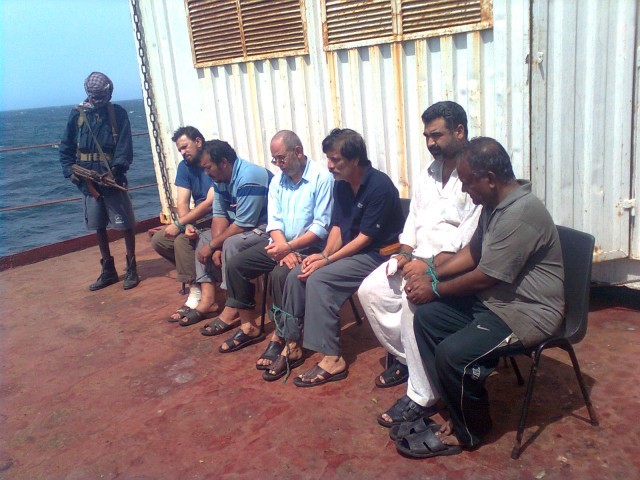
Five Pakistani hostages, who were held captive by Somali pirates for five months and rescued by the Indian Navy, will finally leave for Pakistan on Monday. The hostages had been languishing at Yellow Gate police station after their ‘consular access’ process got stuck in diplomatic channels of the two countries.

TOI was the first to report about the hostages’ plight and the problems in the consular access programmme. A team from the Pakistani High Commission then landed up at the Yellow Gate police station and completed the formalities. Earlier, this was scheduled to be done at Tihar jail in Delhi as the hostages were wrongly labeled ‘prisoners’. The men are Aurangzeb Balloch, his brother Sajjad, Farhad Aalam Khan, Mohammed Umair and Lal Bakhsh.

“We are excited to go home. There were some problems in our travel to Pakistan but the Yellow Gate police took care of us properly. We have no words to thank the Indian police and those who helped make our journey to Pakistan easy,” said Aurangzeb, a resident of Karachi. The other hostages were also jubilant when asked about their return to Pakistan. “In the last three months we saw the lanes and bylanes of this city. It’s very similar to Karachi. The people, places, food and roads here are similar to Karachi. Initially, we were afraid that we may be kept in India, but now we have a positive feeling about this country and its people who loved us,” said Sajjad, another hostage. “We watched the World Cup matches between India and Pakistan in the police station. When India won the final against Sri Lanka, we were happy. We never faced any discrimination here,” added Lal Bakhsh.

The hostages were part of an Iranian fishing trawler, Al-Murtuza. The ship was hijacked by AK-47 borne Somali pirates from the Ballochistan sea in November. “We would get insufficient food after we were captured by the pirates,” added Farhad.

The five men were provided food, chai and clothes. Sometimes they managed to get cigarettes. The policemen even gave their phones to the hostages so they could speak to their families in Pakistan. To speed up the process to send them home, Ansar Burny, former human rights minister in Pakistan, filmmaker Mahesh Bhatt and Abraham Mathai, state minorities commission vice-chairperson, worked together. “We spoke to Gurudas Kamat, the Union minister of state for home and he arranged consular access. The process was speeded up due to his efforts,” said Bhatt.

On the ground: For border village, peace is a beautiful dream

By Taha Siddiqui for The Express Tribune

We left behind everything when we came to this side, but not for such living conditions. Some of our family that stayed behind in India now mock us about our migration,” says Haji Shahzad.

Shahzad, in his early 70s, is a resident of Bhanoo Chak, a village located on the Indo-Pak border.
“The border force here has made our lives miserable. We live not under the threat of India but this force. Day and night, we have to live by their rules,” Shahzad says.

Bhanoo Chak, a village occupied by Sikhs who fled at the time of partition, is an hour’s drive from central Lahore and is closest in distance to the border.

“We just want peace so that there is relaxation on the border and we can have normal lives again,” adds Shahzad.
Mostly farmers, these men are not allowed to roam around freely after 6pm and need to acquire no-objection certificates before constructing anything on their property.

Many of these villagers have families that were divided in the partition in 1947 and wish to go meet them.
“We have family in Rajasthan. They want to come visit us and we want to go and visit them too. But we have to go through bureaucratic hurdles that we have stopped making the effort,” says Shahzad.

Pakistan Rangers Colonel Osman Siddiqui, who is in charge of the Wagah Border area, says that without checks and balances, he cannot trust anyone in the area. “The border is a sensitive spot, and to stop smuggling and unwanted people from crossing over, we have devised a system where we allow men to roam in these areas only between 6am and 6pm,” he says.

When asked if he will ease the policy in case the Pakistan-India dialogue is successful, he replied that national policy and local policy are different subjects. “When a change happens in the national policy, we can see. But for now, the policy will stay the same since the force needs to be vigilant,” he said.

Many villagers believe that if Pakistani and Indian leaders sincerely wanted peace, an accord could be reached today. They also do not fear another war with India.

“In 1965, Indian forces destroyed our homes. There were planes overhead and even the Pakistan Army had little idea what was going on,” says Mohammad Tayyab, who was barely seven years old at the time. “But today, we cannot expect the same as we are now a nuclear state.”
Still, the villagers are always on their toes. “Every time Pakistan Army increases its presence on the border area, I fear I may have to leave home again,” says Tayyab, who moved his family out of the village during a standoff in 2002.

For some, however, peace is just a far-fetched but beautiful dream. “Peace is not possible, even though it will be good for both our countries. We will [finally] be living with no fear,” says Azeem impatiently, during a short break from a cricket match.

Aman ki Asha’s Gift of Life to Six-Year Old Muzaffar

By Lubna J. Naqvi for The News International

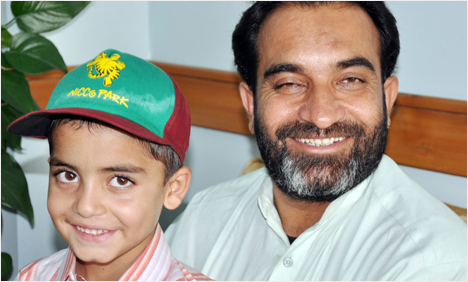
He has the cutest smile. One that was nearly wiped out forever by a congenital heart disease that his parents had no means of getting treated in Pakistan.

Muzaffar Ahmed Khan was only three years old he developed a seemingly never-ending severe chest congestion and cold. His father Rozay Khan, a teacher at a private school in Loralai, took the boy to a medical specialist the nearest big city in Quetta, 260 km away – a long road trip by any standards, and more so for a sick child. The trip led to a doctor diagnosing the boy as having a congenital heart condition. The treatment – risky and expensive heart surgery – was way beyond the reach of his father.

The boy lived on with the help of various medications, but without the required surgery, he was not expected to live much longer. The despair and pain of the family, and the discomfort of the sick child, can only be imagined.

It was a news report in the daily Jang of October 2, 2010 that set them on a path they will forever be grateful for. The paper had a report about a nine-year old Pakistani boy Muhammad Sufiyan, who also had a congenital heart problem. The report said that Rotary International and Aman ki Asha had taken Sufiyan to India where he underwent a successful operation at Manipal Hospital, Bangalore. Suddenly there was hope.

Rozay Khan contacted the Rotary Club representatives in Quetta, and provided them with Muzaffar’s medical documents. Things began to move. The Rotary officials contacted their counterparts in India and sent them the documents. Within a week the family was asked to make arrangements to travel.

Muzaffar was to be accompanied by his father and uncle Qaisar Khan. The Indian High Commission granted their visas within three days. Aziz Memon (President King Group) former governor of Rotary Club helped expedite the travel and other logistics.

They flew to Mumbai on May 5, 2011, and the next day, to Kolkata. There was some difficulty at the immigration, says Rozay Khan, but Rotary representatives in India helped smooth their way.

On May 7 Muzaffar was admitted to Kolkata’s Rabindranath Tagore International Institute of Cardiac Sciences. He underwent a two-and-a-half hour operation on May 11. He was discharged on May 19, with a month’s medication and a directive to avoid lifting heavy items for some time.

The doctors said that Muzaffar should get a medical examination after six months to be on the safe side, but that he was now perfectly healthy. It was like a miracle.

Barely a month later, Muzaffar and his father and uncle visited Aman ki Asha in Karachi on June 4, a day after they returned from India. If one had not been told, there were no signs that this smiling boy had so recently undergone a serious operation. He sat there beaming at us, shyly looking out from underneath long lashes that fringed his mischievous eyes. He would have pranced around the room like any other seven-year old, but was restrained by his father, who held him in his lap throughout the visit. Muzaffar was restless, and probably bored, but seemed to enjoy the attention.

Rozay Khan glowed with happiness at his son’s rapid recovery. A huge weight had been lifted off him, and his wife, who had been worried sick about their son, as his condition didn’t look too good before leaving for India. The first thing he did after Muzaffar’s successful operation was to call his wife over the phone. “It was an emotional time for all of us, but it has passed – all because of Aman ki Asha and Rotary Club.”

Rozay Khan was all praise for India. “I was given so much love and warmth in India that I didn’t even feel I was away from home,” he said.

“The Indians were very hospitable. They treated us just like brothers; they did so much for us that at times we were embarrassed. The hospital staff gave Muzaffar so much love and affection also. It was like we were still in Pakistan. Except for some of the people who didn’t speak Urdu or Hindi in Kolkata, I wouldn’t have known I wasn’t in Pakistan.”

Muzaffar’s uncle added that the Indians were amazed to hear them speaking Urdu – which they thought was Hindi. “They would ask us where we learnt to speak Hindi, and I would laugh and say we were not speaking Hindi we were speaking Urdu.”

He found the Indian people to be very interested in Pakistan. “They asked us so many questions and said they would love to come visit. However they lamented that they knew it would be impossible because of the visa issues. I told them that they should come, and be my family’s guests and see Pakistan.”

“So many people told us to convey their message through the media and Aman ki Asha to Pakistani authorities to ease travel to Pakistan,” said Rozay Khan. “They should do away with the obstacles that travellers have to face if they want to travel from India to Pakistan and vice versa.”

He said that in the nearly two months they spent in India they did not encounter any hostility – only got love and hospitability. “When people got to know that we had come for Muzaffar’s operation they were extra nice, even friendlier, more helpful and hospitable.”

Muzaffar gained health, love and friends across the border. His family wishes that the people of both countries were allowed to interact and visit each other more. They are grateful to Aman ki Asha and Rotary club for helping give Muzaffar a new life.

“We wish,” said Rozay Khan, “that the path of peace continues between the two countries through Aman ki Asha’s efforts. And we pray that we see peace between our two countries so we can visit our new friends again, and have them visit us.”

— Lubna J. Naqvi

Help Muzaffar’s dream come true

When total strangers from India and Pakistan joined hands to help Muzaffar, they did more than help save a life. They sparked off a determination in his family to get a good education for Muzaffar. They want him to be able to enter medical college and become a doctor himself. If anyone would like to contribute and help sponsor Muzaffar’s education to enable him to one day help others, please contact Aman ki Asha – amankiasha@ janggroup.com.pk

Obama, Zardari Discuss Strained US-Pakistani Ties

As Reported by The Voice of America

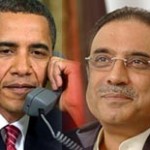
U.S. President Barack Obama called his Pakistani counterpart, Asif Ali Zardari, Wednesday to discuss strained bilateral relations and the situation in the region.

A Pakistani statement said the two leaders agreed to take appropriate action to repair the ties between Washington and Islamabad on the basis of mutual respect and mutual benefit.  It also said President Obama appreciated Pakistan’s effort in the fight against militancy.

President Zardari said the fight against extremism was in Pakistan’s own interest and that it had to fight it to the finish.

The two presidents also agreed on “regular contacts and interaction at appropriate levels for the resolution of issues.”

Ties between the two countries worsened significantly after the May 2 raid by U.S. special forces that killed Osama bin Laden in the northern Pakistani city of Abbottabad.  The military operation has embarrassed Islamabad, which was not informed beforehand of the raid.

Also Wednesday, Pakistan’s army said it was questioning four more officers about suspected ties to the banned Islamic extremist group, Hizb-ut-Tahrir.

Army spokesman Major General Athar Abbas said the four army majors are being questioned for suspected links with the group, but have not been detained.

The interrogation of the officers comes a day after the army said it detained Brigadier General Ali Khan over his links to the group.

Hizb-ut-Tahrir is an international Islamist organization that calls for a return to a pan-Islamic Caliphate under Islamic law.  Although the group does not advocate violence, it is believed to have links to militant groups.

Many critics in Pakistan and around the world say the Pakistani military is deeply infiltrated by extremist groups, making suspect its loyalty in the international effort against terrorism.

The discovery of Osama bin Laden in Pakistan has raised questions as to whether members of Pakistan’s military or intelligence knew the al-Qaida leader was hiding out not far from the capital.

Suspicions Rise as Pakistan Bomb Labs Empty Before Raids

By Thom Shanker for The New York Times

For the second time this month, bomb-making factories in Pakistan were evacuated shortly after American intelligence officials notified Pakistani security forces of their existence, fueling suspicions that such intelligence is being shared with insurgents.

It remains unclear whether the evacuations — four of them in the past month alone — were the result of deliberate or inadvertent leaks or were planned in advance of the intelligence sharing as part of a mobile production operation.

But the disclosure, which appeared in an article by The Associated Press over the weekend, prompted senior members of Congress on Sunday to accuse Pakistan of playing a double game by aiding the United States on some counterterrorism operations while also maintaining ties to violent, extremist organizations operating from its territory.

The comments, by legislators who specialize in intelligence matters and military affairs, were just the latest expression of distrust between Washington and Islamabad after a series of bruising episodes, notably the secret American raid that killed Osama bin Laden.

However — as with everything having to do with Pakistan, terrorism and espionage — it remained unclear how or whether the militants learned of the American intelligence, which came with a request from Washington for local security forces to raid the explosives laboratories. Pakistani security forces routinely inform tribal elders before raids, in order to keep the peace with them, and it is possible that these village leaders in turn tipped off fellow Pashtuns among the insurgents.

Representative Mike Rogers, a Republican of Michigan and the chairman of the House Intelligence Committee, having returned from meetings in Pakistan last week, said Sunday on the CBS program “Face the Nation” that “I am more pessimistic coming out of this trip than I have been in the past.”

He expressed deep skepticism that the Pakistani military and the nation’s spy agency, the Inter-Services Intelligence, or ISI, were fully partners with the United States in battling terrorists and insurgents on their side of the border with Afghanistan.

“Pakistan needs to understand that there is no such thing as a good terrorist,” Mr. Rogers said. “They’re playing this very dangerous game of destabilization by having elements of the ISI and the army sympathetic to the Taliban and Al Qaeda elements.”

He was joined by Senator John McCain of Arizona, the ranking Republican on the Senate Armed Services Committee, in calling for a reassessment of American financial assistance to Pakistan.

“After all, the United States is investing billions and billions of dollars in Pakistan,” Mr. McCain said on the ABC program “This Week.” “And taxpayers have a right to have a return on that.”

He said “the most frustrating aspect of this whole issue” was ISI’s continuing relations with two insurgent organizations, the Taliban and the Haqqani network, a Taliban ally based in the Pakistan tribal area of North Waziristan. “So it seems to me that to restore our confidence in our relationship with Pakistan, they have to make certain steps,” Mr. McCain said. “And we have to sort of set up some benchmarks as to what we expect.”

All four of the bomb factories — which made improvised explosive devices, or I.E.D.’s, the largest killer of American troops in Afghanistan — were evacuated before Pakistani security forces could take action against them. Information on two of the locations, in Pakistan’s tribal areas, was shared only in the past week, and insurgents packed up and left both sites within days.

A range of senior American intelligence officials, diplomats and military officers have visited Pakistan since the May 2 raid that killed Bin Laden; the mission outraged Pakistan’s government and citizens because it was carried out without first informing the government in Islamabad.

The goal of these high-level visits has been to halt the erosion of the relationship and to offer new opportunities for cooperation. Some have described those offers as tests of Pakistan’s will to be a full partner and act on shared information to pursue terrorists and insurgents.

The Pakistan military spy agency has arrested more than 30 people who fed information about the Bin Laden compound to the Central Intelligence Agency in the months leading up to the raid, fueling further distrust between the two nations.

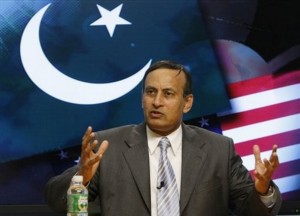
On “This Week” on Sunday, Pakistan’s ambassador to the United States, Husain Haqqani, defended the arrests. “No one is being punished,” he said, adding: “When something like this happens, you want to know what happened and how, and who was involved.”

Slain Pakistani’s Daughter Takes Up His Cause

By Nahal Toosi for The Associated Press
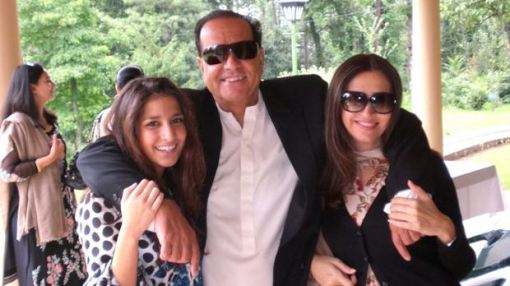
A day after her father was gunned down by an Islamist extremist, a grieving Shehrbano Taseer wrote on Twitter, “A light has gone out in our home today.” It wasn’t long before the 22-year-old realized something else: Her father’s death had lit a fire in her.

In the months since, the daughter of the late Punjab province Gov. Salmaan Taseer has emerged as one of Pakistan’s most outspoken voices for tolerance. Through her writing and speaking, she warns any audience who will listen of the threat of Islamist extremism, and impatiently waits for her father’s killer to be brought to justice.

And yes, sometimes she gets scared. She’s received threats from militants, who’ve warned her to remember her father’s fate.

“These extremists, they want to tell you how to think, how to feel, how to act,” says Taseer, a slim, elegant young woman with intense brown eyes. “It has made me more resolute that these people should never win.”

Salmaan Taseer was assassinated on Jan. 4 at a market in Islamabad by one of his own bodyguards. The confessed killer, Mumtaz Qadri, boasted that he’d carried out the slaying because the outspoken politician — a liberal in Pakistani terms — wanted to change blasphemy laws that impose the death sentence for insulting Islam.

To the horror of Taseer’s supporters, many Pakistanis praised the assassin. Islamist lawyers showered Qadri with rose petals, and major Muslim groups, even ones considered relatively moderate, said Taseer deserved to die because, in their view, speaking out against the blasphemy laws was tantamount to blasphemy itself.

Two months after Taseer’s killing, gunmen killed Shahbaz Bhatti, the sole Christian minister in the government and another opponent of the blasphemy laws, which have often been used against Pakistan’s Christian minority. Bhatti’s killers left a note promising to target others who pushed to change the laws.

Shehrbano Taseer still has trouble remembering those first moments and days after her father’s death — her brother telling her their father was gone, the rush of grief, the hundreds of people flooding her family’s home in the eastern city of Lahore. Mostly, it’s a blur.

“I’d never lost anyone in my life, not a friend or anyone,” she says. “For everyone else it was the governor and their leader and this man, and it was this big, sexy story and it was so sensationalist. But for me, it was my father.”

Taseer majored in government and film at Smith College in Northampton, Massachusetts, and is by profession a journalist. She spends much of her time now writing columns and traveling in and beyond Pakistan to speak about Islamist extremism.

Salmaan Taseer, a father of seven, was not afraid to be blunt — a trait that attracted both enmity and grudging respect. On Twitter, Salmaan Taseer openly taunted and trashed extremists, once tweeting that he’d never back down on the blasphemy issue, “even if I’m the last man standing.”

His daughter, who tweets under the handle shehrbanotaseer, is more gentle but just as firm. Her more than 9,000 followers on Twitter often receive notes that criticize Pakistan’s discriminatory laws, especially blasphemy claims that have reached the courts since her father’s death.

When she singles out a politically marginalized community, either on Twitter or her other outreach, Taseer recalls how well her father treated that group, how he was often the only public official to visit their homes after an attack or publicly speak on their behalf.

Once, Salmaan Taseer took his daughter along on a visit to meet Mukhtar Mai, a Pakistani woman whose case attracted international attention because of allegations that she was gang-raped on the orders of a village council. The governor asked Mai to put her hand on his daughter’s head, so that Shehrbano Taseer could gain the same courage to stand up for her rights.

Like her father and Bhatti, the Christian leader, Taseer wants the blasphemy laws amended to prevent their misuse.

The laws are vaguely written, and often used to persecute minorities or settle rivalries, rights activists say. The state has not executed anyone under the law, but the accused may spend years in custody. Some defendants have been killed by extremists after being freed by the courts.

But Taseer has found that many Muslims, even moderate, liberal ones, are extremely sensitive about blasphemy.

She recalls giving a speech in England when a woman in the audience suggested that her father deserved what he got because he was so blunt about the topic.

“I said, ‘I don’t care what he said, and I don’t care how he said it. He didn’t deserve to be shot and killed for it,'” Taseer says.

She’s dismayed at the toll extremism is taking on Pakistan by spawning violence or an intolerant mindset. She’s also disappointed at how few Pakistani leaders are willing to take a public stand against extremism or how many find some reason to excuse it.

She bemoans how for decades moderate or liberal leaders in Pakistan have appeased the religious right for short-lived political gains — whether it was by banning alcohol and nightclubs or passing laws that discriminate against certain religious sects.

Unlike many Pakistani politicians, she’s willing to criticize the role Saudi Arabia has played in funding numerous hardline Islamist schools in Pakistan. And she’s quick to note that the United States as well as Pakistan says little about it — after all, it needs Saudi Arabia’s oil.

Pakistan has a tradition of dynastic politics. The most famous political family has been that of the Bhuttos, which spawned former Prime Minister Benazir Bhutto, also assassinated by Islamist extremists. Salmaan Taseer was a member of the Bhutto-led Pakistan People’s Party.

Shehrbano Taseer says she views Pakistan as an enticing challenge akin to a Rubik’s Cube because of its many, convoluted problems. But she says she has no plans to run for office. “It’s such a dirty profession,” she says, laughing.

Sherry Rehman, a People’s Party lawmaker who also has been threatened for speaking out against the blasphemy laws, says Shehrbano Taseer will “chart her own future.”

“She’s found a torch to carry, and she will do it,” Rehman says. “It’s what her father would have wanted.”

Taseer is frustrated with the Pakistani justice system’s delays in processing the case of Qadri, her father’s confessed killer.

Pakistan’s courts have very low conviction rates, even in terrorism cases. Qadri’s confession may not be enough to persuade a court to punish him, considering the threats facing any judge who dares pass such a judgment.

Taseer wants the former bodyguard to spend his life in prison, in solitary confinement. A death sentence is “too easy,” and a conviction would send a warning to other would-be assassins, she says.

“In Pakistan, we have very few brave and honest leaders,” she says. “We need our heroes alive.”

Pakistan and the American Learning Curve

By Ethan Casey for Dawn

On June 1, I took part in a TEDx event hosted by the Princeton Public Library in Princeton, New Jersey, USA. The TED people bill what they do as “ideas worth spreading,” and during the weeks I spent preparing my talk I pondered what ideas I wanted to spread to an American audience. I titled my talk “What Does Pakistan Have to Do with Haiti? (the full text is on my website, and I’m told the video will be online soon), but in an important sense it’s really about the United States.

I used the occasion to try to make some sense of the weird coincidence that the two countries I care about most deeply and personally, other than my own, both were devastated in 2010 by horrific natural disasters. I did find a number of things they have in common, believe it or not, but the most salient is that Pakistanis and Haitians both see the United States from the outside. And what they see is often ugly and cruel, because they live on the receiving end of the American power that we Americans usually don’t experience, because we’re the ones wielding it. This is a point that’s very clearly apparent to many people worldwide, but not always easy to get across to Americans.

One way I tried to do it in Princeton was by arguing that both countries are prime examples of what the Nigerian novelist Chimamanda Adichie, in an excellent TED talk in 2009, called “the danger of a single story.” We Americans tell ourselves a single story about Haiti, and a different single story about Pakistan. Dr. Paul Farmer, a celebrated physician who works in the poorest areas of rural Haiti, wrote a book titled The Uses of Haiti. We use Haiti rhetorically and ideologically and, every time there’s a new fitful spasm of American interest in Haiti, our uses for it rear their heads anew. It’s never an edifying thing to see, and it’s maddening to those of us who know Haiti.

America has different uses for Pakistan, and those are not unlike the uses we used to have for the Soviet Union. If Haiti meets Americans’ need to have someone to pity, Pakistan fulfills our need to have someone or something to fear. Fear, pity, and contempt are easy, self-indulgent emotions. But much more demanding, I said, is to cultivate and practice respect. Respect implies distance and difference, and to practice it entails acknowledging that difference is inevitable and even desirable.

Another thing Haitians and Pakistanis have in common is their experience as immigrants and visitors to America. I tried to bring this home by telling the audience about novelist Edwidge Danticat’s 81-year-old uncle, who fled violence in his neighborhood in Haiti’s capital, Port-au-Prince, in 2004 and made the mistake of asking for political asylum at the airport in Miami. US Immigration officials threw him into the infamous Krome Detention Center and denied him his diabetes medication, and he died in detention. Danticat tells the story eloquently in her wonderful nonfiction book Brother, I’m Dying, which is above all a beautifully composed story about family love, immigrant struggle and aspiration, and the tortured and all too intimate relationship between Haiti and the United States, told by a Haitian who is also an American. I often find myself telling Pakistanis the story of Edwidge Danticat’s uncle, and I know that many Pakistanis would recognize its elements.

The idea I tried to leave the American audience with was that, as I put it, our lazy and self-comforting reductionism says nothing about Haiti or Pakistan, and all too much about us Americans — that the earthquake in Haiti and the floods in Pakistan were natural disasters, to be sure, but didn’t happen in a geopolitical vacuum. I gave them a lot to think about, possibly too much.

What I want, by the same token, to offer Pakistani readers is an occasion to reflect on just how big and delicate is the task of influencing American awareness and opinion. The novelist Upton Sinclair famously quipped that it’s difficult to get a man to understand something when his salary depends on his not understanding it. There’s a national analogue that applies to Americans: we are no less innately patriotic than Pakistanis or anyone else, and no one wants to think ill of his or her own country.

So the job of educating and influencing the American public is a long uphill battle, and changing US foreign policy is like turning around an aircraft carrier: it has to be done carefully and very patiently.

Perhaps it can be helped along by American friends of Pakistan like myself and, even more, by leaders and members of the Pakistani-American community. In the meantime I urge Pakistanis to remember the humanity of ordinary Americans, who have been on a steep learning curve since at least September 11, 2001.

Ethan Casey is the author of Alive and Well in Pakistan: A Human Journey in a Dangerous Time (2004) and Overtaken By Events: A Pakistan Road Trip (2010). He is currently writing Bearing the Bruise: A Lifetime in Haiti, to be published in early 2012. Web: http://www.facebook.com/ethancaseyfans or http://www.ethancasey.com.

Follow Ethan Casey on Twitter: http://www.twitter.com/ethan.casey

Pakistan’s Bubbling Water Crisis

By Haider Warraich for Foreign Policy

More than 1 billion people in the developing world lack access to clean water, with this number slated to rise to more than 2 billion by 2020. According to UNESCO, 2.3 billion people suffer from water-related diseases, 5 million of whom die each year. However, the burden of water scarcity is not shared equally. According to Rajendra Pachauri, chair of the intergovernmental panel on climate change (IPCC), “At one level the world’s water is like the world’s wealth. Globally, there is more than enough to go round. The problem is that some countries get a lot more than others. With 31 percent of global freshwater resources, Latin America has 12 times more water per person than South Asia.”

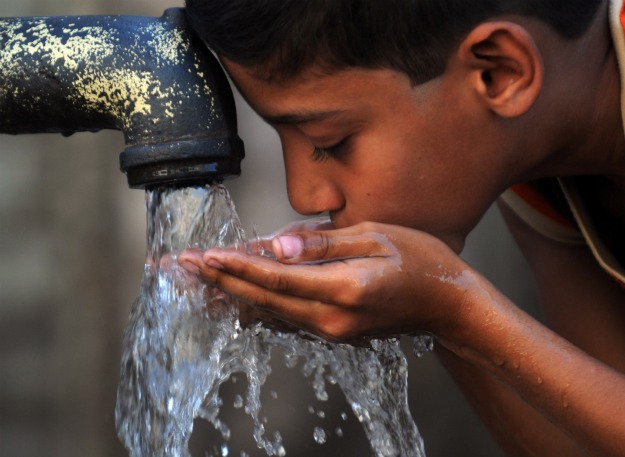
Pakistan is on the dry end of the water stress spectrum. About a third of Pakistanis do not have access to safe drinking water, while a further 46% lack access to proper sanitation. However, this deficiency is not uniformly distributed. Pakistan is populated to a large extent around the Indus River that runs the length of the country. The Indus plains cover about a quarter of the country’s landmass and host two thirds of its people, meaning that people living outside this region are particularly water stressed. Furthermore, according to a World Bank report, Pakistan’s per capita water availability has diminished five-fold from 5000 cubic meters in 1951 to 1100 cubic meters in 2006 due to rising consumption by a growing population coupled with rising water waste.

What is even more worrisome is that of the water that is actually available, very little is safe for consumption. A study of 14,000 water sources in 24 major Pakistani districts conducted by the Pakistan Council of Research in Water Resources (PCRWR) over a five-year period found that 82% of sources in Pakistan were unfit for human consumption. The major contaminants noted were bacteria, dissolved solids, nitrates and fluoride.
By Haider Warraich for Foreign Policy

This worsening water crisis is having a drastic impact on public health in Pakistan. According to a UNICEF report, 20-40 percent of hospitalized patients in Pakistan suffer from water-borne infections. Several disease epidemics in Pakistan have been traced back to water contamination, including several outbreaks of the potentially fatal Hepatitis E, rotavirus diarrhea, typhoid fever and dysentery. Polio is also a water-borne infection, and Pakistan is one of the last countries on earth to continue to suffer major problems from the disease.

The sustained high levels of chemical compounds in Pakistan’s drinking water supply have also caused the outbreak of population-wide poisonings. Fluoride toxicity, known to cause bone pain and deformation, has been reported from several areas of Punjab province, with a high occurrence in children. Arsenic poisoning, which causes a wide array of dangerous complications, has been reported to be present in up to 73% of the residents of Sindh province’s Manchar Lake, the largest freshwater lake in Pakistan and one of the largest in Asia. Pesticide poisoning, also linked to infiltration into the water supply, has been reported in Pakistani farmers.

Pesticide poisoning, among other problems, stems from the endemic misuse of water in Pakistan. About 97 percent of Pakistan’s freshwater resources are expended in irrigation and agriculture, yet Pakistan has one of the lowest productivities per unit of water and unit of land in the world. Waste is incurred at several stages: Canal heads, water courses and farms themselves all are the sites of considerable leakage. Furthermore, with Pakistan’s major hydroelectric dams losing storage capacity, there is little reserve during times of famine. Pakistan is in dire need of major hydroelectric projects to increase power generation, protect against seasonal flooding, and to have greater control over the water supply. However, provincial politics has stifled this debate, halting any progress in this direction. Concerns abound about the fate and compensation for displaced people, fears of downstream provinces of a reduction in water supply. Another important issue is that most Pakistani rivers originate from Indian-occupied Jammu and Kashmir. Pakistan and India in 1960 signed the Indus Water Treaty, in which both countries agreed to abstain from any activity that would jeopardize water supply of the other. However, according to a recent U.S. Senate report, India has made several dams in Jammu and Kashmir, which “could give India the ability to store enough water to limit the supply to Pakistan at crucial moments in the growing season.” Pakistani officials have argued that in doing so, India has violated the treaty, worsening the water situation in Pakistan.

The lack of access to water in Pakistan only exacerbates the country’s already dire public health situation. Hand washing, for instance, is the most effective step against infection in both homes and hospitals, but hand washing practices prescribed by public health organizations are impractical in water stressed areas, with one study concluding that an extra 20 liters per person per year would be required in order to follow handwashing recommendations. Another review of medical literature found that access to potable water sources has far more of an impact on reduced infections than water quality. With a deficit in both water quality and quantity, then, public health in Pakistan faces an immense burden frrom water-related illness.

Several measures need to be taken to ward off this crisis. Water policy, currently a minor issue in Pakistan, needs to be brought to the center stage of national debate. It will remain easy for politicians to defer the contentious issue of building dams unless the masses realize the extent to which they are needed. The good work conducted by the PCRWR should be better-funded and -promoted in order to highlight problems as well as evaluate possible solutions. Water waste in agriculture and irrigation also needs to be addressed; the government must make more of an effort to line canals to prevent leakage, and further promote water efficiency on farms. To increase access of rural populations to potable water, India has developed a successful project to provide piped water and hand pumps, with a particular emphasis on improving child health — Pakistan needs to develop a similar program. Pakistan should also make the most of the post-Cricket World Cup diplomatic thaw with India, insofar as it still exists, and ensure equitable implementation of the Indus Water Treaty. Access in arid areas such as desert regions of Sindh and practically all of Baluchistan need to be particularly improved. Promotion of hygienic practices such as boiling water to kill bacteria and appropriate sanitary practices needs to be increased to reduce water-borne infections. This can be conducted on both a national level using television programs, and on a grass root level using community health workers and prominent locals. Finally, the most long-lasting solution to improving water supply will be to slow Pakistan’s population growth, which will only put further strain on reduced water supplies. Unless measures are taken now, this bubbling crisis might reach the point of overflowing.

Haider Warraich, MD, is a research fellow at Harvard Medical School. He is a graduate of the Aga Khan University in Karachi, Pakistan, and the author of the forthcoming novel, Auras of the Jinn.

Dying to Tell the Story

By Umar Cheema for The New York Times

WE have buried another journalist. Syed Saleem Shahzad, an investigative reporter for Asia Times Online, has paid the ultimate price for telling truths that the authorities didn’t want people to hear. He disappeared a few days after writing an article alleging that Al Qaeda elements had penetrated Pakistan’s navy and that a military crackdown on them had precipitated the May 22 terrorist attack on a Karachi naval base. His death has left Pakistani journalists shaken and filled with despair.

I couldn’t sleep the night that Saleem’s death was confirmed. The fact that he was tortured sent me back to a chilly night last September, when I was abducted by government agents. During Saleem’s funeral service, a thought kept haunting me: “It could have been me.”

Mourning journalists lined up after the service to console me, saying I was lucky to get a lease on life that Saleem was denied. But luck is a relative term.

Adil, my 2-year-old son, was the first person in my thoughts after I was abducted. Journalists in Pakistan don’t have any institutionalized social security system; those killed in the line of duty leave their families at the mercy of a weak economy.

When my attackers came, impersonating policemen arresting me on a fabricated charge of murder, I felt helpless. My mouth muzzled and hands cuffed, I couldn’t inform anybody of my whereabouts, not even the friends I’d dropped off just 15 minutes before. My cellphone was taken away and switched off. Despite the many threats I’d received, I never expected this to happen to me.

Sure, I had written many stories exposing the corrupt practices of high-ranking officials and pieces criticizing the army and the intelligence agencies. After they were published, Inter-Services Intelligence, Pakistan’s prime security agency, always contacted me. I was first advised not to write too much about them and later sent messages laced with subtle threats. But I never imagined action was imminent.

On Sept. 4, I was driven to an abandoned house instead of a police station, where I was stripped naked and tortured with a whip and a wooden rod. While a man flogged me, I asked what crime had brought me this punishment. Another man told me: “Your reporting has upset the government.” It was not a crime, and therefore I did not apologize.

Instead, I kept praying, “Oh God, why am I being punished?” The answer came from the ringleader: “If you can’t avoid rape, enjoy it.” He would employ abusive language whenever he addressed me.

“Have you ever been tortured before?” he asked.

“No,” I said.

“These marks will stay with you forever, offering you a reminder never to defy the authorities,” he replied.

They tortured me for 25 minutes, shaved my head, eyebrows and moustache and then filmed and photographed my naked body. I was dumped nearly 100 miles outside Islamabad with a warning not to speak up or face the consequences.

The following months were dreadful. I suffered from a sleep disorder. I would wake up fearing that someone was beating my back. I wouldn’t go jogging, afraid that somebody would pick me up again and I’d never return. Self-imposed house arrest is the life I live today; I don’t go outside unless I have serious business. I have been chased a number of times after the incident. Now my son asks me questions about my attackers that I don’t answer. I don’t want to sow the seeds of hatred in his heart.

When Saleem disappeared, I wondered if he had been thinking about his children, as I had. He had left Karachi, his hometown, after receiving death threats, and settled with his wife and three children in Islamabad. From there, he often went on reporting trips to the tribal areas along the Afghan border. Tahir Ali, a mutual friend, would ask him: “Don’t you feel scared in the tribal areas?” Saleem would smile and say: “Death could come even in Islamabad.” His words were chilling, and prescient.

The killing of Syed Saleem Shahzad is yet another terrifying reminder to Pakistani journalists. He is the fifth to die in the first five months of 2011. Journalists are shot like stray dogs in Pakistan — easily killed because their assassins sit at the pinnacle of power.

When Daniel Pearl was brutally murdered by militants in Karachi in 2002, his case was prosecuted and four accomplices to the crime were sentenced. This happened only because Mr. Pearl was an American journalist. Had he been a Pakistani, there would have been no justice.

Today, impunity reigns and no organization is powerful enough to pressure the government to bring Saleem’s killers to justice. Journalists have shown resilience, but it is hard to persevere when the state itself becomes complicit in the crime. Now those speaking up for Saleem are doing so at a price: they are being intimidated and harassed.

Pakistan is at a crossroads and so is its news media. In a situation of doom and gloom, Pakistani journalists offer a ray of hope to their fellow citizens and they have earned the people’s trust. Even the former prime minister Chaudhry Shujaat Hussain has admitted that people who once went to the police with complaints now go to the press.

But this trust will be eroded if journalists continue to be bullied into walking away from the truth. News organizations throughout the world must join hands in seeking justice for Saleem and ending the intelligence agencies’ culture of impunity. An award for investigative journalists should be created in his honor, as was done for Daniel Pearl. No stronger message could be delivered to his killers than making him immortal.

Umar Cheema is an investigative reporter at The News International, Pakistan’s largest English-language daily. He was a Daniel Pearl Fellow at The Times in 2008.

Pakistan Troops Caught on Film Shooting Unarmed Teenager Dead

By Barry Neild for The Guardian

Pakistan’s security forces are facing criticism after paramilitary troops were caught on camera apparently shooting dead a teenager at point-blank range.

The footage, broadcast repeatedly on local television, is likely to further undermine faith in the country’s powerful security establishment, which is already facing allegations it helped conceal Osama bin Laden.

The video, captured by a cameraman from Pakistan’s Awaz television channel, shows a youth, identified as Sarfaraz Shah, arguing with paramilitary rangers in Karachi. The 18-year-old appears to plead for mercy before being shot at close quarters. He then falls to the ground and screams in pain as blood pools beneath his legs.

Zohra Yusuf, head of Pakistan’s independent Human Rights Commission, condemned the killing as “another indication of law enforcement personnel becoming increasingly trigger happy.”

She said the violence depicted in the video was a trend seen across Pakistan that reflected the impunity of the country’s law enforcers.

Pakistan’s prime minister, Yousuf Raza Gilani, said an inquiry would be launched and the culprits punished. Six members of the paramilitary Rangers, who are controlled by the interior ministry, have since been arrested.

Major general Aijaz Chaudhry, who commands the force, described the incident as “deplorable”. “The Rangers have no authority to kill any unarmed individual and they can fire only in self-defence,” he said. “On completion of the inquiry, all those found responsible will be given strict punishment.”

The incident is likely to further dent public faith in the government’s ability to control its security forces at a time when the US ally is facing questions about how bin Laden could have hidden for so long without the complicity of intelligence officials.

“What we saw on television shows that now there is the law of the jungle in this country and no one is accountable for his action or deeds. This is pathetic,” Mohammad Sultan, a retired soldier, told Reuters.

“What we are seeing is visual records of what we have long documented, which is the culture of impunity in the Pakistani law enforcement agencies,” said Ali Dayan Hasan, a researcher for Human Rights Watch. “What is becoming clear is that the free for all, the culture of wanton abuse and killing, is becoming untenable in the age of new media and cell phone cameras.”

In one media interview, a man identified as Salik Shah, the victim’s brother, said: “My brother was a victim of barbarism, brutality and aggression and everyone has seen it. The innocent young man was begging for his life regardless of whether he had done anything wrong. He was asking to be pardoned by the rangers; despite his repeated requests they did not listen to him, they did not arrest him, instead they were adamant about killing him and in the end they did.”

Hundreds of people showed up at Shah’s funeral a day after his death and denounced the Rangers. Some shouted “Rangers, murderers!” and others carried signs that said “Down with the Karachi Rangers.”

The video’s broadcast comes a few days after a prominent journalist was tortured to death after reporting claims about al-Qaida. Military intelligence officials have rejected claims they played a role in the killing.

Pakistan’s Daily Times newspaper said the military, paramilitary forces, police and intelligence agencies “who confidently violate human rights” should be held accountable for their actions.

“The security and law enforcement forces that do not respect the law themselves are inviting anarchy, which arguably is already under way,” it said in an editorial.

Last year, a video emerged of two teenage brothers being beaten to death before being strung up on a metal pole in broad daylight as police personnel looked on.

Pakistan Orders an Inquiry After Troops Kill a Teenager

By Salman Masood for The New York Times

President Asif Ali Zardari of Pakistan ordered an investigation on Thursday into the shooting death of an apparently unarmed teenager by paramilitary troops in the southern port city of Karachi. The shooting, which was captured on video and broadcast on national television, has led to protests and has been condemned by political parties and human rights groups.

It was the second time in recent weeks that a video has shown paramilitary troops using extreme force against civilians. Last month, five Chechens were gunned down in Quetta, Pakistan.

The shootings are sure to feed complaints that Pakistan’s security forces are too aggressive and sometimes bypass the sluggish and corrupt judicial system. Pakistan’s military leaders are also still embarrassed by the American raid on Osama bin Laden’s compound in Abbottabad, which the armed forces did not detect.

The victim of the Karachi shooting, Sarfraz Shah, whose age was given as 18 or 19, was stopped by paramilitary troops on Wednesday and accused of being involved in an attempted robbery in a nearby park.

A spokesman for the troops said a gun had been taken from him, but in the video, Mr. Shah does not appear to be armed when he is shot.

The recording shows the young man begging for mercy before being led toward a group of troops. One points his gun at Mr. Shah before firing several shots. Mr. Shah crouches, asking forgiveness while bleeding profusely.

“My hand is gone,” Mr. Shah shouts. “Take me to the hospital.” The troops step back, out of the video frame. A government official said five of the troops had been arrested.

Mr. Shah was buried on Thursday in Karachi, accompanied by protests from family members.

The shootings in Quetta last month were also recorded. The police and paramilitary troops initially reported that the victims, three women and two men, were suicide bombers. They were killed near a checkpoint on the outskirts of Quetta, the capital of Baluchistan Province in southwestern Pakistan, in a volley of fire as police officers stood by.

Video from local television networks showed one young woman raising her arm, as if to try to stop the gunfire. No weapons were recovered on the victims. An investigation of that shooting is under way.

The Pakistani security forces have repeatedly been accused of misusing their power. The army was accused of extrajudicial killings during a military operation to drive out militants that began in the Swat Valley in 2009. The army denied the allegations.

The country’s powerful intelligence agencies have also been accused of illegally detaining hundreds of terrorism suspects. And military intelligence has been accused of gross human rights violations in Baluchistan, where a separatist insurgency by Baluch nationalists has long simmered.

Pakistani Rangers, the group involved in Mr. Shah’s death, are controlled by the Interior Ministry. Rehman Malik, the country’s interior minister, announced the arrests in the case on Thursday evening, but he also accused Mr. Shah of being part of a gang involved in robberies, according to the local news media.

Mr. Malik said Mr. Shah had tried to steal a woman’s purse and was caught by guards in the park before being handed over to the Rangers.

The Rangers have been deployed in Karachi for several years and help the local law enforcement authorities in maintaining peace in the city, which is riven by political, ethnic and sectarian tensions.