Archive for the ‘ Pakistan ’ Category

Pakistan Cricketer Mohammad Asif Freed After Fixing Scam Sentence

As Reported by The BBC

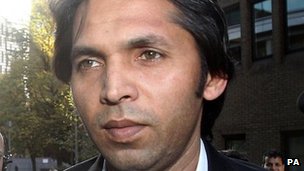
Pakistan cricketer Mohammad Asif, one of three jailed for a fixing scam, has been released after serving half of a 12-month sentence, his lawyer says.

Asif, 29, the former world number two Test bowler, was freed from Canterbury Prison in Kent on Thursday morning.

In November, Asif and team-mates Salman Butt and Mohammad Amir were jailed for a plot to bowl deliberate no balls in a Test match against England in 2010.

All three players were also given five-year playing bans.

A Ministry of Justice spokesman said it did not comment on individuals.

“Foreign national offenders released from prison on licence will be supervised by probation for as long as they remain in this country,” he said.

Undercover reporter
The fixing scandal came to light when an undercover News of the World reporter approached sports agent Mazhar Majeed, who was also jailed for his role, pretending to be a wealthy Indian businessman seeking players for a tournament.

Majeed promised him that Asif and Amir would deliver three no-balls at specific points during the Test between Pakistan and England at Lord’s on 26-29 August 2010, and claimed to have been fixing games for over two years, with seven Pakistan players working for him.

At Southwark Crown Court in November, ex-Test captain Salman Butt, 27, was jailed for two-and-a-half years for his role as the “orchestrator” of the plot.

Explaining why he had bowled a no-ball when Majeed said he would, Asif alleged that Butt had told him to “run faster” moments before his delivery.

The trial judge, Mr Justice Cooke, said there was no evidence that Asif had taken part in fixing before the Lord’s match but added: “It is hard to see how this could be an isolated occurrence for you.”

Asif took his 100th Test wicket during Pakistan’s 2010 series in England.

He had run into controversy before. He twice tested positive for the performance-enhancing drug nandrolone and was held in Dubai for 19 days in 2008 after opium was found in his wallet.

Mohammad Amir was released from jail in February.

Pakistan Offers Mega Projects

By Muzaffar Rizvi for Khaleej Times

Pakistan is confident to secure UAE and Gulf investments in mega projects especially in the energy- and agro-based industries, its delegates at the Annual Investment Meeting, or AIM, said.

Top officials from the Trade Development and Authority of Pakistan, or TDAP, Abu Dhabi Group and Sindh Board of Investment on Wednesday gave presentations on key investment projects in renewable energy, power generation, agriculture, coal mining and infrastructure developments.

“Pakistan offers various investment opportunities in energy and power sectors as well as in agro-based industries to international and Gulf investors at AIM,” Tariq Puri, chief executive of TDAP, told on the sidelines of the conference.

He said discussions and meetings with government and private levels are being held on the sidelines of AIM and the Pakistan delegation is expected positive results in coming days.

Pakistan’s 80-member trade delegation, led by Federal Minister Makhdoom Amin Fahim, participated in the second-day activities of investment forum and gave presentations on various key projects especially in Sindh province.

Amin Fahim said Pakistan has huge potential for investment in key sectors and the government will go all-out to facilitate the foreign investors especially from the Gulf countries.

Sindh chief minister Syed Qaim Ali Shah said the agricultural economy of Sindh province contributes about 23 per cent to Pakistan’s gross domestic production.

“Keeping in view global food security concerns, the province vast agriculture expanse has capacity to become region’s food basket,” he said.

Shah said agro-related investment projects are ready for investment and introduction to value-addition through use of technology, efficient irrigation system and modern implements can help attain true potential of province agriculture. The Sindh Board of Investment, the primary investment promotion agency of the province, invited Gulf investors and UAE companies in particular to avail the benefits of conducive-investment policies.

“We are offering investment opportunities in agriculture farming, livestock, grain-storage project as well as in infrastructure development projects,” Muhammed Zubair Motiwala, chairman of the Sindh Board of Investment, told

Elaborating, he said the government of Sindh is looking to offer land for establishment of Meat Park in Sukkur and Thatta near Karachi. He said the Rs500 million project will pay back the cost in three to five years and offers a 20-22 per cent IRR to investors.

Motiwala said the provincial government has strived to facilitate and create investor-friendly environment to attract more investment especially in Thar Coalfield, which is declared as a special economic zone. Investors can avail 30-year tax holiday, zero per cent customs duties on import of coal mining equipment and machinery. “We are offering up to 22 per cent IRR to investors on the their investment in Sindh along with other benefits which include repatriation of 100 per cent capital, profits, royalty and zero import duties on capital goods, plant and machinery and equipment not manufactured locally,” he said.

He said that the province has also an estimated hydropower potential of 153 megawatts based on various sites identified along the Sindh canal network.

He said the UAE has showed interest in Thar coal mining and power plant projects. “Al Manhal has shown interest in developing block 2 of the Thar Coalfield. We may discuss the project this weekend and if talks go positively, the UAE firm may invest up to $6 billion in the Thar coal project,” he said.

Motiwala said Thar coal reserves have an estimated potential of generating 100,000 megawatts of electricity for a period of 300 years. “It provides an opportunity for large-scale mining and power-generation over a longer period of time,” he said.

He said Pakistan has been facing an acute shortage of electricity and direly need investments in power-generation projects. According to a delegate, about 700 main industries in Punjab and Sindh are directly affected by electricity shortages in the country.

“About 400 industries in Punjab and 300 factories in Sindh have shut down their operations due to load-shedding and shortage of electricity,” he said.

Motiwala further said Sindh government also offers investment opportunities in renewable energy like solar street light initiative and wind power projects worth around $5.3 billion.

“International investors are in queue to invest in wind power projects because the province has potential to generate 50,000 megawatts electricity through wind turbines across its coastal belt,” he said.

To a question about potential investors in wind energy, he said Hydro China, China Three and NBT/Malakoff, among others, showed interest in 26 projects in the province with installed capacity of 1,800 megawatts.

“We also have offered some renewable energy projects to Masdar. We will discuss some investment opportunities with Masdar officials in Abu Dhabi and expect positive results,” he said.

“The annual radiation of 3,000 hours in Sindh has an endless potential for solar energy,” he said adding that the government is keen to encourage public-private partnerships in energy, power, agriculture and infrastructure development projects.”

It’s Too Early to Consider Al-Qaeda a Dwindling Force

By Paul Koring for The Globe and Mail


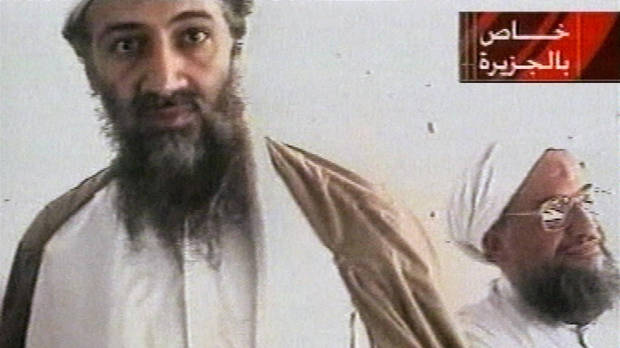
Amid an uneasy anniversary of the killing of al-Qaeda leader Osama bin Laden in a daring U.S. special forces raid, there’s a temptation to consider the war won.

Al-Qaeda’s infamous leader is dead; the cunning mastermind of the Sept. 11, 2001, suicide hijackings, Khalid Sheikh Mohammed, goes on trial this week in Guantanamo; while missile-firing Predator drones have grimly decimated al-Qaeda’s commanders in Pakistan, Yemen and Somalia

More than a decade later, wars in Afghanistan and Iraq, $1.2-trillion in spent bullion, 6,000-plus lost American lives – and perhaps 50 times that many other lives – the “war on terror” is, at least, a defunct term, banned by President Barack Obama’s administration as it shifted rhetorical focus in the struggle against violent, extremist Islam.

But the broader conflict remains unresolved and may have become far more complicated.

No significant terrorist strike has hit an American target since 2001. The Madrid and London bombings of 2004 and 2005 were the last major attacks on Western cities. Al-Qaeda has been battered and decapitated. Yet the threat still looms.

“It’s wishful thinking to say al-Qaeda is on the brink of defeat,” warns Rand analyst Seth Jones. Yet even in the Muslim world, support for al-Qaeda is way down. Only in Egypt does its approval rating top 20 per cent, according to a recent Pew Research poll. In Pakistan, where bin Laden was killed in a violation of Pakistani sovereignty and anti-U.S. fervor runs high, barely 13 per cent hold a positive view of al-Qaeda, and in much of the Arab world support is mired in single digits.

The violent fringes of radical Islam seem to have lost traction among even disenfranchised and repressed Muslims. At the same time, political Islam is emerging as a key force in the change sweeping aside repressive regimes in the Middle East.

As the terror threat and fear of another spectacular attack like the catastrophic destruction of New York’s twin towers diminishes, the nature of the struggle against radical, repressive Islam remains unfinished and the West’s role is increasingly unclear.

The U.S.-led war in Afghanistan is winding down. The coalition of Western nations that sent combat troops – including Canada – is falling apart as nations head for the exits. The dream of transforming Afghanistan from a haven for terrorists run by Taliban brutes into a modern democracy where girls go to school in an oasis of central Asian stability has been eclipsed by harsher realities.

The war’s aims have been reduced to propping up the Karzai regime, talking to the Taliban and hoping Afghanistan doesn’t slide back into a narco-state run by warlords or return to a Taliban fiefdom.

Neighbouring Pakistan, once the supposedly key ally in former president George W. Bush “war on terror” may pose an even greater threat than Afghanistan should it collapse.

Meanwhile, as popular uprisings topple repressive regime across the Arab world, the inherent contradictions in Western policy are being exposed. Backing dictators and monarchs as long as they repressed radical Islamists, kept cold peace with Israel and the oil flowing, was the pragmatic, successful, strategic policy for decades.

In its place is a rapidly evolving effort to stay on the right side of history. So Washington jettisoned longtime loyal ally, Egyptian dictator Hosni Mubarak and then sent warplanes to back the Libyan rebels who ousted and killed Col. Moammar Gadhafi. Still backing pro-democracy forces isn’t a one-size-fits-all shift in policy. Mr. Obama’s support for the Saudi royal family remains unflinching while the unfolding violence in Syria seems to have hamstrung the West.

Al-Qaeda’s new leader, Ayman al-Zawahri, continues to issue calls to arms, urging jihadists to seize the moment. That rallying cry seems, so far, to have had little resonance among the tens of millions of Muslims seeking – and in some nations tasting – freedom across the Arab world. But there has been a spate of suicide bombings – hallmarks of extremist jihadists – in Syria.

If moderate, democratic, freely-elected governments – likely including Islamists – fail to deliver in Egypt and elsewhere, the unfulfilled expectations of tens of millions may provide new recruiting grounds for the extremists.

“Al-Qaeda franchises are still a major factor,” former White House counter-terrorism chief Richard Clarke told ABC. “Groups calling themselves al-Qaeda or claiming affiliation … have large, armed formations in Yemen, Iraq, Pakistan, Somalia, Nigeria, and in the Magreb and the Sahel regions of Africa. They are conducting military-styled attacks in some countries and waves of bombings in others. They are participating in the ‘Arab Spring’ fighting in Libya and Syria.”

Pakistan Reveals Efforts to Hunt Down Osama Bin Laden

Jon Boone and Jason Burke for The Guardian
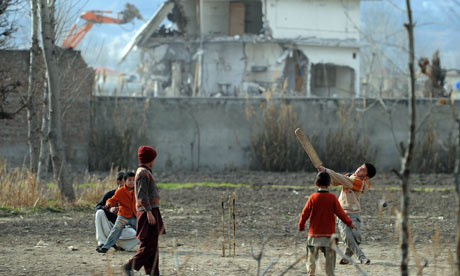
For almost a year, Pakistan‘s security establishment has been in a state of deep fury and embarrassment over the killing of Osama bin Laden. But its annoyance, US diplomats note, has not been directed at how the world’s most wanted man could have lived inside the country for so long, but rather at how a US team could have got in and out of its territory undetected.

So far, there have been no arrests of sympathisers who might have helped Bin Laden move around Pakistan undetected before settling in the town of Abbottabad. Authorities appear more concerned with investigating what they see as a gross violation of sovereignty that badly damaged the prestige and reputation of the powerful Pakistani military.

The only known arrest has been of Shakil Afridi, a Pakistani doctor who worked in Abbottabad as part of the CIA effort to try to pinpoint the al-Qaida chief. A Pakistani commission investigating Bin Laden’s death recommended Afridi be charged with “conspiracy against the state of Pakistan and high treason”.

But amid efforts on both sides to improve the terrible state of US-Pakistani relations, bitter recriminations are starting to give way to a modest effort by Pakistan’s intelligence service to put itself a little nearer the centre of events that led to Bin Laden’s killing.

Last week, a security official in Islamabad gave the Guardian details of three hitherto unknown ground missions conducted by joint CIA-Pakistani teams to capture Bin Laden.

One was in the north-western mountainous area of Chitral in 2005, though the target turned out to be a “near identical lookalike”. Two were in 2006, including one in a village called Barabcha on the border between Afghanistan and Pakistan’s Baluchistan province.

A former US official confirmed there had been some joint operations in the past, particularly in Chitral, but was unaware of the specific incidents.

“The big picture is there have been cases where [the Pakistanis] have moved on information we have given them,” said the former US official in Washington.

According to the Pakistani security official, efforts by Inter-Services Intelligence (ISI) to capture Bin Laden continued even after “the intelligence chief of a western country came to us and gave us a written report Bin Laden was dead” – in 2008.

He also said the al-Qaida operative who eventually led the CIA to Bin Laden was identified as the terrorist leader’s personal courier by Khalid Sheikh Mohammed, a senior detained militant in 2003, during interrogation by ISI. That information was passed to US agencies, he said.

This claim contradicts statements by US officials who say that Mohammed, the chief organiser of the 9/11 attacks, downplayed the importance of the courier, then known as Abu Ahmed al-Kuwaiti, and that it took several more years for his true importance to be recognised.

Shaukat Qadir, a retired brigadier who has launched a personal investigation into the Bin Laden case, has also been boosting the perception of Pakistan’s efforts as he prepares to publish a book on the subject. Based on briefings from intelligence officials, he said ISI had also been interested in Abbottabad in the months before the raid, and had even begun watching the man who would turn out to be al-Kuwaiti.

The agency became suspicious of the man, also known as Arshad Khan, when they ran a check on him after he told locals he had business interests in Peshawar, something that turned out to be false.

Their investigations became urgent when he was seen bulk-buying medicines in Peshawar useful for treating ailments Bin Laden was thought to suffer from.

“When they learned about the medicine, their suspicions were aroused and the passed those suspicions on to the CIA, probably around December 2010,” he said.

Bruce Riedel, a former senior CIA analyst and expert on Islamist militancy, said ISI’s three previous attempts to net Bin Laden “probably looked like wild goose chases from Washington’s perspective”.

“This is an effort by the Pakistanis to try to rebut the very widespread notion in the US that they must have been somehow willing accomplices of Bin Laden’s presence in their country,” he said.

Underlying the distrust between the two ostensible allies is the decision by the US not to share any of the material which the US Navy Seals took away from the house, including huge amounts of data on computer hard drives.

For its part, Pakistan is holding on to tens of thousands of documents taken from the Abbottabad house, although the Pakistani security official described these as mere “scraps” compared with the vast amount of information held by the US.

Some of the Pakistani-held documents are believed to have been seen by European and US intelligence services.

The Pakistani official said close counter-terror co-operation between the two sides was wrecked by the killing on the streets of Lahore of two Pakistani civilians by a CIA contractor, Raymond Davis, in January 2011.

“In 2009, there were 150 joint operations between us and the Americans, one every two days,” he said. “Raymond Davis put a stop to everything.”

But Riedel said Washington’s suspicions of Pakistan ran far deeper. There was “near total consensus” within the administration not to share any intelligence on Bin Laden, despite the damage they knew it would do to US-Pakistani relations.

“My judgment is that if we had told the Pakistanis in anything but the last five minutes, Osama would be alive today,” he said. “He would have escaped.”

Muhammad Amir Rana, director of a thinktank that tracks security trends, said it is much too late for Pakistan to try to take credit for tracking Bin Laden. He said the time to “reconcile and share responsibility” was in the immediate aftermath, when Barack Obama publicly thanked Pakistan for its support. “Unfortunately, they badly miscalculated – they thought Osama was a big figure, they were worried about the reaction of al-Qaida and the public in Pakistan,” he said.

But the wave of retaliatory attacks feared by some in Pakistan never happened, underling al-Qaida’s enfeebled state.
Pakistan Supreme Court Convicts Prime Minister

As Reported by The Los Angeles Times

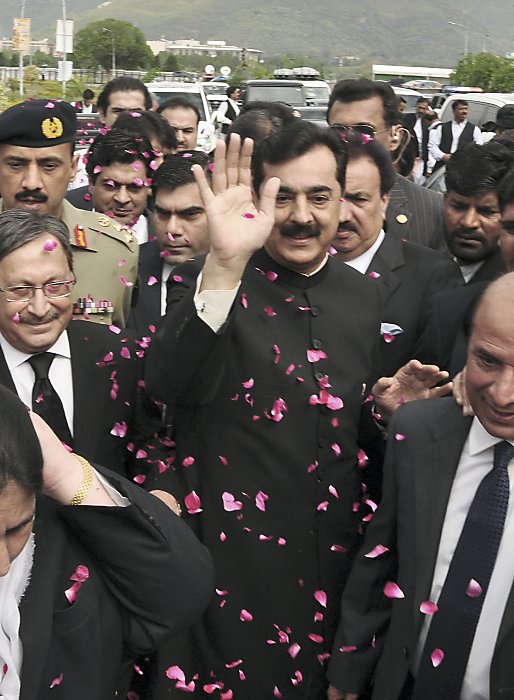
Pakistan’s Supreme Court convicted Prime Minister Yousaf Raza Gilani on Thursday of contempt for failing to revive a long-standing graft case against President Asif Ali Zardari, a ruling that could eventually result in the premier’s ouster and ramp up political tension in an important but troubled U.S. ally.

The court opted not to sentence Gilani to a maximum six months in prison. However, under Pakistani law, a conviction could entail disqualification from the office he has held since 2008.

The verdict comes at a time when the ruling Pakistan Peoples Party, stewarded by Zardari and Gilani, is especially vulnerable. As elections approach, the party faces a public intensely dissatisfied with its performance on issues such as a stagnant economy and crippling power shortages.

Within hours of the ruling, handed down by a seven-judge panel, opposition leaders called for Gilani’s resignation.

“He should step down without causing further crisis,” former Prime Minister Nawaz Sharif, who leads the Pakistan Peoples Party’s archrival Pakistan Muslim League-N, told a Pakistani television channel. “The prime minister himself invited this situation.”

But members of Gilani’s team suggested the Pakistan Peoples Party would defend his right to stay in office. Information Minister Qamar Zaman Kaira called the ruling “a very unfortunate day for this country and for democracy,” but said the court’s ruling did not explicitly call for Gilani’s disqualification as prime minister.

Ultimately, Zardari and other party leaders will have to weigh the benefits of staving off Gilani’s removal from office through legal and legislative maneuvers against the political damage that could come with trying to keep him at the helm of government.

“Essentially, it will go to the court of public opinion,” said Cyril Almeida, a leading columnist for Dawn, an English-language Pakistani newspaper. “The media and political opposition will say you have a prime minister convicted, so morally he should not stay on as prime minister. … What might happen is someone might petition the Supreme Court, saying, ‘This is your order, so please disqualify the prime minister.’ That seems likely to be the next step.”

The contempt conviction stems from a case in Switzerland in which Zardari and his late wife, former Prime Minister Benazir Bhutto, were convicted in absentia in 2003. The couple were charged with taking kickbacks from Swiss companies during Bhutto’s rule in the 1990s. They appealed, and the case was dropped in 2008 at the request of the Pakistani government.

Since 2009, the Supreme Court has repeatedly demanded that Gilani’s government write a letter to Swiss authorities asking that the case be revived. Gilani refused, contending that, as president, Zardari has constitutional immunity from prosecution.

India and Pakistan: The Truth of the One Nation Theory

By Aakar Patel for FirstPost

The first time I came to Pakistan, I was taken aback at how good some of the infrastructure was. The airports at Karachi and Lahore were small, but they were efficient and well designed. I think my host told me the Japanese had built one or both of them, and those airports were a very different thing from the ones I had just taken off from in India.

This was when the government made the airports and as with all things the Indian government takes up, our airports were clumsy and barely functional. But a few years later this changed. Today the airports at Mumbai, Delhi and Bangalore are pretty good. They’re not world class (nothing in India can ever be), but they are not embarrassing as the earlier ones were.

The differences that I had thought were significant turned out not to be so.

This led me to think of how similar we were as nations. Not in the sense that Mohd Ali Jinnah meant. I think it is fairly obvious that the character of India and of Pakistan is different when we observe their constitutions. India’s secularism is fundamentally Hindu in its nature. Pakistans constitution is Islamic by design and in appearance.

Though this is an important aspect of nationhood, however, it is only one aspect.

What I mean is how we are one nation in all the negative aspects. Our neighbourhoods and streets are among the most shameful in the world, because we are selfish and blind to the concern of others. Delhi’s drivers are as terrible as those in Lahore (and the women of Delhi and Lahore would concur on the behaviour of the loutish men of those cities). Half of us are illiterate and the half who are literate don’t really read much. The comments sections of Indian and Pakistani websites are the most dreadful in the world, without qualification. Hateful and pedantic, the product of minds who are only functionally literate. We think time will bring some big change in our society but it isn’t easy to see where this change is going to come from.

I know of few other nations where people would not be embarrassed at the thought of keeping servants. Few cultures would be so unaffected, so uncaring of privacy to not mind the constant presence of the servant in the house. I am not even talking about the bestial manner in which we treat them, because every reader of this piece, whether Indian or Pakistani already knows what I mean.

We divide ourselves into nations based on things like which animal the other eats or does not eat. The outsider probably sees no difference between us, and rightly.

We produce very little of meaning to the outside world, and it is tough to think of what our contribution is to the nations from whom we take so much. In science and technology we have nothing to offer the West, despite the boasts of Indians that we gave the world Arabic numerals and zero (I agree with that; we have given the world zero).

Pakistanis stake claim to Islams golden age. Daily Jang columnist Hassan Nisar often takes up this point. He says that the Arabs laugh when Pakistanis owns Islams achievements. What aspect of the conquest of Spain or the scientific revolution in Baghdad did Punjabis and Sindhis participate in?
To the world we are one people in that sense.

My friend Col Iftikhar, from Musharrafs batch in the Pakistan Military Academy, said he discovered this horrifying fact when he went to Mecca a few decades ago for Haj. He met some Saudis, one of whom asked him where he was from. Lahore, said Ifti. Where’s that, the Saudi asked (this was in the 70s). Pakistan, said Ifti proudly. Where’s that, the puzzled Saudi asked. Ifti took out a map and pointed. Ah, said the Saudi to his friends, he’s Hindi.

Our problems are so primitive that they should make us stop and repair ourselves immediately. But they don’t seem to affect us at all. Our media carry on like we are normal people. Reading the militant bombast of the strategic affairs experts in the newspapers of these two nations, the outsider would never suspect that these were two nations unable to even keep their public toilets clean.

Weeping Relatives Demand Pakistan Crash Answers

As Reported by Agence France Presse

Dozens of coffins lined a hallway at Islamabad’s main hospital on Saturday as weeping relatives of the victims of the Bhoja Air plane crash slammed the authorities for the disaster.

All 127 people on board perished when the Boeing 737 from Karachi crashed and burst into flames as it attempted to land at Islamabad airport in bad weather on Friday evening.

The plane was smashed to pieces by the impact of the crash, with wreckage and human limbs strewn over a wide area of farmland on the outskirts of the Pakistani capital.

Staff at the Pakistan Institute of Medical Sciences (PIMS), their faces covered with masks, sprayed air freshener to mask the smell of burnt flesh in the room where the remains lay.

Some remains were no more than body parts, kept on stretchers and covered by white sheets.

The disaster is the city’s second major plane crash in less than two years — an Airblue plane came down in bad weather in July 2010, killing 152 — and victims’ families voiced fury at the authorities.

A visibly dejected woman identifying herself as Mrs Hassan, 45, said she had come to collect the body of her 45-year old cousin Mohammad Yunus, a Muslim scholar who had been running a madrassa (Islamic seminary) in Karachi.

“We could not get the full body. We recognized his hand and hair along with his jacket,” she said.

“It’s sheer incompetence of the government. This is the second major accident here in less than two years but the president and the prime minister remain unmoved.

“If the weather was bad why they did not warn the pilot. Why did they allow the plane to land?”

Abdul Raoof, 55, said he had come for the body of his cousin Ghulam Farooq, 45, who worked for the State Life Insurance Corporation in Islamabad.

“We have been roaming here since early morning. We go inside the mortuary and return in depression after seeing body parts and severed limbs lying there.

“We wait, get impatient and then go inside again only to return disappointed. We are traumatized. We want to get the body and leave this place as early as possible.”

Raoof blamed the airport control tower for negligence.

“If the weather was bad the plane should have been turned away,” he said.

“It is also a mistake of the airline. They sacrificed 127 lives just to save some fuel.”

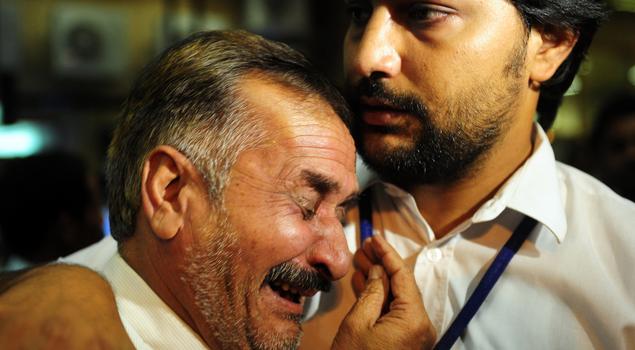
Many of the family members flown from Karachi on a special Pakistan International Airlines (PIA) flight were inconsolable, too overwhelmed with grief to speak.

One young man wept bitterly for the cousin and aunt he lost in the crash, who were returning from pilgrimage in Saudi Arabia.

“I don’t want to talk, please leave us alone,” he told journalists.

Hospital staff sprinkled rose petals on some of the coffins as a gesture of compassion, while police and soldiers consoled relatives.

At the scene of the crash, sniffer dogs joined rescue workers as they resumed the operation to recover bodies.

Debris was scattered over a two-kilometer (one-mile) area, with torn fragments of the fuselage, including a large section bearing the Bhoja Air logo, littering the fields around the village of Hussain Abad.

Prime Minister Yousuf Raza Gilani told reporters a judicial commission would investigate the crash

India Tests Nuclear Missile That Can Hit Beijing

As Reported By The Associated Press

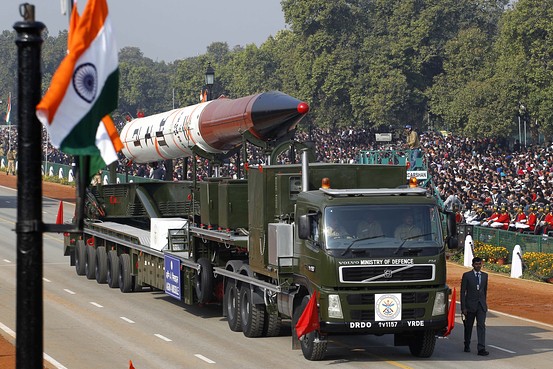
India announced Thursday that it had successfully test launched a new nuclear-capable missile that would give it, for the first time, the capability of striking the major Chinese cities of Beijing and Shanghai.

The government has hailed the Agni-V missile, with a range of 5,000 kilometers (3,100 miles), as a major boost to its efforts to counter China’s regional dominance and become an Asian power in its own right.

The head of India’s Defense Research and Development Organization, Vijay Saraswat, said the missile was launched at 8:07 a.m. from Wheeler Island off India’s east coast.

It rose to an altitude of more than 600 kilometers (370 miles), its three stages worked properly and its payload was deployed as planned, he told Times Now news channel.

“India has emerged from this launch as a major missile power,” he said.

The window for the launch opened Wednesday night, but the test had to be postponed because of weather conditions.

Avinash Chandra, mission director for the test, said that when the launch took place Thursday morning the missile performed as planned.

“We have achieved exactly what we wanted to achieve in this mission,” he told Times Now.

The Agni-V is a solid-fuel, three-stage missile designed to carry a 1.5-ton nuclear warhead. It stands 17.5 meters (57 feet) tall, has a launch weight of 50 tons and was built at a reported cost of 25 billion rupees ($486 million). It can be moved across the country by road or rail and can be used to carry multiple warheads or to launch satellites into orbit.

The missile will need four or five more trials before it can be inducted into India’s arsenal at some point in 2014 or 2015, Indian officials said.

China is far ahead of India in the missile race, with intercontinental ballistic missiles capable of reaching anywhere in India. Currently, the longest-range Indian missile, the Agni-III, has a range of only 3,500 kilometers (2,100 miles) and falls short of many major Chinese cities.

India hailed Thursday’s test as a major step in its fight to be seen as a world power.

“India has today become a nation with the capability to develop, produce, build long-range ballistic missiles and today we are among the six countries who have this capability,” Saraswat said.

India and China fought a war in 1962 and continue to nurse a border dispute. India has also been suspicious of Beijing’s efforts to increase its influence in the Indian Ocean in recent years.

“While China doesn’t really consider India any kind of a threat or any kind of a rival, India definitely doesn’t think in the same way,” said Rahul Bedi, a defense analyst in New Delhi.

India already has the capability of hitting anywhere inside archrival Pakistan, but has engaged in a splurge of defense spending in recent years to counter the perceived Chinese threat.

The Indian navy took command of a Russian nuclear submarine earlier this year, and India is expected to take delivery of a retrofitted Soviet-built aircraft carrier soon.

The new Agni, named for the Hindi word for fire, is part of this military buildup and was designed to hit deep inside China, Bedi said.

Government officials said the missile should not be seen as a threat.

“We have a declared no-first-use policy, and all our missile systems, they are not country specific. There is no threat to anybody,” said Ravi Gupta, spokesman for the Defense Research and Development Organization, which built the missile. “Our missile systems are purely for deterrence and to meet our security needs.”

The test came days after North Korea‘s failed long-range rocket launch. North Korea said the rocket was launched to put a satellite into space, but the U.S. and other countries said it was a cover for testing long-range missile technology.

One Delhi-based Western diplomat dismissed comparisons with the international condemnation of North Korea’s launch, saying that Pyongyang was violating U.N. Security Council resolutions requiring it to suspend its missile program, while India is not considered a global threat. The diplomat spoke on condition of anonymity because he was not authorized to comment on India’s security affairs.

In Washington, State Department spokesman Mark Toner said the United States urges all nuclear-capable states to exercise restraint regarding nuclear capabilities.

“That said, India has a solid non-proliferation record,” he told a news briefing. “They’re engaged with the international community on non-proliferation issues.”

Some reports characterized the Agni-V as an intercontinental ballistic missile — which would make India one of the few countries to have that capability — but Gupta and analysts said its range fell short of that category.

India has no need for such sophisticated weapons, said Rajaram Nagappa, a missile expert and the head of the International Strategic and Security Studies Program at the National Institute of Advanced Studies in Bangalore.

“I don’t think our threat perceptions are anything beyond this region,” he said.

iPakistan- Rebranding Pakistan

About

iPakistan is simply an intitative to bring Pakistan to the world and the world to Pakistan.

WHO ARE THEY?

iPakistan ia a group of university students and young professionals who are done whining about Pakistan’s image and want to do something about it. Most of them are studying in foreign universities and so have first hand experience of various kinds of stereotypes that Pakistanis overseas face as well as the tarnished image of the nation is portrayed in other countries.

Sadly, terrorism has become synonymous with Pakistan. There was this one time when a team member of this group was asked as a serious question by a Chinese students : “Does your family have any Taliban?” IMAGINE!

So iPakistan and iLahore are collaborative efforts about changing this wrongly propagated image, and even if we the group members are only able to neutralize one person’s opinion, they will feel happy that they made a small difference.

THE TEAM

Founder – Rehman Ilyas

He is the guy most pissed about Pakistan’s image and hence the one who came up with iPakistan and iLahore. He studies Economics and Finance at the University of Hong Kong and is particularly interested in Development Economics. Reads up on Chinese economy a lot and plans to heavily promote Chinese recipe of economics success, and apply it to Pakistan with a few unique ingredients of his own, through the Business section of ilahore.

Mentor – Khalid Malik

Mr. Khalid Malik is a famous Business Studies A-Levels teacher in Lahore. He is a visiting lecturer at various top schools including LGS Defence, LGS Paragon, SICAS etc. Recently he has been gaining further acclaim for his efforts to get the beloved festival of Basant, back to the people of Lahore.

Mentor – Ali Murtaza

Mr. Murtaza is a visiting professor at Beacon House National University (BNU) where he teaches design and illustration. In addition he works for a social marketing company and does commercial web site designing. His awesome illustrations, animations & creations have earned him the prestigious

Fulbright scholarship recently.

Editor Health – Burhan Ahmad
MBBS
Founder & CEO Medicalopedia, LLC

Editor Tourism – Muhammad Zargam Arshad

“BBA Accounting and Finance student at University of Hong Kong. Zargam is fondly known as “Ziggy”. He has extensive travel experience: Saudi Arabia, Hong Kong, Austria, England and of course Pakistan! Fond of reading two diverse types of poetry: Modernist and Sufi poetry. Currently working with
“YES Network” on breaking down discrimination barriers in Hong Kong society. “

Editor Fashion – Khizra Wynne

Although i have crippled my four senses while Majoring in Economics and Finance but, the sense of sight still stands to fight because it’s all about living to look ravishing.

Editor Wisdom – Hassan Riaz

Hassan is an engineering student at the University of Hong Kong and claims to be very ‘Wisdomistic’.

Editor Religion – Syed Abrar Ahamd

Abar is an active member of the Muslim Scoiety at the University of Hong Kong and wants to share his passion for Islam and peace through ‘religion’ ilahore.

Editor HumourAli – Mohiudin Ahmad

There is no single description which fits Ali, and you will get to more about him andh is personality based on his upcoming awesome humour at iPakitsan.

Editor ‘Read’ – Hinna Malik

Hinna did her Masters in Mass Communication from the University of Surrey and has worked in RBS for several years.

Editor Music – Muhammad Hamza Bukhari

Hamza is a Biotechnology major in the University of Hong Kong and claims that there isn’t a single article/ blog on metal music that hasn’t passed through his eyes.

Editor Food – Mahnum and Mahnoor

The awesome duo loves dining out and usually are present at every restaurant opening.

Editors, Romancing the Border – Pulkit Saneja, Shirin Soni, Sonica Dunichand, Rehman Ilyas

Sonica and Rehman are from Pakistan, Shirin and pulpit from India and they are typicals, fighting and arguing over Kashmir, Sania Mirza and other crucial issues on a day to day basis.

Editor The world and Us – Mark Gray

“Mark is interested in issues of law and international relations. An American and a graduate from Princeton, he is currently living in Asia doing legal research, and plans to go to law school. He enjoys travel, photography, and music.”

Editor Business – Minahil Haroon

Completing her BBA in Wealth management at the University of Hong Kong. Loves Pakistan and is hoping to represent the real Pakistan through iLahore.
But they are different too, in the sense that they love each other and want to extend their love to the entire region!

Ambassadors

UK ambassador: Bilal Mustafa(Kings College)
India Ambassador: Shirin Soni ( HKU)
Karachi Ambassador: Minahil Haroon (HKU)
Multan Ambassador : Iqra Amjad (Punjab College)
Lahore School of Economics Ambassador: Mehreen Saba
LGS (JT) Ambassador: Ahmed Awais
Salamat School group Ambassador : Rahema Hassan
And counting…

Pakistanis for Peace Editor’s Note–  Groups like iPakistan and Friends Across LOC are attempting to do the same things that we here at Pakistanis for Peace are doing as well and that is to bring the people of India and Pakistan closer together. We feel that the only solution to Pakistan and India’s problems and indeed over a billion people of the sub-continent is through a dialogue and peace. The neighborhood can not suffer another war between the two, which surely would be nuclear. Let’s hope that the our vision of peace between India and Pakistan succeeds and Pakistan is able to rid itself of a terrible image globally that its wonderful people do not deserve.

Taliban Storm Pakistani Prison: Nearly 400 Freed

By Zulfiqar Ali and Alex Rodriguez for The Los Angeles Times

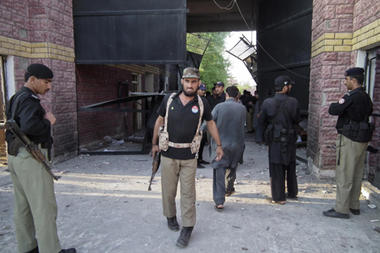
Pakistani Taliban militants stormed a prison in northwest Pakistan early Sunday and freed 390 prisoners, including 20 militants, local officials said.

The attack occurred about 2:30 a.m. at a prison in Bannu. The town is considered the gateway to North Waziristan, a tribal region along the Afghan border that has long been a stronghold for Taliban insurgents and several other militant groups.

Local police officials said as many as 200 Taliban militants drove up in pickups, lobbing hand grenades to break through the jail’s main gate.

Once inside, a two-hour firefight broke out between the attackers and roughly 30 jail guards. The militants began freeing prisoners after the guards ran out of ammunition, officials said. No one was seriously injured or killed in the attack.

One of the prisoners freed was Adnan Rashid, on death row for an assassination attempt on former Pakistani leader Pervez Musharraf when the general was president, police said.

Officials said the jail’s 944 prisoners, including some militant commanders, recently had been moved to the Bannu jail after authorities received intelligence that Taliban militants might be planning major raids on detention centers holding insurgents.

In recent years, Pakistan has sent more than 140,000 troops to battle the Pakistani Taliban across much of the tribal region along the Afghan border. The army has retaken large stretches of territory, but the militants still cling to pockets of resistance throughout the tribal belt and continue to carry out periodic attacks on a variety of targets, including military checkpoints, mosques and markets.

Like the Afghan Taliban, the Pakistani movement is made up of factions united by the goal of toppling the government and imposing Sharia, or Islamic law. It maintains links with Al Qaeda, the Afghan Taliban and other Pakistani militant groups ensconced in Pakistan’s tribal belt.

Authorities in Islamabad, the capital, have blamed the Pakistani Taliban for some of the country’s worst terrorist attacks, including the assassination of former Prime Minister Benazir Bhutto in December 2007.

Baisakhi Festival: Sikhs Pray For World Peace, Porous Borders

By Maha Mussadaq for The Express Tribune

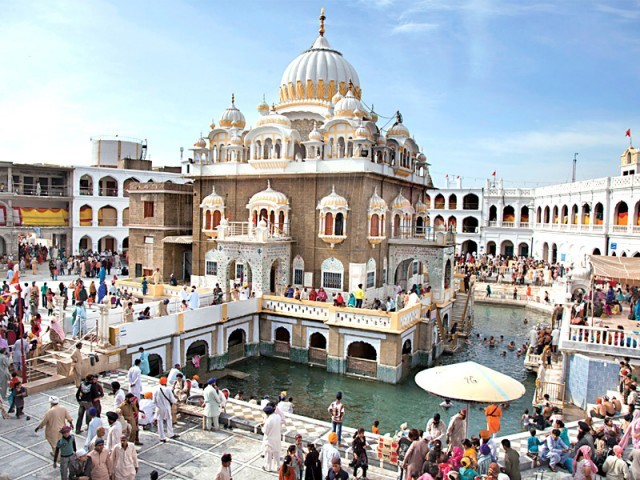
Tears gushed down Supreet Kaur’s face as she stared at the shrine of Punja Sahib and prayed for less stringent border controls so she can visit Hassan Abdal every year for Baisakhi. The three-day festival ended on Friday.

Wiping her tears with her veil Kaur said that her ‘mannat’ — a prayer that she hopes will be answered by visiting the shrine this year — is that people around the world live as one and all borders become porous. “I want the world to live in harmony and peace. So far all my prayers have come true and I am sure this one will as well”

Supreet was not the only one to wish for easier access to the shrine. Thousands of pilgrims who came for Baisakhi prayed for a change in visa policy for Sikhs so that they are able to visit the shrine any time of the year. Some pilgrims complained about acquiring a letter of invitation from either family or friends in Pakistan for their visa.

Rajpal Singh said that it was unfortunate that many Sikhs could not visit Pakistan because of the restrictions. “Both governments should devise a verification system so that Sikhs can cross the border for religious rituals. Even a permit would be fine,” Rajpal added. “I want these restrictions to come to an end so we can visit other shrines in Pakistan, such as Baba Buleh Shah’s,” Supreet said.

Baisakhi is an annual event which holds a very special place in the lives of Sikhs. The day marks the beginning of the new solar year. It also marks the formation of Khalsa (the pure one). Sikhs believe that it was on this day in 1699 when the tenth Sikh Guru, Gobind Singh declared all human beings as equal.

On Baisakhi, traditions of Gurus were compiled by Sikhs. Guru Granth Sahib was established as their eternal guide and the holy book. Punja Sahib is one of the three holiest shrines for Sikhs because of a large rock bearing an imprint of Guru Nanak’s hand or punja, founder of the Sikh religion. Sikhs swim across the stream, making a wish as they touch the imprint.

Security

Due to security fears, Sikhs could not leave Punja Sahib without permission. Some 3,000 Rangers had been deployed by the Punjab government in and around the premises.

Arrangements

Approximately 8,000 Sikhs came to Punja Sahib this year for the annual Baisakhi festival. Singh said that he was extremely satisfied with the arrangements and was happy to see the hospitality of the Pakistani government. However, Major Singh, 67, said both governments should improve facilities offered to pilgrims, including operational bathrooms and lights in trains.

Thousands of pilgrims were accommodated inside the gurdawara like every year. A huge portion of Punja Sahib is still under construction but most pilgrims were satisfied with the rooms provided.

Approximately, 2,300 Sikhs travelling from India have been accommodated in more than 400 rooms in Punja Sahib. Paramjeet Singh laughingly said just sleeping under a shade at Punja Sahib is more relaxing than any other place in the world. “It’s not about my physical needs; I am spiritually satisfied.”

Business opportunities
A large number of men and women had set up their stalls at the back of the gurdwara. Hindu vendor, Inder Kaur had come from Sindh to sell jewellery made in Mumbai. He said merchants make approximately Rs25,000 in three days. “I love shopping here because they sell items such as clothes or even bindia that we do not get in Pakistan,” said Kalvinder Kaur, who was buying bangles from Inder.

Pakistani Parliament Approves Proposals on US Ties

As Reported By The Associated Press

Pakistan’s parliament on Thursday unanimously approved new guidelines for the country in its troubled relationship with the United States, a decision that could pave the way for the reopening of supply lines to NATO troops in neighboring Afghanistan.

The guidelines allow for the blockade on U.S. and NATO supplies to be lifted, but also call for an immediate end to American drone strikes against militants on Pakistani soil.

However, the lawmakers did not make a halt in the CIA-led missile attacks a prerequisite to reopening the supply lines, as some lawmakers had been demanding. The government and the army will use the recommendations as the basis for re-engaging with Washington.

Ties between the U.S. and Pakistan all but collapsed in November after U.S. airstrikes inadvertently killed 24 Pakistani soldiers on the Afghan border, after which Islamabad blocked the supply lines in protest. Washington wants the relationship back on track.

The U.S. State Department expressed respect for the Pakistani parliament’s decision. “We respect the seriousness with which parliament’s review of U.S.-Pakistan relations has been conducted,” said State Department spokeswoman Victoria Nuland. “We seek a relationship with Pakistan that is enduring, strategic, and more clearly defined. We look forward to discussing these policy recommendations with the Government of Pakistan and continuing to engage with it on our shared interests.”

About 30 percent of supplies used by NATO and U.S. troops in landlocked Afghanistan are transported through Pakistan. Washington also needs Islamabad’s cooperation to negotiate an end to the Afghan war because many insurgent leaders are based on Pakistani soil.

The drones are a source of popular outrage in the country and have fueled anti-U.S. sentiment, although Pakistan’s powerful army has tacitly aided the missile attacks in the past, weakening Islamabad’s official stance that they are a violation of sovereignty.

Washington has ignored previous entreaties by the parliament to end the strikes, and is seen as unlikely to change its policy now.

Despite calls by Islamists for a permanent supply line blockade, few inside the Pakistani government or the army believed this was desirable, given that Pakistan relies on the U.S. and other NATO countries for its economic survival and diplomatic and military support.

Soon after the deadly airstrikes on the border, the Pakistani government called on parliament to draw up new guidelines for Islamabad’s relations with the U.S. The government’s move was widely seen as way to give it political cover for reopening the routes.

The national security committee presented a first set of proposals last month but opposition parties riding a wave of anti-American sentiment rejected them, seemingly unwilling to share any fallout ahead of elections this year or early next.

But on Thursday the opposition voted with government lawmakers to approve a revised set of guidelines, which differed little from the original ones. Opposition lawmakers didn’t explain why they had dropped earlier objections, but they could have come under pressure from the army or extracted other, unrelated concessions from the government.

The guidelines call for NATO and the U.S. to pay Pakistan more for the right to ship supplies across its soil and stipulate that no arms or ammunitions be transported. Western forces have only ever trucked fuel and other nonfatal supplies across Pakistan because of the risk they could fall into the hands of insurgents.

“We believe that the world has heard the voice of the people of Pakistan,” Prime Minister Yousuf Raza Gilani told parliament. “I would like to assure the house that our government will implement the recommendations that have been made in both letter and spirit.” Gilani did not say when the supply lines would reopen.

Western officials have said Pakistan would come under intense criticism if routes remained blocked during a NATO conference in Chicago on May 20-21 where more than 50 heads of state will discuss progress on ending the war.

Washington’s public line has been that it is waiting for the parliament to finish its review before calling for Pakistan to reopen the routes. It has refused to apologize for the border incident in November, and last week put a $10 million bounty on the head of a militant leader believed close to Pakistan’s security forces.

Behind the scenes, however, negotiations have been going on between the U.S. and Pakistan over the supply line issue and drone strikes. It was unclear whether there has been any new agreement on the strikes, which Washington believes are key to keeping al-Qaida on its back foot.

U.S. officials had said they had offered Pakistan notice about impending strikes and new limits on which militants are being targeted. For most of the Afghan war, 90 percent of the supplies came through Pakistan, but NATO has increased its reliance on an alternate, so-called “northern” route, through Central Asia in recent years.

Increased use of the northern route has removed some of the leverage Islamabad had over the West, but at a cost to the coalition.

Pentagon officials now say it costs about $17,000 per container to go through the north, compared with about $7,000 per container to go through Pakistan.

More than 120 Pakistani Soldiers Lie Dead in the Snow for Nothing

By Mohammed Hanif for The Guardian

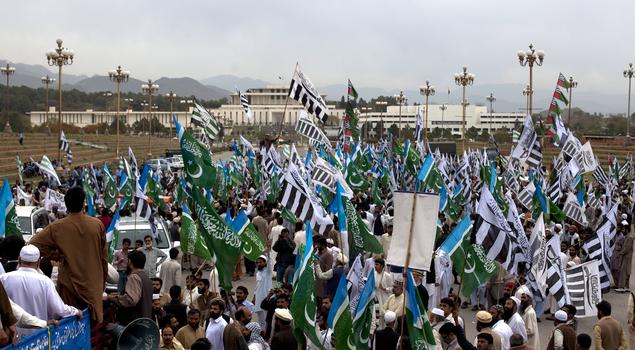
Two months before President Asif Zardari’s unexpected visit to India, a newly formed political alliance, the Council to Defend Pakistan, unveiled its slogan. “What is our relationship with India?” it asked. And then in a rickety Urdu rhyme it answered: of hatred, of revenge.

The council is an alliance between recovering jihadists, some one-person political parties and the kind of sectarian organisations whose declared aim is that Pakistan cannot fulfil its destiny until every single Shia has been killed or expelled from the country.

The council is not likely to have much impact on Pakistan’s electoral politics, but it is a clear reminder that there are strong forces within the country, which want a return to the days when India was Pakistan’s enemy No 1. Back then all you had to do to malign a Pakistani politician was to somehow prove that they were soft on India. Things have changed. When President Zardari went to India, his bitter political enemy and the opposition leader Nawaz Sharif welcomed the visit.

President Zardari’s visit on the one hand was a reminder that India is right next door. If you plan carefully, you can do a day trip, have lunch, visit a shrine and make the correct, polite noises that visitors make about their future intentions.

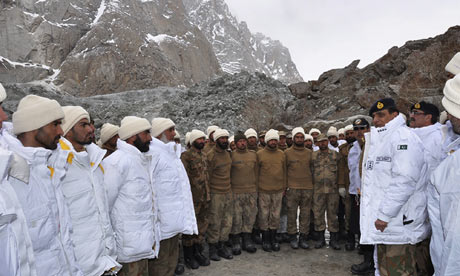
But the president’s visit was also set against a reminder that India and Pakistan have raised their animosity to a brutal art form. As the president’s plane landed in Delhi, rescue workers were trying to reach the Siachen glacier, where more than 120 Pakistani soldiers had been buried after an avalanche obliterated their military post. Siachen is often proclaimed the world’s highest battlefront – as if it’s a Guinness world record and not a monument to our mutual stupidity. As I write this, not a single survivor or body has been found. India offered help in rescue efforts. Pakistan politely declined, because that would compromise its military posts.

President Zardari’s visit was billed as a private one, but the pageantry surrounding it was state-visit like, complete with dozens of cameras broadcasting empty skies where the presidential plane was about to appear. And, of course, the media had scooped the menu for the state lunch a day in advance.

Did the visit achieve anything? An 80-year-old Pakistani prisoner in an Indian jail was released on bail. The leaders’ sons and probable heirs – Bilawal Bhutto Zardari and Rahul Gandhi – got to hang out.

There are peaceniks on both sides who have held endless candlelit vigils on the borders. They would like the borders to melt away, for all of us to come together in a giant hug and live happily ever after just like we did in a mythical past when we were all either little Gandhis or sufis and got along fine. There is another minority on both sides that would like us to live permanently in the nightmare that was partition. There are Pakistani groups who want to raise the green flag over the Red Fort in Delhi, and there are Indian hawks who go to sleep thinking of new ways to teach this pesky little country a lesson. But the vast majority – and given the size of population and ethnic diversity, that majority is really vast – would just be happy with cheaper onions from across the border.

There is another kind of coming together: Pakistani writers and artists can attend both Indian and Pakistani literary festivals and art expos, and although it’s great that they can peddle their wares to a curious audience, the rest of the population are denied that privilege. A Punjabi farmer, for example, can’t sell his often perishable produce in India, a couple of hours away, but is forced to transport it a thousand miles to southern Pakistan. If India and Pakistan could take tiny steps which weren’t just meant for the rulers and cultural tourists, it might make some difference. For instance, if there were only a couple of thousand Pakistani and Indian students studying in each others’ countries, the appetite for a war rhetoric might wane. At the moment it can’t happen because the security establishment fear infiltration. The same establishment forget that infiltrators usually don’t apply for a visa, and no suspects so far have been to an IT school in Bangalore or an arts college in Lahore.

I mention education because one in 10 children who doesn’t go to school lives in Pakistan. One in three children in the world who is malnourished lives in India. And these countries insist on sending young men to a frontline where there is no war, where there is nothing to fight over, and where 4,000 soldiers have died, mostly because it’s just too cold. Tens of thousands return with serious mental ailments because it’s so lonely and depressing. Twenty three years ago a withdrawal agreement had been agreed upon, but according to Indian defence analyst Srikant Rao, the then Indian prime minister Rajiv Gandhi backed out because withdrawing troops wouldn’t look very good in pictures. Well, troops buried under miles of snow don’t look very good either.

If India and Pakistan can’t leave each other alone, they should at least leave those mountains alone.

Rural Tinkerer Builds The First Airplane Made in Afghanistan

By Tom A Peter for The Christian Science Monitor

Afghanistan’s rural Ghazni Province usually appears on the news radar only to herald a tragedy: Five Polish soldiers were killed by a roadside bomb days before Christmas. A group of armed men accused a widow and her daughter of adultery in November and stoned the pair before shooting them in front of their home.

In other words, it’s not the sort of place you’d expect to find a hobbyist aviator in his backyard building what he describes as the first airplane ever designed and constructed in Afghanistan.

Yet, over the past three years Ghazni-native Sabir Shah managed to fashion a one-man “microlight,” aircraft at his family home using instructions from the Internet and parts from the local market.

While impressive compared with a Wright Brothers’ creation, the plane is far from a marvel of modern aviation. But Mr. Shah hopes it’s enough to inspire government support or private investment in Afghan aviation.

So far though, aside from modest, but passing interest from a few government officials, he’s received little attention. Most Afghans, including his own family, have called him crazy and told him to get a regular job. Still, Shah remains determined to create a business building airplanes for Afghanistan.

“I believe that if you want something, you can get it,” he says.

Shah is an unlikely candidate to be Afghanistan’s aviation advocate. A high school graduate with no pilot training nor aeronautical engineering background, he’d never even traveled by airplane when he started building one.

For Afghans wishing to learn how to fly, the options are extremely limited. The country has a fledging air force, but there are no other practical opportunities for pilot training. The Ministry of Transportation and Aviation offers flight classes, but ministry officials admit that few students actually take the courses because Afghan airlines almost exclusively hire foreign pilots with better training and more experience.

After high school, Shah considered going on to college. Yet even though public universities are free, his family couldn’t afford losing the extra pair of hands.
Given his circumstances it’s easy to understand why people were skeptical when Shah announced his plans to build a microlight airplane after seeing one featured on a documentary and doing a bit of Internet research.

“I didn’t have money and there was no one to help me,” says Shah. “Everyone was saying, ‘Have you studied about airplanes? Do you know anything about airplanes?’ I would say, ‘I have got some recommendations from the Internet.’ Nobody believed I could build it.”

Undeterred, Shah continued his research and worked a series of odd jobs to save up money for parts and equipment. As he progressed, friends and family donated money. An uncle in Australia gave him a vital $2,000 donation and even Afghan Vice President Abdul Karim Khalili contributed $1,000 when he learned of the project.

After three years, Shah had constructed a microlight airplane using a propeller he made himself, a small Toyota car engine, a homemade fiberglass body, a wing made of a metal frame and cloth, and some spare gauges he bought at the market for his instrument panel. The project cost Shah a total of $12,000, a small fortune here.

When it came time for his first test flight, the Afghan Ministry of Defense agreed to use a military helicopter to transport Shah and his plane to an airfield north of Kabul. The trip was the first time Shah had ever traveled by air. “I was frightened a little when I was looking down,” he says, recalling the trip.

Before Shah climbed into the pilot seat, a retired Afghan pilot who’d flown jets for the Soviets and now managed the airport gave him a few pointers. Otherwise, he was relying on manuals he’d collected on other microlight aircraft.

As his plane sped down the runway, his fear momentarily faded. The flight lasted less than a minute before he set it down on the runway again.

In a total of four takeoffs, his longest and last flight traveled about a quarter of a mile – nothing compared with professional tests, but 11 times farther than the original Wright Brothers’ flight. However, that final flight ended when he crash-landed just off the runway. Though he walked away from the crash, the plane was damaged beyond repair.

Considering that it’s been 64 years since a pilot first broke the sound barrier and 25 years since a plane circumnavigated the globe without stopping or refueling, Shah’s achievement may seem hardly worth mentioning. But his accomplishment is much less about the actual plane he built and more about his creativity and inventiveness in a country where innovation and ingenuity are in short supply after three decades of war.

“Innovation doesn’t mean anything in this country,” says Daoud Sultanzoy, a former member of parliament from Ghanzi, who has been a pilot since 1973 and is now starting his own airline. “We always look at the past and behind us instead of looking forward…. He’s a young man who must have used his own know-how to build his own airplane, which should be encouraged.”

Despite the challenges, Shah says he’ll keep working. If he can find a scholarship to study abroad he will, but he doesn’t know how to look for such an opportunity and doubts it will happen. For now, he hopes his initial success will attract investors as he endeavors to start his next project, an eight- to 10-seater airplane that he hopes can be used for domestic travel in Afghanistan.

Pakistanis for Peace Editor’s Note– What an amazing story of ingeunity and ambition that Sabir Shah demonstrates that should make all Afghans and Pakistanis proud. Just imagine what amazing talents could be nurtured with several billion dollars in seed money in start-ups in Kabul instead of all the money lost on wars~

Pakistan Leader’s India Visit Hailed For Its Symbolism

By Mark Magnier for The Los Angeles Times

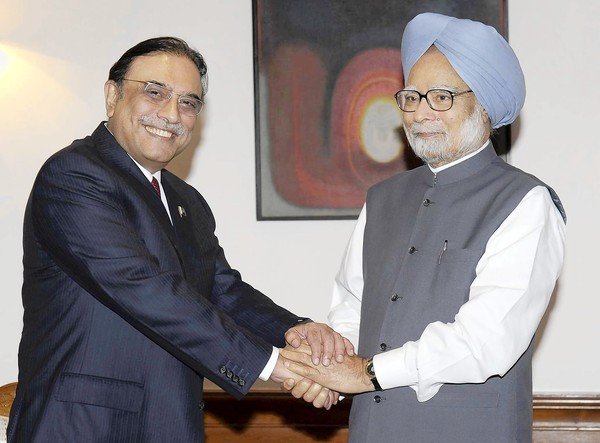
Pakistan’s president arrived in India on Sunday, the first official visit one leader of the wary neighbors has paid to the other nation in seven years. No breakthroughs were announced, but both sides hailed the meeting as a sign of easing tensions along one of the world’s most dangerous borders.

Spinmeisters on both sides worked overtime to lower public expectations of the “private” trip that saw Pakistani President Asif Ali Zardari and Indian Prime Minister Manmohan Singh discuss the 2008 terrorist attack on the Indian city of Mumbai, modest if expanding trade links, the disputed territory of Kashmir and efforts to bring various militants to justice.

The Pakistani president then visited a famous Muslim shrine for Sufi saint Moinuddin Chishti, offering a $1-million contribution.

“I am very satisfied with the outcome of this visit,” Singh said. “The relations between India and Pakistan should become normal — that is our common desire.”

The rapid-fire luncheon and shrine visit weren’t enough to overturn long-standing distrust between the nuclear neighbors, however, as summed up in a headline in India’s Mail Today tabloid newspaper: “Eat, Pray, No Love.”

The meeting is part of an apparent effort to follow the diplomatic model in place between India and China, which fought a war in 1962 over their disputed border: Put aside the most nettlesome issues for the time being and focus on building investment and trade links that benefit both sides.

This year, India and Pakistan approved a most-favored-nation agreement, lowering taxes that impede trade. Although India had offered this benefit to Pakistan in 1996, it wasn’t reciprocated until recently. Official two-way trade of about $2.6 billion is heavily weighted in India’s favor.

Sunday’s one-day visit was heavy on symbolism if not on substance. Zardari invited Singh for a reciprocal visit to Pakistan, which the Indian leader accepted, although no date was set. Zardari’s 23-year-old son, Bilawal, invited ruling Congress Party General Secretary Rahul Gandhi to Pakistan, which was also accepted, again with no date set.

On other fronts, both sides agreed in principle to ease visa restrictions. India offered its assistance in the wake of this weekend’s massive avalanche in the Siachen Glacier area, which buried about 130 people on the Pakistani-controlled side of the border in disputed Kashmir. And both sides did lots of glad-handing for the cameras.

“We had fruitful bilateral talks,” Zardari said. We “hope to meet on Pakistani soil very soon.”

But any bid to bring to justice those who planned the 2008 Mumbai attack that killed at least 166 people was sidestepped. India has long blamed Pakistani-based groups for plotting the attack.

Last week, Washington offered a $10-million reward for information leading to the capture of one Pakistani militant leader, Hafiz Muhammad Saeed, who enjoys widespread support in Pakistan.

Analysts on both sides of the divide welcomed the gradual thaw even as they acknowledged its slow pace. That no date was set for a return visit, and that Congress Party head Sonia Gandhi — characterized by some as India’s real leader behind the scenes — didn’t meet Zardari or attend the lunch, suggests the Indian government is wary of getting too far ahead of public opinion, some observers said.

“There have been some useful steps forward,” said B. Raman, director of Chennai’s Institute for Topical Studies and a former Indian intelligence officer on the Pakistan desk. “But the government has taken a cautious line.”

The fact that Zardari, 56, made the trip at all suggests that Pakistan’s military realizes improved relations are in its interest, added Talat Masood, an analyst and retired Pakistani general.

“They’re overstretched, realize the economy’s in a shambles and that you can’t have a genuine defense without a good economy,” Masood said. “It’s very sad in a way, that the process has been held hostage to jihadi groups and hard-rightists on both sides.”

Singh, 79, heading a weak government beset by corruption scandals, has pushed for improved ties with Pakistan in a bid to secure a legacy, analysts on both sides said. “Prime Minister Singh realizes he’s only going to be there a few more months,” said Masood. “He wants to do something positive so he’s remembered.”