Archive for the ‘ Pakistanis ’ Category

The Khan of the Season

BY E. Shahid for The Khaleej Times

When Imran Khan is around, there are more jealous husbands than worried batsmen. The famous remark made about the handsome Pathan cricketer, who took the subcontinent by storm in the 1970s and 80s, is symptomatic of the aura of the man that transcended sporting excellence. Despite the fierce cricketing rivalry, Imran was admired both in India and Pakistan, and continues to be a revered figure across the world of cricket.
Intensity and self-belief stood out in his performances on the field and charisma and poise surrounded him off it. Imran added virtues of honesty and missionary zeal to his personality when he single-handedly launched a cancer hospital for the poor and, more recently, a rural university in Pakistan. With his coming of age in the world of politics, it appears that the same set of qualities will hold him in good stead. Or is it?

To an outsider uninformed about the intricacies and conspiracy theories of Pakistani politics, Imran brings a breath of fresh air. He offers a glimmer of hope to an embattled country and a much needed respite from its present set of politicians. He combines neo-liberal political thought with a comprehensive worldview, traditional approach and a clean image in the face of rampant corruption. As a package, he promises a political transformation that can be invested in.

It appears that Imran has managed to bring a fragmented country under one umbrella defying the politics of identity, regionalism, sectarianism and even feudalism. He appears to have appealed to all segments of the society at least across a large swath of urban population, especially the youth who hold key to the future.

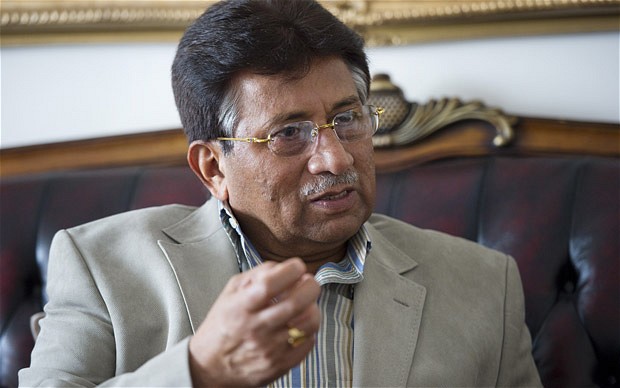
Imran has lured into his fold senior statesmen, veteran politicians, some even controversial ones, artists and army men. If the grapevine is to be believed, Imran Khan’s biggest catch is going to be former army general and President Pervez Musharraf, who is also trying to make a comeback into Pakistan politics.

Imran’s political discourse has also matured. In his public speeches, he stresses on programmes and policies and seems to have prescriptions for most ills facing the country, especially its ailing economy. If all this is taken at face value, Imran Khan is a godsend not just for Pakistan but also for the neighbourhood and the region as a whole.

Interestingly, not everyone is willing to label this as genuine transformation. People who matter – namely Pakistanis in and outside the country – often take disparaging positions on the subject. An Abu Dhabi taxi driver who hails from Swat valley paints a completely different picture from that of a Karachiite IT professional working in Dubai Media City.

One such individual says the rise of Imran is ‘escapism’ on a mass scale. Expecting an ‘elitist’ like him to change things is superficial, even idealistic, way of looking at the state of affairs in Pakistan. The argument is that Imran only promises to be a messiah and doesn’t have the wherewithal to become one.

The bottom line is that a lot of Pakistanis still do not see Imran’s upsurge as change, a positive one at that, and unless a majority believes in this change, it is going to be a futile exercise. There are bound to be differences of opinion but stakeholders must see change as a necessity and not necessarily as a means to an end. Pontification apart, outside perspective on Pakistan will always be interesting because it will reflect what the country should be instead of what it really is and is going to be. Unfortunately, the response usually ranges from the sublime to the ridiculous and is seldom a balanced one.

Imran is not making waves as a run-of-the-mill politician. Far from it, he is promising change in Pakistan and change doesn’t come easy. There is a natural resistance to such transformation, especially in a country where change has meant military rule or martial law. Imran is bound to make mistakes in the process but by putting faith in him the country would have at least tried and failed instead of reposing faith in those who breed inequality and deliver squalor.

Pakistani Judges Press Premier to Defy President

By Salman Masood and Ismail Khan for The New York Times

The political and legal crisis in Pakistan took a new turn on Tuesday when the Supreme Court threatened to dismiss Prime Minister Yousaf Raza Gilani for failing to comply with court orders to reopen corruption cases against his political boss: President Asif Ali Zardari.

The latest pressure from the court compounds the problems of the governing Pakistan Peoples Party, already facing a political crisis over a controversial memo that sought United States support in thwarting a feared military coup.

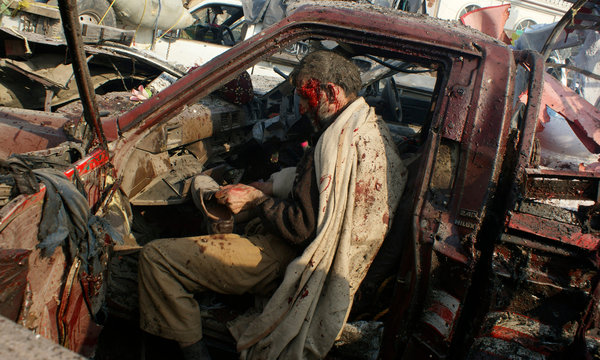
Adding to the government’s troubles is a steep increase in terrorist attacks. Another attack occurred early Tuesday, a truck bombing that the authorities said killed more than 25 people, including women and children, in northwestern Pakistan. A senior government official said the bombing appeared to be in retaliation for the recent killing of a militant leader.

Since December 2009, when the Supreme Court struck down an amnesty that nullified corruption charges against thousands of politicians, the court has insisted that the government reopen corruption cases against Mr. Zardari.

But the government has resisted court orders, and Mr. Zardari said last week that, “come what may,” officials from his party would not reopen the graft cases filed against him and his wife, Benazir Bhutto, in Switzerland. Ms. Bhutto was assassinated in 2007.

On Tuesday, a five-member panel of the Supreme Court, led by Justice Asif Saeed Khosa, ruled that the government was guilty of “willful disobedience” and said that Mr. Gilani was “dishonest” for failing to carry out the earlier court orders.

The judges laid out six options — including initiating contempt of court charges, dismissing the prime minister, forming a judicial commission and taking action against the president for violating his constitutional oath — and ordered the attorney general to explain the government’s position in court on Monday.

A three-member judicial commission that is investigating the controversial memo is scheduled to resume its hearing the same day. Apart from having an acrimonious relationship with the judiciary, the government has an uneasy relationship with the country’s top generals.

Mr. Zardari, who spent 11 years in prison on unproved corruption charges, says the corruption cases against him and Ms. Bhutto that date to the 1990s were politically motivated.

In an interview last week with GEO TV, a news network, Mr. Zardari said reopening those cases would be tantamount to “a trial of the grave” of his wife.

Mr. Zardari also claims immunity as president, but the judiciary, led by Chief Justice Iftikhar Muhammad Chaudhry, has resisted that claim and has aggressively pursued cases against Mr. Zardari’s party, leading many government officials to speculate that the judiciary was being used by the country’s powerful military to dismiss the government before the March elections for the Senate, in which the Pakistan Peoples Party is expected to win a majority.

Political analysts said the fate of Mr. Gilani, the prime minister, was in peril.

Mr. Zardari called a meeting of his party officials and coalition partners on Tuesday evening to chart strategy, and he was expected to get a statement of support from his allies.

“The situation is fast moving towards a head-on confrontation,” said Hasan Askari Rizvi, a political and military analyst based in Lahore. “It depends on what options are exercised by the Supreme Court.”

According to the Pakistani Constitution, a prime minister can be removed only by the Parliament, and the Supreme Court can disqualify the prime minister only indirectly, Mr. Rizvi said.

“If the court disqualifies the prime minister and the prime minister continues to enjoy the support of the Parliament, then the stage is set for a very dangerous confrontation,” he said.

The legal standoff is forcing the government to defer issues of greater importance, like rescuing a failing economy and fighting Taliban insurgents, as it focuses on its political survival, Mr. Rizvi said.

“The court, the military and the executive are trying to assert themselves,” he said. “It has become a free-for-all.”

There were no immediate claims of responsibility for the bombing on Tuesday, but it appeared to have been carried out by Tehrik-i-Taliban, an umbrella organization of Pakistani militant groups, against the Zakhakhel tribe, which has formed a militia in support of the government, said Mutahir Zeb, administrator for the Khyber tribal region.

Mr. Zeb said the Tehrik-i-Taliban sought to avenge the killing of Qari Kamran, a local Taliban commander, by security forces last week in an area occupied by the Zakhakhel.

Mr. Zeb said a pickup truck exploded in the middle of a bus terminal used by the Zakhakhel in the town of Jamrud.

The bomb destroyed several vehicles, damaged a nearby gasoline pump and shattered windows in the area. In addition to those killed, 27 people were reported wounded in the bombing and were taken to hospitals in Peshawar.

“I was on duty at the nearby checkpoint when I heard a big bang,” said Mir Gul, a security guard. “I rushed toward the spot and saw bodies lying around while the injured cried for help. It was devastating. There was blood everywhere.”

Pakistanis for Peace Editor’s Note-
The Pakistani people deserve better than this. The only solution to EVERYTHING that ails Pakistan is a true and long lasting peace with India. The sooner this dream becomes a reality, the sooner grim news of extremism and its grip on Pakistan will go away~

Pervez Musharraf to Announce Date for Return to Pakistan

By Duncan Gardham for The Telegraph

Mr Musharraf will announce his intention to return from London where has been living in exile despite facing arrest on treason charges. “His return will be announced by video link at a rally in Karachi on Sunday,” a source close to the former president told the Daily Telegraph.

He is planning to fly back to Pakistan by the end of January, plunging himself into a political crisis amid reports of an early general election and rumors the military is on the brink of mounting a coup.

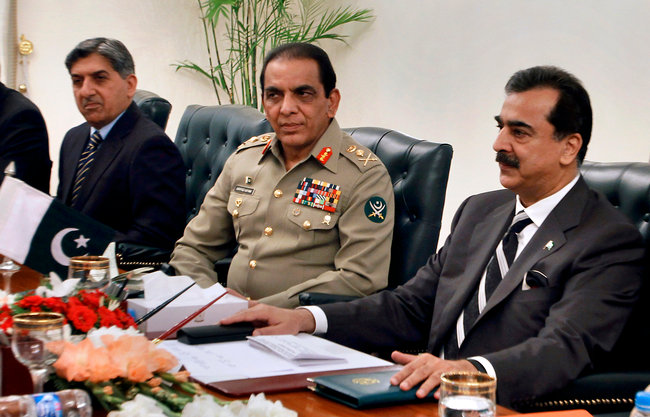
The government and army are at loggerhead trading allegations over a memo allegedly sent to US military chiefs by senior officials asking for support to reduce military influence. Yusuf Gilani, the country’s prime minister, has said publicly Pakistan’s generals are behaving as though they were a “state within a state”.

As rumours of a coup gathered speed, Asif Zardari, the country’s president, has been forced to fly back to Pakistan from Dubai where he was receiving treatment for “stroke-like symptoms”.

General Ashfaq Kayani, the head of the Pakistan army, rejected coup claims, insisting the army would “continue to support the democratic process”.
However the military distrusts both Mr Zardari and the rival Pakistan Muslim League-N, headed by Nawaz Sharif, the prime minister deposed by Mr Musharraf.

Political analysts believe the army command want to back an outside campaign in the elections but it is unclear if Mr Musharraf fits the bill.
While there has been some support to “bring back the general,” Mr Musharraf was deeply unpopular by the time he was forced out of power four years ago.

In order to stage a return he would need political support from Middle Eastern countries to help persuade the government to drop the charges against
him.

However, there have been reports that the army is backing Imran Khan, the former Pakistan cricket captain who leads Tehreek-e-Insaf [the Movement for Justice] and has staged a series of popular rallies.

Mr Khan is a former supporter of Mr Musharraf who has since become one of his fiercest critics. Ahmed Rashid, a political commentator, said the country was facing a “multi-faceted crisis”, particularly with the economy, but he doubted Mr Musharraf could make a comeback. “I don’t think he has enough people supporting him and he would probably be arrested,” he said.

Mr Musharraf launched his own political party, the All Pakistan Muslim League, in London in June 2010 and told the Daily Telegraph last year: “Pakistan is suffering. The people are extremely alive now that something has to be done in Pakistan. The youth is alive, the educated middle class is alive, they are in a state of shock and dismay over the governance in Pakistan.”

He promised a party that was “capable, viable, honest and deliverable internationally.” “I am a person who believes if I try and if I’m failing, I will quit,” he added. “I have no qualms and no ego. I have governed Pakistan for nine years, very successfully and I have no further ambitions, personal ambitions, my ambition is Pakistan.” But it is unlikely that Mr Musharraf would be able to claim victory on his own and he admitted: “I am trying to create an entity which can be the third political alternative, whether alone or in coalition with some other like-minded parties.” Mr Zardari took over from Mr Musharraf as the country’s first elected leader in nine years following the assassination of his wife, Benazir Bhutto in December 2007.

However his party, the Pakistan People’s Party, has become increasingly unpopular as Pakistan faces a economic depression and copes with one crisis after another. The next government is likely to be decided by smaller parties and Mr Musharraf could play a crucial role in that decision.

Pakistan’s alleged ‘Washington lackey’ fears for life

By Aamir Qureshi for MSNBC

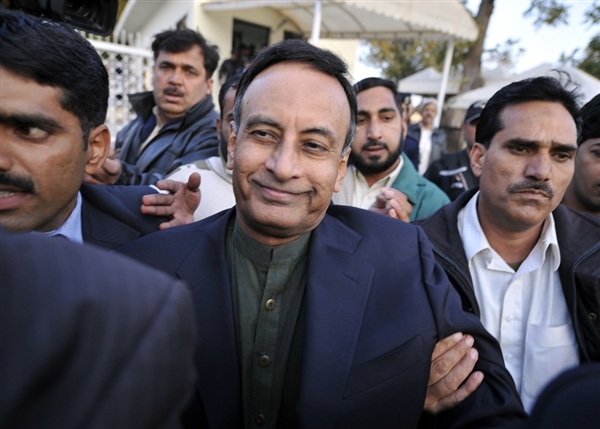
Pakistan’s former ambassador to the United States fears he will be murdered if he leaves the sanctuary of the prime minister’s official residence after he was branded a “Washington lackey” and a “traitor,” according to a new interview.

Speaking to The Daily Telegraph newspaper, Husain Haqqani said that “certain powerful quarters” in Pakistan — the paper said this was a reference to the country’s ISI intelligence agency — were behind the claims against him.

Haqqani is at the center of a scandal that threatens to topple Pakistan’s government over an alleged request to the U.S. to help stop a coup by the army, following the American raid that killed Osama bin Laden.

In October, a U.S. businessman of Pakistani origin, Mansoor Ijaz, wrote an article for the Financial Times newspaper claiming Haqqani had written a memo to U.S. Admiral Mike Mullen, who was then chairman of the joint chiefs of staff, supposedly promising to replace Pakistan’s national security hierarchy with people favorable to the U.S. in exchange for help in reining in the military.

Ijaz, who claimed he had been asked to convey the message to Mullen, further alleged that Pakistani President Asif Ali Zardari supported the move. The Financial Times operates behind a paywall, but Ijaz also wrote an article for Pakistan’s The News in November describing his allegations.

‘Hysteria’
Both Zardari and Haqqani denied Ijaz’s claims, but Haqqani subsequently resigned.

“I’m a guest of the prime minister (Yousuf Raza Gilani) with whom I have had a long-standing political association. There are clear security concerns given the hysteria generated against me. Staying at the prime minister’s house is the safest option,” Haqqani told the Telegraph in an interview published Wednesday.

“My good friend Salman Taseer (the late governor of Punjab) was killed by a security guard because he heard in the media that the governor had blasphemed. I’m being called a traitor and an American lackey in the media with the clear encouragement of certain powerful quarters even though I’ve not been charged legally with anything,” he added.

He said that he had left the prime minister’s house twice, once to go to court and another time to visit the dentist because he had toothache.

“The president and prime minister are firmly standing behind me and the government is not going anywhere. This is psychological warfare against the government,” he told the Telegraph.

In December, Zardari, who was married to former Prime Minister Benazir Bhutto, who was assassinated in 2007, said people should pay tribute to her memory by guarding against anti-democratic conspiracies, an apparent reference to tensions over the memo scandal.

He said his wife’s death was also a conspiracy against Pakistani democracy.

“I therefore urge all the democratic forces and the patriotic Pakistanis to foil all conspiracies against democracy and democratic institutions,” said Zardari in a statement sent to reporters.

Defining Terror: Better Late Than Never?

By Ahad Khan for EthanCasey.com

In his recent article “Home Free: Waging War on Ourselves,” Ethan Casey writes about what I know as “the American dream” or, as he calls it, “the ugly truth buried beneath the manicured lawns of the American suburbs.”

As a person of Pakistani heritage, I didn’t need help to notice the near exact parallel between the history of black people in America on one hand, and the plight of the U.S. government’s ghosts somewhere in “Afpakistan” on the other. I am talking about the victims of America’s drone war in the “Af-Pak” border region, home to the folks who supposedly hate the American way of life (courtesy U.S. presidents of the past decade). If we are to believe their advocates, Predator drones are so advanced that they even have their own conscience. You don’t have to worry about them mistakenly firing on women and children alike.

Our world’s affairs have arrived at a confusing point. Wars between different countries, overt and covert, increasingly appear to be conflicts between civilizations. I should not say that we can’t tell where it may lead us during the course of our own generation. History has clearly taught us time and again that struggles for freedom become inevitable wherever people are forced to live with a feeling of being suppressed. It was just such a struggle that gave birth to an America that dreamt of liberty and justice for all. It was such a struggle that solemnized the rights of the black people of America, through the brilliance of heroes like Martin Luther King and Malcolm X.

It was that same struggle that led to the creation of Pakistan, by a nation of people that – like black Americans – had grown sick and tired of being denied equal treatment in their own society. It is this freedom that we, as human beings, have shown to hold so dear, that it has served to justify our restless campaigns for the rights we demanded to live in honour and dignity.

It is no less amazing what man would do to defend what he perceives to be his freedom, or any symbol that represents it. While it still holds true that the horrific events of 9/11 raised more questions than answers (technically speaking), who would dare to challenge the notion that the USA was dealt a devastating blow to its core beliefs? To repair America’s presumably unshakeable spirit of justice, someone was going to have to pay. A determined U.S. military thus engaged in a worldwide war on ‘terror’. Over a decade later, we find the same forces holed up in Afghanistan, unwelcome and surrounded from all directions. Their enemies (those that were meant to be paid back) are stronger than they were at any point during the course of the war and easily project effective control over most of the country. The lack of a clearly defined war strategy is just one rampant example out of many to show how American leadership is completely clueless about what it’s doing there. But at least bin Laden’s dead. Mission accomplished, whatever it’s been.

As the world looks at its old ally today – they who slammed the lid on Hitler’s coffin – it’s been curious to know what the USA really aims to achieve. As America’s government continues to pursue ‘the terrorists’, it has made that country itself into the biggest victim of terror. Before anyone jumps me for contradicting other countries’ body counts: terror succeeds where people allow themselves to be terrorized; you can’t terrorize the dead. Thus, in my humble opinion, the primary victims of terror are not those that are now laid to rest in their graves; they’re the people amongst us who are ready to sacrifice their freedom for the sake of the mirage that’s presented as “threats to national security.” Those who refused to come to terms with their defeat once, failing to learn from it, are thereby damned to fail in future.

In my humble opinion the Obama administration does know that it had failed, long before the latest breakdown in relations with Pakistan after Pakistani soldiers were attacked without reason. When was the last time you heard any U.S. government official tell the world that they’re trying to “win the hearts of minds” of people on the other side of the world? They never intended to bomb their hearts and minds out, it depends on the means chosen to aim at the target. The tendencies that champion the death sentence as a means for the sake of internal security, favor the use of drones when it comes to external security.

As much as we’ve suffered as Pakistanis under America’s misleading wars, I can’t help but feel sorry for America. As this great nation’s ideology is its biggest victim of war, the defeat couldn’t be greater. The rampant paranoia at present about hunting “terrorists” does not represent the example America gave to the rest of the world in the course of the previous century. Sadly, most of our generation will remember it by the images of a shoe-throwing Iraqi journalist. Pakistan and the emerging Arab nations will learn what democracy is on their own. They’ll take an example in future of what happened in America when people allowed themselves to be governed by fear instead of by a determined leadership. Justice will be sought and found, even by some of those people that the knights of freedom would describe as terrorists.

Ahad Khan is a Dutch Pakistani whose parents hail from Karachi. A health management student from Erasmus University in Rotterdam, he’s a dental practice manager in everyday life.

New Year’s gift: Obama signs bill freezing aid to Pakistan

As Reported By Reuters

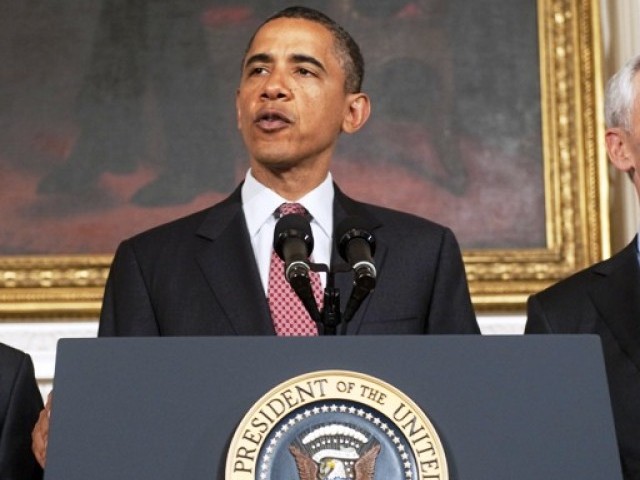
President Barack Obama signed a sweeping US defense funding bill on Saturday which includes new sanctions on financial institutions dealing with Iran’s central bank, and curtailing up to $850 million in aid to Pakistan. The bill was signed despite concerns about sections that expand the US military’s authority over terrorism suspects and limit his powers in foreign affairs.

The massive defense bill Congress passed on earlier in December freezes 60 per cent of the $850 million aid, or $510 million, until the US defense secretary provides lawmakers with assurances that Pakistan is working to counter improvised explosive devices (IEDs). US lawmakers say that many Afghan bombs that kill US troops are made with fertilizer smuggled by militants across the border from Pakistan into Afghanistan.

“The fact that I support this bill as a whole does not mean I agree with everything in it,” Obama said in a statement, citing limits on transferring detainees from the US base at Guantanamo Bay, Cuba, and requirements he notify Congress before sharing some defense missile information with Russia as problematic.

The bill, approved by Congress last week after its language was revised, aims with its Iran sanctions to reduce Tehran’s oil revenues but gives the US president powers to waive penalties as required. Senior US officials said Washington was engaging with its foreign partners to ensure the sanctions can work without harming global energy markets, and stressed the US strategy for engaging with Iran was unchanged by the bill.

The bill may also prove problematic for Pakistan in ways other than providing assurances of concrete steps to counter the manufacture of IEDs. The sanctions placed on dealing with Iran’s central banks may weigh on Pakistan’s plans for the Iran-Pakistan pipeline which aims to provide gas to Pakistan.

Pakistan needs the gas supplies from Iran to augment its own gas reserves which have been shrinking fast, leading to widespread gas shortages affecting its industry and daily life.

Imran Khan’s rally defies Pak’s ruling party

As Reported by IBN Live

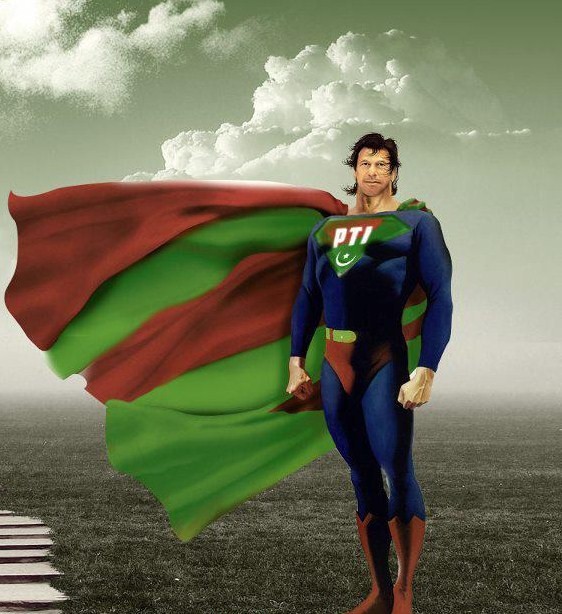
Pakistan’s former cricketer-turned-politician Imran Khan brought at least 100,000 people into the streets of Karachi on Sunday in a massive rally that increases pressure on the civilian government and cements his standing as a political force.

Khan, 59, is riding a wave of dissatisfaction with the government of President Asif Ali Zardari, who co-chairs the ruling Pakistan People’s Party, and is facing challenges from the military, the Supreme Court and political opponents after a year of cascading crises.

Police estimated the rally had been attended by between 100,000 and 150,000 people. Khan’s Pakistan Tehreek-i-Insaaf, or Pakistan Movement for Justice, estimated the crowd at more than 500,000.

Even at the lower estimate, it is among the largest political rallies held in Karachi in recent years.

Khan, in a rousing speech punctuated with patriotic musical refrains, pledged, if elected, to curb Pakistan’s endemic corruption.

“We need a government that changes the system and ends corruption, so we need the PTI to come to power,” Khan told the crowd. “The first thing we need to do is end corruption.”

“I promise we will end big corruption in 90 days,” he added.

Khan’s massive rally comes at a time of crisis in Pakistani politics. Tensions are rising between Pakistan’s civilian leaders and its generals over a memo that accused the Army of plotting a coup after the US raid that killed Osama bin Laden in May.

There are signs that Pakistan’s powerful Army is fed up with Zardari and wants the Supreme Court or early elections to force him from office. The Army chief dismissed any rumours of a coup, however, as “speculation”.

“It’s time for a change and only PTI and Imran Khan can bring about that change,” said Sabina Saifi, 28, a school teacher. She was wearing a PTI cap and had come with her two brothers.

Several recent polls have shown Khan is Pakistan’s most popular politician. He is especially favoured in urban areas.

“He is riding a wave of popular politics right now,” said Mutahir Ahmed, a professor of International Relations at the University of Karachi. “There is a lot of frustration among ordinary people, as well as political workers right now, which he is cashing on.”

On October 30, Khan staged a similar rally in Lahore that observers said pulled between 100,000 and 200,000 people, then one of the largest political rallies ever in Pakistan.

“He has… managed to bring people out on the roads, and this is a big achievement, especially in Karachi, where three months back people were not ready to come out of their houses because of rampant violence and killings,” Ahmed said.

But popularity doesn’t always translate into political power. The majority of Pakistan’s voters are rural, where feudal relationships determine generations of political loyalty.

Khan, for all the enthusiasm shown for him among young people and the urban middle class, has yet to demonstrate the party machinery that the PPP and the Pakistan Muslim League-N faction have had decades to perfect.

In the last 15 years, the PTI has only briefly held one seat in Parliament – Khan’s. Most analysts say Khan could score an upset of 20 to 30 seats in Parliament, but that’s not enough to give him the premiership. It is enough to make him a major political player, however – or even a kingmaker.

“It’s too premature to get into speculation of whether he becomes prime minister or not but the chances of his party getting into Parliament look very good,” said security analyst Imtiaz Gul.

He also has a touchy relationship with the United States, Pakistan’s ally and aid donor.

He says that if elected prime minister, he would end cooperation in the fight against militants based in tribal areas, end the covert campaign of bombings by US drones and refuse all US aid, which totals some $20 billion since 2001.

Relations with the United States have reached a crisis point because of a November 26 cross-border incident in which NATO aircraft killed 24 Pakistani troops. Pakistan has since shut down NATO supply routes into Afghanistan and demanded an apology.

NATO’s full report on the incident, which Pakistan has already rejected based on media leaks, is expected to be released on Monday. It reportedly faults both sides in the incident.

Khan’s anti-American stance is often thought to reflect the views of the security establishment, which includes the powerful Army and its Directorate of Inter-Services Intelligence.

The US ambassador to Pakistan, Cameron Munter, however, said in November that he didn’t see Khan as anti-American.

“Imran Khan is, as far as he tells me, for the same kind of values that we think are important,” Munter said on a popular talk show on November 22. “He says he’s for democracy, he’s for governance that’s clean, he’s for economic growth. We’re all for those things.”

Pakistan Military Denies Conspiracy to Seize Power

By Salman Masood for The New York Times

The military command in Pakistan issued an unusual refutation on Friday of rumors that it was planning to take power, publicizing a pledge by the top general that it is committed to democracy a day after the prime minister warned of conspiracies to subvert the civilian government.

But the pledge, by Gen. Ashfaq Parvez Kayani, did little to assuage anxieties about a possible coup in a country with a history of military interventions. The anxieties were reinforced on Thursday by an extraordinary outburst about just such a possibility from the normally soft-spoken prime minister, Yusuf Raza Gilani, who also said the military generals in Pakistan behaved as though they were “a state within a state” and that they should be accountable to Parliament.

“The army will continue to support democratic process in the country,” General Kayani was quoted as saying in a statement issued by the military command. It said General Kayani had made that pledge on Thursday as he visited troops stationed in the northwestern regions of Mohmand and Kurram.

General Kayani “dispelled the speculations of any military takeover and said that these are misleading and are being used as a bogey to divert the focus from the real issues,” according to the statement by the military.

However, General Kayani stressed that “there can be no compromise on national security,” alluding to the differences with the civilian government over investigations into a contentious memo that suggested the civilian government had sought help from the United States in trying to constrain the Pakistani military.

The public back-and-forth came as the Pakistan military’s relations with the United States, already aggravated by the memo issue, have plunged to new lows over a deadly American-led airstrike on the Afghanistan-Pakistan border last month that killed 26 Pakistani soldiers. Pakistan’s military has rejected results of a Pentagon inquiry that said both sides were at fault but that Pakistani forces opened fire first. In a new sign of the Pakistani military’s anger, a senior official said Friday it had canceled a planned visit by the head of the United States Central Command, Gen. James Mattis, to brief his counterparts on the Pentagon inquiry.

The tensions over the memo began after Mansoor Ijaz, an American businessman of Pakistani origin, wrote an op-ed article for The Financial Times in October saying that a Pakistani diplomat had asked him to deliver a memo to Adm. Mike Mullen, who was chairman of the Joint Chiefs of Staff at the time, after American commandos killed Osama bin Laden in a May raid on a Pakistan safe house. That raid, which deeply embarrassed Pakistan, raised questions about whether Bin Laden, the most-wanted fugitive Al Qaeda plotter of the Sept. 11 attacks, had been protected by elements of Pakistan’s military and intelligence service. Mr. Ijaz described the memo as saying that the civilian government sought help in preventing a possible coup, offering in exchange to dismantle part of the intelligence service.

Since then, the ruling Pakistan Peoples Party and the powerful military have been arguing over the veracity of the memo , which is seen as authentic by the military and as a conspiracy by the civilian government.

Husain Haqqani, the former ambassador to the United States, was forced to resign in November after allegations that he had orchestrated the memo, a charge he denies. Mr. Haqqani returned to the country and is barred from traveling abroad, a step seen as a violation of his fundamental rights, according to his lawyer.

The top generals have urged the country’s Supreme Court to investigate the origins of the memo. Chief Justice Iftikhar Muhammad Chaudhry said Friday that the court is pursuing those investigations but that it would not validate any army coup.

The statements by both Mr. Gilani and General Kayani signified that deep mistrust and tensions exist between the two sides.

“Things don’t look stable at all,” said Enver Baig, a former senator, who predicted that the “civil-military relations will not settle down peacefully.”

Pakistan Most-Deadly Nation for Journalists

As Reported by The Wall Street Journal

Seven journalists died in Pakistan during the year in direct relation to their work, out of a total of 43 journalist killed worldwide in the year, the report said.

There were no deaths in India, after one killing in 2010. In 2008, four Indian journalists died either while covering the conflict in Kashmir or through target killings due to their investigations of criminal activities.

In combat zones such as Libya, where five journalists died in 2011 — the joint second-highest number with Iraq – the killings tend to be random, with reporters caught in the broader fighting. But Pakistan continues to suffer largely from target killings.

These deaths occur when a reporter has unearthed details about militancy or a business deal and is targeted to stop this information getting out. Five of the seven deaths in Pakistan were targeted killings and all remain unsolved, the CPJ said.

In the past five years, 29 journalists have died carrying out their work in Pakistan. Five journalists died in India during the same period.

The best-known case in Pakistan this year involved Saleem Shahzad, a reporter for Asia Times Online, who died in May after writing a report which alleged al Qaeda had infiltrated Pakistan’s navy.

Human Rights Watch, the New York-based advocacy group, said Mr. Shahzad before his death had complained of receiving threats from Pakistan’s Inter-Services Intelligence Directorate military spy agency. ISI officials deny the threats and any involvement in his killing. The case is unsolved.

“Long-term CPJ research shows Pakistan to be among the worst countries in the world in bringing the killers of journalists to justice,” the report said.

Five journalists also died in Iraq from both insurgent attacks and targeted killings, illustrating an entrenched level of violence there as the last U.S. forces pulled out the country at the weekend.

Three journalists died in Mexico, including the first case of a reporter killed for work on social media, the report said. Many of the dead had taken on Mexico’s powerful drug traffickers in their reports.

The Arab Spring revolutions across the Middle East and North Africa led to the first cases of journalist deaths in Syria and Tunisia since the CPJ began recording fatalities in 1992, the report said. The committee independently confirms that journalists died while covering their beats.

Pakistan PM Seeks to Dispel Rumors of Army Rift

By Chris Brummitt for Boston.com

Pakistan’s prime minister dismissed speculation of a rift between the government and the military over a secret memo sent to Washington seeking its help in averting a supposed military coup, saying the country was committed to democracy.

Political tensions have soared in recent days as the Supreme Court begins a hearing into the circumstance surrounding the memo. The absence of President Asif Ali Zardari, recovering from a likely “mini stroke” in his Dubai home with no word on his return, has only added to rumors that the current civilian administration is in possible fatal trouble.

Zardari’s plentiful critics are hoping the scandal will lead to his ouster, and delighted in portraying his trip to Dubai on Dec. 6 as a flight from the fallout from the memo. The president’s aides have denied that, and most independent analysts believe the veteran politician, who has outlasted numerous predictions of his demise since taking office in 2008, will ride it out.

Late Friday, Prime Minister Yousuf Raza Gilani met with army chief Gen. Ashfaq Pervez Kayani to discuss the memo.

Gilani said in a statement he rejected the nation of a “standoff” between the army and the government.

“The government of Pakistan and its institutions remain committed to their constitutional roles and obligations to a democratic and prosperous future for Pakistan,” he said.

Tensions between the army and the government could complicate American attempts to rebuild ties with a country seen by many U.S. officials as key to shepherding peace in Afghanistan. A raid by the U.S.-led coalition in Afghanistan in late November killed 24 Pakistani soldiers, hammering relations already strained by American suspicions that Islamabad is playing both sides in the Afghan war and virulent anti-U.S. sentiments inside Pakistan.

Pakistan has a long history of army coups or behind the scenes meddling by the generals to engineer pliant regimes, often with the support of the judiciary. That has left the country’s 180 million people specially receptive to the idea that the collapse of the government is just around the corner.

SHINE’s Impact on Armadeus Davidson

Volunteers Extraordinaire Todd Shea of SHINE Humanity and Armadeus Davidson of Empact Northwest of WA doing humanitarian work in Pakistan.

The Pakistanis Have A Point

By Bill Keller for The New York Times
As an American visitor in the power precincts of Pakistan, from the gated enclaves of Islamabad to the manicured lawns of the military garrison in Peshawar, from the luxury fortress of the Serena Hotel to the exclusive apartments of the parliamentary housing blocks, you can expect three time-honored traditions: black tea with milk, obsequious servants and a profound sense of grievance.

Talk to Pakistani politicians, scholars, generals, businessmen, spies and journalists — as I did in October — and before long, you are beyond the realm of politics and diplomacy and into the realm of hurt feelings. Words like “ditch” and “jilt” and “betray” recur. With Americans, they complain, it’s never a commitment, it’s always a transaction. This theme is played to the hilt, for effect, but it is also heartfelt.

“The thing about us,” a Pakistani official told me, “is that we are half emotional and half irrational.”

For a relationship that has oscillated for decades between collaboration and breakdown, this has been an extraordinarily bad year, at an especially inconvenient time. As America settles onto the long path toward withdrawal from Afghanistan, Pakistan has considerable power to determine whether the end of our longest war is seen as a plausible success or a calamitous failure.

There are, of course, other reasons that Pakistan deserves our attention. It has a fast-growing population approaching 190 million, and it hosts a loose conglomerate of terrorist franchises that offer young Pakistanis employment and purpose unavailable in the suffering feudal economy. It has 100-plus nuclear weapons (Americans who monitor the program don’t know the exact number or the exact location) and a tense, heavily armed border with nuclear India. And its president, Asif Ali Zardari, oversees a ruinous kleptocracy that is spiraling deeper into economic crisis.

But it is the scramble to disengage from Afghanistan that has focused minds in Washington. Pakistan’s rough western frontier with Afghanistan is a sanctuary for militant extremists and criminal ventures, including the Afghan Taliban, the Pakistani Taliban, the notorious Haqqani clan and important remnants of the original horror story, Al Qaeda. The mistrust between Islamabad and Kabul is deep, nasty — Afghanistan was the only country to vote against letting Pakistan into the United Nations — and tribal. And to complicate matters further, Pakistan is the main military supply route for the American-led international forces and the Afghan National Army.

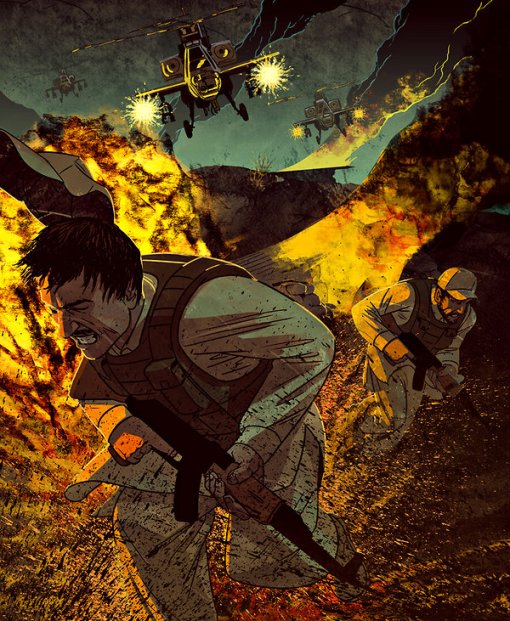
On Thanksgiving weekend, a month after I returned from Pakistan, the relationship veered precipitously — typically — off course again. NATO aircraft covering an operation by Afghan soldiers and American Special Forces pounded two border posts, inadvertently killing 24 Pakistani soldiers, including two officers. The Americans said that they were fired on first and that Pakistan approved the airstrikes; the Pakistanis say the Americans did not wait for clearance to fire and then bombed the wrong targets.

The fallout was painfully familiar: outrage, suspicion and recrimination, petulance and political posturing. Gen. Ashfaq Parvez Kayani, the chief of the army and by all accounts the most powerful man in Pakistan, retaliated by shutting (for now and not for the first time) the NATO supply corridor through his country. The Pakistanis abruptly dropped out of a Bonn conference on the future of Afghanistan and announced they would not cooperate with an American investigation of the airstrikes. President Obama sent condolences but balked at the suggestion of an apology; possibly the president did not want to set off another chorus of Mitt Romney’s refrain that Obama is always apologizing for America. At this writing, American officials were trying to gauge whether the errant airstrike would have, as one worried official put it, “a long half-life.”

If you survey informed Americans, you will hear Pakistanis described as duplicitous, paranoid, self-pitying and generally infuriating. In turn, Pakistanis describe us as fickle, arrogant, shortsighted and chronically unreliable.

Neither country’s caricature of the other is entirely wrong, and it makes for a relationship that is less in need of diplomacy than couples therapy, which customarily starts by trying to see things from the other point of view. While the Pakistanis have hardly been innocent, they have a point when they say America has not been the easiest of partners.

One good place to mark the beginning of this very, very bad year in U.S.-Pakistani relations is Dec. 13, 2010, when Richard C. Holbrooke died of a torn aorta. Holbrooke, the veteran of the Balkan peace, had for two years held the thankless, newly invented role of the administration’s special representative for Afghanistan and Pakistan. The antithesis of mellow, Holbrooke did not hit it off with our no-drama president, and his bluster didn’t always play well in Kabul or Islamabad either.

But Holbrooke paid aggressive attention to Pakistan. While he was characteristically blunt about the divergent U.S. and Pakistani views, he understood that they were a result of different, calculated national interests, not malevolence or mere orneriness. He was convinced that the outlooks could be, if not exactly synchronized, made more compatible. He made a concentrated effort to persuade the Pakistanis that this time the United States would not be a fair-weather friend.

“You need a Holbrooke,” says Maleeha Lodhi, a well-connected former ambassador to Washington. “Not necessarily the person but the role.” In the absence of full-on engagement, she says, “it’s become a very accident-prone relationship.”

On Jan. 27, a trigger-happy C.I.A. contractor named Raymond Davis was stuck in Lahore traffic and shot dead two motorcyclists who approached him. A backup vehicle he summoned ran over and killed a bystander. The U.S. spent heavily from its meager stock of good will to persuade the Pakistanis to set Davis free — pleading with a straight face that he was entitled to diplomatic immunity.

On May 2, a U.S. Navy Seals team caught Osama bin Laden in the military town Abbottabad and killed him. Before long, American officials were quoted questioning whether their Pakistani allies were just incompetent or actually complicit. (The Americans who deal with Pakistan believe that General Kayani and the director of the Inter-Services Intelligence agency, Gen. Ahmed Shuja Pasha, were genuinely surprised and embarrassed that Bin Laden was so close by, though the Americans fault the Pakistanis for not looking very hard.) In Pakistan, Kayani faced rumbles of insurrection for letting Americans violate Pakistani sovereignty; a defining victory for President Obama was a humiliation for Kayani and Pasha.

In September, members of the Haqqani clan (a criminal syndicate and jihadi cult that’s avowedly subservient to the Taliban leader Mullah Omar) marked the 10th anniversary of 9/11 with two theatrical attacks in Afghanistan. First a truck bomb injured 77 American soldiers in Wardak Province. Then militants rained rocket-propelled grenades on the U.S. Embassy in Kabul, forcing our ambassador to spend 20 hours locked down in a bunker.

A few days later the former Afghan president, Burhanuddin Rabbani, spread his arms to welcome an emissary from the Taliban to discuss the possibility of peace talks. As they embraced, the visitor detonated a bomb in his turban, killing himself, Rabbani and the talks. President Hamid Karzai of Afghanistan, without any evidence that American officials are aware of, accused Pakistan of masterminding the grotesque killing in order to scuttle peace talks it couldn’t control.

And two days after that, Adm. Mike Mullen, the outgoing chairman of the Joint Chiefs of Staff, took to Capitol Hill to suggest that Pakistani intelligence had blessed the truck bomb and embassy attack.

His testimony came as a particular shock, because if the turbulent affair between the United States and Pakistan had a solid center in recent years, it was the rapport between Mullen and his Pakistani counterpart, General Kayani. Over the four years from Kayani’s promotion as chief of the army staff until Mullen’s retirement in September, scarcely a month went by when the two didn’t meet. Mullen would often drop by Kayani’s home at the military enclave in Rawalpindi, arriving for dinner and staying into the early morning, discussing the pressures of command while the sullen-visaged general chain-smoked Dunhills. One time, Kayani took his American friend to the Himalayas for a flyby of the world’s second-highest peak, K2. On another occasion, Mullen hosted Kayani on the golf course at the Naval Academy. The two men seemed to have developed a genuine trust and respect for each other.

But Mullen’s faith in an underlying common purpose was rattled by the truck bombing and the embassy attack, both of which opened Mullen to the charge that his courtship of Kayani had been a failure. So — over the objection of the State Department — the admiral set out to demonstrate that he had no illusions.

The Haqqani network “acts as a veritable arm of Pakistan’s Inter-Services Intelligence agency,” he declared. “With ISI support, Haqqani operatives planned and conducted that truck-bomb attack as well as the assault on our embassy.”

Several officials with access to the intelligence told me that while the Haqqanis were implicated in both attacks, there was no evidence of direct ISI involvement. A Mullen aide said later that the admiral was referring to ISI’s ongoing sponsorship of the Haqqanis and did not mean to say Pakistan authorized those specific attacks.

No matter. In Pakistan, Mullen’s denunciation led to a ripple of alarm that U.S. military “hardliners” were contemplating an invasion. The press had hysterics. Kayani made a show of putting the Pakistani Army on alert. The Pakistani rupee fell in value.

In Washington, Mullen’s remarks captured — and fed — a vengeful mood and a rising sense of fatalism about Pakistan. Bruce O. Riedel, an influential former C.I.A. officer who led a 2009 policy review for President Obama on Pakistan and Afghanistan, captured the prevailing sentiment in an Op-Ed in The Times, in which he called for a new policy of “containment,” meaning “a more hostile relationship” toward the army and intelligence services.

“I can see how this gets worse,” Riedel told me. “And I can see how this gets catastrophically worse. . . . I don’t see how it gets a whole lot better.”

When Gen. David H. Petraeus took over the U.S. military’s Central Command in 2008, he commissioned expert briefing papers on his new domain, which sprawled from Egypt, across the Persian Gulf, to Central Asia. The paper on Afghanistan and Pakistan began, according to an American who has read it, roughly this way: “The United States has no vital national interests in Afghanistan. Our vital national interests are in Pakistan,” notably the security of those nuclear weapons and the infiltration by Al Qaeda. The paper then went on for the remaining pages to discuss Afghanistan. Pakistan hardly got a mention. “That’s typical,” my source said. Pakistan tends to be an afterthought.

The Pakistani version of modern history is one of American betrayal, going back at least to the Kennedy administration’s arming of Pakistan’s archrival, India, in the wake of its 1962 border war with China.

The most consequential feat of American opportunism came when we enlisted Pakistan to bedevil the Soviet occupiers of Afghanistan in the 1980s. The intelligence agencies of the U.S. and Pakistan — with help from Saudi Arabia — created the perfect thorn in the Soviet underbelly: young Muslim “freedom fighters,” schooled in jihad at Pakistani madrassas, laden with American surface-to-air missiles and led by charismatic warriors who set aside tribal rivalries to war against foreign occupation.

After the Soviets admitted defeat in 1989, the U.S. — mission accomplished! — pulled out, leaving Pakistan holding the bag: several million refugees, an Afghanistan torn by civil war and a population of jihadists who would find new targets for their American-supplied arms. In the ensuing struggle for control of Afghanistan, Pakistan eventually sided with the Taliban, who were dominated by the Pashtun tribe that populates the Pakistan-Afghanistan frontier. The rival Northern Alliance was run by Tajiks and Uzbeks and backed by India; and the one thing you can never underestimate is Pakistan’s obsession with bigger, richer, better-armed India.

As long as Pakistan was our partner in tormenting the Soviet Union, the U.S. winked at Pakistan’s nuclear-weapons program. After all, India was developing a nuclear arsenal, and it was inevitable that Pakistan would follow suit. But after the Soviets retreated, Pakistan was ostracized under a Congressional antiproliferation measure called the Pressler Amendment, stripped of military aid (some of it budgeted to bring Pakistani officers to the U.S. for exposure to American military values and discipline) and civilian assistance (most of it used to promote civil society and buy good will).

Our relationship with Pakistan sometimes seems like a case study in unintended consequences. The spawning of the mujahadeen is, of course, Exhibit A. The Pressler Amendment is Exhibit B. And Exhibit C might be America’s protectionist tariffs on Pakistan’s most important export, textiles. For years, experts, including a series of American ambassadors in Islamabad, have said that the single best thing the U.S. could do to pull Pakistan into the modern world is to ease trade barriers, as it has done with many other countries. Instead of sending foreign aid and hoping it trickles down, we could make it easier for Americans to buy Pakistani shirts, towels and denims, thus lifting an industry that is an incubator of the middle class and employs many women. Congress, answerable to domestic textile interests, has had none of it.

“Pakistan the afterthought” was the theme very late one night when I visited the home of Pakistan’s finance minister, Abdul Hafeez Shaikh. After showing me his impressive art collection, Shaikh flopped on a sofa and ran through the roll call of American infidelity. He worked his way, decade by decade, to the war on terror. Now, he said, Pakistan is tasked by the Americans with simultaneously helping to kill terrorists and — the newest twist — using its influence to bring them to the bargaining table. Congress, meanwhile, angry about terrorist sanctuaries, is squeezing off much of the financial aid that is supposed to be the lubricant in our alliance.

“Pakistan was the cold-war friend, the Soviet-Afghan-war friend, the terror-war friend,” the minister said. “As soon as the wars ended, so did the assistance. The sense of being discarded is so recent.”

A Boston University-educated economist who made his money in private equity investing — in other words, a cosmopolitan man — Shaikh seemed slightly abashed by his own bitterness.

“I’m not saying that this style of Pakistani thinking is analytically correct,” he said. “I’m just telling you how people feel.”

He waved an arm toward his dining room, where he hung a Warhol of Muhammad Ali. “We’re just supposed to be like Ali — take the beating for seven rounds from Foreman,” he said. “But this time the Pakistanis have wised up. We are playing the game, but we know you can’t take these people at their word.”

With a timetable that has the United States out of Afghanistan, or mostly out, by the end of 2014, Pakistan has leverage it did not have when the war began.

One day after 9/11, Richard Armitage, the deputy secretary of state, summoned the head of Pakistani intelligence for a talking to. “We are asking all of our friends: Do they stand with us or against us?” he said. The following day, Armitage handed over a list of seven demands, which included stopping Al Qaeda operations on the Pakistani border, giving American invaders access to Pakistani bases and airspace and breaking all ties with the Taliban regime.

The Pakistanis believed from the beginning that Afghanistan had “American quagmire” written all over it. Moreover, what America had in mind for Afghanistan was antithetical to Pakistan’s self-interest.

“The only time period between 1947 and the American invasion of Afghanistan that Pakistanis have felt secure about Afghanistan is during the Taliban period,” from 1996 to 2001, says Vali Nasr, an American scholar of the region who is listened to in both academia and government. Now the Bush administration would attempt to supplant the Taliban with a strong independent government in Kabul and a muscular military. “Everything about this vision is dangerous to Pakistan,” Nasr says.

Pakistan’s military ruler at the time, Pervez Musharraf, saw the folly of defying an American ultimatum. He quickly agreed to the American demands and delivered on many of them. In practice, though, the accommodation with the Taliban was never fully curtailed. Pakistan knew America’s mission in Afghanistan would end, and it spread its bets.

The Bush-Musharraf relationship, Vali Nasr says, “was sort of a Hollywood suspension of disbelief. Musharraf was a convenient person who created a myth that we subscribed to — basically that Pakistan was on the same page with us, it was an ally in the war on terror and it subscribed to our agenda for Afghanistan.”

But the longer the war in Afghanistan dragged on, the harder it was to sustain the illusion.

In October, I took the highway west from Islamabad to Peshawar, headquarters of the Pakistan Army corps responsible for the frontier with Afghanistan. Over tea and cookies, Lt. Gen. Asif Yasin Malik, the three-star who commanded the frontier (he retired this month) talked about how the Afghan war looked from his side of the border.

The official American version of the current situation in Afghanistan goes like this: By applying the counterinsurgency strategy that worked in Iraq and relying on a surge of troops and the increasingly sophisticated use of drones, the United States has been beating the insurgency into submission, while at the same time standing up an indigenous Afghan Army that could take over the mission. If only Pakistan would police its side of the border — where the bad guys find safe haven, fresh recruits and financing — we’d be on track for an exit in 2014.

The Pakistanis have a different narrative. First, a central government has never successfully ruled Afghanistan. Second, Karzai is an unreliable neighbor — a reputation that has not been dispelled by his recent, manic declarations of brotherhood. And third, they believe that despite substantial investment by the United States, the Afghan Army and the police are a long way from being ready to hold the country. In other words, America is preparing to leave behind an Afghanistan that looks like incipient chaos to Pakistan.

In Peshawar, General Malik talked with polite disdain about his neighbor to the west. His biggest fear — one I’m told Kayani stresses in every meeting with his American counterparts — is the capability of the Afghan National Security Forces, an army of 170,000 and another 135,000 police, responsible for preventing Afghanistan from disintegrating back into failed-state status. If the U.S. succeeds in creating such a potent fighting force, that makes Pakistanis nervous, because they see it (rightly) as potentially unfriendly and (probably wrongly) as a potential agent of Indian influence. The more likely and equally unsettling outcome, Pakistanis believe, is that the Afghan military — immature, fractious and dependent on the U.S. Treasury — will disintegrate into heavily armed tribal claques and bandit syndicates. And America, as always, will be gone when hell breaks loose.

General Malik studied on an exchange at Fort McNair, in Washington, D.C., and has visited 23 American states. He likes to think he is not clueless about how things work in our country.

“Come 2015, which senator would be ready to vote $9 billion, or $7 billion, to be spent on this army?” he asked. “Even $5 billion a year. O.K., maybe one year, maybe two years. But with the economy going downhill, how does the future afford this? Very challenging.”

American officials will tell you, not for attribution, that Malik’s concerns are quite reasonable.

So I asked the general if that was why his forces have not been more aggressive about mopping up terrorist sanctuaries along the border. Still hedging their bets? His answer was elaborate and not entirely facile.

First of all, the general pointed out that Pakistan has done some serious fighting in terrorist strongholds and shed a lot of blood. Over the past two years, Malik’s forces have been enlarged to 147,000 soldiers, mainly by relocating more than 50,000 from the Indian border. They have largely controlled militant activities in the Swat Valley, for example, which entailed two hard offensives with major casualties. But they have steadfastly declined to mount a major assault against North Waziristan — a mountainous region of terrorist Deadwoods populated by battle-toughened outlaws.

Yes, Malik said, North Waziristan is a terrible situation, but his forces are responsible for roughly 1,500 miles of border, they police an archipelago of rough towns in the so-called Federally Administered Tribal Areas, or FATA, and by the way, they had a devastating flood to handle last year.

“If you are not able to close the Mexican border, when you have the technology at your call, when there is no war,” he said, “how can you expect us to close our border, especially if you are not locking the doors on your side?”

Americans who know the area well concede that, for all our complaints, Pakistan doesn’t push harder in large part because it can’t. The Pakistan Army has been trained to patrol the Indian border, not to battle hardened insurgents. They have comparatively crude weaponry. When they go up against a ruthless outfit like the Haqqanis, they tend to get killed. Roughly 4,000 Pakistani troops have died in these border wars — more than the number of all the allied soldiers killed in Afghanistan.

“They’re obviously reluctant to go against the Haqqanis, but reluctant for a couple of reasons,” an American official told me. “Not just the reason that they see them as a potential proxy force if Afghanistan doesn’t go well, but also because they just literally lack the capability to take them on. They’ve got enough wars on their hands. They’ve not been able to consolidate their gains up in the northern part of the FATA, they have continued problems in other areas and they just can’t deal with another campaign, which is what North Waziristan would be.”

And there is another, fundamental problem, Malik said. There is simply no popular support for stepping up the fight in what is seen as America’s war. Ordinary Pakistanis feel they have paid a high price in collateral damage, between the civilian casualties from unmanned drone attacks and the blowback from terror groups within Pakistan.

“When you go into North Waziristan and carry out some major operation, there is going to be a terrorist backlash in the rest of the country,” Malik told me. “The political mood, or the public mood, is ‘no more operations.’ ”

In late October, Hillary Clinton arrived in Islamabad, leading a delegation that included Petraeus, recently confirmed as C.I.A. director, and Gen. Martin E. Dempsey, Mullen’s successor as chairman of the Joint Chiefs. Petraeus used to refer to Holbrooke as “my diplomatic wingman,” a bit of condescension he apparently intended as a tribute. This time, the security contingent served as diplomacy’s wingmen.

The trip was intended as a show of unity and resolve by an administration that has spoken with conflicting voices when it has focused on Pakistan at all. For more than four hours, the Americans and a potent lineup of Pakistani counterparts talked over a dinner table.

Perhaps the most revealing thing about the dinner was the guest list. The nine participants included Kayani and Pasha, but not President Zardari or Prime Minister Yousuf Raza Gilani, who provided the dining room at his own residence and made himself scarce. The only representative of the civilian government was Clinton’s counterpart, the new foreign minister, Hina Rabbani Khar, a 34-year-old rising star with the dark-haired beauty of a Bollywood leading lady, a degree in hospitality management from the University of Massachusetts and, most important, close ties to the Pakistani military.

For a country that cherishes civilian democracy, we have a surprising affinity for strong men in uniform. Based on my conversations with American officials across the government, the U.S. has developed a grudging respect for Kayani, whom they regard as astute, straightforward, respectful of the idea of democratic government but genuinely disgusted by the current regime’s thievery and ineptitude. (We know from the secret diplomatic cables disclosed by WikiLeaks that Kayani has confided to American officials his utter contempt for his president and “hinted that he might, however reluctantly, have to persuade President Zardari to resign.”) Zardari, whose principal claim to office is that he is the widower of the assassinated and virtually canonized Benazir Bhutto, has been mainly preoccupied with building up his patronage machine for elections in 2013. The Americans expect little from him and don’t see a likely savior among his would-be political challengers. (As this article goes to press, Zardari is recovering from chest pains in a hospital in Dubai; there are rumors he won’t return.) So, Kayani it is. The official American consensus is less enamored of Kayani’s loyal intelligence underling, General Pasha, whose agency consorts with terrorists and is suspected of torturing and killing troublemakers, including journalists, but Pasha is too powerful to ignore.

The day after the marathon dinner, Clinton’s entourage took over the Serena Hotel for a festival of public diplomacy — a press conference with the foreign minister, followed by a town meeting with young Pakistanis and then a hardball round-table interview with a circle of top editors and anchors.

Clinton’s visit was generally portrayed, not least in the Pakistani press, as a familiar ritual of America talking tough to Pakistan. In the town meeting, a woman asked why America always played the role of bossy mother-in-law, and that theme delighted editorial cartoonists for days.

But the private message to the Pakistanis — and a more careful reading of Clinton’s public performance — reflected a serious effort to reboot a troubled relationship. Clinton took care to pay tribute to Pakistani losses in the war against terror in the past decade — in addition to the military, an estimated 30,000 civilian dead, the equivalent of a 9/11 every year. She ruled out sending American ground troops into Pakistani territory. She endorsed a Pakistani plea that U.S. forces in Afghanistan do a better job of cleaning up militant sanctuaries on their own side of the border.

Questioned by a prominent television anchor, she repudiated Mullen’s testimony, not only disavowing any evidence of ISI complicity in the attack on America’s embassy in Kabul but also soft-peddling the spy agency’s coziness with terrorists.

“Now, every intelligence agency has contacts with unsavory characters,” she said. “I don’t think you would get any denial from either the ISI or the C.I.A. that people in their respective organizations have contacts with members of groups that have different agendas than the governments’. But that doesn’t mean that they are being directed or being approved or otherwise given a seal of approval.”

That particular riff may have caused jaws to clench at the C.I.A. compound in Langley, Va. The truth is, according to half a dozen senior officials with access to the intelligence, the evidence of Pakistan’s affinity for terrorists is often circumstantial and ambiguous, a matter of intercepted conversations in coded language, and their dealings are thought to be more pragmatic than ideological, more a matter of tolerating than directing, but the relationship goes way beyond “contacts with unsavory characters.”

“They’re facilitating,” one official told me. “They provide information to the Haqqanis, they let them cross back and forth across the border, they let this L.E.T. guy (the leader of the dangerous Lashkar-e-Taiba faction of Kashmiri terrorists) be in prison and not be in prison at the same time.”

And yet the Pakistanis have been helpful — Abbottabad aside — against Al Qaeda, which is America’s first priority and which the Pakistanis recognize as a menace to everyone. They have shared intelligence, provided access to interrogations and coordinated operations. Before the fatal border mishap Thanksgiving weekend, one U.S. official told me, anti-terror cooperation between the C.I.A. and Pakistani intelligence had been “very much on the upswing.”

The most striking aspect of Clinton’s trip, however, was her enthusiastic embrace of what is now called “reconciliation” — which is the polite word for negotiating with the Taliban.

Pakistan has long argued that the way to keep Afghanistan from coming to grief is to cut a deal with at least some of the Taliban. That would also mean Afghanistan could get by with a smaller, cheaper army. The notion has been anathema to the Americans tasked with killing Taliban; a principled stand against negotiating with terrorists is also a political meme that acquires particular potency in election seasons, as viewers of the Republican debates can attest.

Almost unnoticed, though, reconciliation has moved to a central place in America’s strategy and has become the principal assignment for U.S. officials in the region. Clinton first signaled this in a speech to the Asia Society last February, when she refocused Afghanistan strategy on its original purpose, isolating the terrorists at war with America, meaning Al Qaeda.

The speech was buried beneath other news at the time, but in early October, Tom Donilon, Obama’s national security adviser, met Kayani in Abu Dhabi to stress to skeptical Pakistani leaders that she was serious. Clinton’s visit to Islamabad with her generals in tow was designed to put the full weight of the U.S. behind it.

Clinton publicly acknowledged that the ISI (in fact, it was General Pasha in person) had already brokered a preliminary meeting between a top American diplomat and a member of the Haqqani clan. Nothing much came of the meeting, news of which promptly leaked, but Clinton said America was willing to sit down with the Taliban. She said that what had once been preconditions for negotiations — renouncing violence, shunning Al Qaeda and accepting Afghanistan’s constitution, including freedoms for women — were now “goals.”

In diplomacy, no process is fully initiated until it has been named. A meeting of Pakistani political parties in Islamabad had adopted a rubric for peace talks with the Taliban, a slogan the Pakistanis repeated at every opportunity: “Give peace a chance.” If having this project boiled down to a John Lennon lyric diminished the gravitas of the occasion, Clinton didn’t let on.

Within the American policy conglomerate, not everyone is terribly upbeat about the prospect of reconciling with the Taliban. The Taliban have so far publicly rejected talks, and the turban-bomb killing of Rabbani was a serious reversal. There is still some suspicion — encouraged by Afghanistan and India — about Pakistan’s real agenda. One theory is that Pakistan secretly wants the Taliban restored to power in Afghanistan, believing the Pashtun Islamists would be more susceptible to Pakistani influence. A more cynical theory, which I heard quite a bit in New Delhi, is that the Pakistani Army actually wants chaos on its various borders to justify its large payroll. Most Americans I met who are immersed in this problem put little stock in either of those notions. The Pakistanis may not be the most trustworthy partners in Asia, but they aren’t idiots. They know, at least at the senior levels, that a resurgent Taliban means not just perpetual mayhem on the border but also an emboldening of indigenous jihadists whose aim is nothing less than a takeover of nuclear Pakistan. But agreeing on the principle of a “stable Afghanistan” is easier than defining it, or getting there.

After Clinton left Islamabad, a senior Pakistani intelligence official I wanted to meet arrived for breakfast with me and a colleague at Islamabad’s finest hotel. With a genial air of command, he ordered eggs Benedict for the table, declined my request to turn on a tape recorder, (“Just keep my name out of it,” he instructed later) and settled into an hour of polished spin.

“The Taliban learned its lesson in the madrassas and applied them ruthlessly,” he said, as the Hollandaise congealed. “Now the older ones have seen 10 years of war, and reconciliation is possible. Their outlook has been tempered by reason and contact with the modern world. They have relatives and friends in Kabul. They have money from the opium trade. They watch satellite TV. They are on the Internet.”

On the other hand, he continued, “if you kill off the midtier Taliban, the ones who are going to replace them — and there are many waiting in line, sadly — are younger, more aggressive and eager to prove themselves.”

So what would it take to bring the Taliban into a settlement? First, he said, stop killing them. Second, an end to foreign military presence, the one thing that always mobilizes the occupied in that part of the world. Third, an Afghan constitution framed to give more local autonomy, so that Pashtun regions could be run by Pashtuns.

On the face of it, as my breakfast companion surely knows, those sound like three nonstarters, and taken together they sound rather like surrender. Even Clinton is not calling for a break in hostilities, which the Americans see as the way to drive the Taliban to the bargaining table. As for foreign presence, both the Americans and the Afghans expect some long-term residual force to stay in Afghanistan, to backstop the Afghan Army and carry out drone attacks against Al Qaeda. And while it is not hard to imagine a decentralized Afghanistan — in which Islamic traditionalists hold sway in the rural areas but cede the urban areas, where modern notions like educating girls have already made considerable headway — that would be hard for Americans to swallow.

Clinton herself sounded pretty categorical on that last point when she told Pakistani interviewers: “I cannot in good faith participate in any process that I think would lead the women of Afghanistan back to the dark ages. I will not participate in that.”

To questions of how these seemingly insurmountable differences might be surmounted, Marc Grossman, who replaced Holbrooke as Clinton’s special representative, replies simply: “I don’t know whether these people are reconcilable or not. But the job we’ve been given is to find out.”

If you look at reconciliation as a route to peace, it requires a huge leap of faith. Surely the Taliban have marked our withdrawal date on their calendars. The idea that they are so deeply weary of war — – let alone watching YouTube and yearning to join the world they see on their laptops — feels like wishful thinking.

But if you look at reconciliation as a step in couples therapy — a shared project in managing a highly problematic, ultimately critical relationship — it makes more sense. It gives Pakistan something it craves: a seat at the table where the future of Afghanistan is plotted. It gets Pakistan and Afghanistan talking to each other. It offers a supporting role to other players in the region — notably Turkey, which has taken on a more active part as an Islamic peace broker. It could drain some of the acrimony and paranoia from the U.S.-Pakistan rhetoric.

It might not save Afghanistan, but it could be a helpful start to saving Pakistan.

What Clinton and company are seeking is a course of patient commitment that America, frankly, is not usually so good at. The relationship has given off some glimmers of hope — with U.S. encouragement, Pakistan and India have agreed to normalize trade relations; the ISI has given American interrogators access to Osama bin Laden’s wives — but the funerals of those Pakistani troops last month remind us that the country is still a graveyard of optimism.

At least the U.S. seems, for now, to be paying attention to the right problem.

“If you stand back,” said one American who is in the thick of the American strategy-making, “and say, by the year 2020, you’ve got two countries — 30 million people in this country, 200 million people with nuclear weapons in this country, American troops in neither. Which matters? It’s not Afghanistan.”

Bill Keller, a former executive editor of The Times, writes a column for the Op-Ed page.
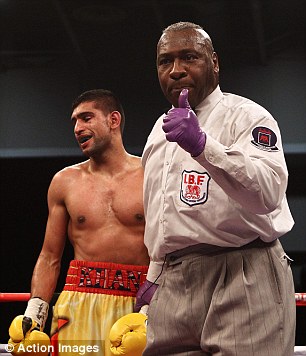
Amir Khan Was Mugged By Dubious Judging

By Jeff Powell for The Daily Mail

Not only the politics stink here. Amir Khan must have felt like going out to join the Occupy Washington protesters in their tents after his grand design for global supremacy was set back for at least a year by some of the most controversial officiating decisions the sport has witnessed.
The only consolation for Britain’s unseated world champion, after he was mugged in the darkness near Capitol Hill, is that he will be given an immediate chance to regain his unified light-welterweight title from Lamont Peterson — the local hero who benefited from the latest of the charitable donations which are another feature of life in this power-crazed city.

A referee who deducted two points from Khan for the obscure infringement of pushing off his opponent and a pair of judges who couldn’t — or wouldn’t — see straight have also put on hold the mega-millions of dollars Khan is hoping to bank from a super-fight with Floyd Mayweather Jnr.
Now, instead of challenging Manny Pacquiao’s rival as the best pound-for-pound fighter on earth next May, he can expect to face Peterson for a second time on March 31, probably in more neutral Las Vegas.

And Mayweather can now conveniently ignore Khan, at least until he regains his WBA and IBF belts from Peterson and then goes on to beat one or two more world-class boxers.

Khan’s plans have been knocked so badly awry by this split-decision defeat in a real thriller — the excitement of which has been lost in the controversy of yet another of the injustices which have plagued boxing of late — that his career may have to be prolonged beyond his nominated retirement age of 28. Khan reached his 25th birthday last Thursday and is unlikely to land his bonanza fight before 2013, at the earliest.
Trainer Freddie Roach insists: ‘Yes, Amir can get back on track by beating Peterson and still become the next pound-for-pound king.’

But the road to that summit is even steeper now.
Instead of going straight to Mayweather or easing himself up to welterweight against a manageable British opponent like Matthew Hatton, Khan is obliged to stay at 10 stones and strive to regain — and then defend — his light-welter titles.

That may be a blessing in disguise. Although Khan’s courage and relish for battle contributed to another Fight of the Year candidate, he does not look as ready for Mayweather just yet as he and Roach had imagined. Not that Floyd Jnr will be willing to accommodate him for a while now.

This defeat, however unfair, moves Khan back in the queue for glory. It also puts more testing obstacles in his path.
Although my scoring was within a point of the one judge, Nelson Vasquez, who voted 115-110 in favour of Khan on Saturday, he must expect another tough night against Peterson.

And although he says ‘I hope Lamont has the nerve for coming to England that I showed in giving him this chance in his home town,’ the reality is that the rematch will go to Las Vegas, not least on economic grounds. This first fight was a real barn-burner and HBO will be as keen as Sky in Britain to do it all over again. That is a somewhat enriching consolation for Khan as he nurses his wounds and his grievances.

But then, assuming he beats Peterson, the most logical fight will be against Timothy Bradley in a bid to become the undisputed world champion at light-welter. And it was Bradley who stamped the only loss on Peterson’s record, with a hefty points victory two years ago.
Bradley is like Peterson — albeit a superior version. He is a hungry street-fighter who uses his head as a third fist and Khan reasoned how that tactic obliged him to push Peterson back ‘to avoid a head coming in lower and lower’.

That does not explain local referee Joe Cooper’s decision to penalise a professional prize-fighter for pushing, something rarely if ever witnessed outside the amateur ranks. Nor does it excuse judges George Hill and Valerie Dorsett giving Peterson the verdict by a single point, 113-112, following the deductions.

Although Peterson was mightily persistent, there were periods when Khan boxed his ears off. Even as he intensified the ring-quartering pressure in the middle rounds, there were spells when Khan boxed almost as beautifully as Muhammad Ali to stay away from trouble and land his combinations.
And when Khan was caught by Peterson’s big shots, he proved once again that his supposedly suspect chin is as punch-resistant as any in this hard old game. Scoring a fight is a subjective business but there is a growing need for boxing to take steps to make judging and refereeing as fair and impartial as possible.

It was a mistake by Team Khan to accept the hometown referee who not only gave Peterson his two-point advantage, but who ruled that the local homeless boy made good was knocked down only once, not twice, in the first round.
Every little point counts in fights like this.

Neutral, scrupulous officials have to be the first part of a solution to the decisions which are not only cheating honest fighters like Khan, but are damaging boxing’s credibility in the eyes of the public. From Watergate to Khangate, Washington has much to answer for in the political and sporting arenas.

Are Pakistan’s Nuclear Weapons Secure?

Qaiser Farooq Gondal for The Washington Times

Pakistan is again facing the possibility of instability, raising concerns that its nuclear weapons are not in safe hands. Once again the ability of Pakistan’s army to secure the weapons is in doubt. The big powers of the world often ask whether Pakistan will be able to overcome this new danger or not. They also worry that if Pakistan suffers from instability, crisis will bleed over the border to Afghanistan.

After the 1979 Islamic revolution of Iran, the world was very much worried as to the spread of the effects of Iranian revolution to Pakistan. But 32 years after revolution in Iran, Pakistan is still safe and free from the effects of revolution in Iran.

In 1979, after the invasion of Afghanistan by the former USSR, alarmists feared that the Soviets would reach the hot waters of Arabian Sea. In fact, USSR did not threaten Pakistan, and it was because of Pakistan’s army that the USSR failed in Afghanistan and retreated back in 1989.

America has been concerned about the safety of Pakistan’s nuclear weapons since 2004, and there have been media reports that America has plans to send special security forces to safeguard the nuclear arsenal in case of instability in Pakistan. But America has denied any such reports and Pakistani authorities ridiculed the idea of US troops coming to the country to help safeguard nuclear weapons. Pakistan argues it can protect its own nuclear weapons, and earlier this month, the Pakistani government stated that it will train 8,000 additional troops to protect its nuclear weapons.

One major priority for the United States is to ensure that Pakistan’s nuclear weapons do not reach the hands of terrorists. Multiple attacks on Pakistani military facilities in recent years heightened those fears. In reality, none of the attacks were of any serious nature and all the culprits were captured and trialed in military courts.

China has played a major role in the development of Pakistani nuclear weapons, as the western countries made it impossible to export nuclear weapons and technology to Pakistan. China is also supporting Pakistan to construct institutes to generate nuclear energy as Pakistan is facing shortages of energy.

The main reason for acquiring nuclear weapons by Pakistan is to prevent any future attack by India. There has been no war between India and Pakistan since both the nations conducted nuclear tests and residents of both countries hope nuclear weapons will continue to deter any attacks.

Since 2001, the US has supplied Pakistan with about 100 million dollars to safeguard its nuclear weapons. Pakistan has developed a weapons release program which requires checks and balances. Pakistan is meeting the international standards in order to fulfill the international pressure over the issue of the security of its nuclear weapons.

Pakistan has been developing strategies to survive a possible nuclear war, as it has developed hard and deeply buried nuclear launch facilities to retain a nuclear strike capability after a nuclear attack.

Pakistan is increasing its capacity to produce plutonium, a fuel for atomic bombs at its Khushab facility and is believed to have about 200 nuclear weapons.

In other words, despite continued Western fears, Pakistan retains firm control of its nuclear weapons. The country has taken extensive measures to safeguard them, and will continue to keep them out of the hands of terrorists. The US should stop worrying and trust Pakistan to secure its own weapons.

Virginia Man Admits Conspiring With Pakistan Spy Agency

By Tom Schoenberg for Bloomberg Businessweek

A Virginia man admitted to aiding what prosecutors said was a “decades-long” operation by Pakistan’s spy agency to influence U.S. policy on Kashmir through unregistered lobbying and campaign contributions to members of Congress.

Syed Ghulam Nabi Fai, 62, pleaded guilty today in federal court in Alexandria, Virginia, to one count of conspiracy to defraud the U.S. and one count of impeding the administration of tax laws. He faces as long as eight years in prison when he’s sentenced on March 9. U.S. District Judge Liam O’Grady agreed to let Fai remain free until sentencing.

Fai admitted to helping funnel at least $3.5 million from Pakistan’s government through the Washington-based Kashmiri American Council to sway the attitudes of U.S. lawmakers on the disputed territory with campaign contributions and other lobbying activities.

The council, which was headed by Fai at the time of his arrest in July, is “actually run” by elements of the Pakistani government, including Pakistan’s military intelligence service, the Inter-Services Intelligence Agency, or ISI, prosecutors said.

Pakistan and India, which have split control of the territory since 1948, fought wars over Kashmir in 1965 and 1999.

‘Paid Operative’

“For the last 20 years, Mr. Fai secretly took millions of dollars from Pakistani intelligence and lied about it to the U.S. government,” U.S. Attorney Neil MacBride said in a statement. “As a paid operative of ISI, he did the bidding of his handlers in Pakistan while he met with U.S. elected officials, funded high-profile conferences, and promoted the Kashmiri cause to decision-makers in Washington.”

Fai, a Pakistani immigrant and U.S. citizen living in Fairfax, Virginia, was charged in July with conspiracy to violate the Foreign Agents Registration Act and lying to federal agents. He was charged along with Zaheer Ahmad, 63, a U.S. citizen who remains at large, according to prosecutors. The pair failed to disclose their affiliation with Pakistan’s government as required by law, prosecutors said.

On Nov. 23, the government separated Fai’s case from Ahmad’s and added the charge of impeding the Internal Revenue Service.

As part of his plea, Fai agreed to pay about $200,000 to the IRS and forfeit about $143,000 the government seized from five bank accounts in Virginia and Washington, according to court papers. Fai also agreed to cooperate with any federal investigation.

Fai’s Admission

Fai said little during today’s plea hearing. He answered “No sir” when O’Grady asked if he disagreed with any of the information contained in the statement of facts submitted by the government outlining the conspiracy and his ties to the ISI.

Fai admitted that during an interview with Federal Bureau of Investigation agents in July, he “falsely denied” that he or the council received money from the ISI or the government of Pakistan, according to the statement of facts.

A search of Fai’s home, office and a storage facility turned up documents detailing the council’s Washington strategies, including budget requirements for contributions to members of Congress and trips to Kashmir for lawmakers, money for opinion pieces distributed to the media, as well as money for seminars and conferences, prosecutors said in a court filing. One document found in the search called for $100,000 for contributions to members of Congress in 2009, prosecutors said.

Annual Budget

Fai, who admitted the conspiracy took place from 1990 until July 18, said he submitted annual budget requests of about $500,000 to $700,000 to officials of the government of Pakistan, including the ISI.

Since the mid-1990s, Ahmad, an American living in Pakistan, has moved government funds through a network he ran to Fai and the council, which also has offices in London and Brussels, prosecutors said.

The council’s goal is to build support for Pakistani interests in Kashmir and offset lobbying by India over the disputed territory, the U.S. said in court papers.

Fai has donated more than $10,000 to federal politicians in the past five years, according to data compiled by the Washington-based Center for Responsive Politics.

Among his political contributions, Fai, in 2008 and again in 2010, gave $2,000 to U.S. Representative Dan Burton, an Indiana Republican, according to the center. He also gave $5,000 to the National Republican Senatorial Committee in 2006, followed by a $1,000 contribution in 2008. He gave $250 to President Barack Obama’s campaign in 2008 and $250 to the Democratic Senatorial Campaign Committee in 2009.

The case is U.S. v. Fai, 11-00561, U.S. District Court, Eastern District of Virginia (Alexandria).