Archive for the ‘ Peace ’ Category

Analysis: Turkey Looks East, Snarling Key US Goals

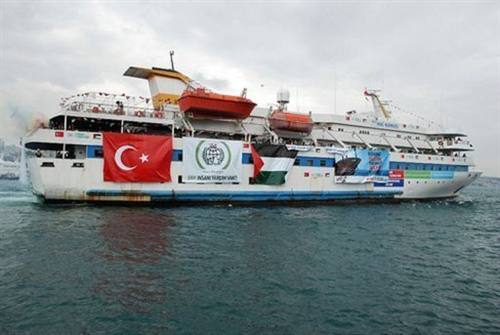
By Steven R Hurst for The Associated Press                                                                                                                                                                                                                                                    President Barack Obama scored two key foreign policy victories this week _ a new round of U.N. sanctions on Iran even as he kept Israeli-Palestinian talks on life support after the Israeli attack on Turkish ship carrying aid to Gaza.  The unintended costs may be heavy.
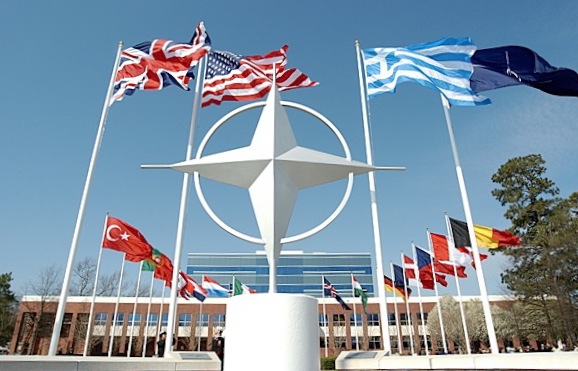
Both issues threaten key alliances with Muslim Turkey. And both test the ability of the U.S. and Israeli to cope with Ankara’s move out of the Western and NATO orbit toward largely Islamic regions of the Middle East and Central Asia. That matters because the United States is losing sway with its longtime NATO anchor, a democracy that bridges Europe to Asia and the Middle East.

Israel too is struggling to avoid Turkey’s threatened estrangement _ a break that would cost the Jewish state its only Muslim military ally. Turkey was one of the first countries to recognize Israel after its establishment more than six decades ago. The widening fissures in both alliances likely carry heavier psychological than strategic implications for the time being, particularly for Israel.

Here’s why. Turkish Prime Minister Recep Tayyip Erdogan “suddenly is the most popular politician in the Arab world and he doesn’t speak a word of Arabic,” asserts Henri Barkey of the Carnegie Endowment for International Peace.

Erdogan’s popularity grew exponentially after the Israeli commando raid on a Turkish-sanction flotilla of aid ships bound for Gaza. Muslims across the Middle East are holding him up as a hero for his tough talk against the Jewish state in their midst. That’s a stunning reversal. Turks, who migrated into modern day Turkey from Central Asia centuries ago, had always been seen in the Arab world as heirs to the Ottoman empire that had oppressed Arabs for 400 years.

Erdogan received a thunderous reception from fellow Muslim leaders Thursday at the Turkish-Arab Economic Forum that opened with calls for an international investigation of the May 31 Israeli raid that killed eight Turkish activists and a Turkish-American teenager. Erdogan’s Islamic-rooted Justice and Development Party came to power in 2002 in a landslide victory, a clear shift away from Turkey’s secular traditions that were established in the modern state, the post World War I and shrunken remnant of the Ottoman Empire.

The political shift was a clear precursor of Turkey’s move toward a more comfortable and powerful place in the Muslim world, despite continued efforts for membership in the European Union. Erdogan has since taken to championing the Palestinians’ cause, often more loudly than their fellow Arabs. That had badly strained Israeli-Turkish relations even before the crisis that blew up around the Gaza aid flotilla.

Then there was Turkey’s insertion of itself into the effort to move Iran away from uranium enrichment and its alleged program to build a nuclear weapon. After Iran rejected a deal to swap nuclear fuel last fall, the United States was determined to impose a fourth round of U.N. sanctions on Tehran. Washington had the backing of fellow U.N. Security Council members France and Britain all along and was on the verge of announcing that Russia and China also were on board.

Turkey, with help from Brazil, suddenly announced that it had revived the swap deal and that Iran had agreed. That agreement, more than a half year after initially rejected by Iran, was deeply flawed.

And the next day the United States said a new sanctions package had unanimous support from all five permanent Security Council members. It thanked Turkey for its efforts but said the train had already left the station. When the council voted earlier this week, only Turkey and Brazil cast no votes. Those did little but register protest since neither country holds a veto.

In spite of its rhetoric and obstructionism, Turkey does not appear ready any time soon the break fully from the West. It has vast interests intricately woven into NATO and the European Union. Turkey has a customs union agreement with its top trading partner, Europe, and wants to become part of the EU. But there is no doubt that the tone in Turkey’s foreign policy is changing.

Although the United States has been its chief ally since the Cold War, Turkey opposed the U.S. invasion of Iraq through Turkish soil, triggering tensions with Washington. Until the late 1990s, Turkish relations with Iran were tense, with its secular, westernized government accusing Tehran of trying to export its radical Islamic regime to this predominantly Muslim but secular country. Today, Turkey wants to build deeper trade ties with Iran.

Erdogan also is building support for next year’s election by playing the Islam card _ one that appeals heavily to traditionalist, rural and Muslim voters who make up the vast majority of the electorate. “This is not being driven by foreign affairs,” said Jonathan Adelman, professor at the University of Denver. “Erdogan is winning points at home _ going back to the country’s Muslim roots.”
Indian PM Manmohan Singh Renews Kashmir Talks Offer

As reported by BBC

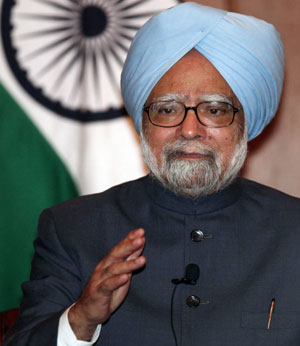
Indian Prime Minister Manmohan Singh has renewed an offer of talks with Kashmiri separatists who shun violence. He made the comments during a visit to a university in Indian-administered Kashmir. He is on a two-day trip to the state to review development schemes. Separatists have called a shutdown. The PM has disappointed those who expected him to announce a political package, the BBC’s Altaf Hussain in Srinagar says.

“We felt that the people of the state are not only interested in financial assistance and development projects, but also desire a political process that meets their aspirations,” Mr Singh told gathering at the agricultural university in Srinagar.

“We want to take the dialogue process forward. We are ready to talk to representatives of all sections who are opposed to terrorism and violence,” he said. ‘Strict instruction’  The prime minister repeated his government’s policy of “zero tolerance” for human rights violations.

“The security forces in Jammu and Kashmir have been strictly instructed to respect the rights of the civilians. We’ll act to remove any deficiency in the implementation of these instructions,” he said. The PM’s visit was greeted by protests against human rights violations  The prime minister’s visit came a day after the Indian army suspended a senior officer accused of killing three civilians in a staged gun battle.

The incident happened at Machhil near the Line of Control, the de facto border which separates Indian-administered Kashmir from Pakistani-administered Kashmir, in April. The Muslim-majority Kashmir Valley staged a total shutdown to protest against the prime minister’s visit. The strike was called by a hardline separatist leader Syed Ali Shah Geelani.

Mr Singh’s visit has also disappointed the moderate faction of the separatist Hurriyat Conference, headed by Mirwaiz Umar Farooq, our correspondent says. Mr Farooq had urged the prime minister to announce a political package during his visit.

He had demanded withdrawal of troops from cities and towns and release of political prisoners to facilitate talks between the separatist leadership and the government, our correspondent adds. Violence has declined in Kashmir in recent years, but analysts say militants opposed to Indian rule are now trying to regroup. There has been a spate of clashes in recent months along the LoC. Hundreds of thousands of Indian troops are based in Kashmir, where there has been a two decade-old insurgey against Indian rule.

India, Pakistan And U.S. Strategic Dialogue

By Apoorva Shah for The American Enterprise Institute

At this week’s first U.S.-India Strategic Dialogue in Washington, D.C., talks between the two countries will cover the spectrum of bilateral and multilateral issues, from trade and economic cooperation to terrorism and regional security. 

American participants may even feel the need to bring up India’s strained relationship with Pakistan. But it would serve them well to first consider a Times of India story from earlier this year, which went almost unreported in the United States.

According to an interview in the Indian newspaper with former Pakistani foreign minister Khurshid Mahmud Kasuri, India and Pakistan in 2007 were days away from reaching a comprehensive accord on their territorial dispute over Kashmir, the axis of the countries’ six-decade-long rivalry and casus belli of three wars between the two nations.

Kasuri, Pakistani leader General Pervez Musharraf’s chief diplomat from 2002 to 2007, said in April that the secret deal had been in progress for more than three years and would have led to a full demilitarization of both Indian- and Pakistani-occupied areas of Kashmir and would have awarded the region a package of loose sovereignty at a point “between complete independence and autonomy.” Not only were Indian and Pakistani leaders on board (including, most importantly, the Pakistani military), so was every Kashmiri leader except for one hard-line separatist, Syed Ali Shah Gilani.

The accord was slated to be signed during Indian Prime Minister Manmohan Singh’s scheduled visit to Islamabad in February and March of 2007, but before the trip ever occurred, a country-wide lawyers’ protest in Pakistan had turned into a broader opposition campaign against General Musharraf. The rest of the year would be one of the most tumultuous in Pakistan’s history, marked by the siege of the Red Mosque in July, the return of former Prime Minister Benazir Bhutto in October and her subsequent assassination in December, and the return of popular leader Nawaz Sharif from exile in September.

By August of the following year, public opposition had peaked, and Musharraf was forced to resign his post as president, ending his decade-long tenure as leader of Pakistan. After Musharraf’s ouster, it appears that the deal had lost much of its momentum.

Then in November, the accord suffered another setback as ten Lashkar-e-Taiba terrorists took India’s largest city, Mumbai, hostage for almost 72 hours, killing more than 160 people and injuring scores more. The attack was quickly coined “India’s 9/11,” and the evidence pointed directly to Pakistan, where the gunmen had been trained and equipped.

In protest, India cut off all diplomatic talks with Pakistan almost immediately; there were even rumors that the country was preparing military action against its northern neighbor. Within a span of less than two years, the India-Pakistan relationship had traveled the spectrum from apparent rapprochement and compromise to mutual suspicion and renewed hostility.

Since then, the signs have only appeared to worsen: for example, in 2009, when Indian Army chief General Deepak Kapoor publicly introduced revisions to his country’s “cold start” military strategy.

This military modernization and training program, which was developed in response to the army’s sluggish mobilization to the Pakistani border following the December 2001 terrorist attacks on the Indian parliament, remained mostly under the radar for most of the early 2000s, relegated to defense journals and the occasional news article.

It was only following the 2008 attacks that “cold start” began to receive renewed attention from the media on both sides of the border and was more publicly discussed by Indian military officials like General Kapoor. Indeed, it appeared as if the next breakthrough in Indo-Pak relations would occur through hard rather than soft power.

Concomitantly, India and Pakistan’s post-Mumbai attempts to return to diplomatic talks also appeared fraught with danger and seemed to only fuel more discord rather than reconciliation.

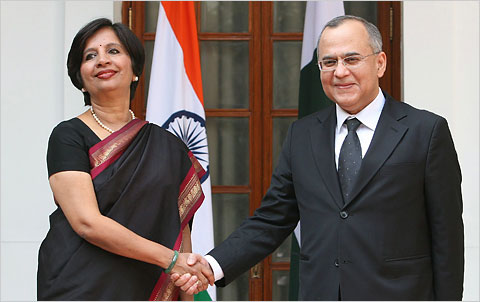
In February this year, Indian Foreign Secretary Nirupama Rao and her Pakistani counterpart Salman Bashir resumed high-level talks for the first time since November 2008, but both sides appeared unprepared (they could not even agree on the specific subject of the talks prior to sitting down) and spent more time bickering through separate press conferences.

For example, while Bashir accused India of covertly supplying weapons to militants in Pakistan’s Balochistan province, Rao complained that Pakistan had “not gone far enough” in the 2008 Mumbai attack investigation. As India presented a dossier of evidence against one of the Mumbai attack perpetrators, Pakistan responded by calling it a “piece of literature not a dossier.”

It’s hard to see how any progress could be made on improving Indo-Pakistani relations in the midst of this hostility. But does Kasuri’s revelation provide hope that a resolution on Kashmir could be revived? First, excepting Musharraf and Kasuri, many of the supporters of the failed 2007 accord—including Pakistani Army Chief of Staff Ashfaq Kayani, Pakistan’s current track II special negotiator Riaz Mohammed Khan, and, on the Indian side, Prime Minister Singh—still hold high-level positions in their respective governments.

And second, the secrecy of the original deal shows that outward indifference, or even enmity, between the two countries can belie an internal desire for change. In a relationship where hostility is status quo and where amicable relations seem aberrant if not bizarre, a furtive accord lets ruling elites make slow, institutional changes in the relationship while preserving outward form and precedent. It also allows deal-makers to keep tempestuous domestic politicians and party leaders at arms length while deliberating sensitive issues.

Even India’s traditionally hyperactive media seems to understand: A subsequent editorial in the Times of India noted, “the fact that such a deal exists emphasizes the importance of maintaining contact with Islamabad.”

So what can we expect in the months ahead? Indian officials will undoubtedly continue to pressure Pakistan to confront Lashkar-e-Taiba and other terrorist groups that plan to attack India, and another attack could indeed result in Indian military action. There will also be more bickering between the sides—on water rights, “most-favored-nation” clauses, and even cricket.

Yet the revelation of the secret deal should be both a lesson and a sign of hope. It is a lesson because it proves that progress on an entrenched conflict like Kashmir can occur without the United States’ public mediation.

American officials at the U.S.-India Strategic Dialogue this week should keep in mind that the accord was pursued during the final years of the Bush administration, in which the United States made it a point to separate the U.S.-India relationship from the more sensitive Indo-Pak relationship.

It is a sign of hope because, despite the outward appearance of discord between the countries, internally, leaders on both sides have—at least at some point in recent memory—wanted to move forward on a resolution.

As Pakistan continues its domestic offensive against terrorists and India pursues closer economic engagement with its northern neighbor, wanting change may be the best sign that change is on the way.

Facebook in Pakistan: Islamists vs. Liberals

By Adam B Ellick and Ahmad Ziadi for The New York Times

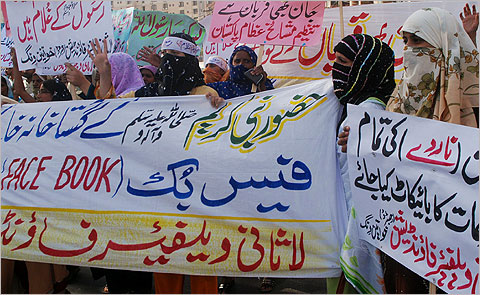
When Facebook was recently banned in Pakistan for hosting a “Draw Muhammad Day” fan page, one thing became very clear: Islamists here operate with organized precision, able to mobilize the masses in an instant, while the liberal voice remains paralyzed by fear and passivity.

Some media experts predicted that the ban – which a Pakistani court has now ordered the government to lift – might motivate the nation’s deeply disconnected liberal elite to take on the Islamists. After all, while members of the urban elite have been largely immune to the recent rise of violent militant attacks, the Facebook ban presented them with a personal vendetta.

In a nation without bars, and where entertainment options such as music concerts are rare, Facebook serves as a precious tool for the elite to organize discreet private events with music, drugs and alcohol. It has also helped mobilize social movements, including the lawyers’ march in 2009.

But the fervor that has followed the Facebook ban has been entirely one-sided in favor of the Islamists.

As the rest of Muslim world remains largely indifferent, tens of thousands of anti-Facebook Pakistanis protested in urban centers by burning American flags. A poll conducted by an IT portal called ProPakistani showed 73 percent out of about 8,000 voters favor a permanent ban on Facebook.

How did it get to this? There has been a widespread SMS campaign perpetuating a false narrative that Pakistan’s ban has brought a behemoth anti-Muslim company to its knees. One SMS attributes the recent fall in the Euro to the ban. Here’s another SMS I received:

THE BOYCOTT MADE BY MUSLIMS AGAINST FACEBOOK SINCE LAST 2 DAYS

CHARGE DEM A LOSS OF 2 BILLION EUROS..AND IF ITS CONTINUED AFTER 7 DAYS IT WOULD

REACH AROUND 40 BILLION EURO…. PLZ SPREAD AS MUCH AS U CAN.

Facts suggest otherwise. Facebook is not a publicly traded company, therefore, its earnings are not published. Still, some venture capitalists have valued Facebook at about $8 billion. Its annual revenue is estimated between $500 to $800 million.

In addition to the SMS campaign, this week, two new Muslim-friendly alternatives to Facebook have been launched. One of them, www.millatfacebook.com, was inaugurated by the bar association of the same Lahore court that banned Facebook. Millat means “Nation” in Urdu.

The site wooed more than 20,000 users with its slogan: “A site for Muslims by Muslims where sweet people of other religions are also welcome!!” Members are asked to specify if they drink alcohol. The founders are enraged at Facebook for curtailing Nazi-related hate speech while refusing to curb the Muhammad cartoons.

Their website says “Let’s prove to the world that if we can generate revenue for Facebook.com then we can also run our own website. Prove to the world that we are independent Muslims…” The other alternative site, www.Buddyflick.com , aims to “create/build/run our own network.” But where are Pakistan’s liberal and moderate voices?

Speaking out against the ban can be as hazardous as the forbidden cartoons. When those against the ban held a small news conference, the press mostly ignored it. After the press conference, several anti-ban activists were aggressively confronted by a large crowd of opposing activists as they left the venue. As tensions escalated, the anti-ban activists retreated into the building and waited for the crowd to dissipate.

One friend who is especially furious about the ban wouldn’t dare to speak out. “Nobody has the guts to go out and do something about it. The issue of Muhammad is so sensitive that you just never know.”

Instead, liberals are hashing out their frustrations in the low-traffic comment sections of liberal blogs and leftist newspapers, and, ironically enough, on their actual Facebook pages. Some have hacked into the banned site from the confines of their gated homes. Among the comment section in one newspaper is the latest joke: What’s the difference between Facebook and Lashkar  e Taiba? Answer: Facebook is banned!

Deaths as Israeli Forces Storm Gaza Aid Ship

As reported on BBC

More than 10 people have been killed after Israeli commandos stormed a convoy of ships carrying aid to the Gaza Strip, the Israeli army says. Armed forces boarded the largest vessel overnight, clashing with some of the 500 people on board. It happened about 40 miles (64 km) out to sea, in international waters.

Israel says its soldiers were shot at and attacked with weapons; the activists say Israeli troops came on board shooting. The activists were attempting to defy a blockade imposed by Israel after the Islamist movement Hamas took power in Gaza in 2007. There has been widespread condemnation of the violence, with several countries summoning the Israeli ambassadors serving there.

UN chief Ban Ki-moon said he was “shocked by reports of killings and injuries” and called for a “full investigation” into what happened.

Israeli Prime Minister Benjamin Netanyahu, who is in Canada, has cancelled a scheduled visit to Washington on Tuesday to return to Israel, officials said.

Earlier, he expressed his “full backing” for the military involved in the raid, his office said. The White House said the US “deeply regrets the loss of life and injuries sustained” in the storming of the aid ship.

A spokesman said US officials were “currently working to understand the circumstances surrounding this tragedy”.

‘Guns and knives’The six-ship flotilla, carrying 10,000 tonnes of aid, left the coast of Cyprus on Sunday and had been due to arrive in Gaza on Monday. Israel had repeatedly said the boats would not be allowed to reach Gaza.

Israel says its soldiers boarded the lead ship in the early hours but were attacked with axes, knives, bars and at least two guns.

“Unfortunately this group were dead-set on confrontation,” Israeli government spokesman Mark Regev told the BBC.

“Live fire was used against our forces. They initiated the violence, that’s 100% clear,” he said.

Organisers of the flotilla said at least 30 people were wounded in the incident. Israel says 10 of its soldiers were injured, one seriously. A leader of Israel’s Islamic Movement, Raed Salah, who was on board, was among those hurt.

Audrey Bomse, a spokesperson for the Free Gaza Movement, which is behind the convoy, told the BBC Israel’s actions were disproportionate.

“We were not going to pose any violent resistance. The only resistance that there might be would be passive resistance such as physically blocking the steering room, or blocking the engine room downstairs, so that they couldn’t get taken over. But that was just symbolic resistance.”

The footage showed a number of people, apparently injured, lying on the ground. A woman was seen holding a blood-stained stretcher.

Al-Jazeera TV reported from the same ship that Israeli navy forces had opened fire and boarded the vessel, wounding the captain. The Al-Jazeera broadcast ended with a voice shouting in Hebrew, saying: “Everybody shut up!” Israel’s deputy Foreign Minister Danny Ayalon said his country “regrets any loss of life and did everything to avoid this outcome”.

He accused the convoy of a “premeditated and outrageous provocation”, describing the flotilla as an “armada of hate”. Palestinian Authority President Mahmoud Abbas condemned Israel’s actions, saying it had committed a massacre, while Hamas said Israel had committed a “great crime and a huge violation of international law”.

Turkey, whose nationals comprised the majority of those on board, accused Israel of “targeting innocent civilians”. “We strongly denounce Israel’s inhumane interception,” it said, warning of “irreparable consequences” to the two countries’ relations

She said there was “absolutely no evidence of live fire”. Israel is towing the boats to the port of Ashdod and says it will deport the passengers from there.

Turkish TV pictures taken on board the Turkish ship leading the flotilla appeared to show Israeli soldiers fighting to control passengers.

The footage showed a number of people, apparently injured, lying on the ground. A woman was seen holding a blood-stained stretcher.

Israel’s deputy Foreign Minister Danny Ayalon said his country “regrets any loss of life and did everything to avoid this outcome”. He accused the convoy of a “premeditated and outrageous provocation”, describing the flotilla as an “armada of hate”.

Palestinian Authority President Mahmoud Abbas condemned Israel’s actions, saying it had committed a massacre, while Hamas said Israel had committed a “great crime and a huge violation of international law”.

“We strongly denounce Israel’s inhumane interception,” it said, warning of “irreparable consequences” to the two countries’ relations. Turkey was Israel’s closest Muslim ally but relations have deteriorated over the past few years.

In Turkey, thousands of protesters demonstrated against Israel in Istanbul, while several countries have summoned Israeli ambassadors to seek an explanation as to what happened.

Greece has withdrawn from joint military exercises with Israel in protest at the raid on the flotilla. Israel had repeatedly said it would stop the boats, calling the campaign a “provocation intended to delegitimise Israel”.

Israel says it allows about 15,000 tonnes of humanitarian aid into Gaza every week. But the UN says this is less than a quarter of what is needed.

Outrage in India As Mumbai Attacks Terrorist Leader Set to Be Freed By Pakistani Courts

By Manzer Munir for Pakistanis for Peace

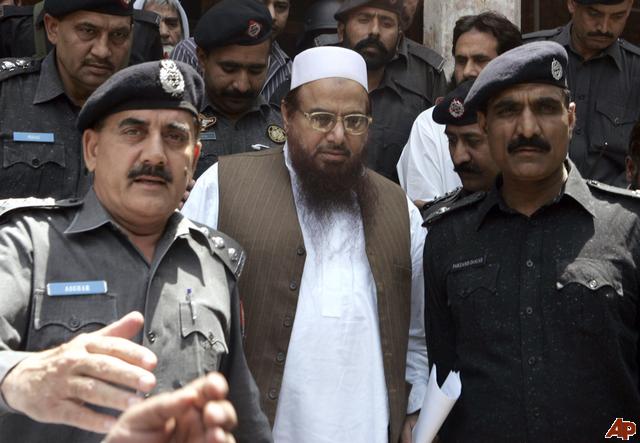
Pakistan’s Supreme Court on Tuesday upheld a lower court’s decision to free the leader of Lashkar e Taiba (LeT), a militant group that is blamed by India for masterminding  and orchestrating the November 2008 Mumbai attacks in India that killed 166 people.

Hafiz Mohammad Saeed, the leader of the terrorist group had been placed under house arrest. However, he was released a year ago by the provincial Lahore High Court due to the fact that there was insufficient evidence against Hafiz and other members of the group. The only evidence against him and the group was the confession of Mohammed Ajmal Amir Kassab, the lone person charged with attacks in India, who was given a death sentence earlier this month. Pakistan’s government appealed the decision of the Lahore High cCourt to the Supreme Court which upheld the lower court’s decision.

Lawyers for the government of Pakistan had requested that India extradite Kassab so that he could give testimony in Pakistani courts against Saeed and the militant group. However, India understandably did not hand over Kassab for fear that the sole surviving perpetrator of the Mumbai attacks could end up in a Pakistani court that sets him free. Sadly, this now happens to be the case as the masterminds of the attacks and leader of an already banned terrorist group, Hafiz Saeed, is set to be freed soon.

This obviously is very disappointing news to India to say the least. It would be the equivalent of letting the mastermind of the September 11 attacks, Khalid Sheikh Mohammed, have a long and high profile trial in New York, only to be set free for lack of evidence and or a weak case by the prosecution. The families of the victims would not stomach such a travesty and neither would the American people. In this same manner, the families of the Mumbai attacks are very upset by this decision by Pakistan the Supreme Court to release Saeed will now surelyonly serve to stall peace talks between India and Pakistan that were slowly progressing at the sidelines of the South Asian Association for Regional Cooperation (SAARC) meeting in Bhutan in April of this year.

At a time when the world’s attention is on Pakistan and Pakistanis for being associated with terrorism due to the attempt to bomb Times Square by Faisal Shahzad, the country and its courts have shot themselves in the foot by allowing to set free a known terrorist leader of a group that is not only attacking India and trying to provoke a war between the two countries, but is believed to be behind many attacks inside Pakistan also killing many innocent people.

If the shoe was on the other foot and the attackers came from India and killed 166 Pakistanis in a busy shopping area, while simultaneously attacking a major hotel, railway station and other locations throughout any of Pakistan’s major cities, then trust me, there would be demand for blood by Pakistani citizens and militias would have formed with or without the government’s blessings, and theywould have retaliated against the Indians. The Indian government and the Indian people are showing great resolve and patience with Pakistan and all along hoping that it truly becomes 100 percent committed to fighting and rooting out terrorism and terrorist groups within its borders as it is touted to be.

But as Tuesday’s decision by the Supreme Court illustrates, Pakistan’s government has a mixed record when fighting extremist groups within the country. As mentioned in previous articles on this site, the government of Pakistan and the army have supported and helped organize some of these militant groups like Lashkar e Taiba in order for the Pakistan army to have a guerrilla outfit as an ally in the event of a war with India. That is why there is reluctance by some inside the military and ISI to fully disband Saeed’s group, believed to be one of the largest and well funded militant groups in Pakistan. The government of Pakistan needs to realize that it cannot talk out of both sides of its mouth. It cannot present itself as one of the biggest allies of the US in the War on Terror, while at the same time not deal effectively with militant groups that are hostile to India.

We at Pakistanis for Peace are outraged that Hafiz Saeed, a known terrorist leader is set to be free from Pakistani courts. Our group and website Pakistanis for Peace was founded immediately after the Mumbai attacks in 2008 by concerned Pakistani Americans in response to the cowardly terrorist attacks by individuals who snuck in from Pakistan to cause one of the biggest terrorist incidents to ever hit India. These attacks certainly became their 9-11. 

To now have the leader of this terrorist group be set free by Pakistani courts only serves to strengthen the claims of opponents of Pakistan that it is not doing enough in the fight against terrorism. Certainly the families of the 166 dead Indian nationals deserve justice and better outcome than what transpired in Pakistan’s Supreme Court this week. One should make no mistake, only a just and lasting peace with India will ever lead to a prosperous Pakistan and the sooner there is an earnest effort to stop ALL militant and terrorist groups operating within inside the country by Pakistan, the sooner the two sides can sit across from each other at the peace table.

Manmohan Singh and Yusuf Raza Gilani hold the key to South Asia’s progress

By Sanjaya Baru for The Business Standard

The world is convinced that the 21st century will be Asia’s century. The only question is whether it will be only East Asia’s century or South Asia’s as well.

China’s great moderniser Deng Xiaoping famously told the late Rajiv Gandhi that “the 21st century can only be the Asian century if India and China combine to make it so”. Prime Minister Manmohan Singh can well tell his Pakistani counterpart this week that the only way South Asia can become a vibrant element of the new Asian century is if India and Pakistan combine to make it so.

As leaders of the South Asian Association for Regional Cooperation (Saarc) meet later this week in Bhutan, they must all ask themselves where this important part of Asia is headed, even as Asia to our East moves relentlessly forward.

Do any of Saarc’s members have a future that can be truly independent of their South Asian identity? Hardly. Can Pakistan hope to be part of a dynamic and rising Asia without resolving its problems at home and with India? Impossible. Can India sustain high growth for long, like China, without a more cooperative relationship with its neighbours, including Pakistan? Unlikely.

At the end of the first decade of the 21st century, South Asia stands once again at a cross roads. It can go forward, along with the more dynamic economies of East Asia, and emerge as the second engine of global growth by the middle of the century, or it can remain in a low-level equilibrium of poverty, conflict and perpetual instability.

If there are any political leaders or strategic analysts in any of the South Asian countries who think that their country can break loose from the neighbourhood and have a rosy future irrespective of what happens in the region, they live in a world of make believe.

The region has had such leaders before. Many in Pakistan thought they could delink from South Asia and attach themselves to the richer Arab and Islamic world to their west. Some in India thought New Delhi too can delink itself from its neighbourhood and “Look East” for prosperity. South Asia’s smaller countries also had fanciful notions of their individual autonomy. Some, like the Maoists in Nepal and the Sinhala chauvinists in Sri Lanka, still see a future for themselves independent of the “Mother Continent”.

The saner lot, even in Pakistan, recognise that what geography and economics propose, mere politics cannot dispose.

If Saarc has to be revived and made a more dynamic regional organisation, then India and Pakistan must get their act together. Both countries have huge internal problems and there are constituencies for peace in both countries, just as there are constituencies for exporting domestic problems across the border in both. Pakistan has used terror to thwart India’s progress, but the elephant moves on at a handsome pace of 8 per cent and more, even as Pakistan has slowed down to 2-3 per cent growth in recent years.

The last few years have, however, shown that the two neighbours owe it to their own people and their region as a whole to amicably resolve their differences, if each of the two countries and the region as a whole have to move forward.

The starting point of any meaningful dialogue between India and Pakistan is for the two to recognise each other’s concerns. Pakistan must demonstrate much greater understanding of India’s concerns about cross-border terrorism and the need to convince Indian public opinion about its sincerity in dealing with the planners and perpetrators of the 26/11 Mumbai and several other terrorist attacks.

Equally, India must address Pakistan’s genuine fears about river water utilisation and deal convincingly with the issue of Kashmir. Pakistan must rid itself of baseless fears about Indian attempts to destabilise it because any destabilisation of Pakistan can only hurt India even more.

The dialogue between Dr Singh and former Pakistan President Pervez Musharraf began with the mutual acknowledgment of these realities and each other’s concerns. It reached a critical point of mutual agreement when President Musharraf got dethroned.

It appears Prime Minister Yusuf Raza Gilani is fighting shy of picking up the threads from where President Musharraf had left them off. Much water has flown down the Indus and US President Barack Obama’s AfPak policy has muddied the waters. It has certainly encouraged Pakistan to overplay its hand.

Dr Singh should remind his counterpart that despite all the money the US is pouring into Pakistan, its economy is in doldrums, with mounting debt, 3 per cent growth and 9 per cent inflation. Pakistan has itself become a victim of the jihadi terrorism and internal conflict.

If realism on Pakistan’s part implies getting a reality check on India’s relative size and success, realism on India’s part implies coming to terms with Pakistan’s power to be a spoiler. Dr Singh and Mr Musharraf came around to getting a balanced and correct view of each other’s strengths and weaknesses. They worked out a realistic modus vivendi. Mr Gilani and his friends in the Pakistan army must catch up and get real.

A realistic and pragmatic leadership in the region is one which tries to resolve cross-border issues so that domestic problems can be handled better. The challenge for every Saarc government is at home and unless domestic problems are tackled, the region will not progress or congeal.

India and Pakistan bear a special responsibility to revitalise Saarc as the region’s biggest nations. The India-Pakistan quarrel has made Saarc non-functional. A resolution of the disputes between the two is vital to the region’s development.

It was in April 2005 that Dr Singh and Mr Musharraf began writing a new chapter in South Asian history. April 2010 would be a good month to get that project back on track.

Time to end the impasse with Pakistan

By Siggharth Varadarajan for The Hindu.com

Forget Kashmir and terrorism or even Afghanistan and water, the current stalemate between India and Pakistan is all down to one word. Both countries publicly say that Dialogue is the only way forward. Yet each is paralysed by the name Composite’. New Delhi is so allergic to it that it will not accept its use, while Islamabad has become so attached to the C word that it insists there can be nothing else.

This Indian allergy and Pakistani attachment is paradoxical, since the composite dialogue approach has suited India more than it has Pakistan. Under the guise of moving ahead simultaneously on all issues, the framework has allowed progress on trade and other subjects considered important by New Delhi, even as the status quo on major disputes like Kashmir and Siachen key concerns for Islamabad has held. Of course, the dialogue did not end cross-border terrorism or extinguish the links between the Pakistani security agencies and violent extremism as some on the Indian side might have hoped. But that was always an improbable shot given the DNA of the Pakistani establishment. Over time, India has realised the best way to deal with the threat of terror is by strengthening its internal capabilities while utilising engagement as a lever for influencing Pakistan’s behaviour over the long run.

The two most important issues for the Pakistani side today going by its public statements are Kashmir and water. But here’s the paradox: the composite dialogue, from its point of view, has produced no forward movement whatsoever on these two fronts. In four and a half rounds of talks within that framework, the total amount of time spent by the two foreign secretaries in discussing the Kashmir dispute has perhaps been 10 hours. During which neither side did anything beyond restating its national positions. As for water, it does not even figure as a separate head under this format. The only water-related dispute covered by the composite dialogue is the Tulbul navigation project, also known as the Wullar barrage. There, too, progress has been insignificant.

In contrast to the composite dialogue framework, the back channel between Satinder Lambah and Tariq Aziz was far more effective and productive. Between 2004 and 2007, the two special envoys, who reported directly to Prime Minister Manmohan Singh and General Pervez Musharraf respectively, discussed Kashmir for hundreds of hours. More significantly, their exertions produced a framework solution that was cleared on the Indian side by the Cabinet Committee on Security and on the Pakistani side by the Corps Commanders conference, before domestic political difficulties triggered by his dismissal of the chief justice forced Musharraf to back off. As for water, the Indus Water Commissioners have been meeting continuously for more than 40 years and their forum represents the best platform for Pakistan because all the Indian projects it opposes on the Indus, Chenab and Jhelum rivers can be referred to an outside arbitrator whose decisions are final and binding. Compared to such a powerful dispute resolution mechanism, the existing dialogue framework is surely inferior. And yet, even though Islamabad’s best shot at making progress on water and Kashmir lies outside the composite dialogue, it has got locked into a situation where it is refusing any form of engagement or talks other than that.

Now let’s consider India. The Indian position has been in a state of flux since it suspended the composite dialogue following the terrorist attacks on Mumbai in November 2008. Broadly speaking, however, India has maintained that there can be no resumption of the composite dialogue till Pakistan moves to punish the Mumbai conspirators and dismantles the infrastructure of terror on its soil. In September last year, Prime Minister Manmohan Singh made a distinction between meaningful dialogue on disputes, which would have to await Pakistani action on terrorism, and talks on humanitarian and other issues. Since then, the Indian position has evolved further. When Pakistan’s Foreign Secretary, Salman Bashir, was invited to Delhi in February 2010, India clarified that while its own priority was terrorism, it was ready to discuss all issues with Pakistan. That is still the official Indian position. At a press conference on April 22, Foreign Secretary Nirupama Rao said dialogue represents a concrete method to move forward in our relationship It is always useful. It helps clear the atmosphere and especially between neighbors, such as India and Pakistan. Dialogue is really the only way forward.

But if India believes dialogue is really the way forward, why is it unable to accept Pakistan’s call for the composite dialogue to be resumed? The paradox here is that from the traditional Indian perspective, the composite dialogue has worked pretty well. Discussions on Kashmir have not led to any change in the territorial status quo but have provided a cover for India to move ahead with other parts of the bilateral agenda that suit it more, like trade and cross-border confidence-building measures. And if the Indian side is opposed to talks on the water issue’, the composite framework of dialogue is ideal because water does not figure as a standalone topic under any of the subject heads. Despite this, India is the one saying no to composite’ dialogue.

India suspended the composite dialogue in order to get Pakistan to take action against terrorism. Some action has been taken but the Manmohan Singh government rightly believes that Pakistan can and must do more. It also knows the continued absence of dialogue is unlikely to produce greater action on the terrorism front and might even be counter-productive. Yet it fears the resumption of the suspended dialogue will be seen as a sign of weakness by the Opposition.

India’s options have been further complicated by the hardening of the Pakistani position on cooperation and dialogue since November 2009, when Barack Obama’s new AfPak policy dealt the military establishment in Rawalpindi a stronger hand in the Afghan endgame. Even as the Pakistan army has stepped up its offensive against the Tehreek-e-Taliban and, to a lesser extent, anti-American extremists on its border with Afghanistan, it has played up the India threat’ card to balance the perception that it is too subservient to the U.S. The rhetoric on water, the Azm-e-Nau III exercises, the loosening of the leash on Lashkar-e-Taiba chief Hafiz Saeed and the increase in infiltration across the Line of Control are all evidence of the hardening of the Pakistani military’s attitude. At the same time, the domestic political situation in Pakistan is fluid. The 18th amendment to the constitution has opened up the possibility of the civilian government and the provinces strengthening themselves vis-a-vis the military. The revival of the Benazir Bhutto assassination case in the wake of the recent U.N. report could also provide political ammunition against the establishment.

In the run up to this week’s Saarc summit in Bhutan, where Prime Minister Manmohan Singh will meet Yusuf Raza Gilani on the sidelines, Indian officials are resigned to keeping the bilateral relationship in a holding pattern.’ Their logic is that if relations cannot improve, then they should not be allowed to deteriorate either. As a short-term strategy, the holding pattern strategy works fine. There are always small things that can be done at that level too. But an aeroplane cannot circle the runway endlessly. The longer it is up in the air, the greater is the likelihood of a disastrous descent. That is why planning for an orderly landing is a much better strategy.

In Thimphu, Dr. Singh must try and find a way of doing that. One possibility is for the two prime ministers to task their foreign secretaries with reviewing what has been accomplished on the terrorism front as well as in the last few rounds of the composite dialogue, with a view to expediting the resolution of existing problems and disputes. Such a mandate would foreground the necessity of a dialogue addressing all outstanding issues while sidestepping, for the moment, any nomenclatural disagreement. It would accomplish the stated Indian objective while allowing Mr. Gilani to return without having surrendered Islamabad’s stand on the resumption of the composite dialogue.

Parallel to this process, the Prime Minister should meet with the leaders of all major political parties in order to explain the reasons why India and Pakistan need to end the current stalemate. Finally, a strict moratorium on grandstanding and posturing, finger-pointing and name-calling is necessary. When the Prime Minister is directly crafting India’s approach to Pakistan, ministers, officials and anonymous sources’ must not confuse the public with contradictory messages and statements.

Behind the Scenes of a Pakistani Suicide Bombing

By Chris Brummit and Asif Shahzad for The Associated Press

Abdul Baseer sent the grenades and explosive vest ahead, then boarded a bus that would take him to his target, accompanied by the 14-year-old boy he had groomed as his suicide bomber.

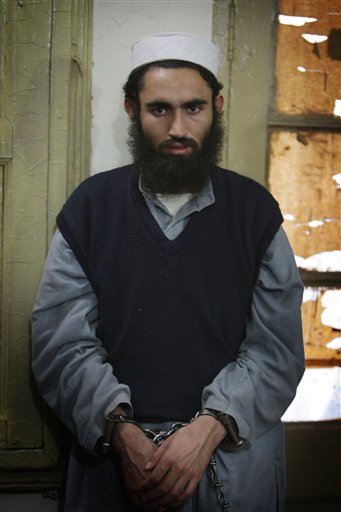
But before they could blow up their target, a luxury hotel in Lahore where they believed Americans would be staying, the two were arrested and are now in jail — Baseer unrepentant about having plotted to send a boy to his death, and the boy saying he never knew what was in store for him.

The story that unfolded in an interview with The Associated Press offers a rare insight into the world of a Pakistani militant, from his education at hard-line Islamic schools, through his professed participation in an attack on a U.S. patrol in Afghanistan, up to his arrest by Pakistani police along with the the boy, Mohi-ud-Din. His tale shares much with that of the thousands of other foot soldiers who make up the Taliban-led insurgency that is ravaging Pakistan, experts say. It also shows how the wars here and in neighboring Afghanistan bleed into each other.

The Associated Press, after several requests, was allowed to interview the two detainees, with police present for most of the meeting at a police interrogation center in Lahore, a political and military power center in eastern Pakistan. Baseer was born in 1985 close to the Swat Valley, which last year was overrun by Taliban and recaptured by the Pakistanis. The eldest of seven children, his father was a wheat farmer and earned barely enough to feed the family. Meat was reserved for guests, he recalled.

Like many who cannot afford a regular education, Baseer attended three Islamic boarding schools where children learn the Quran by heart and spend little time on secular subjects. The religious schools provide free board and lodging, but are widely criticized for indoctrinating students with an extreme version of Islam. At least one of the schools Baseer attended, Jamia Faridia in the capital, Islamabad, has been linked to terror.

“Through my studies, I became aware that this is the time for jihad and fighting the infidels, and I saw that a jihad was going on in Afghanistan,” said Basser, a rail-thin man speaking just louder than whisper. “I looked for a way to get there.” “A trip to Afghanistan is considered part of the profession for a militant,” said Imtiaz Gul, director of the Center for Research and Security Studies in Islamabad. “It is almost like you need to do it for graduation. “The American troops are there, and it’s a cause of resentment.”

Baseer said he spent three summer vacation periods in Kunar, an Afghan province just across the border from northwest Pakistan, which he reached through a network of sympathetic clerics. On his first trip, in his mid-teens, he cooked for around 30 or 40 other militants, most of them Afghans, who were living in a large cave complex. On his second stay he had military training and learned to make suicide jackets. On the final trip he took part in the ambush of a U.S. patrol after he and other fighters had lain in wait in the snow for two days.”I was happy to be in place where I could kill unbelievers,” he said. “I thank God that we all returned safely and had a successful mission.”

He said he was in the rear of the attack, in which automatic weapons and rocket-propelled grenades were fired. He said the vehicles were left smoldering and that later the assailants were told two U.S. soldiers were killed, but there was no way of confirming that.

Back in Pakistan, Baseer worked as a mosque preacher in the Khyber region, not far from the northwestern capital, Peshawar. He said it was there that he hooked up with a man named Nazir, a commander in the Pakistani Taliban, who was plotting the attack in Lahore. Baseer said he made 10 suicide vests for Nazir.

Lahore, a city of around 9 million, has suffered scores of attacks by gunmen and suicide bombers over the last 1 1/2 years. Last month, two suicide bombers killed 43 people in near-simultaneous blasts. Baseer boarded a passenger bus along with the boy, Mohi-ud-Din, heading down the smooth highway to Lahore, where they were supposed to pick up the bomb and grenades.

Police officer Waris Bharawan, as well as Baseer, said the plan was to hook up with other militants and storm the PC International, one of Lahore’s grandest hotels. They said the suicide vest for the attack was sent to the city before the strike. Baseeer gave only a rough outline of the plan: He and others were to hurl the grenades around the lobby or entrance gate of the hotel, and then Mohid-ud-Din was to run in and detonate his explosive belt. Did he feel any guilt about what lay in store for his traveling companion? No, he said. “I was feeling good because he was going to be used against Americans.”

As he sat in Bharawan’s office, handcuffed and dressed in robe and baggy pants, an officer brought in the vest, dropping it on the floor with a thud. The explosive pads studded with ballbearings looked like slices of honeycomb. Also in the evidence bag were 26 grenades. Baseer obliged with a demonstration, miming the yanking of a white cable that would detonate the vest. “My instructors used to say this was the most important weapon in the fight against the enemy,” he said. In the same lockup, a crumbling building built when Britain ruled the Indian subcontinent, police also briefly presented Mohi-ud-Din to the AP. He seemed nervous and tongue-tied, claiming only that he knew nothing about the alleged attack.

The pair were arrested as they arrived at the house of another suspect, just days before the attack was due to have taken place, said Bharawan, who led the arresting officers. He said they acted on surveillance work in Lahore, but declined to give details. Torture and beatings are common inside Pakistani jails, according to rights groups. During a short time when no police were present, Baseer was asked how he was treated. He said he was beaten, but by members of Pakistan’s shadowy and powerful intelligence agencies soon after his arrest, not by the police. Police said Baseer and the boy would be tried for terrorist offenses behind closed doors and without a jury, as is customary in Pakistan

India and Pakistan’s Leaders Meet

As reported by BBC.com

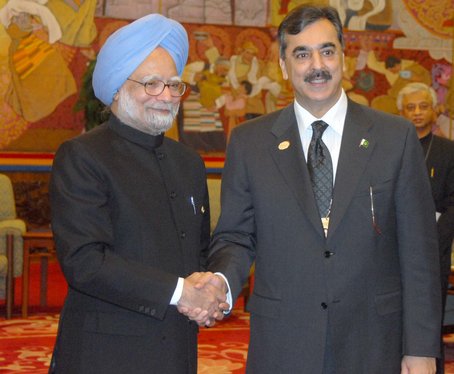
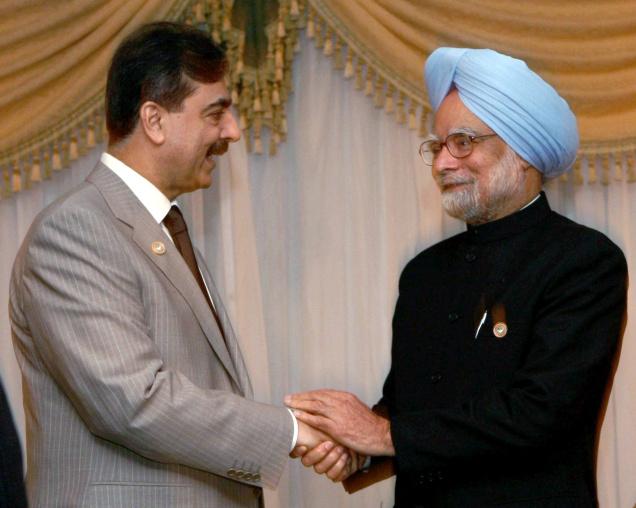
Pakistan PM Yousuf Raza Gilani spoke to his Indian counterpart Manmohan Singh at a reception hosted by the US President Barack Obama, reports said. The prime ministers of India and Pakistan met briefly during a nuclear summit attended by 47 world leaders in Washington DC.

A Pakistani embassy spokesman said it was “not a formal meeting”. cIt comes a day after Mr Singh told Mr Obama that Pakistan’s government lacked the will to punish those responsible for the Mumbai attacks. The November 2008 attacks left 174 people dead, including nine gunmen, and soured ties between India and Pakistan. Late last year, Pakistan charged seven people in connection with the attacks.

They include the suspected mastermind Zaki-ur-Rehman Lakhvi, who is allegedly the leader of the Pakistan-based militant group Lashkar-e-Taiba. Mr Singh and Mr Gilani spoke to each other at a reception hosted by Mr Obama, Pakistani embassy spokesman Nadeem Kiani said.

“Both leaders were present at the same place and so they shook hands and talked,” he said. A spokesman for India’s foreign ministry, Vishnu Prakash, told The Hindu newspaper that the two leaders “exchanged pleasantries”.
‘State elements’

India put peace talks on hold after the attacks, blaming them on Pakistan-based militants. Pakistan admitted they had been partly planned on its soil. India has also suggested what it calls “state elements” were involved. Both Pakistan and Lashkar-e-Taiba have denied any involvement.

In February, the two sides held their first formal talks since the 2008 attacks and agreed to “remain in touch”. Leaders from 40 states are attending the meeting in Washington which is expected to focus on how to secure nuclear material.

U.S. Aims to Ease India-Pakistan Tension

By Peter Spiegel and Matthew Rosenberg for The Wall Street Journal

President Barack Obama issued a secret directive in December to intensify American diplomacy aimed at easing tensions between India and Pakistan, asserting that without détente between the two rivals, the administration’s efforts to win Pakistani cooperation in Afghanistan would suffer.

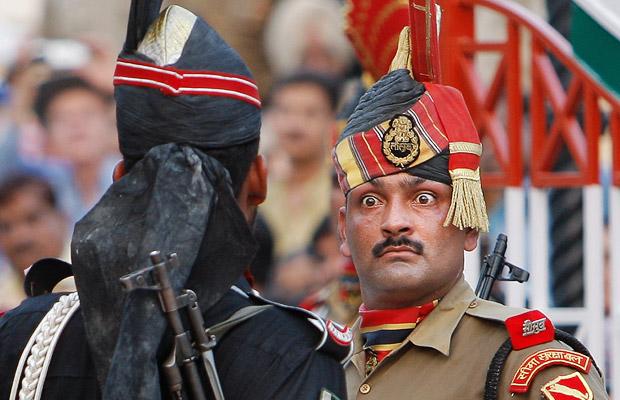
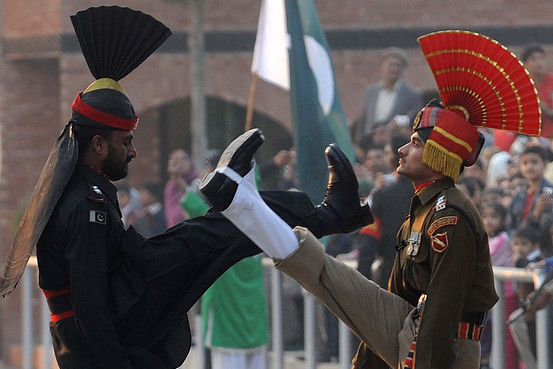
Pakistani Rangers (L) and Indian Border Security Force (BSF) personnel perform the daily retreat ceremony at the India-Pakistan Border at Wagah on December 26, 2009. The directive concluded that India must make resolving its tensions with Pakistan a priority for progress to be made on U.S. goals in the region, according to people familiar with its contents.

The U.S. has invested heavily in its own relations with Pakistan in recent months, agreeing to a $7.5 billion aid package and sending top military and diplomatic officials to Islamabad on repeated visits. The public embrace, which reached a high point last month in high-profile talks in Washington, reflects the Obama administration’s belief that Pakistan must be convinced to change its strategic calculus and take a more assertive stance against militants based in its western tribal regions over the course of the next year in order to turn the tide in Afghanistan.

A debate continues within the administration over how hard to push India, which has long resisted outside intervention in the conflict with its neighbor. The Pentagon, in particular, has sought more pressure on New Delhi, according to U.S. and Indian officials. Current and former U.S. officials said the discussion in Washington over how to approach India has intensified as Pakistan ratchets up requests that the U.S. intercede in a series of continuing disputes.

Pakistan has long regarded Afghanistan as providing “strategic depth”—essentially, a buffer zone—in a potential conflict with India. Some U.S. officials believe Islamabad will remain reluctant to wholeheartedly fight the Islamic militants based on its Afghan border unless the sense of threat from India is reduced.

Indian Prime Minister Manmohan Singh has already taken the political risk of pursuing peace talks with Pakistan, but faces significant domestic opposition to any additional outreach without Pakistani moves to further clamp down on Islamic militants who have targeted India.

U.S. and Indian officials say the Obama administration has so far made few concrete demands of New Delhi. According to U.S. officials, the only specific request has been to discourage India from getting more involved in training the Afghan military, to ease Pakistani concerns about getting squeezed by India on two borders.

“This is an administration that’s deeply divided about the wisdom of leaning on India to solve U.S. problems with Pakistan,” said Ashley Tellis, an analyst at the Carnegie Endowment for International Peace who has discussed the issue with senior officials in the U.S. and India. “There are still important constituencies within the administration that have not given up hope that India represents the answer.”

India has long resisted outside involvement in its differences with Pakistan, particularly over the disputed region of Kashmir. But, according to a U.S. government official, a 56-page dossier presented by the Pakistani government to the Obama administration ahead of high-level talks in Washington last month contained a litany of accusations against the Indian government, and suggestions the U.S. intercede on Pakistan’s behalf.

The official said the document alleges that India has never accepted Pakistan’s sovereignty as an independent state, and accuses India of diverting water from the Indus River and fomenting separatism in the southwestern Pakistani province of Baluchistan.

Secretary of State Hillary Clinton has signaled that Washington isn’t interested in mediating on water issues, which are covered by a bilateral treaty.

The White House declined to comment on Mr. Obama’s directive or on the debate within the administration over India policy. The directive to top foreign-policy and national-security officials was summarized in a memo written by National Security Adviser James Jones at the end of the White House’s three-month review of Afghan war policy in December.

An Indian government official said the U.S.’s increasing attention to Pakistani concerns hasn’t hurt bilateral relations overall. “Our relationship is mature—of course we have disagreements, but we’re trying not to have knee-jerk reactions,” the Indian official said.

According to U.S. and Indian officials, the Pentagon has emerged in internal Obama administration debates as an active lobbyist for more pressure on India, with some officials already informally pressing Indian officials to take Pakistan’s concerns more seriously. Adm. Mike Mullen, chairman of the Joint Chiefs of Staff and the U.S. government’s prime interlocutor with the powerful head of the Pakistani army, Gen. Ashfaq Kayani, has been among the more vocal advocates of a greater Indian role, according to a U.S. military official, encouraging New Delhi to be more “transparent” about its activities along the countries’ shared border and to cooperate more with Pakistan.

In interviews, U.S. military officials were circumspect about what specific moves they would like to see from New Delhi. But according to people who have discussed India policy with Pentagon officials, the ideas discussed in internal debates include reducing the number of Indian troops in Kashmir or pulling back forces along the border.

“They say, ‘The Pakistanis have this perception and you have to deal with the perception’,” said one foreign diplomat who has discussed India’s role with Pentagon officials. An Indian defense ministry spokesman said his country’s army has already moved about 30,000 troops out of Kashmir in recent years.

The State Department has resisted such moves to pressure India, according to current and former U.S. officials, insisting they could backfire. These officials have argued that the most recent promising peace effort—secret reconciliation talks several years ago between Indian Prime Minster Singh and then-Pakistani President Pervez Musharraf—occurred without U.S. involvement.

Progress, For a Price, in Pakistan

By Doyle McManus for The Los Angeles Times

In 2001, on the eve of the U.S. invasion of Afghanistan, President George W. Bush gave Pakistan’s then-leader, Gen. Pervez Musharraf, a choice: He was either with us or against us. Musharraf chose to become an ally, but the question ever since has been whether that shotgun marriage can mature into a healthy adult relationship. At times, the prospect has seemed far from reach.

The world’s second-most-populous Muslim country is caught in a brutal internal struggle between extremism and moderation. Most of its people tell pollsters they don’t like the United States and wish we’d go away. The tribesmen of its western frontier shelter Osama bin Laden and the leaders of Afghanistan’s Taliban. And the United States can’t forget how, in the 1980s, Pakistan built nuclear weapons — and then later exported nuclear technology to North Korea and Iran.

But in recent months, there has been progress in the relationship. Military and intelligence cooperation between the United States and Pakistan has increased significantly. Pakistan has allowed the CIA to increase its missile strikes against Al Qaeda and Taliban targets in Pakistani territory. Pakistani authorities have arrested several Taliban leaders and allowed U.S. intelligence officers to question them. And now Pakistan is offering to increase its own military operations in North Waziristan, the presumed lair of Bin Laden. All that cooperation came at a price, of course: a flood of U.S. military and economic aid.

And last week, the Pakistanis came to Washington to press for more. The academic criticism of the U.S.-Pakistani relationship is that it is “transactional” — nothing more than a series of bargains between buyers and sellers who don’t trust each other much. That’s still mostly true. Pakistan’s delegation arrived with a 56-page shopping list covering everything from military equipment to education and cultural exchanges. And one Pakistani official, asked during the visit whether his government was truly willing to act against the havens that allow the Taliban to maintain bases in Pakistan, replied frankly: “Yes — but at a price.”

After a series of meetings with Secretary of State Hillary Rodham Clinton, Pakistan’s ebullient foreign minister, Shah Mehmood Qureshi, declared: “I think we are going to move from a relationship to a partnership.” But he used the future tense. In the meantime, there are things to work out. Pakistan is clearly worried about what happens when the United States begins pulling troops out of Afghanistan in 2011.

Although Obama administration officials have tried to reassure Pakistan that Washington’s commitment to the region is for the long haul, uncertainty remains. “Our fear is . . . that we get into a fight with these guys [the Taliban], and you walk away, and we’re still there,” a Pakistani official said. Pakistan’s powerful army chief of staff, Gen. Ashfaq Kayani, spent part of his time in Washington visiting Congress with PowerPoint slides to show that Pakistan has committed more troops to its fight against insurgents than the United States has on the ground in Afghanistan, and that it has suffered almost 30,000 killed and wounded in the process.

According to U.S. officials, Kayani made a strong case that Pakistan can do more if it gets more modern military equipment from the United States, especially helicopters to ferry troops into the rugged badlands where Al Qaeda and the Taliban hide. The United States has helped Pakistan acquire some helicopters, but not as many and not as quickly as the Pakistanis would like. U.S. officials said they would try to speed the delivery of more. In the past, U.S. officials complained that Pakistan used much of its U.S. military aid to bolster its eastern front with India instead of its fight with internal insurgents; but since Pakistan’s 2009 offensive in the Swat Valley, that criticism has been stilled.

The delegation also added a new item to Islamabad’s wish list: a nuclear agreement under which the United States would help Pakistan develop its civilian nuclear energy industry — to mirror a similar U.S. agreement with India, Pakistan’s longtime enemy. The United States told the Pakistanis that would have to wait. The memory of having to clamp sanctions on Pakistan for its nuclear weapons program is still too fresh. But it was a sign of improving relations that the idea wasn’t rejected completely.

 In 2001, the United States sought a new relationship with Pakistan mostly because it was next to Afghanistan — and thus a country we would need for moving military supplies and basing drones. But that thinking has slowly evolved. In the long run, with its population of 170 million people — not to mention its cache of nuclear weapons — Pakistan is more important than Afghanistan.

“We’re engaging with Pakistan because we’re afraid of it,” says Christine Fair, a Pakistan expert at Georgetown University. “It’s the scariest country in the region. Because of Afghanistan, it’s been treated as if it were a subsidiary issue. But Pakistan should be the primary issue.” The Americans are working hard to convince the Pakistanis that they are interested in Pakistan’s stability for its own sake, not just because it’s next door to Afghanistan. The Pakistanis are working hard to convince the Americans that they are committed to defeating the extremists in their midst. It’s not a strategic relationship yet. If it’s a partnership, it’s still a wary one. But that’s progress.

Obama Pledges To Work With ‘Peace-Loving’ Pakistanis On Occasion of 70th Pakistan Day 3/23

By Lalit K Jha for The Press Trust of India  

Greeting people of Pakistan on the occasion of its National Day, US President Barack Obama today pledged to remain a partner of all Pakistanis who “seek to build a future of peace and prosperity”.

Sending his best wishes to the people of Pakistan and all those of Pakistani descent in America and around the world observing Pakistan National Day, Obama said: “Seventy years ago, Muhammad Ali Jinnah and those of the independence generation declared their dreams of self-determination and democracy.

“Today, the people of Pakistan are carrying on the great work of Quaid-e Azam,” Obama said in his message issued on the occasion of Pakistan National Day, being marked on March 23.

“Here in the United States, our country is enriched by the many Pakistani Americans who excel as doctors, small business owners, students, members of our armed forces and in many other fields. On this National Day, we give thanks for the contributions of these fellow Americans, and the United States pledges to remain a partner of all Pakistanis who seek to build a future of peace and prosperity.”

“In these efforts, the American people are proud to join in the education, health and economic partnerships that can improve the daily lives of Pakistanis and their families,” he said.

Lahore bombing is Pakistan’s bloodiest this year

By Saeed Shah for The Guardian

A bombing in the eastern city of Lahore has killed at least 43 people – the fifth terrorist attack this week as extremists in Pakistan demonstrate their continued ability to strike.

The bloodiest terrorist strike in Pakistan this year was carried out by two attackers wearing suicide jackets who walked into a busy market in a high security military district and blew themselves up. The target appeared to be passing military vehicles but most of the victims were civilians. Shops in the market were ripped apart, with children crossing the road and people waiting at a bus stop among the victims. About 10 soldiers were killed and 100 injured, said the Lahore police chief, Parvaiz Rathore.

“There were about 10 to 15 seconds between the blasts. Both were suicide attacks,” a senior local government official, Sajjad Bhutta, said at the site. “The maximum preventative measures were being taken but these people find support from somewhere.” The bombers struck at 1pm, around the time of Friday prayers, in the cantonment area, home to the local army garrison and one of Lahore’s most upmarket residential districts.

Lahore is the bustling cultural hub of Pakistan and had enjoyed several weeks of relative peace. It is the capital of the eastern Punjab province, Pakistan’s most densely populated area and its political heartland. The suicide bombings were followed in the evening by three smaller blasts in a residential area across town. They caused panic but damage was reported to be minor. The authorities repeated their regular assertion that the Taliban and other extremist groups have been defeated. The provincial law minister, Rana Sanaullah , said: “We broke their networks. That’s why they have not been able to strike for a considerable time.”

But it was the second bombing this week in Lahore. A car bombing on Monday at a police interrogation centre killed 14 people. Other attacks this week included a gun and grenade assault on a US Christian aid agency’s office in the north-west, killing six of its staff, all Pakistani nationals. “They (the extremists) are trying to project their power, telling the government that they are still alive,” said analyst Imtiaz Gul, author of The al-Qaida Connection. “They are still far from broken. It’s going to be a long haul.”

In 2009 that Lahore was dragged into the bloody insurgency in Pakistan, which claimed around 3,000 lives last year, with a series of spectacular attacks including a gun assault on the visiting Sri Lankan cricket team. The last major attack in Lahore was in December when a market was bombed, killing at least 49 people. The launch of a military offensive in South Waziristan, on the Afghan border, the base of the Pakistani Taliban, in October last year was accompanied by a vicious spate of terrorist reprisals but the country had been relatively peaceful this year.

Pakistan and India Are Back At the Peace Table

By Manzer Munir

Islamabad, Pakistan- India’s Foreign Secretary Nirupama Rao is scheduled to visit Islamabad later this month as both India and Pakistan are back on track to resume their high level diplomatic talks. The discussions between the two so far are considered “preliminary” and are a “first step” in the words of Secretary Rao. She had earlier restated India’s concerns about terrorist groups operating in Pakistan and provided additional information related to the Mumbai attacks. Her counterpart in Pakistan, Foreign Secretary Salman Bashir, stated that “Pakistan is doing all that it can to fight terrorism”. Expressing his sympathy with the victims of the Mumbai attacks, he focused on Pakistan’s core concern that “terrorism should be looked at more broadly”. He believes that the two countries should address the root causes of the terror campaign and, from that perspective; Kashmir is the “core issue.” Pakistani officials believe that if India was a bit more flexible on Kashmir, then all the outstanding issues between the two countries can be resolved.

India’s Prime Minister Manmohan Singh is believed to sincerely desire to make a “breakthrough” in relations with Pakistan and has been vocal about it too in recent interviews. During the elections last year, he had highlighted his efforts to promote back-channel diplomacy for conflict resolution during the rule of former Pakistani President Pervez Musharraf. He also met last year with the current Pakistani Prime Minister to pledge to resume peace talks.

In Pakistan there also appears to be a significant shift in foreign policy. The American and Pakistani militaries and intelligence agencies are working closely and have had some recent successes together to stop the al Qaeda-sponsored terrorism in Pakistan and Afghanistan. The US commanders have been full of praise of the Pakistan army and its recent offensives against the Taliban. The Pakistani army has disrupted the al Qaeda and Taliban network over most of the Federally Administered Tribal Areas. This has come at a steep price as more than 2,500 soldiers have been killed.

This sacrifice by the Pakistan army has not gone unnoticed as the United States has increased both military and economic aid to Pakistan. The US is nudging both India and Pakistan to the peace table since a peaceful border with India will allow Pakistan to focus entirely on its western border at the Taliban and Al-Qaeda in Afghanistan. This will facilitate the Obama administration’s ability to eradicate the Taliban and Al-Qaeda once and for all from the region with Pakistan army’s help.

For far too long since Pakistan’s independence, the army has always felt India to be the biggest threat to the nation’s sovereignty and freedom. But for the first time in its history, an enemy has surfaced and proven to be much more detrimental to Pakistan’s survival as a nation and security for its citizens. And that enemy and threat is the radicalized groups such as the Taliban both from Afghanistan and inside Pakistan as well as the largely Arab Al-Qaeda network that operates in the area. Also militant groups like Lashkar-e-Taiba, Jaish-e-Mohammed and others also pose the biggest threat to the nuclear armed nation. The danger from the extremists has allowed elements inside Pakistan’s army leadership to reconsider the threats to Pakistan.

The dialogue between India and Pakistan has been off again and on again for over 63 years. But in the current climate of mistrust and hatred coupled with tensions still simmering from the Mumbai attacks, there is little room for error on both sides. It is hoped that the upcoming talks prove to be a step in the right direction of normalizing relations between these two nuclear armed neighbors who share almost an 1800 mile long border known in this part of the world as the Berlin Wall of Asia.