Archive for the ‘ Taliban ’ Category

Peace In One Pakistani Tribal Valley Offers Hope
Reported by Abubakar Siddique for Radio Free Europe Radio Liberty
A fragile peace is taking root in Pakistan’s western Kurram tribal region after nearly four years of sectarian warfare between Shi’ite and Sunni Muslims.

Some have criticized a recent peace pact by saying that it is less about forging a lasting peace than about facilitating insurgents’ infiltration into neighboring Afghanistan. But the local population appears committed to making it work.

Success could have far-reaching implications. If peace is possible in a hotbed like Kurram, then it could serve as a model for millions suffering from war in other tribal areas.

‘Many People Were Injured’

Resident Noor Janan’s situation is typical. He lost his budding business in 2007 when clashes broke out between Shi’a and Sunnis in Parachinar. Rioting in the small border city, which serves as the headquarters of Kurram, soon devolved into sectarian war.

As the Sunni population of Parachinar was forced out, the city’s mostly Shi’a population was hemmed in — trapped by retreating Sunnis who blocked the main road to the outside and set siege on the city.

Janan’s priorities changed remarkably. For the past four years his main obligation has not been to look after his wife and four children, but to man frontline trenches and care for the sick and the injured.

Children displaced by fighting stand in line and wait for handouts in 2010.

“Many people were injured and many houses were destroyed,” he said. “I did all in my power to help my people.”

Janan is Turi — a tribe of 500,000 whose adherence to Shi’ite Islam makes it unique among Pashtuns. The Turis occupy a sliver of tribal territory known as the Parrot’s Beak that extends westward across Afghanistan’s eastern border. On the Pakistani side, Parachinar is positioned within striking distance of Kabul, which is just 100 kilometers to its east.

For the most part, the Turis lived in harmony with neighboring Sunni tribes for centuries, with a handful of exceptions. In the 1980s, predominantly Sunni Afghan Islamist guerillas attempted to overrun the strategically important region.

In 2007, a fierce sectarian war broke out when the Sunni Taliban attempted to conquer the Parachinar. More than 3,000 people have died and thousands more injured in the ensuing fighting. Some Sunnis blame Iran for the development, claiming the clerical regime supported and radicalized their Shi’a neighbors.

Both Sides Committed

Animosity remains high, but a cease-fire worked out in early February and backed by Islamabad offers proof that Shi’a and Sunni alike are committed to peace.

Middle-aged businessman Munir Khan Orakzai, who represents the Sunni population of the lower half of Kurram in Pakistan’s parliament, said that both sects realize that they have fought a useless cause that killed many innocent people. “There can be no logical end to this [sectarian violence],” he said. “That’s why people concluded this agreement.”

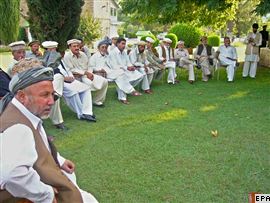
Tribal elders and government representatives attend a peace conference in Parachinar in 2008.

A peace agreement was signed before, in 2008, but it lacked government support and rival factions had one eye on possible military gains.

Under the new agreement, Islamabad is promising rehabilitation for the thousands of displaced families, and the deployment of additional troops to guard key routes.

Work Of The Haqqanis?

Skeptics abound. Pakistani pundits suggested that the deal was worked out by the Haqqanis — a large Pashtun family from Afghanistan whose elderly patriarch Jalaluddin Haqqani emerged as one of the most effective guerilla commanders in the 1980s.

His son, Sirajuddin Haqqani, now controls thousands of fighters and facilitates relations between Al-Qaeda Arabs, extremist Afghans, Pakistanis, and Central Asians out of his sanctuary in North Waziristan, which adjoins Kurram to the south. Considering the Haqqanis anti-Shi’ite bent and outsider status, any role in an agreement would be rejected by Kurram’s Shi’a.

Sajid Hussain Turi, a young lawmaker representing the region’s Shi’ite population in the Pakistani parliament, adamantly rejected any Haqqani role. “We, the Turis, have lost 1,200 people and more than 5,000 of our people were injured in this,” he said. “There is no question of involving people in this process that would ultimately harm us.”

Turi said that the weakened position of the Taliban, in disarray after years of military operations, opened the door to peace. He said that even local Sunni allies of the Taliban now see the futility of their military campaign.

Key intermediaries have high hopes for sustainable peace in Kurram. Waris Khan Afridi, a respected tribal leader from the neighboring Khyber tribal district, was among the mediators who put in countless hours bringing the two sides together.

Unforgettable Scene

On February 5, Afridi led the first civilian convoy of hundreds of vehicles to mark the break of Parachinar’s siege. He described an unforgettable scene of thousands of Sunni and Shi’ite villagers welcoming his entourage. “It was like they all were freed from prison that day,” he said.

Now, Afridi said, Pashtun tribes in neighboring tribal valleys are poised to follow the Kurram example. “We have always said that force is not a solution for anything and that the military operations will not solve our problems,” he said.

“Peace in Kurram,” Afridi said, “will positively affect all the tribal areas, the [neighboring] province of Khyber Pakhtunkhwa, and the whole country.”
Thou Shalt not Mock or It May Cost You Your Life!

By Manzer Munir for Pakistanis for Peace

In the wake of the murder of Salmaan Taseer, the Governor of Punjab a couple weeks back, I did a great deal of contemplation about the situation in Pakistan and the current state of affairs of Pakistan and indeed in much of the Muslim world.

The current situation, especially in Pakistan and when it concerns the rights of the non-Muslims, is apparently the worst of anywhere in the Muslim world. Indeed, the plight of Asia Bibi, (also known as Aasia, Ayesa Noreen) Islam and Islamic Blasphemy laws have come under rightful scrutiny as of late.

One question that tugs at the heart of the debate for me is why is it that Muslims seem to get so very offended to the point they want to KILL you over a remark or something that comes out of your mouth? As Americans, we wonder to ourselves, “Haven’t they ever heard of sticks and stones may break my bones, but words don’t hurt me?!

Sadly, what the fundamentalist preachers at all the podiums of their Friday sermon or khutbah, nor any of their brethren on the run and in caves like the Taliban and Al Qaeda fail to realize that we are all God’s children. And God, Allah, Yahweh, Jesus, or whatever name you assign him, he is One and the same God of all religions. He is too big to fit into just one religion, concept, version or story of him.

And we all are his creations. Not one of us is superior over the other in his eyes and he judges us all equally. To him, the children of these three religions and its offspring’s are all related to each other. Adam being the first man, then Eve, and then all the Biblical figures and names such as Noah, Abraham, Moses, Jesus, yes especially Jesus. He is their Messiah too!

Jesus, in fact is mentioned some 28 times in the Muslim holy book, Qu’ran whereas their own prophet Muhammad is mentioned only 4 times. And the fact that Jesus is also considered by Muslims to be the Messiah, it is sad that his followers should get such abject treatment in Pakistan and sadly, many Muslim countries.

If only the bad guys realized the connections between Christians and Jesus only then would a Pakistani Christian woman, suffering needlessly in a cell tonight going on 2 years away from her children in solitude, and constantly fearful for her life, would see her horrific ordeal come to an end.

These people are incapable of understanding basic rights, freedoms and even the unhindered concept of free will. No, they are primitive minded in their their spiritual and daily lives. They fail to see that a Christian’s God and a Muslim’s God are the one and the same. And he never would agree to laws like Pakistan’s Blasphemy laws at all. Why? Well because the Muslim God is known first and foremost as a Gracious, Merciful, Compassionate God.

In fact, the Arabic phrase Bismillah ir-Rahman ir-Rahim is a beautifully poetic phrase which offers both deep insight and brilliant inspiration to the average Muslim who says it countless times as he or she starts each day and till they rest their head to sleep. “ It has often been said that the phrase Bismillah ir-Rahman ir-Rahim contains the true essence of the entire Qur’an, as well as the true essence of all religions. Muslims often say this phrase when embarking on any significant endeavor and the phrase is considered by some to be a major pillar of Islam. This expression is so magnificent and so concise that all except one chapter of the Qur’an begins with the words Bismillah ir-Rahman ir-Rahim.”

The common translation:”In the name of God, most Gracious, most Compassionate” essentially is saying that God is compassionate, and full of grace. So how would this God punish Asia Bibi? What would he do if he is so full of compassion and mercy? Would he even punish her? And if he is such a gracious and a compassionate God, then wouldn’t he feel that nearly a two year jail sentence in solitary is already far more than her crime not to mention being away from husband and children and being worried about mob vengeance on her or the death penalty?

That God may act in a multitude of ways and we cannot ever know till said Judgment Day. That is what Judgment Day is all about after all. In fact, this is probably one day when the man upstairs works overtime judging all of us mankind, from the beginning with Adam to the last standing comes till Tribulation and the End of Days. It is only he, the Creator who will do the judging and this is something that the men with the loudspeakers who climb to the top of the minaret five times a day to call the faithful to prayers, just do not really understand, in my opinion. They apparently constantly seem to forget and pass judgment from the pulpit and this in turn helps set the “popular” opinion amongst the ultra-religious faithful of Pakistan’s society.

My only prayer to this Creator is that may he keep Asia Bibi safe tonight and continue to give her strength. And if God should call her home and have her die a death at the hands of the real savages those that not only kill but shockingly, in your name, then please Allah grant her heaven just as you should governor Salmaan Taseer, a man who was only defending the rights of all your children, including those of other faiths. He was being compassionate and gracious towards a fellow human being God, as he was only trying to emulate his creator, You Lord. Ameen.

And while you are at it Lord, will you also please let the imam at the microphone know that “Thou shall not mock, should not cost you your life.” Afterall, “Thou shall not kill is one of your top 10 commandments, whereas mocking prophets or religious figures does not make the list!

Manzer Munir, a proud Pakistani American and peace activist, is a Sufi Muslim who is also the founder of Pakistanis for Peace and blogs at www.PakistanisforPeace.com and at other websites such as www.DigitalJournal.com, www.Allvoices.com, www.Examiner.com and www.open.salon.com as a freelance journalist and writer. He asks that you like the Official Facebook Page of Pakistanis for Peace to get the latest articles as they publish here: http://www.facebook.com/home.php#!/pages/Pakistanis-for-Peace/141071882613054

Difficult Outlook for India-Pakistan Talks

By Tom Wright for The Wall Street Journal 

The Times of India reported today that India and Pakistan may try to rekindle peace talks in early February.

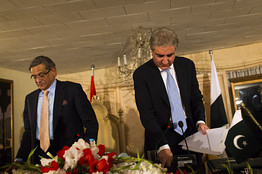
The paper says Pakistan Foreign Minister Shah Mehmood Qureshi could meet his Indian counterpart, S.M. Krishna, informally after a regional meeting in Bhutan on Feb. 8.

The report suggests that the idea is to set the ground rules for an official visit to India by Mr. Qureshi sometime later this year in a bid to normalize relations that have soured since a major terror attack in Mumbai in 2008.

Given the disastrous outcome of Mr. Krishna’s last formal visit to Pakistan – in July of last year – those ground rules will be important.

At that meeting, Mr. Qureshi became incensed during a press conference over India’s claims that Pakistan’s military intelligence services had orchestrated the Mumbai attacks in November 2008, during which 10 Pakistani gunmen killed more than 160 people over three days.

Mr. Krishna arrived back in India to criticism of being made to look a fool by Mr. Qureshi and a peace talks process begun in 2004 was put on hold amid mutual recriminations. The slow-moving (and now stalled) dialogue is an attempt to normalize relations that have been rocky ever since the two nations were created out of British India in 1947.

India has stuck to its claims of official Pakistan involvement in the Mumbai attacks and says Islamabad is not doing enough to prosecute the perpetrators and rein in India-focused militants in general.

Pakistan retorts that it is committed to fighting terrorism. It also has called on India to broaden the agenda for peace talks to include other topics, such as the disputed Himalayan territory of Kashmir, which both countries claim in its entirety.

It is uncertain whether talks at this stage can produce anything meaningful

India is set against any wider peace talks until Pakistan sentences seven militants that it has charged for involvement in the Mumbai attacks.

But the atmosphere in Pakistan right now means it is unlikely that any politician will want to be seen vigorously cracking down on Islamist groups.

The killing earlier this month of Salmaan Taseer, governor of Pakistan’s Punjab province, by one of his own police guards has uncovered the extent to which hardline religious views have permeated many layers of society.

The police guard admitted he was angered by Mr. Taseer’s defense of a Christian woman sentenced to death by a Pakistani court in November for blasphemy.

In recent days, scores of Pakistanis, including lawyers and clerics, have publicly rallied in support of the police officer.

Pakistan Army Propaganda Drama Set for TV

By Khurram hahzad for The Associated Press

Pakistan’s Taliban-fighting soldiers are set for celebrity status with the launch of a multi-million-dollar glossy television drama hailing army victories over militants.

Emotive tales of 11 “brave Pakistanis” battling an Islamist insurgency that is plaguing Pakistan and neighbouring Afghanistan, will air on the small screen in an army-funded drama that casts the anti-terror fight in a positive light.

Focused on the heroism of soldiers fighting a key air and ground offensive in the northwestern Swat valley in 2009, one tale looks at the deeds of soldier Hawaldar Naeem Asghar who died fighting an insurgent checkpoint.

Asghar, portrayed as a hardworking soldier from peasant roots, sacrifices his life to overcome Taliban dug in to a hilltop, during operations in the town of Mingora to flush militants from the picturesque valley.

Throwing grenades from his bunker without success, Asghar is depicted abandoning cover and climbing the hill, tossing more explosives on his way as bullets rain down from the rebels’ post.

The checkpoint is destroyed, but Asghar is killed.

“Hawaldar Asghar’s story is a common man’s story. It’s a message to the public that everybody can play a role in the fight against extremism,” says Sajjad Saji, one of the drama serial’s writers.

“It is filmed to encourage the common people in this war,” he adds.

Urged by its key but critical ally the United States to launch further operations in the lawless tribal areas bordering Afghanistan, the army wants to show the sacrifices it has already endured in the war on terror.

“The basic purpose is to reveal the deeds of bravery of our soldiers, officers and civilians who are at the front of this war…. This drama shows the human face of the war,” says Major General Athar Abbas, head of the army’s publicity wing.

“The nation should own these stories of bravery and sacrifice, they should be proud of our sons and daughters of the land who created these true stories with their blood and defended the motherland.”

One of the filmmakers, who would not be named, said the high-end production was a “multi-million-dollar” effort, but refused to put a precise figure on costs.

The production, peppered with special effects, was filmed amid rugged verdant hills and forests close to the Swat valley — scene of major operations by Pakistan’s military in 2009 to rid the area of rampant militancy.

“We travelled extensively to film this serial. A crew of more than 35 people with trucks of luggage roamed in the forests and hills for months to show the reality,” said Khawar Azhar, the show’s executive producer.

The former tourism hotspot of Swat slipped out of government control after a radical cleric led an uprising in July 2007, beheading opponents, burning schools and fighting to enforce a harsh brand of Islamic law.

Pakistan launched a blistering air and ground offensive in the valley after militants marched out of Swat and advanced to within 100 kilometres (60 miles) of the capital Islamabad in April 2009.

After heavy fighting that displaced an estimated two million people, the military declared the region back under army control last summer and efforts have begun to revive the local economy amid sporadic outbreaks of violence.

Television productions are one of the tools adopted by the military’s publicity wing to polish its image and boost recruitment and morale at a key juncture in anti-Taliban efforts and with religious conservatism on the rise.

Accused by US-based Human Rights Watch of carrying out collective punishments on relatives of militants since it re-established control over the Swat valley, the army knows the importance of securing local hearts and minds.

More than 4,000 people have been killed in Taliban and Al Qaeda-linked attacks since government forces launched an attack against militants in a mosque in Islamabad in 2007.

The television drama depicts the bitter divide between Pakistan’s opposing cultures as the moderate middle class fights religious extremism in a country fractured by deep regional political divided.

In other episodes the film makers show the victims of Taliban power — one girl is subject to brutal gang rape by militants, while in another a young boy is brain-washed into becoming a suicide bomber.

Islamists Rally for Pakistan’s Blasphemy Laws

By Zahid Hussain for The Washington Post

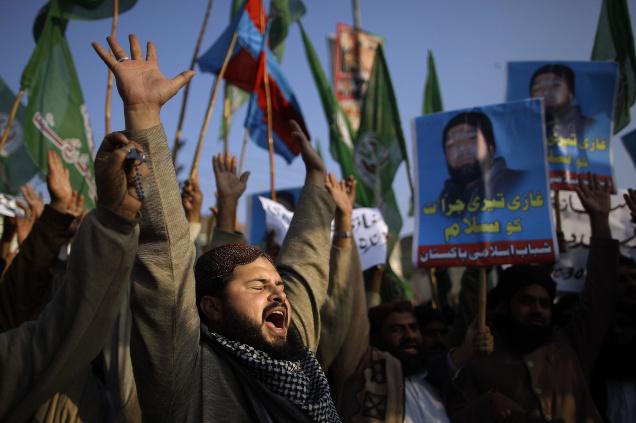
Tens of thousands of Islamists rallied Sunday in Pakistan’s southern port city of Karachi in support of the nation’s controversial blasphemy laws, and clerics threatened to kill anyone who challenged them.

Security was tightened around the house of Sherry Rehman, a former federal minister, who was threatened with death by radical clerics for moving a bill in the parliament last month to amend the blasphemy laws, which currently sentence to death anyone found guilty of insulting Islam.

The blasphemy laws have been in the spotlight since the murder last week of Salmaan Taseer, governor of Punjab province and a critic of the laws, who was shot by a member of his security detail. The shooter, Mumtaz Qadri, later said he killed Mr. Taseer because of the politician’s opposition to the laws. Mr. Taseer was a member of the Pakistan People’s Party, which runs the governing coalition, and was close to President Asif Ali Zardari.

The killing highlighted the extent to which extremist Islam has permeated Pakistan’s middle class and those close to the political elite even as the country grapples with an insurgency from the Pakistan Taliban and other violent Islamist groups. And it has deepened the polarization between moderate and radical Muslims throughout Pakistan. Radical clerics have seized the opportunity to whip up a campaign against moderate and progressive politicians, intellectuals and journalists.

Speakers at the Karachi rally sought to justify Mr. Taseer’s assassination, saying the killer fulfilled his obligation as a Muslim. “We will defend the assassin in the court,” declared Fazalur Rehman, the leader of Jamiat-e-Ulema Islam, a radical Islamic group that recently quit the coalition government after one of its ministers was sacked after publicly accusing a cabinet colleague of corruption.

The rally was organized by an alliance of hard-line Islamic groups including Jamaat-ud-Dawa, which the United Nations has said acts as a front for the outlawed terror group Lashkar-e-Taiba. Lashkar-e-Taiba is accused of masterminding the November 2008 terrorist attacks on Mumbai, which left more than 160 dead. Many demonstrators Sunday carried portraits of Mr. Qadri, who killed Mr. Taseer in a fashionable shopping district of Islamabad. Mr. Qadri has been hailed by Islamists as a great Islamic warrior.

Mr. Taseer had provoked the ire of radical clerics for publicly supporting a Christian woman who has been sentenced to death by a Pakistani court for allegedly making derogatory remarks against Islam’s prophet. The controversial laws have often been used against Christians and other non-Muslim communities, something that Ms. Rehman is seeking to prevent with a private bill she introduced last month.

A cleric of the Sultan Mosque in Karachi in his sermon on Friday called Ms. Rehman an “infidel” for suggesting changes in the blasphemy laws. A pamphlet signed by several Islamic clerics named her for supporting blasphemy. And some hard-line clerics have issued a “fatwa” demanding death to Ms. Rehman, a senior member of parliament of the Pakistan People’s Party.

Ms. Rehman said she is under pressure from the administration to leave the country until the situation calms down. “I am not going anywhere and [will] face the threat,” she said in a telephone interview.

In Pakistan, Another Assassination and the Lessons Unlearned

By Natasha Fatah for Canadian Broadcasting Corporation

The Lion of Punjab is dead. Salman Taseer, the governor of Punjab in Pakistan, was assassinated in Islamabad on Tuesday by one of his own security guards.

When the guard later turned himself in to the police, he said that he killed the man he was supposed to be protecting because he considered Taseer’s campaign against Pakistan’s blasphemy laws an insult to Prophet Muhammad.

The blasphemy laws, which have been around since the 1980s, have been at the heart of a huge religious debate in Pakistan recently after a 45-year-old Christian woman was sentenced to death, allegedly in a dispute over drinking water among farm hands.

Most human rights observers say that the woman did nothing wrong, did not break any blasphemy law, and that the law is just being used to make some kind of example out of her.

Taseer stood by the side of this Christian woman, Asia Bibi, both literally and figuratively.

He stood next to her in the courtroom, which was a brave and dangerous move for any Muslim in Pakistan, but particularly so when you are a member of government and have a profile.

He had also waged an attack on those who wanted her dead by constantly criticizing the mullahs and hard-liners on his very active Twitter account these past weeks.

In response, Islamic fundamentalist politicians and imams were constantly attacking Taseer, even going as far as to say that criticizing the blasphemy law is an act of blasphemy itself, thus making Taseer an apostate.

A member of the Pakistan People’s Party and closely tied to President Asif Ali Zardari, Taseer had dedicated his life to social and political liberalism and to taking on the fundamentalists. But now that bravery has cost him everything.

According to witnesses, the guard who killed Taseer jumped out of a car, pointed his Kalashnikov and blasted away. He then continued his rampage, shooting the governor at least nine times.

Dropping his weapon, the man then gave himself up to police, saying later he was “proud” that he killed the blasphemer.

Another disturbing aspect to this story is that the assassin had managed to get himself into the police force and then, barely four months into the job, was transferred to the unit assigned to protect the governor.

It makes you wonder who was doing the vetting and whether some other even more devious plan was afoot. But how deep and powerful this doctrine of hate must be when someone who is paid to protect you ends up being the one to take your life?

Still, while it was the guard who pulled the trigger, it was the culture of hatred, ignorance and bigotry that put the idea in his head in the first place.

And it will no doubt be the disease of apathy among the majority of Pakistan’s comfortable middle class that will ensure nothing changes, which means more good men and women who want to reform Pakistan’s society will lose their lives.

After all, it was only three years ago that the world lost Benazir Bhutto, the former prime minister and leader of the Pakistan People’s Party, for the same reasons.

She, too, was an advocate on behalf of liberalism and democracy and an enemy of religious extremists and she, too, paid for it with her life. If her death could not motivate the wealthy, powerful and influential in Pakistan to stand up and change things, then I’m not sure what will.

There is strange culture in Pakistan of blaming the victim. When Benazir Bhutto was murdered, many middle-class Pakistanis, in effect blamed her for her own assassination.

They criticized her for knowing the risks and continuing to speak out. Some said that as a mother she was being selfish for putting herself in the public eye.

And now, with Taseer’s murder, there are murmurs about him bringing this on because he provoked the Islamists through his criticism of their agenda. These are the risks you take when you stand behind a Christian blasphemer, some are saying.

It is only in an upside-down world like Pakistan’s self-absorbed middle class where those who die for being brave are considered irresponsible.

And it’s not like these moderate politicians such as Taseer don’t represent the values of the ordinary Pakistani.

Overwhelmingly, whenever given the election opportunity, the people of Pakistan vote in liberal, moderate and middle-of-the-road parties. Hardline Islamist parties do not win majorities in any of the country’s provinces.

Still, there seems to be a disconnect between what the Pakistani middle class say they want — stability and democracy — and what they are willing to work for.

Yes, in the case of Taseer, they will mourn the loss of another great leader. But Pakistan has lost far too many moderate leaders like this while everything goes on as before.

Wealthy Pakistanis will continue to go to their luxurious parties at fancy hotels, where the poor and their servants are not even allowed to enter. They will continue to justify the economic divide that keeps so many of their fellow citizens in squalor. And they will continue to argue that the Islamist militants are just a creation of the Western media.

Fortunately, there are still a handful of journalists, lawyers and politicians in Pakistan who are fighting the good fight and putting their lives on the line to try to push back against the extremists who think that violence is the only way to get their ideas across.

But unless Pakistan’s elites joins this fight, nothing will change.

For Pakistan, with the current government coalition in danger of crumbling and its Taliban launched on a terror campaign in the capital Islamabad itself, Taseer’s murder is a horrible start to a new year.

Yes, there will be vigils throughout Pakistan and around the world this week for this fallen hero. But vigils are temporary and the underlying problem that Taseer was taking on will likely still be around long after the vigils have wrapped up.

The Real Blasphemers

As Reported by Cafe Pyala

“Mera azm itna buland hai ke paraye shaulon ka dar nahin

Mujhe khauf aatish-e-gul se hai, ye kaheen chaman ko jala ne de”

[My resolve is so strong that I do not fear the flames from without

I fear only the radiance of the flowers, that it might burn my garden down] 

— Shakeel Badayuni couplet referenced by Salmaan Taseer on Twitter, 8 hours before his assassination 

I had been hoping that I could post something light-hearted, more entertaining at the start to the new year, but today’s Pakistan it seems is not the place for these sort of things any more. Four days into January and we already have yet another tragedy that has evoked not only pain and sadness but also immense amounts of disgust at the depths to which we, the unfortunate inhabitants of this blighted country, have sunk.

Punjab Governor Salmaan Taseer‘s brutal and senseless murder in Islamabad today (Tuesday) is not only an intensely heavy blow for his family and friends – to whom our thoughts go out to – but also to the hopes for a saner public discourse about issues that certain people endeavour to keep out of the conversation altogether. He often said things that many think but are unwilling to say in public out of fear or aversion to stoking argument. Whatever anyone may have thought about Taseer’s personal life (not that it’s any of anyone’s concern) or his business practices, there is absolutely no doubt that he was a brave and outspoken man who did not compromise his personal beliefs for the sake of cowardly politics. Along with barely a couple of other politicians on the national level (Sherry Rehman being one), his was a rare voice that was willing to take on the rightist mullah mindset in the public domain.

And contrary to what his detractors claimed, he did so with full awareness of the moral responsibilities of a public figure. In a recent interview, he was asked why he chose to raise the issue of the unjust blasphemy laws when he knew that he would receive brickbats from the rightist parties and become the target of the extremists. He replied: “Because if even I don’t, how will others get over their fears?” On December 31, he tweeted: “I was under huge pressure sure 2 cow down b4 rightest pressure on blasphemy.Refused. Even if I’m the last man standing”

In Salmaan Taseer’s untimely death we have all lost a truly courageous individual. Those within his party who opposed his just stand on the abhorrent misuse of blasphemy laws, moral pygmies such as Babar Awan, should hang their heads in shame.

At the same time, one must also feel disgust at those who have either valourized Taseer’s self-confessed lunatic murderer Malik Mumtaz Hussain Qadri, or used their weasely arguments to somehow try and justify the outrage. So-called-intellectuals like Irfan Siddiqui and bigots like Jamaat-e-Islami‘s oily Fareed Parachaand the ever-slimy Ansar Abbasi tried their best to claim (on Geo) that Taseer was somehow himself responsible for his fate because he had raised a “sensitive” issue.

I am not of the opinion that one should not speak ill of the dead only because he or she is dead, curse Zia ul Haq with every breath as far as I am concerned. But these gentlemen’s basic argument was this: even expressing your opinion about a warped law made by a warped dictator and endorsed by his warped proteges is enough to condemn you to death, so everyone should keep quiet about the misuse of religion and leave it all up to the mullah brigade. It’s time to tell them to shut the hell up themselves.

But the disgust does not end with a couple of morons trying to silence all discussion about religion to and other fanatics praising a criminal. The bigger issue, as we have been saying all along, is the refusal of society to see the inter-linkages of such acts of terrorism with the mindset that has been cultivated through the military establishment’s promotion of jihadi outfits, the propping up of so-called religious parties whose only agenda is bigotry, the pusillanimous and opportunistic silence over the treatment of minorities such as Ahmadis, Shias, Hindus and Christians and indeed all dissenters (religious scholar Javed Ghamdi being one), the valourization of criminals such as the illiterate Ilm Deen (dubbedshaheed [martyr] because he was hanged in 1929 for murdering a publisher), the rejection of rationality and logic, the marginalization of the arts and cultural traditions as something alien to our society, and the tolerance for hate-speech and incitements to violence such as that of this monkey.

It is this mindset, which has been cultivated by the state looking the other way at – if not directly promoting – acts of radicalization, that allows an entire police squad to see nothing wrong in one of their own planning to commit the murder of someone they are assigned to protect. (We now hear via Geo that Qadri had in fact confided to his colleagues in the Punjab ‘Elite Force’ about his plans and had even requested them not to shoot at him, a request they honoured.)

Our real disgust should be directed at all those parts of society that cannot put two and two together despite the evidence staring them in the face. We will inevitably hear a lot in the media about security lapses and administrative efficiency lapses that led to a criminal being part of a protective force (incidentally, Geo is also reporting through its sources that Qadri had been sacked from the Punjab Police’s Special Branch a few months ago because he was dubbed a ‘security risk’). But the only void that I think we really need to focus on is the one in our society’s collective brain.

So how do we deal with all this? I have heard a lot of dismay and hopelessness today and I can completely understand the feeling. For many people, this is another nail in the coffin of the idea of a viable future for Pakistan. The only option to counter this feeling of despondency, in my opinion, is to become more assertive and louder and to shame those who would stifle dissent.

The problem of course is that wishy-washy liberalism cannot fight fanaticism. Sometimes you have to fight fire with fire. Simply put, we can either shut up, resign ourselves to our fate and disconnect from this country and society or we can fight back and refuse to cede the space that the bastards want us to. Nobody ever said it would be easy.

As a start, let us declare Qadri, all those who support Qadri and murderers like him, the Khatm-e-Nabuwatmovement and its ilk as outside the pale of Islam. Let’s see how they like being referred to as blasphemers andmurtids. 

Nobody said this fight would not be dirty.

The Illiteracy of Hate

A News and Opinion Special Report by Manzer Munir for Paksitanis for Peace

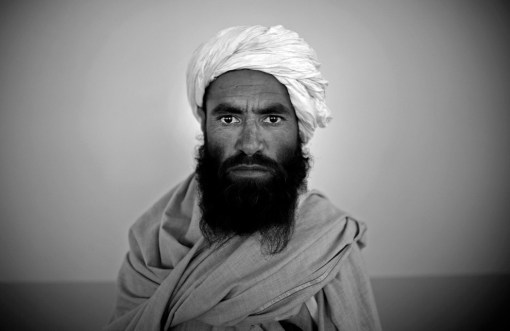
Alleged Taliban Member pic courtsey of Boston Globe

The Taliban are not just simply a bunch of illiterate thugs and bullies for they too often prove to be even worse than animals and barbarians.

Nowhere else in the world has a country experienced a more tragic and callous attack as the one on Christmas day, the birth day of Jesus, the Prince of Peace, than the one Pakistan experienced. In an attack described by President Obama as an “affront on humanity”, the cowards attacked helpless women, children and men while they queued up in food and aid distribution site such as the WFP depot, people who mind you are already suffering from the ongoing war, once in a lifetime floods, and the poverty and radicalism of a generation of desperate, hopeless and increasingly uneducated young men brainwashed by the Taliban and other radical Muslim extremists.

I am still disturbed by the disdain for basic human life that this new attack proves about this radical and extreme enemy. I imagine another one of their brain washed ‘walking zombies’, this time purportedly a woman suicide bomber, a first, even for Pakistan, killed in excess of 43 people in Bajur Pakistan at a World Food Program rations and aid storage and distribution center.

The Pakistani authorities and several domestic and foreign NGO’s who provide food aid at various centers in the area are temporarily closing these centers in order to have increased security. This means that aid distribution will come to a crawl and up to several hundred thousand people will now have to suffer at the hands of the attacker and their backers, the Taliban who have claimed responsibility. The authorities will have to ensure the safety of aid organizations and their personnel for both Pakistani and non Pakistanis relief workers involved in getting food, water and medicine to many people who are either suffering from the war or from the floods.

This catastrophe, although not of near Biblical proportions, does present both a security and humanitarian problem to both the government of Pakistan as well the suffering citizens in the northwest areas of the country where; Taliban fighters take sanctuary from the war in Afghanistan to regroup and return to the fight in warmer weather after the winter months as we have seen in years past. In fact, the reach of the Taliban in Pakistan is now not only reputed to be in the headquartered areas such as in Quetta Pakistan among the restive Baluchi population, now they are so often found to be in major cities like Karachi, Lahore, Rawalpindi, Peshawar and many points in between as they use their religious cover to endear themselves to certain impressionable, weakened or illiterate individuals that are so commonly found in throughout the country. 

Here are the some of the depressing facts. Pakistan, a nation approaching 180 million people at current estimates, perhaps only boasts to having about 60-65% of the male population at a literate level and at best, the females to be only at 40-45% of the total female population. Sadly, what this means is that 4 out of 10 Pakistani males are completely illiterate while up to as many as 6 out of 10 women are not able to read or write. Poverty breeds extremism since there is no support from any government programs or hope for any solution.

Time and time again throughout history and not just of Pakistan’s, we can see that the role of the church, synagogue or mosque in building the community is deeper than that of any government initiatives or other measures. The poverty for these young men along with the lack of jobs like for those individuals who are either very poorly paid construction site workers, household labor or servants, or beggars and sewer workers, a job sadly almost seems to have been reserved for Pakistan’s Christian community members as many can attest in Pakistan of their unfortunate and depressing state. One does not need to remind the reader of the plight of Asia Bibi (also Aasia and Ayesa), the Christian Pakistani woman who is still awaiting her fate in Pakistani courts after more than a year and a half since first being accused of a BS blasphemy charge and being in jail ever since. 

The medieval mentality of these radical extremists is not something that needs to be described as the evidence is here in this latest attack . Certainly anyone alive in any part of the world outside Pakistan and Afghanistan with eyes, TV, radio or newspaper within their reach can see plenty of near daily reminders of the carnage that many natives of these lands see, and to what they have painfully become accustomed.

 The Pakistani and Afghani Talibans have by all the various reports in newspapers and media sources over the last several years have pointed out to the fact that these groups all have too often similar goals. Not only that, these groups all share the same characteristics. The anti-Americanism, the pro-Wahaabi or Orthodox version of Islam, the need for justice for the ‘suffering of the Palestinian people’ , and the anti-colonial and often times anti western sentiment amongst these groups. The radicalization of certain Muslim groups be they Hamas and Hezbollah in the Mideast or Lashkar e taiba, or any other militant outfit operating in this part of the world as mentioned in this quote a few days before he passed, the late Richard Holbrooke of the US State department said that there are a range of militant groups such as the Afghan Taliban, the Pakistani Taliban, the Haqqani Network, Lashkar-e-Taiba, and that “an expert could add another 30.” His exact words are in quotations. 

The radical Muslim groups who take prey of the weaker, cannot think for themselves because they are scions of those abjectly illiterate segments of the society who are only educated in the madrassahs of Pakistan. This is the de facto way of educating Pakistan’s poorer children in little mosque schools which consist of nothing but Qu’ranic surahs and words of ‘wisdom’ or ‘interpretation’ by the local mullah of the said mosque/school. Most probably these children in many Pakistani madrassahs, especially the ones who live near the border areas within the NWFP or North West Frontier Province of Pakistan as this is the part of the country most affected by its close proximity to Afghanistan.

The people in this area of Pakistan, as well as their cousins in Afghanistan have been fighting one enemy or another for the better part of 100 years now. Whether to them the enemy be the British, during the height of the British Raj rule in India, or to the Soviets and the Red army and the Cold War, then in chronological order came the infighting after the Russian withdrawal as various Tajik, Afghani, Uzbek, Pakistani warlords came in to try and consolidate power to now us Americans and the Pakistanis who are our allies in this war.

Granted we do often hear that the Pakistanis can be doing more. By all accounts, the Pakistani government can do more in terms of fighting this war on terror. Numerous western reports and articles in respected dailies have alleged that small elements within both Pakistan’s Army as well as the spy agency, the ISI, have sympathizers to either the Taliban’s cause or they want to be on favorable terms with a powerful entity that most in Pakistan’s establishment believes that Pakistan will be dealing with and not a weakened Karzai once the US begins to draw down troops and end the war by 2014. If this is indeed true, then these ‘officers’ and supposed ‘leaders’ of Pakistan should realize that the colluding with the enemy, which in this case is the Taliban, is tantamount to treason, and the members of the armed forces of Pakistan as well as the intelligence community should not be assisting the enemies of all concerned: Afghanistan, Pakistan and the United States. 

Of course we must not kid ourselves and assume that only alleviating the illiteracy and poverty of the Pakistani youth will and bettering the education system of the Pakistani poor, particularly that of the refugees and residents of the northwest areas near the Afghan border. No there needs to be a study and introspection by the people of these two countries where this hatred breeds. To to get out of this darkness, the population needs be provided not only safety when delivering food aid and or medicine but aldo most importantly give them a book, a pen, and a paper. And teach them how to fish for knowledge with basic comprehension and deductive reasoning skills that can reject a radical and violent view of Islam too often manipulated by the clergy. This is the only way we can come to end this illiteracy of hate.

–Manzer Munir, is a proud and patriotic Pakistani American, an author, who plans to write a book on Pakistan, who is also a blogger and journalist, and as the Founder of Pakistanis for Peace  can be found at www.PakistanisforPeace.com, www.DigitalJournal.com ,www.Open.Salon.com, www.Examiner.com, as well at other websites as a freelance journalist and writer.

‘Attack in Pakistan Affront to Humanity’ says President Obama

As Reported by Hindustan Times from the Indo-Asian News Service

US President Barack Obama condemned a suicide bombing in Pakistan that left at least 44 people dead at a UN World Food Programme distribution point on Saturday. “Killing innocent civilians outside a World Food Programme distribution point is an affront to the people of Pakistan, and to all

humanity,” Obama said that in a statement issued from Hawaii, where he is spending Christmas with his family.
“The United States stands with the people of Pakistan in this difficult time, and will strongly support Pakistan’s efforts to ensure greater peace, security and justice for its people.”

A female suicide bomber targeted the crowd collecting food at the distribution centre in Khar. Seventy others were injured in the attack in the Bajaur tribal district, where government forces are fighting Taliban and Al Qaeda militants.

Saturday’s bombing targeted the Salarzai tribe, which has joined forces with the government against the Taliban and raised a tribal militia to drive them out of their area. The Taliban took responsibility for the attack in a message sent to various news organizations.

Sufi Islam: Reclaiming Muslim Spirituality

By Fahad Faruqui for The Huffington Post

After two bombs recently claimed dozens of innocent lives at the shrine of esteemed Sufi Ali Hajviri, fingers were pointed at the al-Qaeda-linked militants who see Sufism as the work of heretics. The New York Sufi Music Festival was brought to U.S. to showcase the spiritual dimension of Islam and the rich heritage of Pakistan, counteracting a view that Pakistan is predominantly a country known for its terror factories. Sadly, the image of militants waging war is overwhelming and hard to supersede.

Hearing Abida Parveen sing Bulleh Shah’s ecstatic poetry, which enriched the centuries-old Sufi tradition of the Indus valley, made me realize how the Islamists have stripped away spirituality from the religion and left believers with rituals, sketchy interpretations of the divine laws and fear of God’s wrath. Sufi Muslims of the subcontinent, who converted to Islam in the pre-partition era, were drawn to the Sufi path of knowledge that has been hijacked by the al-Qaeda ideology of violence.

The rapturous quality of Sufi poetry continues to fascinate me, but the very idea of loving and seeking God while listening to radical mullahs (like the clerics of Red Mosque) is deeply troubling. Prostration to God devoid of spirituality is no different from doing sit-ups. Surely, the label Sufi is not necessary. What’s important is the sentiment. It helps the cause of clarity to call those on the path “Sufis” rather than “mystics,” which will more likely conjure images of Aladdin on his flying carpet.

Islam is the fastest-growing religion but has too few religious scholars with requisite understanding to link rituals and divine laws to creative spiritual ascension. I reached a level of comfort with my faith through good guidance from prominent Muslim thinkers such as Hamza Yusuf, Faraz Rabbani and Zaid Shakir, who drink deeply of the Quran’s spring of wisdom.

Faith is ineffable; so is our search for God. Ecstatic poetry and Sufi treatises speaking of “annihilation of self” and “Oneness with the Creator” are merely tools to evoke the Sufi sentiment, which is not peculiar to Islam. Teresa of Avila’s “Libro de la Vida,” Bulleh Shah’s ecstatic poetry, Allama Iqbal’s intimate conversation with God in “Shikwa” (complaint) and Mansoor Al-Hallaj’s proclamation “Anal-Haq” (I am the Truth) are all expressions of the acquired wisdom gleaned from deep introspection.

Though unsuccessful, Iqbal tried to revive the true spirit of Islam. He was quick in identifying that the hardline mullah was a hopeless case. But the Sufis were either consumed in “other worldliness” or digressing from the core of Sufism. For Iqbal, a profound religious experience is one that benefits humanity, which is most unlikely if the seeker retreats to constant seclusion.

Saudi Arabia’s government is often accused of demolishing tombs of the companions of the prophet, fearing veneration of graves, and of discouraging Muslims from praying at prominent sites like the Cave of Hira (where Muhammed received his first revelation). Why they discourage is another column, but one thing is certain: visiting graves and sites mentioned in the Quran will not miraculously lead to divine illumination. The essence of Sufism is to dig into the depths of your soul to seek the One. In the shrines of Sufi masters in the subcontinent, one can expect to find numerous vagabonds pretending to be Sufis, who earn a living by giving false hopes to troubled wives, jobless men and childless couples. This defeats the premise of Sufism — absolute reliance on Almighty.

In a phone conversation, a prominent Sufi scholar, William Chittick, said, “The core of Sufism is to strive for nearness to God.” Even though God is absolutely Other, he presupposes a direct relationship with the seeker. No doubt. Allah says in the Quran (50:16): “I am closer to you than your jugular vein.”

It is our egos that have created boundaries between sects within Islam and ensuring rivalries with non-Muslims. Reviving the spiritual dimension of Islam may be the only way to fight intolerant radical elements internally.

Pakistan Shifted Emphasis Away From India Border, says US

As reported by The Economic Times

WASHINGTON: Pakistan was shifting its emphasis away from its eastern border with India, a decision it had taken on its own because of a “definite shift” in Islamabad’s military posture brought about by fundamental changes within the country, the US has said.

It said while it does want Islamabad to act more aggressively against extremists within Pakistan it played little role in Islamabad’s decision to move its troops away from the border with India.

“First of all, how Pakistan decides to deploy its military forces is a decision for Pakistan,” State Department spokesman P. J. Crowley told reporters Friday what role the US had played in the movement of 140,000 troops away from the Pakistani-Indian border as mentioned by Secretary of State Hillary Clinton.

“We’ve made no secret of our desire to see Pakistan take more aggressive action against extremist elements within its own borders,” he said. “That is a threat to Pakistan itself.”

“And as the Secretary said, we have seen Pakistan shift its emphasis away from the Pakistani-Indian border and more aggressively to the Swat Valley and other areas where these extremists operate.”

“And no military has suffered more significant casualties in undertaking these operations than Pakistan. But these were obviously decisions for Pakistan to make,” Crowley said.

“But the context of increasing dialogue and reducing tensions between Pakistan and India is something that we have stressed in our dialogue with both countries,” he said.

Asked if Clinton was making an announcement, Crowley said: “Yeah, we’ve seen a definite shift in the Pakistani military’s posture. (But), it wasn’t an announcement.”

“I think it was a reflection of fundamental changes that have occurred in Pakistan as part of our strategic dialogue and our cooperation on dealing with the threat on both sides of the Afghan-Pakistan border.”

Asked about India’s role in Afghanistan after the recent review of the US Af-Pak strategy, Crowley said: “Well, we do have a regional strategy. India has legitimate interest in helping with the future of Pakistan.

“It has contributed significantly to development and reconstruction projects within Afghanistan. And we encourage that activity, even as we stress the importance of dialogue between India, Pakistan, Afghanistan, other countries. So no efforts like this are misunderstood,” he said.

Obama and the Pakistan Dilemma

By Matthew Kaminski for The Wall Street Journal

Islamabad, Pakistan– America can’t win in Afghanistan as long as assorted Taliban insurgents find safe haven in Pakistan. That’s the no-brainer dressed up as revelation in leaks this week about the latest U.S. National Intelligence Estimate regarding both countries.

The proposed solution is tidy, too: Lean on Pakistan to cut links to extremists in the tribal regions along Afghanistan’s eastern border and in southern Baluchistan, even as the CIA ramps up the number of covert drone strikes on those groups.

The assumption is that Pakistan can bring the extremists to heel at its pleasure. After all, the Pakistani military began nurturing Afghan and other jihadists in the 1980s and has kept them on as “strategic assets” throughout the American long war brought about by 9/11. So, we think, if Islamabad cuts its support and makes life difficult for the jihadists, this unfortunate genie can be put back in the bottle. President Obama might even meet his self-imposed deadlines for drawing down the 98,000 American troops in Afghanistan.

This is all a useful fiction, maybe even a necessary one. American bribes, threats and pleas have prompted Pakistan into its own troop surge in the tribal regions. Over the past 18 months the Pakistanis have more than quadrupled their presence there, to 140,000, and have taken heavy casualties. Last year the Pakistani army cleared Swat Valley and South Waziristan, which had been overrun by militants.

Today’s White House review of the war, which comes a year into the Obama surge, will likely highlight such progress. The president can consider his administration’s spirited engagement with Pakistan a foreign policy success. Credit is also due to “bulldozer” diplomat Richard Holbrooke, who developed close relations with the Pakistani civilian leadership before his untimely death Monday evening.

But Pakistan hasn’t turned. The insurgents who kill American troops in Afghanistan—principally the Taliban, whose leadership is in Baluchistan, and the militants loyal to the legendary fighter Jalaluddin Haqqani in the tribal regions—operate all too freely from Pakistan. President Obama should note that, too, today.

The year ends sourly for U.S.-Pakistani military relations. American frustration with Pakistan’s army chief, Gen. Ashfaq Kayani, has grown over broken Pakistani promises and a perceived lack of urgency. Summer floods diverted Pakistani troops away from the tribal areas, but the military doesn’t have that excuse now. The Pakistanis have also denied American requests to expand drone coverage to the area around Quetta, the city in Baluchistan that is the heaquarters-in-exile of the Taliban.

Pakistani officials say that Gen. Kayani will move his forces into North Waziristan, the tribal region that hosts the Haqqani network, in his own time. Some 50,000 troops are said to be ready to go in. No one wants them to lose, but they could against Haqqani’s respected force. A U.S. official says, “We don’t want them to do it if they’re not ready, but we don’t want them to think it’s not important.”

The Pakistanis may have found a way out. Analysts here say that the military is giving Haqqani time to relocate to a neighboring tribal region, Kurram, before soldiers go in to “clear” North Waziristan. A U.S. defense official here says that he’s seen no evidence to back the claim. But in the past most insurgents have simply melted away in the face of Pakistani advances.

Haqqani also figures as a trusted ally in Islamabad’s plans for a postwar Afghanistan. Afghan President Hamid Karzai and some American officials are open to talks with the Taliban, if they bring peace in exchange for power sharing. Also, who knows, America may get fed up and pull out before it wins. With all that in mind, Pakistani leaders may protect Haqqani, their favorite “asset,” thinking he and his Taliban allies may get power in Kabul one way or another.
Instead of sending drones over Quetta, the CIA this summer was allowed to set up shop on the ground. Across Pakistan, several such “fusion cells” pair CIA operatives with officials from Pakistan’s intelligence agency, the Inter-Services Intelligence. A Pakistani official says that this takes courage, as “ISI officers are murdered for helping Americans.”

Many circles here welcome U.S. pressure on the military and state to act. Islamic extremists are putting down deep roots in society, to the consternation of educated and moderate Pakistanis. This goes well beyond the mountainous regions that are the traditional home to religious warrior tribes. The state is losing its grip on Baluchistan. The country’s largest city, Karachi, is a militant hotbed. Parts of all Pakistani provinces have been radicalized, including the most populous, Punjab. Terrorism now touches all Pakistanis.

Pakistan is becoming more like Afghanistan—only with a more advanced economy and nuclear weapons. The people who cross the porous border between them, an arbitrary line drawn up by the British in the 1890s—already consider them the same country. Pakistan’s military has yet to show that it wants to—or that it can—control the Islamist wave. Many groups have slipped their leash and look at their old patron, the ISI, with distrust.
Gen. David Petraeus, the American commander in Afghanistan, certainly has contingency plans for Pakistan that go beyond extra doses of drones or diplomacy. Putting American boots in Waziristan is an obvious idea. But, like so many options, it is unappealing. The fallout in Pakistan would be hard to predict.

So for the moment, America gets to pretend that Pakistan can do this on its own. A successful terrorist attack on the U.S. with a Pakistani return address might quickly change that.

Pakistanis for Peace Editor’s Note
– As we have noted on several occasions before, Pakistan must do a lot more to hunt down the Taliban, its leaders and other militants on its side of the border. Already the violence and acts of terrorism within Pakistan are at an all time high as noted in this article and have touched every Pakistani and every corner of the country. Not eliminating the Taliban completely only allows them to get stronger.

Pakistan needs to stop playing a double game and stop thinking of the Taliban as a strategic asset as they never were nor ever will be an asset in any way. Pakistan must eliminate the safe havens for the Taliban within its territory, otherwise the United States will be compelled to act, with or without Pakistan’s blessings, and shall be correct in doing so to prevent attacks on its homeland emanating from Pakistan based militants.

Aasia Bibi and Impurities in the Land of the Pure

By Manzer Munir for Pakistanis for Peace

The case of Aasia Noreen aka Aasia Bibi illustrates how far Pakistan has to go to secure freedoms for its religious minorities. Christians and Hindus are not the only minorities who are persecuted for their beliefs but it is also Muslim minorities such as the Ismailis, Ahmadis, and Shiites who are routinely harassed, discriminated and also killed. Sadly, it is the case of Aasia Bibi that has brought some much needed attention to Pakistan’s sad state of affairs towards the treatment of its religious minorities.

Several sections of Pakistan’s Criminal Code consist of its blasphemy laws and of all the Muslim countries of the world that have anti-blasphemy laws, Pakistan’s anti-blasphemy laws are by far the strictest. There is section 295 that forbids damaging or defiling a place of worship or a sacred object. Then there is section 295-A that “forbids outraging religious feelings.” There is also 295-B which prohibits defiling the Qu’ran and was originally punishable by life imprisonment but has since been amended to up to three years imprisonment.

No section of the blasphemy law is more controversial or harder to prove than Article 295-C, the law that Aasia Bibi is allegedly charged with having broken. In respect to prophet Muhammad, this statute states that ” Whoever by words, either spoken or written, or by visible representation, or by any imputation, innuendo, or insinuation, directly or indirectly defiles the sacred name of the Holy Prophet Muhammad shall be punished with death, or imprisonment for life and shall also be liable to a fine.”

Aasia’s case and charges against her started almost a year and a half ago when there was a quarrel over a bowl of water in a dusty village in the heart of Pakistan’s Punjab province. A group of women were working the fields in the heat of the Pakistani sun when one of them, Aasia Bibi, dipped her glass in the communal bucket of drinking water to fetch herself and others a glass of water to drink and immediately was rebuffed by the other women who claimed that the water was now unclean as it had been touched by a non-Muslim. According to witnesses, instead of quietly bowing her head and taking the indignities, Aasia’s crime was that she mounted a strong defense of her faith and remained steadfast in her demeanor that she did nothing wrong. Too often in Pakistan, the blasphemy laws are used against religious minorities to settle personal vendettas and old scores according to Pakistan’s Human Rights Watch, a watchdog group monitoring the case.

The news traveled fast in Aasia’s village of Ittan Wali, in Punjab’s Sheikhupura district that a Christian woman had insulted the prophet. The local mullah got on the mosque loudspeakers, urging the “faithful” to take action against Aasia Bibi. In sad but familiar pattern, her defense of her faith was somehow twisted into an accusation of blasphemy, according to her family and others familiar with the case. Soon as a mob gathered outside her home ready to take the law into their own hands and handing out vigilante justice, the police moved in and took her into custody. But instead of protecting her, they charged her with insulting Islam and its prophet under the blasphemy laws.

And then on Nov. 8, after suffering 18 months in prison, Aasia Bibi was sentenced to death by a district court, making her the first person to be handed the death penalty in Pakistan under the blasphemy laws. Many before her over the years have been charged, but punishment had been commuted to lesser penalties than the death sentence imposed on Aasia Bibi. No concrete evidence was ever presented against Aasia, according to Pakistan’s Human Rights Watch. Instead, the district judge relied on the testimonies of three other women, all of whom were hostile towards her.

Unfortunately this is a common insult hurled at many of Pakistan’s 2 million Christians who make up just 1.59% of the total population. Often, Christians in Pakistan are discriminated and persecuted and many times only get the lowest of the low jobs such as street sweepers, janitorial and sanitation workers. In fact, in Pakistan, the term ‘Chura‘ has become synonym with the Christian community as it relates to an unclean person akin to how the untouchables or Dalit community is seen in India. In India however, the Dalits are not subjected to arcane state blasphemy laws geared towards religious minorities as in Pakistan or are threatened with their lives at the hands of the Hindu majority.

As discussed in a couple of my previous articles, Taliban 1o1, History and Origins and Taliban 201, The Rise of the Pakistani Taliban, the Islamization of Pakistan started under the late General Zia ul Haq of Pakistan who took over the leadership of the country through a military coup in 1977 when he hung the deposed and democratically elected Prime Minister Zulfiqar Ali Bhutto. Earlier in 1973, the 1973 Constitution of Pakistan had declared that “Islam shall be the religion of the Pakistan” and had systematically begun the process of restricting the participation of religious minorities in government and politics.

Before General Zia, there were only two reported cases of blasphemy. Since the death sentence was inserted in 1986 into the Penal Code for the blasphemy laws, this number has now reached 962 — including 340 members of the Ahmadi Muslim community, 119 Christians, and 14 Hindus. A close examination of the cases reveals the blasphemy laws are often invoked to settle personal scores, or they are used by Islamist extremists as cover to persecute religious minorities, sadly with the help of the state under these laws.

General Zia began this policy of Islamization of Pakistan in conjunction with his support for the war against the Russians and assistance to the Afghan Mujahedeen as well as the building of thousands of madrassahs or religious schools across Afghanistan and Pakistan which nurtured the young men into what later became the Taliban. Many of these blasphemy laws fully came into being under his reign, although some were around since as early as more than 100 years prior when the British drew up the Indian Penal Code of 1860 which was initially an ill foreseen aim at keeping the peace among the many fractured faiths of the subcontinent. For instance, section 295-A, which “forbids outraging religious feelings”, could have been applied against a Muslim who insulted a Hindu or a Hindu who taunted a Sikh or Christian or vice versa. However under Zia, the blasphemy laws were expanded and almost exclusively applied against Muslim minorities such as the Ahmadis, Islamilis and Shiites as well as against the Christian and Hindu populations.

Recently, a religious ‘leader’ came out and has offered over $6000 to anyone who can kill Aasia Bibi while she awaits her punishment in police custody. Outrage and denunciations on this case are coming from across the world as many people are appalled at the sad state of rights for religious minorities in Pakistan. The Pope has intervened also asking for clemency for Aasia Bibi from Pakistan’s President Asif Ali Zardari. Against all manner of reason and justice, Lahore’s High Court recently issued an order on November 29, 2o1o, preventing Zardari from exercising his constitutional authority to pardon Aasia Bibi.

In a country rife with violence and chaos and one that has become synonymous with terror the world over, the case of Aasia Bibi is yet another dark stain on the country’s image around the world. The Taliban and the extremist groups ravaging Pakistan can be explained as being a violent minority and do not and should not reflect on the nation as a whole as the majority of people in Pakistan are opposed to them and their views of Islam. But the blasphemy laws, for as long as they have stayed on the books in Pakistan and in the constitution, cannot and should not be excused in any shape or form. These laws need to be repealed and the constitution needs to be amended in an emergency manner so that Aasia Bibi and other religious minority citizens of Pakistan are not subjected to cruel and subjective laws that are almost exclusively used against minorities to settle scores, personal vendettas, and instill terror in less than 3 percent of the country that is not part of the religious majority of Sunni Muslims.

There needs to be international pressure placed on Pakistan from the United Nations, the United States, Europe and others to modify the constitution immediately and to pardon this 45 year old mother of five children. It is ironic that in a country where many people sympathize with Osama’s Al Qaeda and profess to hate the west with one hand, they decry with the other why not enough western aid has came to their country when it recently saw the worst flooding in its history. Can you blame the American citizens, the Europeans or citizens of any other Christian nation from hesitating to give aid to a country that not only plays a duplicitous game when it comes to terrorists and terror havens but also treats Christians and other religious minorities in the manner as in the case of Aasia Bibi?

The name Pakistan literally translates into “The Land of the Pure”. And as a child growing up I was told that the meaning of Pakistan’s flag is this: “The green is a traditional Islamic color and the crescent moon and star are also Islamic symbols. The white stripe represents the non-Muslim minority and religious groups of Pakistan and there place in the country.” In my view, as long as the nation sanctions and tolerates these utterly unjust and biased blasphemy laws, the religious minorities of Pakistan clearly have no place in this land of the ‘pure’.

-Manzer Munir, a proud Pakistani American and peace activist, is the founder of Pakistanis for Peace and blogs at www.PakistanisforPeace.com as well at other websites as a freelance journalist and writer.

Majority of Muslims Reject Al-Qaeda

As Reported by Sandra Johnson for The Daily Mail

Muslims in many parts of the Islamic world overwhelmingly reject al Qaeda, support a large role for their faith in government and believe democracy is preferable to any other kind of political structure, according to a new survey released by Pew Research Center’s Global Attitudes Project.

The study also found falling support for suicide bombings, as well as mixed attitudes towards Hamas and Hezbollah, Islamic groups designated as terrorist organizations by Western governments but which operate extensive social services networks in parts of the Muslim world.

The survey, conducted this spring in Jordan, Lebanon, Nigeria, Indonesia, Egypt, Pakistan and Turkey, found that only in Nigeria did Muslim populations have anything approaching a favorable view of al Qaeda, with 49 percent expressing positive views and 34 percent holding an unfavorable opinion.

At least seven in 10 Muslims had unfavorable views of the group in Egypt, Turkey and Lebanon, as did lesser majorities in Jordan and Indonesia, according to the study.

But views of Hamas and Hezbollah were more mixed. Both groups got favorable ratings from a majority of Jordanian Muslims, with 60 percent supporting Hamas and 55 percent holding favorable views of Hezbollah, Pew reported.

Muslims in every nation but Turkey expressed a positive feeling about Islam’s influence in their nation’s politics. More than nine in 10 Indonesian Muslims said its influence is positive, as did more than eight in 10 Egyptian and Nigerian Muslims. In Jordan, 76 percent of Muslims approved of Islam’s influence, as did 69 percent in Pakistan and 58 percent in Lebanon.

In Turkey, 38 percent had a positive opinion of Islam’s influence in political life.

At the same time, majorities of Muslims in every country but Turkey said they were concerned about Islamic extremism in the world and their own countries.

Democracy was favored by a majority of Muslims in every country but Pakistan, although even there it received the largest share of responses. Lebanese Muslims were most favorable toward democracy, followed by those in Turkey, Jordan, Nigeria, Indonesia and Egypt.

Support for suicide bombing had also fallen by double digits since 2002 in every country except Turkey, where it was never well-received among Muslims, according to the study.

Pakistan Police Officers to be Arrested Over Death of Benazir Bhutto

By Delacn Walsh for The Guardian

A Pakistani court has ordered the arrest of two senior police officers in connection with Benazir Bhutto’s assassination, reviving hopes for a breakthrough in Pakistan’s most pressing political mystery.

An anti-terrorism court ordered the arrest of Rawalpindi’s former police chief, Saud Aziz, and his deputy Khurram Shahzad, who ordered the crime scene to be washed down less than two hours after the killing, destroying critical evidence.

“They were responsible for Bhutto’s security,” said special investigator Chaudhry Zulfiqar. “They ordered the crime scene to be hosed down despite resistance from other officials.”

A strongly-worded UN report into Bhutto’s death last April said the decision to wash the crime scene did “irreparable damage” to the subsequent investigation. Investigators speculated that Aziz had been influenced by powerful military intelligence agencies.

Aziz and Khurram, who are now retired from the police, could not be contacted today. They are due to be formally charged on 11 December along with five men already in custody.

The warrants are the latest twist in a torturously slow police investigation. Three years after Bhutto was killed in a suicide blast as she left an election rally in Rawalpindi on 27 December 2007, Pakistanis have little idea of who was behind her death.

Pervez Musharraf, who was president at the time, initially blamed Taliban leader Baitullah Mehsud, but officials from Bhutto’s party, the PPP, have said that other forces, possibly including elements of Pakistan’s powerful military, played a role in her death.

Bhutto’s widower, President Asif Zardari, has vowed to unveil her killers, but made little progress in an investigation bogged down by controversy, recrimination and conspiracy theories – one popular rumour in Pakistan has it that Zardari himself was responsible.

The three-man UN investigation into the killing, headed by Chilean diplomat Heraldo MuĂąoz, published its report last April in an effort to bring some clarity. It dismissed the allegations against Zardari and blamed Musharraf for failing to protect Bhutto, while accusing police and intelligence officials of hampering the investigation into her death.

The UN team said that Aziz stalled the investigation for two days after Bhutto’s death, deliberately prevented a postmortem on her body, and gave the order to sanitise the crime scene just 100 minutes after Bhutto’s death. As a result crucial DNA evidence was lost and investigators gathered just 23 pieces of evidence instead of the “thousands” that would be expected, MuĂąoz’s team noted.

The UN focused on the actions of Aziz, who witnesses said was “constantly talking on his mobile phone” as doctors scrambled to save Bhutto’s life in a Rawalpindi hospital.

The UN received “credible information” that the Pakistani intelligence agencies had intervened. But Aziz refused to say who he spoke with, and tried to blame the failure to carry out an autopsy on Zardari – something that was “highly improper”, the UN said. “It suggests a preconceived effort to prevent a thorough examination of Ms Bhutto’s remains.”

The strongly-worded report represented a watershed in moribund efforts to solve the mystery of Bhutto’s death – Pakistan’s greatest political trauma since the dictator General Zia-ul-Haq died in mysterious circumstances in 1988. But it fell short of identifying those behind her death, and government efforts to advance the probe has since floundered.

Bhutto’s own party has been split by divisions. Last week Zardari suspended the membership of Naheed Khan, Bhutto’s confidante, following simmering tensions that included criticism of his failure to find Bhutto’s killers. Critics have also raised questions about the role of Rehman Malik, Bhutto’s security chief and now Pakistan’s interior minister.

The main suspect in custody remains a teenager from the tribal belt accused of helping the Bhutto assassins. His case, and those of the police officers, will be heard in camera at Adiala jail outside Rawalpindi.

But the government has not probed the role of the other parties mentioned in the UN report – former president Pervez Musharraf, currently in exile in London, and the intelligence services that are considered beyond the control of the civilian authorities.